Hubspot Inc HUBS
New risk paragraphs, branching off last year
Each branch is a paragraph in Risk Factors with nothing like it in the 10-K filed Feb 12, 2025. A box jumps to the paragraph as filed, below.
Paragraphs with nothing like them in last year's 10-K
23 paragraphs in Risk Factors of the 10-K filed Feb 11, 2026 with nothing like them in the 10-K filed Feb 12, 2025. Quoted exactly. Paragraphs that were only edited are under 10-K change.
Our headcount and operations continue to grow. For example, we had 8,882 full-time employees as of December 31, 2025 and 8,246 as of December 31, 2024. To date, we have opened several international offices. This growth has placed, and will continue to place, a significant strain on our management, administrative, operational and financial infrastructure. We expect to continue to grow
technologies leveraged in our products and services may not be available on commercially reasonable terms or at all and any loss of rights to use such technologies may significantly increase our expenses or otherwise disrupt or delay the provisioning of
due diligence during the acquisition process, including data handling, cybersecurity risks and privacy violations. Generally, if an acquired business fails to meet our expectations, our operating results, business and financial condition may suffer. Acquisitions could also result in dilutive issuances of equity securities or the incurrence of debt, which could adversely affect our business, results of operations or financial condition.
•unexpected changes in regulatory requirements, taxes or trade laws, including tariffs or other trade restrictions;
•global economic uncertainty caused by global political events, including changes in trade policies, including trade wars, tariffs or other trade restrictions or the threat of such actions;
Show the other 10
•perceptions of U.S.-based companies in the regions where we operate or plan to operate;
•perceptions of regions or governments in the regions where we operate or plan to operate, resulting in negative publicity or reputational harm;
Our success and future growth depend upon the continued services of our management team, including our co-founder, Dharmesh Shah, our chief executive officer, Yamini Rangan, and other key employees in the areas of research and development,
Cyber-attacks, denial-of-service attacks, ransomware attacks, supply chain attacks, business email compromises, computer malware, viruses, wrongful intrusions, data breaches social engineering (including phishing), and other compromises are prevalent in our industry, the industries of certain of our service providers and our customers' industries. Like other companies in our industry, we and our third party vendors have in the past experienced threats and security incidents related to our data and systems, and we may in the future experience other threats, compromises, breaches, or incidents. Attempts to disrupt or gain unauthorized access to our and our third-party vendors’ information systems from malicious third parties or insider threats may incorporate widely varying and frequently changing tactics, which may be enhanced or facilitated by AI. Our internal computer systems and those of our current and any future strategic collaborators, vendors, and other contractors or consultants are vulnerable to damage from cyber-attacks, attacks enhanced or facilitated by AI, computer viruses, unauthorized access, natural disasters, cybersecurity threats, terrorism, geopolitical conflict, war and telecommunication and electrical failures. Accordingly, if our cybersecurity measures or those of our service
Recently, plaintiffs’ attorneys have initiated a wave of demand letters, claims and class action lawsuits alleging companies’ use of online trackers, such as cookies and pixels, constitutes a violation of state wiretapping laws, primarily the California Invasion of Privacy Act (“CIPA”). Plaintiffs’ attorneys have also expanded their claims and threatened claims to other privacy-related statutes that provide for private rights of action, including statutes governing text messaging and other commercial communications. So far, most of these claims have settled outside the courthouse, though a risk of costly litigation now exists for business practices that are common. We have been subject to these actions and may become subject to additional such actions in the future.
We currently use and integrate AI technologies into our business processes and services. Development, use, and deployment of these technologies could pose cybersecurity, data privacy, IT, intellectual property, regulatory, legal, operational, competitive, reputational, and other risks and challenges that could affect our business. Specifically, risks related to bias, AI hallucinations, discrimination, harmful content, misinformation, fraud, scams, targeted attacks such as model poisoning or data poisoning, surveillance, data leakage, loss of consensus reality, inequality, environmental harms, and other harms may flow from our development, use, or deployment of AI technologies. If we enable or use solutions that draw controversy due to perceived or actual negative societal impact or otherwise cause harm, we may experience brand or reputational harm, competitive harm, legal liability, and defensive costs and expenses.
A growing number of legislators and regulators are adopting laws and regulations addressing, and have focused enforcement efforts on the development and adoption of AI technologies and use of such technologies in compliance with ethical standards and societal expectations. Several states, including Colorado, California, and Texas passed laws that will take effect in 2026 to regulate various uses of AI, from making consequential decisions to requiring companies to disclose sources of training data for AI technologies, among other requirements. In addition, U.S. states and the federal government have a wide variety of measures to
The rapid evolution of AI technologies and regulatory frameworks will require the application of significant resources to design, develop, test and maintain such systems to help ensure that AI is implemented in accordance with applicable law and regulation and in a socially responsible manner and to minimize any real or perceived unintended harmful impacts. The use of certain AI technologies can also give rise to intellectual property risks, including the disclosure or compromise of our confidential information or other proprietary intellectual property through the use of agentic and generative AI tools, or the ability to assert or defend ownership rights in intellectual property created with the use of agentic and generative AI tools.
Our vendors have in turn incorporated AI tools into their offerings, and the providers of these AI tools may not meet existing or rapidly evolving regulatory or industry standards, including with respect to privacy and data security. Further, bad actors around the world use increasingly sophisticated methods, including the use of AI, to engage in illegal activities involving the theft and misuse of personal information, confidential information and intellectual property. Use of generative AI models in our internal or third-party systems may create new attack surfaces or methods for adversaries, which could impact us and our vendors. The integration of AI systems, by us or by our vendors, may increase cybersecurity risk. Any of these effects could damage our reputation, result in the loss of valuable property and information, cause us to breach applicable laws and regulations, and adversely impact our business.
Our credit facility provides our lenders with a first-priority lien against substantially all of our assets, and contains financial covenants and other restrictions on our actions, which could limit our operational flexibility and otherwise adversely affect our financial condition.
•use our accounts receivable, inventory, trademarks and most of our other assets as security in other borrowings or transactions, unless the value of the assets subject thereto does not exceed a certain threshold;
Our credit facility also requires that our Consolidated Leverage Ratio (as defined in the Revolving Credit Agreement) not exceed specified levels during periods when we do not maintain investment-grade credit ratings. Our ability to comply with these and other covenants is dependent upon several factors, some of which are beyond our control.
Our failure to comply with the covenants or payment requirements, or the occurrence of other events specified in our credit facility, could result in an event of default under the credit facility, which would give our lenders the right to terminate their commitments to provide additional loans under the credit facility and to declare all borrowings outstanding, together with accrued and unpaid interest and fees, to be immediately due and payable. In addition, we have granted our lenders first-priority liens against all of our assets as collateral. Failure to comply with the covenants or other restrictions in the credit facility could result in a default. If the debt under our credit facility was to be accelerated, we may not have sufficient cash on hand or be able to sell sufficient collateral to repay it, which would have an immediate adverse effect on our business and operating results.
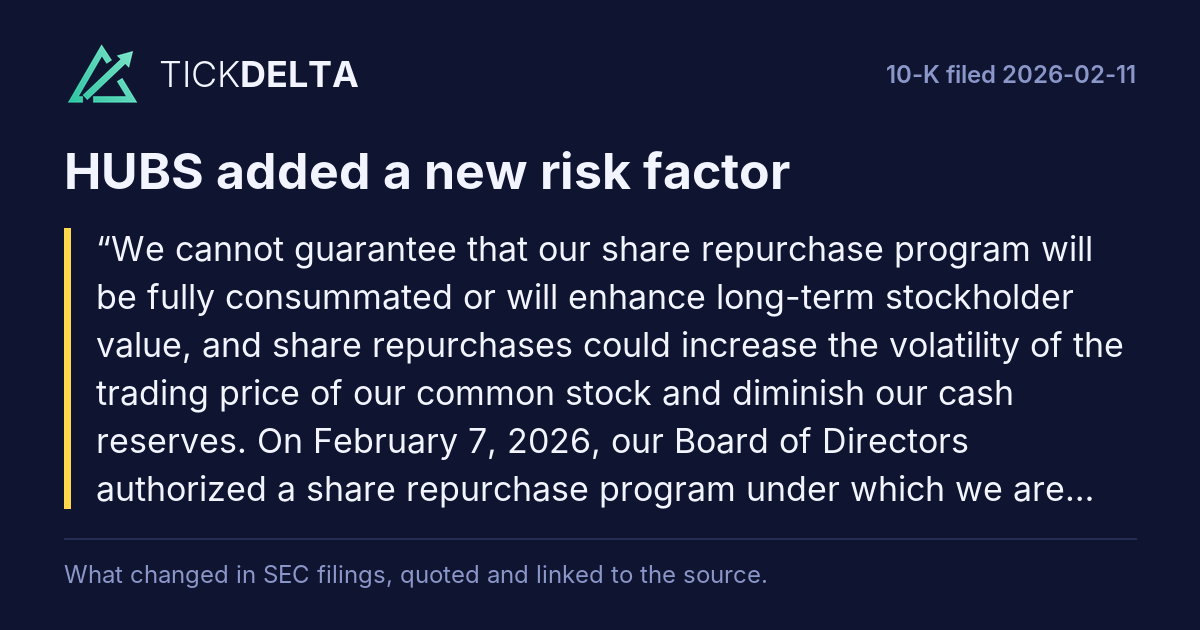
We cannot guarantee that our share repurchase program will be fully consummated or will enhance long-term stockholder value, and share repurchases could increase the volatility of the trading price of our common stock and diminish our cash reserves.
On February 7, 2026, our Board of Directors authorized a share repurchase program under which we are authorized to purchase up to $1.0 billion of our common stock from time to time (the “2026 Share Repurchase Program”). As of the date of filing of this report, a total of $1.0 billion remained available for repurchase under the share repurchase program. Repurchases under the 2026 Share Repurchase Program will be made in the open market, through privately negotiated transactions or other means, including pursuant to 10b5-1 plans, and in compliance with applicable securities laws and other requirements. The timing, manner, price, and amount of the 2026 Share Repurchase Program is subject to the discretion of our management. The 2026 Share Repurchase Program does not obligate us to acquire a specified number of shares, and may be suspended, modified, or terminated at any time, without prior
notice. There can be no assurance that we will repurchase shares at favorable prices. Further, our share repurchases could affect the trading price of our common stock, increase its volatility, reduce our cash reserves, and may be suspended or terminated at any time, which may result in a lower market valuation of our common stock.
Climate-related risks, regulatory compliance and evolving stakeholder expectations may impact our business.
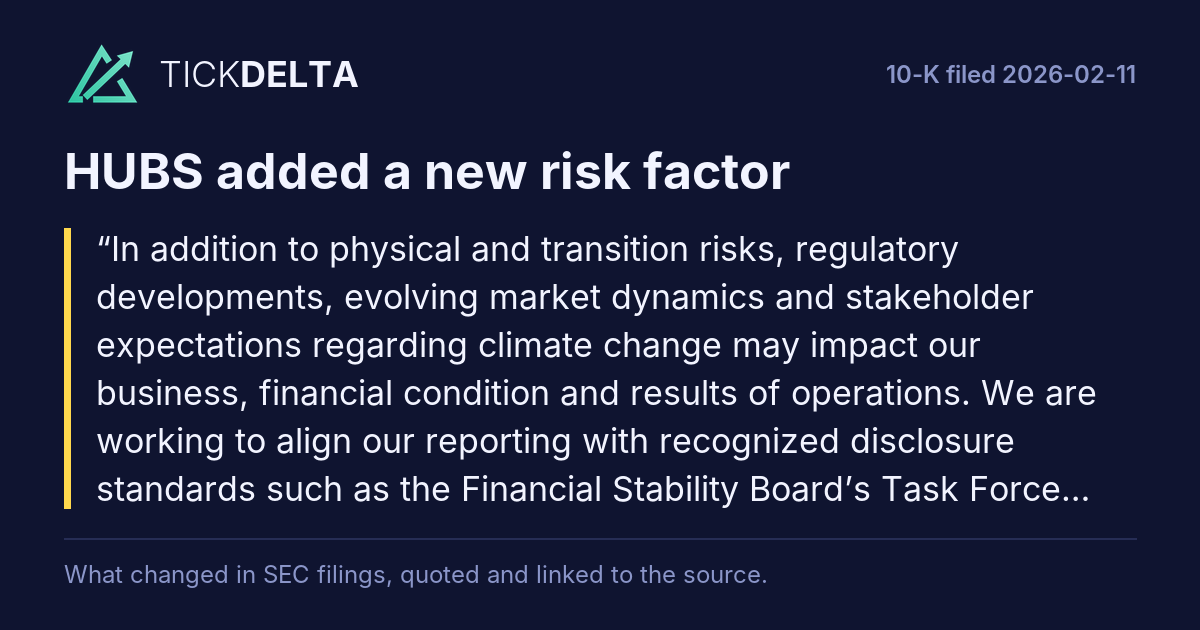
In addition to physical and transition risks, regulatory developments, evolving market dynamics and stakeholder expectations regarding climate change may impact our business, financial condition and results of operations. We are working to align our reporting with recognized disclosure standards such as the Financial Stability Board’s Task Force on Climate-Related Financial Disclosures, the Sustainability Accounting Standards Board and the Global Reporting Initiative, and we regularly monitor and prepare for new disclosure requirements that may be applicable to us (for example, the International Financial Reporting Standards S1 and S2). We may also be subject to California’s recently enacted climate disclosure laws, which will require in-scope companies to report on greenhouse gas emissions and climate-related financial risks. The future of these California laws is uncertain given pending litigation, and the California Air Resources Board, which has been tasked with implementing the climate-disclosure laws, has not yet released implementing regulations. Collecting, measuring and reporting sustainability information and metrics to comply with applicable requirements can be resource-intensive and time-consuming, requiring new systems and processes. These efforts may also expose us to operational challenges, reputational scrutiny, and legal and other risks as expectations continue to evolve.
Paragraphs in the 10-Q filed Nov 4, 2026 that were not in the one before
New in the latest 10-Q
27 paragraphs in the 10-Q filed Nov 4, 2026 with nothing like them in the 10-Q filed Aug 5, 2026 (at least half the words must differ; new numbers alone do not count). Quoted exactly, grouped by the item heading above them. This is text that changed, not a judgement of how serious it is.
10-Q
• our expectations regarding the impact of current demand and pricing headwinds, including changes in customer buying behavior for AI solutions and the recent changes we made to our product, pricing and go-to-market approach;
Read in the 10-Q
• our expectations regarding the benefits of and timing of completion of the 2026 Restructuring Plan and the expected costs and charges of the 2026 Restructuring Plan;
Read in the 10-Q
• Our 2026 Restructuring Plan and associated organizational changes may not adequately create a flatter, faster organization that delivers better customer outcomes, may not adequately drive long-term growth and profitability, may lead to additional workforce attrition, and may cause operational disruptions.
Read in the 10-Q
Financial statements and notes
ended September 30, 2026, and 2025 Changes in unrealized (loss) income on cash flow hedges, (217) 496 (1,469) 2,002
Read in the 10-Q
For certain other financial instruments, including accounts receivable, accounts payable, and other current liabilities, the carrying amounts approximate their fair value due to the relatively short maturity of these balances.
Read in the 10-Q
Show the other 22
connection with the offering of the 2025 Notes, the Company purchased capped call options (“Capped Call Options”) with respect to its common stock for $50.6 million.
Read in the 10-Q
The Company recognized interest expense of $0.9 million in the nine months ended September 30, 2025.
Read in the 10-Q
17. Subsequent Event Restructuring Plan On October 1, 2026, the Board of Directors authorized a restructuring plan (the “2026 Restructuring Plan”) that resulted in the elimination of certain roles, impacting approximately 7% of the Company’s workforce. As the Company has evolved its strategy to have a deeper focus on delivering customer outcomes, it must also change how it organizes and operates. The 2026 Restructuring Plan is designed to create a flatter, faster organization aligned to that strategy, with the resources to invest in the biggest opportunities that support the Company’s long-term growth and profitability objectives. The Company estimates that it will incur charges of approximately $65 million to $75 million in connection with the 2026 Restructuring Plan, consisting primarily of future cash expenditures related to severance, notice period, employee transition and benefits payments. The Company expects to recognize the majority of these charges in the fourth quarter of fiscal year 2026. The Company expects the role eliminations to be substantially complete by the end of the first quarter of fiscal year 2027, subject to local law and consultation requirements, and substantially all related cash payments to be made by June 30, 2027. Share Repurchase Programs Between September 30, 2026 and the date of filing this Form 10-Q, the Company purchased 0.2 million shares of its common stock under the Share Repurchase Programs at an average price of $224.46 per share, for an aggregate repurchase amount of $55.8 million. As of the date of filing this report, $964.1 million remained available for future stock repurchases under the Share Repurchase Programs.
Read in the 10-Q
Beginning in the second quarter of 2026, we have experienced headwinds to demand due to the rapid evolution of how AI is changing the way customers discover, evaluate and purchase software solutions. This shift has increased budget scrutiny from customers, including longer sales and approval cycles with larger buying committees among larger customers and greater price sensitivity and budget optimization among smaller customers. We have made deliberate changes to our product, pricing and go-to-market approach, including free trials of our AI agents and pricing tied to the value customers receive, which we believe are the right long-term decisions for our business. However, these changes have contributed to extended customer buying cycles and adversely affected our revenue growth in the near term. These demand headwinds intensified during the third quarter of 2026, and we expect these dynamics to continue to adversely affect our results of operations.
Read in the 10-Q
We monitor certain key business metrics presented in our Annual Report on Form 10-K or in our press releases announcing our financial results which are furnished on Form 8-K. We use these key business metrics to evaluate our business, measure our performance, identify trends affecting our business and results of operations, formulate financial projections and make strategic decisions. These key business metrics may be calculated in a manner different from similar key business metrics used by other companies.
Read in the 10-Q
Customers. We believe that our ability to increase our customer base is an indicator of our market penetration, the growth of our business, and our potential future business opportunities as we continue to expand our sales force and invest in marketing efforts.
Read in the 10-Q
We define our Customers at the end of a particular period as the number of business entities with one or more paid subscriptions to our customer platform, either purchased directly with us or purchased from a Solutions Partner. A single customer may have separate paid subscriptions to our customer platform, but we count these as one Customer if certain customer-provided information such as company name, URL, or email address indicate that these subscriptions are managed by the same business entity.
Read in the 10-Q
Average Subscription Revenue per Customer. We believe that our ability to increase the Average Subscription Revenue per Customer is an indicator of our ability to grow the long-term value of our existing customer relationships. We define Average Subscription Revenue per Customer during a particular period as subscription revenue from our Customers during the period divided by the average Customers during the same period.
Read in the 10-Q
Net Revenue Retention. We believe that our ability to retain and expand a customer relationship is an indicator of the stability of our revenue base and the long-term value of our Customers. Net Revenue Retention is a measure of the percentage of recurring revenue retained from Customers over a given period of time. Our Net Revenue Retention for a given period is calculated by first dividing Retained Subscription Revenue by Retention Base Revenue in the given period, calculating the weighted average of these rates using the Retention Base Revenue for the period, and then annualizing the resulting rates. A definition of each of the key terms used to calculate Net Revenue Retention is included below. Beginning in the first quarter of 2026, we revised these calculations to include the impact of commissions owed to our Solutions Partners, aligning them with revenue recognition, and updated the fixed foreign currency exchange rates used to convert these inputs into USD. Foreign currency exchange rates will be refreshed annually going forward.
Read in the 10-Q
Retained Subscription Revenue. Contractual Monthly Subscription Revenue of the same cohort of Customers as those that comprise the Retention Base Revenue at the end of the same month.
Read in the 10-Q
Retention Base Revenue. Contractual Monthly Subscription Revenue of our Customers as of the beginning of each month.
Read in the 10-Q
Contractual Monthly Subscription Revenue. The subscription fees contractually committed to be paid for a full month under our Customer agreements, including commissions owed to Solutions Partners, converted into USD at fixed rates.
Read in the 10-Q
Market risk
potential changes in the applicable margin resulting from changes to our total consolidated leverage ratio. As of September 30, 2026, there were no outstanding borrowings under the Revolving Credit Facility.
Read in the 10-Q
Risk Factors
Our current and potential competitors may have significantly more financial, technical, marketing and other resources than we have, be able to devote greater resources to the development, promotion, sale and support of their products and services, may have
Read in the 10-Q
In addition, our information technology infrastructure, operational, financial and management systems and procedures may not be able to effectively manage changes to our headcount and operations that result from the 2026 Restructuring Plan. Our 2026 Restructuring Plan will increase our short-term costs, which will make it more difficult for us to address any future revenue shortfalls by reducing expenses in the short-term. If we fail to successfully manage organizational changes in connection with the 2026 Restructuring Plan or our future growth, we will be unable to successfully execute our business plan, which could have a negative impact on our business, results of operations or financial condition.
Read in the 10-Q
Our 2026 Restructuring Plan and associated organizational changes may not adequately create a flatter, faster organization that delivers better customer outcomes, may not adequately drive long-term growth and profitability, may lead to additional workforce attrition, and may cause operational disruptions.
Read in the 10-Q
In October 2026, we began implementing our 2026 Restructuring Plan that is designed to create a flatter, faster organization aligned to that strategy, with the resources to invest in the biggest opportunities that support the Company’s long-term growth and profitability objectives. The 2026 Restructuring Plan includes a reduction of the Company’s workforce by approximately 7%. The Company estimates that it will incur charges of approximately $65.0 million to $75.0 million in connection with the 2026 Restructuring Plan, consisting primarily of future cash expenditures related to severance, notice period, employee transition and benefits payments.
Read in the 10-Q
The estimates of the charges and expenditures that we expect to incur in connection with the 2026 Restructuring Plan, and timing thereof, are subject to a number of assumptions, including local law requirements in various jurisdictions, and we may incur costs that are greater than we currently expect in connection with the 2026 Restructuring Plan.
Read in the 10-Q
The 2026 Restructuring Plan may yield unintended consequences and costs, such as the loss of institutional knowledge and expertise, employee attrition beyond our intended reduction in force, a reduction in morale among our remaining employees, greater-than-anticipated costs incurred in connection with implementing the 2026 Restructuring Plan, and the risk that we may not achieve the benefits from the 2026 Restructuring Plan to the extent or as quickly as we anticipate, all of which may have a material adverse effect on our results of operations or financial condition. These restructuring initiatives could place substantial demands on our management and employees, which could lead to the diversion of our management’s and employees’ attention from other business priorities. In addition, while certain positions have been eliminated in connection with the 2026 Restructuring Plan, certain functions necessary to our reduced operations remain, and we may be unsuccessful in distributing the duties and obligations of departed employees among our remaining employees or to external service providers, which could result in disruptions to our operations. We may also discover that the workforce reduction and other restructuring efforts will make it difficult for us to pursue new opportunities and initiatives and require us to hire qualified replacement personnel, which may require us to incur additional and unanticipated costs and expenses. Our failure to successfully accomplish any of the above activities and goals may have a material adverse impact on our business, financial condition, and results of operations.
Read in the 10-Q
Additionally, as we anticipate growing our business further outside of the United States, the effects of movements in currency exchange rates will increase as our transaction volume outside of the United States increases.
Read in the 10-Q
• changes in perceptions about the impact of evolving technologies, including AI, on our business;
Read in the 10-Q
Other information
During the three months ended September 30, 2026, none of our directors or officers (as defined in Rule 16a-1(f) of the Securities Exchange Act of 1934, as amended) adopted, terminated or modified the amount, pricing or provisions in a “Rule 10b5-1 trading arrangement” or a “non-Rule 10b5-1 trading arrangement” (each as defined in Item 408 of Regulation S-K).
Read in the 10-Q
The 10-Q's risk factors against the 10-K
Item 1A of the 10-Q filed Nov 4, 2026 against Item 1A of the 10-K filed Feb 11, 2026.
A 10-Q repeats only the risks that changed, so a 10-K paragraph that is missing from it is not counted as removed.
Added is a paragraph with nothing like it in the 10-K, Reworded a sentence that is in both with several words changed,
Quiet changes a sentence in both where one to four words changed and one is a hedge or a modal
(cut words struck through, new words highlighted).
Text on the page, not a score; each links to the filing at sec.gov.
Show the other 20
The first 25 of 48 are shown (at most 12 of each type).
Phrases used for the first time
Two-word phrases in Risk Factors of the 10-K filed Feb 11, 2026 that are in none of the 1 earlier 10-Ks stored, back to Feb 12, 2025
Where each one is used
- credit facility: Our credit facility provides our lenders with a first-priority lien against substantially all of our assets, and contains financial covenants and other restrictions on our actions, which could limit our operational flexibility and otherwise adversely affect our financial condition.
- share repurchase: We cannot guarantee that our share repurchase program will be fully consummated or will enhance long-term stockholder value, and share repurchases could increase the volatility of the trading price of our common stock and diminish our cash reserves.
- repurchase program: We cannot guarantee that our share repurchase program will be fully consummated or will enhance long-term stockholder value, and share repurchases could increase the volatility of the trading price of our common stock and diminish our cash reserves.
- trade restrictions: •unexpected changes in regulatory requirements, taxes or trade laws, including tariffs or other trade restrictions;
- trade wars: •global economic uncertainty caused by global political events, including changes in trade policies, including trade wars, tariffs or other trade restrictions or the threat of such actions;
- wars tariffs: •global economic uncertainty caused by global political events, including changes in trade policies, including trade wars, tariffs or other trade restrictions or the threat of such actions;
- consumption-based pricing: We derive, and expect to continue to derive, a substantial portion of our revenue from the sale of subscriptions to our customer platform. The market for marketing, sales, service, operations, commerce and customer management products is still evolving, and competitive dynamics may cause pricing levels to change as...
- consumption-based products: We derive, and expect to continue to derive, a substantial portion of our revenue from the sale of subscriptions to our customer platform. The market for marketing, sales, service, operations, commerce and customer management products is still evolving, and competitive dynamics may cause pricing levels to change as...
Used at least twice, small words left out. Counted, not picked: a phrase can be new because the company renamed something.
What was taken out
18 paragraphs of last year's Risk Factors with nothing like them now. The longest are quoted.
Sources
Item 1A of each 10-K and 10-Q on EDGAR, quoted exactly. Each paragraph links to the filing at sec.gov.
Also
10-K change: what was reworded or cut, section by section.
Work with it
Excel workbook · CSV. Google Sheet that stays up to date: paste =IMPORTDATA("https://tickdelta.com/company/HUBS/export.csv") into a cell.