Form S-4
Please provide disclosure of any significant crypto asset market developments material to understanding or assessing Hut 8's and USBTC's respective business, financial condition and results of operations, or share price since either company's last reporting period, including any material impact from the price volatility of crypto assets.
The Company respectfully acknowledges the Staff’s comment and has revised the section entitled “Information About Hut 8” with respect to the material impact of recent digital asset market developments to Hut 8 and the sections entitled “Information
About USBTC” and “Management’s Discussion and Analysis of Financial Condition and Results of Operations of
USBTC” with respect to the material impact of recent digital asset market developments to USBTC.Read in the reply ↗Rest of the answer
In addition, the Company has revised pages 36, 37, 38, 39, 132 and 33, 62, 63, 64, 65, 78 to include additional disclosure regarding the potential risks created by recent digital asset market developments for Hut 8 and USBTC, respectively.
You disclose that the parties intend that the Hut 8 Share Exchange occurring pursuant to the Arrangement and the Merger, together, be treated as an exchange by Hut 8 shareholders and USBTC stockholders, respectively, that qualifies under Section 351(a) of the Internal Revenue Code.Rest of the question
Since it appears that the tax consequences to the transaction are material to shareholders, please file a tax opinion as an exhibit to the registration statement. Refer to Item 601(b)(8) of Regulation S-K. For guidance, please refer to Staff Legal Bulletin No. 19, Section III.A.2.
Company acknowledges the Staff’s comment and respectfully submits that a tax opinion is not necessary under the Commission’s guidance, nor, as discussed further below, is it practical or appropriate given uncertainties as to whether the transaction will be taxable or tax-free for shareholders.
Staff
Legal Bulletin No.Read in the reply ↗Rest of the answer
19, Section III.A.2 provides that a tax opinion is generally required with respect to a merger or exchange transaction if “the registrant represents that the transaction is tax-free,” but that no opinion is generally required if “a registrant represents that an exchange offer or merger is a taxable transaction.”
The tax discussion in the Registration Statement, however, does not contain any representation by the registrant as to the tax treatment of the Merger. While the discussion does indicate that the parties intend for the transaction to be tax-free, no assurance is given to shareholders that this will be the case. The Registration Statement expressly provides that:
The Arrangement and the Merger are not conditioned on the receipt of an opinion of counsel that the Hut 8 Share Exchange occurring pursuant to the Arrangement and the Merger, together, will qualify under Section 351(a) of the Code, and there can be no assurance that such an opinion of counsel can or will be obtained. In addition, neither Hut 8 nor USBTC has requested, and neither intends to request, any ruling from the IRS as to the U.S. federal income tax consequences of the Arrangement and the Merger. Consequently, no assurance can be given that the IRS will not assert, or that a court would not sustain, a position contrary to the parties’ position that the Hut 8 Share Exchange occurring pursuant to the Arrangement and the Merger, together, qualify under Section 351(a) of the Code.
Registration Statement then provides full disclosure to shareholders of the tax consequences to them if the transaction does not qualify as tax-free under Section 351(a) of the Code:
Accordingly, if there is a final determination that the Merger is a taxable exchange for United States federal income tax purposes, then a USBTC stockholder that is a United States person that exchanges USBTC common stock in the Merger would generally recognize gain or loss for U.S. federal income tax purposes in an amount equal to the difference, if any, between (i) the fair market value (determined as of the Merger
Effective Time) of the New Hut common stock received and (ii) the holder’s adjusted tax basis in the USBTC common stock exchanged therefor.
Further, in a situation where a transaction is not conditioned on the receipt of a tax opinion, such as the Arrangement and the Merger, we believe the issuance of a tax opinion in connection with the Registration Statement, assuming a tax opinion could even be obtained on this transaction, would mislead investors as to the tax consequences of the transaction. The existence of a tax opinion would provide false assurance that the transaction will be tax-free when the Registration Statement expressly discloses to investors that the
Merger may be taxable.
This situation is different from a transaction conditioned on a reasoned tax opinion based on a less than
“will” comfort level, such as a “should” or “more likely than not” tax opinion. In those cases, the transaction only proceeds if the facts and law at the closing are such that there is a sufficient level of comfort of the tax outcome. Here, if it turns out that the facts and law as they stand immediately before the Merger Effective Time were to be such that the Merger would, without a doubt, be a taxable exchange, the Merger would nevertheless proceed.
Given the uncertainty regarding the potential tax treatment of the Merger and the lack of any gating opinion condition to the transaction proceeding, it is most appropriate to view the tax discussion in the Registration Statement as not containing any representation as to the tax consequences of the Merger.
Instead, the Registration Statement provides a full summary of the tax consequences under both scenarios (taxable and tax-free). Because the Registration Statement as currently drafted does not contain, and in fact specifically disavows, a representation as to the qualification of the Merger for tax-free treatment, the Company respectfully submits that the requirements with respect to a tax opinion as set forth in Item 601(b)(8) of Regulation S-K and Section III of Staff Legal Bulletin No. 19, do not apply to the filing.
The combined financial information does not appear to comply with the requirements for the presentation of pro forma financial information in Article 11 of Regulation S-X. Please either remove this presentation, or explain to us the purpose of the presentation and the basis for its presentation. Refer to Item 11-02(a)(12) of Regulation S-X.
Company respectfully acknowledges the Staff’s comment and has removed the presentation of the combined financial information.
Market Price of and Dividends on Common Equity
Comparative Per Share Market Price, Read in the reply ↗
Please disclose the market value of Hut 8 on an equivalent per share basis. Refer to Item 3(g) of Form S-4.
Company acknowledges the Staff’s comment and respectfully submits that since there is no public trading market for USBTC’s common stock, the Company is unable to add additional equivalent per share market value information and believes that its current disclosure on page 22 complies with Item 3(g) of Form S-4. Read in the reply ↗
To the extent material, please discuss any reputational harm that either Hut 8 or USBTC may face in light of recent disruptions in the crypto asset markets, including bankruptcies, crypto asset price volatility, and legal proceedings involving prominent crypto platforms.Rest of the question
For example, discuss how market conditions have affected how either company's business is perceived by customers, counterparties, and regulators, and whether there is a material impact on its operations or financial condition.
Company respectfully acknowledges the Staff’s comment and has revised the disclosure on pages 37, 38, 39 and 33, 62, 63, 64,
65, 78 to discuss the potential reputational risks created by the recent digital asset market developments for Hut 8 and USBTC. Read in the reply ↗
Please describe any material risks to either Hut 8's or USBTC's business from the possibility of regulatory developments related to crypto assets and crypto asset markets. Identify material pending crypto legislation or regulation and describe any material effects it may have on either company's business, financial condition, and results of operations.
acknowledges the Staff’s comment and has revised the disclosure on pages 36, 37, 38, 39 and 54, 62, 63, 64, 65, 78 to discuss the material risks to Hut 8 and USBTC’s business from the possibility of regulatory developments related to digital assets and the digital asset markets. Read in the reply ↗
Please describe any material risks that either Hut 8 or USBTC faces related to the assertion of jurisdiction by U.S. and foreign regulators and other government entities over crypto assets and crypto asset markets.
Company respectfully acknowledges the Staff’s comment and has revised the disclosure on pages 36, 37, 39 and 54, 62, 63,
64, 65, 78 to discuss the material risks that Hut 8 and USBTC face related to the assertion of jurisdiction by U.S. and foreign regulators and other government entities over digital assets and digital asset markets. Read in the reply ↗
To the extent material, please describe any gaps that either Hut 8's or USBTC's respective board or management have identified with respect to risk management processes and policies in light of current crypto asset market conditions as well as any changes they have made to address those gaps.
The Company acknowledges the
Staff’s comment and respectively advises the Staff that Hut 8’s or USBTC’s respective boards or management have not identified any gaps with respect to risk management processes and policies in light of current digital asset market conditions, and accordingly the Company has not made revisions to the Amendment with respect to this comment. Read in the reply ↗
Please describe any material financing, liquidity, or other risks that either Hut 8 or USBTC faces related to the impact that the current crypto asset market disruption has had, directly or indirectly, on: • The value of the crypto assets or miners that either company uses as collateral; or • The value of either company's crypto assets, miners or mining real estate used by others as collateral, as applicable in eachRest of the question
case.
acknowledges the Staff’s comment and has revised the disclosure on pages 38 and 33, 62, 63, 64, 65, 78 to discuss the material financing and liquidity risks for Hut 8 and USBTC. Other than broad volatility in the digital asset market, neither Hut 8 nor USBTC has experienced material financing or liquidity disruptions. Read in the reply ↗
To the extent material to either Hut 8 or USBTC, please describe any of the following risks from disruptions in the crypto asset markets: • Risk from depreciation in either company's stock price. • Risk of loss of customer demand for either company's products and services. • Financing risk, including equity and debt financing. • Risk of increased losses or impairments in either company's investments or other assets.Rest of the question
• Risks of legal proceedings and government investigations, pending or known to be threatened, in the United States or in other jurisdictions against either company or its affiliates. • Risks from price declines or price volatility of crypto assets. • Risks of increased regulation of the crypto asset industry.
acknowledges the Staff’s comment and has revised the disclosure on pages 38 and 39 to discuss potential risks applicable to
Hut 8 related to the recent digital asset market disruption and pages 33, 54, 62, 63, 64, 65 and 78 to discuss potential risks applicable to USBTC related to the recent digital asset market disruption.
Risks Related to USBTC's Business, Read in the reply ↗
Please expand on your statement on page 46 that “an adverse outcome of the Niagara Falls Litigation may affect U.S. Data Technologies Group Ltd.’s permits and operations with respect to its Niagara Falls data site.” Describe the potential practical implications of an adverse decision in the Niagara Falls Litigation, including whether the site may be required to be closed and its impact on USBTC’s businessRest of the question
performance and results of
The Company acknowledges the Staff’s comment and advises the Staff that USBTC has since entered into the Niagara Falls Settlement. The Company has revised its statements on pages 48, 150 and 151 that any potential noncompliance with the Niagara Falls Settlement may result in fines or a shutdown of the site’s operations, which would have a material adverse effect on USBTC’s business and results of operations. Read in the reply ↗
We note your references to "NYISO" and "ERCOT" on page 58 of your filing. Please ensure that all acronyms and terms are defined when first used. Refer to Rule 421(b) of the Securities Act of 1933, as amended.
Company acknowledges the Staff’s comment and has revised its disclosure on page 60 to properly define “NYISO” and “ERCOT.” Read in the reply ↗
Please tell us why you disclose that USBTC will be marking Bitcoin to fair value each quarter since this policy does not appear consistent with that disclosed on page F-31. The Business Combination, page 75
the Staff’s comment and has revised its disclosure on page 71 to align with USBTC’s policy as disclosed on page F-11. Read in the reply ↗
We note that Hut 8 and USBTC provided certain financial forecasts and projections to the financial advisors and that the financial advisors relied upon these financial projections in preparing their fairness opinions. Please disclose in this section the financial projections and forecasts provided to the financial advisors or explain why such information is not material to security holders.
the Staff’s comment and respectfully submits that each of the Company, Hut 8 and USBTC considered whether to include disclosure of the financial forecasts and projections prepared by management of Hut 8 and USBTC, respectively, and provided to the financial advisors of Hut 8 in connection with the fairness opinions such advisors rendered to the Board of Directors of Hut 8.Read in the reply ↗Rest of the answer
The Company, Hut 8, and
USBTC determined not to include such disclosure in the Registration Statement on the basis that it is not material to USBTC’s securityholders for several reasons, including:
· The projections were provided to the financial advisors in connection with the advisors' engagement by
Hut 8, and the fairness opinions were not delivered to or considered by the USBTC Board in connection with its approval of the Merger;
· The fairness opinions do not address the fairness of the consideration to be received by USBTC’s securityholders;
projections did not affect the consideration offered to USBTC securityholders or otherwise influence any other material terms of the transaction;
financial forecasts and projections prepared by Hut 8’s and USBTC’s respective management teams were not prepared for public disclosure and are inherently uncertain by their nature, and are subject to known and unknown risks, uncertainties and unpredictability, many of which are beyond the control of Hut 8 and USBTC;
·
Each of the management teams of Hut 8 and USBTC made a number of assumptions in developing such projections and forecasts, which assumptions are subjective, inherently uncertain, subject to change, and may not reflect revised prospects for either company’s business, or changes in general business or economic conditions in digital asset markets, particularly in light of significant volatility in such markets; and forecasts and projections were provided to the financial advisors in advance of the filing of the Registration Statement and forecasted information by its nature becomes subject to greater uncertainty with the passage of time.
As a result of the foregoing factors, the Company believes the projections are not material to USBTC securityholders in assessing the value of the consideration in the Merger or for any other purpose. Additionally, inclusion in the Registration Statement of the details of the forecasts and projections would overstate the relevance of these forecasts and projections, particularly given the passage of time, and potentially encourage undue reliance upon the projections by USBTC’s securityholders in making an investment decision.
Notwithstanding the Company’s view that the projections are not material to USBTC securityholders and are not required to be included in the Registration Statement, the Company has provided certain disclosure regarding the fairness opinions received by the Hut 8 Board in order to ensure consistency with Hut 8’s disclosures to be made pursuant to Canadian securities laws. As a foreign private issuer that is not subject to the proxy requirements of Regulation 14A promulgated under the Securities Exchange Act of 1934, as amended, and a Canadian reporting issuer, Hut 8 is subject to, and complies with, the Canadian proxy rules set forth principally in National Instrument
51-102 Continuous Disclosure Obligations (“NI 51-102”) of the Canadian Securities Administrators. Given that the contents of the prospectus included in the Registration Statement will also form part of a management information circular of Hut 8 under NI 51-102
(the “Canadian Circular”), the disclosures relating to fairness opinions delivered by Hut 8’s financial advisors have been prepared in compliance with Canadian proxy solicitation requirements, which do not require Hut 8 to disclose the type of financial forecast and information requested. The Company believes there should be equal disclosure regarding the fairness opinions received by the Hut 8 Board in both the Canadian Circular and the Registration Statement so as not to disadvantage or confuse securityholders, and, given it does not believe the requested financial forecast and projection information is material to USBTC’s securityholders, respectfully submits that such information should not be disclosed in the Registration Statement.
Please revise to quantify the fees Hut 8 paid to Stifel GMP when it rendered its fairness opinion. Also please quantify the fees payable to Stifel GMP contingent on completion of the Business Combination or an alternative transaction. Refer to Item 4(b) of Form S-4 and Item 1015(b)(4) of Regulation M-A.
Company respectfully acknowledges the Staff’s comment and has revised the disclosure on page 87 to quantity the fees Hut 8 paid to Stifel GMP for its fairness opinion and on page 87 to quantify the fees payable to Stifel GMP contingent on completion of the Business Combination. Read in the reply ↗
Please tell us about the pertinent facts and circumstances you considered in determining the acquirer in the business combination. Refer to ASC 805-10, including ASC 805-1055-12. Further, you disclose that the preliminary assessment of the accounting acquirer is subject to evaluation and may be impacted by matters such as New Hut board rights related to tie-break votes and the relative fair values of USBTC and Hut 8Rest of the question
at closing. Include a discussion of these matters in your response.
Company acknowledges the Staff’s comment and respectfully submits that the Company relied on the following pertinent facts and circumstances when assessing who should be identified as the acquirer for accounting purposes in accordance with ASC 805-10-55-12:
A. The relative voting rights in the combined entity.
Upon completion of the Business Combination, Hut 8 shareholders and USBTC stockholders will each own, as a group, approximately 50% of the common stock of the Company, in each case on a fully-diluted in-the-money basis.
B.Read in the reply ↗Rest of the answer
The existence of a large minority voting interest in the combined entity.
There is no individual shareholder or group of shareholders from either Hut 8 or USBTC that will represent a large minority voting interest of the Company.
C. The composition of the governing body of the combined entity.
Upon completion of the Business Combination, New Hut’s Board of Directors will consist of five directors selected by Hut 8 and five directors selected by USBTC. Bill Tai, current Chairman of the
Hut 8 Board, will be appointed as the non-executive chairman of the Company’s board. There is currently no individual director who holds a casting vote in the event of a “tie.” This results in equal number of directors of the combined entity from Hut 8 and USBTC, respectively.
D. The composition of the senior management of the combined entity.
completion of the Business Combination, Jaime Leverton will serve as Chief Executive Officer, Asher Genoot will serve as President,
Michael Ho will serve as Chief Strategy Officer, and Shenif Visram will serve as Chief Financial Officer of the Company.
E. The terms of the exchange of equity interests.
When assessing the terms of the exchange of equity interests in the Business Combination, the acquirer is typically the entity that paid a premium over the pre-combination fair value of the equity interests in the other entities. Consideration transferred is generally measured at fair value. Consideration transferred is the sum of the acquisition-date fair values of the assets transferred, the liabilities incurred by the acquirer to the former owners of the acquiree and the equity interests issued by the acquirer to the former owners of the acquiree (except for the measurement of share-based payment awards).
As at March 31, 2023, Hut 8’s closing share price on Nasdaq was US$1.85, with approximately 221 million shares outstanding. This results in an equity value of approximately US$408.85 million for Hut 8. Hut 8’s financial advisors have issued fairness opinions in connection with the transaction supporting the view that USBTC and Hut 8 at closing have relatively equal values.
F. The relative size of the entities.
relative size between Hut 8 and USBTC is as follows:
USBTC as at and for the 6-month period ended December 31, 2022 (in
USD)
Hut
8 as at and for the 6-month ended
December 31, 2022 (CAD converted to
USD @ 0.7383)
Total assets
~$274 million
~$268 million
Total revenue
~$46 million
~$40.5 million
Net loss
~$81.3 million
~$153.7 million
# of full time headcount
(as at March 31, 2023)
~113
~92
G. Which entity initiated the business combination.
Stifel GMP introduced representatives from both Hut 8 and USBTC for discussions on a potential business combination. As such, neither Hut 8 nor USBTC was considered as the entity initiating the business combination.
H. The combined entity name, location of headquarters and ticker symbol.
The Company will conduct business under the name Hut 8 Corp. and will apply for and maintain a listing of its common stock on Nasdaq and the TSX under the trading symbol “HUT.”
USBTC is not currently public and therefore does not have a trading symbol. The Company is incorporated in Delaware and will have U.S.
headquarters. The majority of the combined company’s digital asset mining sites and energy capacity will be located in the United
States.
Based on the facts and circumstances above, the Company is of the view that no one indicator is clearly determinative. However, the more significant operational footprint being in the United States, the incorporation in Delaware, and the use of U.S. headquarters were utilized as the persuading factors. Thus, management of Hut 8 and USBTC collectively determined that USBTC is the accounting acquirer and prepared the pro forma financial statements and the “anticipated accounting for the transaction” on that basis in the Registration Statement. The description of the anticipated accounting on page 99 highlights the judgmental nature of the conclusion and the possibility that it could change based on changes in the assessments above.
We note your disclosure that certain conditions to the consummation of the business combination may be waived by mutual consent of the Parties. Please specify which, if any, conditions may not be waived by mutual consent of the Parties.
acknowledges the Staff’s comment and has revised the disclosure on pages 118, 119 and 120 to discuss which conditions, if any, may not be waived by mutual consent of the parties. Read in the reply ↗
To the extent material, please discuss how the bankruptcies of companies in crypto assetrelated businesses and the downstream effects of those bankruptcies have impacted or may impact Hut 8's business, financial condition, customers, and counterparties, either directly or indirectly.Rest of the question
Clarify whether Hut 8 has material assets that may not be recovered due to the bankruptcies or may otherwise be lost or misappropriated.
Company respectfully acknowledges the Staff’s comment and has revised the disclosure on pages 38, 39 and 132 to discuss the impact of recent bankruptcies in the crypto asset market on Hut 8. Read in the reply ↗
To the extent material to an understanding of Hut 8's business, please describe any direct or indirect exposures to other counterparties, customers, custodians, or other participants in crypto asset markets known to: • Have filed for bankruptcy, been decreed insolvent or bankrupt, made any assignment for the benefit of creditors, or have had a receiver appointed for them.Rest of the question
• Have experienced excessive redemptions or suspended redemptions or withdrawals of crypto assets. • Have the crypto assets of their customers unaccounted for. • Have experienced material corporate compliance failures.
acknowledges the Staff’s comment and has revised the disclosure on page 132 to discuss the direct and indirect exposure
Hut 8 has to certain counterparties, customers, custodians or other participants in the crypto asset market. Read in the reply ↗
To the extent material, please explain whether Hut 8's crypto assets serve as collateral for any loan, margin, rehypothecation, or other similar activities to which Hut 8 or its affiliates are a party. If so, identify and quantify the crypto assets used in these financing arrangements and disclose the nature of Hut 8's relationship for loans with parties other than third-parties.Rest of the question
State whether there are any encumbrances on the collateral. Discuss whether the current crypto asset market disruption has affected the value of the underlying collateral. Please include similar disclosure for Hut 8's miners used as collateral.
acknowledges the Staff’s comment and has revised the disclosure on page 132 to discuss the use of Hut 8’s digital assets as collateral. Hut 8 is not currently using any Bitcoin or digital assets as collateral for any loan, margin, rehypothecation or other similar activities. Read in the reply ↗
Please revise to address the following: • Discuss Hut 8's intentions to mine, invest in or transact in crypto assets other than Bitcoin and update this disclosure in future filings as appropriate; • Describe Hut 8's process, if any, for analyzing whether a particular crypto asset that it intends to mine, invest in, or transact in is a "security" within the meaning of Section 2(a)(1) of the Securities Act, includingRest of the question
whether and how the recent completion of Ethereum's transition to Proof-of-Stake consensus has impacted its analysis. Disclose that this is a risk-based judgment and does not constitute a legal determination binding on regulators or the courts; and • Expand the risk factors section to describe the specific potential consequences to Hut 8 and to investors if it is subsequently determined that Hut 8 has participated in the unregistered issuance or distribution of securities, including the specific risks inherent in its business model that may necessitate corrective measures as a result of judicial or regulatory actions.
Company respectfully acknowledges the Staff’s comment and has revised the disclosure on pages 36, 129 and 130 to discuss Hut
8’s intentions to mine, invest in, or transact in additional digital assets. Read in the reply ↗
Refer to your disclosure in your Annual Information Form, which has been filed as Exhibit 99.1 to Hut 8's Annual Report on Form 40-F for the year ended December 31, 2021 and revise to address the following points: • On page 11, you disclose that Hut 8 provides cloud services and data centre colocation services to its customers.Rest of the question
Please revise to briefly discuss Hut 8's fee structure for providing such services to its customers and include illustrative examples, as appropriate. • On page 12, you disclose that Hut 8 has entered into agreements with each of ATCO Electric Ltd., City of Medicine Hat and Validus for the provision of power or use of electricity. Please revise to describe in greater detail the material terms and conditions of these agreements, including, without limitation, the material obligations of the parties, the duration of the agreement and the material termination provisions. • On page 13, you state that the primary seasonality that Hut 8 experiences is related to potential changes in electricity prices and that electricity is your largest expense. Please revise to provide a discussion of your average cost of electricity for the periods presented, and whether there are any known trends regarding the fluctuations in the cost of electricity. In addition, consider including a discussion of the differences in the cost of electricity for each of the geographic regions you operate. • On page 16, we note the statements in the bottom risk factor that the Commission's views regarding whether a particular crypto asset falls within the definition of a “security” under the U.S. federal securities laws have "evolved over time and it is difficult to predict the direction or timing of any continuing evolution. It is also possible that a change in the governing administration or the appointment of new SEC commissioners could substantially impact the views of the SEC and its staff." Please remove these statements as the legal tests are well-established by U.S. Supreme Court case law and the Commission and staff have issued reports, orders, and statements that provide guidance on when a crypto asset may be a security for purposes of the U.S. federal securities laws.
Company respectfully acknowledges the Staff’s comment and has revised the disclosure on: pages 130 and 131 to discuss Hut
8’s fee structure for its cloud and data centre colocation services; pages 131 and 132 to discuss Hut 8’s power purchase agreements; page 132 to discuss Hut 8’s electricity pricing; and pages 36 and 37 to remove the statements regarding whether a crypto asset falls within the definition of a “security” under U.S. federal securities Read in the reply ↗
Please revise this section of your filing to address comments 18 through 20 above as they apply to your disclosure concerning USBTC.
Company respectfully acknowledges the Staff’s comment. With respect to comments 18 and 19, the Company has revised the disclosure on pages 63, 64, 81, 142, 143, 149 and 153 to discuss the impact of certain crypto asset companies on USBTC. With respect to comment 20 and its applicability to USBTC, the Company has revised its disclosure on pages 144, 145, 155 and 169 to quantify the number of encumbered miners serving as collateral under USBTC’s debt obligations and further identified that the
Alpha Site and all its property and assets act as additional collateral.Read in the reply ↗Rest of the answer
The current digital asset market disruption has resulted in
USBTC taking an impairment charge on the value of its underlying collateral during the six months ended December 31, 2022, which is discussed and disclosed on pages 169, 171 and F-18.
Please discuss USBTC's intentions to mine, invest in or transact in crypto assets other than Bitcoin and update this disclosure in future filings as appropriate.
Company respectfully acknowledges the Staff’s comment and has revised the disclosure on page 138 to discuss that USBTC does not currently intend to mine, invest in or transact in digital assets other than Bitcoin. Read in the reply ↗
You disclose that USBTC owns a 50% interest in the King Mountain JV with a "leading North American energy company." Please identify your joint venture partner.
Company respectfully acknowledges the Staff’s comment and has revised the disclosure on pages 2, 7, 138 and 152 to identify USBTC’s joint venture partner. Read in the reply ↗
We note your disclosure regarding Reactor, “an advanced, algorithmic energy curtailment platform that USBTC believes will drive significant Bitcoin mining profitability for USBTC.” Please provide further detail regarding Reactor, its development, its role in USBTC’s current operations and any measurable changes in energy efficiency, profitability or any other relevant metrics that may drive USBTC’s results ofRest of the question
operations. Custody Policy, page 132
Company respectfully acknowledges the Staff’s comment and has revised the disclosure on page 139 to provide additional detail regarding Reactor. Read in the reply ↗
Please revise this section to address the following: • Provide quantified disclosure regarding the respective portions of USBTC's Bitcoin balance held by each of the third-party custodians referenced. • Disclose the material terms of USBTC's arrangement with each third-party custodian, including, for example, in what manner the relevant custodian is required to store USBTC's crypto assets, whether it isRest of the question
contractually required to hold USBTC's crypto assets in cold storage, what security precautions the custodian is required to undertake, what inspection rights USBTC has, and what type of insurance, if any, the custodian is required to have to protect USBTC from loss. Also please apply this comment to the same or similar disclosures of Hut 8 throughout the filing, as applicable.
acknowledges the Staff’s comment and has revised the disclosure on pages 133 and 134 to discuss Hut 8’s use of third-party custodians and on page 142 to disclose the respective quantity of USBTC’s Bitcoin held by each of USBTC’s third-party custodians and to also disclose the material terms of the arrangements with such custodians. Read in the reply ↗
You disclose that USBTC uses third-party custody solutions to safeguard its bitcoin and "does not currently hold any bitcoin for third parties." Please disclose whether USBTC has any current plans or intentions to hold any crypto assets for third parties in the future. King Mountain JV, page 133
Company acknowledges the Staff’s comment and has revised the disclosure on page 142 to disclose that USBTC does not currently intend to hold any digital assets for third parties in the future. Read in the reply ↗
Please disclose the material terms of the King Mountain JV Senior Note, including repayment terms, principal events of default, and any security interests that the lenders may hold. Please clarify the nature of USBTC's assumption of the note, including whether the JV partner has also assumed the note.
Company respectfully acknowledges the Staff’s comment and has revised the disclosure on pages 143, 144, 153, 154 and 175 to describe the material terms of the King Mountain JV Senior Note. Read in the reply ↗
We note your disclosure that the Refinanced Loan Agreement with Anchorage Lending CA, LLC is “repaid through profits generated from those certain USBTC miners underlying the security interest, as further specified in the Refinanced Loan Agreement…USBTC is not required to make a minimum monthly payment.” Please provide further disclosure regarding USBTC’s repayment obligations, including how profit from the relevantRest of the question
miners is determined, what would occur in the event that the relevant miners were rendered inoperative or generated lower profit than expected, what would constitute a payment default under the agreement and other relevant terms. Cost of Electricity, page 145
Company respectfully acknowledges the Staff’s comment and has revised the disclosure on pages 144, 145 and 155 to provide further detail regarding USBTC’s repayment obligations with respect to the Refinanced Loan Agreement with
Anchorage. Read in the reply ↗
On page 146, if material, please disclose the amount of demand response payments netted within your costs of electricity for each period. If not material, separately tell us the amounts netted for each period.
Company respectfully acknowledges the Staff’s comment and has revised the disclosure on pages 156 and 157 to disclose the amount of demand response payments for the applicable periods. Read in the reply ↗
Please disclose the steps you are taking to address and/or mitigate the impacts of halving, as well as the potential impact of decreased rewards on revenues and economics of your business model.
Company respectfully acknowledges the Staff’s comment and has revised the disclosure on pages 155 and 156 to disclose the steps USBTC is taking to address the potential impacts of halving.
Key Operating and Financial Indicators, Read in the reply ↗
We note the trends and key factors affecting your performance discussed on page 145. Please include in the table on page 146 quantification of your key indicators for the network hash rate and difficulty, and the number of miners for each period presented to provide context and support trends in your key operating and financial indicators.Rest of the question
If material, also disclose the number of miners that were non-operational in those periods.
Company respectfully acknowledges the Staff’s comment and has revised the table on page 157 to include network hash rate, difficulty and the number of miners for each period.
Company respectfully advises the Staff that USBTC management does not track the number of miners in the network as USBTC believes that it is not material given (i) network hash rate and difficulty, which are widely used data points in the industry, are sufficient indicators for the size and competitiveness of the Bitcoin network and provide investors with key performance indicators comparable across the industry andRead in the reply ↗Rest of the answer
(ii) a calculation of this metric may not be accurate. The Company respectfully advises the Staff that any estimate of the number of miners in the network would have to take into account every single model type and their unique hash rate profile, which is extremely difficult to predict and not feasible to produce. For the foregoing reasons, the Company respectfully advises the Staff that the disclosure has not been revised to include this metric.
Please balance your tabular disclosure and following narrative disclosures to include, with equal or greater prominence, the most comparable GAAP measure to Adjusted EBITDA. See Item 10(e)(1)(i)(A) of Regulation S-K and Question 102.10(a) of the Compliance and Disclosure Interpretations on Non-GAAP Financial Measures.
acknowledges the Staff’s comment and has revised the disclosure on page 157 to clarify that Adjusted EBITDA is a non-GAAP figure and cite the applicable reconciliation to its most comparable GAAP measure. Read in the reply ↗
Please revise to include a breakeven analysis for USBTC’s mining operations or any other crypto assets that it earns or mines that compares the cost to earn or mine one crypto asset with the value of the crypto asset. Please provide a discussion of how USBTC expects the Business Combination to impact its breakeven analysis in the future.Rest of the question
Also please apply this comment to the same or similar disclosures of Hut 8 throughout the filing, as applicable.
Company respectfully acknowledges the Staff’s comment and has revised the disclosure on page 130 to discuss Hut 8’s breakeven analysis and on page 157 to discuss USBTC’s breakeven analysis. Read in the reply ↗
Please revise your disclosure to provide the qualitative and quantitative information necessary to understand the estimation uncertainty and the impact the critical accounting estimates have had or are reasonably likely to have on your financial condition or results of operations to the extent the information is material and reasonably available.Rest of the question
In your revised disclosure discuss why each critical accounting estimate is subject to uncertainty and, to the extent the information is material and reasonably available, how much each estimate and/or assumption has changed over a relevant period, and the sensitivity of the reported amount to the methods, assumptions and estimates underlying its calculation. See Item 303(b)(3) of Regulation S-K and Instruction 3 to Item 303(b).
Company respectfully acknowledges the Staff’s comment and has revised the disclosure starting on page 163 to revise the critical accounting policies and estimates. Read in the reply ↗
Please expand your disclosure regarding USBTC's arrangements with mining pool operators to address the following: • Provide more detailed disclosure regarding each mining pool, including how each pool operates, the transaction fees paid and the amount of reward received from each pool. • Disclose the material terms of any service agreements with such providers, including the term and termination provisions thereof.Rest of the question
• Clarify how USBTC calculates or verifies its proportion of the contributed computing power resulting in the amount of cryptocurrency awarded.
acknowledges the Staff’s comment and has revised the disclosure on pages 129 and 130 to discuss Hut 8’s participation in mining pools and on pages 161 and 162 to discuss USBTC’s participation in mining pools. In addition, the Company has revised the disclosure on page 139 to clarify how USBTC calculates or verifies its proportion of the contributed computing power resulting in the amount of Bitcoin awarded. Read in the reply ↗
Please briefly discuss whether USBTC's business strategy is to hold its crypto assets for investment or convert them into fiat currency immediately upon receipt or soon thereafter. Discuss the average period between receipt of USBTC's crypto assets and the subsequent conversion into fiat currency and quantify the fees incurred.Rest of the question
Please revise to disclose whether USBTC has a specific policy for how it will determine when to sell crypto assets for fiat currency to fund operations or growth and through what exchange or if USBTC intends to hold its mining rewards for investment purposes. To the extent USBTC has an agreement with a third-party exchange for converting crypto assets to fiat currency, please disclose the material terms and file the agreement as an exhibit or tell us why this is not required by Item 601(b)(10) of Regulation S-K. Also please apply this comment to the same or similar disclosures of Hut 8 throughout the filing, as applicable.
The Company respectfully acknowledges the Staff’s comment and has revised the disclosure on page 130 to discuss Hut 8’s strategy regarding holding digital assets and on page 161 to discuss USBTC’s strategy regarding holding digital assets. With respect to the Staff’s comment regarding an agreement with a third-party exchange for converting digital assets to fiat currency, USBTC does not have an agreement with any such exchange for the sole purpose of converting digital assets to fiat currency.Read in the reply ↗Rest of the answer
USBTC has entered into Coinbase’s customary prime-broker agreement to allow it to hold and trade its Bitcoin on the Coinbase exchange. This agreement is customary in the industry and does not contain any USBTC-specific provisions and is required to be entered into in the ordinary course of USBTC’s business. USBTC is also able to sell its digital assets through other exchanges, meaning the agreement with Coinbase can be easily replaced. As a result, the
Company respectfully advises the Staff that it does intend to file the agreement as an Exhibit to the Amendment as the agreement has been entered into in the ordinary course and is not required to be filed under Item 601(b)(10) of Regulation S-K.
Hut 8 through Hut 8 Holdings
Inc. entered into a digital asset execution agreement with NYDIG Execution LLC pursuant to which Hut 8 Holdings Inc. may instruct NYDIG
Execution LLC to execute or arrange for the execution of certain Bitcoin transactions, including the sale of Hut 8’s Bitcoin in exchange for fiat currency. This agreement is customary in the industry and does not contain Hut 8-specific provisions and is required to be entered into in the ordinary course of Hut 8’s business. Hut 8 is also able to sell its digital assets through other exchanges, meaning the agreement with NYDIG Execution LLC can be easily replaced. As a result, the Company respectfully advises the Staff that it does not intend to file the agreement as an Exhibit to the Amendment as the agreement have been entered into in the ordinary course and is not required to be filed under Item 601(b)(10) of Regulation S-K.
Please provide us your analysis supporting the decline in the fair value of USBTC common stock from $4.34 per share in March 2022 to $0.01 per share in August 2022. In your response also tell us why the exercise price of the options granted in August 2022 was reduced from the March 2022 exercise price of $4.34 per share to only $1.78 per share if the fair value of common stock at that time was $0.01 per share.Rest of the question
Results of Operations, page 153
Company acknowledges the Staff’s comment and USBTC respectfully advises the Staff that its analysis of the decline in the fair value is based on an independent report from a third-party valuation consultant, Economics Partners. The consultant recognized that
USBTC raised its Series B-1 Preferred financing round relatively recently, with most commitments agreed to as of
November 30, 2021.Read in the reply ↗Rest of the answer
Since that time, equity valuations for the guideline public companies had declined between 80% - 90%,
USBTC's debt balance had continued to increase, and USBTC had underperformed relative to its expectations. Given all of these changes since the financing round, USBTC's management determined, along with assistance from a third party, that it should decrease the fair value assessment of USBTC common stock from $4.34 per share in March 2022 to $0.01 per share in
August 2022.
acknowledges the Staff’s comment on the exercise price of the options and respectfully advises the Staff the exercise price for these grants were based upon the fair market value associated with a preliminary 409(A) valuation report provided to the USBTC Board.
The subsequent final 409(A) valuation report included the lower fair market valuation, and at that time, the USBTC Board decided not to change the original exercise prices.
Please discuss, including quantitatively where possible, all known trends or uncertainties that have had, or that you reasonably expect will have, a material favorable or unfavorable impact on revenue or results of operations. We note by way of example that USBTC is currently subject to the Niagara Falls Litigation (page 46).Rest of the question
The year ended June 30, 2022 compared to the period from December 4, 2020 (inception) through June 30, 2021, page 156
Company acknowledges the Staff’s comment and USBTC respectfully advises the Staff that it believes all trends or uncertainties material to USBTC have been disclosed.
With respect to the Niagara
Falls Litigation, USBTC has since entered into the Niagara Falls Settlement. As a result, USBTC has omitted any discussion of the Niagara
Falls Litigation from its results of operation section.
The year ended June 30, 2022 compared to the period from December 4, 2020 (inception) through June 30, 2021, page 156 Read in the reply ↗
It appears that the $3.8 million of payments to your officers disclosed in the last two paragraphs on page 162 may be included in the $5.3 million of cash payments to certain employees and advisors included in your one time cost non-GAAP adjustment. Please confirm whether this is true or not.Rest of the question
Regardless, tell us how cash payments to current employees do not represent normal cash operating expenses similar to other cash compensation paid to your employees that should not be removed from non-GAAP performance measures under Question 100.01 of the Compliance and Disclosure Interpretations on Non-GAAP Financial Measures.
acknowledges the Staff’s comment and has revised the disclosure on page 167 to include a quantified break down of the one-time costs included in Adjusted EBITDA, including approximately $5.3 million in one-time cash payments made to certain employees and advisors related to their personal income tax obligations with respect to certain issuances of stock grants. This expense differs from USBTC’s stock-based compensation expense charged in connection with the grants.Read in the reply ↗Rest of the answer
In summary, the one-time $6.3 million breaks down into: $1.0 million for the settlement with the Massachusetts regulators, $1.9 million accounted for in payroll for amounts paid to employees for tax obligations, and $3.4 million paid to advisors and consultants for tax obligations. USBTC respectfully advises the Staff that the
$5.3 million in one-time cash payments made to certain employees and advisors do not represent normal cash operating expenses similar to other compensation given USBTC does not anticipate covering its employees and advisors tax obligations with respect to equity grants on a recurring basis. A table breaking down the one-time cash payments is below:
Please consider revising the title of this section as your pro forma financial information is not limited to a statement of financial condition.
Company respectfully acknowledges the Staff’s comment and has revised the title of the pro forma financial information section on page 210 to read “Unaudited Pro Forma Condensed Combined Financial Statements.” Read in the reply ↗
Please revise your introductory disclosure to also discuss the debt extinguishment transaction presented in Note 3 as required by Item 11-02(a)(2) of Regulation S-X.
Company respectfully acknowledges the Staff’s comment and has revised the disclosure on page 210 to discuss the debt extinguishment transaction. Read in the reply ↗
Please tell us your consideration for presenting the Note 2 Acquisition Transaction Adjustments before the Note 3 Debt Extinguishment adjustments in your pro forma financial statements and including a subtotal column presenting the proposed business combination to differentiate it from the debt extinguishment.
Company respectfully acknowledges the Staff’s comment and has revised the disclosure on pages 211, 212, 213 and 214 to reflect a subtotal column for the acquisition transaction followed by a column reflecting the debt extinguishment adjustments and USBTC’s acquisition of the joint venture. Read in the reply ↗
With respect to other transactions or events that have occurred such as the Niagara Falls litigation of USBTC and the shut down of Hut 8’s North Bay facility and the associated relocation of miners, please tell us your consideration for presenting Management's Adjustments under Item 11-02(a)(7) of Regulation S-X.Rest of the question
In your response tell us whether the inclusion of pro forma adjustments for these events would enhance an understanding of the pro forma effects of your proposed transaction since we note these transactions are not included or discussed. If so, revise your presentation to provide Management's Adjustments or tell us why they are not warranted. If not, tell us why they would not enhance such an understanding.
the Staff’s comment and respectfully submits that Management Adjustments pursuant to Item 11-02(a)(7) may be presented at the discretion of management. USBTC has since entered into the Niagara Falls Settlement and has recorded all expenses and settlement charges related to the Niagara Falls Settlement in its December 31, 2022 results.Read in the reply ↗Rest of the answer
As a result, management does not believe any adjustments as a result of the Niagara Falls Settlement would be material or enhance an understanding of the pro forma effects of the proposed transaction.
In addition, as the shutdown of Hut 8’s North Bay facility is an active dispute, Hut 8 management and USBTC management have decided not to present Management
Adjustments for this matter. The North Bay matter is ongoing and Hut 8 is providing ongoing and timely disclosure updates to ensure investors are well informed about the situation as it develops.
Please revise pages 196 and 197 to present historical basic and diluted per share amounts and the number of shares used to calculate such per share amounts on the face of the pro forma condensed statement of operations. Refer to Item 11-02(a)(9)(i) of Regulation S-X.
Company respectfully acknowledges the Staff’s comment and has revised the disclosure on pages 213 and 214 to reflect the historical basic and diluted per share amounts and the number of shares used to calculate such per share amounts on the face of the pro forma condensed statements of operations.
Note 1. Basis of Presentation, Read in the reply ↗
You disclose that New Hut elected not to present Autonomous Entity Adjustments. We note that under Item 11-02(a)(6) of Regulation S-X, you must include adjustments that depict the registrant as an autonomous entity if the conditions in Item 11-01(a)(7) are met (i.e., the registrant previously was a part of another entity and such presentation is necessary to reflect operations and financial position of theRest of the question
registrant as an autonomous entity). As the presentation of Autonomous Entity Adjustments is not optional, please revise your disclosure to remove the indication that you elected not to provide them.
Company respectfully acknowledges the Staff’s comment and has revised the disclosure on page 215 regarding
Autonomous Entity Adjustments as the Company was not previously part of another entity. Read in the reply ↗
In the introduction to the table in pro forma adjustment a) you disclose that you determined the purchase using the share price as of February 10, 2023, but in the table you disclose that the price is as of February 6, 2022. Please revise.
acknowledges the Staff’s comment and has revised the disclosure to determine the purchase using the share price as of the latest practicable date prior to the date of the filing. Read in the reply ↗
Please disclose in more detail how you determined the adjustment to depreciation and amortization expenses. For example, explain how you changed the method of depreciation and/or useful lives of the assets.
the Staff’s comment and has revised the disclosure on page 218 to disclose in more detail the quantification of the adjustment to depreciation and amortization expense. Hut 8 had historically estimated the expected useful life of its mining infrastructure to be 6-10 years, and mining servers to be two years. In an effort to align with USBTC’s depreciation and amortization policies and useful life estimates, the estimated lives have been updated to align with the useful life assessments of USBTC.Read in the reply ↗Rest of the answer
The change has been retrospectively applied to the periods covered in the pro forma statement of operations.
Please tell us how your pro forma statement of financial position presents current and deferred income taxes. In your response explain why there are no apparent pro forma adjustments for income taxes and reference for us the authoritative literature you rely upon to support your position.
The Company acknowledges the Staff’s comment and respectfully submits that in accordance with paragraph 805-740-25-2 of ASC Topic 805 Business Combinations, an accounting acquirer shall recognize a deferred tax asset or deferred tax liability arising from the assets acquired and liabilities assumed in a business combination and shall account for the potential tax effects of temporary differences, carryforwards, and any income tax uncertainties of an acquiree that exist at the acquisition date, or that arise as a result of the acquisition, in accordance with the guidance in Subtopic 740-10Read in the reply ↗Rest of the answer
together with the incremental guidance provided in this Subtopic. In reference to note 2(a) of the pro forma financial information, the Company has concluded on a preliminary basis that the only temporary differences that arise as a result of the acquisition would be fair value increments of the digital assets held by Hut 8, resulting in an increase in the amount by which the accounting basis of the digital assets exceeds the tax basis of the digital assets, thereby increasing the deferred tax asset balance. However, the Company considers that a deferred tax asset position should be fully provided under valuation allowance given the Company does not believe it has the ability to utilize the benefits of such deferred tax assets going forward. Thus, there is no adjustment made to the deferred tax balances.
Please explain to us why the pro forma footnotes do not include any impact to your revenues and related costs given that you exchanged miners with the finance company. Refer to Item 11-02(a)(11)(i) of Regulation S-X. Please also disclose the number of miners exchanged. Note 4. Adjustments for the effect of reclassifications, foreign exchange and IFRS / U.S. GAAP differences for Hut 8, page 201
Staff’s comment and respectfully submits that USBTC has recently taken steps to restructure its overall financing situation. As part of the restructuring, USBTC extinguished the original debt under the Credit Agreement with NYDIG in February 2023 by returning approximately
19,000 miners which were previously deployed to generate revenue. USBTC also restructured its debt under the Refinanced Loan Agreement with Anchorage in February 2023 and partially as a result of this, an additional approximately 21,000 miners are or have been deployed to generate revenue.Read in the reply ↗Rest of the answer
Given the number of miners which were returned in the NYDIG settlement and the new miners deployed in connection with the Anchorage refinancing effectively offset the revenue generating capacity, USBTC maintains that no adjustment is required as the revenue generating capability would be preserved (on a net basis). Furthermore, the expense base to run those miners will be ongoing.
As such, the pro forma footnotes do not include any impact to the company’s revenue and related cost.
We note that the tables all state that the amounts are in thousands of U.S. dollars. It appears that only the amounts in the last column of the tables are in U.S. dollars and the other columns are in Canadian dollars. If true, please revise to clarify.
Company respectfully acknowledges the Staff’s comment and has revised the disclosure on pages 220, 221, 222 and 223 to clearly indicate the currency of each of the columns presented. Read in the reply ↗
Please disclose the basis for the conversion from Canadian dollars to U.S. dollars.
Company respectfully acknowledges the Staff’s comment and has revised the disclosure on page 219 to describe the basis for the conversion. Read in the reply ↗
For U.S. GAAP purposes, you classify Hut 8's cryptocurrency in current assets. Please tell us how your classification of cryptocurrencies as current assets is consistent with the definition of current assets in ASC 210-10-20.
Staff’s comment and respectfully submits that Hut 8 noted that current asset classification requires such asset to be reasonably expected to be realized in cash or sold or consumed during the normal operating cycle of the business, which is generally expected to be 12-months unless stated otherwise. In respect of the definition, Hut 8 asserts that while Hut 8 prefers to hold on to its Bitcoin holdings,
Hut 8 has the expectation that some of the digital assets will be realized in cash or otherwise sold.Read in the reply ↗Rest of the answer
As Hut 8 periodically sells Bitcoin as part of meeting its ongoing obligations within the normal operating cycle, it considers the Bitcoin holdings to be a relatively liquid component of its capital that can be used as a margin or buffer for meeting obligations in the normal operating cycle. As Hut 8 considers these holdings to be an element of its working capital, Hut 8 has classified the holdings as current assets.
We note that you made a U.S. GAAP adjustment to reverse the impact of applying the revaluation model for cryptocurrency under IFRS as the revaluation model is prohibited under U.S. GAAP and any impairment losses recognized cannot be subsequently reversed. With respect to the accounting for impairment under U.S.Rest of the question
GAAP please address the following and reference for us the authoritative literature you rely upon to support your accounting: • Briefly disclose Hut 8's accounting policy for impairment of cryptocurrency under U.S. GAAP. • Disclose the timing of the assessment. Tell us whether you considered using the lowest intraday amount. Refer to ASC 350-30-35-18B. • Tell us the market(s) you use to determine the quoted price used to assess impairment for Hut 8's cryptocurrency holdings. • Tell us how you identified the principal markets. Explain to us the process you undertook to evaluate the various exchanges on which Hut 8 trades and how this process and ultimate conclusion conforms to the guidance in ASC Topic 820 and ASC 820-10-35-5A.
Company acknowledges the Staff’s comment and respectfully submits the following information regarding the accounting for impairment under U.S. GAAP as applicable to Hut 8.
Accounting Policy
Digital assets (Bitcoins) are accounted for as intangible assets with indefinite useful lives and are recorded at cost less impairment in accordance with ASC 350 – “Intangibles-Goodwill and Other.” An intangible asset with an indefinite useful life is not amortized but assessed for impairment annually, or more frequently, when events or changes in circumstances occur indicating that it is more likelyRead in the reply ↗Rest of the answer
than not that the indefinite-lived asset is impaired. Whenever the exchange-traded price of digital assets declines below its carrying value, Hut 8 has determined that it is more likely than not that an impairment exists and records impairment equal to the amount by which the carrying value exceeds the fair value at that point in time. Hut 8 has deemed the price of digital assets to be a level two input under the ASC 820 - “Fair Value Measurement” hierarchy as there are multiple observable inputs (exchanges) that provide slightly differing benchmarks of digital asset value. Subsequent reversal of impairment losses is not permitted.
Timing of assessment
8 considers that an indicator of impairment exists whenever the exchange-traded price of digital assets declines below its carrying value.
With reference to ASC 350-30-35-18B, the Company is utilizing the lowest intraday U.S. Dollar value per Bitcoin, rather than a closing rate.
Principal market determination
The digital assets (Bitcoin) held by Hut 8 were not frequently traded on any particular market. A fair value measurement under ASC 820 - “Fair Value Measurement” for an asset assumes that the asset is exchanged in an orderly transaction between market participants either in the principal market for the asset or, in the absence of a principal market, the most advantageous market for the asset (ASC 820-10-35-5). The fair value of the assets within Hut 8 were determined using the price of Bitcoin provided by Coinbase, which is considered to be in alignment with
USBTC who have determined that Coinbase would be their principal market.
We note that you reflect no U.S. GAAP adjustments to the Hut 8 financial statements for the recognition of revenue. Please provide us with a thorough accounting analysis, including what literature applies to these arrangements (e.g., ASC 842, ASC 606, ASC 460, etc.).Rest of the question
To the extent ASC 606 is the applicable guidance, please ensure your analysis describes, in appropriate detail, your application of the five steps in ASC 606 and cites the authoritative literature supporting that application. Also ensure your analysis highlights significant accounting judgments you made and the alternatives, if any, that you considered and rejected. In your response, specifically address the following for Hut 8's self-mining: • Provide us a representative sample of the contracts with Hut 8's customers for selfmining. • Substantiate how the provision of computing power to the mining pool is Hut 8's sole performance obligation. • Tell us the types of cryptocurrencies mined by Hut 8 (for example, bitcoin, ethereum, etc.). • Tell us whether there are any penalties for contract termination by either party. Tell us what happens if Hut 8 cancels midterm. Also explain whether Hut 8 can withdraw computing power midterm and reinstitute it later that same day. • Tell us how you determine contract inception. • Tell us the payment terms for cryptocurrencies earned from the mining pool operator, including identifying the form of consideration (including the type of cryptocurrency), how the amount of consideration is determined, and when Hut 8 is paid. • Explain the timing of when Hut 8 measures the value of any non-cash consideration under ASC 606-10-32-21. • Explain the application of any variable consideration constraints. • Tell us the market used to value the non-cash consideration and how it was determined. Explain to us whether this is your principal market.
, specifically address the following for Hut 8's self-mining:
us a representative sample of the contracts with Hut 8's customers for self-mining.
· Substantiate how the provision of computing power to the mining pool is Hut 8's sole performance obligation.
us the types of cryptocurrencies mined by Hut 8 (for example, bitcoin, ethereum, etc.).
us whether there are any penalties for contract termination by either party. Tell us what happens if Hut 8 cancels midterm.Read in the reply ↗Rest of the answer
Also explain whether Hut 8 can withdraw computing power midterm and reinstitute it later that same day.
us how you determine contract inception.
us the payment terms for cryptocurrencies earned from the mining pool operator, including identifying the form of consideration (including the type of cryptocurrency), how the amount of consideration is determined, and when Hut 8 is paid.
· Explain the timing of when Hut 8 measures the value of any non-cash consideration under ASC 606-10-32-21.
the application of any variable consideration constraints.
us the market used to value the non-cash consideration and how it was determined. Explain to us whether this is your principal market.
regarding the accounting for service revenue under ASC 606 as applicable to Hut 8.
Scoping of contract
Hut 8’s main business is digital asset mining, with a focus on Bitcoin mining, which includes contributing hash rate power to certain mining pools (each, a “Pool”).
Mining is the process of verifying digital asst transactions by solving a computationally difficult encrypted code, called a “hash.”
The hash rate is the number of attempts at solving the encryption code the equipment can process per second. Miners use equipment that produces a high hash rate, as it results in more attempts at solving the encrypted code. When a miner is successful in solving the code, a block containing transactions is validated and incorporated into the blockchain resulting in an economic incentive payment for the miner.
In respect of the applicability of ASC 842 Leases, Hut 8 acknowledges that under ASC 842-10-15-3 a contract is or contains a lease if the contract conveys the right to control the use of identified property, plant, or equipment (an identified asset) for a period of time in exchange for consideration. Hut 8 considers that the service contract signed with the Pool does not qualify as such given the commitment in the contract is to provide hash rate power to the Pool, but there is no specific asset being identified to provide such hash rate power. To the extent that Hut 8 has different miners there is no commitment to use any particular miner to provide such hash rate power for mining purposes. As such, Hut 8 considers that, due to lack of a specified asset, the contract would fall outside the scope of ASC 842.
In respect of the applicability of
ASC 460 Guarantees, Hut 8 considers that it is outside of the scope of this topic considering the scope of this topic stated in
ASC 460-10-15-4. The service contract does not provide a guarantee of payment based on change in an underlying (that is related to an asset, a liability, or an equity security of the guaranteed party), failure to perform, indemnification or indirect guarantees of indebtedness of others.
a result, Hut 8 considers that the service contract should be within the scope of ASC 606 and further analysis under the five steps model has been performed.
Assessment under ASC 606 Revenue from contracts with customers core principle of the new revenue standard is that a company should recognize revenue to depict the transfer of promised goods or services to customers in an amount that reflects the consideration to which the company expects to be entitled in exchange for those goods or services. The following five steps are applied to achieve that core principle:
Step 1: Identify the contract with the customer identifying the contract, ASC 606-10-25-1 requires the following criteria to be met before revenue is recognized:
a. The parties to the contract have approved the contract (in writing, orally, or in accordance with other customary business practices) and are committed to perform their respective obligations.
b. The entity can identify each party’s rights regarding the goods or services to be transferred.
c. The entity can identify the payment terms for the goods or services to be transferred.
d. The contract has commercial substance (that is, the risk, timing, or amount of the entity’s future cash flows is expected to change as a result of the contract).
e. It is probable that the entity will collect the consideration to which it will be entitled in exchange for the goods or services that will be transferred to the customer. In evaluating whether collectability of an amount of consideration is probable, an entity shall consider only the customer’s ability and intention to pay that amount of consideration when it is due. The amount of consideration to which the entity will be entitled may be less than the price stated in the contract if the consideration is variable because the entity may offer the customer a price concession (see paragraph 606-10-32-7).
accounting standard requires that contracts be combined if they are entered into at or near the same time with the same customer (or affiliate of the customer) if they meet the following criteria:
contracts are negotiated as a package with a single commercial objective.
amount of consideration to be paid in one contract depends on the price or performance of another contract.
goods and services promised in the contracts (or some goods or services promised in each of the contracts) are a single performance obligation.
Step
1 also requires determination of the duration of the contract to apply the new revenue standard. PricewaterhouseCoopers LLP (“PWC”) provides the following guidance on that assessment:
“Reporting entities should consider termination clauses when assessing contract duration. If a contract can be terminated early for no compensation, enforceable rights and obligations would likely not exist for the entire stated term. The contract may, in substance, be a shorter-term contract with a right to renew. In contrast, a contract that can be terminated early, but requires payment of a substantive termination penalty, is likely to have a contract term equal to the stated term. This is because enforceable rights and obligations exist throughout the stated contract period.
Securities and Exchange Commission
We believe that termination penalties could take various forms, including cash payments or the transfer of an asset to the vendor. Additionally, a payment need not be labelled a "termination penalty" to create enforceable rights and obligations.
For example, a substantive termination penalty might exist if a customer must repay a portion of an upfront discount if the customer terminates the contract.
Management should apply judgment in determining whether a termination penalty is substantive. There are no "bright lines" for making this assessment. The objective is to determine the period over which the parties have enforceable rights and obligations. Factors to consider, among others, include the business purpose for contract terms that include termination rights and related penalties and the reporting entity's past business practices.
A reporting entity should not account for termination rights that do not have substance, similar to any other non-substantive contract provision. For example, a termination right may not have substance if it allows a customer to cancel a contract that has been paid in full, but does not require the vendor to refund any consideration upon cancellation.”
Step 1 Analysis as described above, the delivery of hash rate power to the Pool is governed by a written contract with the mining pool operator, executed electronically. Hut 8 provides the computing power to the Pool and the Pool then uses the hash rate contributed to mine the Bitcoin network.
By combining hash rate together in a Pool, it increases the likelihood of being successful in solving a block and being rewarded. In exchange, the Pool has a written commitment to pays out miners for their hash rate contribution. The benefit for miners is a more stable and secure stream of payment, versus trying to compete directly by attempts to be the first to solve the stated algorithm that identifies a block
(a verified transaction) in exchange for cryptocurrency awarded by the system where payment is not guaranteed. The services required by the customer and consideration payable are specified by the terms of the contract between the customer (the Pool) and the service provider
(Hut 8), and collectability of contract consideration is assured.
Based on the facts and circumstances of our relationships with the mining pool operators, we concluded that the contract arises at the point that Hut 8 provides the hash rate power to the Pool. While Hut 8 has no obligation to perform (no commitment) and can exit the Pool or the contract at any time without any penalty, when it does provide hash rate power it has a right to consideration payable by the Pool for the agreed amount of cryptocurrency. The Pool’s payment obligation arises upon the provision of hash rate power. As such, the
Pool is obligated to pay Hut 8 only when hash rate power has been supplied. This is further reinforced by the fact that Hut 8 can withdraw hash rate power midday and reinstate it on the same day at will given that Hut 8 does not commit to the Pool on providing any hash rate power on a particular day.
These types of arrangements with a Pool are customary within the cryptocurrency industry, and Hut 8 concluded that such arrangements meet all of the criteria set forth in 606-10-25-1 to be considered a contract.
Step 2: Identify the performance obligations in the contract order to identify the performance obligations in a contract with a customer, a company must assess the promised goods or services in the contract and identify each promised good or service that is distinct. In identifying the performance obligations in a contract, ASC
606-10-25-14 provides the following guidance:
“At contract inception, an entity shall assess the goods or services promised in a contract with a customer and shall identify as a performance obligation each promise to transfer to the customer either:
a. A good or service (or a bundle of goods or services) that is distinct.
b. A series of distinct goods or services that are substantially the same and that have the same pattern of transfer to the customer (see paragraph 606-10-25-15).
If a good or service is not distinct, the good or service is combined with other promised goods or services until a bundle of goods or services is identified that is distinct.”
Step 2 Analysis
8 is in the business of providing the service of contributing hash rate from its miners to the Pool. The Pool then uses the hash rate contributed to mine the Bitcoin network. Most digital asset mining pools work similarly in that the service miners are providing is contributing hash rate (instead of mining the Bitcoin network directly). By combining hash rate together in a Pool, it increases the likelihood of being successful in solving a block and being rewarded. In exchange, the Pool retains part of the reward and pays out to the miners for their hash rate contribution. The benefit for miners is a more stable and secure stream of payment, versus trying to compete directly where payment is not guaranteed.
Therefore, the key distinction is that the actual performance obligation for Hut 8 is not mining directly on the Bitcoin network themselves, but rather to provide hash rate to the Pool. As an example, contracts may provide the following terms:
“…
(the Pool) will directly compensation Hut 8 for its SHA-265 Hash rate in BTC…”
Hence
Hut 8 concludes that the sole performance obligation identified in accordance with ASC 606-10-25-14 would be the promise to “contribute hash rate power” to the Pool, given that Hut 8 does not provide any other services or promises to the Pool.
Step 3: Determine the transaction price next step is to determine the transaction price. ASC 606-10-32-2 through 32-4 provide the following guidance on determining the transaction price:
ASC 606-10-32-2
An entity shall consider the terms of the contract and its customary business practices to determine the transaction price. The transaction price is the amount of consideration to which an entity expects to be entitled in exchange for transferring promised goods or services to a customer, excluding amounts collected on behalf of third parties (for example, some sales taxes). The consideration promised in a contract with a customer may include fixed amounts, variable amounts, or both.
ASC 606-10-32-3 nature, timing, and amount of consideration promised by a customer affect the estimate of the transaction price. When determining the transaction price, an entity shall consider the effects of all of the following:
a. Variable consideration (see paragraphs 606-10-32-5 through 32-10 and 606-10-32-14);
b. Constraining estimates of variable consideration (see paragraphs 606-10-32-11 through 32-13);
existence of a significant financing component in the contract (see paragraphs 606-10-32-15 through 32-20);
d. Noncash consideration (see paragraphs 606-10-32-21 through 32-24); and e. Consideration payable to a customer (see paragraphs 606-10-32-25 through 32-27).
ASC
606-10-32-5 through 32-7 provides the following guidance on assessing whether the transaction price includes variable consideration:
the consideration promised in a contract includes a variable amount, an entity shall estimate the amount of consideration to which the entity will be entitled in exchange for transferring the promised goods or services to a customer.
amount of consideration can vary because of discounts, rebates, refunds, credits, price concessions, incentives, performance bonuses, penalties, or other similar items. The promised consideration also can vary if an entity’s entitlement to the consideration is contingent on the occurrence or nonoccurrence of a future event. For example, an amount of consideration would be variable if either a product was sold with a right of return or a fixed amount is promised as a performance bonus on achievement of a specified milestone.
variability relating to the consideration promised by a customer may be explicitly stated in the contract. In addition to the terms of the contract, the promised consideration is variable if either of the following circumstances exists:
customer has a valid expectation arising from an entity’s customary business practices, published policies, or specific statements that the entity will accept an amount of consideration that is less than the price stated in the contract. That is, it is expected that the entity will offer a price concession. Depending on the jurisdiction, industry, or customer this offer may be referred to as a discount, rebate, refund, or credit.
b. Other facts and circumstances indicate that the entity’s intention, when entering into the contract with the customer, is to offer a price concession to the customer.
With respect to the considerations surrounding constraining estimates of variable consideration, the following guidance is provided:
ASC 660-10-32-11 entity shall include in the transaction price some or all of an amount of variable consideration estimated in accordance with paragraph
606-10-32-8 only to the extent that it is probable that a significant reversal in the amount of cumulative revenue recognized will not occur when the uncertainty associated with the variable consideration is subsequently resolved.
ASC 660-10-32-12 assessing whether it is probable that a significant reversal in the amount of cumulative revenue recognized will not occur once the uncertainty related to the variable consideration is subsequently resolved, an entity shall consider both the likelihood and the magnitude of the revenue reversal. Factors that could increase the likelihood or the magnitude of a revenue reversal include, but are not limited to, any of the following:
amount of consideration is highly susceptible to factors outside the entity’s influence.
Those factors may include volatility in a market, the judgment or actions of third parties, weather conditions, and a high risk of obsolescence of the promised good or service.
uncertainty about the amount of consideration is not expected to be resolved for a long period of time.
entity’s experience (or other evidence) with similar types of contracts is limited, or that experience (or other evidence) has limited predictive value.
entity has a practice of either offering a broad range of price concessions or changing the payment terms and conditions of similar contracts in similar circumstances.
e. The contract has a large number and broad range of possible consideration amounts.
Step 3 Analysis transaction consideration in Hut 8’s agreements with the Pools are all variable. The transaction consideration is generally determined based on the Full Pay-Per-Share (“FPPS”) or Pay-Per-Share+ (“PPS+”) payment method whereby Hut
8 gets paid based on the percentage of hash rate power contributed to the Pool multiplied by the FPPS fee rate / PPS+ fee rate which is determined by the expected return based on a formula established by the Pools. In addition, the Pool calculates either a standard transaction fee within a certain period of time (e.g. 24-hour period) and distributes it to Hut 8 based on the percentage of hash rate power contributed under the FPPS model, or a share of actual transaction fees under the PPS+ model.
Considering that the transaction consideration is based on the percentage of hash rate power contributed to the pool relative to the total power at the time which is highly uncertain, Hut 8 considers that it is a form of variable consideration that is constrained and that the constrain would only be resolved upon confirmation from the Pool on Hut 8’s share of the rewards, which usually happens once a day. Furthermore,
Hut 8 noted that there is no significant financing component in these transactions.
The digital assets (Bitcoin) received in exchange for Hut 8’s contribution of hash rate power represents noncash consideration under ASC 606. PwC provides the following guidance in their revenue publication:
606 specifies that the measurement date for noncash consideration is contract inception, which is the date at which the criteria in ASC 606-10-25-1 are met. Changes in the fair value of noncash consideration after contract inception are excluded from revenue. Management should also consider the accounting guidance in ASC 815, Derivatives and Hedging, to determine whether an arrangement with a right to noncash consideration contains an embedded derivative.
should apply the applicable guidance to account for noncash consideration upon receipt. For example, financial instruments guidance would apply if the consideration is in the form of shares. It might be necessary to recognize an immediate impairment if the noncash consideration is received after contract inception and the value of the noncash consideration has subsequently decreased. If a reporting entity satisfies a performance obligation in advance of receiving noncash consideration, management should consider whether the resulting contract asset or receivable is impaired if the value of the noncash consideration subsequently decreases.
Changes in the fair value of noncash consideration can relate to the form of the consideration or to other reasons. For example, an entity might be entitled to receive equity of its customer as consideration, and the value of the equity could change before it is transferred to the entity. Changes in the fair value of noncash consideration that are due to the form of the consideration are not subject to the constraint on variable consideration.
Noncash consideration that is variable for reasons other than only the form of the consideration is included in the transaction price, but is subject to the constraint on variable consideration. For example, a reporting entity might receive noncash consideration upon reaching certain performance milestones. The amount of the noncash consideration varies depending on the likelihood that the reporting entity will reach the milestone. The consideration in that situation is subject to the constraint, similar to other variable consideration.
Judgment may be needed to determine the reasons for a change in the value of noncash consideration, particularly when the change relates to both the form of the consideration and to the reporting entity’s performance. ASC 606 specifies that if there is variability due to both the form of the consideration and other reasons, a reporting entity should apply the variable consideration guidance only to the variability resulting from reasons other than the form of the consideration.
company considers that the digital assets received are noncash consideration and thus must be included in the transaction price at fair value at the inception of the contract – when Hut 8 begins providing hash rate power to the Pool, which would be each day when Hut 8 decides to provide hash rate power to the Pools. Fair value is determined for each award by the closing price of the digital assets using Coinmarketcap for the day’s entitlement, considering that the company sells its Bitcoin holdings in various markets (including OTC markets), and therefore a principal market of which Hut 8 normally enters into a transaction to sell the asset would not have existed. As such, Hut 8 has used Coinmarketcap to determine the price of Bitcoin such that the amount would be representative of Bitcoins traded in the market. As management also noted that the difference in the amount recognizable as revenue would not have been significantly different using Coinbase as the principal market to determine the fair value of noncash consideration in order to align with USBTC’s accounting policy and as such, no further adjustment was made. As Hut 8 classifies its cryptocurrency holding as intangible assets, Hut 8 periodically evaluates it for impairment and will, if appropriate recognizes impairment losses once it has determined that it is more likely than not that an impairment of such assets has occurred.
Step 4: Allocate the transaction price to the performance obligations in the contract
606-10-32-28 provides that the objective when allocating the transaction price is for an entity to allocate the transaction price to each performance obligation (or distinct good or service) in an amount that depicts the amount of consideration to which the entity expects to be entitled in exchange for transferring the promised goods or services to the customer.
Step 4 Analysis that there is only a single performance obligation under the revenue contract – the provision of hash rate power, as such, all consideration for a given contract with a Pool is allocated to the hash rate power provided by Hut 8.
Step 5: Recognize revenue when the company satisfies a performance obligation
Finally, to recognize revenue Hut 8 has assessed when it satisfies a performance obligation by transferring a promised good or service to a customer.
Under this step, Hut 8 must determine whether the performance obligation is satisfied at a point in time or over time.
606 provides the following guidance on assessing whether a performance obligation is satisfied over time:
ASC 606-10-25-27 entity transfers control of a good or service over time and, therefore, satisfies a performance obligation and recognizes revenue over time, if one of the following criteria is met:
customer simultaneously receives and consumes the benefits provided by the entity’s performance as the entity performs (see paragraphs ASC 606-10-55-5 through 55-6).
entity’s performance creates or enhances an asset (for example, work in process) that the customer controls as the asset is created or enhanced (see paragraph ASC 606-10-55-7).
entity’s performance does not create an asset with an alternative use to the entity
(see paragraph ASC 606-10-25-28), and the entity has an enforceable right to payment for performance completed to date (see paragraph ASC 606-10-25-29).
ASC 606-10-25-30 a performance obligation is not satisfied over time in accordance with paragraphs ASC 606-10-25-27 through 25-29, an entity satisfies the performance obligation at a point in time. To determine the point in time at which a customer obtains control of a promised asset and the entity satisfies a performance obligation, the entity shall consider the guidance on control in paragraphs ASC 606-10-25-23 through
25-26. In addition, an entity shall consider indicators of the transfer of control, which include, but are not limited to, the following:
entity has a present right to payment for the asset—If a customer presently is obliged to pay for an asset, then that may indicate that the customer has obtained the ability to direct the use of, and obtain substantially all of the remaining benefits from, the asset in exchange.
customer has legal title to the asset—Legal title may indicate which party to a contract has the ability to direct the use of, and obtain substantially all of the remaining benefits from, an asset or to restrict the access of other entities to those benefits. Therefore, the transfer of legal title of an asset may indicate that the customer has obtained control of the asset. If an entity retains legal title solely as protection against the customer’s failure to pay, those rights of the entity would not preclude the customer from obtaining control of an asset.
entity has transferred physical possession of the asset—The customer’s physical possession of an asset may indicate that the customer has the ability to direct the use of, and obtain substantially all of the remaining benefits from, the asset or to restrict the access of other entities to those benefits. However, physical possession may not coincide with control of an asset. For example, in some repurchase agreements and in some consignment arrangements, a customer or consignee may have physical possession of an asset that the entity controls. Conversely, in some bill-and-hold arrangements, the entity may have physical possession of an asset that the customer controls. ASC Paragraphs 606-10-55-66 through 55-78, 606-10-55-79 through 55-80, and 606-10-55-81 through 55-84 provide guidance on accounting for repurchase agreements, consignment arrangements, and bill-and-hold arrangements, respectively.
customer has the significant risks and rewards of ownership of the asset—The transfer of the significant risks and rewards of ownership.
e. Ownership of an asset to the customer may indicate that the customer has obtained the ability to direct the use of, and obtain substantially all of the remaining benefits from, the asset. However, when evaluating the risks and rewards of ownership of a promised asset, an entity shall exclude any risks that give rise to a separate performance obligation in addition to the performance obligation to transfer the asset. For example, an entity may have transferred control of an asset to a customer but not yet satisfied an additional performance obligation to provide maintenance services related to the transferred asset.
f. The customer has accepted the asset—the customer’s acceptance of an asset may indicate that it has obtained the ability to direct the use of, and obtain substantially all of the remaining benefits from, the asset. To evaluate the effect of a contractual customer acceptance clause on when control of an asset is transferred, an entity shall consider the guidance in paragraphs 606-10-55-85 through 55-88.
Step 5 Analysis
The performance obligation is fulfilled over time as Hut 8 provides the hash rate power considering that once the hash rate power is contributed, it is in control of the Pool to decide how it should be used. However, Hut 8 cannot recognize revenue until confirmation from the Pool is received as recognition of the variable consideration is constrained. Once the confirmation is received Hut 8’s performance is complete and its consideration is ascertainable. As such, Hut 8 records its share of the digital assets receivable by the Pool when confirmation of the Pool is received which is generally on a daily basis, based upon the daily contributions of hash rate to the Pool. Generally, the Pool would settle the receivable within the day.
Please tell us why there is no income tax impact of GAAP adjustments on the historical statement of operations for Hut 8 for the three months ended September 30, 2022 and no apparent US GAAP income tax adjustments on the historical statement of financial condition at September 30, 2022.
Staff’s comment and respectfully submits that overall, Hut 8 had a historical carryforward of losses of which Hut 8 has fully provided for by a valuation allowance. As a result of that, to the extent that any deferred tax impact does not result in consuming the entire deferred tax asset balance, it would not be recognized on the statement of operation and statement of financial condition.
Specifically for Plant and Equipment, as described in note 4(b) of the pro forma financial statements, a GAAP adjustment was included to reflect the difference between IFRS and U.S.Read in the reply ↗Rest of the answer
GAAP whereby reversal of impairment losses are prohibited under U.S. GAAP. Impairment loss reversals previously recognized under
IFRS are reversed for US GAAP. This difference impacts the carrying amount of Property and Equipment, with a corresponding impact to in depreciation expense in the statement of operations.
For the statement of financial condition, this would result in a decrease in the Property and Equipment balance which would trigger an increase in the deferred tax asset balance which would then be fully provided for by a valuation allowance. On the contrary the decrease in depreciation expense in the statement of operations would result in a slight decrease in the deferred tax asset balance. However, given the magnitude of these changes, this does not result in a net additional deferred tax impact (net of valuation allowance).
for holdings of Digital assets (Bitcoins), as described in note 4(a) of the pro forma financial statements, a GAAP adjustment was included to reverse the impact of applying the revaluation model for cryptocurrency under IFRS as the revaluation model is prohibited under U.S. GAAP and any impairment losses recognized cannot be subsequently reversed. The result is a decrease in the accounting cost base of the cryptocurrency as at December 31, 2022 and the related impacts on impairment of cryptocurrency and revaluation of cryptocurrency in the statement of operations.
For the statement of financial condition, the resulting decrease in the Digital asset balance would trigger an increase in the deferred tax asset balance which would then be fully provided for by a valuation allowance. On the contrary the impairment expense recognized in the statement of operations would result in a slight decrease in the deferred tax asset balance. However, given the magnitude of these changes, this does not result net additional deferred tax impact (net of valuation allowance).
respect of the warrant liabilities, Hut 8 has previously concluded that the revaluation of the warrant liability would result in a permanent difference. As such, the US GAAP adjustments performed to reclassify the warrant liability into permanent equity and reversal of all previous impact in the statements of operations would therefore not result in any impact to the deferred tax position.
Regarding adjustment 4(c), please tell us why there is no warrant liability under US GAAP at either the Hut 8 level or at the combined pro forma level. In your response specifically clarify whether the warrants are exercisable in Canadian dollars or U.S. dollars and the impact this has on your classification at either the Hut 8 or combined pro forma level.
Staff’s comment and respectfully submits that the warrants grant the warrant holders the right to subscribe to Hut 8’s common shares by paying a cash consideration as the exercise price. In certain circumstances where Hut 8’s shares are not registered under the Securities Act, the warrant settlement can be affected through a cashless exercise (i.e. net share settlement), which essentially reduces the number of shares settled by an amount that compensates for the lack of payment in exercise price.Read in the reply ↗Rest of the answer
The number of shares to be deducted would be based on a volume-weighted average price of the 5-days preceding the date of share issuance.
a share is net share settled, this variability would not preclude it from being equity classified in accordance with ASC 815-40-25-4.
For a share-settled contract to be classified as equity, each of the additional conditions in ASC 815-40-25-10 must be met to ensure that the issuer has the ability to settle the contract in shares, of which Hut 8 has assessed and concluded that the warrants would satisfy all of the conditions required.
Further, the outstanding warrants that are subject to the terms of the warrant indenture provide the option for Hut 8 to purchase warrants from the open market from time to time, which is solely within the control of Hut 8. There are no other conditions in the warrant that indicate the instrument can be redeemed by other parties or events that are outside of Hut 8's control. As such, the warrants are classified as permanent equity, with no subsequent remeasurement.
respect of the currency for exercising the warrants, the warrants are exercisable by payment of a strike price that is denominated in
Canadian dollars, being the lawful money of Canada. Hut 8 noted that in accordance with ASC 815-40-15-7I an equity-linked financial instrument incurs an exposure to changes in currency exchange rate if the instrument’s strike price is denominated in a currency other than the functional currency of the issuer. Considering that Hut 8’s functional currency is Canadian dollars based on an assessment of facts and circumstances as required under ASC 830-10-55-3 through 55-7, Hut 8 is of the view that ASC 815-40-15-7I would not be applicable and thus would not procure the warrants from being equity classified.
In the contrary, upon completion of the transaction as the Hut warrants would be converted into New Hut warrants of which New Hut has a functional currency of U.S. dollar, this would result in a reclassification to financial liability due to failing the ASC 815-40-15-7I and the pro forma statements have been updated to reflect that.
Financial Statements of USBTC
Note 3. Basis of Presentation,
Please address the following related to your cryptocurrency mining revenue recognition. In your response, where appropriate, reference for us the authoritative literature you rely upon to support your accounting: • Provide us with the contracts you have with each of your mining pool operators. • Tell us specifically how you determine contract inception for each mining pool contract.Rest of the question
• Tell us the payment terms from each mining pool operator. Explain to us the method you use to estimate variable consideration in your arrangements and how you apply the variable consideration constraint in ASC 606-10-32-11 through 32-13. Also describe for us the agreed-upon calculation that measures the bitcoin that could have been mined with your contributed hashrate. • In your disclosure, clarify whether just the transaction fee or all of the consideration received for your mining pool activities is variable and whether it is constrained. • You disclose that you measure consideration received at fair value by using the quoted price of the related cryptocurrency at contract inception and you also disclose that you value the non-cash consideration at fair value when notified of the earnings. Please reconcile and revise as necessary and tell us how you considered ASC 606-1032-21 which requires noncash consideration to be measured at contract inception. • Tell us why it is appropriate to deduct operating fees to the mining pool operator from revenue. Clarify whether the single amount (i.e., the net fees received) represents the transaction price paid to you in satisfaction of your performance obligation to the pool operator and if the amounts retained by the pool operator relate to the activities it must undertake to fulfill its contract with you. • Tell us your accounting for the receivables denominated in cryptocurrencies.
to the Staff’s comment, the Company has attached Exhibit A to this Response Letter, which are USBTC’s contracts (or terms of service where a contract does not exist) with each of its mining pool operators.
The Company respectfully advises the Staff that USBTC’s mining pool operators have contract periods of either one hour or one day depending on the mining pool operator.
USBTC’s mining pool operators calculate the consideration owed to USBTC by measuring the proportion of total computing power provided by USBTC to the mining pool in the contract period (whether hourly or daily), to theRead in the reply ↗Rest of the answer
total computing power of the bitcoin network in the same period, which is publicly available information. USBTC views contract inception as the point in any period (hourly or daily) in which
USBTC begins to provide computing power because USBTC only has an enforceable right to payment in a period in which USBTC provides computing power (ASC 606-10-25-3). A contract would not exist, and would be wholly underperformed in an hourly/daily period in which USBTC did not provide any computing power, as both parties have a unilateral right to terminate without compensation, no services have been transferred
(in that specific period), and USBTC has not received and is not entitled to receive any consideration (ASC 606-10-25-4).
In response to the
Staff’s comment, the disclosure on pages F-14, F-42 and F-43 has been revised to discuss USBTC’s payment terms with its mining pool operators. In addition, the disclosure has been revised on (i) pages F-14 and F-43 to state all consideration is variable and constrained until it is probable that a significant reversal in the amount of cumulative revenue recognized will not occur and (ii) pages F-14 and F-43 to state noncash consideration is measured at fair value at contract inception.
Company respectfully advises the Staff that USBTC’s pool operator fees are charged to cover costs to maintain the pool and are not specific to activities it must undertake to fulfill its obligations to USBTC. Pool operator fees are only charged by one of the pool operators USBTC has transacted with. Pool operator fees are a percentage of the gross Bitcoin earned by USBTC, and therefore vary with the amount of BTC earned. Additionally, for PPS+ transaction fees which are success based, no pool operator fees would be owed if USBTC did not earn any BTC in the period.
The Company further advises the Staff that receivables denominated in digital assets are measured at the fair value of the underlying Bitcoin using quoted prices from USBTC's principal market. These receivables are collected within 24 hours of being generated.
You disclose that your enforceable right to compensation only begins when you provide computing power to the mining pool operator, and exists in any period that you provide computing power (hourly or daily period depending on the mining pool operator). Please address how this disclosure reconciles with your determination of the timing of contract inception.Rest of the question
In circumstances when you are not performing at the beginning of each hour / day but commence performance at some point within the hour / day, please clarify for us when contract inception occurs. Refer, for example, to ASC 606-10-25-4. Similarly, if you start and stop performing more than one time within an hour / day, tell us what constitutes contract inception and how many contracts you have during that hour. Further, if you provide continuous performance across more than one hour / day, tell us what constitutes contract inception and contract duration and the reasons why. Please cite the relevant ASC 606 guidance that supports your determination.
Company acknowledges the Staff’s comment and USBTC respectfully advises the Staff that contract inception is the point in any period
(hourly or daily) in which USBTC begins to provide computing power because USBTC only has an enforceable right to payment in a period in which USBTC provides computing power (ASC 606-10-25-3).Read in the reply ↗Rest of the answer
A contract would not exist, and would be wholly underperformed in an hourly/daily period in which USBTC did not provide any computing power, as both parties have a unilateral right to terminate without compensation, no services have been transferred (in that specific period), and USBTC has not received and is not entitled to receive any consideration
(ASC 606-10-25-4).
USBTC stops and starts contributing computing power in an hourly/daily period, only one contract still exists as USBTC has already started to transfer computing power to the pool, and is entitled to receive consideration from the point it initially began providing the computing power within that hourly/daily period.
Please tell us the material rights and obligations of the parties to your hosting transactions. Provide us with a thorough accounting analysis, including what literature applies to these arrangements (e.g., ASC 842, ASC 606, ASC 460, etc.).Rest of the question
To the extent ASC 606 is the applicable guidance, please ensure your analysis describes, in appropriate detail, your application of the five steps in ASC 606 and cites the authoritative literature supporting that application. Also ensure your analysis highlights significant accounting judgments you made and the alternatives, if any, that you considered and rejected. Mining equipment sales, page F-11
acknowledges the Staff’s comment, and USBTC has attached Exhibit B to this Response Letter, which includes the material rights and obligations of the parties to its hosting transactions as well as USBTC’s accounting analysis with respect its hosting contracts. Read in the reply ↗
Please tell us the material rights and obligations of the parties to your mining equipment transactions. Provide us with a thorough accounting analysis, including what literature applies to these arrangements (e.g., ASC 842, ASC 606, ASC 460, etc.).Rest of the question
To the extent ASC 606 is the applicable guidance, please ensure your analysis describes, in appropriate detail, your application of the five steps in ASC 606 and cites the authoritative literature supporting that application. Also ensure your analysis highlights significant accounting judgments you made and the alternatives, if any, that you considered and rejected.
Company respectfully acknowledges the Staff’s comment, and USBTC has attached Exhibit C to this Response Letter that includes the material rights and obligations of the parties to its mining equipment transactions as well as USBTC’s accounting analysis with respect its mining equipment sales. Read in the reply ↗
Please tell us why you do not have mining equipment inventory on your balance sheet. Tell us the nature of the mining equipment you sell and how and when you obtain the equipment for sale. Tell us how a customer takes possession or control of the equipment and describe any obligation you have to dispose of the mining equipment.Rest of the question
Also tell us whether your mining equipment sales include any other performance obligations, such as hosting services.
the Staff's comment, and USBTC respectfully advises the Staff that as of both June 30, 2022 and December 31, 2022, none of the miners then-owned by USBTC were held with the intent to sell. For USBTC's single equipment sale transaction in the 6 month period ended December
31, 2022, USBTC separately purchased miners specifically with the intent to sell them. In response to the Staff's comment, USBTC's mining equipment sales disclosure on page F-15 has been revised. Read in the reply ↗
You disclose that on December 6, 2022, you acquired a 50% membership interest in a joint venture. Please tell us about your analysis in determining whether you are required to provide audited financial statements and pro forma financial information for this acquisition. Refer to Rule 3-05 and Article 11 of Regulation S-X.
Company acknowledges the Staff’s comment and respectfully advises the Staff that the financials for the King Mountain JV for (i) the audited period from inception through December 31, 2021 and (ii) the interim unaudited three and nine months ended September 30,
2022 have been included in the Amendment. Read in the reply ↗
Please address the following related to your strategic operator agreements. In your response, where appropriate, reference for us the authoritative literature you rely upon to support your accounting: • Tell us the significant terms of your strategic operator agreements, including payment terms. • Tell us your revenue recognition accounting policy for the strategic operator agreements.Rest of the question
• Tell us how you measure progress toward satisfaction of the performance obligation. • Tell us how you determine the transaction price, including estimating variable consideration and assessing whether an estimate of variable consideration is constrained.
Company acknowledges the Staff’s comments and USBTC has revised the disclosure on page F-15 to discuss USBTC’s strategic operator agreements. Read in the reply ↗
Please state separately the amount of costs of revenues for tangible goods sold and services. Refer to Item 5-03(b)(2) of Regulation S-X.
Company acknowledges the Staff’s comment and USBTC’s consolidated statements of operations on page F-3 has been revised to separately state the costs of revenues for tangible goods sold and services. For the period ended June 30, 2022, there were no cost of revenues for tangible goods sold. Read in the reply ↗
Please tell us why it is appropriate to classify the proceeds from the sale of cryptocurrencies as an operating activity and reference for us the authoritative literature you rely upon to support your accounting. In your response, tell us how long you hold cryptocurrencies before selling them for cash.Rest of the question
Provide us the general time frame you hold these cryptocurrencies including the average time you hold them as well as the shortest and longest time periods you have held cryptocurrencies before sale.
Company acknowledges the Staff’s comment and respectfully advises the Staff that cash inflows are not generated from the sale of investing assets or financing activities.
230-10-20 defines operating activities as follows:
“Operating activities include all transactions and other events that are not defined as investing or financing activities (see paragraphs 230-10-45-12 through 45-15). Operating activities generally involve producing and delivering goods and providing services.Read in the reply ↗Rest of the answer
Cash flows from operating activities are generally the cash effects of transactions and other events that enter into the determination of net income.”
As discussed below in the response to comment #68, USBTC regularly monetizes Bitcoin mined at present in order to fund working capital needs. USBTC’s business does not generate sufficient cash fiat to cover working capital needs and most of its operating expenses require cash fiat for payment.
USBTC does not have the current intent and ability to hold Bitcoin mined for long-term investment. To this point, USBTC holds mined Bitcoin on average for a period of 7 to 30 days before monetizing them. The shortest and longest periods of time USBTC held mined Bitcoin before selling them was two days and one month, respectively.
Given this, USBTC observes that cash inflows from operating activities include the following per ASC 230-10-45-16(a):
“Cash receipts from sales of goods or services, including receipts from collection or sales of accounts and both short-and long-term notes receivables from customers arising from those sales. . .”
While the cash proceeds (from monetization of Bitcoin) are not received directly from the sale of USBTC’s services (mining), USBTC believes such is happening in substance because its Bitcoin, which are generated from sales of services to customers, are not currently held for long-term investment.
You classify your cryptocurrency (bitcoin) in current assets. Please tell us how your classification of cryptocurrencies as current assets is consistent with the definition of current assets in ASC 210-10-20.
Company acknowledges the Staff’s comment, and USBTC respectfully advises the Staff that USBTC observes that the FASB ASC Master
Glossary states that the term “current assets” is “used to designate cash and other assets or resources commonly identified as those that are reasonably expected to be realized in cash or sold or consumed during the normal operating cycle of the business.”
To date, digital assets (Bitcoin) mined by USBTC meet this definition given cash realization of digital assets occurs within one year of these assets being mined.
In order to fund working capital needs, USBTCRead in the reply ↗Rest of the answer
monetized digital assets mined. This practice is expected to continue for the foreseeable future based on the rate of production of Bitcoin.
You disclose that you perform a quantitative impairment test daily, determining the fair value of your cryptocurrency by using the quoted price as determined by your principal market. Please address the following and reference for us the authoritative literature you rely upon to support your accounting: for your cryptocurrency holdings. • Tell us how you identify the principal market.Rest of the question
Explain to us the process you undertook to evaluate the various exchanges on which you trade and how this process and ultimate conclusion conforms to the guidance in ASC Topic 820 in general and specifically in ASC 820-10-35-5A. • Disclose the timing of the quoted price used in your assessment. Tell us whether you considered using the lowest intraday amount. Refer to ASC 350-30-35-18B. • Explain how you apply the qualitative assessment given the existence of a quoted price on apparently active markets.
Staff’s comment and respectfully advises the Staff that USBTC’s principal market is Coinbase Prime, which is the market in which USBTC primarily transacts. In response to the Staff’s comment, the disclosure on page F-11 has been revised to state that
USBTC is using the intraday low price. Further, the disclosure on page F-40 has been revised to state that USBTC is measuring daily using the intraday low price. Read in the reply ↗
Please revise your policy disclosure to clarify how/when you record compensation for awards with market conditions versus those with performance conditions.
the Staff’s comment and has revised the policy disclosure on pages F-16 and F-44. Read in the reply ↗
Please revise your rollforward of cryptocurrencies to remove the proceeds from sale and realized gains/losses on crypto currencies and replace them with the carrying value of the cryptocurrencies sold. Provide sufficient supplementary disclosure below the reconciliation to relate the carrying value of cryptocurrencies sold to the realized gains/losses on cryptocurrencies sold on your statements of operations.Rest of the question
In this regard, we note that the sale proceeds themselves does not impact the cryptocurrencies account balance on your general ledger. Furthermore, tell us why the "proceeds from the sale of cryptocurrency in accounts receivable" is a line item in your rollforward if it does not represent carrying value and/or was not included in the beginning balance of cryptocurrencies.
the Staff’s comment and the disclosure on pages F-17 and F-46 regarding the rollforward of cryptocurrencies has been revised. Read in the reply ↗
Please revise to disclose the material terms of the lease agreement between U.S. Data Technologies Group Ltd. and 2747 Buffalo Avenue, LLC filed as Exhibit 10.12 to the registration statement.
Company acknowledges the Staff’s comment and respectfully advises the Staff that the material terms of this lease agreement are disclosed on page 150 under the heading “Information About USBTC—Facilities.” Read in the reply ↗
The fairness opinion provided by Stifel GMP filed as Exhibit 99.1 indicates that it is provided to the Board of Directors of Hut 8 for "its exclusive use only...and may not be used or relied upon by any other person...without [Stifel GMP's] prior written consent." Please also refer to similar language contained in the fairness opinion provided by Kroll, LLC filed as Exhibit 99.2.Rest of the question
Please remove this limitation on reliance as it is inconsistent with the disclosure relating to the fairness opinions.
Company respectfully acknowledges the Staff’s comment and has revised Exhibit 99.1 on page 5 and Exhibit 99.2 on page 5. Read in the reply ↗
Please tell us what consideration you have given to filing the following documents as exhibits to the registration statement: • any agreements that memorialize USBTC's joint venture arrangements in connection with its 50% ownership interest in the King Mountain JV, as discussed on page 133; and • the property management agreements that USBTC has entered into with the owners of Charlie, Delta, and Echo, respectively,Rest of the question
as discussed on pages 44 and 133. Please refer to Item 601(b)(10) of Regulation S-K.
Staff’s comment and has filed the LLC Operating Agreement with respect to the King Mountain JV as Exhibit 10.18 to the Amendment.
addition, the Company respectfully advises the staff that managing data center sites is a component of USBTC’s core business. The entry into property management agreements with counterparties is customary for every property USBTC manages and USBTC will enter into similar agreements for any properties it agrees to manage in the future.Read in the reply ↗Rest of the answer
As a result, the Company has not filed these agreements as exhibits to the Amendment given Item 601(b)(10) of Regulation S-K provides for the exclusive of agreements entered into in the ordinary course of the Registrant’s business.
Please ensure each exhibit is in the proper text-searchable format. See Rules 301 and 304 of Regulation S-T. For example, we note Exhibits 10.6 through 10.8 and 10.12 are not in text-searchable format.
Company respectfully acknowledges the Staff’s comment and has revised Exhibit 10.6, Exhibit 10.7,
Exhibit 10.8 and Exhibit 10.12.
* * * * * contact me at (212) 735-3712 or ryan.dzierniejko@skadden.com if the Staff has any questions or requires additional information. Read in the reply ↗
We note your response to comment 2, but we are unable to agree that a tax opinion is not required by Item 601(b)(8) of Regulation S-K. We view the tax consequences of the transaction to be material to shareholders, and the parties have provided representations that each party intends for the transaction to be tax-free under Section 351(a) of the Internal Revenue Code.Rest of the question
Refer to Section 3.9 of the Merger Agreement where the parties agree “to treat the Hut Share Exchange and the Merger consistently with the Intended Tax Treatment and to not take any position on any Tax return or otherwise take any Tax reporting position inconsistent with such treatment” and “to act in good faith, consistent with the intent of the Parties and the Intended Tax Treatment of the Hut Share Exchange and the Merger as set forth herein and to use commercially reasonable efforts to not take any action, or knowingly fail to take any action, except as expressly provided to the contrary in this Agreement or the Plan of Arrangement, if such action or failure to act would reasonably be expected to prevent the Hut Share Exchange or the Merger from qualifying for the Intended Tax Treatment.” Accordingly, please file a tax opinion as an exhibit to the registration statement. To the extent there is any uncertainty, counsel may issue a “should” opinion; however, we expect counsel to explain why it cannot give a “will” opinion and to describe the degree of uncertainty in the opinion.
The Company acknowledges the Staff’s comment and respectfully submits that, notwithstanding contractual obligations of the parties to attempt to achieve a tax-free exchange, where the discussion of the tax consequences of the Merger does not represent that a transaction is tax-free, no opinion is required, particularly where the discussion provides full disclosure of the anticipated consequences of the transaction being taxable.Read in the reply ↗Rest of the answer
As discussed with the Staff via teleconference on June 5th, 2023, there is significant uncertainty as to whether the transaction is eligible to be tax-free under Section 351(a) of the Code. Specifically, there is uncertainty as to whether
Bitcoin is a security, or is treated as a security, for purposes of Section 351(e)(1) of the Code, which treatment could cause the transaction to be taxable. The Company has revised the disclosure on pages 5, 15, 31 and 135 to 137 to describe to shareholders the basis and degree of the uncertainty as to the tax treatment of the Merger.
We note your response to comment 10 and your new risk factor captioned “Hut 8 may face several risks due to disruptions in the digital asset markets...” on page 38. Please briefly explain the "quasi governmental regulation of digital assets and their use" that you reference in the second bullet and clarify how any related requirements could present material risks to Hut 8.
The Company respectfully acknowledges the Staff’s comment and has revised the disclosure on page 39.
USBTC is subject to a highly-evolving regulatory landscape..., Read in the reply ↗
We note your added disclosure that "in the United States, digital assets are subject to extensive, and in some cases overlapping, ambiguous and evolving regulatory requirements and considerations." Please revise this risk factor to provide more details regarding your references to "overlapping" and "ambiguous" regulations, and to clarify that the Commission and staff have issued reports, orders, and statements thatRest of the question
provide guidance on when a crypto asset may be a security for purposes of the U.S. federal securities laws.
The Company respectfully acknowledges the Staff’s comment and has revised the disclosure on pages 55 and 56. Read in the reply ↗
You state here that “[w]ith respect to all other digital assets, there is currently no certainty under the applicable legal test that such assets are not securities.” Please revise to clarify that “all other digital assets” does not include the significant number of specific digital assets that have been identified as securities by the SEC and its staff.Rest of the question
In addition, the disclosure in this risk factor would also apply to Hut 8. Please revise your risk factors disclosure in this document and confirm that Hut 8 will revise its disclosure in future periodic reports accordingly.
the Staff’s comment and has revised the disclosure on page 58 with respect to USBTC and confirms that Hut 8 will revise its future periodic reports accordingly. Read in the reply ↗
Following a review of your response to comment 14, we reissue it. As the projections appear to have been used by each of Stifel GMP and Kroll in preparation of the discounted cash flow analyses, please revise to disclose such projections.
acknowledges the Staff’s comment and has revised the disclosure on pages 98 to 105. Read in the reply ↗
We acknowledge your response to comment 16. Given that you indicate that "approximately 50%" of the common stock of the combined company will be held by the owners of each pre-combination company on a "fully-diluted in-the-money basis," please provide us share information expected to be outstanding upon completion of the transaction by the prior owners of Hut 8 and USBTC broken down as follows: • Shares actuallyRest of the question
outstanding; • Share equivalents that are in-the-money; and • Share equivalents that are out-of-the-money. In your response, tell us how you determined whether shares are inor out-of-the-money and explain whether any share equivalents have voting rights at the date of your anticipated transaction and, if so, tell us how many. Finally, given the judgment involved and your disclosure that the determination of the accounting acquirer could change at closing of your proposed transaction and that such a change could significantly impact your pro forma financial information presented in your filing, tell us your consideration for disclosing quantified summary information if Hut 8 were deemed to be the accounting acquirer.
, tell us how you determined whether shares are inor out-of-the-money and explain whether any share equivalents have voting rights at the date of your anticipated transaction and, if so, tell us how many. Finally, given the judgment involved and your disclosure that the determination of the accounting acquirer could change at closing of your proposed transaction and that such a change could significantly impact your pro forma financial information presented in your filing, tell us your consideration for disclosing quantified summary information if
Hut 8 were deemed to be the accountingRead in the reply ↗Rest of the answer
acquirer.
The Company acknowledges the Staff’s comments and respectfully makes the following submissions.
For situations where a business combination effected primarily by exchanging equity interests, ASC 805-10-55-12 through 55-14 requires that one should look to, among other factors, the relative voting rights of both parties. When assessing the relative voting rights, the accounting acquirer is typically the entity whose owners as a group retain or receive the largest portion of the voting rights in the combined entity. Pursuant to
ASC 805-10-55-12(a), options, warrants and other convertible instruments assumed or exchange in a business combination are considered in the determination of the accounting acquirer if the holders of these instruments are viewed to be essentially the same as common shareholders. It is generally considered across different accounting literatures that options warrants and convertible instruments that are in the money and are vested, exercisable or convertible may be included in the determination of the relative voting rights in the combined entity. Conversely, options, warrants and convertible instruments that are not vested, exercisable or convertible until after the acquisition date generally should not be included in the assessment or relative voting rights.
As further described below in Subsection A, the Company respectfully advises the Staff that USBTC’s securityholders would have a slight advantage as compared to Hut 8 securityholders in terms of relative voting rights at the various assumed closing dates of the Business Combination, which, under
ASC 805-10-55-12(a) supports the Company’s conclusion that USBTC would be the accounting acquiror.
Furthermore ASC
805-10-55-12 also provides other factors to consider, especially when the relative voting rights split is not fully determinative, including the existence of a large minority voting interest, composition of governing body, composition of senior management, terms of exchange of equity interest, relative size of the combining entities, etc. Notwithstanding that the initial test of relative voting right supports the conclusion of USBTC as the accounting acquiror, given that USBTC’s voting rights advantage was not significant, the Company felt it prudent to consider the additional factors discussed above and summarized further below in
Subsections B through H. As further described below, the relative size of the combining entities also supported the Company’s conclusion that USBTC would be the accounting acquirer at the closing of the Business Combination. As a result, the Company respectfully advises the Staff that it believes its use of USBTC as the accounting acquiror in the Registration Statement is correct.
A. The relative voting rights in the combined entity.
Set out below is a table showing the outstanding securities of Hut 8 as of May 21, 2023:
Type of Security
Number of Securities
Notes
Common shares
221,278,374
Hut 8’s common shares have voting rights
Restricted Stock Units
7,832,659
Unvested, no exercise price and no voting rights
Deferred Stock Units
326,596
Fully vested, no exercise price and no voting rights
Vested Stock Options
115,500
Fully vested, C$5.00 exercise price and no voting rights
Warrants
11,304,441
C$6.25 exercise price, expiring June 15, 2023 and no voting rights
9,477
C$13.36 exercise price, expiring September 17, 2026 and no voting rights
Set out below is a table showing the outstanding securities of USBTC as of May 21, 2023:
Type of Security
Number of Securities
Common stock
64,313,999
USBTC’s common stock has voting rights
802,066
$0.26 and no voting rights
Unvested Stock Options
5,953,426
The below tables show the expected share ownership following the completion of the Transaction, calculated based on the outstanding securities of Hut 8 and USBTC as at May 21, 2023 and projected as of June 30,
2023 and July 31, 2023 when assuming that the Business Combination is completed on those respective dates:
As of May 21, 2023
Hut 8
USBTC
44,255,675
43,193,282
87,448,957
Percentage of Common stock ownership
50.61%
49.39%
-
Share equivalents that are in-the-money and vested
65,319(1)
1,134,531(2)
1,199,850
Common stock and share equivalents that are in-the-money and vested
44,320,994
44,327,813
88,648,807
Percentage of Common stock and share equivalents that are in-the-money and vested
49.99%
50.01%
Share equivalents that are either unvested and/or out-of-the-money
3,852,315(3)
3,402,457(4)
7,254,772
Notes:
(1) Consists of the 326,596 Hut 8 DSUs, adjusted by the Hut 8 Exchange Ratio.
(2) Consists of the 802,066 vested USBTC Options, and assumes the acceleration of 887,230 USBTC Options at the closing of the Transaction, all as adjusted by the USBTC Exchange Ratio.
(3) Consists of: (i) 7,832,659 unvested Hut 8 RSUs; (ii) 115,500 out-of-the-money vested Hut 8 Options; (iii) 11,313,918 out-of-the-money Warrants of Hut 8, all as adjusted by the Hut 8 Exchange Ratio.
(4) Consists of 5,066,196 unvested USBTC Options, adjusted by the USBTC Exchange Ratio.
Projected as of June 30, 2023
44,322,342(1)
44,293,639(2)
88,615,981
50.02%
49.98%
77,494(3)
1,154,901(4)
1,232,395
44,399,836
45,448,540
89,848,376
49.42%
50.58%
1,524,761(5)
3,382,087(6)
4,906,848
(1) Assumes the issuance of
333,334 Hut 8 common shares in connection with the settlement of Hut 8 RSUs expected to be vested as of June 30, 2023, adjusted by the Hut 8 Exchange Ratio.
(2) Assumes the issuance of 1,638,412 shares of USBTC common stock prior to the closing of the Transaction, adjusted by the USBTC Exchange Ratio.
(3) Assumes the issuance of 60,876 Hut 8 DSUs on June 30, 2023 which is dependent on the 5-day VWAP of the Hut 8 common shares at the time of issuance, adjusted by the Hut 8 Exchange Ratio. Hut 8 has assumed a 5-day VWAP of C$2.69 for purposes of the calculations, which was the 5-day VWAP for the period ending May 30, 2023.
(4) Consists of the 832,397 vested USBTC Options, and assumes the acceleration of 887,230 USBTC Options at the closing of the Transaction, all as adjusted by the USBTC Exchange Ratio.
(5) Consists of: (i) 7,499,325 unvested Hut 8 RSUs; (ii) 115,500 out-of-the-money vested Hut 8 Options; (iii) 9,477 out-of-the-money Warrants of Hut 8, all as adjusted by the Hut 8 Exchange Ratio.
(6) Consists of 5,035,865 unvested USBTC Options, adjusted by the USBTC Exchange Ratio.
Projected as of July 31, 2023
44,338,342(1)
88,631,981
50.03%
49.97%
1,189,393(4)
1,266,887
44,415,836
45,483,032
89,898,868
49.41%
50.59%
1,508,761(5)
3,347,595(6)
4,856,356
(1) Assumes the issuance of 413,334 Hut 8 common shares in connection with the settlement of Hut 8 RSUs expected to be vested as of July 31, 2023, adjusted by the Hut 8 Exchange Ratio.
(2) Assumes the issuance of 1,638,412 shares of USBTC common stock prior to the closing of the Transaction, adjusted by the USBTC Exchange Ratio.
(3) Assumes the issuance of 60,876 Hut 8 DSUs on June 30, 2023 which is dependent on the 5-day VWAP of the Hut 8 common shares at the time of issuance, adjusted by the Hut 8 Exchange Ratio. Hut 8 assumed a 5-day VWAP of C$2.69 for purposes of the calculations, which was the 5-day VWAP for the period ending May 30, 2023.
(4) Consists of the 883,755 vested USBTC Options, and assumes the acceleration of 887,230 USBTC Options at the closing of the Transaction, all as adjusted by the USBTC Exchange Ratio.
(5) Consists of: (i) 7,419,325 unvested Hut 8 RSUs; (ii) 115,500 out-of-the-money vested Hut 8 Options; (iii) 9,477 out-of-the-money Warrants of Hut 8, all as adjusted by the Hut 8 Exchange Ratio.
(6) Consists of 4,984,507 unvested USBTC Options, adjusted by the USBTC Exchange Ratio.
The Company determined whether share equivalents were inor out-of the money by reference to the closing share price of Hut 8 as at May 21, 2023, adjusted for the Hut 8 Exchange Ratio in the case of Hut 8 share equivalents and by reference to the Hut 8 share price as at May 21, 2023 adjusted by the USBTC Exchange Ratio in the case of USBTC. None of the share equivalents have voting rights.
As summarized above, when determining relative voting rights taking into account share equivalents that are in-the-money and fully vested, exercisable or convertible, it is anticipated that in any given period projected above, USBTC’s securityholders would have a slight advantage over the other in terms of relative voting rights giving rise to indication in support for USBTC being the accounting acquirer. However, as the split remains to be approximately 50-50 of the outstanding common stock and in-the-money/vested securities of the Company following completion of the Transaction which is less definitive in determining who is the accounting acquirer, the Company has also considered the following factors.
B. The existence of a large minority voting interest in the combined entity.
There is no individual shareholder or group of shareholders from either Hut 8 or USBTC that will represent a large minority voting interest of the Company.
C. The composition of the governing body of the combined entity.
Upon completion of the Business Combination, New Hut’s Board of Directors will consist of five directors selected by Hut 8 and five directors selected by USBTC. Bill Tai, current Chairman of the Hut 8 Board, will be appointed as the non-executive chairman of the Company’s board.
There is currently no individual director who holds a casting vote in the event of a “tie.” This results in equal number of the directors of the combined entity from Hut 8 and USBTC, respectively.
D. The composition of the senior management of the combined entity.
Upon completion of the Business
Combination, Jaime Leverton will serve as Chief Executive Officer, Asher Genoot will serve as President, Michael Ho will serve as Chief
Strategy Officer and Shenif Visram will serve as Chief Financial Officer of the Company.
E. The terms of the exchange of equity interests.
that when assessing the terms of the exchange of equity interests in the Business Combination, the acquirer is typically the entity that paid a premium over the pre-combination fair value of the equity interests in the other entities. Consideration transferred is generally measured at fair value. Consideration transferred is the sum of the acquisition-date fair values of the assets transferred, the liabilities incurred by the acquirer to the former owners of the acquiree and the equity interests issued by the acquirer to the former owners of the acquiree (except for the measurement of share-based payment awards).
Hut 8’s financial advisors have issued fairness opinions in connection with the transaction. The Company believes those opinions support the view that
USBTC and Hut 8 had relatively equal values as of the date of such opinions. As at March 31, 2023, Hut 8’s closing share price on Nasdaq was US$1.85, with approximately 221 million shares outstanding. This results in a value of approximately US$408.85 million for Hut 8’s equity interests.
F. The relative size of the entities.
The Company observed the following with respect to the relative size of Hut 8 and USBTC:
USBTC as at and for the 9-month period ended March 31, 2023 (in
USD)
Hut 8 as at and for the 9-month ended
March 31, 2023 (CAD converted to USD
@ 0.7570)
Total assets
~$194 million
~$267 million
Total revenue
~$61.6 million
~$54.9 million
Net loss
~$63.9 million
~$168.9 million
# of full time headcount (as at March 31, 2023)
~113
~92
Capacity under management
730 megawatts
109 megawatts (excluding North Bay)
139 megawatts (including North Bay)
In evaluating the size of both companies, the operating power of USBTC far surpasses that of Hut 8. USBTC has almost seven times the capacity as measured in megawatts under its operations, along with more employees. On financial metrics, the comparison is more balanced: Hut 8 had more assets on its balance sheet, but USBTC had a higher revenue and a smaller loss for the 9-month period ended March 31, 2023.
G. Which entity initiated the business combination.
Stifel GMP introduced representatives from both Hut 8 and USBTC for discussions regarding a potential business combination. As such, neither Hut 8 nor USBTC was considered as the entity initiating the business combination.
H. The combined entity name, location of headquarters and ticker symbol.
The Company will conduct business under the name Hut 8 Corp. and will apply for and maintain a listing of its common stock on Nasdaq and the TSX under the trading symbol “HUT.” USBTC is not currently public and therefore does not have a trading symbol. The Company is incorporated in Delaware and will have a U.S. headquarters. The majority of the combined company’s digital asset mining sites and energy capacity will be located in the U.S.
I. Conclusion
Based on the facts and circumstances above, the Company is of the view that USBTC’s securityholders would have an advantage over Hut 8’s shareholders in terms of relative voting power. In addition, USBTC’s more significant operational footprint being in the United States, the incorporation in Delaware, and the use of U.S. headquarters were utilized as the persuading factors in determining USBTC’s advantage. Thus, management of Hut 8 and USBTC collectively determined that USBTC will be the accounting acquirer, and prepared the pro forma financial and the “anticipated accounting for the transaction” sections in the Registration Statement on that basis.
We note your response to comment 38. Please revise this section to provide more details regarding Hut 8's sale of crypto assets similar to those that you provided regarding USBTC in response to this comment as they relate to fees and average period of holding prior to conversion in order to fund operations.Rest of the question
Also disclose any other purposes that USBTC or Hut 8 convert bitcoins into fiat currency other than to fund or grow operations.
acknowledges the Staff’s comment and has revised the disclosure on page 138. Read in the reply ↗
We note your response to comment 27 and your disclosures on pages 132 and 141 regarding the custody policies of Hut 8 and USBTC, respectively. Please include disclosure in these sections regarding your intentions for custody following the Business Combination.
acknowledges the Staff’s comment and has revised the disclosure on pages 143 and 152. Read in the reply ↗
We note your response to comment 30. Please expand this section to provide more details regarding how payments are made to the Outstanding Loan through profits generated from certain USBTC miners. Describe the time periods when you calculate whether profit has been generated, if there is a minimum amount of profit required to be generated before a payment is made, how you identify which miners' profits are utilizedRest of the question
for repayment, and other details that describe how payments are made.
acknowledges the Staff’s comment and has revised the disclosure on pages 154, 165 and 186. Read in the reply ↗
We note your revisions on pages 130 and 157 in response to comment 35. Please further revise to provide quantified disclosure regarding your breakeven analysis for USBTC’s and Hut 8's respective mining operations or any other crypto assets that they earn or mine that compares the cost to earn or mine one crypto asset with the value of the crypto asset.
Also please discuss any known trends related to your breakeven analysis as of the most recent practicable date. As a non-exclusive example, clarify whether your cost of revenue and mining inputs have materially increased or decreased and provide a discussion of the bitcoin price volatility since June 30, 2022.Read in the reply ↗Rest of the answer
Furthermore, please provide support for your statement on page 157 that USBTC has “assessed forward energy pricing from quoted prices in the futures market which suggests a decrease in electricity pricing in the near future relative to the most recent market conditions.” acknowledges the Staff’s comment and has revised the disclosure on pages 140 and 167. The Company respectfully advises the Staff that USBTC assessed quoted prices on NYISO electricity futures from CME Group, which suggested a decrease in electricity rates for the six months ending December 31, 2022 compared to the same period in the prior year. USBTC also assessed quoted prices on natural gas futures from NYMEX, which showed a decreasing trend in prices over several months, with natural gas being the largest source of electricity in the United States.
We note the revisions to the disclosure made in response to comment 34, however please revise to also disclose in the table and discuss after the table, with equal or greater prominence, your net loss.
acknowledges the Staff’s comment and has revised the disclosure on pages 168 and 170 to include net loss and a discussion of net loss.
Unaudited Pro Forma Combined Statement of Financial Position, Read in the reply ↗
Please revise your pro forma statements and notes as necessary for the following: • The New Hut column on the unaudited pro forma combined statement of financial condition should be blank but shows $14,226,000 of prepaid expenses and other current assets as of December 31, 2022; • On page 212, you reflect two subtotal and total balances for share capital and four subtotal and total balances for accumulated deficitRest of the question
instead of a single balance for these accounts; • The number of weighted average shares outstanding on page 213 do not align; • The amounts, totals, and subtotals presented for Hut 8 on page 213 do not all agree to the last column in the statement in Note 5 on page 221; • On page 213 you show a '-' in two columns for the header Cost of revenues (exclusive of depreciation and amortization) and it appears that the line items Services and Mining equipment should be indented to reflect that these two items are under the header; and • On page 214 you show a header for Cost of revenues (exclusive of depreciation and amortization) and it appears that the line item Services should either be indented to reflect that the item is under the header, or incorporated into the header.
acknowledges the Staff’s comment and has revised the disclosure on pages 223 to 226 to update unaudited pro forma financial information for the period ended March 31, 2023 and to correct the items noted by the Staff in the bullet points above. Read in the reply ↗
We acknowledge your response to comment 50. Tell us why the step-up in book basis to fair value of digital assets to be acquired would result in deferred tax assets and not deferred tax liabilities as it appears to be a taxable temporary difference under ASC 740- 10-25-23.Rest of the question
To the extent that you agree that a deferred tax liability should be recorded, revise your business combination transactions adjustments to include this deferred tax liability and tell us the impact this deferred tax liability has on your ability to recognize previously existing USBTC deferred tax assets. To the extent that any previously existing valuation allowance would be reversed, reflect that reversal in pro forma income outside acquisition accounting under ASC 805-740-30-3. To the extent appropriate, reference for us the authoritative literature you rely upon to support your position.
the Staff’s comment and respectfully submits that in respect of the step-up in book basis to fair value of digital assets to be acquired, this would give rise to a deferred tax liability due to an increase in the taxable temporary difference. However, given the historical net deferred tax asset position of the Company, the deferred tax liability would be fully offset by the deferred tax asset position net of valuation allowance. As such, the Company does not perform any pro forma adjustment in relation to the creation of a deferred tax liability arising from the fair value step-up.Read in the reply ↗Rest of the answer
In respect of the reversal of valuation allowance, with reference to Examples
2 and 3 of ASC 805 (ASC 805-740-55-4 through 55-8), the deferred tax asset and liability position should be measured at the acquisition date, and the valuation allowance, if any, would be adjusted accordingly. Based on the current tax position of the Company, including incremental taxable temporary differences arising from the fair value step-up would not result in a direction change in the overall deferred tax asset position that the valuation allowance would be applied upon. Considering the extent of the deductible temporary differences, the Company does not currently have an intention to reverse any valuation allowance recognized, considering that the noncapital loss carryforward would be sufficient in covering any taxable temporary differences.
On page F-26 you disclose the existence of stock options that vest only upon the completion of an initial public offering. Please tell us whether the transaction contemplated in this registration statement qualifies as an event that will trigger vesting. If so, include a pro forma adjustment to reflect expense recognition or tell us why such an adjustment is not warranted.
the Staff’s comment and has revised the disclosure on pages 223 to 226, 229 and 230 of the unaudited pro forma financial statements to reflect the pro forma impact of accelerating the vesting of the described stock options. Read in the reply ↗
We acknowledge your response to comment 51. Based on the disclosures on pages 144 - 145 and F-59, please explain to us in more detail how the restructuring of the Anchorage ELSA resulted in you deploying an additional 21,000 miners.
The Company acknowledges the
Staff’s comment and respectfully advises the Staff that the approximately 21,000 miners are part of the collateral package in the restructured Anchorage debt arrangement. Subsequent to the restructuring, USBTC began deploying those miners to start paying down the debt owed. By terminating the NYDIG debt and returning approximately 19,000 miners to NYDIG, capacity to deploy these additional miners became available. USBTC did not have the capacity to deploy these 21,000 miners prior to returning the 19,000 miners to NYDIG.Read in the reply ↗Rest of the answer
The miners linked to the Anchorage debt were able to be deployed in the subsequent months, resulting in the revenue generating capability being preserved.
Additionally, the expense base to run these miners is ongoing, so the pro forma footnotes do not include any impact to the USBTC’s revenue and related costs.
Note 5. Adjustments for the effect of reclassifications, foreign exchange and IFRS / U.S. GAAP differences for Hut 8, page 219
Please respond to the following related to your table on page 221: • Tell us why you reclassified the amount of $113,876 for impairment of mining infrastructure and servers within operating loss to loss on revaluation of digital assets within other expenses. • Tell us why you eliminated the amounts for finance expense, finance income, and amortization within the reclassification column.Rest of the question
• Revise so that the columns and rows properly foot and cross-foot.
The Company acknowledges the Staff’s comment and has revised the disclosure on pages 231 to 233 for presentation and cross-foot references. The eliminated amounts were reclassifications and not eliminations – the Company has corrected its position to clarify the changes. Read in the reply ↗
We acknowledge your response to comment 54. Explain to us in more detail how your classification of cryptocurrencies as current assets is consistent with the definition of current assets in ASC 210-10-20 by addressing each of the following: • Tell us how you reasonably expect to realize your cryptocurrencies in cash through sale or otherwise when it appears that you hold significant amounts of these assets on yourRest of the question
balance sheet as of December 31, 2022. • For cryptocurrency held at December 31, 2022, tell us the average length of time held and the turnover frequency, explaining how you calculated the turnover. • Tell us your consideration for carrying a portion of your holdings that are not expected to be sold for cash as long-term.
Staff’s comment and respectfully submits the following explanation in response to the Staff’s comment on the classification of cryptocurrencies as current assets.
The Company has chosen to classify digital asset holdings as current assets based on several compelling factors that align with the unique characteristics of digital assets and the nature of the industry.
Overall, due to the liquid nature of its cryptocurrency holdings, the Company has considered those holdings as part of its current working capital holding for the purpose of meeting operational needs.Read in the reply ↗Rest of the answer
In accordance with ASC 210-10-20 Glossary, current assets are defined as being “used to designate cash and other assets or resources commonly identified as those that are reasonably expected to be realized in cash or sold or consumed during the normal operating cycle of the business.” It is further noted that in the Glossary, working capital is defined as being
“represented by the excess of current assets over current liabilities and identifies the relatively liquid portion of total entity capital that constitutes a margin or buffer for meeting obligations within the ordinary operating cycle of the entity.” Hence, by inference of the definition, the Company considers that where assets are highly liquid and constitute a margin or buffer for meeting obligations within the ordinary operating cycle of the entity, such assets should satisfy the criteria to be current assets.
In consideration of the above, the company considers the following factors.
1. Cryptocurrencies are highly liquid assets due to their nature and the presence of active markets. They can be readily sold and converted into cash within a matter of minutes or hours. In particular, the realization of the Company’s significant holdings of Bitcoin can be reasonably achieved in short order because those holdings are relatively immaterial when compared to the overall trading volume of Bitcoin in the market. This realization can be reasonably achieved without significant cost associated with the sale nor does it require any extensive search for buyers given the existence of many exchanges which offer highly liquid markets for Bitcoin. While the Company did not conduct a periodic disposal of its Bitcoin during the year 2022, during the year 2023 and in prior years it has been disposed of by way of sales and as a means of payment for services. Therefore, the Company considers that holding Bitcoin would satisfy the condition to be highly liquid and constitute a margin or buffer for meeting obligations as required for operating purposes.
2. As described in item 1 above, the Company did not have a pre-defined plan for disposing of Bitcoin into the market during 2022, and Bitcoin were held as liquid asset serving as a margin or buffer to meet its obligations as the Company saw fit. While the Company has decided to hold on to the digital assets throughout the year, it was part of the Company’s risk management strategy to hold on to the asset, and depending on its operating needs, selling part of its Bitcoin holdings when the Company decided it was of benefit to the Company to do so, or when an obligations come due such that it would be for the satisfaction of working capital needs. Such needs did not exist throughout the year 2022, hence there were no dispositions of Bitcoin during that year.
3. Regarding turnover rate, as there were no sales during 2022, the Bitcoin held remain on the balance sheet, and therefore it would not be possible to calculate turnover frequency. On February 7, 2023, Hut 8 announced its intention to begin to sell Bitcoin to help fund operating expenses through a combination of selling the Bitcoin it mines and Bitcoin from its existing holdings.
Hut 8 may continue to sell Bitcoin to pay expenses on an as-needed basis in the future. Hut 8 does not have a specific policy regarding the number of Bitcoin that will be sold, but expects that it will be equal to approximately one month’s production on an ongoing monthly basis.
The Company understands the importance of clear and transparent financial reporting. In light of this classification, the Company will ensure its financial statement disclosures provide a clear explanation of the rationale behind the decisions made. The Company is also monitoring developments in the financial reporting environment related to digital assets, including ongoing standards setting. The Company will monitor and review its policies as these standards evolve.
We acknowledge your response to comment 55. Please address the following: • As previously requested, briefly disclose in the pro forma notes Hut 8's accounting policy for impairment of cryptocurrency under U.S. GAAP, including the timing of the assessment. • You told us that the fair value of your bitcoin was determined using the price of bitcoin provided by Coinbase because that aligns with USBTC.Rest of the question
ASC 820 defines principal market as the market with the greatest volume and level of activity for the asset or liability. Explain to us how your selection of Coinbase complies with ASC 820. Refer to ASC 820-10-35. • Tell us the market(s) in which you entered into transactions to sell bitcoin during the periods presented in the pro forma statements and the volume of sales in each market. Refer to ASC 820-10-35-5A. • Tell us volume of activity for each of the markets for those periods. • Explain why the market in which you normally enter into transactions to sell bitcoin with the greatest market-based volume and level of activity for bitcoin is not your principal market. Provide us with contrary evidence that exists. • Reconcile your response with your response to comment 56 wherein you told us you use Coinmarketcap to determine the fair value of your bitcoin because you sell bitcoin in various markets and therefore there is no principal market. You also told us that Coinmarketcap provides an amount that would be representative of bitcoins traded in the market. Discuss how your measurement of fair value for bitcoins earned as revenue and those reflected as intangible assets complies with ASC 820.
Staff’s comment and respectfully submits the following responses.
· The Company has updated the pro forma notes to disclose the accounting policy for impairment of cryptocurrency under U.S. GAAP in note 4(a), including the timing of the assessment.
· In accordance with ASC 820-10-35-5A, the Company noted that a “reporting entity need not undertake an exhaustive search of all possible markets to identify the principal market or, in the absence of a principal market, the most advantageous market, but it shall take into account all information that is reasonably available.Read in the reply ↗Rest of the answer
In the absence of evidence to the contrary, the market in which the reporting entity normally would enter into a transaction to sell the asset or to transfer the liability is presumed to be the principal market or, in the absence of a principal market, the most advantageous market.” As the pro forma statement presents the combined impact of the two groups of companies, the combined sales have been considered in order to determine which market is the one the reporting group normally would enter into to sell Bitcoin as it would be presumed to be the principal market in accordance with the above. Considering that Hut 8 did not have any sales during the majority of the time in the pro forma period, the market in which
USBTC sold its Bitcoin has been considered the principal market in accordance with the above. As such, for the purpose of the pro forma statement, Coinbase is being used as the principal market in determining the fair value of the Bitcoin holdings.
· Below is a breakdown of Bitcoin sold during the periods presented in the pro forma statements and the volume of sales in each market:
Pro Forma period
Volume of sales in units of BTC
For the year ended June 30, 2022
For the nine-months ended March 31, 2023
Markets sold
Genesis
1,681.60
140.00
FalconX
45.00
Coinbase
1,402.06
NYDIG
428.00
20.61
· The trading volume of each market during the periods presented in the pro forma statements are summarized below:
Pro Forma period /
Trading volume in units of BTC
$45 billion USD / approx. 1 million BTC
Undisclosed
$301 billion USD / approx. 7.0 million BTC
$146 billion USD / approx. 7.3 million BTC
· For the year 2022 Hut 8 did not have any sales and thus the market in which USBTC conducts sales (i.e.
Coinbase) was considered the principal market. For the nine-months ended March 31, 2023 while Hut 8 has a small amount of holdings sold via the OTC market, the amounts would not be considered significant and considering that the actual trading volume of the OTC platform cannot be ascertained, the Company is of the view that the market traded by USBTC continues to be the principal market for the purpose of determining fair value of the Bitcoin.
· On a standalone basis, Hut 8 uses Coinmarketcap to determine the fair value of its Bitcoin holdings because
Hut 8 used and sold Bitcoin in various markets prior to 2022 and therefore there is no principal market. Management further notes that given the diversity in prices in various exchanges and markets, in order to obtain quality data to perform valuations such that the results would not be skewed because of the entity-specific risk of individual exchanges, Hut 8 has decided to rely on Coinmarketcap to determine the fair value. Coinmarketcap is one of the most recognized platforms in the cryptocurrency industry whereby it tracks prices from a multitude of exchanges, offering a comprehensive representation of the Bitcoin market. This diverse coverage, more extensive than other platforms, allows Hut 8 to capture a more representative and reliable valuation. Due to its transparent methodology in how price is determined and aggregated, the Company believes that it would provide management comfort that the valuation produced in the financial statements would be a fair representation of the value of Bitcoin as opposed to risking the potential of having results that are skewed.
· In addition, although for the relevant period Hut 8 had not made any sales using Coinbase, management has performed an analysis and concluded that the use of a single source from a larger and more reputable market such as Coinbase would not result in any material difference in revenue recognized. The impact to Hut 8’s quarterly results are summarized in the table below, with Hut 8 using the closing price of Bitcoin for the purpose of measuring fair value of Bitcoin for revenue recognition. As such, management had decided to maintain the use Coinmarketcap as the source of valuation for revenue recognition purposes.
Opening
Average
Closing
Pro Forma year - year ended June 30, 2022
Q3 2021
-0.01%
0.38%
0.11%
Q4 2021
0.08%
0.04%
-0.02%
Q1 2022
0.02%
-0.04%
Q2 2022
-0.08%
-1.01%
-0.60%
Pro Forma period - 9 months ended March 31, 2023
Q3 2022
-0.06%
0.01%
Q4 2022
-0.26%
-0.18%
Q1 2023
0.60%
0.33%
· For the basis of pro forma financial statements where policies of the two companies would require alignment, the Company has assessed the companies party to the Business Combination as a whole and concluded that Coinbase would be the principal market, considering ASC 820-10-35-5A stated that companies need not undertake an exhaustive search of all possible markets to identify the principal market. Instead the market in which the reporting entity normally would enter into a transaction to sell the asset or to transfer the liability is presumed to be the principal market. As disclosed above, the sales channel of
Bitcoin for the most recent period by the combined entities is Coinbase. Hence, when determining the pro forma balances, Coinbase was determined to best reflect the aligned approach in valuation and impairment assessment, albeit, the variance between the use of
Coinmarketcap and Coinbase, as discussed above, would be immaterial.
We acknowledge your response to comment 56. Please address the following: • As previously requested, give us representative sample contracts with your mining pool operators. Provide at least one for each type of service (i.e., FPPS and PPS+). • Substantiate for us why the contribution of hash rate is your performance obligation.Rest of the question
In your response, for each type of contract identified in the preceding bullet, tell us:o What a "Share" is in the context of FPPS and PPS+; o Your consideration for treating each nonce you are assigned as a performance obligation or whether the range of all nonces for an individual block is a separate performance obligation; and o Tell us how/when you report your work performed to the pool operator. In this regard, explain whether you report each nonce completed or only report when all nonces assigned are completed or at some point in between. • Given that it appears that your contracts can be terminated at any time without penalty and likely have no minimum service period requirement, tell us your consideration for the guidance in Examples 1 and 2 of Question 7 to the FASB Revenue Recognition Implementation Q&As and the impact on your determination of both contract inception and contract duration. • You told us the digital assets you receive are noncash consideration and must be valued at fair value as of the inception of the contract. You also told us that contract inception is each day when Hut 8 begins providing hash rate power to the Pool. As such, explain why you determine the fair value of the non-cash consideration based on the closing price of the digital assets each day. Tell us how this complies with ASC 606. • Tell us how you have insight into whether the amount of bitcoin received from the pool operator is the appropriate amount given the variable nature of your hash rate related to the entire pool.
acknowledges the Staff’s comment and is supplementally providing to the Staff under separate cover, pursuant to Rule 418 under the Securities Act and Rule 12b-4 under the Securities Exchange Act, a copy of a memo on ASC 606 revenue recognition (the “Memo”), which also attaches the mining pool revenue contracts for both Hut 8 and USBTC. The Memo is accompanied by a request for confidential treatment under Rule 83 of the Securities and Exchange Commission's Rules on Information and Requests.Read in the reply ↗Rest of the answer
The Memo shall not be filed or deemed part of the Registration Statement and is being provided to provide additional detail with respect to our revisions and address the Staff’s comment.
Please revise to provide a similar note calculating the results of operations of Hut 8 for the six months ended December 31, 2022.
acknowledges the Staff’s comment and has revised the disclosure on pages 234 and 235 to include similar note calculating the results of operations of Hut 8 for the interim period pro forma statements Read in the reply ↗
Please revise to show that the filing date is April 18, 2023 for the audit report of Raymond Chabot Grant Thornton LLP included in Hut 8’s Report of Foreign Private Issuer on Form 6-K.
the Staff’s comment and has revised the disclosure on page 242. Read in the reply ↗
Please revise to remove the label Audited from the June 30, 2022 column. While the amounts may have been derived from your audited statements, this presentation of those amounts does not include an audit report and full disclosures required for audited financial statements.
acknowledges the Staff’s comment and has revised the disclosure on page F-2 to remove the label “Audited” from the June 30, 2022 column. Read in the reply ↗
We acknowledge your responses to comments 59 and 60. Please address the following: • Of the three contracts you provide, only the ViaBTC contract clearly indicates that it is on a PPS+ basis. Tell us the bases of each of the other two contracts.Rest of the question
• Tell us how the Foundry USA Pool Service Agreement and the Ultimus Pool Terms of Service identify your promises and related performance obligations as well as contract consideration and payment terms. If these items are contained in another agreement or other webpage not available to the general public on their respective websites, provide us a copy of those agreements/terms. • Substantiate for us why the provision of computing power is your only performance obligation. In your response, for each type of contract identified in the preceding bullet, tell us:o How/when you report your work performed to the pool operator. In this regard, explain whether you report each nonce completed or only report when all nonces assigned are completed or at some point in between; o What a "Share" is in the context of FPPS and PPS+. • You disclose that you measure the non-cash consideration at fair value based on the quoted price of the related cryptocurrency at contract inception. Tell us in more detail how you perform this process since we note from your response to comment 60 that contract inception is the point in any period (hourly or daily) in which USBTC begins to provide computing power. • Disclose when you recognize revenue from your cryptocurrency mining. • As previously requested, if you provide continuous performance across more than one hour / day, tell us what constitutes contract inception and contract duration and the reasons why. Please cite the relevant ASC 606 guidance that supports your determination. • As it relates to your Strategic Co-operation Agreement with ViaBTC Technology Limited, tell us how the one-year term of that agreement and automatic renewals impact your determination of contract duration for your mining pool participation. • Tell us how the requirement to offer discounts to your customers to incentivize them to use ViaBTC product offerings as stipulated in Intension "a" in your agreement impacts your revenue recognition and transaction price associated with your mining pool participation activities. • Disclose your principal market.
· Your consideration for treating each nonce you are assigned as a performance obligation or whether the range of all nonces for
· What a “Share” is in the context of FPPS and PPS+.
· You disclose that you measure the non-cash consideration at fair value based on the quoted price of the related cryptocurrency at contract inception.Read in the reply ↗Rest of the answer
Tell us in more detail how you perform this process since we note from your response to comment 60 that contract inception is the point in any period (hourly or daily) in which USBTC begins to provide computing power.
· Disclose when you recognize revenue from your cryptocurrency mining.
· As previously requested, if you provide continuous performance across more than one hour / day, tell us what constitutes contract inception and contract duration and the reasons why. Please cite the relevant ASC 606 guidance that supports your determination.
have no minimum service period requirement, tell us your consideration for the guidance in Examples 1 and 2 of Question 7 to the FASB
Revenue Recognition Implementation Q&As and the impact on your determination of both contract inception and contract duration.
· As it relates to your Strategic Co-operation Agreement with ViaBTC Technology Limited, tell us how the one-year term of that agreement and automatic renewals impact your determination of contract duration for your mining pool participation.
· Tell us how the requirement to offer discounts to your customers to incentivize them to use ViaBTC product offerings as stipulated in Intension “a” in your agreement impacts your revenue recognition and transaction price associated with your mining pool participation activities.
· Disclose your principal market.
The Company respectfully acknowledges the Staff’s comment and would like to refer to the Memo provided together with this response addressing the comments above in relation to revenue recognition, except for the decision in respect of principal market. USBTC’s principal market is determined to be Coinbase in accordance with ASC 820-10-35-5A which stated that Companies need not undertake an exhaustive search of all possible markets to identify the principal market. Instead the market in which the reporting entity normally would enter into a transaction to sell the asset or to transfer the liability is presumed to be the principal market. As disclosed above in response to comment #18, the sales channel of Bitcoin for the most recent period by USBTC is Coinbase. Hence the company determined to use Coinbase as the principal market.
We acknowledge your response to comment 61. Please respond to the following: • With respect to your analysis under ASC 842-10-15-4, tell us how you considered whether the customer has the ability to dictate when the miners run or sit idle in determining whether the agreement is a lease.Rest of the question
• Tell us how you are recognizing the consideration payable under the equipment agreement and where you reflect that consideration in your statement of operations.
Staff’s comment and respectfully advises the Staff with respect to the Company’s analysis under ASC 842,10-15-4 that USBTC is not contractually required to allow its hosting customers to dictate when their miners run or sit idle, and USBTC’s hosting customers do not have this access. USBTC believes this further evidences that its hosting customers do not have the right to direct how and for what purpose the miners are used throughout the period of use in accordance with ASC 820-10-15-20(a), and therefore further evidences that hosting customers do not have the right to direct the use of theRead in the reply ↗Rest of the answer
miners in accordance with ASC 842-10-15-4(b).
The Company respectfully advises the Staff that the potential consideration payable related to the service-level agreement guarantees in USBTC’s hosting contracts is recorded as a reduction of the transaction price (and hence revenue) in accordance with the guidance on consideration payable to a customer in ASC 606-10-32-25, as this downtime compensation is not in exchange for a distinct good or service that the customer provides to USBTC. This reduction of revenue is recorded in the same period USBTC recognizes the revenue which the consideration payable relates in accordance with ASC 606-10-32-27.
We acknowledge your response to comment 65. Please respond to the following: • Disclose the method(s) used for measuring progress toward satisfaction of your performance obligations. • Disclose the nature of the consideration received for the management fees and reimbursements and references for us the authoritative literature you rely upon to support your accounting.
and respectfully submits to the Staff that USBTC relied on the guidance in ASC 606-10-32-6 through 32-6 to support its accounting that all components of consideration are variable. Read in the reply ↗
From the disclosures in this note it appears that your share of the book equity of TZRC exceeds the cost of your investment. Please tell us and disclose how you account for this difference. In your response, separately reference for us the authoritative literature you rely upon to support your accounting.
Staff’s comment and has updated the disclosures for its Investment in Equity Investees in Note 4 on page F-16. In addition, the
Company has provided updated disclosures referencing ASC 323 Investments – Equity Method and Joint Ventures in Note 10 on pages
F-24 and F-25, which discuss how the Company accounts for the basis difference. Read in the reply ↗
We acknowledge your response to comment 67. You told us that you hold mined bitcoin on average for a period of 7 to 30 days before monetizing them. Given the length of time held, please tell us how management considered the guidance in ASC 230-10-45-12(c) in determining that all of the proceeds from the sale of digital assets should be reflected within operating activities.
The Company respectfully acknowledges the Staff’s comment and advises the Staff that the Company considered the guidance in ASC
230-10-45-12(c), which specifies that receipts from sales of property, plant, and equipment and other productive assets are considered cash inflows from investing activities. The Company also considered the average period it typically holds its Bitcoin prior to liquidation, and concluded that it does not liquidate its Bitcoin nearly immediately.Read in the reply ↗Rest of the answer
Based upon these considerations, the Company determined that the activities are more appropriately characterized as an investing activity and has restated its presentation and its disclosures on pages F-5 and F-40 to reclassify proceeds from sales of cryptocurrency from an operating activity to an investing activity.
Given the significant decline in the fair value of bitcoin relative to historical prices, tell us why you have no impairment of your mining equipment and related assets. In this regard, we note many mining companies, including both USBTC and Hut 8, recorded mining equipment impairment in 2022.
and respectively advises the Staff that TZRC’s data center was not fully operational or energized until October 2022, and therefore the position of the Company is that it was not subject to the volatility with respect to historical Bitcoin prices during the prior eighteen
(18) months. TZRC completed its review and testing of impairment of property and equipment as of December 31, 2022 in accordance with the requirements of ASC 360, Property, Plant and Equipment.
In formulating the impairment testing process, the FASB did not establish specific limits on the assumptions used to generate cashRead in the reply ↗Rest of the answer
flow estimates, such as requiring the use of current prices and volumes because those assumptions may be inconsistent with TZRC’s own assumptions about its use of the long-lived asset. Thus, if TZRC has a reasonable basis to assume that prices or volume will increase from current levels (e.g., current economic and industry trends indicate an increase in demand, or the futures market indicates that prices are likely to increase), it is appropriate to reflect such increases in the cash flow estimates. However, the assumptions used must be reasonable in relation to the assumptions used in developing other information used by TZRC for comparable periods, such as internal budgets and projections and accruals related to incentive compensation plans.
The Company also respectfully advises the Staff that the more significant assumptions used during TZRC’s December 31, 2022 recoverability test included:
(i) an average Bitcoin price of $24,000, which the Company believes is more a reflective price level over the term of its forecast
(note that the average price of Bitcoin for the period from January 1, 2023 through May 20, 2023 was approximately $24,900 and the price of Bitcoin as of May 20, 2023 was approximately $27,100) and (ii) TZRC was provided long-dated expected electric grid pricing from forward energy price data available from USBTC’s JV partner, NextEra Energy, which was approximately $41.2/MWh.
Please respond to the following: • Tell us how the Foundry USA Pool Service Agreement provided by USBTC identifies your promises and related performance obligations as well as contract consideration and payment terms. If these items are contained in another agreement or other webpage not available to the general public on its website, provide us a copy of that agreement/terms.Rest of the question
o What a "Share" is in the context of FPPS. • You disclose that your enforceable right to compensation only begins when, and lasts for as long as, you provide computing power to the mining pool operator, your performance obligation extends over the contract term given your continuous provision of hash rate, and this period of time corresponds with the period of service for which the mining pool operators determine compensation due to you. Tell us in more detail about the term of your contracts and the period of service for which the mining pool operators determine your compensation. In your response tell us your consideration of the guidance in Examples 1 and 2 of Questions 7 to the FASB • You disclose that you measure the fair value of the cryptocurrency consideration using the quoted price on your primary trading platform for bitcoin at the beginning of the contract period. Tell us how you determine when inception occurs for purposes of measuring the fair value under ASC 606-10-32-21. • Tell us the market(s) you use to determine the quoted price used to value the non- cash consideration. • Tell us how you identify these market(s). Refer to ASC Topic 820, including ASC 820-10-35-5A.
, for each type of contract identified in the preceding bullet, tell us:
· How/when you report your work performed to the pool operator. In this regard, explain whether you report each nonce completed
· Your consideration for treating each nonce you are assigned as a performance obligation or whether the range of all nonces for
· What a “Share” is in the context of FPPS.
· You disclose that your enforceable right to compensation only begins when, and lasts for as long as, you provide computing power to the mining pool operator, your performance obligation extends over the contract termRead in the reply ↗Rest of the answer
given your continuous provision of hash rate, and this period of time corresponds with the period of service for which the mining pool operators determine compensation due to you. Tell us in more detail about the term of your contracts and the period of service for which the mining pool operators determine your compensation. In your response tell us your consideration of the guidance in Examples 1 and 2 of Questions 7 to the FASB Revenue
Recognition Implementation Q&As and the impact on your determination of both contract inception and contract duration.
· You disclose that you measure the fair value of the cryptocurrency consideration using the quoted price on your primary trading platform for bitcoin at the beginning of the contract period. Tell us how you determine when inception occurs for purposes of measuring the fair value under ASC 606-10-32-21.
· Tell us the market(s) you use to determine the quoted price used to value the non-cash consideration.
· Tell us how you identify these market(s). Refer to ASC Topic 820, including ASC 820-10-35-5A.
the Staff’s comment and would like to refer to the Memo provided together with this response addressing the comments above in relation to revenue recognition, except for market considerations. The Company uses Coinbase as the market to determine the quoted price used to value the non-cash consideration in question in accordance with ASC 820. As stated in comment #23, Coinbase is the market that the company mostly transacts with, and it is a market that is widely used and maintains a large trading volume. As such, considering the guidance in ASC 820-10-35-5A, the Company decided to rely on the value from the market it mostly transacted in – Coinbase
– to determine the value of the non-cash consideration.
Please revise the header to your financial statement footnotes as these financial statements are audited and are not for an interim period.
acknowledges the Staff’s comment and has revised the headers to USBTC’s financial statement footnotes accordingly. Read in the reply ↗
Please update the table of Currency and Exchange Rate Data provided after your prospectus cover page for March 31, 2023.
The Company respectfully acknowledges the Staff’s comment and has updated the table under the heading Currency and Exchange Rate Data. Read in the reply ↗
We note your added disclosure of shared projections in response to comment 5, including your statements on pages 99, 101 and 103 that the "summaries of these projections...are not intended to influence any securityholder’s decision to vote or otherwise act in favor of the Business Combination or any other proposal." Please remove or revise this disclaimer so it does not constitute an undue limitation on reliance ofRest of the question
information provided in the registration statement.
the Staff’s comment and has revised the disclosure on pages 99, 102, and 104. Read in the reply ↗
We note your disclosure on pages 100 and 104 regarding certain material assumptions made in arriving at Hut 8’s and New Hut's projected financial information. Please address the following points in your next amendment or response: • The financial projections assume that Hut 8’s North Bay site would come back online in April 2023. Please expand your disclosure to clarify, if true, that this assumption was not met.Rest of the question
In this regard, we note Hut 8's disclosure that the North Bay facility was not in operation as of the date of its MD&A for the three months ended March 31, 2023, included as Exhibit 99.3 on Form 6-K dated May 11, 2023. • You also disclose that the projections were based upon the assumption that all other Hut 8 mining sites would be operating and upon regionally available historic information for each site's cost of power assumptions. However, we note your disclosure on page 141 that the Drumheller site is currently operating at approximately 15% of its installed hashrate due to equipment failures caused by electrical issues, which have materially reduced operations, and that the "electrical issues at the Drumheller site have been compounded by high energy rates which further increased curtailment at the site." We also note your disclosure on Form 6-K dated June 9, 2023 that the repair and restoration of the Drumheller site's equipment continues, but progress in bringing the equipment back online has been slower than expected given frequent curtailments and hardware failures due to power surges. Considering (i) the materially reduced operations at the Drumheller site, (ii) the status of the North Bay site, as noted in the first bullet, and (iii) the material amount of time that has passed since these projections were prepared, please tell us whether the projections still reflect management’s views on future performance and whether you intend to revise the forecasts to reflect the occurrence of future events. Please also address the substance of this comment with regards to USBTC's projected financial information, as disclosed on pages 101 - 103, to the extent applicable.
The Company respectfully acknowledges the Staff’s comment and has revised the disclosure on pages 100, 101, 103, 105 and 106. The Company respectfully submits that the financial projections were prepared by management of Hut 8 and USBTC, respectively, based on information available in January 2023 and therefore only reflect the parties' views as of that date.
Notwithstanding the fact that projections by definition are inherently uncertain and are based on a variety of assumptions, the Company has determined to provide supplemental disclosure in order to facilitate enhanced investorRead in the reply ↗Rest of the answer
understanding of the parties' business in light of recent developments since the time the projections were prepared. Specifically, the Company has revised the disclosure to supplementally address the potential impact on the financial projections of the remediation efforts at Hut 8’s Drumheller site, the continued shut down of Hut 8’s North
Bay site and Hut 8’s attempt to relocate and re-energize the miners from Hut 8's North Bay site at a different location, delay’s in Hut 8’s expansion capital expenditures, the deferral of the restart of Hut 8’s yield enhancement program, and, with respect to both Hut 8 and USBTC, that the average price of Bitcoin and the Bitcoin total network hash rate have increased to levels higher than what was assumed when the projected financial information was prepared in January 2023. Additionally, the Company has added disclosure acknowledging that the projections are subject to greater uncertainty given (i) the passage of time since they were first formulated, and (ii) broader market volatility in the digital asset markets. As disclosed on pages 101, 103 and 106 Hut 8 and USBTC’s management do not believe that the projected financial information included herein should be relied upon as a current forecast of the near-term results that Hut 8 and USBTC may achieve.
The Company respectfully advises the Staff that while the projections may not necessarily reflect management’s current views on future performance, neither Hut 8 nor USBTC intend to revise the forecasts to reflect the occurrence of these or any other future events, as the projections were not prepared with a view toward ongoing public disclosure and both Hut 8 and USBTC management believe that the recent events described above are likely to only impact certain near-term projections. The Company confirms that these developments have not affected the recommendations of the boards of directors of Hut 8 or USBTC as to how securityholders should act with respect to the proposed Business Combination.
As a related matter, we note your disclosure that Hut 8’s and New Hut's financial projections assume that "Hut 8 will restart its yield enhancement program in the second half of 2023, putting 2,000 Bitcoin on loan at a 3.0% yield to generate additional income.” Please expand your disclosure, where appropriate, to provide a materially complete description of the yield enhancement program and explain how the programRest of the question
will operate, including, without limitation, adding disclosure regarding: • What the Bitcoin lending arrangements specifically entail, the material obligations of the parties, the duration thereof and the termination provisions; • Any procedures for custodying the company’s Bitcoin lent thereunder; • How and when the 3.0% yield will be earned; and • Identification of the prospective counterparties, if known. Also please revise to add separate risk factor disclosure for the risks attendant to your plans to restart the yield enhancement program, including, without limitation, any related Bitcoin custody and counterparty risks and update your disclosure to address the substance of prior comments 18 and 19 in our letter dated March 23, 2023 in light of such plans, including under the subsection headed "Impact of Market Disruption" on page 142 and the related risk factor on page 40.
the Staff’s comment and has revised the risk factor on page 40 and the disclosure on pages 140 and 144 to discuss any future yield enhancement program.
Accounting Treatment of the Business Combination, Read in the reply ↗
We acknowledge your response to comment 6. Please respond to the following: • Tell us why your response assumes the acceleration of 887,230 USBTC options at the closing of the Transaction (595,864 options on combined basis).Rest of the question
Tell us whether all compensation related to the accelerated vesting is included in pro forma adjustments given that this amount of shares is greater than those associated with comment 14 from our May 19, 2023 letter. • For the USBTC options that are unvested and not included as share equivalents, please provide us with the vesting terms of those options. • Tell us why you did not consider Hut 8's restricted stock units as share equivalents. Tell us the vesting terms of the restricted stock units, including specifically how many vest by quarter through the end of 2024. Tell us the attributes of the holders of the instruments (e.g., board members, executive management, etc.). • For the June 30, and July 31, 2023 tables, tell us why you assume the issuance of 1,638,412 shares of USBTC common stock prior to the closing of the Transaction (1,100,357 on a combined basis). • Tell us the anticipated terms of each of the planned board of directors members. Explain whether there are any designated terms and the impact on your analysis of anyone expected to leave the board over the next two years. • Tell us the status of any employment agreement negotiations for each of your identified executive officers. Tell us why no employment agreements with the identified executives have been negotiated prior to the completion of this transaction.
The Company acknowledges the
Staff’s comment and notes the following in respect of the bullet-point items:
A. Acceleration of USBTC Options
Certain USBTC Options include acceleration provisions for any unvested USBTC Options thereunder upon the occurrence of certain “go public” events, including the proposed Business Combination.Read in the reply ↗Rest of the answer
As the closing of the Business Combination will trigger the acceleration of any unvested USBTC Options as of the closing date under such acceleration provisions, these USBTC Options will become vested and have been included in the below calculation of “share equivalents that are in-the-money and vested.” All compensation related to the vesting upon acceleration is incorporated into the pro forma adjustment.
The below tables show the expected share ownership following the completion of the Business Combination, calculated based on the outstanding securities of Hut 8 and USBTC as at July 12, 2023 and projected as of July 31, 2023 when assuming that the Business Combination is consummated on those respective dates:
As of July 12, 2023
Hut 8
USBTC
Common stock
44,338,342
44,161,670(1)
88,500,012
Percentage of Common stock ownership
50.10%
49.90%
Share equivalents that are in-the-money and vested
73,695 (2)
1,184,711 (3)
1,258,406
Common stock and share equivalents that are in-the-money and vested
44,412,037
45,346,381
89,758,418
Percentage of Common stock and share equivalents that are in-the-money and vested
49.48%
50.52%
Share equivalents that are either unvested and/or out-of-the-money
1,504,560 (4)
3,350,579 (5)
4,855,139
Notes:
1. Assumes the issuance of 1,441,912 shares of USBTC common stock prior to the closing of the Business Combination described in Section 5.D below, adjusted by the USBTC Exchange Ratio.
2. Consists of the 368,477 Hut 8 DSUs adjusted by the Hut 8 Exchange Ratio.
3. Consists of the 897,723 vested USBTC Options, and assumes the acceleration of 866,290 USBTC Options at the closing of the Business Combination as described above, all as adjusted by the USBTC Exchange Ratio.
4. Consists of: (i) 7,398,325 unvested Hut 8 RSUs; (ii) 115,000 out-of-the-money vested Hut 8 Options; (iii)
9,477 out-of-the-money Warrants of Hut 8, all as adjusted by the Hut 8 Exchange Ratio.
5. Consists of 4,988,950 unvested USBTC Options, adjusted by the USBTC Exchange Ratio.
As of July 31, 2023
44,161,670 (1)
Percentage of common stock ownership
1,189,359 (3)
1,263,054
45,351,029
89,763,066
Percentage of common stock and share equivalents that are in-the-money and vested
3,340,968 (5)
4,845,528
1. Assumes the issuance of 1,441,912 shares of USBTC common stock prior to the closing of the Business Combination as described in Section
5.D below, adjusted by the USBTC Exchange Ratio.
2. Assumes 368,477 Hut 8 DSUs vested, adjusted by the Hut 8 Exchange Ratio.
3. 3. Consists of the 912,643 vested USBTC Options, and assumes the acceleration of 858,290 USBTC Options at the closing of the Business
Combination as described above, all as adjusted by the USBTC Exchange Ratio.
4. Consists of: (i) 7,398,325 unvested Hut 8 RSUs; (ii) 115,000 out-of-the-money vested Hut 8 Options; (iii)
5. Consists of 4,974,639 unvested USBTC Options, adjusted by the USBTC Exchange Ratio.
B. USBTC unvested options
Regarding USBTC Options that are unvested and not included as share equivalents, these USBTC Options are held by over 55 USBTC employees, officers, and directors with various vesting terms. However, a majority of such options are based on USBTC’s standard vesting schedule, which includes vesting over either a four or six year period, each with a one-year cliff, with the remaining portion vesting ratably over the remaining period, subject to continued employment or directorship, as applicable. Approximately 1.2 million of unvested USBTC Options are set to vest within the next six months pursuant to their time-based vesting schedules, which does not include the USBTC Options which are expected to accelerate and vest upon closing of the Business Combination as discussed above.
C. Hut 8 RSUs
With respect to Hut 8’s restricted stock units, for those that are vested, or expected to be vested, by the applicable dates, as outlined in the tables responding to comment #6 in the SEC Comment Letter, dated May 19, 2023, were considered and included as share equivalents. The restricted stock units are vested on the first, second, and third anniversaries of the grant date, and 96% of the instruments are held by executive officers, with the remaining held by employees. The following table outlines the vesting schedule for outstanding RSUs as of June 30, 2023:
Period
Number of RSUs vested
July
1 to September 30, 2023
115,000
(of which, 80,000 will vest by July 11, 2023 and included in the tables above in common stock, and remaining 35,000 by September
30, 2023)
October
1 to December 31, 2023
2,410,178
January
1 to March 31, 2024
383,122
April
1 to June 30, 2024
6,666
1 to September 30, 2024
110,000
1 to December 31, 2024
1,976,802
On and after January 1, 2025
2,476,557
When Hut 8 RSUs vesting in the next six months and USBTC Options vesting in the next six months are considered (in conjunction with the application of their respective exchange ratios), USBTC continues to have a slight advantage in the percentage of common stock and share equivalents that are in-the-money and vested.
D. Assumption of issuance of USBTC common stock
The Company respectfully acknowledges the Staff’s comment and notes that the “1,638,412” was a typographical error and the correct number of shares of USBTC common stock to be issued prior to the closing of the Business Combination is “1,441,912.” In
February 2023, in connection with the Business Combination, certain USBTC stockholders forfeited to USBTC an aggregate of 1,441,912 shares of unvested USBTC restricted common stock. The unvested USBTC restricted common stock was forfeited as a result of discussions with Hut 8 to realign on conceptually agreed mechanics of the Business Combination. It is anticipated that the USBTC restricted common stock that was cancelled will be reissued to such individuals as USBTC common stock prior to the consummation of the Business Combination. The Company has provided updated tables below for June 30, and July 31, 2023 above that include the correct figure.
E. Anticipated terms of planned board of director members
The Company respectfully advises the Staff that it expects that the directors of New Hut will serve for an indefinite term, subject to any director retirement policy which the New Hut Board may adopt or amend from time to time. The Company does not expect to enter into any service agreements with non-employee members of the New Hut Board.
No anticipated member of the New Hut Board has conveyed any current intention to resign from such position following the closing of the
Business Combination.
F. Employment agreements the Staff that, as of the date hereof, no new employment agreements have been entered into to be effective between New Hut and individuals expected to serve as New Hut executives following the Closing. The parties continue to consider the terms of such agreements, which are expected to contain customary terms and conditions. No anticipated post-Closing New Hut executive officer has conveyed any current intention or plan to resign from New Hut following the closing of the Business Combination
Information About Hut 8
Key Operating and Financial Indicators,
Please respond to the following regarding Hut 8's presentation of Adjusted EBITDA in the table: • Balance your tabular disclosure to include, with equal or greater prominence, the most comparable GAAP measure to Adjusted EBITDA. See Item 10(e)(1)(i)(A) of Regulation S-K and Question 102.10(a) of the Compliance and Disclosure Interpretations (CDI) on Non-GAAP Financial Measures.Rest of the question
• Tell us why it is appropriate to make adjustments for the gain on disposition of digital assets and revaluation loss (gain) of digital assets. Refer to the guidance in Item 10(e)(ii)(B) as well as CDIs 100.01 and 100.04. • Tell us the significant components of your adjustments in each period for one-time transaction costs.
the Staff’s comment and has revised the tabular disclosure on page 142 to address the prominence of the most comparable GAAP measure.
Hut 8 considers adjustments for the gain on disposition of digital assets and revaluation loss (gain) of digital assets to be consistent with the note to paragraph
(e) in Item 10(e) of Regulation S-K, which permits a foreign private issuer to include in its filings a non-GAAP financial measure that otherwise would be prohibited by Item 10(e)(1)(ii).Read in the reply ↗Rest of the answer
Hut 8 uses non-GAAP measures such as Adjusted EBITDA pursuant to National Instrument
52-112 Non-GAAP and Other Financial Measures Disclosure (“NI 52-112”) and the companion policy to NI 52-112 as a measure to help understand and assess the operating performance of Hut 8’s operations, and believes that the use of such measures such as Adjusted
EBITDA is useful information to investors to help them assess Hut 8’s performance.
Hut 8 believes it is appropriate to make adjustments for the gain on disposition of digital assets because selling Bitcoin is not within Hut 8’s normal course business.
Hut 8 generally sells Bitcoin in order to raise capital. Due to the ongoing Business Combination between Hut 8, USBTC, and New Hut, Hut
8 has been unable to access the capital markets to raise capital, and Hut 8 has had to raise capital alternatively through selling Bitcoin in 2023. Prior to the public announcement of the Business Combination, Hut 8 had not sold any Bitcoin in 2023 or 2022, and has historically only sold Bitcoin infrequently in the years prior to raise capital. Therefore, Hut 8 believes it is appropriate to make adjustments for the gain recognized on the disposition of its digital assets in order to make Adjusted EBITDA a more useful measure of understanding and assessing the operating performance of Hut 8, and that these adjustments are in compliance with the guidance under NI 52-112.
to make adjustments for revaluation loss (gain) of digital assets because the fair value of Hut 8’s digital assets can vary substantially quarter over quarter. This is due to the volatility in Bitcoin price rather than the operating performance of Hut 8. In order to provide a more useful measure of understanding and assessing the operating performance of Hut 8’s operations, Hut 8 believes it is appropriate to make adjustments for the revaluation loss (gain) of digital assets, and that these adjustments are in compliance with the guidance under NI 52-112.
In accordance with Hut 8’s past practice, Hut 8 will continue to evaluate the nature of its operations and applicable regulatory guidance. To the extent there are any material changes to Hut 8’s future operations or applicable regulatory guidance which impact its non-GAAP measures, Hut
8’s management is committed to implementing any required changes to ensure prompt compliance.
One-time transaction costs in 2022 relate to the acquisition of Hut 8’s high performance computing business and the now-suspended pursuit of a potential business combination with a third-party industry participant identified as “Company B” in the Company’s Registration Statement on Form S-4. In 2023 the costs relate to the Business Combination.
Please revise your disclosure under the subsection headed "Custody Policy" to reconcile your statements in the: • First paragraph that USBTC has previously used NYDIG to safeguard its Bitcoin and no longer holds any Bitcoin with NYDIG; and • Seventh and eighth paragraphs that NYDIG serves as custodian for "certain of
· Seventh and eighth paragraphs that NYDIG serves as custodian for “certain of USBTC’s Bitcoin” and that “NYDIG holds USBTC’s Bitcoin in trust for USBTC’s benefit.” the Staff’s comment and has revised the disclosure on page 154. Read in the reply ↗
Your response to comment 11 told us that you made the requested revisions, however we continue to note that your presentation of Adjusted EBITDA is more prominent than your presentation of Net income (loss). That is, you present the measure of Adjusted EBITDA before you present Net income (loss) in the table. Following the table, you discuss Adjusted EBITDA prior to discussing Net income (loss).Rest of the question
Revise so that your disclosure of Net income (loss) has equal or greater prominence than Adjusted EBITDA. See Item 10(e)(1)(i)(A) of Regulation S-K and Question 102.10(a) of the Compliance and Disclosure Interpretations on Non-GAAP Financial Measures.
the Staff’s comment and has revised the disclosure on page 169. Read in the reply ↗
We acknowledge your response to comment 13. We note that Example 2 beginning at ASC 805-740-55-4 deals with acquired deferred tax assets and our comment relates to acquired deferred tax liabilities. Your use of the term "the Company" in your response appears to relate to USBTC.Rest of the question
Please tell us whether there are any acquired deferred tax assets related to Hut 8 to offset, either partially or wholly, the deferred tax liability associated with the step-up in basis of cryptocurrencies held. In your response, clarify whether any deferred tax assets at Hut 8 are of the same character and in the same jurisdictions as this deferred tax liability.
the Staff’s comment and would like to provide the following explanation on the consideration of the deferred tax position.
To the extent there is a step-up in the accounting basis of cryptocurrencies held by Hut 8 Holdings Inc., thereby giving rise to a deferred tax liability in Hut 8 Holdings
Inc., the Company expects Hut 8 Holdings Inc. to have sufficient deferred tax assets to apply against the deferred tax liability. Specifically,
Hut 8 Holdings Inc.Read in the reply ↗Rest of the answer
has deferred tax assets related to net operating losses (“NOLs”) available for carryforward.
Currently, it is not known whether the Business Combination will result in an acquisition of control (“AOC”) of Hut 8 Holdings
Inc. for Canadian income tax purposes. Provided there is no AOC, there are not expected to be any restrictions on applying the deferred tax assets against the deferred tax liabilities. If there is an AOC, additional planning on the stub period pre-acquisition of control tax return for Hut 8 Holdings Inc. will be required to provide for the desired offset.
All of the above-mentioned deferred tax assets and liabilities reside in one legal entity in Canada, Hut 8 Holdings Inc.
Note 4. Adjustments for the effect of reclassifications, foreign exchange and IFRS / U.S. GAAP differences for Hut 8, page 232
We acknowledge your response to comment 12. On page 232, the classification of Hut 8's impairment of long-lived assets in determining the operating loss is not consistent with the classification on page 225. Please revise the table in this note to remove the reclassification adjustment to be consistent with the presentation on page 225.Rest of the question
Otherwise tell us why it is appropriate to reflect this impairment in other expenses for U.S. GAAP purposes and reference for us the authoritative literature you rely upon to support your position.
the Staff’s comment and has revised the disclosure on page 233. Read in the reply ↗
We acknowledge your response to comment 17. Please respond to the following: • Given that the balance of your cryptocurrencies are approximately $127.3 million as of March 31, 2023, tell us why you believe that this entire amount is reasonably expected to be realized in cash or sold or consumed during the normal operating cycle of your business or would all be needed as a margin or buffer for meeting obligationsRest of the question
within your ordinary operating cycle. We further note that there were no sales in 2022. • Your response did not tell us your consideration for carrying a portion of your holdings that are not expected to be sold for cash as long-term. Also, we note from page 100, the disclosure that Hut 8 will restart its yield enhancement program in the second half of 2023 by putting 2,000 Bitcoin on loan at 3% yield to generate additional income. Please discuss the circumstances under which you would classify your cryptocurrencies as long-term and whether those on loan would qualify. Separately, tell us your anticipated accounting for your loans under the yield enhancement program and reference for us the authoritative literature you rely upon to support your position.
Company respectfully acknowledges the Staff’s comment and would like to provide the following explanation on the consideration of current classification on its holdings of digital assets. Hut 8’s position is that splitting digital assets between current and long-term would not appropriately reflect the liquid nature of the underlying asset. Hut 8’s digital asset holdings are almost entirely comprised of Bitcoin, which are actively traded in liquid markets in daily volumes which far exceed the quantity of Bitcoin held by Hut
8.Read in the reply ↗Rest of the answer
Those Bitcoin can be converted to fiat currency in a short period of time. When considering their liquidity, Hut 8 views its Bitcoin holdings akin to cash. Companies may hold cash balances that exceed those consumed in the normal operating cycle of their business, but would not distinguish between current and long-term. Hut 8 believes that classifying these assets as current provides a more accurate representation of financial position and risk management strategy, given the unique characteristics of digital assets and applicable industry dynamics.
Further considerations supporting this classification include:
1. Liquidity and Market Conditions: Cryptocurrencies are highly liquid assets due to their nature and the presence of active markets. They can be readily sold and converted into cash or other cryptocurrencies within a matter of minutes or hours. Hut 8’s ability to liquidate these assets rapidly in response to market conditions provides
Hut 8 with financial flexibility. The current asset classification reflects this ability, even though Hut 8 might not have the immediate intention to liquidate.
2. Risk Management: The volatile nature of cryptocurrencies presents a significant market risk. While Hut 8’s "hold" strategy reflects long-term holding intent, it does not preclude Hut
8’s need to manage the risk associated with market volatility. In response to extreme market conditions, Hut 8 may need to liquidate these digital assets quickly to prevent significant losses. The classification of these digital assets as current assets reflects this potential need and underscores Hut 8’s commitment to sound risk management.
3. Industry Practices: In the cryptocurrency mining industry, it is not uncommon for entities to classify digital assets as current assets. The high volatility, operational needs, and regulatory environment specific to the industry could necessitate a more flexible approach to managing these assets. Classifying digital assets as current assets aligns with these industry-specific factors and enhances the comparability of Hut 8’s financial statements with other entities in the industry.
Hut
8 will ensure its financial statement disclosures provide a clear explanation of the rationale behind its decision to classify these assets as current. Hut 8 may in the future confront circumstances that would cause it to evaluate whether some portion of its digital asset holdings should be classified as long-term. While Hut 8 does not currently believe it is in such circumstances, factors that could potentially cause Hut 8 to re-evaluate include where certain of its digital assets are subject to lending arrangements that make the classification as current inappropriate.
As financial reporting for digital assets is relatively new and evolving, Hut 8 is committed to staying abreast of any changes or new guidance in this area. Hut
8 will continuously review its accounting policies and practices to ensure they are accurate and compliant with the applicable financial reporting standards.
advises the Staff that Hut 8 currently has no yield enhancement programs in place. Any future yield enhancement programs and the accounting for those arrangements would be subject to the completion of definitive agreements. Depending on the terms of the lending arrangements, the Company would evaluate the current or long term classification of either the retained crypto asset or, if appropriate, crypto asset loan receivable. The Company is aware of the guidance released in February 2023 in the AICPA’s
Practice Aid, “Accounting for and auditing of digital assets” and will refer to that guidance in evaluating the accounting for any future yield enhancement program. If, as the Company evaluates any future yield enhancement program, it finds that the arrangements contain features that are unique or raise questions as to the application of that guidance, the Company would look to engage with the SEC Staff on a pre-clearance basis.
We acknowledge your response to comment 18. Please respond to the following: • Tell us how the use of Coinmarketcap complies with IFRS, noting that Coinmarketcap is not itself a market where bitcoin and other cryptocurrencies are traded.Rest of the question
To the extent you agree that Coinmarketcap is not Hut 8's principal market, identify that market for us, explain why and demonstrate to us whether the differences in valuation are material. Reference for us the authoritative literature you rely upon to support your accounting. • In the conversion of the historical IFRS financial statements of Hut 8 into historical U.S. GAAP based financial statements, tell us the nature of the fair value determinations that used Coinbase as the principal market, as opposed to Coinmarketcap. That is, tell us whether the change includes the determination of fair value for all purposes related to the cryptocurrencies, such as revenue recognition, or only for some purposes, such as impairment testing and related expense recognition. Refer to ASC 820-10-35, including paragraphs 35-5 to 35-6C.o If the change was not applied to all fair value determinations, tell us why not and your consideration of why a presentation using different principal markets is consistent with U.S. GAAP. o Tell us why, with reference to IFRS 13 and ASC 820, the principal market determination for your historical IFRS financial statements would not be the same as that for your historical U.S. GAAP financial statements. Refer us to the differences you noted in your application of IFRS 13 vs. ASC 820. o Further, tell us why an adjustment to align accounting policies is appropriate in Hut 8's historical financial statements. In this regard, provide us your analysis explaining whether a consolidated group must have a single principal market or whether different entities within that consolidated group can have different principal markets. Reference for us the authoritative literature you rely upon to support your position. o As it appears from Note 3(iv)(a) on page 13 of the Hut 8 Mining Corp. financial statements filed as Exhibit 99.2 of its 2022 Form 40-F, that bitcoin mined is recorded at the fair value at the time of receipt (i.e., the closing price), tell us why there is no apparent U.S. GAAP adjustment to record bitcoin mined at fair value at contract inception.
the Staff’s comment and would like to provide the following explanation.
The Company acknowledges that
Coinmarketcap may not be itself a market where Bitcoin and other cryptocurrencies are traded. Hut 8 has previously performed a sensitivity analysis against Coinbase, a prominent market which has significant enough trading volume to qualify as a principal market, and this analysis resulted in immaterial difference in revenue recognition.
Specifically, Coinbase was chosen as the comparable due to it being the principal market of Hut 8 under IFRS 13 and ASC 820.Read in the reply ↗Rest of the answer
Both IFRS 13 and ASC 820 defines the principal market to be “the market with the greatest volume and level of activity for the asset or liability”. Hut 8 has performed research on this area and noted that Binance and Coinbase are two of the largest Bitcoin market exchanges. While Binance was larger than Coinbase in terms of trading volume, Hut 8 has decided that Coinbase would be the principal market as opposed to Binance considering that Hut 8 cannot access Binance as a market due to the legal dispute with the
Ontario Securities Commission which impacts Hut 8 as it operates in Ontario. ASC 820-10-35-6A provides that the reporting entity must have access to the principal market at the measurement date, which suggests that if such access is not ascertained, that market should not be made reference to. The same principle is also observed in paragraph 19 of IFRS 13.
For the purposes of the pro forma and conversion of historical IFRS financial statements into U.S. GAAP financial statements, the Company has made the changes by aligning the policy of the acquirer to use Coinbase as the principal market for determination of fair value including revenue recognition and impairment testing. Such a position is also warranted under U.S. GAAP as Hut 8’s principal market would also be Coinbase (as noted above). However, in the case of revenue recognition, no U.S. GAAP adjustment was ultimately recorded as the differences between the revenue recognized using Coinbase versus Coinmarketcap was immaterial (for the 12 months ended June 30, 2022, the impact was 0.09% or $144,000; for the 9 months ended March 31, 2023, the impact was 0.07% or $33,000). In the case of impairment testing, the U.S. GAAP adjustment was recorded within the Company’s pro-forma financial statements in the Amendment.
Finally, the Company acknowledges that there is GAAP difference between
IFRS and U.S. GAAP with regards to the determination of fair value under the respective revenue recognition standards. U.S. GAAP is more prescriptive in that transaction price of a revenue contract should be determined with reference to fair value of non-cash considerations at contract inception, which differs from Hut 8’s current practice of measuring it at the time of receipt. Hut 8 has performed a sensitivity analysis to calculate the values using opening price for the purposes of the U.S. GAAP adjustment and determined that the difference in revenue recognition to be immaterial (for the 12 months ended June 30, 2022, the impact was 0.09% or $142,000; for the 9 months ended March 31, 2023, the impact was 0.12% or $52,000), and hence adjustment is not considered necessary.
We are still considering your response to prior comment 19 and may have further comments. In the interim, please address the following: • On page 31 of your April 17, 2023 response to comment 56 of our letter dated March 23, 2023 you indicate that contract inception would be each day when you decide to provide hash rate power to mining pools. Tell us more as to why you have daily contracts.Rest of the question
In your response specifically tell us your consideration of Example 2 of Question 7 of the FASB Revenue Recognition Implementation Q&As given that you indicate on page 26 of your April 17, 2023 response that you can cancel the contract at any time without penalty. Tell us whether your pool operators can cancel the contract without penalty and, if so, why this Example 2, when coupled with the guidance in Example 1 of the same Question is not indicative of contracts shorter than one day given that there does not appear to be a stated term. If so, tell us what shorter period of time would represent contract duration. • In determining your payment due under the FPPS or PPS+ payment methods indicated on page 30 of your April 17, 2023 response and, in terms of the related "shares" underlying these methods, tell us whether it is possible to provide computing power that does not result in valid shares. If so, tell us how. • Tell us whether you consider contract inception separately for each miner and explain your response.
the Staff’s comment and advises the Staff that it will respond in a subsequent submission. Read in the reply ↗
The link underlying the reference to Hut 8's annual report on Form 40-F for the fiscal year ended December 31, 2022, filed by Hut 8 on March 9, 2023, goes to Hut 8's annual report on Form 40-F for the fiscal year ended December 31, 2021. In your next amendment, please correct this link.
acknowledges the Staff’s comment and has revised the disclosure on page 242 to correct the link.
USBTC Financial Statements
Note 4. Basis of Presentation, Summary of Significant Accounting Policies and Recent Accounting Pronouncements Read in the reply ↗
We acknowledge your response to comments 18 and 23 wherein you told us that USBTC’s principal market is Coinbase. Given your response that USBTC sold all of its BTC through Genesis in the year ended June 30, 2022, please tell us how you determined that Coinbase, and not Genesis, was the principal market for this period. Refer to ASC 820-10-35-5 to 35-6.
the Staff’s comment and notes that ASC 820-10-35-5 states that a fair value measurement assumes that the transaction to sell the asset or transfer the liability takes place either:
a) in the principal market for the asset or liability; or b) in the absence of a principal market, in the most advantageous market for the asset or liability.
Additionally, ASC 820-10-35-6 states that if there is a principal market for the asset or liability, the fair value measurement shall represent the price in that market, even if the price in a different market is potentially more advantageous at theRead in the reply ↗Rest of the answer
measurement date.
In consideration of the above
ASC guidance, USBTC determined that Coinbase was the principal market for Bitcoin for the applicable period, as it was the more liquid market with a higher trading volume compared to Genesis. As shown in the table below, the volume of Bitcoin traded through Coinbase was approximately seven times larger than Genesis for the same period.
Market
Bitcoin trading volume for the year ended June 30, 2022
Coinbase
Approximately $301 billion USD / 7 million BTC
Genesis
Approximately $45 billion USD / 1 million BTC
Although USBTC used Genesis to execute Bitcoin transactions for the fiscal year ended June 30, 2022, this was due to Genesis being more advantageous for USBTC as it could execute larger trades for lower commissions with Genesis than Coinbase.
Additionally, ASC 820-10-35-6A states that the reporting entity must have access to the principal (or most advantageous) market at the measurement date. USBTC had an account with trading access with Coinbase throughout the period, and the majority of USBTC’s Bitcoin was custodied with Coinbase.
Based on the foregoing analysis,
USBTC believes it properly determined that Coinbase was the principal market for the year ended June 30, 2022.
We are still considering your response to prior comment 23 and may have further comments. In the interim, please respond to the following: • You disclose in this policy note that contracts begin when you provide computing power to the pool operator and have a duration of either an hour or a day. Tell us more as to why you have hourly or daily contracts.Rest of the question
In your response specifically address the following:o Tell us your consideration of Example 2 of Question 7 of the FASB Revenue Recognition Implementation Q&As given that you indicate that your contracts are terminable, without conditions or penalties, at any time by either party. Tell us why this Example 2, when coupled with the guidance in Example 1 of the same Question is not indicative of contracts shorter than one hour or one day given that there does not appear to be a stated term. If so, tell us what shorter period of time would represent contract duration. o Tell us in more detail about your determination of the timing of contract inception for any agreements with hourly payouts. Clarify for us whether hourly contracts are settled hourly and, regardless, whether you measure the fair value of bitcoin consideration at the beginning of each hourly period. o Tell us whether you consider contract inception separately for each miner and explain your response. o As previously requested, tell us how you perform the process to determine fair • In determining your payment due under the FPPS or PPS+ payment methods as disclosed in this policy note and, in terms of the related "shares" underlying these methods, tell us whether it is possible to provide computing power that does not result in valid shares. If so, tell us how. • Tell us further about the requirement to offer discounts to your customers to incentivize them to use ViaBTC product offerings in your executed strategic co- operation agreement with ViaBTC as provided in Exhibit A to your April 17, 2023 response and explain the impact this agreement has on your revenue recognition and transaction price.
No numbered answer found in the reply. Read the reply ↗
At the bottom of page F-28 you disclose the issuance of time-based restricted stock awards on January 5, 2023 with an estimated fair value of $0.026 per share. At the top of page F-29 you indicate that the fair value of common stock on December 31, 2022 was $0.26 per share. Further on the top of page F-31 you indicate that in January 2023 you repriced all outstanding stock options to $0.26 per share.Rest of the question
Please tell us whether the $0.026 price on page F-28 is a typographical error and, in any regard, tell us why these awards were subsequently cancelled in February 2023.
Company respectfully acknowledges the Staff’s comment and confirms that “$0.026” was a typographical error and should be $0.26. The Company has corrected this typographical error on page F-28.
Company respectfully acknowledges the Staff’s comment and notes that the USBTC restricted common stock awards were forfeited due to discussions with Hut 8 to realign on conceptually-agreed mechanics of the Business Combination that, after signing of the Business
Combination Agreement, the parties discovered were inadvertently not accurately reflected in the Business Combination Agreement andRead in the reply ↗Rest of the answer
the
Business Combination Agreement did not have the proper mechanics with respect to USBTC restricted common stock. It is anticipated that the USBTC restricted common stock that was forfeited will be reissued to such individuals as USBTC common stock prior to the consummation of the Business Combination.
You disclose on page F-31 that you repriced all outstanding stock options to $0.26 per share in January 2023. It is also apparent by comparing the change in the stock option table on page F-31 with the one provided in your previous amendment that you granted 3,676,507 stock options during the quarter ended March 31, 2023 at an exercise price of $0.26 per share.Rest of the question
It is also apparent that the fair value of your common stock is $6.41 per share based on the stock price of Hut 8 Mining Corp. on June 9, 2023 in your pro forma financial statements after applying the inherent transaction exchange ratios. This $6.41 per share value would imply a $21.52 per share value for your preferred stock if common stock is $0.26 per share. In order for us to fully understand the equity valuations reflected in your financial statements, please provide an itemized chronological schedule covering all equity instruments issued since April 1, 2022 through the date of your response. Please provide the following information separately for each equity issuance: • The date of the transaction; • The number of shares/options issued/granted; • The exercise price or per share amount paid; • Your fair value per share estimate and how the estimate was made; • An explanation of how the fair value of convertible preferred stock and common stock relate, given the one-for-one conversion ratios; • The identity of the recipient, indicating if the recipient was a related party; • The nature and terms of any concurrent transactions; and • The amount of any compensation element. Progressively bridge your fair value determinations to the current value inherent in your proposed transaction. Reconcile and explain (quantifying where possible) the events and circumstances that caused changes in your fair value estimates to the current implied value of common stock based on your proposed transaction.
Company respectfully acknowledges the Staff’s comment and has provided a table below detailing USBTC’s equity issuances from
April 1, 2022 through today:
Equity Compensation
Date of Shares
Underlying
Options
Original
Exercise
Price per
Share
Estimated
Fair Value per Share
Determination of Fair Value
Identity of
Recipients
Related Party
Component
Concurrent
Transactions
August 9, 2022
267,000
$1.68
$0.01
Independent Valuation
USBTC Employees
None
August 15, 2022
122,000
$2.27
USBTC Director
122,000 shares underlying options to Director
August 29,Read in the reply ↗Rest of the answer
2022
323,750
September 2, 2022
11,250
January 5, 2023
3,676,507
$0.26
USBTC Employees, Officers and Directors
1,928,912 shares underlying options to Officers and Directors
Series B-1 Preferred Stock Issuance of Shares(1)
Purchase
Share(2)
April 20, 2022
22,500
$3,966.14
N/A
Private investors in a private offering
1. Prior to 250-to-1 stock split.
2. Prior to 250-to-1 stock split.
3,676,507 USBTC stock options issued during the quarter ended March 31, 2023 were issued early in the quarter, on January 5, 2023. USBTC obtained an independent third-party party valuation dated December 31, 2022 (the “12/31/22 Valuation”). As of that date, USBTC’s financial position and prospects were significantly different than today. As of the 12/31/22 Valuation, USBTC had significant indebtedness with two of its lenders that required restructuring. While there had been discussions with both lenders around the time of the 12/31/22
Valuation regarding restructuring options, there was still significant uncertainty around a constructive path forward or resolution. Further, although a non-binding letter of intent was in place with Hut 8 related to the Business Combination, USBTC understood that a restructuring of its indebtedness and balance sheet would be necessary to enter into a formal agreement regarding the Business Combination and to consummate the Business Combination. The 12/31/22 Valuation was performed in consideration of three potential scenarios: (i) Dissolution;
(ii) Debt Restructure and Standalone Operations; and (iii) Debt Restructure and the Merger. The implied valuations derived from each of these scenarios were then weighted for the estimated probability of occurrence and resulted in the determination of the fair value of
$0.26 per share.
Subsequent to the 12/31/22 Valuation and January 5, 2023 option grants, USBTC has significantly improved its financial position and prospects, including the following: (i) throughout January 2023, USBTC worked diligently to restructure and extinguish certain of its indebtedness, significantly improving its balance sheet as of February 3, 2023; (ii) USBTC entered into the Business Combination Agreement with Hut 8 on February
6, 2023; (iii) USBTC has continued to expand its property management business and put additional mining machines online; and (iv) USBTC won the right to enter into operating and servicing agreements with the restructured Celsius entity and invested in Fahrenheit LLC, which was awarded the right to manage and operate the Celsius assets with proposed management rights in the potential Celsius transaction. In addition, subsequent to the 12/31/22 Valuation and January 5, 2023 option grants, USBTC and other participants in the digital asset industry have experienced improved market conditions. While Hut 8’s market value has increased since the parties entered into the Business
Combination Agreement in February 2023, the valuation with respect to the options granted in January 2023 were based on the valuation of USBTC at that time based on the factors known to USBTC at such time.
Furthermore, the Company understands that the Staff has derived a $21.52 per share price for USBTC preferred stock as of June 9, 2023 by applying the 12/31/22 Valuation price of $0.26 to USBTC’s common stock outstanding as of June 9, 2023, which, when using the market price of Hut 8’s common stock as of June 9, 2023 to derive USBTC’s total valuation as of June 9, 2023, implies a valuation of $21.52 per share of USBTC preferred stock.
The Company respectfully submits to the Staff that it does not believe the foregoing to be an accurate method for deriving the valuation of USBTC as of June 9, 2023. As indicated above, the price of $0.26 per share of USBTC common stock was based on factors underlying, and as of, the 12/31/22 Valuation, and subsequent to the 12/31/22 Valuation and the January 5, 2023 option grants, USBTC has significantly improved its financial position and prospects, and USBTC and other participants in the digital asset industry have experienced improved market conditions. Further, the
Business Combination Agreement provides that USBTC preferred stock and USBTC common stock are treated identically as it relates to the applicable exchange ratio. As a result, to the extent the market price of Hut 8’s common stock is an indication of USBTC’s current valuation, such valuation would take into consideration that USBTC’s common stock and preferred stock are treated on a 1 to 1 basis, and such market per share price would be representative of USBTC’s aggregate outstanding capital stock on an as-converted basis. In addition, the stock price of Hut 8 may vary significantly with market conditions and other factors both related and unrelated to USBTC and the Business Combination and is therefore an imperfect proxy for the valuation of USBTC at any given point in time. In light of the foregoing, the Company respectfully submits to the Staff that it is not accurate to apply $0.26 per share as the price of USBTC’s common stock as of June 9, 2023, or to infer that USBTC’s preferred stock has an implied $21.52 per share valuation as of June 9,
2023.
Please respond to the following: • Tell us the names and relationships of the parties that formed / own the joint venture and the respective ownership percentages. • Tell us how you plan to account for the transactions and why, citing the accounting literature relied upon and how you applied it.Rest of the question
• Tell us whether the transaction is the acquisition of a significant business under Article 11 of Regulation S-X and explain why or why not.
the Staff’s comment and submits that the following are the members of Fahrenheit, LLC (“Fahrenheit”): US Data Ventures
LLC; Arrington Capital; Proof Group Capital Management LLC; Sonic Boom Capital, LLC; and Ravi Kaza Revocable Trust. US Data Ventures LLC, a wholly-owned subsidiary of USBTC, owns a 31.88% interest in Fahrenheit. The other members of Fahrenheit own the remaining 68.12% in the aggregate, and no other member individually owns greater than a 50% interest.Read in the reply ↗Rest of the answer
USBTC does not have any direct or indirect ownership interests in any other members of Fahrenheit, nor are any other members of Fahrenheit related parties of USBTC.
ASC 810-10-20 defines a legal entity as “Any legal structure used to conduct activities or to hold assets. Some examples of such structures are corporations, partnerships, limited liability companies, grantor trusts, and other trusts.” Fahrenheit is a Delaware limited liability company and is therefore considered a legal entity and subject to ASC 810.
USBTC determined that it does not meet any of the scope exceptions in ASC 810-10-15-12 to the consolidation guidance, nor the specific Variable Interest Model scope exceptions described in ASC 810-10-15-17.
ASC 810-10-15-14 states that a legal entity is a Variable Interest Entity (“VIE”) if any of the following conditions exist:
a. The total equity investment at risk is not sufficient to permit the legal entity to finance its activities without additional subordinated financial support provided by any parties, including equity holders.
b. As a group, the holders of the equity investment at risk lack any one of the following three characteristics of a controlling financial interest:
i. The power, through voting or similar rights, to direct the activities of a legal entity that most significantly impact the entity’s economic performance.
ii. The obligation to absorb expected losses iii. The right to receive expected residual returns c. The equity investors’ voting rights are not proportional to the economics and substantially all of the activities of the entity either involve or are conducted on behalf of an investor that has disproportionately few voting rights.
In consideration of ASC 810-10-15-14(a),
USBTC notes that the total equity investment at risk committed by all of the members is sufficient to permit Fahrenheit to finance its activities without additional subordinated financial support.
In consideration of ASC 810-10-15-14(b) and 14(c), USBTC notes that all membership interests in Fahrenheit have proportional voting interests, and participate in both the profits and losses of Fahrenheit.
Based on the above analysis,
USBTC determined that Fahrenheit is not a VIE, and that USBTC should apply the Voting Model per ASC 810-10-15-3(b).
ASC 810-10-15-8 states “for legal entities other than limited partnerships, the usual condition for a controlling financial interest is ownership of a majority voting interest, and, therefore, as a general rule ownership by one reporting entity, directly or indirectly, of more than 50 percent of the outstanding voting shares of another entity is a condition pointing toward consolidation. The power to control may also exist with a lesser percentage of ownership, for example, by contract, lease, agreement with other stockholders, or by court decree.”
As indicated above,
USBTC owns a 31.88% interest in Fahrenheit. Additionally each of the five members of Fahrenheit have one seat on its Board of
Directors (the “Fahrenheit Board”). As a result, USBTC does not have a majority voting interest through its membership interest or through seats on the Fahrenheit Board, and all operating decisions require at least a majority approval. Therefore,
USBTC determined that it does not have the power to control Fahrenheit, and should not consolidate Fahrenheit in accordance with ASC
820-10-15-10.
As USBTC determined it will not consolidate Fahrenheit, USBTC assessed the guidance in 323-10-15-8, which states that “an investment (direct or indirect) of
20 percent or more of the voting stock of an investee shall lead to a presumption that in the absence of predominant evidence to the contrary an investor has the ability to exercise significant influence over an investee.” USBTC also considered ASC 323-10-15-10, which lists indicators that an investor owning 20 percent or more of the voting stock of an investee may be unable to exercise significant influence over the operating and financial policies of an investee, and noted that none were met. Accordingly, USBTC concluded that it had significant influence over Fahrenheit, and the equity method of accounting should be applied. USBTC will measure its investment in Fahrenheit in accordance with ASC 323-10-30-2.
Further, in response to the
Staff's comment, the Company respectfully advises that USBTC considered Rule 3-05, Rule 3-09 and Article 11 of Regulation S-X at the time of investment in the Fahrenheit joint venture to determine the required reporting requirements based on the applicable significance tests as set forth under Rule 1-02(w).
Fahrenheit did not have any assets, revenues or net income (loss) at the time of the investment by USBTC. Accordingly, the Asset Test and Income Test each result in 0%. For the Investment Test, the numerator represents USBTC’s investments in and advances to Fahrenheit of $3.3 million. The denominator is USBTC’s consolidated total assets as of the end of the most recently completed fiscal year of $245 million, for a result under the Investment Test of approximately 1.3%. Further, the ultimate consummation of the Celsius restructuring transaction remains subject to approval of the bankruptcy court. There can be no assurance that such approval will be obtained and USBTC may never realize any benefits from the Fahrenheit joint venture.
Accordingly, USBTC concluded that the investment in Fahrenheit did not necessitate filing separate financial statements of Fahrenheit or pro forma financial statements.
We acknowledge your response to comment 29. Tell us how you determine when inception occurs for purposes of measuring the fair value under ASC 606-10-32-21.
No numbered answer found in the reply. Read the reply ↗
We note your response to comment 4 and your additional disclosures, including on page 101 that "Hut 8 has not implemented any yield enhancement strategies at this time," and that "[a]ny future implementation of a yield enhancement strategy would be decided upon with reference to the timing of the consummation of the Business Combination." To the extent that any expected or known material terms related to any suchRest of the question
strategies are known although not finalized prior to effectiveness, please revise to update your disclosure in a pre-effective amendment to disclose the same and address the substance of comment 4 to the extent the information is material and reasonably available.
The Company respectfully acknowledges the Staff’s comment and advises the Staff that Hut 8 has not entered into any negotiations with respect to any yield enhancement programs. If Hut 8 begins to implement a yield enhancement strategy, the Company will revise the disclosure to include any expected or known material terms in a future amendment to the Registration Statement as requested by the Staff. Read in the reply ↗
We note your disclosure that Hut 8, through Hut 8 Holdings, entered into a $50 million credit agreement with Coinbase Credit, Inc. Please disclose the date on which such agreement was entered into. Also please tell us how you considered filing the same as an exhibit to the registration statement. See Item 601(b)(10) of Regulation S-K.
The Company respectfully acknowledges the Staff’s comment and will revise to include the date of June 26, 2023 for the Coinbase Agreement between Hut 8 Holdings and Coinbase
Credit, Inc. in the Amendment, as illustrated on page A-2 of Appendix A. The Company will file the Coinbase Agreement as an exhibit pursuant to Item 601(b)(10) of Regulation S-K in the Amendment. Read in the reply ↗
On page 149 you disclose a new $50 million credit agreement with Coinbase Credit, Inc. that requires you to post collateral in the form of bitcoin. Please tell us your accounting for collateral under U.S. GAAP and reference for us the authoritative literature you rely upon to support your accounting.Rest of the question
In your response, tell us: • Who controls the private keys for the posted collateral; • What rights you have to retrieve the posted collateral; and • What rights Coinbase Credit, Inc. and its affiliates have to use the posted collateral. Explain whether they can rehypothecate, loan, sell or otherwise dispose of the posted collateral.
, tell us:
· Who controls the private keys for the posted collateral;
· What rights you have to retrieve the posted collateral; and
· What rights Coinbase Credit, Inc.
and its affiliates have to use the posted collateral. Explain whether they can rehypothecate, loan, sell or otherwise dispose of the posted collateral.
The Company respectfully acknowledges the Staff’s comment and would like to provide the following in respect of the bullet point questions:
A.Read in the reply ↗Rest of the answer
Control of Private Keys for the Posted
Collateral and Rights to Retrieve Posted Collateral
Pursuant to the terms of the Coinbase Agreement, Coinbase Custody Trust Company, LLC (“Coinbase”) controls and manages private keys on behalf of Hut 8’s collateral wallet.
Hut 8’s right to retrieve the posted collateral depends on the loan-to-value ratio between the principal outstanding in the loan and the fair value of collateralized
Bitcoin in custody (the “LTV”). If (i) the LTV is less than 50% (the “Release LTV”) for five consecutive calendar days, (ii) the LTV is less than the Release LTV at the time of release of the collateral and (iii) immediately before and after the five consecutive calendar days referenced in (i), the following conditions are met: (a) the Company is not in default on the loan,
(b) the loan is not otherwise repayable, (c) the LTV is not equal to or greater than the Top Up LTV (defined as an LTV below 70%), and
(d) Hut 8 is not otherwise required to pledge more collateral due to a margin call event, then Hut 8 may request that collateral held by Coinbase be returned such that the LTV does not exceed the Initial LTV (defined as an LTV below 60%). For any period beginning on any day when the fair value of Bitcoin declines by greater than 60% of the fair value of Bitcoin as at the loan inception date, and ending on the first day thereafter when the fair value of Bitcoin is equal to or greater than the fair value of Bitcoin as at the loan inception date, a “Deleveraging Trigger Period” will occur which impacts the LTV ratios as follows: Initial LTV will be defined as below 55%; Top Up LTV will be defined as below 65%; and Release LTV will be defined as below 45%.
B. Creditor’s Rights to the Posted
Collateral
Under the terms of the Coinbase
Agreement, Coinbase does not have any right to rehypothecate, loan, sell or otherwise dispose of the posted collateral.
C. Hut 8’s Accounting Analysis under
U.S. GAAP
In accordance with ASC 860-30-50-1A, reporting entities are required to disclose in the balance sheet or footnotes the fact that assets are pledged as collateral against a liability. Further, under ASC 860-30-50-1A(b) a company would disclose both of the following:
1. The carrying amount and classifications of both of the following:
(i) any assets pledged as collateral that are not reclassified and separately reported in the statement of financial position in accordance with paragraph 860-30-25-5(a); and
(ii) associated liabilities.
2. Qualitative information about the relationship(s) between those assets and associated liabilities; for example, if assets are restricted solely to satisfy a specific obligation, a description of the nature of restrictions placed on those assets.
Hut 8 has included the collateralized Bitcoin in a separate financial statement line item, identified as an asset pledged as collateral against the $50 million loan.
Key Operating and Financial Indicators,
In your response to comment 6, you referred to the note to paragraph (e) of Item 10(e) of Regulation S-K, which permits a non-GAAP financial measure that would otherwise be prohibited by Item 10(e)(1)(ii) in a filing of a foreign private issuer if certain conditions are met.Rest of the question
Please address the following: • Since the non-GAAP measure is included in a domestic filing of a domestic registrant (i.e., not just incorporated by reference), tell us why you believe that this note applies to your non-GAAP measure. • Tell us specifically how you meet the second criterion under the note to paragraph (e) in Item 10(e). In this regard, tell us how this specific non-GAAP measure and its related adjustments are "required or expressly permitted" by the Canadian guidance you reference in your response. Otherwise, revise the non-GAAP measure to comply with Item 10(e)(1)(ii) by removing the adjustments for the gain on disposition of digital assets and the revaluation loss (gain) of digital assets.
No numbered answer found in the reply. Read the reply ↗
Please confirm, if true, that the 1,441,912 USBTC share issuance identified in response to comment 5 and as disclosed on page 200 is included in the $19.5 million pro forma stock compensation adjustments (c) and (d). If not true, revise your adjustment to include this issuance.
confirms that the stock compensation adjustments in (c) and (d) presented on page 200 of the Registration Statement are inclusive of the adjustment associated with the 1,441,912 USBTC share issuance identified in response to comment 5 in the Staff’s comment letter dated July 7, 2023. Read in the reply ↗
Based on your response to comment 9, it appears that you have assumed that there is no acquisition of control (AOC) in the business combination. Please address the following: • Revise to discuss the underlying assumptions you made in determining the amount of deferred tax liabilities. • Tell us how AOC is defined and why you have assumed there is no AOC.Rest of the question
• Tell us the nature of the additional planning on the stub period pre-acquisition of control tax return for Hut 8 Holdings Inc. that will be required to provide for the desired offset and whether it is even feasible to implement the necessary tax planning strategies. • Tell us whether the tax character (i.e., capital versus ordinary) of your operating loss carryforwards is the same as the step-up in basis for cryptocurrencies and that they can be offset against one another.
would like to provide the following explanation in addition to subsequently revising the pro forma financial statements in the Amendment to discuss the underlying assumptions:
Generally, an acquisition of control (an “AOC”) occurs when a person or entity (or groups of persons or entities) acquires sufficient shares of a company so that they have the right to a majority of the votes in an election of the company's board of directors.Read in the reply ↗Rest of the answer
The intention of the Company would be that upon closing of the transaction, if AOC cannot be obtained, the Company would implement the planning strategies discussed below to ensure that Hut
8 Holdings Inc.'s Net Operating Loss (“NOL”) balance could be used to shelter capital gains triggered by a step-up in basis for cryptocurrencies.
To the extent there is a step-up in the accounting basis of cryptocurrencies held by Hut 8 Holdings Inc., thereby giving rise to a deferred tax liability in Hut 8 Holdings Inc., Hut 8 Holdings Inc. would file an election to trigger the capital gain. Hut 8 Holdings Inc. could use its existing NOL balance to offset the capital gain. This planning essentially eliminates a loss streaming issue which could arise if the capital gain on the cryptocurrencies were to be triggered in a post-acquisition of control taxation year. Subsequent to filing this election, Hut 8 Holdings Inc. should have tax basis in its cryptocurrencies equal to its accounting basis in the cryptocurrencies, resulting in no deferred tax asset or liability at that time. The Company does not foresee any issues with filing the noted election to implement the tax planning strategies.
Finally, in respect of the tax character of the operating loss carryforwards, in Canada NOLs can be used to shelter income which is capital or ordinary. Therefore,
Hut 8 Holdings Inc.'s NOL balance should be available to shelter capital gains triggered by a step-up in basis for cryptocurrencies.
Note 4. Adjustments for the effect of reclassifications, foreign exchange and IFRS / U.S. GAAP differences for Hut 8, page 231
The adjustments for (i) realized gain (loss) on sale of cryptocurrency on page 233 and (ii) revaluation (loss) gain on digital assets net of tax on pages 233 and 234, are missing references to where those adjustments are described. Please revise.
the Staff’s comment and has will update the relevant references in the Amendment as illustrated on page A-4 and A-5 of Appendix
A. Read in the reply ↗
We are still considering your response to comment 11 and may have further comments.
The Company respectfully acknowledges the Staff’s comment. Read in the reply ↗
We acknowledge your response to comment 12. Please respond to the following: • You told us that Coinbase is the principal market of Hut 8 under IFRS 13 and ASC 820. We note that in your historical IFRS financial statements, you used Coinmarketcap, not Coinbase, for your fair value measurements of cryptocurrencies.o With respect to the error in your historical IFRS financial statements, provide us with your analysisRest of the question
of the materiality of the error in your financial statements for all periods presented of your fair value measurements of cryptocurrencies, and its impact on the various accounts in those statements. o Add disclosure in this note to explain that Coinbase is the principal market of Hut 8 for purposes of both IFRS and U.S. GAAP. • You told us that for purposes of revenue recognition, there is a difference between IFRS and U.S. GAAP because U.S. GAAP requires you to measure the fair value of non-cash consideration at contract inception, whereas IFRS does not. Under IFRS, Hut 8 measures the fair value of non-cash consideration at the time of receipt. As a result, for purposes of your reconciled U.S. GAAP statements, there is a difference whenever the fair value of the non-cash consideration at the time of receipt and inception are different.o With respect to this difference between IFRS and U.S. GAAP, provide us with your analysis of the materiality of the difference in your financial statements for all periods presented and its impact on the various accounts in those statements. We note that the determination of the timing of contract inception under U.S. GAAP is the subject of another comment and resolution of that comment would necessarily need to precede the materiality determination. o After completing the materiality analysis above, also consider the aggregate materiality of (i) the IFRS / U.S. GAAP revenue recognition difference and (ii) the impact of the error in the principal market (i.e., Coinbase not Coinmarketcap) on the U.S. GAAP reconciled financial statements. o Disclose the difference between IFRS and U.S. GAAP with respect to your revenue recognition policies and explain why there is no adjustment.
acknowledges the Staff’s comment and would like to provide the following regarding the differences between Coinmarketcap and Coinbase.
In respect of the materiality assessment under IFRS, the table below summarizes the results of comparing Coinmarketcap and Coinbase for the impacted accounts. The Company notes that the comparison uses the closing price of Bitcoins from both Coinmarketcap and Coinbase to arrive at the materiality assessment under IFRS:
Mining Revenue (CAD, in thousands)
As Disclosed
Per Coinbase
Difference
% Difference
For the 12 monthsRead in the reply ↗Rest of the answer
ended:
31-Dec-21
165,398
165,463
-0.04 %
31-Dec-22
133,046
132,983
0.05 %
For the interim periods ended:
Three months ended 30-Jun-22
39,061
39,030
0.08 %
Three months ended 31-Mar-23
14,526
14,523
0.02 %
Six months ended 30-Jun-21
61,914
61,940
Six months ended 30-Jun-22
88,354
88,313
Digital Assets (CAD, in thousands)
As at:
323,946
323,259
687
0.21 %
203,627
203,409
218
0.11 %
31-Mar-23
352,012
351,948
The Company will update the pro forma financial statements to reflect the disclosure of principal market in the Amendment as illustrated on page A-5 of Appendix
In respect of the materiality assessment for GAAP differences in the pro forma financial statements, the table below summarizes the impacts for the pro forma periods.
Specifically, the Company has compared the difference in value based on the comparison between opening price and closing price of Bitcoin from Coinbase to determine the impact on revenue recognized:
(CAD amounts translated and presented in USD thousands based on average/spot exchange rate of the period)
Difference for the year ended
(as at) June 30, 2022
Difference for the nine months ended
(as at) March 31, 2023
Revenue recognition
$ 176
$ (44 )
0.09 %
(0.07 )%
Digital asset balance*
-
Notes:
* There is no impact to digital assets as U.S. GAAP requires write-down of carrying value to the lowest intraday price, hence whether the amount was initially recognized based on opening or closing price, it would be mark-down to the lowest price of any subsequent day.
Aggregating the impact of
(i) the IFRS and U.S. GAAP revenue recognition difference and (ii) the impact of the principal market, the following table shows the impact of not adjusting revenue recognition for the difference between opening and closing price. The digital asset balance under U.S. GAAP has been determined using the lowest intraday Coinbase price and therefore there is no further unadjusted impact on digital assets.
June 30, 2022
Difference for the nine period ended
March 31, 2023
$ (179 )
$ (1 )
0.00 %
The Company has updated the pro forma statements to reflect the disclosures regarding difference in revenue recognition policy and explained why no adjustment was made on page A-5 of the Registration Statement as set out in Appendix A.
We are still considering your responses to comments 13, 16, 20, and related oral comments, and may have further comments. In the interim, please address the following: • In response to oral comment 2, you told us that share difficulty impacts revenue recognition by influencing how the mining pool operator and mining pool participant, in this case Hut 8 or USBTC, have agreed to measure progress in accordance with theRest of the question
guidance in ASC 606-10-25-31, whereby a ‘share’ is considered the optimal way to measure Hut 8’s or USBTC’s delivery of computing power to the mining pool. Considering this and your response, tell us whether the share is your performance obligation and not computing power and explain why. • Tell us if there is a mechanism in the computational work of the pool to ensure effectiveness by preventing the same hash being submitted by multiple participants. • In response to oral comment 3, you indicate that all of the 4.3 billion available nonces are cycled through over 25,000 times a second. Tell us what limits the nonces to 4.3 billion and why they are not unlimited. • Tell us why you believe the contract provisions with Foundry, Ultimus and ViaBTC cited in response to oral comment 5 provide each of these customers the ability to terminate the arrangements at any time without penalty as disclosed by USBTC on page F-48. Tell us what legal recourse you have, if any, if these pool operators terminate their contracts for reasons other than stipulated in the agreements. Explain whether you can force these customers to continue to operate their pools even if they make decisions to cease operations for valid business reasons, like mining ceases to be profitable for them. • Although your response to oral comment 5 addressed the guidance in Example 2 of Question 7 of the FASB Q&A you did not appear to address the concept that the contract is as long as either party can terminate without penalty. If your contracts can be terminated at any time, without penalty by either party, tell us your consideration of whether duration is each hash or second. • Further if Example 1 of Question 7 applies, and the contract is as long as you continue to provide services, tell us whether contract inception is the first time you start mining for the pool. Tell us why you appear to rely on the payment terms as the basis for the determination of contract duration. • In response to oral comment 6, the terms and conditions of the Luxor contract appear to give it the right not to accept computing power without having to provide a reason and this term does not appear to be limited to instances of platform maintenance, technical problems, or account suspension. As a result, you appear to lose the right to claim any remaining balance. Tell us why Hut 8 nonetheless believes that this term of the contract only covers instances of platform maintenance or technical problems experienced by Luxor or breaches of the terms by Hut 8. Tell us why Hut 8 does not consider this to be a termination clause. • We acknowledge your response to oral comment 12. In connection with the ViaBTC contract, you told us that USBTC does not currently have any hosting customers and thus the clause would not be triggered. Tell us why USBTC has hosting services revenues if it does not have hosting customers. • We acknowledge your response to oral comment 14 regarding the variability associated with the consideration receivable. However, your response did not address how the block reward portion of the consideration cannot be reasonably estimated if network difficulty changes about every two weeks and contract duration is only one hour or one day. Tell us why the block reward would be fully constrained. • Also, in response to oral comment 14, you told us that Hut 8 and USBTC elect to use an accounting convention to account for the revenue when the uncertainty is resolved at the end of the day when the statements are received. Tell us where the election is permitted in U.S. GAAP and how it complies with ASC 606. • Tell us how often you receive the ViaBTC report (hourly, daily with hourly breakdown, other).
acknowledges the Staff’s comment and advises the Staff that it will respond in a subsequent submission. Read in the reply ↗
We acknowledge your response to comment 18. As previously requested, please bridge the common stock fair values presented in your response to the current value inherent in your proposed transaction. In your response, address the following: • Tell us why you granted stock options from August 9, 2022 through September 2, 2022 at exercise prices of $1.68 or $2.27 per share when your estimated fair value of common stockRest of the question
was $0.01 per share. • Explain why your fair value of common stock increased from $0.01 per share on September 2, 2022 to $0.26 at December 31, 2022 if you encountered the difficulties identified in your response at that date. • Confirm that although you indicate that the 22,500 shares of Series B-1 Preferred Stock issued on April 20, 2022 is prior to the 250-to-1 stock split in September 2022, this amount is post split as it appears to represent the number of shares necessary to reconcile the 770,750 shares outstanding at March 31, 2022 to the 793,250 share outstanding balance at June 30, 2022 as presented in the condensed consolidated statements of stockholders' equity that reflect the split on page F-4. • With respect to the December 31, 2022 valuation:o Tell us the methods used to determine fair value, including discounts, weightings of the three scenarios identified in your response, material assumptions, and the enterprise value of the company. o Explain how that enterprise value was allocated to common and preferred stocks and liabilities and the values assigned. o Explain how the valuation considered your most recent sale of preferred stock. • Tell us the dates of key milestones in your development since December 31, 2022 through the date of the valuation performed by Duff & Phelps to bridge the significant difference in valuations. In your response confirm that the date of their determination was February 6, 2023 as stated on page 9 even though you provided them information on January 28, 2023 as indicated on page 102. Finally, we note from page 97, that they calculated implied aggregate equity value reference ranges of approximately $5.89 to $7.72 per share and $387.6 million to $508.6 million in the aggregate for USBTC. • Tell us whether you performed any formal equity valuation after December 31, 2022. If so tell us when those valuations were performed, what methods were used, the material inputs, and the resulting enterprise values and the values assigned to common and preferred equity and liabilities. If not, please tell us the deemed fair value of your common stock and preferred stock at March 31, 2022 and June 30, 2022 as well as your enterprise value at those dates and explain how you derived those values. • Tell us the dates of key milestones in your fair value development since the Duff & Phelps fairness opinion and the impact these milestones had on the value of your common stock. • Disclose the number of options that were repriced to $0.26 in January 2023.
would like to provide the following in respect of the bullet-point items:
A. Grant of USBTC Options
USBTC’s Board maintains compliance in its administration of USBTC’s 2021 Equity Incentive Plan (the “2021 Plan”) so long as stock options are issued at or above the fair value of USBTC’s stock at the time of issuance.Read in the reply ↗Rest of the answer
USBTC’s Board determined that for the period from August 9, 2022 through September 2, 2022, the grants of stock options at exercise prices of $1.68 or $2.27 per share was in compliance with the 2021 Plan given the exercise prices were above the fair market value of the common stock on such dates.
At the time of the August and
September option grants, the latest independent third party valuation of USBTC common stock the USBTC Board obtained was as of March 15,
2022 (the “March 2022 Valuation”), which determined the fair value as of such date was $1.68. Subsequent to the
August and September option grants, the USBTC Board obtained a new independent third party valuation of USBTC common stock as of June 30, 2022 (the “June 2022 Valuation”), which determined the fair value as of such date was $0.01.
At such time, the USBTC Board determined not to reprice the August and September issued options.
The following events and milestones occurred between the March 2022 Valuation and June 2022 Valuation, which were considered and contributed to the
June 2022 Valuation:
· Public company stocks within USBTC’s peer group decreased dramatically during this time period, with many down over 70%;
· The price of Bitcoin dropped by approximately
50% during this period; and
· USBTC added considerable debt during this time period.
B. Increase in Fair Value of USBTC Common
Stock
The fair market value of common stock of $0.01 per share as of September 2, 2022 and $0.26 per share as of December 31, 2022 were determined by an independent third-party valuation firm. Between September 2, 2022 and December 31, 2022, while USBTC was still encountering the difficulties previously disclosed,
USBTC (i) acquired its interest in the King Mountain JV, (ii) engaged in discussions with its lenders on its debt restructuring and (iii) signed the non-binding letter of intent with Hut 8, all of which were factors considered by the independent third-party valuation firm when it determined the fair market value of $0.26 as December 31, 2022.
C. Series B-1 Preferred Stock
USBTC confirms that the 22,500 shares of Series B-1 Preferred Stock reflects the 250-to-1 stock split. However, the $3,966.14 per share purchase price listed in the prior response was prior to the 250-to-1 stock split (or $15.86 per share post-split).
D. December 31, 2022 Valuation
The December 31, 2022 valuation (the “12/31/22 Valuation”) was conducted by an independent third-party firm and relied on a probability-weighted expected return model to determine the fair value of USBTC’s common stock. The 12/31/22 Valuation considered and weighted three separate possible scenarios: (1) USBTC successfully restructuring its debt and merging with Hut 8 (12.5% probability), (2) USBTC successfully restructuring its debt, but failing to consummate a merger with Hut 8 (37.5% probability) and (3) USBTC failing to restructure its debt or consummate a merger with Hut 8, and in such case, the dissolution of USBTC (50% probability).
The equity value in the first scenario was determined by observing the market capitalization of Hut 8 as of the valuation date and assuming that this was a fair proxy for the fair value of USBTC given that the letter of intent at the time called for a merger of equals whereby both USBTC and Hut 8 would each own 50% of the new entity. The equity value of USBTC was determined to be $168.0 million in this first scenario.
This value was then allocated to the individual classes of security though a Current Value Method (“CVM”) waterfall in which all proceeds are assumed to be distributed to current stockholders given their respective rights and preferences. The application of the CVM was designed around the following steps:
1. Determine the different levels of equity value (breakpoints.) This step consists of determining different levels of equity value, called breakpoints (also known as “waterfall” distribution). Each consecutive breakpoint represents an incremental claim on USBTC’s equity value by a certain class of shareholders/option holders triggered by their respective liquidation, participation, and/or conversion rights.
2. Determine the proportion of incremental equity value to be distributed. After calculating the breakpoints, the proportion in which incremental equity value would be distributed between consecutive breakpoints is determined.
3. Distribute the incremental equity value.
The incremental value of each breakpoint is distributed among different classes of shareholders based on their respective distribution proportion as calculated in Step 2.
This method resulted in a value of $1.60 per common share in this first scenario (pre-DLOM).
The equity value in the second scenario was determined through a market approach known as the Guideline Public Company Method (“GPCM”). In using the GPCM, the valuation firm selected trailing twelve months and next twelve months revenue multiples of guideline public companies deemed to be similar to USBTC. The valuation firm selected multiples based on growth, profitability, size, and business development stage of
USBTC relative to the guideline public companies and ultimately selected between the median and average of the range demonstrated by these companies, and applied that multiple to the appropriate financial metrics of USBTC. The equity value was determined to be $46.3 million in this second scenario.
This value was then input into an Option Pricing Model (“OPM”). This methodology models the value of the various components of an entity’s capital structure as a succession of call options on the proceeds expected from the sale of the business or the pending liquidation of the company's assets at some future date. Furthermore, this model treats the fair value of a security as a function of the current fair value of the aggregate equity and debt and assumptions based on the securities’ rights and preferences using an option model, such as the Black-Scholes formula. The Black-Scholes model supports the premise that an investment in an underlying security that is financed with debt results in a payoff stream that is equivalent to the payoff stream of an option on the security. If the values for the two positions were different, arbitrage would be possible. Hence, the Black-Scholes model provides a reasonable estimate of the option's value. The application of the Black-Scholes Option Pricing Model was designed around the following steps:
1. Determine the different levels of equity value (breakpoints). This step consists of determining different levels of equity value,
2. Determine the proportion of incremental
3. Determine the incremental equity value of each option. Each consecutive breakpoint is considered a strike price in the call options on the Company’s equity value. Using the Black-Scholes Option Pricing model, with other inputs as discussed above, the incremental value of each option is calculated.
4. Distribute the incremental equity value.
The incremental value of each call option is distributed among different classes of shareholders value of $0.41 per common share in this second scenario (pre-DLOM).
The valuation firm did not determine an equity value for USBTC overall in the third scenario, given that the scope of its engagement was to conclude the value of common stock. In a dissolution scenario, based on discussions with USBTC management, the valuation firm understood that common stockholders would most likely not receive any distributions. Thus, common stock was valued at $0.00 in this third scenario. Under each of the three scenarios discussed above, discounts for lack of marketability were applied to the common stock conclusions based on the Finnerty Put
Option Method, which is a derivation of the Black-Scholes model. Please refer to the aforementioned discussion for how the enterprise value was allocated to common and preferred stock and liabilities and the values assigned.
Regarding how the 12/31/22
Valuation considered USBTC’s most recent sale of preferred stock in April 2022, given the amount of time that has passed since the Preferred Series B-1 financing round and the significant developments occurring in USBTC’s operations, and for the broader digital asset industry in general, the value implied by this round of financing was not considered to be meaningful at the time of the
12/31/22 Valuation.
E. Dates of Key Milestones since December 31,
2022 through the Duff & Phelps Fairness Opinion
From December 31, 2022 to February 6, 2023, the following key milestones occurred:
· There was significant improvement and transformation of USBTC’s balance sheet due to the restructuring of $50.0 million of Anchorage debt and extinguishing approximately $95.4 million of NYDIG debt, which were both consummated on February 3, 2023;
· General market and industry conditions improved, with the price of bitcoin rising approximately 35% during this time period; and
· USBTC signed the definitive business combination agreement with Hut 8 on February 6, 2023.
The Company confirms the date of Duff & Phelps evaluation and fairness opinion was as of February 6, 2023.
The Company also respectfully notes that the Duff & Phelps evaluation and fairness opinion were conducted at the request of and for Hut 8’s Board, and not at the request or on behalf of USBTC, nor was the final report shared with USBTC. The Duff & Phelps evaluation, which was based on financial projections provided by management of USBTC, was conducted for different purposes than USBTC’s own valuations, at a different point in time (approximately a month after the 12/31/22 Valuation), and pursuant to a different methodology (e.g., it did not use the same probability weightings of the scenarios that the 12/31/22 Valuation took into account).
F. Valuation after December 31, 2022
One independent third-party equity valuation was performed subsequent to December 31, 2022, which was conducted as of July 14, 2023 (the “7/14/23
Valuation”). The 7/14/23 Valuation again leveraged a probability-weighted expected return model to determine the fair value of USBTC’s common stock for the 7/14/23 Valuation. Under this approach, the valuation firm considered and weighted three separate possible scenarios: (1) USBTC successfully merging with Hut 8 (90% probability), (2) USBTC failing to consummate a merger with
Hut 8 but continuing operations and completing its proposed acquisition of interests of Fahrenheit LLC (“Fahrenheit”) and
Fahrenheit being successful in its Celsius bid (7.5% probability), and (3) USBTC failing to consummate a merger with Hut 8, but continuing operations and failing to complete its proposed acquisition of interests in Fahrenheit and the failure of Fahrenheit in its
Celsius bid (2.5% probability).
scenario was determined by observing the market capitalization of Hut 8 as of the valuation date, and assuming that this was a fair proxy for the fair value of USBTC given that the business combination agreement includes an exchange ratio consistent with a merger of equals whereby both companies would own 50% of the new entity. This value was then allocated to the individual classes of security through a
Current Value Method waterfall in which all proceeds are assumed to be distributed to current stockholders given their respective rights and preferences. The equity value of USBTC was determined to be $924.0 million in this first scenario.
scenario was determined through the GPCM and an income approach known as the Discounted Cash Flow (“DCF”) model. In using the GPCM, the valuation firm selected next twelve months revenue and EBITDA multiples of guideline public companies deemed to be similar to USBTC. The valuation firm selected multiples based on growth, profitability, size, and business development stage of USBTC relative to the guideline public companies and ultimately selected at the rounded median of the range demonstrated by these companies and applied that multiple to the appropriate financial metrics of USBTC, including the expected financial contributions of Celsius (through
USBTC’s investment in Fahrenheit). In using the DCF, it modeled the expected cash flows through 2026 based on the forecast provided by USBTC management, and making adjustments for taxes, capital expenditures, depreciation and amortization, and changes in Net Working
Capital (“NWC”). The cash flows were discounted at a discount rate of 33% as determined by a WACC calculation. The terminal value was determined through an exit multiple approach. The resulting values from the market approach and income approach were then weighted and input into an OPM. See discussion of the OPM’s methodology above under “D”. The equity value was determined to be $590.0 million in this second scenario.
The equity value in the third scenario was determined in a similar manner as the second scenario described above, but Celsius’ expected financial results were excluded. The value was determined through the GPCM and DCF model. In using the GPCM, the valuation firm selected next twelve months revenue and EBITDA multiples of guideline public companies deemed to be similar to USBTC. The valuation firm selected multiples based on growth, profitability, size, and business development stage of USBTC relative to the guideline public companies and ultimately selected at the rounded median of the range demonstrated by these companies and applied that multiple to the appropriate financial metrics of
USBTC, excluding the expected financial contributions of Celsius. In using the DCF, the valuation firm modeled the expected cash flows through 2026 based on the forecast provided by USBTC management, and making adjustments for taxes, capital expenditures, depreciation and amortization, and changes in NWC. The cash flows were discounted at a discount rate of 33% as determined by a WACC calculation. The terminal value was determined through an exit multiple approach. The resulting values from the market approach and income approach were then weighted and input into an OPM, as discussed above under “D”. The equity value was determined to be $380.0 million in this third scenario.
G. Dates of Key Milestones Since Fairness
Opinion
Since the Duff &
Phelps fairness opinion, the following key milestones occurred in USBTC’s fair value development that have improved the valuation of USBTC’s common stock:
· Continued market strength through the date hereof as the price of bitcoin is up approximately 44% since January 1, 2023;
· The Celsius bid was awarded to USBTC/Fahrenheit in May 2023 and is continuing to go through the bankruptcy trustee for final clearance, which is expected in the third quarter of 2023; and
· USBTC has deployed online approximately 14,100 additional miners from February 6, 2023 through the date hereof.
H. USBTC Options Repriced
3,076,456 USBTC options were repriced to $0.26 on January 5, 2023.
We acknowledge your response to comment 3, however, your response did not tell us how you are accounting for the collateral under U.S. GAAP. Please respond to the following: • You told us that the collateral will be labeled as asset pledged as collateral. Consider including the nature of the asset in the title. • You referred us to the disclosure requirements of ASC 860-30.Rest of the question
Since the collateral is an intangible asset, please explain why you are applying ASC 860-30 to this nonfinancial asset. • Tell us how you considered ASC 350-10-40 and the derecognition guidance in ASC 610-20. • As a result of this analysis, tell us the nature of the asset pledged as collateral and how you will account for and value the asset. • Disclose your rights and obligations related to the bitcoin pledged, including the right to recovery of any over collateralization and the obligation to post additional collateral; and • Disclose the rights and obligations of the lender to the bitcoin pledged, including the rights and obligations in the preceding bullet and a specific statement that the lender cannot sell, rehypothecate or otherwise dispose of the bitcoin.
No numbered answer found in the reply. Read the reply ↗
We acknowledge your response to comment 4. Given your proposed changes, please also revise to include the other disclosures required by Item 10(e) of Regulation S-K, including a reconciliation, instead of referring on page 141 of the latest amendment to the disclosures in Hut 8's Annual Report on Form 40-F for the year ended December 31, 2022 and Form 6-K dated May 11, 2023.Rest of the question
Unaudited Pro Forma Condensed Combined Financial Statements Note 4. Adjustments for the effect of reclassification, foreign exchange and IFRS / U.S. GAAP differences for Hut 8, page 231
No numbered answer found in the reply. Read the reply ↗
We acknowledge your response to comment 8 and are still considering your response to comment 11 from our July 7, 2023 letter and may have further comments.
No numbered answer found in the reply. Read the reply ↗
We acknowledge your response to comment 9. Please respond to the following: • Tell us what time you used to determine opening and closing prices for Bitcoin and tell us whether that timing was applied consistently on all days. • With respect to your materiality analysis for mining revenue under IFRS, tell us how you calculated the amounts for the Coinbase column.Rest of the question
Confirm, if true, that you summed the product of the Coinbase closing price times the bitcoins earned for each day in the period to derive the amounts presented. • Your response proposed disclosing that the difference between U.S. GAAP and IFRS for revenue recognition is not material based on a quantitative adjustment in comparison between the two accounting frameworks. Tell us what you mean by the phrase a quantititive adjustment and consider rephrasing to clarify. • Further, the timing of contract inception under U.S. GAAP is the subject of another open comment and resolution of that comment would necessarily need to precede our consideration of your materiality determination.
No numbered answer found in the reply. Read the reply ↗
In response to comment 11, you told us the number of options that were repriced to $0.26 in January 2023. As previously requested, please disclose this number in your next amendment.
No numbered answer found in the reply. Read the reply ↗
Please revise the exchange rate data table to reflect the exchange rates for the six months ended June 30, 2023 and 2022.
No numbered answer found in the reply. Read the reply ↗
You refer to the historical audited consolidated financial statements of the King Mountain JV for the period from November 24, 2021 (inception) through December 31, 2021 and the historical audited financial statements of the King Mountain JV for the year ended December 31, 2022, which are either incorporated by reference into the prospectus or included elsewhere in this prospectus.Rest of the question
Please respond to the following: • Revise the disclosure to clarify why you refer to the King Mountain JV when the financial statements included beginning on page F-34 are for TZRC LLC. • Tell us where the historical audited financial statements of the King Mountain JV for the year ended December 31, 2022 are included elsewhere in the prospectus. • To the extent that you believe TZRC LLC financial statements are only required through September 30, 2022, tell us your consideration of the guidance in Rule 3-09 of Regulation S-X.
Company respectfully acknowledges the Staff’s comment and has revised the disclosure on page 2 to clarify that USBTC invested into the TZRC LLC joint venture entity in December 2022, which USBTC refers to as the “King Mountain JV” in the Amendment and in this Response Letter due to the site location being in King Mountain, Texas.
In addition, the Company respectfully advises the Staff that the reference in the Registration Statement regarding the historical audited financial statements of the King Mountain JV for the year ended December 31, 2022 being included elsewhere in the prospectus wasRead in the reply ↗Rest of the answer
included in the Registration Statement in error. As explained further below, such financial statements should not be required to be included in the Registration Statement, and the Company has revised the disclosure on pages 21 and 220 to correctly refer to the historical unaudited interim financial statements of the King Mountain JV for the nine months ended
September 30, 2022.
USBTC invested in the King Mountain JV on December 6, 2022, when it acquired a 50% membership interest in TZRC LLC (the “JV Investment”).
For the purposes of assessing the disclosure obligations of USBTC under the Securities Act of 1933, as amended (the “Securities
Act”) and the Securities and Exchange Act of 1934, as amended (the “Exchange Act”), USBTC qualifies as a
“smaller reporting company” (as defined in Item 10(f)(1) of Regulation S-K) as a company with annual revenues of less than $100 million and no public float. As a result, the Company assessed USBTC’s financial statement obligations with respect to the JV Investment under Article 8 of Regulation S-X.
Rule 8-04 of Regulation S-X (financial statements of businesses acquired or to be acquired) directs smaller reporting companies to Rule 3-05 of Regulation S-X (financial statements of businesses acquired or to be acquired) to determine the financial statement disclosure requirements for certain significant acquisitions. At the time of the JV Investment, USBTC determined that the JV Investment was considered a significant acquisition, and TZRC LLC financial statements would be required to be included in the Registration Statement. As a result, the Company included the most recent audited annual and unaudited interim financial statements available for TZRC LLC prior to the JV
Investment, which included (i) the audited consolidated financial statements of TZRC LLC for the period from November 24, 2021
(inception) through December 31, 2021, and (ii) the unaudited consolidated condensed financial statements of TZRC LLC for the nine months ended September 30, 2022.
Following the JV Investment, USBTC has accounted for its 50% interest in TZRC LLC as an investment in equity investees in accordance with ASC Topic
323, “Investments — Equity Method and Joint Ventures.” Under Article 8 of Regulation S-X, smaller reporting companies are not required to file separate financial statements of equity investees as may otherwise be required under
Rule 3-09 of Regulation S-X. See SEC Financial Reporting Manual Item 1410.1. As a result, the Company believes it has appropriately excluded separate financial statements for TZRC LLC, including audited consolidated financial statements for the fiscal year ended December 31,
2022, subsequent to the date of the JV Investment. USBTC discloses substantial information (including the information required under
Article 8 of Regulation S-X regarding its investment in the King Mountain JV), including a condensed consolidated income statement and balance sheet for TZRC LLC for the relevant USBTC period, in USBTC’s financial statements included in the Registration Statement.
See Note 10 – Investments in unconsolidated joint venture in USBTC’s audited financial statements for the fiscal year ended June 30, 2023 beginning on page F-21 of the Amendment.
We note from Hut 8's Form 6-K filed August 14, 2023, and page 138 that Hut 8 recently began offering graphics processing unit (GPU) based services for the Artificial Intelligence, Machine Learning and Media and Entertainment markets. Please respond to the following: • Tell us the amount of revenues earned from these services for the periods presented in the filing.Rest of the question
• Tell us the significant terms of your agreements for these services. • Give us your analysis of the accounting for the services, citing the accounting literature applied and how you applied it to your facts and circumstances.
The Company acknowledges the
Staff’s comment and respectfully submits that the language included in Hut 8’s Form 6-K filed August 14, 2023 and on page
128 of the Registration Statement states that Hut 8 is bullish on “building and operating computing infrastructure that powers Bitcoin mining, traditional data centres, and emerging technologies like AI and machine learning.” While Hut 8 recently began offering access to its graphics processing units (“GPUs”) for high performance computing in the areas of traditional data centers and emerging technologies like AI and machine learning, noRead in the reply ↗Rest of the answer
customer contracts for these services have been entered into by Hut 8 and no revenues for these services have been recognized by Hut 8 to date. The Company has updated the disclosure on page 143 of the Amendment to this effect. If and to the extent that Hut 8 enters into customer contracts to provide access to its GPUs for these services in the future,
Hut 8 will consider the appropriate accounting for such services based on the terms of any such customer contracts and the applicable accounting literature in existence at such time.
We note that the forum selection provision in New Hut’s certificate of incorporation and bylaws identifies the Court of Chancery of the State of Delaware as the exclusive forum for certain litigation, including any “derivative action.” Please disclose whether this provision applies to actions arising under the Exchange Act.Rest of the question
If this provision does not apply to actions arising under the Exchange Act, please ensure that the exclusive forum provision in the governing documents states this clearly, or tell us how you will inform investors in future filings that the provision does not apply to any actions arising under the Exchange Act. Also please revise to include a risk factor regarding the exclusive forum provision in New Hut’s governing documents.
Company respectfully acknowledges the Staff’s comment and has added a risk factor detailing the exclusive forum provision on page 36 of the Amendment.
Unaudited
Pro Forma Condensed Combined Financial Statements
Introduction, Read in the reply ↗
Please respond to the following: • We note that USBTC's acquisition of 50% of the membership interests in TZRC occurred in December 2022, while the pro forma statement of financial position is as of June 30, 2023, subsequent to the acquisition.Rest of the question
Tell us why you discuss in the introduction reflecting the impacts of the transaction in this statement and include a column for adjustments related to the joint venture investment on page 220, instead of explaining that the historical balance sheet of USBTC already reflects the impacts of the transaction. • You disclose that the pro forma combined financial statements should be read in conjunction with the historical audited financial statements of the King Mountain JV for the year ended December 31, 2022, and the historical audited financial statements of the King Mountain JV for period from inception through December 31, 2021.o Revise the disclosure to clarify why you refer to the King Mountain JV when the financial statements included beginning on page F-34 are for TZRC LLC. o Disclose where a reader may refer to the historical audited financial statements of the King Mountain JV for the year ended December 31, 2022. of the King Mountain JV for the period from inception through December 31, 2021 (for example, included elsewhere in the prospectus).
Company respectfully acknowledges the Staff’s comment and has revised the disclosure on page 220 of the Amendment to clarify that the impact is already reflected in USBTC’s historical balance sheet and the adjustment only relates to the statement of comprehensive income. In addition, the disclosure has been revised to clarify that all references to King Mountain JV refers to TZRC LLC, which is the legal entity name of the acquired joint venture, and refer to historical financial statements for the period ended September 30,
2022 as opposed to December 31, 2022 for the reasons described aboveRead in the reply ↗Rest of the answer
in the Company’s response to Comment 2.
Please respond to the following: • Add an appropriate reference in the Acquisition Transaction Adjustments column for the adjustment to Cryptocurrency, pledged as collateral. • We note that goodwill represents approximately 24% of your total pro forma assets. Include a separate line item for your goodwill. Refer to Rule 11-02(a)(3) of Regulation S-X.
Company respectfully acknowledges the Staff’s comment and has revised the disclosure on page 221 of the Amendment to add reference in the Acquisition Transaction Adjustment column for the adjustment to Cryptocurrency, pledged as collateral and has included the presentation of goodwill as a separate line item. Read in the reply ↗
Please respond to the following: • Explain in the notes how you determine the basic and diluted loss per share for Hut 8 since this amount does not agree to their historical financial statements. • Correct the reference where you refer to Note 7 and not Note 6 for your loss per common share.
Company respectfully acknowledges the Staff’s comment and has revised the disclosure on pages 223 and 231 of the Amendment to revise the reference to the relevant notes and explain in the notes how basic and diluted loss per share for Hut 8 is determined.
Note
3. Adjustments for the effect of investment in Joint Venture, page 226 Read in the reply ↗
You disclose that the pro forma impacts of the acquisition for the year ended June 30, 2022 were the recognition of the share of equity in losses of unconsolidated joint venture in the amount of $355. It appears that this disclosure was inadvertently left after you updated the pro forma information. If this disclosure is an error, please remove it. Otherwise, tell us why you include this information.
Company respectfully acknowledges the Staff’s comment and has revised the disclosure on page 227 of the Amendment to remove the reference.
4. Adjustments for the effect of reclassifications, foreign exchange and IFRS / U.S. GAAP differences for Hut 8, page 226 Read in the reply ↗
In reference to comment 3, we are still considering your response to comment 11 from our July 7, 2023 letter and may have further comments.
Company respectfully acknowledges the Staff’s comment.
5. Hut 8's results of operations for 12 months ended June 30, 2023, page 229 Read in the reply ↗
Please respond to the following: • The first paragraph should be revised to refer to the results of operations of Hut 8 for the 12 months ended June 30, 2023, not March 31, 2023. • It appears that the loss (brackets) before income tax for the six months ended June 30, 2023 should be income (no brackets) with the following changes to the line item descriptions:o Income (loss) before income tax; and o Net incomeRest of the question
(loss).
(loss) before income tax; and ο Net income (loss).
Company respectfully acknowledges the Staff’s comment and has revised the disclosure on pages 230 and 231 of the
Financial Statements
3. Basis of Presentation, Summary of Significant Accounting Policies and Recent Read in the reply ↗
In the penultimate paragraph on page 6 of your August 18, 2023 letter, you indicate that Hut 8 and USBTC determined that Clause 3(d) of the Foundry agreement is not a termination clause; however, we note that this clause was revised to specifically add the suspension and termination of service as indicated in the April 2023 revised terms provided as Exhibit 1 to your August 18, 2023 letter.Rest of the question
Please tell us separately the impact of this revision and the additional new terms effective August 28, 2023 on your accounting with reference to the authoritative literature relied upon to support your accounting.
The Company respectfully acknowledges the Staff’s comment and advises the Staff that Hut 8 and USBTC have both been informed by Foundry that the language affords Foundry the flexibility to remove a participant from the mining pool in order to account for any and all scenarios where allowing the participant to stay in the mining pool could or would have an adverse impact on Foundry and/or Foundry’s ability to provide the mining pool services effectively (such scenarios may include, but are not limited to, the participant operating as a bad actor, or becoming subject to regulatory sanctions).Read in the reply ↗Rest of the answer
Hut 8 and USBTC believe Foundry has no economic incentives to exercise such clause, nor would it do so unless it is necessary in order to maintain the stability of the mining pool and their reputation in the mining pool business. As such, Hut 8 and USBTC are of the view that this is akin to a force majeure clause that is not intended to be exercised outside of exceptional circumstances and, as such, is not considered to be a regular termination right.
As such, these additional terms added would not impact any accounting conclusion previously reached as force majeure clauses would not impact the enforceable rights of the contract unless such agreed conditions were being triggered (e.g. regulatory sanctions or acting as bad actors). As such, the analysis on enforceable rights and obligations under ASC 606-10-25-2 has not been impacted by the additional terms.
In relation to the additional new terms effective August 28, 2023, Foundry has amended the Terms of Service to further clarify the contract duration and termination provision of the contract. Specifically, clause 11(a) clarifies that the pool participants’ access and usage rights to the mining pool shall be an automatically renewed in 24-hour period (the period between 00:00:00 UTC and 23:59:59 UTC) (each, a “Contract
Day”) unless terminated. Pool participants’ access and usage rights to the mining pool are not contingent on delivering any minimum amount of hashrate to the pool during any Contract Day of the Contract Term and not bound to continue using the pool in accordance with any other agreement with Foundry. Clause 11(b) further clarifies that the service can be terminated for any reason, without penalty, by either Foundry or the pool participant by providing one Contract Day’s prior written notice to the other party. As such, Hut
8 and USBTC consider that the amendment further clarifies and supports the assessment that the contract is a daily contract from both the perspective of the mining pool and the pool participants.
In the penultimate paragraph on page 7 of your August 18, 2023 letter, you indicate that USBTC has no power to force all mining pools (i.e., Foundry, Luxor, Ultimus and ViaBTC) to continue to operate if they chose to cease operations for valid business reasons.Rest of the question
Please address the following: • As USBTC does not utilize the Luxor pool and Hut 8 also uses the Foundry pool, confirm that the stated conclusion of USBTC also applies to Hut 8 for those pools. • If you cannot force the pools to operate if they terminate for valid business reasons, tell us how this is consistent with your determination that they can only terminate for a breach of contract or infringement event (i.e., they do not have a universal right to terminate the contracts at any time for any reason without penalty). • If the pools cannot unilaterally terminate the contracts, clarify through citation to authoritative literature your basis for asserting that the accounting contract duration is limited to 24 hours and help us understand how that relates to the legal term of the contract.
The Company respectfully acknowledges the Staff’s comment and would like to provide the following explanations:
A. Luxor and Foundry Pools
Hut 8 would like to confirm that the stated conclusion of USBTC also applies to Hut 8 for those pools.
B. Termination for Breach of Contract
The Company would like to clarify that there is no economic incentive and potentially significant reputational risks for the mining pools to terminate without valid business reasons.Read in the reply ↗Rest of the answer
While the Company would not have any means of forcing the pools to operate if they terminate for valid business reasons, the contractual terms govern that the mining pools are not expected to terminate without reasonable ground or a breach of contract or infringement event.
C. Termination and Contract Duration
While the mining pool cannot unilaterally terminate the contract, the Company does not believe this impacts the assessment of contact duration. In assessing the guidance in Example 2 of Question 7 of the FASB Q&A, the Company acknowledges that a contract endures as long as either party can terminate without penalty. This means that it is not necessary for both parties to the contract to have rights to terminate without penalty for it to be a substantive clause where Example 2 would be applicable. Based on the extract of the termination clause in the previous submission, while Hut 8 and USBTC may terminate their respective mining pool contracts at any time after settlement of pending transactions without penalty for either party upon termination of the contract, the contract duration cannot be shorter than a day as the settlement is generally on a daily basis.
In the penultimate paragraph on page 8 of your August 18, 2023 letter, you indicate that Hut 8 and USBTC believe that contract inception occurs at the beginning of the day. Please tell us why inception would be at the beginning of the day and not when services are first provided, which may be at the beginning of a day.Rest of the question
If true, revise your policy disclosure to clarify inception of the accounting contract commences when you first provide service. Also clarify whether references to day in your disclosure of measurement of noncash consideration relates to coordinated universal time (i.e., UTC).
While ASC 606 does not directly define contract inception, 606-10-25-2 requires that a contract should create enforceable rights and obligations.
Therefore, each of Hut 8 and USBTC consider contract inception to be when Hut 8 or USBTC, as applicable, and the respective mining pool, establish enforceable rights and obligations – i.e.Read in the reply ↗Rest of the answer
the provision of computing power in return for the right to payment denominated in Bitcoin.
As discussed in the previous submission, each of Hut 8 and USBTC consider that once the contract is initiated, it would be completed upon settlement at the end of the day. If Hut 8 or USBTC choose to provide services on the next day, a new daily contract is established because the unilateral right to terminate by Hut 8 or USBTC would effectively reduce the contract duration to a daily contract. As such, each of the new days would be considered a new contract with enforceable rights and obligations being established. This view is reinforced by the fact that while Hut 8 and USBTC can freely decide how much computing power to provide to the mining pools, the mining pool remains committed to receive and measure any computing power being provided throughout the day and provide payment for such services. The same principle applies to the contract with ViaBTC, except that it is measured on an hourly basis.
Finally, each of Hut 8 and
USBTC would like to confirm that the reference to “day” in the disclosure of measurement of noncash consideration relates to UTC time.
In the second paragraph on page 11 of your August 18, 2023 letter, you indicate that Hut 8 and USBTC believe that revenue would be adjusted to the actual amount according to the settlement report at the end of the day. Please tell us how your determination is consistent with the guidance in ASC 606-10-32-21 to value noncash consideration at fair value at contract inception and ASC 606-10-32-23.
the Staff’s comment and would like to clarify that while Hut 8 and USBTC would adjust revenue to the actual amount according to the settlement report at the end of the day, this is referring to the specific quantity of Bitcoins being reported in the settlement report.
The quantity would then be multiplied by the fair value of Bitcoins measured at contract inception and thus be in compliance with ASC
606-10-32-21 through 32-23. Read in the reply ↗
In your August 18, 2023 response 3A on page 12, you indicate that the Luxor agreement was effective since February 7, 2022. Please address the following: • Tell us whether Hut 8 started to mine with Luxor prior to February 7, 2022 and, if so, provide the agreement applicable before this date and tell us the impact of its different provisions on your accounting for bitcoin mined under the prior contract.Rest of the question
• As you mention only the agreements with Luxor and the April 2023 Foundry update, confirm our understanding that the agreements you previously provided for Ultimus and ViaBTC cover all periods reflected in your financial statements.
the Staff’s comment and would like to clarify that Hut 8 signed its first mining pool contract with Luxor in March 2021, with supplements to the contract being signed in December 2021 and September 2022 (collectively, the “Luxor Contracts”). The Luxor Contracts were included in a memo previously provided to the Staff pursuant to Rule 418 under the Securities Act and Rule 12b-4 under the Exchange
Act. Together, the Luxor Contracts govern the services provided throughout the financial statement periods presented in the Registration
Statement.Read in the reply ↗Rest of the answer
The February 7, 2022 amendments to the terms of services in the Luxor Contracts mentioned in response 3A of the Company’s
August 18, 2023 submission updated Luxor’s know-you-client procedures and provided legal protection for the mining pool against illegal activities conducted by the participants. The original Luxor terms of service that were effective prior to February 7, 2022 are included herein as Appendix A. Hut 8 does not consider that the changes to Luxor’s terms of service would impact any accounting conclusion reached with respect to the Luxor Contracts.
Further, USBTC would like to confirm that the agreements previously provided for Ultimus and ViaBTC cover all periods reflected in the financial statements included in the Registration Statement.
In your August 18, 2023 response 6 on page 14, you indicate that different approaches in estimating variable consideration being taken by both Hut 8 and USBTC would not result in any material or immaterial impact to the financials. Please address the following: • Tell us what different approaches were applied by both Hut 8 and USBTC.Rest of the question
• Explain whether these different approaches relate to differing application under U.S. GAAP and IFRS, the citations in the respective literature that support such different approaches, and whether they have been conformed in preparation of the pro forma financial statements in your filing.
The Company respectfully acknowledges the Staff’s comment and would like to clarify to the Staff that Hut 8 and USBTC do not take a different approach in estimating variable consideration. Hut 8 and
USBTC both recognize revenue at the end of the day when the actual amount is determinable due to the variability of the consideration being fully realized. Neither Hut 8 nor USBTC believe a different approach would result in any material impact to their respective financial statements as any uncertainty in the total variable consideration being realized would be resolved within the same day. Read in the reply ↗
We note your response to comment 4 and reissue in part. You disclose that the Court of Chancery of the State of Delaware is the sole and exclusive forum for any derivative action or proceeding brought on New Hut’s behalf, including any derivative action asserting violations of the Exchange Act.Rest of the question
Please note that Section 27 of the Exchange Act creates exclusive federal jurisdiction over all suits brought to enforce any duty or liability created by the Exchange Act or the rules and regulations thereunder. Please revise your disclosure to clarify, if true, that the company does not intend for the exclusive forum provision to apply to Exchange Act claims. If this provision does not apply to actions arising under the Exchange Act, please also ensure that the exclusive forum provision in the governing documents states this clearly, or tell us how you will inform investors in future filings that the provision does not apply to any actions arising under the Exchange Act.
The Company respectfully acknowledges the Staff’s comment and confirms that the forum selection provisions in the New Hut certificate of incorporation and
New Hut bylaws would not apply to suits arising under the under the Securities Exchange Act of 1934 (the “Exchange Act”), including derivative actions asserting violations of the Exchange Act, and has revised the risk factor detailing the exclusive forum provision on page 36 of the Amendment.Read in the reply ↗Rest of the answer
The Company has also revised the amended and restated certificate of incorporation and amended and restated bylaws, in the forms filed as Exhibits 3.1 and 3.2 to the Amendment.
USBTC Financial Statements
Note 3. Basis of Presentation, Summary of Significant Accounting Policies and Recent Accounting Pronouncements
Please note that we are still considering your responses in your letter dated October 11, 2023. In the meantime, we note from pages F-15 and F-44 that USBTC has determined that given the cancellation terms of the contracts, the contracts effectively provide them with the option to renew and that it determined that this renewal right is not a material right as the terms, conditions, and compensation amounts are atRest of the question
then market rates. Tell us whether Hut 8 has reached a similar conclusion.
The Company acknowledges the Staff’s comment and respectfully advises the Staff that Hut 8 has reached a similar conclusion to USBTC with regard to the interpretation of cancellation terms being options to renew and that Hut 8 considers these renewal rights as not a material right as the terms, conditions and compensation amounts are at then market rates.
Relatedly, USBTC has revised its revenue recognition policy disclosure in the Amendment to align with its previously communicated determinations regarding its revenue recognition policy.Read in the reply ↗Rest of the answer
To facilitate the Staff’s review of the revised disclosure, the Company has attached the applicable changes as Exhibit A hereto.
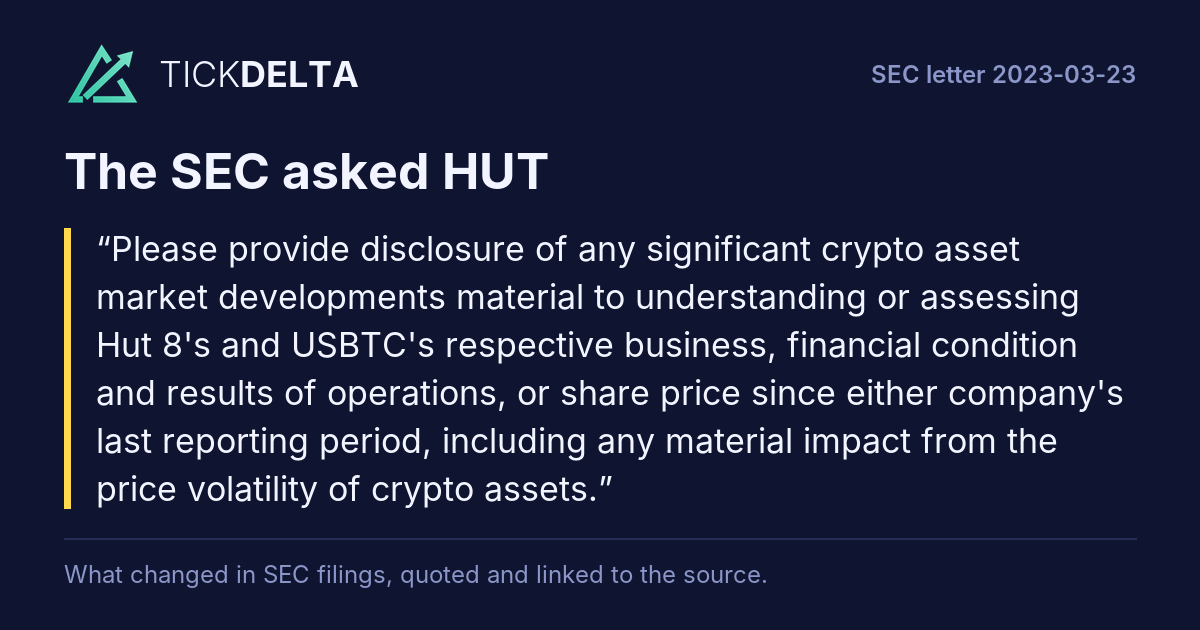
Also in this review: company letter, 2023-07-21, company letter, 2023-08-24, company letter, 2023-10-11, company letter, 2023-11-07