Paragraph 26 · 49% changed
Every version of it
Screener
/
SEC EDGAR
/CIK 0000750577
/10-K filed Feb 27, 2026, compared with Feb 27, 2025
/Numbers from the XBRL of the 10-Ks
Nasdaq
Financials · Banks
Hancock Whitney Corp HWC
The 10-K against last year's
234 changes: 31 added, 39 removed, 164 reworded
10-K Feb 27, 2026 vs Feb 27, 2025
Risk Factors
16.6%
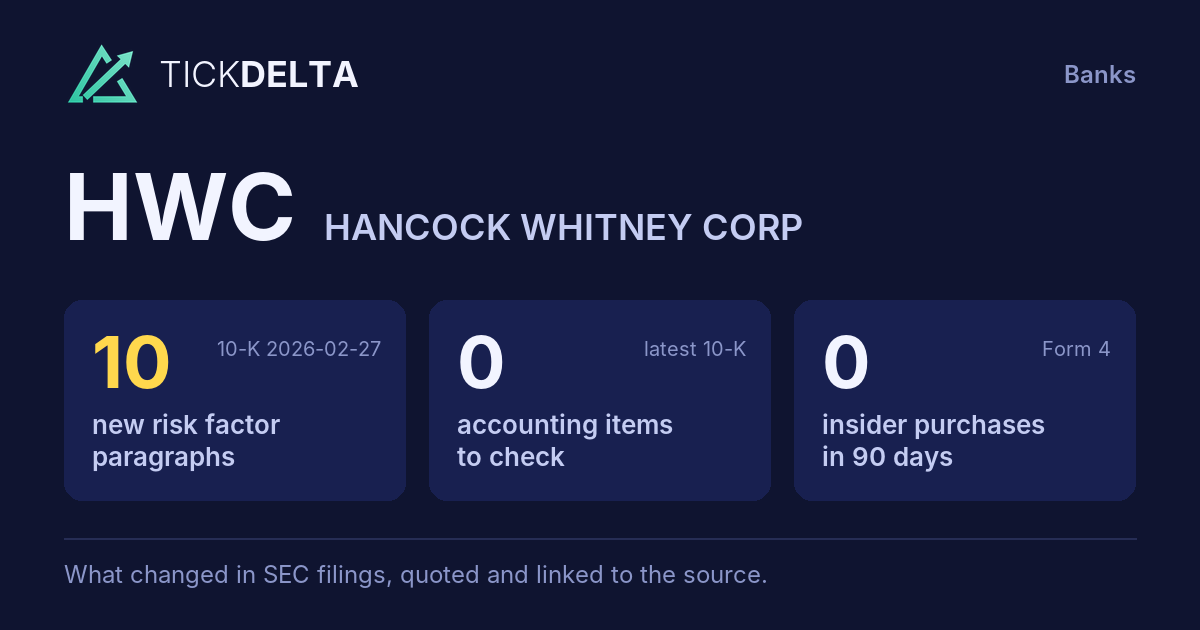
of the text changed · 12,511 words now · 10 new paragraphs, 10 gone
MD&A
21.5%
of the text changed · 18,610 words now · 21 new paragraphs, 29 gone
Legal Proceedings
9.7%
of the text changed · 563 words now
Accounting Policies
16.8%
of the text changed · 8,689 words now
10-K 0001193125-26-077903 (Feb 27, 2026) vs 10-K 0000950170-25-028009 (Feb 27, 2025)
Every paragraph, and how much of it changed
One bar per paragraph, in the order of the 10-K. Height and colour show the share of its words not in the closest paragraph a year earlier; the tallest bars are new paragraphs.
Risk Factors
136 paragraphs · 10 new · 45 reworded · 10 gone · 10-K Feb 27, 2026 against Feb 27, 2025
New paragraph
Reworded (5% of its words or more)
Same or nearly
Paragraph 74 · 40% changed
Every version of it
Paragraph 44 · 38% changed
Every version of it
Our common stock is listed and traded on the NASDAQ Global Select Market. If our capital resources are inadequate to meet our capital requirements in the future, we may need to raise additional debt or equity capital. If conditions in the capital markets are not favorable, we may be constrained in raising capital. We maintain a consistent analyst following; therefore, downgrades in our prospects by one or more of our analysts may cause our stock price to fall and significantly limit our ability to access the markets for additional capital requirements. An inability to raise additional capital on acceptable terms when and if needed could have a material adverse effect on our business, financial condition or results of operations.
Paragraph 50 · 35% changed
Every version of it
Effective liquidity management is essential for the operation of our business. We require sufficient liquidity to support our operations and fund outstanding liabilities, as well as to meet regulatory requirements. Our access to sources of liquidity in amounts adequate to fund our activities on terms that are acceptable to us could be impaired by factors that affect us specifically or the financial services industry or economy generally. Factors that could detrimentally impact our access to liquidity sources include an economic downturn that affects the geographic markets in which our loans and operations are concentrated, or any material deterioration of the credit markets. Our operating results may also be negatively impacted by the value of our securities portfolio, if liquidity and/or business strategy necessitate the sales of securities in a loss position, and/or access to select sources of liquidity could be limited should unrealized losses continue to grow to exceed certain levels. Our access to deposits may also be affected by the liquidity needs of our depositors and the loss of deposits to alternative institutions or investments. Although we have historically been successful in replacing maturing deposits and advances as necessary, we might not be able to duplicate that success in the future, especially if a large number of our depositors were to withdraw their amounts on deposit. A failure to maintain an adequate level of liquidity could materially and adversely affect our business, financial condition and results of operations. Conversely, liquidity in excess of current demand or operating needs may result in lower-earning assets that may adversely affect our results of operations.
Paragraph 73 · 34% changed
Every version of it
The Company or its third-party (or fourth-party) vendors, clients or counterparties may develop or incorporate AI technology in certain business processes, services, or products. The development and use of AI presents a number of risks and challenges to the Company’s business. The legal and regulatory environment relating to AI is uncertain and rapidly evolving, both in the U.S. and internationally, and includes regulatory schemes targeted specifically at AI as well as provisions in intellectual property, privacy, cybersecurity, consumer protection, employment, and other laws applicable to the use of AI. These evolving laws and regulations could require changes in the Company’s implementation of AI technology and increase the Company’s compliance costs and the risk of non-compliance. AI models, particularly generative AI models, may produce output or take action that is incorrect, that reflects biases included in the data on which they are trained, that results in the release of private, confidential, or proprietary information, that infringes on the intellectual property rights of others, or that is otherwise harmful. In addition, the complexity of many AI models makes it difficult to understand why they are generating particular outputs. This limited transparency increases the challenges associated with assessing the proper operation of AI models, understanding and monitoring the capabilities of the AI models, reducing erroneous output, eliminating bias, and complying with regulations that require documentation or explanation of the basis on which decisions are made. Further, the Company may rely on AI models developed by third parties, and, to that extent, would be dependent
Paragraph 68 · 33% changed
Every version of it
To date, we have seen no material adverse impact on our business or operations from cyber-attacks or events. Any future significant compromise or breach of our data security, whether external or internal, or misuse of customer, associate, supplier or Company data, could result in significant disruption of our operations, reimbursement and other costs, lost sales, fines, lawsuits fines (which fines may not be covered by our insurance policies), lawsuits, regulatory scrutiny, and other legal exposure, a loss of trust in us on the part of our clients, vendors or other counterparties, client attrition and damage to our reputation. Any of these could materially and adversely affect our results of operations, our financial condition, and/or our share price. However, the ever-evolving threats mean we and our third-party service providers and vendors must continually evaluate and adapt our respective systems and processes and overall security environment, as well as those of any companies we acquire. We are continuously enhancing our controls, processes and practices designed to protect our networks, systems, data and other infrastructure from attack, damage or unauthorized access. This continued enhancement will require us to expend additional resources, including to investigate and remediate any information security vulnerabilities that may be detected. Despite our ongoing investments in security resources, talent, and business practices, there is no guarantee that these measures will be adequate to safeguard against all data security breaches, system compromises or misuses of data.
Paragraph 129 · 32% changed
Every version of it
We and our customers rely on the existence of, and ability of private and public insurance programs to provide coverage for these types of events. Cost for insurance coverage under these programs has and may continue to increase, negatively impacting our business costs and our customers’ levels of liquidity and the ability to service their debt. The unavailability of these types of coverage or the inability of these entities to perform could also have a materially adverse impact on our operations. Further, our business, financial condition, and results of operations may be adversely affected by potential changes in federal emergency response, disaster relief, and recovery policies, including, but not limited to, actions by the Federal Emergency Management Agency or reductions in federal disaster funding. Delays or changes in governmental support programs, rebuilding assistance, flood‑insurance availability, or disaster‑recovery rules could slow economic recovery in affected areas, impact collateral values, and adversely affect borrower repayment capacity.
Paragraph 52 · 32% changed
Every version of it
Paragraph 26 · 49% changed
Every version of it
10-K Feb 27, 2025Although management believes it has implemented an effective asset and liability management strategy to manage the potential effects of changes in interest rates, including the use of adjustable rate and/or short-term assets, and FHLB advances or longer term repurchase agreements, any substantial, unexpected change in market interest rates could have a material adverse effect on our financial condition and results of our operation and our strategies may not always be successful in managing the risks associated with changes in interest rates.
10-K Feb 27, 2026
financial condition and results of our operation and our strategies may not always be successful in managing the risks associated with changes in interest rates.
Paragraph 74 · 40% changed
Every version of it
10-K Feb 27, 2025The Company or its third-party (or fourth-party) vendors, clients or counterparties may develop or incorporate AI technology in certain business processes, services, or products. The development and use of AI presents a number of risks and challenges to the Company’s business. The legal and regulatory environment relating to AI is uncertain and rapidly evolving, both in the U.S. and internationally, and includes regulatory schemes targeted specifically at AI as well as provisions in intellectual property, privacy, consumer protection, employment, and other laws applicable to the use of AI. These evolving laws and regulations could require changes in the Company’s implementation of AI technology and increase the Company’s compliance costs and the risk of non-compliance. AI models, particularly generative AI models, may produce output or take action that is incorrect, that reflects biases included in the data on which they are trained, that results in the release of private, confidential, or proprietary information, that infringes on the intellectual property rights of others, or that is otherwise harmful. In addition, the complexity of many AI models makes it difficult to understand why they are generating particular outputs. This limited transparency increases the challenges associated with assessing the proper operation of AI models, understanding and monitoring the capabilities of the AI models, reducing erroneous output, eliminating bias, and complying with regulations that require documentation or explanation of the basis on which decisions are made. Further, the Company may rely on AI models developed by third parties, and, to that extent, would be dependent
10-K Feb 27, 2026
AI models, particularly generative AI models, may produce output or take action that is incorrect, that reflects biases included in the data on which they are trained, that results in the release of private, confidential, or proprietary information, that infringes on the intellectual property rights of others, or that is otherwise harmful. In addition, the complexity of many AI models makes it difficult to understand why they are generating particular outputs. This limited transparency increases the challenges associated with assessing the proper operation of AI models, understanding and monitoring the capabilities of the AI models, reducing erroneous output, eliminating bias, and complying with regulations that require documentation or explanation of the basis on which decisions are made. If these models fail to operate as intended, or if unintended outputs are relied upon for business decisions, we could experience operational errors, regulatory scrutiny, or reputational harm. Further, the Company may rely on AI models developed by third parties, and, to that extent, would be dependent in part on the manner in which those third parties develop and train their models, including risks arising from the inclusion of any unauthorized material in the training data for their models and the effectiveness of the steps these third parties have taken to limit the risks associated with the output of their models, matters over which the Company may have limited visibility. AI systems often rely on large volumes of data, including sensitive or proprietary information. The use, storage, and processing of such data could increase our exposure to cybersecurity, privacy, and data protection risks. Failure to properly safeguard data used in AI systems, or any real or perceived misuse of data, could result in unauthorized access, data compromises, regulatory actions, contractual liability, reputational harm, or loss of client trust. Additionally, limitations on our ability to access or use data, whether due to legal restrictions, contractual constraints, or changes in data availability, could impair the effectiveness of our AI tools. Any of these risks could expose the Company to liability or adverse legal or regulatory consequences and harm the Company’s reputation and the public perception of its business or the effectiveness of its security measures.
Paragraph 44 · 38% changed
Every version of it
10-K Feb 27, 2025
Our common stock is listed and traded on the NASDAQ Global Select Market. If our capital resources are inadequate to meet our capital requirements in the future, we may need to raise additional debt or equity capital. If conditions in the capital markets are not favorable, we may be constrained in raising capital. We maintain a consistent analyst following; therefore, downgrades in our prospects by one or more of our analysts may cause our stock price to fall and significantly limit our ability to access the markets for additional capital requirements. An inability to raise additional capital on acceptable terms when and if needed could have a material adverse effect on our business, financial condition or results of operations.
10-K Feb 27, 2026
Our common stock is listed and traded on the NASDAQ Global Select Market. If our capital resources are inadequate to meet our capital requirements in the future, we may need to raise additional debt or equity capital. If conditions in the capital markets are not
Paragraph 50 · 35% changed
Every version of it
10-K Feb 27, 2025
Effective liquidity management is essential for the operation of our business. We require sufficient liquidity to support our operations and fund outstanding liabilities, as well as to meet regulatory requirements. Our access to sources of liquidity in amounts adequate to fund our activities on terms that are acceptable to us could be impaired by factors that affect us specifically or the financial services industry or economy generally. Factors that could detrimentally impact our access to liquidity sources include an economic downturn that affects the geographic markets in which our loans and operations are concentrated, or any material deterioration of the credit markets. Our operating results may also be negatively impacted by the value of our securities portfolio, if liquidity and/or business strategy necessitate the sales of securities in a loss position, and/or access to select sources of liquidity could be limited should unrealized losses continue to grow to exceed certain levels. Our access to deposits may also be affected by the liquidity needs of our depositors and the loss of deposits to alternative institutions or investments. Although we have historically been successful in replacing maturing deposits and advances as necessary, we might not be able to duplicate that success in the future, especially if a large number of our depositors were to withdraw their amounts on deposit. A failure to maintain an adequate level of liquidity could materially and adversely affect our business, financial condition and results of operations. Conversely, liquidity in excess of current demand or operating needs may result in lower-earning assets that may adversely affect our results of operations.
10-K Feb 27, 2026
Effective liquidity management is essential for the operation of our business. We require sufficient liquidity to support our operations and fund outstanding liabilities, as well as to meet regulatory requirements. Our access to sources of liquidity in amounts adequate to fund our activities on terms that are acceptable to us could be impaired by factors that affect us specifically or the financial services industry or economy generally. Factors that could detrimentally impact our access to liquidity sources include an economic downturn that affects the geographic markets in which our loans and operations are concentrated, or any material deterioration of the credit markets.
Paragraph 73 · 34% changed
Every version of it
10-K Feb 27, 2025
The Company or its third-party (or fourth-party) vendors, clients or counterparties may develop or incorporate AI technology in certain business processes, services, or products. The development and use of AI presents a number of risks and challenges to the Company’s business. The legal and regulatory environment relating to AI is uncertain and rapidly evolving, both in the U.S. and internationally, and includes regulatory schemes targeted specifically at AI as well as provisions in intellectual property, privacy, consumer protection, employment, and other laws applicable to the use of AI. These evolving laws and regulations could require changes in the Company’s implementation of AI technology and increase the Company’s compliance costs and the risk of non-compliance. AI models, particularly generative AI models, may produce output or take action that is incorrect, that reflects biases included in the data on which they are trained, that results in the release of private, confidential, or proprietary information, that infringes on the intellectual property rights of others, or that is otherwise harmful. In addition, the complexity of many AI models makes it difficult to understand why they are generating particular outputs. This limited transparency increases the challenges associated with assessing the proper operation of AI models, understanding and monitoring the capabilities of the AI models, reducing erroneous output, eliminating bias, and complying with regulations that require documentation or explanation of the basis on which decisions are made. Further, the Company may rely on AI models developed by third parties, and, to that extent, would be dependent
10-K Feb 27, 2026
The Company or its third-party (or fourth-party) vendors, clients or counterparties may develop or incorporate AI technology in certain business processes, services, or products. The development and use of AI presents a number of risks and challenges to the Company’s business. The legal and regulatory environment relating to AI is uncertain and rapidly evolving, both in the U.S. and internationally, and includes regulatory schemes targeted specifically at AI as well as provisions in intellectual property, privacy, cybersecurity, consumer protection, employment, and other laws applicable to the use of AI. These evolving laws and regulations could require changes in the Company’s implementation of AI technology and increase the Company’s compliance costs and the risk of non-compliance.
Paragraph 68 · 33% changed
Every version of it
10-K Feb 27, 2025
To date, we have seen no material adverse impact on our business or operations from cyber-attacks or events. Any future significant compromise or breach of our data security, whether external or internal, or misuse of customer, associate, supplier or Company data, could result in significant disruption of our operations, reimbursement and other costs, lost sales, fines, lawsuits and other legal exposure, a loss of trust in us on the part of our clients, vendors or other counterparties, client attrition and damage to our reputation. Any of these could materially and adversely affect our results of operations, our financial condition, and/or our share price. However, the ever-evolving threats mean we and our third-party service providers and vendors must continually evaluate and adapt our respective systems and processes and overall security environment, as well as those of any companies we acquire. We are continuously enhancing our controls, processes and practices designed to protect our networks, systems, data and other infrastructure from attack, damage or unauthorized access. This continued enhancement will require us to expend additional resources, including to investigate and remediate any information security vulnerabilities that may be detected. Despite our ongoing investments in security resources, talent, and business practices, there is no guarantee that these measures will be adequate to safeguard against all data security breaches, system compromises or misuses of data.
10-K Feb 27, 2026
To date, we have seen no material adverse impact on our business or operations from cyber-attacks or events. Any future significant compromise or breach of our data security, whether external or internal, or misuse of customer, associate, supplier or Company data, could result in significant disruption of our operations, reimbursement and other costs, lost sales, fines (which fines may not be covered by our insurance policies), lawsuits, regulatory scrutiny, and other legal exposure, a loss of trust in us on the part of our clients, vendors or other counterparties, client attrition and damage to our reputation. Any of these could materially and adversely affect our results of operations, our financial condition, and/or our share price. However, the ever-evolving threats mean we and our
Paragraph 129 · 32% changed
Every version of it
10-K Feb 27, 2025
We and our customers rely on the existence of, and ability of private and public insurance programs to provide coverage for these types of events. Cost for insurance coverage under these programs has and may continue to increase, negatively impacting our business costs and our customers’ levels of liquidity and the ability to service their debt. The unavailability of these types of coverage or the inability of these entities to perform could also have a materially adverse impact on our operations.
10-K Feb 27, 2026
We and our customers rely on the existence of, and ability of private and public insurance programs to provide coverage for these types of events. Cost for insurance coverage under these programs has and may continue to increase, negatively impacting our business costs and our customers’ levels of liquidity and the ability to service their debt. The unavailability of these types of coverage or the inability of these entities to perform could also have a materially adverse impact on our operations. Further, our business, financial condition, and results of operations may be adversely affected by potential changes in federal emergency response, disaster relief, and recovery policies, including, but not limited to, actions by the Federal Emergency Management Agency or reductions in federal disaster funding. Delays or changes in governmental support programs, rebuilding assistance, flood‑insurance availability, or disaster‑recovery rules could slow economic recovery in affected areas, impact collateral values, and adversely affect borrower repayment capacity.
Paragraph 52 · 32% changed
Every version of it
10-K Feb 27, 2025Effective liquidity management is essential for the operation of our business. We require sufficient liquidity to support our operations and fund outstanding liabilities, as well as to meet regulatory requirements. Our access to sources of liquidity in amounts adequate to fund our activities on terms that are acceptable to us could be impaired by factors that affect us specifically or the financial services industry or economy generally. Factors that could detrimentally impact our access to liquidity sources include an economic downturn that affects the geographic markets in which our loans and operations are concentrated, or any material deterioration of the credit markets. Our operating results may also be negatively impacted by the value of our securities portfolio, if liquidity and/or business strategy necessitate the sales of securities in a loss position, and/or access to select sources of liquidity could be limited should unrealized losses continue to grow to exceed certain levels. Our access to deposits may also be affected by the liquidity needs of our depositors and the loss of deposits to alternative institutions or investments. Although we have historically been successful in replacing maturing deposits and advances as necessary, we might not be able to duplicate that success in the future, especially if a large number of our depositors were to withdraw their amounts on deposit. A failure to maintain an adequate level of liquidity could materially and adversely affect our business, financial condition and results of operations. Conversely, liquidity in excess of current demand or operating needs may result in lower-earning assets that may adversely affect our results of operations.
10-K Feb 27, 2026
Our access to deposits may also be affected by the liquidity needs of our depositors and the loss of deposits to alternative institutions or investments. Although we have historically been successful in replacing maturing deposits and advances as necessary, we might not be able to duplicate that success in the future, especially if a large number of our depositors were to withdraw their amounts on deposit. A failure to maintain an adequate level of liquidity could materially and adversely affect our business, financial condition and results of operations. Conversely, liquidity in excess of current demand or operating needs may result in lower-earning assets that may adversely affect our results of operations.
MD&A
227 paragraphs · 21 new · 108 reworded · 29 gone · 10-K Feb 27, 2026 against Feb 27, 2025
New paragraph
Reworded (5% of its words or more)
Same or nearly
Paragraph 49 · 45% changed
Noninterest income for the year ended December 31, 2024 2025 totaled $364.1 $406.4 million, a $75.6 $42.3 million, or 26%, 12%, increase from 2023. For 2024. The increase in noninterest income from the year ended December 31, 2023, noninterest income included two supplemental disclosure items totaling $49.3 million, comprised of a $65.4 million loss on restructuring of 2024 is attributable in part to the available for sale securities portfolio and a $16.1 million gain on the sale of a parking facility. Excluding these supplemental disclosure items, noninterest income was up $26.4 million, or 8%, driven by increases Sabal acquisition, as well as growth in most fee categories. revenue lines, partially offset by declines in gains on sales of assets and other miscellaneous income. Noninterest income variances are discussed in more detail below.
Paragraph 157 · 44% changed
Paragraph 205 · 44% changed
Paragraph 208 · 44% changed
Total loans were $24.0 billion at December 31, 2024 were $23.3 billion, a decrease of $156.1 2025, up $361.9 million, or 1%, 2%, from September 30, 2024. The linked-quarter decline reflects 2025. Loan growth was driven primarily by strong production in the healthcare portfolio, increased payoffs of investor commercial real estate loans, partially offset by a seasonal increase activity and continued growth in line utilization and higher activity in commercial non-real estate loans. equipment finance.
Paragraph 117 · 44% changed
At December 31, 2024, 2025, the allowance for credit losses was $341.7 million, comprised of $307.8 million in allowance for loan losses and $33.9 million in the reserve for unfunded lending commitments. The allowance for credit losses decreased $1.3 million from $342.9 million, million at December 31, 2024, which was comprised of $318.9 million in allowance for loan losses and $24.1 million in the reserve for unfunded lending commitments. The allowance for credit losses increased $6.1 $11.2 million from $336.8 million at December 31, 2023, which was comprised of $307.9 million in allowance for loan losses and $28.9 million in the reserve for unfunded lending commitments. The $11.0 million increase decrease in the funded allowance for loan losses at December 31, 2024 compared was largely due to December 31, 2023 reflects higher coverage across most portfolios, resulting from stress related to prolonged elevated interest rates and inflation and other market conditions. a reduction in reserves on commercial real estate – income producing loans, a portfolio where credit metrics have been improving. The decline $9.9 million increase in the reserve for unfunded lending commitments of $4.8 million was largely volume driven as unfunded commitments are down. driven.
Paragraph 78 · 44% changed
We recorded income tax expense at an effective rate of 20.6% in 2025, compared to 19.7% in 2024. The comparability of the effective tax rate between 2025 and 2024 is affected by higher pre-tax book income in 2025 that decreased the relative impact of net tax benefits related to tax credit investments, tax-exempt interest income and bank-owned life insurance. Our effective tax rate has historically varied from the federal statutory rate primarily due to tax-exempt income and tax credits. Interest income on bonds issued by or loans to state and municipal governments and authorities, and earnings from the bank-owned life insurance contract program are the major components of tax-exempt income.
Paragraph 37 · 43% changed
The $88.2 $105.2 million increase decrease in interest expense was largely driven by the impact of the falling interest rate environment, as higher prevailing interest rates drove an increase environment on interest-bearing liabilities, particularly in the cost of deposits interest-bearing deposit cost, volume and continued to foster shifts in deposit composition from noninterest-bearing and within the mix of interest-bearing deposits to higher-cost products, partially offset by a decrease in short-term borrowings expense, mostly attributable to a decline in average Federal Home Loan Bank (FHLB) advances. mix. Compared to the prior year, average noninterest-bearing interest-bearing deposits were down $1.4 billion, while $191.8 million in 2025, and the mix therein saw a shift from higher-cost time deposits to transaction and savings deposits as instruments matured. Average other short-term borrowings, consisting primarily of FHLB advances, were up $857.8 million. Average short-term borrowings $104.4 million in 2024 were down $802.0 million from 2023, as the incremental FHLB borrowings drawn 2025 compared to 2024, largely as a cautionary measure in early 2023 were repaid. function of funding needs. Our total cost of funds increased 30 decreased 31 bps to 1.88% 1.57% in 2024 from 1.58% in 2023, 2025, largely driven by higher a 54 bp decline in the cost of interest-bearing deposit costs, up 55 bps in 2024 to 3.08% from 2.53% in 2023, and other short-term borrowing costs, which consist largely of FHLB advances, increasing 43 bps to 5.49% in 2024 from 5.06% in 2023. deposits.
Paragraph 56 · 43% changed
Losses on sales of securities totaled less than $0.1 million for the year ended December 31, 2025. There were no gains or losses on sales of securities during the year ended December 31, 2024. There was a $65.4 million loss on sales of securities for the year ended December 31, 2023 as a result of the strategic restructuring of the available for sale portfolio to enhance net interest margin through deployment of the proceeds into higher-yielding earning assets and repayment of short-term borrowings.
Paragraph 49 · 45% changed
10-K Feb 27, 2025
Noninterest income for the year ended December 31, 2024 totaled $364.1 million, a $75.6 million, or 26%, increase from 2023. For the year ended December 31, 2023, noninterest income included two supplemental disclosure items totaling $49.3 million, comprised of a $65.4 million loss on restructuring of the available for sale securities portfolio and a $16.1 million gain on the sale of a parking facility. Excluding these supplemental disclosure items, noninterest income was up $26.4 million, or 8%, driven by increases in most fee categories. Noninterest income variances are discussed in more detail below.
10-K Feb 27, 2026
Noninterest income for the year ended December 31, 2025 totaled $406.4 million, a $42.3 million, or 12%, increase from 2024. The increase in noninterest income from the year ended December 31, 2024 is attributable in part to the Sabal acquisition, as well as growth in most revenue lines, partially offset by declines in gains on sales of assets and other miscellaneous income. Noninterest income variances are discussed in more detail below.
Paragraph 157 · 44% changed
10-K Feb 27, 2025•Governance committees. The Capital Committee (CAPCO) of the Company serves as the senior level management risk/reward committee and oversees the business strategy, organizational structure, capital planning, and liquidity strategies for the Company. CAPCO directly oversees the strategic and reputation risk categories, which include litigation strategy and the development of capital stress testing within the Company’s risk governance framework. CAPCO drives business strategy development and execution, provides corporate financial oversight, and is responsible for portfolio risk committee oversight. CAPCO provides oversight of the portfolio risk/reward committees to ensure tactics to address business strategy changes are properly vetted and adopted, and protect the Company’s reputation.
10-K Feb 27, 2026
committee oversight. CAPCO provides oversight of the portfolio risk/reward committees to ensure tactics to address business strategy changes are properly vetted and adopted, and protect the Company’s reputation.
Paragraph 205 · 44% changed
10-K Feb 27, 2025Net income for the fourth quarter of 2024 totaled $122.1 million, or $1.40 per diluted common share (EPS), compared to $115.6 million, or $1.33 per diluted common share, in the third quarter of 2024 and $50.6 million, or $0.58 per diluted common share in the fourth quarter of 2023. The fourth quarter of 2023 included a net charge of $75.4 million, or $0.68 per diluted share after-tax, of supplemental disclosure items. Excluding the impact of these supplemental disclosure items, EPS would have been $1.26 per diluted share in the fourth quarter of 2023. There were no supplemental disclosure items in the third or fourth quarters of 2024.
10-K Feb 27, 2026
•Net income totaled $125.6 million, or $1.49 per diluted share, compared to $127.5 million, or $1.49 per diluted share in the third quarter of 2025
Paragraph 208 · 44% changed
10-K Feb 27, 2025
Total loans at December 31, 2024 were $23.3 billion, a decrease of $156.1 million, or 1%, from September 30, 2024. The linked-quarter decline reflects increased payoffs of commercial real estate loans, partially offset by a seasonal increase in line utilization and higher activity in commercial non-real estate loans.
10-K Feb 27, 2026
Total loans were $24.0 billion at December 31, 2025, up $361.9 million, or 2%, from September 30, 2025. Loan growth was driven primarily by strong production in the healthcare portfolio, increased investor commercial real estate activity and continued growth in equipment finance.
Paragraph 117 · 44% changed
10-K Feb 27, 2025
At December 31, 2024, the allowance for credit losses was $342.9 million, comprised of $318.9 million in allowance for loan losses and $24.1 million in the reserve for unfunded lending commitments. The allowance for credit losses increased $6.1 million from $336.8 million at December 31, 2023, which was comprised of $307.9 million in allowance for loan losses and $28.9 million in the reserve for unfunded lending commitments. The $11.0 million increase in the funded allowance for loan losses at December 31, 2024 compared to December 31, 2023 reflects higher coverage across most portfolios, resulting from stress related to prolonged elevated interest rates and inflation and other market conditions. The decline in the reserve for unfunded lending commitments of $4.8 million was largely volume driven as unfunded commitments are down.
10-K Feb 27, 2026
At December 31, 2025, the allowance for credit losses was $341.7 million, comprised of $307.8 million in allowance for loan losses and $33.9 million in the reserve for unfunded lending commitments. The allowance for credit losses decreased $1.3 million from $342.9 million at December 31, 2024, which was comprised of $318.9 million in allowance for loan losses and $24.1 million in the reserve for unfunded lending commitments. The $11.2 million decrease in the funded allowance was largely due to a reduction in reserves on commercial real estate – income producing loans, a portfolio where credit metrics have been improving. The $9.9 million increase in the reserve for unfunded lending commitments was largely volume driven.
Paragraph 78 · 44% changed
10-K Feb 27, 2025
Our effective tax rate has historically varied from the federal statutory rate primarily due to tax-exempt income and tax credits. Interest income on bonds issued by or loans to state and municipal governments and authorities, and earnings from the bank-owned life insurance contract program are the major components of tax-exempt income.
10-K Feb 27, 2026
We recorded income tax expense at an effective rate of 20.6% in 2025, compared to 19.7% in 2024. The comparability of the effective tax rate between 2025 and 2024 is affected by higher pre-tax book income in 2025 that decreased the relative impact of net tax benefits related to tax credit investments, tax-exempt interest income and bank-owned life insurance. Our effective tax rate has historically varied from the federal statutory rate primarily due to tax-exempt income and tax credits. Interest income on bonds issued
Paragraph 37 · 43% changed
10-K Feb 27, 2025
The $88.2 million increase in interest expense was largely driven by the interest rate environment, as higher prevailing interest rates drove an increase in the cost of deposits and continued to foster shifts in deposit composition from noninterest-bearing and within the mix of interest-bearing deposits to higher-cost products, partially offset by a decrease in short-term borrowings expense, mostly attributable to a decline in average Federal Home Loan Bank (FHLB) advances. Compared to the prior year, average noninterest-bearing deposits were down $1.4 billion, while higher-cost time deposits were up $857.8 million. Average short-term borrowings in 2024 were down $802.0 million from 2023, as the incremental FHLB borrowings drawn as a cautionary measure in early 2023 were repaid. Our total cost of funds increased 30 bps to 1.88% in 2024 from 1.58% in 2023, largely driven by higher interest-bearing deposit costs, up 55 bps in 2024 to 3.08% from 2.53% in 2023, and other short-term borrowing costs, which consist largely of FHLB advances, increasing 43 bps to 5.49% in 2024 from 5.06% in 2023.
10-K Feb 27, 2026
The $105.2 million decrease in interest expense was largely driven by the impact of the falling interest rate environment on interest-bearing liabilities, particularly in interest-bearing deposit cost, volume and mix. Compared to the prior year, average interest-bearing deposits were down $191.8 million in 2025, and the mix therein saw a shift from higher-cost time deposits to transaction and savings deposits as instruments matured. Average other short-term borrowings, consisting primarily of FHLB advances, were up $104.4 million in 2025 compared to 2024, largely as a function of funding needs. Our total cost of funds decreased 31 bps to 1.57% in 2025, largely driven by a 54 bp decline in the cost of interest-bearing deposits.
Paragraph 56 · 43% changed
10-K Feb 27, 2025
There were no gains or losses on sales of securities during the year ended December 31, 2024. There was a $65.4 million loss on sales of securities for the year ended December 31, 2023 as a result of the strategic restructuring of the available for sale portfolio to enhance net interest margin through deployment of the proceeds into higher-yielding earning assets and repayment of short-term borrowings.
10-K Feb 27, 2026
Losses on sales of securities totaled less than $0.1 million for the year ended December 31, 2025. There were no gains or losses on sales of securities during the year ended December 31, 2024.
A paragraph is matched with the one last year that shares the most of its words; under half in common makes it new. The paragraphs shown are the 8 reworded the most in each section.
The paragraph that changed most in each section
The redline
Marked against last year's 10-K: cut words struck through, new words highlighted.
MD&A274 words changed in this paragraph; it is 34% similar to last year's version.
The baseline economic scenario continues to maintain an overall optimistic tenor with respect to acknowledges that economic outcomes. The forecast reflects new assumptions about fiscal policy, monetary policy and immigration and population growth given under the Republican sweep of the White House and Congress. current administration is rapidly shifting. Key assumptions within the December 2024 2025 baseline forecast include the following: (1) With the Republican majority, spending will decrease, personal income tax provisions of the Tax Cuts and Jobs Act will be extended and the corporate income tax effective tariff rate will decrease rise from just over 2% at the start of 2025 to 15%; approximately 12% by early 2026 before gradually falling late in the decade; (2) The Federal Reserve will issue two rate cuts of 25 basis points each in 2025, with further gradual reductions in 2026 until while the benchmark rate reaches 3%; (3) Though the labor market has softened, the economy remains near full-employment with the current unemployment rate is still relatively low at 4.4%, it will continue to rise to a peak of 4%, and is forecasted 4.8% in late 2026 before gradually returning to remain relatively stable at 4.1% over the succeeding three years; (4) near 4% in 2029; (3) GDP growth will display begin to decelerate, displaying modest annual below-trend growth in the coming years of 2.2% in 2025, 1.6% 2.1% in 2026, 1.9% in 2027 and 1.8% 2.1% in 2027; and, (5) 2028; (4) the 10-year U.S. Treasury yield will remain elevated near its current rate, and is forecasted to average 4.3% for 2025 through 2027 and only gradually decline rate through the end of the decade. decade as a result of elevated inflation and a deteriorating fiscal outlook; and (5) the soft economy and a struggling job market will prompt the Federal Reserve to continue to cut its benchmark rate until it reaches 2.75% in early 2027 before a return to its neutral level of 3% in 2028. The scenario further assumes that, with these rate cuts, the recent acceleration in inflation will prove temporary as it is largely due to a one-time price increase caused by higher tariffs.
Source: Item 7, 10-K 0001193125-26-077903 vs Item 7, 10-K 0000950170-25-028009
Risk Factors262 words changed in this paragraph; it is 43% similar to last year's version.
AI models, particularly generative AI models, may produce output or take action that is incorrect, that reflects biases included in the data on which they are trained, that results in the release of private, confidential, or proprietary information, that infringes on the intellectual property rights of others, or that is otherwise harmful. In addition, the complexity of many AI models makes it difficult to understand why they are generating particular outputs. This limited transparency increases the challenges associated with assessing the proper operation of AI models, understanding and monitoring the capabilities of the AI models, reducing erroneous output, eliminating bias, and complying with regulations that require documentation or explanation of the basis on which decisions are made. If these models fail to operate as intended, or if unintended outputs are relied upon for business decisions, we could experience operational errors, regulatory scrutiny, or reputational harm. Further, the Company may rely on AI models developed by third parties, and, to that extent, would be dependent in part on the manner in which those third parties develop and train their models, including risks arising from the inclusion of any unauthorized material in the training data for their models and the effectiveness of the steps these third parties have taken to limit the risks associated with the output of their models, matters over which the Company may have limited visibility. AI systems often rely on large volumes of data, including sensitive or proprietary information. The use, storage, and processing of such data could increase our exposure to cybersecurity, privacy, and data protection risks. Failure to properly safeguard data used in AI systems, or any real or perceived misuse of data, could result in unauthorized access, data compromises, regulatory actions, contractual liability, reputational harm, or loss of client trust. Additionally, limitations on our ability to access or use data, whether due to legal restrictions, contractual constraints, or changes in data availability, could impair the effectiveness of our AI tools. Any of these risks could expose the Company to liability or adverse legal or regulatory consequences and harm the Company’s reputation and the public perception of its business or the effectiveness of its security measures.
Source: Item 1A, 10-K 0001193125-26-077903 vs Item 1A, 10-K 0000950170-25-028009
Accounting Policies214 words changed in this paragraph; it is 32% similar to last year's version.
Investment and annuity services fee income represents income earned from investment investment, annuity, insurance and advisory services. The Company provides its customers with access to these products using a third-party broker dealer that provides full-service brokerage, insurance and investment products through the use of third-party carriers advisory activities to meet their financial needs and investment objectives. As the agent in the arrangement, the Company recognizes service commissions on a net basis. Upon selection of an investment a product, the customer enters into a policy an agreement with the carrier. third-party service provider. The performance obligation is satisfied by fulfilling its responsibility to process the order to acquire the investment for which a commission fee is earned from either the carrier or our third-party service provider based on agreed-upon fee percentages on a trade date basis, net of any associated costs. The Company has a contractual relationship with a third-party broker dealer to provide full-service brokerage and investment advisory activities. As the agent in the arrangement, the Company recognizes the investment services commissions on a net basis. Investment revenue also includes portfolio management fees, which represent monthly fees charged on a contractual basis to customers for the management of their investment portfolios and are recorded under the accrual method of accounting. Prior to August 12, 2022, investment and annuity services fee income was recorded on a gross basis, with expenses recorded in the appropriate expense line item; subsequent to that date, such fee income is recorded net of expenses, as the Company is now agent in these transactions following a change in service providers. place
Source: Item 8, Note 1 – Summary of Significant Accounting Policies and Recent Accounting Pronouncements, 10-K 0001193125-26-077903 vs Item 8, Note 1 – Summary of Significant Accounting Policies and Recent Accounting Pronouncements, 10-K 0000950170-25-028009
Legal Proceedings68 words changed in this paragraph; it is 64% similar to last year's version.
In November 2023, the FDIC approved a final rule to implement a special deposit insurance assessment to recover losses to the Deposit Insurance Fund (DIF) arising from the full protection of uninsured depositors under the systemic risk exception following the receiverships of Silicon Valley Bank and Signature Bank in the spring of 2023. In the fourth quarter of 2023, To-date, the Company recorded a pre-tax has expensed $27.6 million related to this special assessment expense totaling $26.1 million based on loss estimate information provided by the November 2023 final rule. In 2024, the FDIC provided several notices with updated estimates of losses attributable to the protection of uninsured depositors, extending the collection period by quarters and necessitating less material adjustments to the expense in the current year. FDIC.
Source: Item 3, via Note 20 – Commitments and Contingencies, 10-K 0001193125-26-077903 vs Item 3, via Note 19 – Commitments and Contingencies, 10-K 0000950170-25-028009
Sentences and paragraphs added, removed or reworded
Every change, by type
Sentences and paragraphs of HWC's Risk Factors and MD&A, 10-K Feb 27, 2026 against 10-K Feb 27, 2025. Each links to the text at sec.gov.
Quiet changes are sentences kept from last year with one to four words changed, at least one of them a hedge, a modal or a qualifier (may, could, will, not, significant, material…). A year or date rolling forward is not counted.
The full word list
adverse, adversely, all, although, anticipate, anticipates, any, approximately, believe, believes, can, cannot, certain, could, expect, expects, generally, however, if, intend, intends, largely, likely, many, material, materially, may, might, most, must, never, no, not, possible, primarily, probable, should, significant, significantly, some, substantial, substantially, unlikely, will, would
AddedRisk Factors
•continued political gridlock or delays in federal budget appropriations could produce additional shutdowns that negatively affect household income, business activity, and the availability of timely federal economic reporting;
Read it in 10-K Feb 27, 2026 at sec.gov
AddedRisk Factors
Geopolitical tensions, civil unrest, shifting U.S. foreign‑policy priorities, prolonged conflicts abroad, and heightened scrutiny of cross‑border business activity may also contribute to market volatility, reduced customer confidence, repricing of commodities or agricultural goods, and other economic pressures that could negatively affect our borrowers’ financial condition and credit performance.
Read it in 10-K Feb 27, 2026 at sec.gov
AddedRisk Factors
Various modifications to U.S. tariffs have been announced, and further changes are expected to be made in the future, including in response to litigation. On February 20, 2026, the U.S. Supreme Court rendered a decision invalidating tariffs imposed under the International Emergency Economic Powers Act. This decision introduces uncertainty regarding potential refund processes and future trade policy actions and could affect the general economy, inflation, interest rates, supply chains, our customers, depositors, and third party service providers, and the results of our operations. The ultimate impact of tariffs and other trade policies on the Company’s business will depend on several factors, including future measures implemented by the U.S. government and the governments of other countries, the overall magnitude and duration of these measures, and the Company’s ability to mitigate effects.
Read it in 10-K Feb 27, 2026 at sec.gov
AddedRisk Factors
Congress and financial regulators have and may continue to implement measures designed to stabilize financial markets, including in reaction to inflation. Potential future actions such as the proposed consumer credit card interest rate cap may lead to unprofitable products, especially for riskier borrowers, and could lead to cutting credit lines or eliminating cards, increased reliance on fees and increased debt burdens for those needing credit most, thereby having the potential to negatively impact bank asset quality. The overall impact of these and other efforts on the financial markets may be ineffective and could adversely affect our business. In addition, rapidly issued policy changes may create operational uncertainty, require accelerated compliance efforts, or result in market distortions that negatively affect our funding costs, deposit flows, loan demand, or securities valuations. There is also a risk that certain government interventions may create moral hazard, shift competitive dynamics, or produce uneven impacts across the banking industry.
Read it in 10-K Feb 27, 2026 at sec.gov
AddedRisk Factors
Our operating results may also be negatively impacted by the value of our securities portfolio, if liquidity and/or business strategy necessitate the sales of securities in a loss position, and/or access to select sources of liquidity could be limited should unrealized losses continue to grow to exceed certain levels.
Read it in 10-K Feb 27, 2026 at sec.gov
AddedRisk Factors
We are in the early stages of incorporating AI into our business activities to increase employee productivity. We have not yet deployed AI-driven systems in critical decision-making or client-facing processes. As noted above, our vendors or third parties may develop or incorporate AI technology in certain business processes, services, or products. Any reliance on AI presents a number of risks and challenges to our business. The legal and regulatory environment relating to AI is uncertain and rapidly evolving, both in the U.S. and internationally, and includes regulatory schemes targeted specifically at AI. On January 23, 2025, President Trump issued an executive order aimed at reducing barriers to AI innovation in the U.S. economy. The order requires relevant persons and bodies
Read it in 10-K Feb 27, 2026 at sec.gov
AddedRisk Factors
within the federal government to develop an AI action plan to carry out this objective and revokes prior AI-related executive orders, as well as all corresponding policies, regulations, order, directives, and other actions taken in response to such order. These evolving laws and regulations could require changes in our consideration and implementation of AI technology and increase our compliance costs and the risk of non-compliance.
Read it in 10-K Feb 27, 2026 at sec.gov
AddedRisk Factors
Increased scrutiny and evolving expectations from stakeholders with respect to sustainability practices may impose additional costs on us or expose us to new or additional risks.
Read it in 10-K Feb 27, 2026 at sec.gov
Show the other 60
AddedRisk Factors
As a regulated financial institution and a publicly traded company, we are facing increasing public, investor, activist, legislative and regulatory scrutiny related to sustainability practices, disclosures and developments. Regulators, politicians, investor advocacy groups, investment funds, and influential investors are increasingly focused on these practices, especially as they relate to climate risk, hiring practices, diversity, health and safety and human rights. Failure to adapt to or comply with regulatory requirements or regulatory, investor or stakeholder expectations and standards could negatively impact the Company’s reputation, ability to do business with certain partners, and stock price. Ongoing legislative or regulatory uncertainties, divergence and changes regarding sustainability may result in higher compliance, credit and reputational risks and costs. To the extent that we or our customers experience increases in
Read it in 10-K Feb 27, 2026 at sec.gov
AddedRisk Factors
costs, including with respect to compliance with any additional regulatory or disclosure requirements or expectations, reductions in the value of assets, constraints on operations or similar concerns driven by changes in sustainability oversight and regulation, our results of operations, financial condition, and business could be adversely affected.
Read it in 10-K Feb 27, 2026 at sec.gov
RemovedRisk Factors
RemovedRisk Factors
RemovedRisk Factors
RemovedRisk Factors
RemovedRisk Factors
RemovedRisk Factors
RemovedRisk Factors
RemovedRisk Factors
RemovedRisk Factors
RemovedRisk Factors
RewordedRisk Factors
Although management believes it has implemented an effective asset and liability management strategy to manage the potential effects of changes in interest rates, including the use of adjustable rate and/or short-term assets, and FHLB advances or longer term repurchase agreements, any substantial, unexpected change in market interest rates could have a material adverse effect on our financial condition and results of our operation and our strategies may not always be successful in managing the risks associated with changes in interest rates.
Read it in 10-K Feb 27, 2026 at sec.gov
RewordedRisk Factors
RewordedRisk Factors
RewordedRisk Factors
Increases in funding, deposit insurance or other costs as a result of these types of events have and could in the future materially adversely affect our financial condition and results of operations.
Read it in 10-K Feb 27, 2026 at sec.gov
RewordedRisk Factors
Any future significant compromise or breach of our data security, whether external or internal, or misuse of customer, associate, supplier or Company data, could result in significant disruption of our operations, reimbursement and other costs, lost sales, fines, lawsuits fines (which fines may not be covered by our insurance policies), lawsuits, regulatory scrutiny, and other legal exposure, a loss of trust in us on the part of our clients, vendors or other counterparties, client attrition and damage to our reputation.
Read it in 10-K Feb 27, 2026 at sec.gov
RewordedRisk Factors
Such estimates rely upon complex modeling inputs and judgments, including forecasts of economic conditions, which may be impaired during periods of heightened volatility or incomplete economic data reporting, and could therefore be rendered inaccurate and/or no longer subject to accurate forecasting;
Read it in 10-K Feb 27, 2026 at sec.gov
RewordedRisk Factors
We and others in our industry regularly are, and will continue to be, regularly the subject of attempts by attackers to gain unauthorized access to our networks, systems, data and other infrastructure, or to obtain, change, or destroy confidential data (including personal identifying information of individuals) through a variety of means, including computer hacking, acts of vandalism or theft, malware, computer viruses or other malicious codes, phishing, brute force attacks, exploiting software vulnerabilities (including “zero-day attacks”), supply chain attacks, employee error or malfeasance, catastrophes, unforeseen events or other cyber-attacks.
Read it in 10-K Feb 27, 2026 at sec.gov
RewordedRisk Factors
In the future, these attacks may result in unauthorized individuals obtaining material access to our confidential information or that of our clients, or otherwise materially accessing, damaging, or disrupting our systems or infrastructure. infrastructure, or those of our third-party service providers.
Read it in 10-K Feb 27, 2026 at sec.gov
RewordedRisk Factors
Further, implementation of new rules, such as the Commission’s proposed climate related disclosures, rules could require additional cost and negatively impact operating results.
Read it in 10-K Feb 27, 2026 at sec.gov
RewordedRisk Factors
Our online, business, financial, accounting, data processing, or other operating systems and facilities facilities, or those of our third-party service providers, may stop operating properly or become disabled or damaged as a result of a number of factors, including events that are wholly or partially beyond our control.
Read it in 10-K Feb 27, 2026 at sec.gov
RewordedRisk Factors
If conditions in the capital markets are not favorable, we may be constrained in raising capital.
Read it in 10-K Feb 27, 2026 at sec.gov
RewordedRisk Factors
Beginning in the third quarter of 2024, and continuing throughout 2025, the Federal Reserve began slowly decreasing decreased interest rates, with future interest rate changes, either increases or decreases uncertain, and dependent on the Federal Reserve’s assessment of economic conditions and inflation.
Read it in 10-K Feb 27, 2026 at sec.gov
AddedMD&A
On May 2, 2025, we completed the acquisition of Sabal Trust Company (“Sabal”). Based in St. Petersburg, Florida, with three additional locations in the Central Florida region, Sabal was the largest independent, employee-owned non-depository trust company in Florida. The transaction added assets under management and administration of approximately $3 billion to our existing trust and asset management business and provides the opportunity to develop relationships and offer other private banking, wholesale and retail products and services in high-growth markets. For additional information on this transaction, refer to Note 2 – "Acquisition" in the notes to our consolidated financial statements included elsewhere in this document.
Read it in 10-K Feb 27, 2026 at sec.gov
AddedMD&A
In January 2026, we executed a restructuring of our available for sale securities portfolio whereby we sold securities with an amortized cost of $1.5 billion and average yield of 2.49% and reinvested the $1.4 billion of proceeds with the purchase of securities with an average yield of 4.35%. We anticipate a 50 month payback period to cover the $98.5 million pre-tax loss associated with the sale, or approximately $0.93 per diluted share after tax, that will be reflected in our first quarter 2026 operating results. The restructure is expected to contribute approximately $23.8 million to net interest income, or $0.23 per diluted share, resulting in increases of 32 basis points (bps) to the securities portfolio yield and 7 bps to net interest margin on an annual basis.
Read it in 10-K Feb 27, 2026 at sec.gov
AddedMD&A
The year ended December 31, 2025 began with notable economic shifts as the new presidential administration swiftly began implementing its second-term agenda. The impacts of tariffs, tax reform, deportations, and deregulation each carried distinct economic and market implications. Tariffs quickly became the most influential factor, creating cost pressures across supply chains. Further, concerns over the pace and scale of tariffs created increased uncertainty as to near and long term effects that led to significant volatility in equity markets in the early part of the year. As policy clarity improved, markets successfully rebounded from the steep descent and remained strong for the duration of the year.
Read it in 10-K Feb 27, 2026 at sec.gov
AddedMD&A
Labor market statistics continued to indicate weakening that stemmed from policy uncertainty, labor force impacts of deportation efforts and the increasing use of artificial intelligence. Job gains decelerated substantially compared to 2024, and the unemployment rate rose to 4.4% in December 2025 compared to 4.1% a year earlier. Despite deterioration in the labor market, consumer spending remained resilient and real gross domestic product (GDP) displayed growth of approximately 2.2% for 2025, rebounding from a net decline in the first quarter. The Federal Reserve held monetary policy steady for most of the year amid the difficult crosswinds. By September, some stabilization in inflation markers and sustained weakening in the labor market led to a 25 basis point interest rate cut. Operational disruptions and negative economic impacts of the 43-day government shutdown that followed shortly thereafter further clouded the economic picture, but the Federal Reserve subsequently issued two additional 25 basis point cuts in the fourth quarter of 2025, with the expectation that the adjusted rates will allow stabilization in the labor market and the resumption of downward trends in inflationary conditions.
Read it in 10-K Feb 27, 2026 at sec.gov
AddedMD&A
A number of headwinds that have burdened the financial services industry in recent years continued to ease, with many institutions benefiting from recent interest rate movement, robust capital markets, deregulation and credit quality stabilization. Within our markets, loan demand gained momentum and deposit cost pressures eased amid the falling interest rate environment, contributing favorably to net interest margin and profitability.
Read it in 10-K Feb 27, 2026 at sec.gov
AddedMD&A
The baseline economic scenario acknowledges that economic policy under the current administration is rapidly shifting. Key assumptions within the December 2025 baseline forecast include the following: (1) the effective tariff rate will rise from just over 2% at the start of 2025 to approximately 12% by early 2026 before gradually falling late in the decade; (2) while the unemployment rate is still relatively low at 4.4%, it will continue to rise to a peak of 4.8% in late 2026 before gradually returning to near 4% in 2029; (3) GDP growth will begin to decelerate, displaying modest annual below-trend growth in the coming years of 2.1% in 2026, 1.9% in 2027 and 2.1% in 2028; (4) the 10-year U.S. Treasury yield will remain elevated near its current rate through the end of the decade as a result of elevated inflation and a deteriorating fiscal outlook; and (5) the soft economy and a struggling job market will prompt the Federal Reserve to continue to cut its benchmark rate until it reaches 2.75% in early 2027 before a return to its neutral level of 3% in 2028. The scenario further assumes that, with these rate cuts, the recent acceleration in inflation will prove temporary as it is largely due to a one-time price increase caused by higher tariffs.
Read it in 10-K Feb 27, 2026 at sec.gov
AddedMD&A
market contracting 22% and a peak-to-trough decline in GDP of 1%. The combination of a recession and rising inflation causes the Federal Reserve to lower its benchmark rate moderately over the course of a few quarters; as the recession persists and inflation subsides, the Federal Reserve subsequently reduces the rate more significantly.
Read it in 10-K Feb 27, 2026 at sec.gov
AddedMD&A
The credit loss outlook for our portfolio as a whole has not changed materially since December 31, 2024. We continue to closely monitor our portfolio for customers that are sensitive to prolonged inflation, the elevated interest rate environment, tariffs, labor market conditions and/or other economic circumstances that may impact credit quality.
Read it in 10-K Feb 27, 2026 at sec.gov
AddedMD&A
•Net income of $486.1 million, or $5.67 per diluted common share, up from $460.8 million, or $5.28 per diluted share
Read it in 10-K Feb 27, 2026 at sec.gov
AddedMD&A
•Tangible common equity ratio of 10.06%, up 59 bps; common equity tier 1 capital ratio of 13.65%, down 49 bps, reflecting the return of capital through our share repurchase program and an increase in shareholder dividends
Read it in 10-K Feb 27, 2026 at sec.gov
AddedMD&A
•Credit metrics remain relatively stable, with criticized commercial loans down $87.7 million, or 14%, and nonaccrual loans up $9.5 million, or 10%; the net charge-off ratio was 0.22% compared to 0.19%
Read it in 10-K Feb 27, 2026 at sec.gov
AddedMD&A
The year ended December 31, 2025 was an outstanding year for our company. Net interest margin expanded ten basis points, adjusted pre-provision net revenue and return on assets grew, efficiency ratio improved, and credit quality remained stable. We deployed capital through the repurchase of 4.3 million shares of our common stock, increasing our quarterly shareholder dividends, and funding both organic and inorganic growth, including the acquisition of Sabal Trust Company on May 2, 2025. The Sabal acquisition expanded our trust and asset management business in Central Florida and provides opportunities to build relationships in that region. We experienced loan growth of 3% across our footprint and in most business segments, driven by increased demand and progress on our multi-year growth plan. We remain committed to continuing to fulfill our organic growth initiatives while maintaining operational efficiency and proactively managing capital to enhance shareholder value.
Read it in 10-K Feb 27, 2026 at sec.gov
RemovedMD&A
RemovedMD&A
RemovedMD&A
RemovedMD&A
RemovedMD&A
RemovedMD&A
RemovedMD&A
RemovedMD&A
RemovedMD&A
RemovedMD&A
RemovedMD&A
RemovedMD&A
RewordedMD&A
($ in thousands) 2025 2024 2023 2022 Reconciliation of pre-provision net revenue (te) and adjusted pre-provision net revenue (te) (non-GAAP measures) (e) Net income (GAAP) $ 486,073 $ 460,815 $ 392,602 $ 524,089 Provision for credit losses 51,183 52,167 59,103 (28,399) Income tax expense 126,322 113,158 97,526 135,107 Pre-provision net revenue 663,578 626,140 549,231 630,797 Taxable equivalent adjustment 10,378 11,086 11,107 10,348 Pre-provision net revenue (te) 673,956 637,226 560,338 641,145 Adjustments from supplemental disclosure items Sabal Trust Company acquisition expense 5,911 — — Loss on securities portfolio restructure — — 65,380 — Gain on sale of parking facility — — (16,126) — FDIC special assessment — 3,800 26,123 — Adjusted pre-provision net revenue (te) $ 679,867 $ 641,026 $ 635,715 $ 641,145 Reconciliation of revenue (te), adjusted revenue (te) and efficiency ratio (non-GAAP measures) (e) Net interest income $ 1,108,772 $ 1,081,921 $ 1,097,599 $ 1,050,003 Noninterest income 406,447 364,129 288,480 331,486 Total GAAP revenue 1,515,219 1,446,050 1,386,079 1,381,489 Taxable equivalent adjustment 10,378 11,086 11,107 10,348 Total revenue (te) 1,525,597 1,457,136 1,397,186 1,391,837 Adjustments from supplemental disclosure items Loss on securities portfolio restructure — — 65,380 — Gain on sale of parking facility — — (16,126) — Adjusted revenue $ 1,525,597 $ 1,457,136 $ 1,446,440 $ 1,391,837 GAAP noninterest expense $ 851,641 $ 819,910 $ 836,848 $ 750,692 Amortization of intangibles (9,953) (9,413) (11,556) (14,033) Adjustments from supplemental disclosure items Sabal Trust Company acquisition expense (5,911) — — FDIC special assessment — (3,800) (26,123) — Adjusted noninterest expense $ 835,777 $ 806,697 $ 799,169 $ 736,659 Efficiency ratio (d) 54.78% 55.36% 55.25% 52.93%
Read it in 10-K Feb 27, 2026 at sec.gov
RewordedMD&A
Our criticized commercial loans at December 31, 2024 2025 are spread across many industries, with the largest concentrations as follows: $95.7 million in manufacturing, $90.9 million in retail trade, $68.8 million in wholesale trade, $68.7 million in hospitality, $62.7 million in transportation and warehousing, $56.7 million in construction, $49.4 $96.4 million real estate, rental and leasing, $44.6 $67.5 million in hospitality, $63.9 million in transportation and warehousing, $62.9 million healthcare and social assistance, and $27.4 $57.4 million in professional, scientific retail trade, $54.4 million in construction and technical services. $51.1 million in wholesale trade.
Read it in 10-K Feb 27, 2026 at sec.gov
RewordedMD&A
Other miscellaneous income for the year ended December 31, 2024 2025 was $27.0 $23.0 million, up $3.4 down $4.0 million, or 14%, 15%, from 2023, largely due to 2024, driven primarily by a $2.2 decrease of $6.6 million increase in dividends on FHLB stock as stock, reflecting a result of both an increase decline in prevailing rates and an increase in volume the level of stock owned and a $1.0 the yield, partially offset by an increase of $2.9 million increase in income from SBICs. syndication fees.
Read it in 10-K Feb 27, 2026 at sec.gov
RewordedMD&A
Investment and annuity fees and insurance commissions, which include both fees earned from sales of annuity and insurance products as well as managed account fees, totaled $43.4 $49.2 million, a $5.7 million, or 13%, increase from 2024, largely attributable to increases of $2.0 million in 2024, a $6.7 million, or 18%, increase from 2023. investment management fees and $1.9 million in fixed income trading fees and also reflects increases in annuity fees, corporate underwriting fees and insurance commissions.
Read it in 10-K Feb 27, 2026 at sec.gov
RewordedMD&A
RewordedMD&A
Each of the scenarios considered have varying degrees of severity and duration of inflationary pressure, including volatility in commodities prices and impacts to the labor market, the consequences of the Federal Reserve’s actions with regard to forecasted market conditions, economic indicators, monetary policy, the effect of the recent change in presidential administration on fiscal and other policies, governmental policies and impacts from geopolitical unrest. conditions, among other variables.
Read it in 10-K Feb 27, 2026 at sec.gov
RewordedMD&A
After considering the variables underlying each of the Moody’s economic scenarios, management probability-weighed probability-weighted the baseline scenario at 50% and the downside S-2 mild recessionary scenario at 50% in the estimation of the allowance for credit losses at December 31, 2025, compared to probability weighting of the baseline scenario at 40% and the downside S-2 mild recessionary scenario at 60% in the computation estimation of the allowance for credit losses at December 31, 2024, consistent with the weighting used at December 31, 2023. 2024.
Read it in 10-K Feb 27, 2026 at sec.gov
RewordedMD&A
The 110 59 bp increase from December 31, 2023 is comprised of net income (+136 (+145 bps), tangible asset contraction (+13 bps), other comprehensive income (+67 bps) and stock-based compensation and other activity (+6 bps), and other comprehensive income (+4 bps), partially offset by share repurchases (-73 bps), dividends (-38 (-45 bps), capital deployed in the Sabal acquisition (-33 bps) and share repurchases (-11 tangible asset growth (-8 bps).
Read it in 10-K Feb 27, 2026 at sec.gov
RewordedMD&A
Commercial non-real estate $ 29,678 $ 14,172 $ 20,840 Commercial non-real estate - modified 4,847 19,246 — Total commercial non-real estate 34,525 33,418 20,840 Commercial real estate - owner occupied 6,482 2,727 2,228 Commercial real estate - owner-occupied - modified — 241 — Total commercial real estate - owner-occupied 6,723 2,727 2,228 Commercial real estate - income producing 4,760 356 461 Commercial real estate - income producing - modified — — Total commercial real estate - income producing 4,760 356 461 Construction and land development 3,173 5,561 815 Construction and land development - modified — — Total construction and land development 3,173 5,561 815 Residential mortgage 46,399 43,157 26,039 Residential mortgage - modified 587 929 98 Total residential mortgage 46,986 44,086 26,137 Consumer 10,555 11,187 8,555 Consumer - modified — 148 — Total consumer 10,703 11,187 8,555 Total nonaccrual loans $ 106,870 $ 97,335 $ 59,036 ORE and foreclosed assets 14,788 27,797 3,628 Total nonaccrual loans and ORE and foreclosed assets $ 121,658 $ 125,132 $ 62,664 Modified loans - still accruing:
Read it in 10-K Feb 27, 2026 at sec.gov
RewordedMD&A
Excluding the special assessment charges in the respective periods, supplemental disclosure item, deposit insurance and regulatory fees were down $3.4 $2.4 million, or 14%, 12%, from 2024, mostly reflective of changes in our risk-based assessment calculation. calculation as well as less significant quarterly adjustments to the special assessment based on quarterly updates from the FDIC.
Read it in 10-K Feb 27, 2026 at sec.gov
RewordedMD&A
Internal Sources Free securities $3,631,840 $4,153,209 $— $3,631,840 $4,153,209 External Sources Federal Home Loan Bank (a) 6,592,945 1,083,088 5,509,857 6,749,076 1,452,438 5,296,638 Federal Reserve Bank 3,231,661 3,307,233 — 3,231,661 3,307,233 Brokered deposits 4,423,928 6,901 4,417,027 4,391,966 — 4,391,966 Other 1,229,000 — 1,229,000 1,159,000 70,000 1,089,000 Total Available Sources of Funding $19,109,374 $1,089,989 $18,019,385 $19,760,484 $1,522,438 $18,238,046 Cash and other interest-bearing bank deposits 1,514,625 695,261 Total Liquidity $19,534,010 $18,933,307
Read it in 10-K Feb 27, 2026 at sec.gov
RewordedMD&A
In January 2023, December 2024, the Company’s Board of Directors authorized a stock repurchase program program, effective January 1, 2025, pursuant to which the Company may, from time to time, purchase up to approximately 4.3 million shares of its outstanding common stock (approximately 5% of the shares of its common stock outstanding as of December 31, 2022). 2024, totaling 4.3 million shares, through the program's expiration date of December 31, 2026.
Read it in 10-K Feb 27, 2026 at sec.gov
Sources
The two latest 10-Ks on EDGAR, section by section. Each change links to the text at sec.gov.
Also
New risk factors: paragraphs with nothing like them last year, quoted in full.
Work with it
Excel workbook · CSV. Google Sheet that stays up to date: paste =IMPORTDATA("https://tickdelta.com/company/HWC/export.csv") into a cell.