Screener / SEC EDGAR /CIK 0000046250 /Numbers from the XBRL of the 10-Ks
Nasdaq Industrials · Chemicals & Allied Products

Hawkins Inc HWKN

Compare with peers Embed
SEC comment letters, last 20 years

6 reviews of HWKN's filings by SEC staff

UPLOAD and CORRESP
Reviews 6 latest letter Feb 27, 2026
Questions asked 27 each answered in the company's own letter
No closing letter 1 reviews without a letter saying the staff completed it

When the SEC's staff reviews a filing, it writes to the company with numbered questions, and the company answers each one in a letter. SEC publishes the exchange once the review is over, at least 20 business days later. A question is not an accusation; most reviews end with the company adding detail to its next filing.

How the reviews went

Every review on EDGAR, from the first staff letter to the letter that closes it

  1. 1. Staff letters 7 UPLOAD
  2. 2. Questions in them 27 numbered comments
  3. 3. Company replies 7 CORRESP
  4. 4. Reviews closed 5 of 6 closing letter

Half the closed reviews took 25 days or less from the first letter to the closing letter.

Form 10-K

2026-02-27 to 2026-03-24 · 2 questions · 1 letter from the SEC, 1 from the company
Review closed 2026-03-24
LeasesResults discussion (MD&A)Non-GAAP measuresSegments
Notes to Consolidated Financial Statements, page 32
SEC asked (1)
It appears selling, general and administrative expenses is material to your results of operations. Please consider describing what this line item consists of. Note 14 - Leases, page 45
HWKN answered
Our selling, general and administrative expenses consist of expenses related to selling products, including personnel and related expenses, amortization of intangibles, marketing and promotion expenses, and travel expenses; and administrative expenses, primarily personnel costs, related to certain executive officers, information technology, accounting and human resources; and the fair value accretion of any earnout liabilities.

We intend to include a description of our selling, general and administrative expenses in the notes to our audited consolidated financial statements in future filings
Rest of the answer

beginning with our Form 10-K for the year ending March 29, 2026.

Read in the reply
In its next report

First report after the company's reply of Mar 13, 2026: 10-K filed May 13, 2026 ↗, against the 10-K filed May 14, 2025 ↗.

Note 14, Leases: 4 paragraphs changed; the 3 closest in words to the question are below.

Reworded

Total lease expense Cash paid for leases was $ 4.6 3.8 million for the twelve months ended March 30, 2025 and $ 4.0 million for the twelve months ended March 31, 2024, and includes leases less than 12 months in duration. 29, 2026.

27 words cut, 7 added sec.gov
New paragraph

Total lease expense was $ 5.2 million for the twelve months ended March 29, 2026, $ 4.6 million for the twelve months ended March 30, 2025, and $4.0 million for the twelve months ended March 31, 2024, and includes leases less than 12 months in duration.

0 words cut, 46 added sec.gov
Reworded

As of March 30, 2025 29, 2026 and March 31, 2024, 30, 2025, our operating lease components with initial or remaining terms in excess of one year were classified on the consolidated balance sheet within right-of-use assets, short-term lease liability liabilities and long-term lease liability. liabilities.

6 words cut, 6 added sec.gov

Paragraphs where only numbers, dates or period words changed are not shown. Cut words struck through, new words highlighted.
Notes to Consolidated Financial Statements, page 32
SEC asked (2)
Please disclose the cash paid for amounts included in the measurement of lease liabilities pursuant to ASC 842-20-50-4.g.1. Note 15 - Segment Information, page 45 You disclose here there are no intersegment sales.
Rest of the question

On page 1 under Business you disclose the Industrial Group ("Industrial") repackages water treatment chemicals for the Water Treatment Group ("Water Treatment"), there are significant synergies between Water Treatment and Industrial regarding chemicals sold by Water Treatment derived from large volume of chemicals purchased by Industrial, and Water Treatment and Industrial share certain resources. In view of this, please describe for us and disclose as 3. appropriate the relationship between these two groups such that no intersegment sales occur. Also, describe for us and disclose as appropriate how the costs of resources shared between these groups and chemicals purchased by Industrial on behalf of Water Treatment are assigned to the appropriate segment. Exhibit 99.1, page 1 4. Under the caption "Third Quarter Fiscal Year 2026 Highlights," for the non-GAAP measure Adjusted EBITDA, please present the most directly comparable GAAP measure of net income with equal or greater prominence. Refer to Question 102.10(a) of the Compliance and Disclosure Interpretations on Non-GAAP Financial Measures. In closing, we remind you that the company and its management are responsible for the accuracy and adequacy of their disclosures, notwithstanding any review, comments, action or absence of action by the staff.

HWKN answered
We intend to disclose cash paid for amounts included in the measurement of lease liabilities in the notes to our audited consolidated financial statements in future filings beginning with our Form 10-K for the year ending March 29, 2026.
Read in the reply
In its next report

First report after the company's reply of Mar 13, 2026: 10-K filed May 13, 2026 ↗, against the 10-K filed May 14, 2025 ↗.

Note 15, Segment Information: 11 paragraphs changed; the 3 closest in words to the question are below.

Reworded

Effective beginning with the first fiscal quarter of fiscal 2026, we realigned our reporting segments to reflect organizational changes made and to reflect the way we manage our operations and allocate resources. We believe this realignment better reflects the value our company provides to our customers and our evolution from a bulk commodity distributor into a specialty ingredients company. Segment information for fiscal 2025 and fiscal 2024 has been recast to reflect the Company's current reportable segments after realignment. We organize and manage our business by the following three segments, which meet the definition of reportable segments under ASC 280-10, Segment Reporting: Water Treatment, Industrial Food and Health Sciences, and Nutrition. Industrial Solutions. These segments are defined primarily by product and type of customer.

2 words cut, 83 added sec.gov
Reworded

• Water Treatment Segment. Our Water Treatment segment Group specializes in providing chemicals, products, filtration media and systems, equipment, services and solutions for potable water, municipal and industrial wastewater, industrial process water, mainly non-residential swimming pool water and agricultural water. This segment group has the resources and flexibility to treat systems ranging in size from a single small well to a multi-million-gallon-per-day facility.

3 words cut, 10 added sec.gov
Reworded

• Industrial Solutions Segment. Our Industrial segment Solutions Group specializes in providing industrial chemicals, products and services to industries such as agriculture, industrial manufacturing, chemical processing, electronics, energy, food, pharmaceutical plating, and plating. surface finishing. This segment's group’s principal products are acids, alkalis acids and food-grade alkalis. This segment receives, stores and pharmaceutical salts distributes various chemicals in bulk quantities, including liquid caustic soda, sulfuric acid, hydrochloric acid, urea, phosphoric acid, aqua ammonia and ingredients. potassium hydroxide. They perform customer blending of chemicals according to customer formulas and specifications and repackage bulk industrial chemicals to sell in smaller quantities to our customers. The Industrial Solutions group relies on a specially trained sales staff that works directly with customer on their specific needs. This segment conducts its business primarily through manufacturing locations and terminal operations.

12 words cut, 95 added sec.gov

Paragraphs where only numbers, dates or period words changed are not shown. Cut words struck through, new words highlighted.

Also in this review: closing letter, 2026-03-24
Form 10-K for the Fiscal Year Ended April 3, 2022

2023-03-20 to 2023-04-11 · 1 question · 1 letter from the SEC, 1 from the company
Review closed 2023-04-11
SegmentsResults discussion (MD&A)
Fiscal 2022 Compared to Fiscal 2021 · Sales, page 16
SEC asked
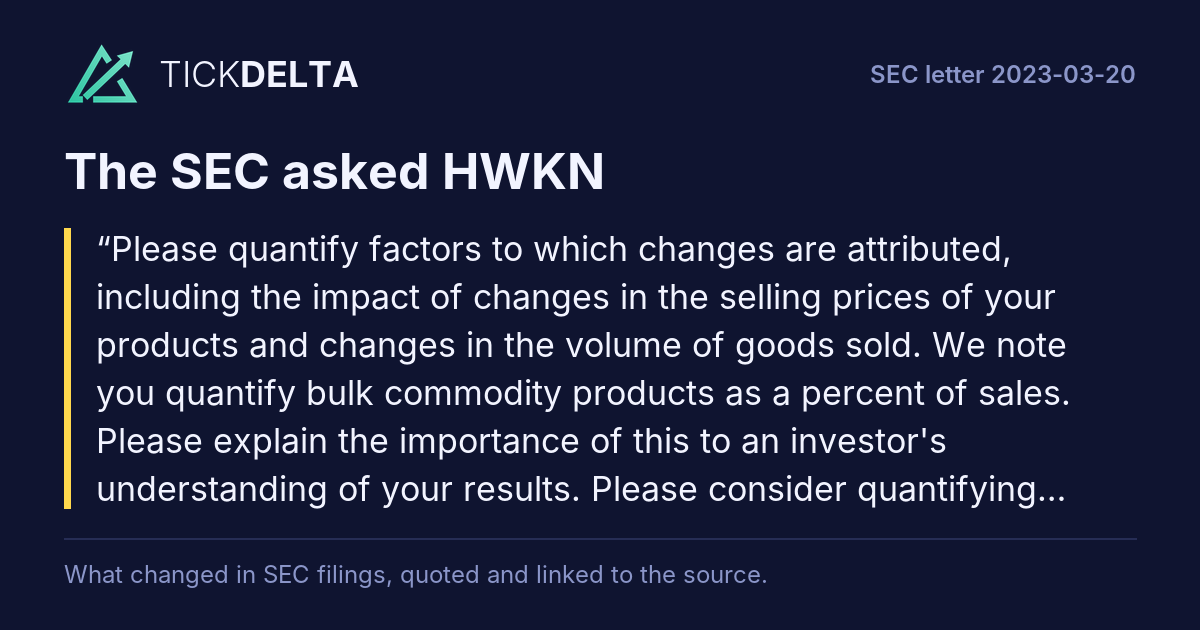
Please quantify factors to which changes are attributed, including the impact of changes in the selling prices of your products and changes in the volume of goods sold. We note you quantify bulk commodity products as a percent of sales. Please explain the importance of this to an investor's understanding of your results.
Rest of the question

Please consider quantifying increases in your sales by product lines in your segment sales discussion if important to investor's understanding. Refer to Item 303(b)(2)(iii) of Regulation S-K. In closing, we remind you that the company and its management are responsible for the accuracy and adequacy of their disclosures, notwithstanding any review, comments, action or absence of action by the staff.

HWKN answered
We acknowledge the staff’s comment and in future filings will endeavor to provide additional detail quantifying the extent to which changes in prices or volume resulted in material changes in sales.

Our fiscal year ended April 3, 2022 (“fiscal 2022”) had 53 weeks of sales as compared to the prior fiscal year which had 52 weeks. The extra week occurs approximately every six years.
Rest of the answer

The extra week in fiscal 2022 contributed approximately $17.5 million of the $177.7 million increase in sales over the prior year.

Within both our Industrial and Water Treatment segments, we disclose the percentage of our overall sales that consist of sales of bulk commodity products as these products are generally distributed and we do not add significant value to these products in comparison to our non-bulk products. Sales of these products are generally highly competitive and price sensitive. As a result, bulk commodity products generally have our lowest margins. Because non-bulk products carry higher per-unit margins, we have sought to increase our sales of higher margin products. We, therefore, believe that quantifying bulk commodity products as a percentage of sales for our Industrial and Water Treatment segments is important to an investor’s understanding of our operating results.

Our fiscal 2022 Industrial segment sales increased by $113.6 million, and we estimated the 53rd week contributed approximately $10 million of this increase. The remaining increase in revenue was driven by increased selling prices and volume. Removing the impact of the 53rd week, increased selling prices represented approximately 58% of the increase and volume increases represented 42% of the increase.

Our fiscal 2022 Water Treatment segment sales increased by $58.1 million, and we estimated the 53rd week contributed approximately $3.9 million of this increase. The remaining increase in revenue was driven by increased volume growth, including growth from acquisitions and increased selling prices. Removing the impact of the 53rd week, increased volume, both organic growth and growth from acquisitions, represented 63% of the increase, with the remainder due to increased selling prices.

Our fiscal 2022 Health and Nutrition segment sales increased by $6.0 million, and we estimated the 53rd week contributed approximately $3.6 million of the increase. The remaining increase in revenue was driven by increased selling prices offset by decreases in volume. Our Health and Nutrition segment has no bulk commodity product sales. We believe a more important measure to enhance an investor’s understanding of our results is the amount of revenue derived from manufactured products as compared to distributed products which is further detailed in the revenue footnote.

At this time, we do not believe that quantifying changes in our sales by product lines in our segment sales discussion will enhance an investor’s understanding of our results of operation. Due to our diverse product offerings and end customers, we sell similar products to different customers at substantially different prices and margins in multiple segments, depending on market conditions. As a result, we do not believe that reporting by product line would be helpful to an investor’s understanding of our operating results disclosed in the consolidated financial statements, which includes the information related to sales of our manufactured, blended or repackaged products, distributed specialty products and bulk products disclosed in Footnote 3 (Revenue) to the consolidated financial statements.

We periodically consider additional quantitative disclosures in light of applicable requirements and guidance. However, we believe that quantifying increases in our sales by product line within our segments is not necessary for investors to understand our results of operations. Further, we believe it would disclose proprietary information that would be available for use against us by our competitors.

Read in the reply

Also in this review: closing letter, 2023-04-11

Form 8-K

2009-06-17 to 2009-06-19 · 1 question · 1 letter from the SEC, 1 from the company
Review closed 2009-06-19
SEC asked
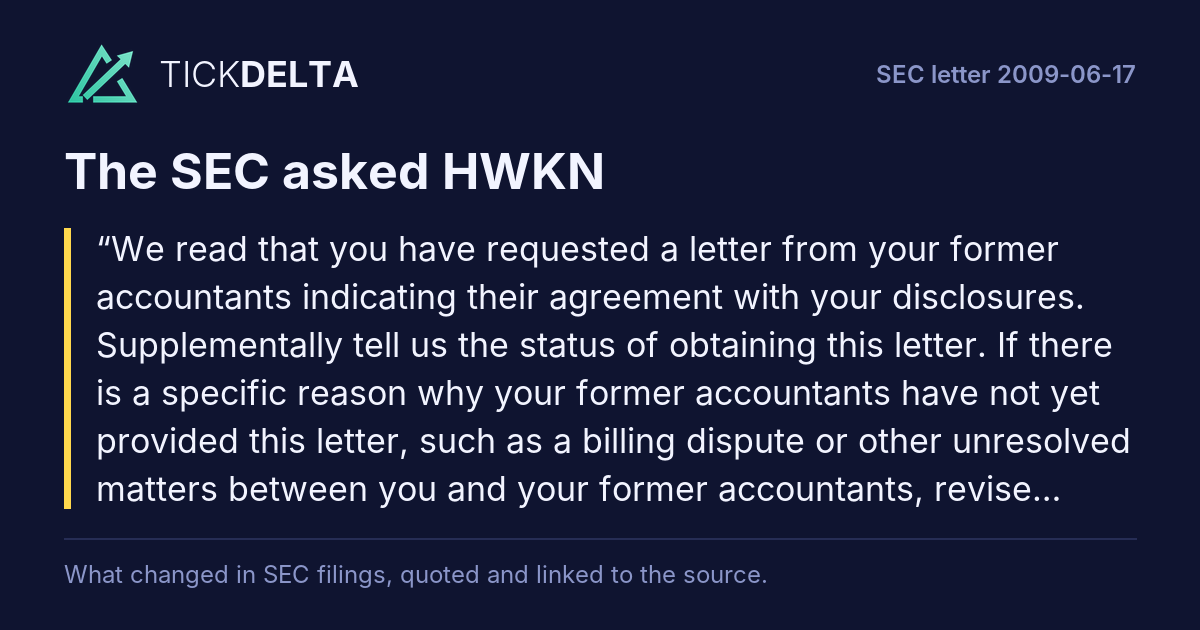
We read that you have requested a letter from your former accountants indicating their agreement with your disclosures. Supplementally tell us the status of obtaining this letter. If there is a specific reason why your former accountants have not yet provided this letter, such as a billing dispute or other unresolved matters between you and your former accountants, revise your disclosure to explain to your investors
Rest of the question

the nature of the delay in obtaining this letter. Otherwise, confirm to us that you expect to receive this letter shortly and will file an amendment to your Item 4.01 Form 8-K to provide this letter as Exhibit 16 upon its receipt.

HWKN answered
On June 16, 2009, the Company received the requested letter from our former accountants. On June 17, 2009, the Company electronically filed with the Commission an amendment to its previously filed Current Report on Form 8-K for the purpose of providing the above-mentioned letter as Exhibit 16.

Pursuant to the staff’s request, the Company acknowledges that:

• it is responsible for the adequacy and accuracy of the disclosure in the filings, staff comments or changes to disclosure in response to staff comments in the filings reviewed by the staff do not foreclose the Securities Exchange
Rest of the answer

Commission from taking any action with respect to the filings, and the Company may not assert staff comments as a defense in any proceeding initiated by the Commission or any person under the federal securities laws of the United States.

Should there be any questions or comments with respect to the above responses, or should additional information be required, please contact the undersigned at (612) 617-8582.

Yours truly,

/s/ Richard G. Erstad

Richard G. Erstad

Vice President and

General Counsel cc:

Read in the reply

Also in this review: closing letter, 2009-06-19

Form 10-K for the fiscal year ended March 30, 2008

2009-02-23 to 2009-03-26 · 14 questions · 1 letter from the SEC, 1 from the company
Review closed 2009-03-26
Executive payControlsRisk factorsSegmentsResults discussion (MD&A)Goodwill and impairment
General
SEC asked (1)
Please advise us as to why you have not filed an Exhibit 21 disclosing the information required by Item 601(b)(21) of Regulation S-K.
HWKN answered
Item 601(b)(21) of Regulation S-K requires a listing of all subsidiaries of the registrant, among other information. We have no subsidiaries and, therefore, an Exhibit 21 is not required.
Read in the reply
Business, page 2
SEC asked (2)
Because of the nature of your business, the discussion about sources and availability of raw materials appears limited despite some general disclosure of these matters in various risk factors. Further, we note that in your latest quarterly report on Form 10-Q for the period ended December 31, 2008, you disclose that you have experienced rising material costs and supply constraints for certain products (see the first
Rest of the question

paragraph of the “Sales” discussion on page 11). In future filings, please expand your disclosure related to information contained in subparagraphs (c)(1)(iii) of Item 101 of Regulation S-K, to the extent that such information is material to your business taken as a whole.

HWKN answered
In future filings, we will expand our disclosure related to the information contained in subparagraphs (c)(1)(iii) of Item 101 of Regulation S-K, to the extent this information is material to our business taken as a whole.
Read in the reply
Item 7. Management’s Discussion and Analysis of Financial Condition and Results of · Operations, page 11
SEC asked (3)
We note that you have presented several factors which impact your results on both a consolidated and segment basis. Please revise future filings to quantify the impact of these factors where practicable. Reference Release No. 33-8350.
HWKN answered
In future filings, we will quantify the impact of factors impacting our results on both a consolidated and segment basis where practicable.
Read in the reply
In its next report

First report after the company's reply of Mar 6, 2009: 10-K filed Jun 5, 2009 ↗, against the 10-K filed Jun 13, 2008 ↗.

Tickdelta does not hold the text of both reports, so they are not compared here.

Allowance for Doubtful Accounts, page 16
SEC asked (4)
We note your disclosure that your allowance for doubtful accounts is an estimate which is evaluated on a quarterly basis. It is therefore unclear to us why the additions are equal to the deductions to this allowance for each year presented on Schedule II. Please explain. In addition, please tell us how you have evaluated the adequacy of the remaining allowance for each year presented.
HWKN answered
The Company performs specific reviews of outstanding receivables to determine at-risk accounts receivables to be reserved or written off. On a monthly basis, the Credit Department reviews detailed accounts receivable reports to identify delinquent and/or long outstanding customer accounts. From this review, the Credit Department will contact at-risk accounts to attempt to collect the past due balance.

On a quarterly basis, the Company reviews the adequacy of its estimated allowance for doubtful accounts.
Rest of the answer

This analysis involves a detailed review of the accounts receivable aging by customer account to identify delinquent or long outstanding accounts. The specific at-risk accounts are reviewed individually, with the Credit Department, to determine what portion of the outstanding balance should be reserved. The individual account review is aggregated to determine the allowance for doubtful accounts at the end of each quarter. Account balances that the Company deems uncollectible based on our analytical review or past collection efforts are written off and are not part of the allowance for doubtful accounts.

The overall quality of our accounts receivable balance has remained relatively consistent during each quarter over the three fiscal years ended March 30, 2008 and, consequently, the allowance for doubtful accounts has not fluctuated significantly during this period. On a quarterly basis over that period, the allowance for doubtful accounts ranged from $200,000 to $300,000, with the allowance at the end of each of the three reported fiscal years at $225,000. However, as a result of our review of the adequacy of the quality of the accounts receivable balance for the quarter ended December 31, 2008, we recorded bad debt expense of approximately $700,000, as reported in our Quarterly Report on Form 10-Q, related to two specifically identified at-risk accounts. Consequently, if Schedule II was prepared as of December 31, 2008, it would disclose $701,000 as additions charged to expense and approximately $26,000 of write-offs for the nine months ended December 31, 2008, with a balance of $900,000 in the allowance for doubtful accounts as of December 31, 2008.

Read in the reply
In its next report

First report after the company's reply of Mar 6, 2009: 10-K filed Jun 5, 2009 ↗, against the 10-K filed Jun 13, 2008 ↗.

Tickdelta does not hold the text of both reports, so they are not compared here.

Goodwill and Identifiable Intangible Assets, page 24
SEC asked (5)
We note your disclosure that you determined an annual impairment test for goodwill and identifiable assets not subject to amortization was not necessary because there were no impairment indicators. It is unclear to us how you have complied with paragraph 26 of FAS 142. Please explain.
HWKN answered
In accordance with paragraph 26 of SFAS No. 142, Accounting for Goodwill and Other Intangible Assets, the Company’s policy is to test goodwill for impairment on an annual basis and between annual tests if certain indicators of impairment are identified. We have selected January 1st as our annual impairment assessment date.

All of the Company’s goodwill and identifiable assets not subject to amortization were recorded in conjunction with our acquisition of Trumark, Inc. which was completed on May 31, 2007.
Rest of the answer

Prior to this acquisition, the Company did not have any goodwill or identifiable assets not subject to amortization that would have required the Company to conduct impairment testing in accordance with SFAS No. 142.

Subsequent to the Trumark, Inc. acquisition, the Company assessed its reporting units in accordance with paragraph 30, of SFAS No. 142, and concluded the acquired business would be aggregated within the Company’s Industrial segment to constitute the reporting unit to be tested for impairment.

As of January 1, 2008, because only seven months had passed since acquisition, the Company did a high level assessment of whether any impairment had occurred. Given that revenues and margins of the reporting unit had continued increasing, the Company’s market capitalization as of January 1, 2008 was $153.7 million, compared to net assets of $85.8 million, the total goodwill and indefinite lived intangible assets were only approximately 2% of total assets, and the fact that none of the impairment indicators listed in paragraph 28 of SFAS No. 142 were present, a more in depth discounted cash flows model was not performed.

The Company is currently in the process of performing our annual test of impairment related to goodwill and indefinite lived intangible assets, as of January 1, 2009 which does include a detailed discounted cash flow analysis. Based upon our analysis to date, we do not anticipate there will be any impairment. During 2009, revenues and margins of the Industrial Segment have increased over 2008, and no other indicators of impairment were present. The results of our annual test will be disclosed in our Form 10-K for the year ending March 29, 2009.

Read in the reply
In its next report

First report after the company's reply of Mar 6, 2009: 10-K filed Jun 5, 2009 ↗, against the 10-K filed Jun 13, 2008 ↗.

Tickdelta does not hold the text of both reports, so they are not compared here.

Evaluation of disclosure controls and procedures, page 33
SEC asked (6)
We note your disclosure that your certifying officers concluded that your disclosure controls and procedures were effective to “ensure that information required to be disclosed in reports it files or submits under the Exchange Act is recorded, processed, summarized and reported within the time periods specified in the SEC’s rules and forms.” This description appears to be based on the definition of disclosure
Rest of the question

controls and procedures set forth in Rules 13a-15(e) and 15d-15(e) under the Exchange Act. As described, however, the evaluation does not fully conform to the definition in those rules. Specifically, the description does not indicate that your disclosure controls and procedures are effective to ensure that information is accumulated and communicated to management, including the principal executive and financial officers, as appropriate to allow timely decisions regarding required disclosure. Please confirm this to us and revise accordingly in future filings. Alternatively, you may simply state in future filings that your certifying officers concluded on the applicable dates that your disclosure controls and procedures were effective.

HWKN answered
We hereby confirm that our principal executive officer and principal financial officer concluded that as of March 30, 2008 our disclosure controls and procedures were effective to ensure that information is accumulated and communicated to management, including the principal executive officer and the principal financial officer to allow timely decisions regarding required disclosures.

In future filings we will simply state, when true, that our certifying officers concluded on the applicable dates that our disclosure controls and procedures were effective.
Read in the reply
In its next report

First report after the company's reply of Mar 6, 2009: 10-K filed Jun 5, 2009 ↗, against the 10-K filed Jun 13, 2008 ↗.

Tickdelta does not hold the text of both reports, so they are not compared here.

Evaluation of disclosure controls and procedures, page 33
SEC asked (7)
We note the statement that the company’s disclosure controls and procedures are designed to provide “reasonable assurance” as to the reliability of your published financial statements and other disclosures included in your filing. We also note this statement under “Item 4 – Controls and Procedures” in your quarterly reports on Form 10-Q for the quarters ended June 30, 2008, September 30, 2008, and December 31, 2008.
Rest of the question

Please tell us, and in future filings disclose, whether your principal executive officer and principal financial officer concluded that your disclosure controls and procedures are effective at that reasonable assurance level. In the alternative, remove the reference to the level of assurance of your disclosure controls and procedures. Please refer to Section II.F.4 of Management’s Reports on Internal Control Over Financial Reporting and Certification of Disclosure in Exchange Act Periodic Reports, SEC Release No. 33-8238, available on our website at http://www.sec.gov/rules/final/33-8238.htm.

HWKN answered
We hereby confirm that our principal executive officer and principal financial officer concluded that, as of each of the relevant dates, our disclosure controls and procedures were effective at a reasonable assurance level as to the reliability of our published financial statements and other disclosures in the relevant filings.

In future filings we will remove the reference to the level of assurance of our disclosure controls and procedures.
Read in the reply
In its next report

First report after the company's reply of Mar 6, 2009: 10-K filed Jun 5, 2009 ↗, against the 10-K filed Jun 13, 2008 ↗.

Tickdelta does not hold the text of both reports, so they are not compared here.

Schedule 14A Definite Proxy Statement Filed on July 9, 2008 · Information About Directors, page 2
SEC asked (8)
In future filings, please complete the biographical information for Mr. Chacko after his role as Vice President and Chief Financial Officer of MedicalCV, Inc.
HWKN answered
Mr. Chacko had no subsequent employment following his departure from MedicalCV, Inc. as of the time of the filing of our proxy statement. In future filings, we will disclose any additional biographical information for Mr. Chacko after his role as Vice President and Chief Financial Officer of MedicalCV, Inc.
Read in the reply
In its next report

First report after the company's reply of Mar 6, 2009: 10-K filed Jun 5, 2009 ↗, against the 10-K filed Jun 13, 2008 ↗.

Tickdelta does not hold the text of both reports, so they are not compared here.

Compensation of Executive Officers and Directors, page 6 · Determining Executive Compensation for Fiscal 2008, page 7
SEC asked (9)
Based on your current disclosure, it remains unclear whether you benchmark your compensation, which would otherwise require disclosure in accordance with Item 402(b)(2)(xiv) of Regulation S-K. Question 118.05 of Regulation S-K Compliance and Disclosure Interpretations, which are available on our website at http://www.sec.gov/divisions/corpfin/guidance/regs-kinterp.htm, provides further guidance on when a registrant
Rest of the question

must identify the benchmark in the filing. In future filings, please clarify whether you benchmark your compensation, and if so, please make the appropriate disclosures.

HWKN answered
The Company does not benchmark its compensation. The Company’s Compensation Committee does review and consider broad-based third-party survey data to understand current compensation practices, levels and structures and thereby inform its compensation decisions, but not to establish specific compensation parameters based on such data. In future filings, we will provide this clarification.
Read in the reply
In its next report

First report after the company's reply of Mar 6, 2009: 10-K filed Jun 5, 2009 ↗, against the 10-K filed Jun 13, 2008 ↗.

Tickdelta does not hold the text of both reports, so they are not compared here.

Elements of Executive Officer Compensation, page 7 · Annual Cash Bonus Compensation, page 7
SEC asked (10)
We note that you have not provided a quantitative discussion of the terms of the necessary performance targets to be achieved in order for your named executive officers to earn a cash bonus. Please tell us, and in future filings disclose, the specific performance targets used to determine cash bonus amounts.
Rest of the question

To the extent you believe that disclosure of the performance targets is not required because it would result in competitive harm such that the targets could be excluded under Instruction 4 to Item 402(b) of Regulation S-K, please provide on a supplemental basis a detailed explanation for such conclusion, and note that we may have additional comments. Please note that to the extent that you have an appropriate basis for omitting the specific targets, you must discuss how difficult it would be for the named executive officers or how likely it will be for you to achieve the undisclosed target levels or other factors. In addition, please disclose whether the performance targets have been achieved for each named executive officer.

HWKN answered
As described on pages 8 and 9 of our proxy statement, the corporate performance portion of the bonuses was based on our company-wide results for the applicable period as measured by income before taxes compared to a targeted level of income before taxes for the first and second six months of fiscal 2008. The business unit performance portion of the bonus was based on individual business unit profitability for the first and second six months of fiscal 2008.
Rest of the answer

As disclosed in the proxy statement, the target corporate performance level for the first six months of fiscal 2008 was the actual income before taxes for the same period of the prior fiscal year, excluding certain costs related to the implementation of the ERP system and compliance with Section 404 of Sarbanes-Oxley, and the target business unit profitability was the actual profitability of the respective business unit for the same period of the prior fiscal year.

The following table sets forth all of the quantitative performance targets set by the Compensation Committee in determining cash bonus amounts for fiscal 2008:

Six Months Ended

September 30, 2007

March 30, 2008

Target

Actual

Income before taxes

$

11,135,000

11,148,000

4,500,000

4,996,000

Business Unit Profitability

Industrial Segment

11,375,000

12,594,000

11,700,000

13,569,000

Water Treatment Segment

17,147,000

18,159,000

12,965,000

13,334,000

Pharmaceutical Segment

2,385,000

2,296,000

1,900,000

2,617,000

In future filings, we will (i) disclose all quantitative performance targets and (ii) clarify whether the applicable performance targets were achieved by each named executive officer.

Read in the reply
In its next report

First report after the company's reply of Mar 6, 2009: 10-K filed Jun 5, 2009 ↗, against the 10-K filed Jun 13, 2008 ↗.

Tickdelta does not hold the text of both reports, so they are not compared here.

Elements of Executive Officer Compensation, page 7 · Annual Cash Bonus Compensation, page 7
SEC asked (11)
We note your disclosure in the last paragraph on page 8. In future filings, please disclose how the actual bonus amount was calculated, whether any of the named executive officers received more that the targeted bonus amount, and how the bonus payment was reduced if the goals were partially achieved.
HWKN answered
In future filings, we will clarify our disclosures regarding (i) how the actual bonus amount was calculated for the period(s) covered by the filing, (ii) whether any of the named executive officers received more than the targeted bonus amount, and (iii) how the bonus payment was reduced if the goals were partially achieved.
Read in the reply
In its next report

First report after the company's reply of Mar 6, 2009: 10-K filed Jun 5, 2009 ↗, against the 10-K filed Jun 13, 2008 ↗.

Tickdelta does not hold the text of both reports, so they are not compared here.

Cash Compensation for Second Six Months, page 9
SEC asked (12)
In future filings, please clarify whether the “minimum level of performance” refers to the company’s performance or the individual performance of each named executive officer. Further, please disclose how the Compensation Committee will determine “superior performance”.
HWKN answered
In future filings, we will (i) specifically identify references to performance as company performance or individual performance in our disclosures regarding cash compensation of named executive officers and (ii) clarify how the Compensation Committee determines “superior performance.”
Read in the reply
In its next report

First report after the company's reply of Mar 6, 2009: 10-K filed Jun 5, 2009 ↗, against the 10-K filed Jun 13, 2008 ↗.

Tickdelta does not hold the text of both reports, so they are not compared here.

Cash Compensation for Second Six Months, page 9
SEC asked (13)
We note your disclosure about the role that the individual objectives play in determining the amount of the cash bonus for the second six months. The compensation discussion and analysis should be sufficiently precise to identify material differences in compensation policies with respect to individual named executive officers.
Rest of the question

In future filings, if a named executive officer’s personal performance is measured against pre-established personal goals or individual objectives, please disclose them to the extent material in determining the amount of the annual cash bonus. Please refer to Section II.B.1 of Commission Release No. 33-8732A, which is available on our website at http://www.sec.gov/rules/final/2006/33-8732a.pdf.

HWKN answered
In future filings, if a named executive officer’s personal performance is measured against pre-established personal goals or individual objectives, we will disclose them (i) to the extent material in determining the amount of the annual cash bonus and (ii) to the extent we believe that disclosure of the personal goals or individual objectives would not result in competitive harm such that the targets could be excluded under Instruction 4 to Item 402(b) of Regulation S-K.
Read in the reply
In its next report

First report after the company's reply of Mar 6, 2009: 10-K filed Jun 5, 2009 ↗, against the 10-K filed Jun 13, 2008 ↗.

Tickdelta does not hold the text of both reports, so they are not compared here.

Equity Awards, page 10
SEC asked (14)
We note that your disclosure focuses on how the compensation committee determines the number of performance units to be issued based on achieving a certain level of pre-tax income. In future filings, please disclose in more detail the factors taken in consideration by the Compensation Committee in determining the number of stock options granted to each named executive officer.
Rest of the question

Your discussion should provide a comprehensive analysis of the substance of the compensation committee’s decision. * * * * Please respond to these comments with in 10 business days, or tell us when you will provide us with a response. Please provide us with a supplemental response letter that keys your responses to our comments and provides any requested supplemental information. Detailed letters greatly facilitate our review. Please file your supplemental response on EDGAR as a correspondence file. Please understand that we may have additional comments after reviewing your responses to our comments.

HWKN answered
In future filings, we will disclose in more detail the factors considered by the Compensation Committee in determining the number of stock options granted to each named executive officer, including a comprehensive analysis of the substance of the Compensation Committee’s decision.

Pursuant to the staff’s request, the Company acknowledges that:

• it is responsible for the adequacy and accuracy of the disclosure in the filings, staff comments or changes to disclosure in response to staff comments in the filings reviewed by the staff do not foreclose the Securities Exchange Commission from
Rest of the answer

taking any action with respect to the filings, and the Company may not assert staff comments as a defense in any proceeding initiated by the Commission or any person under the federal securities laws of the United States.

To assist the staff in reviewing this letter, we will separately deliver a copy of this letter to Mr. Hartz and Ms. Armelin by overnight mail.

Should there be any questions or comments with respect to the above responses, or should additional information be required, please contact the undersigned at (612) 617-8571.

Yours truly,

/s/ Kathleen P. Pepski

Kathleen P. Pepski

Vice President and

Chief Financial Officer cc:

Read in the reply
In its next report

First report after the company's reply of Mar 6, 2009: 10-K filed Jun 5, 2009 ↗, against the 10-K filed Jun 13, 2008 ↗.

Tickdelta does not hold the text of both reports, so they are not compared here.

Also in this review: closing letter, 2009-03-26

Form 10-Q

2007-05-09 to 2007-05-14 · 1 question · 1 letter from the SEC, 1 from the company
No closing letter
Controls
Form 10-Q for the quarter ended December 31, 2006 · Item 4. Controls and Procedures, page 13
SEC asked
You state that your Chief Executive Officer and Chief Financial Officer have concluded that your disclosure controls and procedures were not effective for the purposes for which they were designed as of the quarter ended December 31, 2006 because implementation and transitional issues encountered with implementation of your new Enterprise Resource Planning (ERP) system resulted in your inability to file the December
Rest of the question

31, 2006 Form 10-Q within the filing period specified in the SEC’s rules and forms. In future filings, please use only the definition of disclosure controls and procedures provided in Exchange Act Rule 13a-15(e), or simply state that the disclosure controls and procedures were either effective or ineffective, as applicable. * * * * As appropriate, please respond to these comments within 10 business days or tell us when you will provide us with a response. Please furnish a letter that keys your responses to our comments and provides any requested supplemental information. Detailed response letters greatly facilitate our review. Please file your response letter on EDGAR. Please understand that we may have additional comments after reviewing your responses to our comments.

HWKN answered
In future filings, the Company will use only the definition of disclosure controls and procedures provided in Exchange Act Rule 13a-15(e), or simply state that the disclosure controls and procedures were either effective or ineffective, as applicable.

* * * * *

Should there be any questions or comments with respect to the above response, or should additional information be required, please contact the undersigned at (612) 617-8571.

Yours truly,

/s/ Marvin E. Dee

Marvin E. Dee

Vice President and CFO cc:
Read in the reply
In its next report

First report after the company's reply of May 14, 2007: 10-K filed Jun 15, 2007 ↗, against the 10-K filed Jun 16, 2006 ↗.

Tickdelta does not hold the text of both reports, so they are not compared here.

Form 10-K for the fiscal year ended April 2, 2006

2007-03-08 to 2007-05-16 · 8 questions · 2 letters from the SEC, 2 from the company
Review closed 2007-05-16
Results discussion (MD&A)Liquidity and cashAcquisitionsLegal and contingenciesControlsRevenueSegmentsDebt
Management’s Discussion and Analysis, page 10 · Sales, page 11
SEC asked (1)
In future filings please provide a discussion of the extent to which increases in sales are attributable to increases in prices or to increases in the volume or amount of goods being sold or to the introduction of new products. Tell us what consideration you have given to providing quantified volume and pricing information.
Rest of the question

Such information would provide a more transparent understanding of the trends in your operations. Refer to Item 303(a)(3)(iii) of Regulation S-K.

HWKN answered
The Company has considered providing quantified volume and pricing information, however, due to system limitations and the nature of the Company’s business the available information has been limited. In conjunction with the Company’s implementation of its Enterprise Resource Planning (ERP) system during the third fiscal quarter ended December 31, 2006, the Company believes it will be able to produce data that can be used to provide management and shareholders with better insight into the Company’s operations of the type described above.
Rest of the answer

However, quantified information regarding volume and pricing may be difficult to obtain due to the number of products sold by the Company (over 10,000 products) and due to the fact that products are sold in various units of measure (from a gram to a truckload). The Company will attempt to provide additional information of the type described in the comment in future filings.

Read in the reply
In its next report

First report after the company's reply of Apr 5, 2007: 10-Q filed May 7, 2007 ↗, against the 10-Q filed Nov 9, 2006 ↗.

Tickdelta does not hold the text of both reports, so they are not compared here.

Gross Margin, page 11
SEC asked (2)
We note your discussion of gross margin activity for fiscal years 2006 and 2005 by segment. For example, you state that the decrease in gross margin during fiscal 2006 for the Industrial segment relates to “changes in the cost and selling price of caustic soda during fiscal 2005 and 2006, increased product costs, a highly competitive market environment, and changes in product mix along several product lines” and
Rest of the question

that the decrease during fiscal 2006 for the Pharmaceutical segment related primarily to “an increase in operating costs for staffing increases to facilitate future growth, changes in product mix and competitive pressures”. In future filings, please quantify the effects of the various sources you have identified that have contributed to such decreases. See our observations above concerning providing volume and price information. Pursuant to Item 303(a)(3)(ii) of Regulation S-K, you should describe any known trends or uncertainties that have had or that you reasonably expect will have a material unfavorable impact on revenues or income from continuing operations. If you know of events that will cause a material change in the relationship between costs and revenues, you should disclose the change in the relationship.

HWKN answered
As noted in the response to Comment 1 above, the Company’s recently implemented ERP system, once it is fully functional, is expected to improve information available to management and shareholders. This information will be used to better comply with the requirements of Item 303(a)(3)(ii) of Regulation S-K.
Read in the reply
In its next report

First report after the company's reply of Apr 5, 2007: 10-Q filed May 7, 2007 ↗, against the 10-Q filed Nov 9, 2006 ↗.

Tickdelta does not hold the text of both reports, so they are not compared here.

Selling, General and Administrative, page 12
SEC asked (3)
You attribute the increase in selling, general and administrative expenses to, among other things, an increase in bad debt expense of $564,445 due primarily to the bankruptcy of a large customer. We note that this event is not discussed elsewhere in the filing, nor was it disclosed in any of the Forms 10-Q or Forms 8- K of fiscal 2006.
Rest of the question

Please tell us and address in future filings the following: • When this customer declared bankruptcy. • Whether this customer is one of your five largest as discussed on page 3. • Whether the loss of this customer has materially affected your results of operations for fiscal 2006. • The impact that the bankruptcy of this customer will have on your future results of operations, financial condition, and liquidity. • How you plan on compensating for the loss of this customer’s business. Also, please be advised that a material event such as a significant customer’s bankruptcy may qualify for timely reporting under the provisions of Form 8-K.

HWKN answered
This customer, the Company’s 18th largest customer for fiscal 2006 and 16th largest customer for fiscal 2005, declared bankruptcy on March 21, 2006. The loss of this customer did not materially affect the Company’s results of operations for fiscal 2006. In addition, the bankruptcy of this customer has not had a significant impact on fiscal 2007 results of operations, as the customer was a high volume, but low margin account.
Rest of the answer

Annual sales for this customer were approximately $1.3 million in fiscal 2006 and $900,000 for fiscal 2005 (representing 0.9% and 0.8% of total revenues for 2006 and 2005, respectively) and material margin for both fiscal years for this customer was less than $75,000 each year. New customers and additional sales to existing customers have already more than offset the loss of this customer’s business.

The Company intends to add the following disclosure to the fiscal 2007 10-K: this customer’s bankruptcy did not have a material impact on the Company’s results of operations, financial condition, and liquidity during fiscal 2007.

The Company considered the requirements of Form 8-K in connection with this customer’s bankruptcy and concluded that disclosure of this event was not mandated or prudent under the applicable rules.

Read in the reply
In its next report

First report after the company's reply of Apr 5, 2007: 10-Q filed May 7, 2007 ↗, against the 10-Q filed Nov 9, 2006 ↗.

Tickdelta does not hold the text of both reports, so they are not compared here.

Litigation Settlement, page 12
SEC asked (4)
Please provide us with a more comprehensive description of the events leading up to the Universal Chemical settlement. Tell us when you acquired Universal Chemical, describe the terms of the acquisition and explain the nature of the underlying dispute. Tell us whether the shares returned were subject to any contingencies at the time of acquisition.
Rest of the question

Provide support for your accounting for the receipt of shares as a gain rather than a capital transaction, or adjustment to the acquisition. Provide support for classification as an operating item.

HWKN answered
The Company completed the acquisition of Universal Chemicals on May 26, 2000. As consideration for this acquisition the Company paid cash of $2,700,000 and issued 75,358 shares of unregistered common stock valued at $600,000 to Universal Chemicals’ shareholders. The stock issued was not subject to any contingencies at the time of the acquisition.

In the fourth quarter of fiscal 2004, the Company paid $3.0 million to resolve a personal injury lawsuit encaptioned Chavarria et al v.
Rest of the answer

Hawkins, Inc., Panorama Compounding Pharmacy, and Valley Drug and Compounding, et al that arose from the alleged mislabeling of certain inventory the Company purchased in connection with its acquisition of Universal Chemicals. The lawsuit alleged that the inventory was purchased in conjunction with the acquisition, however, subsequent information confirmed that the inventory was purchased from Universal Chemicals prior to the acquisition. Pursuant to the terms of the settlement, the Company denied all liability and reserved its right to pursue indemnification and contribution from third parties. In July 2004, the Company filed suit in Hennepin County, Minnesota against the former principals of Universal Chemicals, seeking indemnification for the costs the Company incurred in defending and resolving the prior litigation.

On June 23, 2005, the Company and the former Universal Chemicals principals (the “defendants”) executed a settlement agreement in full and final resolution of the Company’s claims, as well as any claims the defendants may have or may have had against the Company. The settlement agreement required the defendants to surrender to the Company 75,358 shares of the Company’s common stock and required the parties to execute mutual releases and a stipulation of dismissal. The 75,358 shares represent a partial reimbursement for the $3.0 million settlement paid by the Company in fiscal 2004. The value of the shares was approximately $1,057,000 and was recorded during the quarter ended September 30, 2005 as the Company received the 75,358 shares and the executed final releases and stipulations.

As noted above, the June 23, 2005 settlement agreement related to the final settlement regarding inventory that was purchased from Universal Chemicals prior to the acquisition and was not related to assets purchased in the acquisition and accordingly was determined not to be an adjustment to the purchase price for Universal Chemicals. The Company ultimately accepted the 75,358 shares of common stock as the form of payment as it was determined to be more favorable to the Company and its shareholders than an alternative cash payment. The acceptance of the shares as payment of the settlement avoided the Universal Chemicals principals selling the shares on the open market, which may have had a significant adverse impact on the trading price of the Company’s stock due to the low average daily trading volume of the Company’s stock.

Both the original $3.0 million settlement paid by the Company and the settlement received from the Universal Chemicals shareholders were recorded within the litigation settlement line, which is a component of income from operations. This settlement is an income statement item rather than adjustment of purchase price because as described above, the settlement was not clearly and directly linked to the purchase price nor does it indicate that the initial allocation of fair value was incorrect. This treatment is consistent with a speech from Randolph P. Green on December 11, 2003 at the 2003 AICPA National Conference on Current SEC Developments that states, in part, “In order to reflect some or all of the settlement of such a claim as an adjustment of the purchase price of the acquired business, the acquirer should be able to persuasively demonstrate that all or a specifically identified portion of the mixed claim is clearly and directly linked to the purchase price. I would not expect that the settlement of litigation that does not indicate that the initial allocation of fair value was incorrect to be accounted for as an adjustment of the purchase price.” The Company believes presenting these items as a component of operating income is appropriate as this charge is part of the Company’s ongoing operations and the litigation settlement does not qualify as a non-operating income or expense item as defined in Article 5-03(7) or 5-03(8) of Regulation S-X.

Read in the reply
In its next report

First report after the company's reply of Apr 5, 2007: 10-Q filed May 7, 2007 ↗, against the 10-Q filed Nov 9, 2006 ↗.

Tickdelta does not hold the text of both reports, so they are not compared here.

General
SEC asked (5)
We note a Warning Letter Bulletin dated October 1, 2006. Please tell us the impact, if any, on your results of operations, financial condition, and liquidity arising from the FDA’s investigation that disclosed that you were in violation of current Good Manufacturing Practices for the repacking and re-labeling of bulk drugs.
HWKN answered
Due to the Warning Letter Bulletin and continued correspondence with the FDA regarding their investigation, the Company was unable to sell certain products during a portion of the Company’s fiscal third quarter ended December 31, 2006. Sales of these products were approximately $1.1 million during the quarter ended December 31, 2006 compared to approximately $1.7 million for the comparable period a year ago.
Rest of the answer

Some of these products have since been released to sell, however the Company has approximately $100,000 of Pharmaceutical products in inventory that it is not permitted to sell at this time as a result of this matter. The Form 10-Q for the quarter ended December 31, 2006 will include the foregoing information. The Company is currently working to resolve this matter in a manner that will allow the Company to continue sales of Pharmaceutical products in a manner consistent with its past practice. As a result, at this time, the Company is not able to accurately estimate the future impact of this matter on its results of operations, financial condition, and liquidity.

Read in the reply
Notification of Late Filing, February 8, 2007
SEC asked (6)
We note that you have filed a Notification of Late Filing for your Form 10-Q for the period ended December 31, 2006 because the Company has encountered delays in the process of implementing its new enterprise resource planning (ERP) system, which has necessitated additional time to complete its quarterly financial closing process and to prepare the related information required to be included in the 10-Q Report.
Rest of the question

Please advise us on the status of your report. In addition, we note that you determined that your disclosure controls and procedures as of September 30, 2006 were effective, despite the implementation of the ERP system and the lack of testing of that system, and the assessment of internal control over financial reporting. We assume that this delay will represent a material weakness in your disclosure controls and procedures. Please advise. * * * * Please respond to these comments by providing the supplemental information requested within ten business days or tell us when you will provide us with a response. Please provide us with a supplemental response that addresses each of our comments. Please file your supplemental response on EDGAR as a correspondence file. We may raise additional comments after we review your responses. To expedite our review, you may wish to provide complete packages to each of the persons named below. Each package should include a copy of your response letter and any supplemental information.

HWKN answered
The Company is devoting significant resources to complete the Form 10-Q Report as expeditiously as possible. The Company currently anticipates filing its Form 10-Q for the quarter ended December 31, 2006 in May of 2007.

The Company’s Form 10-Q for the quarter ended September 30, 2006 was filed utilizing its legacy system and there were no changes in the Company’s internal control over financial reporting that materially affected, or were reasonably likely to materially effect, the Company’s internal control over financial reporting.
Rest of the answer

As noted in the Form 10-Q for the quarter ended September 30, 2006, the Company implemented a new Enterprise Resource Planning (ERP) system in October 2006. We disclosed that operation of the ERP system may result in unexpected cost or difficulties, including failure or inefficient operation of the new system. We also noted ERP systems are highly complex and as a result of the implementation there would be significant changes in our internal controls, processes and procedures, and as a result, the operation of the ERP system could cause a material adverse effect on our internal control environment, our business, financial condition and results of operation.

For the quarter ended December 31, 2006 the internal control design was reviewed and updated to reflect the changes in the Company’s internal control over financial reporting. The Company’s Chief Executive Officer and its Chief Financial Officer are currently evaluating the operating effectiveness of the Company’s disclosure controls and procedures for the fiscal third quarter ended December 31, 2006. The Form 10-Q that the Company will file for the quarter ended December 31, 2006 will disclose the conclusion of the Company’s Chief Executive Officer and its Chief Financial Officer regarding the results of the design and operating effectiveness of the Company’s disclosure controls and procedures and will describe the changes in internal controls over financial reporting precipitated by the implementation of the ERP system.

****

Should there be any questions or comments with respect to the above responses, or should additional information be required, please contact the undersigned at (612) 617-8571.

Yours truly,

Marvin E. Dee

Vice President and CFO cc:

Read in the reply
In its next report

First report after the company's reply of Apr 5, 2007: 10-Q filed May 7, 2007 ↗, against the 10-Q filed Nov 9, 2006 ↗.

Tickdelta does not hold the text of both reports, so they are not compared here.

Form 10-K for the year ended April 2, 2006 · Litigation Settlement, page 12
SEC asked (1)
In future filings please provide a more comprehensive discussion concerning settlements through the receipt of shares from the former principals of an acquisition target, so that readers can understand your accounting treatment and classification in a more transparent manner.
Rest of the question

It may also be material to know that the selling of those shares on the open market may have had a significant adverse impact on your trading price due to the low average daily trading volume of your stock.

HWKN answered
The Company will provide additional information of the type described in the original comment dated March 8, 2006, our response dated April 5, 2007, and additional comment dated April 16, 2007 in future filings, including the Form 10-Q for the period ended December 31, 2006.
Read in the reply
In its next report

First report after the company's reply of Apr 25, 2007: 10-Q filed May 7, 2007 ↗, against the 10-Q filed Nov 9, 2006 ↗.

Tickdelta does not hold the text of both reports, so they are not compared here.

Notification of Late Filing, February 8, 2007
SEC asked (2)
We have read your response to comment 6 in our letter dated March 8, 2007. You indicate that your chief executive officer and chief financial officer are currently evaluating the operating effectiveness of your disclosure controls and procedures for the fiscal third quarter ended December 31, 2006. We note that you anticipate such filing to be in May of 2007, and you have experienced numerous difficulties.
Rest of the question

We urge you to carefully consider the definition of effectiveness of disclosure controls and procedures in your assessment and the whether this represents a material weakness. We may have further comments when the December 31, 2006 Form 10-Q is filed. * * * * As appropriate, please respond to these comments within 10 business days or tell us when you will provide us with a response. Please furnish a letter that keys your responses to our comments and provides any requested supplemental information. Detailed response letters greatly facilitate our review. Please file your response letter on EDGAR. Please understand that we may have additional comments after reviewing your responses to our comments.

HWKN answered
The Company will comply with the above comment and carefully consider the definition of effectiveness of disclosure controls and procedures when performing our assessment of disclosure controls and procedures for the December 31, 2006 10-Q filing.

Should there be any questions or comments with respect to the above responses, or should additional information be required, please contact the undersigned at (612) 617-8571.

Yours truly,

/s/ Marvin E. Dee

Marvin E. Dee

Vice President and CFO cc:
Read in the reply
In its next report

First report after the company's reply of Apr 25, 2007: 10-Q filed May 7, 2007 ↗, against the 10-Q filed Nov 9, 2006 ↗.

Tickdelta does not hold the text of both reports, so they are not compared here.

Also in this review: closing letter, 2007-05-16

From the SEC's correspondence on EDGAR: staff letters (form UPLOAD) and company letters (form CORRESP), 19 letters filed since 2007-03-08. Questions and answers are matched by their numbers; topics come from words in each question. The reports are compared word for word (same form, before the first SEC letter against the first report after the company's reply). No AI.

Sources

The SEC's correspondence on EDGAR: staff letters (form UPLOAD) and company letters (form CORRESP), matched question by question. No AI.

Also

Filings: the letters in the filing list.

Work with it

Excel workbook · CSV. Google Sheet that stays up to date: paste =IMPORTDATA("https://tickdelta.com/company/HWKN/export.csv") into a cell.

Next in Owners and insiders:Insider trades
Esc

Type a ticker such as AAPL, a name, an investor such as Buffett, or a topic such as tariffs. ↑ ↓ to move, Enter to open.