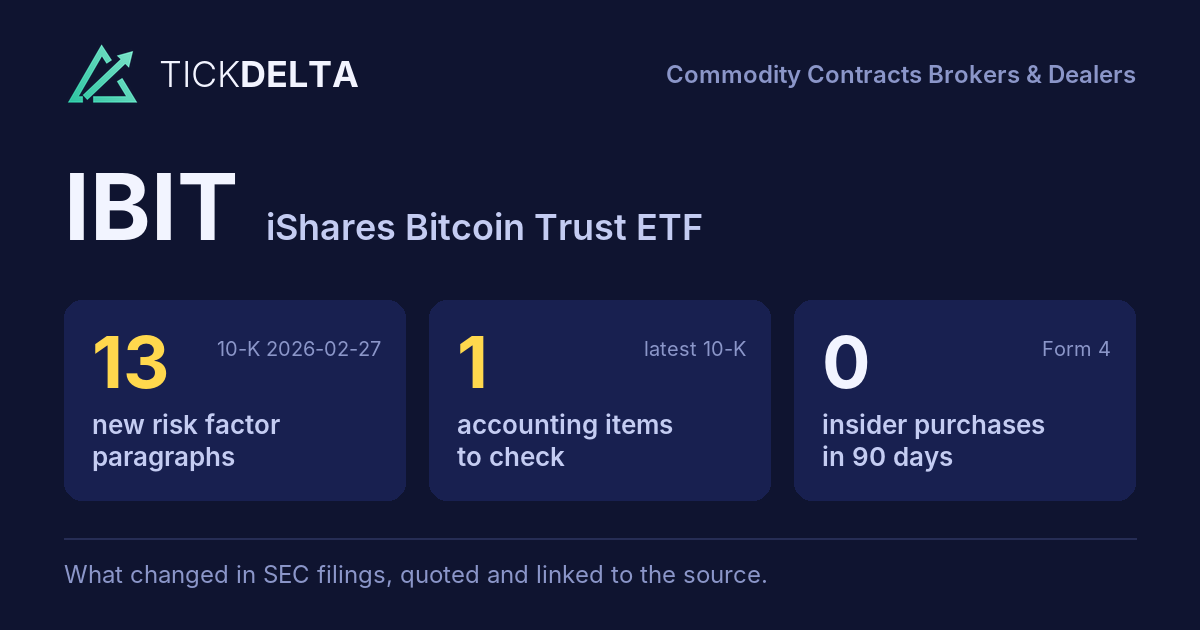
Screener / SEC EDGAR /CIK 0001980994 /10-K filed Feb 27, 2026, compared with Mar 5, 2025 /Numbers from the XBRL of the 10-Ks
Nasdaq Financials · Commodity Contracts Brokers & Dealers

iShares Bitcoin Trust ETF IBIT

Compare with peers Embed
The 10-K against last year's

107 changes: 13 added, 15 removed, 77 reworded, 2 quiet changes

10-K Feb 27, 2026 vs Mar 5, 2025

10-K 0001437749-26-006058 (Feb 27, 2026) vs 10-K 0001437749-25-006260 (Mar 5, 2025) Not compared: Legal Proceedings.

Every paragraph, and how much of it changed

One bar per paragraph, in the order of the 10-K. Height and colour show the share of its words not in the closest paragraph a year earlier; the tallest bars are new paragraphs.

Risk Factors

356 paragraphs · 13 new · 102 reworded · 15 gone · 10-K Feb 27, 2026 against Mar 5, 2025
New paragraph Reworded (5% of its words or more) Same or nearly
Paragraph 132 · 49% changed Every version of it
Given the foundational role that stablecoins play in global digital asset markets, their fundamental liquidity can have a dramatic impact on the broader digital asset market, including the market for bitcoin. Because a large A significant portion of the digital asset market still depends continues to depend on stablecoins such as Tether and USDC, there is a risk that USDC. As such, any disruption in the operation or perceived stability of these stablecoins such as a disorderly de-pegging event or a loss of market confidence resulting in a run on Tether or USDC reserves could lead to dramatic substantial market volatility in across digital assets more broadly. Volatility in stablecoins, Additional risks such as operational issues with stablecoins (for example, failures (e.g., technical issues that prevent settlement), concerns about regarding the sufficiency adequacy or transparency of any reserves that support reserve assets backing stablecoins, the use of unbacked or undercollateralized stablecoins or potential in potentially manipulative activity when unbacked stablecoins are used to pay for other digital assets (including bitcoin), or trading practices and regulatory concerns about scrutiny of stablecoin issuers or intermediaries, such as exchanges, including exchanges that support stablecoins, facilitate stablecoin transactions, may also adversely affect market confidence and liquidity. Further, these risks are underscored by recent legislative developments. On July 18, 2025, the Guiding and Establishing National Innovation for U.S. Stablecoins Act of 2025 (“GENIUS Act”) was enacted, establishing a federal regulatory framework for payment stablecoins. The GENIUS Act will become effective on July 18, 2028. The GENIUS Act prohibits the issuance or use of payment stablecoins unless the issuer obtains a qualifying license and complies with a range of regulatory requirements, including reserve backing with liquid assets, redemption rights, governance standards, and operational transparency. The GENIUS Act also restricts the payment of interest on stablecoins and imposes oversight on both bank and nonbank issuers. The enactment of the GENIUS Act, or the removal or migration of prominent stablecoins from the Bitcoin network, could impact individuals’ reduce the willingness of market participants to trade on trading venues engage in digital asset transactions that rely on stablecoins, reduce diminish liquidity in the bitcoin market, and adversely affect the price of bitcoin. Any such developments could, in turn, materially and adversely impact the value of bitcoin, and in turn impact an investment in the Shares.
Paragraph 94 · 49% changed Every version of it
monetary policies of governments, legislation or regulation, trade restrictions, tariffs, currency devaluations and revaluations and regulatory measures or enforcement actions, if any, that restrict the use of bitcoin as a form of payment or the purchase of bitcoin on the digital asset markets; revaluations;
Paragraph 170 · 38% changed Every version of it
Intellectual property rights claims may Any of these factors could adversely affect the performance of the Trust and the value of the Shares.
Paragraph 197 · 38% changed Every version of it
Further, if the Trustee decides to operationalize the Additional Bitcoin Custodian, the Additional Bitcoin Custodian would perform essential functions in terms of safekeeping any of the Trust’s bitcoin that is held with Anchorage. The Anchorage Custodian Agreement provides the Trust with an available alternative bitcoin custodian to safeguard the Trust’s bitcoin; however, if the Trustee does not operationalize the Additional Bitcoin Custodian, or if Anchorage fails to perform the functions of the Anchorage Custodian Agreement once operationalized, the Trust may be unable to operate or create or redeem Baskets, or may suffer losses, which could force the Trust to liquidate or adversely affect the price of the Shares. Anchorage could terminate services under the Anchorage Custodian Agreement upon providing the applicable notice to the Trust for any reason, or immediately for Cause. A “Termination for Cause” is defined in the Anchorage Custodian Agreement as: (i) the Trust materially breaches any provision of the Additional Bitcoin Custodian Agreement, and such breach remains uncured for a period of 30 calendar days after notice of such breach is provided by Anchorage to the Trust; or (ii) the Trust becomes bankrupt or insolvent. If Anchorage were to terminate services under the Anchorage Custodian Agreement, the Trustee may need to find and appoint a replacement bitcoin custodian. The Trustee may not be able to find a party willing to serve as the custodian of the Trust’s bitcoin or as the Trust’s prime execution agent under the same terms as the current Custodian Agreement or Prime Execution Agent Agreement or at all. To the extent that Trustee is not able to find a suitable party willing to serve as the custodian or prime execution agent, the Trustee may be required to terminate the Trust and liquidate the Trust’s bitcoin. In addition, to the extent that the Trustee finds a suitable party but must enter into a modified Custodian Agreement custodian agreement or Prime Execution Agent Agreement prime execution agent agreement that is less favorable for the Trust or Trustee, the value of the Shares could be adversely affected. If the Trust is unable to find a replacement prime execution agent, its operations could be adversely affected.
Paragraph 196 · 37% changed Every version of it
The Trust is dependent on the Bitcoin Custodian, which is Coinbase Custody, and the Prime Execution Agent, Coinbase Inc. to hold bitcoin. Coinbase Custody performs essential functions in terms of safekeeping the Trust’s bitcoin in the Vault Balance, and its affiliate, Coinbase Inc., in its capacity as Prime Execution Agent, facilitates the buying and selling or settlement of bitcoin by the Trust in connection with cash creations and redemptions, the selling of bitcoin to pay the Sponsor’s Fee, any other Trust expenses, to the extent applicable, and in extraordinary circumstances, to liquidate the Trust’s bitcoin. If Coinbase Custody or Coinbase Inc. fails to perform the functions they perform for the Trust, the Trust may be unable to operate or create or redeem Baskets, which could force the Trust to liquidate or adversely affect the price of the Shares. On March 22, 2023, the Prime Execution Agent and its parent, Coinbase Global, Inc. (such parent, “Coinbase Global” and together with Coinbase Inc., the “Relevant Coinbase Entities”) received a “Wells Notice” from the SEC staff stating that the SEC staff made a “preliminary determination” to recommend that the SEC file an enforcement action against the Relevant Coinbase Entities alleging violations of the federal securities laws, including the Exchange Act and the Securities Act. According to Coinbase Global’s public reporting company disclosure, based on discussions with the SEC staff, the Relevant Coinbase Entities believe these potential enforcement actions would relate to aspects of the Relevant Coinbase Entities’ Coinbase Prime service, spot market, staking service Coinbase Earn, and Coinbase Wallet, and the potential civil action may seek injunctive relief, disgorgement, and civil penalties. On June 6, 2023, the SEC filed a complaint against the Relevant Coinbase Entities in federal district court in the Southern District of New York, alleging, inter alia: (i) that Coinbase Inc. has violated the Exchange Act by failing to register with the SEC as a national securities exchange, broker-dealer, and clearing agency, in connection with activities involving certain identified digital assets that the SEC’s complaint alleges are asserted were securities, (ii) that Coinbase Inc. has had violated the Securities Act by failing to register with the SEC the offer and sale of its staking program, and (iii) that Coinbase Global is was jointly and severally liable as a control person under the Exchange Act for Coinbase Inc.’s violations of the Exchange Act to the same extent as Coinbase Inc. The SEC’s complaint against the Relevant Coinbase Entities does did not allege that bitcoin is a security nor does did it allege that Coinbase Inc’s activities involving bitcoin caused the alleged registration violations, and the Bitcoin Custodian was not named as a defendant. The SEC’s complaint seeks sought a permanent injunction against the Relevant Coinbase Entities to prevent them from violations of the Exchange Act or Securities Act, disgorgement, civil monetary penalties, and such other relief as the court deems deemed appropriate or necessary. On February 27, 2025, the SEC and Coinbase Inc. and Coinbase Global filed a joint stipulation to dismiss the case with prejudice, and the case has been dismissed. Notwithstanding the dismissal of the SEC enforcement action, Coinbase Inc. is currently—and, together with the Bitcoin Custodian, may from time to time be—subject to a variety of other litigation in the future. Although the Trust does not presently anticipate such an outcome, there can be no assurance that in the future Coinbase Inc., as the Prime Execution Agent, could or Coinbase Custody, as Bitcoin Custodian, will not be required, as a result of a judicial determination, or could will not choose, to restrict or curtail the services it offers, they offer, or its their financial condition and ability to provide services to the Trust could will not be negatively affected. If in the future the Prime Execution Agent or the Bitcoin Custodian were to be required or choose, as a result of a regulatory action (including, for example, the litigation initiated by the SEC), choose to restrict or curtail the services it offers, they offer for any reason, whether related to litigation or otherwise, it could negatively affect the Trust’s ability to operate or process creations or redemptions of Baskets, which could force the Trust to liquidate or adversely affect the price of the Shares. While Alternatively, the Trustee could decide to replace Coinbase Custody as the Bitcoin Custodian with custody of the Trust’s bitcoin, pursuant to the Custodian Agreement. Similarly, Coinbase Custody or Coinbase Inc. could terminate services under the Custodian Agreement or the Prime Execution Agent Agreement respectively upon providing the applicable notice to the Trust for any reason, or immediately for Cause. A “Termination for Cause” is defined in the Custodian Agreement and Prime Execution Agent Agreement as (i) the Trust materially breaching any provision of the Custodian Agreement and such failure is not named in the complaint, if cured within 30 calendar days after notice of such breach is provided by Coinbase Global, as the parent of the Bitcoin Custodian, is required, as a result of a judicial determination, or could choose, to restrict or curtail the services its subsidiaries provide Inc. to the Trust, or the Trust materially breaching any provision of the Prime Execution Agent Agreement and such breach remains uncured for 10 calendar days following notice; (ii) the Trust becomes bankrupt or insolvent; or (iii) the Trust fails to pay and settle in full its financial condition is negatively affected, it could negatively affect obligations to Coinbase Custody’s affiliate, the Trade Credit Lender (as defined below), which may, from time to time, provide financing to the Trust in the form of Trade Credits. In the event that the Trust transfers maintenance responsibilities of the Trust’s ability account at the Bitcoin Custodian to operate. another custodian (or transfers the Trust’s bitcoin from the Bitcoin Custodian or the Prime Execution Agent to the Additional Bitcoin Custodian or vice versa), the Trust’s bitcoin would be subject to a risk of loss during the transfer, which if such risk eventuates, could have a negative impact on the performance of the Shares or result in loss of the Trust’s assets. As Prime Execution Agent, Coinbase Inc. does not guarantee uninterrupted access to the Trading Platform or the services it provides to the Trust as Prime Execution Agent. Under certain circumstances, Coinbase Inc. is permitted to halt or suspend trading on its trading platform, or impose limits on the amount or size of, or reject, the Trust’s orders, including in the event of, among others, (a) delays, suspension of operations, failure in performance, or interruption of service that are directly due to a cause or condition beyond the reasonable control of Coinbase Inc, (b) the Trust has engaged in unlawful or abusive activities or fraud, (c) the acceptance of the Trust’s order would cause the amount of Trade Credits extended to exceed the maximum amount of Trade Credit (as defined below) that the Trust’s agreement with the Trade Credit Lender permits to be outstanding at any one time, or (d) a security or technology issue occurred and is continuing that results in Coinbase Inc. being unable to provide trading services or accept the Trust’s order, in each case, subject to certain protections for the Trust. Also, if Coinbase Custody or Coinbase Inc. becomes insolvent, suffers business failure, ceases business operations, defaults on or fails to perform their obligations under their contractual agreements with the Trust, or abruptly discontinues the services they provide to the Trust for any reason, the Trust’s operations, including its creation and redemption processes, would be adversely affected.
Paragraph 19 · 37% changed Every version of it
Moreover, in the past flaws in the source code for digital assets have been exposed and exploited, including flaws that disabled some functionality for users, exposed users’ personal information and/or resulted in the theft of users’ digital assets. The cryptography underlying bitcoin could prove to be flawed or ineffective, or developments in mathematics and/or technology, including advances in digital computing, algebraic geometry and quantum computing, could result in such cryptography becoming ineffective. Quantum computing technology is an emerging phenomenon which, because it is still developing, makes it difficult to predict its ultimate effect on the future value of bitcoin and other digital assets. However, if quantum computing technology is able to advance and significantly increase its capacity relative to the capacity of today’s leading quantum computers, it could potentially undermine the viability of many of the cryptographic algorithms used across the world’s information technology infrastructure, including the cryptographic algorithms used for digital assets like bitcoin. If quantum computing is able to advance in that way, there is a risk that quantum computing could result in the cryptography underlying the Bitcoin network becoming ineffective, which, if realized, could compromise the security of the Bitcoin network, or allow a malicious actor to compromise the wallets holding bitcoin owned by the Trust or others on the Bitcoin network, which would result in losses to Shareholders. While various actors in the Bitcoin community are taking steps to enable the uses of cryptographic algorithms that would be resistant to advanced quantum computers, there is no guarantee that new quantum-proof architectures will be built and appropriate transitions will be implemented across the network at scale in a timely manner; any such changes could require the achievement of broad consensus within the Bitcoin network community and a fork (or multiple forks), and there can be no assurance that such consensus would be achieved or the changes implemented successfully. See “ --Changes in the governance of a digital asset network may not receive sufficient support from users and miners, which may negatively affect that digital asset network’s ability to grow and respond to challenges” and “ --A temporary or permanent “fork” could adversely affect the value of the Shares.” If any of the foregoing were to occur, it could result in losses to Shareholders. In any of these circumstances, a malicious actor may be able to compromise the security of the Bitcoin network or take the Trust’s bitcoin, which would adversely affect the value of the Shares. Moreover, functionality of the Bitcoin network may be negatively affected such that it is no longer attractive to users, thereby dampening demand for bitcoin. Even if another digital asset other than bitcoin were affected by similar circumstances, any reduction in confidence in the source code or cryptography underlying digital assets generally could negatively affect the demand for digital assets and therefore adversely affect the value of the Shares.
Paragraph 182 · 37% changed Every version of it
The Trust will not hold or trade in commodity interests (as currently defined) regulated by the CEA, as administered by the CFTC. Furthermore, the Sponsor believes that the Trust is not a commodity pool for purposes of the CEA, and that neither the Sponsor nor the Trustee is subject to regulation by the CFTC as a commodity pool operator or a commodity trading adviser in connection with the operation of the Trust. Consequently, Shareholders will not have the regulatory protections provided to investors in CEA-regulated instruments or commodity pools. However, Congress is currently considering legislation, such as the Digital Asset Market Clarity Act of 2025 (CLARITY Act), which could give the CFTC greater powers to regulate the spot digital asset market. It is possible that, if legislation is passed, it could require the Trust or the Sponsor, or service providers to the Trust, such as the Prime Execution Agent, Authorized Participants, or Bitcoin Trading Counterparties, among others, to register with the CFTC. Such additional regulatory obligations may cause the Trust, the Trustee, the Sponsor Sponsor, the Prime Execution Agent, the Authorized Participants or Bitcoin Trading Counterparties to incur extraordinary expenses. If the Trust, the Trustee, the Sponsor Sponsor, the Prime Execution Agent, the Authorized Participants or the Bitcoin Trading Counterparties decided to seek the required licenses, there is no guarantee that they will timely receive them. The Trustee may decide to discontinue and wind up the Trust. A dissolution of the Trust in response to the changed regulatory circumstances may be at a time that is disadvantageous to the Shareholders. A Bitcoin Trading Counterparty may also instead decide to terminate its role as a Bitcoin Trading Counterparty of the Trust, which may decrease the liquidity of the Shares.
Paragraph 56 · 35% changed Every version of it
The Bitcoin network operates using open-source protocols, meaning that any user can download the software, modify it and then propose that the users and miners of bitcoin adopt the modification. When a modification is introduced and a substantial majority of users and miners consent to the modification, the change is implemented and the network remains uninterrupted. However, if less than a substantial majority of users and miners consent to the proposed modification, and the modification is not compatible with the software prior to its modification, the consequence would be what is known as a “hard fork” of the Bitcoin network, with one group running the pre-modified software and the other running the modified software. The effect of such a fork would be the existence of two versions of bitcoin running in parallel on separate networks using separate blockchain ledgers, yet lacking interchangeability. For example, in August 2017, bitcoin “forked” into bitcoin and a new digital asset, Bitcoin Cash, as a result of a several-year dispute over how to increase the rate of transactions that the Bitcoin network can process. There have been other contentious disputes over changes to the Bitcoin network’s source code, though these have not led to hard forks. For example, the predominant software implementation used to access the Bitcoin network is Bitcoin Core. The October 2025 release of the updated Bitcoin Core client (version 30) removed a long-standing limit on the inclusion of non-transaction-related data in blocks, the effect of which is to permit larger amounts of arbitrary data to be embedded in transactions. This change has prompted debate within the bitcoin community. Because the change is backwards-compatible, rather than a hard fork, certain previous versions of the Bitcoin Core client remain operable, and it remains interoperable with other clients, such as Bitcoin Knots. Some participants have expressed concerns that such changes could facilitate the inclusion of illegal or non-transaction-related content on the Bitcoin blockchain or could introduce new or unknown software vulnerabilities. In response, certain miners and users have reportedly adopted alternative client software implementations to access the Bitcoin network, such as Bitcoin Knots. There is a risk that unresolved divisions could lead to community fragmentation which, if they grew sufficiently severe and were not resolved, eventually a future Bitcoin network hard fork could occur, which may adversely affect the security or stability of the Bitcoin network (such as if miners leave the original Bitcoin network for the forked network), reduce or impede the adoption of bitcoin overall, or cause bitcoin or the Shares to lose value.

MD&A

19 paragraphs · 0 new · 10 reworded · 0 gone · 10-K Feb 27, 2026 against Mar 5, 2025
New paragraph Reworded (5% of its words or more) Same or nearly
Paragraph 10 · 25% changed
The Trust’s net asset value grew increased from $100,000 at December 31, 2023 to $51,519,566,547 at December 31, 2024. 2024 to $67,401,155,244 at December 31, 2025, a 30.83% increase. The increase in the Trust’s net asset value resulted primarily from an increase in the number of outstanding Shares, which rose from 4,000 Shares at December 31, 2023 to 970,440,000 Shares at December 31, 2024, 2024 to 1,358,680,000 Shares at December 31, 2025, a consequence of 982,160,000 623,640,000 Shares (24,554 (15,591 Baskets) being created and 11,724,000 235,400,000 Shares (293 Baskets plus the original 4,000 seed Shares) (5,885 Baskets) being redeemed during the period. year. The increase in the Trust’s net asset value also benefited from an increase was partially offset by a decrease in the price of bitcoin, which rose 112.78% fell 6.32% from the Trust’s first bitcoin purchase at $43,878.41 on January 5, 2024 to $93,365.36 at December 31, 2024. 2024 to $87,463.03 at December 31, 2025.
Paragraph 12 · 24% changed
The NAV of $60.57 $71.32 on December 17, 2024 October 6, 2025 was the highest during the period, year, compared with a low during the period year of $22.36 $43.60 on January 23, 2024. April 8, 2025.
Paragraph 3 · 12% changed
The Trust is a Delaware statutory trust. The Trust does not have any officers, directors, or employees, and is administered by the Second Third Amended and Restated Trust Agreement dated as of December 28, 2023, June 27, 2025, among the Sponsor, the Trustee and the Delaware Trustee, as amended by Amendment No. 1 thereto, with effect from August 8, 2024. Trustee. The Trust issues Shares representing fractional undivided beneficial interests in its net assets. The assets of the Trust consist primarily of bitcoin held by a custodian on behalf of the Trust.
Paragraph 13 · 12% changed
Net increase decrease in net assets resulting from operations for the year ended December 31, 2024 2025 was $14,232,135,930, $8,968,686,985, resulting from an unrealized gain loss on investment in bitcoin of $14,157,070,942, $11,437,550,471 and a net investment loss of $174,563,824, partially offset by a net realized gain of $18,811,883 $41,985,070 from bitcoin sold to pay expenses and expenses, a net realized gain of $103,751,770 $2,110,644,201 from bitcoin sold for the redemption of Shares, partially offset by Shares and a net investment loss realized gain of $47,498,665. $490,798,039 from bitcoin paid for the in-kind redemptions of Shares. Other than the net Sponsor’s Fee of $47,498,665, $174,563,824, the Trust had no expenses during the period. year.
Paragraph 11 · 12% changed
The 112.36% increase 6.55% decrease in the NAV for purposes of the Trust’s periodic financial statements (“Financial Statement NAV”) from $25.00 at December 31, 2023 to $53.09 at December 31, 2024 to $49.61 at December 31, 2025 is directly related to the 112.78% increase 6.32% decrease in the price of bitcoin. The Financial Statement NAV increased decreased slightly less more than the price of bitcoin on a percentage basis due to the net Sponsor’s Fee, which was $47,498,665 $174,563,824 for the period, year, or 0.22% 0.25% of the Trust’s average weighted assets of $21,516,137,559 $69,896,349,409 during the period. year.
Paragraph 7 · 10% changed
The Trust is not aware of any trends, demands, conditions or events that are reasonably likely to result in material changes to its liquidity needs. In exchange for a fee, the Sponsor has agreed to assume most of the expenses incurred by the Trust. For As a result, the only ordinary expense of the Trust during the period covered by this report, report was the Trust did not incur any Sponsor’s Fee. The Trust’s only source of liquidity is its sales of bitcoin.
Paragraph 15 · 6% changed
The 112.36% increase in the Financial Statement NAV for purposes of the Trust’s periodic financial statements (“Financial Statement NAV”) from $25.00 at December 31, 2023 to $53.09 at December 31, 2024 is directly related to the 112.78% increase in the price of bitcoin. The Financial Statement NAV increased slightly less than the price of bitcoin on a percentage basis due to the Sponsor’s Fee, which was $47,498,665 for the period, or 0.22% of the Trust’s average weighted assets of $21,516,137,559 during the period.

A paragraph is matched with the one last year that shares the most of its words; under half in common makes it new. The paragraphs shown are the 8 reworded the most in each section.

The paragraph that changed most in each section

The redline

Marked against last year's 10-K: cut words struck through, new words highlighted.

Risk Factors827 words changed in this paragraph; it is 51% similar to last year's version.
The Trust is dependent on the Bitcoin Custodian, which is Coinbase Custody, and the Prime Execution Agent, Coinbase Inc. to hold bitcoin. Coinbase Custody performs essential functions in terms of safekeeping the Trust’s bitcoin in the Vault Balance, and its affiliate, Coinbase Inc., in its capacity as Prime Execution Agent, facilitates the buying and selling or settlement of bitcoin by the Trust in connection with cash creations and redemptions, the selling of bitcoin to pay the Sponsor’s Fee, any other Trust expenses, to the extent applicable, and in extraordinary circumstances, to liquidate the Trust’s bitcoin. If Coinbase Custody or Coinbase Inc. fails to perform the functions they perform for the Trust, the Trust may be unable to operate or create or redeem Baskets, which could force the Trust to liquidate or adversely affect the price of the Shares. On March 22, 2023, the Prime Execution Agent and its parent, Coinbase Global, Inc. (such parent, “Coinbase Global” and together with Coinbase Inc., the “Relevant Coinbase Entities”) received a “Wells Notice” from the SEC staff stating that the SEC staff made a “preliminary determination” to recommend that the SEC file an enforcement action against the Relevant Coinbase Entities alleging violations of the federal securities laws, including the Exchange Act and the Securities Act. According to Coinbase Global’s public reporting company disclosure, based on discussions with the SEC staff, the Relevant Coinbase Entities believe these potential enforcement actions would relate to aspects of the Relevant Coinbase Entities’ Coinbase Prime service, spot market, staking service Coinbase Earn, and Coinbase Wallet, and the potential civil action may seek injunctive relief, disgorgement, and civil penalties. On June 6, 2023, the SEC filed a complaint against the Relevant Coinbase Entities in federal district court in the Southern District of New York, alleging, inter alia: (i) that Coinbase Inc. has violated the Exchange Act by failing to register with the SEC as a national securities exchange, broker-dealer, and clearing agency, in connection with activities involving certain identified digital assets that the SEC’s complaint alleges are asserted were securities, (ii) that Coinbase Inc. has had violated the Securities Act by failing to register with the SEC the offer and sale of its staking program, and (iii) that Coinbase Global is was jointly and severally liable as a control person under the Exchange Act for Coinbase Inc.’s violations of the Exchange Act to the same extent as Coinbase Inc. The SEC’s complaint against the Relevant Coinbase Entities does did not allege that bitcoin is a security nor does did it allege that Coinbase Inc’s activities involving bitcoin caused the alleged registration violations, and the Bitcoin Custodian was not named as a defendant. The SEC’s complaint seeks sought a permanent injunction against the Relevant Coinbase Entities to prevent them from violations of the Exchange Act or Securities Act, disgorgement, civil monetary penalties, and such other relief as the court deems deemed appropriate or necessary. On February 27, 2025, the SEC and Coinbase Inc. and Coinbase Global filed a joint stipulation to dismiss the case with prejudice, and the case has been dismissed. Notwithstanding the dismissal of the SEC enforcement action, Coinbase Inc. is currently—and, together with the Bitcoin Custodian, may from time to time be—subject to a variety of other litigation in the future. Although the Trust does not presently anticipate such an outcome, there can be no assurance that in the future Coinbase Inc., as the Prime Execution Agent, could or Coinbase Custody, as Bitcoin Custodian, will not be required, as a result of a judicial determination, or could will not choose, to restrict or curtail the services it offers, they offer, or its their financial condition and ability to provide services to the Trust could will not be negatively affected. If in the future the Prime Execution Agent or the Bitcoin Custodian were to be required or choose, as a result of a regulatory action (including, for example, the litigation initiated by the SEC), choose to restrict or curtail the services it offers, they offer for any reason, whether related to litigation or otherwise, it could negatively affect the Trust’s ability to operate or process creations or redemptions of Baskets, which could force the Trust to liquidate or adversely affect the price of the Shares. While Alternatively, the Trustee could decide to replace Coinbase Custody as the Bitcoin Custodian with custody of the Trust’s bitcoin, pursuant to the Custodian Agreement. Similarly, Coinbase Custody or Coinbase Inc. could terminate services under the Custodian Agreement or the Prime Execution Agent Agreement respectively upon providing the applicable notice to the Trust for any reason, or immediately for Cause. A “Termination for Cause” is defined in the Custodian Agreement and Prime Execution Agent Agreement as (i) the Trust materially breaching any provision of the Custodian Agreement and such failure is not named in the complaint, if cured within 30 calendar days after notice of such breach is provided by Coinbase Global, as the parent of the Bitcoin Custodian, is required, as a result of a judicial determination, or could choose, to restrict or curtail the services its subsidiaries provide Inc. to the Trust, or the Trust materially breaching any provision of the Prime Execution Agent Agreement and such breach remains uncured for 10 calendar days following notice; (ii) the Trust becomes bankrupt or insolvent; or (iii) the Trust fails to pay and settle in full its financial condition is negatively affected, it could negatively affect obligations to Coinbase Custody’s affiliate, the Trade Credit Lender (as defined below), which may, from time to time, provide financing to the Trust in the form of Trade Credits. In the event that the Trust transfers maintenance responsibilities of the Trust’s ability account at the Bitcoin Custodian to operate. another custodian (or transfers the Trust’s bitcoin from the Bitcoin Custodian or the Prime Execution Agent to the Additional Bitcoin Custodian or vice versa), the Trust’s bitcoin would be subject to a risk of loss during the transfer, which if such risk eventuates, could have a negative impact on the performance of the Shares or result in loss of the Trust’s assets. As Prime Execution Agent, Coinbase Inc. does not guarantee uninterrupted access to the Trading Platform or the services it provides to the Trust as Prime Execution Agent. Under certain circumstances, Coinbase Inc. is permitted to halt or suspend trading on its trading platform, or impose limits on the amount or size of, or reject, the Trust’s orders, including in the event of, among others, (a) delays, suspension of operations, failure in performance, or interruption of service that are directly due to a cause or condition beyond the reasonable control of Coinbase Inc, (b) the Trust has engaged in unlawful or abusive activities or fraud, (c) the acceptance of the Trust’s order would cause the amount of Trade Credits extended to exceed the maximum amount of Trade Credit (as defined below) that the Trust’s agreement with the Trade Credit Lender permits to be outstanding at any one time, or (d) a security or technology issue occurred and is continuing that results in Coinbase Inc. being unable to provide trading services or accept the Trust’s order, in each case, subject to certain protections for the Trust. Also, if Coinbase Custody or Coinbase Inc. becomes insolvent, suffers business failure, ceases business operations, defaults on or fails to perform their obligations under their contractual agreements with the Trust, or abruptly discontinues the services they provide to the Trust for any reason, the Trust’s operations, including its creation and redemption processes, would be adversely affected.

Source: Item 1A, 10-K 0001437749-26-006058 vs Item 1A, 10-K 0001437749-25-006260

Accounting Policies40 words changed in this paragraph; it is 56% similar to last year's version.
Coinbase Custody Trust Company, LLC (the “Bitcoin Custodian”) is responsible for safekeeping the bitcoin owned by the Trust. Anchorage Digital Bank N.A. is the “Additional Bitcoin Custodian” for the Trust. At the current time, the Sponsor has no plans to move any of the Trust’s bitcoin to the Additional Bitcoin Custodian. The Bitcoin Custodian is and the Additional Bitcoin Custodian are appointed by the Trustee.

Source: 10-K text, Note 2 – Significant Accounting Policies, 10-K 0001437749-26-006058 vs 10-K text, Note 2 – Significant Accounting Policies, 10-K 0001437749-25-006260

MD&A38 words changed in this paragraph; it is 78% similar to last year's version.
Net increase decrease in net assets resulting from operations for the year ended December 31, 2024 2025 was $14,232,135,930, $8,968,686,985, resulting from an unrealized gain loss on investment in bitcoin of $14,157,070,942, $11,437,550,471 and a net investment loss of $174,563,824, partially offset by a net realized gain of $18,811,883 $41,985,070 from bitcoin sold to pay expenses and expenses, a net realized gain of $103,751,770 $2,110,644,201 from bitcoin sold for the redemption of Shares, partially offset by Shares and a net investment loss realized gain of $47,498,665. $490,798,039 from bitcoin paid for the in-kind redemptions of Shares. Other than the net Sponsor’s Fee of $47,498,665, $174,563,824, the Trust had no expenses during the period. year.

Source: Item 7, 10-K 0001437749-26-006058 vs Item 7, 10-K 0001437749-25-006260

Sentences and paragraphs added, removed or reworded

Every change, by type

Sentences and paragraphs of IBIT's Risk Factors and MD&A, 10-K Feb 27, 2026 against 10-K Mar 5, 2025. Each links to the text at sec.gov.

Quiet changes are sentences kept from last year with one to four words changed, at least one of them a hedge, a modal or a qualifier (may, could, will, not, significant, material…). A year or date rolling forward is not counted.

The full word list

adverse, adversely, all, although, anticipate, anticipates, any, approximately, believe, believes, can, cannot, certain, could, expect, expects, generally, however, if, intend, intends, largely, likely, many, material, materially, may, might, most, must, never, no, not, possible, primarily, probable, should, significant, significantly, some, substantial, substantially, unlikely, will, would

AddedRisk Factors
On March 6, 2025, President Trump issued an executive order for the “Establishment of the Strategic Bitcoin Reserve and United States Digital Asset Stockpile” (the “Order”). The Order requires the Secretary of the U.S. Department of Treasury to establish two offices to administer and maintain a “Strategic Bitcoin Reserve” (the “Bitcoin Reserve”) and a U.S. Digital Asset Stockpile (the “Digital Asset Stockpile”), respectively. The Bitcoin Reserve is intended to be capitalized with bitcoin forfeited as part of U.S. criminal or civil proceedings or in satisfaction of penalties imposed by executive agencies. The Digital Asset Stockpile is intended to be capitalized initially with other digital assets forfeited as part of criminal or civil asset forfeiture proceedings. Following the issuance of the Order, bitcoin markets developed expectations that the United States may begin acquiring and holding bitcoin, which many viewed as a positive development for bitcoin prices. The Order directs the Secretaries of the U.S. Treasury Department and the U.S. Department of Commerce to develop budget-neutral strategies for acquiring additional bitcoin for the Bitcoin Reserve. Legislation was introduced in the U.S. Senate and the U.S. House of Representatives that would direct the acquisition of one million bitcoin by the federal government over a five-year period, to be held in trust in secure storage by the U.S. Treasury. The bill proposed funding the bitcoin acquisition using remittances from the Federal Reserve, revaluations of Federal Reserve gold certificates, and other mechanisms characterized as budget-neutral (such as transfers from federal agencies using bitcoin acquired through asset forfeitures). Bills were also introduced in several state legislatures to authorize the acquisition of bitcoin by state governments or their instrumentalities, some of which have failed to pass. As of early 2026, these initiatives remain subject to significant uncertainty. While some administrative steps have reportedly been taken, there is no assurance that the federal government or any state government will announce or implement bitcoin acquisition plans, or that any such plans will meet market expectations. Even if government acquisitions occur or legislation requiring acquisitions is enacted, the price of bitcoin may decline if there are implementation challenges, unexpected difficulties, policy or legal reversals, or changes in political priorities, any of which may negatively impact Share value. Executive orders such as the Order are subject to change and can be reversed or overturned. The enduring existence and size of the Bitcoin Reserve and Digital Asset Stockpile, and the passage and implementation of legislation at the federal or state level, remain subject to complex challenges and uncertainty that make it difficult to evaluate their effect on the value of bitcoin and the Shares, now or in the future.
Read it in 10-K Feb 27, 2026 at sec.gov
AddedRisk Factors
There are a small number of major suppliers of bitcoin mining hardware globally, and a significant amount of bitcoin mining hardware manufacturing is located in China. Mining hardware manufacturers may fail to supply the mining hardware due to their inability to manufacture sufficient mining hardware, whether due to shortages of components or resources such as semiconductors, or due to default, insolvency, or changes of laws and trade restrictions (including export/import restrictions, quotas or tariffs). Trade policies such as export/import restrictions, quotas or tariffs may reduce the ability of bitcoin mining hardware suppliers to supply miners with bitcoin mining hardware or create a shortage or lack of components necessary for their manufacture or repair. If bitcoin miners are unable to source mining hardware from those suppliers (for example due to overwhelming global demand for bitcoin miners, or due to trade restrictions, or other causes) at commercially reasonable prices, or at all, and replacement or substitute sources of bitcoin mining hardware prove to be unavailable, there could be a negative impact on bitcoin mining globally. These could affect the Bitcoin network by making it more difficult for transactions to be confirmed, increasing transaction costs, or affecting the Bitcoin network’s security, among other negative effects, any of which could negatively affect the value of bitcoin and consequently the Shares.
Read it in 10-K Feb 27, 2026 at sec.gov
AddedRisk Factors
Manufacture, assembly and delivery of hardware and components for mining operations can be complex and protracted processes, during the course of which various problems could arise, including disruptions or delays in the supply chain, product quality control issues, as well as other external factors.
Read it in 10-K Feb 27, 2026 at sec.gov
AddedRisk Factors
Mining operations can ordinarily only be profitable if the costs associated with bitcoin mining, including hardware costs, are lower than the price of bitcoin itself. During the course of the normal operation of bitcoin mining facilities, miners and other critical equipment and materials related to data center construction and maintenance, such as containers, switch gears, transformers and cables, will experience ordinary wear and tear and may also face more significant malfunctions. Declines in the condition of miners and other hardware will require bitcoin miners, over time, to repair or replace those miners.
Read it in 10-K Feb 27, 2026 at sec.gov
AddedRisk Factors
Additionally, as the technology evolves, miners may be required to acquire newer models of mining hardware and machines to remain competitive in the market. Any upgrading process may require substantial capital investment, and miners may face challenges in doing so on a timely and cost-effective basis. The business of bitcoin miners will be subject to limitations inherent within the supply chain of their mining hardware equipment and components, including competitive, governmental, and legal limitations, and other events. For example, many miners will significantly rely on foreign imports to obtain mining hardware equipment and materials. Any global trade disruption, introductions of tariffs, trade barriers and bilateral trade frictions, together with any potential downturns in the global economy resulting therefrom, could adversely affect the necessary supply chains for mining hardware. Depending on the magnitude of such effects on the mining hardware supply chain, shipments of parts for mining hardware, or new mining hardware and equipment, may be delayed.
Read it in 10-K Feb 27, 2026 at sec.gov
AddedRisk Factors
There are a small number of major suppliers of bitcoin mining hardware globally, and a significant amount of bitcoin mining hardware manufacturing is located in China. Mining hardware manufacturers may fail to supply the mining hardware due to their inability to manufacture sufficient mining hardware, whether due to shortages of components or resources such as semiconductors, or changes of laws and trade restrictions (including export/import restrictions, quotas or tariffs), or due to insolvency, or non-performance or default on their contracts. Trade policies such as export/import restrictions, quotas or tariffs may reduce the ability of bitcoin mining hardware suppliers to supply miners with bitcoin mining hardware or create a shortage or lack of components necessary for their manufacture or repair. If bitcoin miners are unable to source mining hardware from those suppliers (for example due to overwhelming global demand for bitcoin miners, or due to trade restrictions, or other causes) at commercially reasonable prices, or at all, and replacement or substitute sources of bitcoin mining hardware prove to be unavailable, there could be a negative impact on bitcoin mining globally. These could affect the Bitcoin network by making it more difficult for transactions to be confirmed, increase transaction costs, or affect the Bitcoin network’s security, among other negative effects, any of which could negatively affect the value of bitcoin and consequently the Shares.
Read it in 10-K Feb 27, 2026 at sec.gov
AddedRisk Factors
Further, the first-generation ASIC chips and other critical components for mining equipment may be subject to price fluctuations or shortages. For example, the ASIC chip is the key component of a mining machine as it determines the efficiency of the device. The production of ASIC chips typically requires highly sophisticated silicon wafers, which currently only a small number of fabrication facilities, or wafer foundries, in the world are capable of producing. There have been previous microchip shortages which led to price fluctuations and disruption in the supply of key bitcoin mining hardware components. ASIC chips have recently been subject to supply and demand fluctuations, significant price increases and shortages. Shortages of ASIC chips could create problems in the supply chain for bitcoin mining equipment, negatively affecting the Bitcoin network by making it more difficult for transactions to be confirmed or increasing transaction costs, or even affecting network security, which again could cause the value of bitcoin and the Shares to decline.
Read it in 10-K Feb 27, 2026 at sec.gov
Show the other 41
AddedRisk Factors
With respect to the Anchorage Custodian Agreement, other than with respect to claims and losses arising from: (i) fraud or willful misconduct of the Additional Bitcoin Custodian and (ii) the Anchorage Mutually Capped Liabilities (defined below), in no event will the Additional Bitcoin Custodian’s liability exceed the value of the cash or affected bitcoin giving rise to such liability. With respect to Anchorage Mutually Capped Liabilities, other than with respect to claims and losses arising from fraud or willful misconduct of the Additional Bitcoin Custodian, in no event will the Additional Bitcoin Custodian’s liability exceed the greater of $5 million and the aggregate amount of fees paid by client to the Additional Bitcoin Custodian in the 12-month period prior to the event giving rise to such liability. “Anchorage Mutually Capped Liabilities” means (i) claims and losses arising from a party’s breach of its confidentiality obligations under the Anchorage Custodian Agreement, (ii) a party’s indemnity obligations under the Anchorage Custodian Agreement (except with respect to the full amount of any Trust bitcoin lost, which shall not constitute an Anchorage Mutually Capped Liability), and (iii) claims and losses arising from the violation, misappropriation, or infringement by a party of any third-party intellectual and/or industrial property rights, including patent rights, copyrights, moral rights, trademarks, trade names, service marks, trade secrets, rights in inventions (including applications for, and registrations, extensions, renewals, and re-issuances of the foregoing).
Read it in 10-K Feb 27, 2026 at sec.gov
AddedRisk Factors
With respect to claims and losses related to a withdrawal or transfer of bitcoin, if the Trust has operationalized Anchorage, the value of such digital assets shall be determined by reference to the benchmark valuation on the date delivery of such bitcoin in connection with such withdrawal or transfer is due in accordance with the terms of the Anchorage Custodian Agreement. In respect of any incidental, indirect, special, punitive, consequential or similar losses, the Additional Bitcoin Custodian is not liable, even if the Additional Bitcoin Custodian has been advised of or knew or should have known of the possibility thereof. The Additional Bitcoin Custodian is not liable for delays, suspension of operations, failure in performance, or interruption of service to the extent it is directly due to a cause or condition beyond the reasonable control of the Additional Bitcoin Custodian.
Read it in 10-K Feb 27, 2026 at sec.gov
AddedRisk Factors
The Trust’s NAV will fluctuate with changes in the market value of bitcoin and its securities, and the Sponsor expects the trading price of the Shares to fluctuate in accordance with changes in the Trust’s NAV, as well as market supply and demand. However, the Shares may trade on NASDAQ at a price that is at, above or below the Trust’s NAV for a variety of reasons. For example, NASDAQ is open for trading in the Shares for a limited period each day, but the digital asset market is a 24-hour marketplace. During periods when NASDAQ is closed but constituent trading platforms are open, significant changes in the price of bitcoin on the digital asset market could result in a difference in performance between the value of bitcoin as measured by IBIT shares or the Bitcoin Index and the most recent NAV or closing trading price. For example, if the price of bitcoin on the digital asset market, and the value bitcoin as measured by the Bitcoin Index, move significantly in a negative direction after the close of NASDAQ, the trading price of the Shares may “gap” down to the full extent of such negative price shift when NASDAQ reopens. If the price of bitcoin on the digital asset market drops significantly during hours NASDAQ is closed, shareholders may not be able to sell their Shares until after the “gap” down has been fully realized, resulting in an inability to mitigate losses in a negative market. Even during periods when NASDAQ is open, large constituent trading platforms (or a substantial number of smaller constituent trading platforms) may be lightly traded or closed for any number of reasons, which could increase trading spreads and widen any premium or discount on the Shares.
Read it in 10-K Feb 27, 2026 at sec.gov
RemovedRisk Factors
The trading prices of many digital assets, including bitcoin, have experienced extreme volatility in recent periods and may continue to do so. The average one-year trailing volatility of bitcoin over the past ten years to date remains elevated at 66%. Over the course of 2021, there were steep increases in the value of certain digital assets, including bitcoin, and multiple market observers asserted that digital assets were experiencing a “bubble.” These increases were followed by steep drawdowns throughout 2022 in digital asset trading prices, including for bitcoin. In the 2021-2022 cycle, the price of bitcoin peaked at $67,734 and bottomed at $15,632, marking a steep 77% drawdown. These episodes of rapid price appreciation followed by steep drawdowns have occurred multiple times throughout bitcoin’s history, including in 2011, 2013-2014, and 2017-2018, before repeating again in 2021-2022.
Read it in 10-K Mar 5, 2025 at sec.gov
RemovedRisk Factors
The Trust is an “emerging growth company” and it cannot be certain if the reduced disclosure requirements applicable to emerging growth companies will make the Shares less attractive to investors.
Read it in 10-K Mar 5, 2025 at sec.gov
RemovedRisk Factors
The Trust is an “emerging growth company” as defined in the JOBS Act. For as long as the Trust continues to be an emerging growth company it may choose to take advantage of certain exemptions from various reporting requirements applicable to other public companies but not to emerging public companies, which include, among other things:
Read it in 10-K Mar 5, 2025 at sec.gov
RemovedRisk Factors
exemptions from the requirements of holding advisory “say-on-pay” votes on executive compensation and shareholder advisory votes on “golden parachute” compensation; and
Read it in 10-K Mar 5, 2025 at sec.gov
RemovedRisk Factors
exemption from any rules requiring mandatory audit firm rotation and auditor discussion and analysis and, unless otherwise determined by the SEC, any new audit rules adopted by the Public Company Accounting Oversight Board.
Read it in 10-K Mar 5, 2025 at sec.gov
RemovedRisk Factors
The Trust could be an emerging growth company until the last day of the fiscal year following the fifth anniversary after its initial public offering, or until the earliest of (1) the last day of the fiscal year in which it has annual gross revenue of $1.235 billion or more, (2) the date on which it has, during the previous three year period, issued more than $1 billion in non-convertible debt or (3) the date on which it is deemed to be a large accelerated filer under the federal securities laws. The Trust will qualify as a large accelerated filer as of the first day of the first fiscal year after it has (A) more than $700 million in outstanding equity held by nonaffiliates, (B) been public for at least 12 months and (C) filed at least one annual report on Form 10-K.
Read it in 10-K Mar 5, 2025 at sec.gov
RemovedRisk Factors
Under the JOBS Act, emerging growth companies are also permitted to elect to delay adoption of new or revised accounting standards until companies that are not subject to periodic reporting obligations are required to comply, if such accounting standards apply to non-reporting companies. However, the Trust has chosen to opt out of this extended transition period for complying with new or revised accounting standards. Section 107 of the JOBS Act provides that the decision to opt out of the extended transition period for complying with new or revised accounting standards is irrevocable.
Read it in 10-K Mar 5, 2025 at sec.gov
RemovedRisk Factors
The Trust is currently only able to accept cash purchase orders and redemption orders, which means that an Authorized Participant will deliver only cash to create Shares and will receive only cash when redeeming Shares and the Trust will choose, in its sole discretion, to enter into a transaction with a Bitcoin Trading Counterparty or the Prime Execution Agent to buy or sell bitcoin in exchange for cash. However, and in common with other spot bitcoin exchange‑traded products, the Trust is not at this time able to create and redeem Shares via in‑kind transactions with Authorized Participants in exchange for bitcoin.
Read it in 10-K Mar 5, 2025 at sec.gov
RemovedRisk Factors
To the knowledge of the Sponsor, exchange-traded products for all spot-market commodities other than bitcoin, such as gold and silver, employ in-kind creations and redemptions with the underlying asset. The Sponsor believes that it is generally more efficient, and therefore less costly, for spot commodity exchange-traded products to utilize in-kind orders rather than cash orders, because there are fewer steps in the process and therefore there is less operational risk involved when an authorized participant can manage the buying and selling of the underlying asset itself, rather than depend on an unaffiliated party such as the issuer or sponsor of the exchange-traded product. As such, a spot commodity exchange-traded product that only employs cash creations and redemptions and does not permit in-kind creations and redemptions is a novel product that has not been tested, and could be impacted by any resulting operational inefficiencies.
Read it in 10-K Mar 5, 2025 at sec.gov
RewordedRisk Factors
There On May 15, 2025, the Division of Trading and Markets of the SEC and the Office of General Counsel of FINRA stated that broker-dealers are permitted to facilitate in-kind creations and redemptions in connection with spot crypto exchange-traded products; however, there has yet to be definitive regulatory guidance on whether and the specific details of how registered broker-dealers can comply with these SEC rules with regard to transacting in or holding spot bitcoin.
Read it in 10-K Feb 27, 2026 at sec.gov
RewordedRisk Factors
Coinbase Global has informed the Sponsor that it maintains an a commercial crime insurance policy of up to $320 million, policy, which is intended to cover the loss of client assets held by Coinbase Insureds, Global and all of its subsidiaries, including the Bitcoin Custodian and the Prime Execution Agent (collectively, Coinbase Global and its subsidiaries are referred to as the “Coinbase Insureds”), including from employee collusion or fraud, physical loss including theft, damage of key material, security breach or hack, and fraudulent transfer.
Read it in 10-K Feb 27, 2026 at sec.gov
RewordedRisk Factors
Although the Trust does not presently anticipate such an outcome, there can be no assurance that in the future Coinbase Inc., as the Prime Execution Agent, could or Coinbase Custody, as Bitcoin Custodian, will not be required, as a result of a judicial determination, or could will not choose, to restrict or curtail the services it offers, they offer, or its their financial condition and ability to provide services to the Trust could will not be negatively affected.
Read it in 10-K Feb 27, 2026 at sec.gov
RewordedRisk Factors
If in the future the Prime Execution Agent or the Bitcoin Custodian were to be required or choose, as a result of a regulatory action (including, for example, the litigation initiated by the SEC), choose to restrict or curtail the services it offers, they offer for any reason, whether related to litigation or otherwise, it could negatively affect the Trust’s ability to operate or process creations or redemptions of Baskets, which could force the Trust to liquidate or adversely affect the price of the Shares.
Read it in 10-K Feb 27, 2026 at sec.gov
RewordedRisk Factors
The Rules like those previously proposed rule changes by the SEC, that would amend the definition of a “qualified custodian” under Rule 206(4)-2(d)(6) and expand the current custody rule in 406(4)-2 to cover all digital assets, including bitcoin, bitcoin and related advisory activities. activities, would likely impose additional regulatory requirements with respect to the custody and storage of digital assets, including bitcoin.
Read it in 10-K Feb 27, 2026 at sec.gov
RewordedRisk Factors
Shortly thereafter, FTX’s CEO resigned and FTX and many of its affiliates filed for bankruptcy in the United States, while other affiliates have entered insolvency, liquidation, or similar proceedings around the globe, following which the U.S. DOJ brought criminal fraud and other charges, and the SEC and CFTC brought civil securities and commodities fraud charges, against certain of FTX’s and its affiliates’ senior executives, including its former CEO.
Read it in 10-K Feb 27, 2026 at sec.gov
RewordedRisk Factors
The Bitcoin Custodian has represented that it is a fiduciary under § 100 of the New York Banking Law and a qualified custodian for purposes of Rule 206(4)-2(d)(6) under the Advisers Act and is licensed to custody the Trust’s bitcoins in trust on the Trust’s behalf. Law.
Read it in 10-K Feb 27, 2026 at sec.gov
RewordedRisk Factors
Furthermore, Authorized Participants, as broker-dealers, and the Prime Execution Agent and Bitcoin Custodian, Agent, as an entity licensed to conduct virtual currency business activity by the New York Department of Financial Services and Services, the Bitcoin Custodian, as a limited purpose trust company subject to New York Banking Law, respectively, and the Additional Bitcoin Custodian, as a national trust bank chartered by the OCC, are “financial institutions” subject to the U.S.
Read it in 10-K Feb 27, 2026 at sec.gov
RewordedRisk Factors
First any cash related to the Trust’s purchase or sale of bitcoin will be held in an FBO Account, omnibus account in the Prime Execution Agent’s name for the benefit of (“FBO”) its customers at each of multiple FDIC-insured banks (an “FBO Account”), or in a Money Market Fund.
Read it in 10-K Feb 27, 2026 at sec.gov
RewordedRisk Factors
Moreover, in the event of an insolvency or bankruptcy of the Prime Execution Agent (in the case of the Trading Balance) or the Bitcoin Custodian (in the case of the Vault Balance) in the future, Balance), given that the contractual protections and legal rights of customers with respect to digital assets held on their behalf by third parties are relatively untested in a bankruptcy insolvency of an entity such as the Bitcoin Custodian or Prime Execution Agent these types of entities in the digital asset industry, there is a risk that customers’ assets – including the Trust’s assets – may be considered the property of the bankruptcy estate of the Prime Execution Agent (in the case of the Trading Balance) or the Bitcoin Custodian (in the case of the Vault Balance), and customers – including the Trust – may be at risk of being treated as general unsecured creditors of such entities and subject to the risk of total loss or markdowns on value of such assets.
Read it in 10-K Feb 27, 2026 at sec.gov
RewordedRisk Factors
The insurance maintained by the Coinbase Global is Anchor Labs may be shared among all of Coinbase’s Anchor Labs Insureds’ other customers, is not specific necessarily exclusive to the Trust or to customers holding bitcoin with the Additional Bitcoin Custodian or Prime Execution Agent and may not be available or sufficient to protect the Trust from all possible losses or sources of losses.
Read it in 10-K Feb 27, 2026 at sec.gov
RewordedRisk Factors
To avoid having to pre-fund purchases or sales of bitcoin in connection with cash creations and redemptions and sales of bitcoin to pay the Sponsor’s Fee and any other Trust expenses not assumed by the Sponsor, to the extent applicable, the Trust may borrow bitcoin or cash as Trade Credit trade credit (“Trade Credit”) from the Trade Credit Lender on a short-term basis pursuant to the Trade Financing Agreement. Coinbase Credit, Inc.
Read it in 10-K Feb 27, 2026 at sec.gov
Quiet changesRisk Factors
If the Authorized Participants or Bitcoin Trading Counterparties have inadequate policies, procedures and controls for complying with applicable anti-money laundering and applicable sanctions laws or the Trust’s procedures or diligence prove to be ineffective, violations of such laws could result, which could result in regulatory liability for the Trust, the Sponsor, the Trustee or their affiliates under such laws, including governmental fines, penalties, and other punishments, as well as potential liability to or cessation of services by the Prime Execution Agent and its affiliates, including the Bitcoin Custodian, under the Prime Execution Agent Agreement and Custodian Agreement, or the Trust’s other service providers and counterparties.
Read it in 10-K Feb 27, 2026 at sec.gov
RewordedMD&A
Net increase decrease in net assets resulting from operations for the year ended December 31, 2024 2025 was $14,232,135,930, $8,968,686,985, resulting from an unrealized gain loss on investment in bitcoin of $14,157,070,942, $11,437,550,471 and a net investment loss of $174,563,824, partially offset by a net realized gain of $18,811,883 $41,985,070 from bitcoin sold to pay expenses and expenses, a net realized gain of $103,751,770 $2,110,644,201 from bitcoin sold for the redemption of Shares, partially offset by Shares and a net investment loss realized gain of $47,498,665. $490,798,039 from bitcoin paid for the in-kind redemptions of Shares.
Read it in 10-K Feb 27, 2026 at sec.gov
RewordedMD&A
The increase in the Trust’s net asset value also benefited from an increase was partially offset by a decrease in the price of bitcoin, which rose 112.78% fell 6.32% from the Trust’s first bitcoin purchase at $43,878.41 on January 5, 2024 to $93,365.36 at December 31, 2024. 2024 to $87,463.03 at December 31, 2025.
Read it in 10-K Feb 27, 2026 at sec.gov
RewordedMD&A
The increase in the Trust’s net asset value resulted primarily from an increase in the number of outstanding Shares, which rose from 4,000 Shares at December 31, 2023 to 970,440,000 Shares at December 31, 2024, 2024 to 1,358,680,000 Shares at December 31, 2025, a consequence of 982,160,000 623,640,000 Shares (24,554 (15,591 Baskets) being created and 11,724,000 235,400,000 Shares (293 Baskets plus the original 4,000 seed Shares) (5,885 Baskets) being redeemed during the period. year.
Read it in 10-K Feb 27, 2026 at sec.gov
RewordedMD&A
Net increase in net assets resulting from operations for the year ended December 31, 2024 was $14,232,135,930, resulting from an unrealized gain on investment in bitcoin of $14,157,070,942, a net realized gain of $18,811,883 from bitcoin sold to pay expenses and expenses, a net realized gain of $103,751,770 from bitcoin sold for the redemption of Shares, Shares and an unrealized gain on investment in bitcoin of $14,157,070,942, partially offset by a net investment loss of $47,498,665.
Read it in 10-K Feb 27, 2026 at sec.gov
RewordedMD&A
The Trust does not have any officers, directors, or employees, and is administered by the Second Third Amended and Restated Trust Agreement dated as of December 28, 2023, June 27, 2025, among the Sponsor, the Trustee and the Delaware Trustee, as amended by Amendment No. 1 thereto, with effect from August 8, 2024. Trustee.
Read it in 10-K Feb 27, 2026 at sec.gov
RewordedMD&A
The 112.36% increase 6.55% decrease in the NAV for purposes of the Trust’s periodic financial statements (“Financial Statement NAV”) from $25.00 at December 31, 2023 to $53.09 at December 31, 2024 to $49.61 at December 31, 2025 is directly related to the 112.78% increase 6.32% decrease in the price of bitcoin.
Read it in 10-K Feb 27, 2026 at sec.gov
RewordedMD&A
The NAV of $60.57 $71.32 on December 17, 2024 October 6, 2025 was the highest during the period, year, compared with a low during the period year of $22.36 $43.60 on January 23, 2024. April 8, 2025.
Read it in 10-K Feb 27, 2026 at sec.gov
RewordedMD&A
The Trust’s net asset value grew increased from $100,000 at December 31, 2023 to $51,519,566,547 at December 31, 2024. 2024 to $67,401,155,244 at December 31, 2025, a 30.83% increase.
Read it in 10-K Feb 27, 2026 at sec.gov
RewordedMD&A
The Financial Statement NAV increased decreased slightly less more than the price of bitcoin on a percentage basis due to the net Sponsor’s Fee, which was $47,498,665 $174,563,824 for the period, year, or 0.22% 0.25% of the Trust’s average weighted assets of $21,516,137,559 $69,896,349,409 during the period. year.
Read it in 10-K Feb 27, 2026 at sec.gov
RewordedMD&A
The 112.36% increase in the Financial Statement NAV for purposes of the Trust’s periodic financial statements (“Financial Statement NAV”) from $25.00 at December 31, 2023 to $53.09 at December 31, 2024 is directly related to the 112.78% increase in the price of bitcoin.
Read it in 10-K Feb 27, 2026 at sec.gov

Sources

The two latest 10-Ks on EDGAR, section by section. Each change links to the text at sec.gov.

Also

New risk factors: paragraphs with nothing like them last year, quoted in full.

Work with it

Excel workbook · CSV. Google Sheet that stays up to date: paste =IMPORTDATA("https://tickdelta.com/company/IBIT/export.csv") into a cell.

Next:Related parties
Esc

Type a ticker such as AAPL, a name, an investor such as Buffett, or a topic such as tariffs. ↑ ↓ to move, Enter to open.