Form 10-K
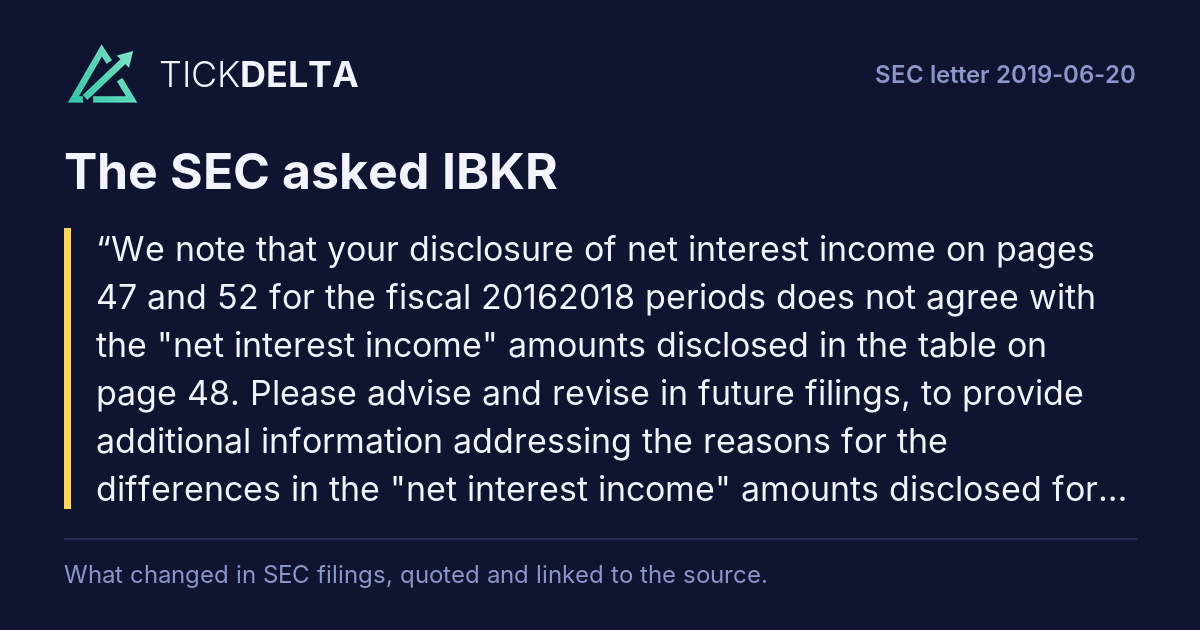
We note that your disclosure of net interest income on pages 47 and 52 for the fiscal 20162018 periods does not agree with the "net interest income" amounts disclosed in the table on page 48. Please advise and revise in future filings, to provide additional information addressing the reasons for the differences in the "net interest income" amounts disclosed for the periods presented.Rest of the question
The impact of any adjustments made in determining the net interest margin should also be addressed.
The Company notes the Staff’s comment. The Company believes that it is appropriate to include income that has the same characteristics as interest (e.g., from certain financial instruments or the Company’s FDIC sweep program), in its Net Interest Margin (“NIM”) calculation but is reported as other income in the Company’s statement of comprehensive income.Read in the reply ↗Rest of the answer
The Company believes that including these items in NIM gives investors a more complete view of the Company’s return on its interest-bearing assets.
The Company has disclosed this information in Note 6 to the “Other net interest income” line item in the NIM table on page 48, which states, “Includes income from financial instruments which has the same characteristics as interest, but is reported in other income in the Company’s consolidated statements of comprehensive income.” In its future filings with the Commission, the Company will enhance this disclosure to include the amounts reported in other income for all periods presented. In addition, the Company will add reference to Note 6 on the “Net interest income” line item. Exhibit A hereto contains an example of the revised disclosure as of December 31, 2018.
First report after the company's reply of 2019-07-02: 10-Q filed 2019-08-08 ↗, against the 10-Q filed 2019-05-09 ↗.
Tickdelta does not hold the text of both reports, so they are not compared here.
We note that you recognized, during the quarter ended March 31, 2019, an aggregate loss of $42 million, due to the stock price decline of a security listed on a major U.S. exchange and the inability to liquidate customers' positions which were obtained through margin loans.Rest of the question
Please advise and revise in future filings, to address the following: • Disclose whether the gross amount of the loss was $42 million or if this amount was reflective of any debt collections or liquidated collateral; • Disclose the amount of subsequent debt collections which have occurred since the end of the quarter; and • Disclose how collateral requirements are evaluated and adjusted during a trading day to compensate for potential liquidation and credit risks when there this is no liquid market and there is the existence of margin loans exist.
The Company notes the Staff’s comments and in response to the first bullet point the $42 million is net of liquidated collateral. The Company will revise its future disclosures to state whether the loss is a gross amount or if it is reflective of recoveries.
In response to the second bullet point, the Company recovered $5 million from the liquidation of collateral for the month ended March 31, 2019 (amount disclosed on page 110 of the
Company’s Form 10-K for the year ended December 31, 2018, of $47 million was as of February 27, 2019).Read in the reply ↗Rest of the answer
The Company will revise its future disclosures to include material amounts recovered in its discussion of the results of operations.
In response to the third bullet point, the Company’s Risk Management Committee proactively examines various types of potential risks, e.g., scenario-based risks, large position risk, low liquidity risk and collateral valuation, and enhances its margin and exposure systems on a routine basis. The goal of these practices is to identify potentially risky activity by clients before the resulting positions accumulate to a meaningful extent. Based on approved parameters, the Company’s automated credit management system performs the functions of setting margin requirements and collateral valuation in real time throughout the trading day, as well as undertaking automated liquidations when accounts fall below minimum requirements, subject to allowable market conditions.
These practices are disclosed on page 62 of the Company’s Quarterly Report on Form 10-Q for the period ending March 31, 2019:
“We have a comprehensive policy implemented in accordance with regulatory standards to assess and monitor the suitability of investors to engage in various trading activities. To mitigate our risk, we also continuously monitor customer accounts to detect excessive concentration, large orders or positions, patterns of day trading and other activities that indicate increased risk to us.
“Our credit exposure is to a great extent mitigated by our policy of automatically evaluating each account throughout the trading day and closing out positions automatically for accounts that are found to be under‑margined. While this methodology is effective in most situations, it may not be effective in situations where no liquid market exists for the relevant securities or commodities or where, for any reason, automatic liquidation for certain accounts has been disabled.”
In connection with the Company’s responses to the Staff’s comments set forth above, the Company hereby acknowledges that:
the Company is responsible for the adequacy and accuracy of the disclosure in its filings with the Commission;
the Staff’s comments or the Company’s changes to disclosure in response to the Staff’s comments do not foreclose the Commission from taking any action with respect to the Company’s filings with the
Commission; and the Company may not assert the Staff’s comments as a defense in any proceeding initiated by the Commission or any person under the federal securities laws of the United States.
First report after the company's reply of 2019-07-02: 10-Q filed 2019-08-08 ↗, against the 10-Q filed 2019-05-09 ↗.
Tickdelta does not hold the text of both reports, so they are not compared here.
We note your response to comment 2. Disclose, in future filings, how the customer accounts related to the margin loan loss were "well margined" considering you only recovered $5 million from the liquidation of collateral.
The Company notes the Staff’s comments. The company believes that its current disclosures adequately describe its process related to margin loan risk as described on page 11 of its Annual Report in Part I, Item 1
“Business – Risk Management Activities – Electronic Brokerage” and on page 61 of its Quarterly Report in Part 1, Item 3 “Quantitative and Qualitative Disclosures about Market Risk – Margin Loans”.
In addition, the Company’s disclosure on page 40 states that the customer accounts were well margined at December 31, 2018 and that the Company had not incurred any losses since none ofRead in the reply ↗Rest of the answer
its customer accounts had fallen in deficit at December 31, 2018. This statement is accurate as to that date: at December 31, 2018 these customer accounts had aggregate positive equity of $86 million based on the stock’s price of $3.96 per share. As a result, the Company believes the disclosure was adequate because the accounts were well margined at December 31, 2018.
The losses the Company incurred resulted from significant declines in the share price of the stock collateralizing margin loans following an analyst report which alleged that “at least 77% of the [issuer’s] assets are fabricated.” The report also alleged that the issuer’s only operating entity has been declared insolvent in China and is involved in multiple legal proceedings which it has failed to disclose in its filings with the Commission. As a result of the analyst report and the allegations of fraud therein, the stock’s price fell significantly in a short period of time.
During the first quarter of 2019, the stock’s share price continued to fall significantly (e.g., to $0.41 per share at February 28, 2019) resulting in aggregate gross deficits in the affected customer accounts of $47 million. Despite the Company’s efforts to liquidate the customers’ positions, given the low liquidity in the market there were limited opportunities to do so without realizing losses. As a result, as of March 31, 2019, the Company was able to recover
$5 million through these efforts, thereby reducing the total loss to a net of $42 million. In addition, the Company’s foreclosure on the remaining shares (that had previously been held as collateral) began a six-month holding period under Rule 144(d)(1), and the Company will continue to record mark-to-market gains/losses until such time as it is able to liquidate this position.
First report after the company's reply of 2019-08-07: 10-Q filed 2019-08-08 ↗, against the 10-Q filed 2019-05-09 ↗.
Tickdelta does not hold the text of both reports, so they are not compared here.
We note your response to comment 2. Given that margin loans represent a significant portion of total assets, the differing risk levels associated with these types of loans as well as the events and circumstances which lead to the gross losses and minimal recoveries recognized, please address the following in order to provide investors with an enhanced understanding of the Company's exposures as it relates to theRest of the question
margin loans: • Disaggregate your margin loans by type, amount and underlying strategy; and • Disclose if you revised or enhanced your policies for margin loans in response to the loss incurred.
The Company notes the Staff’s comments. In response to the first bullet point, the Company has considered how disaggregation can be accomplished and does not believe that margin loans can be disaggregated as requested.
Margin loans represent a type of loan extended to brokerage customers that is collateralized by marketable securities in the customers’ accounts in accordance with regulatory requirements and internal policies. This is the only type of loan the
Company extends to its customers.Read in the reply ↗Rest of the answer
Because the margin requirements placed on a customer account depend on the many combinations of positions that may be held in an account (e.g., stock and options positions may reduce price risk and, therefore, margin requirements), margin loans cannot be disaggregated by security type or underlying strategy. As such, the Company believes that its disclosures with respect to its margin loans are in compliance with the requirements of Commission’s Regulations and
U.S. GAAP.
In response to the second bullet point, the Company continuously enhances its policies for margin loans, including for the events leading to the loss, as disclosed on page 41 of the Company’s Form 10-K for the period ending December 31, 2018:
“Our Risk Management Committee continuously monitors and evaluates our risk management policies, including the implementation of policies and procedures to enhance the detection and prevention of these types of events.”
The Company will include similar disclosures, as appropriate, in its future filings with the Commission:
First report after the company's reply of 2019-08-07: 10-Q filed 2019-08-08 ↗, against the 10-Q filed 2019-05-09 ↗.
Tickdelta does not hold the text of both reports, so they are not compared here.
Also in this review: closing letter, 2019-08-29