Screener / SEC EDGAR /CIK 0001580905 /10-K filed Feb 26, 2026, compared with Feb 27, 2025 /Numbers from the XBRL of the 10-Ks
NYSE Industrials · Homebuilders

Installed Building Products, Inc. IBP

Compare with peers Embed
The 10-K against last year's

90 changes: 7 added, 3 removed, 80 reworded

10-K Feb 26, 2026 vs Feb 27, 2025

10-K 0001580905-26-000004 (Feb 26, 2026) vs 10-K 0001580905-25-000010 (Feb 27, 2025)

Every paragraph, and how much of it changed

One bar per paragraph, in the order of the 10-K. Height and colour show the share of its words not in the closest paragraph a year earlier; the tallest bars are new paragraphs.

Risk Factors

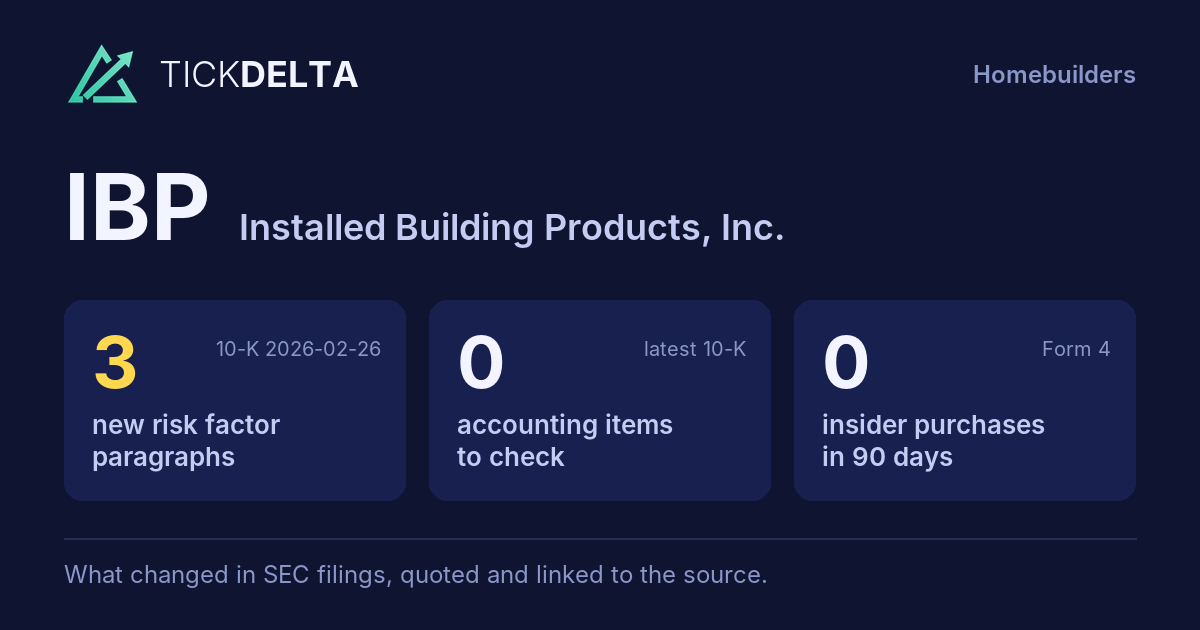
178 paragraphs · 3 new · 40 reworded · 2 gone · 10-K Feb 26, 2026 against Feb 27, 2025
New paragraph Reworded (5% of its words or more) Same or nearly
Paragraph 32 · 46% changed Every version of it
Our ability to offer a wide variety of products to our customers depends on our ability to obtain adequate product supply from manufacturers. We do not typically enter into long-term agreements with our suppliers but have done so from time to time. We currently have two three long-term agreements with suppliers and may enter into other short- or long-term supply agreements at any time. We have certain agreements that do not qualify as supply agreements due to a lack of a fixed price and/or lack of a fixed and determinable purchase quantity, but nonetheless may require us to purchase certain of our products from certain vendors, depending on the specific circumstances. Generally, our products are available from various sources and in sufficient quantities to meet our operating needs. However, the loss of, or a substantial decrease in the availability of, products from our suppliers or the loss of key supplier arrangements could adversely impact our business, financial condition, results of operations and cash flows. Historically, unexpected events, such as incapacitation of supplier facilities due to extreme weather or fire, have temporarily reduced manufacturing capacity and production. U.S. international trade policy can impact the suppliers of certain
Paragraph 91 · 36% changed Every version of it
Our existing branches or any branches we may start or acquire serving the commercial end market involve competitive, operational, financial and accounting challenges and other risks that differ from our traditional residential installation business. In addition, the typical contractual terms and arrangements and billing cycle for the commercial construction end market are different than the residential new construction end market. Our expansion into this market may include opening new branches that have higher start-up costs compared to our acquired branches. These factors and any other challenges we encounter could adversely affect our margins, financial condition, operating results and cash flows.
Paragraph 100 · 34% changed Every version of it
We have significant exposure to changes in laws governing our relationships with our employees, including wage and hour laws and regulations, fair labor standards, minimum wage requirements, overtime pay, unemployment tax rates, workers’ compensation rates, citizenship requirements and payroll taxes, which likely would have a direct impact on our operating costs. Significant additional government-imposed increases in the preceding areas could have a material adverse effect on our business, financial condition and results of operations.
Paragraph 60 · 33% changed Every version of it
The United States has experienced, and may experience again in the future, outbreaks of contagious diseases that affect public health and public perception of health. For example, the COVID-19 pandemic affected the global economy and caused our business significant supply chain disruptions, increased material costs and caused a slowdown in commercial construction demand. The full extent and scope of impact of an outbreak of any contagious disease on our business and industry, as well as national, regional and global markets and economies, depends on numerous evolving factors that we may not be able to accurately predict, including the duration and scope of the outbreak, additional government actions taken in response, the impact on construction activity and demand for homes (based on employment levels, consumer spending and consumer confidence). Accordingly, our ability to conduct our business could be materially and negatively affected, any of which could have a material adverse impact on our business, financial condition, operating results and cash flows.
Paragraph 113 · 30% changed Every version of it
We are subject to various federal, state, local and other laws, building codes and regulations including, among other things, worker and workplace health and safety regulations promulgated by the OSHA, employment regulations promulgated by the U.S. Equal Employment Opportunity Commission and tax regulations promulgated by the Internal Revenue Service and various other state and local tax authorities. Our primary manufacturing facility is also subject to additional laws and regulations which may increase our exposure to health and safety liabilities. In addition, we are subject to increased regulation of data privacy and information security and may be subject to certain more stringent state laws where we operate. These types of data privacy and security laws, which continue to evolve, create a range of new compliance obligations for us and increase financial penalties for non-compliance. Additional or more burdensome regulatory requirements in states including California, these or other areas may increase our expenses, reduce demand for our services or restrict our ability to offer services in certain geographies, all of which could adversely affect our business, financial condition, results of operations and cash flows. Moreover, our failure to comply with any of the regulatory requirements applicable to our business could subject us to substantial fines and penalties that could adversely affect our business, financial condition, results of operations and cash flows.
Paragraph 33 · 27% changed Every version of it
time. We have certain agreements that do not qualify as supply agreements due to a lack of a fixed price and/or lack of a fixed and determinable purchase quantity, but nonetheless may require us to purchase certain of our products from certain vendors, depending on the specific circumstances. Generally, our products are available from various sources and in sufficient quantities to meet our operating needs. However, the loss of, or a substantial decrease in the availability of, products from our suppliers or the loss of key supplier arrangements could adversely impact our business, financial condition, results of operations and cash flows. Historically, unexpected events, such as incapacitation of supplier facilities due to extreme weather or fire, have temporarily reduced manufacturing capacity and production. U.S. international trade and tariff policies can impact the suppliers of certain materials we use in our business. Increased tariff rates on particular countries could motivate us to change suppliers to a different country of origin which could increase our dependence on certain suppliers. In addition, during prior economic downturns in the housing industry, manufacturers have reduced capacity by closing plants and production lines within plants. Even if such capacity reductions are not permanent, there may be a delay in manufacturers’ ability to increase capacity in times of rising demand. If the demand for products from manufacturers and other suppliers exceeds the available supply, we may be unable to source additional products in sufficient quantity or quality in a timely manner and the prices for the products that we use in our business could rise. These developments could affect our ability to take advantage of market opportunities and limit our growth prospects. We continually evaluate our supplier relationships and at any given time may move some or all of our purchases from one or more of our suppliers. There can be no assurance that any such action would have its intended effect.
Paragraph 16 · 27% changed Every version of it
In 2024, 2025, the U.S. Census Bureau reported an estimated 1.37 1.36 million non-seasonally adjusted total housing starts, down from 1.42 as compared to 1.37 million starts in 2023. 2024. Mortgage interest rates are indirectly affected by the Federal Reserve's monetary policies and significantly impact the affordability of housing. The Federal Reserve raised the federal funds rate significantly in 2022 and 2023 to stabilize inflation. This contributed to higher mortgage interest rates. rate environment is also affected by the perception of higher interest rates following the historic period when the average 30 year mortgage rates were generally less than 5% during most of the 2010s and through 2021. The Federal Reserve began easing monetary policy in September 2024, however 2024 after raising the federal funds rates in 2022 and 2023, however, mortgage rates have remained elevated due to other economic factors such as treasury yields and sticky inflation concerns. According to the January 2025 Fannie Mae forecast, 2025 2026 housing starts are projected to decrease slightly remain relatively stable at 1.31 million starts according to 1.32 million. the January 2026 Fannie Mae forecast.
Paragraph 59 · 25% changed Every version of it
The United States has experienced, and may experience again in the future, outbreaks of contagious diseases that affect public health and public perception of health. For example, Pandemics have, including in the COVID-19 pandemic recent past, affected the global economy and caused our business significant supply chain disruptions, increased material costs and caused a slowdown in commercial construction demand. The full extent and scope of impact of an outbreak of any contagious disease on our business and industry, as well as national, regional and global markets and economies, depends on numerous evolving factors that we may not be able to accurately predict, including the duration and scope of the outbreak, additional government actions taken in response, the impact on construction activity and demand for homes (based on employment levels, consumer spending and consumer confidence). Accordingly, our ability to conduct our business could be materially and negatively affected, any of which could have a material adverse impact on our business, financial condition, operating results and cash flows.

MD&A

112 paragraphs · 4 new · 66 reworded · 1 gone · 10-K Feb 26, 2026 against Feb 27, 2025
New paragraph Reworded (5% of its words or more) Same or nearly
Paragraph 68 · 48% changed
The components Known obligations beyond the next twelve months as of gross profit for the years ended December 31, 2024, 2023 and 2022 were 2025 are as follows (in millions):
Paragraph 31 · 46% changed
Net revenues revenue increased 4.1%, or $108.8 million, while gross profit increased 12.4% to $930.7 million during the year ended December 31, 2023 2025 compared to 2022. The increase the year ended December 31, 2024 primarily due to increased sales in net revenue was primarily driven by the 33.3% growth in our commercial end market and contributions from our recent acquisitions. Same branch sales from our single-family end market declined 4.1% while same branch sales from our multi-family sales, end market remained resilient with a decrease of only 5.7%, far outpacing the 20.3% decline in national multi-family completions per U.S. Census Bureau data. These markets combined for a residential end market same branch sales decline of 4.4% for the year ended December 31, 2025 over 2024, driven primarily by lower job volume. Conversely, our commercial end market grew 11.2% primarily due to strong same branch sales growth of 10.4% as well as selling price and product mix improvements and the contribution of that were concentrated within our recent acquisitions. The 7.7% increase in our price/mix metric for our Installation segment was primarily due to a higher mix of multi-family and heavy commercial jobs. Gross profit margin grew faster than revenue as we continued to prioritize profitability over sales volume. Specifically, gross profit outpaced sales growth due to higher selling prices and resulting leverage gained on material costs compared to the prior year. businesses.
Paragraph 37 · 42% changed
2024, 2025, we saw our administrative costs increase as a percentage of sales primarily due to higher salaries inflationary pressures on compensation, rent and bonuses due to higher profitability insurance, which were partially offset by lower transaction fees and margins. decreased costs driven by organizational optimization.
Paragraph 53 · 41% changed
We typically purchase the materials we use in our business directly from manufacturers. The largest fiberglass manufacturers have cut production capacity during past business cycles which has caused periods of industry-wide supply allocations. While we are not currently experiencing material supply shortages, we could incur such shortages in 2025 2026 and beyond if these manufacturers reduce production this year. We experience price increases from our suppliers from time to time, including multiple increases over the last four years caused by supply shortages and general economic inflationary pressures. We could be subject to increased material pricing on some of the materials we install and sell due to tariffs imposed on goods imported from certain foreign nations. The extent of these increases will depend on a variety of factors including the magnitude of each tariff, the extent our vendors pass on the tariffs they incur, and the number of countries subject to tariffs in the future. Increased market pricing, regardless of the catalyst, has and could continue to impact our results of operations in 2025, to the extent that price increases cannot be passed on to our customers. Our selling price increases were able to support most material cost increases in 2024 but we may have more difficulty raising prices in 2025 if housing demand slows. We will continue to work with our customers to adjust selling prices to offset higher costs as they occur.
Paragraph 46 · 40% changed
During the year ended December 31, 2024, we recorded unrealized losses, net of taxes, of $2.0 million on our cash flow hedges primarily due to the market's expectations for interest rates to decline in the future which offset the previous unrealized gains on our existing and forward swaps. We also amortized $4.4 million of the remaining unrealized gains, off-market terms and unrealized losses on our terminated cash flow hedges to interest expense, net during the year ended December 31, 2024, 2025, not including tax effects of $1.1 $0.4 million.
Paragraph 69 · 37% changed
Known obligations above include $1.0 billion in interest and principal payments on long-term debt obligations through 2029. 2031. In addition, our finance leases will require $5.9 $4.4 million in interest and principal payments under current agreements through 2029. Operating lease obligations will require $66.6 million in payments beyond the next twelve months. Finally, we have two product supply agreements with various vendors that requires us to purchase a minimum quantity of inventory with variable and fixed rate pricing after 2025. 2030.
Paragraph 8 · 35% changed
We continue continued to diversify our operations through our acquisition strategy as we by investing $51.5 million during the year ended December 31, 2025. We acquired nine seven businesses in 2024 2025 that we expect to contribute approximately $104.2 $53.3 million in annual aggregate revenues. revenues, and we also completed four bolt-on acquisitions that were merged into our existing businesses. We expect will continue to also use our disciplined approach in identifying and purchasing attractive acquisition targets to meet our goal of acquiring at least $100.0 million in annual aggregate revenue in 2025. 2026.
Paragraph 100 · 34% changed
We performed an annual quantitative goodwill impairment test as of October 1, 2024 2025 on our Distribution operating segment which we have determined is also a reporting unit. The estimate of the reporting unit’s fair value was determined by placing a 75% 50% weighting on a discounted cash flow model and a 25% 50% weighting on market-related model using current industry information that involve significant unobservable inputs (Level 3 inputs). Based on the results of this evaluation, we concluded that there were no impairments of goodwill as the estimated fair value exceeded its carrying value. The estimated fair value exceeded the Distribution operating segment's carrying value by 32.1%. A 100 basis point change in either the discount rate or residual growth rate, or both, utilized in our discounted cash flow model using our weighted system would not have resulted in an impairment for our Distribution operating segment, nor would any change in the weighting of each method. The estimates and assumptions used in the test are subject to uncertainty due to the professional judgments required. We performed a qualitative evaluation for our Installation and Manufacturing operating segments and determined that it was more likely than not that the fair value of these operating segments exceeded their carrying values.

A paragraph is matched with the one last year that shares the most of its words; under half in common makes it new. The paragraphs shown are the 8 reworded the most in each section.

The paragraph that changed most in each section

The redline

Marked against last year's 10-K: cut words struck through, new words highlighted.

Accounting Policies192 words changed in this paragraph; it is 34% similar to last year's version.
Standard Description Effective Date Effect on the financial statements or other significant matters Adoption ASU 2023-09 "Income Taxes" (Topic 740): Improvements to Income Tax Disclosures. January 1, 2025 This pronouncement amends Topic 280 740 to require all entities to disclose specific categories in the rate reconciliation, income taxes paid, and other income tax information. Effective We applied the pertinent provisions of this pronouncement prospectively for annual periods beginning after the year ended December 15, 2024. Early 31, 2025. The adoption is permitted. The Company will adopt and apply impacted the guidance as prescribed by this ASU to income tax disclosures occur after within the effective date. We are currently assessing the impact of the adoption on our consolidated financial information. ASU 2024-03 "Income Statement—Reporting Comprehensive Income—Expense Disaggregation Disclosures" (Subtopic 220-40): Disaggregation of Income Statement Expenses. This pronouncement amends Topic 220 to require all entities to disclose, in the notes to financial statements, but did not affect our financial position or the results of specified operations. See Note 15 to our Consolidated Financial Statements for more information about certain costs and expenses. Effective for annual periods beginning after December 15, 2026, and interim periods beginning after December 15, 2027. Early adoption is permitted. The Company will adopt and apply the guidance as prescribed by this ASU to regarding our income statement expenses occur after the effective date. We are currently assessing the impact of the adoption on our consolidated financial information. taxes.

Source: Item 8, Note 2 – SIGNIFICANT ACCOUNTING POLICIES, 10-K 0001580905-26-000004 vs Item 8, Note 2 – SIGNIFICANT ACCOUNTING POLICIES, 10-K 0001580905-25-000010

Risk Factors161 words changed in this paragraph; it is 66% similar to last year's version.
time. We have certain agreements that do not qualify as supply agreements due to a lack of a fixed price and/or lack of a fixed and determinable purchase quantity, but nonetheless may require us to purchase certain of our products from certain vendors, depending on the specific circumstances. Generally, our products are available from various sources and in sufficient quantities to meet our operating needs. However, the loss of, or a substantial decrease in the availability of, products from our suppliers or the loss of key supplier arrangements could adversely impact our business, financial condition, results of operations and cash flows. Historically, unexpected events, such as incapacitation of supplier facilities due to extreme weather or fire, have temporarily reduced manufacturing capacity and production. U.S. international trade and tariff policies can impact the suppliers of certain materials we use in our business. Increased tariff rates on particular countries could motivate us to change suppliers to a different country of origin which could increase our dependence on certain suppliers. In addition, during prior economic downturns in the housing industry, manufacturers have reduced capacity by closing plants and production lines within plants. Even if such capacity reductions are not permanent, there may be a delay in manufacturers’ ability to increase capacity in times of rising demand. If the demand for products from manufacturers and other suppliers exceeds the available supply, we may be unable to source additional products in sufficient quantity or quality in a timely manner and the prices for the products that we use in our business could rise. These developments could affect our ability to take advantage of market opportunities and limit our growth prospects. We continually evaluate our supplier relationships and at any given time may move some or all of our purchases from one or more of our suppliers. There can be no assurance that any such action would have its intended effect.

Source: Item 1A, 10-K 0001580905-26-000004 vs Item 1A, 10-K 0001580905-25-000010

MD&A160 words changed in this paragraph; it is 47% similar to last year's version.
We typically purchase the materials we use in our business directly from manufacturers. The largest fiberglass manufacturers have cut production capacity during past business cycles which has caused periods of industry-wide supply allocations. While we are not currently experiencing material supply shortages, we could incur such shortages in 2025 2026 and beyond if these manufacturers reduce production this year. We experience price increases from our suppliers from time to time, including multiple increases over the last four years caused by supply shortages and general economic inflationary pressures. We could be subject to increased material pricing on some of the materials we install and sell due to tariffs imposed on goods imported from certain foreign nations. The extent of these increases will depend on a variety of factors including the magnitude of each tariff, the extent our vendors pass on the tariffs they incur, and the number of countries subject to tariffs in the future. Increased market pricing, regardless of the catalyst, has and could continue to impact our results of operations in 2025, to the extent that price increases cannot be passed on to our customers. Our selling price increases were able to support most material cost increases in 2024 but we may have more difficulty raising prices in 2025 if housing demand slows. We will continue to work with our customers to adjust selling prices to offset higher costs as they occur.

Source: Item 7, 10-K 0001580905-26-000004 vs Item 7, 10-K 0001580905-25-000010

Legal Proceedings84 words changed in this paragraph; it is 32% similar to last year's version.
17.3 million pounds commitment to 12.3 million pounds and amended the period commitment to May 15, 2026. During the year ended December 31, 2024, 2025, we executed a supply contract with various fixed rate pricing with a supplier to purchase a portion of satisfied the materials we employ in our business. The agreement is effective January 1, for the period ending May 15, 2025 through December 31, 2027 with a purchase obligation of 8.0 and purchased approximately 7.4 million pounds of materials under this agreement for each of the periods period ending December 31, 2025, 2026 and 2027, and a total minimum commitment of $10.8 million. May 15, 2026.

Source: Item 3, via Note 17 – COMMITMENTS AND CONTINGENCIES, 10-K 0001580905-26-000004 vs Item 3, via Note 17 – COMMITMENTS AND CONTINGENCIES, 10-K 0001580905-25-000010

Sentences and paragraphs added, removed or reworded

Every change, by type

Sentences and paragraphs of IBP's Risk Factors and MD&A, 10-K Feb 26, 2026 against 10-K Feb 27, 2025. Each links to the text at sec.gov.

Quiet changes are sentences kept from last year with one to four words changed, at least one of them a hedge, a modal or a qualifier (may, could, will, not, significant, material…). A year or date rolling forward is not counted.

The full word list

adverse, adversely, all, although, anticipate, anticipates, any, approximately, believe, believes, can, cannot, certain, could, expect, expects, generally, however, if, intend, intends, largely, likely, many, material, materially, may, might, most, must, never, no, not, possible, primarily, probable, should, significant, significantly, some, substantial, substantially, unlikely, will, would

AddedRisk Factors
systems could be adversely affected if any of our significant providers, customers or suppliers experience a cybersecurity incident, data breach, reputational damage or disruption to their business operations.
Read it in 10-K Feb 26, 2026 at sec.gov
AddedRisk Factors
creating a safer working environment for both our employees and other jobsite personnel through year-round education and training, to help reduce jobsite, warehouse and plant injuries.
Read it in 10-K Feb 26, 2026 at sec.gov
AddedRisk Factors
•our operations are restricted by our debt instruments, which contain certain financial and operating covenants, and those restrictions may limit, among other things, our ability to borrow money in the future for working capital, capital expenditures, acquisitions, rent expense or other purposes.
Read it in 10-K Feb 26, 2026 at sec.gov
RemovedRisk Factors
have employees could have a significant impact on our operating costs and may require that we take steps to mitigate such increases, all of which may cause us to incur additional costs, expend resources responding to such increases and lower our margins.
Read it in 10-K Feb 27, 2025 at sec.gov
RemovedRisk Factors
not fully comply with all recordkeeping obligations of federal and state immigration laws. These factors could have a material adverse effect on our reputation, business, financial condition and results of operations.
Read it in 10-K Feb 27, 2025 at sec.gov
RewordedRisk Factors
In addition, while the Federal Trade Commission enacted a rule which is currently set aside moving to vacate its rule regarding non-compete agreements and subject has voted to court challenges and dismiss the related appeals, an increasing number of states have proposed rules rules, and some states have enacted legislation, that would prohibit limit the enforceability of non-competition agreements in most cases.
Read it in 10-K Feb 26, 2026 at sec.gov
RewordedRisk Factors
The Federal Reserve began easing monetary policy in September 2024, however 2024 after raising the federal funds rates in 2022 and 2023, however, mortgage rates have remained elevated due to other economic factors such as treasury yields and sticky inflation concerns. 2026 housing starts are projected to remain relatively stable at 1.31 million starts according to the January 2026 Fannie Mae forecast.
Read it in 10-K Feb 26, 2026 at sec.gov
RewordedRisk Factors
The full extent and scope of impact of an outbreak of any contagious disease on our business and industry, as well as national, regional and global markets and economies, depends on numerous evolving factors that we may not be able to accurately predict, including the duration and scope of the outbreak, additional government actions taken in response, the impact on construction activity and demand for homes (based on employment levels, consumer spending and consumer confidence).
Read it in 10-K Feb 26, 2026 at sec.gov
Show the other 26
RewordedRisk Factors
As some of our systems are maintained or operated by third-party providers, including cloud-based systems, our information, operations and systems could be adversely affected if any of our significant providers, customers or suppliers experience a cybersecurity incident, data breach, reputational damage or disruption to their business operations.
Read it in 10-K Feb 26, 2026 at sec.gov
RewordedRisk Factors
The commercial construction market, as measured by investment dollars, increased 7% decreased 1% in the ten months ended October 31, 2025 compared to the same period in 2024 from 2023 per the most recently available U.S.
Read it in 10-K Feb 26, 2026 at sec.gov
RewordedRisk Factors
For example, we lease facilities and have significant operations in regions Florida, Texas, California and other coastal areas that experience extreme weather conditions. conditions or natural disasters including hurricanes and wildfires.
Read it in 10-K Feb 26, 2026 at sec.gov
RewordedRisk Factors
Immigration and Customs Enforcement, or ICE, and We are subject to regulations of the Department of Labor, Homeland Security, and we are audited from time to time by these parties for compliance with work authentication requirements.
Read it in 10-K Feb 26, 2026 at sec.gov
RewordedRisk Factors
Restrictions in our existing credit facilities, senior notes, and any future facilities or any other indebtedness we may incur in the future, limit our ability to take certain actions and breaches thereof could adversely affect impair our business, financial condition, results of operations, and the value of our common stock. liquidity.
Read it in 10-K Feb 26, 2026 at sec.gov
RewordedRisk Factors
We have significant exposure to changes in laws governing our relationships with our employees, including wage and hour laws and regulations, fair labor standards, minimum wage requirements, overtime pay, unemployment tax rates, workers’ compensation rates, citizenship requirements and payroll taxes, which likely would have a direct impact on our operating costs.
Read it in 10-K Feb 26, 2026 at sec.gov
RewordedRisk Factors
Additional risks and uncertainties not presently known to us, or that we currently believe to be immaterial, may also adversely impact our business, financial condition and results of operations.
Read it in 10-K Feb 26, 2026 at sec.gov
RewordedRisk Factors
We could also become subject to fines, penalties and other costs related to claims that we did not fully comply with all recordkeeping obligations of federal and state immigration laws.
Read it in 10-K Feb 26, 2026 at sec.gov
AddedMD&A
In January 2026, we completed an offering (the "2026 Offering") of $500.0 million aggregate principal amount of 5.625% Senior Notes due 2034 (the "2034 Senior Notes"). We used part of the proceeds from the 2026 Offering to redeem in full the 2028 Senior Notes. This transaction would have reduced the principal payments included in the 2028 known obligations by $300.0 million and increased the thereafter known obligations by $500.0 million in the above table. The increased principal and extended maturity of the 2034 Senior Notes will also increase the amount of interest we will be required to pay in 2026 and beyond. The $181.8 million in remaining proceeds on the 2034 Senior Notes will also increase our short-term liquidity and be used for short-term material cash obligations. See Note 20, Subsequent Events, in Item 8, Financial Statements and Supplementary Data of this Form 10-K for more information regarding the 2034 Senior Notes.
Read it in 10-K Feb 26, 2026 at sec.gov
AddedMD&A
that there were no impairments of goodwill, as the estimated fair value exceeded its carrying value by 18.4%. This is a decrease from the estimated fair value exceeding the carrying value by 32.1% on October 1, 2024. The primary reasons due to this decline was the additional carrying value resulting from a 2024 distribution acquisition and lower forecasted revenue and EBITDA in future periods due to near-term softening demand.
Read it in 10-K Feb 26, 2026 at sec.gov
RemovedMD&A
Some of our acquisitions have contingent consideration liabilities in the form of earnouts included in the total purchase price of the business. We assess the fair value of the contingent consideration liability at each reporting period, and any changes in the estimated fair value are reflected in gains on acquisition earnouts on the Consolidated Statements of Operations and Comprehensive Income. There were no gains on acquisition earnouts during the years ended December 31, 2024 and 2023.
Read it in 10-K Feb 27, 2025 at sec.gov
RewordedMD&A
Years ended December 31, 2025 2024 2023 2022 Period-over-period Period-over-Period Growth Consolidated Sales Growth 1.0% 5.9% 4.1% 35.6% Consolidated Same Branch Sales Growth (1) (1.3)% 3.5% 0.2% 24.6% Installation Sales Growth (2) 0.1% 6.0% 3.7% 29.5% Same Branch Sales Growth (1)(2) (1.5)% 3.8% (0.1)% 24.5% Single-Family Sales Growth (3) (1.9)% 6.4% (5.4)% 33.5% Single-Family Same Branch Sales Growth (1)(3) (4.1)% 3.6% (9.0)% 28.9% Multi-Family Sales Growth (4) (5.4)% 6.5% 35.0% 31.8% Multi-Family Same Branch Sales Growth (1)(4) (5.7)% 5.6% 33.3% 31.0% Residential Sales Growth (5) (2.6)% 6.4% 1.0% 33.2% Residential Same Branch Sales Growth (1)(5) (4.4)% 4.0% (2.3)% 29.2% Commercial Sales Growth (6) 11.2% 3.0% 17.2% 15.2% Commercial Same Branch Sales Growth (1)(6) 10.4% 1.2% 11.5% 6.6% Other Other, net of Eliminations Sales Growth (7) 8.2% 12.1% 453.8% (7)(11) 15.5% 3.7% 10.7% Same Branch Sales Growth (1)(7) 3.6% 6.7% 41.5% (1)(7)(11) 2.3% (1.0)% 5.2% Same Branch Sales Growth - Installation (8) Volume Growth (1)(9) (0.2)% (9.0)% 5.5% (1)(9)(11) (5.7)% 0.2% (8.4)% Price/Mix Growth (1)(10) (1)(10)(11) 1.6% 3.7% 7.7% 23.0% 7.2% U.S.
Read it in 10-K Feb 26, 2026 at sec.gov
RewordedMD&A
These rate hikes indirectly raised affected the 30-year fixed rate mortgage average in the United States to over States, resulting in some rates peaking above 7% for the first time since 2008 during periods of 2023 and 2024. in recent years.
Read it in 10-K Feb 26, 2026 at sec.gov
RewordedMD&A
We also amortized $4.4 $1.5 million of the remaining unrealized gains, off-market terms and unrealized losses on our terminated cash flow hedges to interest expense, net during the year ended December 31, 2024, not including tax effects of $1.1 million.
Read it in 10-K Feb 26, 2026 at sec.gov
RewordedMD&A
Net cash provided by operating activities slightly decreased from 2023 to 2024 primarily driven The increase was partially offset by the increase in accounts receivable and inventory due to higher sales and material cost inflation expanded distribution operations and the decrease in accounts payable.
Read it in 10-K Feb 26, 2026 at sec.gov
RewordedMD&A
The increase in cash used in financing activities in 2024 2025 was primarily due to common stock repurchases increasing to $172.6 million during the year ended December 31, 2025 from $145.3 million during the year ended December 31, 2024 from $6.3 million during the year ended December 31, 2023. 2024.
Read it in 10-K Feb 26, 2026 at sec.gov
RewordedMD&A
Our 2023 liquidity was remains strong despite investing $59.6 $88.6 million in our acquisition strategy, and more than tripling the 2023 amount of returned to shareholders through repurchasing $6.3 $145.3 million of our Company's stock and paying $63.1 $84.7 million in dividends during the year ended December 31, 2023. 2024.
Read it in 10-K Feb 26, 2026 at sec.gov
RewordedMD&A
Inflation rates in 2024 2025 have remained above the 2% stated target, however the Federal Reserve began cutting the federal funds rate in September 2024. has signaled plans to potentially lower rates further during 2026.
Read it in 10-K Feb 26, 2026 at sec.gov
RewordedMD&A
Firm commitments for funds include $67.2 as of December 31, 2025 included $79.0 million in interest and principals payments on long-term debt obligations including our 2028 Senior Notes, Notes (which, as described below, have now been redeemed in full), Term Loan, notes payable to sellers of acquisitions and vehicles purchased under the Master Loan and Security Agreement, the Master Equipment Agreement and the Master Loan Agreements.
Read it in 10-K Feb 26, 2026 at sec.gov
RewordedMD&A
The ABL Credit Agreement and the Term Loan Agreement contain restrictive covenants that, among other things, limit the ability of the Company and certain of our subsidiaries (subject to certain exceptions) to:
Read it in 10-K Feb 26, 2026 at sec.gov
RewordedMD&A
As of December 31, 2024 2025 and 2023, 2024, our working capital, including cash and cash equivalents, was $698.4 million, or 23.5% of net revenue, and $695.9 million, or 23.7% of net revenue, and $723.6 million, or 26.0% of net revenue, respectively.
Read it in 10-K Feb 26, 2026 at sec.gov
RewordedMD&A
The decrease was partially offset Net cash provided by operating activities increased from 2024 to 2025 primarily driven by higher net income due to increased consolidated sales of 5.9%. 1.0%.
Read it in 10-K Feb 26, 2026 at sec.gov
RewordedMD&A
Facility expense Also, facility expenses and insurance cost increases costs increased due to inflationary pressures also factored into and costs attributable to acquisitions contributed to the overall increase in administrative operating expenses.
Read it in 10-K Feb 26, 2026 at sec.gov

Sources

The two latest 10-Ks on EDGAR, section by section. Each change links to the text at sec.gov.

Also

New risk factors: paragraphs with nothing like them last year, quoted in full.

Work with it

Excel workbook · CSV. Google Sheet that stays up to date: paste =IMPORTDATA("https://tickdelta.com/company/IBP/export.csv") into a cell.

Next:Related parties
Esc

Type a ticker such as AAPL, a name, an investor such as Buffett, or a topic such as tariffs. ↑ ↓ to move, Enter to open.