Paragraphs with nothing like them in last year's 10-K
Quoted exactly
13 paragraphs in Risk Factors of the 10-K filed Feb 19, 2026
with nothing like them in the 10-K filed Feb 27, 2025. Quoted exactly.
Paragraphs that were only edited are under 10-K change.
terms that are less favorable to us. Any inability of current and/or potential customers to pay us for our products or any demands by suppliers for different payment terms may adversely affect our earnings and cash flow.
procedures, will be fully implemented, complied with or effective in protecting our systems, networks and Confidential Information.
We derive a significant portion of our revenues from non-U.S. sales and from products manufactured at our non-U.S. facilities which are then imported to the U.S. We are therefore subject to risks of doing business in other countries, including those related to tariffs, retaliatory counter measures and further escalation of trade tensions.
The imposition of tariffs by the U.S. government and retaliatory tariffs imposed by other foreign governments is expected to increase our costs. Where possible, we may address increasing supply chain costs in pricing; however, we operate to a large extent under long-term contracts whereby pricing is fixed for a set period of time. The tariffs as currently implemented are likely to have a material impact on our business, financial condition and results of operations; however, the extent to which the imposition of tariffs, possible delays and exemptions may have a material impact remains fluid.
Additionally, the imposition of higher tariffs could undermine the competitiveness of a U.S. based company in the global market and could result in termination of orders by customers, lower demand for products and the loss of market share.
A meaningful portion of our global revenues is from products manufactured in our Costa Rica and Mexico manufacturing facilities which are then imported into the U.S. We expect revenues from goods manufactured in Costa Rica and Mexico and imported to the U.S. to remain a significant portion of our revenues for the foreseeable future.
The U.S. administration has continued to engage in trade discussions and impose tariffs on imports from other countries. Certain of these tariffs have been subsequently paused or modified, and the situation remains highly fluid. For example, most recently, on July 31, 2025, the U.S. announced that the 10% baseline reciprocal tariff on imports from all countries would be raised to 15% for certain countries, including Costa Rica. As to the majority of products manufactured in our Mexico facilities, these are currently exempted from tariffs under the United States-Mexico-Canada Agreement ("USMCA"). If, however, the USMCA exemptions were eliminated in the future, our tariff expense for products manufactured in Mexico would increase substantially.
In September 2025, the U.S. Commerce Department ("the Department") initiated a national security investigation into imports of medical consumables and equipment under Section 232 of the Trade Expansion Act (the "Act"). The Act allows the President to negotiate tariffs to promote international trade. Section 232 of the Act specifically grants the President the authority to impose tariffs if the Department determines imports threaten U.S. national security. The Department has 270 days to deliver its policy recommendations to the President, who then has up to 90 days to decide on potential action and 15 days to implement it. If the probes conducted determine these imports, which comprise the vast majority of our product portfolio, pose a national security risk, it could result in potential tariffs imposed in addition to the country-based tariffs and/or could reduce the benefits we receive from currently available exemptions such as the USMCA.
These actions have resulted, and are expected to further result, in retaliatory measures on U.S. goods by other foreign governments. If maintained, these recently announced tariffs, and the potential escalation of trade disputes could pose a risk to our business that could further affect our financial condition or results of operations and/or cash flows, as well as, our long-term investment strategies. The extent and duration of the tariffs and the resulting impact on general economic conditions and on our business are uncertain and are expected to be impacted by various factors, such as negotiations between U.S. and affected countries, the responses of other countries or regions, exemptions or exclusions that already exist or may be granted, availability and cost of alternative sources of our products and materials, and our ability to offset the effects of any tariffs that might be imposed.
In addition, modification to a 510(k)-cleared device that could significantly affect its safety or effectiveness, or that would constitute a major change in its intended use, design or manufacture, requires a new 510(k) clearance or, possibly, approval of a PMA. The FDA requires every manufacturer to make this determination in the first instance, but the FDA may review any manufacturer’s decision. The FDA may not agree with our decisions regarding whether new clearances or approvals
are necessary. We have modified certain of our products subsequent to obtaining 510(k) clearance, and have determined based on our review of the applicable FDA guidance that in these instances new 510(k) clearances or pre-market approvals were not required. If the FDA disagrees with our determination and requires us to submit new 510(k) notifications or PMAs for modifications to our products or any other product for which we may obtain 510(k) clearance in the future, and for which we have concluded that new clearances or approvals are unnecessary, we may be required to cease marketing or to recall the modified product until we obtain clearance or approval, and we may be subject to significant regulatory fines or penalties. On April 4, 2025, we received a warning letter from the FDA regarding certain modifications we made to our cleared MedFusion™ Model 4000 Syringe Infusion Pump and CADD™ Solis VIP Ambulatory Infusion Pump, and since then we are working closely with the FDA to resolve all concerns identified in such warning letter, including the filing of new clearances for next generation MedFusion™ and a refreshed CADD™ Solis device (which are currently under review by the FDA), and though we believe we will be able to ultimately close out this warning letter, there is no guarantee that we will be able to do so in a timely manner, or that we will not receive similar notices in the future.
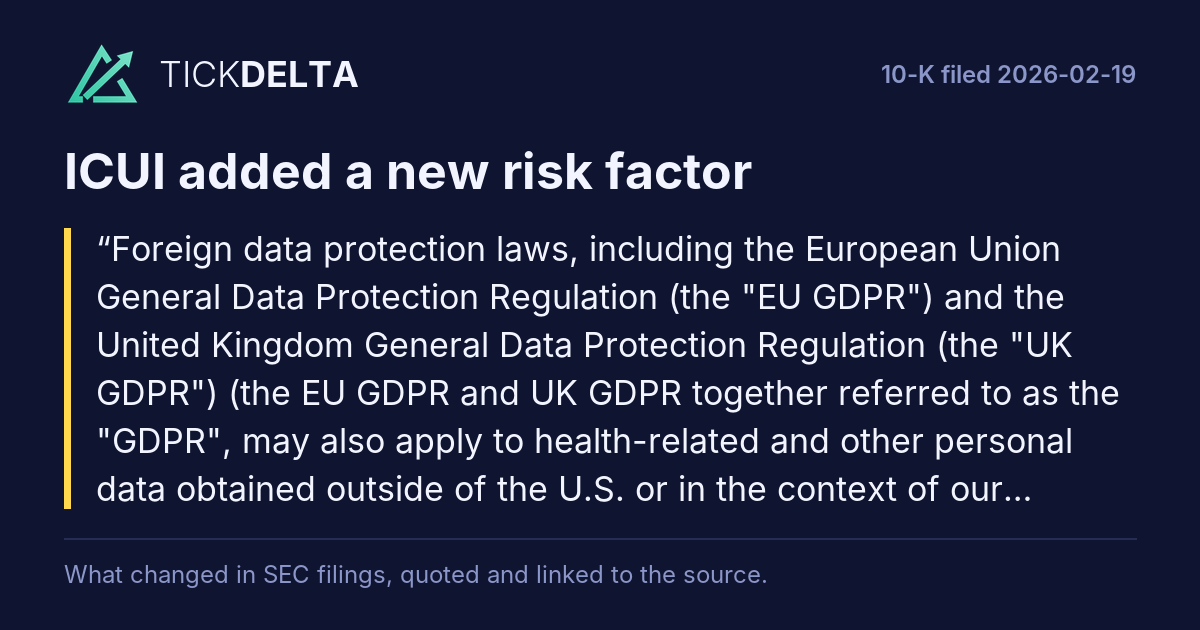
Foreign data protection laws, including the European Union General Data Protection Regulation (the "EU GDPR") and the United Kingdom General Data Protection Regulation (the "UK GDPR") (the EU GDPR and UK GDPR together referred to as the "GDPR", may also apply to health-related and other personal data obtained outside of the U.S. or in the context of our establishments outside of the U.S.. The GDPR imposes strict requirements for processing the personal data of individuals within the EEA and the UK or in the context of our activities within the EEA and the UK, including by mandating potentially burdensome documentation requirements and granting certain rights to individuals to control how we collect, use, disclose,
Show the other 1
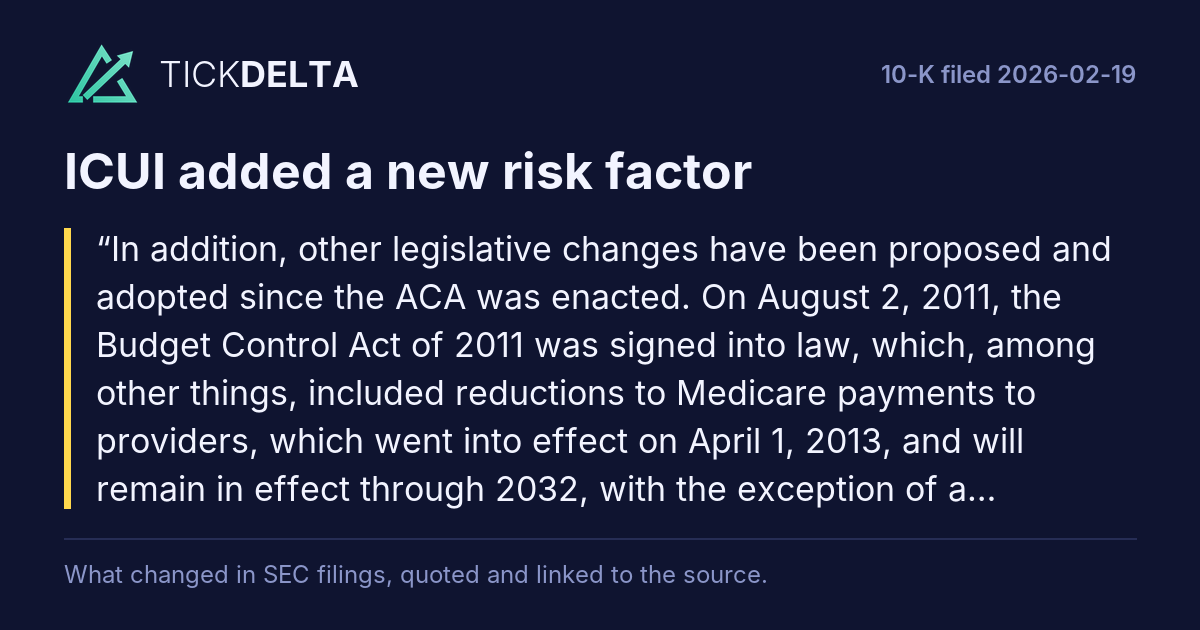
In addition, other legislative changes have been proposed and adopted since the ACA was enacted. On August 2, 2011, the Budget Control Act of 2011 was signed into law, which, among other things, included reductions to Medicare payments to providers, which went into effect on April 1, 2013, and will remain in effect through 2032, with the exception of a temporary suspension from May 1, 2020 through March 31, 2022, unless additional Congressional action is taken. On January 2, 2013, the American Taxpayer Relief Act of 2012, was signed into law, which, among other things, further reduced Medicare payments to several providers, including hospitals. More recently, the OBBBA, which was enacted in July 2025, imposes significant reductions in the funding of the Medicaid program. Such reductions are expected to decrease the number of persons enrolled in Medicaid and reduce the services covered by Medicaid, which could adversely affect our sales of our products.
Paragraphs in the 10-Q filed Nov 5, 2026 that were not in the one before
New in the latest 10-Q
17 paragraphs in the 10-Q filed Nov 5, 2026 with nothing like
them in the 10-Q filed Aug 6, 2026 (at least half the words must differ; new numbers alone do not count).
Quoted exactly, grouped by the item heading above them. This is text that changed, not a judgement of how serious it is.
10-Q
(1) Due to the net loss for the three months ended September 30, 2025, there are no potentially dilutive common shares included in the computation of diluted earnings per share.
Read in the 10-Qopen_in_new
In July 2026, Otsuka ICU Medical LLC announced plans for an over $ 500 million expansion to its IV Solutions manufacturing plant in Austin, Texas. During the three and nine months ended September 30, 2026, our equity in (losses) earnings of unconsolidated affiliates related to our Otsuka ICU Medical LLC joint venture included $ 0.8 million in non-cash impairment charges related to the expansion.
Read in the 10-Qopen_in_new
On October 13, 2026, we resolved a 2024 legal action in which we were named co-defendant. Under the terms of the settlement, we agreed to fully relinquish our approximately 20% non-marketable equity interest in the unconsolidated affiliate. As such, we evaluated the investment for impairment as of September 30, 2026, determined that the impairment became probable and reasonably estimable, and consequently, we recorded a full write-down of $ 2.8 million, recognized as an other-than-temporary impairment loss included in other (expense) income, net within the condensed consolidated statement of operations for the three and nine months ended September 30, 2026. On the condensed consolidated statement of cash flows for the nine months ended September 30, 2026, this non-cash impairment charge is included as an add back to net income in the other line item within operating activities. Our distribution agreement remains in effect until its various termination dates in 2027.
Read in the 10-Qopen_in_new
• U.S. return-to-provision adjustments net of related tax reserves for the year ended December 31, 2025 resulted in a tax benefit of $ 3.3 million, for both the three and nine months ended September 30, 2026. The adjustments related primarily to a decrease to the U.S. valuation allowance.
Read in the 10-Qopen_in_new
• Tax expense of $ 0.0 million and $ 6.1 million, respectively, related to the sale of a 60% interest in our IV solutions business during the three and nine months ended September 30, 2025.
Read in the 10-Qopen_in_new
Show the other 12
• Unrecognized tax benefits released as a result of the expiration of statutes of limitations during the three and nine months ended September 30, 2025 of $ 0.0 million and $ 5.0 million, respectively.
Read in the 10-Qopen_in_new
material acquisition, and (ii) a Minimum Interest Coverage Ratio of 3.00 to 1.00, which remains unchanged from the Existing Credit Agreement.
Read in the 10-Qopen_in_new
Other comprehensive (loss) income before reclassifications (4,441) 8,414 — 3,973
Read in the 10-Qopen_in_new
Other comprehensive income (loss) before reclassifications 81,569 (6,524) — 75,045
Read in the 10-Qopen_in_new
Other comprehensive income (loss) before reclassifications (4,520) 7,743 — 3,223
Read in the 10-Qopen_in_new
Our General Anesthesia & Respiratory products include anesthesia, airway management, and respiratory care products.
Read in the 10-Qopen_in_new
Our Critical Care products include catheters, blood pressure transducers and related components used in hospital and acute care settings.
Read in the 10-Qopen_in_new
Our Pain Management products are used in regional anesthesia and pain management procedures.
Read in the 10-Qopen_in_new
Based on current geopolitical conditions we expect foreign currency exchange rates, freight costs, oil prices, interest rates, and general inflation to remain subject to volatility in the market. For example, the conflict involving Iran has and could
Read in the 10-Qopen_in_new
We do not expect any additional refunds related to tariffs previously paid under IEEPA to be material and, therefore, do not expect such refunds to materially impact our future gross margins..
Read in the 10-Qopen_in_new
to certain foreign currencies, including the Euro and British Pound, partially offset by the strengthening of the U.S. dollar relative to the Mexican Peso.
Read in the 10-Qopen_in_new
In July 2026, Otsuka ICU Medical LLC announced plans for an over $500 million expansion to its IV Solutions manufacturing plant in Austin, Texas. This capital project will be funded by OPF, and we have no commitment to provide cash in connection with the plant expansion. Our equity in (losses) earnings of unconsolidated affiliates related to our Otsuka ICU Medical LLC ("OIM") joint venture is expected to be impacted by anticipated non-cash impairment charges related to the write-off of certain historical plant assets and equipment as they are decommissioned or replaced prior to the end of their respective useful lives. Our proportionate share of these non-cash charges will temporarily and significantly impact our reported net income (loss) in the periods recognized. These charges are expected to be non-cash in nature. Further, our equity in (losses) earnings of unconsolidated affiliates may also be impacted by certain expenses incurred solely for the benefit of our joint venture partner that will be fully reimbursable under our contract exit provisions. Accordingly, these expenses and the non-cash charges should not impact our consolidated cash flows or our recoverability of our investment in OIM. During the three and nine months ended September 30, 2026, our equity in (losses) earnings of unconsolidated affiliates related to our Otsuka ICU Medical LLC joint venture included $0.8 million of these non-cash impairment charges.
Read in the 10-Qopen_in_new
The 10-Q's risk factors against the 10-K
Item 1A of the 10-Q filed Nov 5, 2026 against Item 1A of the 10-K filed Feb 19, 2026.
A 10-Q repeats only the risks that changed, so a 10-K paragraph that is missing from it is not counted as removed.
Added is a paragraph with nothing like it in the 10-K, Reworded a sentence that is in both with several words changed,
Quiet changes a sentence in both where one to four words changed and one is a hedge or a modal
(cut words struck through, new words highlighted).
Text on the page, not a score; each links to the filing at sec.gov.
Reworded10-Q Nov 5, 2026 vs 10-K Feb 19, 2026
In evaluating an investment in our common stock, investors should consider carefully, among other things, the following risk factors, factors previously disclosed in Part I, Item 1A of our 2025 Annual Report on Form 10-K, as well as the other information contained in this Annual Report on Form 10-K and Quarterly Report, in each case, as updated by our other reports and registration statements filed filings with the SEC.
Read it in the 10-Q at sec.govopen_in_newThe 10-K sentenceopen_in_new
The rules applicable in Great Britain differ from the EEA as a result of Brexit. On June 26, 2022, the Medicines and Healthcare Products Regulatory Agency (“MHRA”) published its response to a 10-week consultation on the future regulation of medical devices in the United Kingdom (“UK”). The MHRA proposes amendments to the UK Medical Devices Regulations 2002 (which are based on EU legislation, primarily the EU Medical Devices Directive), in particular to create new access pathways to support innovation, create an innovative framework for regulating software and artificial intelligence as...
In the 10-K filed Feb 27, 2025open_in_new
For example, in September 2019, the FDA issued revised final guidance describing an optional "safety and performance based" pre-market review pathway for manufacturers of "certain, well-understood device types" to demonstrate substantial equivalence under the 510(k) clearance pathway by demonstrating that such device meets objective safety and performance criteria established by the FDA, thereby obviating the need for manufacturers to compare the safety and performance of their medical devices to specific predicate devices in the clearance process. The FDA maintains a list of device types...
In the 10-K filed Feb 27, 2025open_in_new
The Smiths Medical acquisition has resulted in significant growth in our personnel and operations, adding approximately 6,700 employees to our headcount at the time of acquisition. Our total headcount as of December 31, 2024 was approximately 15,000 employees. We have incurred and continue to incur significant expenditures and the allocation of management time to assimilate the Smiths Medical employees in a manner that preserves the key aspects of our corporate culture, including a focus on strong customer satisfaction, but there can be no assurance that we will be successful in our...
In the 10-K filed Feb 27, 2025open_in_new
Further, from January 1, 2021, companies have to comply with the GDPR and also the UK GDPR, which, together with the amended UK Data Protection Act 2018, retains the GDPR in UK national law. The UK GDPR mirrors the fines under the GDPR, e.g. fines up to the greater of €20 million (£17.5 million) or 4% of global turnover. On October 12, 2023, the UK Extension to the DPF came into effect (as approved by the UK Government), as a data transfer mechanism from the UK to U.S. entities self-certified under the DPF. As we continue to expand into other foreign countries and jurisdictions, we may be...
In the 10-K filed Feb 27, 2025open_in_new
Sources
Item 1A of each 10-K and 10-Q on EDGAR, quoted exactly. Each paragraph links to the filing at sec.gov.
Also
10-K change: what was reworded or cut, section by section.
Work with it
Excel workbook · CSV. Google Sheet that stays up to date: paste =IMPORTDATA("https://tickdelta.com/company/ICUI/export.csv") into a cell.