tickdelta
Sign in

Tickdelta is free for now. Sign up and get Pro free

← Screener

Health care · Research Services · Nasdaq

INCYIncyte

Compare with peers → Embed
The 10-K against last year's

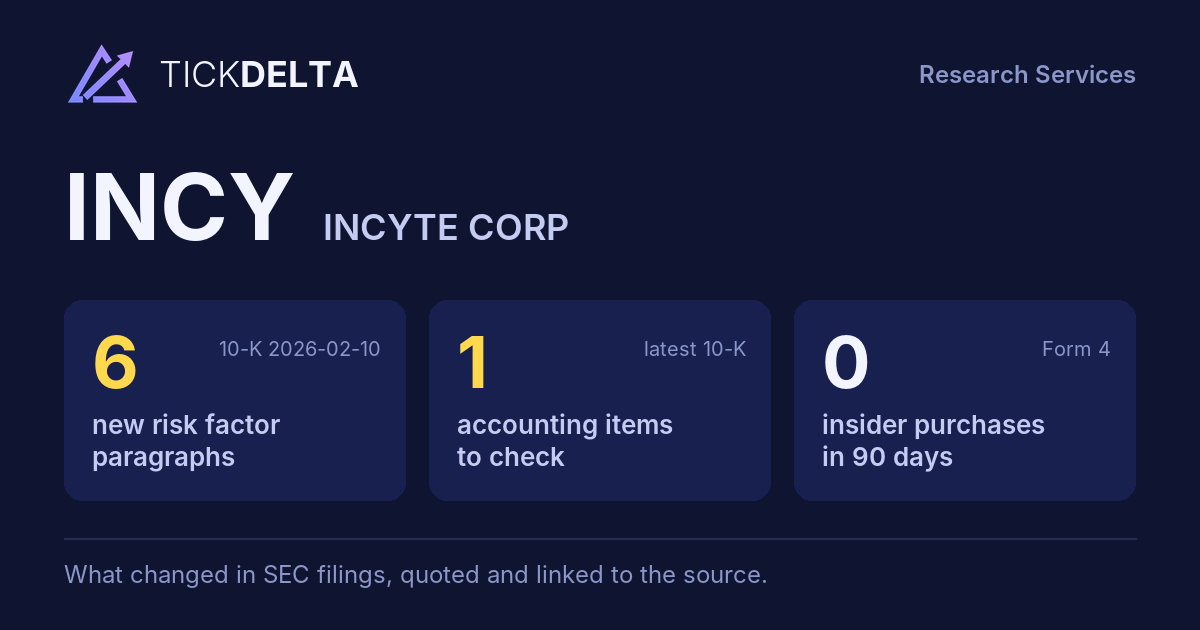
126 changes: 15 added, 7 removed, 101 reworded, 3 quiet changes

10-K Feb 10, 2026 vs Feb 10, 2025
Risk FactorsRedline ↓
8.6%
of the text changed · 19,637 words now
19.5%
of the text changed · 6,211 words now
Legal ProceedingsRedline ↓
7.8%
of the text changed · 754 words now
Accounting PoliciesRedline ↓
13.5%
of the text changed · 6,927 words now

10-K 0000879169-26-000010 (2026-02-10) vs 10-K 0001628280-25-004633 (2025-02-10)

The redline

The paragraph that changed most in each section

Marked against last year's 10-K: cut words struck through, new words highlighted and underlined.

Risk Factors 483 words changed in this paragraph; it is 30% similar to last year's version.
New tax laws or regulations could be enacted at any time, and existing tax laws or regulations could be interpreted, modified or applied in a manner that is adverse to us or our customers, which could adversely affect our results of operations, business and financial condition. For example, beginning in 2022, July 2025, U.S. federal tax legislation commonly referred to as the Tax Cuts and Jobs One Big Beautiful Bill Act of 2017 eliminated the option to deduct was enacted, which, among other things, allows domestic research and development expenditures to be expensed for tax purposes years beginning on or after January 1, 2025, with retroactive elections for such expenditures paid or incurred in the year incurred and instead requires taxpayers to capitalize and subsequently amortize such expenditures over five two prior years but also increases the effective tax rate on foreign-derived deduction eligible income (formerly known as “foreign-derived intangible income”) for research activities conducted in the United States and over 15 tax years for research activities conducted outside the United States. If the requirement to amortize research and development expenditures is not repealed beginning on or otherwise modified, it will continue to have an adverse effect on our tax liability, and the amount of that effect could be material. after January 1, 2026. As another example, in August 2022, the Inflation Reduction Act of 2022 was enacted, which, among other things, includes a new 15% alternative minimum tax on the adjusted financial statement income of certain large corporations for tax years beginning after December 31, 2022. Furthermore, the enactment of some or all of the recommendations set forth or that may be forthcoming in the Organization for Economic Co-Operation and Development, or OECD, project on “Base Erosion and Profit Shifting,” commonly known as BEPS 2.0, by tax authorities and economic blocs in the countries in which we operate, could unfavorably impact our effective tax rate. Broadly speaking, BEPS 2.0 would make fundamental changes to the international tax system, including with respect to the entitlement to tax global corporate profits and minimum global tax rates. For example, in December 2022, the European Union member states agreed to implement in their domestic tax laws a 15% global minimum tax on the profits of large multinational enterprises with a target effective date for fiscal years beginning on or after December 31, 2023. Although we continue to evaluate and monitor the potential impact of BEPS 2.0 on us, and the OECD minimum tax rules do not currently have a material impact on us, these minimum tax rules could in the future result in tax increases in both the United States and many foreign jurisdictions where we operate or have a presence. On January 15, 2025, the OECD released new guidance addressing implementation of the Pillar Two global minimum tax rules, which were effective for us in tax year 2024. As part of the guidance, the OECD placed limitations on transactions that produce deferred tax assets entered into during the transition period that runs from November 2021 through an entity’s adoption of Pillar Two. On January 20, 2025, President Trump signed an executive order effectively cancelling the United States’ commitments to the global minimum tax rules, stating that those commitments cannot have any effect in the United States without an act of approval of the U.S. Congress. Any new tax legislation or initiatives could not only significantly increase our tax provision, cash tax liabilities, and effective tax rate, but could also significantly increase tax uncertainty due to differing interpretations and increased audit scrutiny.

Source: Item 1A, 10-K 0000879169-26-000010 vs Item 1A, 10-K 0001628280-25-004633

Accounting Policies 135 words changed in this paragraph; it is 32% similar to last year's version.
In November 2023, July 2025, the Financial Accounting Standards Board (the "FASB") FASB issued ASU No. 2023-07, “Segment Reporting 2025-05, “Financial Instruments - Credit Losses (Topic 280): Improvements to Reportable Segment Disclosures.” 326): Measurement of Credit Losses for Accounts Receivable and Contract Assets.” This amended guidance applies to all public entities and aims to improve reportable segment disclosure requirements, primarily through enhanced disclosures about significant segment expenses, to enable investors to develop more decision-useful financial analyses. This guidance is simplify the estimation of expected credit losses for current accounts receivable and contract assets by providing a practical expedient for all companies. The amendments are effective for fiscal years annual reporting periods beginning after December 15, 2023 2025 and interim reporting periods within fiscal years beginning after December 15, 2024. See Note 17 for additional those annual periods. If electing the practical expedient, entities should apply the amendments in this update prospectively. We are currently evaluating the impact ASU No. 2025-05 will have on our consolidated financial statements and related disclosures.

Source: Item 8, Note 1 – Organization and Summary of Significant Accounting Policies, 10-K 0000879169-26-000010 vs Item 8, Note 1 – Organization and Summary of Significant Accounting Policies, 10-K 0001628280-25-004633

MD&A 108 words changed in this paragraph; it is 60% similar to last year's version.
Cash used in (used in) provided by investing activities. Our investing activities, other than purchases, sales and maturities of marketable securities, have consisted predominantly of capital expenditures and sales of long term investments. During 2025, net cash used in investing activities was $102.6 million, which primarily represented purchases of marketable securities of $295.5 million, capital expenditures of $58.9 million and payments for intangible assets of $25.0 million, offset in part by maturities of marketable securities of $284.6 million. During 2024, net cash provided by investing activities was $157.5 million, which primarily represented sales of equity investments of $284.8 million and sale and maturity of marketable securities of $231.3 million, offset in part by purchases of marketable securities of $258.4 million, payments for intangible assets of $13.9 million, and capital expenditures of $86.3 million. During 2023, net cash used in investing activities was $207.7 million, which represents purchases of marketable securities of $456.0 million, capital expenditures of $32.5 million, payments for intangible assets of $15.0 million, and purchases of long term investments of $10.0 million, offset in part by the sale and maturity of marketable securities of $305.8 million.

Source: Item 7, 10-K 0000879169-26-000010 vs Item 7, 10-K 0001628280-25-004633

Legal Proceedings 3 words changed in this paragraph; it is 99% similar to last year's version.
We brought a lawsuit against the U.S. Centers for Medicare and Medicaid Services (“CMS”) alleging that a recent regulation issued by CMS on the definition of “line extension” for purposes of the Medicaid rebate program is too broad and has the unintended consequence of treating OPZELURA as a “line extension” of JAKAFI under this program. We believe that such a reading would violate CMS's CMS’s statutory authority and be arbitrary and capricious, given that OPZELURA, among other differentiators, is indicated to treat entirely different medical conditions and entirely different patient populations than JAKAFI. As of December 31, 2024, 2025, we have accrued approximately $127.6 $218.5 million within accrued and other current liabilities on the consolidated balance sheet, relating to the incremental rebates that would be owed were OPZELURA considered a line extension of JAKAFI. The impact on OPZELURA gross to net deductions for the quarter ending December 31, 2024, 2025, is approximately 6.3%. 6.9%. If OPZELURA is not treated as a line extension of JAKAFI, this would result in a reversal of our accrual and a lower future gross to net deduction for OPZELURA.

Source: Item 3, via Note 17 – Commitments and Contingencies, 10-K 0000879169-26-000010 vs Item 3, via Note 16 – Commitments and Contingencies, 10-K 0001628280-25-004633
Every change, by type

Sentences and paragraphs added, removed or reworded

Sentences and paragraphs of INCY's Risk Factors and MD&A, 10-K 2026-02-10 against 10-K 2025-02-10. Each links to the text at sec.gov.

AddedRisk Factors
Changes in government pricing policies, including the enactment of “most favored nation” pricing legislation, could adversely affect our business.

Read it in 10-K 2026-02-10 at sec.gov ↗

AddedRisk Factors
Our revenue, results of operations, and cash flows could be materially and adversely affected by changes in government pricing policies, including recently proposed or enacted “most favored nation” (MFN) pricing legislation or executive actions. For example, an executive order issued on May 12, 2025, directed the Department of Health and Human Services to establish MFN price targets, and, if progress toward these targets is insufficient, to pursue rulemaking that could require sale of certain products in the U.S. at prices no higher than those in comparable developed nations. The extent, timing, and ultimate effect of this policy are uncertain, and we cannot predict the potential impact on our pricing, reimbursement, or profitability.

Read it in 10-K 2026-02-10 at sec.gov ↗

AddedRisk Factors
conflicts could result in delays in our plans to develop drug candidates or result in the expenditure of additional funds to resolve those conflicts that could have an adverse effect on our results of operations. We have also licensed, and may in the future need to license, drug delivery or other technology in order to continue to develop our drug candidates. If we are unable to enter into additional agreements to license drug candidates, drug delivery technology or other technology or if these arrangements are unsuccessful, our research and development efforts could be adversely affected, and we may be unable to increase our number of successfully marketed products and our revenues.

Read it in 10-K 2026-02-10 at sec.gov ↗

AddedRisk Factors
conditions affecting the cost and availability of raw materials, such as inflation, decreases in available manufacturing capacity, or otherwise, would adversely affect our results of operations.

Read it in 10-K 2026-02-10 at sec.gov ↗

AddedRisk Factors
New tax laws or regulations could be enacted at any time, and existing tax laws or regulations could be interpreted, modified or applied in a manner that is adverse to us or our customers, which could adversely affect our results of operations, business and financial condition. For example, in July 2025, U.S. federal tax legislation commonly referred to as the One Big Beautiful Bill Act was enacted, which, among other things, allows domestic research and development expenditures to be expensed for tax years beginning on or after January 1, 2025, with retroactive elections for such expenditures paid or incurred in the two prior years but also increases the effective tax rate on foreign-derived deduction eligible income (formerly known as “foreign-derived intangible income”) for tax years beginning on or after January 1, 2026. As another example, in August 2022, the Inflation Reduction Act of 2022 was enacted, which, among other things, includes a new 15% alternative minimum tax on the adjusted financial statement income of certain large corporations for tax years beginning after December 31, 2022.

Read it in 10-K 2026-02-10 at sec.gov ↗

AddedMD&A
Medicare Part D Rebates: Changes to our Medicare Part D prescription drug coverage reimbursements (“Part D Discount Program”) became effective January 1, 2025 pursuant to the Inflation Reduction Act of 2022. Under the revised Part D Discount Program, manufacturers must give a 10 percent discount on Part D drugs in the initial coverage phase, and a 20 percent discount on Part D drugs in the so-called “catastrophic phase” (the phase after the patient incurs costs above the initial phase out-of-pocket threshold, which is $2,000 beginning in 2025). The Inflation Reduction Act includes certain exemptions for small biotech drug manufacturers, including Incyte. These exemptions apply on a drug-specific basis, and qualifying drugs will be exempt from possible negotiation through 2028 and subject to reduced discounts that will be phased-in over a number of years under the new Part D benefit. In 2025, we saw a reduction in our sales allowances owed under Medicare Part D, due to changes to the Part D Discount Program.

Read it in 10-K 2026-02-10 at sec.gov ↗

AddedMD&A
NIKTIMVO net product revenues for 2025 reflect continued strong uptake of the product following its commercial launch during the first quarter of 2025.

Read it in 10-K 2026-02-10 at sec.gov ↗

Show the other 7
AddedMD&A
The increase in ZYNYZ net product revenues from 2024 to 2025 was primarily driven by the approval of the product in squamous cell anal carcinoma in the second quarter of 2025.

Read it in 10-K 2026-02-10 at sec.gov ↗

AddedMD&A
As described further in Note 7 of Notes to the Consolidated Financial Statements, during May 2025, we and Novartis entered into a settlement agreement with respect to litigation initiated by Novartis relating to the duration of royalty payments owed by us to Novartis under our Collaboration and License Agreement. As of March 31, 2025, we had approximately $537.1 million of accrued royalties relating to the dispute with Novartis included in accrued and other current liabilities on our consolidated balance sheet. Under the settlement agreement, we paid Novartis $280.0 million as the settlement of disputed royalties on net sales of JAKAFI in the United States through December 31, 2024, and agreed to reduce by 50% the royalty rate payable by us on future net sales of JAKAFI in the United States beginning January 1, 2025. The reduced royalty paid for the quarter ended March 31, 2025, was approximately $14.9 million. The difference of $242.2 million between the total accrued royalties and the total amount paid by us to Novartis as disclosed above was recorded in contract dispute settlement on our consolidated statement of operations for the year ended December 31, 2025.

Read it in 10-K 2026-02-10 at sec.gov ↗

AddedMD&A
As described further in Note 8 of Notes to the Consolidated Financial Statements, during December 2025, the downtown Wilmington, Delaware properties that we acquired in May 2024 met the criteria to be classified as assets held for sale. As a result of this classification, we recorded an asset impairment charge of $76.3 million on our consolidated statement of operations for the year ended December 31, 2025 relating to the downtown Wilmington properties in order to reflect the properties at the lower of their carrying amount or estimated fair value less cost to sell as of December 31, 2025. The estimated fair value less cost to sell of the properties has been recorded within the Prepaid expenses and other current assets line item on our consolidated balance sheet as of December 31, 2025.

Read it in 10-K 2026-02-10 at sec.gov ↗

AddedMD&A
2025 2024 (in millions) December 31: Cash, cash equivalents, and marketable securities $3,580.6 $2,158.1 Working capital $3,508.7 $1,597.2 Year ended December 31: Cash provided by (used in): Operating activities $1,413.5 $335.3 Investing activities $(102.6) $157.5 Financing activities $101.0 $(2,021.5) Capital expenditures (included in investing activities above) $(58.9) $(86.3)

Read it in 10-K 2026-02-10 at sec.gov ↗

AddedMD&A
The enactment of the One Big Beautiful Bill Act on July 4, 2025 modified key provisions of the Tax Cuts and Jobs Act of 2017. The legislation introduces multiple elections and features various effective dates, with some provisions effective in 2025 and others in subsequent years. The change related to the expensing of domestic research costs will materially reduce our U.S. tax liabilities in 2025 and 2026. We intend to continue to evaluate the impacts of these provisions for our tax return filing.

Read it in 10-K 2026-02-10 at sec.gov ↗

Next Related parties →