6 paragraphs in Risk Factors of the 10-K filed Feb 10, 2026
with nothing like them in the 10-K filed Feb 10, 2025. Quoted exactly.
Paragraphs that were only edited are under 10-K change.
Compared with the Risk Factors in the latest 10-K of the other 59 Health care companies:
a paragraph with at least half its words the same at another company is called similar, and the companies are listed under it.
A paragraph most of them have is marked boilerplate. No line means no other company has one like it.
This counts text; it does not say how serious a risk is.
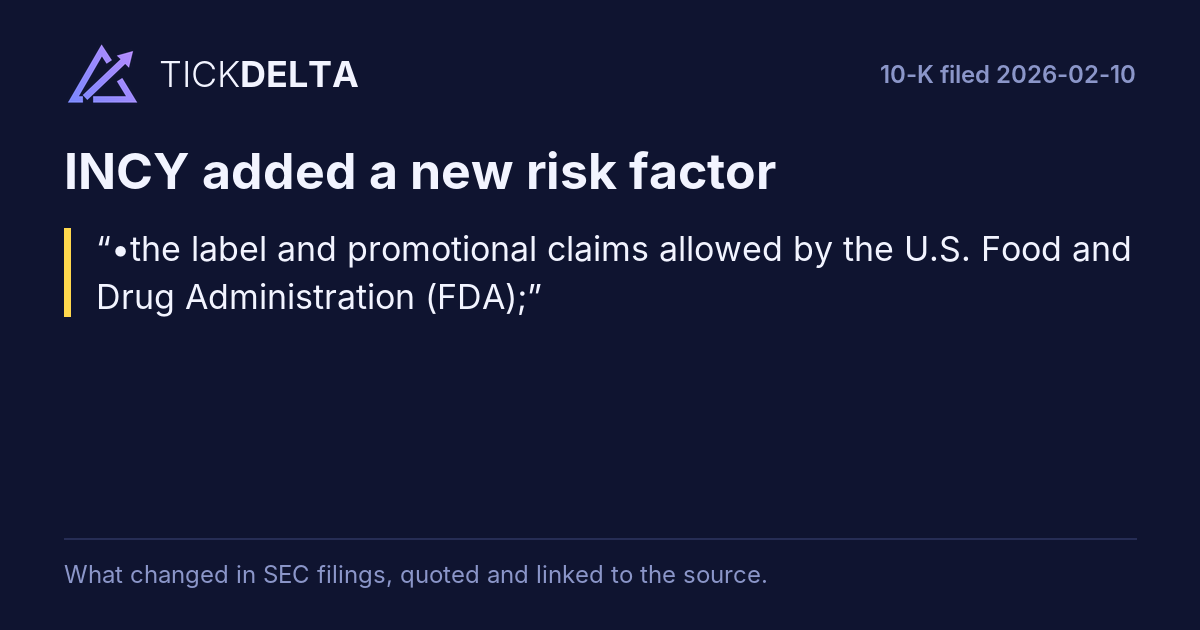
•the label and promotional claims allowed by the U.S. Food and Drug Administration (FDA);
Read in the 10-K ↗
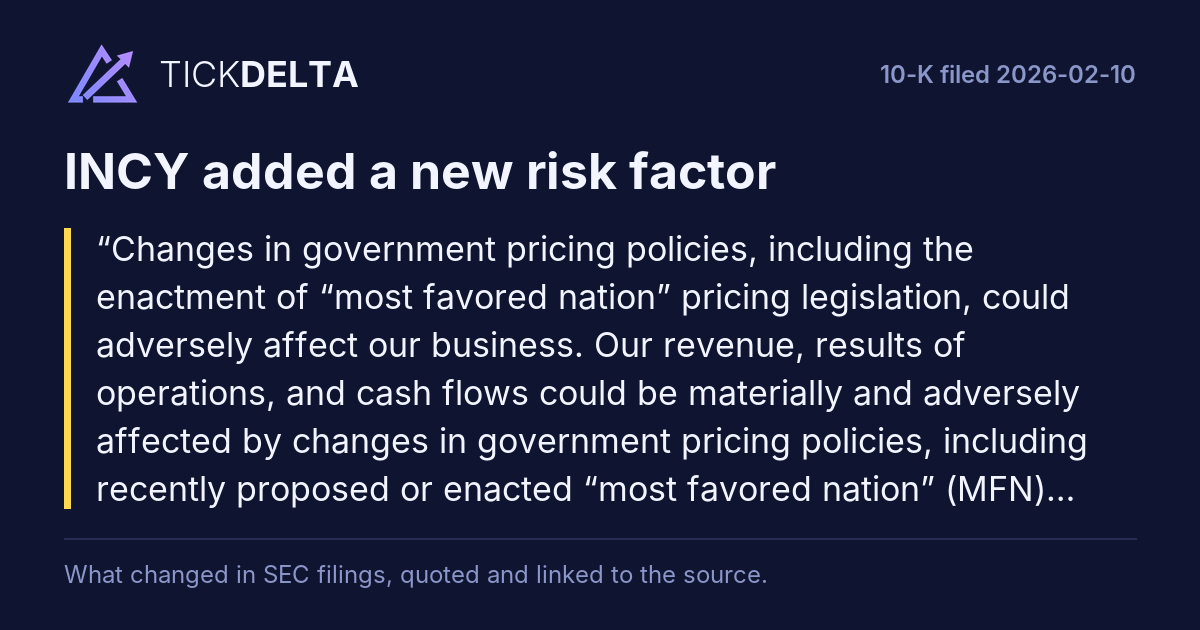
Changes in government pricing policies, including the enactment of “most favored nation” pricing legislation, could adversely affect our business.
Similar paragraph at 2 of 59 other Health care companies:
GEHC,
ZTSOur revenue, results of operations, and cash flows could be materially and adversely affected by changes in government pricing policies, including recently proposed or enacted “most favored nation” (MFN) pricing legislation or executive actions. For example, an executive order issued on May 12, 2025, directed the Department of Health and Human Services to establish MFN price targets, and, if progress toward these targets is insufficient, to pursue rulemaking that could require sale of certain products in the U.S. at prices no higher than those in comparable developed nations. The extent, timing, and ultimate effect of this policy are uncertain, and we cannot predict the potential impact on our pricing, reimbursement, or profitability.
Read in the 10-K ↗
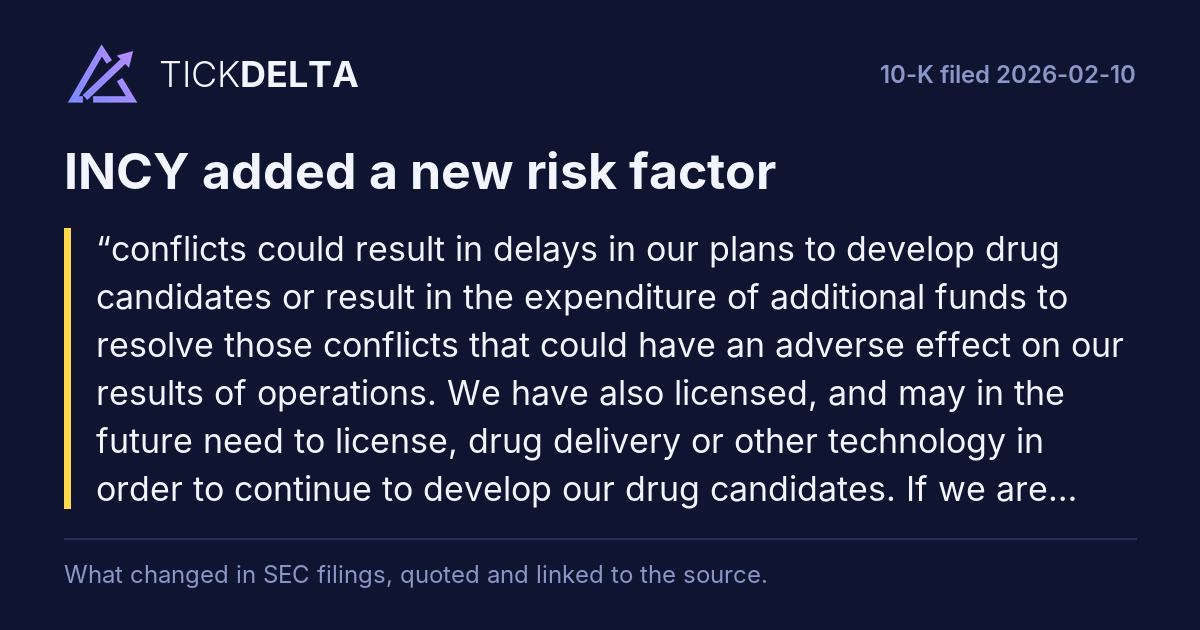
conflicts could result in delays in our plans to develop drug candidates or result in the expenditure of additional funds to resolve those conflicts that could have an adverse effect on our results of operations. We have also licensed, and may in the future need to license, drug delivery or other technology in order to continue to develop our drug candidates. If we are unable to enter into additional agreements to license drug candidates, drug delivery technology or other technology or if these arrangements are unsuccessful, our research and development efforts could be adversely affected, and we may be unable to increase our number of successfully marketed products and our revenues.
Read in the 10-K ↗
conditions affecting the cost and availability of raw materials, such as inflation, decreases in available manufacturing capacity, or otherwise, would adversely affect our results of operations.
Read in the 10-K ↗
New tax laws or regulations could be enacted at any time, and existing tax laws or regulations could be interpreted, modified or applied in a manner that is adverse to us or our customers, which could adversely affect our results of operations, business and financial condition. For example, in July 2025, U.S. federal tax legislation commonly referred to as the One Big Beautiful Bill Act was enacted, which, among other things, allows domestic research and development expenditures to be expensed for tax years beginning on or after January 1, 2025, with retroactive elections for such expenditures paid or incurred in the two prior years but also increases the effective tax rate on foreign-derived deduction eligible income (formerly known as “foreign-derived intangible income”) for tax years beginning on or after January 1, 2026. As another example, in August 2022, the Inflation Reduction Act of 2022 was enacted, which, among other things, includes a new 15% alternative minimum tax on the adjusted financial statement income of certain large corporations for tax years beginning after December 31, 2022.
Read in the 10-K ↗
New in the latest 10-Q
10 paragraphs in the 10-Q filed Oct 29, 2026 with nothing like
them in the 10-Q filed Jul 28, 2026 (at least half the words must differ; new numbers alone do not count).
Quoted exactly, grouped by the item heading above them. This is text that changed, not a judgement of how serious it is.
Financial statements and notes
Effective July 1, 2026, we changed our inventory costing method for commercial product manufactured by third-party contract manufacturers from the specific identification method to the first-in, first-out (“FIFO”) method. Following the change, all inventories are accounted for under the FIFO method. We believe this change in accounting method is preferable as it (i) aligns accounting policies with the predominant inventory costing method used by industry peers, improving comparability for investors; (ii) is consistent with how we manage our business; and (iii) provides a single, uniform inventory costing methodology across all of our inventory. This change in accounting principle did not have a material effect on inventory or cost of sales for all periods presented; nor did it have a material impact on opening retained earnings. Therefore, prior comparative financial statements have not been restated.
Read in the 10-Q ↗
Vega’s lead molecule, latarcibart (formerly VGA039), is a first-in-class anti - Protein S monoclonal antibody in Phase 3 development for the treatment of von Willebrand disease, the most common inherited bleeding disorder. We accounted for the Vega transaction as an asset acquisition under U.S. GAAP because the latarcibart asset represents substantially all of the fair value of the gross assets acquired.
Read in the 10-Q ↗
In addition to the $ 1.25 billion closing cash consideration, we incurred $ 16.7 million of direct transaction costs that were included in the total consideration allocated to the acquired net assets. Of the $ 1.267 billion in total consideration, $ 1.232 billion was allocated to the latarcibart asset, an acquired in-process research and development (“IPR&D”) asset. The remaining $ 35.3 million of total consideration was allocated to the net assets acquired, including $ 37.5 million of a deferred tax asset, offset by liabilities assumed. As the acquired IPR&D asset does not have an alternative future use at the acquisition date, we recognized the full amount of $ 1.232 billion as research and development expenses on our condensed consolidated statements of operations during the three months and nine months ended September 30, 2026.
Read in the 10-Q ↗
Star is eligible to receive up to $ 750 million in additional payments upon the achievement of specified annual net sales milestones in the U.S. for latarcibart. Because the transaction was accounted for as an asset acquisition, the contingent milestone payments were not recognized as of the acquisition date. We will recognize any additional consideration when the related contingency is resolved, and the U.S. net sales milestones are met. No amounts were recorded for the contingent milestone payments as of September 30, 2026.
Read in the 10-Q ↗
The effective tax rates for the three and nine months ended September 30, 2026 were unfavorable as compared to the three and nine months ended September 30, 2025 primarily due to the one-time non-deductible charge of $ 1.23 billion associated with the acquisition of Vega.
Read in the 10-Q ↗
Net (loss) income per share was calculated as follows for the periods indicated below:
Read in the 10-Q ↗
In the third quarter of 2026, as part of our strategic shift in focus toward the first-line maintenance ovarian cancer setting, enrollment in the Phase 3 study (MAESTRA-2) evaluating INCB123667 in PROC was discontinued. A Phase 3 study (MAESTRA-3) evaluating INCB123667 in first-line maintenance ovarian cancer is planned to initiate in the fourth quarter of 2026.
Read in the 10-Q ↗
In July 2026, the European Commission approved OPZELURA for the treatment of moderate AD in adult patients for whom topical corticosteroids (“TCSs”) and topical calcineurin inhibitors (“TCIs”) are inadequate or inappropriate. OPZELURA is the first steroid-free topical JAK inhibitor approved in the EU for adults with moderate AD. This approval represents OPZELURA’s second approved indication in the EU.
Read in the 10-Q ↗
Loss (gain) on change in fair value of acquisition-related contingent consideration
Read in the 10-Q ↗
Item 6
18.1* Preferability Letter from Ernst & Young LLP, dated October 29, 2026, relating to change in accounting principle
Read in the 10-Q ↗
The 10-Q's risk factors against the 10-K
Item 1A of the 10-Q filed Oct 29, 2026 against Item 1A of the 10-K filed Feb 10, 2026.
A 10-Q repeats only the risks that changed, so a 10-K paragraph that is missing from it is not counted as removed.
Added is a paragraph with nothing like it in the 10-K, Reworded a sentence that is in both with several words changed,
Quiet changes a sentence in both where one to four words changed and one is a hedge or a modal
(cut words struck through, new words highlighted and underlined).
Text on the page, not a score; each links to the filing at sec.gov.
Added10-Q 2026-10-29 vs 10-K 2026-02-10
• develop products internally or license or acquire drug candidates from others;
Read it in the 10-Q at sec.gov ↗
Added10-Q 2026-10-29 vs 10-K 2026-02-10
Even if our or our collaborators’ drug candidates receive regulatory approval in the United States or foreign jurisdictions, the market success of these products will be adversely affected if they are unable to achieve and maintain market acceptance by patients, providers and payors. Demand for our products could be adversely affected if providers elect a course of treatment which does not include our or our collaborators’ approved products. The market success of our products depends on our ability to successfully communicate the safety and efficacy of our and our collaborator’s products, and the failure to do so could adversely impact our results of operations and financial condition.
Read it in the 10-Q at sec.gov ↗
Added10-Q 2026-10-29 vs 10-K 2026-02-10
In recent years, the U.S. federal government has enacted significant healthcare and drug pricing reforms through legislation and regulation. These reforms include modifications to Medicare reimbursement, increased manufacturer rebate obligations under certain government healthcare programs and the establishment of new mechanisms intended to reduce prescription drug spending. For example, the American Rescue Plan Act of 2021 included a provision that became effective in January 2024 that eliminated the statutory cap on rebates that drug manufacturers pay to Medicaid. It is expected that this provision, as implemented by the Centers for Medicare and Medicaid Services (“CMS”), will have the effect of increasing Medicaid rebate liability, particularly in the case of medicines that have experienced price increases at a rate in excess of inflation.
Read it in the 10-Q at sec.gov ↗
Added10-Q 2026-10-29 vs 10-K 2026-02-10
In addition, the Inflation Reduction Act of 2022 (the “IRA”) introduced several significant changes to Medicare, including: requiring CMS to negotiate prices for certain high-expenditure, single source Medicare drugs; imposing inflation-based rebates on manufacturers whose prices increase faster than inflation; redesigning the Medicare Part D benefit to cap beneficiary out-of-pocket costs while requiring manufacturers to provide mandatory discounts under the Medicare Part D Manufacturer Discount Program beginning in 2025; and establishing penalties for manufacturers that fail to comply with applicable Medicare Drug Price Negotiation Program requirements. The IRA provides phased implementation of the Medicare Part D Manufacturer Discount Program for certain qualifying products. Certain Incyte products currently qualify for this phase-in, although our manufacturer discount obligations will increase over time as those provisions phase out.
Read it in the 10-Q at sec.gov ↗
Added10-Q 2026-10-29 vs 10-K 2026-02-10
In 2025, Congress enacted the ORPHAN Cures Act, which amended certain provisions of the Medicare Drug Price Negotiation Program established under the IRA. As a result, the timeline under which the ruxolitinib phosphate active moiety could become eligible for Medicare drug price negotiation has been extended. While the ORPHAN Cures Act delayed the timing of potential Medicare drug price negotiation applicable to ruxolitinib phosphate, future policy actions could modify, repeal or further amend these provisions, or otherwise expand government authority over pharmaceutical pricing.
Read it in the 10-Q at sec.gov ↗
Added10-Q 2026-10-29 vs 10-K 2026-02-10
Our manufacturing facility in Switzerland is subject to similar risks as those described above in relation to our third-party manufacturers. This facility may encounter unanticipated delays and expenses in operations due to a number of factors, including regulatory requirements. For example, our manufacturing facilities are subject to inspection in connection with clinical development and new drug approvals as well as ongoing, periodic inspections by regulatory agencies. Any failures or deficiencies identified by such inspections could delay or prevent our manufacturing activities. If our manufacturing operations are delayed, we may not be able to manufacture sufficient quantities of our drug candidates and approved drug products which could limit our development and commercialization activities and adversely affect our business.
Read it in the 10-Q at sec.gov ↗
Added10-Q 2026-10-29 vs 10-K 2026-02-10
We are subject to income tax in the United States and the foreign jurisdictions in which we operate. We must make certain judgments in determining our worldwide tax liabilities, and our effective tax rate is derived from the applicable statutory tax rates and relative income in each taxing jurisdiction. We record liabilities for uncertain tax positions that involve significant estimation uncertainty or management judgments. Taxing authorities in the jurisdictions in which we operate may disagree with our interpretation of tax law or with the positions we may take with respect to particular tax issues. Consequently, tax assessments or judgments in excess of accrued amounts that we have estimated in preparing our financial statements may materially and adversely affect our reported effective tax rate or our cash flows. Further, other factors may adversely affect our effective tax rate, including changes in the mix of our profitability from country to country, tax effects of stock-based compensation and changes in tax laws or regulations.
Read it in the 10-Q at sec.gov ↗
Added10-Q 2026-10-29 vs 10-K 2026-02-10
Increasing use of artificial intelligence-based software and tools creates new risks and challenges that could adversely affect our business or cause reputational harm.
Read it in the 10-Q at sec.gov ↗
Added10-Q 2026-10-29 vs 10-K 2026-02-10
Additionally, failures or disruptions in any artificial intelligence functionality we incorporate into our business activities or products could adversely impact our business or result in delays or errors. Conversely, any failure to successfully develop and deploy artificial intelligence in our business activities or products could adversely affect our competitiveness (particularly if our competitors successfully deploy artificial intelligence in their businesses, products and services), and the development and deployment of artificial intelligence will require additional investment and increase our costs. The use of artificial intelligence is subject to rapidly evolving laws and regulations. Compliance with these laws and regulations may impose operational costs and limit our ability to use artificial intelligence-based software and tools, and failure to comply may result in potential government actions, litigation, fines, penalties, and brand or reputational harm.
Read it in the 10-Q at sec.gov ↗
Reworded10-Q 2026-10-29 vs 10-K 2026-02-10
For example, in February 2024 we entered into a purchase agreement with acquired the rights to tafasitamab (MONJUVI/MINJUVI) from MorphoSys AG and MorphoSys US Inc. under which we acquired rights to tafasitamab (MONJUVI/MINJUVI) that resulted in our holding exclusive global development and commercialization rights to tafasitamab. tafasitamab, and in July 2026 we acquired Vega Therapeutics and its novel antibody therapies for rare blood disorders.
Read it in the 10-Q at sec.gov ↗ · The 10-K sentence ↗
Reworded10-Q 2026-10-29 vs 10-K 2026-02-10
These reforms may affect future investments in our drug development, development should the reforms they affect our risk-benefit analysis of investing in a drug candidate. candidates, reduce the price that we or any of our collaborators or licensees receive for our products and adversely affect our business strategy, operations and financial results.
Read it in the 10-Q at sec.gov ↗ · The 10-K sentence ↗
Reworded10-Q 2026-10-29 vs 10-K 2026-02-10
None of the notice letters challenge the ruxolitinib or ruxolitinib phosphate composition of matter patents, providing patent coverage (with pediatric extension) until December 2028, and the notice letter from Zydus Lifesciences Limited also does not challenge certain patents covering ruxolitinib phosphate cream and its uses, providing patent coverage (with pediatric extension) until November 2031. 2028.
Read it in the 10-Q at sec.gov ↗ · The 10-K sentence ↗
Reworded10-Q 2026-10-29 vs 10-K 2026-02-10
In October 2025 and February 2026, we We subsequently entered into a confidential settlement agreement agreements with Hikma Pharmaceuticals USA Inc. and Inc., Granules India Ltd., respectively, settling all outstanding claims in the Hikma and Granules litigations. Dr.
Read it in the 10-Q at sec.gov ↗ · The 10-K sentence ↗
Reworded10-Q 2026-10-29 vs 10-K 2026-02-10
Any increases in the cost of our drug candidates or drug products, whether through conditions affecting the cost and availability of raw materials, such as inflation, decreases in available manufacturing capacity, or otherwise, would adversely affect our results of operations.
Read it in the 10-Q at sec.gov ↗ · The 10-K sentence ↗
Reworded10-Q 2026-10-29 vs 10-K 2026-02-10
Reddy’s Laboratories, (together “MSN”) and Hetero USA Inc., Hetero Labs Limited Unit-V, and Eugia Pharma Specialties, Ltd., Hetero Labs Limited (together “Hetero”), which we refer to as the Generic JAKAFI Manufacturers, notifying us that each has filed an ANDA requesting approval to market a generic version of JAKAFI and that contains contain a paragraph IV certification purporting to challenge one or more patents covering ruxolitinib composition of matter and its use that expire (with pediatric extension) in June 2028 and patents covering ruxolitinib phosphate and its use that expire (with pediatric extension) in December 2028.
Read it in the 10-Q at sec.gov ↗ · The 10-K sentence ↗
Reworded10-Q 2026-10-29 vs 10-K 2026-02-10
In response to the notice letters, we filed patent infringement actions against each of Padagis Israel Pharmaceuticals Ltd., Taro Pharmaceuticals Inc., Zydus Lifesciences Limited and Encube Ethicals Private Limited the Generic OPZELURA Manufacturers in the U.S.
Read it in the 10-Q at sec.gov ↗ · The 10-K sentence ↗
Reworded10-Q 2026-10-29 vs 10-K 2026-02-10
We have received a notice letter letters from each of Padagis Israel Pharmaceuticals Ltd., Taro Pharmaceuticals Inc., Zydus Lifesciences Limited and Encube Ethicals Private Limited Limited, which we refer to as the Generic OPZELURA Manufacturers, notifying us that each has filed an ANDA requesting approval to market a generic version of OPZELURA and that contains contain a paragraph IV certification purporting to challenge one or more patents covering ruxolitinib phosphate cream and its uses that expire in 2031 and 2040.
Read it in the 10-Q at sec.gov ↗ · The 10-K sentence ↗
Reworded10-Q 2026-10-29 vs 10-K 2026-02-10
If we fail to comply with applicable laws and regulations, we could lose our approval to market our products or be subject to other governmental enforcement activity. activity, and we could face increased costs, penalties and a loss of business.
Read it in the 10-Q at sec.gov ↗ · The 10-K sentence ↗
Reworded10-Q 2026-10-29 vs 10-K 2026-02-10
Risks related to proposed changes in government regulations and healthcare reform measures are described below under “Other Risks Relating to our Business—Healthcare Business - Healthcare reform measures measures, including federal and state drug pricing reforms, could impact the pricing and profitability of pharmaceuticals, and adversely affect the commercial viability of our or our collaborators’ products and drug candidates.
Read it in the 10-Q at sec.gov ↗ · The 10-K sentence ↗
Reworded10-Q 2026-10-29 vs 10-K 2026-02-10
Business—Competition” Business - Competition” in this our Annual Report on Form 10-K for the year ended December 31, 2025 for additional information regarding the effects of competition.
Read it in the 10-Q at sec.gov ↗ · The 10-K sentence ↗
Reworded10-Q 2026-10-29 vs 10-K 2026-02-10
Healthcare reform measures measures, including federal and state drug pricing reforms, could impact the pricing and profitability of pharmaceuticals, pharmaceuticals and adversely affect the commercial viability of our or our collaborators’ products and drug candidates.
Read it in the 10-Q at sec.gov ↗ · The 10-K sentence ↗
Quiet changes10-Q 2026-10-29 vs 10-K 2026-02-10
In addition to the risks described above under “Risks Relating to Commercialization of Our Products—If Products - If the use of our products harms patients, or is perceived to harm patients even when such harm is unrelated to our products, our regulatory approvals could be revoked or otherwise negatively impacted or we could be subject to costly and damaging product liability claims,” the conduct of clinical trials of medical products that are intended for human use entails an inherent risk of product liability.
Read it in the 10-Q at sec.gov ↗ · The 10-K sentence ↗
The first 22 of 35 are shown (at most 12 of each type).