Independent Bank Corp INDB
New risk paragraphs, branching off last year
Each branch is a paragraph in Risk Factors with nothing like it in the 10-K filed Feb 28, 2025. A box jumps to the paragraph as filed, below.
Paragraphs with nothing like them in last year's 10-K
10 paragraphs in Risk Factors of the 10-K filed Feb 27, 2026 with nothing like them in the 10-K filed Feb 28, 2025. Quoted exactly. Paragraphs that were only edited are under 10-K change.
An investment in the Company’s securities is subject to risks inherent in its business. The material risks and uncertainties that management believes affect the Company are described below. Additional risks and uncertainties that management is not aware of or that management currently deems immaterial may also impact the Company’s business operations. If any of the events described in the risk factors occur, the Company’s financial condition and results of operations could be materially and adversely affected. If this were to happen, the value of the Company’s securities could decline significantly, which would impact the value of your investment in the Company’s stock.
Although inflation has slowed from the levels experienced in recent years, possible inflationary pressures and any increases in market interest rates could cause the value of investment securities, particularly those with longer maturities, to
The soundness of other financial institutions could adversely affect the Company’s liquidity and operations. The Company’s ability to engage in routine funding transactions could be adversely affected by the actions and commercial soundness of other financial institutions. Financial services institutions are interrelated as a result of trading, clearing, counterparty and other relationships. The Company has exposure to many different counterparties, and routinely executes transactions with counterparties in the financial industry, including brokers and dealers, commercial banks, government sponsored entities, investment banks, and other institutional clients. As a result, defaults by, or even rumors or questions about, one or more financial services institutions, or the financial services industry generally, have led to market-wide liquidity problems and could lead to losses or defaults by other institutions. Credit risk may be exacerbated when the collateral held by the Company cannot be realized upon or is liquidated at prices not sufficient to recover the full amount of the financial instrument exposure due the Company. There is no assurance that any such losses would not materially and adversely affect the Company’s results of operations.
The soundness of other financial institutions could adversely affect the Company’s liquidity and operations. The Company’s ability to engage in routine funding transactions could be adversely affected by the actions and commercial soundness of other financial institutions. Financial services institutions are interrelated as a result of trading, clearing, counterparty and other relationships. The Company has exposure to many different counterparties, and routinely executes transactions with counterparties in the financial industry, including brokers and dealers, commercial banks, government sponsored entities, investment banks, and other institutional clients. As a result, defaults by, or even rumors or questions about, one or more financial services institutions, or the financial services industry generally, have led to market-wide liquidity problems and could lead to losses or defaults by other institutions. Credit risk may be exacerbated when the collateral held by the Company cannot be realized upon or is liquidated at prices not sufficient to recover the full amount of the financial instrument exposure due the Company. There is no assurance that any such losses would not materially and adversely affect the Company’s results of operations.
potential environmental hazards. The remediation costs and any other financial liabilities associated with an environmental hazard could have a material adverse effect on the Company’s financial condition or results of operations.
Show the other 4
intensify, in the future. While the Company has implemented a comprehensive cybersecurity strategy and program to strengthen the control environment, there can be no assurance these risk mitigation strategies will be sufficient to prevent future significant breaches or losses.
The development and use of AI presents risks and challenges that may adversely impact the Company’s business. The Company or its third-party vendors, clients and counterparties may develop or incorporate AI technology in certain
business processes, services or products. The development and use of AI present a number of risks and challenges to the Company’s business. The legal and regulatory environment relating to AI is uncertain and rapidly evolving and includes regulatory expectations targeted specifically at AI as well as provisions in intellectual property, privacy, consumer protection, employment, and other laws applicable to the use of AI. These evolving laws and regulations could increase the Company’s compliance costs and the risk of non-compliance and could require changes with respect to any use or implementation of AI technology by the Company. AI models, particularly generative AI models, may produce output or take action that is incorrect, that reflects biases included in the data on which they are trained, that results in the release of private, confidential or proprietary information, that infringes on the intellectual property rights of others, or that is otherwise harmful. In addition, the complexity of many AI models makes it difficult to understand why they are generating particular outputs. This limited transparency increases the challenges associated with assessing the proper operation of AI models, understanding and monitoring the capabilities of AI models, reducing erroneous output, eliminating bias, and complying with regulations that require documentation or explanation of the basis on which decisions are made. Further, the Company may rely on AI models developed by third parties, and, to that extent, would be dependent in part on the manner in which those third parties develop and train their models, including risks arising from the inclusion of any unauthorized material in the training data for their models and the effectiveness of the steps these third parties have taken to limit the risks associated with the output of their models, matters over which the Company may have limited visibility. Any of these risks could expose the Company to liability or adverse legal or regulatory consequences and harm the Company’s reputation and the public perception of its business or the effectiveness of its security measures.
business. In addition to competitive dynamics, the labor market is being influenced by broader structural and macroeconomic factors, including demographic shifts driven by retirements within the financial services industry, a limited pipeline of experienced mid-level and senior banking professionals, evolving employee expectations related to career development and purpose, and increased demand for specialized skills in areas such as commercial credit, risk management, compliance, data analytics, cybersecurity, and digital banking. Employers across the financial services sector continue to offer enhanced compensation, benefits, and flexible work arrangements, including hybrid and remote models, as long-term features of their employment value proposition. Ongoing regulatory complexity, heightened compliance requirements, and increased workload demands may further intensify competition for highly qualified professionals with relevant subject matter expertise. As competition for experienced banking, technology, credit, lending, and investment management, and commercial relationship management talent remains strong, the Company may be required to invest additional resources in recruitment, compensation, training, development, succession planning, and retention initiatives. Wage inflation, benefit cost increases, and investments in programs designed to retain, develop, or attract skilled employees could increase operating expenses and adversely impact earnings.
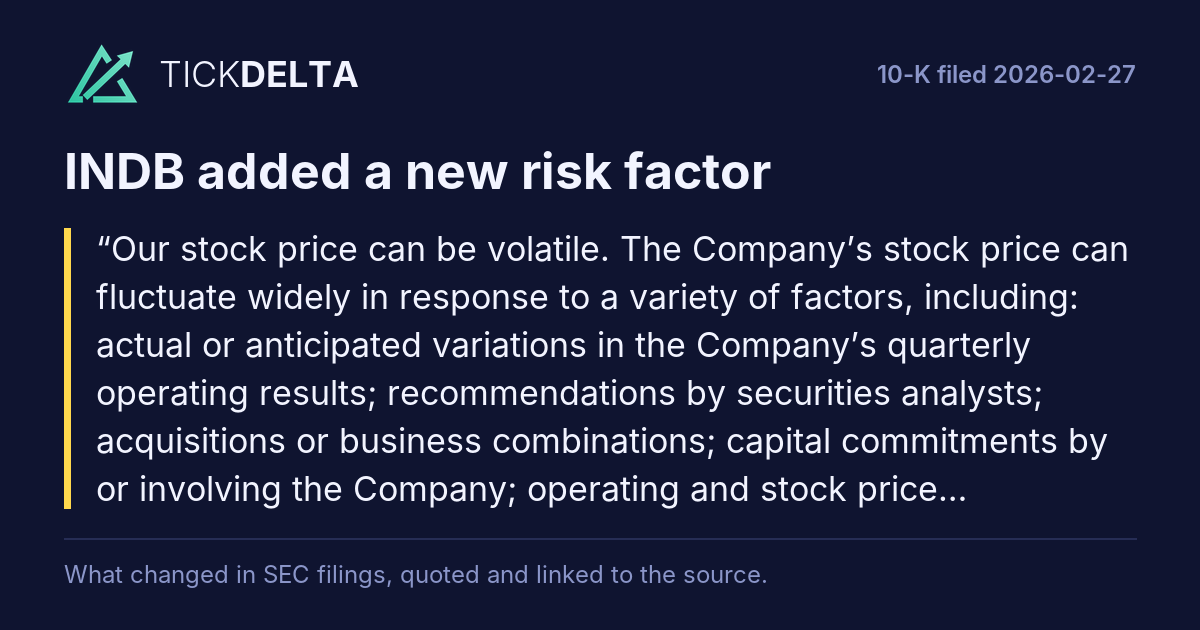
Our stock price can be volatile. The Company’s stock price can fluctuate widely in response to a variety of factors, including: actual or anticipated variations in the Company’s quarterly operating results; recommendations by securities analysts; acquisitions or business combinations; capital commitments by or involving the Company; operating and stock price performance of other companies that investors deem comparable to the Company; new technology used or services offered by the Company’s competitors; new reports relating to trends, concerns and other issues in the financial services industry; and changes in government regulations. General market fluctuations, industry factors and general economic and political conditions and events have caused a decline in the Company’s stock price in the past, and these factors, as well as, interest rate changes, unfavorable credit loss trends, or unforeseen events such as geopolitical conflicts could cause volatility in the Company’s stock price regardless of its operating results.
Paragraphs in the 10-Q filed Nov 9, 2026 that were not in the one before
New in the latest 10-Q
6 paragraphs in the 10-Q filed Nov 9, 2026 with nothing like them in the 10-Q filed Aug 6, 2026 (at least half the words must differ; new numbers alone do not count). Quoted exactly, grouped by the item heading above them. This is text that changed, not a judgement of how serious it is.
Financial statements and notes
The Company had no fair value hedges as of September 30, 2026 or December 31, 2025.
Read in the 10-Q
Loan Portfolio The Company’s total loan portfolio at September 30, 2026 increased $48.8 million, or 0.3%, when compared to December 31, 2025.
Read in the 10-Q
• Mortgage banking income was lower for the third quarter of 2026, primarily due to lower saleable loan volume, and was generally consistent on a year-to-date basis for 2026 as compared to the same prior year period.
Read in the 10-Q
• Loan level derivative income decreased during the third quarter of 2026 and increased for the first nine months of 2026 as compared to the same prior year periods primarily due to fluctuations in customer demand resulting from changes in the macroeconomic environment.
Read in the 10-Q
• FDIC assessment decreased for the third quarter of 2026, reflecting the benefit of a lower assessment rate compared to the prior year period. On a year-to-date basis, FDIC assessment costs were higher in 2026 due primarily to larger assessment base following the Enterprise acquisition.
Read in the 10-Q
Show the other 1
September 30, 2026 December 31, 2025 Outstanding Additional Outstanding Additional
Read in the 10-Q
The 10-Q's risk factors against the 10-K
Item 1A of the 10-Q filed Nov 9, 2026 against Item 1A of the 10-K filed Feb 27, 2026.
A 10-Q repeats only the risks that changed, so a 10-K paragraph that is missing from it is not counted as removed.
Added is a paragraph with nothing like it in the 10-K, Reworded a sentence that is in both with several words changed,
Quiet changes a sentence in both where one to four words changed and one is a hedge or a modal
(cut words struck through, new words highlighted).
Text on the page, not a score; each links to the filing at sec.gov.
What the 10-Q itself says about its risk factors:The section titled Risk Factors in Part I, Item 1A of the 2025 Form 10-K, includes a discussion of the material risks and uncertainties the Company faces, any one or more of which could have a material adverse effect on the Company’s business, results of operations, or financial condition (including capital and liquidity). As of the date of this Report, there have been no material changes with regard to the Risk Factors disclosed in Item 1A of the 2025 Form 10-K, which are incorporated herein by reference.
Read in the 10-Q
1 paragraph in the 10-Q's Item 1A, and none of them adds, rewords or quietly edits a paragraph of the 10-K's.
Phrases used for the first time
Two-word phrases in Risk Factors of the 10-K filed Feb 27, 2026 that are in none of the 1 earlier 10-Ks stored, back to Feb 28, 2025
Where each one is used
- negative developments: Negative developments in the banking industry could adversely affect the Company’s financial conditions and results of operations. Certain events impacting the financial services industry, including the bank failures of 2023, have in the past had, and may in the future have, an adverse impact on the market price...
- services institutions: The soundness of other financial institutions could adversely affect the Company’s liquidity and operations. The Company’s ability to engage in routine funding transactions could be adversely affected by the actions and commercial soundness of other financial institutions. Financial services institutions are...
- skilled employees: The success of the Company is dependent on the Company’s ability to attract, hire and retain key personnel. The Company’s business is complex and specialized and performance is largely dependent on the knowledge, talents and efforts of highly skilled individuals. The Company relies on key personnel to manage and...
- global national: Changes in global, national or local economic conditions, including those in the states of Massachusetts and New Hampshire, may pose significant challenges for the Company and could adversely affect its financial condition and results of operations. The Company’s business is impacted by factors outside of its...
- banking industry: Negative developments in the banking industry could adversely affect the Company’s financial conditions and results of operations. Certain events impacting the financial services industry, including the bank failures of 2023, have in the past had, and may in the future have, an adverse impact on the market price...
- routine funding: The soundness of other financial institutions could adversely affect the Company’s liquidity and operations. The Company’s ability to engage in routine funding transactions could be adversely affected by the actions and commercial soundness of other financial institutions. Financial services institutions are...
- funding transactions: The soundness of other financial institutions could adversely affect the Company’s liquidity and operations. The Company’s ability to engage in routine funding transactions could be adversely affected by the actions and commercial soundness of other financial institutions. Financial services institutions are...
- commercial soundness: The soundness of other financial institutions could adversely affect the Company’s liquidity and operations. The Company’s ability to engage in routine funding transactions could be adversely affected by the actions and commercial soundness of other financial institutions. Financial services institutions are...
Used at least twice, small words left out. Counted, not picked: a phrase can be new because the company renamed something.
What was taken out
11 paragraphs of last year's Risk Factors with nothing like them now. The longest are quoted.
Sources
Item 1A of each 10-K and 10-Q on EDGAR, quoted exactly. Each paragraph links to the filing at sec.gov.
Also
10-K change: what was reworded or cut, section by section.
Work with it
Excel workbook · CSV. Google Sheet that stays up to date: paste =IMPORTDATA("https://tickdelta.com/company/INDB/export.csv") into a cell.