Added10-Q Nov 6, 2026 vs 10-K Feb 17, 2026
The pending acquisition of Tate & Lyle is subject to conditions, some or all of which may not be satisfied or may not be satisfied on a timely basis, which could have adverse effects on us.
Each branch is a paragraph in Risk Factors with nothing like it in the 10-K filed Feb 20, 2025. A box jumps to the paragraph as filed, below.
14 paragraphs in Risk Factors of the 10-K filed Feb 17, 2026 with nothing like them in the 10-K filed Feb 20, 2025. Quoted exactly. Paragraphs that were only edited are under 10-K change.
The demand for food products that contain our ingredients, including agricultural products developed through biotechnology, may be adversely affected by changes in consumer practices, preferences, price sensitivities, tastes, and national, regional and local economic conditions. Consumer preferences and purchasing behaviors relating to food and beverage products continue to evolve and may be influenced by nutrition guidance, education campaigns, and public‑health initiatives. These developments may cause consumers to avoid food or beverage products that contain added sugars, sweeteners, carbohydrates, highly-processed foods, high fructose corn syrup, or biotechnology‑derived ingredients, in favor of foods or beverages that are perceived as being “healthier” or of contributing to a “cleaner” ingredient label. These perceptions have negatively affected the demand for some of our ingredients.
As a result, certain customers may reformulate products, reduce volumes, or discontinue products that incorporate certain of our ingredients, including sweeteners, starches, texturizers, and other specialty ingredients, or seek alternative ingredients from our competitors. Such changes could reduce demand for our products, increase pricing pressure, require additional investment by us in reformulation and product development, influence customer procurement decisions and mix, or result in underutilization of manufacturing assets. While we continue to invest in innovation and solutions that we believe aligns with evolving customer and consumer needs, these efforts may not fully offset those adverse demand, pricing, or cost impacts. Any of the foregoing could materially and adversely affect our production volumes, profit margins, results of operations, financial condition, and cash flows.
Geopolitical developments, tensions, threats or conflicts could harm our business by adversely affecting the availability and prices of raw materials and energy supplies; disrupting global markets, supply chains, and foreign exchange and interest rates, and causing changes in migration patterns.
Ingredion operates a global manufacturing and sourcing network and relies on agricultural commodities, energy, logistics services, and international customers, suppliers, and other counterparties. Our operations could be adversely affected by actions taken in connection with cross-border actions by the governments of countries in which we conduct business or through which our products may travel. Heightened geopolitical tensions, a perceived reduction in multilateral security cooperation, or changes to geopolitical policies or relationships, could contribute to increased or more volatile energy or freight costs, shortages or delays in raw materials or other inputs, sanctions or export controls, changes in trade policy, currency volatility, and reduced customer demand in certain markets. In addition, these factors may spur secondary or tertiary conflicts with or between other countries or regions, which could increase volatility in the availability and prices of raw materials and energy supplies, create supply chain disruptions or delays, or reduce customer or consumer demand.
These developments, together with ongoing conflicts and tensions in other regions, including the ongoing conflict between Russia and Ukraine and the continuing situation in the Middle East, could disrupt international trade flows, energy and commodity markets, transportation networks, and financial markets. Certain of these locations are in regions that provide sources of raw material and energy supplies for both us and some companies whose products we distribute, particularly in our Texture & Healthful Solutions segment and our Pakistan business.
In addition, heightened geopolitical uncertainty may increase the risk of cyber incidents, disrupt capital markets, and adversely affect foreign exchange and interest rate conditions, all of which could negatively affect our financial results. While we seek to mitigate these risks through diversification, risk management, and contingency planning, such efforts may not be successful. Any of the foregoing developments could materially and adversely affect our results of operations, financial condition, and cash flows.
Our ability to expand our business may suffer if we do not keep pace with technological developments and continue to offer innovative products, including more sustainable production methods.
Competitive pressures may adversely affect our market share, revenue and profitability.
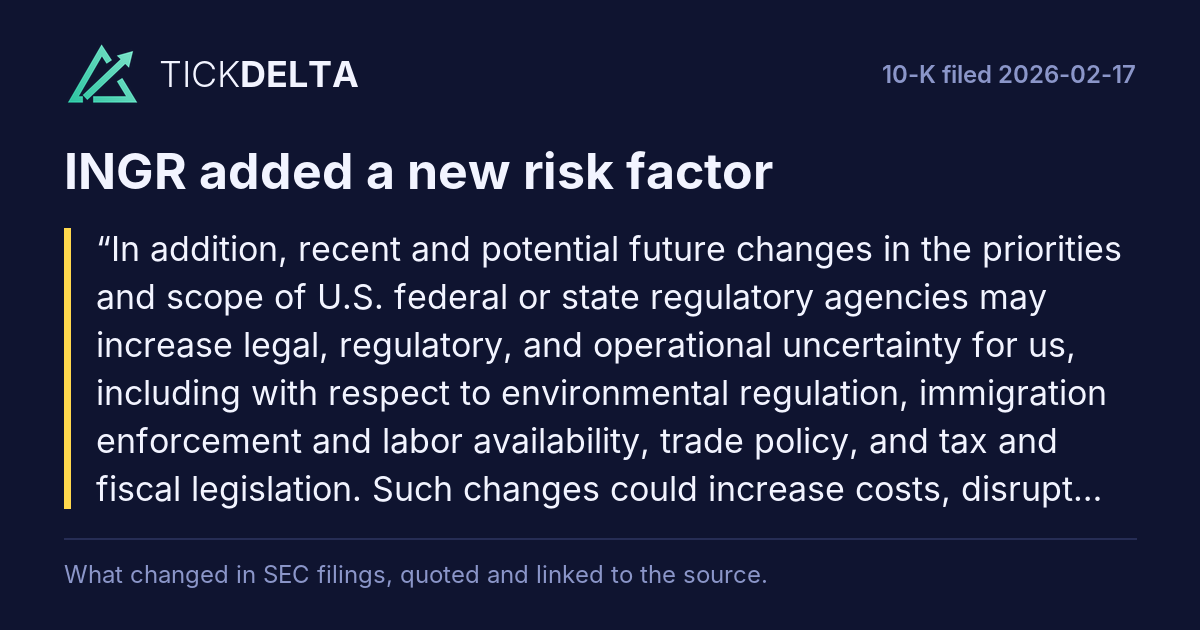
In addition, recent and potential future changes in the priorities and scope of U.S. federal or state regulatory agencies may increase legal, regulatory, and operational uncertainty for us, including with respect to environmental regulation, immigration enforcement and labor availability, trade policy, and tax and fiscal legislation. Such changes could increase
costs, disrupt supply chains, limit access to talent, affect demand, and reduce predictability in regulatory oversight and enforcement.
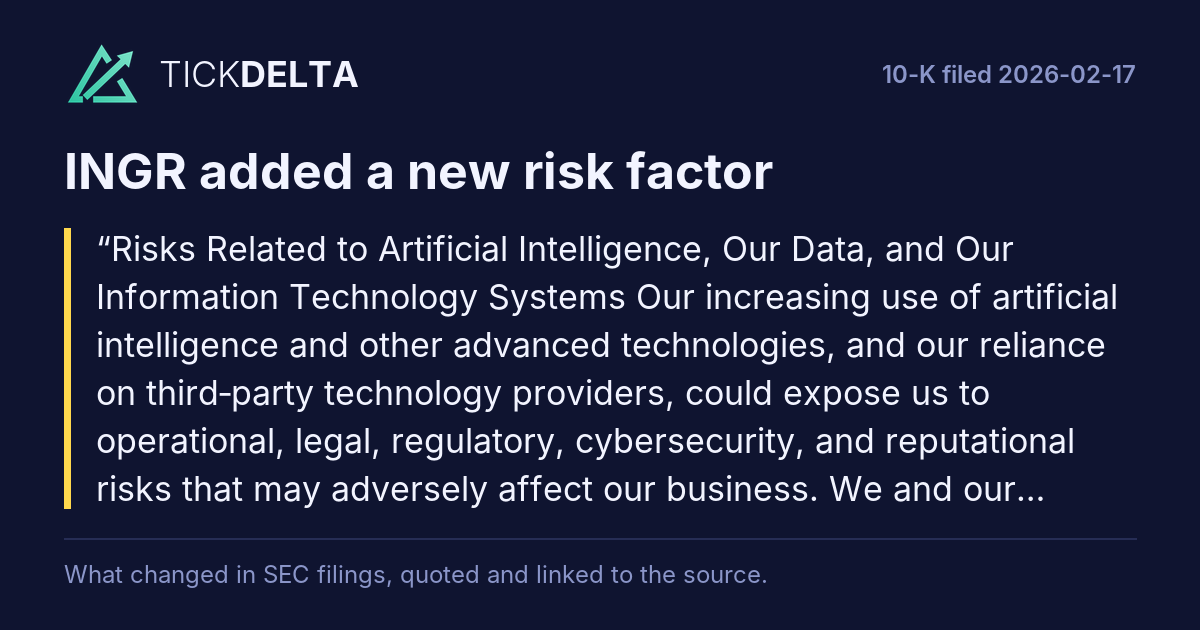
Risks Related to Artificial Intelligence, Our Data, and Our Information Technology Systems
Our increasing use of artificial intelligence and other advanced technologies, and our reliance on third‑party technology providers, could expose us to operational, legal, regulatory, cybersecurity, and reputational risks that may adversely affect our business.
We and our customers, suppliers, and service providers increasingly develop, deploy, and rely on artificial intelligence (“AI”), machine learning and other advanced technologies to support product innovation, manufacturing operations, quality and safety processes, supply‑chain planning, customer service, and other administrative functions. These technologies are
complex and may be less transparent or predictable than other technologies, and may fail, underperform, or produce incorrect, biased, or otherwise unreliable outputs, which could disrupt operations, adversely affect decision making, compromise product quality, or otherwise result in financial loss. Our use of and the value derived from AI may lag behind that of our competition. In addition, AI regulations are rapidly evolving and may diverge across jurisdictions, which could increase our compliance costs and limit how we deploy AI. How AI-related technologies are trained and the output from such tools could be the subject of infringement claims or other types of litigation. We may also incur significant capital expenditures and operating costs to acquire, implement, maintain and update AI capabilities, and may not realize the expected benefits of these capabilities. Further, AI may affect our workforce needs and may create challenges related to recruiting, retention, training and employee relations. If we fail to develop or use AI responsibly, or if public statements regarding our use of AI are alleged to be misleading, we could suffer reputational harm, regulatory scrutiny, or litigation, any of which could adversely affect our business, results of operations, financial condition and cash flows.
New in the latest 10-Q
10 paragraphs in the 10-Q filed Nov 6, 2026 with nothing like them in the 10-Q filed Aug 7, 2026 (at least half the words must differ; new numbers alone do not count). Quoted exactly, grouped by the item heading above them. This is text that changed, not a judgement of how serious it is.
Goodwill represents the excess of the cost of an acquired entity over the fair value assigned to identifiable assets acquired and liabilities assumed.
Read in the 10-Q
The original carrying value of goodwill by reportable segment and All Other as of September 30, 2026 is presented below. There were no accumulated impairment charges.
Read in the 10-Q
We assess goodwill and indefinite-lived intangible assets for impairment annually (or more frequently if impairment indicators arise). Based on the results of our assessment as of July 1, 2026, there were no impairments in our goodwill or indefinite-lived intangible assets. Our indefinite-lived intangible assets balance was $143 million as of both September 30, 2026 and December 31, 2025.
Read in the 10-Q
(i) The service cost component of net periodic cost is presented within either Cost of sales or Operating expenses on the Condensed Consolidated Statements of Income. The interest cost, expected return on plan assets and amortization of prior service costs are presented within Other non-operating expense on the Condensed Consolidated Statements of Income.
Read in the 10-Q
On September 9, 2026, we completed the sale of land for a previously closed facility in Lane Cove, Australia for cash proceeds and resulting pre-tax gain of $ 26 million. The pre-tax gain was recorded in Restructuring/impairment charges, net on our Condensed Consolidated Statements of Income.
Read in the 10-Q
On August 21, 2026, we completed the sale of our Vanscoy, Canada plant for cash proceeds of $ 8 million. As part of the sale, we recorded a pre-tax impairment charge of $ 3 million, which we recorded to Restructuring/impairment charges, net on our Condensed Consolidated Statements of Income.
Read in the 10-Q
Restructuring and impairment charges, net. Restructuring and impairment charges, net was a $14 million benefit for the third quarter of 2026 compared to $3 million of charges for the third quarter of 2025. In the third quarter of 2026, we recognized a $26 million gain for the sale of property at a previously closed facility in Australia, this was partially offset by charges incurred from other previously announced facility closures.
Read in the 10-Q
1.625 percent. The DDTL Agreement will require compliance with the same financial covenants as the Bridge Loan Agreement, as described above. The DDTL Agreement contains customary representations, covenants and events of default that are substantially similar to those under the Bridge Facility and our revolving credit facility agreement. As of September 30, 2026, no borrowings were outstanding under the DDTL Facility.
Read in the 10-Q
In September 2022, following certain air emissions testing Ingredion performed at our Bedford Park, Illinois manufacturing facility, we reported to the Illinois Environmental Protection Agency (the “Illinois EPA”) that certain emissions had exceeded applicable limits under an air emissions permit. On February 8, 2023, the Illinois EPA issued us a Notice of Violation with respect to the matter addressed in our report. Violations of the Illinois environmental statute could result in the imposition of civil or criminal monetary penalties. On October 22, 2026, the Illinois EPA referred this matter to the Office of the Illinois Attorney General (“Illinois Attorney General”). We are engaged in discussions with both the Illinois EPA and the Illinois Attorney General regarding this matter.
Read in the 10-Q
On August 5, 2026, Larry Fernandes, Senior Vice President, Chief Commercial and Sustainability Officer, entered into a written plan for the sale of up to 21,303 shares of our common stock (before adjustment for tax withholding) that is intended to satisfy the affirmative defense conditions of Rule 10b5-1(c) under the Exchange Act. The plan will commence on November 10, 2026, and will expire on March 3, 2028, or any earlier date on which all of the shares have been sold.
Read in the 10-Q
Item 1A of the 10-Q filed Nov 6, 2026 against Item 1A of the 10-K filed Feb 17, 2026.
A 10-Q repeats only the risks that changed, so a 10-K paragraph that is missing from it is not counted as removed.
Added is a paragraph with nothing like it in the 10-K, Reworded a sentence that is in both with several words changed,
Quiet changes a sentence in both where one to four words changed and one is a hedge or a modal
(cut words struck through, new words highlighted).
Text on the page, not a score; each links to the filing at sec.gov.
What the 10-Q itself says about its risk factors:There have been no material changes to the risk factors discussed in our Form 10-K for the year ended December 31, 2025, other than the risk factors below, which relate to our pending acquisition of Tate & Lyle.
Read in the 10-Q
The first 12 of 22 are shown (at most 12 of each type).
Two-word phrases in Risk Factors of the 10-K filed Feb 17, 2026 that are in none of the 1 earlier 10-Ks stored, back to Feb 20, 2025
Used at least twice, small words left out. Counted, not picked: a phrase can be new because the company renamed something.
7 paragraphs of last year's Risk Factors with nothing like them now. The longest are quoted.
Item 1A of each 10-K and 10-Q on EDGAR, quoted exactly. Each paragraph links to the filing at sec.gov.
10-K change: what was reworded or cut, section by section.
Excel workbook · CSV. Google Sheet that stays up to date: paste =IMPORTDATA("https://tickdelta.com/company/INGR/export.csv") into a cell.