Paragraph 116 · 50% changed
Every version of it
Screener
/
SEC EDGAR
/CIK 0001679049
/10-K filed Feb 26, 2026, compared with Feb 27, 2025
/Numbers from the XBRL of the 10-Ks
NYSE
Industrials · Cruise Lines & Shipping
International Seaways, Inc. INSW
The 10-K against last year's
126 changes: 24 added, 18 removed, 84 reworded
10-K Feb 26, 2026 vs Feb 27, 2025
Risk Factors
11.2%
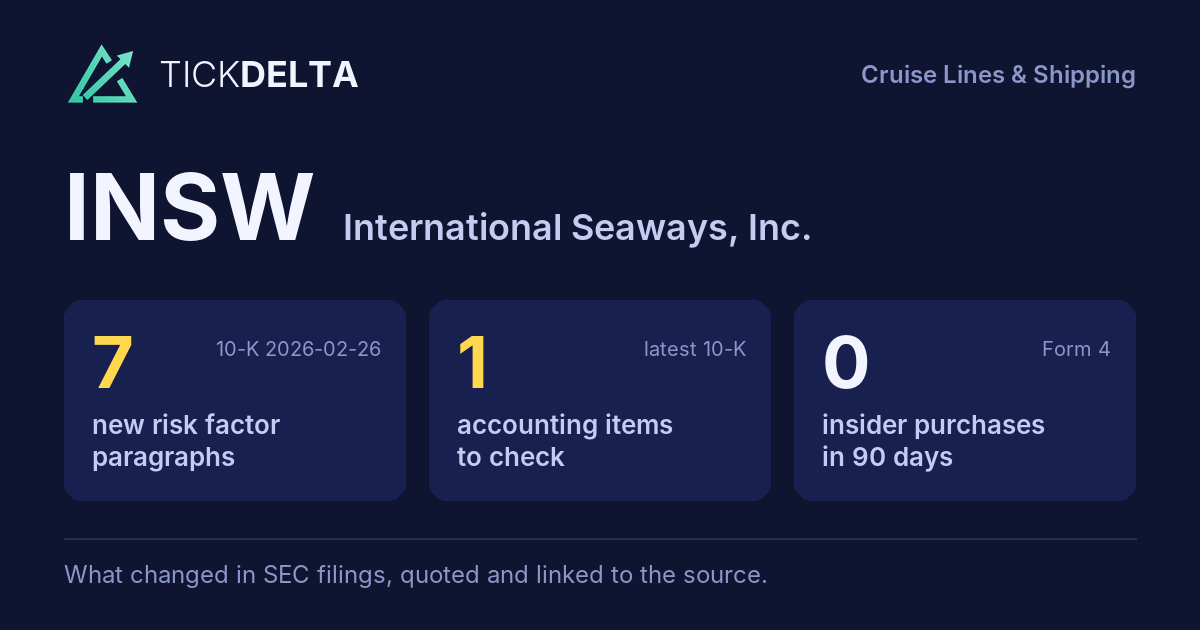
of the text changed · 17,495 words now · 7 new paragraphs, 5 gone
MD&A
28.3%
of the text changed · 9,121 words now · 17 new paragraphs, 13 gone
Legal Proceedings
7.6%
of the text changed · 1,747 words now
Accounting Policies
9.9%
of the text changed · 4,967 words now
10-K 0001104659-26-020113 (Feb 26, 2026) vs 10-K 0001558370-25-001691 (Feb 27, 2025)
Every paragraph, and how much of it changed
One bar per paragraph, in the order of the 10-K. Height and colour show the share of its words not in the closest paragraph a year earlier; the tallest bars are new paragraphs.
Risk Factors
233 paragraphs · 7 new · 45 reworded · 5 gone · 10-K Feb 26, 2026 against Feb 27, 2025
New paragraph
Reworded (5% of its words or more)
Same or nearly
Paragraph 139 · 48% changed
Every version of it
Paragraph 189 · 47% changed
Every version of it
Paragraph 181 · 43% changed
Every version of it
Paragraph 94 · 36% changed
Every version of it
In April 2019, Iran publicly threatened that it would interrupt the flow of oil through the Straits of Hormuz, the entrance to the Arabian Gulf. Commencing in May 2019, several vessels in the Arabian Gulf have been attacked, which attacks the United States has attributed to Iranian forces, and at least two vessels have been seized by Iran. Further the war between Russia and Ukraine and the Israel/Gaza conflict have resulted in attacks on commercial vessels in the Black Sea, Red Sea and Gulf of Aden in the 2022 – 2025 period. None of these attacks or seizures have involved the Company’s vessels. To date, these attacks and vessel seizures, while increasing the costs of the Company conducting its business to a limited extent, have not had a material adverse effect on INSW’s business, financial condition, results of operations and cash flow but no assurance can be given that continued vessel attacks or seizures will not do so.
Paragraph 88 · 32% changed
Every version of it
Additionally, protectionist developments, or the perception they may occur, may have a material adverse effect on global economic conditions, and may significantly reduce global trade. Governments may turn to trade barriers to protect their domestic industries against foreign imports, thereby or to retaliate against other governments imposing tariffs, potentially depressing shipping demand. The United States government has made statements and taken actions that impact U.S. international trade policies, including imposing new tariffs on imports from Canada, Mexico and China, and those and other countries have imposed, or threatened to impose, retaliatory tariffs on imports from the United States. In particular, leaders shifts in trade regulations or port-related regulatory actions in China and the United States, including changes to port fee structures, can create uncertainty around voyage costs and operational planning. We cannot predict the timing, outcome, or impact of future developments in the United States have indicated the United States may seek to implement more protective U.S., China or other countries’ trade measures regulations or tariff policy, and to withdraw from certain international trade treaties, including with China. any such changes could materially adversely affect our business, financial condition or results of operations. Increasing trade protectionism may cause an increase in the cost of goods exported from regions globally, particularly the Asia-Pacific region and the risks associated with exporting goods, which may significantly affect the quantity of goods to be shipped, shipping time schedules, voyage costs and other associated costs. Further, increased tensions may adversely affect oil demand, which would have an adverse effect on shipping rates.
Paragraph 44 · 31% changed
Every version of it
INSW depends on short duration, or “spot,” charters, for a significant portion of its revenues, which exposes INSW to fluctuations in market conditions. In the years ended December 31, 2024, 2023 2025, 2024 and 2022, 2023, INSW derived approximately 86%, 91% 82%, 86% and 96%, 91%, respectively, of its TCE revenues in the spot market. The tanker industry is both cyclical and volatile in terms of charter rates and profitability. Fluctuations in charter rates and vessel values result from changes in supply and demand both for tanker capacity and for oil and oil products. Factors affecting these changes in supply and demand are generally outside of the Company’s control. The nature, timing and degree of changes in industry conditions are unpredictable and could adversely affect the values of the Company’s vessels or result in significant fluctuations in the amount of charter revenues the Company earns, which could result in significant volatility in INSW’s quarterly results and cash flows, and the Company’s ability to remain in compliance with financial covenants in its credit facilities. See “—The Company may not be able to generate sufficient cash to service all of its indebtedness and could in the future breach covenants in its credit facilities, term loans and certain vessel charters.” Furthermore, recent geopolitical instability and weather conditions have significantly benefitted the Company’s financial results by increasing tanker demand in 2022 and 2023. This increased demand remained at an elevated level in 2024. There can be no certainty as to when such geopolitical instability and weather conditions will normalize, and any such normalization could cause tanker rates to decline significantly.
Paragraph 207 · 24% changed
Every version of it
Crew members, suppliers of goods and services to a vessel, shippers of cargo and other parties may be entitled to a maritime lien against that vessel for unsatisfied debts, claims or damages. In many jurisdictions, a maritime lien holder may enforce its lien by arresting a vessel through foreclosure proceedings. The arrest or attachment of one or more of the Company’s vessels could interrupt INSW’s cash flow and require it to pay a significant amount of money to have the arrest lifted. In addition, in some jurisdictions, such as South Africa, under the “sister ship” theory of liability, a claimant may arrest both the vessel that is subject to the claimant’s maritime lien and any “associated” vessel, meaning any vessel owned or controlled by the same owner. Claimants could try to assert “sister ship” liability against one vessel in the Company’s fleet for claims relating to another vessel in its fleet which, if successful, could have an adverse effect on the Company’s business, financial condition, results of operations and cash flows.
Paragraph 116 · 50% changed
Every version of it
10-K Feb 27, 2025Undertaking alternative financing plans, if necessary, might not allow INSW to meet its debt obligations. The Company’s ability to restructure or refinance its debt will depend on the condition of the capital markets, its access to such markets and its financial condition at that time. Any refinancing of debt could be at higher interest rates and might require the Company to comply with more onerous covenants, which could further restrict INSW’s business operations. In addition, the terms of existing or future debt instruments may restrict INSW from adopting some alternative measures. These alternative measures may not be successful and may not permit INSW to meet its scheduled debt service obligations. The Company’s inability to generate sufficient cash flow to satisfy its debt obligations, to meet the covenants of its credit agreements and term loans and/or to obtain alternative financing in such circumstances, could materially and adversely affect INSW’s business, financial condition, results of operations and cash flows.
10-K Feb 26, 2026
debt obligations, to meet the covenants of its credit agreements and term loans and/or to obtain alternative financing in such circumstances, could materially and adversely affect INSW’s business, financial condition, results of operations and cash flows.
Paragraph 139 · 48% changed
Every version of it
10-K Feb 27, 2025The Company’s vessels are employed in a highly competitive market. Competition arises from other vessel owners, including major oil companies, which may have substantially greater resources than INSW. Competition for the transportation of crude oil and other petroleum products depends on price, location, size, age, condition and the acceptability of the vessel operator to the charterer. The Company believes that because ownership of the world tanker fleet is highly fragmented, no single vessel owner is able to influence charter rates.
10-K Feb 26, 2026
Company believes that because ownership of the world tanker fleet is highly fragmented, no single vessel owner is able to influence charter rates.
Paragraph 189 · 47% changed
Every version of it
10-K Feb 27, 2025INSW could incur significant costs, including cleanup costs, fines, penalties, third-party claims and natural resource damages, as the result of an oil spill or liabilities under environmental laws. The Company is subject to the oversight of several government agencies, including the U.S. Coast Guard and the EPA. OPA 90 affects all vessel owners shipping oil or hazardous material to, from or within the United States. OPA 90 allows for potentially unlimited liability without regard to fault for owners, operators and bareboat charterers of vessels for oil pollution in U.S. waters. Similarly, the International Convention on Civil Liability for Oil Pollution Damage, 1969, as amended, which has been adopted by most countries outside of the United States, imposes liability for oil pollution in international waters. OPA 90 expressly permits individual states to impose their own liability regimes with regard to hazardous materials and oil pollution incidents occurring within their boundaries. Coastal states in the United States have enacted pollution prevention liability and response laws, many providing for unlimited liability.
10-K Feb 26, 2026
in international waters. OPA 90 expressly permits individual states to impose their own liability regimes with regard to hazardous materials and oil pollution incidents occurring within their boundaries. Coastal states in the United States have enacted pollution prevention liability and response laws, many providing for unlimited liability.
Paragraph 181 · 43% changed
Every version of it
10-K Feb 27, 2025Our business consists of transporting crude oil and refined petroleum products. Regulatory changes and growing public concern about the environmental impact of climate change may lead to reduced demand for crude oil and refined petroleum products and decreased demand for our services, while increasing or creating greater incentives for use of alternative energy sources. We expect regulatory and consumer efforts aimed at combating climate change to intensify and accelerate. Although we do not expect demand for oil to decline dramatically over the short-term, in the long-term climate change likely will significantly affect demand for oil and for alternatives. Any such change could adversely affect our ability to compete in a changing market and our business, financial condition and results of operations. Further, no assurance can be given that capital expenditures we make to comply with existing or proposed environmental regulations or strategies that we adopt with respect to changes in demand for crude oil or refined petroleum products or in demand for our services will be successful.
10-K Feb 26, 2026
and results of operations. Further, no assurance can be given that capital expenditures we make to comply with existing or proposed environmental regulations or strategies that we adopt with respect to changes in demand for crude oil or refined petroleum products or in demand for our services will be successful.
Paragraph 94 · 36% changed
Every version of it
10-K Feb 27, 2025
In April 2019, Iran publicly threatened that it would interrupt the flow of oil through the Straits of Hormuz, the entrance to the Arabian Gulf. Commencing in May 2019, several vessels in the Arabian Gulf have been attacked, which attacks the United States has attributed to Iranian forces, and at least two vessels have been seized by Iran. Further the war between Russia and Ukraine and the Israel/Gaza conflict have resulted in attacks on commercial vessels in the Black Sea, Red Sea and Gulf of Aden in the 2022 – 2025 period. None of these attacks or seizures have involved the Company’s vessels. To date, these attacks and vessel seizures, while increasing the costs of the Company conducting its business to a limited extent, have not had a material adverse effect on INSW’s business, financial condition, results of operations and cash flow but no assurance can be given that continued vessel attacks or seizures will not do so.
10-K Feb 26, 2026
In April 2019, Iran publicly threatened that it would interrupt the flow of oil through the Straits of Hormuz, the entrance to the Arabian Gulf. Commencing in May 2019, several vessels in the Arabian Gulf have been attacked, which attacks the United States has attributed to Iranian forces, and at least two vessels have been seized by Iran. Further the war between Russia and Ukraine and the
Paragraph 88 · 32% changed
Every version of it
10-K Feb 27, 2025
Additionally, protectionist developments, or the perception they may occur, may have a material adverse effect on global economic conditions, and may significantly reduce global trade. Governments may turn to trade barriers to protect their domestic industries against foreign imports, thereby depressing shipping demand. In particular, leaders in the United States have indicated the United States may seek to implement more protective trade measures and to withdraw from certain international trade treaties, including with China. Increasing trade protectionism may cause an increase in the cost of goods exported from regions globally, particularly the Asia-Pacific region and the risks associated with exporting goods, which may significantly affect the quantity of goods to be shipped, shipping time schedules, voyage costs and other associated costs. Further, increased tensions may adversely affect oil demand, which would have an adverse effect on shipping rates.
10-K Feb 26, 2026
Additionally, protectionist developments, or the perception they may occur, may have a material adverse effect on global economic conditions, and may significantly reduce global trade. Governments may turn to trade barriers to protect their domestic industries against foreign imports, or to retaliate against other governments imposing tariffs, potentially depressing shipping demand. The United States government has made statements and taken actions that impact U.S. international trade policies, including imposing new tariffs on imports from Canada, Mexico and China, and those and other countries have imposed, or threatened to impose, retaliatory tariffs on imports from the United States. In particular, shifts in trade regulations or port-related regulatory actions in China and the United States, including changes to port fee structures, can create uncertainty around voyage costs and operational planning. We cannot predict the timing, outcome, or impact of future developments in the U.S., China or other countries’ trade regulations or tariff policy, and any such changes could materially adversely affect our business, financial condition or results of operations. Increasing trade protectionism may cause an increase in the cost of goods exported from regions globally, particularly the Asia-Pacific region and the risks associated with exporting goods, which may significantly affect the quantity of goods to be shipped, shipping time schedules, voyage costs and other associated costs. Further, increased tensions may adversely affect oil demand, which would have an adverse effect on shipping rates.
Paragraph 44 · 31% changed
Every version of it
10-K Feb 27, 2025
INSW depends on short duration, or “spot,” charters, for a significant portion of its revenues, which exposes INSW to fluctuations in market conditions. In the years ended December 31, 2024, 2023 and 2022, INSW derived approximately 86%, 91% and 96%, respectively, of its TCE revenues in the spot market. The tanker industry is both cyclical and volatile in terms of charter rates and profitability. Fluctuations in charter rates and vessel values result from changes in supply and demand both for tanker capacity and for oil and oil products. Factors affecting these changes in supply and demand are generally outside of the Company’s control. The nature, timing and degree of changes in industry conditions are unpredictable and could adversely affect the values of the Company’s vessels or result in significant fluctuations in the amount of charter revenues the Company earns, which could result in significant volatility in INSW’s quarterly results and cash flows, and the Company’s ability to remain in compliance with financial covenants in its credit facilities. See “—The Company may not be able to generate sufficient cash to service all of its indebtedness and could in the future breach covenants in its credit facilities, term loans and certain vessel charters.” Furthermore, recent geopolitical instability and weather conditions have significantly benefitted the Company’s financial results by increasing tanker demand in 2022 and 2023. This increased demand remained at an elevated level in 2024. There can be no certainty as to when such geopolitical instability and weather conditions will normalize, and any such normalization could cause tanker rates to decline significantly.
10-K Feb 26, 2026
INSW depends on short duration, or “spot,” charters, for a significant portion of its revenues, which exposes INSW to fluctuations in market conditions. In the years ended December 31, 2025, 2024 and 2023, INSW derived approximately 82%, 86% and 91%, respectively, of its TCE revenues in the spot market. The tanker industry is both cyclical and volatile in terms of charter rates and profitability. Fluctuations in charter rates and vessel values result from changes in supply and demand both for tanker capacity and for oil and oil products. Factors affecting these changes in supply and demand are generally outside of the Company’s control. The nature, timing and degree of changes in industry conditions are unpredictable and could adversely affect the values of the Company’s vessels
Paragraph 207 · 24% changed
Every version of it
10-K Feb 27, 2025
Crew members, suppliers of goods and services to a vessel, shippers of cargo and other parties may be entitled to a maritime lien against that vessel for unsatisfied debts, claims or damages. In many jurisdictions, a maritime lien holder may enforce its lien by arresting a vessel through foreclosure proceedings. The arrest or attachment of one or more of the Company’s vessels could interrupt INSW’s cash flow and require it to pay a significant amount of money to have the arrest lifted. In addition, in some jurisdictions, such as South Africa, under the “sister ship” theory of liability, a claimant may arrest both the vessel that is subject to the claimant’s maritime lien and any “associated” vessel, meaning any vessel owned or controlled by the same owner. Claimants could try to assert “sister ship” liability against one vessel in the Company’s fleet for claims relating to another vessel in its fleet which, if successful, could have an adverse effect on the Company’s business, financial condition, results of operations and cash flows.
10-K Feb 26, 2026
Crew members, suppliers of goods and services to a vessel, shippers of cargo and other parties may be entitled to a maritime lien against that vessel for unsatisfied debts, claims or damages. In many jurisdictions, a maritime lien holder may enforce its lien by arresting a vessel through foreclosure proceedings. The arrest or attachment of one or more of the Company’s vessels could interrupt INSW’s cash flow and require it to pay a significant amount of money to have the arrest lifted. In addition, in some jurisdictions, such
MD&A
126 paragraphs · 17 new · 57 reworded · 13 gone · 10-K Feb 26, 2026 against Feb 27, 2025
New paragraph
Reworded (5% of its words or more)
Same or nearly
Paragraph 12 · 50% changed
The Company’s revenues are highly sensitive to impacted by (i) the patterns of supply and demand for vessels of the size and design configurations owned and operated by the Company and the trades in which those vessels operate. Rates for operate and (ii) the transportation of crude oil and refined petroleum products from which the Company earns a substantial majority of its revenues are determined by market forces such as the supply and demand for oil, the distance that cargoes must be transported, and the number of vessels expected to be available at the time such cargoes need to be transported. The demand for oil shipments is significantly affected by the state of the global economy, levels of U.S. domestic and international production and OPEC exports. The number of vessels is affected by newbuilding deliveries and by the removal of existing vessels from service, principally through storage, recycling or conversions. The Company’s revenues are also affected by its vessel employment strategy, which seeks to achieve the an optimal mix of spot (voyage charter) and long-term (time or bareboat charter) charters. Because shipping revenues and voyage expenses are significantly affected by the mix
Paragraph 64 · 46% changed
Interest expense decreased in 2024 2025 compared to 2023 2024 as a result of (i) a reduction in the average outstanding principal balance under the $750 Million Term Loan Facility (which was amended and extended in Company’s revolving credit facilities, due to voluntary repayment of certain of such facilities since April 2024), 2024, (ii) the repayment in full of the COSCO Lease financing in July 2023 and (iii) the repayment in full of the ING Credit Facility in April 2024, and (iii) the decline of SOFR rates in 2025 compared to the prior year. Those year-over-year decreases were partially offset by post-delivery $6.3 million of interest expense incurred on the ECA Credit Facility and the 2030 Bonds, which were issued during 2025. See Note 8, “Debt,” to the accompanying consolidated financial statements as set forth in Item 8, “Financial Statements and Supplementary Data,” for further information on the Company’s debt facilities.
Paragraph 43 · 45% changed
(e) Represents nine VLCCs and Aframaxes that secured lease financing arrangements during the periods presented. Between March and July 2023 In November 2025 the Company purchased six of the three remaining Aframaxes VLCCs that it had been bareboat chartering-in under chartering-in. See Note 8, “Debt,” to the purchase options contained in such charters, and accordingly, such vessels are not included in this category for 2024. accompanying consolidated
Paragraph 88 · 44% changed
Paragraph 22 · 43% changed
The Company’s revenues are also affected by its vessel employment strategy, which seeks to achieve the optimal mix of spot (voyage charter) and long-term (time or bareboat charter) charters. Because shipping revenues and voyage expenses are significantly affected by the mix between voyage charters and time charters, the Company measures the performance of its fleet of vessels based on TCE revenues. Management makes economic decisions based on anticipated TCE rates and evaluates financial performance based on TCE rates achieved. In order to take advantage of market conditions and optimize economic performance, management employs all of the Company’s LR1 product carriers, which currently participate in the Panamax International pool, in the transportation of crude oil cargoes.
Paragraph 24 · 43% changed
Paragraph 99 · 41% changed
Paragraph 19 · 40% changed
Paragraph 12 · 50% changed
10-K Feb 27, 2025
The Company’s revenues are highly sensitive to patterns of supply and demand for vessels of the size and design configurations owned and operated by the Company and the trades in which those vessels operate. Rates for the transportation of crude oil and refined petroleum products from which the Company earns a substantial majority of its revenues are determined by market forces such as the supply and demand for oil, the distance that cargoes must be transported, and the number of vessels expected to be available at the time such cargoes need to be transported. The demand for oil shipments is significantly affected by the state of the global economy, levels of U.S. domestic and international production and OPEC exports. The number of vessels is affected by newbuilding deliveries and by the removal of existing vessels from service, principally through storage, recycling or conversions. The Company’s revenues are also affected by its vessel employment strategy, which seeks to achieve the optimal mix of spot (voyage charter) and long-term (time or bareboat charter) charters. Because shipping revenues and voyage expenses are significantly affected by the mix
10-K Feb 26, 2026
The Company’s revenues are impacted by (i) the patterns of supply and demand for vessels of the size and design configurations owned and operated by the Company and the trades in which those vessels operate and (ii) the Company’s vessel employment strategy, which seeks to achieve an optimal mix of spot (voyage charter) and long-term (time charter) charters.
Paragraph 64 · 46% changed
10-K Feb 27, 2025
Interest expense decreased in 2024 compared to 2023 as a result of (i) a reduction in the average outstanding principal balance under the $750 Million Term Loan Facility (which was amended and extended in April 2024), (ii) the repayment in full of the COSCO Lease financing in July 2023 and (iii) the repayment in full of the ING Credit Facility in April 2024, partially offset by post-delivery
10-K Feb 26, 2026
Interest expense decreased in 2025 compared to 2024 as a result of (i) a reduction in the average outstanding principal balance under the Company’s revolving credit facilities, due to voluntary repayment of certain of such facilities since April 2024, (ii) the repayment in full of the ING Credit Facility in April 2024, and (iii) the decline of SOFR rates in 2025 compared to the prior year. Those year-over-year decreases were partially offset by $6.3 million of interest expense incurred on the ECA Credit Facility and the 2030 Bonds, which were issued during 2025. See Note 8, “Debt,” to the accompanying consolidated financial statements as set forth in Item 8, “Financial Statements and Supplementary Data,” for further information on the Company’s debt facilities.
Paragraph 43 · 45% changed
10-K Feb 27, 2025
(e) Represents VLCCs and Aframaxes that secured lease financing arrangements during the periods presented. Between March and July 2023 the Company purchased the three remaining Aframaxes that it had been bareboat chartering-in under the purchase options contained in such charters, and accordingly, such vessels are not included in this category for 2024.
10-K Feb 26, 2026
(e) Represents nine VLCCs that secured lease financing arrangements during the periods presented. In November 2025 the Company purchased six of the VLCCs that it had been bareboat chartering-in. See Note 8, “Debt,” to the accompanying consolidated
Paragraph 88 · 44% changed
10-K Feb 27, 2025During 2024, the Company repurchased and retired 501,646 shares of its common stock in open-market purchases, at an average price of $49.81 per share, for a total cost of $25.0 million. In November 2024, the Company’s Board of Directors authorized an increase in the share repurchase program to $50.0 million from $25.0 million. The expiry date of the stock repurchase program is on December 31, 2025.
10-K Feb 26, 2026
In October 2025, the Company’s Board of Directors authorized the extension of the expiry date of the Company’s $50.0 million share repurchase program from December 31, 2025 to December 31, 2026.
Paragraph 22 · 43% changed
10-K Feb 27, 2025
between voyage charters and time charters, the Company measures the performance of its fleet of vessels based on TCE revenues. Management makes economic decisions based on anticipated TCE rates and evaluates financial performance based on TCE rates achieved. In order to take advantage of market conditions and optimize economic performance, management employs all of the Company’s LR1 product carriers, which currently participate in the Panamax International pool, in the transportation of crude oil cargoes.
10-K Feb 26, 2026
The Company’s revenues are also affected by its vessel employment strategy, which seeks to achieve the optimal mix of spot (voyage charter) and long-term (time or bareboat charter) charters. Because shipping revenues and voyage expenses are significantly affected by the mix between voyage charters and time charters, the Company measures the performance of its fleet of vessels based on TCE revenues. Management makes economic decisions based on anticipated TCE rates and evaluates financial performance based on TCE rates achieved.
Paragraph 24 · 43% changed
10-K Feb 27, 2025Our revenues are derived predominantly from spot market voyage charters and our vessels are predominantly employed in the spot market via market-leading commercial pools. We derived approximately 86% and 91% of our total TCE revenues in the spot market for the years ended December 31, 2024 and 2023, respectively. The future minimum revenues, before reduction for brokerage commissions, expected to be received on non-cancelable time charters for three VLCCs, one Suezmax, one Aframax, one LR2 and eight MRs as of December 31, 2024 are as follows:
10-K Feb 26, 2026
commissions, expected to be received on non-cancelable time charters for three VLCCs, two Suezmaxes, one Aframax, one LR2 and six MRs as of December 31, 2025 are as follows:
Paragraph 99 · 41% changed
10-K Feb 27, 2025interest expense related to the BoComm Lease Financing. See Note 9, “Debt,” to the accompanying consolidated financial statements as set forth in Item 8, “Financial Statements and Supplementary Data,” for further information on the Company’s debt facilities.
10-K Feb 26, 2026
See Note 8, “Debt,” to the Company’s consolidated financial statements set forth in Item 8, “Financial Statements and Supplementary Data” of this Form 10-K for further information on the ECA Credit Facility and the 2030 Bonds. The Company’s debt service commitments and aggregate purchase commitments for vessel construction and betterments as of December 31, 2025, are presented in the Aggregate Contractual Obligations Table below.
Paragraph 19 · 40% changed
10-K Feb 27, 2025The ongoing military conflict between Israel and Hamas has had a direct and indirect impact on the trade of crude oil and refined petroleum products. Heightened security risks because of attacks on merchant vessels transiting through the Red Sea to or from the Suez Canal has led to an increase in ton-mile demand for vessels as more vessel owners are opting to re-route their vessels around the Cape of Good Hope. See Item 1A, Risk Factors – Terrorist attacks and international hostilities and instability can affect the tanker industry, which could adversely affect INSW’s business.
10-K Feb 26, 2026
Military hostilities in the Middle East, including those in the Israel-Gaza region and those between Israel, Iran, the Houthis of Yemen and the United States have had both a direct and an indirect impact on the transportation of crude oil and refined petroleum products through the region. Heightened security risks because of attacks and threats of attacks on merchant vessels transiting through the region led to an increase in ton-mile demand for vessels as more vessel owners were opting to re-route their vessels around the Cape of Good Hope. Such hostilities also led to periodic increases in charter rates to compensate vessel owners for the heightened risks as well as increases in war risk insurance premiums.
A paragraph is matched with the one last year that shares the most of its words; under half in common makes it new. The paragraphs shown are the 8 reworded the most in each section.
The paragraph that changed most in each section
The redline
Marked against last year's 10-K: cut words struck through, new words highlighted.
Risk Factors240 words changed in this paragraph; it is 33% similar to last year's version.
In general, capital expenditures and other costs necessary for maintaining a vessel in good operating condition increase as the age of the vessel increases. As of December 31, 2024, 2025, the weighted average age of the Company’s total owned and operated fleet was 11.0 10.9 years (which excludes the six four remaining dual fuel LNG ready LR1s currently under construction and contracted for delivery to the Company during the third quarter of 2025 through the third quarter of 2026). In addition, older vessels are typically less fuel-efficient than more recently constructed vessels due to improvements in engine technology. Accordingly, it is likely that the operating costs of INSW’s currently operated vessels will rise as the age of the Company’s fleet increases. In addition, changes in governmental regulations and compliance with Classification Society standards may restrict the type of activities in which the vessels may engage and/or may require INSW to make additional expenditures for new equipment. Every commercial tanker must pass inspection by a Classification Society authorized by the vessel’s country of registry. The Classification Society certifies that a tanker is safe and seaworthy in accordance with the applicable rules and regulations of the country of registry of the tanker and the international conventions of which that country is a member. If a Classification Society requires the Company to add equipment, INSW may be required to incur substantial costs or take its vessels out of service. Market conditions may not justify such expenditures or permit INSW to operate its older vessels profitably even if those vessels remain operational. If a vessel in INSW’s fleet does not maintain its class and/or fails any survey, it will be unemployable and unable to trade between ports until its class is restored or such failure is remedied. This would negatively impact the Company’s results of operation.
Source: Item 1A, 10-K 0001104659-26-020113 vs Item 1A, 10-K 0001558370-25-001691
MD&A174 words changed in this paragraph; it is 42% similar to last year's version.
During 2024, 2025, TCE revenues for the Product Carriers Crude Tankers segment decreased by $47.3 $13.8 million, or 9%, 3%, to $496.0 $423.3 million from $543.3 $437.1 million in 2023. The reduction in TCE revenues was primarily as a result of 2024. Such decrease principally resulted from (i) a $31.6 $26.2 million days-based decline in the VLCC sector, which reflected the sales of one 2010-built VLCC and one 2011-built VLCC during the first quarter of 2025, and 67 more off-hire days during the current year which included 47 drydocking days for a 2020-built VLCC acquired by the Company in November 2025 and (ii) a $16.7 million decrease in the LR1 Crude Tankers Lightering business. Partially offsetting the TCE revenue decreases described above were (i) a rates-based increase in the VLCC fleet of $26.4 million due to strengthening rates in the sector which reflects and (ii) a days-based increase of $5.2 million in the impacts of a 419-day net decrease in time chartered-in days and 129 more Aframax fleet reflecting 162 fewer off-hire days in the current year, (ii) a $24.8 million rates-based decrease in the LR1 sector due to lower average daily rates earned in the current year, (iii) a $1.6 million days-based decrease in the LR2 fleet due to 57 more off-hire days in the current year, and (iv) a $1.0 million days-based decrease in the MR sector, which reflects an increase of 179 off-hire days in the current year, significantly offset by 139 more owned vessel days in the current year. The increase in owned vessel days reflects the Company’s acquisition of six MRs between April 2024
Source: Item 7, 10-K 0001104659-26-020113 vs Item 7, 10-K 0001558370-25-001691
Accounting Policies164 words changed in this paragraph; it is 42% similar to last year's version.
15. Recently adopted accounting standards - – In November December 2023, the FASB issued ASU No. 2023-07, 2023-09, Improvements to Reportable Segment Disclosures. This guidance is expected Income Tax Disclosures, applies to improve financial reporting by providing additional all entities subject to income taxes. The standard requires disaggregated information about a public company’s significant segment expenses and more timely and detailed segment information reporting throughout the fiscal year. This guidance requires annual and interim period disclosure of significant segment expenses that are provided to the chief operating decision maker (“CODM”) entity’s effective tax rate reconciliation as well as interim disclosures for all reportable segments’ profit or loss. It also requires disclosure of information on income taxes paid. For public business entities, the title and position of the CODM and an explanation of how the CODM uses the reported measures of segment profit or loss in assessing segment performance and deciding how to allocate resources. The amendments in ASU 2023-07 are new requirements will be effective for us for fiscal years beginning after December 15, 2023, and interim annual periods within fiscal years beginning after December 15, 2024. We The Company adopted the standard in this annual report for the year ended December 31, 2024 2025 and applied retrospectively to all prior periods presented in the consolidated financial statements. See Note 4, “Business and Segment Reporting.” 10, “Taxes.”
Source: Item 8, Note 2 – SUMMARY OF SIGNIFICANT ACCOUNTING POLICIES:, 10-K 0001104659-26-020113 vs Item 8, Note 2 – SUMMARY OF SIGNIFICANT ACCOUNTING POLICIES:, 10-K 0001558370-25-001691
Legal Proceedings35 words changed in this paragraph; it is 90% similar to last year's version.
Vessel Impairment of Vessels Indicators Description of the Matter As of December 31, 2024, 2025, the carrying value of the Company’s vessels (including deferred drydock expenditures, net) was approximately $2.2 billion. As described in Notes 2 and 5 to the consolidated financial statements, the Company assesses whether events or changes in circumstances have occurred that could indicate that the carrying amounts of its vessels may not be recoverable. Upon identification of an indicator of impairment, the Company evaluates the recoverability of a vessel by comparing its carrying amount to the undiscounted future net cash flows it is expected to generate. If the Company determines that a vessel’s carrying value is not recoverable, an impairment charge is recognized equal to the excess of the vessel’s carrying amount over its estimated fair value determined using an income or market approach. Throughout the year, the Company performed an evaluation of its vessels to determine if any such indicators of impairment were present. During Auditing the year ended December 31, 2024, Company’s impairment indicator assessment was complex due to the significant estimation uncertainty and judgment required to evaluate the future market and economic conditions and forecasted
Source: Item 3, via Note 18 – CONTINGENCIES:, 10-K 0001104659-26-020113 vs Item 3, via Note 19 – CONTINGENCIES:, 10-K 0001558370-25-001691
Sentences and paragraphs added, removed or reworded
Every change, by type
Sentences and paragraphs of INSW's Risk Factors and MD&A, 10-K Feb 26, 2026 against 10-K Feb 27, 2025. Each links to the text at sec.gov.
Quiet changes are sentences kept from last year with one to four words changed, at least one of them a hedge, a modal or a qualifier (may, could, will, not, significant, material…). A year or date rolling forward is not counted.
The full word list
adverse, adversely, all, although, anticipate, anticipates, any, approximately, believe, believes, can, cannot, certain, could, expect, expects, generally, however, if, intend, intends, largely, likely, many, material, materially, may, might, most, must, never, no, not, possible, primarily, probable, should, significant, significantly, some, substantial, substantially, unlikely, will, would
AddedRisk Factors
An increase in trade protectionism and regulations issued by the United States to impose significant fees on vessels entering a U.S. port where that vessel was constructed in China or owned or operated by a Chinese entity , and orders issued by China to impose comparable fees on vessels entering a Chinese port where that vessel was not constructed in China and is owned or operated by a United States controlled entity could adversely impact our results of operation, financial condition and cash flows.
Read it in 10-K Feb 26, 2026 at sec.gov
AddedRisk Factors
In general, capital expenditures and other costs necessary for maintaining a vessel in good operating condition increase as the age of the vessel increases. As of December 31, 2025, the weighted average age of the Company’s total owned and operated fleet was 10.9 years (which excludes the four remaining dual fuel LNG ready LR1s currently under construction and contracted for delivery to the
Read it in 10-K Feb 26, 2026 at sec.gov
AddedRisk Factors
and customers may no longer need a vessel that is currently under charter or contract or may be able to obtain a comparable vessel at lower rates. As a result, the Company’s customers may fail to pay charter hire or attempt to renegotiate charter rates. If the counterparties fail to meet their obligations, the Company could suffer losses on such contracts which would decrease revenues, cash flows and earnings.
Read it in 10-K Feb 26, 2026 at sec.gov
AddedRisk Factors
government regulation of tankers, particularly in the areas of safety and environmental impact may change in the future and require the Company to incur significant capital expenditures with respect to its ships to keep them in compliance.
Read it in 10-K Feb 26, 2026 at sec.gov
AddedRisk Factors
An increase in trade protectionism and regulations issued by the United States to impose significant fees on vessels entering a U.S. port where that vessel was constructed in China or is owned or operated by a Chinese entity, and orders issued by China to impose comparable fees on vessels entering a Chinese port where that vessel was not constructed in China and is owned or operated by a United States controlled entity could adversely impact our results of operation, financial condition and cash flows.
Read it in 10-K Feb 26, 2026 at sec.gov
AddedRisk Factors
Protectionist trade developments, such as increased tariffs on imports, or the perception that they may occur, may have an adverse effect on global economic conditions, and may significantly affect and/or reduce global trade. Governments may increasingly turn to trade barriers to protect their domestic industries against foreign imports or to retaliate against other governments imposing tariffs, potentially depressing shipping demand. The United States government has made statements and taken actions that impact U.S. international trade policies, including imposing new tariffs on imports from Canada, Mexico and China, and those and other countries have imposed, or threatened to impose, retaliatory tariffs on imports from the United States. In addition, the United States issued regulations in October 2025 that certain vessels that were constructed in China or operated by a Chinese entity are charged a fee based on their net tonnage upon entering a U.S. port, which fee increases over time. The Company currently owns 13 vessels that were constructed in China (four of which are below the 55,000 dwt minimum to which the U.S. fees apply), time charters in one vessel that was constructed in China and bareboat charters in three non-Chinese built vessels from a Chinese financial institution in a financing leasing arrangement. China issued orders that became effective at the same time as the United States regulations that imposed comparable fees on certain vessels that were not constructed in China and that are owned or operated by a United States controlled entity (which includes a company formed in the U.S., where the board is composed of more than 25% U.S. persons or where the company is more than 25% owned by U.S. persons), upon the entry of such vessels to a Chinese port. While the Chinese order is subject to final interpretation and enforcement, the Company has certain vessels that may be subject to the Chinese order. On November 10, 2025, the United States and China each suspended its port fee orders for one year. We cannot predict the timing, outcome, or impact of future developments in the U.S., China or other countries’ trade regulations or tariff policy, including whether the suspension of port fees will terminate earlier than the one-year period or will be extended, and any such changes could materially adversely affect our business, financial condition or results of operations.
Read it in 10-K Feb 26, 2026 at sec.gov
AddedRisk Factors
Following a redomiciliation effort that began in September 2025, as of December 31, 2025, all of the Company’s vessel owning subsidiaries and certain intermediate holding company subsidiaries are domiciled in Bermuda. Bermuda has adopted Pillar Two–aligned domestic corporate income tax rules under the Bermuda Corporate Income Tax Act 2023 (the “ Bermuda CIT Act”), effective for fiscal years beginning on or after January 1, 2025. The Bermuda CIT Act is closely aligned with the OECD Pillar Two Model Rules and generally imposes a 15% corporate income tax on Bermuda constituent entities (as defined in the Bermuda CIT Act) that are part of an in‑scope multinational enterprise group. Although the Bermuda CIT Act provides an exclusion for Qualifying International Shipping Income that is substantially similar to the exclusion under the Pillar Two Model Rules, the availability of such exclusion depends on satisfaction of detailed substance-based requirements, including that the strategic or commercial management of vessels is effectively carried on from within Bermuda. Additionally, Bermuda does not impose a separate “top‑up” tax under the Pillar Two framework, which could lead to other countries in which we operate or may operate in the future to seek to impose additional tax on our income if they determine that the Qualifying International Shipping Income exclusion is unavailable or improperly applied. While we currently believe that our shipping income is expected to qualify for this Qualifying International Shipping Income exclusion, there can be no assurance that tax authorities will not challenge our satisfaction of the applicable requirements, that future guidance will not interpret the exclusion more narrowly, or that all of our income streams will continue to qualify. Any such challenge, change in interpretation, or failure to satisfy the applicable requirements could result in additional tax liabilities, increased compliance obligations, or adverse effects on our results of operations.
Read it in 10-K Feb 26, 2026 at sec.gov
RemovedRisk Factors
Show the other 52
RemovedRisk Factors
RemovedRisk Factors
RemovedRisk Factors
RemovedRisk Factors
RewordedRisk Factors
The nature, timing and degree of changes in industry conditions are unpredictable and could adversely affect the values of the Company’s vessels or result in significant fluctuations in the amount of charter revenues the Company earns, which could result in significant volatility in INSW’s quarterly results and cash flows, and the Company’s ability to remain in compliance with financial covenants in its credit facilities.
Read it in 10-K Feb 26, 2026 at sec.gov
RewordedRisk Factors
Notwithstanding the foregoing advantages provided by the Amended and Restated Rights Plan to the interests of all stockholders, the Amended and Restated Rights Plan Plan, while in effect, may depress the market price of the Company’s common stock by acting to discourage, delay or prevent a change of control of the Company or changes in the management of the Company that the stockholders of the Company may deem advantageous.
Read it in 10-K Feb 26, 2026 at sec.gov
RewordedRisk Factors
RewordedRisk Factors
In the years ended December 31, 2024, 2023 2025, 2024 and 2022, 2023, INSW derived approximately 86%, 91% 82%, 86% and 96%, 91%, respectively, of its TCE revenues in the spot market.
Read it in 10-K Feb 26, 2026 at sec.gov
RewordedRisk Factors
As of December 31, 2024, 2025, nine of the Company’s 13 12 VLCCs participate in the TI pool; 12 11 of its 13 Suezmaxes participate in the Maersk Tankers pool; three of the Company’s four Aframaxes participate in the Aframax International pool; all eight seven of its LR1s participate in the PI pool; and 30 27 of the 39 33 MRs participate in the CPTA pool or NTP pool.
Read it in 10-K Feb 26, 2026 at sec.gov
RewordedRisk Factors
If too few analysts commence and maintain coverage of the Company, the trading price for its shares might be adversely affected.
Read it in 10-K Feb 26, 2026 at sec.gov
RewordedRisk Factors
RewordedRisk Factors
Governments may turn to trade barriers to protect their domestic industries against foreign imports, thereby or to retaliate against other governments imposing tariffs, potentially depressing shipping demand.
Read it in 10-K Feb 26, 2026 at sec.gov
RewordedRisk Factors
RewordedRisk Factors
In addition, the Company’s fleet includes a number of vessels purchased in the secondhand market or otherwise acquired after they have been constructed, such as through the Merger. constructed.
Read it in 10-K Feb 26, 2026 at sec.gov
RewordedRisk Factors
The threat of pirate attacks on seagoing vessels remains, particularly off the west coast of Africa Africa, the Gulf of Aden and in the South China Sea.
Read it in 10-K Feb 26, 2026 at sec.gov
RewordedRisk Factors
As of December 31, 2024, 2025, INSW had approximately $688 $567 million of outstanding indebtedness (including finance lease obligations), net of discounts and deferred finance costs.
Read it in 10-K Feb 26, 2026 at sec.gov
AddedMD&A
cargoes must be transported, and the number of vessels expected to be available at the time such cargoes need to be transported. The demand for oil shipments is significantly affected by general U.S. domestic and international economic conditions and actual or expected supply chain disruptions and inflation, war and political instability in oil producing countries or regions, government regulations (both in the United States and internationally), levels of consumer demand, adverse weather and other conditions, which are beyond our control, that impact the levels of U.S. domestic and international production and OPEC+ exports.
Read it in 10-K Feb 26, 2026 at sec.gov
AddedMD&A
The geopolitical and macroeconomic consequences of political instability and armed conflict including the instability in Venezuela, the Russian-Ukraine war, conflicts in the Israel-Gaza region and continued hostilities in the Middle East, including those between Israel, Iran and the United States, continue to have ongoing direct and indirect repercussions on the global trade of crude oil and refined petroleum products.
Read it in 10-K Feb 26, 2026 at sec.gov
AddedMD&A
The United States’ naval blockade of oil exports from Venezuela on sanctioned vessels has also resulted in a shift of trade from sanctioned vessels to unsanctioned vessels as the U.S. Department of the Treasury’s Office of Foreign Assets Control (“OFAC”) has recently expanded its issuance of licenses, which authorize various oil trading activities involving Venezuela (including transportation).
Read it in 10-K Feb 26, 2026 at sec.gov
AddedMD&A
See Item 1A, Risk Factors – Terrorist attacks and international hostilities and instability can affect the tanker industry, which could adversely affect INSW’s business.
Read it in 10-K Feb 26, 2026 at sec.gov
AddedMD&A
See Item 1, “Business — Fleet Operations,” for further information on our vessel employment strategy.
Read it in 10-K Feb 26, 2026 at sec.gov
AddedMD&A
Tanker rates were strong in the fourth quarter of 2025 compared with the third quarter of 2025. VLCCs, in particular, saw large increases in rates (to well over $100,000/day) in November and early December 2025 before decreasing towards the end of the year. So far, during the first quarter of 2026 there has been a further strengthening in VLCC rates. Other sectors remained strong throughout the fourth quarter, continuing into the start of 2026.
Read it in 10-K Feb 26, 2026 at sec.gov
AddedMD&A
(1) The average spot rate reported in the table above for VLCCs in 2025 represents VLCCs less than 15 years of age. The average spot TCE rates earned by the Company’s VLCCs on an overall basis during such period was $44,817.
Read it in 10-K Feb 26, 2026 at sec.gov
AddedMD&A
Beginning in September 2025, in an effort to maximize future operational and strategic flexibility while maintaining compliance with evolving global tax regulations that are focused on the alignment of the jurisdictions in which an entity’s commercial or strategic management are performed with where its profits are realized, the Company commenced the process of changing the domicile of its international shipping income generating vessel-owning subsidiaries and various intermediate parent holding companies under International Seaways, Inc. from the Marshall Islands and Liberia to Bermuda. The redomiciliation process was completed in December 2025.The Company itself remains organized under the laws of the Republic of the Marshall Islands.
Read it in 10-K Feb 26, 2026 at sec.gov
AddedMD&A
In general, income arising from international shipping is exempted from the scope of corporate income tax chargeable to a Bermuda Constituent Entity Group (as defined in the Bermuda CIT Act) to the extent that the applicable substance-based requirements relating to strategic or commercial management in Bermuda are satisfied. Accordingly, in compliance with the Bermuda CIT Act and the Bermuda economic substance requirements, the strategic management of the Company’s international shipping income generating subsidiaries and their intermediate parent holding companies was carried out from Bermuda, following their redomiciliation between September and December 2025. See Note 10, “Taxes,” to the Company’s consolidated financial statements set forth in Item 8, “Financial Statements and Supplementary Data,” for further details on the income tax benefit line and the tax implications of redomiciling the Company’s international shipping income generating vessel-owning subsidiaries and their intermediate holding companies to Bermuda.
Read it in 10-K Feb 26, 2026 at sec.gov
AddedMD&A
The Company’s total cash decreased by $40.6 million during the year ended December 31, 2025. This decrease principally reflects the net impact of (i) $319.8 million in proceeds from the issuance of debt, net of deferred financing costs; (ii) $144.6 million of net loan repayments under the $500 Million Revolving Credit Facility; (iii) $144.6 million of cash dividends paid to shareholders; (iv) $46.0 million in regularly scheduled principal amortization of the Company’s lease financing arrangements; (v) $257.5 million of prepayment in full on the Ocean Yield Lease Financing; (vi) $380.1 million of cash provided by operating activities; (vii) $56.9 million in returned security deposits and net proceeds from the sale of two VLCCs, two LR1s, and eight MRs, net of the purchase of two MRs and one VLCC; (viii) $146.9 million in other expenditures for vessels, vessel improvements and other property, of which $142.9 million was construction in progress payments; and (ix) $50.0 million in investments in short-term time deposits.
Read it in 10-K Feb 26, 2026 at sec.gov
AddedMD&A
Completed the sales of two 2006-built LR1s, five 2007-built MRs, and three 2008-built MRs for net proceeds of $131.0 million.
Read it in 10-K Feb 26, 2026 at sec.gov
AddedMD&A
Purchased a 2020-built, scrubber fitted VLCC in November 2025 for $119.0 million.
Read it in 10-K Feb 26, 2026 at sec.gov
RemovedMD&A
RemovedMD&A
RemovedMD&A
RemovedMD&A
RemovedMD&A
RemovedMD&A
RemovedMD&A
RemovedMD&A
RemovedMD&A
RemovedMD&A
RemovedMD&A
RemovedMD&A
RewordedMD&A
Interest expense decreased in 2024 2025 compared to 2023 2024 as a result of (i) a reduction in the average outstanding principal balance under the $750 Million Term Loan Facility (which was amended and extended in Company’s revolving credit facilities, due to voluntary repayment of certain of such facilities since April 2024), 2024, (ii) the repayment in full of the COSCO Lease financing in July 2023 and (iii) the repayment in full of the ING Credit Facility in April 2024, partially offset by post-delivery and (iii) the decline of SOFR rates in 2025 compared to the prior year.
Read it in 10-K Feb 26, 2026 at sec.gov
RewordedMD&A
RewordedMD&A
RewordedMD&A
The Company has entered into interest rate swaps agreements with major financial institutions covering for accounting purposes 100% of the $500 Million Revolving Credit Facility outstanding balance of $144.6 million as of December 31, 2024, and $83.6 million of the notional principal amount outstanding under the Ocean Yield Lease Financing that Swaps effectively converts convert the Company’s interest rate exposure from a three-month SOFR floating rate to a fixed rate of 2.84% through the maturity date of February 22, 2027.
Read it in 10-K Feb 26, 2026 at sec.gov
RewordedMD&A
The Company has entered into interest rate swaps agreements with major financial institutions covering for accounting purposes 100% of the $500 Million Revolving ECA Credit Facility outstanding balance of $144.6 $81.5 million as of December 31, 2024, and $83.6 million of the notional principal amount outstanding under the Ocean Yield Lease Financing that effectively converts the Company’s interest rate exposure from a three-month SOFR floating rate to a fixed rate of 2.84% through the maturity date of February 22, 2027. 2025.
Read it in 10-K Feb 26, 2026 at sec.gov
RewordedMD&A
Market conditions that could influence the volume and pricing of vessel recycling activity in 2025 2026 and beyond include (i) geopolitical pressure that drives a shift in the global transportation of oil from sanctioned vessels to unsanctioned vessels and makes recycling the most economical option for owners of underutilized sanctioned vessels, (ii) the combined impact of scheduled newbuild deliveries and charter rate expectations for vessels potentially facing age restrictions imposed by oil majors, (ii) the impact of ballast water treatment systems regulatory requirements or proposals, (iii) costs and timing of pending special surveys, which are likely to be expensive for vessels over 15 years of age, and (iv) IMO requirements for the use of low-sulfur fuels and other carbon reduction initiatives.
Read it in 10-K Feb 26, 2026 at sec.gov
RewordedMD&A
RewordedMD&A
RewordedMD&A
Year-over-year, the size of the tanker fleet increased by 5.5 14.6 million dwt with the VLCCs decreasing by increases of 0.6 million dwt, 3.5 million dwt, 5.4 million dwt and Suezmaxes, Aframaxes, 5.3 million dwt in the VLCCs, Suezmax, Aframax and MRs increasing by 1.1 million dwt, 2.5 million dwt, and 2.5 million dwt, MR fleets, respectively.
Read it in 10-K Feb 26, 2026 at sec.gov
RewordedMD&A
The increase decrease reflects increased decreased activity levels year-over-year, with 329 service support only lighterings and four full-service lighterings being performed during 2025 compared to the 459 service support only lighterings and six full-service lighterings being performed during 2024 compared to the 438 service support only lighterings and two full-service lightering that were performed during 2023. 2024.
Read it in 10-K Feb 26, 2026 at sec.gov
RewordedMD&A
The current year includes $9.9 million of interest income compared to interest income of $13.9 million earned during 2023.The year-over-year decrease reflects the impact of a lower average balance of invested cash during 2024, 2025, attributable to the significant deleveraging initiatives completed during 2023, 2024, as well as a decrease in interest rates in anticipation of the Federal Reserve’s move to cut rates in the second half of 2024. 2025.
Read it in 10-K Feb 26, 2026 at sec.gov
RewordedMD&A
Sources
The two latest 10-Ks on EDGAR, section by section. Each change links to the text at sec.gov.
Also
New risk factors: paragraphs with nothing like them last year, quoted in full.
Work with it
Excel workbook · CSV. Google Sheet that stays up to date: paste =IMPORTDATA("https://tickdelta.com/company/INSW/export.csv") into a cell.