Screener / SEC EDGAR /CIK 0000874015 /10-K filed Feb 26, 2026, compared with Feb 19, 2025 /Numbers from the XBRL of the 10-Ks
Nasdaq Health care · Pharmaceuticals

Ionis Pharmaceuticals Inc IONS

Compare with peers Embed
The 10-K against last year's

101 changes: 21 added, 17 removed, 60 reworded, 3 quiet changes

10-K Feb 26, 2026 vs Feb 19, 2025

10-K 0000874015-26-000115 (Feb 26, 2026) vs 10-K 0000874015-25-000089 (Feb 19, 2025)

Every paragraph, and how much of it changed

One bar per paragraph, in the order of the 10-K. Height and colour show the share of its words not in the closest paragraph a year earlier; the tallest bars are new paragraphs.

Risk Factors

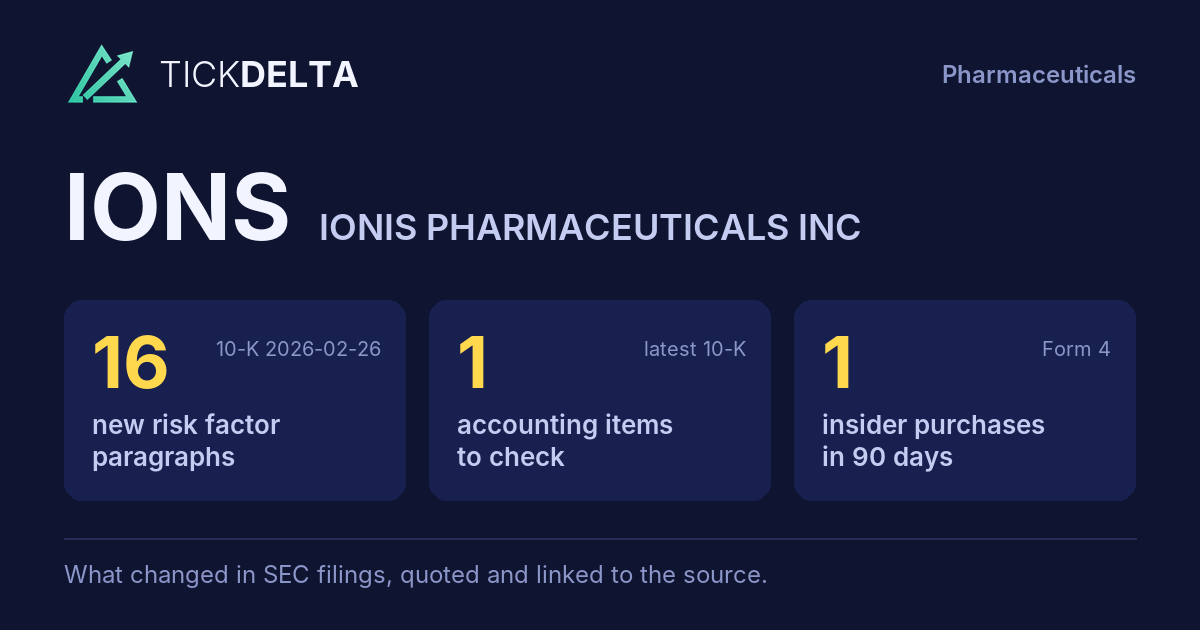
179 paragraphs · 16 new · 77 reworded · 13 gone · 10-K Feb 26, 2026 against Feb 19, 2025
New paragraph Reworded (5% of its words or more) Same or nearly
Paragraph 16 · 38% changed Every version of it
Third-party payers, whether foreign or domestic, or governmental or commercial, are developing increasingly sophisticated methods of controlling healthcare costs. In addition, in the U.S., no uniform policy of coverage and reimbursement for medicines exists among third-party payers. Therefore, coverage and reimbursement for medicines can differ significantly from payer to payer. For example, the Affordable Care Act, or ACA, was passed in March 2010, and substantially changed the way healthcare is financed by both governmental and private insurers and continues to significantly impact the U.S. pharmaceutical industry. There have been judicial and Congressional challenges to certain aspects of the ACA, as well as efforts to repeal or replace certain aspects of the ACA. It is unclear how future litigation and healthcare reform measures will impact the ACA and our business.
Paragraph 30 · 29% changed Every version of it
SPINRAZA injection for intrathecal use is an antisense medicine indicated for the treatment of SMA patients of all ages approved in over 50 countries. Specifically, ● SPINRAZA faces competition from onasemnogene abeparvovec, both a gene therapy product that was approved in the U.S. in May 2019 and in the EU in May 2020 for the treatment of SMA, as well as risdiplam, an oral product for the treatment of SMA that was approved in the U.S. in August 2020 and in the EU in March 2021. SMA. Biogen has in the past disclosed that SPINRAZA revenue decreased due to a reduction in demand as a result of increased competition and that future sales of SPINRAZA may be adversely affected by competing products. products;
Paragraph 13 · 29% changed Every version of it
Based on the profile of our medicines, physicians, patients, patient advocates, payers or the medical community in general may not accept or use any of the medicines that we or our partners may develop. For example, the product label for WAYLIVRA in the EU requires regular blood monitoring, which has negatively affected our ability to attract and retain patients for this medicine.
Paragraph 130 · 28% changed Every version of it
Social media is increasingly being used to communicate about our medicines and the diseases our therapies are designed to treat. Social media practices in the biopharmaceutical industry continue to evolve and regulations relating to such use are not always clear and create uncertainty and risk of noncompliance with regulations applicable to our business. There Despite our efforts to provide guidelines and training to our employees regarding social media use and monitor social media communications, there is also a risk that the unauthorized use of inappropriate social media by our employees to communicate about our products or business, or any inadvertent disclosure of sensitive material, nonpublic information or through these means, may result in violations of applicable laws and regulations, which may result in significant legal and financial exposure and reputational damages that could have a material adverse impact on our business. Furthermore, negative or inaccurate posts or comments about us on social media. We may also encounter criticism or our medicines on social media regarding could seriously damage our company, management, or medicines. Our reputation could be damaged by negative publicity or if adverse information concerning us is posted on social media platforms or similar mediums, which we may not be able to reverse. reputation, brand image and goodwill. If any of these events were to occur or we otherwise fail to comply with applicable regulations, we could incur liability, face restrictive regulatory actions or incur other harm to our business.
Paragraph 21 · 27% changed Every version of it
At the state level, legislatures have increasingly passed legislation and implemented regulations designed to control pharmaceutical and biological product pricing, including price or patient reimbursement constraints, discounts, restrictions on certain product access and marketing cost disclosure and transparency measures, and, in some cases, designed to encourage importation from other countries and bulk purchasing. For example, on January 5, 2024, the FDA approved Florida’s Section 804 Importation Program, or SIP, proposal to import certain drugs from Canada for specific state healthcare programs. It is unclear how this program will be implemented, including which drugs will be chosen, and whether it will be subject to legal challenges in the United States or Canada. Other states have also submitted SIP proposals that are pending review by the FDA. Any such approved importation plans, when implemented, may result in lower drug prices for products covered by those programs. Third-party coverage and reimbursement for medicines may not be available or adequate in either the U.S. or international markets, which would negatively affect the potential commercial success of our products, our revenue and our profits.
Paragraph 23 · 25% changed Every version of it
The biotechnology and pharmaceutical industries are highly competitive and subject to significant and rapid technological change. Our competitors engage in drug discovery throughout the world, are numerous, and include, among others, major pharmaceutical companies and specialized biopharmaceutical firms. In addition, other companies are engaged in developing RNA-targeted technology. Our competitors may succeed may, among other things, relative to our medicines or medicines in developing medicines that are: development:
Paragraph 50 · 24% changed Every version of it
We rely on third-party manufacturers to supply the drug substance and drug product for TRYNGOLZA TRYNGOLZA, DAWNZERA and WAINUA and drug product for WAYLIVRA. The operations of our suppliers, many of which are located outside of the United States, are subject to additional risks that are beyond our control. For example, there have been Congressional legislative proposals, such as tariffs on the recent bill titled the BIOSECURE Act, raw materials, components, or equipment we use to discourage contracting with Chinese companies for the development manufacture our products, or on our drug substance or finished products, will increase our manufacturing of pharmaceutical products. costs. In addition, merger and acquisition activity within the commercial manufacturing space could reduce the availability of resources from our third-party manufacturers. Delays or disruption to our own or third-party commercial manufacturing capabilities for any reason could limit the commercial success of our medicines.
Paragraph 34 · 24% changed Every version of it
Certain of our partners are pursuing other technologies or developing other medicines either on their own or in collaboration with others, including our competitors, to treat some of the same diseases that our own collaborative programs target. Competition may negatively impact a partner’s focus on and commitment to our medicines and, as a result, could delay or otherwise negatively affect the commercialization of our medicines, including our commercial partnered medicines. Additionally, companies that are developing medicines and that target the same patient populations as our medicines in development. development may compete with us to enroll participants in the clinical trials for such medicines, which could make it more difficult for us to complete enrollment for these clinical trials.

MD&A

87 paragraphs · 5 new · 30 reworded · 4 gone · 10-K Feb 26, 2026 against Feb 19, 2025
New paragraph Reworded (5% of its words or more) Same or nearly
Paragraph 57 · 47% changed
Our working capital increased decreased from 2023 2024 to 2024 primarily 2025 as we reclassified our 0% Notes due 2026 from non-current liabilities to a decrease in current liabilities as a result in the second quarter of lower deferred contract revenue as of December 31, 2024 compared to December 31, 2023. 2025 because the notes are due in April 2026. During the same period, our long-term obligations did not change significantly. increased due to the issuance of our 0% Notes due 2030, which was partially offset by the partial repurchase of our 0% Notes due 2026, in the fourth quarter of 2025.
Paragraph 46 · 46% changed
Investment income for 2024 2025 was $107.0 $97.8 million compared to $89.0 $107.0 million for 2023. 2024. The increase decrease in investment income was primarily due to an increase a decrease in interest rates associated with our investments during a majority of 2024 2025 compared to 2023. In addition, our cash available for investing increased due to the $489.1 million net proceeds we received from our public common stock offering in September 2024. Refer to Part IV, Item 15, Note 8, Stockholders’ Equity, in the Notes to the Consolidated Financial Statements for further details on the public offering.
Paragraph 13 · 38% changed
Our WAINUA joint development revenue in 2024 and 2023 includes included a $30 million milestone payment from AstraZeneca that we earned when the MHRA Medicines and Healthcare products Regulatory Agency, or MHRA, approved WAINUA for ATTRv-PN in the UK as WAINZUA WAINZUA. Research and a $50 million milestone payment from AstraZeneca that we earned when development expenses related to the FDA approved Phase 3 development of WAINUA for decreased in 2025 compared to 2024 as development activities related to ATTRv-PN in continued to wind down with the U.S., respectively. commercial launch of WAINUA.
Paragraph 6 · 38% changed
Year Ended December 31, 2025 2024 2023 Revenue: Commercial revenue: Product sales, net: TRYNGOLZA sales, net $ 107.5 $- DAWNZERA sales, net 7.8 - Total product sales, net 115.3 - Royalty revenue: SPINRAZA royalties $ 212.3 216.1 $ 240.4 WAINUA royalties 49.1 20.2 — Other royalties 24.1 21.0 Total royalty revenue 285.5 257.3 Other commercial revenue: TEGSEDI and WAYLIVRA revenue, net 34.2 34.9 Other revenue 22.6 33.3 Total other commercial revenue 56.8 68.2 35.0 35.8 Total commercial revenue 435.8 293.1 308.6 R&D Research and development revenue: Amortization from upfront payments 131.4 125.3 Milestone payments 106.4 100.5 License fees 71.3 116.8 Other services 23.5 10.0 Collaborative agreement revenue 465.8 332.6 352.6 WAINUA joint development revenue 42.1 79.4 126.4 Total R&D research and development revenue 507.9 412.0 479.0 Total revenue $ 705.1 $ 787.6 943.7 $705.1
Paragraph 4 · 34% changed
Below we have included our results of operations for 2024 compared to 2023. Refer to Part II, Item 7, Management’s Discussion and Analysis of Financial Condition and Results of Operations, of our 2023 Form 10-K for our results of operations for 2023 compared to 2022. The following table provides selected summary information from our consolidated statements of operations for 2025 and 2024 and 2023 (in millions):
Paragraph 15 · 34% changed
Operating expenses, excluding non-cash compensation expense related to equity awards, increased slightly in 2024 2025 compared to 2023. 2024. SG&A expenses increased year over year primarily due to the launches of WAINUA TRYNGOLZA, DAWNZERA and TRYNGOLZA, including establishing the TRYNGOLZA field team in the second quarter of 2024, and advancing launch preparation activities for donidalorsen. R&D expenses were essentially flat year over year as several late-stage studies ended. WAINUA.
Paragraph 42 · 30% changed
R&D support expenses, excluding non-cash compensation expense related to equity awards, were essentially flat increased in 2024 2025 compared to 2023. 2024 primarily due to increased costs relating to computer software and licenses.
Paragraph 50 · 27% changed
In 2023, 2025, we completed a $575.0 $770.0 million offering of our 1.75% 0% Notes due 2030 and used $488.2 $267.6 million of the net proceeds to repurchase $504.4 $200.0 million in principal of our 0.125% Notes. 0% Notes due 2026 at a premium. As a result of these repurchases, the repurchase, we recognized induced conversion expense of $16.3 million, which we recorded a $13.4 million gain on early retirement as other expense in our consolidated statement of debt in 2023, which reflects operations for the year ended December 31, 2025. The induced conversion expense is the difference between the amounts we amount paid to repurchase portions of our 0.125% the 0% Notes due 2026 and the net carrying balance if-converted value of the liability notes at the time that we repurchased the debt. debt repurchase terms were finalized. Refer to Part IV, Item 15, Note 7, Long-Term Obligations and Commitments, in the Notes to the Consolidated Financial Statements for further details regarding our convertible debt.

A paragraph is matched with the one last year that shares the most of its words; under half in common makes it new. The paragraphs shown are the 8 reworded the most in each section.

The paragraph that changed most in each section

The redline

Marked against last year's 10-K: cut words struck through, new words highlighted.

Risk Factors426 words changed in this paragraph; it is 36% similar to last year's version.
Further, we believe that future coverage, reimbursement and pricing will likely be subject to increased restrictions both in the U.S. and in international markets. In the U.S., recent health reform measures have resulted in reductions in Medicare and other healthcare funding, and there have been several recent U.S. Congressional inquiries, legislation and executive orders designed to, among other things, reduce drug prices, increase competition (including by enhancing support for generic and biosimilar drugs), lower out-of-pocket drug costs for patients, curtail spread pricing practices by pharmacy benefit managers, and foster scientific innovation to promote better health care and improved health. In addition, For example, the Inflation Reduction Affordable Care Act of 2022, or substantially changed the IRA, includes key actions aimed at reducing way healthcare is financed by both governmental and private insurers and continues to significantly impact the costs of prescription drugs and allows HHS to negotiate the price of certain single-source drugs covered under Medicare and establish a price cap on such drugs. The IRA, among other things, (1) directs HHS to negotiate the price of certain single-source drugs and biologics that U.S. pharmaceutical industry. Since its enactment, there have been on the market for at least seven years covered under Medicare, or the Medicare Drug Price Negotiation Program, amendments and (2) imposes rebates under Medicare Part B judicial, Congressional and Medicare Part D executive branch challenges to penalize price increases that outpace inflation. These provisions began to take effect progressively starting in fiscal year 2023, although the Medicare Drug Price Negotiation Program is currently subject to legal challenges. Under this program, HHS has already announced the agreed-upon prices certain aspects of the first drugs Affordable Care Act, as well as efforts to repeal or replace certain aspects of the Affordable Care Act. We expect that were subject to price negotiations and will announce the agreed-upon prices of additional drugs in the coming years. In response to an October 2022 executive order, on February 14, 2023, HHS released a report outlining three new models for testing by the CMS Innovation Center that U.S. federal healthcare reform measures will be evaluated on their ability to lower the cost of drugs, promote accessibility, and improve quality of care. It is unclear whether the models will be utilized in any health reform measures in the future. Further, on December 7, 2023, the Biden administration announced an initiative to control the price of prescription drugs using march-in rights under the Bayh-Dole Act. On December 8, 2023, the National Institute of Standards and Technology published for comment a Draft Interagency Guidance Framework for Considering the Exercise of March-In Rights which for the first time includes the price of a product as one factor an agency can use when deciding to exercise march-in rights. While march-in rights have not previously been exercised, it is uncertain if that will continue under the new framework. It is unclear whether or how these selected models or similar policy initiatives will impact prescription drug pricing adopted in the future, particularly any of which could limit the amounts that the U.S. federal government will pay for healthcare products and services, which could result in light of the recent U.S. presidential reduced demand or revenue for our commercial medicines and congressional elections. our medicines in development.

Source: Item 1A, 10-K 0000874015-26-000115 vs Item 1A, 10-K 0000874015-25-000089

Legal ProceedingsNew paragraph this year (127 words), with no similar paragraph last year.
On September 10, 2025, Arrowhead Pharmaceuticals, Inc., or Arrowhead, filed a lawsuit in the District of Delaware, or the Delaware Lawsuit, seeking a declaratory judgment that our patent US9,593,333 is invalid or not infringed by use of Arrowhead's ApoCIII inhibitor plozasiran. On September 11, 2025, we filed a lawsuit in the Central District of California, or the California Lawsuit, asserting infringement of that same patent by Arrowhead's announced intention to commercialize plozasiran in November 2025. On December 23, 2025, the Delaware Lawsuit was dismissed in favor of the California Lawsuit. On January 12, 2026, Arrowhead filed its Answer to our Complaint and Counterclaims, which are similar to its previously filed claims in the Delaware Lawsuit. Accordingly, the consolidated dispute is proceeding in the Central District of California.

Source: Item 3, via Note 11 – Legal Proceedings, 10-K 0000874015-26-000115 vs Item 3, via Note 11 – Legal Proceedings, 10-K 0000874015-25-000089

MD&A77 words changed in this paragraph; it is 35% similar to last year's version.
Our working capital increased decreased from 2023 2024 to 2024 primarily 2025 as we reclassified our 0% Notes due 2026 from non-current liabilities to a decrease in current liabilities as a result in the second quarter of lower deferred contract revenue as of December 31, 2024 compared to December 31, 2023. 2025 because the notes are due in April 2026. During the same period, our long-term obligations did not change significantly. increased due to the issuance of our 0% Notes due 2030, which was partially offset by the partial repurchase of our 0% Notes due 2026, in the fourth quarter of 2025.

Source: Item 7, 10-K 0000874015-26-000115 vs Item 7, 10-K 0000874015-25-000089

Accounting Policies31 words changed in this paragraph; it is 70% similar to last year's version.
We incorporated in California on January 10, 1989. In conjunction with our IPO, we reorganized as a Delaware corporation in April 1991. We were organized principally to develop human therapeutic medicines using antisense technology. In December 2015, we changed our name from Isis Pharmaceuticals, Inc. to Ionis Pharmaceuticals, Inc. We are a fully integrated commercial-stage biotechnology company and a leader in the discovery and development of RNA-targeted therapeutics.

Source: 10-K text, Note 1 – Organization and Significant Accounting Policies, 10-K 0000874015-26-000115 vs 10-K text, Note 1 – Organization and Significant Accounting Policies, 10-K 0000874015-25-000089

Sentences and paragraphs added, removed or reworded

Every change, by type

Sentences and paragraphs of IONS's Risk Factors and MD&A, 10-K Feb 26, 2026 against 10-K Feb 19, 2025. Each links to the text at sec.gov.

Quiet changes are sentences kept from last year with one to four words changed, at least one of them a hedge, a modal or a qualifier (may, could, will, not, significant, material…). A year or date rolling forward is not counted.

The full word list

adverse, adversely, all, although, anticipate, anticipates, any, approximately, believe, believes, can, cannot, certain, could, expect, expects, generally, however, if, intend, intends, largely, likely, many, material, materially, may, might, most, must, never, no, not, possible, primarily, probable, should, significant, significantly, some, substantial, substantially, unlikely, will, would

AddedRisk Factors
Further, we believe that future coverage, reimbursement and pricing will likely be subject to increased restrictions both in the U.S. and in international markets. In the U.S., recent health reform measures have resulted in reductions in Medicare and other healthcare funding, and there have been several recent U.S. Congressional inquiries, legislation and executive orders designed to, among other things, reduce drug prices, increase competition (including by enhancing support for generic and biosimilar drugs), lower out-of-pocket drug costs for patients, curtail spread pricing practices by pharmacy benefit managers, and foster scientific innovation to promote better health care and improved health. For example, the Affordable Care Act substantially changed the way healthcare is financed by both governmental and private insurers and continues to significantly impact the U.S. pharmaceutical industry. Since its enactment, there have been amendments and judicial, Congressional and executive branch challenges to certain aspects of the Affordable Care Act, as well as efforts to repeal or replace certain aspects of the Affordable Care Act. We expect that additional U.S. federal healthcare reform measures will be adopted in the future, any of which could limit the amounts that the U.S. federal government will pay for healthcare products and services, which could result in reduced demand or revenue for our commercial medicines and our medicines in development.
Read it in 10-K Feb 26, 2026 at sec.gov
AddedRisk Factors
In addition, the Inflation Reduction Act of 2022, or the IRA, includes key actions aimed at reducing the costs of prescription drugs and allows HHS to negotiate the price of certain single-source drugs covered under Medicare and establish a price cap on such drugs. The IRA, among other things, (1) directed HHS to negotiate the price of certain single-source drugs and biologics that have been on the market for at least seven years covered under Medicare, or the Medicare Drug Price Negotiation Program, and (2) imposed rebates under Medicare Part B and Medicare Part D to penalize price increases that outpace inflation. Each year, up to 20 products will be selected by HHS for the Medicare Drug Price Negotiation Program. Products subject to the Medicare Drug Price Negotiation Program are expected to experience a significant reduction in reimbursement from the Medicare program on a per unit basis.
Read it in 10-K Feb 26, 2026 at sec.gov
AddedRisk Factors
The current U.S. Presidential administration is pursuing policies to reduce regulations and expenditures across government agencies, including at HHS, the FDA, CMS, and other related agencies, with a particular focus on most favored nation pricing equal to or lower than those paid in other developed nations. These actions, presently directed by executive orders or memoranda from the Office of Management and Budget, may propose additional policy changes that create uncertainty for our business. For example, in furtherance of the administration’s drug pricing initiatives, in December 2025, CMS issued proposed rules that, if finalized, would implement new mandatory and voluntary payment models to implement a most favored nation rebate model. These models are referred to as the GLOBE Model, GUARD Model and GENEROUS Model. At this time, it remains unclear whether the proposed models will be finalized and, if so, whether any changes will be made prior to their implementation. These and other recent actions and policies may significantly reduce U.S. drug prices, potentially impacting manufacturers’ global pricing strategies and profitability, while increasing their operational costs and compliance risks.
Read it in 10-K Feb 26, 2026 at sec.gov
AddedRisk Factors
● WAINUA faces competition in ATTRv-PN from numerous competitors, including an oral product, and, if approved for ATTR-CM, would face competition from several commercial competitors, including an oral product, and could face competition from additional commercial competitors in the future;
Read it in 10-K Feb 26, 2026 at sec.gov
Show the other 52
AddedRisk Factors
For details regarding medicines that compete or may compete directly with our marketed medicines and late-stage medicines, refer to the section titled, Competition, in Part I, Item 1, Business.
Read it in 10-K Feb 26, 2026 at sec.gov
AddedRisk Factors
For example, while we continue to activate sites in the U.S., Canada, U.K., Australia and Japan, we revised and resubmitted the study protocol for the REVEAL study of obudanersen to address changes requested by EU regulators and plan to initiate EU sites for this study in 2026. Importantly, we believe we are on track to complete enrollment for this study in 2026.
Read it in 10-K Feb 26, 2026 at sec.gov
AddedRisk Factors
In addition, our development and commercialization activities could be harmed or delayed by staffing shortages or a shutdown or other significant disruption of the U.S. government, including the FDA or the U.S. PTO.
Read it in 10-K Feb 26, 2026 at sec.gov
RemovedRisk Factors
Further, we believe that future coverage, reimbursement and pricing will likely be subject to increased restrictions both in the U.S. and in international markets. In the U.S., recent health reform measures have resulted in reductions in Medicare and other healthcare funding, and there have been several recent U.S. Congressional inquiries, legislation and executive orders designed to, among other things, reduce drug prices, increase competition (including by enhancing support for generic and biosimilar drugs), lower out-of-pocket drug costs for patients, curtail spread pricing practices by pharmacy benefit managers, and foster scientific innovation to promote better health care and improved health. In addition, the Inflation Reduction Act of 2022, or the IRA, includes key actions aimed at reducing the costs of prescription drugs and allows HHS to negotiate the price of certain single-source drugs covered under Medicare and establish a price cap on such drugs. The IRA, among other things, (1) directs HHS to negotiate the price of certain single-source drugs and biologics that have been on the market for at least seven years covered under Medicare, or the Medicare Drug Price Negotiation Program, and (2) imposes rebates under Medicare Part B and Medicare Part D to penalize price increases that outpace inflation. These provisions began to take effect progressively starting in fiscal year 2023, although the Medicare Drug Price Negotiation Program is currently subject to legal challenges. Under this program, HHS has already announced the agreed-upon prices of the first drugs that were subject to price negotiations and will announce the agreed-upon prices of additional drugs in the coming years. In response to an October 2022 executive order, on February 14, 2023, HHS released a report outlining three new models for testing by the CMS Innovation Center that will be evaluated on their ability to lower the cost of drugs, promote accessibility, and improve quality of care. It is unclear whether the models will be utilized in any health reform measures in the future. Further, on December 7, 2023, the Biden administration announced an initiative to control the price of prescription drugs using march-in rights under the Bayh-Dole Act. On December 8, 2023, the National Institute of Standards and Technology published for comment a Draft Interagency Guidance Framework for Considering the Exercise of March-In Rights which for the first time includes the price of a product as one factor an agency can use when deciding to exercise march-in rights. While march-in rights have not previously been exercised, it is uncertain if that will continue under the new framework. It is unclear whether or how these selected models or similar policy initiatives will impact prescription drug pricing in the future, particularly in light of the recent U.S. presidential and congressional elections.
Read it in 10-K Feb 19, 2025 at sec.gov
RemovedRisk Factors
Budesonide, sparsentan, atrasentan, iptacopan, zigakibart, sibeprenlimab, atacicept, ravulizumab, vemircopan, felzartamab, telitacicept and povetacicept could compete with sefaxersen; and
Read it in 10-K Feb 19, 2025 at sec.gov
RemovedRisk Factors
The FDA and foreign regulatory bodies have the authority to impose significant restrictions on an approved medicine through the product label and on advertising, promotional and distribution activities.
Read it in 10-K Feb 19, 2025 at sec.gov
RewordedRisk Factors
Cybersecurity related events could include the deployment or use of harmful malware or malicious code, denial-of-service attacks, credential stuffing attacks, credential harvesting attacks, social engineering attacks (including deep fakes), fakes and phishing attacks), ransomware and other means to affect affect, as applicable, the confidentiality, privacy, security, integrity or availability of our data as well as information systems and infrastructure. infrastructure (including that of third parties with whom we work).
Read it in 10-K Feb 26, 2026 at sec.gov
RewordedRisk Factors
In 2021, 2025, we completed a $632.5 $770 million offering of 0% Notes due 2030 and used $319.0 $267.6 million of the net proceeds from the issuance of the 0% Notes due 2030 to repurchase the remaining $309.9 $200 million of our 1% Notes. 0% Notes due 2026.
Read it in 10-K Feb 26, 2026 at sec.gov
RewordedRisk Factors
If government or other third-party payers fail to provide adequate coverage and payment rates for our medicines, including our commercial medicines and our medicines in development, or if healthcare reform measures increase our costs, decrease our sales, or negatively impact reimbursement for our products, our revenue will be limited.
Read it in 10-K Feb 26, 2026 at sec.gov
RewordedRisk Factors
For example, in 2025, Novartis decided to return the clinical development program for a follow on to pelacarsen, and in 2022, Pfizer and Bayer decided to discontinue the clinical development programs for vupanorsen and fesomersen, respectively.
Read it in 10-K Feb 26, 2026 at sec.gov
RewordedRisk Factors
We must also continue to scale-up existing internal support functions to aid our commercialization efforts. efforts, which will need to work effectively in coordination with new commercial functional areas.
Read it in 10-K Feb 26, 2026 at sec.gov
RewordedRisk Factors
If we are unable to effectively establish and or maintain marketing, sales, market access, distribution, and related functions, an effective commercialization infrastructure, or enter into agreements with third parties to commercialize our medicines, we may not be able to successfully commercialize our medicines.
Read it in 10-K Feb 26, 2026 at sec.gov
RewordedRisk Factors
TRYNGOLZA is our first We currently have two independently launched medicine medicines, TRYNGOLZA and DAWNZERA, and we expect to independently launch additional medicines in the near future.
Read it in 10-K Feb 26, 2026 at sec.gov
RewordedRisk Factors
Our operations are subject to extensive legal and regulatory requirements affecting the health care industry, including federal federal, state, and state foreign fraud and abuse (including anti-kickback laws, laws and false claims laws, laws), transparency laws, such as the federal Sunshine Act, and health information privacy and security laws, which are subject to change at any time.
Read it in 10-K Feb 26, 2026 at sec.gov
RewordedRisk Factors
If we are not successful in executing this expansion, or if the demand for any of our commercial medicines exceeds our expectations, it could limit our ability to meet our manufacturing requirements and commercial objectives in the future.
Read it in 10-K Feb 26, 2026 at sec.gov
RewordedRisk Factors
Our obligations (including in relation to personal information obligations information) require us to implement and maintain certain practices, including those in relation to cross-border transfers of personal information. data.
Read it in 10-K Feb 26, 2026 at sec.gov
RewordedRisk Factors
While we have invested, and continue to invest, in the protection of our data and information technology systems and infrastructure, infrastructure as well as our compliance with relevant privacy and cybersecurity obligations, our efforts may not be successful.
Read it in 10-K Feb 26, 2026 at sec.gov
RewordedRisk Factors
Competition may negatively impact a partner’s focus on and commitment to our medicines and, as a result, could delay or otherwise negatively affect the commercialization of our medicines, including our commercial medicines and our medicines in development. partnered medicines.
Read it in 10-K Feb 26, 2026 at sec.gov
Quiet changesRisk Factors
Since corporate partnering is part of our strategy to fund the advancement and commercialization of some of our development programs, if any of our collaborative partners fail to fund our collaborative programs, or if we cannot obtain additional partners, we may have to delay or stop progress on our those drug development programs.
Read it in 10-K Feb 26, 2026 at sec.gov
AddedMD&A
The remainder of our revenue came from programs under our R&D collaborations, including a $280 million upfront payment for the global license of sapablursen to Ono in the second quarter of 2025, reflecting the value that our pipeline and technology continues to generate.
Read it in 10-K Feb 26, 2026 at sec.gov
AddedMD&A
Costs of sales for recently launched products, such as TRYNGOLZA and DAWNZERA, does not include the full cost of manufacturing until we manufacture and sell additional inventory after exhausting pre-launch inventory, which we previously recorded as R&D expense.
Read it in 10-K Feb 26, 2026 at sec.gov
AddedMD&A
In July 2025, H.R.1 - 119th Congress was signed into law, introducing significant changes to U.S. federal tax law. The new law restores current expensing of domestic R&D costs and allows us to accelerate the deduction for a significant amount of such costs we capitalized since 2022. These tax law changes did not have a material effect on our tax expense for the year ended December 31, 2025.
Read it in 10-K Feb 26, 2026 at sec.gov
RemovedMD&A
Commercial revenue in 2024 included new sources of commercial revenue with the launch of WAINUA in the U.S. in late January 2024 and the launch of TRYNGOLZA in the U.S. in late December 2024. SPINRAZA royalties in 2024 compared to 2023 were impacted from an annual order from a single country that did not recur in 2024.
Read it in 10-K Feb 19, 2025 at sec.gov
RemovedMD&A
R&D revenue decreased in 2024 compared to 2023 primarily due to the decrease in WAINUA joint development revenue as development activities relating to ATTRv-PN wound down with the commercial launch of WAINUA. In addition, R&D revenue decreased due to the timing of significant partner payments.
Read it in 10-K Feb 19, 2025 at sec.gov
RemovedMD&A
Interest expense for 2024 was $17.0 million compared to $12.7 million for 2023. In June 2023, we completed a $575.0 million offering of our 1.75% Notes and repurchased $504.4 million in principal of our 0.125% Notes. As a result, beginning in the second quarter of 2023, our interest expense related to our convertible notes included interest expense incurred for our 1.75% Notes. Interest expense in 2024 included a full year of interest expense related to our 1.75% Notes.
Read it in 10-K Feb 19, 2025 at sec.gov
RemovedMD&A
The decrease in income tax expense for 2024 compared to 2023 primarily related to the impact of the Royalty Pharma transaction in 2023. We reflected the Royalty Pharma transaction as a taxable sale, which required us to include the proceeds from the sale, net of currently deductible issuance costs, as taxable income in 2023.
Read it in 10-K Feb 19, 2025 at sec.gov
RewordedMD&A
Year Ended December 31, 2025 2024 2023 WAINUA $ 103.7 $ 115.5 TEGSEDI and WAYLIVRA 11.2 8.1 Eplontersen $87.6 $103.7 DAWNZERA 14.3 16.6 Olezarsen 87.1 147.4 138.3 Donidalorsen Zilganersen 13.9 7.6 Obudanersen 31.9 16.6 24.9 Zilganersen 7.6 8.4 Ulefnersen 11.1 15.0 10.8 Other development projects 89.9 101.0 81.1 84.5 Development overhead expenses 159.2 135.9 123.3 Total drug development, development expenses, excluding non-cash compensation expense related to equity awards 486.2 527.3 530.3 Non-cash compensation expense related to equity awards 42.5 41.2 34.5 Total drug development expenses $ 568.5 $ 564.8 $528.7 $568.5
Read it in 10-K Feb 26, 2026 at sec.gov
RewordedMD&A
Contractual Obligations Payments Due by Period (in millions) (selected balances described below) Total Less than 1 year More than 1 year 0% Notes due 2030 (principal payable) $ 770.0 $- $770.0 1.75% Notes due 2028 (principal and interest payable) $ 610.3 $ 600.2 10.1 $ 600.2 590.1 0% Notes due 2026 (principal payable) 632.5 — 632.5 432.5 432.5 - Operating leases 260.3 20.9 239.4 484.8 35.5 449.3 Building mortgage payments (principal and interest payable) 9.6 9.1 0.5 9.1 8.6 Other obligations (principal and interest payable) 0.7 0.6 0.1 0.6 0.5 Total $ 1,513.4 $ 31.6 $ 1,481.8 2,297.2 $478.7 $1,818.5
Read it in 10-K Feb 26, 2026 at sec.gov
RewordedMD&A
Year Ended December 31, 2025 2024 2023 Personnel costs $ 31.4 $ 27.2 33.1 $31.4 Occupancy 31.1 28.5 28.7 Consulting 0.4 4.8 Patent expenses 5.3 4.3 Insurance 3.3 3.6 Computer software and licenses 14.4 8.4 2.7 Insurance 3.3 3.3 Patent expenses 6.4 5.3 Other 5.3 9.7 6.5 5.7 Total R&D support expenses, excluding non-cash compensation expense related to equity awards 94.8 82.6 81.0 Non-cash compensation expense related to equity awards 18.2 18.6 15.0 Total R&D support expenses $ 101.2 $ 96.0 113.0 $101.2
Read it in 10-K Feb 26, 2026 at sec.gov
RewordedMD&A
Our WAINUA joint development revenue in 2024 and 2023 includes included a $30 million milestone payment from AstraZeneca that we earned when the MHRA Medicines and Healthcare products Regulatory Agency, or MHRA, approved WAINUA for ATTRv-PN in the UK as WAINZUA and a $50 million milestone payment from AstraZeneca that we earned when the FDA approved WAINUA for ATTRv-PN in the U.S., respectively. WAINZUA.
Read it in 10-K Feb 26, 2026 at sec.gov
RewordedMD&A
SG&A expenses, excluding non-cash compensation expense related to equity awards, increased in 2024 2025 compared to 2023 2024 primarily due to the launches of WAINUA TRYNGOLZA, DAWNZERA and TRYNGOLZA, including establishing the TRYNGOLZA field team in the second quarter of 2024, and advancing launch preparation activities for donidalorsen. WAINUA.
Read it in 10-K Feb 26, 2026 at sec.gov
RewordedMD&A
From the time we were founded through December 31, 2024, 2025, we have raised net proceeds of approximately $2.6 $2.8 billion from the sale of our equity securities, which includes our sale of 11.5 million shares of common stock for net proceeds of $489 million in September 2024. securities.
Read it in 10-K Feb 26, 2026 at sec.gov
RewordedMD&A
SG&A expenses increased year over year primarily due to the launches of WAINUA TRYNGOLZA, DAWNZERA and TRYNGOLZA, including establishing the TRYNGOLZA field team in the second quarter of 2024, and advancing launch preparation activities for donidalorsen. WAINUA.
Read it in 10-K Feb 26, 2026 at sec.gov
RewordedMD&A
We recorded an income tax expense of $1.8 million for 2025 compared to an income tax benefit of $6.2 million for 2024 compared to an income tax expense of $32.3 million for 2023. 2024.
Read it in 10-K Feb 26, 2026 at sec.gov
RewordedMD&A
Non-cash compensation expense related to equity awards increased in 2024 compared to 2023 were essentially flat year over year due to increased headcount and offset by a higher lower stock price on the grant date of annual equity awards in 2024 2025 compared to 2023. 2024.
Read it in 10-K Feb 26, 2026 at sec.gov
RewordedMD&A
In 2023, 2025, we completed a $575.0 $770.0 million offering of our 1.75% 0% Notes due 2030 and used $488.2 $267.6 million of the net proceeds to repurchase $504.4 $200.0 million in principal of our 0.125% Notes. 0% Notes due 2026 at a premium.
Read it in 10-K Feb 26, 2026 at sec.gov
RewordedMD&A
Non-cash amortization of debt issuance costs $ 6.1 $ 5.9 6.3 $6.1 Interest expense payable in cash 10.1 10.5 6.4 Interest on mortgage for primary R&D and manufacturing facilities facility 0.4 0.4 Other 0.5 - Total interest expense $ 17.0 $ 12.7 17.3 $17.0
Read it in 10-K Feb 26, 2026 at sec.gov
RewordedMD&A
R&D support expenses, excluding non-cash compensation expense related to equity awards, were essentially flat increased in 2024 2025 compared to 2023. 2024 primarily due to increased costs relating to computer software and licenses.
Read it in 10-K Feb 26, 2026 at sec.gov

Sources

The two latest 10-Ks on EDGAR, section by section. Each change links to the text at sec.gov.

Also

New risk factors: paragraphs with nothing like them last year, quoted in full.

Work with it

Excel workbook · CSV. Google Sheet that stays up to date: paste =IMPORTDATA("https://tickdelta.com/company/IONS/export.csv") into a cell.

Next:Related parties
Esc

Type a ticker such as AAPL, a name, an investor such as Buffett, or a topic such as tariffs. ↑ ↓ to move, Enter to open.