Paragraph 169 · 45% changed
Every version of it
Screener
/
SEC EDGAR
/CIK 0001642896
/10-K filed Mar 16, 2026, compared with Mar 25, 2025
/Numbers from the XBRL of the 10-Ks
NYSE
Technology · IT Services
Samsara Inc. IOT
The 10-K against last year's
197 changes: 6 added, 6 removed, 183 reworded, 2 quiet changes
10-K Mar 16, 2026 vs Mar 25, 2025
Risk Factors
5.8%
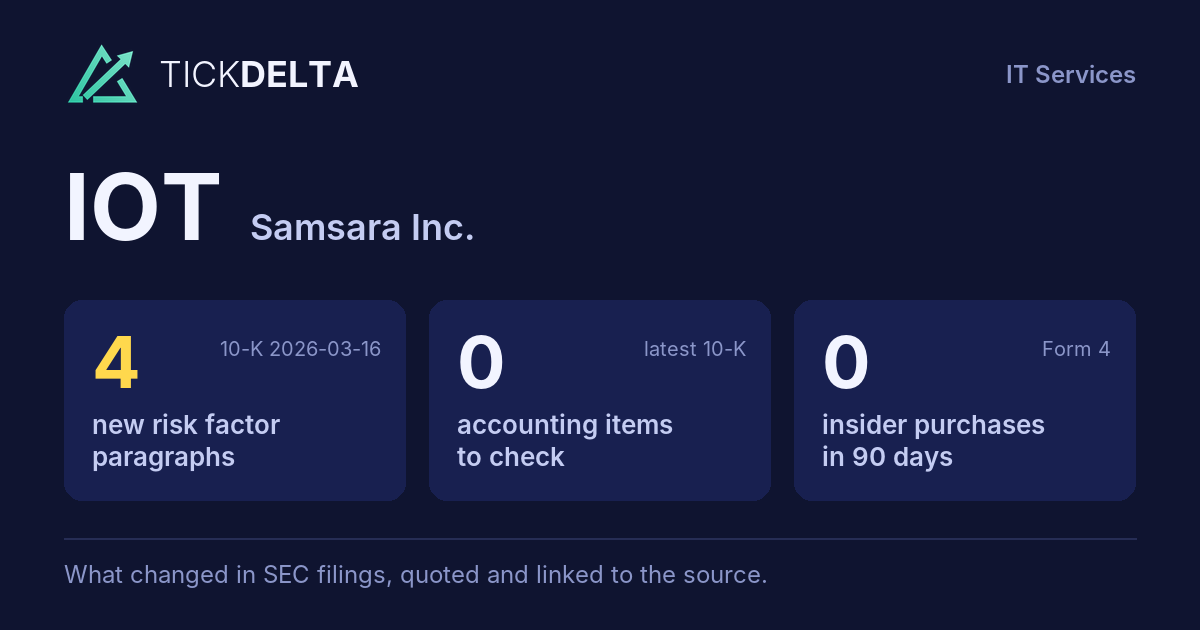
of the text changed · 34,733 words now · 4 new paragraphs, 1 gone
MD&A
15.6%
of the text changed · 7,107 words now · 2 new paragraphs, 5 gone
Legal Proceedings
19.7%
of the text changed · 522 words now
Accounting Policies
35.4%
of the text changed · 4,319 words now
10-K 0001628280-26-018167 (Mar 16, 2026) vs 10-K 0001642896-25-000022 (Mar 25, 2025)
Every paragraph, and how much of it changed
One bar per paragraph, in the order of the 10-K. Height and colour show the share of its words not in the closest paragraph a year earlier; the tallest bars are new paragraphs.
Risk Factors
326 paragraphs · 4 new · 125 reworded · 1 gone · 10-K Mar 16, 2026 against Mar 25, 2025
New paragraph
Reworded (5% of its words or more)
Same or nearly
Paragraph 116 · 43% changed
Every version of it
•greater difficulty collecting accounts receivable, longer sales and payment cycles, different pricing environments, and different pricing environments; risks associated with country- and region-specific legal, regulatory, and compliance requirements and environments, including related to privacy, data protection, and fraud;
Paragraph 236 · 40% changed
Every version of it
In addition, tax laws are dynamic and subject to change as new laws are passed and new interpretations of the law are issued or applied, and any such changes could adversely affect our tax liability. For example, in August 2022, July 2025, the United States U.S. government enacted the Inflation Reduction One Big Beautiful Bill Act, which includes several changes to U.S. federal income tax law, including the temporary and permanent extension of expiring provisions of the Tax Cuts and Jobs Act of 2022, which imposes a 15% minimum tax on the adjusted financial statement income of certain large corporations. Many countries in the EU, 2017. In addition, many countries, as well as a number of other countries and organizations such as the Organisation for Economic Cooperation and Development (the “OECD”), are actively considering “OECD”) have enacted or proposed changes to existing tax laws, including a 15% global minimum tax (“Pillar 2”). The OECD and participating jurisdictions have agreed to a “side-by-side” solution that would exempt U.S. parented multinational corporations from certain provisions of Pillar 2 for fiscal years beginning on or after January 1, 2026. These and other changes to applicable tax laws that, if enacted, could increase our tax obligations in countries where we do business. As part of the OECD’s base erosion and profit shifting project, over 130 member jurisdictions of the OECD Inclusive Framework have joined the Two-Pillar Solution to Address the Tax Challenges of the Digitalisation of the Economy, which includes a reallocation of taxing rights among jurisdictions and a global minimum tax rate of 15%. If U.S. or other non-U.S. tax authorities change applicable tax laws, our overall tax liabilities could increase, liabilities, and our business, financial condition, or results of operations may be adversely impacted.
Paragraph 124 · 38% changed
Every version of it
•laws and business practices favoring local competitors or general market preferences for local vendors; vendors, including recent efforts by foreign governments to reduce dependence on America-based technology providers;
Paragraph 44 · 38% changed
Every version of it
Paragraph 10 · 30% changed
Every version of it
•potential customers’ inexperience with or reluctance to adopt software and cloud-based solutions in their physical operations; operations or our failure to adequately demonstrate the return on investment ROI of our solution;
Paragraph 110 · 29% changed
Every version of it
•challenges in recruiting, training, and retaining qualified employees, particularly in markets where in which we have not historically operated; little or no experience operating;
Paragraph 96 · 25% changed
Every version of it
We typically provide service-level commitments under our subscription agreements. agreements and may provide product performance obligations, warranties or commitments to larger customers. If we fail to meet these contractual commitments, we could be obligated to provide credits for future service or other remedies, or face subscription termination with prorated refunds of prepaid amounts, amounts or breach of contract claims, which would could lower our revenue revenue, require personnel time or company resources to remedy the issue, and harm our reputation, business, financial condition, and results of operations.
Paragraph 169 · 45% changed
Every version of it
10-K Mar 25, 2025We also expect that there will continue to be new laws, regulations, executive orders, directives, and industry standards concerning privacy, data protection, and information security proposed and enacted in various jurisdictions. For example, the data protection landscape in Europe is currently evolving, resulting in possible significant operational costs for internal compliance and risks to our business. The EU adopted the General Data Protection Regulation (“GDPR”), which became effective in May 2018, and contains numerous requirements and changes from previously existing EU laws, including more robust obligations on data processors and heavier documentation requirements for data protection compliance programs by companies. Among other requirements, the GDPR regulates the transfer of personal data subject to the GDPR to “third countries” that have not been found to provide adequate protection to such personal data, including the United States, Mexico, Colombia, Taiwan, and India. We have undertaken certain efforts to conform transfers of personal data subject to the GDPR from the European Economic Area (“EEA”) to the United States and other relevant jurisdictions based on our understanding of current regulatory obligations and the guidance of data protection authorities, including the use of SCCs approved by the European Commission; however, international data transfers may still be challenged in countries that have not received “adequacy” status from the European Commission. For example, in the Schrems II decision issued by the Court of Justice of the European Union (“CJEU”) on July 16, 2020, the CJEU, among other things, imposed additional obligations on companies when relying on the SCCs. EEA regulators since have provided guidance regarding use of the SCCs, and on June 4, 2021, the European Commission issued new SCCs that are required to be implemented where appropriate. The European Commission subsequently adopted an adequacy decision that also covers transfers of personal data to the United States under an alternative mechanism called the EU-U.S. Data Privacy Framework. The EU-U.S. Data Privacy Framework is the successor to the EU-U.S. Privacy Shield and allows participating entities to transfer personal data to the United States. As we continued to participate in Privacy Shield, we transitioned automatically to the EU-U.S. Data Privacy Framework, as well as a UK Extension to the EU-U.S. Data Privacy Framework and the Swiss-U.S. Data Privacy Framework, which are designed to allow personal data transfers from the United Kingdom and Switzerland, respectively, to the United States. The Swiss-U.S. Data Privacy Framework was granted an adequacy decision from Switzerland’s Federal Data Protection and Information Commissioner that became effective on September 15, 2024. There is no guarantee that any of these frameworks will survive any legal challenges and therefore, in light of this uncertainty, we will need to continue monitoring and taking appropriate steps to mitigate the impact on us with respect to the transfers of relevant personal data outside of the EEA, United Kingdom, and Switzerland. The United Kingdom has enacted the UK Data Protection Act (“UK DPA”) and UK GDPR, which substantially implement the GDPR and provide for substantial penalties in a manner similar to the GDPR (up to the greater of £17.5 million and 4% of global annual turnover for the preceding financial year for the most serious violations). The United Kingdom also has adopted, in addition to the UK Extension to the EU-U.S. Data Privacy Framework, new data transfer mechanisms (namely, the UK International Data Transfer Agreement and the UK international data transfer addendum to the SCCs) addressing the cross-border transfer of personal data outside the United Kingdom that became effective as of March 21, 2022, and which are required to be implemented as necessary. While the EU has deemed the United Kingdom to be an “adequate country” to which personal data could be exported from the EEA, this decision is required to be renewed after four years of being in effect and may be modified, revoked, or challenged in the interim. The United Kingdom has also introduced legislation that would provide for significant modifications to its data protection regime. It is unclear how United Kingdom data protection laws or regulations will develop in the medium to longer term and how data transfers to and from the United Kingdom will be regulated. Further, some jurisdictions and/or particular sectors also are considering or have enacted regulations or standards requiring local storage and processing of data that could increase the cost and complexity of delivering our services.
10-K Mar 16, 2026
The United Kingdom has enacted the UK DPA, which substantially implement the GDPR and provide for substantial penalties in a manner similar to the GDPR (up to the greater of £17.5 million and 4% of global annual turnover for the preceding financial year for the most serious violations). The United Kingdom also has adopted, in addition to the UK Extension to the EU-U.S. Data Privacy Framework, new data transfer mechanisms (namely, the UK International Data Transfer Agreement and the UK international data transfer addendum to the SCCs) addressing the cross-border transfer of personal data outside the United Kingdom that became effective as of March 21, 2022, and which are required to be implemented as necessary. While the EU has deemed the United Kingdom to be an “adequate country” to which personal data could be exported from the EEA, this decision may be modified, or revoked. If the United Kingdom loses its adequacy status, we will then need to rely upon alternative data transfer mechanisms for any exports from the EEA to the United Kingdom. It is unclear how United Kingdom data protection laws or regulations will continue to develop in the medium to longer term and therefore how data transfers to and from the United Kingdom will continue to be regulated. Further, some jurisdictions and/or particular sectors also are considering or have enacted regulations or standards requiring local storage and processing of data that could increase the cost and complexity of delivering our services.
Paragraph 116 · 43% changed
Every version of it
10-K Mar 25, 2025
•greater difficulty collecting accounts receivable, longer sales and payment cycles, and different pricing environments;
10-K Mar 16, 2026
•greater difficulty collecting accounts receivable, longer sales and payment cycles, different pricing environments, and different risks associated with country- and region-specific legal, regulatory, and compliance requirements and environments, including related to privacy, data protection, and fraud;
Paragraph 236 · 40% changed
Every version of it
10-K Mar 25, 2025
In addition, tax laws are dynamic and subject to change as new laws are passed and new interpretations of the law are issued or applied, and any such changes could adversely affect our tax liability. For example, in August 2022, the United States enacted the Inflation Reduction Act of 2022, which imposes a 15% minimum tax on the adjusted financial statement income of certain large corporations. Many countries in the EU, as well as a number of other countries and organizations such as the Organisation for Economic Cooperation and Development (the “OECD”), are actively considering changes to existing tax laws that, if enacted, could increase our tax obligations in countries where we do business. As part of the OECD’s base erosion and profit shifting project, over 130 member jurisdictions of the OECD Inclusive Framework have joined the Two-Pillar Solution to Address the Tax Challenges of the Digitalisation of the Economy, which includes a reallocation of taxing rights among jurisdictions and a global minimum tax rate of 15%. If U.S. or other non-U.S. tax authorities change applicable tax laws, our overall tax liabilities could increase, and our business, financial condition, or results of operations may be adversely impacted.
10-K Mar 16, 2026
In addition, tax laws are dynamic and subject to change as new laws are passed and new interpretations of the law are issued or applied, and any such changes could adversely affect our tax liability. For example, in July 2025, the U.S. government enacted the One Big Beautiful Bill Act, which includes several changes to U.S. federal income tax law, including the temporary and permanent extension of expiring provisions of the Tax Cuts and Jobs Act of 2017. In addition, many countries, as well as organizations such as the Organisation for Economic Cooperation and Development (the “OECD”) have enacted or proposed changes to existing tax laws, including a 15% global minimum tax (“Pillar 2”). The OECD and participating jurisdictions have agreed to a “side-by-side” solution that would exempt U.S. parented multinational corporations from certain provisions of Pillar 2 for fiscal years beginning on or after January 1, 2026. These and other changes to applicable tax laws could increase our overall tax liabilities, and our business, financial condition, or results of operations may be adversely impacted.
Paragraph 124 · 38% changed
Every version of it
10-K Mar 25, 2025
•laws and business practices favoring local competitors or general market preferences for local vendors;
10-K Mar 16, 2026
•laws and business practices favoring local competitors or general market preferences for local vendors, including recent efforts by foreign governments to reduce dependence on America-based technology providers;
Paragraph 44 · 38% changed
Every version of it
10-K Mar 25, 2025Trade barriers, including tariffs, import and export restrictions, and evolving geopolitical trade policies in regions where we operate, such as North America and Europe, may increase the cost of our devices, disrupt supply chain logistics, and affect our ability to efficiently transport, store, and deliver our IoT devices to customers, which could negatively impact our revenue growth and operating margins.
10-K Mar 16, 2026
Evolving trade policies, including the imposition of tariffs and other trade barriers by the United States and other countries, can have the effect of increasing production costs and creating disruptions and delays in supply chains. We expect that the occurrence of these developments in regions where we operate, such as North America and Europe, would likely increase the cost of our devices, disrupt supply chain logistics, and affect our ability to efficiently transport, store, and deliver our IoT devices to customers, which could negatively impact our revenue growth and operating margins. Our efforts to optimize our supply chain and manufacturing practices in light of evolving trade policies, component, production, and transportation costs, and other factors can be expensive, time-consuming, ineffective, and disruptive to our business and results of operations and may not succeed.
Paragraph 10 · 30% changed
Every version of it
10-K Mar 25, 2025
•potential customers’ inexperience with or reluctance to adopt software and cloud-based solutions in their physical operations;
10-K Mar 16, 2026
•potential customers’ inexperience with or reluctance to adopt software and cloud-based solutions in their physical operations or our failure to adequately demonstrate the return on investment ROI of our solution;
Paragraph 110 · 29% changed
Every version of it
10-K Mar 25, 2025
•challenges in recruiting, training, and retaining qualified employees, particularly in markets where we have not historically operated;
10-K Mar 16, 2026
•challenges in recruiting, training, and retaining qualified employees, particularly in markets in which we have little or no experience operating;
Paragraph 96 · 25% changed
Every version of it
10-K Mar 25, 2025
We typically provide service-level commitments under our subscription agreements. If we fail to meet these contractual commitments, we could be obligated to provide credits for future service or face subscription termination with prorated refunds of prepaid amounts, which would lower our revenue and harm our reputation, business, financial condition, and results of operations.
10-K Mar 16, 2026
We typically provide service-level commitments under our subscription agreements and may provide product performance obligations, warranties or commitments to larger customers. If we fail to meet these contractual commitments, we could be obligated to provide credits for future service or other remedies, or face subscription termination with prorated refunds of prepaid amounts or breach of contract claims, which could lower our revenue, require personnel time or company resources to remedy the issue, and harm our reputation, business, financial condition, and results of operations.
MD&A
103 paragraphs · 2 new · 59 reworded · 5 gone · 10-K Mar 16, 2026 against Mar 25, 2025
New paragraph
Reworded (5% of its words or more)
Same or nearly
Paragraph 83 · 45% changed
(3)In January 2024, we settled non-recurring lease-related litigation and made a cash payment of $60.0 million. In November 2025, we settled an unrelated non-recurring legal matter, net of insurance proceeds, for $1.2 million. Both the legal settlement and insurance proceeds individually were not material to our financial position, results of operations, or cash flows.
Paragraph 32 · 44% changed
Sales and marketing expenses consist primarily of employee-related costs directly associated with our sales and marketing activities, costs, including salaries, employee benefits, stock-based compensation, and sales commissions. commissions incurred to acquire and retain new customers and increase product adoption with our existing customers. Sales and marketing expenses also include expenditures related to advertising, media, marketing, marketing activities, promotional costs, free trial expenses, brand awareness activities, business development, corporate partnerships, travel, conferences and events, professional services, and costs associated with software subscriptions, subscriptions and office facilities, IT-related expenses, and depreciation and amortization of property and equipment. facilities.
Paragraph 50 · 36% changed
Sales and marketing expense increased by $115.0 $82.1 million, or 24%, 14%, for the fiscal year ended February 1, 2025 January 31, 2026 compared to the fiscal year ended February 3, 2024, 1, 2025, primarily due to a $88.2 $64.1 million increase in employee-related costs, which included a $69.4 $40.4 million increase in salaries and benefits salaries, benefits, and related employer taxes, a $13.7 $18.6 million increase in sales commissions, and a $5.1 million increase in stock-based compensation expense, and a $5.1 million increase in sales commissions, primarily due to increased headcount to support our sales organization. headcount. The increase in sales and marketing expense was also due to a $10.0 $12.3 million increase in travel-related costs expenditures incurred to generate demand through various marketing channels and expenses relating to promotional events, including our customer visits, conferences, and other events, a $7.1 million increase in IT-related costs and software subscriptions, a $3.1 million increase in expenses relating to campaign marketing and brand awareness, a $2.8 million increase in expenses relating to professional services, and a $1.7 million increase in free trial expense. The increase in sales and marketing expense was partially offset by an extra week in our fiscal year 2024. annual conference.
Paragraph 30 · 35% changed
Research and development expenses consist primarily of employee-related costs, including salaries, employee benefits benefits, and stock-based compensation, depreciation associated with improvements to our platform and other expenses related to prototyping IoT devices, product initiatives, software subscriptions, hosting current offerings and cellular-related costs used in research and development, the development of new products, and costs associated with software subscriptions and office facilities, IT-related expenses, and depreciation and amortization of property and equipment. facilities. We continue to focus our research and development efforts on adding new features and products and enhancing the utility of our Connected Operations Platform. We capitalize the portion of our internal-use software development costs that meets the criteria for capitalization.
Paragraph 28 · 34% changed
Cost of revenue consists primarily of the amortization of IoT connected device costs associated with subscription agreements, third-party cloud and cellular infrastructure costs, customer support costs, warranty costs, and employee-related costs directly associated with our customer support and operations, supply chain teams, including salaries, employee benefits benefits, and stock-based compensation, amortization of internal-use software development and certain cloud computing implementation costs, expenses related to shipping and handling, packaging, fulfillment, warehousing, write-downs of fulfillment costs, warranty costs, provision for excess and obsolete inventory, and costs associated with software subscriptions, subscriptions and office facilities, IT-related expenses, and depreciation and amortization of property and equipment. facilities.
Paragraph 47 · 33% changed
Research and development expense increased by $41.1 $44.9 million, or 16%, 15%, for the fiscal year ended February 1, 2025 January 31, 2026 compared to the fiscal year ended February 3, 2024, 1, 2025, primarily due to a $31.0 $26.5 million increase in employee-related costs, which included a $20.5 million increase in salaries and benefits and related employer taxes and a $10.5 $19.0 million increase in stock-based compensation expense, primarily due to increased headcount to support our research expense and development organization. a $7.6 million increase in salaries, benefits, and related employer taxes. The increase in research and development expense was also due to a $5.2 $8.3 million increase in software subscriptions, IT, hosting cloud and cellular-related costs, cellular costs and a $2.8 $7.2 million increase in expenses relating to contractor and other professional services, and a $1.5 million increase in prototyping expenses. The increase in research and development expense was partially offset by an extra week in our fiscal year 2024. costs associated with software subscriptions.
Paragraph 53 · 33% changed
General and administrative expense increased by $39.6 $31.7 million, or 20%, 14%, for the fiscal year ended February 1, 2025 January 31, 2026 compared to the fiscal year ended February 3, 2024, 1, 2025, primarily due to a $28.0 $16.5 million increase in employee-related costs, which included a $16.5 $11.2 million increase in stock-based compensation expense and a $11.6 $5.3 million increase in salaries and benefits salaries, benefits, and related employer taxes, primarily due to increased headcount to support the growth of our finance, accounting, human resources, and legal functions. headcount. The increase in general and administrative expense was also due to a $14.7 $9.8 million increase in expenses relating to professional services write-offs against the allowance for credit losses and a $2.2 $7.5 million increase in software subscriptions, partially offset by a $4.1 million decrease in bad debt expense. The increase in general consulting and administrative expense was partially offset by an extra week in our fiscal year 2024. professional services fees.
Paragraph 59 · 30% changed
Paragraph 83 · 45% changed
10-K Mar 25, 2025
(3)In January 2024, we settled non-recurring lease-related litigation and made a cash payment of $60.0 million.
10-K Mar 16, 2026
(3)In January 2024, we settled non-recurring lease-related litigation and made a cash payment of $60.0 million. In November 2025, we settled an unrelated non-recurring legal matter, net of insurance proceeds, for $1.2 million. Both the legal settlement and insurance proceeds individually were not material to our financial position, results of operations, or cash flows.
Paragraph 32 · 44% changed
10-K Mar 25, 2025
Sales and marketing expenses consist primarily of employee-related costs directly associated with our sales and marketing activities, including salaries, employee benefits, stock-based compensation, and sales commissions. Sales and marketing expenses also include expenditures related to advertising, media, marketing, promotional costs, free trial expenses, brand awareness activities, business development, corporate partnerships, travel, conferences and events, professional services, and costs associated with software subscriptions, office facilities, IT-related expenses, and depreciation and amortization of property and equipment.
10-K Mar 16, 2026
Sales and marketing expenses consist primarily of employee-related costs, including salaries, benefits, stock-based compensation, and sales commissions incurred to acquire and retain new customers and increase product adoption with our existing customers. Sales and marketing expenses also include marketing activities, promotional events, and costs associated with software subscriptions and office facilities.
Paragraph 50 · 36% changed
10-K Mar 25, 2025
Sales and marketing expense increased by $115.0 million, or 24%, for the fiscal year ended February 1, 2025 compared to the fiscal year ended February 3, 2024, primarily due to a $88.2 million increase in employee-related costs, which included a $69.4 million increase in salaries and benefits and related employer taxes, a $13.7 million increase in stock-based compensation expense, and a $5.1 million increase in sales commissions, primarily due to increased headcount to support our sales organization. The increase in sales and marketing expense was also due to a $10.0 million increase in travel-related costs and expenses relating to our customer visits, conferences, and other events, a $7.1 million increase in IT-related costs and software subscriptions, a $3.1 million increase in expenses relating to campaign marketing and brand awareness, a $2.8 million increase in expenses relating to professional services, and a $1.7 million increase in free trial expense. The increase in sales and marketing expense was partially offset by an extra week in our fiscal year 2024.
10-K Mar 16, 2026
Sales and marketing expense increased by $82.1 million, or 14%, for the fiscal year ended January 31, 2026 compared to the fiscal year ended February 1, 2025, primarily due to a $64.1 million increase in employee-related costs, which included a $40.4 million increase in salaries, benefits, and related employer taxes, a $18.6 million increase in sales commissions, and a $5.1 million increase in stock-based compensation expense, primarily due to increased headcount. The increase in sales and marketing expense was also due to a $12.3 million increase in expenditures incurred to generate demand through various marketing channels and promotional events, including our annual conference.
Paragraph 30 · 35% changed
10-K Mar 25, 2025
Research and development expenses consist primarily of employee-related costs, including salaries, employee benefits and stock-based compensation, depreciation and other expenses related to prototyping IoT devices, product initiatives, software subscriptions, hosting and cellular-related costs used in research and development, and costs associated with office facilities, IT-related expenses, and depreciation and amortization of property and equipment. We continue to focus our research and development efforts on adding new features and products and enhancing the utility of our Connected Operations Platform. We capitalize the portion of our internal-use software development costs that meets the criteria for capitalization.
10-K Mar 16, 2026
Research and development expenses consist primarily of employee-related costs, including salaries, benefits, and stock-based compensation, associated with improvements to our platform and current offerings and the development of new products, and costs associated with software subscriptions and office facilities. We continue to focus our research and development efforts on adding new features and products and enhancing the utility of our Connected Operations Platform.
Paragraph 28 · 34% changed
10-K Mar 25, 2025
Cost of revenue consists primarily of the amortization of IoT device costs associated with subscription agreements, third-party cloud and cellular infrastructure costs, customer support costs, warranty costs, and employee-related costs directly associated with our customer support and operations, including salaries, employee benefits and stock-based compensation, amortization of internal-use software development and certain cloud computing implementation costs, expenses related to shipping and handling, packaging, fulfillment, warehousing, write-downs of excess and obsolete inventory, and costs associated with software subscriptions, office facilities, IT-related expenses, and depreciation and amortization of property and equipment.
10-K Mar 16, 2026
Cost of revenue consists primarily of the amortization of connected device costs associated with subscription agreements, third-party cloud and cellular costs, employee-related costs directly associated with our customer support and supply chain teams, including salaries, benefits, and stock-based compensation, amortization of internal-use software costs, fulfillment costs, warranty costs, provision for excess and obsolete inventory, and costs associated with software subscriptions and office facilities.
Paragraph 47 · 33% changed
10-K Mar 25, 2025
Research and development expense increased by $41.1 million, or 16%, for the fiscal year ended February 1, 2025 compared to the fiscal year ended February 3, 2024, primarily due to a $31.0 million increase in employee-related costs, which included a $20.5 million increase in salaries and benefits and related employer taxes and a $10.5 million increase in stock-based compensation expense, primarily due to increased headcount to support our research and development organization. The increase in research and development expense was also due to a $5.2 million increase in software subscriptions, IT, hosting and cellular-related costs, a $2.8 million increase in expenses relating to contractor and other professional services, and a $1.5 million increase in prototyping expenses. The increase in research and development expense was partially offset by an extra week in our fiscal year 2024.
10-K Mar 16, 2026
Research and development expense increased by $44.9 million, or 15%, for the fiscal year ended January 31, 2026 compared to the fiscal year ended February 1, 2025, primarily due to a $26.5 million increase in employee-related costs, which included a $19.0 million increase in stock-based compensation expense and a $7.6 million increase in salaries, benefits, and related employer taxes. The increase in research and development expense was also due to a $8.3 million increase in cloud and cellular costs and a $7.2 million increase in costs associated with software subscriptions.
Paragraph 53 · 33% changed
10-K Mar 25, 2025
General and administrative expense increased by $39.6 million, or 20%, for the fiscal year ended February 1, 2025 compared to the fiscal year ended February 3, 2024, primarily due to a $28.0 million increase in employee-related costs, which included a $16.5 million increase in stock-based compensation expense and a $11.6 million increase in salaries and benefits and related employer taxes, primarily due to increased headcount to support the growth of our finance, accounting, human resources, and legal functions. The increase in general and administrative expense was also due to a $14.7 million increase in expenses relating to professional services and a $2.2 million increase in software subscriptions, partially offset by a $4.1 million decrease in bad debt expense. The increase in general and administrative expense was partially offset by an extra week in our fiscal year 2024.
10-K Mar 16, 2026
General and administrative expense increased by $31.7 million, or 14%, for the fiscal year ended January 31, 2026 compared to the fiscal year ended February 1, 2025, primarily due to a $16.5 million increase in employee-related costs, which included a $11.2 million increase in stock-based compensation expense and a $5.3 million increase in salaries, benefits, and related employer taxes, primarily due to increased headcount. The increase in general and administrative expense was also due to a $9.8 million increase in write-offs against the allowance for credit losses and a $7.5 million increase in consulting and professional services fees.
Paragraph 59 · 30% changed
10-K Mar 25, 2025(2)In January 2025, we settled in principle a non-recurring litigation and recognized a one-time operating expense charge of $0.9 million for the fiscal year ended February 1, 2025. In January 2024, we settled non-recurring lease-related litigation and recognized a charge of $68.7 million for the fiscal year ended February 3, 2024. The settlement consisted of a $60.0 million cash payment and $8.7 million associated with the forgiveness of a previously drawn letter of credit.
10-K Mar 16, 2026
In the fiscal year ended February 1, 2025, we settled in principle a non-recurring litigation and recognized a one-time charge of $0.9 million in legal settlement expense.
A paragraph is matched with the one last year that shares the most of its words; under half in common makes it new. The paragraphs shown are the 8 reworded the most in each section.
The paragraph that changed most in each section
The redline
Marked against last year's 10-K: cut words struck through, new words highlighted.
Risk Factors275 words changed in this paragraph; it is 78% similar to last year's version.
We also expect that there will continue to be new laws, regulations, executive orders, directives, and industry standards concerning privacy, data protection, and information security proposed and enacted in various jurisdictions. For example, the data protection landscape in Europe is currently evolving, resulting in possible significant operational costs for internal compliance and risks to our business. The EU adopted the General Data Protection Regulation (“GDPR”), GDPR, which became effective in May 2018, and contains numerous requirements and changes from previously existing EU laws, including more robust obligations on data processors and heavier documentation requirements for data protection compliance programs by companies. Among other requirements, the GDPR regulates the transfer of personal data subject to the GDPR to “third countries” that have not been found to provide adequate protection to such personal data, including the United States, Mexico, Colombia, Taiwan, and India. We have undertaken certain efforts to conform transfers of personal data subject to the GDPR from the European Economic Area (“EEA”) to the United States and other relevant jurisdictions based on our understanding of current regulatory obligations and the guidance of data protection authorities, including the use of SCCs approved by the European Commission; however, international data transfers may still be challenged in countries that have not received “adequacy” status from the European Commission. For example, in the Schrems II decision issued by the Court of Justice of the European Union (“CJEU”) on July 16, 2020, the CJEU, among other things, imposed additional obligations on companies when relying on the SCCs. EEA regulators since have provided guidance regarding use of the SCCs, and on June 4, 2021, the European Commission issued new SCCs that are required to be implemented where appropriate. The European Commission subsequently adopted an adequacy decision that also covers transfers of personal data to the United States under an alternative mechanism called the EU-U.S. Data Privacy Framework. The EU-U.S. Data Privacy Framework is the successor to the EU-U.S. Privacy Shield and allows participating entities to transfer personal data to the United States. As we continued to participate in Privacy Shield, we transitioned automatically to the EU-U.S. Data Privacy Framework, as well as a UK Extension to the EU-U.S. Data Privacy Framework and the Swiss-U.S. Data Privacy Framework, which are designed to allow personal data transfers from the United Kingdom and Switzerland, respectively, to the United States. The Swiss-U.S. Data Privacy Framework was granted an adequacy decision from Switzerland’s Federal Data Protection and Information Commissioner that became effective on September 15, 2024. There is no guarantee that any of these frameworks will survive any legal challenges and therefore, in light of this uncertainty, we will need to continue monitoring and taking appropriate steps to mitigate the impact on us with respect to the transfers of relevant personal data outside of the EEA, United Kingdom, and Switzerland. The United Kingdom has enacted Additionally, the UK EU’s Data Protection Act (“UK DPA”) became applicable on September 12, 2025 and, among other things, introduces new obligations related to data portability and UK GDPR, services switching, which substantially implement the GDPR introduces operational and provide for substantial penalties in a manner similar to the GDPR (up to the greater of £17.5 million and 4% of global annual turnover for the preceding financial year for the most serious violations). The United Kingdom also has adopted, in addition to the UK Extension to the EU-U.S. Data Privacy Framework, new data transfer mechanisms (namely, the UK International Data Transfer Agreement and the UK international data transfer addendum to the SCCs) addressing the cross-border transfer of personal data outside the United Kingdom that became effective as of March 21, 2022, and which are required to be implemented as necessary. While the EU has deemed the United Kingdom to be an “adequate country” to which personal data could be exported from the EEA, this decision is required to be renewed after four years of being in effect contractual complexities, and may be modified, revoked, or challenged in the interim. The United Kingdom has also introduced legislation that would provide for significant modifications to its data protection regime. It is unclear how United Kingdom data protection laws or regulations will develop in the medium to longer term increase our compliance and how data transfers to and from the United Kingdom will be regulated. Further, some jurisdictions and/or particular sectors also are considering or have enacted regulations or standards requiring local storage and processing of data that could increase the cost and complexity of delivering our services. operational costs.
Source: Item 1A, 10-K 0001628280-26-018167 vs Item 1A, 10-K 0001642896-25-000022
Accounting Policies240 words changed in this paragraph; it is 46% similar to last year's version.
Source: Item 8, Note 2 – Summary of Significant Accounting Policies, 10-K 0001628280-26-018167 vs Item 8, Note 2 – Summary of Significant Accounting Policies, 10-K 0001642896-25-000022
MD&A119 words changed in this paragraph; it is 67% similar to last year's version.
Cash used in provided by operating activities was $11.8 $131.7 million for the fiscal year ended February 3, 2024. 1, 2025. This consisted of a net loss of $286.7 $154.9 million, which included a charge of $60.0 million for a cash payment made to settle non-recurring lease-related litigation, and adjusted for non-cash charges of $253.7 $288.5 million, and changes in our operating assets and liabilities of $21.2 $2.0 million. The non-cash charges were primarily comprised composed of stock-based compensation expense of $237.1 $277.9 million, depreciation and amortization of $15.5 million, non-cash legal settlement of $8.7 $20.6 million, and lease modification, impairment, and related charges of $4.8 $3.5 million, partially offset by net accretion of discounts on marketable debt securities of $16.9 $15.3 million. Changes in our operating assets and liabilities during the fiscal year ended February 3, 2024 1, 2025 reflect increased accounts receivable from customers, higher deferred commissions and connected device costs due to the growth of our business, and higher levels of inventories to meet anticipated demand requirements, partially offset by increases in deferred revenue due to the growth of our business, increases in accounts payable and other liabilities due to timing of invoices received from vendors, lower inventories due to operating efficiencies in our order fulfillment processes, business and lower operating lease ROU assets, partially offset by higher connected device costs, lower cash collections from customers, higher deferred commissions, and higher prepaid expenses and other current assets vendor payments during the fiscal year ended February 3, 2024. 1, 2025.
Source: Item 7, 10-K 0001628280-26-018167 vs Item 7, 10-K 0001642896-25-000022
Legal Proceedings9 words changed in this paragraph; it is 90% similar to last year's version.
Letters of Credit—As of January 31, 2026 and February 1, 2025 and February 3, 2024, 2025, the Company had $14.6 $15.8 million and $17.7 $14.6 million, respectively, in letters of credit outstanding primarily in favor of certain issued to landlords for office space. These letters of credit renew annually and expire on various dates through 2031.
Source: Item 3, via Note 9 – Commitments and Contingencies, 10-K 0001628280-26-018167 vs Item 3, via Note 9 – Commitments and Contingencies, 10-K 0001642896-25-000022
Sentences and paragraphs added, removed or reworded
Every change, by type
Sentences and paragraphs of IOT's Risk Factors and MD&A, 10-K Mar 16, 2026 against 10-K Mar 25, 2025. Each links to the text at sec.gov.
Quiet changes are sentences kept from last year with one to four words changed, at least one of them a hedge, a modal or a qualifier (may, could, will, not, significant, material…). A year or date rolling forward is not counted.
The full word list
adverse, adversely, all, although, anticipate, anticipates, any, approximately, believe, believes, can, cannot, certain, could, expect, expects, generally, however, if, intend, intends, largely, likely, many, material, materially, may, might, most, must, never, no, not, possible, primarily, probable, should, significant, significantly, some, substantial, substantially, unlikely, will, would
AddedRisk Factors
•technology developments that minimize the demand for our solution, such as the use of AI to internally develop software solutions instead of procuring them; and
Read it in 10-K Mar 16, 2026 at sec.gov
AddedRisk Factors
•The timing and magnitude of customer terminations, which may lead to one-time revenue recognition and subsequent impacts to ARR;
Read it in 10-K Mar 16, 2026 at sec.gov
AddedRisk Factors
•Product quality issues, network outages or performance degradation of our cloud service;
Read it in 10-K Mar 16, 2026 at sec.gov
AddedRisk Factors
•Fluctuations in the cost of hardware components, particularly memory and computing, and our ability to mitigate such costs through pricing or supply chain management;
Read it in 10-K Mar 16, 2026 at sec.gov
RemovedRisk Factors
RewordedRisk Factors
U.S. and global market and economic conditions have been, and continue to be, disrupted and volatile due to many factors, including evolving global trade policies (including the imposition of, and threatened imposition of, tariffs and other trade barriers by the United States and other countries), component shortages and related supply chain challenges (including rising memory and computing costs), financial distress caused by bank failures, volatility in the global banking sector, potential or actual shutdowns of the United States federal government, component shortages and related supply chain challenges, geopolitical developments such (such as the conflict between Russia and Ukraine, the conflict conflicts in the Middle East, and geopolitical tensions involving China, China), elevated inflation rates and the responses by central banking authorities to control such inflation, and public health crises, among others. and other changes in legislation, regulations, enforcement priorities, or other economic and monetary policies of the governments in the jurisdictions in which we operate.
Read it in 10-K Mar 16, 2026 at sec.gov
RewordedRisk Factors
Our manufacturers and suppliers will continue to face the risk of temporary or permanent disruptions in their manufacturing operations due to component or material shortages, cost increases (such as increases in the cost of memory, storage and computing), equipment breakdowns, labor strikes or shortages, natural disasters, disease outbreaks and resulting lockdowns, energy crises and power outages, geopolitical disputes (such as ongoing conflicts between China and other countries), tension, civil unrest, hostilities or wars (such as the ongoing conflict between Russia and Ukraine and the conflict in the Middle East), component or material shortages, cost increases, wars, trade policies, tariffs, acquisitions, insolvency, changes in legal or regulatory requirements, or other similar problems.
Read it in 10-K Mar 16, 2026 at sec.gov
RewordedRisk Factors
Significant judgments, estimates, and assumptions used in preparing our consolidated financial statements include, or may in the future include, those related to revenue recognition, stock-based compensation, collectability the period of benefit for connected device costs and deferred commissions, collectibility of receivables, inventory valuation, capitalization and useful lives of internal-use software costs, timing and amount of legal contingencies, and valuation of inventory, costs to obtain deferred income taxes and fulfill a contract, accrued liabilities and contingencies, and income taxes. uncertain tax positions.
Read it in 10-K Mar 16, 2026 at sec.gov
Show the other 30
RewordedRisk Factors
Changes in our platform, solution, services, technology, and software software, changes in export or import laws or regulations, economic sanctions, or related legislation, shifts in the enforcement or scope of existing laws and regulations, or changes in export the countries, governments, persons, or technologies targeted by such laws and import regulations may require further product modifications, create delays in the introduction of or reductions in the use of our platform in international markets, prevent our customers with international operations from deploying our platform globally or, in some cases, prevent the export or import of our platform to certain countries, governments, or persons altogether.
Read it in 10-K Mar 16, 2026 at sec.gov
RewordedRisk Factors
RewordedRisk Factors
For example, in January 2024, we previously filed a lawsuit lawsuits against Motive alleging that they have engaged in patent infringement, false advertising, fraud, computer fraud and abuse, and unfair competition, and in November 2024, theft of trade secrets, and we filed an additional lawsuit against Motive alleging that they have misappropriated may take further action to protect our trade secrets. intellectual property rights and business interests.
Read it in 10-K Mar 16, 2026 at sec.gov
RewordedRisk Factors
In addition, we may not achieve anticipated revenue growth from expanding our sales force if we are unable to hire, develop, integrate, and retain talented and effective sales personnel, personnel (including by failing to effectively market and sell our Connected Operations Platform, including our IoT devices, Applications, and other products, to prospects and customers and failing to effectively differentiate our platform from competitor offerings), if our new and existing sales personnel are unable to achieve desired productivity levels in a reasonable period of time, if our sales programs are not effective, or if we are not able to accurately account for the impact of sales personnel leaves of absence.
Read it in 10-K Mar 16, 2026 at sec.gov
RewordedRisk Factors
As a government contractor, contractor and subcontractor, we must comply with laws, regulations, policies, contractual provisions, and other requirements relating to the procurement, formation, administration, and performance of government contracts and their inclusion in government contract vehicles, which affect how we and our resellers, channel partners, lobbyists, and other partners do business with government agencies. agencies and which require significant investment of time and resources to provide appropriate training to our personnel and direction to our partners.
Read it in 10-K Mar 16, 2026 at sec.gov
RewordedRisk Factors
RewordedRisk Factors
RewordedRisk Factors
RewordedRisk Factors
For example, as a result of the COVID-19 pandemic and subsequent economic conditions, we have experienced an increase in the average length of sales cycles to onboard new customers, delays in new projects and purchasing decisions, and requests by some customers for contract renegotiations or extension extensions of payment obligations, all of which have adversely affected, and could materially and adversely impact, our business, financial condition, and results of operations in future periods. obligations.
Read it in 10-K Mar 16, 2026 at sec.gov
Quiet changesRisk Factors
We or our third-party intermediaries may have direct or indirect interactions with officials and employees of government agencies or state-owned or affiliated entities, and we can be held liable for the any corrupt or other illegal activities of these third-party intermediaries, our employees, representatives, contractors, partners, and agents, even if we do not explicitly authorize such activities.
Read it in 10-K Mar 16, 2026 at sec.gov
AddedMD&A
(1)Customer count previously disclosed for prior periods has been adjusted to reflect the definition of “customer” as described below under “Number of Customers Over $100,000 in ARR”, which we previously updated in the fiscal quarter ended May 3, 2025.
Read it in 10-K Mar 16, 2026 at sec.gov
AddedMD&A
To better reflect the structure of our largest enterprise customers, who often have multiple subsidiaries and grow through mergers and acquisitions, we adjusted our definition of a customer in the fiscal quarter ended May 3, 2025. Previously, separate entities within a larger organization were counted as individual customers. We now define a customer as an entity, or group of affiliated entities with a shared parent organization, that has ARR of greater than $1,000 at the end of a reporting period. This better aligns with our current go-to-market strategy and how we assign sales representatives to customer accounts. Determinations regarding the relationship between customer entities are primarily based on publicly available information and information supplied to us by our customers, and we have not independently verified the legal relationship between entities in all cases. Our customer count is subject to adjustments for mergers and acquisitions, spin-offs, segmentation by geography, and other market and commercial activity.
Read it in 10-K Mar 16, 2026 at sec.gov
RemovedMD&A
RemovedMD&A
RemovedMD&A
RemovedMD&A
RemovedMD&A
RewordedMD&A
Cost of revenue increased by $51.3 $78.2 million, or 21%, 26%, for the fiscal year ended February 1, 2025 January 31, 2026 compared to the fiscal year ended February 3, 2024, 1, 2025, primarily due to $22.0 $38.1 million of increased amortization of IoT device cloud and cellular costs, $19.1 $21.8 million of increased infrastructure costs associated with our product offerings, connected device costs, and $7.9 million of increased employee-related costs, which included a $6.5 $6.0 million increase in salaries and benefits salaries, benefits, and related employer taxes and a $1.4 $1.9 million increase in stock-based compensation expense, $3.1 million of increased excess and obsolete inventory charges, and $2.2 million of increased amortization of internally-developed software, partially offset by $4.6 million of decreased warranty costs. expense.
Read it in 10-K Mar 16, 2026 at sec.gov
RewordedMD&A
For example, our business and results of operations operations, as well as those of our customers, could be affected by global macroeconomic trends and events such as inflationary pressure, fluctuations in foreign currency exchange rates, interest rate increases and declines in consumer confidence, widespread disruptions of supply chains and freight and shipping channels, increased prices for many goods and services (including fluctuating hardware component costs, memory, storage and computing costs, and fuel costs), labor shortages, delayed or reduced spending on IT products, technology, and significant volatility and disruption of financial markets, as well as other conditions arising from international conflicts, such as the ongoing conflict between Russia conflicts and Ukraine, geopolitical tensions involving China, and the conflict in the Middle East, tension, the outcome of political elections, and new monetary, fiscal, and trade policies (including tariff policies and import and export restrictions), restrictions) in the United States and the emergence of public health crises. abroad.
Read it in 10-K Mar 16, 2026 at sec.gov
RewordedMD&A
Research and development expense increased by $41.1 $44.9 million, or 16%, 15%, for the fiscal year ended February 1, 2025 January 31, 2026 compared to the fiscal year ended February 3, 2024, 1, 2025, primarily due to a $31.0 $26.5 million increase in employee-related costs, which included a $20.5 million increase in salaries and benefits and related employer taxes and a $10.5 $19.0 million increase in stock-based compensation expense, primarily due to increased headcount to support our research expense and development organization. a $7.6 million increase in salaries, benefits, and related employer taxes.
Read it in 10-K Mar 16, 2026 at sec.gov
RewordedMD&A
Cost of revenue consists primarily of the amortization of IoT connected device costs associated with subscription agreements, third-party cloud and cellular infrastructure costs, customer support costs, warranty costs, and employee-related costs directly associated with our customer support and operations, supply chain teams, including salaries, employee benefits benefits, and stock-based compensation, amortization of internal-use software development and certain cloud computing implementation costs, expenses related to shipping and handling, packaging, fulfillment, warehousing, write-downs of fulfillment costs, warranty costs, provision for excess and obsolete inventory, and costs associated with software subscriptions, subscriptions and office facilities, IT-related expenses, and depreciation and amortization of property and equipment. facilities.
Read it in 10-K Mar 16, 2026 at sec.gov
RewordedMD&A
Research and development expenses consist primarily of employee-related costs, including salaries, employee benefits benefits, and stock-based compensation, depreciation associated with improvements to our platform and other expenses related to prototyping IoT devices, product initiatives, software subscriptions, hosting current offerings and cellular-related costs used in research and development, the development of new products, and costs associated with software subscriptions and office facilities, IT-related expenses, and depreciation and amortization of property and equipment. facilities.
Read it in 10-K Mar 16, 2026 at sec.gov
RewordedMD&A
Sales and marketing expense increased by $115.0 $82.1 million, or 24%, 14%, for the fiscal year ended February 1, 2025 January 31, 2026 compared to the fiscal year ended February 3, 2024, 1, 2025, primarily due to a $88.2 $64.1 million increase in employee-related costs, which included a $69.4 $40.4 million increase in salaries and benefits salaries, benefits, and related employer taxes, a $13.7 $18.6 million increase in sales commissions, and a $5.1 million increase in stock-based compensation expense, and a $5.1 million increase in sales commissions, primarily due to increased headcount to support our sales organization. headcount.
Read it in 10-K Mar 16, 2026 at sec.gov
RewordedMD&A
Revenue increased by $311.8 $369.4 million, or 33%, 30%, for the fiscal year ended February 1, 2025 January 31, 2026 compared to the fiscal year ended February 3, 2024, 1, 2025, primarily due to an increase in customer count new customers and increased purchases by existing customers of subscriptions to our subscription offerings, Connected Operations Platform, including subscriptions to additional Applications, partially offset Applications by an extra week in our fiscal year 2024. existing customers.
Read it in 10-K Mar 16, 2026 at sec.gov
RewordedMD&A
General and administrative expense increased by $39.6 $31.7 million, or 20%, 14%, for the fiscal year ended February 1, 2025 January 31, 2026 compared to the fiscal year ended February 3, 2024, 1, 2025, primarily due to a $28.0 $16.5 million increase in employee-related costs, which included a $16.5 $11.2 million increase in stock-based compensation expense and a $11.6 $5.3 million increase in salaries and benefits salaries, benefits, and related employer taxes, primarily due to increased headcount to support the growth of our finance, accounting, human resources, and legal functions. headcount.
Read it in 10-K Mar 16, 2026 at sec.gov
RewordedMD&A
We have increased our headcount from 2,895 employees as of the last business day of the fiscal year ended February 3, 2024 to more than 3,500 full-time employees as of the last business day of the fiscal year ended February 1, 2025. 2025 to more than 4,100 full-time employees as of the last business day of the fiscal year ended January 31, 2026.
Read it in 10-K Mar 16, 2026 at sec.gov
RewordedMD&A
Sales and marketing expenses also include expenditures related to advertising, media, marketing, marketing activities, promotional costs, free trial expenses, brand awareness activities, business development, corporate partnerships, travel, conferences and events, professional services, and costs associated with software subscriptions, subscriptions and office facilities, IT-related expenses, and depreciation and amortization of property and equipment. facilities.
Read it in 10-K Mar 16, 2026 at sec.gov
RewordedMD&A
General and administrative expenses consist primarily of employee-related costs for executive, finance, legal, human resources, facilities, and certain IT personnel, including salaries, employee benefits benefits, and stock-based compensation, professional services fees for external legal, accounting, recruiting and other consulting services, bad debt, costs associated with software subscriptions, office facilities, IT-related expenses, and depreciation and amortization of property and equipment. compensation.
Read it in 10-K Mar 16, 2026 at sec.gov
RewordedMD&A
Interest income and other income, net, consists primarily of income earned on our money market funds included in cash and cash equivalents, restricted cash, and our short-term and long-term investments, marketable debt securities, including amortization of premiums and accretion of discounts related to discounts, and net unrealized gains (losses) on our marketable debt securities, net of associated fees. strategic investments.
Read it in 10-K Mar 16, 2026 at sec.gov
Quiet changesMD&A
As a result, we expect our sales and marketing expenses to generally increase in absolute dollars for the foreseeable future.
Read it in 10-K Mar 16, 2026 at sec.gov
Sources
The two latest 10-Ks on EDGAR, section by section. Each change links to the text at sec.gov.
Also
New risk factors: paragraphs with nothing like them last year, quoted in full.
Work with it
Excel workbook · CSV. Google Sheet that stays up to date: paste =IMPORTDATA("https://tickdelta.com/company/IOT/export.csv") into a cell.