Screener / SEC EDGAR /CIK 0000822663 /10-K filed Mar 10, 2026, compared with Mar 11, 2025 /Numbers from the XBRL of the 10-Ks
Nasdaq Consumer staples · Cosmetics

Interparfums Inc IPAR

Compare with peers Embed
SEC comment letters, last 20 years

5 reviews of IPAR's filings by SEC staff

UPLOAD and CORRESP
Reviews 5 latest letter Oct 30, 2020
Questions asked 33 each answered in the company's own letter
No closing letter 0 reviews without a letter saying the staff completed it

When the SEC's staff reviews a filing, it writes to the company with numbered questions, and the company answers each one in a letter. SEC publishes the exchange once the review is over, at least 20 business days later. A question is not an accusation; most reviews end with the company adding detail to its next filing.

How the reviews went

Every review on EDGAR, from the first staff letter to the letter that closes it

  1. 1. Staff letters 8 UPLOAD
  2. 2. Questions in them 33 numbered comments
  3. 3. Company replies 8 CORRESP
  4. 4. Reviews closed 5 of 5 closing letter

Half the closed reviews took 25 days or less from the first letter to the closing letter.

Form 10-K for the Year Ended December 31, 2019

2020-10-30 to 2020-11-04 · 1 question · 1 letter from the SEC, 1 from the company
Review closed 2020-11-04
Exhibit Index, page 117
SEC asked
The consent of Mazars USA LLP included in Exhibit 23 appears to be misdated. Please amend your filing to have Mazars USA LLP provide an appropriately dated consent.
IPAR answered
We agree that our Annual

Report on 10-K for the year ended December 31, 2019 that was filed with the United States Securities and Exchange Commission on

March 2, 2020 contained a typographical error on Exhibit 23. Although we had received the signed consent for Exhibit 23 with the correct date from our independent registered public accounting firm on March 2, 2020, the correct date was not included in the original 10-K filing with the SEC. We have filed Amendment No. 1 on Form 10/A today, November 2, 2020.

I trust that this adequately addresses your comment.
Rest of the answer

However, if further information is required, please feel free to contact the undersigned.

Read in the reply
In its next report

First report after the company's reply of Nov 2, 2020: 10-Q filed Nov 9, 2020 ↗, against the 10-Q filed Aug 10, 2020 ↗.

Tickdelta does not hold the text of both reports, so they are not compared here.

Also in this review: closing letter, 2020-11-04

Form 10-K for the year ended December 31, 2018

2019-11-07 to 2019-11-25 · 3 questions · 2 letters from the SEC, 2 from the company
Review closed 2019-11-25
Revenue
Revenue recognition, page F-11
SEC asked (1)
You recognize revenue from your contracts when contract terms are met, the price is fixed and determinable, collectability is reasonably assured and product is shipped or risk of ownership has been transferred to and accepted by the customer. It is unclear how this policy complies with the provisions of ASC 606.
Rest of the question

Specifically, clarify how you consider the transfer of control of your products when considering the timing of revenue recognition. Refer to paragraphs ASC 606-10-25-23 through 25-26. Furthermore, tell us your consideration of the disclosures set forth in ASC 606-10-50 (e.g. contract balances, remaining performance obligations, determining the transaction price, including variable consideration, etc.)

IPAR answered
Each of the Company’s revenue contracts principally represent a single performance obligation to sell fragrance and fragrance related products to customers.

Revenue is recognized when contract terms are met, the price is fixed and determinable, collectability is reasonably assured and the product is shipped or risk of ownership has been transferred to and accepted by the customer.
Rest of the answer

In using the terminology “risk of ownership has been transferred to and accepted by the customer” our intent was to convey that transfer of control of the goods has passed to the customer based upon the agreed shipping terms. As our products are not manufactured specifically for a single customer, the performance obligation is satisfied at the point in time when the control of the goods has passed to the customer.

In future filings, the Company will modify the disclosure to state that revenue is recognized when control of the assets has passed to the customer based upon the agreed upon shipping terms.

The Company considered all disclosures set forth in ASC 606-10-50 and determined that these were either not applicable, not material, or were disclosed elsewhere in the Form 10-K for the period ended December 31, 2018. For the disclosure of performance obligations, as provided by

ASC 606-10-50-14, the Company elected the practical expedient as any material performance obligations were part of contracts with an original performance obligation of a year or less. As such, no additional disclosure regarding transaction price allocated to remaining performance obligations were required. We also note in our current disclosure that net sales are comprised of gross revenues less returns, trade discounts and allowances. This disclosure is meant to convey that in measuring revenue and determining the consideration the Company is entitled to as part of a contract with a customer, the Company takes into account the related elements of variable consideration.

the Company will modify the disclosure to make it clear that the Company takes into account the related elements of variable consideration in measuring revenue.

Read in the reply
In its next report

First report after the company's reply of Nov 15, 2019: 10-K filed Mar 2, 2020 ↗, against the 10-K filed Mar 1, 2019 ↗.

Tickdelta does not hold the text of both reports, so they are not compared here.

Sales Returns, page F-11
SEC asked (2)
Tell us whether you record an asset for the right to recover goods from your customers. Please refer to ASC 606-10-55-23 .
IPAR answered
Revenue is only recorded in the amount the Company expects to be received. As prescribed in ASC 606-10-55-23 and as stated in our disclosure, the Company records estimated reserves for sales returns as a reduction of sales, cost of sales, and accounts receivable. An asset is recorded for the right to recover product estimated to be returned, which is netted in accounts receivable. We will include a statement of that fact in future filings.

I trust that this adequately addresses your questions. However, if further information is required, please feel free to contact the undersigned.
Read in the reply
In its next report

First report after the company's reply of Nov 15, 2019: 10-K filed Mar 2, 2020 ↗, against the 10-K filed Mar 1, 2019 ↗.

Tickdelta does not hold the text of both reports, so they are not compared here.

Sales Returns, page F-11
SEC asked
We note your response to our comment number 2 from our letter dated November 7, 2019 and have the following additional comments: • Explain why the asset for the right to recover product estimated to be returned is netted against accounts receivable.
Rest of the question

In this regard, we note that ASC 606-10-55-23c requires a corresponding adjustment to cost of sales for the right to recover product; • Please reconcile your use of an allowance for sales returns given the requirement to separately recognize a refund liability pursuant to ASC 606-10-55-23b; and • Tell us the amounts you have recognized as assets for your rights to recover product and refund liabilities for each of the periods presented and, if material, address the guidance in ASC 606-10-55-27 regarding separate presentation of these assets and liabilities.

IPAR answered
The refund liability as well as the asset for the right to recover product estimated to be returned has historically been immaterial as compared to total current assets and total current liabilities at the end of each reporting period. As such, we continued to follow a simplified method of recording the refund liability as a reduction of sales and a reduction of accounts receivable and recording the right to recover product as a reduction of cost of sales with the asset netted in accounts receivable, as we had done prior to the release of ASC 606.

In future filings, the

Company will record
Rest of the answer

the refund liability in current liabilities and record the asset for the right to recover product in inventory and update the disclosure accordingly.

The refund liability was

$2.2 million and $5.3 million at December 31, 2018 and 2017, respectively, and the amounts recognized for the rights to recover product were $0.8 million and $2.0 million at December 31, 2018 and 2017, respectively. Had the Company followed the requirements of ASC 606-10-55-23b and ASC 606-10-55-23c., current liabilities and current assets would have increased by $2.2 million and $5.3 million at December 31, 2018 and 2017, respectively. This reclassification is immaterial compared to total current assets and current liabilities for the periods presented.

I trust that this adequately addresses your questions. However, if further information is required, please feel free to contact the undersigned.

Read in the reply
In its next report

First report after the company's reply of Nov 21, 2019: 10-K filed Mar 2, 2020 ↗, against the 10-K filed Mar 1, 2019 ↗.

Tickdelta does not hold the text of both reports, so they are not compared here.

Also in this review: closing letter, 2019-11-25

Form 10-K for the Year Ended December 31, 2012

2013-10-04 to 2013-11-26 · 14 questions · 2 letters from the SEC, 2 from the company
Review closed 2013-11-26
Executive payResults discussion (MD&A)Non-GAAP measuresSegmentsLiquidity and cash
Regulation G, page iv
SEC asked (1)
You indicate that your presentation of the non-GAAP financial information included on pages 35, 38, 48, 50 and 55 represents important supplemental measures of operating performance to investors. Please show us how you will review your future filings to provide the disclosures required by Item 10(e) of Regulation S-K or reference where these disclosures can be found in your filing.
Rest of the question

In particular, your non-GAAP financial information should be clearly reconciled to the most directly comparable GAAP measure. Your disclosures should also include a detailed statement addressing the specific reasons why management believes that the presentation of the non-GAAP financial information provides useful information to investors.

IPAR answered
The transaction whereby

Burberry exercised its option to buy out the license rights effective December 31, 2012 was clearly a significant transaction for the Company. As previously disclosed in the Current Report on Form 8-K filed on January 4, 2013, the exit payment of €181 million (approximately $237 million at then exchange rates) was made by Burberry to the Company on December 21, 2012. Since inception, the Company has not had such a material transaction of this nature, and at the present time, no such similar transaction, either in form or magnitude, is reasonably foreseeable.
Rest of the answer

In future 10-K filings we will add a statement that in essence states that, “due to the significance of this transaction as well as its non-recurring nature, exclusion of such gain in the non-GAAP financial measures provides a more complete disclosure and facilitates a more accurate comparison of current results to historic results”. The Company is comfortable that its disclosure has been clear and not misleading, as well as assimilated and understood by the market.

All five references to the non-GAAP financial information provide the same detailed reconciling information with respect to non-GAAP financial information disclosed. The first reference on page 35 of the Annual Report on Form 10-K for the year ended December 31, 2012 (the “2012

10-K”) in Item 6, Selected Financial Data, the following explanation is provided:

Operating income includes a gain on termination of license aggregating $198,838. After taxes (tax rate of Interparfums SA is 36.1%) and after allocation to the noncontrolling interest (26.77%), the gain attributable to Inter Parfums, Inc. common shareholders’ aggregated $93,044.

Therefore, excluding the gain, net income attributable to Inter Parfums, Inc. common shareholders’ would have been $38,092 or $1.24 per diluted share.

In the above paragraph, the non-GAAP financial measures, i.e., Net Income Attributable to Inter Parfums, Inc. and Net Income Attributable to Inter Parfums,

Inc. common shareholders per share excluding the gain on sale of termination of license, are clearly reconciled to the GAAP financial measures disclosed in the table in Item 6, Selected Financial Date. All other references provide the same detailed reconciling information providing readers with more complete disclosure and facilitating a more accurate comparison of current results to historic results.

Read in the reply
In its next report

First report after the company's reply of Oct 31, 2013: 10-Q filed Nov 6, 2013 ↗, against the 10-Q filed Aug 7, 2013 ↗.

Tickdelta does not hold the text of both reports, so they are not compared here.

Management’s Discussion and Analysis, page 36 · Results of Operations, page 44
SEC asked (2)
Your MD&A does not appear to include an analysis of your financial condition, changes in financial condition and results of operations on a segment basis as required by Item 303(A) of Regulation S-K. We would expect that your discussion of changes in results of operations would address at least some of the material income statement line items that you present in your segment footnote on page F-26.
Rest of the question

Please either refer us to the section of your filing where this information has been provided or alternatively show us how you will revise your MD&A in future filings accordingly.

IPAR answered
In response to this question, the staff is directed to pages 44-45 of the 2012 10-K, wherein net sales of each of the European based product sales

(“European Operating Segment”) at page 45 and United States based product sales (“United States Operating Segment”) at page 46 are discussed. Other than Net Income Attributable to Inter Parfums, Inc. and Total Assets, both as discussed below, we do not believe that a discussion of other segment information would be material or enhance our disclosure.
Rest of the answer

However, to the extent future discussions regarding fluctuations in gross margin and/or selling, general and administrative expenses by operating segment would provide meaningful supplemental data to users of the financial statements, such information will be provided as well.

For the annual report on form 10-K for the year ending 2013, we will also include a discussion for Net Income Attributable to Inter Parfums, Inc., for both the European Operating Segment and United States Operating Segment. Proposed revised text and table from the 2012 10-K at pages 49-50 are provided below, to demonstrate what the proposed format of such disclosure:

Net Income and Earnings per Share

(as reported)

Year ended December 31,

2011

2010

(In thousands except share and per share data)

Net income attributable to European operations

$

171,799

40,841

34,906

Net income attributable to United States operations

5,091

2,108

769

Net income

176,890

42,949

35,675

Less: Net income attributable to the noncontrolling interest

45,754

10,646

9,082

Net income attributable to Inter Parfums, Inc.

131,136

32,303

26,593

Net income attributable to Inter Parfums, Inc. common shareholders’:

Basic

4.29

1.06

0.88

Diluted

4.26

1.05

0.87

Weighted average number of shares outstanding:

30,574,772

30,514,529

30,360,602

30,715,684

30,677,825

30,481,991

Page 3 of 10 Pages

See information regarding Regulation G on page iv of this

Form 10-K.

On an after tax basis (tax rate of Interparfums

SA is 36.1%) and after allocation to the noncontrolling interest (26.77%), the 2012 gain on termination of license attributable to Inter Parfums, Inc. common shareholders’ aggregated $93.0 million. Therefore, had this transaction not occurred, net income and earnings per share would have been as follows:

44,472

49,833

11,741

38,092

1.25

1.24

Excluding the gain on termination of license, on a consolidated basis, net income increased 16% to $49.8 million in 2012, as compared to $42.9 million in 2011. Net income of

$44.5 million, $40.8 million and $34.9 million was attributable to European operations in 2012, 2011 and 2010, respectively. Net income of $5.1 million, $2.1 million and $0.8 million was attributable to United States operations in 2012, 2011 and 2010, respectively.

Net income increased 20% to $42.9 million in 2011, as compared to $35.7 million in 2010. Net income attributable to the noncontrolling interest comes solely through our European operations and aggregated 26.4%, 26.0% and 26.0% of net income attributable to European operations in 2012, 2011 and 2010, respectively. Net income attributable to Inter Parfums, Inc. increased 18% to $38.1 million in 2012, as compared to $32.3 million in 2011 and net income attributable to Inter Parfums, Inc. increased 21% to $32.3 million in 2011, as compared to $26.6 million in 2010. Net margins attributable to Inter Parfums, Inc. aggregated 5.8%, 5.3% and 5.8% for the years ended December 31, 2012, 2011 and 2010, respectively.

With regard to Total

Assets, the following would be our proposed disclosure under “Liquidity and Capital Resources” in substantially the following form (with additional disclosure in underlined text):

Liquidity and Capital

Resources

Having received the proceeds from the termination of the Burberry license, our financial position is the strongest in our history. At December 31,

2012, working capital aggregated $367 million and we had a working capital ratio of over 2.4 to 1. Cash and cash equivalents aggregated

$307 million of which $283 million is held in euro by our European operations, which are readily convertible into U.S. dollars.

We have not had any liquidity issues to date, and do not expect any liquidity issues relating to such cash and cash equivalents and short-term investments held by our European operations. In connection with the termination of the Burberry license and the transition agreement with Burberry, it was agreed that accounts receivables and accounts payables would be collected and paid in the ordinary course of business and it anticipates that inventories at March 31, 2013 should be less than $20.0 million in the aggregate. Burberry agreed to purchase, at cost, Burberry Beauty finished goods subject to a $4.0 million maximum, and Burberry fragrance and Burberry Beauty raw materials and components subject to a $6.5 million maximum. The Company has until June 30,

2013 to sell-off any remaining inventory not purchased by Burberry. Taxes on the gain at approximately 36% will be paid by the

Company in April 2013.

Page 4 of 10 Pages

Approximately 93% of the Company’s total assets are held by European operations. In addition to cash and cash equivalents and short-term investments referred to above, approximately $119 million of long lived assets are held by European operations.

Read in the reply
In its next report

First report after the company's reply of Oct 31, 2013: 10-Q filed Nov 6, 2013 ↗, against the 10-Q filed Aug 7, 2013 ↗.

Tickdelta does not hold the text of both reports, so they are not compared here.

Liquidity and Capital Resources, page 50
SEC asked (3)
On page 2, you indicate that your European operations represented 87% of net sales for 2012. Please tell us and revise your future filings to disclose the following:  The amount of cash and short-term investments held by foreign subsidiaries as compared to your total amount of cash and short-term investments as of your most recent period presented; and  Quantify the amount of cash and short-term investments held
Rest of the question

by foreign subsidiaries where the funds are not readily convertible into other foreign currencies, including U.S. dollars. Please also explain the implications of any such restrictions upon your liquidity. Refer to Item 303(a)(1) of Regulation S-K, SEC Release 33-8350 Section IV and Financial Reporting Codification 501.06.a.

IPAR answered
In our future filings, we will provide in “Liquidity and Capital Resources,” the amount of cash and short-term investments held by foreign subsidiaries as compared to total amount of cash and short-term investments as of our most recent period presented and the amount of cash and short-term investments held by foreign subsidiaries where the funds are not readily convertible into other foreign currencies, including U.S.
Rest of the answer

dollars, which may affect the Company’s liquidity, substantially as follows:

“Cash and cash equivalents aggregated $307 million of which $283 million is held in euro by our European operations, which are readily convertible into U.S.

dollars. We have not had any liquidity issues to date, and do not expect any liquidity issues relating to such cash and cash equivalents and short-term investments held by our European operations..”

Page 5 of 10 Pages

Directors, Executive Officers and Corporate Governance,

Read in the reply
In its next report

First report after the company's reply of Oct 31, 2013: 10-Q filed Nov 6, 2013 ↗, against the 10-Q filed Aug 7, 2013 ↗.

Tickdelta does not hold the text of both reports, so they are not compared here.

Directors, Executive Officers and Corporate Governance, page 60 · Business Experience, page 61
SEC asked (4)
In future filings, please revise each director’s biographical information to discuss the specific experience, qualifications, attributes or skills that led to the conclusion that he or she should serve as your director in light of your business and structure. Please refer to Item 401(e)(1) of Regulation S-K.
IPAR answered
We will revise, in future filings, each director’s biographical information to discuss the specific experience, qualifications, attributes or skills that led to the conclusion that he or she should serve as a director of the Company in light of the Company’s business and structure. Disclosure is to be made in substantially the following form, subject to further adjustments as may be necessary.

Two examples of the additional disclosure are provided in underlined text.

Jean Madar

Jean Madar, age 52, a Director, has been the Chairman of the Board since our company’s inception, and is a
Rest of the answer

co-founder of our company with Mr. Philippe Benacin.

From inception until December 1993 he was the President of our company; in January 1994 he became Director General of Interparfums

SA, our company’s subsidiary; and in January 1997 he became Chief Executive Officer of our company. Mr. Madar was previously the managing director of Interparfums SA, from September 1983 until June 1985. At such subsidiary, he had the responsibility of overseeing the marketing operations of its foreign distribution, including market research analysis and actual marketing campaigns.

Mr. Madar graduated from The French University for Economic and Commercial Sciences (ESSEC) in 1983. We believe that Mr. Madar’s skills in guiding, leading and determining the strategic direction of our company since its inception, in addition to his contacts in the fragrance and cosmetic industry, render him qualified to serve as a member of our board of directors.

Patrick Choël

Mr. Choël, age 69, was appointed to the board of directors in June 2006 as an independent director, and is a member of the Audit Committee, Nominating Committee and the Executive Compensation and Stock Option Committee. Mr. Choël is a director of our majority-owned subsidiary, Interparfums

SA, and Modellabs, both publicly held companies, and Christian Dior and Guerlain, both privately held companies. He is also the manager of Université 82, a business consultant and advisor. For approximately 10 years, through March 2004, Mr. Choël worked as the President and CEO of two divisions of LVMH, first Parfums Christian Dior, a leading world-wide prestige beauty/fragrances business, and later, the LVMH Perfumes and Cosmetics Division, which included such well-known brands as Parfums Christian Dior,

Guerlain, and Parfums Givenchy, among others. Prior to such time, for approximately 30 years, he worked at various executive positions at Unilever, including President and CEO of Elida Fabergé France and President and CEO of Chesebrough Pond’s USA.

We believe that Mr. Choël, who has previously worked as President and Chief Executive Officer of two divisions of LVMH

Moet Hennessy Louis Vuitton S.A., which included such well-known brands as Parfums Christian Dior, Guerlain, and Parfums Givenchy, is qualified to serve as a member of our board of directors.

Page 6 of 10 Pages

Comment from letter dated October 4, 2013 of Mr. John Cash,

Accounting Branch Chief:

Read in the reply
In its next report

First report after the company's reply of Oct 31, 2013: 10-Q filed Nov 6, 2013 ↗, against the 10-Q filed Aug 7, 2013 ↗.

Tickdelta does not hold the text of both reports, so they are not compared here.

Executive Compensation, page 65 · General, page 65
SEC asked (5)
Please tell us, and to the extent applicable in future filings disclose, how the compensation committee has considered the results of the most recent shareholder advisory vote on executive compensation in determining the 2012 compensation policies and decisions and, if so, how that consideration affected the executive compensation decisions and policies. See Item 402(b)(1)(vii) of Regulation S-K.
IPAR answered
The Compensation Committee was pleased that the most recent shareholder advisory vote on executive compensation overwhelmingly approved the compensation policies and decisions of the Compensation Committee. As such vote validated the compensation policies and decisions of the Compensation

Committee, and such committee has determined to continue its present compensation policies in order to determine similar future decisions.
Read in the reply
Base Salary, page 67
SEC asked (6)
Please refer to your discussion regarding Mr. Clarke’s salary in the middle of page 68. With a view towards future disclosure, please tell us what the sales targets related to Mr. Clarke’s commission were and how the actual amount of the commission was calculated. Please refer to Item 402(b)(2)(v) of Regulation S-K.
IPAR answered
For 2012, in lieu of a base salary increase, Mr. Clarke was awarded a commission on certain new sales that he was instrumental in bringing to the company.

The commission rate was determined based on internal estimates of sales targets for the new business. For the new Anna Sui license our internal sales projection for the first year was $20 million. For new secondary market distribution our internal sales projection for the first year was $10 million. A commission rate of 0.8% of those new sales would yield an annual commission of $240,000.

As Mr.
Rest of the answer

Clarke was instrumental in obtaining the Anna Sui license for the Company and obtaining this new secondary market distribution, it was determined that such additional compensation was fair in view of his contribution to the Company’s increase in sales.

Read in the reply
In its next report

First report after the company's reply of Oct 31, 2013: 10-Q filed Nov 6, 2013 ↗, against the 10-Q filed Aug 7, 2013 ↗.

Tickdelta does not hold the text of both reports, so they are not compared here.

Base Salary, page 67
SEC asked (7)
Please tell us and in future filings disclose the material factors considered by the compensation committee in granting Mr. Greenberg a 5% salary increase, other than it was comparable to his 2011 salary increase.
IPAR answered
considered the following material factors in granting Mr. Greenberg a 5% salary increase: his individual performance, level of responsibility, skill and experience, as well as the recommendation of the Chief Executive Officer.
Read in the reply
In its next report

First report after the company's reply of Oct 31, 2013: 10-Q filed Nov 6, 2013 ↗, against the 10-Q filed Aug 7, 2013 ↗.

Tickdelta does not hold the text of both reports, so they are not compared here.

Long-Term Incentives, page 70
SEC asked (8)
Supplementally, please provide us with insight into the compensation committee’s decision making process in determining the size of the option grants received by each of the named executive officers in 2012. Please revise your future filings accordingly.
IPAR answered
The Compensation Committee determined that the option grants for Messrs. Madar, Benacin and Greenberg, which have remained the same for years 2009-2011, were reasonable, so based upon the recommendation of the Chief Executive Officer, it determined to keep the option grants for such executive officers at the same level. As stated in the Compensation Discussion and Analysis at page 71, the Compensation Committee determined to grant options to purchase an additional 2,000 shares (above the grants options to purchase 3,000 shares for 2011 and 2010) to each of

Messrs.
Rest of the answer

Santi and Garcia-Pelayo, as additional compensation for their contribution to the efforts of the United States based operations.

Read in the reply
In its next report

First report after the company's reply of Oct 31, 2013: 10-Q filed Nov 6, 2013 ↗, against the 10-Q filed Aug 7, 2013 ↗.

Tickdelta does not hold the text of both reports, so they are not compared here.

Financial Statements · Equipment and Leasehold Improvements, page F-19
SEC asked (9)
In future filings, please disclose whether a portion of your depreciation and amortization is included in cost of sales. If depreciation and amortization is not allocated to cost of sales, please remove the gross profit subtotal from your future filings. In addition, please ensure that your disclosures throughout the filing relating to cost of sales indicate that it is exclusive of depreciation and amortization.
Rest of the question

Refer to SAB 11:B.

IPAR answered
Depreciation provided on equipment used to produce inventory, such as tools and molds are currently included in cost of sales. We will revise our significant accounting policy disclosure on page F-9 relating to Equipment and Leasehold Improvements to read as follows, with the new underlined text:

Equipment and Leasehold Improvements

Equipment and leasehold improvements are stated at cost less accumulated depreciation and amortization.
Rest of the answer

Depreciation and amortization are provided using the straight-line method over the estimated useful lives for equipment, which range between three and ten years and the shorter of the lease term or estimated useful asset lives for leasehold improvements. Depreciation provided on equipment used to produce inventory, such as tools and molds is included in cost of sales.

Read in the reply
In its next report

First report after the company's reply of Oct 31, 2013: 10-Q filed Nov 6, 2013 ↗, against the 10-Q filed Aug 7, 2013 ↗.

Tickdelta does not hold the text of both reports, so they are not compared here.

Definitive Proxy Statement on Schedule 14A filed on June 11, 2013 · Proxy Card
SEC asked (10)
In future filings, please ensure that the proxy card clearly indicates that shareholders are being asked to vote, on an advisory basis, to approve executive compensation. For additional guidance, please see Question 169.07 of the Exchange Act Rules Compliance and Disclosure Interpretations, available on our website.
IPAR answered
Page 9 of 10 Pages

In compliance with the guidance set forth in answer to Question 169.07 of the Exchange Act Rules Compliance and Disclosure Interpretations, we will in future filings have the proxy card clearly indicate that shareholders are being asked to vote, on an advisory basis, to approve executive compensation.
Rest of the answer

One of the following examples as set forth in the answer to Question 169.07 will be used:

(1) To approve the company’s executive compensation

(2) Advisory approval of the company’s executive compensation

(3) Advisory resolution to approve executive compensation, or

(4) Advisory vote to approve name executive officer compensation.

As requested, we acknowledge the following:

● The Company is responsible for the adequacy and accuracy of the disclosure in its filings;

● The staff comments or changes to disclosure in response to staff comments do not foreclose the Commission from taking any action with respect to the filings;

and

● The Company may not assert staff comments as a defense in any proceeding initiated by the Commission or any person under the federal securities laws of the United

States.

I trust that this adequately addresses your questions. However, if further information is required, please feel free to contact the undersigned.
Read in the reply
In its next report

First report after the company's reply of Oct 31, 2013: 10-Q filed Nov 6, 2013 ↗, against the 10-Q filed Aug 7, 2013 ↗.

Tickdelta does not hold the text of both reports, so they are not compared here.

Regulation G, page iv
SEC asked (1)
We note your response to comment one from our letter dated October 4, 2013. In the absence of a tabular reconciliation between your GAAP and non-GAAP financial information, please enhance your textual reconciliation disclosures to more clearly identify how you calculated the non-GAAP amounts. For example, you disclose on page 35 that, excluding the gain, net income attributable to Inter Parfums, Inc.
Rest of the question

common shareholders is calculated by adjusting the allocation to noncontrolling interest by 26.77%. Your revised disclosure should make it clear that the amount allocated to noncontrolling interest was adjusted by 26.77% of the after-tax gain on the termination of the license, as opposed to 26.77% of the pre-tax gain or some other figure. Please supplementally show us what your revisions will look like.

IPAR answered
The revised disclosure would be in substantially the following form (with revised text in underlined font):

At page 35: Operating income includes a gain on termination of license aggregating $198,838. After taxes (tax rate of Interparfums SA is 36.1%) and after allocation to the noncontrolling interest at 26.77% of the after tax gain, the net gain attributable to Inter Parfums, Inc.

common shareholders’ aggregated $93,044. Therefore, excluding the net gain, net income attributable to Inter Parfums,

Inc.
Rest of the answer

common shareholders’ would have been $38,092 or $1.24 per diluted share.

At page 38:

On an after tax basis (tax rate of Interparfums SA is 36.1%) and after allocation to the noncontrolling interest at

26.77% of the after tax gain, the net gain on termination of license attributable to Inter Parfums, Inc. common shareholders’ aggregated $93.0 million. Therefore, had this transaction not occurred, net income attributable to Inter Parfums, Inc. common shareholders’ for the year ended December 31, 2012, would have been $38.1 million or $1.24 per diluted share as compared to the amounts reported in U.S. GAAP of $131.1 million or $4.26 per diluted share.

At page 48: As previously discussed, as a result of the termination of the Burberry license, the Company recognized a gain of $198.8 million as of December 31, 2012. On an after tax basis, and after allocation to the noncontrolling interests on an after tax basis, the net gain on termination of license attributable to Inter Parfums, Inc. common shareholders’ aggregated $93.0 million. . . .

At page 50: Excluding the gain on termination of license, and after allocation to the noncontrolling interests on an after tax basis, net income increased 16% to $49.8 million in 2012, as compared to $42.9 million in 2011. . . .

At page 55: Net income in the fourth quarter of 2012 includes an after tax gain (Interparfums SA tax rate is 36.1%) on termination of license aggregating $127,057. After allocation to the noncontrolling interest at 26.77% of the after tax gain, the net gain attributable to Inter Parfums,

Inc. common shareholders’ aggregated $93,044. Therefore, excluding the net gain, net income attributable to Inter

Parfums, Inc. common shareholders’ in the fourth quarter of 2012 would have been $6,569 or $0.21 per diluted share.

Comment from letter dated November 8, 2013 of Mr. John Cash,

Accounting Branch Chief:

Read in the reply
In its next report

First report after the company's reply of Nov 18, 2013: 10-K filed Mar 11, 2014 ↗, against the 10-K filed Mar 12, 2013 ↗.

Tickdelta does not hold the text of both reports, so they are not compared here.

Executive Compensation, page 65 · Base Salary, page 67
SEC asked (2)
We note your response to comment six in our letter dated October 4, 2013 in which you state that based on a commission rate of 0.8% and total sales projections of $30 million, Mr. Clarke’s commission would have been $240,000. Since this amount differs from the $248,224 amount disclosed in the third paragraph on page 68, please confirm, if true, that Mr.
Rest of the question

Clarke’s actual commission was calculated at a rate of 0.8% on actual rather than projected sales, which sales also included the new secondary market distribution sales. We note that your proxy disclosure refers only to sales of Anna Sui.

IPAR answered
For 2012, in determining the projected amount of the commission portion of Mr. Clarke’s estimated compensation, the initial assumption was based upon internal net sales projections of $30 million, which at 0.8% of net sales would yield $240,000. However, net sales exceeded the internal projections and his commission rate of 0.8% was based upon actual sales of $31,028,000, which yielded a total commission of $248,224. We acknowledge that a more accurate disclosure in the proxy statement should have referred to net sales of the Anna

Sui brand as well as new secondary market distribution sales.
Read in the reply
In its next report

First report after the company's reply of Nov 18, 2013: 10-K filed Mar 11, 2014 ↗, against the 10-K filed Mar 12, 2013 ↗.

Tickdelta does not hold the text of both reports, so they are not compared here.

Executive Compensation, page 65 · Base Salary, page 67
SEC asked (3)
We note your response to comment seven in our letter dated October 4, 2013. In future filings and to the extent applicable, please ensure to discuss how the factors enumerated in your response influenced the compensation committee’s decision in increasing a named executive officer’s salary.
IPAR answered
In the company’s future filings to the extent applicable, the company will discuss how the factors enumerated in our response of October 31, 2013 influenced the compensation committee’s decision in increasing a named executive officer’s salary.
Read in the reply
In its next report

First report after the company's reply of Nov 18, 2013: 10-K filed Mar 11, 2014 ↗, against the 10-K filed Mar 12, 2013 ↗.

Tickdelta does not hold the text of both reports, so they are not compared here.

Management’s Discussion and Analysis…, page 15 · Results of Operations, page 22
SEC asked (4)
We note your response to comment two from our letter dated October 4, 2013 and your disclosures regarding segment net income on page 27. It appears that your disclosures do not sufficiently address the specific reasons for each segment’s fluctuations in net income.
Rest of the question

For example, net income for your United States segment more than doubled during the three months ended September 30, 2013 compared to September 30, 2012 while the net income for your Europe segment declined by nearly 38% over the same period. In both cases, it is unclear which specific factors led to fluctuations. Please show us how you will revise your MD&A in future filings accordingly.

IPAR answered
The staff is directed to the discussion on pages 22-27 specific reasons for each segment’s fluctuations in net income. We believe such discussion adequately discusses such reasons. However, we will revise our discussion of net income to summarize the previously discussed information, with the new proposed text in underlined font.

At page 27: (Net income)

Net income decreased to $9.9 million for the three months ended September 30, 2013, as compared to $13.2 million for the corresponding period of the prior year.
Rest of the answer

Net income increased to $57.4 million for the nine months ended September 30, 2013, as compared to $40.9 million for the corresponding period of the prior year. The fluctuations in net income for both European operations and U.S. operations for the three months ended

September 30, 2013, as compared to the corresponding period of the prior year are directly related to the previous discussions relating to changes in sales, gross margin and selling, general and administrative expenses. For European operations, the absence of Burberry brand sales and related decline in gross margin as a percentage of sales was partially mitigated by the decline in

Burberry related selling, general and administrative expenses. For U.S. operations, the 62% increase in sales without a substantial increase in selling, general and administrative expense is the primary contributor to the increase in net income.

I trust that this adequately addresses your questions. However, if further information is required, please feel free to contact the undersigned.
Read in the reply
In its next report

First report after the company's reply of Nov 18, 2013: 10-K filed Mar 11, 2014 ↗, against the 10-K filed Mar 12, 2013 ↗.

Tickdelta does not hold the text of both reports, so they are not compared here.

Also in this review: request for more time, Oct 11, 2013, closing letter, 2013-11-26

Form 10-K for the Fiscal Year Ended December 31, 2011

2012-05-18 to 2012-06-12 · 1 question · 1 letter from the SEC, 1 from the company
Review closed 2012-06-12
Russia and Ukraine
General
SEC asked
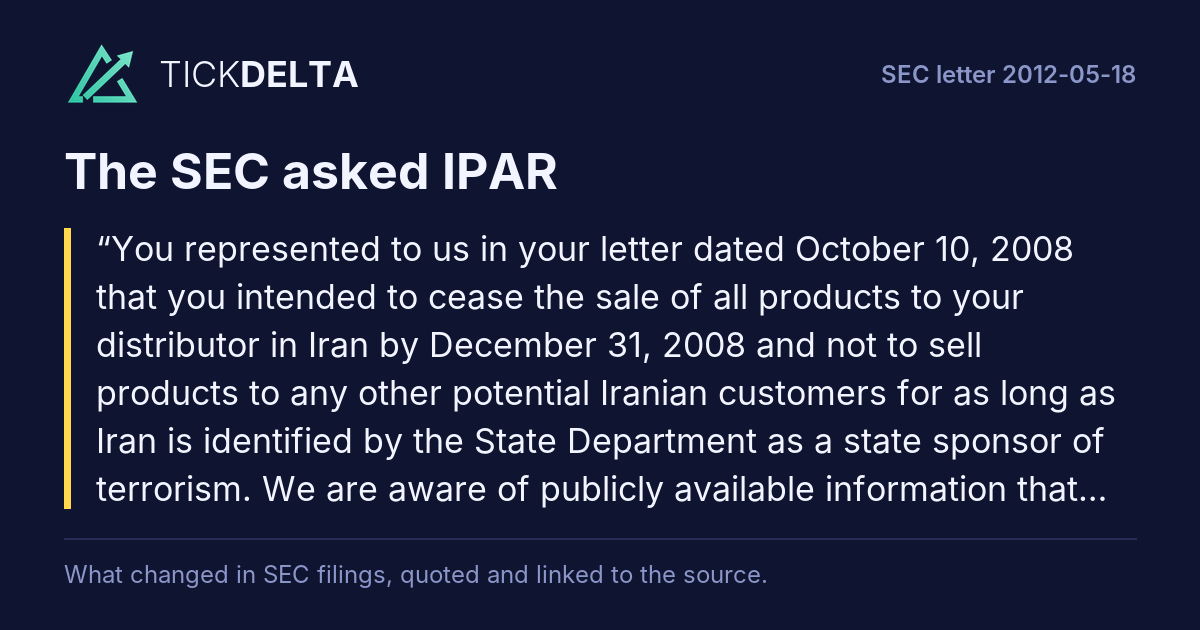
You represented to us in your letter dated October 10, 2008 that you intended to cease the sale of all products to your distributor in Iran by December 31, 2008 and not to sell products to any other potential Iranian customers for as long as Iran is identified by the State Department as a state sponsor of terrorism.
Rest of the question

We are aware of publicly available information that your Lanvin fragrances were available in the Iranian retail market in at least 2009 and 2010. In addition, we note that in Exhibit 10.148 to your Form 10-Q for the quarterly period ended June 30, 2011, filed August 9, 2011, pursuant to a license agreement executed in 2011, Anna Sui Corp. granted you the right to use certain licensed marks for Iran and Syria transferred or licensed from Procter & Gamble. Iran and Syria are designated by the State De partment as state sponsors of terrorism, and are subject to U.S. economic sanctions and export controls. Your Form 10-K does not include disclosure pertaining to business with Iran and Syria. Please describe to us the nature and extent of your past, current, and anticipated contacts with Iran and Syria, if any, whether through subsidiaries, distributors, or other direct or indirect arrangements, since your referenced letter. Your response should describe any products or materials you have provided directly or indirectly into Iran and Syria, and any agreements, arrangements, or other contacts you have had, directly or indirectly, with the governments of those countries and entities those governments own or control.

IPAR answered
United States Operations does not sell any products or provide any services to Iran, directly or indirectly through one or more intermediaries. Further, neither United States

Operations nor European Operations export any United States products to Iran, directly or indirectly through one or more intermediaries.

Further still, neither United States Operations nor European Operations have any arrangement, agreement, understanding or contact with the Iranian government, or to the best of our knowledge, any entities controlled by the Iranian government.
Rest of the answer

Accordingly, the

Company believes it is acting in good faith and not violating any United States regulations imposing economic sanctions or export controls relating to Iran.

Page 2 of 4 Pages

We confirm to you that Interparfums SA ceased selling and distributing prestige fragrances to its former distributor in Iran, Farkish Co. (“Farkish”) by December

31, 2008. Farkish was at no time an affiliate of the Company. Since such time, Interparfums SA has not sold any products into Iran, or sold products to a third party outside of Iran with the intent of redistributing or re-exporting them into Iran.

It should be noted that Interparfums SA has distribution agreements and relationships with several distributors in other Middle Eastern countries, none of which have any right to export any products of Interparfums SA into Iran. That being said, gray market goods, i.e., officially authorized or licensed products exported or diverted by third party distributors, wholesalers or jobbers into non-authorized jurisdictions is and has been quite common in the fragrance and cosmetic industry. Interparfums SA has no actual knowledge of such third parties selling products into Iran, but surmises it is a gray goods issue. Once Interparfums SA sells to either (i) authorized distributors, which in turn sell only to authorized retailers, or (ii) authorized retailers directly, Interparfums SA has little or no control over subsequent sales or transfers of such products, which are already in the stream of commerce to an estimated 25,000 points of sale for prestige fragrances.

In addition, the staff comment above relates to Lanvin fragrances found publicly available in Iran in 2009 and 2010. As Interparfums SA ceased selling Farkish by December 31,

2008, then it is quite possible that Farkish did not complete the resale of its inventory at such times. However, as Interparfums

SA has no further dealings with Farkish, Interparfums SA has no information to confirm this supposition.

With respect to Syria, we advise you that neither United States Operations nor European Operations have any arrangement, agreement, understanding or contact with the Syrian government, or to the best of our knowledge, any entities controlled by the Syrian government.

During the years ended December 31, 2010 and 2011, Interparfums SA did make insignificant amounts of sales of prestige fragrances into Syria, $143,716 and $9,604, respectively.

In addition, for the 4 month period ended April 30, 2012, sales by Interparfums SA into Syria were $14,236. Sales were made to a distributor, a subsidiary of the Chalhoub Group, a well-known distributor of luxury goods in the Middle East. No sales were made by Interparfums SA into Syria in 2009. The Company reported consolidated net sales of $460.4 million and $615.2 million for the years ended December 31, 2010 and 2011, respectively. As the amount of sales into Syria were so insignificant when compared to the Company’s net sales, approximately 0.03% in 2010 and less than 0.0016% in 2011, no disclosure relating to such sales was made in the Company’s 2010 or 2011 Annual Report on Form 10-K. However, Interparfums SA intends to cease selling products into Syria by May 31, 2012, and will no longer sell products into Syria for as long as Syria is identified by the State Department as state sponsors of terrorism or until applicable United States regulations permit such sales.

Anna Sui

Neither our United States Operations nor our European Operations has sold any Anna Sui products into Iran or Syria, directly or indirectly through any third parties, whether affiliated or not. Further, our United States Operations and our European Operations will not sell any Anna Sui products into Iran or Syria, directly or indirectly through any third parties, for as long as Iran and Syria are identified by the State Department

Page 3 of 4 Pages

In connection with the license agreement for Anna Sui brand fragrances entered into in 2011 and effective January 2012, the Company acquired the exclusive world-wide rights to exploit the Anna Sui brand for fragrances. Although the Company acquired the license to use all Anna Sui trademarks for fragrances in Iran and Syria, the Company acquired them as part of the license for all Anna Sui trademarks for fragrances throughout the entire world. The Company has no intention of selling any Anna Sui products into Iran or Syria, directly or indirectly through any third parties, for as long as Iran and Syria are identified by the State Department as state sponsors of terrorism or until applicable

United States regulations permit such sales. The Company’s exclusive license for all Anna Sui trademarks in the fragrance category, including those in Iran and Syria, prevents any pretext of any third party fragrance licensee competing with the Company, but it does not require sales of Anna Sui fragrances into Iran or Syria by the Company.

As requested, we acknowledge the following:

● The Company is responsible for the adequacy and accuracy of the disclosure in its filings;

● The staff comments or changes to disclosure in response to staff comments do not foreclose the Commission from taking any action with respect to the filings; and

● The Company may not assert staff comments as a defense in any proceeding initiated by the Commission or any person under the federal securities laws of the United States.

I trust that this adequately addresses your questions. However, if further information is required, please feel free to contact the undersigned.
Read in the reply

Also in this review: closing letter, 2012-06-12

Form 10-K for the Fiscal Year ended December 31, 2009

2010-11-09 to 2010-12-16 · 14 questions · 2 letters from the SEC, 2 from the company
Review closed 2010-12-16
Liquidity and cashDebtAcquisitionsLeasesDerivatives and hedging
FORM 10-K FOR THE YEAR ENDED DECEMBER 31, 2009 · General
SEC asked (1)
Where a comment below requests additional disclosures or other revisions to be made, please show us in your supplemental response what the revisions will look like. These revisions should be included in your future filings.
IPAR answered
1. Below are our responses to the comments set forth in the Staff Letter, which provide the requested information, and we acknowledge that all revisions will be included in future filings.

Item 6 — Management's

Discussion and Analysis of Financial Condition and Results of Operations, page

Contractual Obligations,
Read in the reply
Operations, page 32 · Contractual Obligations, page 47
SEC asked (2)
Please revise your table of contractual obligations to clarify whether the interest due amounts are included or excluded from the long-term debt line item and address the payments you are obligated to make under your interest rate swap agreement. If you have already included the interest rate swap amounts in the interest due amounts in footnote (2), please revise your disclosure to clarify this.
Rest of the question

Please also disclose any assumptions used to derive estimated interest payments and estimated payments under interest rate swaps.

IPAR answered
2. The interest due amounts which include the interest rate swap amounts will be included in long-term debt on the contractual obligations table. The interest rate swap exchanged a variable rate of interest for a fixed rate of interest. As all long-term debt now bears interest at a fixed rate, there are no assumptions used to derive interest payments. The disclosure in the footnote to the table relating to long term debt to be included in future filings will be in substantially the following form:

(2)

Includes long-term debt and related interest costs including interest rate swap amounts.
Rest of the answer

Interest due as the result of interest rate swaps is all at a fixed rate and is payable $0.70 million, $0.40 million and $0.07 million in 2010, 2011 and 2012, respectively.

Item 14 — Exhibits,

Read in the reply
In its next report

First report after the company's reply of Nov 23, 2010: 10-K filed Mar 8, 2011 ↗, against the 10-K filed Mar 10, 2010 ↗.

Tickdelta does not hold the text of both reports, so they are not compared here.

Consolidated Statements of Changes in Shareholders’ Equity and Comprehensive · Income, page F-5
SEC asked (3)
Please revise your presentation to separately disclose comprehensive income attributable to Inter Parfums, Inc. and comprehensive income attributable to noncontrolling interest. Refer to FASB ASC 220-10-45-5 and ASC 810-10-501A(a).
IPAR answered
3. In future filings we will add

Consolidated Statements of Comprehensive Income which will separately disclose comprehensive income attributable to Inter Parfums, Inc. and comprehensive income attributable to the noncontrolling interest. A pro forma such statement is attached hereto as Exhibit

A.
Read in the reply
In its next report

First report after the company's reply of Nov 23, 2010: 10-K filed Mar 8, 2011 ↗, against the 10-K filed Mar 10, 2010 ↗.

Tickdelta does not hold the text of both reports, so they are not compared here.

Consolidated Statements of Changes in Shareholders’ Equity and Comprehensive · Income, page F-5
SEC asked (4)
It is not clear why there is no foreign currency translation adjustment attributable to noncontrolling interest. Please tell us how you concluded your presentation was appropriate based on the guidance set forth in FASB ASC 220.
IPAR answered
4. When noncontrolling interest was moved into equity pursuant to ASC 810-10-45, our original thought was that assets and liabilities should be translated at the exchange rate at the balance sheet date pursuant to ASC 830-30-45-3a with 100% of the exchange gain or loss included in comprehensive income of the parent. Upon further review, we have determined that accumulated translation adjustments attributable to the noncontrolling interests should be allocated to and reported as part of the noncontrolling interest.
Rest of the answer

The reclassification which we deem to be immaterial only affects the 2009 period and will be reflected in future filings. A pro forma of the reclassified Consolidated Statements of Changes in Equity is attached hereto as Exhibit

B.

Read in the reply
In its next report

First report after the company's reply of Nov 23, 2010: 10-K filed Mar 8, 2011 ↗, against the 10-K filed Mar 10, 2010 ↗.

Tickdelta does not hold the text of both reports, so they are not compared here.

Consolidated Statements of Changes in Shareholders’ Equity and Comprehensive · Income, page F-5
SEC asked (5)
Please revise your presentation to clarify that the number of common shares column represents the number of common shares outstanding.
IPAR answered
5. In future filings we will add the word "outstanding" to the common stock heading of the Consolidated Statements of

Changes in Equity. A pro forma reflecting such change is attached hereto as

Exhibit B.
Read in the reply
In its next report

First report after the company's reply of Nov 23, 2010: 10-K filed Mar 8, 2011 ↗, against the 10-K filed Mar 10, 2010 ↗.

Tickdelta does not hold the text of both reports, so they are not compared here.

Consolidated Statements of Cash Flows, page F-6
SEC asked (6)
Please tell us how you determined that proceeds from the sale of stock of a subsidiary and the payment for acquisition of noncontrolling interests should be classified in the cash used in investing activities section instead of the cash provided by (used in) financing activities in circumstances when Inter Parfums maintains control of the subsidiary, since these transactions are accounted for as equity transactions.
Rest of the question

Refer to FASB ASC 230.

IPAR answered
6. In 2008 and 2007, we acquired a 3.6% and 1.2% interest, respectively, in Inter Parfums, S.A., our majority owned French subsidiary, from its minority shareholders for cash of approximately $18.5 million in 2008 and $6.3 million in 2007. The acquisition was accounted for under the purchase method.

In addition, in June 2007, the minority shareholders of Nickel S.A., a consolidated subsidiary of the Company, exercised their rights to sell their remaining 32.4% interest in Nickel S.A. to the

Company for approximately $4.7 million in cash.
Rest of the answer

The acquisition was also accounted for under the purchase method.

These tranactions occurred prior to the effective date of ASC topic 805-10-05 (formerly SFAS 141 (revised 2007),

“Business Combinations”). Since purchase accounting was used to record these transactions, it seemed reasonable to treat the acquisition as investing activities. In addition, with respect to the purchases of additional interest in

Inter Parfums, S.A., our majority owned French subsidiary, the purpose of these transactions were to fight the dilution from the sale of shares resulting from the exercise of stock options. Therefore, treating the sale of stock of subsidiary from stock option exercises as an investing activity also seemed appropriate.

However, currently ASC 805-10-05 is effective and additional noncontrolling interests acquired or sold are accounted for as equity transactions. Pursuant to ASC

230-10-45, it appears that these transactions are cash inflows from and outflows for financing transactions. Future filing will reflect these transactions as financing transactions and prior periods will be reclassified to conform to current period presentation. A pro forma of the Consolidated Statements of Cash

Flows is attached hereto as Exhibit C.

Read in the reply
In its next report

First report after the company's reply of Nov 23, 2010: 10-K filed Mar 8, 2011 ↗, against the 10-K filed Mar 10, 2010 ↗.

Tickdelta does not hold the text of both reports, so they are not compared here.

Note 9 – Commitments, page F-21 · Leases, page F-21
SEC asked (7)
Please disclose how you account for (a) step rent provisions and escalation clauses and (b) capital improvement funding and other lease concessions, which may be present in your leases. Lease payments that depend on an existing index or rate, such as the consumer price index or the prime interest rate, should also be included in your minimum lease payments.
Rest of the question

If, as we assume, they are taken into account in computing your minimum lease payments and the minimum lease payments are recognized on a straight-line basis over the minimum lease term, the note should so state. If our assumption is incorrect, please tell us how your accounting complies with FASB ASC 840.

IPAR answered
7. Rent expense is calculated on a straight-line basis taking into account step rent provisions and rent concessions, but excludes the amounts due for escalation clauses tied to an index or rate as they are not material. In addition, we do not have any material capital improvement fundings. The disclosure in note 9 (Commitments) to the

Consolidated Financial Statements relating to Leases to be included in future filings will be modified in substantially the following form:

Leases

The

Company leases its office and warehouse facilities under operating leases which are subject to various
Rest of the answer

step rent provisions, rent concessions and escalation clauses expiring at various dates through 2015. Escalation clauses are not material and have been excluded from minimum future annual rental payments.

Rental expense, which is calculated on a straight-line basis, amounted to $9.9 million, $9.9 million and $9.1 million in 2009, 2008 and 2007, respectively.

Minimum future annual rental payments are as follows: [table omitted].

Read in the reply
In its next report

First report after the company's reply of Nov 23, 2010: 10-K filed Mar 8, 2011 ↗, against the 10-K filed Mar 10, 2010 ↗.

Tickdelta does not hold the text of both reports, so they are not compared here.

FORM 10-Q FOR THE PERIOD ENDED JUNE 30, 2010
SEC asked (8)
Please address the above comments in your interim filings as well.
IPAR answered
8. To the extent any of our answers to the comments above affect our interim filings, we agree to make the appropriate modification in our subsequent interim filings.
Read in the reply
Item 1 – Financial Statements, page 1
SEC asked (9)
We note your presentation of comprehensive income on page 13. FASB ASC 220-10-45-8 requires a statement of comprehensive income that is displayed with the same prominence as your other financial statements. As such, please present your statement of comprehensive income within (1) your statements of income, (2) your statements of changes in equity, or (3) as a separate financial statement. Please revise accordingly.
IPAR answered
9. We agree to present

Consolidated Statements of Comprehensive Income as a separate financial statement in future interim filings for all periods presented. A pro forma of such statement is attached hereto as Exhibit D.

Consolidated Balance Sheets,
Read in the reply
In its next report

First report after the company's reply of Nov 23, 2010: 10-K filed Mar 8, 2011 ↗, against the 10-K filed Mar 10, 2010 ↗.

Tickdelta does not hold the text of both reports, so they are not compared here.

Consolidated Balance Sheets, page 2
SEC asked (10)
The column heading of your June 30, 2010 balance sheet indicates that these amounts are unaudited, which implies that your December 31, 2009 balance sheet includes amounts that are audited. Since none of the amounts are covered by an audit report when they are presented in your interim financial statements for the period ended June 30, 2010, you should not imply that the December 31, 2009 balance sheet amounts are
Rest of the question

audited. Please revise.

IPAR answered
10. In future interim filings we agree to remove the word "unaudited" from the consolidated balance sheets column heading for the current period, but will include the word

"unaudited" in the heading of the consolidated balance sheets so each of the consolidated balance sheets presented will be unaudited.

* * * *

As requested, we acknowledge the following:

· the company is responsible for the adequacy and accuracy of the disclosure in their filing;

staff comments or changes to disclosure in response to staff comments do not foreclose the Commission from taking any action with respect to
Rest of the answer

the filing; and company may not assert staff comments as a defense in any proceeding initiated by the Commission or any person under the federal securities laws of the United States.

I trust that this adequately addresses your questions. However, if further information is required, please feel free to contact the undersigned.

Read in the reply
In its next report

First report after the company's reply of Nov 23, 2010: 10-K filed Mar 8, 2011 ↗, against the 10-K filed Mar 10, 2010 ↗.

Tickdelta does not hold the text of both reports, so they are not compared here.

FORM 10-K FOR THE YEAR ENDED DECEMBER 31, 2009 · General
SEC asked (1)
Where a comment below requests additional disclosures or other revisions to be made, please show us in your supplemental response what the revisions will look like. These revisions should be included in your future filings.
IPAR answered
1. Below are our responses to the comments set forth in the Staff Letter, which provide the requested information, and we acknowledge that all revisions will be included in future filings.

Item 14 -- Exhibits,
Read in the reply
Consolidated Statements of Changes in Shareholders’ Equity and Comprehensive · Income, page F-5
SEC asked (2)
We have reviewed your response to prior comment 3 from our letter dated November 9, 2010. It appears that the amounts for derivatives and reclassification from OCI into earnings in the comprehensive income attributable to noncontrolling interests section in Exhibit A are reversed. Please revise or advise.
IPAR answered
2. You are correct, as the amounts for derivatives and reclassification from OCI into earnings in the comprehensive income attributable to noncontrolling interests section in Exhibit

A were reversed, and we regret the inadvertent error. The corrected pro forma statement is attached hereto as Exhibit

A.
Read in the reply
In its next report

First report after the company's reply of Dec 14, 2010: 10-K filed Mar 8, 2011 ↗, against the 10-K filed Mar 10, 2010 ↗.

Tickdelta does not hold the text of both reports, so they are not compared here.

Consolidated Statements of Changes in Shareholders’ Equity and Comprehensive · Income, page F-5
SEC asked (3)
We have reviewed your response to prior comment 4 from our letter dated November 9, 2010. With regards to this reclassification, please ensure that you provide the disclosures required by FASB ASC 250-10-50-7. Please also disclose the impact on accumulated other comprehensive income and the noncontrolling interest balance sheet line item.
IPAR answered
3. We will include a reclassification footnote to the financial statements in substantially the following form:

Reclassification:

For the year ended December 31, 2009, we reclassified $2.0 million of foreign currency translation adjustments originally included as an increase to comprehensive income of Inter Parfums, Inc., to the noncontrolling interest. There was no affect on the consolidated statements of income or per share amounts.
Rest of the answer

As of

December 31, 2009, the balance sheet effect of this reclassification is a decrease in accumulated other comprehensive income attributable to Inter

Parfums, Inc. and a corresponding increase in noncontrolling interest.

Read in the reply
In its next report

First report after the company's reply of Dec 14, 2010: 10-K filed Mar 8, 2011 ↗, against the 10-K filed Mar 10, 2010 ↗.

Tickdelta does not hold the text of both reports, so they are not compared here.

Consolidated Statements of Cash Flows, page F-6
SEC asked (4)
We have reviewed your response to prior comment 6 from our letter dated provide the disclosures required by FASB ASC 250-10-50-7.
IPAR answered
4. We

Certain prior year amounts in the accompanying consolidated statements of cash flows have been reclassified to conform to current period presentation. More specifically, proceeds from sale of stock of subsidiary and payments for acquisition of noncontrolling interests have been reclassified from net cash provided by (used in) investing activities to net cash provided by (used in) financing activities.

* * * *

As previously requested, we acknowledge the following:

● the company is responsible for the adequacy and accuracy of the disclosure in their filing;

● staff comments or
Rest of the answer

changes to disclosure in response to staff comments do not foreclose the Commission from taking any action with respect to the filing;

and

● the company may not assert staff comments as a defense in any proceeding initiated by the

Commission or any person under the federal securities laws of the United

States.

I trust that this adequately addresses your questions. However, if further information is required, please feel free to contact the undersigned.

Read in the reply
In its next report

First report after the company's reply of Dec 14, 2010: 10-K filed Mar 8, 2011 ↗, against the 10-K filed Mar 10, 2010 ↗.

Tickdelta does not hold the text of both reports, so they are not compared here.

Also in this review: closing letter, 2010-12-16

From the SEC's correspondence on EDGAR: staff letters (form UPLOAD) and company letters (form CORRESP), 22 letters filed since 2010-11-09. Questions and answers are matched by their numbers; topics come from words in each question. The reports are compared word for word (same form, before the first SEC letter against the first report after the company's reply). No AI.

Sources

The SEC's correspondence on EDGAR: staff letters (form UPLOAD) and company letters (form CORRESP), matched question by question. No AI.

Also

Filings: the letters in the filing list.

Work with it

Excel workbook · CSV. Google Sheet that stays up to date: paste =IMPORTDATA("https://tickdelta.com/company/IPAR/export.csv") into a cell.

Next in Owners and insiders:Insider trades
Esc

Type a ticker such as AAPL, a name, an investor such as Buffett, or a topic such as tariffs. ↑ ↓ to move, Enter to open.