Paragraph 57 · 50% changed
Every version of it
Screener
/
SEC EDGAR
/CIK 0001388658
/10-K filed Feb 19, 2026, compared with Feb 20, 2025
/Numbers from the XBRL of the 10-Ks
Nasdaq
Health care · Medical Instruments
iRhythm Holdings, Inc. IRTC
The 10-K against last year's
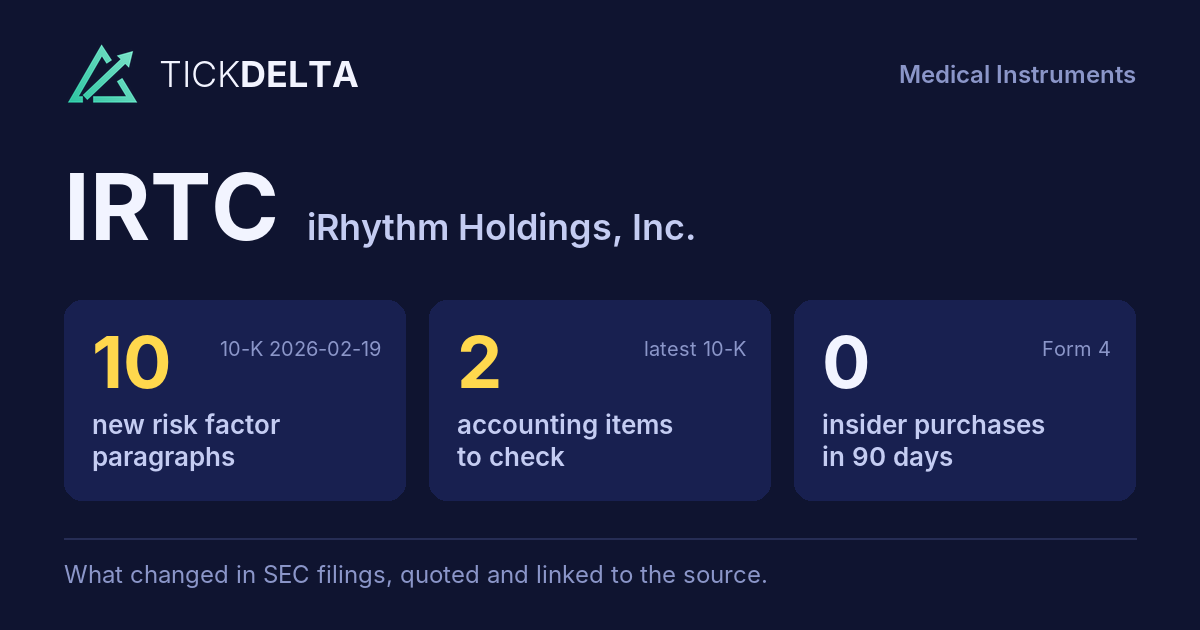
165 changes: 18 added, 8 removed, 134 reworded, 5 quiet changes
10-K Feb 19, 2026 vs Feb 20, 2025
Risk Factors
10.6%
of the text changed · 29,184 words now · 10 new paragraphs, 6 gone
MD&A
22.0%
of the text changed · 8,041 words now · 8 new paragraphs, 2 gone
Legal Proceedings
39.0%
of the text changed · 1,289 words now
Accounting Policies
13.0%
of the text changed · 5,972 words now
10-K 0001388658-26-000011 (Feb 19, 2026) vs 10-K 0001388658-25-000028 (Feb 20, 2025)
Every paragraph, and how much of it changed
One bar per paragraph, in the order of the 10-K. Height and colour show the share of its words not in the closest paragraph a year earlier; the tallest bars are new paragraphs.
Risk Factors
311 paragraphs · 10 new · 157 reworded · 6 gone · 10-K Feb 19, 2026 against Feb 20, 2025
New paragraph
Reworded (5% of its words or more)
Same or nearly
Paragraph 164 · 49% changed
Every version of it
Any policy changes as a result of the new current presidential administration and Congress could significantly affect our business as well as the markets in which we operate. Specific legislative and regulatory proposals discussed during election campaigns and more recently since inauguration that might materially impact our business include, but are not limited to, promoting access to healthcare via market competition and pricing transparency, enhancing flexibility and choice in healthcare at the state and individual level, prioritizing domestic production and increasing tariffs on imports (which may complicate and increase costs associated with our supply chain), chain and rolling back regulatory initiatives adopted under the previous administration. We cannot predict whether industry initiatives to seek tariff carve-outs for devices or other life sciences goods and products will be successful. Additionally, the new administration is expected to evaluate potential budgetary cuts and reallocation of regulatory priorities by key federal agencies that oversee our products, services, and associated reimbursement, including FDA and the U.S. Department of Health and Human Services more broadly. The new administration also has issued, and is expected to continue relying upon, executive orders to address a wide range of policy areas, some of which may impact our business. Examples of executive orders that have already been issued on public health and healthcare topics include orders seeking to withdraw the United States from the World Health Organization, rescind a 2022 order issued under the prior administration to lower the cost of prescription drugs, and address COVID-19 vaccination requirements. Such political developments may require us to allocate significant time, resources, and expense to modifying our policies and procedures, processes, systems, and practices to ensure compliance or adapt to the new regulatory climate, particularly to the extent such actions are subject to protracted and uncertain legal challenges. To the extent changes in the political environment have a negative impact on us or on our markets, our business, results of operation, and financial condition could be materially and adversely affected in the future. international
Paragraph 258 · 48% changed
Every version of it
Foreign data protection, privacy, and related laws and regulations can be more restrictive than those in the United States. For example, data localization laws in some countries generally mandate that certain types of data collected in a particular country be stored and/or processed solely within that country. Other foreign laws, such as the GDPR, GDPR and Swiss data protection laws, impose strict requirements for processing and cross-border transfers of personal data. data outside of the EU, UK or Switzerland to a “third country,” including the United States, unless particular compliance mechanisms are implemented. The mechanisms that we and many other companies rely upon for such data transfers (for example, standard contractual clauses or the EU-U.S. and Swiss-U.S. Data Privacy Framework (“DPF”) and the UK extension to the DPF) are the subject of legal challenge, regulatory interpretation, and judicial decisions. While we maintain EU-U.S., Swiss-U.S. and UK-U.S. DPF certifications, we still rely on the standard contractual clauses for intercompany data transfers from the EU, Switzerland, and the UK to the United States in certain situations. As supervisory authorities continue to issue further guidance on personal data, we could suffer additional costs, complaints, or regulatory investigations or fines, and if we are otherwise unable to transfer personal data between and among countries and regions in which we operate, it could affect the manner in which we provide our services, the geographical location or segregation of our relevant systems and operations and could adversely affect our financial results.
Paragraph 17 · 46% changed
Every version of it
The CPT codes used to report remote cardiac monitoring services, including those used to report our Zio iRhythm Services, were drafted by the American Medical Association (“AMA”) AMA in a manufacturer- and specific technology-agnostic manner. Regulators or other third parties Regulators’ evolving understandings and definitions of certain cardiac monitoring modalities could assert result in assertions that our technology does not support certain diagnostic procedures described by the CPT codes that we currently use to report our Zio iRhythm Services. For example, although FDA “Product Codes” are created and assigned by FDA to support the agency’s responsibility for regulating medical devices in the framework of device classifications designated under 21 C.F.R. Parts 862-892, Product Codes have the potential to raise questions about expectations for devices. In November 2023, FDA established a new Product Code QYX for “Outpatient Cardiac Telemetry” and retrospectively assigned Product Code QYX to several devices, including Zio AT. FDA’s “Definition” of the “Outpatient Cardiac Telemetry” devices within this Product Code references monitoring data being “transmitted to the prescribing clinician during the monitoring period by a 24/7 attended analysis center after review by a qualified individual,” which may be read as incorporating activities of an IDTF into the device. If our IDTF capabilities and performance do not align with FDA’s interpretation and expectations for Product Code QYX, a regulator or other third party could assert that the Zio AT System cannot support MCT services, which services. Any such assertion could jeopardize our ability to obtain clearances with indications and labeling that provide for the scope we planned, and our ability to submit claims for reimbursement for services utilizing our Zio AT System and may require us to evaluate whether we have received any overpayments that must be reported and returned to third-party payors. Certain language in a warning letter we received from FDA on May 25, 2023 could increase the risk of inquiries regarding our historical or current use of CPT code 93229. Consistent with the AMA’s definition of MCT and the technology categorization in FDA’s outpatient cardiac telemetry product code, the Zio AT device is intended to capture and transmit symptomatic and asymptomatic cardiac events and record continuous ECG data for long-term monitoring on adult patients who may be asymptomatic or who may suffer from transient symptoms (e.g., palpitations, shortness of breath, dizziness, light-headedness, pre-syncope, syncope, fatigue, or anxiety), with escalation to the patient’s treating healthcare professional, consistent with the healthcare professional’s prescribed notification criteria, during the monitoring period.
Paragraph 166 · 42% changed
Every version of it
Paragraph 229 · 41% changed
Every version of it
Paragraph 220 · 40% changed
Every version of it
For example, in 2017, the U.S. government enacted under the TCJA, which made significant changes to as amended by the taxation of business entities, including legislation commonly known as the requirement One Big Beautiful Bill Act (“OBBBA”), for tax years beginning after December 31, 2021, taxpayers are required to capitalize and amortize certain research and development expenditures over fifteen years if incurred in foreign jurisdictions. For tax years beginning after December 31, 2021, and beginning on or before December 31, 2024, taxpayers generally were required to capitalize and amortize such certain research and development expenditures over five years for domestic if incurred in the United States; however, beginning after that period, the OBBBA restored immediate deductibility of research and development expenditures and fifteen years for foreign expenditures for taxable years beginning on or after January 1, 2022. While it is possible that Congress may modify or repeal this provision, we have no assurance that this provision will be modified or repealed and even if Congress makes any such decision, it may not be retroactive, and could still therefore result incurred in an impact on cash from operating activities and on the balance of our deferred taxes. United States. In addition, we have a presence in the UK, as well as sales in the UK, such that any changes in tax laws in the UK will impact our business. The overall impact of these changes is uncertain, and our business and financial condition could be adversely affected.
Paragraph 11 · 39% changed
Every version of it
Finally, government and commercial payors have and may, in the future, consider healthcare policies and proposals intended to limit or reduce perceived increases in healthcare costs, including those that could significantly affect reimbursement for healthcare products such as our systems and services. These policies have included, and may in the future include: basing reimbursement policies and rates on clinical outcomes, the comparative effectiveness, and costs, of different treatment technologies and services, changes in risk adjustment weights or the criteria required to support risk adjustment eligible diagnoses in Medicare Advantage, as well as other measures. For example, from time to time CMS or Medicare Administrative Contractors may develop National Coverage Determinations, Local Coverage Determinations (“LCDs”), or similar policies dictating the conditions for coverage and reimbursement of our iRhythm Services. For instance, in September 2025, Noridian Healthcare Solutions, LLC, Palmetto GBA, LLC, and CGS Administrators, LLC each published proposed LCDs regarding “Temporary Nontherapeutic Ambulatory Cardiac Monitoring Devices.” These proposed LCDs seek to outline the circumstances in which ambulatory cardiac monitoring is considered reasonable and necessary for Medicare purposes, device requirements, and associated coverage limitations. The proposed LCDs were subject to a public comment period that concluded in November 2025, in which iRhythm and other stakeholders had the opportunity to inform consideration of whether, and in what form, the LCDs might be adopted. The adoption of the proposed LCDs, or any other developments in the Medicare coverage policies on which the industry has come to rely, could necessitate changes to our business model, methods of operation, billing processes, and related compliance controls. Future significant changes in the healthcare systems in the United States or elsewhere could also have a negative impact on the demand for our current and future products and services. These include changes that may limit coverage or reduce reimbursement rates for our products and changes that may be proposed or implemented by the current or future laws or regulations.
Paragraph 57 · 50% changed
Every version of it
10-K Feb 20, 2025We cannot give any assurances that FDA will be satisfied with our response, the actions taken to resolve the concerns raised in the warning letter or the more recent 483 observations, or the expected date for the resolution of such matters. Until these issues are resolved to FDA’s satisfaction, additional legal or regulatory action may be taken with or without further notice. The warning letter and the 483 observations are publicly available on FDA’s website and have been the subject of a high degree of media and industry attention, which subjects us to additional scrutiny.
10-K Feb 19, 2026
publicly available on FDA’s website and have been the subject of a high degree of media and industry attention, which subjects us to additional scrutiny.
Paragraph 164 · 49% changed
Every version of it
10-K Feb 20, 2025
Any policy changes as a result of the new presidential administration and Congress could significantly affect our business as well as the markets in which we operate. Specific legislative and regulatory proposals discussed during election campaigns and more recently that might materially impact our business include, but are not limited to, promoting access to healthcare via market competition and pricing transparency, enhancing flexibility and choice in healthcare at the state and individual level, prioritizing domestic production and increasing tariffs on imports (which may complicate and increase costs associated with our supply chain), and rolling back regulatory initiatives adopted under the previous administration. We cannot predict whether industry initiatives to seek tariff carve-outs for devices or other life sciences goods and products will be successful. Additionally, the new administration is expected to evaluate potential budgetary cuts and reallocation of regulatory priorities by key federal agencies that oversee our products, services, and associated reimbursement, including FDA and the U.S. Department of Health and Human Services more broadly. The new administration also has issued, and is expected to continue relying upon, executive orders to address a wide range of policy areas, some of which may impact our business. Examples of executive orders that have already been issued on public health and healthcare topics include orders seeking to withdraw the United States from the World Health Organization, rescind a 2022 order issued under the prior administration to lower the cost of prescription drugs, and address COVID-19 vaccination requirements. Such political developments may require us to allocate significant time, resources, and expense to modifying our policies and procedures, processes, systems, and practices to ensure compliance or adapt to the new regulatory climate, particularly to the extent such actions are subject to protracted and uncertain legal challenges. To the extent changes in the political environment have a negative impact on us or on our markets, our business, results of operation, and financial condition could be materially and adversely affected in the future.
10-K Feb 19, 2026
Any policy changes as a result of the current presidential administration and Congress could significantly affect our business as well as the markets in which we operate. Specific legislative and regulatory proposals discussed during election campaigns and since inauguration that might materially impact our business include, but are not limited to, promoting access to healthcare via market competition and pricing transparency, enhancing flexibility and choice in healthcare at the state and individual level, prioritizing domestic production and increasing tariffs on imports (which may complicate and increase costs associated with our supply chain and our international
Paragraph 258 · 48% changed
Every version of it
10-K Feb 20, 2025
Foreign data protection, privacy, and related laws and regulations can be more restrictive than those in the United States. For example, data localization laws in some countries generally mandate that certain types of data collected in a particular country be stored and/or processed solely within that country. Other foreign laws, such as the GDPR, impose strict requirements for processing and cross-border transfers of personal data.
10-K Feb 19, 2026
Foreign data protection, privacy, and related laws and regulations can be more restrictive than those in the United States. For example, data localization laws in some countries generally mandate that certain types of data collected in a particular country be stored and/or processed solely within that country. Other foreign laws, such as the GDPR and Swiss data protection laws, impose strict requirements for processing and cross-border transfers of personal data outside of the EU, UK or Switzerland to a “third country,” including the United States, unless particular compliance mechanisms are implemented. The mechanisms that we and many other companies rely upon for such data transfers (for example, standard contractual clauses or the EU-U.S. and Swiss-U.S. Data Privacy Framework (“DPF”) and the UK extension to the DPF) are the subject of legal challenge, regulatory interpretation, and judicial decisions. While we maintain EU-U.S., Swiss-U.S. and UK-U.S. DPF certifications, we still rely on the standard contractual clauses for intercompany data transfers from the EU, Switzerland, and the UK to the United States in certain situations. As supervisory authorities continue to issue further guidance on personal data, we could suffer additional costs, complaints, or regulatory investigations or fines, and if we are otherwise unable to transfer personal data between and among countries and regions in which we operate, it could affect the manner in which we provide our services, the geographical location or segregation of our relevant systems and operations and could adversely affect our financial results.
Paragraph 17 · 46% changed
Every version of it
10-K Feb 20, 2025
The CPT codes used to report remote cardiac monitoring services, including those used to report our Zio Services, were drafted by the American Medical Association (“AMA”) in a manufacturer- and specific technology-agnostic manner. Regulators or other third parties could assert that our technology does not support certain diagnostic procedures described by the CPT codes that we currently use to report our Zio Services. For example, a regulator or other third party could assert that the Zio AT System cannot support MCT services, which could jeopardize our ability to submit claims for reimbursement for services utilizing our Zio AT System and may require us to evaluate whether we have received any overpayments that must be reported and returned to third-party payors. Certain language in a warning letter we received from FDA on May 25, 2023 could increase the risk of inquiries regarding our historical or current use of CPT code 93229. Consistent with the AMA’s definition of MCT and the technology categorization in FDA’s outpatient cardiac telemetry product code, the Zio AT device is intended to capture and transmit symptomatic and asymptomatic cardiac events and record continuous ECG data for long-term monitoring on adult patients who may be asymptomatic or who may suffer from transient symptoms (e.g., palpitations, shortness of breath, dizziness, light-headedness, pre-syncope, syncope, fatigue, or anxiety), with escalation to the patient’s treating healthcare professional, consistent with the healthcare professional’s prescribed notification criteria, during the monitoring period.
10-K Feb 19, 2026
The CPT codes used to report remote cardiac monitoring services, including those used to report our iRhythm Services, were drafted by the AMA in a manufacturer- and specific technology-agnostic manner. Regulators’ evolving understandings and definitions of certain cardiac monitoring modalities could result in assertions that our technology does not support certain diagnostic procedures described by the CPT codes that we currently use to report our iRhythm Services. For example, although FDA “Product Codes” are created and assigned by FDA to support the agency’s responsibility for regulating medical devices in the framework of device classifications designated under 21 C.F.R. Parts 862-892, Product Codes have the potential to raise questions about expectations for devices. In November 2023, FDA established a new Product Code QYX for “Outpatient Cardiac Telemetry” and retrospectively assigned Product Code QYX to several devices, including Zio AT. FDA’s “Definition” of the “Outpatient Cardiac Telemetry” devices within this Product Code references monitoring data being “transmitted to the prescribing clinician during the monitoring period by a 24/7 attended analysis center after review by a qualified individual,” which may be read as incorporating activities of an IDTF into the device. If our IDTF capabilities and performance do not align with FDA’s interpretation and expectations for Product Code QYX, a regulator or other third party could assert that the Zio AT cannot support MCT services. Any such assertion could jeopardize our ability to obtain clearances with indications and labeling that provide for the scope we planned, and our ability to submit claims for reimbursement for services utilizing Zio AT and may require us to evaluate whether we have received any overpayments that must be reported and returned to third-party payors.
Paragraph 166 · 42% changed
Every version of it
10-K Feb 20, 2025Any policy changes as a result of the new presidential administration and Congress could significantly affect our business as well as the markets in which we operate. Specific legislative and regulatory proposals discussed during election campaigns and more recently that might materially impact our business include, but are not limited to, promoting access to healthcare via market competition and pricing transparency, enhancing flexibility and choice in healthcare at the state and individual level, prioritizing domestic production and increasing tariffs on imports (which may complicate and increase costs associated with our supply chain), and rolling back regulatory initiatives adopted under the previous administration. We cannot predict whether industry initiatives to seek tariff carve-outs for devices or other life sciences goods and products will be successful. Additionally, the new administration is expected to evaluate potential budgetary cuts and reallocation of regulatory priorities by key federal agencies that oversee our products, services, and associated reimbursement, including FDA and the U.S. Department of Health and Human Services more broadly. The new administration also has issued, and is expected to continue relying upon, executive orders to address a wide range of policy areas, some of which may impact our business. Examples of executive orders that have already been issued on public health and healthcare topics include orders seeking to withdraw the United States from the World Health Organization, rescind a 2022 order issued under the prior administration to lower the cost of prescription drugs, and address COVID-19 vaccination requirements. Such political developments may require us to allocate significant time, resources, and expense to modifying our policies and procedures, processes, systems, and practices to ensure compliance or adapt to the new regulatory climate, particularly to the extent such actions are subject to protracted and uncertain legal challenges. To the extent changes in the political environment have a negative impact on us or on our markets, our business, results of operation, and financial condition could be materially and adversely affected in the future.
10-K Feb 19, 2026
Some of these legislative and regulatory proposals have manifested to date in the form of specific tariff proposals, and actions to reduce the size of the federal government, including large-scale reductions in force at FDA. The loss of key personnel at FDA, including those in leadership positions, is likely to impact the operations at FDA, which could result in, among other things, delays or limitations on our ability to obtain guidance from FDA on our products, longer review times, and delays in obtaining regulatory approvals. The escalating global economic competition and trade tensions among the U.S. and its trading partners could have an adverse effect on our business, results of operations, financial condition and cash flows, and there is risk of additional tariffs and other kinds of restrictions. The current administration also has issued, and is expected to continue relying upon, executive orders to address a wide range of policy areas, some of which may impact our business. Examples of executive orders that have already been issued on public health and healthcare topics include orders seeking to promote healthcare price transparency, deliver most-favored-nation pricing for prescription drugs to patients and facilitate direct-to-consumer drug sales, promote domestic production of pharmaceutical products, and expand access to in vitro fertilization. Such political developments may require us to allocate significant time, resources, and expense to modifying our policies and procedures, processes, systems, and practices to ensure compliance or adapt to the new regulatory climate, particularly to the extent such actions are subject to protracted and uncertain legal challenges. To the extent changes in the political environment have a negative impact on us or on our markets, our business, results of operation, and financial condition could be materially and adversely affected in the future.
Paragraph 229 · 41% changed
Every version of it
10-K Feb 20, 2025Any infringement or misappropriation claim could cause us to incur significant costs, place significant strain on our financial resources, divert management’s attention from our business, and harm our reputation. In addition, if the relevant patents are upheld as valid and enforceable and we are found to infringe such patents, we could be prohibited from using any portion of our Zio Services, including our Zio Systems, that is found to infringe such patent unless we could obtain licenses to use the technology covered by the patent or are able to design around the patent. We may be unable to obtain a license on terms acceptable to us, if at all, and we may not be able to redesign our Zio Services, including our Zio Systems, to avoid infringement. We may be unable to maintain or renew licenses on terms acceptable to us, if at all, and we may be prohibited from selling any portion of our Zio Services, including our Zio Systems, that required the technology covered by the relevant licensed patents. Although patent and intellectual property disputes in the healthcare and medical devices area have often been settled through licensing or similar arrangements, costs associated with such arrangements may be substantial and would likely include ongoing royalties. Even if we are able to redesign our Zio Services, including our Zio Systems, to avoid an infringement claim, we may not receive FDA approval for such changes in a timely manner or at all.
10-K Feb 19, 2026
area have often been settled through licensing or similar arrangements, costs associated with such arrangements may be substantial and would likely include ongoing royalties. Even if we are able to redesign our iRhythm Services, including our iRhythm ACM Systems, to avoid an infringement claim, we may not receive FDA approval for such changes in a timely manner or at all.
Paragraph 220 · 40% changed
Every version of it
10-K Feb 20, 2025
For example, in 2017, the U.S. government enacted the TCJA, which made significant changes to the taxation of business entities, including the requirement to capitalize research and development expenditures and amortize such expenditures over five years for domestic expenditures and fifteen years for foreign expenditures for taxable years beginning on or after January 1, 2022. While it is possible that Congress may modify or repeal this provision, we have no assurance that this provision will be modified or repealed and even if Congress makes any such decision, it may not be retroactive, and could still therefore result in an impact on cash from operating activities and on the balance of our deferred taxes. In addition, we have a presence in the UK, as well as sales in the UK, such that any changes in tax laws in the UK will impact our business. The overall impact of these changes is uncertain, and our business and financial condition could be adversely affected.
10-K Feb 19, 2026
For example, under the TCJA, as amended by the legislation commonly known as the One Big Beautiful Bill Act (“OBBBA”), for tax years beginning after December 31, 2021, taxpayers are required to capitalize and amortize certain research and development expenditures over fifteen years if incurred in foreign jurisdictions. For tax years beginning after December 31, 2021, and beginning on or before December 31, 2024, taxpayers generally were required to capitalize and amortize certain research and development expenditures over five years if incurred in the United States; however, beginning after that period, the OBBBA restored immediate deductibility of research and development expenditures incurred in the United States. In addition, we have a presence in the UK, as well as sales in the UK, such that any changes in tax laws in the UK will impact our business. The overall impact of these changes is uncertain, and our business and financial condition could be adversely affected.
Paragraph 11 · 39% changed
Every version of it
10-K Feb 20, 2025
Finally, government and commercial payors have and may, in the future, consider healthcare policies and proposals intended to limit or reduce perceived increases in healthcare costs, including those that could significantly affect reimbursement for healthcare products such as our systems and services. These policies have included, and may in the future include: basing reimbursement policies and rates on clinical outcomes, the comparative effectiveness, and costs, of different treatment technologies and services, as well as other measures. Future significant changes in the healthcare systems in the United States or elsewhere could also have a negative impact on the demand for our current and future products and services. These include changes that may reduce reimbursement rates for our products and changes that may be proposed or implemented by the current or future laws or regulations.
10-K Feb 19, 2026
Finally, government and commercial payors have and may, in the future, consider healthcare policies and proposals intended to limit or reduce perceived increases in healthcare costs, including those that could significantly affect reimbursement for healthcare products such as our systems and services. These policies have included, and may in the future include: basing reimbursement policies and rates on clinical outcomes, the comparative effectiveness, and costs, of different treatment technologies and services, changes in risk adjustment weights or the criteria required to support risk adjustment eligible diagnoses in Medicare Advantage, as well as other measures. For example, from time to time CMS or Medicare Administrative Contractors may develop National Coverage Determinations, Local Coverage Determinations (“LCDs”), or similar policies dictating the conditions for coverage and reimbursement of our iRhythm Services. For instance, in September 2025, Noridian Healthcare Solutions, LLC, Palmetto GBA, LLC, and CGS Administrators, LLC each published proposed LCDs regarding “Temporary Nontherapeutic Ambulatory Cardiac Monitoring Devices.” These proposed LCDs seek to outline the circumstances in which ambulatory cardiac monitoring is considered reasonable and necessary for Medicare purposes, device requirements, and associated coverage limitations. The proposed LCDs were subject to a public comment period that concluded in November 2025, in which iRhythm and other stakeholders had the opportunity to inform consideration of whether, and in what form, the LCDs might be adopted. The adoption of the proposed LCDs, or any other developments in the Medicare coverage policies on which the industry has come to rely, could necessitate changes to our business model, methods of operation, billing processes, and related compliance controls. Future significant changes in the healthcare systems in the United States or elsewhere could also have a negative impact on the demand for our current and future products and services. These include changes that may limit coverage or reduce reimbursement rates for our products and changes that may be proposed or implemented by the current or future laws or regulations.
MD&A
98 paragraphs · 8 new · 48 reworded · 2 gone · 10-K Feb 19, 2026 against Feb 20, 2025
New paragraph
Reworded (5% of its words or more)
Same or nearly
Paragraph 43 · 48% changed
Paragraph 33 · 47% changed
Revenue increased by $99.2 $155.3 million, or 20%, 26%, to $747.1 million during the year ended December 31, 2025, as compared to $591.8 million during the year ended December 31, 2024, as compared to $492.7 million during the year ended December 31, 2023. 2024. The increase in revenue was primarily attributable to increases in the volume of Zio iRhythm Services resulting from increased demand. Average We have experienced higher volumes from larger healthcare enterprise accounts which utilize both Zio monitor and Zio AT. Additionally, during the year ended December 31, 2025, Zio AT as a proportion of our total revenue volume grew significantly compared to the prior year primarily as a result of new customer account growth. Offsetting the revenue growth from volume and product mix were higher contractual allowance reserves recognized during the year ended December 31, 2025, as compared to the year ended December 31, 2024, resulting from higher payer claims denials from revenue growth associated with our contracted third-party payors and CMS. Overall average selling price remained relatively stable period over period. slightly increased for the year ended December 31, 2025, as compared to the prior year.
Paragraph 47 · 46% changed
Paragraph 51 · 45% changed
During the year ended December 31, 2024, 2025, cash provided by operating activities was $3.4 $80.9 million, as compared to $50.1 $3.4 million cash used in provided by operating activities during the year ended December 31, 2023. 2024. Cash provided by operating activities increased by $53.5 million $77.5 million, primarily attributable due to a reduction reductions in our net loss from operations, favorable impacts from decreases driven by our revenue growth, timing of cash collections associated with our accounts receivable, and timing of accruals and payments associated with our accrued compensation and third-party vendor expenditures within our accrued liabilities. These increases in cash provided by operating activities were offset by increases to inventory and prepaid expenses and other current assets, supporting growth in our operations and favorable impacts from a reduction in other long-term assets, primarily from lower levels of purchases of PCBAs. securing additional inventory stock.
Paragraph 38 · 39% changed
Impairment and restructuring expenses decreased increased by $10.4 $3.8 million, or 94%, 595%, to $4.5 million during the year ended December 31, 2025, as compared to $0.6 million during the year ended December 31, 2024, as compared to $11.1 million during the year ended December 31, 2023. 2024. During the year ended December 31, 2024, second quarter of 2025, we recorded impairment charges of $2.5 million, associated with capitalized internal-use software in development relating to the Zio Watch with our clinically integrated ZEUS system. We do not intend to commercially launch the Zio Watch. During the fourth quarter of 2025, we recorded an additional $2.0 million of impairment charge of $0.6 million charges related to capitalized internal-use software projects in development not expected to be completed. During the fourth quarter of 2023, we recorded an impairment of our ROU asset completed and related property and equipment for our headquarters in San Francisco, California, due to real estate rental market conditions within San Francisco, California, of $11.1 million for the year ended December 31, 2023. placed in-service.
Paragraph 92 · 39% changed
Paragraph 34 · 38% changed
Cost of revenue increased by $23.4 $35.6 million, or 15%, 19%, to $219.9 million during the year ended December 31, 2025, as compared to $184.3 million during the year ended December 31, 2024, as compared to $160.9 million during the year ended December 31, 2023. 2024. The majority of our increase in cost of revenue was primarily is due to increases in headcount-related headcount, component costs (inclusive of tariffs), and amortization costs related to Zio monitor and Zio AT PCBAs. Additionally, our cost of revenue increase was associated with material scrap costs and freight costs associated with the increase in volume of Zio iRhythm Services. For the twelve months ended December 31, 2024, additional impacts to cost of revenue include an increase of approximately $4.0 million in amortization charges for Zio XT and Zio Monitor PCBAs in conjunction with the ongoing commercial launch of Zio Monitor, an increase of $3.4 million for freight-related charges in connection with our increased volume of Zio Services, and an increase of approximately $2.7 million in amortization charges for capitalized internal use software which support our revenue generation.
Paragraph 4 · 36% changed
Each Zio iRhythm ACM System combines an FDA-cleared, CE-marked and Japan PMDA-approved a wire-free, patch-based, 14-day wearable biosensor (FDA-cleared, CE-marked and/or Japan PMDA-approved, as applicable) that continuously records ECG data with a proprietary, FDA-cleared, CE-marked cloud-based data analytic software (FDA-cleared, CE-marked, and Japan PMDA-approved) to help physicians monitor patients and diagnose arrhythmias. Since receiving FDA clearance, we have provided the Zio Services to over eight million patients and have collected over 2 billion hours of curated heartbeat data.
Paragraph 43 · 48% changed
10-K Feb 20, 2025Other income (expense), net increased by $1.5 million to $1.3 million during the year ended December 31, 2024, as compared to other income (expense), net $(0.2) million during the year ended December 31, 2023. The increase was primarily attributable to the changes in the fair value of our strategic debt and equity investments recognized during the year ended December 31, 2024.
10-K Feb 19, 2026
Income tax provision increased by $0.4 million, or 69%, to $1.0 million, during the year ended December 31, 2025, as compared to $0.6 million during the year ended December 31, 2024. The increase was primarily attributable to the increase in state income taxes. Due to the uncertainties surrounding the realization of the U.S. deferred tax assets through future taxable income, we have provided a full valuation allowance against our deferred tax assets, and therefore, no benefit has been recognized for the U.S. net operating loss carryforwards and other deferred tax assets.
Paragraph 33 · 47% changed
10-K Feb 20, 2025
Revenue increased by $99.2 million, or 20%, to $591.8 million during the year ended December 31, 2024, as compared to $492.7 million during the year ended December 31, 2023. The increase in revenue was primarily attributable to increases in the volume of Zio Services resulting from increased demand. Average selling price remained relatively stable period over period.
10-K Feb 19, 2026
Revenue increased by $155.3 million, or 26%, to $747.1 million during the year ended December 31, 2025, as compared to $591.8 million during the year ended December 31, 2024. The increase in revenue was primarily attributable to increases in the volume of iRhythm Services resulting from increased demand. We have experienced higher volumes from larger healthcare enterprise accounts which utilize both Zio monitor and Zio AT. Additionally, during the year ended December 31, 2025, Zio AT as a proportion of our total revenue volume grew significantly compared to the prior year primarily as a result of new customer account growth. Offsetting the revenue growth from volume and product mix were higher contractual allowance reserves recognized during the year ended December 31, 2025, as compared to the year ended December 31, 2024, resulting from higher payer claims denials from revenue growth associated with our contracted third-party payors and CMS. Overall average selling price slightly increased for the year ended December 31, 2025, as compared to the prior year.
Paragraph 47 · 46% changed
10-K Feb 20, 2025On September 3, 2019, we entered into a Development Collaboration Agreement with Verily Life Sciences LLC, an Alphabet company (“VLS”) and Verily Ireland Limited (“VIL” and together with VLS, “Verily”) (such Development Collaboration Agreement, as amended, the “Development Agreement”). Under the terms of the Development Agreement, we agreed to make milestone payments to Verily up to an aggregate of $12.75 million upon achievement of various development and regulatory milestones. We have achieved milestones tied to payments totaling $11.0 million through December 31, 2024, and we are obligated to make additional milestone payments of $1.75 million, subject to the achievement of specified milestones.
10-K Feb 19, 2026
Under the terms of the Development Collaboration Agreement dated September 3, 2019, as amended, between us and Verily Life Sciences LLC ("VLS") and Verily Ireland Limited ("VIL" and together with VLS, "Verily"), we agreed to make milestone payments to Verily up to an aggregate of $12.75 million upon achievement of various development and regulatory milestones. During the year ended December 31, 2025, we formally terminated the Development Collaboration Agreement with Verily, including our obligation to make further milestone payments. Through termination of the Development Collaboration Agreement, we and Verily achieved milestones that resulted in payments from us to Verily totaling $11.0 million. In the second quarter of 2025, we recorded an impairment charge of $2.5 million associated with capitalized internal-use software in development relating to the Zio Watch with our clinically integrated ZEUS system. We continue to expand our product development program into other clinical-grade wearables to detect and characterize arrhythmias while integrating with clinicians' workflows.
Paragraph 51 · 45% changed
10-K Feb 20, 2025
During the year ended December 31, 2024, cash provided by operating activities was $3.4 million, as compared to $50.1 million cash used in operating activities during the year ended December 31, 2023. Cash provided by operating activities increased by $53.5 million primarily attributable to a reduction in our loss from operations, favorable impacts from decreases in prepaid and other current assets, and favorable impacts from a reduction in other long-term assets, primarily from lower levels of purchases of PCBAs.
10-K Feb 19, 2026
During the year ended December 31, 2025, cash provided by operating activities was $80.9 million, as compared to $3.4 million cash provided by operating activities during the year ended December 31, 2024. Cash provided by operating activities increased by $77.5 million, primarily due to reductions in our net loss driven by our revenue growth, timing of cash collections associated with our accounts receivable, and timing of accruals and payments associated with our accrued compensation and third-party vendor expenditures within our accrued liabilities. These increases in cash provided by operating activities were offset by increases to inventory and prepaid expenses and other current assets, supporting growth in our operations and securing additional inventory stock.
Paragraph 38 · 39% changed
10-K Feb 20, 2025
Impairment and restructuring expenses decreased by $10.4 million, or 94%, to $0.6 million during the year ended December 31, 2024, as compared to $11.1 million during the year ended December 31, 2023. During the year ended December 31, 2024, we recorded an impairment charge of $0.6 million related to internal-use software in development not expected to be completed. During the fourth quarter of 2023, we recorded an impairment of our ROU asset and related property and equipment for our headquarters in San Francisco, California, due to real estate rental market conditions within San Francisco, California, of $11.1 million for the year ended December 31, 2023.
10-K Feb 19, 2026
Impairment expenses increased by $3.8 million, or 595%, to $4.5 million during the year ended December 31, 2025, as compared to $0.6 million during the year ended December 31, 2024. During the second quarter of 2025, we recorded impairment charges of $2.5 million, associated with capitalized internal-use software in development relating to the Zio Watch with our clinically integrated ZEUS system. We do not intend to commercially launch the Zio Watch. During the fourth quarter of 2025, we recorded an additional $2.0 million of impairment charges related to capitalized internal-use software projects in development not expected to be completed and placed in-service.
Paragraph 92 · 39% changed
10-K Feb 20, 2025As of December 31, 2024, we held $17.4 million of contingent consideration liabilities related to development milestones from the acquisition of licensed technologies from BioIS. The expected probability of achievement of those milestones has been estimated at 75% - 90% as of December 31, 2024. If the milestones are achieved by their due dates, we estimate an additional $4.8 million of additional contingent consideration. However, if the milestones are not achieved by their due dates, no contingent consideration may be due.
10-K Feb 19, 2026
The expected probability of achievement of the remaining milestone is estimated to be approximately 80% as of December 31, 2025. If the remaining milestone is to be achieved by its due date, and all required contractual conditions were completed by the end of 2026, we estimate that we would be obligated to pay up to an additional $2.4 million of contingent consideration. However, no contingent consideration is due until all milestones and all required contractual conditions are achieved by their due dates.
Paragraph 34 · 38% changed
10-K Feb 20, 2025
Cost of revenue increased by $23.4 million, or 15%, to $184.3 million during the year ended December 31, 2024, as compared to $160.9 million during the year ended December 31, 2023. The increase in cost of revenue was primarily due to increases in headcount-related costs associated with the increase in volume of Zio Services. For the twelve months ended December 31, 2024, additional impacts to cost of revenue include an increase of approximately $4.0 million in amortization charges for Zio XT and Zio Monitor PCBAs in conjunction with the ongoing commercial launch of Zio Monitor, an increase of $3.4 million for freight-related charges in connection with our increased volume of Zio Services, and an increase of approximately $2.7 million in amortization charges for capitalized internal use software which support our revenue generation.
10-K Feb 19, 2026
Cost of revenue increased by $35.6 million, or 19%, to $219.9 million during the year ended December 31, 2025, as compared to $184.3 million during the year ended December 31, 2024. The majority of our increase in cost of revenue is due to increases in headcount, component costs (inclusive of tariffs), and amortization costs related to Zio monitor and Zio AT PCBAs. Additionally, our cost of revenue increase was associated with material scrap costs and freight costs associated with the increase in volume of iRhythm Services.
Paragraph 4 · 36% changed
10-K Feb 20, 2025
Each Zio System combines an FDA-cleared, CE-marked and Japan PMDA-approved wire-free, patch-based, 14-day wearable biosensor that continuously records ECG data with a proprietary, FDA-cleared, CE-marked cloud-based data analytic software to help physicians monitor patients and diagnose arrhythmias. Since receiving FDA clearance, we have provided the Zio Services to over eight million patients and have collected over 2 billion hours of curated heartbeat data.
10-K Feb 19, 2026
Each iRhythm ACM System combines a wire-free, patch-based, 14-day wearable biosensor (FDA-cleared, CE-marked and/or Japan PMDA-approved, as applicable) that continuously records ECG data with a proprietary, cloud-based data analytic software (FDA-cleared, CE-marked, and Japan PMDA-approved) to help physicians monitor patients and diagnose arrhythmias.
A paragraph is matched with the one last year that shares the most of its words; under half in common makes it new. The paragraphs shown are the 8 reworded the most in each section.
The paragraph that changed most in each section
The redline
Marked against last year's 10-K: cut words struck through, new words highlighted.
Legal Proceedings320 words changed in this paragraph; it is 35% similar to last year's version.
On February 20, 2024, Welch Allyn, Inc. (“Welch Allyn”), a subsidiary of Hill-Rom Holdings, Inc. now part of Baxter International, Inc., Allyn filed a lawsuit complaint against us iRhythm Technologies in the United States District Court for the District of Delaware, which was amended on April 24, 2024, alleging that our its Zio devices infringe certain of its Welch Allyn's patents and that the Company’s its infringement was willful. We filed a motion Thereafter, iRhythm Technologies successfully petitioned the District Court to dismiss Welch Allyn’s willful infringement claims on April 11, 2024. Welch Allyn filed an amended complaint on April 24, 2024 that continued to allege that our Zio devices infringe certain of its patents and that our infringement was willful. We filed a motion to dismiss Welch Allyn’s willful infringement allegations found in the amended complaint on May 22, 2024 and a hearing on the motion to dismiss was held on January 28, 2025. After hearing arguments, the Court granted our motion and the willful infringement claims in the amended complaint were dismissed without prejudice. On February 14, 2025, Welch Allyn filed a second amended complaint adding additional patent claims on February 14, 2025. The Company is preparing to file claims. On March 21, 2025, iRhythm Technologies filed a response to the allegations found in the second amended complaint, denying all allegations of patent infringement and asserting defenses including patent invalidity. On October 14, 2025, Welch Allyn filed a third amended complaint no later than March 21, 2025. adding back claims for willful infringement. On October 28, 2025, iRhythm Technologies filed a motion to dismiss the willful infringement claims, and that motion remains pending. On December 23, 2024, iRhythm Technologies filed a petition with the USPTO seeking Inter Partes Review ("IPR") of the Welch Allyn patents asserted in the original complaint. The IPR petitions became subject to a new consideration for “discretionary denial” of IPRs first announced by the USPTO after iRhythm Technologies filed its petitions. Under this new basis, iRhythm Technologies' IPRs were denied institution. iRhythm Technologies filed a Petition for Director review, seeking to vacate the denial in July 2025, but the Petition was denied. iRhythm Technologies subsequently filed for Ex Parte Reexamination on four of the Welch Allyn patents being asserted, and the USPTO instituted re-examination of those four patents on January 20, 2026. Welch Allyn seeks money damages and attorneys’ fees. We believe this lawsuit is without merit and plan to defend ourselves iRhythm Technologies vigorously.
Source: Item 3, 10-K 0001388658-26-000011 vs Item 3, 10-K 0001388658-25-000028
Risk Factors308 words changed in this paragraph; it is 40% similar to last year's version.
The CPT codes used to report remote cardiac monitoring services, including those used to report our Zio iRhythm Services, were drafted by the American Medical Association (“AMA”) AMA in a manufacturer- and specific technology-agnostic manner. Regulators or other third parties Regulators’ evolving understandings and definitions of certain cardiac monitoring modalities could assert result in assertions that our technology does not support certain diagnostic procedures described by the CPT codes that we currently use to report our Zio iRhythm Services. For example, although FDA “Product Codes” are created and assigned by FDA to support the agency’s responsibility for regulating medical devices in the framework of device classifications designated under 21 C.F.R. Parts 862-892, Product Codes have the potential to raise questions about expectations for devices. In November 2023, FDA established a new Product Code QYX for “Outpatient Cardiac Telemetry” and retrospectively assigned Product Code QYX to several devices, including Zio AT. FDA’s “Definition” of the “Outpatient Cardiac Telemetry” devices within this Product Code references monitoring data being “transmitted to the prescribing clinician during the monitoring period by a 24/7 attended analysis center after review by a qualified individual,” which may be read as incorporating activities of an IDTF into the device. If our IDTF capabilities and performance do not align with FDA’s interpretation and expectations for Product Code QYX, a regulator or other third party could assert that the Zio AT System cannot support MCT services, which services. Any such assertion could jeopardize our ability to obtain clearances with indications and labeling that provide for the scope we planned, and our ability to submit claims for reimbursement for services utilizing our Zio AT System and may require us to evaluate whether we have received any overpayments that must be reported and returned to third-party payors. Certain language in a warning letter we received from FDA on May 25, 2023 could increase the risk of inquiries regarding our historical or current use of CPT code 93229. Consistent with the AMA’s definition of MCT and the technology categorization in FDA’s outpatient cardiac telemetry product code, the Zio AT device is intended to capture and transmit symptomatic and asymptomatic cardiac events and record continuous ECG data for long-term monitoring on adult patients who may be asymptomatic or who may suffer from transient symptoms (e.g., palpitations, shortness of breath, dizziness, light-headedness, pre-syncope, syncope, fatigue, or anxiety), with escalation to the patient’s treating healthcare professional, consistent with the healthcare professional’s prescribed notification criteria, during the monitoring period.
Source: Item 1A, 10-K 0001388658-26-000011 vs Item 1A, 10-K 0001388658-25-000028
MD&A194 words changed in this paragraph; it is 32% similar to last year's version.
During the year ended December 31, 2024, 2025, cash provided by financing used in investing activities was $511.4 $277.1 million, an increase of $502.6 million, $154.1 million as compared to $8.8 cash used in investing activities of $123.0 million provided by financing activities during the year ended December 31, 2023. 2024. The increase in cash used in investing activities was primarily attributed attributable to $661.3 a net increase in the change in marketable securities of $211.4 million, primarily from an increase in the purchases of marketable securities of $347.9 million offset by an increase in maturities of marketable securities of $136.5 million. Additionally, our purchases of property and equipment increased by $12.4 million, primarily due to an increase in capitalized internal use software. These increases were offset by a decrease of $54.7 million in proceeds received from cash used for the issuance purchases of our 2029 Notes. The increase was offset by $37.8 million associated with the payment strategic investments, as well as a reduction of the SVB Loan Agreement and related termination costs, payment cash used of $5.6 million associated with the Braidwell Term Loan Facility debt issuance and termination costs, payment of $17.4 million associated with debt issuance costs for our 2029 Notes, payment of $72.4 $15.0 million for purchases of acquired in-process research and development from BioIS during the purchase of the 2029 Capped Calls, and payment of $25.0 million for the repurchase of shares of our common stock. year ended December 31, 2024.
Source: Item 7, 10-K 0001388658-26-000011 vs Item 7, 10-K 0001388658-25-000028
Accounting Policies128 words changed in this paragraph; it is 30% similar to last year's version.
In November 2023, 2024, the FASB issued Accounting Standards Update (“ASU”) 2023-07 (“ASU 2023-07”), Segment Reporting (Topic 280): Improvements to Reportable Segment Disclosures, which updates reportable segment disclosure ASU 2024-04, Debt-Debt with Conversion and Other Options. The ASU clarifies the requirements primarily through enhanced disclosures about significant segment expenses. for determining whether certain settlements of convertible debt instruments should be accounted for as an induced conversion. The amendments are ASU is effective for fiscal years annual reporting periods beginning after December 15, 2023, 2025, and for interim periods within fiscal years beginning after December 15, 2024. those annual reporting periods, with early adoption permitted. The ASU may be applied on either a prospective or a retrospective basis. The Company adopted is currently evaluating this ASU 2023-07 during the year ended December 31, 2024. See Note 3, Business Segment and Revenue, for disclosure within the notes to determine its impact on the Company's consolidated financial statements. statements and related disclosures.
Source: Item 8, Note 2 – SUMMARY OF SIGNIFICANT ACCOUNTING POLICIES, 10-K 0001388658-26-000011 vs Item 8, Note 2 – SUMMARY OF SIGNIFICANT ACCOUNTING POLICIES, 10-K 0001388658-25-000028
Sentences and paragraphs added, removed or reworded
Every change, by type
Sentences and paragraphs of IRTC's Risk Factors and MD&A, 10-K Feb 19, 2026 against 10-K Feb 20, 2025. Each links to the text at sec.gov.
Quiet changes are sentences kept from last year with one to four words changed, at least one of them a hedge, a modal or a qualifier (may, could, will, not, significant, material…). A year or date rolling forward is not counted.
The full word list
adverse, adversely, all, although, anticipate, anticipates, any, approximately, believe, believes, can, cannot, certain, could, expect, expects, generally, however, if, intend, intends, largely, likely, many, material, materially, may, might, most, must, never, no, not, possible, primarily, probable, should, significant, significantly, some, substantial, substantially, unlikely, will, would
AddedRisk Factors
requirements, coverage criteria, procedures, or expectations. We also bill insured patients for co-payments, co-insurance, and deductible amounts, as well as bill self-pay patients directly.
Read it in 10-K Feb 19, 2026 at sec.gov
AddedRisk Factors
the filing of reports may increase regulator and public scrutiny, especially given that these reports are typically publicly available information in most jurisdictions, including the United States, which could harm our business.
Read it in 10-K Feb 19, 2026 at sec.gov
AddedRisk Factors
•compliance risks under the EU and UK General Data Protection Regulation (collectively, the “GDPR”), including restrictions on the cross-border transfers of personal data, as applicable;
Read it in 10-K Feb 19, 2026 at sec.gov
AddedRisk Factors
We also regularly evaluate a variety of other potential strategic transactions, including equity and other investments and strategic alliances. Equity and other investments and strategic alliances pose additional risks, as we could share ownership and, in some cases, management responsibilities with one or more other parties whose objectives may diverge from ours over time; who may not have the same priorities, strategies, or resources as we do; or whose interpretation of applicable policies may differ from our own.
Read it in 10-K Feb 19, 2026 at sec.gov
AddedRisk Factors
Healthcare laws and regulations, and interpretations of the same, change frequently and may change significantly in the future. We may not be able to adapt our operations to address every new regulation or interpretation, and new regulations or interpretations may adversely affect our business. For example, FDA has taken novel steps in recent years to regulate MCT devices—including Zio AT—through administrative actions including development of Product Code QYX and assignment of that Product Code to certain devices already on the market, and also to applicants seeking 510(k) clearance for devices used in MCT monitoring services. FDA’s inclusion in the Product Code’s “Definition” of “Outpatient Cardiac Telemetry” devices certain activities in the purview of IDTFs and other monitoring locations presents the potential for these activities to be viewed as a component of the device subject to direct FDA oversight. It remains unclear how FDA will continue to interpret and enforce the device requirements for devices that FDA assigns to Product Code QYX.
Read it in 10-K Feb 19, 2026 at sec.gov
AddedRisk Factors
There also remains general uncertainty regarding future government activities, including enforcement policies. For example, DOJ disbanded the CBP, which was responsible for enforcement of the FD&C Act. Following dissolution of the CPB, on September 25, 2025, DOJ announced a restructuring under which the Civil Division’s litigation work would be consolidated into a new Enforcement & Affirmative Litigation Branch, and the Health and Safety Unit housed within the Fraud Section of DOJ’s Criminal Division is now charged with criminal enforcement of the FD&C Act. The current presidential administration could also issue or promulgate executive orders, regulations, policies or guidance that adversely affect us or create a more challenging or costly environment to pursue the development of new diagnostic products or services. Alternatively, state governments may attempt to address perceived gaps in regulation or react to changes at the federal level with changes to their own regulatory frameworks in a manner that is adverse to our operations. If we become negatively impacted by future governmental orders, regulations, policies or guidance as a result of the current presidential administration or state regulatory responses, there could be a material adverse effect on us and our business. We also cannot assure that a review of our business by courts or regulatory authorities would not result in a determination that adversely affects our revenue and operating results.
Read it in 10-K Feb 19, 2026 at sec.gov
AddedRisk Factors
expansion), and rolling back regulatory initiatives adopted under the previous administration. We cannot predict whether industry initiatives to seek tariff carve-outs for devices or other life sciences goods and products will be successful.
Read it in 10-K Feb 19, 2026 at sec.gov
AddedRisk Factors
As a public company, we are subject to certain reporting requirements, including those under the Sarbanes-Oxley Act, which requires, among other things, that we maintain effective internal control over financial reporting and disclosure controls and procedures. In order to maintain and improve the effectiveness of our internal controls and disclosure controls and procedures, we have expended, and anticipate that we will continue to expend, significant resources, including accounting related costs and significant management oversight.
Read it in 10-K Feb 19, 2026 at sec.gov
Show the other 47
AddedRisk Factors
Maintaining effective internal control and disclosure controls and procedures requires ongoing attention and resources. We continue to seek improvements to enhance our control environment and to strengthen our internal controls to provide reasonable assurance that our financial statements continue to be fairly stated in all material respects.
Read it in 10-K Feb 19, 2026 at sec.gov
AddedRisk Factors
In addition, the BIOSECURE Act was signed into law in December 2025 as part of the National Defense Authorization Act restricting U.S. federal contracts and funding for companies using biotech equipment or services from "biotechnology companies of concern" ("BCCs"), to curb national security risks. A phased rollout includes publishing lists of BCCs, issuing guidance, and revising Federal Acquisition Regulations with full prohibitions taking effect over a period of years. Compliance with this law will require us to perform additional supply chain due diligence and potentially change supplier sources if we wish to do business with the U.S. government such as the Veterans Administration. We cannot predict what actions may ultimately be taken with respect to trade relations between the United States and China or other countries, what products and services may be subject to such actions or what actions may be taken by the other countries in retaliation.
Read it in 10-K Feb 19, 2026 at sec.gov
RemovedRisk Factors
RemovedRisk Factors
RemovedRisk Factors
RemovedRisk Factors
RemovedRisk Factors
RemovedRisk Factors
RewordedRisk Factors
Both foreign and U.S. legislators and regulators may make legal and regulatory changes, or interpret and apply existing laws, in ways that require us to incur substantial costs, expose us to unanticipated civil or criminal liability, or cause us to change our business practices.As the regulatory guidance and enforcement landscape in relation to data transfers continue to develop, we could suffer additional costs, complaints and/or regulatory investigations or fines; we may have to stop using certain tools and vendors and make other operational changes; and/or it could adversely affect our business, financial condition, results of operations and prospects. practices.
Read it in 10-K Feb 19, 2026 at sec.gov
RewordedRisk Factors
RewordedRisk Factors
RewordedRisk Factors
RewordedRisk Factors
RewordedRisk Factors
Failure to maintain full compliance with the requirements of FDA's QMSR, the Quality System Regulation (“QSR”), also known as 21 CFR Part 820, EU Standards (presently MDR, the Medical Devices Regulations (“EU MDR”)), UK Medical Device Regulations (“UK MDR”), MDR, the Japanese medical device Quality Management System (“Japanese QMS”) QMS and the SMDO Swiss MedDO could result in similar disruptions in these markets.
Read it in 10-K Feb 19, 2026 at sec.gov
RewordedRisk Factors
The success of this plan our efforts to evolve our revenue cycle management function depends on the ability of our ability to complete the integration of these service providers in a to deliver timely manner and accurate services that will continue to support our business as we scale our operations to facilitate growth opportunities, without adversely affecting current revenues and accounts receivable.
Read it in 10-K Feb 19, 2026 at sec.gov
RewordedRisk Factors
If we do not implement the necessary quality measures to manage cybersecurity and minimize or avoid risks of a potential cyber-attack that impacts our devices and services, services in a way that regulators deem satisfactory, this could impact our product applications and in addition we could be subject to a range of FDA enforcement action, action or investigation by other regulatory agencies or enforcement bodies including DOJ, and such a situation could trigger the need for a recall, a hold on the distribution of our products, or require other corrective actions to our products.
Read it in 10-K Feb 19, 2026 at sec.gov
RewordedRisk Factors
An increase in the reporting of events associated with the use of our products and services from us or others and any delays to the filing of reports may increase regulator and public scrutiny, especially given that these reports are typically publicly available information in most jurisdictions, including the United States, which could harm our business.
Read it in 10-K Feb 19, 2026 at sec.gov
RewordedRisk Factors
Other foreign laws, such as the GDPR, GDPR and Swiss data protection laws, impose strict requirements for processing and cross-border transfers of personal data. data outside of the EU, UK or Switzerland to a “third country,” including the United States, unless particular compliance mechanisms are implemented.
Read it in 10-K Feb 19, 2026 at sec.gov
RewordedRisk Factors
RewordedRisk Factors
Quiet changesRisk Factors
These activities are complex and time-consuming and can involve delays or additional and unforeseen expenses.
Read it in 10-K Feb 19, 2026 at sec.gov
Quiet changesRisk Factors
As a result, we expect to may continue to incur operating losses in the future.
Read it in 10-K Feb 19, 2026 at sec.gov
Quiet changesRisk Factors
The option counterparties or their respective affiliates may modify their hedge positions by entering into or unwinding various derivatives with respect to our common stock and/or purchasing or selling our common stock or other securities of ours in secondary market transactions at any point prior to the maturity of the 2029 Notes (and are likely to do so during any observation period related to a conversion of 2029 Notes or following any redemption or repurchase of 2029 Notes by us, in each case, if we elect to unwind a corresponding portion of the 2029 Capped Calls in connection with such conversion or such redemption or repurchase).
Read it in 10-K Feb 19, 2026 at sec.gov
AddedMD&A
2 Excludes third-party attorneys' fees and expenses associated with patent litigation brought against the Company by Welch Allyn, Inc. and Bardy Diagnostics, Inc., subsidiaries of Baxter International, Inc.
Read it in 10-K Feb 19, 2026 at sec.gov
AddedMD&A
Impairment charges consist of amounts recorded to write down the carrying value of long-lived assets to fair value.
Read it in 10-K Feb 19, 2026 at sec.gov
AddedMD&A
On July 4, 2025, the United States enacted tax reform legislation commonly referred to as the One Big Beautiful Bill Act (“OBBBA”). Included in this legislation are provisions that allow for the immediate expensing of domestic U.S. research and development expenses, immediate expensing of certain capital expenditures, and other changes to the U.S. taxation of profits derived from foreign operations. The provisions of the OBBBA did not have a material impact on our Consolidated Financial Statements for the year ended December 31, 2025.
Read it in 10-K Feb 19, 2026 at sec.gov
AddedMD&A
We believe that our current cash, cash equivalents, and marketable securities balances, together with income to be derived from the sales of our iRhythm Services, will be sufficient to meet our liquidity requirements for at least the next 12 months.
Read it in 10-K Feb 19, 2026 at sec.gov
AddedMD&A
On January 12, 2026, we implemented the Holding Company Transaction. The Holding Company Transaction constituted a Merger Event as defined under the Indenture. The Holding Company Transaction did not constitute a Fundamental Change or a Make-Whole Fundamental Change as defined under the Indenture. As a result of the Holding Company Transaction, pursuant to Section 4.01(f) of the Indenture, holders may convert their 2029 Notes at any time up through March 4, 2026, the thirty-fifth trading day after the effective date of the Holding Company Transaction. As of the filing date of our annual report on Form 10-K, there have been no conversions.
Read it in 10-K Feb 19, 2026 at sec.gov
AddedMD&A
On January 12, 2026, in connection with the Holding Company Transaction, we entered into a supplemental indenture to the Indenture (the “First Supplemental Indenture”) in order to (a)(i) provide that the right to convert each $1,000 principal amount of 2029 Notes into shares of iRhythm Technologies common stock was changed to a right to convert such principal amount of 2029 Notes into shares of our common stock; (ii) iRhythm Technologies shall continue to have the right to determine the form of consideration to be paid or delivered, as the case may be, upon conversion of the 2029 Notes; (iii) any amount payable in cash upon conversion of the 2029 Notes in accordance with the Indenture shall continue to be payable in cash; (iv) any shares of common stock of iRhythm Technologies that iRhythm Technologies would have been required to deliver upon conversion shall instead be deliverable in shares of our common stock; and (v) the Daily VWAP (as defined in the Indenture) shall be calculated based on the value of a share of our common stock; and (b) provide for the full and unconditional guarantee by us of the obligations of iRhythm Technologies under the 2029 Notes and the Indenture.
Read it in 10-K Feb 19, 2026 at sec.gov
AddedMD&A
As of December 31, 2025, we held $20.4 million of contingent consideration liabilities related to development milestones from the acquisition of licensed technologies from BioIS. In June 2025, BioIS achieved the first of two regulatory milestones. As of December 31, 2025, BioIS and the Company are in the process of completing all required contractual conditions to cancel $10.0 million in Milestone Notes plus accrued and unpaid interest.
Read it in 10-K Feb 19, 2026 at sec.gov
AddedMD&A
In connection with the Holding Company Transaction, on January 12, 2026, we, as guarantor, iRhythm Technologies, and U.S. Bank Trust Company, National Association, entered into the First Supplemental Indenture. As of December 31, 2025, there was $661.3 million aggregate principal amount of issued and outstanding 2029 Notes of iRhythm Technologies that, as of January 12, 2026, are fully and unconditionally guaranteed by us. Accordingly, pursuant to Rule 3-10 of Regulation S-X, separate consolidated financial statements of iRhythm Technologies have not been presented. As permitted under Rule 13-01(a)(4)(vi) of Regulation S-X, we have excluded summarized financial information for iRhythm Technologies because the assets, liabilities and results of operations of iRhythm Technologies are not materially different than the corresponding amounts in our Consolidated Financial Statements.
Read it in 10-K Feb 19, 2026 at sec.gov
RemovedMD&A
RemovedMD&A
RewordedMD&A
The increase decrease was attributable to higher market lower interest rates earned from our cash, cash equivalents and marketable securities, as well as an increase in the average on invested balances during the year ended December 31, 2024 balances, as compared to the year ended December 31, 2023, same period in 2024, offset by higher average invested balances in 2025, primarily as a result of the borrowing under the 2029 Notes in March 2024.
Read it in 10-K Feb 19, 2026 at sec.gov
RewordedMD&A
The increase in cash used in investing activities was primarily attributable to a net decrease increase in the change in marketable securities of $59.3 $211.4 million, primarily from an increase in the purchases of $54.0 marketable securities of $347.9 million related to the purchase offset by an increase in maturities of strategic loan investments, and the acquisition marketable securities of in-process research and development from BioIS of $15.0 $136.5 million.
Read it in 10-K Feb 19, 2026 at sec.gov
RewordedMD&A
On August 30, 2024, we entered into a Technology License Agreement (as amended, the “License Agreement”) with BioIS, pursuant to which (i) we will receive a perpetual fully paid up license to certain of BioIS’ intellectual property, technology and products for research, development and commercialization of potential next generation products and services in certain fields of use, including (x) an exclusive license to develop and commercialize pulse oximetry, accelerometry, and trending non-invasive blood pressure technologies for use within our ambulatory cardiac monitoring products and services, and (y) a limited, non-exclusive license to develop and commercialize products and services for use in unattended, home-based diagnostic testing and assessment of central and obstructive sleep apnea, and (ii) the parties iRhythm and BioIS agreed to negotiate in good faith a supply agreement for pulse oximetry hardware.
Read it in 10-K Feb 19, 2026 at sec.gov
RewordedMD&A
The increase in research and development expenses during the twelve months year ended December 31, 2024 2025 was primarily due to higher headcount-related employee-related costs (including stock-based compensation), which include supporting ongoing FDA remediation and sustaining activities, product development consulting costs, and costs to support regulatory affairs, product development, and legal matters, and further development, enhancement enhancement, and functionality of our current and future product offerings.
Read it in 10-K Feb 19, 2026 at sec.gov
RewordedMD&A
The increase in interest expense was during the year ended December 31, 2025, is primarily attributable to the $75.0 million Braidwell Term Loan Facility (as defined below) borrowed and repaid during the first quarter of 2024, as well as the $661.3 million 2029 Notes borrowed in March 2024.
Read it in 10-K Feb 19, 2026 at sec.gov
RewordedMD&A
For discussion related to the results of operations and changes in financial condition for fiscal 2023 the year ended December 31, 2024 compared to fiscal 2022 the year ended December 31, 2023 refer to “Management’s Discussion and Analysis of Financial Condition and Results of Operations” in Part II, Item 7 of our 2023 Annual Report on Form 10-K, 10-K for the year ended December 31, 2024, which was filed with the SEC on February 22, 2024. 20, 2025.
Read it in 10-K Feb 19, 2026 at sec.gov
RewordedMD&A
Revenue increased by $99.2 $155.3 million, or 20%, 26%, to $747.1 million during the year ended December 31, 2025, as compared to $591.8 million during the year ended December 31, 2024, as compared to $492.7 million during the year ended December 31, 2023. 2024.
Read it in 10-K Feb 19, 2026 at sec.gov
RewordedMD&A
Cost of revenue increased by $23.4 $35.6 million, or 15%, 19%, to $219.9 million during the year ended December 31, 2025, as compared to $184.3 million during the year ended December 31, 2024, as compared to $160.9 million during the year ended December 31, 2023. 2024.
Read it in 10-K Feb 19, 2026 at sec.gov
RewordedMD&A
Research and development expenses increased by $11.2 $13.2 million, or 19%, 18%, to $84.6 million during the year ended December 31, 2025, as compared to $71.5 million during the year ended December 31, 2024, as compared to $60.2 million during the year ended December 31, 2023. 2024.
Read it in 10-K Feb 19, 2026 at sec.gov
RewordedMD&A
Selling, general and administrative expenses increased by $32.9 $74.0 million, or 9%, 18%, to $492.6 million during the year ended December 31, 2025, as compared to $418.6 million during the year ended December 31, 2024, as compared to $385.6 million during the year ended December 31, 2023. 2024.
Read it in 10-K Feb 19, 2026 at sec.gov
RewordedMD&A
Interest income increased decreased by $15.6 $0.4 million to $21.5 million during the year ended December 31, 2025, as compared to $21.9 million during the year ended December 31, 2024, as compared to $6.4 million during the year ended December 31, 2023. 2024.
Read it in 10-K Feb 19, 2026 at sec.gov
RewordedMD&A
Quiet changesMD&A
The net proceeds from the offering, after deducting initial purchasers’ discounts and estimated costs directly related to the offering, were approximately $643.8 million.
Read it in 10-K Feb 19, 2026 at sec.gov
Quiet changesMD&A
The 2029 Capped Calls will cover, subject to anti-dilution adjustments substantially similar to those applicable to the 2029 Notes, the number of shares of our common stock that will initially underlie the 2029 Notes.
Read it in 10-K Feb 19, 2026 at sec.gov
Sources
The two latest 10-Ks on EDGAR, section by section. Each change links to the text at sec.gov.
Also
New risk factors: paragraphs with nothing like them last year, quoted in full.
Work with it
Excel workbook · CSV. Google Sheet that stays up to date: paste =IMPORTDATA("https://tickdelta.com/company/IRTC/export.csv") into a cell.