tickdelta
Sign in

Tickdelta is free for now. Sign up and get Pro free

← Screener

Technology · Professional Services · NYSE

ITGartner

Compare with peers → Embed
The 10-K against last year's

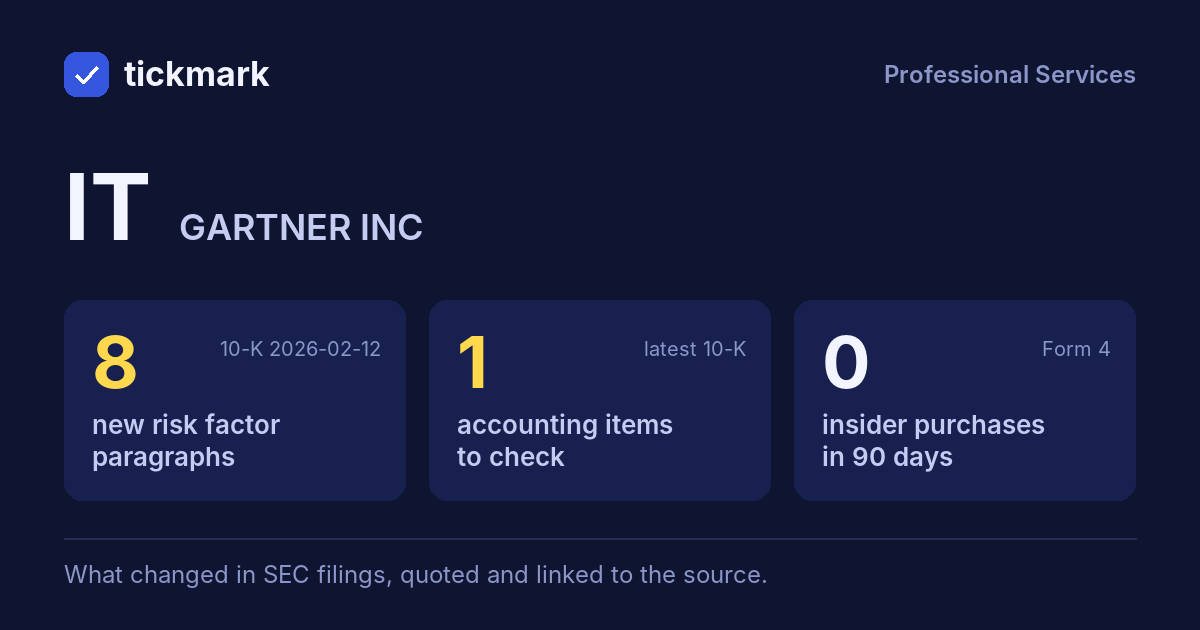
127 changes: 21 added, 5 removed, 99 reworded, 2 quiet changes

10-K Feb 12, 2026 vs Feb 13, 2025
Risk FactorsRedline ↓
17.2%
of the text changed · 8,210 words now
25.7%
of the text changed · 6,905 words now
Legal ProceedingsRedline ↓
0.0%
of the text changed · 232 words now
Accounting PoliciesRedline ↓
20.3%
of the text changed · 4,335 words now

10-K 0000749251-26-000112 (2026-02-12) vs 10-K 0000749251-25-000008 (2025-02-13)

The redline

The paragraph that changed most in each section

Marked against last year's 10-K: cut words struck through, new words highlighted and underlined.

MD&A 294 words changed in this paragraph; it is 73% similar to last year's version.
We operate in a very competitive and rapidly changing environment that involves numerous known and unknown risks and uncertainties, some of which are beyond our control. Although we believe that the expectations reflected in any of our forward-looking statements are reasonable, actual results could differ materially from those projected or assumed in any of our forward-looking statements. Our future quarterly and annual revenues, operating income, results of operations and cash flows, as well as any forward-looking statement, are subject to change and to inherent risks and uncertainties, such as those disclosed or incorporated by reference in our filings with the Securities and Exchange Commission. Important factors that could cause our actual results, performance and achievements, or industry results to differ materially from estimates or projections contained in our forward-looking statements include, among others, the following: the impact our ability to maintain and expand our products and services; our ability to keep pace with technological developments in artificial intelligence (“AI”) and comply with evolving AI regulations; our ability to achieve continued customer renewals and achieve new contract value, backlog and deferred revenue growth in light of general economic conditions, including inflation (and related monetary policy by governments in response competitive pressures; our ability to inflation), on economic activity and grow or sustain revenue from individual customers; our operations; changes in macroeconomic and market conditions and market volatility, including interest rates and the effect on the credit markets and access ability to capital; the impact of global economic and geopolitical conditions, including inflation, and recession; expand or retain our customer base; our ability to carry out our strategic initiatives and manage associated costs; the timing of conferences and meetings, in particular our Gartner Symposium/Xpo series that normally occurs during the fourth quarter; our ability to achieve and effectively manage growth, including our ability to integrate our acquisitions and consummate and integrate future acquisitions; our ability to pay our debt obligations; our ability to maintain and expand our products and services; our ability to expand or retain our customer base; our ability to grow or sustain revenue from individual customers; our ability to attract and retain a professional staff of research analysts and consultants as well as experienced sales personnel upon whom we are dependent, especially in light of labor competition; our ability to achieve continued customer renewals and achieve new contract value, backlog and deferred revenue growth in light of competitive pressures; our ability to successfully compete with existing competitors and potential new competitors; our ability to enforce and protect our intellectual property rights; the impact of cybersecurity incidents or other disruptions to our information systems; our ability to keep pace pay our debt obligations; the impact of global economic and geopolitical conditions, including inflation (and related monetary policy by governments in response to inflation) and recession; uncertain effects, both direct and indirect, of changes and volatility in tariffs and trade policies; risks associated with technological developments in artificial intelligence (“AI”) the creditworthiness, budget cuts, priorities and comply with evolving AI regulations; shutdown of governments and agencies; additional risks associated with international operations, including foreign currency fluctuations; the impact on our business resulting from changes in international conditions, including those resulting from the conflict tensions in the Middle East, the war in Ukraine and current and future sanctions imposed by governments or other authorities; the impact of restructuring and other charges on our businesses and operations; cybersecurity incidents or other disruptions to our information systems; risks associated with the creditworthiness, budget cuts, and shutdown of governments and agencies; our ability to meet sustainability commitments and comply with applicable regulatory requirements; requirements, as well as potential reactions by customers to these commitments; the impact of changes in tax policy (including global minimum tax legislation) and heightened scrutiny from various taxing authorities globally; changes to laws and regulations; and other risks and uncertainties. The potential fluctuations in our operating income could cause period-to-period comparisons of operating results not to be meaningful and could provide an unreliable indication of future operating results. A description of the risk factors associated with our business is included under “Risk Factors” in Item 1A of this Annual Report on Form 10-K, which is incorporated herein by reference.

Source: Item 7, 10-K 0000749251-26-000112 vs Item 7, 10-K 0000749251-25-000008

Risk Factors 211 words changed in this paragraph; it is 64% similar to last year's version.
Our operating results could be negatively impacted by global economic conditions. Our business is impacted by general economic conditions and trends in the United States and abroad, including without limitation inflation, slowing growth, rising interest rates and recession. In its recent report, Global Economics Economic Prospects, January 2025, 2026, the World Bank reported that global noted growth is projected to hold steady at ease to 2.6%, driven by a notable slowdown in demand for traded goods and softening domestic demand in many major economies. The World Bank expects growth to pick up slightly to 2.7% in 2025-26. 2027, as domestic demand benefits from earlier monetary policy easing and trade improves amid declining uncertainty. The report notes global that near-term risks are tilted to the downside, observing growth is stabilizing as could falter if trade tensions escalate, barriers rise further, or financial market sentiment deteriorates amid asset price declines, fiscal concerns, or inflation returns closer surprises. On the upside, firms’ adaptability to targets new trade conditions could support growth, and monetary easing supports AI-related activity in both advanced economies and emerging market and developing economies. However, the World Bank concludes the global economy appears to be settling at a low growth rate that will be insufficient to foster sustained economic development—with the possibility of further headwinds from heightened policy uncertainty and adverse trade policy shifts, geopolitical tensions, persistent inflation, and climate-related natural disasters. could broaden. A downturn in growth could negatively and materially affect future demand for our products and services in general, in certain geographic regions, in particular countries, or industry sectors, or could reduce demand for our in-person conferences. In addition, U.S. federal, state and local government spending limits have reduced, and may reduce continue to reduce, demand for our products and services from those governmental agencies as well as organizations that receive funding from those agencies and could negatively affect macroeconomic conditions in the United States, which could further reduce demand for our products and services. Such difficulties could negatively impact our ability to maintain or improve the various business measurements we utilize (which are defined in this Annual Report), such as contract value and consulting backlog growth, client retention, wallet retention, consulting utilization rates, and the number of attendees and exhibitors at our conferences and other meetings. Failure to achieve acceptable levels of these indicators or improve them will negatively impact our financial condition, results of operations, and cash flows.

Source: Item 1A, 10-K 0000749251-26-000112 vs Item 1A, 10-K 0000749251-25-000008

Accounting Policies 120 words changed in this paragraph; it is 55% similar to last year's version.
The majority of the Company’s Research Insights contracts are billable upon signing, absent special terms granted on a limited basis from time to time. Research Insights contracts are generally non-cancellable and non-refundable, except for government contracts that may have cancellation or fiscal funding clauses. The Company generally records the amount of When a subscription contract that is invoiced, the Company records the billable amount as a fee receivable at the time the contract is signed with a receivable, representing its legally enforceable right to payment. The corresponding amount is recognized as deferred revenue because until the contract underlying services are provided and control is transferred to the customer. In certain instances, the Company may have satisfied its performance obligations and earned revenue prior to invoicing the customer. In such cases, the Company records an unbilled receivable, which represents a legally enforceable claim. its right to payment for services already delivered but not yet billed. Fees derived from assisting organizations in selecting the right business software for their needs are recognized when the leads are provided to vendors. Note 9 - Revenue and Related Matters provides additional information regarding the Company’s business and revenues.

Source: 10-K text, Note 1 – Business and Significant Accounting Policies, 10-K 0000749251-26-000112 vs 10-K text, Note 1 – Business and Significant Accounting Policies, 10-K 0000749251-25-000008

Every change, by type

Sentences and paragraphs added, removed or reworded

Sentences and paragraphs of IT's Risk Factors and MD&A, 10-K 2026-02-12 against 10-K 2025-02-13. Each links to the text at sec.gov.

AddedRisk Factors
delays in new product or service releases or significant problems in creating new products or services could materially adversely affect our business, results of operations and financial position.

Read it in 10-K 2026-02-12 at sec.gov ↗

AddedRisk Factors
Our balance sheet includes significant amounts of goodwill and intangible assets. Impairment of a significant portion of these assets would negatively affect our financial results. Our balance sheet includes significant amounts of goodwill and intangible assets. Impairment of a significant portion of these assets would negatively affect our financial results. Our balance sheet includes goodwill and intangible assets that represent approximately 38% of our total assets at December 31, 2025. We are required to amortize certain intangible assets over the useful life of the asset, while goodwill and indefinite-lived intangible assets are not amortized. On at least an annual basis, we assess whether there have been impairments in the carrying value of goodwill and indefinite-lived intangible assets. During the year ended December 31, 2025, ongoing weakness in the market as well as changes in the Company’s internal organization structure prompted a revision to the long-term earnings forecast for the Digital Markets business. During the year ended December 31, 2025, a goodwill impairment loss of $150.0 million was recognized in the Digital Markets reporting unit.

Read it in 10-K 2026-02-12 at sec.gov ↗

AddedRisk Factors
our employees to thrive. We may also be limited in our ability to recruit internationally by restrictive domestic immigration laws, and changes to policies that restrain the flow of technical and professional talent could inhibit our ability to adequately staff our research and development and other efforts.

Read it in 10-K 2026-02-12 at sec.gov ↗

AddedRisk Factors
other coordinated disruptions, to more advanced threats that target us because of our prominence in the global business and technology insights field.

Read it in 10-K 2026-02-12 at sec.gov ↗

AddedRisk Factors
Moreover, the demand for our products and services from U.S. government agencies is generally driven by the level of discretionary government program funding. In 2025, our revenues with U.S. federal government agencies declined approximately $58 million year over year, primarily due to reductions in discretionary spending. Further significant reduction in federal government spending, the absence of an agreement on the federal government budget, a partial or full federal government shutdown or a change in budgetary priorities could reduce demand for our products and services, cancel or delay federal projects, result in the closure of federal facilities and significant personnel reductions and have a material and adverse impact on our business, financial condition, results of operations and cash flows. As the current geopolitical environment remains unpredictable, we continue to monitor and evaluate the impact, both direct and indirect, of government actions that could adversely impact our business operations and financial performance.

Read it in 10-K 2026-02-12 at sec.gov ↗

AddedRisk Factors
Our operating results could be negatively impacted by global economic conditions. Our business is impacted by general economic conditions and trends in the United States and abroad, including without limitation inflation, slowing growth, rising

Read it in 10-K 2026-02-12 at sec.gov ↗

AddedRisk Factors
harm our reputation, adversely affect our ability to attract and retain employees or clients and expose us to increased scrutiny from investors and regulatory authorities.

Read it in 10-K 2026-02-12 at sec.gov ↗

Show the other 12
AddedMD&A
Our Insights contract value with the US federal government was approximately $126.0 million at December 31, 2025. Less than half of our December 31, 2024 Insights contract value was retained in 2025. In addition to the non-renewals, we have received notices of termination-for-convenience from various US government agencies for approximately $3.0 million of contracts that are primarily scheduled to expire in the first quarter of 2026.

Read it in 10-K 2026-02-12 at sec.gov ↗

AddedMD&A
As the current geopolitical environment remains unpredictable, we continue to monitor and evaluate the impact, both direct and indirect, of government actions that could adversely impact our business operations and financial performance.

Read it in 10-K 2026-02-12 at sec.gov ↗

AddedMD&A
On July 4, 2025, the One Big Beautiful Bill Act (the “OBBBA”) was enacted in the U.S. The OBBBA includes significant provisions, such as the permanent extension of certain expiring provisions of the Tax Cuts and Jobs Act, modifications to the international tax framework and the restoration of favorable tax treatment for certain business provisions. The legislation has multiple effective dates, with certain provisions effective in 2025 and others implemented through 2027. OBBBA did not have a material impact on our consolidated financial results in the current period. We are currently assessing and will continue to assess and reflect the impact of OBBBA on our future consolidated financial statements as appropriate.

Read it in 10-K 2026-02-12 at sec.gov ↗

AddedMD&A
Our most recent annual impairment test of goodwill was a quantitative analysis conducted during the quarter ended September 30, 2025 that indicated an impairment of the Company's Digital Markets reporting unit. During the three months ended September 30, 2025, ongoing weakness in the market as well as changes in our internal organization structure prompted a revision to the long-term earnings forecast for the Digital Markets business. During the year ended December 31, 2025, a goodwill impairment loss of $150.0 million was recognized in the Digital Markets reporting unit. The fair value of that reporting unit was estimated using a combination of the expected present value of future cash flows and market approach.

Read it in 10-K 2026-02-12 at sec.gov ↗

AddedMD&A
On January 29, 2026, we entered into a definitive agreement to sell our Digital Markets business. As of December 31, 2025, the assets and liabilities of Digital Markets were considered held for sale, resulting in $106.4 million of assets held for sale and $20.5 million of liabilities held for sale on the Consolidated Balance Sheet. The majority of the held for sale assets were goodwill, property, equipment and leasehold improvements, net and accounts receivable, with carrying amounts of $49.1 million, $26.3 million and $25.2 million, respectively, while the majority of the held for sale liabilities was accounts payable and accrued liabilities, with a carrying amount of $14.2 million.

Read it in 10-K 2026-02-12 at sec.gov ↗

AddedMD&A
Goodwill and other intangible assets — Our goodwill is evaluated in accordance with FASB ASC Topic 350, which requires goodwill to be assessed for impairment at least annually and whenever events or changes in circumstances indicate that the carrying value of goodwill may not be recoverable. In addition, an impairment evaluation of our amortizable intangible assets may also be performed if events or circumstances indicate potential impairment. Among the factors that could trigger an impairment review are current operating results that do not align with our annual plan or historical performance; changes in our strategic plans or the use of our assets; restructuring charges or other changes in our business segments; competitive pressures and changes in the general economy or in the markets in which we operate; and a significant decline in our stock price and our market capitalization relative to our net book value.

Read it in 10-K 2026-02-12 at sec.gov ↗

AddedMD&A
When performing our annual assessment of the recoverability of goodwill, we initially perform a qualitative analysis evaluating whether any events or circumstances occurred or exist that provide evidence that it is more likely than not that the fair value of any of our reporting units is less than the related carrying amount. If we do not believe that it is more likely than not that the fair value of any of our reporting units is less than the related carrying amount, then no quantitative impairment test is performed. However, if the results of our qualitative assessment indicate that it is more likely than not that the fair value of a reporting unit is less than its respective carrying amount, then we perform a quantitative impairment test.

Read it in 10-K 2026-02-12 at sec.gov ↗

AddedMD&A
Evaluating the recoverability of goodwill requires judgments and assumptions regarding future trends and events. As a result, both the precision and reliability of our estimates are subject to uncertainty. Among the factors that we consider in our qualitative assessment are general economic conditions and the competitive environment; actual and projected reporting unit financial performance; forward-looking business measurements; and external market assessments. To determine the fair values of our reporting units for a quantitative analysis, we typically utilize detailed financial projections, which include significant variables, such as projected rates of revenue growth, profitability and cash flows, as well as assumptions regarding discount rates, our weighted average cost of capital and other data.

Read it in 10-K 2026-02-12 at sec.gov ↗

AddedMD&A
Our most recent annual impairment test of goodwill was a quantitative analysis conducted during the quarter ended September 30, 2025 that indicated an impairment of our Digital Markets reporting unit. During the three months ended September 30, 2025, ongoing weakness in the market as well as changes in our internal organization structure prompted a revision to the long-term earnings forecast for the Digital Markets business. As a result, during the year ended December 31, 2025 a goodwill impairment loss of $150.0 million was recognized in the Digital Markets reporting unit, which is included in Other for segment reporting purposes. The fair value of that reporting unit was estimated using a combination of the expected present value of future cash flows and market approach. Subsequent to completing our 2025 annual impairment test, no events or changes in circumstances were noted that required an interim goodwill impairment test. Note 1 — Business and Significant Accounting Policies and Note 3 — Goodwill and Intangible Assets in the Notes to Consolidated Financial Statements provide additional information regarding our goodwill and amortizable intangible assets.

Read it in 10-K 2026-02-12 at sec.gov ↗

AddedMD&A
to be realized. Uncertain tax positions are periodically re-evaluated and adjusted as more information about their ultimate realization becomes available.

Read it in 10-K 2026-02-12 at sec.gov ↗

AddedMD&A
Amortization of intangibles decreased by 9% during 2025 compared to 2024 primarily due to certain intangible assets that became fully amortized in 2025.

Read it in 10-K 2026-02-12 at sec.gov ↗
Next Related parties →