Form 10-K
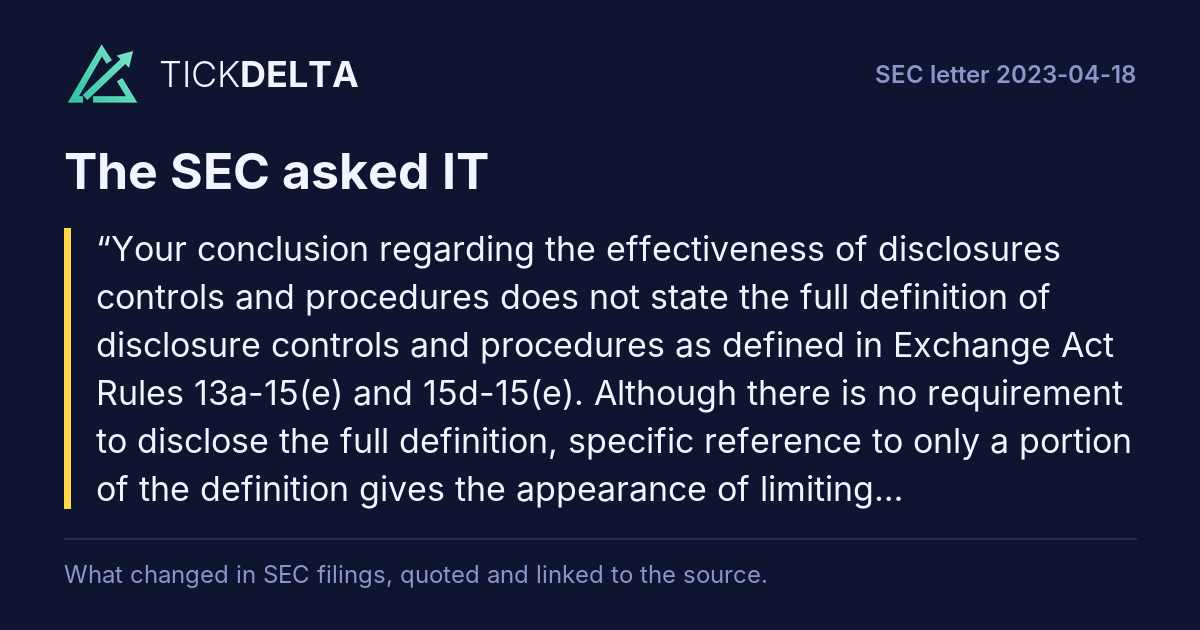
Your conclusion regarding the effectiveness of disclosures controls and procedures does not state the full definition of disclosure controls and procedures as defined in Exchange Act Rules 13a-15(e) and 15d-15(e).Rest of the question
Although there is no requirement to disclose the full definition, specific reference to only a portion of the definition gives the appearance of limiting management´s conclusion solely to the portion referred to. Please represent to us and revise future filings to state management´s conclusion in regard to the company's disclosure controls and procedures as fully defined in Exchange Act rules 13a15(e) and 15d-15(e).
The Company acknowledges the Staff’s comment. The Company represents that it will revise its future filings to state management’s conclusion in regard to the Company’s disclosure controls and procedures as fully defined in Exchange Act Rules 13a-15(e) and 15d-15(e). The
Company’s Form 10-Q for the quarter ended March 31, 2023, which was filed on May 2, 2023, reflects these revisions, as detailed below:
We have established disclosure controls and procedures that are designed to ensure that the information we are required to disclose in our reports filed or submitted under the SecuritiesRead in the reply ↗Rest of the answer
Exchange Act of 1934, as amended (the “Exchange Act”), is recorded, processed, summarized and reported within the time periods specified in the rules and forms of the SEC, and such information is accumulated and communicated to our executive management team, including our chief executive officer and our chief financial officer, to allow timely decisions regarding required disclosure.
Management conducted an evaluation, as of March 31, 2023, of the effectiveness of the design and operation of our disclosure controls and procedures, under the supervision and with the participation of our chief executive officer and chief financial officer. Based upon that evaluation, our chief executive officer and chief financial officer have concluded that the Company’s disclosure controls and procedures are effective in alerting them in a timely manner to material Company information required to be disclosed by us in reports filed or submitted under the Exchange Act.
There have been no changes in the Company’s internal control over financial reporting during the period covered by this report that have materially affected, or are reasonably likely to materially affect, the Company’s internal control over financial reporting.
First report after the company's reply of 2023-05-12: 10-Q filed 2023-08-01 ↗, against the 10-Q filed 2022-11-01 ↗.
Tickdelta does not hold the text of both reports, so they are not compared here.
On page 67 you disclose you recorded a deferred tax asset of approximately $122.9 million for tax basis in intangible assets along with an offsetting valuation allowance of the same amount. Please tell us where in the table of the components of long-term deferred tax assets (liabilities) on page 66 this deferred tax asset is recorded.Rest of the question
Also, explain to us the circumstances leading to the the full valuation allowance against this deferred tax asset. Further, explain to us how the increase in the valuation allowance is reflected in the table on page 67 reconciling the statutory tax rate to the effective tax rate. Note 17 - Contingencies, page 75
This deferred tax asset (“DTA”) is recorded in the line titled Intangible Assets in the table of long-term deferred tax assets and liabilities presented in Note 12, Income Taxes, of the Company’s 2022 Form 10-K. It is presented with deferred tax assets and liabilities relating to all other intangible assets.
In July 2020, the Company completed an intra-entity transfer of a significant amount of intellectual property (“IP”). This transaction provided for local tax basis in the IP.Read in the reply ↗Rest of the answer
There is no reported financial statement basis in these assets.
One of the primary objectives in ASC 740 is to recognize deferred taxes for the future tax consequences of events that have been recognized in an entity’s financial statements or tax returns. Under ASC 740-10-5-7, a temporary difference exists when any difference between the tax basis of an asset or a liability and its reported amount in financial statements will result in taxable income or deductions upon the reversal of the difference. Certain basis differences may not result in taxable or deductible amounts in future years when the related asset or liability for financial reporting is recovered or settled and, therefore, may not be temporary differences for which a deferred tax liability or asset is recognized1.
Under operation of tax law in the jurisdiction upon which the IP was transferred, an amortization deduction is only permitted if a certain threshold of taxable income is attained. Forecasted results at the time of the transfer indicated that the Company would not generate sufficient taxable income to claim amortization deductions for the tax basis in IP in future years. Further, the relevant taxing jurisdiction allows taxpayers to sell IP in a tax-free manner. Based on these facts, the Company did not expect to recover or otherwise obtain a tax benefit for its tax basis in the IP. Therefore, it was treated as a basis difference for which no future tax consequence would occur and the Company did not recognize a DTA.
In 2021, the Company experienced unexpectedly high levels of profitability largely attributable to the receipt of insurance proceeds as well as generating elevated margins in the research and advisory business. This led to the Company claiming IP amortization deductions in its 2021 tax year. However, forecasted results at the end of 2021 continued to indicate that that the Company would not generate sufficient taxable income to claim amortization deductions for the tax basis in IP in future years.
In 2022, the Company experienced another year of unexpectedly high levels of profitability. This led to the Company claiming IP amortization deductions in its 2022 tax year. Based on the above new facts and circumstances in 2022, the Company evaluated whether the tax basis in IP represents a deductible temporary difference for which a DTA should be recorded. Because Management’s expectations as to the recovery of the tax basis had changed (as evidenced by the tax amortization deductions claimed in both 2021 and 2022 as explained above), the Company recognized a DTA for the difference between the US GAAP and local tax basis in the IP in 2022.
Upon recognition of the DTA, the Company must also assess the DTA for realizability. ASC 740-10-30-16 requires companies to reduce the measurement of DTA’s not expected to be realized. The Company considered four sources of taxable income to support realization of the DTA per ASC 740-10-30-18.
When assessing the realizability of the DTA, past operating results are a source of positive evidence but need to be viewed in connection with all positive and negative evidence. Based on future projected results and the continued availability of tax-free sales of IP, the Company concluded that it is not likely that the DTA will be realized (more-likely-than-not standard). Therefore, a full valuation allowance was recorded.
Income tax expense for the year ended December 31, 2022 included a tax benefit to establish the deferred tax asset, fully offset by an expense for the valuation allowance. The reconciliation of the statutory tax rate to the effective tax rate in Note 12, Income Taxes, of the
1 ASC 740-10-25-30
Company’s 2022 Form 10-K, reflects the net tax expense of zero in the line titled Intercompany sale of Intellectual Property.
First report after the company's reply of 2023-05-12: 10-Q filed 2023-08-01 ↗, against the 10-Q filed 2022-11-01 ↗.
Tickdelta does not hold the text of both reports, so they are not compared here.
We note from your risk factor disclosure you face risks related to insurance coverage for your cancelled 2020 and 2021 conferences. We further note you have a lawsuit against the insurer and you also commenced litigation against the insurance broker. Please tell us what consideration you gave to disclosing these matters here pursuant to ASC 450-20-503 through 5 or 450-30-50-1, as appropriate.Rest of the question
Explain to us if there are any adverse consequences to you if you are not successful in these litigations. In connection with this, tell us how you accounted for costs incurred associated with these cancelled conferences. Additionally, in connection with the $152.3 million gain on event cancellation insurance claims recorded in fiscal 2021, explain to us why there was a gain and how the gain was determined.
The Company acknowledges the Staff’s comment. The Company’s event cancellation insurance included a two-year policy covering destination conferences during 2020 and 2021 and a policy covering Evanta conferences during 2020. This insurance included coverage for cancellations due to communicable diseases and enabled the Company to receive an amount up to the lost contribution margin per conference plus incurred expenses, as more specifically set forth in the policies’ provisions for calculating the amount of recoverable loss, and subject to the policies’ limits of liability.
These policiesRead in the reply ↗Rest of the answer
provided up to $170 million in coverage for 2020 cancellations with the right to reinstate the policy limits for the payment of additional premium if those limits are utilized, for a maximum recovery of $340 million. The insurer has accepted and paid claims on the initial $170 million of 2020 coverage. However, the insurer has contested the Company’s right to reinstate the limits and use the reinstated limits to cover additional losses resulting from 2020 conferences cancelled due to COVID-19.
Gartner's two-year event cancellation policy also covered conferences that were planned for 2021 but cancelled, with limits of $150 million with the right to reinstate up to that amount if the initial limits are inadequate to cover the loss. The insurer has contested all coverage for events that were planned for 2021 but were cancelled due to COVID-19, as well as Gartner’s right to reinstate the policy limits.
The Company’s insurance coverage for 2022 (and likely beyond) excluded coverage for cancellations due to communicable diseases.
The Company is the plaintiff in litigation with the insurer and is seeking to reinstate the policy limits pursuant to the policies’ reinstatements of limits clause and recover up to an additional $170 million for events cancelled in 2020. Gartner is also seeking $150 million in initial limits for events cancelled in 2021 and to reinstate those limits up to an additional $150 million. The Company is also the plaintiff in litigation with the insurance broker that negotiated and procured our event cancellation insurance.
Although document discovery has begun in the Company’s cases against the insurer and insurance broker, neither party has answered the Company’s complaints pending the court’s decisions on their partial motions to dismiss certain counts in the Company’s complaints. The Company is in the early stages of litigation with both parties, and at this point, the Company cannot predict how long it will take to resolve these lawsuits, whether the Company will be successful or the impact the resolution could have on the Company’s financial results.
The Company believes the guidance in ASC 450-20-50-3 to 5 is not applicable as there is no potential for loss related to this litigation. Legal fees and costs related to the litigation are expensed as incurred, and the Company did not have any assets on its balance sheet related to conferences cancelled in 2020 or 2021 at December 31, 2022. The Company expensed all fees related to 2021 cancelled conferences, totaling $13.7 million, in 2021 because the insurer did not acknowledge that the Company had coverage for 2021.
In determining whether disclosure under ASC 450-30-50-1 was warranted at December 31, 2022, the Company considered several factors, including the probability of a favorable outcome, the potential range of any award, and the difficulty of accurately estimating either of the aforementioned. Due to the substantial uncertainty regarding both the likelihood and size of any potential gain, the Company concluded that disclosure of this litigation was neither required nor appropriate under ASC 450-30-50-1 at December 31, 2022 as it would not convey meaningful information to users of the Company’s financial statements. However, the Company will continue to reassess this conclusion in future filings as the litigation progresses.
The $152.3 million gain on event cancellation insurance claims recorded in fiscal 2021 was the result of $166.9 million in insurance proceeds received (related to 2020 cancelled conferences) less $14.6 million of prepaid conference expenses recorded on the balance sheet at that time. As disclosed in Note 1, Business and Significant Accounting Policies, of the Company’s 2022 Form 10-K, the Company does not record any gain on insurance claims in excess of expenses incurred until the receipt of the insurance proceeds is deemed to be realizable.
First report after the company's reply of 2023-05-12: 10-Q filed 2023-08-01 ↗, against the 10-Q filed 2022-11-01 ↗.
Tickdelta does not hold the text of both reports, so they are not compared here.
We note the revised disclosure in your response to comment 1 and in the Form 10-Q for the fiscal quarter ended March 31, 2023. However, the conclusion language still refers to only a portion of the definition of disclosure controls and procedures. This gives the appearance your conclusion applies only to this portion and leaves open your conclusion with respect to the remainder of the definition.Rest of the question
Your conclusion does not need to recite the full definition as long as it refers to the definition as defined by Exchange Act Rules 13a-15(e) and 15d-15(e). Please revise your conclusion as appropriate. If your conclusion is limited to only the portion of the definition stated, please advise.
The Company acknowledges the Staff’s comment and represents that management’s conclusions set forth in the Company’s Form 10-K for the year ended December 31, 2022 and Form 10-Q for the quarter ended March 31, 2023 with respect to the Company’s disclosure controls and procedures were on the basis of the full definition of disclosure controls and procedures in Exchange Act Rules 13a-15(e) and 15d-15(e).Read in the reply ↗Rest of the answer
The Company represents that it will revise its future filings to state management’s conclusion in regard to the Company’s disclosure controls and procedures as fully defined in Exchange Act Rules 13a-15(e) and 15d-15(e). The Company’s Form 10-Q for the quarter ended June 30, 2023, which was filed on August 1, 2023, reflects these revisions, as detailed below:
We have established disclosure controls and procedures that are designed to ensure that the information we are required to disclose in our reports filed or submitted under the Securities Exchange Act of 1934, as amended (the “Exchange Act”), is recorded, processed, summarized and reported within the time periods specified in the rules and forms of the SEC, and such information is accumulated and communicated to our executive management team, including our chief executive officer and our chief financial officer, to allow timely decisions regarding required disclosure.
Management conducted an evaluation, as of June 30, 2023, of the effectiveness of the design and operation of our disclosure controls and procedures, as such term is defined in Rules 13a-15(e) and 15d-15(e) of the Exchange Act, under the supervision and with the participation of our chief executive officer and chief financial officer. Based upon that evaluation, our chief executive officer and chief financial officer have concluded that, as of June 30, 2023, the Company’s disclosure controls and procedures were effective.
There have been no changes in the Company’s internal control over financial reporting during the period covered by this report that have materially affected, or are reasonably likely to materially affect, the Company’s internal control over financial reporting.
First report after the company's reply of 2023-08-02: 10-Q filed 2023-11-03 ↗, against the 10-Q filed 2022-11-01 ↗.
Tickdelta does not hold the text of both reports, so they are not compared here.
Refer to your response to comment 2. You say the $122.9 million deferred tax asset for the tax basis in intangible assets is recorded in the line titled "Intangible Assets" in the applicable table. Please reconcile this amount with the $35.8 million amount presented in that line for 2022.Rest of the question
If the deferred tax asset and offsetting valuation allowance were netted in this line, please present each component separately in the table as appropriate. Refer to ASC 740-10-50-6. In connection with this, if these two amounts also were netted in the statutory tax rate reconciliation table, there does not appear to be a basis to do this in this table pursuant to Rule 4-08(h)(2) of Regulation S-X. Accordingly, present each component separately in this table as appropriate.
The Company acknowledges the Staff’s comment and respectfully advises the Staff that the $122.9 million deferred tax asset (“DTA”) was not netted with the related valuation allowance in the table of long-term deferred tax assets and liabilities in the Company’s Form 10-
K for the year ended December 31, 2022. The $35.8 million DTA presented in the line titled “Intangible Assets” represents the net amount of deferred tax assets and liabilities related to all the Company’s intangible assets but does not include an offsetting valuation allowance.Read in the reply ↗Rest of the answer
Below are the components of the gross amounts as presented.
(in millions) December 31,
2022 2021
Net deferred tax liability related to all other intangible assets $ (87.1) $ (123.5)
DTA for the intangible asset established in 2022 122.9
-
Net deferred tax asset (liability) related to intangible assets $ 35.8 $ (123.5)
Valuation allowance related to all other DTAs $ (29.9) $ (23.3)
Valuation allowance related to DTA for intangible asset established in 2022 (122.9)
Total valuation allowance $(152.8) $ (23.3)
In its statutory tax rate reconciliation table, Gartner did not separately identify the impact of establishing the DTA in the current year or the expense of establishing the related valuation allowance in the current year. The Company concluded that the rate reconciliation as provided, taken in conjunction with valuation allowance presented gross in the table of long-term deferred tax assets and liabilities, together with disclosure that a DTA of $122.9 million with a fully offsetting valuation allowance was recorded, provides adequate disclosure. The Company concluded that there is a reasonable basis for this presentation and also believes that a change in presentation of the tax rate reconciliation for this one-time item would not be material to the consolidated financial statements taken as a whole.
Accounting Standards Codification (“ASC”) 740-10-45-20 states that income tax expense from continuing operations “shall include the effect of a change in the beginning-of-the-year balance of a valuation allowance that results from a change in circumstances that causes a change in judgment about the realizability of the related deferred tax asset in future years”. Establishing an initial DTA with a full valuation allowance does not represent a change in judgment on a beginning of the year balance. Further, there is no income tax expense or benefit recognized in the period.
Public entities are required to provide a statutory rate reconciliation disclosing the estimated amount and nature of each significant reconciling item included in income tax expense from continuing operations. While ASC 740 does not provide specific guidance on the definition of a significant reconciling item, Rule 4.08(h)(2) of Regulation S-X requires disclosure of any reconciling item that is greater than 5% of the amount computed by multiplying the income before tax by the applicable statutory Federal income tax rate. The guidance in ASC 740 indicates that the tax effects of changes in the valuation allowance where there is a change in judgment about an entity’s ability to realize deferred tax assets in future years are included as a component of income tax expense from continuing operations. Therefore, such changes in valuation allowance should be separately identified and reported in the rate reconciliation table if significant.
For DTAs established in the current year where there is no beginning of the year balance and no change in judgment related to realizability, there is no tax expense or benefit recognized in the period. Gartner disclosed only the portion of change of valuation allowance attributable to changes in judgment in the realizability of DTAs and only to the extent the tax impact exceeds the required disclosure threshold of 5% of 21% (i.e., 1.05%). The Company concluded that this is a reasonable interpretation of the tax rate reconciliation disclosure requirements as outlined in ASC 740 and Rule 4-08(h)(2) of Regulation S-X.
First report after the company's reply of 2023-08-02: 10-Q filed 2023-11-03 ↗, against the 10-Q filed 2022-11-01 ↗.
Tickdelta does not hold the text of both reports, so they are not compared here.
Also in this review: closing letter, 2023-09-05