Added10-Q Nov 5, 2026 vs 10-K Feb 9, 2026
The ongoing conflict in the Middle East and related geopolitical instability may adversely affect our business.
Each branch is a paragraph in Risk Factors with nothing like it in the 10-K filed Feb 10, 2025. A box jumps to the paragraph as filed, below.
34 paragraphs in Risk Factors of the 10-K filed Feb 9, 2026 with nothing like them in the 10-K filed Feb 10, 2025. Quoted exactly. Paragraphs that were only edited are under 10-K change.
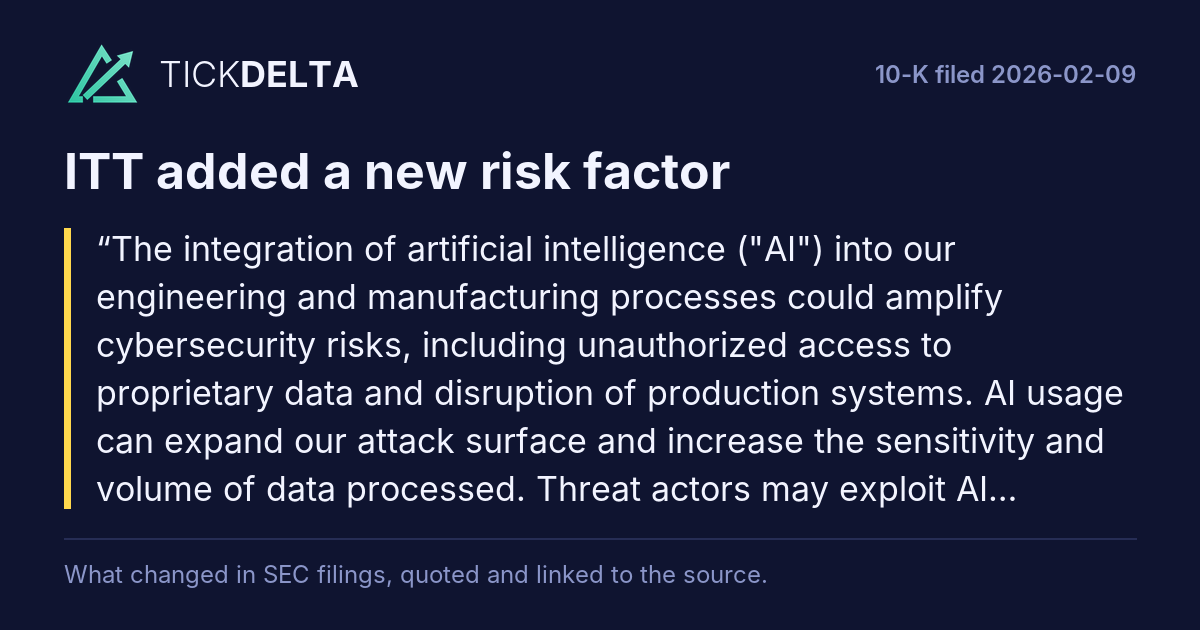
The integration of artificial intelligence ("AI") into our engineering and manufacturing processes could amplify cybersecurity risks, including unauthorized access to proprietary data and disruption of production systems. AI usage can expand our attack surface and increase the sensitivity and volume of data processed. Threat actors may exploit AI systems (including generative models) to enable more sophisticated phishing, deepfake social engineering, and automated vulnerability discovery. In addition, we depend on third-party AI tools, cloud platforms, and model providers; deficiencies in those vendors’ security, privacy, or model governance could create risks we cannot fully control. The unavailability of our information technology systems, the failure of these systems to perform as anticipated for any reason, or any significant breach of security could cause significant disruption to our business or could result in decreased performance and increased costs.
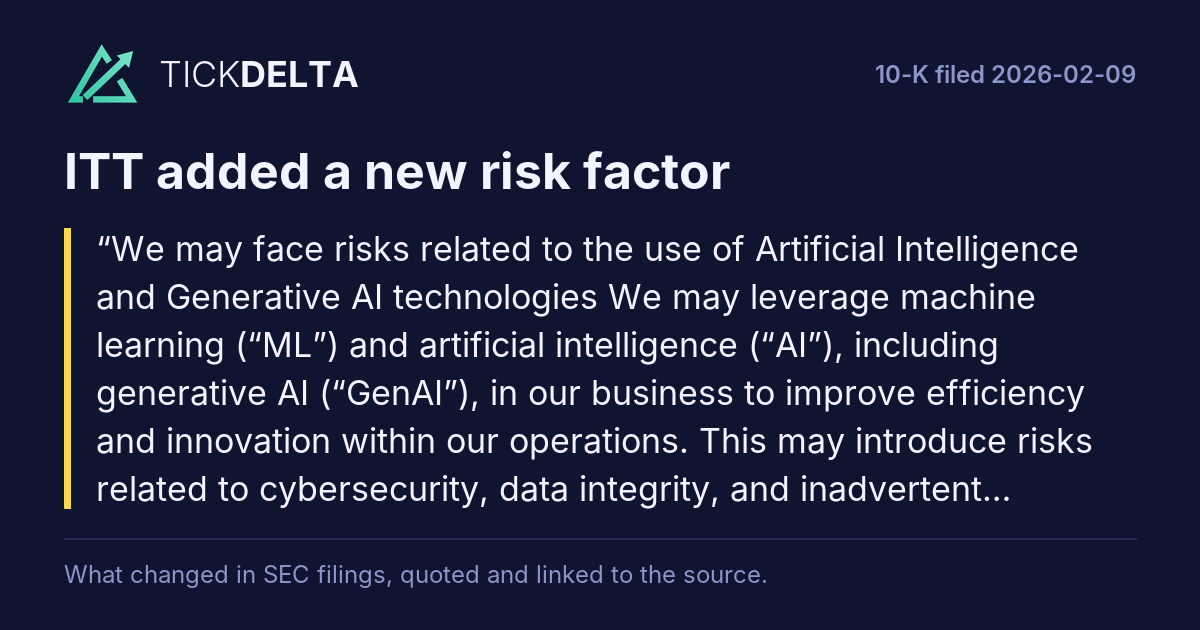
We may face risks related to the use of Artificial Intelligence and Generative AI technologies
We may leverage machine learning (“ML”) and artificial intelligence (“AI”), including generative AI (“GenAI”), in our business to improve efficiency and innovation within our operations. This may introduce risks related to cybersecurity, data integrity, and inadvertent misuse, as well as ethical and social concerns. While we have implemented governance measures, including a GenAI Governance Committee and restrictions limiting usage to approved enterprise-level tools, these controls may not fully address risks associated with rapidly evolving technologies, provider practices, and competitive adoption. Controls related to AI lifecycle management—covering data stewardship, bias detection, reliability testing, human oversight, incident response, and decommissioning are evolving and may not mitigate all risks. Failure to implement effective AI observability, traceability, and post-deployment monitoring could impair our ability to detect and remedy issues promptly.
AI algorithms may be flawed or biased, and datasets used to train AI systems may be insufficient, unlawfully obtained, or contain personal or protected information without proper rights. These issues could lead to inaccurate or discriminatory outputs, infringement of intellectual property or data privacy rights, and other legal or regulatory violations, as well as adversely affect our business, financial condition, and results of operations. Furthermore, our competitors or other third parties may incorporate AI into their operational processes more quickly or more successfully than us, which could have a material adverse effect on our competitive position, reputation, and operations.
Agentic AI systems are tools capable of autonomously initiating tasks, making decisions, or executing multi-step actions without direct human prompting, which may introduce additional operational, security, and compliance risks. These systems could take actions outside intended business parameters, propagate errors at scale, or interact with internal and external systems in unanticipated ways, increasing the likelihood of operational disruptions or regulatory exposure. Agentic AI may also heighten risks related to model alignment, permissions design, and dependency on third party control mechanisms, any of which may fail to function as expected. If agentic AI systems behave unpredictably, are misconfigured, or are exploited by malicious actors, they could result in unauthorized transactions, data leakage, safety incidents, or other adverse impacts. If we are unable to effectively govern or oversee these autonomous capabilities, we could experience material and negative affects to our business, reputation, financial condition, and results of operations.
The legal, regulatory, and compliance environments surrounding the design and use of AI technology at the federal, state, and international levels are evolving and complex. For example, the European Union’s Artificial Intelligence Act establishes obligations based on risk classifications, and U.S. federal and state agencies continue
to introduce new frameworks governing AI. Compliance with these evolving regulations could entail significant costs and negatively affect our business. Additionally, AI-related changes may disrupt our industry, lower barriers to entry, and increase competition from larger or better-funded companies with more advanced AI capabilities. If our AI initiatives fail to deliver anticipated benefits or if we cannot adapt to evolving customer expectations, regulatory requirements, or competitive pressures, our business, reputation, financial condition, and results of operations could be materially and adversely affected.
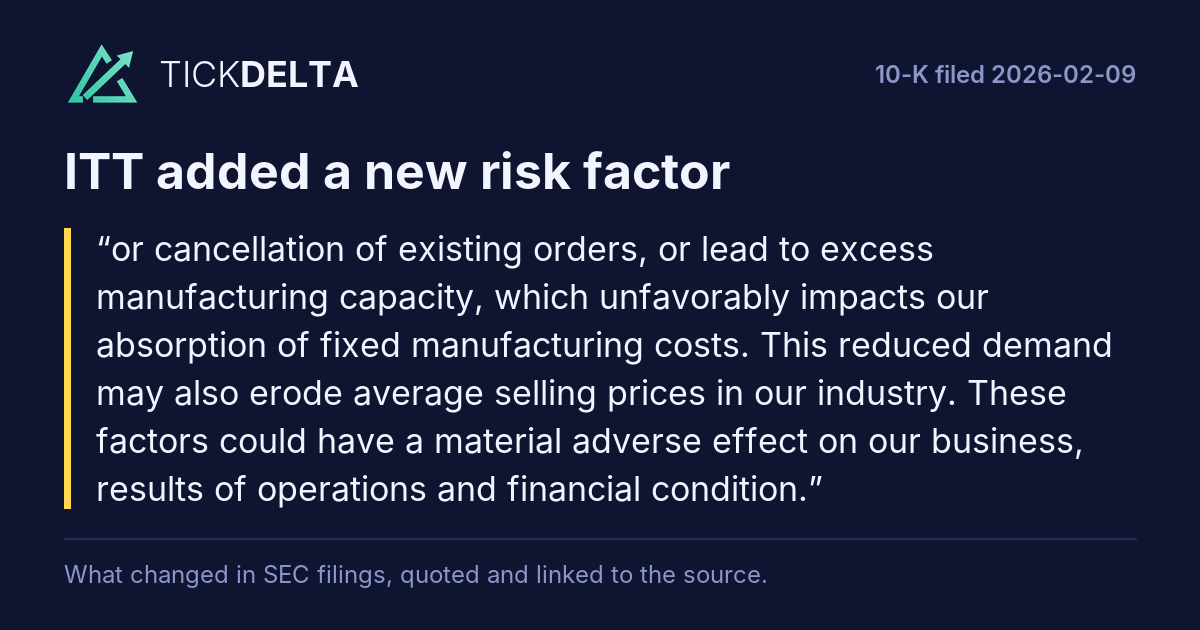
or cancellation of existing orders, or lead to excess manufacturing capacity, which unfavorably impacts our absorption of fixed manufacturing costs. This reduced demand may also erode average selling prices in our industry. These factors could have a material adverse effect on our business, results of operations and financial condition.
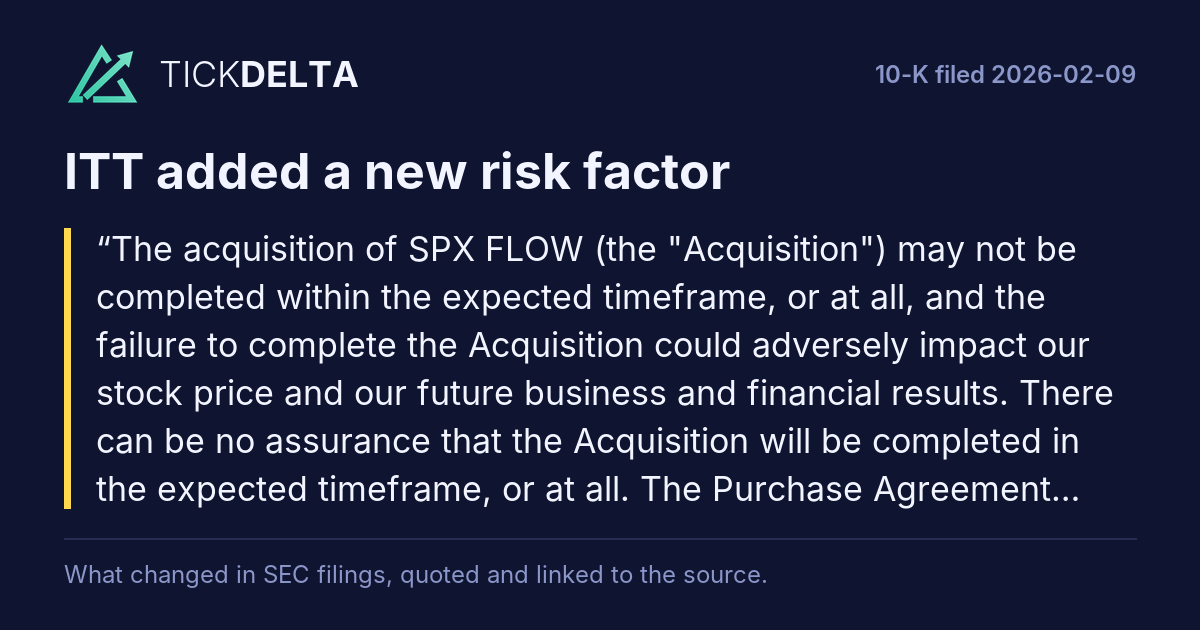
The acquisition of SPX FLOW (the "Acquisition") may not be completed within the expected timeframe, or at all, and the failure to complete the Acquisition could adversely impact our stock price and our future business and financial results.
There can be no assurance that the Acquisition will be completed in the expected timeframe, or at all. The Purchase Agreement contains a number of conditions that must be satisfied or waived prior to the completion of the Acquisition, including regulatory approvals. We can provide no assurance that all closing conditions will be satisfied (or waived, if applicable). Many of the conditions to completion of the Acquisition are not within our control, and we cannot predict when or if these conditions will be satisfied (or waived, as applicable). Whether or not the Acquisition is completed:
•while the Purchase Agreement is in force, we are subject to certain restrictions on the conduct of our business, including taking any action that would reasonably be expected to have a material negative impact on or materially delay the satisfaction of the conditions in the Purchase Agreement required to consummate the Acquisition, which restrictions may adversely affect our ability to execute certain of our business strategies; and
•matters relating to the Acquisition (including integration planning) may require substantial commitments of time and resources by our management, which could otherwise have been devoted to other opportunities that may have been beneficial to us.
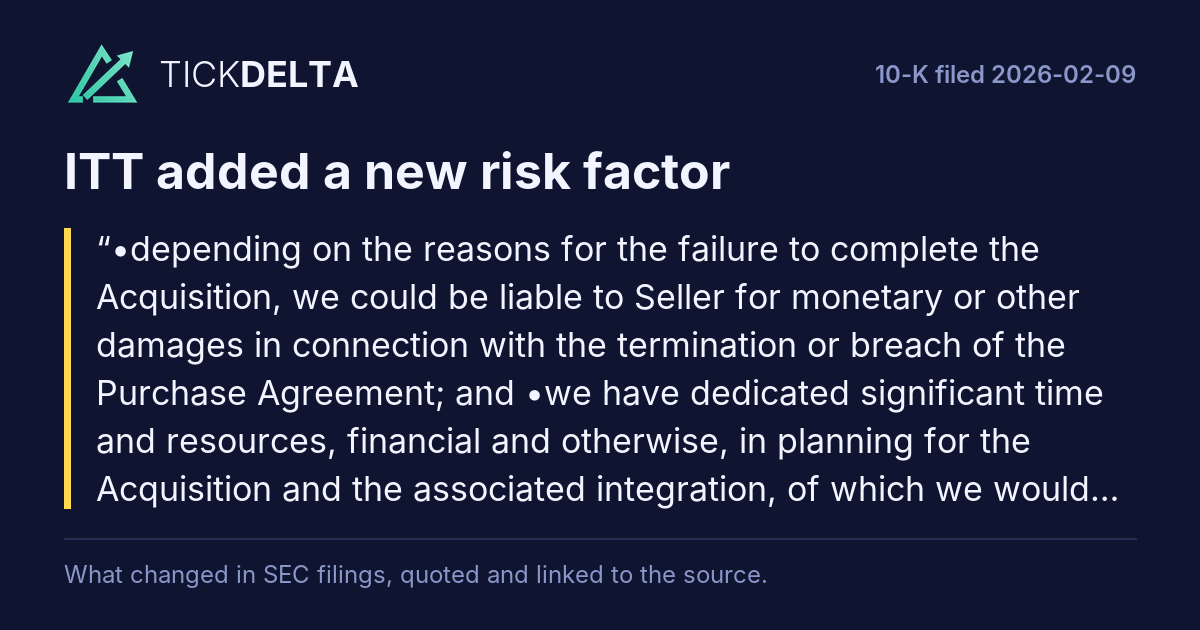
•depending on the reasons for the failure to complete the Acquisition, we could be liable to Seller for monetary or other damages in connection with the termination or breach of the Purchase Agreement; and
•we have dedicated significant time and resources, financial and otherwise, in planning for the Acquisition and the associated integration, of which we would lose the benefit if the Acquisition were not completed.
In addition, if the Acquisition is not completed, we may experience negative reactions from the financial markets and from our customers and employees. We also may be subject to litigation related to any failure to complete the Acquisition or to enforcement proceedings commenced against us to perform our obligations under the Purchase Agreement. If the Acquisition is not completed, these risks may materialize and may adversely affect our business, financial results and financial condition, as well as the price of our common stock.
Moreover, we intend to finance the cash portion of the purchase price of the Acquisition with proceeds from the offering of our common stock that closed on December 10, 2025 (the "Equity Offering"), together with proceeds to be drawn from the Term Loan Facility (as defined below) and cash on hand. If the Acquisition is not completed, the proceeds from the equity offering will remain available to us. In such event, we may retain the proceeds for general corporate purposes or deploy them in other ways, which may not generate a return commensurate with investors’ expectations or enhance shareholder value.
We may be unable to integrate SPX FLOW successfully and realize the anticipated benefits of the Acquisition.
If the Acquisition is completed, the successful integration of SPX FLOW and its operations into those of our own and our ability to realize the expected synergies and benefits of the transaction are subject to a number of risks and uncertainties, many of which are outside of our control. We will also be required to devote significant management attention and resources to integrating business practices, cultures and operations of each business. The risks and uncertainties relating to integrating the two businesses include, among other things:
•the challenge of integrating complex organizations, systems, operating procedures, compliance programs, technology, networks and other assets of SPX FLOW;
•the difficulties harmonizing differences in the business cultures of our company and SPX FLOW;
•the inability to successfully integrate our respective businesses in a manner that permits us to achieve the expected growth opportunities, cost savings, synergies and other anticipated benefits from the Acquisition;
•the inability to minimize the diversion of management attention from ongoing business concerns during the process of integrating SPX FLOW into our business;
•the inability to resolve potential conflicts that may arise relating to customer, supplier and other important relationships of our business and the business of SPX FLOW;
•the challenge of managing the expanded operations of a significantly larger and more complex company and coordinating geographically separate organizations.
We will incur substantial expenses to consummate the proposed Acquisition but may not realize the anticipated cost synergies and other benefits. In addition, even if we are able to integrate SPX FLOW successfully, the anticipated benefits of the pending Acquisition may not be realized fully, or at all, or may take longer to realize than expected. Given the size and significance of the Acquisition, we may encounter difficulties in the integration of the operations of SPX FLOW and may fail to realize the full benefits and synergies that we anticipate for the Acquisition, which could adversely impact our business, results of operation and financial condition.
If the Acquisition is completed, the combined company may fail to realize the anticipated benefits and synergies expected from the Acquisition, which could adversely affect the combined company’s business, financial condition and results of operations. The success of the Acquisition will depend, in significant part, on the combined company’s ability to successfully integrate the acquired business, grow the revenue of the combined company and realize the anticipated strategic benefits and synergies from the combination. We expect double-digit adjusted EPS accretion in the first full year after the Acquisition is consummated, excluding non-cash amortization of intangible assets. Further, we believe that the combination of the companies will provide an annualized run-rate of approximately $80 million of cost synergies by the end of the third year after the Acquisition is consummated (exclusive of an estimated $96 million in associated one-time costs). However, the anticipated benefits of the transaction may not be realized fully or at all, or may take longer to realize than expected. Actual operating, technological, strategic and revenue opportunities, if achieved at all, may be less significant than expected or may take longer to achieve than anticipated. If the combined company is not able to achieve these objectives and realize the anticipated benefits and synergies expected from the Acquisition within the anticipated timing or at all, the combined company’s business, financial condition and results of operations may be adversely affected.
SPX FLOW may have liabilities that we failed, or were unable, to discover in the course of performing our due diligence investigations of SPX FLOW. We cannot assure you that the indemnification available to us under the Purchase Agreement in respect of the Acquisition in connection with such agreement will be sufficient in amount, scope or duration to fully offset the possible liabilities associated with the business of SPX FLOW or property that we will assume upon consummation of the Acquisition. We may learn additional information about SPX FLOW that materially adversely affects us, such as unknown or contingent liabilities and liabilities related to compliance with applicable laws. Any such liabilities, individually or in the aggregate, could have a material adverse effect on our business, financial condition and results of operations.
Acquisition accounting adjustments could adversely affect our financial results.
If completed, we will account for the completion of the Acquisition by allocating the purchase price of the Acquisition to the tangible and intangible assets acquired, liabilities assumed and non-controlling interests in SPX FLOW based on their estimated fair value at the Acquisition date. The excess of the purchase price over those estimated fair values will be recorded as goodwill. Changes to acquisition date fair values prior to the expiration of the measurement period, a period not to exceed 12 months from the closing date of the Acquisition, are recorded as an adjustment to the associated goodwill in the reporting period in which the adjustment amounts are determined. Changes to acquisition date fair values after expiration of the measurement period are recorded in earnings.
Differences between preliminary estimates and the final accounting for the Acquisition may occur, and these differences could have a material impact on our future consolidated financial statements and the combined company’s future results of operations and financial position.
While the Acquisition is pending, we and SPX FLOW will be subject to business uncertainties that could adversely affect our respective businesses.
Our success following the Acquisition will depend in part upon the ability of us and SPX FLOW to maintain our respective business relationships. Uncertainty about the effect of the Acquisition on customers, suppliers, employees and other constituencies may have a material adverse effect on us and SPX FLOW. Customers, suppliers and others who deal with us or SPX FLOW may delay or defer business decisions, decide to terminate, modify or renegotiate their relationships or take other actions as a result of the Acquisition that could negatively affect the revenues, earnings and cash flows of our company or SPX FLOW. If we are unable to maintain these business and operational relationships, our financial position, results of operations or cash flows could be materially affected.
Financing the Acquisition will result in an increase in our indebtedness, which could adversely affect us, including by decreasing our business flexibility and increasing our interest expense.
We have secured commitments for a $2,875 million term loan facility (the “Term Loan Facility”) and expect to enter into a related credit agreement prior to the closing of the Acquisition. We intend to finance the cash portion of the purchase price of the Acquisition with proceeds from the Equity Offering, together with proceeds to be drawn from the Term Loan Facility and cash on hand. As of December 31, 2025 our total debt was $782.8 and our total debt as of that date on a pro forma basis after giving effect to the incurrence of indebtedness under the Term Loan Facility in full (without giving effect to $10 million of unamortized debt issuance costs) would have been approximately $3,660. These increases in our indebtedness may, among other things, reduce our flexibility to respond to changing business and economic conditions or to fund capital expenditures or working capital needs, and cause ratings agencies to downgrade our credit ratings or place us on negative watch. In addition, the amount of cash required to pay interest on our indebtedness following, subject to market conditions and other factors, completion of the debt financing and the Acquisition, and thus the demands on our cash resources, will materially increase as a result of the Term Loan Facility and the Acquisition.
New in the latest 10-Q
23 paragraphs in the 10-Q filed Nov 5, 2026 with nothing like them in the 10-Q filed Aug 6, 2026 (at least half the words must differ; new numbers alone do not count). Quoted exactly, grouped by the item heading above them. This is text that changed, not a judgement of how serious it is.
Three Months Ended Nine Months Ended October 3, September 27, October 3, September 27,
Read in the 10-Q
Three Months Ended Nine Months Ended October 3, September 27, October 3, September 27,
Read in the 10-Q
2026 2025 ──────────────────────────────────────────────────────────────────────────────────────────────────────────────────────────────────────────────────────────────────────── Operating Activities Income from continuing operations attributable to ITT Inc. $ 286.4 $ 356.4 Adjustments to income from continuing operations: Depreciation and amortization 243.0 107.9 Equity-based compensation 33.4 27.4 Other non-cash charges, net 36.2 27.6 Changes in assets and liabilities: Change in receivables (81.1) (68.0) Change in inventories (8.5) (14.0) Change in contract assets (13.7) (14.7) Change in contract liabilities (18.5) 43.7 Change in accounts payable 26.5 (19.3) Change in accrued expenses 64.3 18.9 Change in income taxes (3.3) (9.4) Other, net (21.1) (15.5) Net Cash – Operating Activities 543.6 441.0 Investing Activities Acquisitions, net of cash acquired (3,569.3) (0.2) Capital expenditures (84.2) (80.9) Proceeds from government incentives for capital expenditures 4.9 7.9 Other, net 2.1 1.3 Net Cash – Investing Activities (3,646.5) (71.9) Financing Activities Commercial paper, net borrowings 455.0 (55.1) Long-term debt issued, net of debt issuance costs 2,868.3 749.0 Long-term debt repayments (1,117.4) (405.6) Share repurchases under repurchase plan (155.0) (500.9) Payments for taxes related to net share settlement of stock incentive plans (20.6) (13.7) Dividends paid (104.1) (83.5) Other, net (3.1) (6.4) Net Cash – Financing Activities 1,923.1 (316.2) Exchange rate effects on cash and cash equivalents (4.0) 24.9 Net cash – operating activities of discontinued operations (0.4) (0.3) Net change in cash and cash equivalents (1,184.2) 77.5 Cash and cash equivalents – beginning of year (includes restricted cash of $0.8 and $0.7, respectively) 1,743.7 440.0 Cash and Cash Equivalents – End of Period (includes restricted cash of $1.4 and $1.1, respectively) $ 559.5 $ 517.5 Supplemental Disclosures of Cash Flow and Non-Cash Information: Cash paid for interest $ 86.9 $ 31.4 Cash paid for income taxes, net of refunds received 137.6 115.9 Capital expenditures included in current liabilities 16.6 13.8 Equity value of common stock issued to acquire SPX FLOW 777.2 —
Read in the 10-Q
Three Months Ended Nine Months Ended October 3, September 27, October 3, September 27,
Read in the 10-Q
During the three and nine months ended October 3, 2026, we recognized revenue of $ 29.5 and $ 146.2, respectively, related to contract liabilities as of December 31, 2025. The increase in current contract assets and liabilities is due to contract liabilities acquired as a result of the SPX FLOW acquisition.
Read in the 10-Q
Three Months Ended Nine Months Ended October 3, September 27, October 3, September 27,
Read in the 10-Q
Three Months Ended Nine Months Ended October 3, September 27, October 3, September 27,
Read in the 10-Q
Three Months Ended Nine Months Ended October 3, September 27, October 3, September 27,
Read in the 10-Q
In 2023, a subsidiary in our MT segment entered into an incentive grant agreement with the Italian government related to the expansion of a production facility in Termoli, Italy and an upgrade of research and development capabilities in Barge, Italy. The total grant of € 18.3 is expected to be received over a three-year period that began in 2025 and is primarily related to capital expenditures and, to a lesser extent, certain research and development activities. During the nine months ended October 3, 2026 and September 27, 2025, the Company received $ 4.9 and $ 7.9, respectively. The proceeds were recorded as a reduction of property,
Read in the 10-Q
plant and equipment and will be recognized as a reduction to depreciation expense over the life of the related assets.
Read in the 10-Q
During the three months ended October 3, 2026, the Company recognized $ 23.1 of non-cash right-of-use assets and corresponding lease liabilities, primarily related to the renewal of a key manufacturing site lease in the Motion Technologies segment.
Read in the 10-Q
Three Months Ended Nine Months Ended October 3, September 27, October 3, September 27,
Read in the 10-Q
Three Months Ended Nine Months Ended October 3, September 27, October 3, September 27,
Read in the 10-Q
Three Months Ended Nine Months Ended October 3, September 27, October 3, September 27,
Read in the 10-Q
Three Months Ended Nine Months Ended October 3, September 27, October 3, September 27,
Read in the 10-Q
Three Months Ended Nine Months Ended October 3, September 27, October 3, September 27,
Read in the 10-Q
On July 6, 2026, we completed the acquisition of privately held Aerospace Contacts LLC for a purchase price of $ 31.6, net of cash acquired. Aerospace Contacts is a manufacturer of precision contacts, housings and shells used in harsh-environment aerospace and defense connector applications. The company generated approximately $ 24.0 of revenue in 2025 and operates a manufacturing facility in Gilbert, Arizona with approximately 140 employees. As a long-standing supplier of ITT Cannon, this acquisition is expected to strengthen our supply chain resilience and support continued growth in this strategic market. Subsequent to the acquisition, Aerospace Contacts LLC's financial results are reported within our CCT segment.
Read in the 10-Q
Pro forma results of operations and the allocation of the preliminary purchase price to assets acquired and liabilities assumed have not been presented because the acquisition is not deemed significant as of the acquisition date.
Read in the 10-Q
Global macroeconomic conditions continued to evolve during the third quarter of 2026 amid geopolitical conflict, sustained energy market volatility, shifting trade policies, and changing monetary policy conditions. While customer demand remained generally resilient across many of our end markets, particularly in defense and aftermarket applications, activity levels varied by geography and market sector. We continue to focus on operational execution, productivity initiatives, and disciplined capital allocation while leveraging our diversified portfolio and global operating footprint to navigate changing market conditions.
Read in the 10-Q
Supply Chain and Cost Inflation: Supply chain conditions remained relatively stable during the third quarter of 2026; however, periodic volatility in freight markets, energy costs, transportation networks, and certain commodity categories continued to affect portions of our global operations. In addition, higher interest rates and broader financial market uncertainty may affect customer investment decisions, working capital requirements, and overall economic activity. We continue to utilize dual-sourcing strategies, long-term supplier agreements, localized sourcing initiatives, inventory management practices, and productivity programs to mitigate supply chain and cost pressures and support operational performance.
Read in the 10-Q
both Friction OEM and aftermarket reflecting strength within the European region, and from strength in KONI defense market applications.
Read in the 10-Q
(2) Average price paid per share is calculated on a settlement basis and excludes commissions.
Read in the 10-Q
Bartek Makowiecki, the Company’s Senior Vice President, Chief Strategy Officer & President, Flow Technologies, entered into a Rule 10b5-1 trading arrangement (the “Rule 10b5-1 Plan”) on September 14, 2026, that is intended to satisfy the affirmative defense conditions of Rule 10b5-1(c). The Rule 10b5-1 Plan provides for the sale, subject to certain price limits, of up to 1,778 shares of the Company’s common stock. The Rule 10b5-1 Plan has a trading effective date of December 14, 2026, and no sales may occur before that date. Mr. Makowiecki’s Rule 10b5-1 Plan will expire on August 31, 2027, unless terminated earlier pursuant to the terms of the Rule 10b5-1 Plan. If all shares are sold pursuant to the Rule 10b5-1 Plan, Mr. Makowiecki will continue to satisfy the Company’s executive stock ownership guidelines.
Read in the 10-Q
Item 1A of the 10-Q filed Nov 5, 2026 against Item 1A of the 10-K filed Feb 9, 2026.
A 10-Q repeats only the risks that changed, so a 10-K paragraph that is missing from it is not counted as removed.
Added is a paragraph with nothing like it in the 10-K, Reworded a sentence that is in both with several words changed,
Quiet changes a sentence in both where one to four words changed and one is a hedge or a modal
(cut words struck through, new words highlighted).
Text on the page, not a score; each links to the filing at sec.gov.
What the 10-Q itself says about its risk factors:Reference is made to the risk factors set forth in Part I, Item 1A, “Risk Factors”, of our 2025 Annual Report, which are incorporated by reference herein. Other than the following risk factor, there have been no material changes with regard to the risk factors disclosed in such report.
Read in the 10-Q
Two-word phrases in Risk Factors of the 10-K filed Feb 9, 2026 that are in none of the 1 earlier 10-Ks stored, back to Feb 10, 2025
Used at least twice, small words left out. Counted, not picked: a phrase can be new because the company renamed something.
2 paragraphs of last year's Risk Factors with nothing like them now. The longest are quoted.
Item 1A of each 10-K and 10-Q on EDGAR, quoted exactly. Each paragraph links to the filing at sec.gov.
10-K change: what was reworded or cut, section by section.
Excel workbook · CSV. Google Sheet that stays up to date: paste =IMPORTDATA("https://tickdelta.com/company/ITT/export.csv") into a cell.