Paragraph 76 · 49% changed
Every version of it
Screener
/
SEC EDGAR
/CIK 0000216228
/10-K filed Feb 9, 2026, compared with Feb 10, 2025
/Numbers from the XBRL of the 10-Ks
The 10-K against last year's
137 changes: 62 added, 22 removed, 53 reworded
10-K Feb 9, 2026 vs Feb 10, 2025
Risk Factors
21.6%
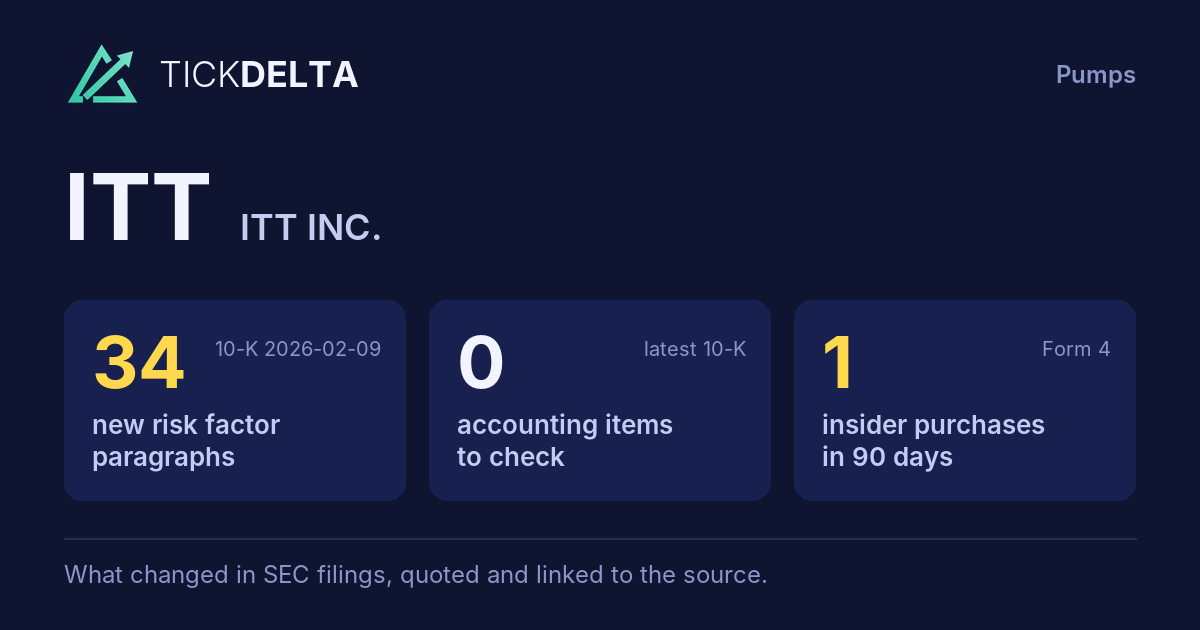
of the text changed · 8,799 words now · 34 new paragraphs, 2 gone
MD&A
29.9%
of the text changed · 9,523 words now · 28 new paragraphs, 20 gone
Legal Proceedings
4.1%
of the text changed · 1,016 words now
10-K 0000216228-26-000012 (Feb 9, 2026) vs 10-K 0000216228-25-000014 (Feb 10, 2025) Not compared: Accounting Policies.
Every paragraph, and how much of it changed
One bar per paragraph, in the order of the 10-K. Height and colour show the share of its words not in the closest paragraph a year earlier; the tallest bars are new paragraphs.
Risk Factors
98 paragraphs · 34 new · 18 reworded · 2 gone · 10-K Feb 9, 2026 against Feb 10, 2025
New paragraph
Reworded (5% of its words or more)
Same or nearly
Paragraph 62 · 48% changed
Every version of it
On August 16, 2022, the U.S. government enacted the Inflation Reduction Act of 2022 (the Inflation Reduction Act) into law. The Inflation Reduction Act includes a new corporate alternative minimum tax (the Corporate AMT) of 15% on the adjusted financial statement income (AFSI) (the "AFSI") of corporations with an average AFSI exceeding $1.0 billion over a three-year period. The Corporate AMT was effective for the Company beginning in 2023. Given the AFSI threshold, the Corporate AMT was not applicable to the Company in 2024, but the Corporate AMT may have potential impacts on our future U.S. tax expense, cash taxes and effective tax rate. Additionally, the Inflation Reduction Act imposes a 1% excise tax on the fair market value of net stock repurchases made after December 31, 2022. Although the impact of this provision was not material in 2024 and future impacts will be dependent on the extent of share repurchases made in future periods, there can be no assurance that our business operations and financial condition will not be materially impacted by this provision in the future.
Paragraph 63 · 26% changed
Every version of it
Paragraph 53 · 25% changed
Every version of it
The ESG factors by which companies’ corporate responsibility practices are assessed have been evolving and may continue to evolve. Additionally, requirements on U.S. public companies and companies with European operations with regards to ESG compliance have been increasing and may continue to increase, including, but not limited to California's Climate Accountability Laws and the European Union's Corporate Sustainability Reporting Directive (CSRD), which will require third-party assurance disclosures. These evolving standards and regulations have caused us, and may continue causing us, to undertake costly initiatives to satisfy such new criteria. If we are unable to satisfy new corporate responsibility criteria, investors may conclude our policies are inadequate and choose not to invest in our securities or to divest all or a portion of their current holdings, which in either case may adversely affect the price of our securities.
Paragraph 44 · 20% changed
Every version of it
Over the last seven several years the U.S. government has undertaken a series of actions to increase tariffs on certain goods imported into the U.S., particularly from China and other key trading partners. In early 2025, the U.S. There is government announced or extended tariffs on a possibility the current presidential administration may also impose new range of imported goods, including certain industrial components and raw materials, as part of ongoing trade actions. In response, several countries, including China, announced or increased U.S. import tariffs, initially focusing on goods from Mexico, Canada, and China, with the potential for additional countries to be affected. In response to prior tariffs, certain governments imposed implemented retaliatory tariffs on various goods, goods exported from the United States. These reciprocal trade measures have contributed to increased uncertainty in global trade policy and in response to new or increased U.S. tariffs, have threatened to similarly retaliate. supply chain dynamics. Prior tariffs have negatively impacted demand for our products as well as the cost of certain parts and materials that we purchase from vendors located overseas, particularly in China. Although we have been mitigating, and will continue attempting to mitigate, the impact of tariffs by supplier and customer negotiations, diversification strategies and pricing actions, there can be no assurance that our mitigation actions will be effective. At this time, it remains unclear what further measures will be implemented implemented, including changes to existing trade agreements or if the imposition of additional countries will impose retaliatory tariffs. Any new or continued trade disputes or increased tensions between the U.S. and other countries, and any governmental actions, including further increases of existing tariffs or the imposition of new tariffs, or changes to trade agreements applicable to our operations, may continue to adversely impact demand for our products, increase our costs, and disrupt our supply chain. These risks, in turn, could have a material adverse effect on our business results of operations and financial condition.
Paragraph 52 · 16% changed
Every version of it
There is an increasing focus from certain investors, customers and other key stakeholders on corporate responsibility, specifically related to ESG environmental, social, and governance ("ESG") matters, including companies' contribution to climate change and loss of biodiversity. Some investors have used, and may continue to use, ESG criteria to guide their investment strategies and, in some cases, have chosen, and may continue to choose, not to invest in ITT, or to divest their holdings of ITT if they believe our policies relating to corporate responsibility are inadequate. New U.S. and European Union climate-related disclosure requirements may require additional systems, internal controls, and assurance processes that could increase compliance costs.
Paragraph 47 · 13% changed
Every version of it
Our customer's customers' businesses, particularly those in the energy, chemical and mining industries, which represented approximately 11%, 8%, 16%, 9%, and 3%, respectively, of our 2024 2025 revenue, are to varying degrees cyclical and have experienced, and may in the future experience, periodic downturns of varying severity. For example, the volatility of the energy market has generally been dependent upon the prevailing view of future gas and oil prices, which are influenced by numerous supply and demand factors, including availability and cost of capital, global and domestic economic conditions, environmental regulations, policies of the Organization of the Petroleum Exporting Countries (OPEC) countries and Russia and other factors. Our customers in these industries, particularly those whose demand for our products and services is primarily profit-driven, have tended to delay large capital projects, including expensive maintenance and upgrades, during economic downturns. Additionally, fluctuating energy demand forecasts and commodity pricing and other macroeconomic factors may cause our customers to be more conservative in their capital planning, which could reduce demand for our products and services, result in the delay or cancellation of existing orders, or lead to excess manufacturing capacity, which unfavorably impacts our absorption of fixed manufacturing costs. This reduced demand may also erode average selling prices in our industry. These factors could have a material adverse effect on our business, results of operations and financial condition.
Paragraph 8 · 9% changed
Every version of it
We regularly review our portfolio of businesses and pursue growth through the acquisition of other companies, assets and product lines that either complement or expand our existing businesses. For example, on December 4, 2025, we entered into the Purchase Agreement for the acquisition of SPX FLOW, which remains subject to the satisfaction or waiver of customary closing conditions, including regulatory approvals. Refer to Note 22, Acquisitions, Investments, and Divestitures, for further information regarding acquisitions and investments made during the year and the pending acquisition of SPX FLOW. In addition, from time to time, we make minority investments in other early-stage companies, and we risk losing part or all of our capital in any such investment. Refer to Note 21, Acquisitions, Investments, and Divestitures, for further information regarding acquisitions and investments made during the year. Although we conduct what we believe to be a prudent level of investigation regarding the operating and financial condition of the businesses we acquire, a level of risk remains regarding the actual operating condition of these businesses. Until we actually assume operating control of these businesses and their operations, we may not be able to ascertain the actual value or understand the potential liabilities of, or challenges facing, the acquired businesses and their operations. Acquisitions Acquisitions, including the pending acquisition of SPX FLOW, involve a number of risks and present financial, managerial and operational challenges that could have a material adverse effect on our reputation, financial results and business. These include the possibility that:
Paragraph 76 · 49% changed
Every version of it
10-K Feb 10, 2025Due to our operations and sales outside of the U.S., we are subject to inherent business risks, including the imposition of tariffs, which may adversely affect our financial results.
10-K Feb 9, 2026
If the Acquisition is not completed, our ongoing business and financial results may be adversely affected and we will be subject to a number of risks, including the following:
Paragraph 62 · 48% changed
Every version of it
10-K Feb 10, 2025
On August 16, 2022, the U.S. government enacted the Inflation Reduction Act of 2022 (the Inflation Reduction Act) into law. The Inflation Reduction Act includes a new corporate alternative minimum tax (the Corporate AMT) of 15% on the adjusted financial statement income (AFSI) of corporations with an average AFSI exceeding $1.0 billion over a three-year period. The Corporate AMT was effective for the Company beginning in 2023. Given the AFSI threshold, the Corporate AMT was not applicable to the Company in 2024, but the Corporate AMT may have potential impacts on our future U.S. tax expense, cash taxes and effective tax rate. Additionally, the Inflation Reduction Act imposes a 1% excise tax on the fair market value of net stock repurchases made after December 31, 2022. Although the impact of this provision was not material in 2024 and future impacts will be dependent on the extent of share repurchases made in future periods, there can be no assurance that our business operations and financial condition will not be materially impacted by this provision in the future.
10-K Feb 9, 2026
On August 16, 2022, the U.S. government enacted the Inflation Reduction Act of 2022 (the Inflation Reduction Act) into law. The Inflation Reduction Act includes a new corporate alternative minimum tax (the Corporate AMT) of 15% on the adjusted financial statement income (the "AFSI") of corporations with an average AFSI exceeding $1.0
Paragraph 63 · 26% changed
Every version of it
10-K Feb 10, 2025On August 16, 2022, the U.S. government enacted the Inflation Reduction Act of 2022 (the Inflation Reduction Act) into law. The Inflation Reduction Act includes a new corporate alternative minimum tax (the Corporate AMT) of 15% on the adjusted financial statement income (AFSI) of corporations with an average AFSI exceeding $1.0 billion over a three-year period. The Corporate AMT was effective for the Company beginning in 2023. Given the AFSI threshold, the Corporate AMT was not applicable to the Company in 2024, but the Corporate AMT may have potential impacts on our future U.S. tax expense, cash taxes and effective tax rate. Additionally, the Inflation Reduction Act imposes a 1% excise tax on the fair market value of net stock repurchases made after December 31, 2022. Although the impact of this provision was not material in 2024 and future impacts will be dependent on the extent of share repurchases made in future periods, there can be no assurance that our business operations and financial condition will not be materially impacted by this provision in the future.
10-K Feb 9, 2026
billion over a three-year period. The Corporate AMT was effective for the Company beginning in 2023. Given the AFSI threshold, the Corporate AMT was not applicable to the Company in 2025, but the Corporate AMT may have potential impacts on our future U.S. tax expense, cash taxes and effective tax rate. Additionally, the Inflation Reduction Act imposes a 1% excise tax on the fair market value of net stock repurchases made after December 31, 2022. Although the impact of this provision was not material in prior years, we incurred $5.0 of excise tax on stock repurchases in 2025, and future impacts will depend on the extent of share repurchases in subsequent periods.
Paragraph 53 · 25% changed
Every version of it
10-K Feb 10, 2025
assurance disclosures. These evolving standards and regulations have caused us, and may continue causing us, to undertake costly initiatives to satisfy such new criteria. If we are unable to satisfy new corporate responsibility criteria, investors may conclude our policies are inadequate and choose not to invest in our securities or to divest all or a portion of their current holdings, which in either case may adversely affect the price of our securities.
10-K Feb 9, 2026
The ESG factors by which companies’ corporate responsibility practices are assessed have been evolving and may continue to evolve. Additionally, requirements on U.S. public companies and companies with European operations with regards to ESG compliance have been increasing and may continue to increase, including, but not limited to California's Climate Accountability Laws and the European Union's Corporate Sustainability Reporting Directive (CSRD), which will require third-party assurance disclosures. These evolving standards and regulations have caused us, and may continue causing us, to undertake costly initiatives to satisfy such new criteria. If we are unable to satisfy new corporate responsibility criteria, investors may conclude our policies are inadequate and choose not to invest in our securities or to divest all or a portion of their current holdings, which in either case may adversely affect the price of our securities.
Paragraph 44 · 20% changed
Every version of it
10-K Feb 10, 2025
Over the last seven years the U.S. government has undertaken a series of actions to increase tariffs on certain goods imported into the U.S. There is a possibility the current presidential administration may also impose new or increased U.S. import tariffs, initially focusing on goods from Mexico, Canada, and China, with the potential for additional countries to be affected. In response to prior tariffs, certain governments imposed retaliatory tariffs on various goods, and in response to new or increased U.S. tariffs, have threatened to similarly retaliate. Prior tariffs have negatively impacted demand for our products as well as the cost of certain parts and materials that we purchase from vendors located overseas, particularly in China. Although we have been mitigating, and will continue attempting to mitigate, the impact of tariffs by supplier and customer negotiations, diversification strategies and pricing actions, there can be no assurance that our mitigation actions will be effective. At this time, it remains unclear what further measures will be implemented or if additional countries will impose retaliatory tariffs. Any new or continued trade disputes or increased tensions between the U.S. and other countries, and any governmental actions, including further increases of existing tariffs or the imposition of new tariffs, may continue to adversely impact demand for our products, increase our costs, and disrupt our supply chain. These risks, in turn, could have a material adverse effect on our business results of operations and financial condition.
10-K Feb 9, 2026
Over the last several years the U.S. government has undertaken a series of actions to increase tariffs on certain goods imported into the U.S., particularly from China and other key trading partners. In early 2025, the U.S. government announced or extended tariffs on a range of imported goods, including certain industrial components and raw materials, as part of ongoing trade actions. In response, several countries, including China, announced or implemented retaliatory tariffs on goods exported from the United States. These reciprocal trade measures have contributed to increased uncertainty in global trade policy and supply chain dynamics. Prior tariffs have negatively impacted demand for our products as well as the cost of certain parts and materials that we purchase from vendors located overseas, particularly in China. Although we have been mitigating, and will continue attempting to mitigate, the impact of tariffs by supplier and customer negotiations, diversification strategies and pricing actions, there can be no assurance that our mitigation actions will be effective. At this time, it remains unclear what further measures will be implemented, including changes to existing trade agreements or the imposition of additional tariffs. Any new or continued trade disputes or increased tensions between the U.S. and other countries, and any governmental actions, including further increases of existing tariffs or the imposition of new tariffs, or changes to trade agreements applicable to our operations, may continue to adversely impact demand for our products, increase our costs, and disrupt our supply chain. These risks, in turn, could have a material adverse effect on our business results of operations and financial condition.
Paragraph 52 · 16% changed
Every version of it
10-K Feb 10, 2025
There is an increasing focus from certain investors, customers and other key stakeholders on corporate responsibility, specifically related to ESG matters, including companies' contribution to climate change and loss of biodiversity. Some investors have used, and may continue to use, ESG criteria to guide their investment strategies and, in some cases, have chosen, and may continue to choose, not to invest in ITT, or to divest their holdings of ITT if they believe our policies relating to corporate responsibility are inadequate.
10-K Feb 9, 2026
There is an increasing focus from certain investors, customers and other key stakeholders on corporate responsibility, specifically related to environmental, social, and governance ("ESG") matters, including companies' contribution to climate change and loss of biodiversity. Some investors have used, and may continue to use, ESG criteria to guide their investment strategies and, in some cases, have chosen, and may continue to choose, not to invest in ITT, or to divest their holdings of ITT if they believe our policies relating to corporate responsibility are inadequate. New U.S. and European Union climate-related disclosure requirements may require additional systems, internal controls, and assurance processes that could increase compliance costs.
Paragraph 47 · 13% changed
Every version of it
10-K Feb 10, 2025
Our customer's businesses, particularly those in the energy, chemical and mining industries, which represented approximately 11%, 8%, and 3%, respectively, of our 2024 revenue, are to varying degrees cyclical and have experienced, and may in the future experience, periodic downturns of varying severity. For example, the volatility of the energy market has generally been dependent upon the prevailing view of future gas and oil prices, which are influenced by numerous supply and demand factors, including availability and cost of capital, global and domestic economic conditions, environmental regulations, policies of the Organization of the Petroleum Exporting Countries (OPEC) countries and Russia and other factors. Our customers in these industries, particularly those whose demand for our products and services is primarily profit-driven, have tended to delay large capital projects, including expensive maintenance and upgrades, during economic downturns. Additionally, fluctuating energy demand forecasts and commodity pricing and other macroeconomic factors may cause our customers to be more conservative in their capital planning, which could reduce demand for our products and services, result in the delay or cancellation of existing orders, or lead to excess manufacturing capacity, which unfavorably impacts our absorption of fixed manufacturing costs. This reduced demand may also erode average selling prices in our industry. These factors could have a material adverse effect on our business, results of operations and financial condition.
10-K Feb 9, 2026
Our customers' businesses, particularly those in the energy, chemical and mining industries, which represented approximately 16%, 9%, and 3%, respectively, of our 2025 revenue, are to varying degrees cyclical and have experienced, and may in the future experience, periodic downturns of varying severity. For example, the volatility of the energy market has generally been dependent upon the prevailing view of future gas and oil prices, which are influenced by numerous supply and demand factors, including availability and cost of capital, global and domestic economic conditions, environmental regulations, policies of the Organization of the Petroleum Exporting Countries (OPEC) countries and Russia and other factors. Our customers in these industries, particularly those whose demand for our products and services is primarily profit-driven, have tended to delay large capital projects, including expensive maintenance and upgrades, during economic downturns. Additionally, fluctuating energy demand forecasts and commodity pricing and other macroeconomic factors may cause our customers to be more conservative in their capital planning, which could reduce demand for our products and services, result in the delay
Paragraph 8 · 9% changed
Every version of it
10-K Feb 10, 2025
We regularly review our portfolio of businesses and pursue growth through the acquisition of other companies, assets and product lines that either complement or expand our existing businesses. In addition, from time to time, we make minority investments in other early-stage companies, and we risk losing part or all of our capital in any such investment. Refer to Note 21, Acquisitions, Investments, and Divestitures, for further information regarding acquisitions and investments made during the year. Although we conduct what we believe to be a prudent level of investigation regarding the operating and financial condition of the businesses we acquire, a level of risk remains regarding the actual operating condition of these businesses. Until we actually assume operating control of these businesses and their operations, we may not be able to ascertain the actual value or understand the potential liabilities of, or challenges facing, the acquired businesses and their operations. Acquisitions involve a number of risks and present financial, managerial and operational challenges that could have a material adverse effect on our reputation, financial results and business. These include the possibility that:
10-K Feb 9, 2026
We regularly review our portfolio of businesses and pursue growth through the acquisition of other companies, assets and product lines that either complement or expand our existing businesses. For example, on December 4, 2025, we entered into the Purchase Agreement for the acquisition of SPX FLOW, which remains subject to the satisfaction or waiver of customary closing conditions, including regulatory approvals. Refer to Note 22, Acquisitions, Investments, and Divestitures, for further information regarding acquisitions and investments made during the year and the pending acquisition of SPX FLOW. In addition, from time to time, we make minority investments in other early-stage companies, and we risk losing part or all of our capital in any such investment. Although we conduct what we believe to be a prudent level of investigation regarding the operating and financial condition of the businesses we acquire, a level of risk remains regarding the actual operating condition of these businesses. Until we actually assume operating control of these businesses and their operations, we may not be able to ascertain the actual value or understand the potential liabilities of, or challenges facing, the acquired businesses and their operations. Acquisitions, including the pending acquisition of SPX FLOW, involve a number of risks and present financial, managerial and operational challenges that could have a material adverse effect on our reputation, financial results and business. These include the possibility that:
MD&A
126 paragraphs · 28 new · 40 reworded · 20 gone · 10-K Feb 9, 2026 against Feb 10, 2025
New paragraph
Reworded (5% of its words or more)
Same or nearly
Paragraph 10 · 50% changed
•Operating income of $676.0 $684.5 increased $147.8, primarily due to $6.4, as benefits from higher revenue volume, productivity and a $47.8 pricing, and contributions from acquisitions more than offset the prior year gain on sale of the Wolverine business in MT, partially offset by higher material, labor, overhead, M&A costs, of $47.8, cost inflation, increased restructuring, acquisition-related expenses, and unfavorable sales mix. Adjusted operating income increased 11.2%.
Paragraph 34 · 50% changed
General and administrative (G&A) expenses increased $2.1 $71.3 for the year ended December 31, 2024. The increase was 2025, primarily driven by the acquisitions of Svanehøj higher incentive-based compensation, restructuring expenses, acquisition-related expenses, and kSARIA, and a prior year gain of $3.7 associated with a lease termination, partially offset by the divestiture of the Wolverine business and lower incentive compensation cost. unfavorable foreign currency translation.
Paragraph 11 · 47% changed
•Income from continuing operations was $6.30 $6.11 per diluted share, a decrease of 3.3%, which primarily reflects the prior year gain on sale of Wolverine, a higher effective tax rate, and increased interest expense, partially offset by a lower weighted average share count. Adjusted EPS was $6.72, an increase of $1.33 as compared to 14.3%, reflecting the prior strength in core operations throughout the year. The increase was primarily due to higher operating income, and lower share count resulting from open-market share repurchases executed during the year, partially offset by higher interest due to acquisition-related debt, and higher corporate expenses.
Paragraph 61 · 45% changed
On August 5, 2021, July 30, 2025, we entered into a revolving credit facility agreement with a syndicate of third-party lenders including U.S. Bank National Association ("US Bank"), as administrative agent (the "2025 Revolving Credit Agreement"). Upon its effectiveness, the 2025 Revolving Credit Agreement replaced the revolving credit facility agreement that we entered into on August 5, 2021, with a syndicate of third-party lenders including Bank of America, N.A., as administrative agent (as amended, the (the 2021 Revolving Credit Agreement). The 2021 Revolving Credit Agreement was terminated on July 30, 2025 with no outstanding balances remaining. The 2025 Revolving Credit Agreement matures in August 2026 July 2030 and provides for an aggregate principal amount of up to $700 of (i) revolving extensions of credit (the revolving loans) outstanding at any time, and (ii) letters of credit $1,100. The 2025 Revolving Credit Agreement provides for a face amount potential increase of commitment of up to $100 $550 for a possible maximum of $1,650 in aggregate commitments at any time outstanding. Subject to certain conditions, we are permitted to terminate permanently the total commitments and reduce commitments by a minimum aggregate amount of $10 or any whole multiple of $1 in excess thereof. Borrowings under the credit facility are available in U.S. dollars, Euros, British pound sterling or any other currency that may be requested by us, subject to the approval request of the administrative Company and with the consent of the institutions providing such increase of commitments.
Paragraph 31 · 44% changed
Gross profit for 2025 was $1,392.4, reflecting a gross margin of 35.4%. Gross profit for 2024 was $1,247.3, $1,249.4, reflecting a gross margin of 34.4%. Gross profit for 2023 was $1,107.3, reflecting a gross margin of 33.7%. The increases in gross profit and gross margin were primarily driven by higher revenue, including benefits from pricing actions, described above in the section titled "Revenue", actions and volume growth, net savings from productivity and sourcing initiatives and favorable foreign currency translation, partially offset by increases in material and labor costs, as discussed above in the section titled "Global Macroeconomic Conditions". unfavorable sales mix.
Paragraph 43 · 44% changed
Paragraph 40 · 42% changed
MT operating income for the year ended December 31, 2024 increased $83.8 primarily due to a 2025 decreased $38.7, driven by the $47.8 gain on sale of the Wolverine business. In addition, operating income benefited from higher revenue and savings from productivity and sourcing initiatives business recognized in 2024, as well as lower material the loss of income following the divestiture, and overhead unfavorable foreign currency, pricing and sales mix impacts, and higher restructuring costs. Operating income growth The decrease was partially offset by higher labor costs productivity and strategic investments. supply chain savings and benefits from sales volume growth.
Paragraph 41 · 42% changed
IP operating income for the year ended December 31, 2024 2025 increased $32.7, $36.7, driven by benefits from pricing actions, higher revenue, as discussed above, sales volume, net savings from supply chain, restructuring, and productivity and sourcing initiatives. The increase was partially offset by higher material, labor, overhead, M&A costs, and unfavorable sales mix. initiatives, lower
Paragraph 10 · 50% changed
10-K Feb 10, 2025
•Operating income of $676.0 increased $147.8, primarily due to higher revenue and a $47.8 gain on sale of the Wolverine business in MT, partially offset by higher material, labor, overhead, M&A costs, and unfavorable sales mix.
10-K Feb 9, 2026
•Operating income of $684.5 increased $6.4, as benefits from higher volume, productivity and pricing, and contributions from acquisitions more than offset the prior year gain on sale of the Wolverine business of $47.8, cost inflation, increased restructuring, acquisition-related expenses, and unfavorable sales mix. Adjusted operating income increased 11.2%.
Paragraph 34 · 50% changed
10-K Feb 10, 2025
General and administrative (G&A) expenses increased $2.1 for the year ended December 31, 2024. The increase was primarily driven by the acquisitions of Svanehøj and kSARIA, and a prior year gain of $3.7 associated with a lease termination, partially offset by the divestiture of the Wolverine business and lower incentive compensation cost.
10-K Feb 9, 2026
General and administrative (G&A) expenses increased $71.3 for the year ended December 31, 2025, primarily driven by higher incentive-based compensation, restructuring expenses, acquisition-related expenses, and unfavorable foreign currency translation.
Paragraph 11 · 47% changed
10-K Feb 10, 2025
•Income from continuing operations was $6.30 per diluted share, an increase of $1.33 as compared to the prior year. The increase was primarily due to higher operating income, and lower share count resulting from open-market share repurchases executed during the year, partially offset by higher interest due to acquisition-related debt, and higher corporate expenses.
10-K Feb 9, 2026
•Income from continuing operations was $6.11 per diluted share, a decrease of 3.3%, which primarily reflects the prior year gain on sale of Wolverine, a higher effective tax rate, and increased interest expense, partially offset by a lower weighted average share count. Adjusted EPS was $6.72, an increase of 14.3%, reflecting the strength in core operations throughout the year.
Paragraph 61 · 45% changed
10-K Feb 10, 2025
On August 5, 2021, we entered into a revolving credit facility agreement with a syndicate of third-party lenders including Bank of America, N.A., as administrative agent (as amended, the 2021 Revolving Credit Agreement). The 2021 Revolving Credit Agreement matures in August 2026 and provides for an aggregate principal amount of up to $700 of (i) revolving extensions of credit (the revolving loans) outstanding at any time, and (ii) letters of credit for a face amount up to $100 at any time outstanding. Subject to certain conditions, we are permitted to terminate permanently the total commitments and reduce commitments by a minimum aggregate amount of $10 or any whole multiple of $1 in excess thereof. Borrowings under the credit facility are available in U.S. dollars, Euros, British pound sterling or any other currency that may be requested by us, subject to the approval of the administrative
10-K Feb 9, 2026
On July 30, 2025, we entered into a revolving credit facility agreement with a syndicate of third-party lenders including U.S. Bank National Association ("US Bank"), as administrative agent (the "2025 Revolving Credit Agreement"). Upon its effectiveness, the 2025 Revolving Credit Agreement replaced the revolving credit facility agreement that we entered into on August 5, 2021, with a syndicate of third-party lenders including Bank of America, N.A., as administrative agent (the 2021 Revolving Credit Agreement). The 2021 Revolving Credit Agreement was terminated on July 30, 2025 with no outstanding balances remaining. The 2025 Revolving Credit Agreement matures in July 2030 and provides for an aggregate principal amount of up to $1,100. The 2025 Revolving Credit Agreement provides for a potential increase of commitment of up to $550 for a possible maximum of $1,650 in aggregate commitments at the request of the Company and with the consent of the institutions providing such increase of commitments.
Paragraph 31 · 44% changed
10-K Feb 10, 2025
Gross profit for 2024 was $1,247.3, reflecting a gross margin of 34.4%. Gross profit for 2023 was $1,107.3, reflecting a gross margin of 33.7%. The increases in gross profit and gross margin were primarily driven by higher revenue, including pricing actions, described above in the section titled "Revenue", partially offset by increases in material and labor costs, as discussed above in the section titled "Global Macroeconomic Conditions".
10-K Feb 9, 2026
Gross profit for 2025 was $1,392.4, reflecting a gross margin of 35.4%. Gross profit for 2024 was $1,249.4, reflecting a gross margin of 34.4%. The increases in gross profit and gross margin were primarily driven by benefits from pricing actions and volume growth, net savings from productivity and sourcing initiatives and favorable foreign currency translation, partially offset by unfavorable sales mix.
Paragraph 43 · 44% changed
10-K Feb 10, 2025IP operating income for the year ended December 31, 2024 increased $32.7, driven by higher revenue, as discussed above, savings from productivity and sourcing initiatives. The increase was partially offset by higher material, labor, overhead, M&A costs, and unfavorable sales mix.
10-K Feb 9, 2026
CCT operating income for the year ended December 31, 2025 increased $32.1, driven by benefits from pricing actions, net savings from productivity, sourcing, and restructuring initiatives, higher sales volume, and contributions from kSARIA. The increase was partially offset by higher strategic investment costs, and temporary acquisition related amortization associated with kSARIA.
Paragraph 40 · 42% changed
10-K Feb 10, 2025
MT operating income for the year ended December 31, 2024 increased $83.8 primarily due to a $47.8 gain on sale of the Wolverine business. In addition, operating income benefited from higher revenue and savings from productivity and sourcing initiatives as well as lower material and overhead costs. Operating income growth was partially offset by higher labor costs and strategic investments.
10-K Feb 9, 2026
MT operating income for the year ended December 31, 2025 decreased $38.7, driven by the $47.8 gain on sale of the Wolverine business recognized in 2024, as well as the loss of income following the divestiture, and unfavorable foreign currency, pricing and sales mix impacts, and higher restructuring costs. The decrease was partially offset by productivity and supply chain savings and benefits from sales volume growth.
Paragraph 41 · 42% changed
10-K Feb 10, 2025
IP operating income for the year ended December 31, 2024 increased $32.7, driven by higher revenue, as discussed above, savings from productivity and sourcing initiatives. The increase was partially offset by higher material, labor, overhead, M&A costs, and unfavorable sales mix.
10-K Feb 9, 2026
IP operating income for the year ended December 31, 2025 increased $36.7, driven by benefits from pricing actions, higher sales volume, net savings from supply chain, restructuring, and productivity initiatives, lower
A paragraph is matched with the one last year that shares the most of its words; under half in common makes it new. The paragraphs shown are the 8 reworded the most in each section.
The paragraph that changed most in each section
The redline
Marked against last year's 10-K: cut words struck through, new words highlighted.
MD&A174 words changed in this paragraph; it is 42% similar to last year's version.
On August 5, 2021, July 30, 2025, we entered into a revolving credit facility agreement with a syndicate of third-party lenders including U.S. Bank National Association ("US Bank"), as administrative agent (the "2025 Revolving Credit Agreement"). Upon its effectiveness, the 2025 Revolving Credit Agreement replaced the revolving credit facility agreement that we entered into on August 5, 2021, with a syndicate of third-party lenders including Bank of America, N.A., as administrative agent (as amended, the (the 2021 Revolving Credit Agreement). The 2021 Revolving Credit Agreement was terminated on July 30, 2025 with no outstanding balances remaining. The 2025 Revolving Credit Agreement matures in August 2026 July 2030 and provides for an aggregate principal amount of up to $700 of (i) revolving extensions of credit (the revolving loans) outstanding at any time, and (ii) letters of credit $1,100. The 2025 Revolving Credit Agreement provides for a face amount potential increase of commitment of up to $100 $550 for a possible maximum of $1,650 in aggregate commitments at any time outstanding. Subject to certain conditions, we are permitted to terminate permanently the total commitments and reduce commitments by a minimum aggregate amount of $10 or any whole multiple of $1 in excess thereof. Borrowings under the credit facility are available in U.S. dollars, Euros, British pound sterling or any other currency that may be requested by us, subject to the approval request of the administrative Company and with the consent of the institutions providing such increase of commitments.
Source: Item 7, 10-K 0000216228-26-000012 vs Item 7, 10-K 0000216228-25-000014
Risk Factors149 words changed in this paragraph; it is 70% similar to last year's version.
Over the last seven several years the U.S. government has undertaken a series of actions to increase tariffs on certain goods imported into the U.S., particularly from China and other key trading partners. In early 2025, the U.S. There is government announced or extended tariffs on a possibility the current presidential administration may also impose new range of imported goods, including certain industrial components and raw materials, as part of ongoing trade actions. In response, several countries, including China, announced or increased U.S. import tariffs, initially focusing on goods from Mexico, Canada, and China, with the potential for additional countries to be affected. In response to prior tariffs, certain governments imposed implemented retaliatory tariffs on various goods, goods exported from the United States. These reciprocal trade measures have contributed to increased uncertainty in global trade policy and in response to new or increased U.S. tariffs, have threatened to similarly retaliate. supply chain dynamics. Prior tariffs have negatively impacted demand for our products as well as the cost of certain parts and materials that we purchase from vendors located overseas, particularly in China. Although we have been mitigating, and will continue attempting to mitigate, the impact of tariffs by supplier and customer negotiations, diversification strategies and pricing actions, there can be no assurance that our mitigation actions will be effective. At this time, it remains unclear what further measures will be implemented implemented, including changes to existing trade agreements or if the imposition of additional countries will impose retaliatory tariffs. Any new or continued trade disputes or increased tensions between the U.S. and other countries, and any governmental actions, including further increases of existing tariffs or the imposition of new tariffs, or changes to trade agreements applicable to our operations, may continue to adversely impact demand for our products, increase our costs, and disrupt our supply chain. These risks, in turn, could have a material adverse effect on our business results of operations and financial condition.
Source: Item 1A, 10-K 0000216228-26-000012 vs Item 1A, 10-K 0000216228-25-000014
Legal Proceedings40 words changed in this paragraph; it is 76% similar to last year's version.
Bartek Makowiecki has served as our Senior Vice President, Chief Strategy Officer & President, Industrial Process since September 2024. Mr. Makowiecki previously served as our Senior Vice President, Strategy and Business Development since September 2021. Prior to joining ITT, he served as Global Head of Strategy, M&A and Venturing of Ingredion Incorporated from October 2017 to September 2021. Immediately prior, he served as Director, Corporate Strategy & Head of M&A at Owens Corning from November 2015 to October 2017. Prior to that, Mr. Makowiecki held roles of increasing responsibility in global strategy and M&A at Parker-Hannifin Corporation from August 2003 to October 2015.
Source: Item 3, 10-K 0000216228-26-000012 vs Item 3, 10-K 0000216228-25-000014
Sentences and paragraphs added, removed or reworded
Every change, by type
Sentences and paragraphs of ITT's Risk Factors and MD&A, 10-K Feb 9, 2026 against 10-K Feb 10, 2025. Each links to the text at sec.gov.
Quiet changes are sentences kept from last year with one to four words changed, at least one of them a hedge, a modal or a qualifier (may, could, will, not, significant, material…). A year or date rolling forward is not counted.
The full word list
adverse, adversely, all, although, anticipate, anticipates, any, approximately, believe, believes, can, cannot, certain, could, expect, expects, generally, however, if, intend, intends, largely, likely, many, material, materially, may, might, most, must, never, no, not, possible, primarily, probable, should, significant, significantly, some, substantial, substantially, unlikely, will, would
AddedRisk Factors
The integration of artificial intelligence ("AI") into our engineering and manufacturing processes could amplify cybersecurity risks, including unauthorized access to proprietary data and disruption of production systems. AI usage can expand our attack surface and increase the sensitivity and volume of data processed. Threat actors may exploit AI systems (including generative models) to enable more sophisticated phishing, deepfake social engineering, and automated vulnerability discovery. In addition, we depend on third-party AI tools, cloud platforms, and model providers; deficiencies in those vendors’ security, privacy, or model governance could create risks we cannot fully control. The unavailability of our information technology systems, the failure of these systems to perform as anticipated for any reason, or any significant breach of security could cause significant disruption to our business or could result in decreased performance and increased costs.
Read it in 10-K Feb 9, 2026 at sec.gov
AddedRisk Factors
We may face risks related to the use of Artificial Intelligence and Generative AI technologies
Read it in 10-K Feb 9, 2026 at sec.gov
AddedRisk Factors
We may leverage machine learning (“ML”) and artificial intelligence (“AI”), including generative AI (“GenAI”), in our business to improve efficiency and innovation within our operations. This may introduce risks related to cybersecurity, data integrity, and inadvertent misuse, as well as ethical and social concerns. While we have implemented governance measures, including a GenAI Governance Committee and restrictions limiting usage to approved enterprise-level tools, these controls may not fully address risks associated with rapidly evolving technologies, provider practices, and competitive adoption. Controls related to AI lifecycle management—covering data stewardship, bias detection, reliability testing, human oversight, incident response, and decommissioning are evolving and may not mitigate all risks. Failure to implement effective AI observability, traceability, and post-deployment monitoring could impair our ability to detect and remedy issues promptly.
Read it in 10-K Feb 9, 2026 at sec.gov
AddedRisk Factors
AI algorithms may be flawed or biased, and datasets used to train AI systems may be insufficient, unlawfully obtained, or contain personal or protected information without proper rights. These issues could lead to inaccurate or discriminatory outputs, infringement of intellectual property or data privacy rights, and other legal or regulatory violations, as well as adversely affect our business, financial condition, and results of operations. Furthermore, our competitors or other third parties may incorporate AI into their operational processes more quickly or more successfully than us, which could have a material adverse effect on our competitive position, reputation, and operations.
Read it in 10-K Feb 9, 2026 at sec.gov
AddedRisk Factors
Agentic AI systems are tools capable of autonomously initiating tasks, making decisions, or executing multi-step actions without direct human prompting, which may introduce additional operational, security, and compliance risks. These systems could take actions outside intended business parameters, propagate errors at scale, or interact with internal and external systems in unanticipated ways, increasing the likelihood of operational disruptions or regulatory exposure. Agentic AI may also heighten risks related to model alignment, permissions design, and dependency on third party control mechanisms, any of which may fail to function as expected. If agentic AI systems behave unpredictably, are misconfigured, or are exploited by malicious actors, they could result in unauthorized transactions, data leakage, safety incidents, or other adverse impacts. If we are unable to effectively govern or oversee these autonomous capabilities, we could experience material and negative affects to our business, reputation, financial condition, and results of operations.
Read it in 10-K Feb 9, 2026 at sec.gov
AddedRisk Factors
The legal, regulatory, and compliance environments surrounding the design and use of AI technology at the federal, state, and international levels are evolving and complex. For example, the European Union’s Artificial Intelligence Act establishes obligations based on risk classifications, and U.S. federal and state agencies continue
Read it in 10-K Feb 9, 2026 at sec.gov
AddedRisk Factors
to introduce new frameworks governing AI. Compliance with these evolving regulations could entail significant costs and negatively affect our business. Additionally, AI-related changes may disrupt our industry, lower barriers to entry, and increase competition from larger or better-funded companies with more advanced AI capabilities. If our AI initiatives fail to deliver anticipated benefits or if we cannot adapt to evolving customer expectations, regulatory requirements, or competitive pressures, our business, reputation, financial condition, and results of operations could be materially and adversely affected.
Read it in 10-K Feb 9, 2026 at sec.gov
AddedRisk Factors
or cancellation of existing orders, or lead to excess manufacturing capacity, which unfavorably impacts our absorption of fixed manufacturing costs. This reduced demand may also erode average selling prices in our industry. These factors could have a material adverse effect on our business, results of operations and financial condition.
Read it in 10-K Feb 9, 2026 at sec.gov
Show the other 54
AddedRisk Factors
The acquisition of SPX FLOW (the "Acquisition") may not be completed within the expected timeframe, or at all, and the failure to complete the Acquisition could adversely impact our stock price and our future business and financial results.
Read it in 10-K Feb 9, 2026 at sec.gov
AddedRisk Factors
There can be no assurance that the Acquisition will be completed in the expected timeframe, or at all. The Purchase Agreement contains a number of conditions that must be satisfied or waived prior to the completion of the Acquisition, including regulatory approvals. We can provide no assurance that all closing conditions will be satisfied (or waived, if applicable). Many of the conditions to completion of the Acquisition are not within our control, and we cannot predict when or if these conditions will be satisfied (or waived, as applicable). Whether or not the Acquisition is completed:
Read it in 10-K Feb 9, 2026 at sec.gov
AddedRisk Factors
•while the Purchase Agreement is in force, we are subject to certain restrictions on the conduct of our business, including taking any action that would reasonably be expected to have a material negative impact on or materially delay the satisfaction of the conditions in the Purchase Agreement required to consummate the Acquisition, which restrictions may adversely affect our ability to execute certain of our business strategies; and
Read it in 10-K Feb 9, 2026 at sec.gov
AddedRisk Factors
•matters relating to the Acquisition (including integration planning) may require substantial commitments of time and resources by our management, which could otherwise have been devoted to other opportunities that may have been beneficial to us.
Read it in 10-K Feb 9, 2026 at sec.gov
RemovedRisk Factors
RemovedRisk Factors
RewordedRisk Factors
Although the impact of this provision was not material in 2024 prior years, we incurred $5.0 of excise tax on stock repurchases in 2025, and future impacts will be dependent depend on the extent of share repurchases made in future periods, there can be no assurance that our business operations and financial condition will not be materially impacted by this provision in the future. subsequent periods.
Read it in 10-K Feb 9, 2026 at sec.gov
RewordedRisk Factors
Additionally, fluctuating energy demand forecasts and commodity pricing and other macroeconomic factors may cause our customers to be more conservative in their capital planning, which could reduce demand for our products and services, result in the delay or cancellation of existing orders, or lead to excess manufacturing capacity, which unfavorably impacts our absorption of fixed manufacturing costs.
Read it in 10-K Feb 9, 2026 at sec.gov
RewordedRisk Factors
Commodity prices and the prices for other raw materials necessary for production have fluctuated, and may continue to fluctuate, and in 2024 increases in raw material costs negatively impacted which represent a potential risk for our financial results.
Read it in 10-K Feb 9, 2026 at sec.gov
RewordedRisk Factors
At this time, it remains unclear what further measures will be implemented implemented, including changes to existing trade agreements or if the imposition of additional countries will impose retaliatory tariffs.
Read it in 10-K Feb 9, 2026 at sec.gov
RewordedRisk Factors
Over the last seven several years the U.S. government has undertaken a series of actions to increase tariffs on certain goods imported into the U.S. U.S., particularly from China and other key trading partners.
Read it in 10-K Feb 9, 2026 at sec.gov
RewordedRisk Factors
We are subject to a variety of federal, state, local and foreign laws, rules and regulations related to the use, storage, handling, discharge or disposal of certain toxic, volatile or otherwise hazardous chemicals, gases and other substances chemicals used in manufacturing our products, as well as laws related to greenhouse gas emissions (including cap-and-trade laws).
Read it in 10-K Feb 9, 2026 at sec.gov
RewordedRisk Factors
RewordedRisk Factors
Any new or continued trade disputes or increased tensions between the U.S. and other countries, and any governmental actions, including further increases of existing tariffs or the imposition of new tariffs, or changes to trade agreements applicable to our operations, may continue to adversely impact demand for our products, increase our costs, and disrupt our supply chain.
Read it in 10-K Feb 9, 2026 at sec.gov
RewordedRisk Factors
RewordedRisk Factors
Our customer's customers' businesses, particularly those in the energy, chemical and mining industries, which represented approximately 11%, 8%, 16%, 9%, and 3%, respectively, of our 2024 2025 revenue, are to varying degrees cyclical and have experienced, and may in the future experience, periodic downturns of varying severity.
Read it in 10-K Feb 9, 2026 at sec.gov
RewordedRisk Factors
The Inflation Reduction Act includes a new corporate alternative minimum tax (the Corporate AMT) of 15% on the adjusted financial statement income (AFSI) (the "AFSI") of corporations with an average AFSI exceeding $1.0 billion over a three-year period.
Read it in 10-K Feb 9, 2026 at sec.gov
RewordedRisk Factors
Sales to Continental, Aumovio SE, a supplier to the automotive industry and ITT's largest customer, were approximately 7% 6% of our total revenue in 2024. 2025.
Read it in 10-K Feb 9, 2026 at sec.gov
AddedMD&A
Effective January 1, 2025, the Company changed its method of determining the cost for certain inventories from a last-in, first-out (LIFO) to first-in, first out (FIFO) for all inventories previously accounted for under LIFO. For additional information on the change in accounting principle, refer to Note 1, Description of Business and Basis of Presentation. Management’s discussion and analysis of financial condition and results of operations have been adjusted to reflect the change in accounting principle.
Read it in 10-K Feb 9, 2026 at sec.gov
AddedMD&A
•Revenue of $3,938.5 increased $307.8, or 8.5%, due to growth in each of our three business segments. IP drove significant growth with pump projects, CCT saw strength across connectors and components within the aerospace and defense markets, and MT continued to outperform with share gains in automotive and strength in rail, resulting in total ITT organic revenue growth of 4.8% for the year. In addition, the 2025 results included incremental revenue of $161.5, primarily from our 2024 acquisition of kSARIA, and benefitted from favorable foreign currency translation of $64.6. The 2024 Wolverine divestiture reduced our total revenue growth by $89.2.
Read it in 10-K Feb 9, 2026 at sec.gov
AddedMD&A
•Capital expenditures over $120 for the second year in a row, reflecting our continued commitment to fund future growth through capacity expansion, productivity and innovation.
Read it in 10-K Feb 9, 2026 at sec.gov
AddedMD&A
•Executed repurchases of 3.8 shares of common stock on the open market for $521.0.
Read it in 10-K Feb 9, 2026 at sec.gov
AddedMD&A
•Enter into a definitive agreement to acquire SPX FLOW for $4,775 to be funded through a combination of cash and equity.
Read it in 10-K Feb 9, 2026 at sec.gov
AddedMD&A
Throughout 2025, global macroeconomic conditions evolved against a backdrop of geopolitical uncertainty and shifting market demands. While these dynamics created areas of variability, the Company continued to apply disciplined execution and strategic investment across its businesses. In 2026 we expect demand to remain firm, but with variation between industrial end markets. In addition, changes in tariffs and trade policies, geopolitical and energy market risk, workforce availability and cost, technology transformation and cost inflation are factors that we are watching that may impact our performance going forward.
Read it in 10-K Feb 9, 2026 at sec.gov
AddedMD&A
Tariffs and Trade Policies: Ongoing tariff regimes and changes in global trade frameworks may influence input costs and sourcing patterns. At the same time, these dynamics reinforce the value of our multi‑sourcing, localization, and regional manufacturing strategies. We also continue to monitor developments associated with the United States‑Mexico‑Canada Agreement (USMCA) and ensure that our operations, supply‑chain partners, and cross‑border flows remain compliant with its requirements. Adhering to USMCA rules of origin, documentation standards, and regional content thresholds helps support stable access to North American markets, reduces potential trade-related disruptions, mitigates trade duties, and lowers costs.
Read it in 10-K Feb 9, 2026 at sec.gov
AddedMD&A
Geopolitical and Energy Market Risk: Geopolitical developments may impact supply chains, energy pricing trends, and defense-related procurement. For example, while such factors can shift project timing in certain Industrial Process markets, our growing presence in critical flow technologies and resilient aftermarket channels helps balance exposure. Moreover, select programs in Connect & Control Technologies may benefit from sustained investments in defense and security. Overall, our portfolio evolution aims to strengthen durability across macro cycles.
Read it in 10-K Feb 9, 2026 at sec.gov
AddedMD&A
Workforce Availability and Cost: Tight labor markets and specialized skill requirements remain industry‑wide considerations. We continue to address these trends through talent development and selective automation, which help maintain high levels of quality and delivery performance. These efforts strengthen our long‑term operational capabilities and support sustainable growth.
Read it in 10-K Feb 9, 2026 at sec.gov
AddedMD&A
Technology Transformation: Accelerating advancements in automation, data analytics, and artificial intelligence continue to reshape manufacturing and industrial solutions. We view this shift as an opportunity to further enhance efficiency, reliability, and customer value but it also exposes us to additional cyber related risks and the possibility
Read it in 10-K Feb 9, 2026 at sec.gov
AddedMD&A
that our competitors are able to adapt and utilize this technology at a faster pace and with greater success than we do, We are expanding digital investments across operations and product lines, including technologies that improve energy efficiency and reduce operating costs for customers.
Read it in 10-K Feb 9, 2026 at sec.gov
AddedMD&A
Supply Chain and Cost Inflation: We continue to experience variability in material availability, logistics conditions, and input costs caused by supply chain disruptions, geopolitical developments and tariff pressures. We are using dual‑sourcing strategies, long‑term agreements, strengthened supplier partnerships, and targeted inventory buffers to support consistent delivery performance and help mitigate potential impacts.
Read it in 10-K Feb 9, 2026 at sec.gov
RemovedMD&A
RemovedMD&A
RemovedMD&A
RemovedMD&A
RemovedMD&A
RemovedMD&A
RemovedMD&A
RemovedMD&A
RemovedMD&A
RemovedMD&A
RemovedMD&A
RemovedMD&A
RewordedMD&A
Revenue Operating Income Operating Margin EPS $3,631 $676 18.6% $6.30 10.6% $3,939 $685 17.4% $6.11 8.5% Increase 28.0% 0.9% Increase 250bp Increase 26.8% Increase (130)bp Decrease (3.3)% Decrease Organic Revenue Adjusted Operating Income Adjusted Operating Margin Adjusted EPS $3,425 $643 17.7% $5.86 6.9% $3,712 $717 18.2% $6.72 4.8% Increase 15.9% 11.2% Increase 80bp 40bp Increase 12.5% 14.3% Increase
Read it in 10-K Feb 9, 2026 at sec.gov
RewordedMD&A
RewordedMD&A
Our non-U.S. pension plans, which are typically not funded due to local regulations, had a decrease in projected benefit obligation of $12.0 $0.3 during 2024, 2025, primarily due to an actuarial gain of $6.8 and benefits paid of $3.7, offset by foreign currency impacts, the settlement translation of a plan in connection with the divestiture of Wolverine and a higher discount rate. $7.8.
Read it in 10-K Feb 9, 2026 at sec.gov
RewordedMD&A
For the Year Ended December 31 2025 2024 2023 Change General and administrative expenses $ 296.6 368.4 $ 294.5 0.7% 297.1 24.0% Sales and marketing expenses 228.7 205.7 174.0 18.2% 11.2% Research and development expenses 110.8 116.3 102.6 13.4% (4.7)% (Gain) loss on sale of businesses — (47.8) 8.1 ** (Gain) loss on sale of long-lived assets 0.5 (0.1) ** Total operating expenses $ 707.9 $ 571.3 $ 579.1 (1.3)% 23.9% By Segment:
Read it in 10-K Feb 9, 2026 at sec.gov
RewordedMD&A
MT revenue for the year ended December 31, 2024 2025 decreased $10.0 $19.6 primarily due to driven by the loss prior year divestiture of $68.7 the Wolverine business which generated $89.1 of revenue as a result of the divestiture of Wolverine in July during 2024.
Read it in 10-K Feb 9, 2026 at sec.gov
RewordedMD&A
RewordedMD&A
RewordedMD&A
The increase in net cash from operating activities of $24.6 $106.2 was primarily driven by due to higher operating income and customer advance payments, favorable net working capital impacts primarily from focused inventory management and timing of accounts receivable collections, offset by higher and lower compensation payments in the current year.
Read it in 10-K Feb 9, 2026 at sec.gov
RewordedMD&A
For the Year Ended December 31 2025 2024 2023 Change Interest expense $ 48.1 $ 36.6 $ 19.2 90.6% 31.4% Interest income (10.7) (6.6) (8.8) (25.0)% 62.1% Non-operating postretirement cost (benefit), net (1.1) 0.2 (0.4) (150.0)% 650.0% Other non-operating income, net (3.3) (1.8) (1.3) 38.5% 83.3% Total interest and other non-operating expense, net $ 33.0 $ 28.4 $ 8.7 226.4% 16.2%
Read it in 10-K Feb 9, 2026 at sec.gov
RewordedMD&A
Revenue growth for the year was partially offset by a weaker slower demand for electric vehicle charging applications and the loss of $10.2 of revenue from our Matrix business which we divested in December 2023. applications.
Read it in 10-K Feb 9, 2026 at sec.gov
RewordedMD&A
Sales and marketing expenses increased $31.7 $23.0 for the year ended December 31, 2024, 2025, primarily driven by the additions of kSARIA and Svanehøj, as well as higher personnel personnel, commissions, and other selling and marketing-related costs to support higher sales activity. activity, as well as increased intangible amortization expenses.
Read it in 10-K Feb 9, 2026 at sec.gov
RewordedMD&A
Excluding the impacts from acquisition, divestiture, acquisitions and foreign currency translation, organic revenue increased $64.0 $51.5, or 9.3%. 6.2%, reflecting growth in connectors of 5% and components of 7%, primarily within the aerospace and defense markets.
Read it in 10-K Feb 9, 2026 at sec.gov
Sources
The two latest 10-Ks on EDGAR, section by section. Each change links to the text at sec.gov.
Also
New risk factors: paragraphs with nothing like them last year, quoted in full.
Work with it
Excel workbook · CSV. Google Sheet that stays up to date: paste =IMPORTDATA("https://tickdelta.com/company/ITT/export.csv") into a cell.