RemovedRisk Factors
The 10-K against last year's
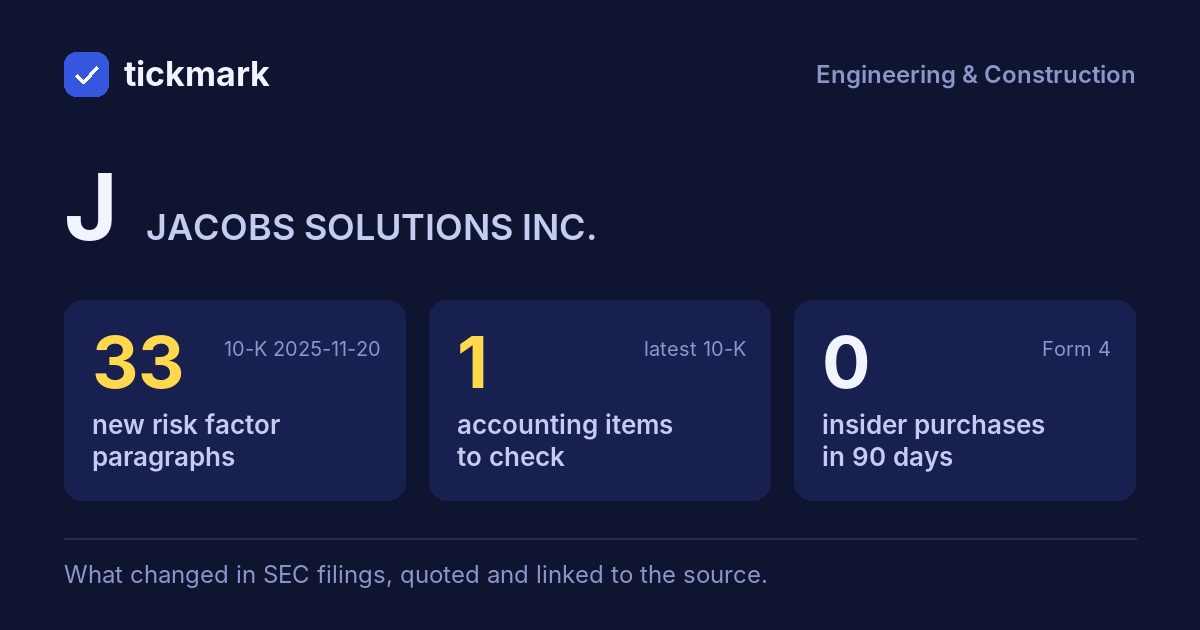
221 changes: 46 added, 30 removed, 142 reworded, 3 quiet changes
10-K 0001628280-25-053316 (2025-11-20) vs 10-K 0000052988-24-000065 (2024-11-25)
The redline
The paragraph that changed most in each section
Marked against last year's 10-K:
cut words struck through, new words highlighted and underlined.
MD&A 332 words changed in this paragraph; it is 40% similar to last year's version.
Net earnings attributable to the Company from continuing operations for fiscal 2024 2025 were $313.3 million (or $2.58 per diluted share), a decrease of $299.5 million, or 48.9%, from $612.8 million (or $4.79 per diluted share), an increase of $233.7 million, or 61.6%, from $379.1 million (or $3.05 per diluted share) for the prior year. The Our reported net earnings for the current year results reflected were favorably impacted by higher year-over-year operating gross profit of $16.0 million, which benefited from favorable year-over-year underlying operating results, $152.2 million compared to the prior year, primarily driven by stronger performance in the our Infrastructure & Advanced Facilities ("I&AF") operating segment, specifically in the Advanced Facilities, Europe and Asia, Pacific and Middle East ("APME") businesses, as well as growth in our PA Consulting operating segment, as discussed below in the Segment Financial Information section. Further, While current year results reflected higher year-over-year underlying gross profit, the Company’s results from continuing operations for fiscal 2025 were favorably unfavorably impacted by $186.9 an increase in miscellaneous expense of $409.1 million primarily as a result of $227.3 million in pre-tax mark-to-market gains associated with losses relating to our investment in Amentum stock recorded in connection with the Separation Transaction compared to $186.9 million in gains relating to the same investment in the prior year. Fiscal 2025 comparative results were also unfavorably impacted by a prior year realized gain of $35.2 million from settlement of interest rate swaps in fiscal 2024 and $20.5 million in discounts and expenses recorded to Loss on extinguishment of debt associated with our Equity-for-Debt Transaction on March 13, 2025, where the Company exchanged shares of our investment in Amentum Holdings, Inc. for a principal amount of term loans under the 2021 Term Loan Facility, which term loans were immediately extinguished (see Note 9- Borrowings and Note 14- Discontinued Operations). The favorable underlying operating performance was achieved despite higher year over year These unfavorable impacts were partly offset by an increase in TSA-related income and a decrease in interest expense included in miscellaneous expense as well as a decrease in pre-tax Restructuring and other charges and transaction costs due of $104.6 million reported in Selling, general & administrative ("SG&A") expenses compared to the fiscal 2024 period, primarily to expenses incurred relating to associated with the Separation Transaction amounting to $144.2 million (primarily (mainly professional services and employee separation costs), compared to fiscal 2023 amounts of $142.5 million mainly associated with the Company's Restructuring and other charges and transaction costs relating to expenses incurred which are discussed in conjunction with the real estate transformation rescaling initiatives and the PA Consulting restructuring program charges (primarily employee separation costs) and expenses incurred relating to the Separation Transaction (primarily professional services). See Note 17- 16- Restructuring and Other Charges.
Source: Item 7, 10-K 0001628280-25-053316 vs Item 7, 10-K 0000052988-24-000065
Risk Factors 234 words changed in this paragraph; it is 50% similar to last year's version.
There is increased increasing scrutiny from governmental organizations, clients, investors, suppliers, partners, communities, employees and employees other stakeholders on companies’ environmental, social, and governance (“ESG”) practices and disclosures, disclosures related to sustainability and corporate responsibility, including with respect to inclusion climate change and diversity. carbon emissions, human rights, ethics, supply chain management and human capital management. If our ESG practices, including our goals for inclusion practices and diversity, disclosures related to sustainability and corporate responsibility do not meet evolving rules and regulations or stakeholder expectations and standards (or if we are viewed negatively based on positions we do or do not take or work we do or do not perform or cannot publicly disclose for certain clients and industries), then our reputation, reputation and our ability to attract or and/or retain new clients and leading experts, employees and other professionals and our ability to attract new business and clients could be negatively impacted, as could our attractiveness as an investment, service provider, employer, or business partner. partner, and further, could lead to lawsuits, penalties or market access restrictions. Similarly, any failure or perceived failure in our efforts to execute our ESG strategy or our diversity and inclusion strategy and achieve our current or future related sustainability and corporate responsibility-related goals, targets, and objectives, or to satisfy various reporting standards within the timelines expected advance our related initiatives, including by stakeholders or at all, could also result in similar negative impacts. Organizations that provide information to investors on corporate governance and related matters have developed rating processes for evaluating companies on their approach to ESG matters, and unfavorable ratings of our ESG efforts may lead to negative investor sentiment, diversion of investment to other companies, and difficulty in hiring skilled employees. In addition, complying or failing to comply with existing or future federal, state, local, and foreign legislation and regulations applicable to our ESG efforts, which may conflict with one another, could cause us to incur additional compliance and operational costs or actions and suffer reputational harm, which could materially and adversely affect our business, financial condition and results of operations. satisfy
Source: Item 1A, 10-K 0001628280-25-053316 vs Item 1A, 10-K 0000052988-24-000065
Accounting Policies 159 words changed in this paragraph; it is 40% similar to last year's version.
ASU 2023-09, 2024-03, Income Taxes, (Topic 740): Improvements to Statement, (Subtopic 220-40): Reporting Comprehensive Income Tax Disclosures, provides qualitative and quantitative updates to the Company's effective income tax rate reconciliation and income taxes paid disclosures, among others, in order to enhance the transparency - Disaggregation of income tax disclosures, including consistent categories and greater disaggregation of information Income Statement Expenses, requires disclosure, in the rate reconciliation notes to financial statements, of specified information about certain costs and expenses. The amendments in this update also provide guidance on the disaggregation by jurisdiction disclosure requirements for certain expense captions presented on the face of an entity’s income taxes paid. statement and provide guidance on the disclosure of selling expenses. The amendments in ASU 2023-09 2024-03 are effective for fiscal years annual reporting periods beginning after December 15, 2024, 2026, and interim reporting periods beginning after December 15, 2027, with early adoption permitted. The amendments should be applied prospectively; however, retrospective application is also permitted. ASU 2023-09 2024-03 will be effective for the Company's annual Company in the fourth quarter of fiscal 2026 period. 2027. The Company has identified is evaluating the impact of this guidance on its consolidated financial statements and is implementing changes to processes and internal controls to meet the standard’s updated reporting and disclosure requirements. related disclosures.
Source: 10-K text, Note 2 – Significant Accounting Policies, 10-K 0001628280-25-053316 vs 10-K text, Note 2 – Significant Accounting Policies, 10-K 0000052988-24-000065
Legal Proceedings 52 words changed in this paragraph; it is 86% similar to last year's version.
In the normal course of business, we make contractual commitments (some of which are supported by separate guarantees) and on occasion we are a party in a litigation or arbitration proceeding. proceeding, such as the Consolidated JV Matter (see Note 19- Segment Information). The litigation or arbitration in which we are involved primarily includes personal injury claims, professional liability claims and breach of contract claims. Where we provide a separate guarantee, it is strictly in support of the underlying contractual commitment. Guarantees take various forms including surety bonds required by law, or standby letters of credit ("LOC" and also referred to as “bank guarantees”) or corporate guarantees given to induce a party to enter into a contract with a subsidiary. Standby LOCs are also used as security for advance payments or in various other transactions. The guarantees have various expiration dates ranging from an arbitrary date to completion of our work (e.g., engineering only) to completion of the overall project. We record in the Consolidated Balance Sheets amounts representing our estimated liability relating to such guarantees, litigation and insurance claims. Guarantees are accounted for in accordance with ASC 460-10, Guarantees, at fair value at the inception of the guarantee. See Note 18- 17- Commitments and Contingencies and Derivative Financial Instruments for more information surrounding LOCs and surety bonds.
Source: Item 3, via Note 18 – Contractual Guarantees, Litigation, Investigations and Insurance, 10-K 0001628280-25-053316 vs Item 3, via Note 19 – Contractual Guarantees, Litigation, Investigations and Insurance, 10-K 0000052988-24-000065
Every change, by type
Sentences and paragraphs added, removed or reworded
Sentences and paragraphs of J's Risk Factors and MD&A, 10-K 2025-11-20 against 10-K 2024-11-25. Each links to the text at sec.gov.
RemovedRisk Factors
RemovedRisk Factors
RemovedRisk Factors
RemovedRisk Factors
RemovedRisk Factors
RemovedRisk Factors
RemovedRisk Factors
Show the other 16
RemovedRisk Factors
RemovedRisk Factors
RemovedRisk Factors
RemovedRisk Factors
RemovedMD&A
RemovedMD&A
RemovedMD&A
RemovedMD&A
RemovedMD&A
RemovedMD&A
RemovedMD&A
RemovedMD&A
RemovedMD&A
RemovedMD&A
RemovedMD&A
RemovedMD&A