Form 10-K for the year ended September 30, 2022
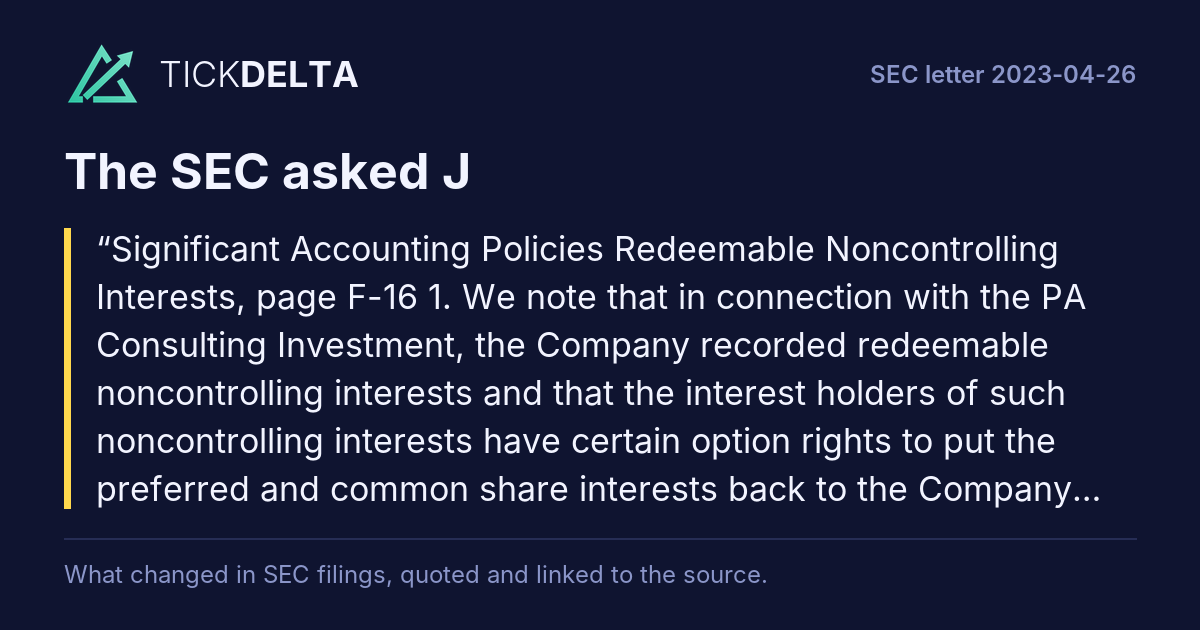
Significant Accounting Policies Redeemable Noncontrolling Interests, page F-16 1. We note that in connection with the PA Consulting Investment, the Company recorded redeemable noncontrolling interests and that the interest holders of such noncontrolling interests have certain option rights to put the preferred and common share interests back to the Company at a value based on the fair value of PA Consulting (theRest of the question
redemption values). It appears that the Company also has an option to call the interests for certain individual shareholders in certain circumstances. We further note that the Company has deemed these interests probable of becoming redeemable in the future and requiring their measurement at the greater of (i) the redemption amount that would be paid if settlement occurred at the balance sheet date, or (ii) the historical value resulting from the original acquisition date fair value plus the impact of any earnings or loss attribution amounts, including dividends. In order to better understand the Company's accounting, please tell us how the Company considered and applied the guidance in ASC 480-10, specifically the guidance through ASC 480-10-55-53 through ASC 480-10-55-62 and the guidance in ASC 480-10-S99 to its facts and circumstances.
We respectfully inform the Staff that the Company applied the guidance of ASC 480-10 Distinguishing Liabilities from Equity, including consideration of ASC 480-10-55-53 through ASC 480-10-55-62 and the guidance in ASC 480-10-S99 to determine the proper balance sheet classification of the PA Consulting noncontrolling interest instruments, which are comprised of the Class B Preferred Shares (the “B Preferred Shares”), and the Class B Ordinary Shares (the “B Ordinary Shares” and together with the B Preferred Shares, the “Class B Shares”) and the put and call options embedded within the Class BRead in the reply ↗Rest of the answer
Shares (which we determined to not be free-standing) as further described below.
The Company determined based on its analysis of the Class B Shares and associated options mentioned above that the PA Consulting noncontrolling interests instruments should be classified as temporary equity, which is reported outside of permanent equity, in accordance with ASC 480-10-S99-3A, which provides that certain contingent redemption features in equity securities require classification as temporary equity and not as a liability.
In arriving at this determination, the Company considered the following:
The Company acquired its interest in PA Consulting on March 2, 2021. At that time, PA Consulting was recapitalized, the Class B Shares were newly issued, and PA Consulting adopted, by special resolution, Articles of Association that incorporated the terms of the various options rights agreed to by the parties in connection with the Company’s investment in PA Consulting. The terms of the put and call options related to the Class B Shares are summarized as follows:
•A Call Option held by the Company (inclusive of its consolidated subsidiaries) to repurchase shares from a shareholder who ceases to be an employee at either (i) the fair value of such shares as determined at the last annual valuation date (the “Annual Fair Value”), or (ii) in certain circumstances (e.g. subsequent employment at a competing business) the lower of the cost paid by the shareholder for the Class B Shares or the Annual Fair Value. This option is exercisable at the Company’s discretion only upon an employee’s termination (whether voluntary or involuntary).
•The holders of Class B Shares have the right to require that their Class B Shares be repurchased by the Company only in certain circumstances:
i. if the parties are not able to agree to a liquidity event on the timeline agreed-upon by the parties at the date of acquisition (which time period has not lapsed yet) (the “Value Put Option”); or ii. if the Company exercises certain protective governance related rights that were granted to it in connection with the investment (the “Additional Put Option”).
The put price of such Class B Shares is based on the fair value of PA Consulting at the date the put is exercised (and may not be the same as the Annual Fair Value).
All Class B Shares are subject to the options, the options cannot be transferred apart from the Class B Shares and in no instances are there any scenarios that allow for net settlement. Based on the terms of the options, we concluded these options are not freestanding financial instruments.
With respect to the guidance in ASC 480-10-55-53 through ASC 480-10-55-62, we respectfully inform the Staff that we determined this guidance was not applicable as it mainly relates to circumstances where the parent company has a fixed price call option to purchase a noncontrolling interest and the noncontrolling interest holder has a fixed price put option. The price at which the PA Consulting noncontrolling interest options are exercisable are not at fixed prices but are instead at fair value (or in certain cases the lower of fair value or original purchase cost) as more fully described in the preceding paragraphs above. Consequently, the Company concluded that the PA noncontrolling interest instruments are not eligible for liability classification under ASC 480-10-55-53 through ASC 480-10-55-62.
Further, we evaluated whether the Class B Shares provide for mandatory redemption as defined in ASC 480-10. We note that to be mandatorily redeemable, the redemption of the instrument must be subject to an unconditional obligation, which is not the case for the Class B shares. As such, we next evaluated the redeemable equity guidance in ASC 480-10-S99 and noted the Class B shares included the redemption feature that was not solely within the control of the Company (the Value Put Option that enables the holders of Class B Shares the right to require repurchase of the shares by the Company as described further below) and, therefore, the Company determined that the Class B shares are within the scope of ASC 480-10-S99 and require classification as temporary equity.
The Company evaluated the subsequent measurement guidance in ASC 480-10-S99-3A §15 which requires that the balances subsequently be remeasured in temporary equity either utilizing an accretion method or redemption method if the redemption feature is probable of becoming redeemable. To determine whether the interests are probable of becoming redeemable by virtue of the Value Put Option, we considered that the Company and the noncontrolling interest holders must each take the required action to negotiate and agree to a liquidity event, and if nothing were to occur other than the passage of time, the Value Put Option would become exercisable. As such, the Company concluded the redeemable noncontrolling interests were probable of becoming redeemable. The Company has elected to follow the redemption method and present the redeemable noncontrolling interests at the greater of the interests’ carrying amount under ASC 810 and the contractual redemption price (derived based on PA Consulting’s fair value) as if the interests were redeemed at the balance sheet date.
Revenue Accounting for Contracts, page F-18 2. We note that 52% of your $15 billion remaining performance obligations will be recognized in within the next 12 months and the remaining 48% thereafter. Considering the long term nature of your contracts, please tell us in what periods you expect to recognize the remaining 48% "thereafter" and how your current disclosures reflect the appropriate time bands for yourRest of the question
arrangements. In that regard, please tell us how you considered disclosure around revenue expected to be recognized within 1 year, 2 years etc. Refer to 606-10-50-13(b) 14. PA Consulting Business Combination, page F-47 3. We note your disclosure related to the changes in the Company's redeemable noncontrolling interests during the fiscal year ended September 30, 2022. Based on the disclosure in your table, it appears that the Company repurchased $53.8 million in redeemable noncontrolling interests and issued $54.9 million in redeemable noncontrolling interests during the year ended September 30, 2022. However, we note that in the paragraph preceding such table, you disclose that the Company repurchased $46.1 million in cash and issued certain shares of redeemable noncontrolling interests for $49.7 million with the difference between the cash purchase prices and the recorded book values of these repurchased and issued interests recorded in the Company’s consolidated retained earnings. Finally, we note that per your disclosure in your consolidated statement of stockholder's equity on page F-6, the Company recognized $2.6 million related to the repurchase and issuance of redeemable noncontrolling interests. As such, please provide us with an understanding of the differences impacting each of your disclosures. 17. Restructuring and Other Charges, page F-54
The Company respectfully informs the Staff that the Company expects to recognize the majority of the remaining performance obligation after the first twelve months at varying amounts within the next four years, subject to change as our portfolio mix and contract lives evolve. As the majority of the remaining performance obligations is expected to be recognized in the next 12 months, we believe our quantitative disclosure for the one-year time band and thereafter was sufficient to convey that our remaining performance obligations are not expected to remain outstanding for extended periods ofRead in the reply ↗Rest of the answer
time. However, for future filings, the Company will include additional qualitative disclosure to provide the reader additional insight into the time period over which our remaining performance obligations are expected to be recognized, which periods may vary over time. For example, in future filings, we will disclose that the majority of the remaining performance obligations after the first 12 months are expected to be recognized over a four year period..
14. PA Consulting Business Combination, page F-47
3.We note your disclosure related to the changes in the Company's redeemable noncontrolling interests during the fiscal year ended September 30, 2022. Based on the disclosure in your table, it appears that the Company repurchased $53.8 million in redeemable noncontrolling interests and issued $54.9 million in redeemable noncontrolling interests during the year ended September 30, 2022. However, we note that in the paragraph preceding such table, you disclose that the Company repurchased $46.1 million in cash and issued certain shares of redeemable noncontrolling interests for $49.7 million with the difference between the cash purchase prices and the recorded book values of these repurchased and issued interests recorded in the Company’s consolidated retained earnings. Finally, we note that per your disclosure in your consolidated statement of stockholder's equity on page F-6, the Company recognized $2.6 million related to the repurchase and issuance of redeemable noncontrolling interests. As such, please provide us with an understanding of the differences impacting each of your disclosures.
Response:
The Company respectfully informs the Staff that the differences noted in the Staff’s comment stem from the different prices at which the options described in comment #1 are exercisable. To reflect periodic remeasurement of outstanding noncontrolling interests, we use the redemption method accounting policy described in comment #1. However, when disclosing repurchases of noncontrolling interests, we use the actual cost to us under the Call Option described under comment #1.
As noted in the Staff’s comment, during fiscal year 2022, the Company repurchased a portion of the redeemable noncontrolling interests for a cash price of $46.1 million as compared to such interests’ redemption value of $53.8 million determined in accordance with ASC 480 as described in comment #1. While the changes reflected in the redeemable noncontrolling interest disclosures reflect periodic remeasurement of outstanding noncontrolling interests using the redemption method accounting policy described in comment #1, consistent with the contractual Value Put Option price, $46.1 million is the actual price paid to repurchase non-controlling interests in accordance with the Call Option. In accordance with ASC 810-10-45-21A through 24, the difference as described is accounted for as equity transactions given the Company’s continued ability to control PA Consulting.
Furthermore, as noted in your comment, during fiscal year 2022, the Company issued Class B Shares of PA Consulting for a cash price of $49.7 million that had a redemption value of $54.9 million on the issuance date. The difference is attributable to a minor non-compensatory discount made available to all of the noncontrolling interest holders to fair value coupled with a difference between fair value of such shares and the contractual redemption value set forth under the Value Put Option. Accordingly, as the Company retained control of PA Consulting, under ASC 810-10-45-21A through -24, such differences between cash received and redemption value were accounted for as equity transactions reflected as an adjustment to the Company’s retained earnings.
17. Restructuring and Other Charges, page F-54
Please also expand your disclosures here or within MD&A to disclose the expected effects on future earnings and cash flows resulting from each of your restructuring plans along with the initial period in which those effects are expected to be realized.Rest of the question
In that regard, quantify the impact the restructuring activities had on your operating income (i.e., the amount by which expenses decreased) and cash flows, including whether the actual results were in line with management’s expectations when the restructuring activities were initiated. If the anticipated savings were not achieved as expected or are achieved in periods other than as expected, please disclose as such, the reasons for the differences and the likely effects on future operating results and liquidity. Please refer to SAB Topic 5:P.4 for guidance
The Company acknowledges the Staff’s comments to expand our disclosures to include the expected effects on future earnings and cash flows resulting from our restructuring plans. For future filings, we will consider the factors outlined in the Staff’s comment and for each restructuring plan, we will provide expanded disclosures within the MD&A—Results of Operations section of our respective Form 10-Q and Form 10-K filings to the extent they are determined to be material.Read in the reply ↗Rest of the answer
In certain situations, such as where the restructuring plan relates to future cost savings from labor and benefits costs from employee separation programs, deviations from management’s expectations may be minimal and therefore disclosure of the reasons for any differences may not be viewed as material.
We note your disclosure that net revenue is calculated excluding pass through revenue of your People & Places and Divergent Solutions segments. Please tell us how you determined it was appropriate to use a title for your non-GAAP financial measure that appears to be the same as, or confusingly similar to, a title used for a GAAP financial measure. Refer to Non-GAAP Financial Measures C&DI 100.05 .Rest of the question
Clarify within your response if the adjustment to exclude pass through revenue includes a mark up of pass through costs.
The Company respectfully informs the Staff that it has defined “net revenue” under the heading “Non-GAAP Financial Measures and Operating Metrics” in its earnings release as follows:
Net revenue is calculated excluding third-party pass through revenue of the Company’s People & Places Solutions and Divergent Solutions segments from the Company’s revenue from continuing operations.
We respectfully acknowledge the Staff’s comment and advise the Staff that we intend to change the title of this non-GAAP financial measure from “Net Revenue” to “Adjusted Net Revenue” in future filings to clearlyRead in the reply ↗Rest of the answer
identify it as a non-GAAP financial measure. We will also continue to denote that this is a Non-GAAP financial measure through use of footnotes, which will direct readers to the relevant definitions.
The Company’s adjustment to exclude pass throughs from our GAAP revenue and GAAP direct costs does not include any mark-up of pass through costs, as the Company believes any mark-up is nominal and is similar to an administrative fee that the Company is entitled to for the pass through activities. The administrative fee is de minimis in its impacts to revenue, costs and operating profit margin.
The Company will also include its definition of pass through revenues in future filings under Non-GAAP Financial Measures and Operating Metrics.
Reconciliation of Income Tax Expense from Continuing Operations to Adjusted Income Tax Expense from Continuing Operations, page 14
First report after the company's reply of 2023-05-26: 10-Q filed 2023-08-08 ↗, against the 10-Q filed 2023-02-07 ↗.
Tickdelta does not hold the text of both reports, so they are not compared here.
We note your presentation of your Non GAAP measure Adjusted Income Tax Expense from Continuing Operations includes an adjustment for Other income tax adjustments which are defined as certain income tax adjustments for the purposes of presenting the Company’s expected annual non-GAAP effective tax rate to facilitate a more meaningful evaluation of the Company’s current operating performance and comparisons to theRest of the question
Company’s operating performance in other periods. In order to better understand the adjustment, please better describe the nature of such adjustment, how you calculated the adjustment and the reason such adjustment is useful to investors. We remind you that the company and its management are responsible for the accuracy and adequacy of their disclosures, notwithstanding any review, comments, action or absence of action by the staff.
The nature of the Other income tax adjustments in our Non GAAP measure titled “Adjusted Income Tax Expense from Continuing Operations” relates to the Company’s intention to provide more meaningful disclosure of our projected annual Non-GAAP income tax rate (adjusted for tax impacts on Restructuring, Transaction and Other Charges, amortization of intangibles and other projected pretax items) by also removing the effects of items of notable and exceptional nature such as tax impacts from changes in tax valuation allowances, acquisition related costs, changes in unrecognized tax benefits andRead in the reply ↗Rest of the answer
other exceptional tax items which can vary in size, frequency and timing during the interim quarterly reporting periods of a given fiscal year. These items can cause effective tax rate volatility during the quarterly periods in comparison to the final annual tax rate for the fiscal year.
The Other income tax adjustment items are arrived at by calculating the difference between the projected annual Non-GAAP income tax rate described above applied to the respective quarter’s pretax income and the actual tax rate computed for the respective quarters during the year under ASC 740-270. These adjustments may either increase or decrease our quarterly Non-GAAP income tax rate depending on the nature of the respective adjustment item. For example, in the second quarter of fiscal 2023, these adjustments resulted in an increase in our Non-GAAP tax rate and in a corresponding decrease in our reported Non-GAAP earnings.
We believe that these adjustments help investors to better understand the expectations for our annual income tax rate. Further, we believe that by disclosing our full year Non-GAAP annual tax rate along with our GAAP quarterly tax rate information, we are providing a more comprehensive operational view of the Company’s projected annual tax rate and the associated impacts on our reported results throughout the year.
We hope this response has addressed all of the Staff’s comments. Should you have additional questions regarding the information contained herein, we would be pleased to discuss them with you.
First report after the company's reply of 2023-05-26: 10-Q filed 2023-08-08 ↗, against the 10-Q filed 2023-02-07 ↗.
Tickdelta does not hold the text of both reports, so they are not compared here.
We note your response to our comment number 6. Given that the Other income tax adjustment items are arrived at by calculating the difference between the projected annual Non-GAAP income tax rate applied to the respective quarter’s pretax income and the actual tax rate computed for the respective quarters during the year under ASC 740270; please tell us how you considered whether the Non GAAP measure substitutes anRest of the question
individually tailored recognition and measurement method for those of GAAP which results in a misleading non-GAAP measure that violates Rule 100(b) of Regulation G. Please refer to Question 100.04 of the Compliance and Disclosure Interpretations on Non- GAAP Financial Measures for guidance.
The Company acknowledges the Staff’s comment and informs the Staff that the Company considered Rule 100(b) of Regulation G, which states that a registrant shall not make public a Non-GAAP financial measure that, taken together with the information accompanying that measure, is misleading, as well as Question 100.04 of the Non-GAAP Compliance and Disclosure Interpretations (“C&DIs”), which advises that Non-GAAP adjustments that have the effect of
Jacobs Solutions Inc.
changing the recognition and measurement principles required to be applied in accordance with GAAP would be consideredRead in the reply ↗Rest of the answer
individually tailored and may cause the presentation of a Non-GAAP measure to be misleading. The Company respectfully informs the Staff that it does not view the Non-GAAP tax rate to be a misleading measure. The Company views the Non-GAAP tax rate as an appropriate and meaningful supplemental measure that provides investors a complete perspective of an annual tax rate that takes into consideration current, deferred and other taxes that are attributable to the business.
In accordance with ASC 740, the interim GAAP financial statements reflect taxes considering a combination of the estimated annual effective tax rate for ordinary income (or loss), combined with calculations of tax (or benefit) for all other items computed individually and recognized in the periods in which such items occur. While such information provides important knowledge regarding the tax impacts in a given interim period, the Company believes that since taxes are calculated on an annual basis, investors also benefit from a comprehensive understanding of how discrete items from individual interim periods are expected to ultimately impact the full annual financial statements. The Company believes its annual Non-GAAP tax rate achieves this, as it is based on the aggregated statutory income tax rates in the jurisdictions in which the Company operates and considers discrete event taxes, permanent adjustments, current and deferred impacts to the effective tax rate, and other known information as of the reporting date, including changes in business operations, tax legislation changes, and major events that could have a material impact on a given quarter. As an example, in the second quarter of fiscal 2023, the Company experienced a significant uncertain tax position release that resulted in the recognition of a benefit for GAAP purposes in the second quarter. The benefit resulted in a significantly lower tax rate that does not represent the full year Non-GAAP anticipated rate. If the Company did not include the “other income tax adjustment,” the Adjusted Diluted Net Earnings Per Share from Continuing Operations would have been higher by $0.25 per share, which may have given investors a misleading view of the Company’s performance. Even though this method results in an “other tax adjustment” in the interim periods, by the end of the fiscal year, the “other income tax adjustment” will eliminate, since all anticipated tax impacts would have occurred by year end. The Company believes that applying the anticipated annual tax rate to each quarterly period provides investors with important information that allows investors to assess trends in the underlying business performance of the Company when discrete tax events may otherwise significantly impact the Company’s quarterly performance.
Importantly, the Company believes that its Non-GAAP presentation allows investors to understand and evaluate the Company’s results in the same manner as management does. For example, the Company’s executive management generally does not consider the impact of discrete tax items in reviewing the Company’s quarterly performance and monitors Adjusted Diluted Net Earnings Per Share from Continuing Operations, as adjusted by “other income tax adjustment,” to facilitate decision-making at the consolidated corporate level, such as with respect to setting annual performance expectations and evaluating quarterly progress against those expectations, and therefore the Company believes this information is important for investors.
The Company understands and recognizes that there are a variety of methods used to calculate Non-GAAP tax rates. Some of these methods exclude certain discrete taxes altogether in their Non-GAAP presentations. Others use the application of a cash tax rate, which effectively excludes the impact of deferred taxes. In contrast, the determination of the tax rate based on the Company’s method does not exclude any applicable taxes to the business. Given all of the methodologies considered, the Company believes the methodology utilized to calculate its annual Non-GAAP tax rate to be comprehensive, robust and transparent. The Company further believes the Non-GAAP tax rate is a meaningful supplement to the GAAP measure, which only considers the isolated interim period impact of the discrete items. The Non-GAAP measure provides information regarding the annual impact, to supplement the GAAP calculation, for the readers of Management’s Discussion and Analysis of Financial Condition and Results of Operations. The Company respectfully informs the Staff that prior to inclusion of this adjustment, the Company received many questions from analysts and investors regarding the Company’s expected tax rate, and the impact of discrete tax items on results and forecasts. Since the Company began including this measure, management has received fewer inquiries in this area and believes the reduction is attributable to the provision of this information in the Company’s earnings release.
We hope this response letter has addressed all of the Staff’s comments. Should you have additional questions regarding the information contained herein, we would be pleased to discuss them with you.
First report after the company's reply of 2023-06-23: 10-Q filed 2023-08-08 ↗, against the 10-Q filed 2023-02-07 ↗.
Tickdelta does not hold the text of both reports, so they are not compared here.
Your response to our comment number 1 states that you view the non-GAAP tax rate as an appropriate and meaningful supplemental measure that provides investors a complete perspective of an annual tax rate. Please clarify this statement as Adjusted Income Tax Expense from Continuing Operations appears to equal or approximate your statutory tax rate, but based on the disclosure in your Form 10-K for the year endedRest of the question
September 30, 2022, your effective tax rate in recent years has differed from the statutory tax rate.
The Company respectfully informs the staff that in the past two fiscal years, the Adjusted Income Tax Expense from Continuing Operations has approximated the statutory tax rate coincidentally.
By way of background, the starting point for Adjusted Income Tax Expense from Continuing Operations is our US GAAP tax expense.Read in the reply ↗Rest of the answer
The current and deferred tax impacts of As Adjusted book items are then calculated and adjusted appropriately in conjunction with their pre-tax book item counterparts to arrive at Adjusted Income Tax Expense from Continuing Operations.
Jacobs Solutions Inc.
Adjustments to Adjusted Income Tax Expense from Continuing Operations that are made on an interim basis, but do not have an impact on the annual effective tax rate, are described in the example provided in response #2 below.
Occasionally, there are unusual and non-recurring income tax-specific items unrelated to the regular operations of the business that are also adjusted to arrive at the final annual Adjusted Income Tax Expense from Continuing Operations. In recent years, some examples include:
1.removing tax benefit related to the impact on the carrying value of the Company’s deferred tax assets/liabilities caused by statutory rate change in the United States due to the Tax Cuts and Jobs Act in FY18 (these items are referred to as the “Statutory Rate Change Amendments”);
First report after the company's reply of 2023-08-22: 10-K filed 2023-11-21 ↗, against the 10-K filed 2022-11-21 ↗.
Tickdelta does not hold the text of both reports, so they are not compared here.
In response to our comment number 1, you explain that applying the anticipated annual tax rate to each quarterly period provides investors with important information that allows investors to assess trends in your underlying business performance when discrete tax events may otherwise significantly impact your quarterly performance.Rest of the question
Please clarify this statement as it appears that discrete tax events could similarly impact an annual period. Also, as Adjusted Income Tax Expense from Continuing Operations relates to an interim period, tell us how you considered Question 102.11 of the Compliance and Disclosure Interpretations on Non-GAAP Financial Measures which states that non-GAAP performance measures should include current and deferred income tax expense commensurate with the non-GAAP measure of profitability.
removing tax expense related to the impact on the carrying value of the Company’s deferred tax assets/liabilities caused by statutory rate change in the United Kingdom in FY21; Read in the reply ↗
First report after the company's reply of 2023-08-22: 10-K filed 2023-11-21 ↗, against the 10-K filed 2022-11-21 ↗.
Tickdelta does not hold the text of both reports, so they are not compared here.
We have considered your responses to our prior comments 1 and 2 and the information provided on our October 20, 2023 call with you. Based on the information provided, the presentation of the Other Income Tax Adjustments line item changes the recognition and measurement principles required by GAAP and results in non-GAAP measure that is inconsistent with Rule 100(b) of Regulation G and Question 100.04 of theRest of the question
Compliance and Disclosure Interpretations on Non-GAAP Financial Measures. As such, please remove this adjustment from your future non-GAAP presentations.
The Company respectfully acknowledges the Staff’s comment. Based on the Company’s discussions with the Staff, the Company believes that the Staff’s concern related to certain adjustments encompassed in the Company’s “Other Income Tax Adjustments” line item (generally, those adjustments contained within this line item that are for the purpose of presenting the Company’s expected annual non-GAAP effective tax rate to facilitate a more meaningful evaluation of the Company’s current operating performance and the comparisons to the Company’s operating performance in other periods), but not toRead in the reply ↗Rest of the answer
others (for example, the revaluation of deferred tax assets and liabilities resulting from statutory tax rate changes). The Company will reach out to the Staff for further clarification on that matter to confirm our understanding.
The Company respectfully informs the Staff that it will revise the relevant adjustments from all future non-GAAP presentations beginning in the first fiscal quarter of 2024. The Company also respectfully informs the Staff that the Company has a pre-announced earnings release date of tomorrow, November 21st. The Company intends to inform shareholders in tomorrow’s earnings release and investor presentation that commencing with our first fiscal quarter of 2024, we will be revising the adjustments we make to adjusted net earnings from continuing operations and adjusted EPS. The Company further respectfully informs the Staff that, in light of the timing of our receipt of your most recent comment letter in relation to the Company’s previously scheduled earnings release, the need for clarification described above, and the near completion of the Company’s processes and procedures for the fourth fiscal quarter and full fiscal year 2023 earnings, the Company is unable to make these changes in the related earnings materials prior to tomorrow morning’s earnings announcement.
We hope this response letter has addressed all of the Staff’s comments. We respectfully request a teleconference with the Staff at your convenience to fully understand the Staff's position so that we may implement appropriate changes in the first quarter of our 2024 fiscal year. Should you have additional questions regarding the information contained herein, we would also be pleased to discuss them with you.
First report after the company's reply of 2023-11-20: 10-K filed 2023-11-21 ↗, against the 10-K filed 2022-11-21 ↗.
Tickdelta does not hold the text of both reports, so they are not compared here.
Also in this review: closing letter, 2023-11-21