Screener / SEC EDGAR /CIK 0001232524 /10-K filed Feb 24, 2026, compared with Feb 26, 2025 /Numbers from the XBRL of the 10-Ks
Nasdaq Health care · Pharmaceuticals

Jazz Pharmaceuticals plc JAZZ

Compare with peers Embed
SEC comment letters, last 20 years

3 reviews of JAZZ's filings by SEC staff

UPLOAD and CORRESP
Reviews 3 latest letter Jul 17, 2025
Questions asked 4 each answered in the company's own letter
No closing letter 0 reviews without a letter saying the staff completed it

When the SEC's staff reviews a filing, it writes to the company with numbered questions, and the company answers each one in a letter. SEC publishes the exchange once the review is over, at least 20 business days later. A question is not an accusation; most reviews end with the company adding detail to its next filing.

How the reviews went

Every review on EDGAR, from the first staff letter to the letter that closes it

  1. 1. Staff letters 3 UPLOAD
  2. 2. Questions in them 4 numbered comments
  3. 3. Company replies 6 CORRESP
  4. 4. Reviews closed 3 of 3 closing letter

Half the closed reviews took 33 days or less from the first letter to the closing letter.

Form 10-K for the Fiscal Year Ended December 31, 2024

2025-07-17 to 2025-08-08 · 2 questions · 1 letter from the SEC, 1 from the company
Review closed 2025-08-08
Item 1. Business · Competition, page 22
SEC asked (1)
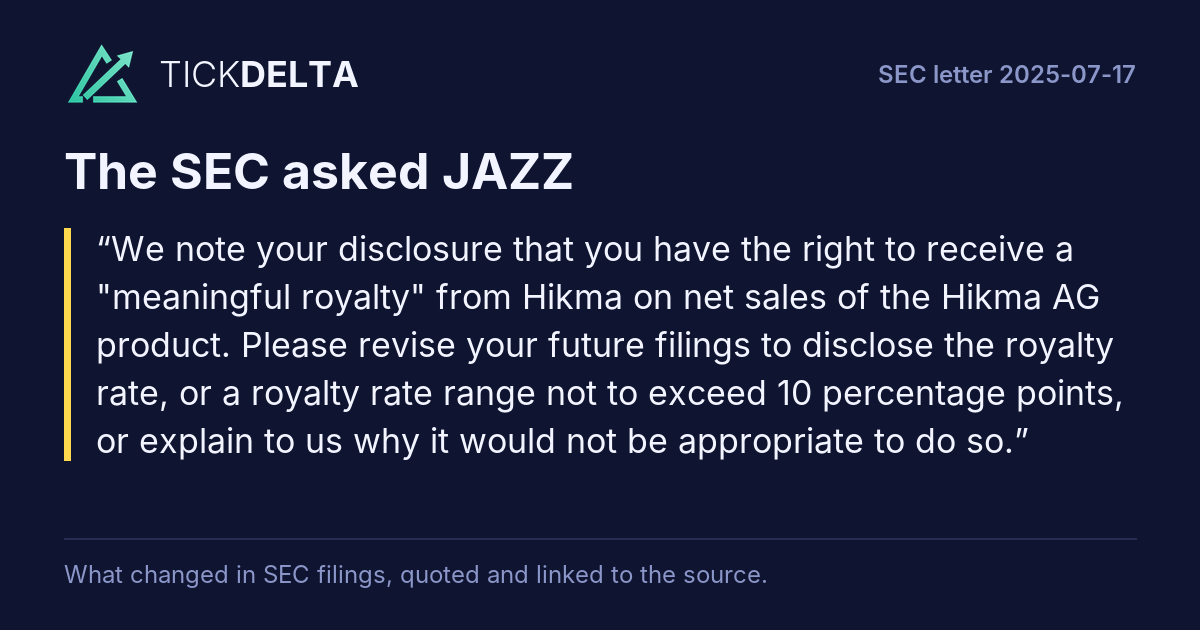
We note your disclosure that you have the right to receive a "meaningful royalty" from Hikma on net sales of the Hikma AG product. Please revise your future filings to disclose the royalty rate, or a royalty rate range not to exceed 10 percentage points, or explain to us why it would not be appropriate to do so.
JAZZ answered
The Company acknowledges the Staff’s comment and respectfully advises the Staff that the Company believes that disclosure of the royalty rate from Hikma on net sales of the Hikma AG product (the “royalty rate”) (or in lieu thereof, a royalty rate range) is not required because disclosure of the royalty rate is neither material nor necessary for the protection of investors and moreover, it would not be appropriate for the Company to make such disclosure given the confidential nature of the royalty rate and an associated order of the U.S.
Rest of the answer

District Court for the Northern District of California, as explained in more detail below.

Disclosure of the royalty rate is neither material nor necessary for the protection of investors

In the context of omitted disclosure, the U.S. Supreme Court has held that, to fulfill the materiality requirement, “there must be a substantial likelihood that the disclosure of the omitted fact would have been viewed by the reasonable investor as having significantly altered the ‘total mix’ of information made available.” TSC Industries v. Northway, Inc., 426 U.S.

438, 449 (1976); Basic, Inc. v. Levinson, 485 U.S. 224 (1988). The Staff has advised against making materiality determinations through the application of any single quantitative formula, stating that both quantitative and qualitative factors must be taken into account. SEC Release No. SAB 99 (Aug. 12, 1999). Set forth below are the quantitative and qualitative factors the Company considered in making the determination that disclosure of the royalty rate (or in lieu thereof, a royalty rate range) would not significantly alter the “total mix” of information the Company makes available to investors.

Quantitative analysis

The Company respectfully advises the Staff that, for each of the fiscal year ended December 31, 2024 and the three months ended March 31,

2025, high-sodium oxybate authorized generic royalty revenue in the aggregate, including the Hikma AG product royalty revenue, comprised only approximately 5% of the Company’s total revenue. Furthermore, the Company currently expects the Hikma

AG product royalty revenue, as a percentage of the Company’s total revenue, to decline in future years as narcolepsy patients continue to adopt lower sodium Xywav and the Company continues to diversify its product portfolio and revenue drivers

(in particular, the Company’s diversification of total revenue away from high-sodium oxybate). Accordingly, the royalty revenues realized from Hikma on net sales of the Hikma AG product have not been, and are not currently expected to be, quantitatively material.

Jazz Pharmaceuticals plc. registered in Ireland (company number 399192) Registered Office: Fifth Floor, Waterloo Exchange, Waterloo Road, Dublin 4, Ireland Directors: Bruce C. Cozadd - Chairman (USA), Jennifer Cook (USA), Patrick

G. Enright (USA), Laura Hamill (USA), Patrick Kennedy, Heather Ann McSharry, Seamus Mulligan, Kenneth W. O’Keefe (USA), Anne O’Riordan, Norbert G. Riedel (DE), Mark Smith (USA), Rick E Winningham (USA)

Fifth Floor, Waterloo Exchange,

Waterloo Road, Dublin 4, Ireland

T:

+353.1.634.7800

F: +353.1.634.7850

Qualitative analysis

The Company respectfully advises the Staff that the Hikma royalty revenues relate to a high sodium oxybate AG product, which is essentially an authorized generic version of the Company’s Xyrem product. The Company no longer considers Xyrem one of its lead marketed products, as indicated in the Company’s Annual Report on Form 10-K for the fiscal year ended December 31, 2024 (the “Annual Report”), and the Company does not consider AG royalty revenues to be a material part of its business. As disclosed in the Annual Report, the Company’s oxybate commercial efforts are focused on educating patients and physicians about the lifelong impact of high sodium intake, and how the use of Xywav enables them to address what is a modifiable risk factor. As discussed above, the Company expects revenues from high sodium oxybate products to decrease as a percentage of the Company’s total revenue in future years as Xywav has become a standard of care for patients with narcolepsy and idiopathic hypersomnia and the Company continues to focus its commercial efforts on educating patients about the benefits of Xywav and on its other lead marketed products. Further, the Company’s operating plan assumes that Xywav, with 92% lower sodium compared to high-sodium oxybates (depending on the dose), a dosing titration option and an absence of a sodium warning, will remain the #1 branded oxybate treatment for narcolepsy (the position it held based on revenue in the first quarter of 2025).

Moreover, the royalty rate, which the Company has disclosed is fixed, beginning in January 2024, for the duration of the Company’s agreements with Hikma, is only one factor that determines the amount of royalties the Company receives from Hikma; the amount of royalties the Company receives is dependent on the prices at which Hikma sells its AG product and the volume of such sales, neither of which is publicly disclosed by Hikma. Hikma’s plans for commercialization and distribution of its AG product are controlled by Hikma. In addition, and as disclosed in the Annual Report, the Company respectfully advises the Staff that Hikma’s election to sell the Hikma AG product (with royalties to be paid to the Company) for a total of up to four years beginning in January 2024 may be terminated by Hikma at any time in accordance with the notice provisions in the agreements between the parties. Relatedly, the Company also granted Hikma a license to launch its own generic high-sodium oxybate product. If Hikma elects to launch its own generic product, it will no longer have the right to sell the Hikma AG product and the Company will no longer be entitled to royalty payments from Hikma. As a result, in addition to not being material to the Company on an absolute or relative basis, any royalties that may be payable under the Company’s agreements with Hikma are also uncertain in amount and duration, and additional detail about one factor that may influence such speculative information would not alter the total mix of information useful to investors in evaluating the Company’s business or in making investment decisions.

The Company provides substantial disclosure regarding oxybate revenues

The Company’s existing disclosure with respect to oxybate revenues and the drivers thereof is substantial, and includes the quantitative and qualitative information that is material to investors. Such quantitative information includes:

• product revenue information;

royalty revenue information;

Xywav patient numbers by indication; and estimates with respect to patient populations.

Such qualitative information includes:

the Company’s commercialization strategy for its oxybate products;

information about competition for the Company’s oxybate products;

the Company’s research and development strategy and progress; and historical and anticipated trends with respect to oxybate product revenues and royalty revenues.

Accordingly, the Company respectfully submits that additional disclosure regarding the Hikma royalty rate would not significantly alter the “total mix” of information made available to investors and there is not a substantial likelihood that a reasonable investor would consider the Hikma royalty rate important in making an investment decision. Indeed, the Company believes that investment decisions are based on the Company’s overall business strategy and performance rather than the Hikma royalty rate. In any event, the Company believes that protection of investors has been satisfied with the substantial disclosure that currently exists in the Annual Report regarding the Company’s oxybate revenues, including with respect to Hikma’s rights to sell the Hikma AG product and its own generic high-sodium oxybate product, and the potential time periods under which the Company would be entitled to royalty payments from Hikma for sales of the Hikma AG product.

The royalty rate is highly confidential and disclosure of such rate would cause competitive harm to the

Company

The Company treats its Hikma pricing and royalty revenue rate as highly confidential and has not disclosed this information publicly, nor widely disseminated it within the Company. Notably, in multidistrict litigation proceedings before the U.S. District Court for the Northern District of California (the “Court”) relating to patent litigation settlements the Company entered into with certain generic drug manufacturers who had filed abbreviated new drug applications for generic versions of Xyrem (“ANDA filers”), the Court has granted motions made by both the Company and Hikma to seal the pricing and royalty rates in authorized generic agreements between the Company and Hikma, as well as the Company’s agreements with certain other ANDA filers. The Company believes that disclosure of the Hikma royalty rate would permit counterparties to gain an advantage in their negotiations with the Company in ongoing and future license negotiations by demanding the same or better terms and would allow competitors to use those values to glean insight into the Company’s practices related to negotiating these or other types of commercial agreements, all of which could cause the Company substantial competitive harm to the detriment of its shareholders. The Company is separately supplementally providing the most recent such order, granted on July 10, 2025, to the Staff. In granting the Company’s and Hikma’s motions to seal the pricing and royalty rates, the Court found that public interest in these terms was outweighed by the risk of competitive harm. The Court also determined that the precise royalty rates were not critical to the public understanding of the litigation. Accordingly, such rates and prices have and will be redacted in the documents that are publicly available for such proceedings.

In light of the foregoing, because disclosure of the royalty rate is neither material nor necessary for the protection of investors and disclosure with respect to the royalty rate that is more granular than the Company’s existing disclosure could cause competitive harm to the Company, the Company respectively advises the Staff that it believes it would not be appropriate for the Company to disclose the royalty rate (or in lieu thereof, a royalty rate range).

Read in the reply
In its next report

First report after the company's reply of Jul 29, 2025: 10-Q filed Aug 6, 2025 ↗, against the 10-Q filed May 7, 2025 ↗.

Tickdelta does not hold the text of both reports, so they are not compared here.
Patents and Proprietary Rights, page 27
SEC asked (2)
We note that Rylaze accounted for approximately 11% of your total net product sales for the fiscal year ended December 31, 2024. We further note from your disclosure on page 28 that you obtained your rights to Rylaze pursuant to a licensing agreement.
Rest of the question

Please either file the licensing agreement governing your rights to Rylaze as an exhibit to future filings or explain to us why you do not believe such exhibit is required. Refer to Item 601(b)(10) of Regulation S-K.

JAZZ answered
The Company respectfully acknowledges the Staff’s comment and plans to file the above-referenced licensing agreement, subject to appropriate redactions for confidential information, as an exhibit with its Quarterly Report on Form 10-Q for the quarter ended June 30, 2025.

* * * * *

Please advise us if we can provide any further information or assistance to facilitate your review. Please direct any further comments or questions regarding this response letter to me at + 1 650 496 3777.
Read in the reply
In its next report

First report after the company's reply of Jul 29, 2025: 10-Q filed Aug 6, 2025 ↗, against the 10-Q filed May 7, 2025 ↗.

Tickdelta does not hold the text of both reports, so they are not compared here.

Also in this review: closing letter, 2025-08-08
Form 10-K for the Fiscal Year Ended December 31, 2018

2019-11-05 to 2020-02-20 · 1 question · 1 letter from the SEC, 4 from the company
Review closed 2020-02-20
Non-GAAP measures
After reviewing your response to the comment, we may have additional comments. Exhibit 99.1 · Reconciliations of GAAP Reported to Non-GAAP Adjusted Information, page 12
SEC asked
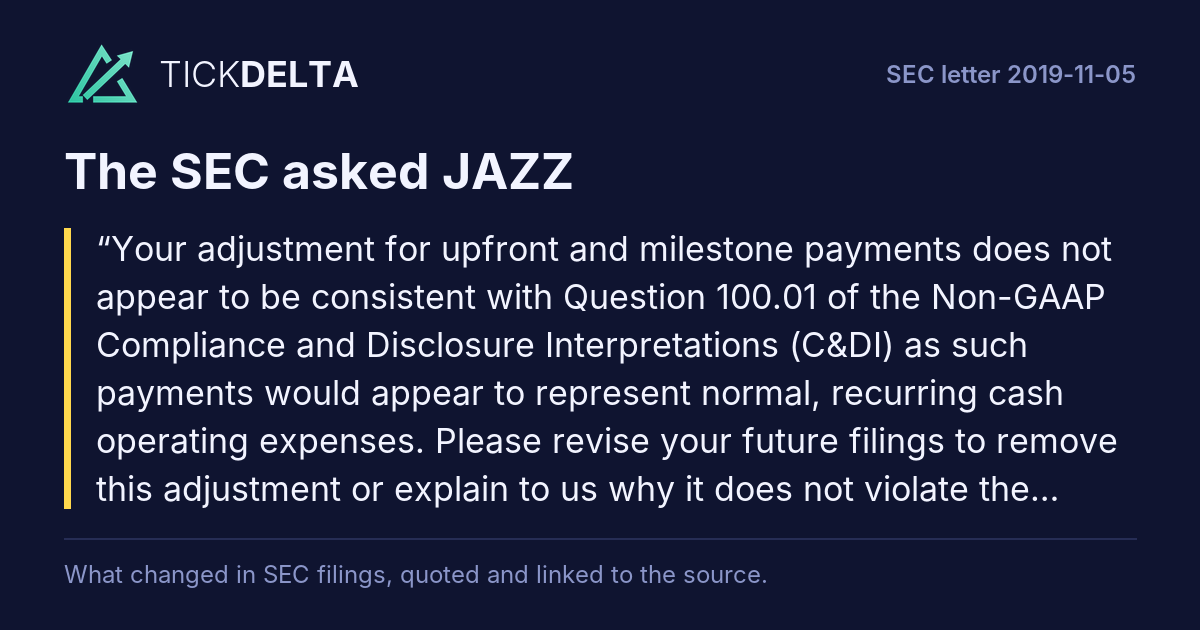
Your adjustment for upfront and milestone payments does not appear to be consistent with Question 100.01 of the Non-GAAP Compliance and Disclosure Interpretations (C&DI) as such payments would appear to represent normal, recurring cash operating expenses. Please revise your future filings to remove this adjustment or explain to us why it does not violate the C&DI.
JAZZ answered
to the Staff´s comment, the Company acknowledges Question 100.01 of the Non-GAAP Compliance and Disclosure Interpretations (“C&DIs”), as well as Rule 100(b) of Regulation G to which Question 100.01 relates. The Company respectfully advises the Staff that the Company has considered the foregoing guidance and believes that its presentation of non-GAAP financial measures that exclude selected upfront and milestone payments is not misleading.

The Company respectfully advises the Staff that it does not consider the selected upfront and milestone payments that it excludes when presenting its
Rest of the answer

non-GAAP financial measures to be normal and recurring in the manner contemplated by the Staff in Question 100.01 due to the nature, magnitude, variability of amount and lack of predictability as to occurrence and/or timing of such payments. The Company’s upfront and milestone payment obligations relate to arrangements that provide the Company with license or other rights (such arrangements, “Rights Acquisitions”), which payments may not recur with similar materiality or impact on operating results across reporting periods due to the highly variable nature of those payments, which variability may be impacted by the discretionary and opportunistic nature of new

Rights Acquisitions by the Company as well as the level and timing of achievement of milestone events. The Company regularly reviews its upfront and milestone payment adjustments and currently applies a quantitative and qualitative assessment to determine whether it is appropriate to potentially exclude an upfront or milestone payment due to the magnitude and nature of such payment and/or the related Rights Acquisition agreement. Upfront or milestone payments that do not meet the above-mentioned

Fifth Floor, Waterloo Exchange,

Waterloo Road, Dublin 4, Ireland p 353.1.634.7800 f 353.1.634.7850

Jazz Pharmaceuticals plc. Registered in Ireland (company number 399192). Registered Office: Fifth Floor, Waterloo Exchange, Waterloo Road, Dublin 4, Ireland. Directors: Bruce C. Cozadd – Chairman (USA),

Paul L. Berns (USA), Patrick G. Enright (USA), Peter Gray, Heather Ann McSharry, Seamus Mulligan, Kenneth W. O’Keefe (USA), Anne O’Riordan (HK), Norbert G. Riedel, Ph.D (USA), Elmar Schnee (CH), Catherine A. Sohn (USA), Rick E Winningham

(USA) quantitative and qualitative criteria are not excluded. Conversely, the upfront and milestone payments that are excluded under such criteria are more distinctive and substantial such that the

Company does not view such payments as normal and recurring in the manner contemplated by the Staff in Question 100.01. Rather, the Company believes that adjusting for upfront and milestone payments that meet such criteria allows investors to more meaningfully compare the Company’s results from period to period and to identify operating trends in the Company’s business. Importantly, the Company also uses these same non-GAAP financial measures internally to understand, manage and evaluate its business and to make operating decisions. Because these non-GAAP financial measures are important internal measurements for the Company’s management, the

Company also believes that these non-GAAP financial measures are useful to investors since these measures allow for greater transparency with respect to key financial metrics the Company uses in assessing its own operating performance and making operating decisions.

In an effort to ensure that the Company’s presentation of its non-GAAP financial measures is not misleading, the Company presents the most directly comparable GAAP financial measures with equal or greater prominence and includes disclosure explaining how these measures are used by management and why management believes they are useful to investors. In addition, consistent with Question 102.03 of the Non-GAAP C&DIs, the Company does not describe upfront and milestone payments as non-recurring, infrequent or unusual, or in other terms that mischaracterize the frequency of these payments. Finally, the Company clearly explains the limitations of its non-GAAP financial measures, including by explaining that such financial measures should not be considered in isolation or as a substitute for comparable GAAP measures, and should in any event be read in conjunction with the Company’s reported GAAP results.

For the foregoing reasons, the Company respectfully advises the Staff that it believes that excluding selected upfront and milestone payments from its non-GAAP financial measures, as described above, does not violate Question 100.01. Further, the Company respectfully advises the Staff that it will continue to regularly review the appropriateness of its non-GAAP financial measures and related adjustments to ensure that such financial measures do not exclude normal, recurring, cash operating expenses necessary to operate its business.

Read in the reply
In its next report

First report after the company's reply of Nov 19, 2019: 10-K filed Feb 25, 2020 ↗, against the 10-K filed Feb 26, 2019 ↗.

Tickdelta does not hold the text of both reports, so they are not compared here.

Also in this review: company letter, Dec 20, 2019, company letter, Jan 17, 2020, company letter, Feb 14, 2020, closing letter, 2020-02-20

Form 10-K for the Fiscal Year Ended December 31, 2017

2018-11-08 to 2018-12-11 · 1 question · 1 letter from the SEC, 1 from the company
Review closed 2018-12-11
Notes to Condensed Consolidate Financial Statements
SEC asked
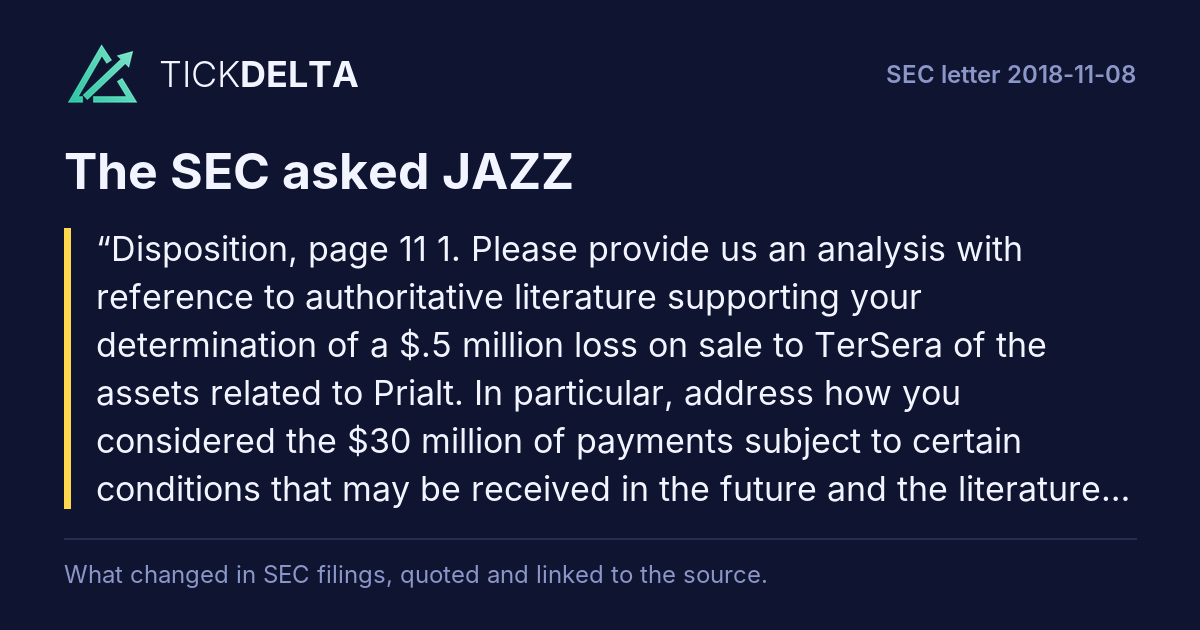
Disposition, page 11 1. Please provide us an analysis with reference to authoritative literature supporting your determination of a $.5 million loss on sale to TerSera of the assets related to Prialt. In particular, address how you considered the $30 million of payments subject to certain conditions that may be received in the future and the literature upon which you relied.
JAZZ answered
to the Staff’s comment, the Company respectfully advises the Staff that the Company recognized a loss on disposal of the assets related to Prialt of $0.5 million based on the difference between the carrying amount of the assets sold and the total transaction price, net of direct selling costs. The Company referred to the guidance under Accounting Standards

Codification (“ASC”) 610-20, Gains and Losses from the Derecognition of Nonfinancial Assets, which applies to gains or losses recognized upon the derecognition of a nonfinancial asset or an in substance nonfinancial asset if the
Rest of the answer

transaction is not with a customer. ASC 610-20-32-2 states the following:

When an entity meets the criteria to derecognize a distinct nonfinancial asset or a distinct in substance nonfinancial asset, it shall recognize a gain or loss for the difference between the amount of consideration measured and allocated to that distinct asset in accordance with paragraphs

610-20-32-3 through 32-6 and the carrying amount of the distinct asset. The amount of consideration promised in a contract that is included in the calculation of a gain or loss includes both the transaction price and the carrying amount of liabilities assumed or relieved by a counterparty.

ASC 610-20-32-3 provides that an entity shall apply the guidance under ASC 606, Revenue from

Contracts with Customers, in determining the transaction price.

The total consideration for the Prialt assets sold to TerSera Therapeutics LLC

(“TerSera”), as provided in the asset purchase agreement (as amended, the “APA”), was $80.0 million, of which $50.0 million was received at closing, and the Company is entitled to receive installment payments of $15.0 million on each of December 31, 2019 and December 31, 2020, or earlier under certain circumstances (the “installment payments”). The consideration is subject to reduction if certain events, as defined in the APA, occur. TerSera may also deduct from the installment payments certain expenses that it incurs as provided in the APA. Thus, an element of the total consideration is variable. In accordance with ASC 606-10-32-11, an entity shall include in the transaction price some or all of an amount of variable consideration only to the extent that it is probable that a significant reversal in the amount of cumulative revenue recognized will not occur when the uncertainty associated with the variable consideration is subsequently resolved. The Company considered the likelihood of occurrence of the events that would result in adjustments to the total consideration and based on the Company’s assessment of the relevant facts, concluded that the likelihood of such events occurring is remote. In addition, the Company reviewed each item that could give rise to a claim for reimbursable expenses by TerSera and determined that the best estimate of the total amount of consideration that will be withheld to cover such expenses is $0.5 million.

In addition, the Company considered the guidance in ASC

606-10-32-15 through ASC 606-10-32-17 related to the existence of a significant financing component in assessing whether the two $15.0 million installment payments should be adjusted for the effects of the time value of money. The Company concluded the APA does not contain a significant financing component as the consideration varies based on the nonoccurrence of future events that are not substantially within the control of the Company or TerSera.

The Company concluded that the most likely amount of total consideration to be received under the APA is $79.5 million, which was included in the calculation of the gain or loss on derecognition of the Prialt assets. After subtracting the carrying amount of the assets held for sale as of the closing date and direct selling costs from the total transaction price, the resulting loss on disposal of the assets was $0.5 million.

Read in the reply

Also in this review: closing letter, 2018-12-11

Letters without questions

Other letters

UPLOAD and CORRESP
1 other letter: notices that a filing will not be reviewed, requests to declare a registration effective, and the like
  • Apr 4, 2025 · JAZZ: letter to the SEC · Jazz Pharmaceuticals Public Limited Company · Chimerix, Inc. · Schedule TO-T Filed...

From the SEC's correspondence on EDGAR: staff letters (form UPLOAD) and company letters (form CORRESP), 13 letters filed since 2018-11-08. Questions and answers are matched by their numbers; topics come from words in each question. The reports are compared word for word (same form, before the first SEC letter against the first report after the company's reply). No AI.

Sources

The SEC's correspondence on EDGAR: staff letters (form UPLOAD) and company letters (form CORRESP), matched question by question. No AI.

Also

Filings: the letters in the filing list.

Work with it

Excel workbook · CSV. Google Sheet that stays up to date: paste =IMPORTDATA("https://tickdelta.com/company/JAZZ/export.csv") into a cell.

Next in Owners and insiders:Insider trades
Esc

Type a ticker such as AAPL, a name, an investor such as Buffett, or a topic such as tariffs. ↑ ↓ to move, Enter to open.