Paragraph 61 · 48% changed
Every version of it
Screener
/
SEC EDGAR
/CIK 0001037976
/10-K filed Feb 19, 2026, compared with Feb 19, 2025
/Numbers from the XBRL of the 10-Ks
NYSE
Real estate · Real Estate Agents & Managers (For Others)
Jones Lang Lasalle Inc JLL
The 10-K against last year's
151 changes: 34 added, 47 removed, 70 reworded
10-K Feb 19, 2026 vs Feb 19, 2025
Risk Factors
19.1%
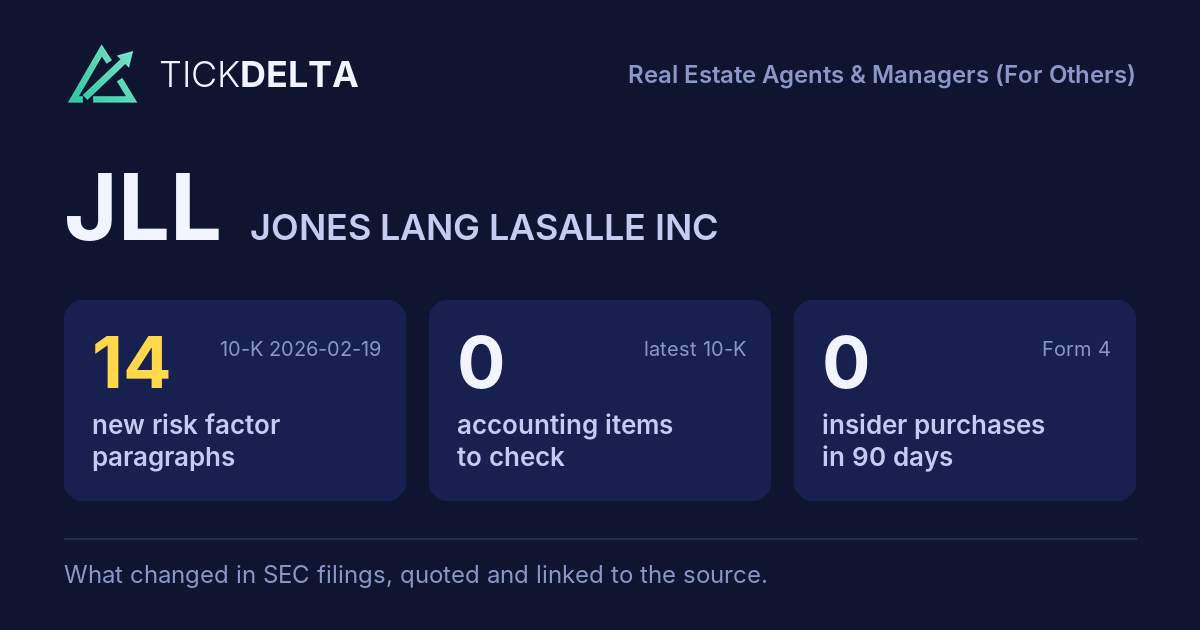
of the text changed · 9,309 words now · 14 new paragraphs, 31 gone
MD&A
21.6%
of the text changed · 7,695 words now · 20 new paragraphs, 16 gone
Legal Proceedings
24.0%
of the text changed · 520 words now
Accounting Policies
11.9%
of the text changed · 8,537 words now
10-K 0001037976-26-000037 (Feb 19, 2026) vs 10-K 0001037976-25-000006 (Feb 19, 2025)
Every paragraph, and how much of it changed
One bar per paragraph, in the order of the 10-K. Height and colour show the share of its words not in the closest paragraph a year earlier; the tallest bars are new paragraphs.
Risk Factors
121 paragraphs · 14 new · 34 reworded · 31 gone · 10-K Feb 19, 2026 against Feb 19, 2025
New paragraph
Reworded (5% of its words or more)
Same or nearly
Paragraph 114 · 40% changed
Every version of it
We have previously experienced and expect in the future that we will be negatively impacted by periods of economic slowdown or recession and corresponding declines in the demand for real estate and related services. While supply-chain pressures have eased somewhat since 2022, The ongoing challenges persist, potentially impacting our ability reconfiguration of global supply chains for greater resilience, combined with persistent geopolitical tensions, continues to deliver goods create volatility in the cost and services to availability of materials, which can affect project timelines and profitability for our clients and affecting the resultant costs in doing so. our business.
Paragraph 28 · 38% changed
Every version of it
In addition, the competitive conditions, particularly in connection with increasingly environment for servicing large clients, clients may require us to agree to contractual terms that increase our potential risk and liability. To secure and retain business, we may need to compromise on certain contract terms with respect related to the payment of fees, the extent of risk transfer, or acting as principal rather than agent in connection with supplier relationships, liability limitations, indemnification obligations, credit terms terms, and other contractual terms, or in connection with disputes or potential litigation. the allocation of risk. Where competitive pressures result in higher levels of potential liability under our contracts, the cost financial impact of operational errors and or other activities matters for which we have indemnified our clients will could be greater significant and may not be fully insured. covered by our insurance.
Paragraph 31 · 35% changed
Every version of it
The precautions we take to prevent these types of occurrences, which represent a significant commitment of corporate resources, may nevertheless be ineffective in certain cases. Any increased or unexpected costs or unanticipated delays in connection with the performance of these engagements, including delays caused by factors outside our control, could have an adverse effect on profit margins.
Paragraph 27 · 31% changed
Every version of it
Deepening relationships with our large enterprise clients may intensify client concentration risk, where a service delivery failure or relationship issue in one service line could jeopardize our entire relationship with that client across other or even all business lines. We are also dependent on long-term client relationships and revenue received for services under various service agreements. In this competitive market, if we are unable to maintain these relationships or are otherwise unable to retain existing clients and develop new clients, our business, results of operations and/or financial condition may be materially adversely affected. Weaknesses in the markets in which our clients compete may lead to additional pricing pressure from clients as they themselves come under financial pressure.
Paragraph 47 · 27% changed
Every version of it
The legal and regulatory landscape surrounding AI also is rapidly evolving. evolving and fragmented. Jurisdictions are beginning to implement distinct regulatory frameworks, such as the European Union’s AI Act, which could impose varying and potentially conflicting compliance obligations on our global operations. Navigating these changes may require significant resources to ensure compliance with both U.S. and non-U.S. laws, potentially impacting our operations and financial performance.
Paragraph 82 · 23% changed
Every version of it
Our employees or suppliers supply partners may directly or indirectly engage in unethical, illegal or non-compliant practices related to bribery, corruption, money laundering, fraud, international trade sanctions, modern slavery, violations of applicable data privacy laws, or other acts that constitute a breach of our Code of Ethics. Failure to adequately prevent, monitor, and detect such behavior could lead to significant reputational damage, regulatory consequences, and adversely impact our operations, profitability and enterprise value. The increased utilization of AI by third-party fraudsters also may exacerbate all, or some, of these risks and it can be challenging to keep pace with the emerging technologies third-parties are using to commit fraudulent and other illegal acts targeting JLL and its supply chain partners.
Paragraph 89 · 23% changed
Every version of it
Paragraph 61 · 48% changed
Every version of it
10-K Feb 19, 2025We are also dependent on long-term client relationships and revenue received for services under various service agreements. In this competitive market, if we are unable to maintain these relationships or are otherwise unable to retain existing clients and develop new clients, our business, results of operations and/or financial condition may be materially adversely affected. Weaknesses in the markets in which our clients compete may lead to additional pricing pressure from clients as they themselves come under financial pressure.
10-K Feb 19, 2026
Weaknesses in the markets in which our clients compete may lead to additional pricing pressure from clients as they themselves come under financial pressure.
Paragraph 114 · 40% changed
Every version of it
10-K Feb 19, 2025
We have previously experienced and expect in the future that we will be negatively impacted by periods of economic slowdown or recession and corresponding declines in the demand for real estate and related services. While supply-chain pressures have eased somewhat since 2022, ongoing challenges persist, potentially impacting our ability to deliver goods and services to our clients and affecting the resultant costs in doing so.
10-K Feb 19, 2026
We have previously experienced and expect in the future that we will be negatively impacted by periods of economic slowdown or recession and corresponding declines in the demand for real estate and related services. The ongoing reconfiguration of global supply chains for greater resilience, combined with persistent geopolitical tensions, continues to create volatility in the cost and availability of materials, which can affect project timelines and profitability for our clients and our business.
Paragraph 28 · 38% changed
Every version of it
10-K Feb 19, 2025
In addition, competitive conditions, particularly in connection with increasingly large clients, may require us to compromise on certain contract terms with respect to the payment of fees, the extent of risk transfer, or acting as principal rather than agent in connection with supplier relationships, liability limitations, credit terms and other contractual terms, or in connection with disputes or potential litigation. Where competitive pressures result in higher levels of potential liability under our contracts, the cost of operational errors and other activities for which we have indemnified our clients will be greater and may not be fully insured.
10-K Feb 19, 2026
In addition, the competitive environment for servicing large clients may require us to agree to contractual terms that increase our potential risk and liability. To secure and retain business, we may need to compromise on terms related to liability limitations, indemnification obligations, credit terms, and the allocation of risk. Where competitive pressures result in higher levels of potential liability under our contracts, the financial impact of operational errors or other matters for which we have indemnified our clients could be significant and may not be fully covered by our insurance.
Paragraph 31 · 35% changed
Every version of it
10-K Feb 19, 2025
The precautions we take to prevent these types of occurrences, which represent a significant commitment of corporate resources, may nevertheless be ineffective in certain cases. Any increased or unexpected costs or unanticipated delays in connection with the performance of these engagements, including delays caused by factors outside our control, could have an adverse effect on profit margins.
10-K Feb 19, 2026
The precautions we take to prevent these types of occurrences, which represent a significant commitment of corporate resources, may nevertheless be ineffective in certain cases.
Paragraph 27 · 31% changed
Every version of it
10-K Feb 19, 2025
We are also dependent on long-term client relationships and revenue received for services under various service agreements. In this competitive market, if we are unable to maintain these relationships or are otherwise unable to retain existing clients and develop new clients, our business, results of operations and/or financial condition may be materially adversely affected. Weaknesses in the markets in which our clients compete may lead to additional pricing pressure from clients as they themselves come under financial pressure.
10-K Feb 19, 2026
Deepening relationships with our large enterprise clients may intensify client concentration risk, where a service delivery failure or relationship issue in one service line could jeopardize our entire relationship with that client across other or even all business lines. We are dependent on long-term client relationships and revenue received for services under various service agreements. In this competitive market, if we are unable to maintain these relationships or are otherwise unable to retain existing clients and develop new clients, our business, results of operations and/or financial condition may be materially adversely affected.
Paragraph 47 · 27% changed
Every version of it
10-K Feb 19, 2025
The legal and regulatory landscape surrounding AI also is rapidly evolving. Navigating these changes may require significant resources to ensure compliance with both U.S. and non-U.S. laws, potentially impacting our operations and financial performance.
10-K Feb 19, 2026
The legal and regulatory landscape surrounding AI also is rapidly evolving and fragmented. Jurisdictions are beginning to implement distinct regulatory frameworks, such as the European Union’s AI Act, which could impose varying and potentially conflicting compliance obligations on our global operations. Navigating these changes may require significant resources to ensure compliance with both U.S. and non-U.S. laws, potentially impacting our operations and financial performance.
Paragraph 82 · 23% changed
Every version of it
10-K Feb 19, 2025
Our employees or suppliers may directly or indirectly engage in unethical, illegal or non-compliant practices related to bribery, corruption, money laundering, fraud, international trade sanctions, modern slavery, violations of applicable data privacy laws, or other acts that constitute a breach of our Code of Ethics. Failure to adequately prevent, monitor, and detect such behavior could lead to significant reputational damage, regulatory consequences, and adversely impact our operations, profitability and enterprise value.
10-K Feb 19, 2026
Our employees or supply partners may directly or indirectly engage in unethical, illegal or non-compliant practices related to bribery, corruption, money laundering, fraud, international trade sanctions, modern slavery, violations of applicable data privacy laws, or other acts that constitute a breach of our Code of Ethics. Failure to adequately prevent, monitor, and detect such behavior could lead to significant reputational damage, regulatory consequences, and adversely impact our operations, profitability and enterprise value. The increased utilization of AI by third-party fraudsters also may exacerbate all, or some, of these risks and it can be challenging to keep pace with the emerging technologies third-parties are using to commit fraudulent and other illegal acts targeting JLL and its supply chain partners.
Paragraph 89 · 23% changed
Every version of it
10-K Feb 19, 2025Laws and regulations applicable to our business, both in the United States and in other countries, may change in ways that materially increase the costs of compliance. Particularly in emerging markets, there can be relatively less transparency around the standards and conditions under which licenses are granted, maintained, or renewed. It also may be difficult to defend against the arbitrary revocation of a license in a jurisdiction where the rule of law is less well developed.
10-K Feb 19, 2026
Licensing requirements in various jurisdictions may change, increasing compliance costs. Particularly in emerging markets, there can be relatively less transparency around the standards and conditions under which licenses are granted, maintained, or renewed. It also may be difficult to defend against the arbitrary revocation of a license in a jurisdiction where the rule of law is less well developed.
MD&A
132 paragraphs · 20 new · 60 reworded · 16 gone · 10-K Feb 19, 2026 against Feb 19, 2025
New paragraph
Reworded (5% of its words or more)
Same or nearly
Paragraph 75 · 50% changed
Paragraph 76 · 48% changed
Year Ended December 31, (in millions, except per share data) 2025 2024 Net income attributable to common shareholders was $546.8 million for the year, or $11.30 $792.1 546.8 Basic earnings per diluted common share, compared with $225.4 million for 2023, or $4.67 share $16.73 11.51 Diluted earnings per diluted common share. share $16.40 11.30 Adjusted EBITDA increased 28% from the prior year to $1,186.3 million in 2024. $1,452.9 1,186.3
Paragraph 95 · 47% changed
Paragraph 122 · 47% changed
Year Ended December 31, ($ in (in millions) 2025 2024 2023 Total number of shares repurchased (in 000's) 373.1 410.3 Payments relating to current-year acquisitions $ 7.7 62.3 Payments for deferred business acquisition and earn-out obligations 19.6 7.4 Total paid for shares repurchased business acquisitions $ 80.4 62.0 27.3 69.7
Paragraph 89 · 47% changed
Higher Adjusted EBITDA was driven by transactional the revenue growth, which outpaced the expense increased described above. growth coupled with incremental platform leverage.
Paragraph 86 · 42% changed
Paragraph 70 · 42% changed
Paragraph 106 · 42% changed
Financing activities used $451.2 $643.2 million of cash during 2024, 2025, compared with $374.3 $451.2 million used during 2023. This 2024. The change resulted from a was driven by higher share repurchases and incremental net year-over-year decrease reductions on short-term borrowings in debt outstanding, as cash provided by earnings was higher in 2024. 2025. We discuss the key components of our financing activity below these drivers in further detail. detail below.
Paragraph 75 · 50% changed
10-K Feb 19, 2025Below is a reconciliation of Net income attributable to common shareholders to Adjusted EBITDA.
10-K Feb 19, 2026
The following details Net income attributable to common shareholders, earnings per share and Adjusted EBITDA.
Paragraph 76 · 48% changed
10-K Feb 19, 2025
Net income attributable to common shareholders was $546.8 million for the year, or $11.30 per diluted common share, compared with $225.4 million for 2023, or $4.67 per diluted common share. Adjusted EBITDA increased 28% from the prior year to $1,186.3 million in 2024.
10-K Feb 19, 2026
Year Ended December 31, (in millions, except per share data) 2025 2024 Net income attributable to common shareholders $792.1 546.8 Basic earnings per common share $16.73 11.51 Diluted earnings per common share $16.40 11.30 Adjusted EBITDA $1,452.9 1,186.3
Paragraph 95 · 47% changed
10-K Feb 19, 2025Lower Segment platform operating expenses reflected (i) lower variable incentive compensation expense as a result of decreased revenue and (ii) the 2024 benefit of cost management actions. These decreases were partially offset by a few discrete, individually immaterial expense items.
10-K Feb 19, 2026
The decrease in Segment platform operating expenses was largely driven by lower variable incentive compensation expense as a result of the decrease in incentive fees.
Paragraph 122 · 47% changed
10-K Feb 19, 2025
Year Ended December 31, ($ in millions) 2024 2023 Total number of shares repurchased (in 000's) 373.1 410.3 Total paid for shares repurchased $ 80.4 62.0
10-K Feb 19, 2026
Year Ended December 31, (in millions) 2025 2024 Payments relating to current-year acquisitions $ 7.7 62.3 Payments for deferred business acquisition and earn-out obligations 19.6 7.4 Total paid for business acquisitions $ 27.3 69.7
Paragraph 89 · 47% changed
10-K Feb 19, 2025
Higher Adjusted EBITDA was driven by transactional revenue growth, which outpaced the expense increased described above.
10-K Feb 19, 2026
Higher Adjusted EBITDA was driven by the revenue growth coupled with incremental platform leverage.
Paragraph 86 · 42% changed
10-K Feb 19, 2025The Adjusted EBITDA improvement was largely attributable to transactional revenue growth, together with cost discipline, tempered by the expense drivers described above.
10-K Feb 19, 2026
Adjusted EBITDA expansion was largely attributable to revenue growth described above together with the enhanced platform leverage.
Paragraph 70 · 42% changed
10-K Feb 19, 2025Lower equity losses in 2024 were attributable to modest valuation increases across several investments, offset by less significant valuation declines compared with 2023.
10-K Feb 19, 2026
The following table details Equity earnings (losses) by category of investment. Specific to Proptech Investments, lower equity losses in 2025 were attributable to modest valuation increases across several investments and less significant valuation declines compared with 2024. Refer to the Investment Management segment discussion for additional details.Year Ended December 31, (in millions) 2025 2024 Investment Management $ 12.3 (22.6) Proptech Investments (38.8) (53.8) Other 5.8 5.6 Equity losses $ (20.7) (70.8)
Paragraph 106 · 42% changed
10-K Feb 19, 2025
Financing activities used $451.2 million of cash during 2024, compared with $374.3 million used during 2023. This change resulted from a net year-over-year decrease in debt outstanding, as cash provided by earnings was higher in 2024. We discuss the key components of our financing activity below in further detail.
10-K Feb 19, 2026
Financing activities used $643.2 million of cash during 2025, compared with $451.2 million used during 2024. The change was driven by higher share repurchases and incremental net reductions on short-term borrowings in 2025. We discuss these drivers in further detail below.
A paragraph is matched with the one last year that shares the most of its words; under half in common makes it new. The paragraphs shown are the 8 reworded the most in each section.
The paragraph that changed most in each section
The redline
Marked against last year's 10-K: cut words struck through, new words highlighted.
MD&A147 words changed in this paragraph; it is 49% similar to last year's version.
Source: Item 7, 10-K 0001037976-26-000037 vs Item 7, 10-K 0001037976-25-000006
Risk Factors136 words changed in this paragraph; it is 37% similar to last year's version.
Our increasing reliance on AI technology introduces various risks, including risks relating to our dependency on the accuracy and reliability of AI-generated outputs, the potential for data privacy and security breaches, and challenges in complying with rapidly-evolving AI regulations across multiple jurisdictions. We also face potential workforce disruption Specifically, the rapid adoption of AI tools exposes us to risks of inaccurate or misleading outputs, which could lead to flawed business analysis or client advice. Furthermore, the use of generative AI may create uncertainty around intellectual property ownership of both inputs and outputs, and could increase the need for reskilling, risk of intellectual property infringement inadvertent disclosure of confidential client or disputes, company information. In addition, as we deploy AI to create efficiencies, we face risks relating to our pricing models. A failure to adopt our pricing strategies, particularly in cost-plus arrangements, to reflect AI-enabled cost reductions could result in margin erosion or damage client relationships if our pricing is not perceived as transparent and unforeseen consequences of AI decision-making in real estate transactions and valuations. fair.
Source: Item 1A, 10-K 0001037976-26-000037 vs Item 1A, 10-K 0001037976-25-000006
Accounting Policies119 words changed in this paragraph; it is 45% similar to last year's version.
We do not enter into derivative financial instruments for trading or speculative purposes. However, in the normal course of business, we do use derivative financial instruments in the form of foreign currency forward contracts and cross-currency swaps to manage our foreign currency exchange rate risk. We currently do not use hedge accounting for these contracts, which record all derivatives on our Consolidated Balance Sheets at fair value. Cash flows related to the derivatives are marked-to-market each period with changes classified in unrealized gains or losses offset by foreign currency gains and losses on associated intercompany loans and other foreign currency balances. Gains and losses from the revaluation Consolidated Statements of these contracts are recognized as a component of Operating, administrative and other expense and are offset by the gains and losses recognized Cash Flows based on the revaluation of intercompany loans and other foreign currency balances such that the impact to net income was not significant for any of the three years ended December 31, 2024. instrument’s nature.
Source: Item 8, Note 2 – SUMMARY OF SIGNIFICANT ACCOUNTING POLICIES, 10-K 0001037976-26-000037 vs Item 8, Note 2 – SUMMARY OF SIGNIFICANT ACCOUNTING POLICIES, 10-K 0001037976-25-000006
Legal Proceedings48 words changed in this paragraph; it is 79% similar to last year's version.
As a participant in the DUS program, we retain a portion of the risk of loss for loans that are originated and sold under the DUS program. Net losses on defaulted loans are shared with Fannie Mae based upon established loss-sharing ratios. Generally, we share approximately one-third of incurred losses, subject to a cap of 20% of the principal balance of the mortgage at origination. As of December 31, 2024 2025 and 2023, 2024, we had loans, funded and sold, subject to loss-sharing arrangements with an aggregate UPB unpaid principal balance of $23.0 $25.8 billion and $20.8 $23.0 billion, respectively. We incurred $0.4 million in loan losses for the year ended December 31, 2024. There were no loan losses incurred for the years ended December 31, 2023 and 2022. See "Financial Guarantees" section of Note 2, Summary of Significant Accounting Policies, for additional information.
Source: Item 3, via Note 13 – COMMITMENTS AND CONTINGENCIES, 10-K 0001037976-26-000037 vs Item 3, via Note 13 – COMMITMENTS AND CONTINGENCIES, 10-K 0001037976-25-000006
Sentences and paragraphs added, removed or reworded
Every change, by type
Sentences and paragraphs of JLL's Risk Factors and MD&A, 10-K Feb 19, 2026 against 10-K Feb 19, 2025. Each links to the text at sec.gov.
Quiet changes are sentences kept from last year with one to four words changed, at least one of them a hedge, a modal or a qualifier (may, could, will, not, significant, material…). A year or date rolling forward is not counted.
The full word list
adverse, adversely, all, although, anticipate, anticipates, any, approximately, believe, believes, can, cannot, certain, could, expect, expects, generally, however, if, intend, intends, largely, likely, many, material, materially, may, might, most, must, never, no, not, possible, primarily, probable, should, significant, significantly, some, substantial, substantially, unlikely, will, would
AddedRisk Factors
We provide services to many of the world's largest and most sophisticated corporate and investor clients. Our business could be adversely affected by the loss of a major client or the disruption of key client relationships.
Read it in 10-K Feb 19, 2026 at sec.gov
AddedRisk Factors
EVOLVING WORKPLACE STRATEGIES AND REAL ESTATE TRENDS, INCLUDING VARYING OFFICE REAL ESTATE OCCUPANCY RATES IN SOME GEOGRAPHIC MARKETS, MAY AFFECT DEMAND FOR OUR SERVICES AND CLIENT PORTFOLIOS.
Read it in 10-K Feb 19, 2026 at sec.gov
AddedRisk Factors
The ongoing evolution of corporate workplace strategies continues to alter how companies use real estate, impacting demand across asset types, particularly the office sector. As organizations seek to optimize their portfolios for cost, efficiency, and employee experience, they are re-evaluating their real estate needs. This dynamic has created opportunities for our advisory services in areas like workplace strategy and design, but it also presents potential risks to our business.
Read it in 10-K Feb 19, 2026 at sec.gov
AddedRisk Factors
A sustained “flight-to-quality,” where clients prioritize modern, well-amenitized buildings, could lead to bifurcated market performance. This may result in reduced transaction volumes and downward pressure on asset values for older or less competitive properties, which could, in turn, affect our brokerage revenues. However, while lower quality assets struggle, the high-quality segment of the market is filling up rapidly, and limited financing availability for new office construction constrains the addition of new high-end supply. This supply shortage in premium office space could limit overall market activity and present challenges for parts of our business. A shift in the mix of services demanded by clients, such as changes to the size and nature of their managed facilities, could also affect long-term annuity revenues from our Real Estate Management Services business.
Read it in 10-K Feb 19, 2026 at sec.gov
AddedRisk Factors
For our Investment Management business, these evolving real estate dynamics may influence the performance and valuation of office-focused investment portfolios and affect investor sentiment and capital allocation decisions.
Read it in 10-K Feb 19, 2026 at sec.gov
AddedRisk Factors
Our financial performance is linked to our ability to anticipate and adapt to these market shifts. Our success depends on our continued ability to advise clients effectively, evolve our service offerings, and help investors navigate the changing risk and opportunity profile of commercial real estate.
Read it in 10-K Feb 19, 2026 at sec.gov
AddedRisk Factors
Our ability to execute our strategy is increasingly dependent on the successful adoption of AI. A failure to optimally deploy and integrate AI could result in the write-off of significant investments and a failure to realize expected productivity and efficiency gains, negatively impacting our profit margins and competitive position. As we replace human processes, we create critical dependencies on AI systems, which could lead to extended operational disruptions if those systems fail and manual backups are no longer viable. Furthermore, as an established incumbent, our legacy data architecture and the need to retrain a large workforce may impede our ability to adopt new technology as quickly as our competitors or new market entrants.
Read it in 10-K Feb 19, 2026 at sec.gov
AddedRisk Factors
Our increasing reliance on AI technology introduces risks relating to our dependency on the accuracy and reliability of AI-generated outputs, the potential for data privacy and security breaches, and challenges in complying with rapidly-evolving AI regulations across multiple jurisdictions. Specifically, the rapid adoption of AI tools exposes us to risks of inaccurate or misleading outputs, which could lead to flawed business analysis or client advice. Furthermore, the use of generative AI may create uncertainty around intellectual property ownership of both inputs and outputs, and could increase the risk of inadvertent disclosure of confidential client or company information. In addition, as we deploy AI to create efficiencies, we face risks relating to our pricing models. A failure to adopt our pricing strategies, particularly in cost-plus arrangements, to reflect AI-enabled cost reductions could result in margin erosion or damage client relationships if our pricing is not perceived as transparent and fair.
Read it in 10-K Feb 19, 2026 at sec.gov
Show the other 64
AddedRisk Factors
As a global company operating in over 80 countries, we are inherently exposed to risks arising from geopolitical volatility, conflicts, and shifting international relations. The current global landscape is marked by significant tensions, including the ongoing war in Ukraine and broader instability in the Middle East, which have disrupted energy markets, global supply chains, and international trade through events like attacks on commercial shipping. Strategic competition between major global powers has led to a more fragmented and unpredictable trade environment characterized by tariffs, investment restrictions, sanctions, and controls on technology transfers. These trade barriers can directly increase the cost and complexity of real estate projects by raising prices for essential construction materials and technology, which particularly affects our Project and Development Services and Workplace Management businesses and can lead to project delays or cancellations.
Read it in 10-K Feb 19, 2026 at sec.gov
AddedRisk Factors
Collectively, these geopolitical conditions contribute to widespread economic uncertainty, currency volatility, and reduced investor and corporate confidence. This environment can cause clients to delay or reconsider real estate investment and leasing decisions, leading to longer sales cycles and potentially lower transaction volumes that would negatively impact our capital markets, leasing, and investment management revenues. Geopolitical developments may also restrict or limit our ability to provide services in countries where we operate today. Navigating this complex landscape of sanctions and evolving trade regulations also increases our operational costs and compliance risks and can pose direct risks to the safety of our employees in affected regions. While we actively monitor these global developments and adapt our strategies to mitigate their impact, a significant escalation of conflict or trade tensions could materially harm our operations, financial performance, and reputation.
Read it in 10-K Feb 19, 2026 at sec.gov
AddedRisk Factors
•We may lose some or all of the capital we invest if the investments underperform.
Read it in 10-K Feb 19, 2026 at sec.gov
AddedRisk Factors
As a licensed real estate service provider and advisor in various jurisdictions, we and our licensed employees may be subject to various licensing obligations that vary by jurisdiction. Failure to maintain proper licensing could subject us to loss of our ability to conduct business in those jurisdictions. We could also face fines, penalties, or suspension of licenses if we fail to meet licensing requirements.
Read it in 10-K Feb 19, 2026 at sec.gov
RemovedRisk Factors
RemovedRisk Factors
RemovedRisk Factors
RemovedRisk Factors
RemovedRisk Factors
RemovedRisk Factors
RemovedRisk Factors
RemovedRisk Factors
RemovedRisk Factors
RemovedRisk Factors
RemovedRisk Factors
RemovedRisk Factors
RewordedRisk Factors
In addition, the potential exists for many countries have enacted significant legislative policy change changes in the taxation of multinational corporations, as has recently been the subject of inspired by the “Pillar One” and “Pillar Two” initiatives of the Organization for Economic Co-operation and Development, Development and the European Union Anti-Tax Avoidance Directives, and legislation enacted or to be enacted pursuant to those initiatives. Directives.
Read it in 10-K Feb 19, 2026 at sec.gov
RewordedRisk Factors
Recent legislative changes in the United States include the 2017 Tax Cuts and Jobs 2022 Inflation Reduction Act and the 2022 Inflation Reduction 2025 One Big Beautiful Bill Act, which have introduced limitations on certain business-related deductions and increased deductions, continued taxation of foreign earnings in the U.S., and established a corporate minimum tax, all of which could increase our future tax expense.
Read it in 10-K Feb 19, 2026 at sec.gov
RewordedRisk Factors
Where competitive pressures result in higher levels of potential liability under our contracts, the cost financial impact of operational errors and or other activities matters for which we have indemnified our clients will could be greater significant and may not be fully insured. covered by our insurance.
Read it in 10-K Feb 19, 2026 at sec.gov
RewordedRisk Factors
Insufficient proactive and reactive organizational agility and responsiveness to industry trends and other external factors may negatively impact our operational results results, reputation, and cause loss of market share and negatively impact the differentiated services we provide as compared to our competitors.
Read it in 10-K Feb 19, 2026 at sec.gov
RewordedRisk Factors
RewordedRisk Factors
If we fail to maintain our licenses or conduct regulated licensed activities without a license or in contravention of applicable regulations, license, we may be required to pay fines, return commissions or investment capital from investors or may have a given license suspended or revoked.
Read it in 10-K Feb 19, 2026 at sec.gov
RewordedRisk Factors
The sheer size and footprint of our company -with - with over 112,000 113,000 employees across more than 80 countries - makes change-management and responsiveness challenging.
Read it in 10-K Feb 19, 2026 at sec.gov
RewordedRisk Factors
We have experienced various types of cyber-attack cyberattack incidents which to-date which, to date, have been contained and not material to us.
Read it in 10-K Feb 19, 2026 at sec.gov
RewordedRisk Factors
Several of our business operations are subject to requirements in various jurisdictions to maintain licenses and comply with particular regulations. licenses.
Read it in 10-K Feb 19, 2026 at sec.gov
RewordedRisk Factors
However, despite significant investments in our safety platform, management systems and vendor due diligence program, if our health and safety policies, procedures, and programs are not adequate, or if our employees or contractors do not receive or complete adequate training or comply with our policies and procedures, we may be be, and have previously been, exposed to significant consequences including serious injury or loss of life, which could have a material impact on our financial performance and reputation.
Read it in 10-K Feb 19, 2026 at sec.gov
RewordedRisk Factors
As JLL and the sector increasingly embraces embrace data-driven decision-making, our ability to effectively manage and utilize big data and AI tools is crucial for maintaining our competitive edge.
Read it in 10-K Feb 19, 2026 at sec.gov
RewordedRisk Factors
AddedMD&A
•Assets under management data for Investment Management is primarily reported on a one-quarter lag.
Read it in 10-K Feb 19, 2026 at sec.gov
AddedMD&A
•Effective January 1, 2025, we report Project Management in Resilient revenue. Prior period financial information was recast to conform with this presentation.
Read it in 10-K Feb 19, 2026 at sec.gov
AddedMD&A
The provision for income taxes increased for the year as higher earnings before taxes outpaced the slight decline in our effective tax rate. The following details our Income tax provision and effective tax rate.
Read it in 10-K Feb 19, 2026 at sec.gov
AddedMD&A
On July 4, 2025, the United States enacted the One Big Beautiful Bill Act ("OBBBA"). The OBBBA includes provisions altering the timing of deduction associated with certain depreciable assets, research and experimental expenses, and interest expense, with some effective in 2025 and some in 2026. The OBBBA further alters the determination and rates of taxation of international earnings, primarily effective in 2026. The current period’s financial statements include the impact of the OBBBA provisions effective for 2025, which are not material to either income tax expense or the financial statements as a whole.
Read it in 10-K Feb 19, 2026 at sec.gov
AddedMD&A
Higher profits were primarily driven by Leasing Advisory and Capital Markets Services, fueled by strong Transactional revenue growth, with incremental contributions from Real Estate Management Services. All segments reflected enhanced platform leverage and continued cost discipline. In addition, an approximate $25 million adverse impact associated with U.S. employee healthcare actuarial deficit was largely offset by discrete cost management actions. Refer to the segment performance highlights for additional detail.
Read it in 10-K Feb 19, 2026 at sec.gov
AddedMD&A
In addition to the aforementioned segment drivers, Net income attributable to common shareholders was favorably impacted by lower Interest expense, net of interest income, and lower equity losses, and unfavorably impacted by higher Restructuring and acquisition charges. These additional drivers are discussed above in further detail.
Read it in 10-K Feb 19, 2026 at sec.gov
AddedMD&A
Effective January 1, 2025, we report Property Management (historically included in Markets Advisory, which was renamed Leasing Advisory) within Real Estate Management Services (formerly referred to as Work Dynamics). Additionally, Capital Markets, LaSalle and JLL Technologies were renamed to Capital Markets Services, Investment Management, and Software and Technology Solutions, respectively.
Read it in 10-K Feb 19, 2026 at sec.gov
AddedMD&A
Effective July 1, 2025, we report the balances and activity associated with the investments historically reported within Software and Technology Solutions in "All Other." These investments (inclusive of convertible notes receivable) in proptech funds and early to mid-stage proptech companies ("Proptech Investments") do not constitute an operating or reporting segment.
Read it in 10-K Feb 19, 2026 at sec.gov
AddedMD&A
Prior period financial information was recast to conform with the presentation changes described above.
Read it in 10-K Feb 19, 2026 at sec.gov
AddedMD&A
Higher Real Estate Management Services revenue was primarily driven by Workplace Management and Project Management. Within Workplace Management, growth reflected a largely balanced mix of mandate expansions and new client wins. Management fees within Workplace Management were unfavorably impacted by approximately $12 million of higher pass-through costs, compared with the prior year, associated with the U.S. employee healthcare actuarial surplus/deficit. Project Management delivered 20% growth, with broad-based contributions from most geographies, as higher pass-through costs augmented a low double-digit management fee increase.
Read it in 10-K Feb 19, 2026 at sec.gov
AddedMD&A
The increase in Segment platform operating expenses was primarily driven by higher compensation and benefits expense to support business growth, partially mitigated by enhanced platform leverage. The difference between the lower 4% increase in segment platform operating expenses compared with the 11% increase in total segment operating expenses was driven by incremental gross contract costs. In addition, an approximate $22 million adverse bottom-line impact associated with the U.S. medical actuarial surplus/deficit was largely offset by discrete cost management actions.
Read it in 10-K Feb 19, 2026 at sec.gov
AddedMD&A
The increase in Leasing Advisory revenue was attributable to Leasing, led by continued momentum in the office sector. Many geographies achieved double-digit Leasing revenue increases, with the most significant growth coming from the U.S., Germany and Canada. Broad-based growth across the U.S. was primarily driven by office — as a meaningful increase in average deal size complemented higher volume — and industrial, largely due to higher deal volume.
Read it in 10-K Feb 19, 2026 at sec.gov
RemovedMD&A
RemovedMD&A
RemovedMD&A
RemovedMD&A
RemovedMD&A
RemovedMD&A
RemovedMD&A
RemovedMD&A
RemovedMD&A
RemovedMD&A
RemovedMD&A
RemovedMD&A
RewordedMD&A
RewordedMD&A
The change in Adjusted EBITDA was flat compared to primarily reflected (i) the prior year, reflecting expected, lower incentive fees noted above, net of variable compensation costs and (ii) the lower revenues offset by the expense drivers noted above and an absence of a prior-year $8.2 million benefit from the gain recognized in the second quarter of 2024 following the purchase of a controlling interest in a LaSalle-managed fund.
Read it in 10-K Feb 19, 2026 at sec.gov
RewordedMD&A
Restructuring and acquisition charges primarily consist of (i) severance and employment-related charges, including those related to external service providers, incurred in conjunction with a structural business shift, which can be represented by a notable change in headcount, change in leadership or transformation of business processes, (ii) acquisition, transaction and integration-related charges, including non-cash fair value adjustments to assets and liabilities recorded in purchase accounting such as earn-out liabilities and intangible assets and (iii) other restructuring, including lease exit charges. processes;
Read it in 10-K Feb 19, 2026 at sec.gov
RewordedMD&A
RewordedMD&A
Refer to Note 2, the Income Tax discussion in the Summary of Significant Critical Accounting Policies and Estimates and Note 8, Income Taxes, of the Notes to Consolidated Financial Statements, included in Item 8. 8, for a further discussion of our effective tax rate.
Read it in 10-K Feb 19, 2026 at sec.gov
RewordedMD&A
As of December 31, 2024, 2025, we had forward exchange cross-currency swap contracts in effect with a gross notional value of $2.21 billion ($1.08 billion on $805.8 million and forward contracts with a net basis). gross notional value of $2.04 billion.
Read it in 10-K Feb 19, 2026 at sec.gov
RewordedMD&A
Restructuring and acquisition charges 75.3 23.1 100.7 Net loss (gain) on disposition — 0.5 Net non-cash MSR and mortgage banking derivative activity 18.2 15.2 18.2 Interest on employee loans, net of forgiveness (6.5) (5.9) (3.6) Equity losses - JLL Technologies Investment Management and LaSalle Proptech Investments(1) 25.8 76.4 201.7 Credit losses on convertible note investments 5.1 6.3 — Adjusted EBITDA $ 1,452.9 1,186.3 938.4
Read it in 10-K Feb 19, 2026 at sec.gov
RewordedMD&A
Certain investments are accounted for under the measurement alternative, defined as cost minus impairment. impairment, plus or minus adjustments resulting from observable price changes in orderly transactions for the identical or a similar investment of the same issuer.
Read it in 10-K Feb 19, 2026 at sec.gov
RewordedMD&A
Generally, the net increase in platform operating expenses was largely driven by growth in revenue-related expenses, partially offset by greater platform leverage. including pass-through costs (gross contract costs) and commission expense, and also reflected higher restructuring and acquisition charges.
Read it in 10-K Feb 19, 2026 at sec.gov
RewordedMD&A
RewordedMD&A
Year Ended December 31, ($ in millions) 2025 2024 2023 Average outstanding borrowings Income tax provision $ 1,381.4 1,875.9 Average effective interest 189.5 132.5 Effective tax rate 5.9 19.3 % 5.9 % 19.5%
Read it in 10-K Feb 19, 2026 at sec.gov
RewordedMD&A
In 2024 2025 and 2023, 2024, funding of investments exceeded returns of capital by $111.1 million (which notably included $100.0 million invested in JLL IPT as described above) and $69.4 million and $85.7 million, respectively.
Read it in 10-K Feb 19, 2026 at sec.gov
Sources
The two latest 10-Ks on EDGAR, section by section. Each change links to the text at sec.gov.
Also
New risk factors: paragraphs with nothing like them last year, quoted in full.
Work with it
Excel workbook · CSV. Google Sheet that stays up to date: paste =IMPORTDATA("https://tickdelta.com/company/JLL/export.csv") into a cell.