Kyndryl Holdings, Inc. KD
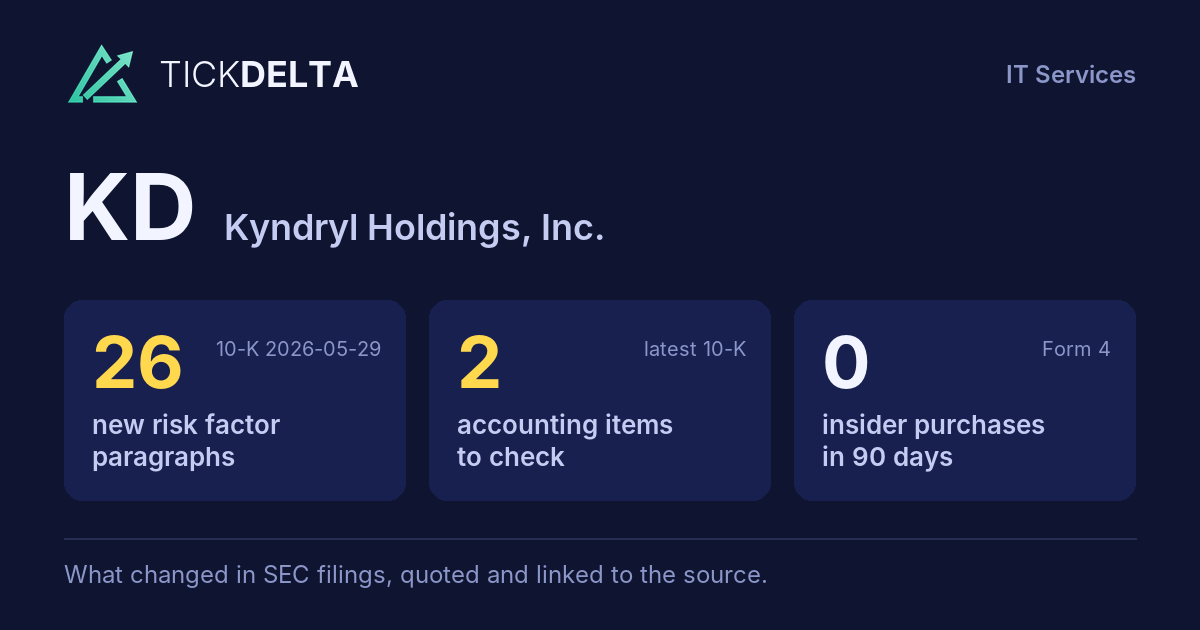
2 facts worth reading about, 8 checks with nothing to note
10-K, 8-K and filing indexFacts from the latest 10-K that are worth reading about. They are not a verdict on the company.
What each check found
Each one cites its filing
-
Late filing notice (NT 10-K or NT 10-Q)NT 10-Q filed Feb 9, 2026: the company said its 10-Q would be late
-
Material weakness in internal control“Based on that evaluation, the Chief Executive Officer and the Interim Chief Financial Officer have concluded that the Company’s disclosure controls and procedures were not effective as of March 31, 2026 due to the material weaknesses in internal control over financial reporting described below.”
-
Receivables growing faster than revenueReceivables -3.3% ($1.3B to $1.3B) vs revenue +0.2% ($15.1B to $15.1B), -3.6 pts apart
-
Cash from operations lower than net incomeCash from operations $948.0M vs net income $198.0M (FY ending Mar 31, 2026)
-
Auditor changeSame auditor in both 10-Ks: PricewaterhouseCoopers LLPSource: 10-K 0001104659-26-067881: auditor PricewaterhouseCoopers LLP; 10-K 0001558370-25-008282: auditor PricewaterhouseCoopers LLP; no 8-K item 4.01 in the last 2 years
-
Going concern languageNo statement of substantial doubt about going concern
-
Restatement (8-K item 4.02)No 8-K item 4.02 in the last 2 yearsSource: Filing index, 8-Ks since Nov 15, 2024
-
Critical audit matters changedThe same matters as last year: Revenue Recognition for Certain Services
-
Material impairment (8-K item 2.06)No 8-K item 2.06 in the last 2 yearsSource: Filing index, 8-Ks since Nov 15, 2024
-
Bankruptcy (8-K item 1.03)No 8-K item 1.03 in the last 2 yearsSource: Filing index, 8-Ks since Nov 15, 2024
-
Inventory growing faster than revenue not applicableThe 10-K does not report inventory for both years.
Did the profit turn into cash?
Net income against operating cash flow, FY2019 to FY2026 · 10-K XBRL
Ratios over five years
Trends · the 10-K's own numbers
Each ratio is worked out from the 10-K's own numbers; hover a value for its source. The small grey figure under each value (“peers”) is the median of 9 companies in the same peer group, for the same fiscal year. The line at the right shows the company (solid) against the peer median (dashed) on one scale. A ratio that moves is a reason to read the filing, not a verdict.
| Ratio | FY2021 | FY2023 | FY2024 | FY2025 | FY2026 | Trend |
|---|---|---|---|---|---|---|
| Days of sales in receivables Receivables / revenue x 365 How long customers take to pay. A rise means sales are being booked faster than cash arrives. | 45 peers 55 | 33 peers 52 | 36 peers 59 | 33 peers 57 | 31 peers 57 | |
| Gross margin (Revenue - cost of revenue) / revenue What is left of each sales dollar after the direct cost of the goods or services. | 11.3% peers 53.8% | 14.8% peers 49.8% | 17.8% peers 51.0% | 20.9% peers 53.2% | 21.8% peers 48.9% | |
| Cash from operations / net income Cash from operations / net income (only when net income is above zero) Near or above 1.0x means profit arrives as cash. Well below it for years means profit is sitting in receivables, stock or estimates. | - peers 1.48x | - peers 1.26x | - peers 1.52x | 3.74x peers 1.52x | 4.79x peers 0.86x | |
| Accruals ratio (Net income - cash from operations) / average total assets The part of profit that is not cash, as a share of the balance sheet. Higher means more of the profit rests on accounting estimates. | −17.9% peers −3.6% | −18.8% peers −3.0% | −7.2% peers −3.7% | −6.6% peers −4.7% | −6.5% peers 4.0% | |
| SG&A / revenue Selling, general and administrative expense / revenue Overhead per dollar of sales. A sudden fall can come from cutting costs, or from moving costs elsewhere. | 14.9% peers 8.6% | 17.1% peers 9.4% | 17.3% peers 9.2% | 17.2% peers 8.5% | 17.6% peers 4.7% |
Published score, FY2026
Published formulas · 10-K line items
Academic formulas, worked out from this company's 10-K numbers. They describe a pattern in the figures; they do not say what the company did, and they are not a view on the shares. Every input is a line item from the filing.
One point for each test the company passes. The paper used it on low price-to-book companies; here it is shown as a summary of the year's financial direction.
The tests
| Return on assets is positiveNet income / assets at the start of the year, above zero. | ✓ 1 |
|---|---|
| Cash from operations is positiveOperating cash flow above zero. | ✓ 1 |
| Return on assets roseThis year's return on assets above last year's. | – 0 |
| Cash from operations exceeds net incomeOperating cash flow / assets above return on assets. | ✓ 1 |
| Long-term debt fell relative to assetsLong-term debt / average assets lower than last year. | ✓ 1 |
| Current ratio roseCurrent assets / current liabilities above last year's. | – 0 |
| No new shares issuedDiluted share count not above last year's (the paper tests for an equity offering). | ✓ 1 |
| Gross margin rose(Revenue - cost of revenue) / revenue above last year's. | ✓ 1 |
| Asset turnover roseRevenue / assets at the start of the year above last year's. | ✓ 1 |
What it does not mean: a low score is not a prediction of a fall, and a high score is not a reason to buy. A test the XBRL could not support is shown as n/a and left out of the total.
How each check works
what it measures, the threshold, what it does not mean
| Check | What it measures | When it is marked | What it does not mean |
|---|---|---|---|
| Receivables growing faster than revenue | Whether customers owe more, relative to sales, than a year ago. | Receivables grew more than 10 percentage points faster than revenue, and grew. | Not proof that revenue is overstated. A large deal at year end, longer payment terms or an acquisition can do the same. |
| Cash from operations lower than net income | Whether reported profit is backed by cash from the business. | Cash from operations is below net income. Not computed for banks and other financial companies. | Common in fast-growing or seasonal companies. It is a question to ask, not a failure. |
| Inventory growing faster than revenue | Whether stock is piling up relative to sales. | Inventory grew more than 10 percentage points faster than revenue, and grew. | May be a planned build ahead of a product launch or a supply-chain change. |
| Auditor change | Whether the company changed its auditor. | An 8-K item 4.01 in the last 2 years, or a different auditor name in the two latest 10-Ks. | Often routine: rotation, a tender, or an audit firm merger. |
| Going concern language | Whether the 10-K states substantial doubt about continuing as a going concern. | A sentence to that effect is found in the 10-K text. Quoted as filed. | The wording is the company's, not our estimate. It can also appear in a sentence saying the doubt was removed. |
| Restatement (8-K item 4.02) | Whether the company said earlier financial statements should no longer be relied on. | An 8-K item 4.02 in the last 2 years. | Some restatements are small and do not change the picture. |
| Late filing notice | Whether the company asked for more time to file a 10-K or 10-Q. | An NT 10-K or NT 10-Q in the last 2 years. | Delays can be technical and one-off. |
| Critical audit matters changed | Which topics the auditor singled out as most difficult, and whether they changed. | A matter is new in the latest 10-K compared with the one before. | A new matter shows where the auditor spent its effort, not that something is wrong. |
| Material weakness in internal control | Whether the 10-K concludes that internal control over financial reporting was not effective because of a material weakness. | A sentence in the 10-K text concludes that controls were not effective because of a material weakness, quoted as filed. Sentences that say there is none, that one could occur, or that an earlier one was fixed are not marked. | It is the company's or the auditor's own wording, not our estimate. Many are about one account or process and are fixed within a year. It does not say the numbers are wrong. |
| Material impairment (8-K item 2.06) | Whether the company told the SEC it expects a material charge for impaired assets, such as goodwill. | An 8-K item 2.06 in the last 2 years. | A non-cash write-down. It says an earlier value was too high, not that the business is failing or that cash ran out. |
| Bankruptcy (8-K item 1.03) | Whether the company filed for bankruptcy or receivership. | An 8-K item 1.03 in the last 2 years. | The filing is the company's own and is a fact. It does not say what shareholders will get or whether the business continues. |
The 10-point threshold is our choice, not an academic result. Every check cites the filing and the line items it used.
The auditor
Auditor's report in the 10-K filed May 29, 2026
What the auditor found hardest this year
- Revenue Recognition for Certain ServicesAlso last yearAs described in Notes 1 and 3 to the consolidated financial statements, the Company recorded total revenues of $15,092 million for the year ended March 31, 2026, of which a majority relates to services that are single performance obligations comprised of a series of distinct services. The Company offers services...
Years with the same auditor, closest peers
GLW 82 · PricewaterhouseCoopers LLP DXC 61 · Deloitte & Touche LLP ADI 58 · Ernst & Young WDC 56 · Kpmg LLP KLAC 49 · PricewaterhouseCoopers LLP STX 46 · Ernst & Young LLP CLS 29 · Kpmg LLP ANET 18 · Ernst & Young LLP PANW 17 · Ernst & Young LLP NOW 15 · PricewaterhouseCoopers LLP SHOP 15 · PricewaterhouseCoopers LLP SANM 9 · PricewaterhouseCoopers LLP MSI 8 · PricewaterhouseCoopers LLP FLUT 8 · Kpmg KD 6 · PricewaterhouseCoopers LLP NXPI 6 · EY Accountants B.V.The first year is from the report's own sentence "We have served as the Company's auditor since ...". Critical audit matters are the parts of the audit the auditor judged hardest; a new one is worth reading. A long tenure is common and not a finding by itself. Open the 10-K
Sources
The latest 10-K and its XBRL, the auditor's report, and 8-K items 4.01, 4.02, 2.06 and 1.03 in the filing index. Each check names its source.
Also
Revised numbers: past numbers a later 10-K reports differently.
Work with it
Excel workbook · CSV. Google Sheet that stays up to date: paste =IMPORTDATA("https://tickdelta.com/company/KD/export.csv") into a cell.