Paragraph 33 · 39% changed
Every version of it
Screener
/
SEC EDGAR
/CIK 0000056047
/10-K filed Feb 17, 2026, compared with Feb 18, 2025
/Numbers from the XBRL of the 10-Ks
NYSE
Industrials · Cruise Lines & Shipping
Kirby Corp KEX
The 10-K against last year's
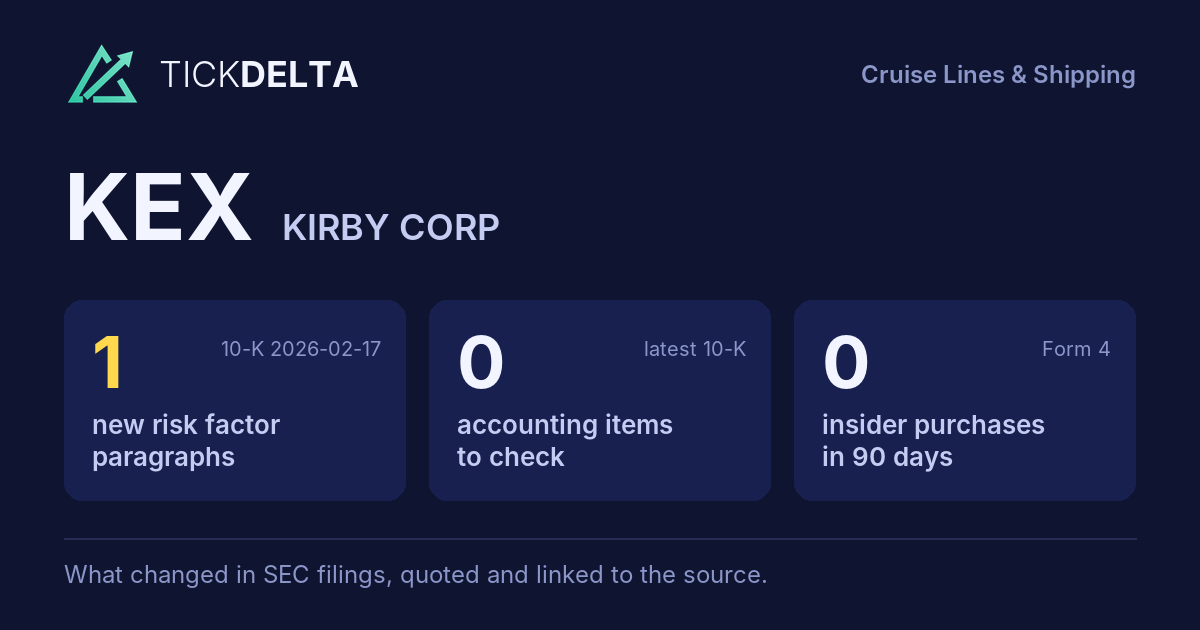
107 changes: 4 added, 2 removed, 100 reworded, 1 quiet changes
10-K Feb 17, 2026 vs Feb 18, 2025
Risk Factors
9.4%
of the text changed · 7,643 words now · 1 new paragraphs, 1 gone
MD&A
14.3%
of the text changed · 9,297 words now · 3 new paragraphs, 1 gone
10-K 0001193125-26-054016 (Feb 17, 2026) vs 10-K 0000950170-25-022012 (Feb 18, 2025) Not compared: Legal Proceedings, Accounting Policies.
Every paragraph, and how much of it changed
One bar per paragraph, in the order of the 10-K. Height and colour show the share of its words not in the closest paragraph a year earlier; the tallest bars are new paragraphs.
Risk Factors
47 paragraphs · 1 new · 17 reworded · 1 gone · 10-K Feb 17, 2026 against Feb 18, 2025
New paragraph
Reworded (5% of its words or more)
Same or nearly
Paragraph 35 · 38% changed
Every version of it
Loss of a large customer or changes in customer demand could adversely affect the Company. Five KMT customers accounted for approximately 17% of the Company’s 2025 revenue, 18% of 2024 revenue, and 16% of 2023 revenue. The Company has contracts with these customers expiring in 2026 through 2031. Three KDS customers accounted for approximately 9% of 2022 the Company’s 2025 revenue, 10% of 2024 revenue, and 12% of 2023 revenue. Although the Company considers its relationships with these companies to be strong, the loss of any of these customers, or their inability to meet financial obligations, could have an adverse effect on the Company. Recent growth in prime power (“behind the meter”) and data center demand has contributed to increased revenue in the power generation market in the KDS segment, and changes in customer demand in this area or other areas of business could have an adverse effect on the Company.
Paragraph 17 · 26% changed
Every version of it
Significant increases in the construction cost of tank barges and towing vessels may limit the Company’s ability to earn an adequate return on its investment in new tank barges and towing vessels. The price of steel, economic conditions, and supply and demand dynamics can significantly impact the construction cost of new tank barges and towing vessels. Over the last 20 years, the Company’s average construction price for a new 30,000 barrel capacity inland tank barge has fluctuated up or down significantly. For example, the
Paragraph 23 · 24% changed
Every version of it
The Company is subject to competition in KDS. The distribution and services industry is very competitive. The segment’s oil and gas market’s principal competitors are independent distribution and service and oilfield manufacturing companies and other factory-authorized distributors and service centers. In addition, certain oilfield service companies that are customers of the Company also manufacture and service a portion of their own oilfield equipment. Increased competition in the distribution and services industry and continued low price or alternative sourcing of natural gas, crude oil or natural gas condensate, and resulting decline in drilling for such natural resources in North American shale formations, could result in less oilfield equipment being manufactured and remanufactured,
Paragraph 41 · 23% changed
Every version of it
Corporate responsibility, specifically related to ESG matters, may impose additional costs and expose the Company to new risks. There is an increasing focus from regulators, certain investors, and other stakeholders concerning environmental, social, and governance (“ESG”) matters, both in the United States and internationally. The Company communicates certain ESG-related initiatives, goals, and/or aspirations regarding environmental matters, diversity, responsible sourcing and social investments, and other matters in its annual Sustainability Report, on its website, in its filings with the SEC, and elsewhere. These initiatives, goals, or aspirations reflect the Company’s current plans and are not guarantees that the Company will be able to achieve them. The standards for tracking and reporting on ESG matters are relatively new, have not been harmonized and continue to evolve. Further, the statutory and regulatory requirements continue to evolve as well. In 2023, the State of California enacted climate related legislation legislation, and in 2024 the SEC was adopted climate disclosure rules, each of which are expected to issue its own climate disclosure rules in 2024, both of which will or could impose additional reporting requirements on the Company resulting in additional compliance cost and expense. The California legislation is subject to ongoing litigation and regulatory rulemaking and enforcement of certain provisions have been stayed. Similarly, the SEC’s climate-related disclosure rules are subject to pending litigation, have been stayed and the SEC has withdrawn its defense of those rules. The Company’s selection of disclosure frameworks that seek to align with various reporting standards may change from time to time and may result in a lack of comparative data from period to period. The ESG-related Company’s sustainability-related initiatives, goals and/or aspirations may be difficult to achieve and costly to implement, and the Company may be unable to economically develop or deploy technologies to achieve such initiatives, goals or aspirations, if at all. In addition, the Company could be criticized for the timing, scope or nature of these initiatives, goals, or aspirations, or for any revisions to them. As mandatory and voluntary disclosures about sustainability matters continues to evolve and increase, the Company may be penalized or criticized for the accuracy, adequacy, or completeness of such disclosures. The Company’s actual or perceived failure to report accurately or achieve its sustainability-related initiatives, goals, or aspirations could result in government enforcement action, negatively impact its reputation, result in sustainability-focused investors not purchasing and holding Company stock, or otherwise materially harm the Company’s business.
Paragraph 32 · 18% changed
Every version of it
The United States Congress has considered, but has not passed, various bills that would create an economy-wide “cap-and-trade” system that would establish a limit (or cap) on overall greenhouse gas emissions and create a market for the purchase and sale of emissions permits or “allowances.” Any proposed cap-and-trade legislation would likely affect the chemical industry due to anticipated increases in energy costs as fuel providers pass on the cost of the emissions allowances, which they would be required to obtain under cap-and-trade to cover the emissions from fuel production and the eventual use of fuel by the Company or its energy suppliers. In addition, cap-and-trade proposals would likely increase the cost of energy, including purchases of diesel fuel, steam and electricity, and certain raw materials used or transported by the Company. Proposed domestic and international cap-and-trade systems could materially increase raw material and operating costs of the Company’s customer base. Future environmental regulatory developments related to climate change in the United States that restrict emissions of greenhouse gases could result in financial impacts on the Company’s operations that cannot be predicted with certainty at this time.
Paragraph 4 · 11% changed
Every version of it
The Company transports a wide variety of petrochemicals, black oil, refined petroleum products and agricultural chemicals throughout the Mississippi River System, on the Gulf Intracoastal Waterway, and coastwise along all three United States coasts. The Company manages its exposure to losses from potential unauthorized discharges of pollutants through the use of well-maintained and equipped tank barges and towing vessels, through safety, training and environmental programs, and through the Company’s insurance
Paragraph 45 · 11% changed
Every version of it
Paragraph 33 · 39% changed
Every version of it
10-K Feb 18, 2025The United States Congress has considered, but has not passed, various bills that would create an economy-wide “cap-and-trade” system that would establish a limit (or cap) on overall greenhouse gas emissions and create a market for the purchase and sale of emissions permits or “allowances.” Any proposed cap-and-trade legislation would likely affect the chemical industry due to anticipated increases in energy costs as fuel providers pass on the cost of the emissions allowances, which they would be required to obtain under cap-and-trade to cover the emissions from fuel production and the eventual use of fuel by the Company or its energy suppliers. In addition, cap-and-trade proposals would likely increase the cost of energy, including purchases of diesel fuel, steam and electricity, and certain raw materials used or transported by the Company. Proposed domestic and international cap-and-trade systems could materially increase raw material and operating costs of the Company’s customer base. Future environmental regulatory developments related to climate change in the United States that restrict emissions of greenhouse gases could result in financial impacts on the Company’s operations that cannot be predicted with certainty at this time.
10-K Feb 17, 2026
certain raw materials used or transported by the Company. Proposed domestic and international cap-and-trade systems could materially increase raw material and operating costs of the Company’s customer base. Future environmental regulatory developments related to climate change in the United States relating to emissions of greenhouse gases could result in financial impacts on the Company’s operations that cannot be predicted with certainty at this time.
Paragraph 35 · 38% changed
Every version of it
10-K Feb 18, 2025
and 9% of 2022 revenue. Although the Company considers its relationships with these companies to be strong, the loss of any of these customers, or their inability to meet financial obligations, could have an adverse effect on the Company.
10-K Feb 17, 2026
Loss of a large customer or changes in customer demand could adversely affect the Company. Five KMT customers accounted for approximately 17% of the Company’s 2025 revenue, 18% of 2024 revenue, and 16% of 2023 revenue. The Company has contracts with these customers expiring in 2026 through 2031. Three KDS customers accounted for approximately 9% of the Company’s 2025 revenue, 10% of 2024 revenue, and 12% of 2023 revenue. Although the Company considers its relationships with these companies to be strong, the loss of any of these customers, or their inability to meet financial obligations, could have an adverse effect on the Company. Recent growth in prime power (“behind the meter”) and data center demand has contributed to increased revenue in the power generation market in the KDS segment, and changes in customer demand in this area or other areas of business could have an adverse effect on the Company.
Paragraph 17 · 26% changed
Every version of it
10-K Feb 18, 2025
Significant increases in the construction cost of tank barges and towing vessels may limit the Company’s ability to earn an adequate return on its investment in new tank barges and towing vessels. The price of steel, economic conditions, and supply and demand
10-K Feb 17, 2026
Significant increases in the construction cost of tank barges and towing vessels may limit the Company’s ability to earn an adequate return on its investment in new tank barges and towing vessels. The price of steel, economic conditions, and supply and demand dynamics can significantly impact the construction cost of new tank barges and towing vessels. Over the last 20 years, the Company’s average construction price for a new 30,000 barrel capacity inland tank barge has fluctuated up or down significantly. For example, the
Paragraph 23 · 24% changed
Every version of it
10-K Feb 18, 2025
The Company is subject to competition in KDS. The distribution and services industry is very competitive. The segment’s oil and gas market’s principal competitors are independent distribution and service and oilfield manufacturing companies and other factory-authorized distributors and service centers. In addition, certain oilfield service companies that are customers of the Company also manufacture and service a portion of their own oilfield equipment. Increased competition in the distribution and services industry and
10-K Feb 17, 2026
The Company is subject to competition in KDS. The distribution and services industry is very competitive. The segment’s oil and gas market’s principal competitors are independent distribution and service and oilfield manufacturing companies and other factory-authorized distributors and service centers. In addition, certain oilfield service companies that are customers of the Company also manufacture and service a portion of their own oilfield equipment. Increased competition in the distribution and services industry and continued low price or alternative sourcing of natural gas, crude oil or natural gas condensate, and resulting decline in drilling for such natural resources in North American shale formations, could result in less oilfield equipment being manufactured and remanufactured,
Paragraph 41 · 23% changed
Every version of it
10-K Feb 18, 2025
Corporate responsibility, specifically related to ESG matters, may impose additional costs and expose the Company to new risks. There is an increasing focus from regulators, certain investors, and other stakeholders concerning environmental, social, and governance (“ESG”) matters, both in the United States and internationally. The Company communicates certain ESG-related initiatives, goals, and/or aspirations regarding environmental matters, diversity, responsible sourcing and social investments, and other matters in its annual Sustainability Report, on its website, in its filings with the SEC, and elsewhere. These initiatives, goals, or aspirations reflect the Company’s current plans and are not guarantees that the Company will be able to achieve them. The standards for tracking and reporting on ESG matters are relatively new, have not been harmonized and continue to evolve. Further, the statutory and regulatory requirements continue to evolve as well. In 2023, the State of California enacted climate related legislation and the SEC was expected to issue its own climate disclosure rules in 2024, both of which will or could impose additional reporting requirements on the Company resulting in additional compliance cost and expense. The Company’s selection of disclosure frameworks that seek to align with various reporting standards may change from time to time and may result in a lack of comparative data from period to period. The ESG-related initiatives,
10-K Feb 17, 2026
Corporate responsibility, specifically related to ESG matters, may impose additional costs and expose the Company to new risks. There is an increasing focus from regulators, certain investors, and other stakeholders concerning environmental, social, and governance (“ESG”) matters, both in the United States and internationally. The Company communicates certain ESG-related initiatives, goals, and/or aspirations regarding environmental matters, diversity, responsible sourcing and social investments, and other matters in its annual Sustainability Report, on its website, in its filings with the SEC, and elsewhere. These initiatives, goals, or aspirations reflect the Company’s current plans and are not guarantees that the Company will be able to achieve them. The standards for tracking and reporting on ESG matters are relatively new, have not been harmonized and continue to evolve. Further, the statutory and regulatory requirements continue to evolve as well. In 2023, the State of California enacted climate related legislation, and in 2024 the SEC adopted climate disclosure rules, each of which are expected to impose additional reporting requirements on the Company resulting in additional compliance cost and expense. The California legislation is subject to ongoing litigation and regulatory rulemaking and enforcement of certain provisions have been stayed. Similarly, the SEC’s climate-related disclosure rules are subject to pending litigation, have been stayed and the SEC has withdrawn its defense of those rules. The Company’s selection of disclosure frameworks that seek to align with various reporting standards may change from time to time and may result in a lack of comparative data from period to period. The Company’s sustainability-related initiatives, goals and/or aspirations may be difficult to achieve and costly to implement, and the Company may be unable to economically develop or deploy technologies to achieve such initiatives, goals or aspirations, if at all. In addition, the Company could be criticized for the timing, scope or nature of these initiatives, goals, or aspirations, or for any revisions to them. As mandatory and voluntary disclosures about sustainability matters continues to evolve and increase, the Company may be penalized or criticized for the accuracy, adequacy, or completeness of such disclosures. The Company’s actual or perceived failure to report accurately or achieve its sustainability-related initiatives, goals, or aspirations could result in government enforcement action, negatively impact its reputation, result in sustainability-focused investors not purchasing and holding Company stock, or otherwise materially harm the Company’s business.
Paragraph 32 · 18% changed
Every version of it
10-K Feb 18, 2025
The United States Congress has considered, but has not passed, various bills that would create an economy-wide “cap-and-trade” system that would establish a limit (or cap) on overall greenhouse gas emissions and create a market for the purchase and sale of emissions permits or “allowances.” Any proposed cap-and-trade legislation would likely affect the chemical industry due to anticipated increases in energy costs as fuel providers pass on the cost of the emissions allowances, which they would be required to obtain under cap-and-trade to cover the emissions from fuel production and the eventual use of fuel by the Company or its energy suppliers. In addition, cap-and-trade proposals would likely increase the cost of energy, including purchases of diesel fuel, steam and electricity, and certain raw materials used or transported by the Company. Proposed domestic and international cap-and-trade systems could materially increase raw material and operating costs of the Company’s customer base. Future environmental regulatory developments related to climate change in the United States that restrict emissions of greenhouse gases could result in financial impacts on the Company’s operations that cannot be predicted with certainty at this time.
10-K Feb 17, 2026
The United States Congress has considered, but has not passed, various bills that would create an economy-wide “cap-and-trade” system that would establish a limit (or cap) on overall greenhouse gas emissions and create a market for the purchase and sale of emissions permits or “allowances.” Any proposed cap-and-trade legislation would likely affect the chemical industry due to anticipated increases in energy costs as fuel providers pass on the cost of the emissions allowances, which they would be required to obtain under cap-and-trade to cover the emissions from fuel production and the eventual use of fuel by the Company or its energy suppliers. In addition, cap-and-trade proposals would likely increase the cost of energy, including purchases of diesel fuel, steam and electricity, and
Paragraph 4 · 11% changed
Every version of it
10-K Feb 18, 2025
The Company transports a wide variety of petrochemicals, black oil, refined petroleum products and agricultural chemicals throughout the Mississippi River System, on the Gulf Intracoastal Waterway, and coastwise along all three United States coasts. The Company manages its exposure to losses from potential unauthorized discharges of pollutants through the use of well-maintained and equipped tank barges and towing vessels, through safety, training and environmental programs, and through the Company’s insurance
10-K Feb 17, 2026
The Company transports a wide variety of petrochemicals, black oil, refined petroleum products and agricultural chemicals throughout the Mississippi River System, on the Gulf Intracoastal Waterway, and coastwise along all three United States coasts. The Company manages its exposure to losses from potential unauthorized discharges of pollutants through the use of well-maintained and
Paragraph 45 · 11% changed
Every version of it
10-K Feb 18, 2025Tariffs and other trade measures could adversely affect the Company’s business, financial condition and results of operations. Additional or new tariffs or other trade measures could adversely impact the Company’s input costs and supply chain, which could reduce availability or increase the cost of goods sold to its customers, especially in KDS. Supply chain disruptions can adversely impact the Company’s operations, particularly where supply chain delays adversely impact availability of materials, components, and equipment for construction, maintenance or repair, including with regard to KMT vessels or in KDS manufacturing. In KMT, Company also transports customer cargoes that are imported into the U.S. or which are destined for export from the U.S. Trade discussions and arrangements between the U.S. and various of its trading partners are fluid, and existing and future trade agreements are, and are expected to continue to be, subject to a number of uncertainties, including the imposition of new tariffs or adjustments and changes to the products or materials covered by existing tariffs. Any decision by the U.S. government to adopt actions such as an increase in customs duties or tariffs, or the renegotiation of U.S. trade agreements, or any other action that could have a negative impact on international trade, including corresponding actions taken by other countries in response to U.S. governmental actions, could cause an increase to the cost of goods sold to KDS customers, adversely impact operations in KMT through interruptions in customer trade patterns or volumes, and adversely impact input costs and supply chain in both segments. To the extent possible, the Company seeks to include contractual language to address recovery of increased costs related to tariffs in the KDS segment. Any changes in trade policies in the U.S. and corresponding actions by other countries could adversely impact Company’s financial performance.
10-K Feb 17, 2026
components, and equipment necessary for construction, maintenance or repair, including with regard to KMT vessels or in KDS manufacturing. In KMT, Company also transports customer cargoes that are imported into the U.S. or which are destined for export from the U.S. Trade discussions and arrangements between the U.S. and various of its trading partners are fluid, and existing and future trade agreements are, and are expected to continue to be, subject to a number of uncertainties, including the imposition of new tariffs or adjustments and changes to the products or materials covered by existing tariffs. Any decision by the U.S. government to adopt actions such as an increase in customs duties or tariffs, or the renegotiation of U.S. trade agreements, or any other action that could have a negative impact on international trade, including corresponding actions taken by other countries in response to U.S. governmental actions, could cause an increase to the cost of goods sold to KDS customers, adversely impact operations in KMT through interruptions in customer trade patterns or volumes, and adversely impact input costs and supply chain in both segments. To the extent possible, the Company seeks to include contractual language to address recovery of increased costs related to tariffs in the KDS segment although there can be no assurance that such provisions will fully offset the impact of changes in trade policies. Any changes in trade policies in the U.S. and corresponding actions by other countries could adversely impact Company’s financial performance.
MD&A
131 paragraphs · 3 new · 66 reworded · 1 gone · 10-K Feb 17, 2026 against Feb 18, 2025
New paragraph
Reworded (5% of its words or more)
Same or nearly
Paragraph 64 · 43% changed
Selling, general and administrative expenses for 2024 2025 increased 2% 5% compared to 2023 2024 due to higher business activity levels and inflationary cost pressures. The increase is primarily due to pressures, including higher medical costs, and salary and wage increases, partially offset by lower legal costs. increases that went into effect on July 1, 2025.
Paragraph 87 · 43% changed
Paragraph 86 · 42% changed
Current assets as of December 31, 2024 decreased 6% 2025 increased 1% compared to December 31, 2023. 2024. Trade accounts receivable decreased 7% 3% primarily due to strong collections activity during 2024. Inventories 2025. Accounts receivable – net decreased by 13% primarily due to the impairment of conventional diesel fracturing equipment inventory and deliveries of power generation units and oilfield service equipment during 2024. Prepaid expenses and other current assets decreased 9% primarily due to lower prepaid fuel increased 48% due to a decrease in the price of diesel fuel and lower assets held for sale due to sales in 2024. federal income tax
Paragraph 49 · 41% changed
KMT’s revenues for 2024 2025 increased 11% 1% compared to 2023 2024 and operating income increased 52%, 3%, compared to 2023. 2024. The increases increase in revenues for 2024 were 2025 was primarily due to improved higher term pricing in the coastal market and higher term and spot pricing in the inland market during the 2025 first half, partially offset by lower fuel rebills in both the inland and coastal markets when markets. The increase in operating income for 2025 as compared to 2023. Results for 2024 were modestly impacted was primarily due to higher term pricing in the coastal market and higher term and spot pricing in the inland market over the 2025 first half, partially offset by weather lower barge utilization and lock delays, while 2023 results were impacted by various lock closures along moderating prices in the Gulf Intracoastal Waterway inland market in the 2025 second half. For 2025 and Illinois River. In addition, several refinery outages also impacted utilization in 2023. For 2024 and 2023, 2024, the inland tank barge fleet contributed 81% 80% and 82%, 81%, respectively, and the coastal fleet contributed 19% 20% and 18%, 19%, respectively, of marine transportation revenues.
Paragraph 115 · 40% changed
The Company generated net cash provided by operating activities of $670.2 million, $756.5 million, and $540.2 million, and $294.1 million for the years ended December 31, 2025, 2024, and 2023, and 2022, respectively. The 40% increase 11% decrease in 2024 2025 as compared to 2023 2024 was primarily due to higher revenues and operating income in KMT and a decrease in trade the timing of accounts receivable primarily collections, accounts payable payments and federal income tax payments, as well as an increase in inventories in 2025, partially offset by increased net earnings. The increase in inventories was due to strong collections activity. Increases the impact of higher business activity levels and efforts to manage supply in KMT revenues and operating income were KDS resulting in the buildup of inventory for projects, mainly due to power generation orders, which are scheduled to be delivered in 2026. The increase in net earnings was driven by higher term and spot contract pricing in the inland KMT coastal market and coastal markets during 2024. improved KDS business activity levels in the commercial and industrial and power generation markets.
Paragraph 74 · 38% changed
Selling, general and administrative expenses for 2024 2025 increased 2% 4% compared to 2023 due to 2024. The increase reflected higher business activity levels and levels, inflationary cost pressures. The increase is primarily due to pressures, including higher medical costs, and salary and wage increases, partially offset by lower legal costs. increases that went into effect July 1, 2025.
Paragraph 83 · 37% changed
Interest expense for 2024 2025 decreased 6% compared to 2023, 2024, primarily due to a lower average interest rate, partially offset by higher average debt outstanding as a result during 2025. Interest expense for 2025 excludes capitalized interest of debt repayments. $1.0 million. There was no capitalized interest excluded from interest expense during 2024 and 2023.
Paragraph 96 · 36% changed
Other long-term liabilities as of December 31, 2024 decreased 39% 2025 increased 10% compared to December 31, 2023, 2024, primarily due to a decrease an increase in pension liabilities due to pension contributions of $1.7 million and an improved funded status. deferred compensation accruals.
Paragraph 64 · 43% changed
10-K Feb 18, 2025
Selling, general and administrative expenses for 2024 increased 2% compared to 2023 due to higher business activity levels and inflationary cost pressures. The increase is primarily due to higher salary and wage increases, partially offset by lower legal costs.
10-K Feb 17, 2026
Selling, general and administrative expenses for 2025 increased 5% compared to 2024 due to inflationary cost pressures, including higher medical costs, and salary and wage increases that went into effect on July 1, 2025.
Paragraph 87 · 43% changed
10-K Feb 18, 2025Current assets as of December 31, 2024 decreased 6% compared to December 31, 2023. Trade accounts receivable decreased 7% primarily due to strong collections activity during 2024. Inventories – net decreased by 13% primarily due to the impairment of conventional diesel fracturing equipment inventory and deliveries of power generation units and oilfield service equipment during 2024. Prepaid expenses and other current assets decreased 9% primarily due to lower prepaid fuel due to a decrease in the price of diesel fuel and lower assets held for sale due to sales in 2024.
10-K Feb 17, 2026
receivable associated with the One Big Beautiful Bill Act (“OBBBA”). Inventories – net increased by 1% primarily due to the impact of higher business activity levels in KDS. Prepaid expenses and other current assets decreased 9% primarily due to lower prepaid fuel due to a decrease in the price of diesel fuel.
Paragraph 86 · 42% changed
10-K Feb 18, 2025
Current assets as of December 31, 2024 decreased 6% compared to December 31, 2023. Trade accounts receivable decreased 7% primarily due to strong collections activity during 2024. Inventories – net decreased by 13% primarily due to the impairment of conventional diesel fracturing equipment inventory and deliveries of power generation units and oilfield service equipment during 2024. Prepaid expenses and other current assets decreased 9% primarily due to lower prepaid fuel due to a decrease in the price of diesel fuel and lower assets held for sale due to sales in 2024.
10-K Feb 17, 2026
Current assets as of December 31, 2025 increased 1% compared to December 31, 2024. Trade accounts receivable decreased 3% primarily due to strong collections activity during 2025. Accounts receivable – other increased 48% due to a federal income tax
Paragraph 49 · 41% changed
10-K Feb 18, 2025
KMT’s revenues for 2024 increased 11% compared to 2023 and operating income increased 52%, compared to 2023. The increases for 2024 were primarily due to improved term and spot pricing in the inland and coastal markets when compared to 2023. Results for 2024 were modestly impacted by weather and lock delays, while 2023 results were impacted by various lock closures along the Gulf Intracoastal Waterway and Illinois River. In addition, several refinery outages also impacted utilization in 2023. For 2024 and 2023, the inland tank barge fleet contributed 81% and 82%, respectively, and the coastal fleet contributed 19% and 18%, respectively, of marine transportation revenues.
10-K Feb 17, 2026
KMT’s revenues for 2025 increased 1% compared to 2024 and operating income increased 3%, compared to 2024. The increase in revenues for 2025 was primarily due to higher term pricing in the coastal market and higher term and spot pricing in the inland market during the 2025 first half, partially offset by lower fuel rebills in both the inland and coastal markets. The increase in operating income for 2025 as compared to 2024 was primarily due to higher term pricing in the coastal market and higher term and spot pricing in the inland market over the 2025 first half, partially offset by lower barge utilization and moderating prices in the inland market in the 2025 second half. For 2025 and 2024, the inland tank barge fleet contributed 80% and 81%, respectively, and the coastal fleet contributed 20% and 19%, respectively, of marine transportation revenues.
Paragraph 115 · 40% changed
10-K Feb 18, 2025
The Company generated net cash provided by operating activities of $756.5 million, $540.2 million, and $294.1 million for the years ended December 31, 2024, 2023, and 2022, respectively. The 40% increase in 2024 as compared to 2023 was primarily due to higher revenues and operating income in KMT and a decrease in trade accounts receivable primarily due to strong collections activity. Increases in KMT revenues and operating income were driven by higher term and spot contract pricing in the inland and coastal markets during 2024.
10-K Feb 17, 2026
The Company generated net cash provided by operating activities of $670.2 million, $756.5 million, and $540.2 million for the years ended December 31, 2025, 2024, and 2023, respectively. The 11% decrease in 2025 as compared to 2024 was primarily due to the timing of accounts receivable collections, accounts payable payments and federal income tax payments, as well as an increase in inventories in 2025, partially offset by increased net earnings. The increase in inventories was due to the impact of higher business activity levels and efforts to manage supply in KDS resulting in the buildup of inventory for projects, mainly due to power generation orders, which are scheduled to be delivered in 2026. The increase in net earnings was driven by higher term contract pricing in the KMT coastal market and improved KDS business activity levels in the commercial and industrial and power generation markets.
Paragraph 74 · 38% changed
10-K Feb 18, 2025
Selling, general and administrative expenses for 2024 increased 2% compared to 2023 due to higher business activity levels and inflationary cost pressures. The increase is primarily due to higher salary and wage increases, partially offset by lower legal costs.
10-K Feb 17, 2026
Selling, general and administrative expenses for 2025 increased 4% compared to 2024. The increase reflected higher business activity levels, inflationary cost pressures, including higher medical costs, and salary and wage increases that went into effect July 1, 2025.
Paragraph 83 · 37% changed
10-K Feb 18, 2025
Interest expense for 2024 decreased 6% compared to 2023, primarily due to lower average debt outstanding as a result of debt repayments.
10-K Feb 17, 2026
Interest expense for 2025 decreased 6% compared to 2024, primarily due to a lower average interest rate, partially offset by higher average debt outstanding during 2025. Interest expense for 2025 excludes capitalized interest of $1.0 million. There was no capitalized interest excluded from interest expense during 2024 and 2023.
Paragraph 96 · 36% changed
10-K Feb 18, 2025
Other long-term liabilities as of December 31, 2024 decreased 39% compared to December 31, 2023, primarily due to a decrease in pension liabilities due to pension contributions of $1.7 million and an improved funded status.
10-K Feb 17, 2026
Other long-term liabilities as of December 31, 2025 increased 10% compared to December 31, 2024, primarily due to an increase in deferred compensation accruals.
A paragraph is matched with the one last year that shares the most of its words; under half in common makes it new. The paragraphs shown are the 8 reworded the most in each section.
The paragraph that changed most in each section
The redline
Marked against last year's 10-K: cut words struck through, new words highlighted.
Risk Factors230 words changed in this paragraph; it is 38% similar to last year's version.
Tariffs and other trade measures could adversely affect the Company’s business, financial condition and results of operations. Additional or new tariffs tariffs, trade restrictions, or other trade measures could adversely impact the Company’s input costs and supply chain, which could reduce availability or increase the cost of goods sold to its customers, especially in KDS. Supply chain disruptions can adversely impact the Company’s operations, particularly where supply chain delays adversely impact availability of materials, components, and equipment for construction, maintenance or repair, including with regard to KMT vessels or in KDS manufacturing. In KMT, Company also transports customer cargoes that are imported into the U.S. or which are destined for export from the U.S. Trade discussions and arrangements between the U.S. and various of its trading partners are fluid, and existing and future trade agreements are, and are expected to continue to be, subject to a number of uncertainties, including the imposition of new tariffs or adjustments and changes to the products or materials covered by existing tariffs. Any decision by the U.S. government to adopt actions such as an increase in customs duties or tariffs, or the renegotiation of U.S. trade agreements, or any other action that could have a negative impact on international trade, including corresponding actions taken by other countries in response to U.S. governmental actions, could cause an increase to the cost of goods sold to KDS customers, adversely impact operations in KMT through interruptions in customer trade patterns or volumes, and adversely impact input costs and supply chain in both segments. To the extent possible, the Company seeks to include contractual language to address recovery of increased costs related to tariffs in the KDS segment. Any changes in trade policies in the U.S. and corresponding actions by other countries could adversely impact Company’s financial performance.
Source: Item 1A, 10-K 0001193125-26-054016 vs Item 1A, 10-K 0000950170-25-022012
MD&A126 words changed in this paragraph; it is 58% similar to last year's version.
In 2026, the inland marine transportation market in 2025, the Company anticipates is expected to experience positive market dynamics due to limited new barge construction. The Company expects barge utilization rates to remain steady for the year with continued improvement in term contract pricing as renewals occur throughout the year. However, the year progresses. The Company also continues to see inflationary pressures and there remains an acute mariner shortage in the industry which continues to drive up labor costs. These pressures, along with the increasing cost of equipment, should continue to put upward pressure on spot and term contract prices. In the The coastal marine transportation market in 2025, is also expected to see very favorable market conditions remain very favorable with in 2026. The coastal marine transportation market should experience steady customer demand expected to keep keeping barge utilization at high levels with improved improving rates as the availability of equipment is remains limited across the industry due to industry. There are no further ATBs coastal barges currently under construction and favorable economic conditions. construction. The Company does expect more shipyard days in the coastal marine transportation market as compared to 2025.
Source: Item 7, 10-K 0001193125-26-054016 vs Item 7, 10-K 0000950170-25-022012
Sentences and paragraphs added, removed or reworded
Every change, by type
Sentences and paragraphs of KEX's Risk Factors and MD&A, 10-K Feb 17, 2026 against 10-K Feb 18, 2025. Each links to the text at sec.gov.
Quiet changes are sentences kept from last year with one to four words changed, at least one of them a hedge, a modal or a qualifier (may, could, will, not, significant, material…). A year or date rolling forward is not counted.
The full word list
adverse, adversely, all, although, anticipate, anticipates, any, approximately, believe, believes, can, cannot, certain, could, expect, expects, generally, however, if, intend, intends, largely, likely, many, material, materially, may, might, most, must, never, no, not, possible, primarily, probable, should, significant, significantly, some, substantial, substantially, unlikely, will, would
AddedRisk Factors
Tariffs and other trade measures could adversely affect the Company’s business, financial condition and results of operations. Additional or new tariffs, trade restrictions, or other trade measures could adversely impact the Company’s input costs and supply chain, which could reduce availability or increase the cost of goods sold to its customers, especially in KDS. Supply chain disruptions can adversely impact the Company’s operations, particularly where supply chain delays adversely impact availability of materials,
Read it in 10-K Feb 17, 2026 at sec.gov
RemovedRisk Factors
RewordedRisk Factors
In 2023, the State of California enacted climate related legislation legislation, and in 2024 the SEC was adopted climate disclosure rules, each of which are expected to issue its own climate disclosure rules in 2024, both of which will or could impose additional reporting requirements on the Company resulting in additional compliance cost and expense.
Read it in 10-K Feb 17, 2026 at sec.gov
RewordedRisk Factors
To the extent possible, the Company seeks to include contractual language to address recovery of increased costs related to tariffs in the KDS segment. segment although there can be no assurance that such provisions will fully offset the impact of changes in trade policies.
Read it in 10-K Feb 17, 2026 at sec.gov
RewordedRisk Factors
Although to date the Company is unaware of any material no data breach or system disruption, including a cyber-attack, has resulted in a material cybersecurity incident for the Company, the Company cannot provide any assurances that such events and impacts will not be material in the future.
Read it in 10-K Feb 17, 2026 at sec.gov
RewordedRisk Factors
The Company manages its exposure to losses from potential unauthorized discharges of pollutants through the use of well-maintained and equipped tank barges and towing vessels, through safety, training and environmental programs, and through the Company’s insurance
Read it in 10-K Feb 17, 2026 at sec.gov
RewordedRisk Factors
The price of steel, economic conditions, and supply and demand dynamics can significantly impact the construction cost of new tank barges and towing vessels.
Read it in 10-K Feb 17, 2026 at sec.gov
RewordedRisk Factors
In addition, cap-and-trade proposals would likely increase the cost of energy, including purchases of diesel fuel, steam and electricity, and certain raw materials used or transported by the Company.
Read it in 10-K Feb 17, 2026 at sec.gov
Show the other 19
RewordedRisk Factors
At the present time, there are an estimated 4,003 4,004 inland tank barges in the United States, of which the Company operates 1,094, 1,105, or 27%. 28%.
Read it in 10-K Feb 17, 2026 at sec.gov
RewordedRisk Factors
AddedMD&A
There were no coastal marine transportation contracts scheduled for renewal in the 2025 fourth quarter.
Read it in 10-K Feb 17, 2026 at sec.gov
AddedMD&A
On October 14, 2025, the Company purchased certain assets from an undisclosed seller in support of the KDS segment for $9.3 million in cash. The assets consisted of inventory and an authorized distributorship for EMD Power Products (“EMD”) for certain geographic regions including Mexico, Central America, the northern part of South America and the Caribbean islands.
Read it in 10-K Feb 17, 2026 at sec.gov
AddedMD&A
There were no coastal marine transportation contracts scheduled for renewal in the 2025 fourth quarter.
Read it in 10-K Feb 17, 2026 at sec.gov
RemovedMD&A
RewordedMD&A
Through KDS, the Company provides equipment, after-market parts and services for power generation systems in applications that include behind the meter power systems and emergency backup systems, after-market and genuine replacement parts and services for engines, transmissions, reduction gears gears, electric motors, drives, and controls, specialized electrical distribution and controls systems, and related equipment used in power generation, marine, on-highway, oilfield services, marine, power generation, on-highway, and other industrial applications.
Read it in 10-K Feb 17, 2026 at sec.gov
RewordedMD&A
The Company, through KDS, provides equipment, after-market parts and services for power generation systems in applications that include behind the meter power systems and emergency backup systems, after-market and genuine replacement parts and services for engines, transmissions, reduction gears gears, electric motors, drives, and controls, specialized electrical distribution and controls systems, and related equipment used in power generation, marine, on-highway, oilfield services, marine, power generation, on-highway, and other industrial applications.
Read it in 10-K Feb 17, 2026 at sec.gov
RewordedMD&A
The Company’s debt-to-capitalization ratio decreased increased to 21.4% at December 31, 2025 from 20.7% at December 31, 2024 from 24.2% at December 31, 2023, 2024, primarily due to an increase in debt outstanding of $44.3 million, partially offset by an increase in total equity, primarily from net earnings attributable to Kirby of $286.7 $354.6 million during 2024 and a reduction of debt outstanding of $141.6 million, 2025 partially offset by treasury stock purchases of $174.6 $354.2 million.
Read it in 10-K Feb 17, 2026 at sec.gov
RewordedMD&A
The Company used discount rates of 5.5% for the Kirby Pension Plan and 5.7% for the Higman Pension Plan in 2025 and 5.7% for both the Kirby pension plan Pension Plan and Higman pension plan Pension Plan in 2024 and 5.1% for the Kirby pension plan and 5.2% for the Higman pension plan in in 2023. 2024.
Read it in 10-K Feb 17, 2026 at sec.gov
RewordedMD&A
The petrochemical market, the Company’s largest market, contributed 51% 48% of marine transportation revenues for 2024, 2025, reflecting increased steady rates, volumes and utilization from Gulf Coast petrochemical plants as a result of improved economic conditions and a reduced supply of barges across the industry due to a heavier than normal maintenance cycle as compared to 2023. plants.
Read it in 10-K Feb 17, 2026 at sec.gov
RewordedMD&A
RewordedMD&A
The increase in operating income and operating margin were primarily due to higher term pricing in the coastal market and higher spot contract and term pricing in the inland market over the 2025 first half, partially offset by lower barge utilization and coastal markets. moderating prices in the inland market in the 2025 second half.
Read it in 10-K Feb 17, 2026 at sec.gov
RewordedMD&A
The Company also owns operates shifting operations and fleeting facilities for dry cargo barges and tank barges on the Houston Ship Channel and Channel, in Freeport and Port Arthur, Texas, and Lake Charles, Louisiana, and its San Jac shipyard for building inland towboats and performing routine maintenance on marine vessels near the Houston Ship Channel, as well as a two-thirds interest in Osprey Line, L.L.C., which transports project cargoes and cargo containers by barge. Channel.
Read it in 10-K Feb 17, 2026 at sec.gov
RewordedMD&A
Selling, general and administrative expenses for 2024 2025 increased 2% 5% compared to 2023 2024 due to higher business activity levels and inflationary cost pressures. pressures, including higher medical costs, and salary and wage increases that went into effect on July 1, 2025.
Read it in 10-K Feb 17, 2026 at sec.gov
RewordedMD&A
Other long-term liabilities as of December 31, 2024 decreased 39% 2025 increased 10% compared to December 31, 2023, 2024, primarily due to a decrease an increase in pension liabilities due to pension contributions of $1.7 million and an improved funded status. deferred compensation accruals.
Read it in 10-K Feb 17, 2026 at sec.gov
RewordedMD&A
In the power generation market, revenues increased 20% 26% compared to 2023 2024 due to several large project awards from data center customers as well as other backup increased demand for backup, prime power industrial customers. and critical power applications.
Read it in 10-K Feb 17, 2026 at sec.gov
RewordedMD&A
The inland marine transportation fleet operated an average of 279 towboats during 2025, of which an average of 69 were chartered, compared to 285 towboats during 2024, of which an average of 70 were chartered, compared to 280 during 2023, of which an average of 64 were chartered.
Read it in 10-K Feb 17, 2026 at sec.gov
Quiet changesMD&A
Sources
The two latest 10-Ks on EDGAR, section by section. Each change links to the text at sec.gov.
Also
New risk factors: paragraphs with nothing like them last year, quoted in full.
Work with it
Excel workbook · CSV. Google Sheet that stays up to date: paste =IMPORTDATA("https://tickdelta.com/company/KEX/export.csv") into a cell.