KEYKeyCorp
KeyCorp, organized in 1958 under the laws of the State of Ohio, is headquartered in Cleveland, Ohio. 10-K, Item 1
- Headquarters
- Cleveland, OH
- CEO
- Christopher M. Gorman
- Next results
- around Jan 19, 2027
19 paragraphs in Risk Factors of the 10-K filed Feb 23, 2026 with nothing like them in the 10-K filed Feb 21, 2025. Quoted exactly. Paragraphs that were only edited are under 10-K change.
Compared with the Risk Factors in the latest 10-K of the other 75 Financials companies: a paragraph with at least half its words the same at another company is called similar, and the companies are listed under it. A paragraph most of them have is marked boilerplate. No line means no other company has one like it. This counts text; it does not say how serious a risk is.
◦A loss of customer deposits or an adverse change in deposit mix could increase our funding costs and/or impair our liquidity.
Read in the 10-K ↗
◦Our development and use of AI, including through third parties, exposes us to inherent risks that may adversely impact KeyCorp.
Read in the 10-K ↗
After disruptions in 2022 through early 2024 as a result of the increases in the Fed Funds rate and dislocations in the office sector as a result of COVID-19, the commercial and residential real estate markets have remained relatively steady over the past 18 months as they have adjusted to a more “normalized” rate environment. Capitalization rates and commercial property prices have been supported by a continued inflow of capital into the real estate markets. However, potential headwinds (labor market, geo-political, rate environment) could impact the real estate markets and Key’s portfolio moving forward.
A large portion of our clients are active in real estate, with most focused on the multifamily space, which has been the best performing real estate sector over the cycle. However, while development and construction have continued
at muted levels over the past two years, oversupply of multifamily housing is a concern in certain urban markets. This oversupply has resulted in higher vacancy rates and put pressure on some borrowers to achieve underwritten rents. These two factors impact the ability of borrowers to generate sufficient cash flow in order to make debt service payments on loans or to refinance the loans at maturity. Key’s risk to any specific market is limited, with all metropolitan statistical area concentrations less than 4%. Further, Key has limited its exposure to rent-controlled properties across the country, with no exposure to rent-controlled properties in New York City.
Read in the 10-K ↗
An inability to grow cash flow or pressure on expenses created by supply chain, insurance, or interest rate increases would result in an increase in the level of payment defaults within the sector, as well as limiting refinance options. Further, these pressures would likely result in an outflow of capital from the real estate markets, which would in turn drive up capitalization rates and decrease property values.We are subject to the risk of defaults by our loan clients and counterparties.
Read in the 10-K ↗
•The imposition of further tariffs and other changes to U.S. or global trade policies;
Similar paragraph at 1 of 75 other Financials companies: WTWRead in the 10-K ↗
•A decrease in the value of collateral, or an increase in the haircuts on that collateral, that we pledge to secure funding and liquidity, reducing the quantum of that funding and/or liquidity;
Read in the 10-K ↗
To facilitate our wholesale funding and other business activities, we maintain credit ratings with three major credit rating agencies, and their assessments of our capital and liquidity are prominent determinants of our credit ratings. Additionally, from time to time, the agencies revise their bank rating methodologies and may increase their expectations of the amount and/or type of capital and liquidity we hold in order to maintain our investment grade credit ratings. In certain cases, those rating agency requirements may exceed regulatory requirements, making the
rating agency requirements our binding constraint and increasing our capital and/or liquidity costs above what they would otherwise be and potentially reducing our profitability.
Read in the 10-K ↗
We rely on customer deposits as a low-cost and stable source of funding. KeyBank competes with banks and other financial institutions, and increasingly with non-banks that offer non-deposit and other alternative savings vehicles, such as stablecoins, for deposits. If demand for deposit alternatives were to grow materially, KeyBank could experience deposit outflows or be compelled to materially increase deposit interest rates to retain its deposits. Customers may also shift their deposits from non-interest bearing to interest bearing accounts or otherwise to higher cost products at KeyBank. Our ability to maintain and grow deposits may be constrained by gaps in our product offerings, emerging technologies and changes in consumer behaviors and preferences, our scale relative to other banks and financial institutions, underlying macroeconomic conditions and monetary policy, and loss of confidence in our brand and our business. To the extent that KeyBank is unable to retain deposits, funding costs may increase as such deposits are replaced with more expensive wholesale funding. Any adverse movement in deposits and associated higher funding costs could reduce our net interest margin and net interest income and otherwise materially and adversely affect our liquidity, financial condition, and results of operations.
Read in the 10-K ↗
6 more
Further, regulatory guidance adopted by federal banking regulators related to how banks select, contract with, evaluate, engage with, and manage their third parties, including such third parties’ use of subcontractors and
Read in the 10-K ↗
We use, and will increasingly use AI, including through third party vendors acting on our behalf and other counterparties, in connection with our business and operations. AI is complex and rapidly evolving and in order to compete with other banks and financial institutions effectively, we must incorporate new and emerging AI technology into our business and this may subject us to new or heightened legal, regulatory, operational, and other risk. The legal and regulatory environment relating to AI is uncertain and evolving, and any changes to applicable laws and regulations could require changes to our use of AI technology and could cause an increase in associated costs and expenses. We may also be unsuccessful in realizing the intended benefits of AI or otherwise enhancing our business or operations and our competitors may incorporate AI in their businesses or operations more quickly or more successfully than us, all of which could occur despite considerable expense and which could negatively affect our financial condition and results of operations.
The models underlying AI that we may leverage, including those developed by third party providers, may be incorrectly or inadequately designed or implemented and trained on, or otherwise use, data or algorithms that are incomplete, inadequate, misleading, biased, or otherwise flawed, or that are subject to intellectual property rights not known to us, and that ultimately produce outputs that are similarly flawed but that which we or third parties acting on our behalf rely, and any such flaw may not be easily and readily detectable. The limited transparency into the underlying complexity of AI and associated models that we rely on makes reproducing the connection between input and output, at times, difficult or impossible. If the AI that we leverage is flawed in such ways, we may make inaccurate or ineffective decisions and otherwise incur operational inefficiencies, compliance issues, competitive and reputational harm, adverse legal and regulatory actions, or other adverse impacts to our business and operations. We may not be able to sufficiently mitigate or detect any of the foregoing risks given the emerging nature of AI technology. Additionally, inappropriate or controversial data practices by third party AI developers and
their end-users could adversely affect public opinion of AI and ultimately impair acceptance of AI, including those incorporated into our business and operations.
Read in the 10-K ↗
VI. Strategic RiskWe may not realize the expected benefits of our strategic initiatives.
Read in the 10-K ↗
in the financial services industry, or our failure to perform in any of these areas, could significantly weaken our competitive position, which could adversely affect our growth and profitability.
Similar paragraph at 1 of 75 other Financials companies: KKRRead in the 10-K ↗
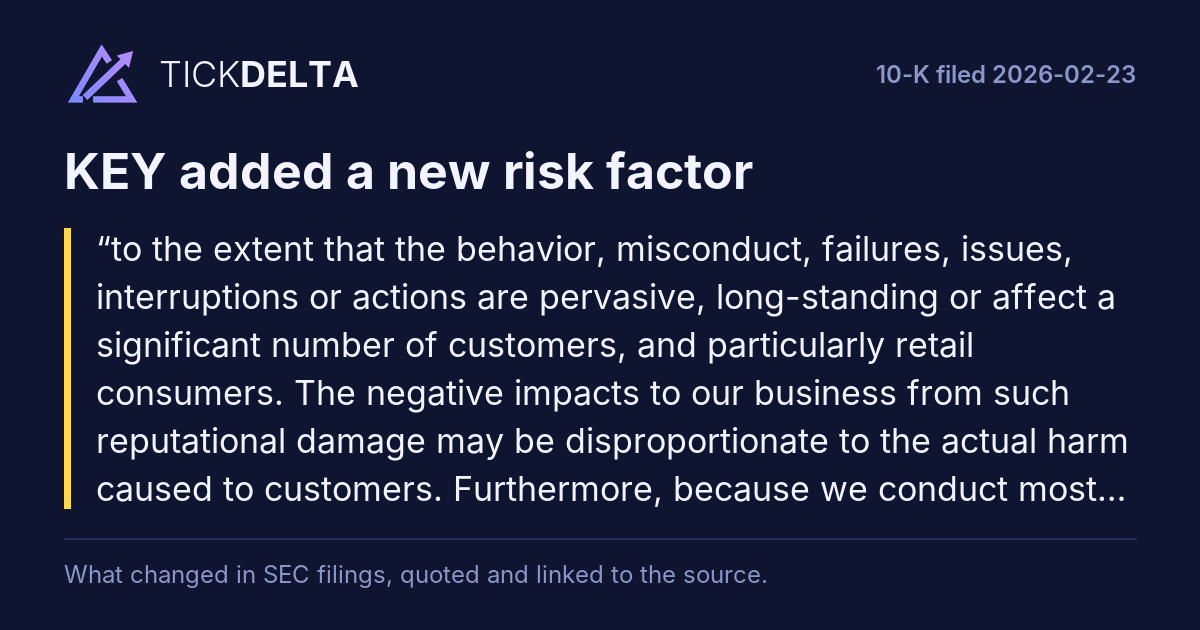
to the extent that the behavior, misconduct, failures, issues, interruptions or actions are pervasive, long-standing or affect a significant number of customers, and particularly retail consumers. The negative impacts to our business from such reputational damage may be disproportionate to the actual harm caused to customers. Furthermore, because we conduct most of our businesses under the “Key” brand, negative public opinion about one business could also affect our other businesses. Additionally, actions by the financial services industry generally or by certain members or individuals in the industry as well as legislative or regulatory actions that target or negatively impact the industry may also have a significant adverse effect on our reputation.
Read in the 10-K ↗
Negative coverage about Key published in traditional media or on social media websites, whether or not factually
Read in the 10-K ↗
New in the latest 10-Q
20 paragraphs in the 10-Q filed Nov 3, 2026 with nothing like them in the 10-Q filed Aug 4, 2026 (at least half the words must differ; new numbers alone do not count). Quoted exactly, grouped by the item heading above them. This is text that changed, not a judgement of how serious it is.
10-Q
• Our continuous focus on disciplined client selection, prudent underwriting standards and deep domain expertise in helping clients navigate the uncertain environment was evident this quarter. Net charge-offs were 32 basis points in the third quarter.
Read in the 10-Q ↗
On September 30, 2026, the Federal Reserve adopted two final rules related to supervisory stress testing and stress capital buffer (“SCB”) requirements. One of the final rules codifies a process under which the Federal Reserve will annually disclose and seek public comment on the models and scenarios used in the supervisory stress test. The other final rule (the “SCB Averaging Rule”) is intended to reduce year-over-year volatility in capital requirements by revising the Federal Reserve’s approach to calculating SCBs for certain firms.
Read in the 10-Q ↗
Under the Federal Reserve’s previous rules, and subject to a floor of 2.5%, the SCB of a firm subject to an annual supervisory stress test was calculated as the sum of the difference between the firm's starting and minimum projected CET1 capital ratio under the severely adverse scenario in the supervisory stress test (the “stress capital decline component”) plus four quarters of planned common stock dividends as a percentage of risk-weighted assets (the “dividend add-on component”). Under the SCB Averaging Rule, the Federal Reserve will generally calculate the stress capital decline component for a firm that is subject to the Federal Reserve’s supervisory stress test in two consecutive years by taking the average of the firm’s stress capital decline component over those two years. That average stress capital decline will then be added to the dividend add-on component from the current year to produce the firm’s final SCB, subject to a floor of 2.5%.
Read in the 10-Q ↗
The SCB Averaging Rule also includes other changes to the Federal Reserve’s rules relating to SCBs, including a change that will make new SCBs effective January 1 of the year following the year in which the SCB was calculated, rather than October 1 of the year in which the SCB was calculated. The change to SCB effective dates will be effective for the 2027 supervisory stress test, but the Federal Reserve will not begin to implement SCB averaging until after the 2028 supervisory stress test. Accordingly, beginning January 1, 2029, the SCB assigned to a firm that was subject to both the 2027 and 2028 supervisory stress test will be calculated using the averaging approach described above. A firm that was subject to the 2028 supervisory stress test but not the 2027 supervisory stress test will be assigned an SCB calculated using only the results of the 2028 supervisory stress test.
Read in the 10-Q ↗
As a Category IV banking organization, KeyCorp is not required to participate in the 2027 supervisory stress test, but may elect by January 5, 2027, to opt in to the 2027 test. If KeyCorp opts in to the 2027 test, it will receive a new SCB, effective January 1, 2028, equal to KeyCorp’s stress capital decline component calculated based on the results of the 2027 stress test, plus an updated dividend add-on component. If KeyCorp does not opt in to the 2027
Read in the 10-Q ↗
test, KeyCorp’s new SCB, effective January 1, 2028, is expected to be equal to KeyCorp’s current SCB, as adjusted to reflect an updated dividend add-on component.
Read in the 10-Q ↗
Rules adopted by the federal banking regulators under the Community Reinvestment Act (“CRA”) require depository institutions to help meet the credit needs of the communities that they serve, including low- and moderate-income neighborhoods. In October 2023 the federal banking agencies adopted a final rule to substantially revise their regulations implementing the CRA. Various trade associations filed a lawsuit in the United States District Court for the Northern District of Texas against the rule, and in March 2024 the court in that case issued a preliminary injunction. The decision was appealed to the United States Court of Appeals for the Fifth Circuit, but the appeal was subsequently stayed after the federal banking agencies indicated that they intended to issue a proposal to rescind the 2023 rule and to generally reinstate the CRA framework that was in place prior to the issuance of that rule (the “rescission proposal”). The rescission proposal was issued on July 16, 2025.
Read in the 10-Q ↗
On July 31, 2026, the FDIC and OCC withdrew the rescission proposal and instead proposed changes that, while reinstating the general framework of CRA rules that was in place prior to 2023 rule, would also make certain substantive changes to those rules. For example, the proposal would modify the criteria that would need to be satisfied for a bank to receive CRA credit for certain activities. The proposal would also change the thresholds for the application of certain CRA requirements to certain banks, but would not change the applicability of the CRA rules to KeyBank.
Read in the 10-Q ↗
2026, KeyCorp redeemed all of the depositary shares representing ownership interests in the Series D preferred
Read in the 10-Q ↗
Figure 30 shows the composition of our nonperforming assets. As shown in Figure 30, nonperforming assets at September 30, 2026 were unchanged compared to December 31, 2025.
Read in the 10-Q ↗
During the period ended September 30, 2026, Key refined its estimation approach for incorporating economic and forecast uncertainty within its allowance for credit losses. Since CECL adoption in 2020, the quantitative estimate was based on a single reasonable and supportable economic forecast, while uncertainty in the economic outlook and alternative scenarios were considered in the development of the qualitative reserve. In the current period, Key refined this approach by incorporating three probability-weighted economic scenarios directly within the quantitative framework. Refer to Note 4 (“Asset Quality”) for additional information.
Read in the 10-Q ↗
Financial statements and notes
Key Shareholders’ Equity Dollars in millions, except per share amounts Preferred Common Preferred Common Capital Retained Treasury Accumulated Total Shareholders’ Equity (Unaudited) Shares Shares Stock Shares Surplus Earnings Stock, Other Outstanding Outstanding at Cost Comprehensive (000) (000) Income (Loss) BALANCE AT DECEMBER 31, 2024 1,996 1,106,786 $2,500 $1,257 $ 6,038 $ 14,584 $ (2,733) $ (3,470) $ 18,176 Net income (loss) 1,319 1,319 Other comprehensive income (loss) 1,321 1,321 Deferred compensation (1) (1) Cash dividends declared Common Shares ($.410 per share) (684) (684) Series D Preferred Stock ($25.00 per depositary share) (20) (20) Series E Preferred Stock ($.766 per depositary share) (23) (23) Series F Preferred Stock ($.706 per depositary share) (18) (18) Series G Preferred Stock ($.703 per depositary share) (19) (19) Series H Preferred Stock ($.775 per depositary share) (28) (28) Employee equity compensation program Common Share repurchases (1,963) — (35) (35) Common Shares reissued (returned) for stock options and other employee benefit plans 8,129 (35) 149 114 BALANCE AT SEPTEMBER 30, 2025 1,996 1,112,952 $2,500 $1,257 $ 6,002 $ 15,111 $ (2,619) $ (2,149) $ 20,102 BALANCE AT JUNE 30, 2025 1,996 1,112,453 $2,500 $1,257 $ 5,971 $ 14,886 $ (2,629) $ (2,501) $ 19,484 Net income (loss) 489 489 Other comprehensive income (loss) 352 352 Cash dividends declared Common Shares ($.205 per share) (228) (228) Series D Preferred Stock ($12.50 per depositary share) (7) (7) Series E Preferred Stock ($.382813 per depositary share) (8) (8) Series F Preferred Stock ($.353125 per depositary share) (6) (6) Series G Preferred Stock ($.351563 per depositary share) (6) (6) Series H Preferred Stock ($.387500 per depositary share) (9) (9) Employee equity compensation program Common Share repurchases (1) — — — Common Shares reissued (returned) for stock options and other employee benefit plans 500 31 10 41 BALANCE AT SEPTEMBER 30, 2025 1,996 1,112,952 $2,500 $1,257 $ 6,002 $ 15,111 $ (2,619) $ (2,149) $ 20,102
Read in the 10-Q ↗
(a) Includes a $ 6 million deemed dividend associated with the redemption of Series D Preferred Stock for the three and nine months ended September 30, 2026.
Read in the 10-Q ↗
During the period ended September 30, 2026, Key refined its estimation approach for incorporating economic and forecast uncertainty within its allowance for credit losses. Since CECL adoption in 2020, the quantitative estimate was based on a single reasonable and supportable economic forecast, while uncertainty in the economic outlook and alternative scenarios were considered in the development of the qualitative reserve. In the current period, Key refined this approach by incorporating three probability-weighted economic scenarios directly within the quantitative framework. This enhancement was applied prospectively in the current period. The increase in quantitative model reserves associated with a weighted scenario approach was offset by a release of qualitative reserves where economic uncertainty and alternate scenarios were previously considered. At September 30, 2026, the net impact of this change did not have a material impact on the allowance.
Read in the 10-Q ↗
As of September 30, 2026, the economy continues to be resilient, but the outlook is mixed. Economic growth has slowed, but there is continued labor-market resilience. Consumer confidence weakened and inflation remains above target. The Federal Reserve’s September rate increase, elevated energy costs, and geopolitical tensions increase pressure and create downside risks to the U.S. economy.
Read in the 10-Q ↗
Evolving market conditions and emerging risks which are not fully captured by the quantitative models and scenario weights, are addressed through the qualitative reserve component.
Read in the 10-Q ↗
The ALLL from continuing operations for the commercial segment decreased $ 52 million, or 4.7 %, from June 30, 2026. The decrease was primarily driven by continued improvement in the composition and strong performance of the commercial loan portfolio, including the runoff of higher-reserved exposures, new originations with stronger risk characteristics, and favorable trends in individually evaluated credits. While reserve levels declined during the quarter, the allowance continues to reflect a range of potential economic outcomes and captures uncertainty in the macroeconomic environment, including elevated inflation, energy costs and higher-for-longer interest rates.
Read in the 10-Q ↗
On August 14, 2026, we provided notice of our intention to redeem all of the depositary shares each representing a 1/25th ownership interest in a share of our issued and outstanding Series D Fixed-to-Floating Rate Perpetual Non-Cumulative Preferred Stock (the “Series D Preferred Stock”) on September 15, 2026. On September 15, 2026, we redeemed the Series D Preferred Stock for cash at a redemption price of $ 25,312.50 per share ($ 1,012.50 per depositary share).
Read in the 10-Q ↗
Item 6
22 Subsidiary Issuers of Guaranteed Securities, filed as Exhibit 22 to Form 10-K for the year ended December 31, 2025. ^
Read in the 10-Q ↗
104 The cover page from KeyCorp’s Form 10-Q for the quarterly period ended September 30, 2026, formatted in inline XBRL (contained in Exhibit 101).
Read in the 10-Q ↗
The 10-Q's risk factors against the 10-K
Item 1A of the 10-Q filed Nov 3, 2026 against Item 1A of the 10-K filed Feb 23, 2026.
A 10-Q repeats only the risks that changed, so a 10-K paragraph that is missing from it is not counted as removed.
Added is a paragraph with nothing like it in the 10-K, Reworded a sentence that is in both with several words changed,
Quiet changes a sentence in both where one to four words changed and one is a hedge or a modal
(cut words struck through, new words highlighted and underlined).
Text on the page, not a score; each links to the filing at sec.gov.
What the 10-Q itself says about its risk factors:
Read in the 10-Q ↗
For a discussion of certain risk factors affecting us, see the section titled “Supervision and Regulation” in Part I, Item 1. Business, on pages 11-24 of our 2025 Form 10-K; Part I, Item 1A. Risk Factors, on pages 25-43 of our 2025 Form 10-K; the section titled “Supervision and regulation” in this report; and our disclosure regarding forward-looking statements in this report.
1 paragraph in the 10-Q's Item 1A, and none of them adds, rewords or quietly edits a paragraph of the 10-K's.
Work on KEY in a spreadsheet:
Excel workbook (a sheet per section, ten years by column, charts, links to the filings) ·
CSV.
For a Google Sheet that stays up to date, paste =IMPORTDATA("https://tickdelta.com/company/KEY/export.csv") into a cell.