tickdelta
Sign in

Tickdelta is free for now. Sign up and get Pro free

← Screener

KIMKimco Realty

Real estate · REIT · NYSE

The Company is the leading owner and operator of high-quality, open-air, grocery-anchored shopping centers and mixed-use properties in the United States. 10-K, Item 1

Headquarters
Jericho, NY
CEO
Conor Flynn
Next results
around Feb 11, 2027
Compare with peers → Embed

When the SEC's staff reviews a filing, it writes to the company with numbered questions, and the company answers each one in a letter. SEC publishes the exchange once the review is over, at least 20 business days later. Below: what the staff asked KIM, and the company's answer to each question, quoted from the letters. A question is not an accusation; most reviews end with the company adding detail to its next filing.

Schedule TO-C

2024-08-30 to 2024-09-09 · 7 questions · 1 letter from the SEC, 1 from the company
No closing letter
Cover Page
SEC asked (1)
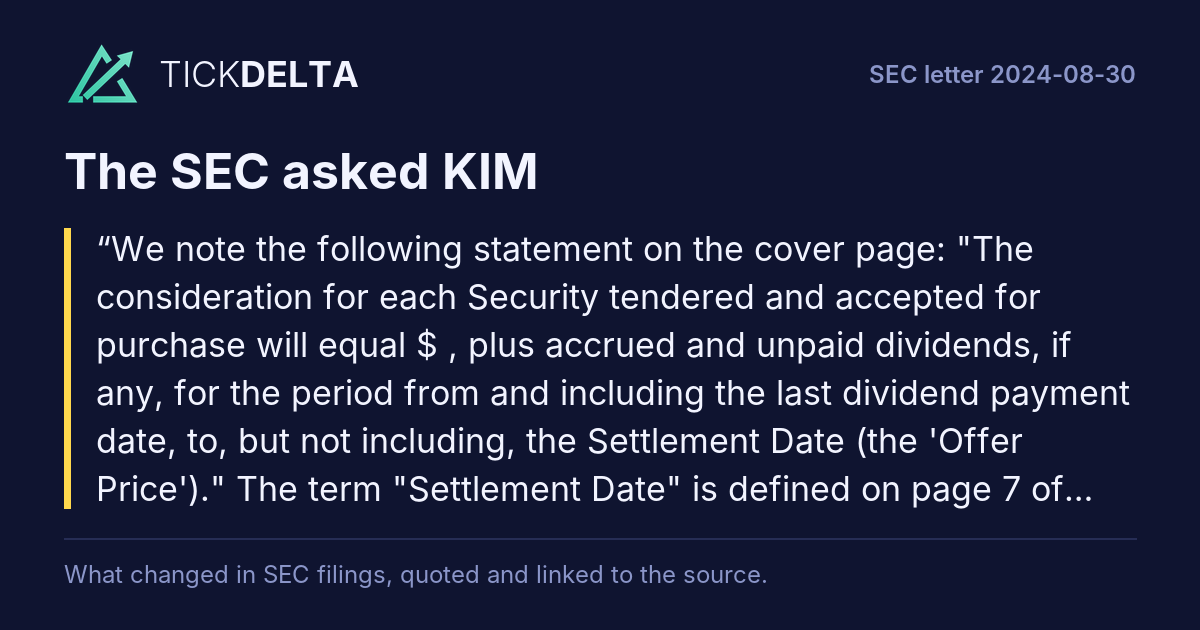
We note the following statement on the cover page: "The consideration for each Security tendered and accepted for purchase will equal $ , plus accrued and unpaid dividends, if any, for the period from and including the last dividend payment date, to, but not including, the Settlement Date (the 'Offer Price')." The term "Settlement Date" is defined on page 7 of the Offer to Purchase to mean the date the Company pays
Rest of the question

for tendered securities. Thus, it appears that dividends that may accrue after the Expiration Date and through the Settlement Date could result in a change to the Offer consideration. Please revise the disclosure here and throughout the Offer to Purchase, consistent with our view that any change to the Offer Price can occur only before the Expiration Date, and may require an extension of the offering period under Rule 14e-1(b), or advise.

KIM answered
The Company respectfully acknowledges the Staff’s comment and advises the Staff that the Company believes that in the context of an issuer tender offer for fixed income securities (whether debt, including convertible debt, or preferred equity), such as the Securities, it is common practice for the offer consideration to be structured such that the holder receives for his or her securities (1) a fixed price plus (2) accrued and unpaid interest (in the case of debt, including convertible debt) or accrued and unpaid dividends (in the case of preferred equity) that the holder would have received
Rest of the answer

had the holder owned the securities through the next relevant record date. The Company believes that the market expectation for an issuer tender offer is that the holder will receive the “accrued and unpaid interest” or “accrued and unpaid dividend,” as applicable. In addition, in analogous situations where holders of the Securities cease to be holders of the Securities (such as through the payment of the liquidation preference to the holders of the

Securities), the terms of the Securities described in the Charter entitle holders of the Securities to receive accrued and unpaid dividends through, but not including, the date of the liquidation payment (in this case, by analogy, the settlement date of the Offer). Should the Offer and Consent Solicitation consideration not include the payment of accrued and unpaid dividends, tendering holders would be deprived of the payment to which they are entitled.

Where settlement of an issuer tender offer falls between the relevant interest (or dividend) record date and the interest (or dividend) payment date, the Company believes that it is common practice for the tender offer consideration to be structured to include a fixed price, without the payment of accrued interest (or accrued dividends). This is because, in addition to receiving the payment of the fixed tender offer price at settlement of the tender offer, holders of the subject securities at the close of business on the relevant record date that tender their securities in the tender offer will receive the payment of accrued and unpaid interest (or dividends) through, but not including, the interest (or dividend) payment date on the relevant payment date. Furthermore, consistent with market practice, should any trades be made in the subject securities between the record date and the relevant payment date, investors purchasing the securities will do so with the expectation that they will not be paid the next dividend payment (and the purchase price for the securities would typically be adjusted to account for any accrued on unpaid interest the investor would have otherwise been owed for the period from the date of purchase of the securities through, but not including, the relevant interest (or dividend) payment date).

On July 30, 2024, the board of directors of the Company authorized a quarterly dividend (the “October Dividend”) on the Class N Preferred Stock underlying the Securities payable on October

15, 2024 (the “October Dividend Payment Date”) to holders of record of the Class N Preferred Stock at the close of business on October 1, 2024 (the “October Dividend Record Date”) for distribution to the holders of the Securities, which dividend was declared by the Company on August 1, 2024. As a result, in the event the Offer settles following the close of business on the October Dividend Record Date, but before the October Dividend Payment Date, holders of record of the

Securities at the close of business on the October Dividend Record Date will receive the October Dividend for the Securities regardless of whether they participate in the Offer, since the October Dividend Record Date will occur prior to the consummation of the Offer. In this scenario, the total per-share consideration that holders who tender their Securities will receive will equal the stated dollar amount in the Offer to Purchase for each Security, without any amount to be paid with respect to dividends, including the October Dividend; however, holders of the Securities at the close of business on the October Dividend Record Date that tender their Securities in the Offer will receive both the October Dividend and the Offer Price for the Securities.

In the alternative scenario, where the Offer will settle on or following the October Dividend Payment Date, the total per-share consideration that holders who tender their Securities will receive will equal (i) the stated dollar amount in the Offer to Purchase for each Security plus (ii) an amount equal to the amount of accrued and unpaid dividends that would otherwise be payable for a period beginning on, and including, the

October Dividend Payment Date and ending with, but not including, the Settlement Date, as if such dividends had otherwise been declared and paid in accordance with the Charter. In this scenario, in the event of a delay in the expected

Settlement Date, security holders who validly tendered their Securities would continue to receive an amount equal to dividends that would have accrued up to, but not including, such delayed Settlement Date as if such dividends had otherwise been declared and paid.

On the basis of the foregoing, the Company believes that the Offer to Purchase complies with the Company’s obligations under Rule 14e-1(b) because the Company will provide security holders with the disclosure of the type and amount of consideration offered and the total consideration payable for each Security. Furthermore, the Company believes that the Offer Price of a base amount plus accrued and unpaid dividends (in the context of preferred equity securities) or interest (in the context of debt securities, including convertible debt instruments) is common practice for issuer tender offers for fixed income securities. The Company believes that such formulation is commonly viewed as not involving a

“change” in the offer price requiring an extension of ten business days under Rule 14e-1(b).

Read in the reply ↗
Purpose of and Reasons for the Offer and Consent Solicitation, page 9
SEC asked (2)
Please explain the reasons for the timing of the Offer and Consent Solicitation. See Item 7 of Schedule 13E-3 and Item 1013(c) of Regulation M-A.
KIM answered
The Company respectfully acknowledges the Staff’s comment and has revised the disclosure on pages 9 and 10 of Amendment No. 1. The Company advises the Staff that the Offer and

Consent Solicitation constitute post-closing optimization of the Company’s capital structure following the Company’s acquisition of RPT in January of 2024. The Company was required to issue the Securities to holders of similar securities of RPT in connection with the acquisition.
Rest of the answer

The terms of the Securities are not consistent with the terms of similar securities issued by the Company or other investment-grade issuers in the REIT industry. For instance, it would be unusual for the Company or any other investment grade issuer in the REIT industry to issue perpetual convertible preferred equity securities without an optional redemption provision. Consequently, the Company is seeking to conduct a tender offer for any and all of the outstanding Securities (and, potentially, to redeem any Securities that remain outstanding following consummation of the Offer and Consent Solicitation). This Offer and Consent

Solicitation is intended to rationalize and optimize the Company’s capital structure as soon as practicable following the acquisition of RPT.

Read in the reply ↗
Potential Effects on Holders of Securities, page 10
SEC asked (3)
The first paragraph in this section lists as a potential effect of the Offer and the Consent Solicitation that "tendering holders of Securities will receive a purchase price that represents a premium... over recent market prices." Revise to note that since the redemption may not occur until at least mid-2025, if at all, there is no guarantee that the purchase price in the redemption will represent a premium to the
Rest of the question

market price at that time. If you do not believe this is likely. explain the basis for your belief in the revised Offer to Purchase.

KIM answered
The Company respectfully acknowledges the Staff’s comment and has revised the disclosure on page 10 of Amendment No. 1 accordingly. Given potential timing for redemption of the

Securities (assuming the Company’s receipt of the Requisite Approvals and, thereafter, that the Company elects to conduct a redemption of the Securities), there is no guarantee that the redemption price will represent a premium to the market price for the Securities at the time of the redemption, or that there will even be an established market price for the Securities at such time. Read in the reply ↗
Fairness of the Offer and Consent Solicitation, page 13
SEC asked (4)
We note the disclosure in the first bullet point on page 14 that the Offer Price was "based on price discovery efforts conducted by the Company to determine indicative levels of interest in the Offer." In an appropriate part of the Offer to Purchase, expand to discuss who conducted the price discovery efforts, including whether they were conducted by a financial advisor or other third party on the Company's behalf,
Rest of the question

when they were conducted, and how.

KIM answered
The Company respectfully acknowledges the Staff’s comment and advises the Staff that the Company does not intend to engage in price discovery efforts with investors, nor does it intend to engage any financial advisor or third party to do so on its behalf. The Company has revised the disclosure on page 14 of Amendment No. 1 accordingly. Read in the reply ↗
Factors Considered, page 14
SEC asked (5)
The introductory paragraph of this section states that the Board of Directors has determined that both the Offer and the Consent Solicitation are fair to unaffiliated holders of the Securities. However, it is not clear how the factors that follow and that were considered by the Board support the fairness determination as it relates to the Consent Solicitation.
Rest of the question

For example, even if the Company receives the Requisite Approvals, it may choose not to redeem the Class N Preferred and any redemption will be delayed for a significant period, at which time the Offer Price may no longer represent a premium to the trading price of the Class N Preferred. Please revise to discuss more specifically how the Board considered and analyzed the fairness of the Consent Solicitation specifically.

KIM answered
The Company respectfully acknowledges the Staff’s comment and has revised the disclosure on page 14 of Amendment No. 1.

The Company advises the Staff that the Board of Directors considered a number of factors in determining the fairness of the Offer and Consent Solicitation to the holders of the Securities, including unaffiliated holders.

However, the Board of Directors did not consider the fairness of the Offer and Consent Solicitation separately, as it views the Offer and Consent Solicitation as part of the same transaction.
Rest of the answer

The price offered to holders of the

Securities is in return for both the tender of the holders’ Securities and their consent to the Proposed Amendments. The foregoing is consistent with the purpose of the Offer and Consent Solicitation, which, as part of a single transaction, are intended to rationalize and optimize the Company’s capital structure following the Company’s acquisition of RPT.

Read in the reply ↗
Factors Considered, page 14
SEC asked (6)
Refer to the condition listed in the seventh bullet point in this section on page 14 of the Offer to Purchase. Expand to identify the "various developments" and "certain selected market indices" to which the Board compared the year-to-date historical trading yields and prices of the Securities. Provide additional detail about this comparison and how it supports the Board's fairness determination.
KIM answered
The Company respectfully acknowledges the Staff’s comment and has revised the disclosure on page 14 of Amendment No. 1 accordingly. Read in the reply ↗
Factors Considered, page 14
SEC asked (7)
Refer to the eighth bullet point in this section. Identify the "selected public REITs that have certain characteristics in common with the Company," and expand to explain the specific ways in which the Board used this comparison to arrive at its fairness determination.
Rest of the question

Approval from Holders of Securities, page 15 Refer to the following statement on page 16 of the Offer to Purchase: "Should the Company elect to waive the receipt of the Requisite Preferred Shareholder Consents as a condition to the Offer, the Company may accept for purchase any Securities validly 8. tendered (and not subsequently withdrawn) in the Offer on or prior to the Expiration Date without obtaining the approval of any unaffiliated holders of Securities." If you waive the requirement that two-thirds of the Class N Preferred holders provide consents by tendering into the Offer, it appears that the subsequent redemption of any remaining Securities could not occur, and that the deregistration and delisting of the Class N Preferred would be less likely to result. In addition, the current fairness determination addresses both the fairness of the Offer price and the Consent Solicitation, which currently includes the two-thirds consent requirement. Please confirm that if this Offer condition is waived, the Company will extend the Offer period and disseminate revised disclosure addressing the impact of this change. Conditions of the Offer and Consent Solicitation, page 23 9. Please revise to more clearly state that the minimum acceptance condition in this Offer is effectively the tender of two-thirds of the outstanding Class N Preferred Stock. The reference to the defined term "Requisite Preferred Shareholder Consents" on page 24 in this section is not clear. General 10. We note that the Company cannot redeem any Class N Preferred Stock that remains outstanding after the Offer unless Common Stock holders of the Company also approve the redemption. We further note the disclosure that the Company intends to solicit approval for redemption from Common Stock holders in connection with its 2025 annual meeting, and that any redemption of remaining Class N Preferred can occur only after such approval is received. Please advise in your response letter whether a subsequent redemption of the Class N Preferred shares would itself be subject to Rule 13e-3. 11. We note that the Company may but will not be obligated to redeem any Class N Preferred not purchased in the Offer, if it receives the Requisite Approvals. In an appropriate part(s) of the Offer to Purchase, discuss how the Company will decide whether or not to redeem any remaining Class N Preferred. This discussion should explain the factors upon which the Company will make this decision, the circumstances under which it would opt not to redeem, and how then-current trading prices of either the Class N Preferred or Common Stock would factor into the Company's decision.

KIM answered
The Company respectfully acknowledges the Staff’s comment and has revised the disclosure on pages 14 and 15 of Amendment No. 1 accordingly. Read in the reply ↗
Form S-4

2023-10-18 to 2023-11-07 · 1 question · 1 letter from the SEC, 2 from the company
No closing letter
Income taxes
MATERIAL U.S. FEDERAL INCOME TAX CONSEQUENCES OF THE COMPANY · MERGER, page 92
SEC asked
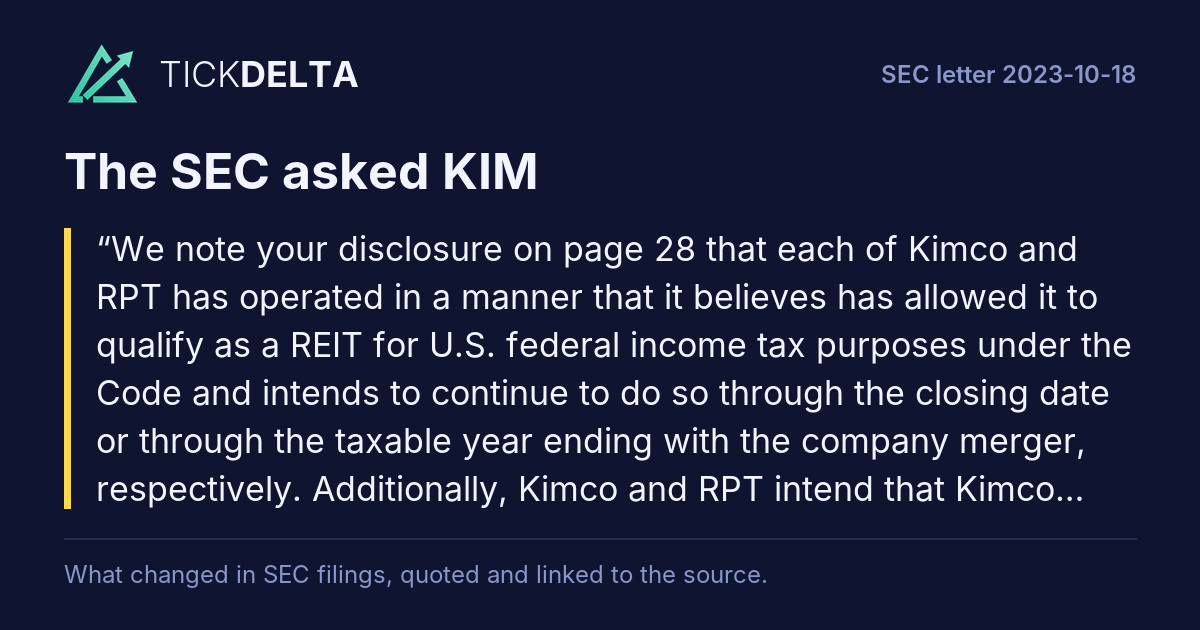
We note your disclosure on page 28 that each of Kimco and RPT has operated in a manner that it believes has allowed it to qualify as a REIT for U.S. federal income tax purposes under the Code and intends to continue to do so through the closing date or through the taxable year ending with the company merger, respectively.
Rest of the question

Additionally, Kimco and RPT intend that Kimco will continue to operate in such a manner after the company merger. We also note your reference to certain material U.S. federal income tax considerations regarding Kimco’s taxation as a REIT on page 94. Please file as an exhibit a tax opinion supporting the tax matters and consequences to the shareholders as described in the filing, or advise how you determined such an opinion is not required. Refer to Item 601(b)(8) of Regulation S-K.

KIM answered
The Company acknowledges the Staff’s comment and advises the Staff that forms of the tax opinions supporting the tax matters and consequences to the shareholders as described in the filing have been filed with Amendment No. 1 as Exhibits 8.1, 8.2, 8.3 and 8.4, and the Company will file executed versions of the foregoing opinions as exhibits to a subsequent amendment to the Registration Statement prior to effectiveness of the Registration

Statement. Read in the reply ↗

Also in this review: company letter, 2023-11-07

Form 10-K for the fiscal year ended December 31, 2016

2017-03-30 to 2017-04-12 · 2 questions · 1 letter from the SEC, 1 from the company
Review closed 2017-04-12
China
Operations · Funds from Operations, pages 30 to 31
SEC asked (1)
In arriving at FFO and FFO as adjusted, you start with Net income available to common shareholders. In future filings, please characterize FFO and FFO as adjusted as FFO available to common shareholders and FFO available to common shareholders as adjusted, respectively.
KIM answered
In response to the Staff's comment, in our future filings we will characterize FFO and FFO as adjusted as FFO available to common shareholders and FFO available to common shareholders as adjusted, respectively. Read in the reply ↗
In its next report

First report after the company's reply of 2017-04-11: 10-Q filed 2017-04-28 ↗, against the 10-Q filed 2016-10-28 ↗.

Tickdelta does not hold the text of both reports, so they are not compared here.

Financial Statements · Note 10. Variable Interest Entities, page 67
SEC asked (2)
Please tell us and revise future filings to provide qualitative information about the relationships between the assets and associated liabilities of your variable interest entities (VIE). For example, if the VIE’s assets can be used only to settle specific obligations of the VIE, you should disclose qualitative information about the nature of the restrictions on those assets.
Rest of the question

In addition, please clarify if creditors of your consolidated VIE have recourse or no recourse to you as the primary beneficiary. Reference is made to paragraph 810-10-50-14(a) and (b) of the Financial Accounting Standards Codification (ASC). To the extent restrictions exist on VIE assets and VIE liabilities are non-recourse, please revise future filings to conform to the presentation outlined within paragraph 810-10-45-25 of the ASC.

KIM answered
The Company has 23 consolidated VIEs, for which it is the primary beneficiary. All liabilities of these VIEs are non-recourse to the Company. Two of these VIEs were established to develop, and are currently developing, real estate properties to hold as long-term investments. The remaining 21 VIEs own and operate real estate property. Of the 23 VIEs, 19 are unencumbered by mortgage debt. In addition, assets of these 19 VIEs are not restricted for use to settle only the obligations of the VIEs. The remaining four VIEs are encumbered by third party non-recourse mortgage debt.
Rest of the answer

The assets associated with these four VIEs are collateral under the mortgages and are therefore restricted and can only be used to settle the corresponding liabilities of the VIE.

In future filings, the Company will provide qualitative disclosure about such relationships between the assets and liabilities of its VIEs. Additionally, in future filings, the Company will, to the extent restrictions exist on VIE assets and VIE liabilities are non-recourse, include the required disclosure in accordance with paragraph 810-10-45-25 of the ASC on the Company’s Consolidated Balance Sheets for the amounts of restricted assets and non-recourse liabilities, when deemed material.

Read in the reply ↗
In its next report

First report after the company's reply of 2017-04-11: 10-Q filed 2017-04-28 ↗, against the 10-Q filed 2016-10-28 ↗.

Tickdelta does not hold the text of both reports, so they are not compared here.

Also in this review: closing letter, 2017-04-12

Form 10-K for the Year Ended December 31, 2014

2015-03-30 to 2015-04-23 · 2 questions · 1 letter from the SEC, 1 from the company
Review closed 2015-04-23
Non-GAAP measuresSegments
Form 10-K for the year ended December 31, 2014 · Combined Same Property Net Operating Income, page 32
SEC asked (1)
Please provide the disclosures required by Item 10(e) related to the non-GAAP measures Combined Same Property NOI, before foreign currency impact, and U.S. Same Property NOI, in future filings, including the reasons why you believe presentation of these measures provides useful information to investors and any additional purposes for which you use the measures.
KIM answered
In response to the Staff's comment, in our future filings we will include additional disclosure related to the non-GAAP measures Combined Same Property NOI, before foreign currency impact, and U.S. Same Property NOI, including the reasons why the Company believes presentation of these measures provides useful information to the Company’s analysis and investors.
Rest of the answer

As an example of our expected future disclosure, the below excerpt from the 2014 Form 10-K has been revised to include the requested additional disclosure (for your convenience additions to our existing disclosure are shown in bold):

Combined Same Property Net Operating Income

Combined Same Property Net Operating Income (“Combined Same Property NOI”) is a supplemental non-GAAP financial measure of real estate companies’ operating performance and should not be considered an alternative to net income in accordance with GAAP or as a measure of liquidity. Combined Same Property NOI is considered by management to be an important performance measure of the Company’s operations and management believes that it is helpful to investors as a measure of the Company’s operating performance because it includes only the net operating income of properties that have been owned for the entire current and prior year reporting periods including those properties under redevelopment and excludes properties under development and pending stabilization. Properties are deemed stabilized at the earlier of (i) reaching 90% leased or (ii) one year following a projects inclusion in operating real estate. As such, Combined Same Property NOI assists in eliminating disparities in net income due to the development, acquisition or disposition of properties during the particular period presented, and thus provides a more consistent performance measure for the comparison of the Company's properties.

Combined Same Property NOI is calculated using revenues from rental properties (excluding straight-line rents, lease termination fees, above/below market rents and includes charges for bad debt) less operating and maintenance expense, real estate taxes and rent expense, plus the Company’s proportionate share of Combined Same Property NOI from unconsolidated real estate joint ventures, calculated on the same basis.

The Company also presents Combined Same Property NOI, before foreign currency impact, as it considers it an important supplemental non-GAAP financial measure of the Company’s operations and believes it is frequently used by securities analysts and investors. Combined Same Property NOI, before foreign currency impact, derives an appropriate measure of period-to-period operating performance by removing the effect of foreign currency exchange rate movements from Combined Same Property NOI. The effect of foreign currency exchange rate movements is determined by using the current period exchange rate to translate from local currency into U.S. dollars for both periods.

Additionally, the Company presents U.S. Same Property Net Operating Income (“U.S. Same Property NOI”), which excludes the impact of foreign currency exchange rates and the Company’s Canadian operations from Combined Same Property NOI. The Company provides U.S. Same Property NOI because it believes such measure is frequently used by securities analysts and investors as a valuable measure of period-to-period U.S. operating performance.

The Company’s method of calculating Combined Same Property NOI, Combined Same Property NOI, before foreign currency impact and U.S. Same Property NOI may differ from methods used by other REITs and, accordingly, may not be comparable to such other REITs.

Read in the reply ↗
In its next report

First report after the company's reply of 2015-04-10: 10-Q filed 2015-05-07 ↗, against the 10-Q filed 2014-11-03 ↗.

Tickdelta does not hold the text of both reports, so they are not compared here.

Notes to Consolidated Financial Statements · Business, page 48
SEC asked (2)
We note your disclosure on page 48 that you believe you have a single reportable segment in part because you do not group your operations on a geographical basis for purposes of measuring performance. Please tell us how you considered your presentation of the non-GAAP measure U.S. Same Property NOI in coming to this determination.
Rest of the question

In responding to our comments, please provide a written statement from the company acknowledging that:  the company is responsible for the adequacy and accuracy of the disclosure in the filing;  staff comments or changes to disclosure in response to staff comments do not foreclose the Commission from taking any action with respect to the filing; and  the company may not assert staff comments as a defense in any proceeding initiated by the Commission or any person under the federal securities laws of the United States.

KIM answered
The Company currently evaluates performance on a property specific or transactional basis and does not distinguish its principal business or group its operations on a geographical basis for purposes of measuring performance. The Company’s business activities, regardless of geographical location, involve owning and operating real estate. The Company provides U.S. Same Property NOI in its non-GAAP measures because this item has been requested by securities analysts to allow them to compare the Company’s operating performance to other REITs that solely operate in the U.S..
Rest of the answer

Although the Company believes that the disclosure of U.S. Same Property NOI is an important measurement that allows for such a comparison the Company does not use these comparisons to make decisions about resources or to assess performance on a geographical basis.

* * *

The Company acknowledges that:

· the Company is responsible for the adequacy and accuracy of the disclosure in the filing;

Staff comments or changes to disclosure in response to Staff comments do not foreclose the Commission from taking any action with respect to the filing; and the Company may not assert Staff comments as a defense in any proceeding initiated by the Commission or any person under the federal securities laws of the United States.

Read in the reply ↗

Also in this review: closing letter, 2015-04-23

Form 10-K

2014-07-01 to 2014-07-21 · 4 questions · 1 letter from the SEC, 1 from the company
Review closed 2014-07-21
Results discussion (MD&A)Liquidity and cashLegal and contingenciesReserves and insuranceIncome taxes
Operations, page 17 · Liquidity and Capital Resources, page 26
SEC asked (1)
On page 52, you disclose that you capitalized salaries to deferred leasing costs and you capitalized certain payroll and payroll-related costs to software development costs. To the extent material, please separately quantify and disclose personnel costs capitalized to deferred leasing costs and to software development costs for all periods presented and discuss fluctuations in capitalized personnel costs for all
Rest of the question

periods presented within your MD&A. Financial Statements Notes to Consolidated Financial Statements, page 48 19. Commitments and Contingencies, page 84

KIM answered
In response to the Staff's comment, in our future annual filings, we will, to the extent material, separately quantify and disclose personnel costs capitalized to deferred leasing costs and to software development costs for all periods presented and discuss significant fluctuations in capitalized personnel costs for all periods presented within our MD&A.
Rest of the answer

For the years ended December 31, 2013 and 2012, the Company capitalized personnel costs of $15.3 million and $16.0 million, respectively, to deferred leasing costs and $1.3 million and $1.6 million, respectively, to software development costs.

Financial Statements - Notes to Consolidated Financial Statements, page 48

19. Commitments and Contingencies, page 84

Read in the reply ↗
In its next report

First report after the company's reply of 2014-07-11: 10-Q filed 2014-08-01 ↗, against the 10-Q filed 2014-05-08 ↗.

Tickdelta does not hold the text of both reports, so they are not compared here.

Captive Insurance, page 84
SEC asked (2)
In future filings, please disclose a roll forward of your insurance reserves for each year presented. The roll forward should include the amount of incurred claims, any changes in the provision for prior year events, and the amount of payments made. Please provide an example of your proposed disclosure.
KIM answered
In response to the Staff's comment, we will, in our future annual filings, disclose a roll forward of the Company’s insurance reserves for each year presented as follows:

Activity in the liability for unpaid losses and loss adjustment expenses for the years ended December 31, 201X and 201X, is summarized as follows (amounts in thousands):

201X

Balance at the beginning of the year

$ XXX

Incurred related to:

Current year

X

Prior years

Total incurred

Paid related to: Read in the reply ↗
In its next report

First report after the company's reply of 2014-07-11: 10-Q filed 2014-08-01 ↗, against the 10-Q filed 2014-05-08 ↗.

Tickdelta does not hold the text of both reports, so they are not compared here.

Form 10-Q for the quarterly period ended March 31, 2014 · Condensed Consolidated Statements of Income, page 4
SEC asked (3)
On page 21, you disclose the Provision for income taxes, net includes foreign taxes relating to the sale of nine properties and it appears these same nine properties are included in Discontinued operations. Please tell us how you determined it was not necessary to present the related tax expense in discontinued operations. Please refer to paragraph 3 of ASC 205-20-45.
KIM answered
During the three months ended March 31, 2014, the Company sold a portfolio of nine properties in Latin America in a single transaction, three of these properties were consolidated and the remaining six were unconsolidated. The three consolidated property sales, which were reclassified to discontinued operations, did not have a corresponding tax expense as these properties did not generate any taxable gains on sale. With respect to three of the six unconsolidated properties, there was foreign tax expense incurred at consolidated entity levels which held these investments.
Rest of the answer

The Company continues to own these consolidated entities and therefore these entities are not deemed to be discontinued operations. As such, the related tax provision is classified within continuing operations in Provision for income taxes, net on the Company’s Condensed Consolidated Statements of Income. The gain on the sale of such equity method investments is also classified in continuing operations as such sales do not qualify as a discontinued operation. In future filings, the Company will revise its disclosure on the change in Provision for income taxes, net to clarify that the change in foreign tax expense was primarily related to the sale of unconsolidated properties within a nine property portfolio sale which were subject to foreign taxes at a higher consolidated reporting entity.

Read in the reply ↗
In its next report

First report after the company's reply of 2014-07-11: 10-Q filed 2014-08-01 ↗, against the 10-Q filed 2014-05-08 ↗.

Tickdelta does not hold the text of both reports, so they are not compared here.

Item 2. Management’s Discussion and Analysis of Financial Condition and Results of · Operations, page 19
SEC asked (4)
We note your disclosure that the Company may, in the near term, substantially liquidate all of its investments in foreign entities. To the extent these investments are held by TRS, in future periodic filings, please provide liquidity disclosures to discuss the potential tax impact associated with the repatriation of undistributed earnings of foreign subsidiaries.
Rest of the question

Your discussion should disclose the amount of cash that is currently held by your foreign subsidiaries and disclose the impact of repatriating the undistributed earnings of foreign subsidiaries. Please refer to Item 303(A)(1) of Regulation S-K and Section IV of our Release 33-8350. Please provide us an example of your proposed disclosure.

KIM answered
The Company anticipates substantially liquidating its investments in its Latin American portfolio. These investments are held by the Company at the REIT level not in the Company’s taxable REIT subsidiary. Accordingly, the Company does not expect a U.S. income tax impact associated with the repatriation of undistributed earnings from the Company’s Latin American subsidiaries.

* * *

The Company acknowledges that:

● the Company is responsible for the adequacy and accuracy of the disclosure in the filing;

Staff comments or changes to disclosure in response to Staff comments do not foreclose
Rest of the answer

the Commission from taking any action with respect to the filing; and the Company may not assert Staff comments as a defense in any proceeding initiated by the Commission or any person under the federal securities laws of the United States.

Read in the reply ↗
In its next report

First report after the company's reply of 2014-07-11: 10-Q filed 2014-08-01 ↗, against the 10-Q filed 2014-05-08 ↗.

Tickdelta does not hold the text of both reports, so they are not compared here.

Also in this review: closing letter, 2014-07-21

Form 10-K for the fiscal year ended December 31, 2012

2013-04-30 to 2013-06-10 · 4 questions · 1 letter from the SEC, 1 from the company
Review closed 2013-06-10
LeasesAcquisitionsResults discussion (MD&A)Liquidity and cash
Item 2. Properties, page 11
SEC asked (1)
We note your disclosure on page 16 of your executed leases and leasing spreads. In future Exchange Act periodic reports please clarify the portion of the executed leases that were new leases and those that were renewals or options. Also, please provide balancing disclosure regarding your leasing cost, including tenant improvement cost and leasing commissions, for both new and renewed leases.
Rest of the question

Please disclose the square footage the leasing cost applies to or provide the cost on a per square footage basis.

KIM answered
In response to the Staff's comment, we will, in our future filings, expand our disclosure on executed leases and leasing spreads to include the portion of the executed leases that were new leases and those that were renewals or options. Also, we will provide disclosure regarding the Company’s leasing cost, including tenant improvement cost and leasing commissions, for both new and renewed leases. We will additionally disclose the leasing cost on a per square footage basis. Read in the reply ↗
In its next report

First report after the company's reply of 2013-05-10: 10-Q filed 2013-08-02 ↗.

No earlier 10-Q before the SEC's letter is in Tickdelta, so there is nothing to compare with.

Item 2. Properties, page 11
SEC asked (2)
In future Exchange Act periodic reports please provide disclosure regarding your lease expirations for the next 10 years, stating (i) the number of tenants whose leases will expire, (ii) the total area in square feet covered by such leases, (iii) the annual rent represented by such leases, and (iv) the percentage of gross annual rent represented by such leases.
KIM answered
In response to the Staff's comment, we will, in our future filings, disclose our lease expirations for the next 10 years, including (i) the number of tenants whose leases will expire, (ii) the total area in square feet covered by such leases, (iii) the annual rent represented by such leases, and (iv) the percentage of gross annual rent represented by such leases. Read in the reply ↗
In its next report

First report after the company's reply of 2013-05-10: 10-Q filed 2013-08-02 ↗.

No earlier 10-Q before the SEC's letter is in Tickdelta, so there is nothing to compare with.

Acquisitions of and Improvements to Real Estate Under Development, page 25
SEC asked (3)
We note the three development projects and the anticipated capital commitments during 2013. In future Exchange Act periodic reports, to the extent you have a significant construction/redevelopment portfolio, please expand your disclosure to include information regarding anticipated completion dates, costs incurred to date and estimated costs to completion.
KIM answered
In response to the Staff's comment, to the extent that the Company has a significant construction/redevelopment portfolio, we will expand our disclosure to include information regarding anticipated completion dates, costs incurred to date and estimated costs to completion. Read in the reply ↗
In its next report

First report after the company's reply of 2013-05-10: 10-Q filed 2013-08-02 ↗.

No earlier 10-Q before the SEC's letter is in Tickdelta, so there is nothing to compare with.

Financial Statements · Consolidated Statements of Cash Flows, page 47
SEC asked (4)
We note that you have included acquisitions of and improvements to operating real estate on one line item and acquisition of and improvements to real estate under development on a separate line item in the investing section of the cash flow statement. In future filings, please disclose separately the amounts paid for acquisitions separate from improvements for each category.
Rest of the question

In addition, please include a discussion, within your MD&A of your improvements including a breakdown of these expenditures between new development, redevelopment/renovations, tenant allowances and other capital expenditures by year and a discussion of significant fluctuations between years. Lastly, please disclose the amount of soft costs interest and payroll expenditures capitalized for all periods presented with a narrative discussion of significant fluctuations. We urge all who are responsible for the accuracy and adequac y of the disclosure in the filing to be certain that the filing includes the information the Securities Exchange Act of 1934 and all applicable Exchange Act rules require. Since the company and its management are in possession of all facts relating to a c ompany’s disclosure, they are responsible for the accuracy and adequacy of the disclosures they have made. In responding to our comments, please provide a written statement from the company acknowledging that:  the company is responsible for the adequacy and accuracy of the disclosure in the filing;  staff comments or changes to disclosure in response to staff comments do not foreclose the Commission from taking any action with respect to the filing; and  the company may not assert staff comments as a defense in any proceeding initiated by the Commission or any person under the federal securities laws of the United States.

KIM answered
In response to the Staff's comment, we will, in our future filings, disclose separately the amounts paid for acquisitions separate from improvements for both operating real estate and real estate under development. Additionally, in future filings, we will include discussion within the MD&A of our improvements including a breakdown of these expenditures between new development, redevelopment/renovations, tenant allowances and other capital expenditures by period and we will include a discussion of significant fluctuations between periods.
Rest of the answer

Also, in future filings we will disclose the amount of soft costs interest and payroll expenditures capitalized for all periods presented with a narrative discussion of significant fluctuations.

* * *

The Company acknowledges that:

· the Company is responsible for the adequacy and accuracy of the disclosure in the filing;

Staff comments or changes to disclosure in response to Staff comments do not foreclose the Commission from taking any action with respect to the filing; and the Company may not assert Staff comments as a defense in any proceeding initiated by the Commission or any person under the federal securities laws of the United States.

Read in the reply ↗
In its next report

First report after the company's reply of 2013-05-10: 10-Q filed 2013-08-02 ↗.

No earlier 10-Q before the SEC's letter is in Tickdelta, so there is nothing to compare with.

Also in this review: closing letter, 2013-06-10

2 other letters: notices that a filing will not be reviewed, requests to declare a registration effective, and the like

From the SEC's correspondence on EDGAR: staff letters (form UPLOAD) and company letters (form CORRESP), 19 letters filed since 2013-04-30. Questions and answers are matched by their numbers; topics come from words in each question. The reports are compared word for word (same form, before the first SEC letter against the first report after the company's reply). No AI.

Work on KIM in a spreadsheet: Excel workbook (a sheet per section, ten years by column, charts, links to the filings) · CSV. For a Google Sheet that stays up to date, paste =IMPORTDATA("https://tickdelta.com/company/KIM/export.csv") into a cell.