28 paragraphs in Risk Factors of the 10-K filed Aug 6, 2026
with nothing like them in the 10-K filed Aug 8, 2025. Quoted exactly.
Paragraphs that were only edited are under 10-K change.
Compared with the Risk Factors in the latest 10-K of the other 74 Technology companies:
a paragraph with at least half its words the same at another company is called similar, and the companies are listed under it.
A paragraph most of them have is marked boilerplate. No line means no other company has one like it.
This counts text; it does not say how serious a risk is.
•Tariffs, retaliatory trade measures and other trade restrictions, including uncertainty related to tariff authority, implementation and refund processes;
Read in the 10-K ↗
•System failures, ERP system implementation risks or limited access to critical information could disrupt our operations and financial reporting processes;
Read in the 10-K ↗
•Our interest rate hedging activities expose us to risks related to changes in floating interest rates;
Read in the 10-K ↗
•Changes in accounting standards or practices or taxation rules or practices could have unforeseen effects.
Read in the 10-K ↗
•Prevailing local and global economic conditions, semiconductor industry cyclicality, customer capital spending patterns and AI-related investment trends may negatively affect customer demand and purchasing decisions; and
Read in the 10-K ↗
•We may not receive components, materials or subassemblies necessary to build our products in a timely, cost-effective or compliant manner, including as a result of limited-source suppliers, the availability of rare earth elements or DRAM chip shortages;
Read in the 10-K ↗
•Government funding may be terminated, modified or subject to audit, repayment obligations, penalties or other restrictions;
Read in the 10-K ↗
In September 2025, Commerce released an interim final rule that further expands export control restrictions and licensing requirements for foreign entities 50% or more directly or indirectly owned by one or more listed parties on the U.S. Entity List, Military End-User List, and certain entities on the Specially Designated Nationals and Block Persons List, which Commerce has labeled the “Affiliates Rule.” The new rule increases compliance requirements with the EAR by imposing on exporters, re-exporters, and transferors of items subject to the EAR a responsibility to know the ownership of the parties to a transaction. In November 2025, the BIS suspended the Affiliates Rule for one year until November 2026.
Read in the 10-K ↗
12 more
In February 2026, the U.S. Supreme Court ruled that tariffs imposed under the International Emergency Economic Powers Act were not authorized, creating uncertainty around the status of prior tariffs, potential refund processes and the scope of future presidential tariff authority. This ruling adds volatility to an already fluid tariff environment and may result in rapid changes in tariff rates, shifts in enforcement, delays in customs processing and increased uncertainty in supply chain and capital planning for us and our customers.
Read in the 10-K ↗
Additionally, while we are pursuing recovery of duties previously paid through the administrative refund process established by U.S. Customs and Border Protection and have begun receiving refunds, changes in the refund process or related legal challenges could impact the timing of cash receipts and our results of operations.
Read in the 10-K ↗
The threat of terrorism targeted at, or acts of war in, the regions of the world in which we do business increases the uncertainty in our markets. Any act of terrorism or war that affects the economy or the industries we serve could adversely affect our business. Increased international political instability or geopolitical tensions in various parts of the world, disruption in air transportation and further enhanced security measures as a result of terrorist attacks may hinder our ability to do business and may increase our costs of operations.
We maintain significant operations in Israel. Since the establishment of the State of Israel in 1948, a number of armed conflicts have taken place between Israel and its Arab neighbors, and a state of hostility varying in degree and intensity has led to security and economic challenges for Israel. Persistent hostilities involving Iran and Iran-backed groups, including Hezbollah in Lebanon, the Houthis in Yemen and Hamas in the Gaza Strip, have involved missile strikes against civilian targets in various
parts of Israel and attacks on marine vessels traversing the Red Sea. The recent escalation of conflicts in the region has heightened instability, disrupted airspace, and increased freight and insurance costs. Disruptions in shipping routes in the Red Sea could result in delays in shipping our products to customers, which could delay the timing of revenue recognition and create uncertainty related to timeliness of shipments from the region. In addition, some of our employees in Israel are obligated to perform annual reserve duty in the Israel Defense Forces, and may be called to active military duty in emergency circumstances. The ongoing conflicts, including additional military actions, retaliatory measures, sanctions, cyberattacks, or other governmental or market responses, could lead to further disruption of global energy supplies, heighten inflationary pressures on our input costs, adversely affect global supply chains, commodity prices, currency exchange rates, financial markets and overall macroeconomic conditions. These developments could impact our ability to operate our business directly and indirectly through a similar impact on our suppliers and customers.
Read in the 10-K ↗
In 2026, we entered into interest rate swaps which are designated as fair value hedges and allow us to convert a portion of our fixed-rate payments under the senior, unsecured long-term notes issued in June 2022 (“2022 Senior Notes”) into floating-rate payments based on the Daily Secured Overnight Financing Rate swap rate plus a fixed number of basis points. As of June 30, 2026, we had an aggregate principal amount of $2.00 billion in fixed-rate debt that was swapped to floating-rate debt.
Because the interest rate swaps convert a portion of our fixed-rate debt to floating-rate debt, an increase in interest rates would require us to pay additional interest on the swapped debt, which may have an adverse effect on our results of operations and cash flows. These hedges may be inadequate to achieve their intended purpose of managing the fair value of our fixed-rate debt exposure. Furthermore, if a financial counterparty to our hedges experiences financial difficulties or is otherwise unable to honor the terms of the interest rate hedges, we may experience material financial losses.
Read in the 10-K ↗
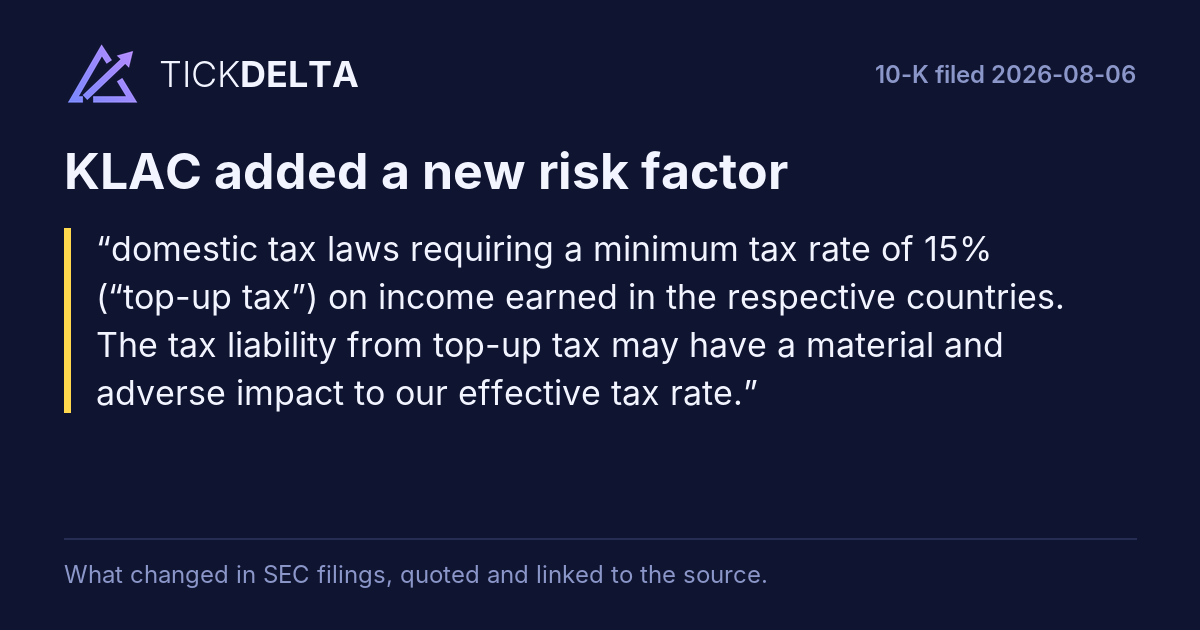
domestic tax laws requiring a minimum tax rate of 15% (“top-up tax”) on income earned in the respective countries. The tax liability from top-up tax may have a material and adverse impact to our effective tax rate.
Read in the 10-K ↗
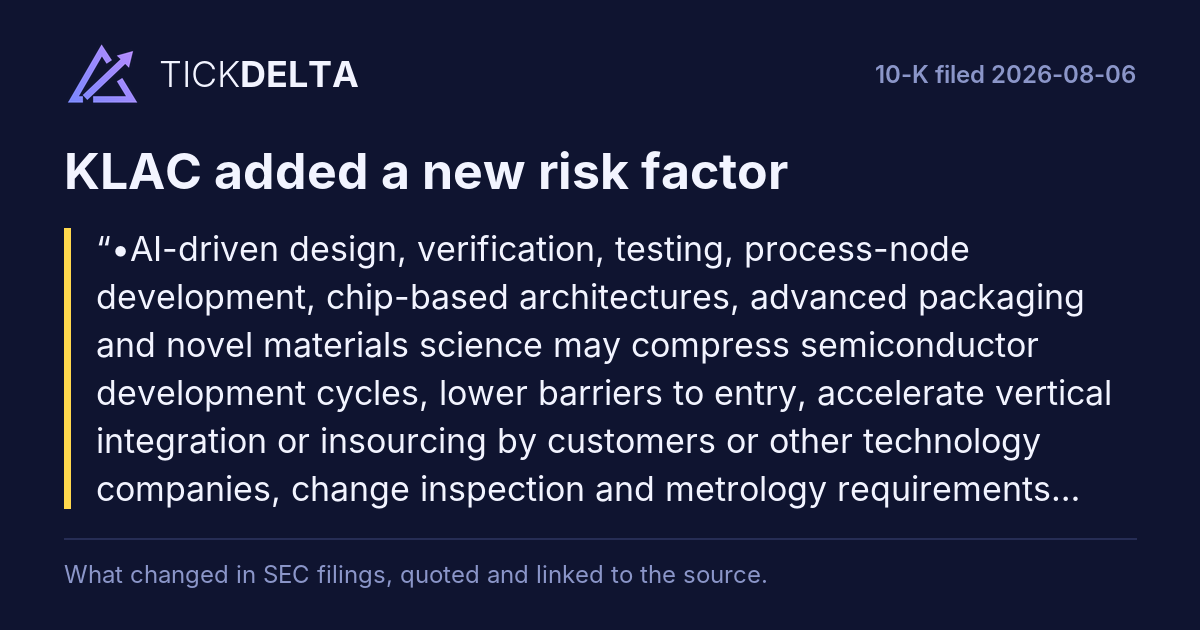
•AI-driven design, verification, testing, process-node development, chip-based architectures, advanced packaging and novel materials science may compress semiconductor development cycles, lower barriers to entry, accelerate vertical integration or insourcing by customers or other technology companies, change inspection and metrology requirements, shorten the useful commercial life of existing products, reduce returns on our R&D investments, or render certain product lines, manufacturing processes or IP less valuable or obsolete;
•The focus on reducing energy usage and improving the environmental impact and sustainability associated with semiconductor manufacturing operations, including the availability of adequate and reliable energy sources
Similar paragraph at 1 of 74 other Technology companies:
AMAT•Changes in demand for semiconductor chips due to changes in the timing, level of investment in, or technologies used in the buildout of data centers, including data-center buildout driven by demand for AI technologies;
Similar paragraph at 1 of 74 other Technology companies:
LRCX
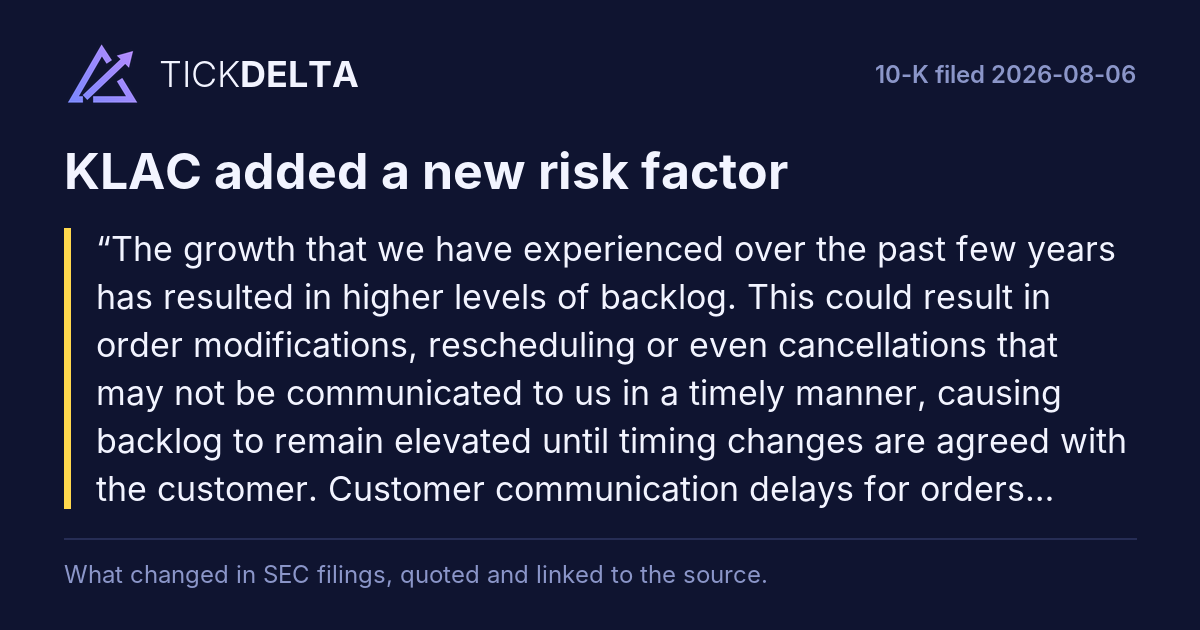
The growth that we have experienced over the past few years has resulted in higher levels of backlog. This could result in order modifications, rescheduling or even cancellations that may not be communicated to us in a timely manner, causing backlog to remain elevated until timing changes are agreed with the customer. Customer communication delays for orders already placed could affect our ability to respond quickly in weakening demand environments, which could harm our results of operations.
Read in the 10-K ↗
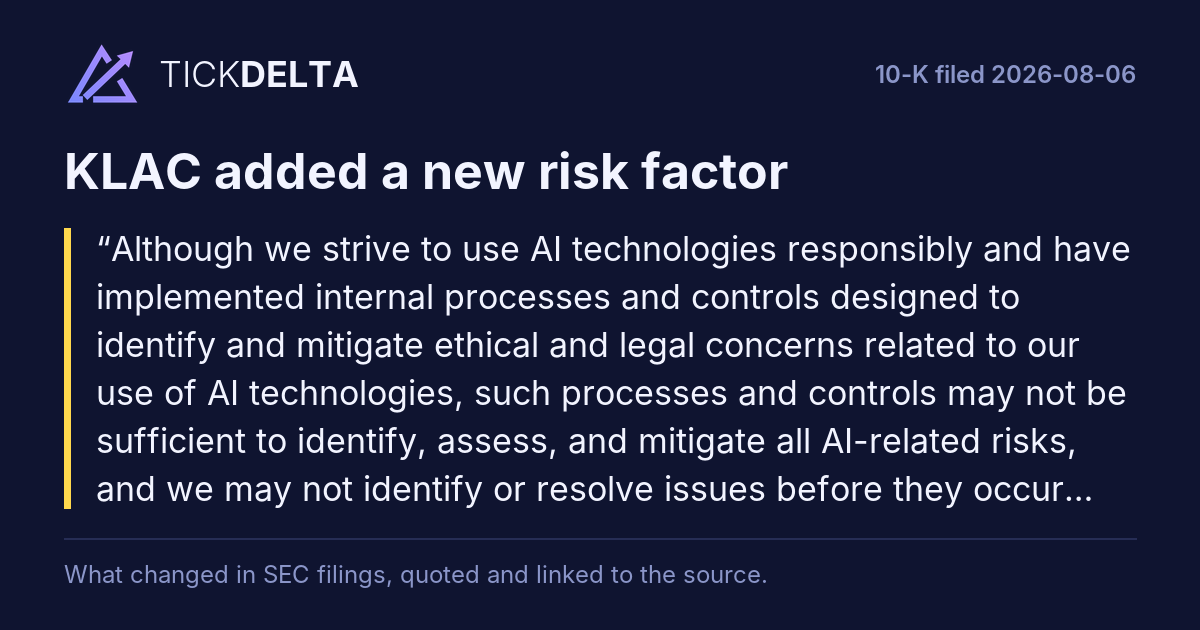
Although we strive to use AI technologies responsibly and have implemented internal processes and controls designed to identify and mitigate ethical and legal concerns related to our use of AI technologies, such processes and controls may not be sufficient to identify, assess, and mitigate all AI-related risks, and we may not identify or resolve issues before they occur. Failure to effectively develop and manage our AI governance framework could result in legal liability, regulatory action, reputational harm, or other adverse consequences to our business.
Furthermore, the regulatory framework for AI technologies is rapidly evolving, uncertain, and varies significantly by jurisdiction, with new laws and regulations being enacted or proposed in the United States, the European Union and elsewhere. Compliance with new or changing AI-related laws and regulations may impose significant operational costs, require additional investment in governance and controls, or necessitate changes to our offerings or business practices. Any failure or perceived failure by us to comply with such regulatory requirements could subject us to legal liabilities, damage our reputation, or otherwise have a material and adverse impact on our business.
Read in the 10-K ↗
standards and develop as well as offer competitive technology solutions in a timely manner with cost-effective products could result in loss of market share, unanticipated costs and inventory obsolescence, which would adversely impact our business, operating results and financial condition.
Read in the 10-K ↗
In April 2025, the Chinese government imposed export controls on seven of the seventeen elements classified as rare earth elements. In October 2025, the Chinese government imposed additional restrictions and licensing requirements on certain rare earth elements, some of which became effective immediately on the announcement date and other portions of the regulations became effective in November 2025. The Chinese government imposed export controls on an additional five rare earth elements and certain license requirements for items made outside of China that incorporate controlled rare earth elements. It is estimated that China controls about 70% of the worldwide mining of rare earth elements, 90% of the separation and processing of those elements and 93% of the magnets manufactured from those elements. Rare earth elements are critical to certain components contained in our products. If our suppliers are unable to provide the components necessary to make our products because of restrictions placed on their access to rare earth elements or products derived from rare earth elements, our business, financial condition and results of operations could be materially harmed. Our operating results and business may be adversely impacted if we are unable to obtain parts to meet our production requirements and product specifications, or if we are able to do so only on unfavorable terms.
A supplier may discontinue production of a particular part for any number of reasons, including the supplier’s financial condition or business operational decisions, which would require us to purchase, in a single transaction, a large number of such discontinued parts in order to ensure that a continuous supply of such parts remains available to our customers. Such “end-of-life” parts purchases could result in significant expenditures by us in a particular period, and, ultimately, any unused parts may result in a significant inventory write-off, either of which could have an adverse impact on our financial condition and results of operations for the applicable periods. Recently, a few large suppliers have discontinued manufacturing certain DRAM chips that are incorporated in a number of our products, and the resulting shortage has caused a dramatic increase in the prices to acquire these chips. Our efforts to procure these chips contributed to an increase in purchase commitments in fiscal 2026. We estimate that the additional costs to procure these DRAM chips will continue to have an adverse impact on our gross margin in
fiscal 2027. If we are unable to acquire adequate supply of such chips or acquire them in a timely or cost-controlled manner, our results of operations could be harmed.
Similar paragraph at 2 of 74 other Technology companies:
CRWD,
MRVL
Although our standard commercial documentation sets forth the terms and conditions that we intend to apply to commercial transactions with our business partners, counterparties to such transactions may not explicitly agree to our terms
Read in the 10-K ↗
We are exposed to additional risks related to our receipt of external funding for certain strategic development programs from various governments and government agencies, both domestically and internationally. Governments and government
Read in the 10-K ↗
New in the latest 10-Q
30 paragraphs in the 10-Q filed Oct 29, 2026 with nothing like
them in the 10-Q filed Apr 30, 2026 (at least half the words must differ; new numbers alone do not count).
Quoted exactly, grouped by the item heading above them. This is text that changed, not a judgement of how serious it is.
Financial statements and notes
Three Months Ended September 30, (In thousands) 2026 2025 ─────────────────────────────────────────────────────────────────────────────────────────────────────────────────────────────────────────────────────────────────────────────────────────────── Net income $ 1,548,588 $ 1,121,040 Other comprehensive income (loss): Currency translation adjustments: Cumulative currency translation adjustments 4,962 4,640 Income tax provision (1,578) (716) Net change related to currency translation adjustments 3,384 3,924 Cash flow hedges: Net unrealized gains (losses) arising during the period (13,014) 3,364 Reclassification adjustments for net gains included in net income (6,148) (12,212) Income tax benefit 2,826 2,404 Net change related to cash flow hedges (16,336) (6,444) Net change related to unrecognized gains and transition obligations in connection with defined benefit plans 410 146 Available-for-sale securities: Net unrealized gains (losses) arising during the period (15,887) 2,446 Reclassification adjustments for net (gains) losses included in net income 85 (97) Income tax (provision) benefit 3,391 (505) Net change related to available-for-sale securities (12,411) 1,844 Other comprehensive loss (24,953) (530) Total comprehensive income $ 1,523,635 $ 1,120,510
Read in the 10-Q ↗
Adjustments to reconcile net income to net cash provided by operating activities:
Read in the 10-Q ↗
Proceeds from maturity and sale of available-for-sale securities 716,202 632,795
Read in the 10-Q ↗
Tax withholding payments related to vested and released restricted stock units (238,682) (81,122)
Read in the 10-Q ↗
Common Stock Split. On June 11, 2026, the Company effected a ten -for-one stock split of its common stock and a proportional increase in the number of authorized shares of common stock. Share and per share information throughout this Quarterly Report on Form 10-Q have been retroactively adjusted to reflect the stock split. The par value per share remains unchanged at $ 0.001 per share after the stock split.
Read in the 10-Q ↗
The following table summarizes our debt as of September 30, 2026 and June 30, 2026:
Read in the 10-Q ↗
In fiscal 2026, we entered into interest rate swaps on $ 2.00 billion principal amount of the senior, unsecured long-term notes issued in June 2022 (“2022 Senior Notes”). The interest rate swaps effectively convert the fixed interest rates on the hedged portion of 2022 Senior Notes to floating interest rates based on the Secured Overnight Financing Rate (“SOFR”) swap rate. Under the terms of the swaps, we pay semi-annual interest at the daily compounded SOFR swap plus a fixed number of basis points on the notional amount and in exchange, we receive semi-annual fixed-rate interest on the 2022 Senior Notes from the swap. The interest rate swaps are accounted for as fair value hedges, and as a result the carrying value of the hedged portion of our 2022 Senior Notes reflects adjustments in fair value.
Read in the 10-Q ↗
There were no anti-dilutive securities excluded from the computation of diluted net income per share for the three months ended September 30, 2026 and 2025.
Read in the 10-Q ↗
Purchase Commitments. We maintain commitments to purchase inventory from our suppliers as well as goods, services and other assets in the ordinary course of business. Our liability under these purchase commitments is generally restricted to a
Read in the 10-Q ↗
During the three months ended June 30, 2026 and September 30, 2026, we submitted claims for refunds of tariffs previously paid under the International Emergency Economic Powers Act refund program and have substantially received the related refunds. The refunds did not have a material impact on our consolidated financial statements. We do not expect any remaining claims or recoveries to have a material impact on our consolidated financial statements.
Read in the 10-Q ↗
We utilize fixed-to-floating interest rate swaps designated as fair value hedges to minimize certain exposures to changes in the fair value of fixed-rate debt that result from fluctuations in benchmark interest rates. The interest rate swaps effectively convert the fixed interest rates on a portion of our 2022 Senior Notes to floating interest rates based on the SOFR swap rate. Under the terms of the swaps, we pay semi-annual interest at the daily compounded SOFR swap rate plus a fixed number of basis points on the $ 2.00 billion notional amount of 2022 Senior Notes hedged, and in exchange, we receive fixed-rate interest on the 2022 Senior Notes hedged from the swap counterparties on a semi-annual basis. If a financial counterparty to any of our hedging arrangements experiences financial difficulties or is otherwise unable to honor the terms of the interest rate swap, we may experience material losses. We apply the shortcut method to these fair value hedges as they are assumed to be perfectly effective in hedging the change in interest rates related to a portion of our 2022 Senior Notes. The resulting gains and losses from these transactions are recognized in interest expense each period.
Read in the 10-Q ↗
Three Months Ended September 30, (In thousands) 2026 2025 ────────────────────────────────────────────────────────────────────────────────────────────────────────────────────────────────── Derivatives Designated as Cash Flow Hedging Instruments: Foreign exchange contracts: Amounts included in the assessment of effectiveness $ (12,984) $3,300 Amounts excluded from the assessment of effectiveness $ (30) $64 Derivatives Designated as Net Investment Hedging Instruments: Foreign exchange contracts(1): $ (4,044) $19,325
Read in the 10-Q ↗
• Tariffs, retaliatory trade measures and other trade restrictions, as well as uncertainty regarding tariff authority, implementation and refund process;
Read in the 10-Q ↗
• Our reliance on critical information, including our enterprise resource planning system for daily operations;
Read in the 10-Q ↗
• Ongoing changes in the technology industry, including artificial intelligence (“AI”) related developments and changes in semiconductor manufacturing processes, customer investment patterns and end-market demand;
Read in the 10-Q ↗
• Risks related to the development, adoption, governance and use of AI by us, our competitors and third parties;
Read in the 10-Q ↗
We are a leading supplier of process control and yield management solutions and services for the semiconductor and related electronics industries. Our broad portfolio of inspection and metrology products, along with related services, software
Read in the 10-Q ↗
and other offerings, support R&D and manufacturing of integrated circuits (“ICs”), wafers and reticles. Our products, services and expertise enable our customers to measure, detect, analyze and resolve critical nanometer-scale product defects, helping them to address manufacturing challenges and achieve higher yields at lower cost.
Read in the 10-Q ↗
While we continue to invest in technological innovation, demand for our products may be affected by the timing of customer adoption decisions and changes in delivery schedules, which can result in variability in our operating results. In addition, geopolitical factors, including government regulations and tariffs, have impacted our results of operations and may continue to do so. We have also increased our purchase commitments, in part to secure the supply of key components, which may affect the timing and magnitude of our costs and working capital requirements. Despite these dynamics, we delivered higher revenue and net income in the three months ended September 30, 2026 compared to the three months ended June 30, 2026 and September 30, 2025, driven by increased sales volume and disciplined cost management. Looking ahead, we expect continued revenue growth as we expand manufacturing capacity and increase production levels to meet customer demand.
Read in the 10-Q ↗
Beginning this quarter, we have changed our primary basis of comparison of results of operations in Management’s Discussion and Analysis from the corresponding quarter in the prior fiscal year to the immediately preceding fiscal quarter. Management believes a sequential comparison provides a more meaningful view of current business trends and operating performance. Accordingly, the analysis below compares the three months ended September 30, 2026 to the three months ended June 30, 2026 and, as required in the first period following this change, also includes comparisons to the three months ended September 30, 2025, where applicable.
Read in the 10-Q ↗
Each of the remaining regions accounted for less than 10% of revenue in all periods presented.
Read in the 10-Q ↗
impact of tariffs, customer support costs, including the efficiencies in which we manage our production plans and inventory risk.
Read in the 10-Q ↗
Interest expense represents interest associated with our debt instruments. Interest on our senior, unsecured long-term notes (the “Senior Notes”) is payable semi-annually. Concurrent with the Senior Notes interest payments, floating interest payments on our interest rate swaps are paid semi-annually and the fixed-rate interest receivable on the swaps is received semi-annually.
Read in the 10-Q ↗
The effective tax rate during the three months ended September 30, 2026 was higher compared to the three months ended June 30, 2026, primarily due to a reduction in the tax effects of our stock-based compensation expense and the tax effects of the Undertaxed Profits Rule (“UTPR”) provision under the Organization for Economic Co-operation and Development (“OECD”) Pillar Two Global Anti-Base Erosion (“GloBE”) rules during the three months ended September 30, 2026. We are expecting $94.5 million tax expense in our fiscal year ending June 30, 2027 relating to the UTPR provision and have accrued $20.2 million tax expense during the three months ended September 30, 2026. As countries enact legislation to adopt the Side-by-Side Safe Harbor, the UTPR tax expense may be reversed without payment.
Read in the 10-Q ↗
The effective tax rate during the three months ended September 30, 2026 was higher compared to the three months ended September 30, 2025, primarily due to the tax effects of the UTPR provision under the OECD Pillar Two GloBE rules during the three months ended September 30, 2026.
Read in the 10-Q ↗
Risk Factors
Our success is dependent in part on our technology and other proprietary rights. If we are unable to maintain our lead or protect our proprietary technology, we may lose valuable assets.
Read in the 10-Q ↗
Our success is dependent, in part, on our technology and other proprietary rights. We own various U.S. and international patents and have additional pending patent applications relating to some of our products and technologies. The process of seeking patent protection is lengthy and expensive, and we cannot be certain that pending or future applications will actually result in issued patents or that issued patents will be of sufficient scope or strength to provide meaningful protection or commercial advantage to us. Other companies and individuals, including our larger competitors, may develop technologies and obtain patents relating to our business that are similar or superior to our technology or may design around the patents we own, which may adversely affect our business. In addition, we at times engage in collaborative technology development efforts with our customers and suppliers, and these collaborations may constitute a key component of certain of our ongoing technology and product R&D projects. The termination of any such collaboration, or delays caused by disputes or other unanticipated challenges that may arise in connection with any such collaboration, could significantly impair our R&D efforts, which could have a material adverse impact on our business and operations.
Read in the 10-Q ↗
We also maintain trademarks on certain of our products and services and claim copyright protection for certain proprietary software and documentation. However, we can give no assurance that our trademarks and copyrights will be upheld or successfully deter infringement by third parties.
Read in the 10-Q ↗
While patent, copyright and trademark protection for our IP is important, we believe our future success in highly dynamic markets is most dependent upon the technical competence and creative skills of our personnel. We attempt to protect our trade secrets and other proprietary information through confidentiality and other agreements with our customers, suppliers, employees and consultants and through other security measures. We also maintain exclusive and non-exclusive licenses with third parties for strategic technology used in certain products. However, these employees, consultants and third parties may breach these agreements, and we may not have adequate remedies for wrongdoing. We also try to control access to and distribution of our technology and proprietary information. Despite our efforts, internal or external parties, including state actors, may attempt to copy, disclose, obtain, reverse engineer, decompile or otherwise misappropriate our IP or technology, including through the use of AI or machine learning technologies. Advances in AI and machine learning technologies may make policing unauthorized use of our IP and technology more difficult to detect, and if third parties are able to replicate our technologies, our competitors may be able to take advantage of our R&D efforts to develop competing products. In addition, former employees may seek employment with our customers, suppliers or competitors and there can be no assurance that the confidential nature of our proprietary information will be maintained in the course of such future employment. In addition, the laws of certain territories in which we develop, manufacture or sell our products may not protect our IP rights to the same extent as the laws of the U.S. In any event, the extent to which we can protect our trade secrets through the use of confidentiality agreements is limited, and our success will depend to a significant extent on our ability to innovate ahead of our competitors.
Read in the 10-Q ↗
Other information
During the three months ended September 30, 2026, no director or officer of the Company adopted or terminated a “Rule 10b5-1 trading arrangement” or “non-Rule 10b5-1 trading arrangement,” as each term is defined in Item 408(a) of Regulation S-K.
Read in the 10-Q ↗
The 10-Q's risk factors against the 10-K
Item 1A of the 10-Q filed Oct 29, 2026 against Item 1A of the 10-K filed Aug 6, 2026.
A 10-Q repeats only the risks that changed, so a 10-K paragraph that is missing from it is not counted as removed.
Added is a paragraph with nothing like it in the 10-K, Reworded a sentence that is in both with several words changed,
Quiet changes a sentence in both where one to four words changed and one is a hedge or a modal
(cut words struck through, new words highlighted and underlined).
Text on the page, not a score; each links to the filing at sec.gov.
What the 10-Q itself says about its risk factors:
Other than the risk factor listed below, there have been no material changes in our risk factors since our Annual Report on Form 10-K for the fiscal year ended June 30, 2026. Refer to “Risk Factors” contained in Part I Item 1A of our Annual Report on Form 10-K for our fiscal year ended June 30, 2026 for a complete description of our risk factors. Any of these risks, as well as risks unknown to us or that we believe are currently immaterial, could have a material adverse impact on our business, financial condition or results of operations.
Read in the 10-Q ↗
Reworded10-Q 2026-10-29 vs 10-K 2026-08-06
Despite our efforts, internal or external parties parties, including state actors, may attempt to copy, disclose, obtain obtain, reverse engineer, decompile or otherwise misappropriate our IP or technology. technology, including through the use of AI or machine learning technologies.
Read it in the 10-Q at sec.gov ↗ · The 10-K sentence ↗