Paragraph 80 · 49% changed
Every version of it
NYSE
Materials · Aggregates
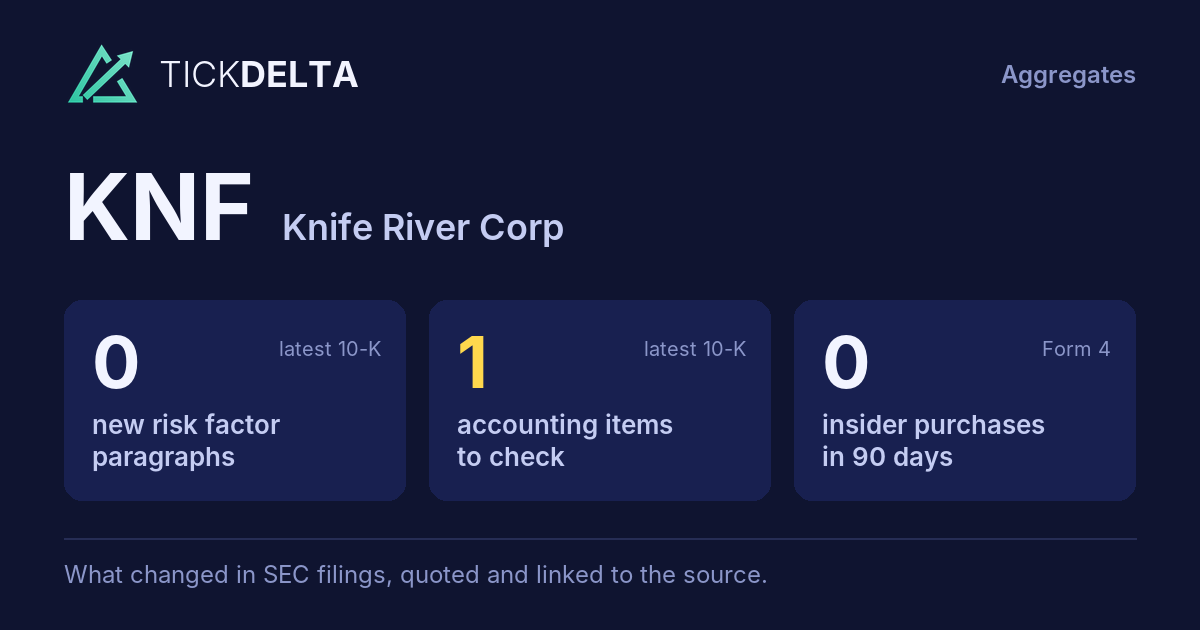
Knife River Corp KNF
The 10-K against last year's
196 changes: 28 added, 60 removed, 106 reworded, 2 quiet changes
10-K Feb 20, 2026 vs Feb 21, 2025
Risk Factors
25.9%
of the text changed · 9,676 words now · 0 new paragraphs, 44 gone
MD&A
35.0%
of the text changed · 10,566 words now · 28 new paragraphs, 16 gone
Legal Proceedings
51.1%
of the text changed · 1,232 words now
Accounting Policies
15.5%
of the text changed · 4,319 words now
10-K 0001955520-26-000003 (Feb 20, 2026) vs 10-K 0001955520-25-000010 (Feb 21, 2025)
Every paragraph, and how much of it changed
One bar per paragraph, in the order of the 10-K. Height and colour show the share of its words not in the closest paragraph a year earlier; the tallest bars are new paragraphs.
Risk Factors
132 paragraphs · 0 new · 81 reworded · 44 gone · 10-K Feb 20, 2026 against Feb 21, 2025
New paragraph
Reworded (5% of its words or more)
Same or nearly
Paragraph 29 · 47% changed
Every version of it
While our insurance policies include liability coverage for certain of these matters, if we experience a significant security incident, we could be subject to liability or other damages that exceed our insurance coverage and we cannot be certain that such insurance policies will continue to be available to us on economically reasonable terms, or at all, or that any insurer will not deny coverage as to any future claim. The successful assertion of one or more large claims against us that exceed available insurance coverage, or the occurrence of changes in our insurance policies, including premium increases or the imposition of large deductible or co-insurance requirements, could have a material adverse effect on our results of operations, financial condition and cash flows.
Paragraph 71 · 47% changed
Every version of it
Paragraph 9 · 47% changed
Every version of it
Paragraph 66 · 42% changed
Every version of it
Paragraph 116 · 42% changed
Every version of it
Paragraph 46 · 36% changed
Every version of it
shortage which may cause prices to increase faster than downstream products. Any material disruption at our facilities or those of our customers or suppliers or otherwise within our supply chain, whether as a result of downtime, work stoppages or facility damage, could prevent us from meeting customer demands or expected timelines, require us to incur unplanned capital expenditures, or cause other material disruptions to our operations, any of which could have a material adverse effect on our operations, financial position and cash flows.
Paragraph 20 · 35% changed
Every version of it
Our results of operations from potential acquisitions could, in the future, result in impairment charges for any of the intangible assets, including goodwill, or other long‑lived assets, particularly if economic conditions worsen unexpectedly. As a result of these changes, our financial condition, results of operations and liquidity could be materially adversely affected. In addition, many of the businesses that we have acquired and may acquire have unaudited financial statements that have been prepared by the management of such companies and have not been independently reviewed or audited. We cannot assure that the financial statements of companies we have acquired or may acquire would not be materially different if such statements were independently reviewed or audited. If such statements were to be materially different, the tangible and intangible assets we acquire may be more susceptible to impairment charges, which could have a material adverse effect on our results of operations.
Paragraph 80 · 49% changed
Every version of it
10-K Feb 21, 2025extreme or unusually adverse weather conditions could negatively affect our results of operations, financial position and cash flows.
10-K Feb 20, 2026
adversely affect the ability to perform under contracts, which could negatively impact our results of operations, cash flows and financial condition.
Paragraph 29 · 47% changed
Every version of it
10-K Feb 21, 2025
While our insurance policies include liability coverage for certain of these matters, if we experience a significant security incident, we could be subject to liability or other damages that exceed our insurance coverage and we cannot be certain that such insurance policies will continue to be available to us on economically reasonable terms, or at all, or that any insurer will not deny coverage as to any future claim. The successful assertion of one or more large claims against us that exceed available insurance coverage, or the occurrence of changes in our insurance policies, including premium increases or the imposition of large deductible or co-insurance requirements, could have a material adverse effect on our results of operations, financial condition and cash flows.
10-K Feb 20, 2026
While our insurance policies include liability coverage for certain of these matters, if we experience a significant security incident, we could be subject to liability or other damages that exceed our insurance coverage
Paragraph 71 · 47% changed
Every version of it
10-K Feb 21, 2025Public concern over climate change has resulted in, and may continue to result in, new or increased regional, federal and global legal and regulatory requirements, including taxation, to reduce or mitigate carbon emissions and to limit or impose additional costs on hydrocarbon and water usage or other climate-related objectives. In October 2023, California passed two climate disclosure bills (SB 253 - Climate Corporate Accountability Act and SB 261 - Climate-Related Financial Risk Act) that will require disclosure from both public and private entities that do business in the state of California. SB 253 mandates reporting entities to disclose Scope 1, Scope 2 and Scope 3 GHG emissions. SB 261 mandates reporting companies to disclose climate risk reports. Both California laws are set to take effect in 2026. We may experience increases to our costs of operation to comply with new regulatory requirements due to investments in facilities and equipment or the relocation of our facilities. If we or our suppliers are required to comply with these laws and regulations, or if we choose to take additional voluntary steps to reduce or mitigate our impact on the climate, we may experience increased costs for energy, production, transportation, and raw materials, increased capital expenditures, or increased insurance premiums and deductibles, each of which could adversely impact our operations. In particular, proposed, new or inconsistent regulation and taxation of fuel and energy could increase the cost of complying with such laws and regulations as well as the cost of operation, including fuel required to operate our facilities or transport and distribute our products, thereby increasing the distribution and supply chain costs associated with our products. Any assessment of the potential impact of future climate change legislation, regulations or industry standards, as well as any international treaties and accords, is uncertain given the wide scope of potential regulatory change in the jurisdictions in which we operate.
10-K Feb 20, 2026
Certain public concern over climate change has resulted in, and may continue to result in, new or increased state, regional, federal and global legal and regulatory requirements, including taxation, to reduce or mitigate carbon emissions and to limit or impose additional costs on hydrocarbon and water usage or other climate-related objectives. In the event that such new regulation is more stringent than current regulatory obligations, or the measures that we are currently undertaking to monitor and improve our resource efficiency, we may experience disruptions in, or increases in our costs of operation and delivery to comply with new regulatory requirements due to investments in facilities and equipment or the relocation of our facilities. We monitor, analyze and report GHG emissions from our operations. We will continue to monitor GHG regulations and their potential impact on operations. Due to the uncertain availability of technologies to control GHG emissions and the unknown obligations that potential GHG emission legislation or regulations may create, we cannot determine the potential financial impact on our operations.
Paragraph 9 · 47% changed
Every version of it
10-K Feb 21, 2025Our customers include public and private entities that have been, and may continue to be, negatively impacted by the economy. A recessionary construction economy can increase the likelihood that we will not be able to collect on all accounts receivable or may experience a delay in payment from some customers. If our customers or counterparties experience financial difficulties, which has occurred and may reoccur, we could experience difficulty in collecting receivables. While no one customer accounted for over 10 percent of our revenue in 2024 or 2023, we face collection risk as a normal part of business where we perform services and subsequently bill clients for such services. In the event that we have concentrated credit risk from customers in a specific geographic area or industry, negative trends or a worsening in financial conditions in that specific geographic area or industry, we could become more susceptible to disproportionately high levels of default. Nonpayment and/or nonperformance by our customers and counterparties could have a negative impact on our results of operations and cash flows.
10-K Feb 20, 2026
negative trends or a worsening in financial conditions in that specific geographic area or industry, we could become more susceptible to disproportionately high levels of default. Nonpayment and/or nonperformance by our customers and counterparties could have a negative impact on our results of operations and cash flows.
Paragraph 66 · 42% changed
Every version of it
10-K Feb 21, 2025Climate change may impact a region’s economic health, which could impact its revenues. Our financial performance is tied to the health of the regional economies served where we provide construction materials and services. Increases in severe weather events or significant changes in temperature and precipitation patterns could adversely affect the economies of the states and communities we serve.
10-K Feb 20, 2026
services. Increases in severe weather events or significant changes in temperature and precipitation patterns could adversely affect the economies of the states and communities affected by that industry.
Paragraph 116 · 42% changed
Every version of it
10-K Feb 21, 2025operating revenues derived from our core business, the operating and stock price performance of comparable companies, margin trading, short sales, hedging and derivative transactions involving our common stock, changes in the regulatory and legal environment in which we operate, market conditions in the construction materials and contracting services market, and the domestic and global economy as a whole.
10-K Feb 20, 2026
which we operate, market conditions in the construction materials and contracting services market, and the domestic and global economy as a whole.
Paragraph 46 · 36% changed
Every version of it
10-K Feb 21, 2025
timelines, require us to incur unplanned capital expenditures, or cause other material disruptions to our operations, any of which could have a material adverse effect on our operations, financial position and cash flows.
10-K Feb 20, 2026
shortage which may cause prices to increase faster than downstream products. Any material disruption at our facilities or those of our customers or suppliers or otherwise within our supply chain, whether as a result of downtime, work stoppages or facility damage, could prevent us from meeting customer demands or expected timelines, require us to incur unplanned capital expenditures, or cause other material disruptions to our operations, any of which could have a material adverse effect on our operations, financial position and cash flows.
Paragraph 20 · 35% changed
Every version of it
10-K Feb 21, 2025
Our results of operations from potential acquisitions could, in the future, result in impairment charges for any of the intangible assets, including goodwill, or other long‑lived assets, particularly if economic conditions worsen unexpectedly. As a result of these changes, our financial condition, results of operations and liquidity could be materially adversely affected. In addition, many of the businesses that we have acquired and may acquire have unaudited financial statements that have been prepared by the management of such companies and have not been independently reviewed or audited. We cannot assure that the financial statements of companies we have acquired or may acquire would not be materially different if such statements were independently reviewed or audited. If such statements were to be materially different, the tangible and intangible assets we acquire may be more susceptible to impairment charges, which could have a material adverse effect on our results of operations.
10-K Feb 20, 2026
Our results of operations from potential acquisitions could, in the future, result in impairment charges for any of the intangible assets, including goodwill, or other long‑lived assets, particularly if economic conditions worsen unexpectedly. As a result of these changes, our financial condition, results of operations and liquidity could be
MD&A
135 paragraphs · 28 new · 50 reworded · 16 gone · 10-K Feb 20, 2026 against Feb 21, 2025
New paragraph
Reworded (5% of its words or more)
Same or nearly
Paragraph 109 · 49% changed
Paragraph 88 · 49% changed
Years ended December 31, 2025 2024 2023 2022 (In millions) Capital expenditures $ (172.4) $ (124.3) $ (178.2) Acquisitions, net of cash acquired (131.0) — 1.7 Net proceeds from sale or disposition of property and other 12.0 8.3 22.9 Investments (3.4) (1.9) (2.3) Net cash used in investing provided by (used in) Operating activities $ 278.5 $ 322.3 $ 335.7 Investing activities (913.7) (294.8) (117.9) Financing activities 477.5 (8.7) 34.4 Increase (decrease) in cash, cash equivalents and restricted cash (157.7) 18.8 252.2 Cash, cash equivalents and restricted cash – beginning of year 281.1 262.3 10.1 Cash, cash equivalents and restricted cash – end of year $ (117.9) 123.4 $ (155.9) 281.1 $ 262.3
Paragraph 46 · 49% changed
Income tax expense increased $6.9 million corresponding with higher income before income taxes. Our effective tax rate for 2024 was 25.6 percent, compared to 25.5 percent in 2023. For a reconciliation of the federal tax rate to our effective tax rate, see Item 8 - Note 16.
Paragraph 38 · 48% changed
Interest expense decreased $2.9 increased $26.7 million due primarily to lower higher average debt balances, balances with the issuance of a new $500 million Term Loan B in March of 2025 and borrowings under our revolving credit facility during the year, offset by higher slightly lower average interest rates.
Paragraph 55 · 48% changed
Our revenue increased $29.1 decreased $19.1 million in 2024, 2025, primarily from due to decreased contracting services work in Montana and Wyoming, which also contributed to lower aggregate and asphalt volumes of $12.7 million and $9.2 million, respectively. The decrease was driven by less available asphalt paving work as a result of competitive bid dynamics and the type and location of available DOT projects throughout the region. Partially offsetting this decrease was an increase in Idaho public agency construction work aggregate and airport work, which drove increases in both ready-mix pricing of $13.2 million and higher contracting services revenue and asphalt volumes. We also benefited from the continued implementation of our EDGE-related pricing initiative throughout all product lines, which contributed $24.6 $6.7 million in additional revenue. Offsetting these increases were lower ready-mix concrete volumes of $14.4 million our Idaho market due to a decrease in demand for residential and commercial work, as well as lower aggregates sales volumes of $11.0 million, largely due to the timing of wind energy projects and lower internal sales from the lack of large aggregate projects in 2024. larger DOT projects.
Paragraph 50 · 48% changed
Our revenue increased $44.1 $24.8 million in 2023. This increase was across most product lines and was the 2025, as a result of increased prices to cover rising costs more available public-agency and the early stages of EDGE-related pricing implementation, private contracting services work as well as increased sales of higher priced products, adding $32.0 million. We saw strong ready-mix concrete volumes and pricing in our California market compared to prior year. Hawaii experienced increased ready-mix concrete and cement product sales volumes to third-party customers in Alaska pricing and strong aggregate sales volumes of $6.0 million, primarily from $36.4 million driven by increased market demand, while Alaska saw its aggregate and ready-mix concrete volumes increase by $8.3 million due to stronger demand in Hawaii as the local economy continues private sector. Partially offsetting these increases was decreased volumes throughout most Oregon product lines due to regain momentum for public less secured public-agency and private work. Ready-mix concrete sales volumes increased in northern California as a result of an acquisition in December 2022, which were offset in part by lower sales volumes in Alaska due to fewer projects over the prior year. Partially offsetting the increased revenues was the absence in 2023 of an impact project in California of $11.2 million, which affected both contracting services workloads and asphalt volumes. Northern California experienced mild weather in the fourth quarter which also contributed to a strong finish to the year.
Paragraph 93 · 46% changed
The increase in cash used in investing activities from 2025 to 2024 to 2023 was primarily due to the completion of six additional investments to grow our company. We spent $479.0 million more on acquisitions in 2024 and higher 2025, which includes the acquisition of Strata. We also spent $175.6 million more on capital expenditures, including a liquid asphalt expansion project, the replenishment of depleting aggregate reserve replacements reserves and routine replacement of construction equipment. greenfield projects. The increase in cash usage was offset in part by additional proceeds from asset sales, largely the sale of ready-mix operations as a result part of the Strata acquisition in the Central segment as discussed in Item 8 - Note 3 and the sale of non-strategic assets in Texas in 2024. both the West and Central segments.
Paragraph 18 · 45% changed
Profitability. Our management team continually monitors our margins and has been proactive in applying strategies to increase margins to support our long-term profitability goals and to create shareholder value. In 2023, we began implementing EDGE initiatives and established teams to deliver training, assist with targeting higher-margin bidding opportunities across the regions and pursue growth opportunities, as well as identifying ways to increase efficiencies and reduce costs. In 2023, its first year of operation, the Materials Process Improvement Team (Materials PIT Crew) traveled to 10 locations throughout our operational footprint, visiting 67 individual aggregate, asphalt and ready-mix concrete plants. In 2024, the team traveled to eight additional locations and 58 individual plants, in addition to follow-up trips to sites visited in the prior year. The Materials PIT Crew also hosted a Plant Equipment Best Practices training seminar at our training center in Oregon in December of 2024. This training was attended by approximately 150 front line plant operators and maintenance personnel and was supported by our internal subject matter experts and a number of plant equipment manufacturers. Also in 2024, a broader process improvement framework was established with teams focused on standardization, commercial excellence and operational excellence, due in part to the success of the Materials PIT Crew.
Paragraph 109 · 49% changed
10-K Feb 21, 2025Revenue is recognized to depict the transfer of promised goods or services to customers in an amount that reflects the consideration to which the entity expects to be entitled in exchange for those goods or services. The recognition of revenue requires us to make estimates and assumptions that affect the reported amounts of revenue. The accuracy of revenues reported on the audited consolidated financial statements depends on, among other things, management’s estimates of total costs to complete projects because we use the cost-to-cost measure of progress on contracting services contracts for revenue recognition.
10-K Feb 20, 2026
management’s estimates of total costs to complete projects because we use the cost-to-cost measure of progress on contracting services contracts for revenue recognition.
Paragraph 88 · 49% changed
10-K Feb 21, 2025
Years ended December 31, 2024 2023 2022 (In millions) Capital expenditures $ (172.4) $ (124.3) $ (178.2) Acquisitions, net of cash acquired (131.0) — 1.7 Net proceeds from sale or disposition of property and other 12.0 8.3 22.9 Investments (3.4) (1.9) (2.3) Net cash used in investing activities $ (294.8) $ (117.9) $ (155.9)
10-K Feb 20, 2026
Years ended December 31, 2025 2024 2023 (In millions) Net cash provided by (used in) Operating activities $ 278.5 $ 322.3 $ 335.7 Investing activities (913.7) (294.8) (117.9) Financing activities 477.5 (8.7) 34.4 Increase (decrease) in cash, cash equivalents and restricted cash (157.7) 18.8 252.2 Cash, cash equivalents and restricted cash – beginning of year 281.1 262.3 10.1 Cash, cash equivalents and restricted cash – end of year $ 123.4 $ 281.1 $ 262.3
Paragraph 46 · 49% changed
10-K Feb 21, 2025
Income tax expense increased $6.9 million corresponding with higher income before income taxes.
10-K Feb 20, 2026
Income tax expense increased $6.9 million corresponding with higher income before income taxes. Our effective tax rate for 2024 was 25.6 percent, compared to 25.5 percent in 2023. For a reconciliation of the federal tax rate to our effective tax rate, see Item 8 - Note 16.
Paragraph 38 · 48% changed
10-K Feb 21, 2025
Interest expense decreased $2.9 million due primarily to lower average debt balances, offset by higher average interest rates.
10-K Feb 20, 2026
Interest expense increased $26.7 million due primarily to higher average debt balances with the issuance of a new $500 million Term Loan B in March of 2025 and borrowings under our revolving credit facility during the year, offset by slightly lower average interest rates.
Paragraph 55 · 48% changed
10-K Feb 21, 2025
Our revenue increased $29.1 million in 2024, primarily from an increase in Idaho public agency construction work and airport work, which drove increases in both contracting services revenue and asphalt volumes. We also benefited from the continued implementation of our EDGE-related pricing initiative throughout all product lines, which contributed $24.6 million in additional revenue. Offsetting these increases were lower ready-mix concrete volumes of $14.4 million due to a decrease in demand for residential and commercial work, as well as lower aggregates sales volumes of $11.0 million, largely due to the timing of wind energy projects and lower internal sales from the lack of large aggregate projects in 2024.
10-K Feb 20, 2026
Our revenue decreased $19.1 million in 2025, primarily due to decreased contracting services work in Montana and Wyoming, which also contributed to lower aggregate and asphalt volumes of $12.7 million and $9.2 million, respectively. The decrease was driven by less available asphalt paving work as a result of competitive bid dynamics and the type and location of available DOT projects throughout the region. Partially offsetting this decrease was an increase in aggregate and ready-mix pricing of $13.2 million and higher contracting services revenue of $6.7 million in our Idaho market due to larger DOT projects.
Paragraph 50 · 48% changed
10-K Feb 21, 2025
Our revenue increased $44.1 million in 2023. This increase was across most product lines and was the result of increased prices to cover rising costs and the early stages of EDGE-related pricing implementation, as well as increased sales of higher priced products, adding $32.0 million. We saw strong cement product sales volumes to third-party customers in Alaska and strong aggregate sales volumes of $6.0 million, primarily from increased demand in Hawaii as the local economy continues to regain momentum for public and private work. Ready-mix concrete sales volumes increased in northern California as a result of an acquisition in December 2022, which were offset in part by lower sales volumes in Alaska due to fewer projects over the prior year. Partially offsetting the increased revenues was the absence in 2023 of an impact project in California of $11.2 million, which affected both contracting services workloads and asphalt volumes. Northern California experienced mild weather in the fourth quarter which also contributed to a strong finish to the year.
10-K Feb 20, 2026
Our revenue increased $24.8 million in 2025, as a result of more available public-agency and private contracting services work as well as increased ready-mix concrete volumes and pricing in our California market compared to prior year. Hawaii experienced increased ready-mix concrete and cement pricing and volumes of $36.4 million driven by increased market demand, while Alaska saw its aggregate and ready-mix concrete volumes increase by $8.3 million due to stronger demand in the private sector. Partially offsetting these increases was decreased volumes throughout most Oregon product lines due to less secured public-agency and private work.
Paragraph 93 · 46% changed
10-K Feb 21, 2025
The increase in cash used in investing activities from 2024 to 2023 was primarily due to the completion of six acquisitions in 2024 and higher capital expenditures, including a liquid asphalt expansion project, aggregate reserve replacements and routine replacement of construction equipment. The increase in cash usage was offset in part by additional proceeds from asset sales, largely as a result of the sale of non-strategic assets in Texas in 2024.
10-K Feb 20, 2026
The increase in cash used in investing activities from 2025 to 2024 was primarily due to additional investments to grow our company. We spent $479.0 million more on acquisitions in 2025, which includes the acquisition of Strata. We also spent $175.6 million more on capital expenditures, including the replenishment of depleting aggregate reserves and greenfield projects. The increase in cash usage was offset in part by proceeds from the sale of ready-mix operations as part of the Strata acquisition in the Central segment as discussed in Item 8 - Note 3 and the sale of non-strategic assets in both the West and Central segments.
Paragraph 18 · 45% changed
10-K Feb 21, 2025
Profitability. Our management team continually monitors our margins and has been proactive in applying strategies to increase margins to support our long-term profitability goals and to create shareholder value. In 2023, we began implementing EDGE initiatives and established teams to deliver training, assist with targeting higher-margin bidding opportunities across the regions and pursue growth opportunities, as well as identifying ways to increase efficiencies and reduce costs. In 2023, its first year of operation, the Materials Process Improvement Team (Materials PIT Crew) traveled to 10 locations throughout our operational footprint, visiting 67 individual aggregate, asphalt and ready-mix concrete plants. In 2024, the team traveled to eight additional locations and 58 individual plants, in addition to follow-up trips to sites visited in the prior year. The Materials PIT Crew also hosted a Plant Equipment Best Practices training seminar at our training center in Oregon in December of 2024. This training was attended by approximately 150 front line plant operators and maintenance personnel and was supported by our internal subject matter experts and a number of plant equipment manufacturers. Also in 2024, a broader process improvement framework was established with teams focused on standardization, commercial excellence and operational excellence, due in part to the success of the Materials PIT Crew.
10-K Feb 20, 2026
Profitability. Our management team continually monitors our margins and has been proactive in applying strategies to increase margins to support our long-term profitability goals and to create shareholder value. In 2023, we began implementing EDGE initiatives and established teams to deliver training, assist with targeting higher-margin bidding opportunities across the regions and pursue growth opportunities, as well as identifying ways to
A paragraph is matched with the one last year that shares the most of its words; under half in common makes it new. The paragraphs shown are the 8 reworded the most in each section.
The paragraph that changed most in each section
The redline
Marked against last year's 10-K: cut words struck through, new words highlighted.
Risk Factors304 words changed in this paragraph; it is 37% similar to last year's version.
Source: Item 1A, 10-K 0001955520-26-000003 vs Item 1A, 10-K 0001955520-25-000010
Accounting Policies292 words changed in this paragraph; it is 51% similar to last year's version.
Standard Description Standard Effective Date Impact on financial statements/disclosures Recently adopted ASU’s ASU 2023-07 - Improvements to Reportable Segment Disclosures In November 2023, the FASB issued guidance on modifying the disclosure requirements to improve reportable segment disclosure requirements through enhanced disclosures about significant segment expenses. The guidance also expands the interim disclosure requirements. The guidance is to be applied on a retrospective basis to the financial statements and footnotes and early adoption is permitted. Adopted for the year ended December 31, 2024. We updated our disclosures for the year ended December 31, 2024, to incorporate the required changes. ASU 2023-09 - Improvements to Income Tax Disclosures In December 2023, the FASB issued guidance on modifying the disclosure requirements to increase transparency about income tax information through improvements to income tax disclosures primarily related to the rate reconciliation and income taxes paid information. The guidance is to be applied on a prospective basis to the financial statements and footnotes, however, retrospective adoption is also permitted. The guidance also permits early adoption. Adopted for the year ended December 31, 2024. We updated our disclosures, which were not material, for the year ended December 31, 2024. Recently issued ASU’s not yet adopted ASU 2024-03 - Disaggregation of Income Statement Expenses In November 2024, the FASB issued guidance on modifying the disclosure requirements to improve the disclosures for a public entity’s expenses and address requests from investors for more detailed information about the types of expenses in commonly presented expense captions. The guidance is to be applied either on a prospective basis to the financial statements issued for reporting periods after the effective date or on a retrospective basis to the financial statements to all prior periods presented in the financial statements. Early adoption is permitted. Annual reporting periods beginning after December 15, 2026 and interim reporting periods beginning after December 15, 2027. We are currently evaluating the impact the guidance will have on our disclosures for the year ended December 31, 2027 and interim periods for fiscal year 2028. ASU 2025-05 - Measurement of Credit Losses for Accounts Receivable and Contract Assets In July 2025, the FASB issued guidance to provide a practical expedient for all entities related to the estimation of expected credit losses for current accounts receivable and current contract assets that arise from transactions accounted for under ASC 606, Revenue from Contracts with Customers. Annual reporting periods beginning after December 15, 2025 and interim reporting periods within those annual reporting periods on a prospective basis. Early adoption is permitted and should be applied on a prospective basis. We are currently evaluating the impact the guidance will have on our financial statements and related disclosures.
Source: Item 8, Note 2 – Significant Accounting Policies, 10-K 0001955520-26-000003 vs Item 8, Note 2 – Significant Accounting Policies, 10-K 0001955520-25-000010
MD&A167 words changed in this paragraph; it is 52% similar to last year's version.
Corporate Services had negative EBITDA of $60.7 $63.9 million, or $7.5 $3.2 million less EBITDA in 2024, 2025, compared to the prior year. Corporate Services had increased selling, general and administrative expenses of $7.0 million. The increase in costs for non-Separation related expenses totaled $7.4 $2.8 million, which was primarily due to higher due diligence and integration costs related to corporate development and completed acquisitions of $7.5 $4.4 million and higher information technology costs of $3.4 million. These costs were partially offset by lower payroll-related costs of $2.4 million, largely due to lower bonus accruals, and a reduction in insurance loss reserves at our captive insurer of $2.6 million. As a result of the Separation, we experienced higher recurring costs as a publicly traded company of $6.3 million, including payroll-related costs of $9.5 million, largely due to additional staff and increased stock-based compensation expenses expense for the management team and board of directors; information technology costs of $2.8 million; professional services of $1.8 million; directors due to additional participants. In addition, salaries and fees of $750,000 primarily related burden were higher for the year due to fees on new debt issued in conjunction with the Separation, partially additional staff, however, these were mostly offset by a reduction in general corporate expenses from MDU Resources of $8.9 million. lower incentive accruals. We also incurred less had a benefit of $3.8 million primarily due to the lack of one-time costs of $6.5 million primarily incurred in the prior year consisting of insurance costs related to the Separation and the transition services agreement with MDU Resources.
Source: Item 7, 10-K 0001955520-26-000003 vs Item 7, 10-K 0001955520-25-000010
Legal Proceedings150 words changed in this paragraph; it is 49% similar to last year's version.
We are party to claims and lawsuits arising out of our business and that of our consolidated subsidiaries, which may include, but are not limited to, matters involving property damage, personal injury, and environmental, contractual and statutory obligations. We accrue a liability for those contingencies when the incurrence of a loss is probable, and the amount can be reasonably estimated. If a range of amounts can be reasonably estimated and no amount within the range is a better estimate than any other amount, then the minimum of the range is accrued. We do not accrue liabilities when the likelihood that the liability has been incurred is probable, but the amount cannot be reasonably estimated or when the liability is believed to be only reasonably possible or remote. For contingencies where an unfavorable outcome is probable or reasonably possible and which are material, we disclose the nature of the contingency and, in some circumstances, an estimate of the possible loss. Accruals are based on the best information available, but in certain situations management is unable to estimate an amount or range of a reasonably possible loss, including, but not limited to, when: (1) the damages are unsubstantiated or indeterminate, (2) the proceedings are in the early stages, (3) numerous parties are involved, or (4) the matter involves novel or unsettled legal theories.
Source: Item 3, via Note 18 – Commitments and contingencies, 10-K 0001955520-26-000003 vs Item 3, via Note 18 – Commitments and contingencies, 10-K 0001955520-25-000010
Sentences and paragraphs added, removed or reworded
Every change, by type
Sentences and paragraphs of KNF's Risk Factors and MD&A, 10-K Feb 20, 2026 against 10-K Feb 21, 2025. Each links to the text at sec.gov.
Quiet changes are sentences kept from last year with one to four words changed, at least one of them a hedge, a modal or a qualifier (may, could, will, not, significant, material…). A year or date rolling forward is not counted.
The full word list
adverse, adversely, all, although, anticipate, anticipates, any, approximately, believe, believes, can, cannot, certain, could, expect, expects, generally, however, if, intend, intends, largely, likely, many, material, materially, may, might, most, must, never, no, not, possible, primarily, probable, should, significant, significantly, some, substantial, substantially, unlikely, will, would
RemovedRisk Factors
RemovedRisk Factors
RemovedRisk Factors
RemovedRisk Factors
RemovedRisk Factors
RemovedRisk Factors
RemovedRisk Factors
RemovedRisk Factors
Show the other 54
RemovedRisk Factors
RemovedRisk Factors
RemovedRisk Factors
RemovedRisk Factors
RewordedRisk Factors
RewordedRisk Factors
While our insurance policies include liability coverage for certain of these matters, if we experience a significant security incident, we could be subject to liability or other damages that exceed our insurance coverage and we cannot be certain that such insurance policies will continue to be available to us on economically reasonable terms, or at all, or that any insurer will not deny coverage as to any future claim.
Read it in 10-K Feb 20, 2026 at sec.gov
RewordedRisk Factors
Our stockholders’ percentage ownership in our company may be Knife River has been, and is expected to further be, diluted because of equity awards that have been and will be granted to our its directors, officers and employees or otherwise as a result of equity issuances for acquisitions or capital market transactions. employees.
Read it in 10-K Feb 20, 2026 at sec.gov
RewordedRisk Factors
If we Knife River or our suppliers are required to comply with these new climate or GHG emission laws and regulations, or if we choose to take additional voluntary steps to reduce or mitigate our impact on the climate, we may experience increased costs for energy, production, transportation, and raw materials, increased capital expenditures, or increased insurance premiums and deductibles, each of which could adversely impact our operations.
Read it in 10-K Feb 20, 2026 at sec.gov
RewordedRisk Factors
RewordedRisk Factors
In the event that we have concentrated credit risk from customers in a specific geographic area or industry, negative trends or a worsening in financial conditions in that specific geographic area or industry, we could become more susceptible to disproportionately high levels of default.
Read it in 10-K Feb 20, 2026 at sec.gov
RewordedRisk Factors
Additionally, certain regions or states may require or possess the means to finance only a limited number of large infrastructure projects, which could result in fewer projects and periods of high demand may be followed by years of little to no activity. in our markets being released.
Read it in 10-K Feb 20, 2026 at sec.gov
RewordedRisk Factors
Our stockholders’ stockholders' percentage ownership in our company Knife River may also be diluted because of equity awards that have been and will be granted to our directors, officers and employees or otherwise as a result of equity issuances for acquisitions or capital market transactions.
Read it in 10-K Feb 20, 2026 at sec.gov
RewordedRisk Factors
RewordedRisk Factors
Accordingly, in the event that our the Company’s board of directors determines that a potential business combination transaction is not in the best interests of our company Knife River and our its stockholders but certain stockholders believe that such a transaction would be beneficial to our company Knife River and our its stockholders, such stockholders may elect to sell their shares in our company Knife River and the trading price of our Knife River common stock could decrease.
Read it in 10-K Feb 20, 2026 at sec.gov
RewordedRisk Factors
The market price of shares of our Knife River common stock may fluctuate significantly due to a number of factors, some of which may be beyond our control, including: actual or anticipated fluctuations in our operating results, declining the operating and stock price performance of comparable companies, changes in the regulatory and legal environment in
Read it in 10-K Feb 20, 2026 at sec.gov
RewordedRisk Factors
Other factors associated with a pandemic that could impact our businesses and future operating results, revenues and liquidity include impacts related to the health, safety, and availability of employees and contractors; extended rise in unemployment; public and private-sector budget changes and constraints; counterparty credit; costs and availability of supplies; capital construction and infrastructure operation and maintenance programs; financing plans; pension valuations; travel restrictions; and legal matters.
Read it in 10-K Feb 20, 2026 at sec.gov
Quiet changesRisk Factors
As a result of these changes, our financial condition, results of operations and liquidity could be materially adversely affected.
Read it in 10-K Feb 20, 2026 at sec.gov
Quiet changesRisk Factors
AddedMD&A
In January 2025, we made a change to our organizational structure to better align with our business strategy. We reorganized our business segments to reflect changes in the way our chief operating decision maker evaluates performance, makes operating decisions and allocates resources. Our former Pacific and Northwest operating segments were combined to form the new West operating segment. Our former North Central and South operating segments were combined to form the new Central operating segment. The reorganization resulted in four operating segments: West, Mountain, Central and Energy Services, each of which is also a reportable segment. Each segment’s performance is evaluated based on segment results without allocating corporate expenses, which include corporate costs associated with accounting, legal, treasury, business development, information technology, human resources, and other corporate expenses that support the operating segments. Prior periods have been recast to conform to the current reportable segment presentation.
Read it in 10-K Feb 20, 2026 at sec.gov
AddedMD&A
Additionally, DOT budgets in most of the states where we operate remain strong, with ten of our 14 states having record DOT budgets going into the 2026 fiscal year. The North Dakota DOT’s estimated bid lettings for their 2026 construction program is between $745 million and $810 million, which is a significant increase over their 2025 bid lettings of $345 million. We have already seen our contracting services backlog increase in North Dakota, year-over-year, and expect more work yet to bid. Oregon is the one Knife River state that has not finalized its budget for the current biennium, however, their budget has been legislatively approved and is expected to be approximately $6 billion, just short of the record funding from the previous biennium. The Oregon DOT expects its 2026 asphalt paving volumes will be comparable to 2025. We continue to monitor legislative activity in all of our states as they address their infrastructure needs.
Read it in 10-K Feb 20, 2026 at sec.gov
AddedMD&A
In early 2025, the American Society of Civil Engineers published its 2025 Report Card for America's Infrastructure, assigning the United States roads a "D+" grade and estimating that between 2024 and 2033, the country will require more funding than what is currently authorized. It is estimated that a total of $2.2 trillion in funding will be needed for our roadway systems to reach a state of good repair during that time period.
Read it in 10-K Feb 20, 2026 at sec.gov
AddedMD&A
increase efficiencies and reduce costs. The Materials Process Improvement Team (Materials PIT Crew) has rolled out new technologies and training programs to boost productivity and control costs across the product lines and provide more real-time visibility into daily operations.
Read it in 10-K Feb 20, 2026 at sec.gov
AddedMD&A
Under the current tariff environment, we did not experience a material direct impact in 2025. We have clauses in most of our quotes that allows for us to pass-through increased costs associated with tariffs to our customers, and to date, we have been substantially successful with passing those costs on. We continue to closely monitor the effects and changes to these announcements.
Read it in 10-K Feb 20, 2026 at sec.gov
AddedMD&A
Growth. Our management team continues to evaluate growth opportunities, both through organic growth and acquisitions they believe will generate shareholder value. Our business development team is focused on our growth with materials-led businesses in mid-size, higher-growth markets, and has several targets at various stages of completion in our acquisition pipeline. In 2025, we successfully completed the acquisition and integration of five companies expanding our footprint within existing markets, which was an investment of $611.7 million. As a result of these acquisitions, we added approximately 30 years of aggregate reserves, 29 ready-mix plants, 5 asphalt plants and a fleet of equipment and vehicles, as well as skilled construction, materials production and delivery professionals. We expect the additions made to our company in 2025 will provide meaningful volume and margin growth in future periods, as well as provide synergies across the segments. For more information on our acquisitions, see Item 8 - Note 3.
Read it in 10-K Feb 20, 2026 at sec.gov
AddedMD&A
In addition, we continue to invest in multiple organic projects, including an aggregates expansion project in South Dakota that will increase our production capabilities in the Sioux Falls market. This project is scheduled to be operational in 2027. In the first quarter of 2025, we completed construction of a processing plant to manufacture polymer-modified asphalt (PMA) and increased our liquid asphalt storage capacity at our South Dakota terminal, which has allowed us to more cost effectively supply this market. In Twin Falls, Idaho, we are greenfielding new ready-mix operations, which allows us to build a local team in this market, and are expected to be fully operational in the first quarter of 2026.
Read it in 10-K Feb 20, 2026 at sec.gov
AddedMD&A
Revenue increased $247.0 million, largely driven by contributions of acquired companies, as well as price increases of mid-single digits on aggregates, ready-mix concrete and cement across our legacy operations. Partially offsetting these increases were decreased asphalt sales volumes and pricing, primarily due to decreased asphalt paving work.
Read it in 10-K Feb 20, 2026 at sec.gov
AddedMD&A
As a percentage of revenues, selling, general and administrative expenses was 9.3% in 2025, compared to 8.7% in 2024. This increase was largely driven by increased costs from recently acquired companies, including $12.9 million of purchase accounting-related intangible asset amortization, and $4.4 million higher acquisition-
Read it in 10-K Feb 20, 2026 at sec.gov
AddedMD&A
related transaction costs. These increases were offset in part by higher asset sale gains of $12.5 million on the sale of non-strategic assets and equipment throughout the company.
Read it in 10-K Feb 20, 2026 at sec.gov
AddedMD&A
Other income decreased $700,000, primarily due to a $4.3 million decrease in interest income on lower cash balances, offset by a one-time gain of $3.5 million on the bargain purchase of an aggregate quarry operation in the West segment.
Read it in 10-K Feb 20, 2026 at sec.gov
AddedMD&A
Income tax expense decreased $13.2 million corresponding with lower income before income taxes. Our effective tax rate for 2025 was 26.3 percent, compared to 25.6 percent in 2024. The increase in our effective tax rate for the current year was largely due to increased non-deductible compensation expenses and a mix of state income taxes. For a reconciliation of the federal tax rate to our effective tax rate, see Item 8 - Note 16.
Read it in 10-K Feb 20, 2026 at sec.gov
RemovedMD&A
RemovedMD&A
RemovedMD&A
RemovedMD&A
RemovedMD&A
RemovedMD&A
RemovedMD&A
RemovedMD&A
RemovedMD&A
RemovedMD&A
RemovedMD&A
RemovedMD&A
RewordedMD&A
RewordedMD&A
The increase in cash usage was offset in part by additional proceeds from asset sales, largely the sale of ready-mix operations as a result part of the Strata acquisition in the Central segment as discussed in Item 8 - Note 3 and the sale of non-strategic assets in Texas in 2024. both the West and Central segments.
Read it in 10-K Feb 20, 2026 at sec.gov
RewordedMD&A
Other than these letters of credit further discussed in Item 8 - Note 18, we do not currently have any off-balance sheet arrangements that have, or are reasonably likely to have, a material impact on current or future financial conditions, results of operations or cash flows.
Read it in 10-K Feb 20, 2026 at sec.gov
RewordedMD&A
Our revenue increased $65.9 $57.0 million in 2023, 2024, largely the result of EDGE-related pricing initiatives on all product lines, which together contributed $52.0 million. $76.5 million as well as higher demand for contracting services work primarily driven by large public agency-related construction projects.
Read it in 10-K Feb 20, 2026 at sec.gov
RewordedMD&A
We also incurred less had a benefit of $3.8 million primarily due to the lack of one-time costs of $6.5 million primarily incurred in the prior year consisting of insurance costs related to the Separation and the transition services agreement with MDU Resources.
Read it in 10-K Feb 20, 2026 at sec.gov
RewordedMD&A
The accuracy of revenues reported on the audited consolidated financial statements depends on, among other things, management’s estimates of total costs to complete projects because we use the cost-to-cost measure of progress on contracting services contracts for revenue recognition.
Read it in 10-K Feb 20, 2026 at sec.gov
RewordedMD&A
Receivables (44.0) 14.1 (54.8) (32.5) Due from related-party — — 16.1 (8.0) Inventories (13.4) (44.3) 3.7 (31.0) Other current assets (9.1) 10.9 (19.6) — Accounts payable (15.0) 7.3 33.1 17.5 Due to related-party — — (7.3) 3.6 Other current liabilities (9.3) (4.0) 49.0 21.4 Pension and postretirement benefit plan contributions (.6) (2.7) (1.8) (.4) Other noncurrent changes 3.3 1.9 5.6 8.3 Net cash provided by operating activities $ 278.5 $ 322.3 $ 335.7 $ 207.5
Read it in 10-K Feb 20, 2026 at sec.gov
RewordedMD&A
We believe Adjusted EBITDA and Adjusted EBITDA margin are useful performance measures because they allow for an effective evaluation of our operating performance by excluding stock-based compensation and compensation, unrealized gains and losses on benefit plan investments investments, and the impact of selling acquired inventory after markup to fair value as part of acquisition accounting as they are considered non-cash and not part of our core operations.
Read it in 10-K Feb 20, 2026 at sec.gov
RewordedMD&A
Facility Facility Limit Amount Outstanding Letters of Credit Expiration Date (In millions) Revolving credit agreement agreement1 $ 350.0 500.0 $ $ 20.6 5/31/2028 23.4 3/7/2030 Term loan A 275.0 264.7 259.7 — 5/31/2028 3/7/2030 Term loan B 500.0 496.3 — 3/8/2032 Senior notes 425.0 425.0 — 4/30/2031 5/1/2031
Read it in 10-K Feb 20, 2026 at sec.gov
RewordedMD&A
In 2024, 2025, we spent $170.5 million, compared to $124.3 $169.5 million in 2023, on the replacement of depleting aggregate reserves, construction equipment, equipment and plant improvements and buildings. improvements.
Read it in 10-K Feb 20, 2026 at sec.gov
RewordedMD&A
In addition, our selling, general and administrative expenses decreased $3.0 $5.3 million due to the absence of a non-cash asset impairment in 2023 of $3.6 $5.8 million on an certain aggregate site, sites, as discussed in Item 8 - Note 2; higher gains on the sale of equipment; lower bad debt expense of $500,000; and lower professional services, expenses, offset in part by higher payroll-related costs of $3.6 million due to additional staffing.
Read it in 10-K Feb 20, 2026 at sec.gov
RewordedMD&A
Although we may engage independent third-party consultants to assist with the valuation of aggregate reserves and intangibles, the valuations are based on significant estimates that are approved by management.
Read it in 10-K Feb 20, 2026 at sec.gov
Sources
The two latest 10-Ks on EDGAR, section by section. Each change links to the text at sec.gov.
Also
New risk factors: paragraphs with nothing like them last year, quoted in full.
Work with it
Excel workbook · CSV. Google Sheet that stays up to date: paste =IMPORTDATA("https://tickdelta.com/company/KNF/export.csv") into a cell.