Paragraph 99 · 43% changed
Every version of it
Screener
/
SEC EDGAR
/CIK 0001492691
/10-K filed Feb 19, 2026, compared with Feb 20, 2025
/Numbers from the XBRL of the 10-Ks
NYSE
Industrials · Trucking
Knight-Swift Transportation Holdings Inc. KNX
The 10-K against last year's
86 changes: 15 added, 15 removed, 55 reworded, 1 quiet changes
10-K Feb 19, 2026 vs Feb 20, 2025
Risk Factors
7.5%
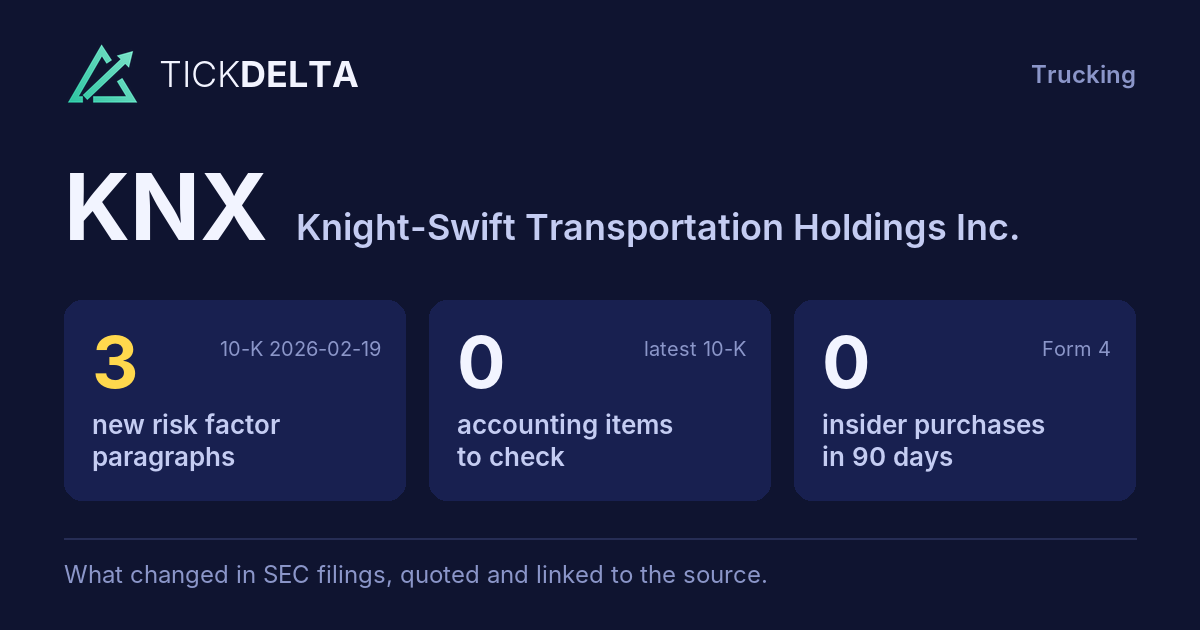
of the text changed · 9,344 words now · 3 new paragraphs, 3 gone
MD&A
15.0%
of the text changed · 12,523 words now · 12 new paragraphs, 12 gone
Legal Proceedings
4.7%
of the text changed · 677 words now
Accounting Policies
2.6%
of the text changed · 4,296 words now
10-K 0001492691-26-000016 (Feb 19, 2026) vs 10-K 0001492691-25-000013 (Feb 20, 2025)
Every paragraph, and how much of it changed
One bar per paragraph, in the order of the 10-K. Height and colour show the share of its words not in the closest paragraph a year earlier; the tallest bars are new paragraphs.
Risk Factors
149 paragraphs · 3 new · 30 reworded · 3 gone · 10-K Feb 19, 2026 against Feb 20, 2025
New paragraph
Reworded (5% of its words or more)
Same or nearly
Paragraph 97 · 38% changed
Every version of it
In addition, tractors and trailers used in our full truckload and LTL operations are affected by laws and regulations related to air emissions and fuel efficiency. Governmental agencies continue to enact more stringent revise laws and regulations to reduce engine regarding greenhouse gases and emissions. These When these laws and regulations are applicable to engines used in our revenue equipment. We have generally become more stringent, we have incurred and continue to incur costs related increased compliance costs. More recently, the EPA proposed to repeal certain federal regulations regarding greenhouse gases and emissions, which could lead to more states enacting similar laws, resulting in a patchwork of emission regulations, which may increase our compliance costs. Legal challenges to the implementation repeal or enactment of these more rigorous such laws and regulations. regulations at both the federal and state level could lead to uncertainty regarding our compliance which may negatively affect our results of operations. Additionally, in certain locations governments have banned or may in the future ban internal combustion engines for some types of vehicles. To the extent these bans affect our revenue equipment, we may be forced to incur substantial expense to retrofit existing engines or make capital expenditures to update our fleet. As a result, our business, results of operations, and financial condition could be negatively affected.
Paragraph 23 · 34% changed
Every version of it
Paragraph 115 · 31% changed
Every version of it
Paragraph 143 · 30% changed
Every version of it
We have goodwill and indefinite-lived intangible assets on our balance sheet, which have increased since due to our U.S. Xpress and DHE history of acquisitions. Given our history of acquisitions and growth objectives, which may include future acquisitions, our goodwill and intangible assets could grow. We periodically evaluate our goodwill and indefinite-lived intangible assets for impairment. In 2025 we recognized impairments in tradenames of $28.8 million associated with the rebranding of the MME and DHE brands of our LTL business under the AAA Cooper brand. Additionally, in 2025 we recognized impairments of $43.0 million associated with the decision to cease the operations of our Abilene truckload brand and combine the operations into our Swift business, much of which was related to goodwill and other intangible assets. We could recognize other impairments in the future, and we may never realize the full value of our intangible assets. If these events occur, our profitability and financial condition will suffer.
Paragraph 114 · 29% changed
Every version of it
Recently, trucking companies, including us, have been subject to lawsuits, including class action lawsuits, alleging violations of various federal and state wage and hour laws regarding, among other things, employee meal breaks, rest periods, overtime eligibility, and failure to pay for all hours worked. A number of these lawsuits have resulted in the payment of substantial settlements or damages by the defendants.
Paragraph 118 · 22% changed
Every version of it
Paragraph 66 · 21% changed
Every version of it
Difficulty in attracting and retaining sufficient numbers of qualified driving associates, independent contractors, and third-party capacity providers could have a materially adverse effect on our growth and profitability. The truckload and LTL transportation industries are subject to a shortage of qualified driving associates. Such shortage is exacerbated during periods of economic expansion, in which there may be alternative employment opportunities, or during periods of economic downturns, in which unemployment benefits might be extended and financing is limited for independent contractors who seek to purchase equipment or for students who seek financial aid for driving school. Furthermore, increased scrutiny of accreditation of driving schools and limitations on capacity at driving schools may be limited by resulting from future outbreaks of contagious diseases and any governmental imposed lockdown or other attempts to reduce the spread of such an outbreak outbreak, may reduce the pool of potential drivers available to us. Regulatory requirements could further reduce the number of eligible driving associates. associates, including the DOT guidelines issued in 2025 strengthening enforcement of the FMCSA’s longstanding English-language proficiency requirements for commercial drivers. Further, the FMCSA issued an interim rule in 2025 revising the requirements for the issuance or renewal of CDLs to non-domiciled persons and restricting the issuance or renewal of a CDL for non-domiciled persons without a lawful immigration status or legitimate employment-based reason to hold a CDL. While the interim rule has been challenged and enforcement has been temporarily stayed by a federal appeals court while it reviews the legality of the interim rule, it remains uncertain whether there will be further changes to the interim rule in response to such challenges or whether it will go into effect as originally issued. We believe our employee screening process, which includes background checks and hair follicle drug testing, is more rigorous than generally employed in our industry and has decreased the pool of qualified applicants available to us. Our inability to engage a sufficient number of driving associates and independent contractors may negatively affect our operations.
Paragraph 99 · 43% changed
Every version of it
10-K Feb 20, 2025If the independent contractors we contract with were ever re-classified as employees, the magnitude of this risk would increase. "Industry Regulation" in Part I, Item 1 of this Annual Report, provides discussion of labor and employment laws applicable to our business and operations.
10-K Feb 19, 2026
position and have a negative impact on our stock price and reputation. "Environmental Regulation" in Part I, Item 1 of this Annual Report, provides a discussion of the environmental laws and regulations applicable to our business and operations.
Paragraph 97 · 38% changed
Every version of it
10-K Feb 20, 2025
In addition, tractors and trailers used in our full truckload and LTL operations are affected by laws and regulations related to air emissions and fuel efficiency. Governmental agencies continue to enact more stringent laws and regulations to reduce engine emissions. These laws and regulations are applicable to engines used in our revenue equipment. We have incurred and continue to incur costs related to the implementation of these more rigorous laws and regulations. Additionally, in certain locations governments have banned or may in the future ban internal combustion engines for some types of vehicles. To the extent these bans affect our revenue equipment, we may be
10-K Feb 19, 2026
In addition, tractors and trailers used in our full truckload and LTL operations are affected by laws and regulations related to air emissions and fuel efficiency. Governmental agencies continue to revise laws and regulations regarding greenhouse gases and emissions. When these laws and regulations have generally become more stringent, we have incurred and continue to incur increased compliance costs. More recently, the EPA proposed to repeal certain federal regulations regarding greenhouse gases and emissions, which could lead to more states enacting similar laws, resulting in a patchwork of emission regulations, which may increase our compliance costs. Legal challenges to the repeal or enactment of such laws and regulations at both the federal and state level could lead to uncertainty regarding our compliance which may negatively affect our results of operations. Additionally, in certain locations governments have banned or may in the future ban internal combustion engines for some types of vehicles. To the extent these bans affect our revenue equipment, we may be forced to incur substantial expense to retrofit existing engines or make capital expenditures to update our fleet. As a result, our business, results of operations, and financial condition could be negatively affected.
Paragraph 23 · 34% changed
Every version of it
10-K Feb 20, 2025Our full truckload and LTL operations are dependent upon diesel fuel, and accordingly, significant increases in diesel fuel costs or decreases in availability of fuel could materially and adversely affect our results of operations and financial condition if we are unable to pass increased costs on to customers through rate increases or fuel surcharges.
10-K Feb 19, 2026
and financial condition if we are unable to pass increased costs on to customers through rate increases or fuel surcharges.
Paragraph 115 · 31% changed
Every version of it
10-K Feb 20, 2025Recently, trucking companies, including us, have been subject to lawsuits, including class action lawsuits, alleging violations of various federal and state wage and hour laws regarding, among other things, employee meal breaks, rest periods, overtime eligibility, and failure to pay for all hours worked. A number of these lawsuits have resulted in the payment of substantial settlements or damages by the defendants.
10-K Feb 19, 2026
rest periods, overtime eligibility, and failure to pay for all hours worked. A number of these lawsuits have resulted in the payment of substantial settlements or damages by the defendants.
Paragraph 143 · 30% changed
Every version of it
10-K Feb 20, 2025
We have goodwill and indefinite-lived intangible assets on our balance sheet, which have increased since our U.S. Xpress and DHE acquisitions. Given our history of acquisitions and growth objectives, our goodwill and intangible assets could grow. We periodically evaluate our goodwill and indefinite-lived intangible assets for impairment. We could recognize impairments in the future, and we may never realize the full value of our intangible assets. If these events occur, our profitability and financial condition will suffer.
10-K Feb 19, 2026
We have goodwill and indefinite-lived intangible assets on our balance sheet, which have increased due to our history of acquisitions. Given our growth objectives, which may include future acquisitions, our goodwill and intangible assets could grow. We periodically evaluate our goodwill and indefinite-lived intangible assets for impairment. In 2025 we recognized impairments in tradenames of $28.8 million associated with the rebranding of the MME and DHE brands of our LTL business under the AAA Cooper brand. Additionally, in 2025 we recognized impairments of $43.0 million associated with the decision to cease the operations of our Abilene truckload brand and combine the operations into our Swift business, much of which was related to goodwill and other intangible assets. We could recognize other impairments in the future, and we may never realize the full value of our intangible assets. If these events occur, our profitability and financial condition will suffer.
Paragraph 114 · 29% changed
Every version of it
10-K Feb 20, 2025
Recently, trucking companies, including us, have been subject to lawsuits, including class action lawsuits, alleging violations of various federal and state wage and hour laws regarding, among other things, employee meal breaks, rest periods, overtime eligibility, and failure to pay for all hours worked. A number of these lawsuits have resulted in the payment of substantial settlements or damages by the defendants.
10-K Feb 19, 2026
Recently, trucking companies, including us, have been subject to lawsuits, including class action lawsuits, alleging violations of various federal and state wage and hour laws regarding, among other things, employee meal breaks,
Paragraph 118 · 22% changed
Every version of it
10-K Feb 20, 2025Recently, the Trump administration has stated its intention to impose new or increased tariff rates on imported goods from a number of countries, including China, Canada, Mexico, and the E.U. The imposition of additional tariffs or quotas or changes to certain trade agreements, or retaliatory trade policies could, among other things, increase the costs of the materials used by our suppliers to produce new revenue equipment, limit the availability of new revenue equipment, or increase the price of fuel. Such cost increases for our revenue equipment suppliers would likely be passed on to us, and to the extent fuel prices increase, we may not be able to fully recover such increases through rate increases or our fuel surcharge program, either of which could have an adverse effect on our business.
10-K Feb 19, 2026
Since April 2025, new, substantial tariffs have been imposed on imports to the United States. The imposition of additional tariffs, import or export controls, or changes to certain trade agreements, or retaliatory trade policies could, among other things, increase the costs of the materials used by our suppliers to produce new revenue equipment, limit the availability of new revenue equipment, or increase the price of fuel. Such cost increases for our revenue equipment suppliers would likely be passed on to us, and to the extent fuel prices increase, we may not be able to fully recover such increases through rate increases or our fuel surcharge program, either of which could have an adverse effect on our business.
Paragraph 66 · 21% changed
Every version of it
10-K Feb 20, 2025
Difficulty in attracting and retaining sufficient numbers of qualified driving associates, independent contractors, and third-party capacity providers could have a materially adverse effect on our growth and profitability. The truckload and LTL transportation industries are subject to a shortage of qualified driving associates. Such shortage is exacerbated during periods of economic expansion, in which there may be alternative employment opportunities, or during periods of economic downturns, in which unemployment benefits might be extended and financing is limited for independent contractors who seek to purchase equipment or for students who seek financial aid for driving school. Furthermore, capacity at driving schools may be limited by future outbreaks of contagious diseases and any governmental imposed lockdown or other attempts to reduce the spread of such an outbreak may reduce the pool of potential drivers available to us. Regulatory requirements could further reduce the number of eligible driving associates. We believe our employee screening process, which includes background checks and hair follicle drug testing, is more rigorous than generally employed in our industry and has decreased the pool of qualified applicants available to us. Our inability to engage a sufficient number of driving associates and independent contractors may negatively affect our operations.
10-K Feb 19, 2026
Difficulty in attracting and retaining sufficient numbers of qualified driving associates, independent contractors, and third-party capacity providers could have a materially adverse effect on our growth and profitability. The truckload and LTL transportation industries are subject to a shortage of qualified driving associates. Such shortage is exacerbated during periods of economic expansion, in which there may be alternative employment opportunities, or during periods of economic downturns, in which unemployment benefits might be extended and financing is limited for independent contractors who seek to purchase equipment or for students who seek financial aid for driving school. Furthermore, increased scrutiny of accreditation of driving schools and limitations on capacity at driving schools resulting from future outbreaks of contagious diseases and any governmental imposed lockdown or other attempts to reduce the spread of such an outbreak, may reduce the pool of potential drivers available to us. Regulatory requirements could further reduce the number of eligible driving associates, including the DOT guidelines issued in 2025 strengthening enforcement of the FMCSA’s longstanding English-language proficiency requirements for commercial drivers. Further, the FMCSA issued an interim rule in 2025 revising the requirements for the issuance or renewal of CDLs to non-domiciled persons and restricting the issuance or renewal of a CDL for non-domiciled persons without a lawful immigration status or legitimate employment-based reason to hold a CDL. While the interim rule has been challenged and enforcement has been temporarily stayed by a federal appeals court while it reviews the legality of the interim rule, it remains uncertain whether there will be further changes to the interim rule in response to such challenges or whether it will go into effect as originally issued. We believe our employee screening process, which includes background checks and hair follicle drug testing, is more rigorous than generally employed in our industry and has decreased the pool of qualified applicants available to us. Our inability to engage a sufficient number of driving associates and independent contractors may negatively affect our operations.
MD&A
238 paragraphs · 12 new · 71 reworded · 12 gone · 10-K Feb 19, 2026 against Feb 20, 2025
New paragraph
Reworded (5% of its words or more)
Same or nearly
Paragraph 93 · 50% changed
Paragraph 63 · 50% changed
During 2024, 2025, we opened 37 additional 16 new service centers and added 14 more facilities through the DHE Acquisition centers, four of which replaced larger sites, bringing our year-over-year growth in door count to 10.0% for 2025. As previously noted, we expect our pace of facility expansion will be slower in the third quarter. Overall, our organic near term and inorganic expansion activities in 2024 added approximately 1,430 doors, representing over 30% growth in our door count from the beginning of the year. We believe this meaningfully impacts the reach of our service offering ongoing bid events with new and ultimately existing customers will increase the density of our network. We believe the investments in our network during 2024 bring provide further opportunities to service additional freight and customers, though the associated set-up costs and initial operational inefficiencies are near-term headwinds to improving margins. Our focus for 2025 will be to grow shipment volumes at these locations, particularly as they participate in the bid cycle, which we expect will help volume and improve efficiencies. Our near-term focus is to drive both revenue and margin expansion in the business. While we currently anticipate that our pace of facility additions will slow in 2025, we business through strong service, disciplined pricing, and cost efficiency. We continue to look for both organic and inorganic opportunities to geographically expand our footprint within the LTL market.
Paragraph 66 · 49% changed
Paragraph 11 · 48% changed
•Liquidity and Capital — During 2024, 2025, we generated $799.1 million $1.3 billion in operating cash flows. Our Free Cash Flow1 was $233.8 $763.2 million. We Note that operating cash flows for 2025 were increased by $478.2 million in sales proceeds funded under the new accounts receivable securitization program upon its closing on December 31, 2025, as further discussed below. From a financing perspective, during 2025 we paid down $140.2 $380 million in long-term debt, $134.8 of outstanding term loan balances, $147.5 million in finance lease liabilities, and $175.9 $161.6 million on our operating lease liabilities. We obtained financing Additionally, we had $65.2 million of $150.0 million in new long-term debt and $165.0 million from net borrowings on our revolving lines 2025 Revolver and prior accounts receivable securitization after giving effect for the $478.2 million payoff and termination of credit. In 2024, we issued $104.2 million in dividends to our stockholders. Gain the prior accounts receivable securitization agreement on sale of property and equipment decreased to $34.4 million in 2024, compared to $64.7 million in 2023. December 31, 2025, as discussed below.
Paragraph 51 · 47% changed
4Average trailers includes 8,985 9,671 and 8,724 8,769 trailers from our All Other Segments for 2024 2025 and 2023, 2024, respectively. Starting with the fourth quarter of 2025, the Company is excluding its chassis trailers from its average trailer calculation. Prior period information has been recast for comparability.
Paragraph 99 · 45% changed
Paragraph 96 · 42% changed
2025 Compared to 2024 2023 2024 vs. 2023 (Dollars in thousands) Increase (decrease) — Communications $ 31,152 $ 29,661 5.0 % % expense as a percentage of total revenue 0.4 % 0.4 % — bps % of and revenue, excluding truckload and LTL fuel surcharge 0.5 % 0.5 % — bps remained relatively flat for 2025, as compared to 2024.
Paragraph 30 · 40% changed
Paragraph 93 · 50% changed
10-K Feb 20, 2025•Contributor — $31.5 million decrease in operating income from our LTL segment as a result of increased costs related to expanding our LTL service area and a 4.1% decrease in weight per shipment.
10-K Feb 19, 2026
2025 Compared to 2024 — Operating taxes and licenses expenses increased by $7.6 million for 2025, as compared to the same periods last year, primarily as a result of expanding our LTL network.
Paragraph 63 · 50% changed
10-K Feb 20, 2025
During 2024, we opened 37 additional service centers and added 14 more facilities through the DHE Acquisition in the third quarter. Overall, our organic and inorganic expansion activities in 2024 added approximately 1,430 doors, representing over 30% growth in our door count from the beginning of the year. We believe this meaningfully impacts the reach of our service offering and ultimately will increase the density of our network. We believe the investments in our network during 2024 bring opportunities to service additional freight and customers, though the associated set-up costs and initial operational inefficiencies are near-term headwinds to improving margins. Our focus for 2025 will be to grow shipment volumes at these locations, particularly as they participate in the bid cycle, which we expect will help drive both revenue and margin expansion in the business. While we currently anticipate that our pace of facility additions will slow in 2025, we continue to look for both organic and inorganic opportunities to geographically expand our footprint within the LTL market.
10-K Feb 19, 2026
During 2025, we opened 16 new service centers, four of which replaced larger sites, bringing our year-over-year growth in door count to 10.0% for 2025. As previously noted, we expect our pace of facility expansion will be slower in the near term and believe ongoing bid events with new and existing customers will provide further opportunities to grow shipment volume and improve efficiencies. Our near-term focus is to drive both revenue and margin expansion in the business through strong service, disciplined pricing, and cost efficiency. We continue to look for both organic and inorganic opportunities to geographically expand our footprint within the LTL market.
Paragraph 66 · 49% changed
10-K Feb 20, 20252024 Compared to 2023 — Our Truckload segment revenue, excluding fuel surcharge and intersegment transactions, increased 9.4 % year-over-year, driven by a 13.6% increase in loaded miles. Revenue per loaded mile, excluding fuel surcharge and intersegment transactions, declined 3.8% year-over-year. The 2024 Adjusted Operating Ratio increased 340 basis points year-over-year to 95.6%.
10-K Feb 19, 2026
2025 Compared to 2024 — Logistics Adjusted Operating Ratio was 95.1%, with gross margin remaining flat at 17.5% in 2025, compared to 2024. Revenue increased 0.1% year-over-year, driven by a 4.7% increase in revenue per load and partially offset by a 4.6% decrease in load count.
Paragraph 11 · 48% changed
10-K Feb 20, 2025
•Liquidity and Capital — During 2024, we generated $799.1 million in operating cash flows. Our Free Cash Flow1 was $233.8 million. We paid down $140.2 million in long-term debt, $134.8 million in finance lease liabilities, and $175.9 million on our operating lease liabilities. We obtained financing of $150.0 million in new long-term debt and $165.0 million from net borrowings on our revolving lines of credit. In 2024, we issued $104.2 million in dividends to our stockholders. Gain on sale of property and equipment decreased to $34.4 million in 2024, compared to $64.7 million in 2023.
10-K Feb 19, 2026
•Liquidity and Capital — During 2025, we generated $1.3 billion in operating cash flows. Our Free Cash Flow1 was $763.2 million. Note that operating cash flows for 2025 were increased by $478.2 million in sales proceeds funded under the new accounts receivable securitization program upon its closing on December 31, 2025, as further discussed below. From a financing perspective, during 2025 we paid down $380 million of outstanding term loan balances, $147.5 million in finance lease liabilities, and $161.6 million on operating lease liabilities. Additionally, we had $65.2 million of net borrowings on our 2025 Revolver and prior accounts receivable securitization after giving effect for the $478.2 million payoff and termination of the prior accounts receivable securitization agreement on December 31, 2025, as discussed below.
Paragraph 51 · 47% changed
10-K Feb 20, 2025
4Average trailers includes 8,985 and 8,724 trailers from our All Other Segments for 2024 and 2023, respectively.
10-K Feb 19, 2026
4Average trailers includes 9,671 and 8,769 trailers from our All Other Segments for 2025 and 2024, respectively. Starting with the fourth quarter of 2025, the Company is excluding its chassis trailers from its average trailer calculation. Prior period information has been recast for comparability.
Paragraph 99 · 45% changed
10-K Feb 20, 20252024 Compared to 2023 — The increase in consolidated depreciation and amortization of property and equipment includes a $65.7 million increase of expense as a result of including U.S. Xpress' full year expense in 2024 compared to its partial year expense in 2023 following the U.S. Xpress Acquisition in July 2023. This was partially offset by a decrease in tractor and trailer depreciation as a result of the decrease in the tractor and trailer counts for our legacy business, excluding U.S. Xpress.
10-K Feb 19, 2026
2025 Compared to 2024 — The decrease in consolidated depreciation and amortization is primarily due to the decrease in tractor and trailer counts in our Truckload segment, partially offset by an increase in equipment counts for our LTL segment.
Paragraph 96 · 42% changed
10-K Feb 20, 2025
2024 2023 2024 vs. 2023 (Dollars in thousands) Increase (decrease) Communications $ 31,152 $ 29,661 5.0 % % of total revenue 0.4 % 0.4 % — bps % of revenue, excluding truckload and LTL fuel surcharge 0.5 % 0.5 % — bps
10-K Feb 19, 2026
2025 Compared to 2024 — Communications expense as a percentage of total revenue and revenue, excluding truckload and LTL fuel surcharge remained relatively flat for 2025, as compared to 2024.
Paragraph 30 · 40% changed
10-K Feb 20, 2025•Contributor — $49.1 million increase in net interest expense primarily due to an increase in interest rates and increase in outstanding borrowings.
10-K Feb 19, 2026
•Offset — $3.7 million decrease in net interest expense primarily due to a decrease in interest rates, partially offset by higher average borrowings.
A paragraph is matched with the one last year that shares the most of its words; under half in common makes it new. The paragraphs shown are the 8 reworded the most in each section.
The paragraph that changed most in each section
The redline
Marked against last year's 10-K: cut words struck through, new words highlighted.
MD&A184 words changed in this paragraph; it is 32% similar to last year's version.
During 2024, 2025, we opened 37 additional 16 new service centers and added 14 more facilities through the DHE Acquisition centers, four of which replaced larger sites, bringing our year-over-year growth in door count to 10.0% for 2025. As previously noted, we expect our pace of facility expansion will be slower in the third quarter. Overall, our organic near term and inorganic expansion activities in 2024 added approximately 1,430 doors, representing over 30% growth in our door count from the beginning of the year. We believe this meaningfully impacts the reach of our service offering ongoing bid events with new and ultimately existing customers will increase the density of our network. We believe the investments in our network during 2024 bring provide further opportunities to service additional freight and customers, though the associated set-up costs and initial operational inefficiencies are near-term headwinds to improving margins. Our focus for 2025 will be to grow shipment volumes at these locations, particularly as they participate in the bid cycle, which we expect will help volume and improve efficiencies. Our near-term focus is to drive both revenue and margin expansion in the business. While we currently anticipate that our pace of facility additions will slow in 2025, we business through strong service, disciplined pricing, and cost efficiency. We continue to look for both organic and inorganic opportunities to geographically expand our footprint within the LTL market.
Source: Item 7, 10-K 0001492691-26-000016 vs Item 7, 10-K 0001492691-25-000013
Risk Factors141 words changed in this paragraph; it is 73% similar to last year's version.
Difficulty in attracting and retaining sufficient numbers of qualified driving associates, independent contractors, and third-party capacity providers could have a materially adverse effect on our growth and profitability. The truckload and LTL transportation industries are subject to a shortage of qualified driving associates. Such shortage is exacerbated during periods of economic expansion, in which there may be alternative employment opportunities, or during periods of economic downturns, in which unemployment benefits might be extended and financing is limited for independent contractors who seek to purchase equipment or for students who seek financial aid for driving school. Furthermore, increased scrutiny of accreditation of driving schools and limitations on capacity at driving schools may be limited by resulting from future outbreaks of contagious diseases and any governmental imposed lockdown or other attempts to reduce the spread of such an outbreak outbreak, may reduce the pool of potential drivers available to us. Regulatory requirements could further reduce the number of eligible driving associates. associates, including the DOT guidelines issued in 2025 strengthening enforcement of the FMCSA’s longstanding English-language proficiency requirements for commercial drivers. Further, the FMCSA issued an interim rule in 2025 revising the requirements for the issuance or renewal of CDLs to non-domiciled persons and restricting the issuance or renewal of a CDL for non-domiciled persons without a lawful immigration status or legitimate employment-based reason to hold a CDL. While the interim rule has been challenged and enforcement has been temporarily stayed by a federal appeals court while it reviews the legality of the interim rule, it remains uncertain whether there will be further changes to the interim rule in response to such challenges or whether it will go into effect as originally issued. We believe our employee screening process, which includes background checks and hair follicle drug testing, is more rigorous than generally employed in our industry and has decreased the pool of qualified applicants available to us. Our inability to engage a sufficient number of driving associates and independent contractors may negatively affect our operations.
Source: Item 1A, 10-K 0001492691-26-000016 vs Item 1A, 10-K 0001492691-25-000013
Accounting Policies32 words changed in this paragraph; it is 90% similar to last year's version.
Unrecognized tax benefits are defined as the difference between a tax position taken or expected to be taken in a tax return and the benefit recognized and measured pursuant to ASC 740, Income Taxes. The Company does not recognize a tax benefit for uncertain tax positions unless it concludes that it is more likely than not that the benefit will be sustained on audit (including resolutions of any related appeals or litigation processes) by the taxing authority, based solely on the technical merits of the associated tax position. If the recognition threshold is met, the Company recognizes a tax benefit measured at the largest amount of the tax benefit that, in management's judgment, is greater than 50% likely to be realized. The Company records expected incurred interest and penalties related to unrecognized tax positions in "Income tax expense" in the consolidated statements of comprehensive income. To the extent interest and penalties are not assessed with respect to uncertain tax positions, amounts accrued will be reduced and reflected as a reduction of the overall income tax provision.
Source: Item 8, Note 2 – Summary of Significant Accounting Policies, 10-K 0001492691-26-000016 vs Item 8, Note 2 – Summary of Significant Accounting Policies, 10-K 0001492691-25-000013
Legal Proceedings32 words changed in this paragraph; it is 86% similar to last year's version.
Based on management's present knowledge of the facts and, in certain cases, advice of outside counsel, management believes the resolution of open claims and pending litigation, taking into account existing reserves, is not likely to have a materially adverse impact on our overall financial position, operating results, or cash flows. However, there are inherent uncertainties in these legal matters, some of which are beyond management's control, making the ultimate outcomes difficult to predict. Moreover, management's views and estimates related to these matters may change in the future, as new events and circumstances arise and the matters continue to develop. The Company's financial position, cash flows or results of operations could be materially affected in any particular period by future claims or the adverse development or ultimate resolution of one or more of these contingencies.
Source: Item 3, via Note 17 – Contingencies and Legal Proceedings, 10-K 0001492691-26-000016 vs Item 3, via Note 17 – Contingencies and Legal Proceedings, 10-K 0001492691-25-000013
Sentences and paragraphs added, removed or reworded
Every change, by type
Sentences and paragraphs of KNX's Risk Factors and MD&A, 10-K Feb 19, 2026 against 10-K Feb 20, 2025. Each links to the text at sec.gov.
Quiet changes are sentences kept from last year with one to four words changed, at least one of them a hedge, a modal or a qualifier (may, could, will, not, significant, material…). A year or date rolling forward is not counted.
The full word list
adverse, adversely, all, although, anticipate, anticipates, any, approximately, believe, believes, can, cannot, certain, could, expect, expects, generally, however, if, intend, intends, largely, likely, many, material, materially, may, might, most, must, never, no, not, possible, primarily, probable, should, significant, significantly, some, substantial, substantially, unlikely, will, would
AddedRisk Factors
could create cargo claims, and could reduce the reliability, timeliness, efficiency, and overall attractiveness of our rail-based intermodal services.
Read it in 10-K Feb 19, 2026 at sec.gov
AddedRisk Factors
Additionally, a portion of the freight we deliver is imported to the U.S. through ports of call where workers are represented by labor unions. Ports have long been the primary gateways for cargo coming into and leaving the U.S. and have a long history of labor and other port disputes, protracted collective bargaining, and contract negotiations which, in the past, have involved closures, as well as threats of a strike that would have disrupted domestic supply chains. There can be no guarantee that work stoppages or further disruptions at ports will not occur.
Read it in 10-K Feb 19, 2026 at sec.gov
AddedRisk Factors
Our effective tax rate may be adversely impacted by changes in tax laws in jurisdictions where we operate. The OBBBA was signed into law in 2025. The OBBBA makes permanent key elements of the Tax Cuts and Jobs Act, including 100% bonus depreciation and the business interest expense limitation. Although we do not expect the OBBBA to have a negative effect on our financial position, results of operations, and cash flows, until certain regulations are promulgated, we may not know the full extent of the OBBBA’s effects on our financial results and financial position. Additionally, President Trump has indicated a desire to potentially amend the federal tax laws
Read it in 10-K Feb 19, 2026 at sec.gov
RemovedRisk Factors
RemovedRisk Factors
RemovedRisk Factors
RewordedRisk Factors
RewordedRisk Factors
Although we do not have any direct operations in Russia, Belarus, Ukraine, outside of the Middle East, China, or Taiwan, US and Mexico, we may be affected by the broader consequences of such conflicts or their expansion to other areas or countries or similar conflicts elsewhere, global conflicts, such as increased inflation, supply chain issues, including shortages of new revenue equipment, access to parts for our revenue equipment, embargoes, tariffs, import or export controls, geopolitical shift, access to or increased prices for diesel fuel, higher energy prices, potential retaliatory action by foreign governments, including cyber-attacks, and the extent of an armed conflict’s effect on the global economy.
Read it in 10-K Feb 19, 2026 at sec.gov
Show the other 47
RewordedRisk Factors
Future laws and regulations or changes to existing laws and regulations may be more stringent, require changes in our operating practices, influence the demand for transportation services, or require us to incur significant additional costs, or change the balance of supply and demand in the freight market, including an increase in supply if driver requirements are softened, which could materially adversely affect our business, financial condition, and results of operations.
Read it in 10-K Feb 19, 2026 at sec.gov
RewordedRisk Factors
RewordedRisk Factors
Regulatory requirements could further reduce the number of eligible driving associates. associates, including the DOT guidelines issued in 2025 strengthening enforcement of the FMCSA’s longstanding English-language proficiency requirements for commercial drivers.
Read it in 10-K Feb 19, 2026 at sec.gov
RewordedRisk Factors
Our full truckload and LTL operations are dependent upon diesel fuel, and accordingly, significant increases in diesel fuel costs or decreases in availability of fuel could materially and adversely affect our results of operations and financial condition if we are unable to pass increased costs on to customers through rate increases or fuel surcharges.
Read it in 10-K Feb 19, 2026 at sec.gov
RewordedRisk Factors
RewordedRisk Factors
Railroads could reduce their services in the future for various reasons, which may include work stoppages, insufficient network capacity, adverse weather conditions, accidents, or other factors, which could increase the cost of the rail-based services we provide, could create cargo claims, and could reduce the reliability, timeliness, efficiency, and overall attractiveness of our rail-based intermodal services.
Read it in 10-K Feb 19, 2026 at sec.gov
RewordedRisk Factors
Furthermore, increased scrutiny of accreditation of driving schools and limitations on capacity at driving schools may be limited by resulting from future outbreaks of contagious diseases and any governmental imposed lockdown or other attempts to reduce the spread of such an outbreak outbreak, may reduce the pool of potential drivers available to us.
Read it in 10-K Feb 19, 2026 at sec.gov
RewordedRisk Factors
To the extent these bans affect our revenue equipment, we may be forced to incur substantial expense to retrofit existing engines or make capital expenditures to update our fleet.
Read it in 10-K Feb 19, 2026 at sec.gov
RewordedRisk Factors
Although we carry insurance to help protect us from losses due to an interruption of our systems, there is no guarantee such an interruption will fall within the coverage limits of our insurance.
Read it in 10-K Feb 19, 2026 at sec.gov
RewordedRisk Factors
Companies have recently faced attention from stakeholders relating to ESG environmental and societal matters, including environmental stewardship, stewardship and social responsibility, and diversity and inclusion. responsibility.
Read it in 10-K Feb 19, 2026 at sec.gov
Quiet changesRisk Factors
AddedMD&A
On December 31, 2025, the Company entered into a new $575 million accounts receivable securitization facility via the Receivables Purchase Agreement (the "2025 RPA"), replacing the Company's previous $575 million securitization facility first entered into in 2013, as amended and restated through October 2025 (the "2025 RSA"). Replacing the 2025 RSA, which was treated as a financing secured by receivables, with the 2025 RPA, which is treated as a sale of receivables, has the effect of removing the subject receivables and the former secured borrowing from the Company's balance sheet beginning December 31, 2025 and is expected to reduce expenses on a go-forward basis. Note that the payoff and termination of the prior debt facility with the sales proceeds under the new sales arrangement on December 31, 2025 had the effect of increasing operating cash flow for 2025 by the amount of the $478.2 million proceeds at closing, while the payoff of the prior debt facility is a cash outflow for financing activities and reduces the net borrowings from working capital facilities for 2025 by the same amount. Going forward, we would expect less pronounced impacts to the cash flow statement from this program as ongoing changes in the size of the pool of receivables in the ordinary course of business are expected to be less than the initial proceeds funded at closing for the outstanding pool of receivables.
Read it in 10-K Feb 19, 2026 at sec.gov
AddedMD&A
•Contributor — $21.1 million decrease in operating income within our Truckload segment, primarily due to $52.9 million in non-cash impairments of goodwill and intangible assets associated with Abilene as a result of the decision to cease its separate operations and combine it into our Swift business and certain revenue equipment as well as owned and lease real property. This was partially offset by a 3.3% increase in our average revenue per tractor.
Read it in 10-K Feb 19, 2026 at sec.gov
AddedMD&A
During the fourth quarter, we made the decision to combine the Abilene trucking operations into our Swift business to improve efficiency and enhance productivity. We continue to make tangible progress improving our cost structure and implementing technology-driven initiatives to offset inflationary pressures and which we believe will position our business to generate meaningful returns as market conditions recover.
Read it in 10-K Feb 19, 2026 at sec.gov
AddedMD&A
During 2025, we decided to adopt the strong and historically significant AAA Cooper brand across our entire LTL business, effective as of January 1, 2026. The consolidated branding recognizes that we are already one business, operating seamlessly on one system through one network to present a cohesive solution to our customers, while simplifying administration and communication.
Read it in 10-K Feb 19, 2026 at sec.gov
AddedMD&A
We remain focused on delivering excellent service and driving appropriate returns through cost control, network balance, equipment utilization, and growing our load count with disciplined pricing.
Read it in 10-K Feb 19, 2026 at sec.gov
AddedMD&A
Operations and maintenance expense remained relatively flat for 2025, as compared to 2024.
Read it in 10-K Feb 19, 2026 at sec.gov
AddedMD&A
2025 Compared to 2024 — Consolidated insurance and claims expense decreased primarily due to the Company exiting the third-party insurance business at the end of the first quarter of 2024. Additionally, the decrease was due to a 1.0% decrease in total miles driven year-over-year, improvements within our current year experience as a result of lower frequency and severity of claims, and positive development within certain prior year losses.
Read it in 10-K Feb 19, 2026 at sec.gov
AddedMD&A
Depreciation and amortization of property and equipment $ 711,069 $ 717,522 (0.9 %)
Read it in 10-K Feb 19, 2026 at sec.gov
AddedMD&A
2025 Compared to 2024 — In 2025, we incurred impairment charges related to goodwill and intangible assets associated with Abilene as a result of the decision to cease its operations and combine it into our Swift business, tradenames associated with the decision to rebrand the MME and DHE brands of our LTL businesses under the AAA Cooper brand (within the LTL segment), certain discontinued software projects (within the Intermodal Segment), and certain revenue equipment as well as owned and lease real property (within the Truckload Segment).
Read it in 10-K Feb 19, 2026 at sec.gov
AddedMD&A
•Fourth quarter 2025 impairments reflects the non-cash impairments of goodwill and intangible assets associated with Abilene as a result of the decision to cease its operations and combine it into our Swift business and certain revenue equipment as well as owned and lease real property (within the Truckload Segment). Third quarter 2025 impairments reflect the non-cash impairments of tradenames associated with the decision to rebrand the MME and DHE brands of our LTL businesses under the AAA Cooper brand (within the LTL segment), as well as certain discontinued software projects (within the Intermodal Segment), and certain real property leases (within the Truckload Segment). Second quarter 2025 impairments reflects non-cash impairments related to certain real property owned and leased (within the Truckload Segment). First quarter 2025 reflects non-cash impairments related to certain real property leases (within the Truckload segment).
Read it in 10-K Feb 19, 2026 at sec.gov
AddedMD&A
8"Write-off of deferred debt issuance costs" was incurred from replacing the 2021 Debt Agreement and 2023 Debt Agreement with the 2025 Debt Agreement, as well as replacing the 2025 RSA with the 2025 RPA.
Read it in 10-K Feb 19, 2026 at sec.gov
AddedMD&A
with Abilene would be zero. As a result, the Company recorded a non-cash impairment of $27.4 million related to Abilene's goodwill.
Read it in 10-K Feb 19, 2026 at sec.gov
RemovedMD&A
RemovedMD&A
RemovedMD&A
RemovedMD&A
RemovedMD&A
RemovedMD&A
RemovedMD&A
RemovedMD&A
RemovedMD&A
RemovedMD&A
RemovedMD&A
RemovedMD&A
RewordedMD&A
Income tax expense attributable to Knight-Swift 29,768 32,960 54,768 Income before income taxes attributable to Knight-Swift 95,714 150,586 271,917 Amortization of intangibles 1 78,229 75,945 70,138 Impairments 2 98,308 19,012 2,236 Legal accruals 3 1,241 2,560 7,694 Transaction fees 4 — 602 6,868 Other acquisition related expenses 5 — 7,697 Severance expense 6 5 3,005 7,219 5,151 Change in fair value of deferred earnout 7 6 — (859) (3,359) Loss on investment 7 — 12,107 Write-off of deferred debt issuance costs 8 12,107 2,860 — USX mark to market adjustment 9 — (36,617) — Adjusted income before income taxes 279,357 230,555 368,342 Provision for income tax expense at effective rate 10 (74,619) (58,470) (89,603) Non-GAAP:
Read it in 10-K Feb 19, 2026 at sec.gov
RewordedMD&A
Income tax expense (benefit) attributable to Knight-Swift 0.18 0.20 0.34 Income before income taxes attributable to Knight-Swift 0.59 0.93 1.68 Amortization of intangibles 1 0.48 0.47 0.43 Impairments 2 0.61 0.12 0.01 Legal accruals 3 0.01 0.02 0.05 Transaction fees 4 — 0.04 Other acquisition related expenses 5 — 0.05 Severance expense 6 5 0.02 0.04 0.03 Change in fair value of deferred earnout 7 6 — (0.01) (0.02) Loss on investment 7 — 0.07 Write-off of deferred debt issuance costs 8 0.07 0.02 — USX mark to market adjustment 9 — (0.23) — Adjusted income before income taxes 1.72 1.42 2.28 Provision for income tax expense at effective rate 10 (0.46) (0.36) (0.55) Non-GAAP:
Read it in 10-K Feb 19, 2026 at sec.gov
RewordedMD&A
Truckload and LTL fuel surcharge (777,614) (798,121) (833,597) Amortization of intangibles 1 (78,229) (75,945) (70,138) Impairments 2 (98,308) (19,012) (2,236) Legal accruals 3 (1,241) (2,560) (7,694) Transaction fees 4 — (602) (6,868) Other acquisition related expenses 5 — (7,697) Severance expense 6 5 (3,005) (7,219) (5,151) Change in fair value of deferred earnout 7 6 — 859 3,359 Adjusted Operating Expenses 6,295,230 6,264,090 5,873,591 Adjusted Operating Income $ 396,845 $ 347,867 $ 434,578 Adjusted Operating Ratio 94.1 % 94.7 % 93.1 %
Read it in 10-K Feb 19, 2026 at sec.gov
RewordedMD&A
RewordedMD&A
Letters of Credit — Pursuant to the terms of the 2021 Debt Agreement and the 2023 RSA, our Our lenders may issue standby letters of credit on our behalf. behalf, certain of which reduce availability under our revolving line of credit.
Read it in 10-K Feb 19, 2026 at sec.gov
RewordedMD&A
We had a working capital deficit of $143.7 million as of December 31, 2025 and a working capital deficit of $258.0 million as of December 31, 2024 and a working capital deficit of $116.3 million as of December 31, 2023. 2024.
Read it in 10-K Feb 19, 2026 at sec.gov
RewordedMD&A
Amount (In thousands) Cash and cash equivalents, excluding restricted cash $ 218,261 220,420 Availability under 2021 2025 Revolver, due September 2026 July 8, 2030 1 849,899 855,711 Availability under 2023 RSA, 2025 RPA, due October 2025 2, 2028 2 14,333 21,100 Total unrestricted liquidity $ 1,082,493 1,097,231 Cash and cash equivalents – restricted 3 151,969 88,320 Total liquidity, including restricted cash $ 1,234,462 1,185,551
Read it in 10-K Feb 19, 2026 at sec.gov
RewordedMD&A
RewordedMD&A
Prior to the maturity of our 2023 RSA, 2023 Term Loan, 2021 2025 Term Loans, 2021 2025 Revolver, Prudential Notes, revenue equipment installment notes, and other debt, we expect to be contractually obligated to make interest payments of approximately $19.4 $189.5 million, $27.0 $154.8 million, $115.7 $0.3 million, $7.0 million, $0.7 million, $11.1 $4.4 million and $1.4 $1.0 million, respectively.
Read it in 10-K Feb 19, 2026 at sec.gov
RewordedMD&A
This segment produced a 90.1% 93.2% Adjusted Operating Ratio in 2024, while 2025, and Adjusted Operating Income decreased 21.6% 17.0% year-over-year primarily due to start-up costs and early-stage operations at our recently opened facilities and costs related to the system integration of DHE, which was completed during the fourth quarter of 2024. DHE.
Read it in 10-K Feb 19, 2026 at sec.gov
RewordedMD&A
RewordedMD&A
Revenue per hundredweight, excluding fuel surcharge, increased 11.4%, while 7.4%, revenue per shipment, excluding fuel surcharge, increased by 6.7%, reflecting a 4.1% decrease in 6.2%, and weight per shipment. shipment decreased 1.2%.
Read it in 10-K Feb 19, 2026 at sec.gov
Sources
The two latest 10-Ks on EDGAR, section by section. Each change links to the text at sec.gov.
Also
New risk factors: paragraphs with nothing like them last year, quoted in full.
Work with it
Excel workbook · CSV. Google Sheet that stays up to date: paste =IMPORTDATA("https://tickdelta.com/company/KNX/export.csv") into a cell.