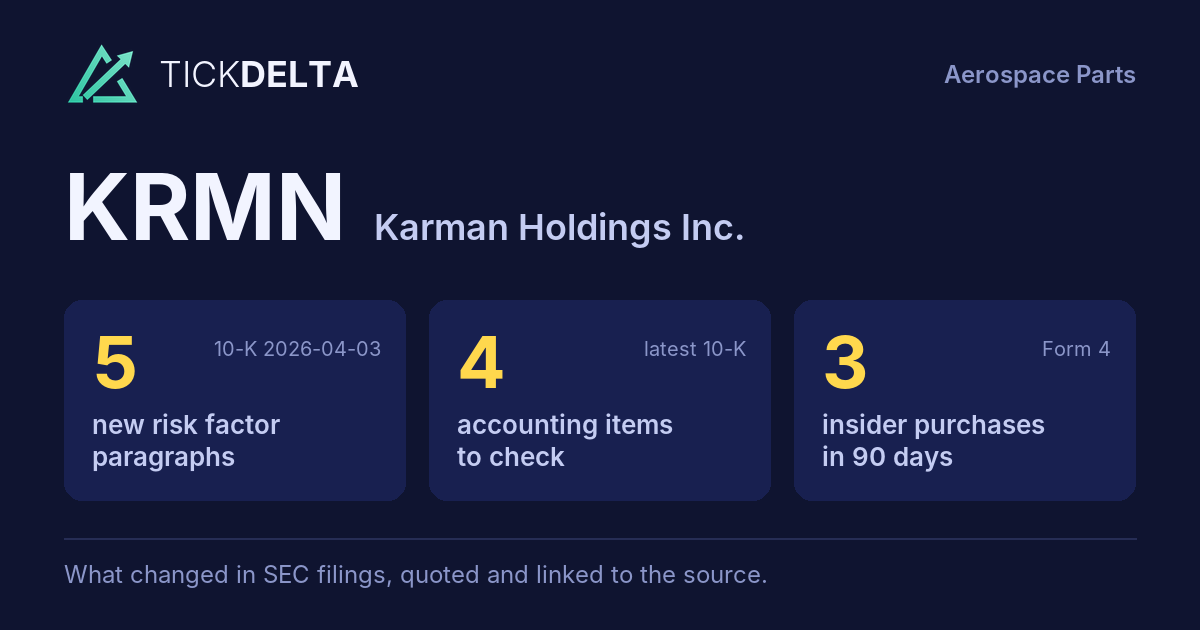
Paragraph 28 · 44% changed
Every version of it
Screener
/
SEC EDGAR
/CIK 0002040127
/10-K filed Apr 3, 2026, compared with Apr 10, 2025
/Numbers from the XBRL of the 10-Ks
NYSE
Industrials · Aerospace Parts
Karman Holdings Inc. KRMN
The 10-K against last year's
146 changes: 32 added, 57 removed, 57 reworded
10-K Apr 3, 2026 vs Apr 10, 2025
Risk Factors
9.5%
of the text changed · 20,727 words now · 5 new paragraphs, 21 gone
MD&A
40.0%
of the text changed · 8,331 words now · 27 new paragraphs, 36 gone
Legal Proceedings
0.6%
of the text changed · 268 words now
10-K 0002040127-26-000014 (Apr 3, 2026) vs 10-K 0000950170-25-052639 (Apr 10, 2025) Not compared: Accounting Policies.
Every paragraph, and how much of it changed
One bar per paragraph, in the order of the 10-K. Height and colour show the share of its words not in the closest paragraph a year earlier; the tallest bars are new paragraphs.
Risk Factors
247 paragraphs · 5 new · 44 reworded · 21 gone · 10-K Apr 3, 2026 against Apr 10, 2025
New paragraph
Reworded (5% of its words or more)
Same or nearly
Paragraph 216 · 44% changed
Every version of it
As a result of our recent IPO, as a public company, we will incur significant legal, regulatory, finance, accounting, investor relations, insurance and other expenses that we have had not incurred as a private company, including costs associated with public company reporting requirements and costs of recruiting and retaining non-executive directors. We also have incurred and will continue to incur costs associated with the Sarbanes-Oxley Act, and the Dodd-Frank Wall Street Reform and Consumer Protection Act, and related rules implemented by the SEC and the NYSE. The expenses incurred by public companies for reporting and corporate governance purposes have been increasing. We expect these rules and regulations to increase our legal and financial compliance costs and to make some activities more time-consuming and costly, although we are currently unable to estimate these costs with any degree of certainty. Our management will need to devote a substantial amount of time to ensure that we comply with all of these requirements, diverting the attention of management away from revenue-producing activities. These laws and regulations also could make it more difficult or costly for us to obtain certain types of insurance, including director and officer liability insurance, and we may be forced to accept reduced policy limits and coverage or incur substantially higher costs to obtain the same or similar coverage. These laws and regulations could also make it more difficult for us to attract and retain qualified persons to serve on our Board, our Board committees or as our executive officers. Furthermore, if we are unable to satisfy our obligations as a public company, we could be subject to delisting of our common stock, fines, sanctions, and other regulatory action and potentially civil litigation.
Paragraph 247 · 41% changed
Every version of it
Paragraph 75 · 35% changed
Every version of it
Paragraph 20 · 34% changed
Every version of it
Paragraph 148 · 32% changed
Every version of it
their share, could require us to incur material additional costs in excess of those anticipated. We may become a party to legal proceedings and disputes involving government and private parties (including individual and class actions) relating to alleged impacts from pollutants released into the environment, including bodily injury and property damage. These matters could result in material compensatory or other damages, remediation costs, penalties, non-monetary relief, and adverse allowability or insurance coverage determinations. The impact of these factors is difficult to predict, but one or more of them could harm our reputation and business and have a material adverse effect on our results of operations, prospects and financial condition.
Paragraph 187 · 32% changed
Every version of it
As of December 31, 2024, 2025, our total indebtedness, excluding approximately $3.1 $7.6 million of unamortized debt issuance costs, was approximately $362.1 $499.1 million, consisting of borrowings under our Financing Agreement with TCW Asset Management Company LLC, as amended (the “TCW Citibank N.A.(the “Citi Credit Agreement”). See Note 16 6 in the Notes to the Consolidated Financial Statements for further details on our refinancing agreement with Citibank N.A., which became effective in April, 2025 (the “Citi Credit Agreement”), which refinanced and replaced the TCW Credit Agreement. We may incur additional indebtedness in the future. For additional information related to our debt, see Note 7 in the Notes to the Consolidated Financial Statements. details.
Paragraph 181 · 25% changed
Every version of it
Paragraph 28 · 44% changed
Every version of it
10-K Apr 10, 2025Our ability to meet customers’ demands depends, in part, on our ability to obtain timely and adequate delivery of quality materials, parts and components from our suppliers. We obtain certain of our hardware components, various subsystems and systems from a limited group of suppliers, some of which are sole source suppliers. Although we hold long-term non-binding contracts with certain key suppliers that establish pricing, minimize lead times and to some degree mitigate risk, we do not have long-term agreements with all suppliers that obligate them to continue to sell components, products required to build our systems or products to us. Our reliance on suppliers without long-term non-binding contracts involves significant risks and uncertainties, including whether our suppliers will provide an adequate supply of required components or products of sufficient quality, will increase prices for the components or products and will perform their obligations on a timely basis. In addition, certain raw materials and components used in the manufacture of our products and in our development programs are periodically subject to supply shortages, and our business is subject to the risk of price increases and periodic delays in delivery. Particularly, the market for electronic components has been and currently still is experiencing increased demand and a global shortage of semiconductors, creating substantial uncertainty regarding our suppliers’ ongoing timely delivery of these components to us. Shortages in components for our products and delays in obtaining components for our products could cause customers to terminate their contracts with us, delay orders from us or cause us to delay accepting orders, negatively impact our ability to win new programs and/or contracts, negatively impact and disrupt our development programs, increase our costs and materially adversely affect our business, results of operations, prospects and financial condition. Moreover, if any of our suppliers become capacity constrained, financially unstable or otherwise unable or unwilling to provide us with raw materials or components, then we may have to find new suppliers. It may take several months to locate alternative suppliers, if required, or to redesign our products to accommodate components from different suppliers. Even if we identify alternate suppliers, we may experience significant delays in manufacturing and shipping our products to customers and incur additional development, manufacturing and other costs to establish such alternative sources, be required to redesign our products and to complete additional quality control procedures. In addition, credit constraints of key suppliers could result in accelerated payment of accounts payable by us, adversely impacting our cash flow. We have experienced increased costs for components, as well as increased shipping, warehousing and inventory costs. We cannot predict the extent to which these costs will continue and/or continue to increase or if we will be able to obtain replacement components within the time frames that we require at an affordable cost, if at all. Additionally, shortages of components may result in increased inventory of unfinished products and significant quantities of other unused components remaining in inventory, which could expose us to increased risks of obsolescence and losses which may not be fully covered by insurance.
10-K Apr 3, 2026
manufacturing and other costs to establish such alternative sources, be required to redesign our products and to complete additional quality control procedures. In addition, credit constraints of key suppliers could result in accelerated payment of accounts payable by us, adversely impacting our cash flow. We have experienced increased costs for components, as well as increased shipping, warehousing and inventory costs. We cannot predict the extent to which these costs will continue and/or continue to increase or if we will be able to obtain replacement components within the time frames that we require at an affordable cost, if at all. Additionally, shortages of components may result in increased inventory of unfinished products and significant quantities of other unused components remaining in inventory, which could expose us to increased risks of obsolescence and losses which may not be fully covered by insurance.
Paragraph 216 · 44% changed
Every version of it
10-K Apr 10, 2025
As a result of our recent IPO, as a public company, we will incur significant legal, regulatory, finance, accounting, investor relations, insurance and other expenses that we have not incurred as a private company, including costs associated with public company reporting requirements and costs of recruiting and retaining non-executive directors. We also have incurred and will continue to incur costs associated with the Sarbanes-Oxley Act, and the Dodd-Frank Wall Street Reform and Consumer Protection Act, and related rules implemented by the SEC and the NYSE. The expenses incurred by public companies for reporting and corporate governance purposes have been increasing. We expect these rules and regulations to increase our legal and financial compliance costs and to make some activities more time-consuming and costly, although we are currently unable to estimate these costs with any degree of certainty. Our management will need to devote a substantial amount of time to ensure that we comply with all of these requirements, diverting the attention of management away from revenue-producing activities. These laws and regulations also could make it more difficult or costly for us to obtain certain types of insurance, including director and officer liability insurance, and we may be forced to accept reduced policy limits and coverage or incur substantially higher costs to obtain the same or similar coverage. These laws and regulations could also make it more difficult for us to attract and retain qualified persons to serve on our Board, our Board committees or as our executive officers. Furthermore, if we are unable to satisfy our obligations as a public company, we could be subject to delisting of our common stock, fines, sanctions, and other regulatory action and potentially civil litigation.
10-K Apr 3, 2026
As a result of our recent IPO, as a public company, we will incur significant legal, regulatory, finance, accounting, investor relations, insurance and other expenses that we had not incurred as a private company, including costs associated with public company reporting requirements and costs of recruiting and retaining non-executive directors. We also have incurred and will continue to incur costs associated with the Sarbanes-Oxley Act, and the Dodd-Frank Wall Street Reform and Consumer Protection Act, and related rules implemented by the SEC and the NYSE. The expenses incurred by public companies for reporting and corporate governance
Paragraph 247 · 41% changed
Every version of it
10-K Apr 10, 2025Any person or entity purchasing or otherwise acquiring any interest in shares of our capital stock shall be deemed to have had notice of and consented to the forum provisions in our certificate of incorporation, including the federal forum provision. Additionally, our stockholders cannot waive compliance with the federal securities laws and rules and regulations thereunder. This choice of forum provision may limit a stockholder’s ability to bring a claim in a judicial forum that it finds favorable for disputes with us or any of our directors, officers, other associates or stockholders which may discourage lawsuits with respect to such claims. Alternatively, if a court were to find the choice of forum provision contained in our certificate of incorporation to be inapplicable or unenforceable in an action, we may incur additional costs associated with resolving such action in other jurisdictions, which could harm our business, operating results and financial condition.
10-K Apr 3, 2026
were to find the choice of forum provision contained in our certificate of incorporation to be inapplicable or unenforceable in an action, we may incur additional costs associated with resolving such action in other jurisdictions, which could harm our business, operating results and financial condition.
Paragraph 75 · 35% changed
Every version of it
10-K Apr 10, 2025If we fail to establish and maintain important relationships with government agencies and prime contractors, our ability to successfully maintain and develop new business could be materially adversely affected.
10-K Apr 3, 2026
relationships with government agencies or prime contractors, and any failure to do so could materially adversely affect our ability to maintain our existing business and compete successfully for new business.
Paragraph 20 · 34% changed
Every version of it
10-K Apr 10, 2025Changes in federal government budgetary priorities could directly affect our financial performance and could have a material adverse effect on our business, results of operations, prospects and financial condition. A significant decline in government expenditures, a shift of expenditures away from programs that we support or a change in federal government contracting policies could cause federal government agencies to reduce their purchases under contracts, to exercise their right to terminate contracts at any time without penalty or not to exercise options to renew contracts, any of which could result in decreased sales of our products.
10-K Apr 3, 2026
could cause federal government agencies to reduce their purchases under contracts, to exercise their right to terminate contracts at any time without penalty or not to exercise options to renew contracts, any of which could result in decreased sales of our products. In addition, any disruptions in federal government operations could have a material adverse effect on our revenues, earnings, and cash flows. A prolonged failure to maintain significant U.S. government operations, particularly those pertaining to our business, and continued uncertainty related to recent and future government shutdowns could have a material adverse effect on our revenues, earnings, and cash flows.
Paragraph 148 · 32% changed
Every version of it
10-K Apr 10, 2025
compensatory or other damages, remediation costs, penalties, non-monetary relief, and adverse allowability or insurance coverage determinations. The impact of these factors is difficult to predict, but one or more of them could harm our reputation and business and have a material adverse effect on our results of operations, prospects and financial condition.
10-K Apr 3, 2026
their share, could require us to incur material additional costs in excess of those anticipated. We may become a party to legal proceedings and disputes involving government and private parties (including individual and class actions) relating to alleged impacts from pollutants released into the environment, including bodily injury and property damage. These matters could result in material compensatory or other damages, remediation costs, penalties, non-monetary relief, and adverse allowability or insurance coverage determinations. The impact of these factors is difficult to predict, but one or more of them could harm our reputation and business and have a material adverse effect on our results of operations, prospects and financial condition.
Paragraph 187 · 32% changed
Every version of it
10-K Apr 10, 2025
As of December 31, 2024, our total indebtedness, excluding approximately $3.1 million of unamortized debt issuance costs, was approximately $362.1 million, consisting of borrowings under our Financing Agreement with TCW Asset Management Company LLC, as amended (the “TCW Credit Agreement”). See Note 16 in the Notes to the Consolidated Financial Statements for further details on our refinancing agreement with Citibank N.A., which became effective in April, 2025 (the “Citi Credit Agreement”), which refinanced and replaced the TCW Credit Agreement. We may incur additional indebtedness in the future. For additional information related to our debt, see Note 7 in the Notes to the Consolidated Financial Statements.
10-K Apr 3, 2026
As of December 31, 2025, our total indebtedness, excluding approximately $7.6 million of unamortized debt issuance costs, was approximately $499.1 million, consisting of borrowings under our Financing Agreement with Citibank N.A.(the “Citi Credit Agreement”). See Note 6 in the Notes to the Consolidated Financial Statements for details.
Paragraph 181 · 25% changed
Every version of it
10-K Apr 10, 2025As a privately-held company, we were not required to evaluate our internal control over financial reporting in a manner that meets the standards of publicly traded companies required by Section 404(a) of the Sarbanes- Oxley Act (“Section 404”). As a public company, we are subject to significant requirements for enhanced financial reporting and internal controls. The process of designing and implementing effective internal controls is a continuous effort that requires us to anticipate and react to changes in our business and the economic and regulatory environments and to expend significant resources to maintain a system of internal controls that is adequate to satisfy our reporting obligations as a public company. In addition, once we are no longer an “Emerging Growth Company” we will be required, pursuant to Section 404, to furnish a report by management on, among other things, the effectiveness of our internal control over financial reporting.
10-K Apr 3, 2026
As a public company, we are subject to significant requirements for enhanced financial reporting and internal controls. The process of designing and implementing effective internal controls is a continuous effort that requires us to anticipate and react to changes in our business and the economic and regulatory environments and to expend significant resources to maintain a system of internal controls that is adequate to satisfy our reporting obligations as a public company. As permitted under the U.S. securities laws, neither we nor our independent registered public accounting firm have performed or are required to perform an evaluation of the effectiveness of our internal control over financial reporting for the year ended December 31, 2025. In 2026, we expect to no longer qualify as an “Emerging Growth Company” and, as a result, will be subject to the requirements of Section 404 of the Sarbanes-Oxley Act, including the obligation to furnish a report by management on, among other things, the effectiveness of our internal control over financial reporting.
MD&A
111 paragraphs · 27 new · 46 reworded · 36 gone · 10-K Apr 3, 2026 against Apr 10, 2025
New paragraph
Reworded (5% of its words or more)
Same or nearly
Paragraph 48 · 50% changed
Paragraph 43 · 49% changed
Paragraph 70 · 49% changed
Paragraph 98 · 43% changed
Paragraph 100 · 40% changed
Net cash provided by used in operating activities was $26,645,535 in for the year ended December 31, 2024 compared to $20,326,561 2025 was $22.1 million, primarily consisting of net income of $17.4 million, non-cash items of $53.8 million and a net change in the year ended December 31, 2023. The changes our operating assets and liabilities of $93.3 million. Changes in accounts receivable, our operating assets and liabilities was primarily driven by an increase in contract assets, and assets of $49.1 million, a decrease in contract liabilities during the year ended December 31, 2024 were of $7.1 million, which was mainly due to initial and subsequent measurement of contracts with customers, changes in business volume, and progress of existing contracts. Changes Change in our operating assets and liabilities including was also driven by a decrease in accounts receivable, contract assets, payable, accruals and contract liabilities between the year ended December 31, 2024 income tax payable of $16.9 million, which was mainly driven by payment of $11.7 million acquisition-related expenses and 2023 were $692,427, $9,827,882, and $(26,212,351), respectively. The increase in the source of cash of $6,318,974 was primarily attributable to the increase in revenues, favorable timing of cash payments to vendors and positive net income from RMS since the acquisition date on February 16, 2024. other payments.
Paragraph 109 · 40% changed
Paragraph 83 · 36% changed
Paragraph 29 · 36% changed
Paragraph 48 · 50% changed
10-K Apr 10, 2025Cost of goods sold increased to $175,156,456 for the year ended December 31, 2023, from $145,364,015 for the year ended December 31, 2022. The $29,792,441, or 20.5%, increase in cost of goods sold was primarily a result of increased materials and labor costs.
10-K Apr 3, 2026
Gross margin increased 2.0% to 40.3% for the year ended December 31, 2025, compared to 38.3% for the year ended December 31, 2024. The increase was primarily driven by operating leverage and improved operating efficiency.
Paragraph 43 · 49% changed
10-K Apr 10, 2025The increase in revenues for the year ended December 31, 2024 as compared to the year ended December 31, 2023 was primarily attributable to organic growth across all end-markets, Tactical Missile and Integrated Defense Systems, followed by Space and Launch and Missile and Hypersonics and Strategic Missile Defense.
10-K Apr 3, 2026
Growth in Hypersonics and Strategic Missile Defense revenue for the year ended December 31, 2025 from the comparable periods in the prior year, was primarily driven by expanded strategic missile programs, continued progress on NGI through
Paragraph 70 · 49% changed
10-K Apr 10, 20256.Reflects non-cash share-based compensation expenses associated with the Company's P Units.
10-K Apr 3, 2026
5.Reflects share-based compensation expenses associated with the Company’s P Units and Phantom Units. These Units were fully vested in connection with the completion of the Company’s IPO in February 2025.
Paragraph 98 · 43% changed
10-K Apr 10, 2025Based on our current outlook, we believe that net cash provided by operating activities, net proceeds of $147.3 million from the IPO offering and financing capability under the new Credit Agreement will be sufficient to fund expansion of our business, including any acquisitions we may make, or additional working capital for increased costs of operations.
10-K Apr 3, 2026
We believe that our cash and cash equivalents as of December 31, 2025, together with available borrowings under the Citi Credit Agreement and expected net cash provided by operating activities will be sufficient to fund our cash requirements for at least the next twelve months. As we continue to grow our business, including by any acquisitions we may make, we may in the future require additional working capital.
Paragraph 100 · 40% changed
10-K Apr 10, 2025
Net cash provided by operating activities was $26,645,535 in the year ended December 31, 2024 compared to $20,326,561 in the year ended December 31, 2023. The changes in accounts receivable, contract assets, and contract liabilities during the year ended December 31, 2024 were due to initial and subsequent measurement of contracts with customers, changes in business volume, and progress of existing contracts. Changes in operating assets and liabilities including accounts receivable, contract assets, and contract liabilities between the year ended December 31, 2024 and 2023 were $692,427, $9,827,882, and $(26,212,351), respectively. The increase in the source of cash of $6,318,974 was primarily attributable to the increase in revenues, favorable timing of cash payments to vendors and positive net income from RMS since the acquisition date on February 16, 2024.
10-K Apr 3, 2026
Net cash used in operating activities for the year ended December 31, 2025 was $22.1 million, primarily consisting of net income of $17.4 million, non-cash items of $53.8 million and a net change in our operating assets and liabilities of $93.3 million. Changes in our operating assets and liabilities was primarily driven by an increase in contract assets of $49.1 million, a decrease in contract liabilities of $7.1 million, which was mainly due to initial and subsequent measurement of contracts with customers, changes in business volume, and progress of existing contracts. Change in our operating assets and liabilities was also driven by a decrease in accounts payable, accruals and income tax payable of $16.9 million, which was mainly driven by payment of $11.7 million acquisition-related expenses and timing of other payments.
Paragraph 109 · 40% changed
10-K Apr 10, 2025effective dates for public and private companies until the earlier of the date we (i) are no longer an emerging growth company or (ii) affirmatively and irrevocably opt out of the extended transition period provided in the JOBS Act. As a result, our financial statements may not be comparable to companies that comply with new or revised accounting pronouncements as of public company effective dates.
10-K Apr 3, 2026
In 2026, we expect to no longer qualify as an ‘emerging growth company’ as defined in the JOBS Act. Until that time, we have elected to use the extended transition period for adopting new or revised accounting standards, which permits us to delay adoption until the dates applicable to private companies. Once we cease to qualify as an emerging growth company, we will be required to adopt all new or revised accounting standards as of their applicable public‑company effective dates. As a result, our financial statements may not be comparable to those of companies that have already adopted such standards in accordance with public‑company reporting requirements.
Paragraph 83 · 36% changed
10-K Apr 10, 2025The majority of our revenue is generated pursuant to written contractual arrangements to design, develop, manufacture and/or modify complex products, and to provide related engineering, technical and other services according to customer specifications. In most cases, goods or services provided under the Company’s contracts are accounted for as a single performance obligation due to the complex and integrated nature of its products and services. These contracts generally require significant integration of a group of goods and services to deliver a combined output. These contracts may be cost-plus fixed price or time and materials. Revenue is recognized over time using the input method, by tracking costs incurred, which measures progress toward completion and control is transferred as the Company performs its contractual obligations due to the performance having no alternative use and the Company’s enforceable right to payment. The Company estimates profit on these contracts as the difference between total estimated revenues and total estimated costs at completion (EAC) and recognizes profit as costs are incurred. Significant judgment is used to estimate total costs at completion. EAC’s are estimated using historical actual margins as a percentage of revenue, applied to open jobs. Unforeseen events and circumstances can alter the estimate of the costs and potential benefits associated with a particular contract. Changes in job performance, job conditions, estimated profitability, and final contract settlements may result in revisions to costs and income. The Company recognizes changes in contract estimates on a cumulative “catch-up” basis in the period in which the changes are identified. Such changes in contract estimates can result in the recognition of revenue in a current period for performance obligations which were satisfied or partially satisfied in a prior period. Changes in contract estimates may also result in the reversal of previously recognized revenue if the current estimate differs from the previous estimate.
10-K Apr 3, 2026
The Company estimates profit on these contracts as the difference between total estimated revenues and total estimated costs at completion (EAC) and recognizes profit as costs are incurred. Significant judgment is used to estimate total costs at completion. EAC’s are estimated using historical actual margins as a percentage of revenue, applied to open jobs. Unforeseen events and circumstances can alter the estimate of the costs and potential benefits associated with a particular contract.Changes in job performance, job conditions, estimated profitability, and final contract settlements may result in revisions to costs and income. The Company recognizes changes in contract estimates on a cumulative “catch-up” basis in the period in which the changes are identified. Such changes in contract estimates can result in the recognition of revenue in a current period for performance obligations which were
Paragraph 29 · 36% changed
10-K Apr 10, 2025Our defense operations are affected by U.S. Department of Defense (“DoD”) budget and spending levels, changes in demand, changes in policy positions or priorities, the domestic and global political and economic environment, and the evolving nature of the global and national security threat environment. Changes in these budget and spending levels, policies, or priorities, which are subject to U.S. domestic and foreign geopolitical risks and threats, may impact our defense businesses, including the timing of and delays in U.S. government licenses and approvals for sales, the risk of sanctions, or other restrictions.
10-K Apr 3, 2026
foreign geopolitical risks and threats, may impact our defense businesses, including the timing of and delays in U.S. government licenses and approvals for sales, the risk of sanctions, or other restrictions.
A paragraph is matched with the one last year that shares the most of its words; under half in common makes it new. The paragraphs shown are the 8 reworded the most in each section.
The paragraph that changed most in each section
The redline
Marked against last year's 10-K: cut words struck through, new words highlighted.
Risk Factors187 words changed in this paragraph; it is 50% similar to last year's version.
As a result of our recent IPO, as a public company, we will incur significant legal, regulatory, finance, accounting, investor relations, insurance and other expenses that we have had not incurred as a private company, including costs associated with public company reporting requirements and costs of recruiting and retaining non-executive directors. We also have incurred and will continue to incur costs associated with the Sarbanes-Oxley Act, and the Dodd-Frank Wall Street Reform and Consumer Protection Act, and related rules implemented by the SEC and the NYSE. The expenses incurred by public companies for reporting and corporate governance purposes have been increasing. We expect these rules and regulations to increase our legal and financial compliance costs and to make some activities more time-consuming and costly, although we are currently unable to estimate these costs with any degree of certainty. Our management will need to devote a substantial amount of time to ensure that we comply with all of these requirements, diverting the attention of management away from revenue-producing activities. These laws and regulations also could make it more difficult or costly for us to obtain certain types of insurance, including director and officer liability insurance, and we may be forced to accept reduced policy limits and coverage or incur substantially higher costs to obtain the same or similar coverage. These laws and regulations could also make it more difficult for us to attract and retain qualified persons to serve on our Board, our Board committees or as our executive officers. Furthermore, if we are unable to satisfy our obligations as a public company, we could be subject to delisting of our common stock, fines, sanctions, and other regulatory action and potentially civil litigation.
Source: Item 1A, 10-K 0002040127-26-000014 vs Item 1A, 10-K 0000950170-25-052639
MD&A168 words changed in this paragraph; it is 62% similar to last year's version.
The majority of our revenue is generated pursuant to written contractual arrangements to design, develop, manufacture and/or modify complex products, and to provide related engineering, technical and other services according to customer specifications. In most cases, goods or services provided under the Company’s contracts are accounted for as a single performance obligation due to the complex and integrated nature of its products and services. These contracts generally require significant integration of a group of goods and services to deliver a combined output. These contracts may be cost-plus cost-plus, fixed price or time and materials. Revenue is recognized over time using the input method, by tracking costs incurred, which measures progress toward completion and control is transferred as the Company performs its contractual obligations due to the performance having no alternative use and the Company’s enforceable right to payment. The Company estimates profit on these contracts as the difference between total estimated revenues and total estimated costs at completion (EAC) and recognizes profit as costs are incurred. Significant judgment is used to estimate total costs at completion. EAC’s are estimated using historical actual margins as a percentage of revenue, applied to open jobs. Unforeseen events and circumstances can alter the estimate of the costs and potential benefits associated with a particular contract. Changes in job performance, job conditions, estimated profitability, and final contract settlements may result in revisions to costs and income. The Company recognizes changes in contract estimates on a cumulative “catch-up” basis in the period in which the changes are identified. Such changes in contract estimates can result in the recognition of revenue in a current period for performance obligations which were satisfied or partially satisfied in a prior period. Changes in contract estimates may also result in the reversal of previously recognized revenue if the current estimate differs from the previous estimate.
Source: Item 7, 10-K 0002040127-26-000014 vs Item 7, 10-K 0000950170-25-052639
Legal Proceedings3 words changed in this paragraph; it is 99% similar to last year's version.
The Company accrues a liability for legal contingencies when it is both probable that a liability has been incurred and the amount of loss is reasonably estimable. The Company reviews these accruals and adjusts them to reflect ongoing negotiations, settlements, rulings, advice of legal counsel, and other relevant information. To the extent new information is obtained and our views on the probable outcomes of claims, suits, assessments, investigations, or legal proceedings change, changes in our accrued liabilities would be recorded in the period in which such determination is made. For certain matters, the liability is not probable, or the amount cannot be reasonably estimated, and therefore, accruals have not been made. In addition, in accordance with the relevant authoritative guidance, for any matters in which the likelihood of a material loss is at least reasonably possible, the Company will provide disclosure of the possible loss or range of loss. If a reasonable estimate cannot be made, however, the Company will provide disclosure to that effect. As of December 31, 2024 and 2023, 2025and 2024, the Company has no material reserves for legal contingencies and does not believe it is subject to material litigation risk. Legal fees are expensed as incurred.
Source: Item 3, via Note 14 – Commitments and Contingencies, 10-K 0002040127-26-000014 vs Item 3, via Note 15 – Commitments and Contingencies, 10-K 0000950170-25-052639
Sentences and paragraphs added, removed or reworded
Every change, by type
Sentences and paragraphs of KRMN's Risk Factors and MD&A, 10-K Apr 3, 2026 against 10-K Apr 10, 2025. Each links to the text at sec.gov.
Quiet changes are sentences kept from last year with one to four words changed, at least one of them a hedge, a modal or a qualifier (may, could, will, not, significant, material…). A year or date rolling forward is not counted.
The full word list
adverse, adversely, all, although, anticipate, anticipates, any, approximately, believe, believes, can, cannot, certain, could, expect, expects, generally, however, if, intend, intends, largely, likely, many, material, materially, may, might, most, must, never, no, not, possible, primarily, probable, should, significant, significantly, some, substantial, substantially, unlikely, will, would
AddedRisk Factors
see “Management’s Discussion and Analysis of Financial Condition and Results of Operations—Key Financial and Non-GAAP Operating Measures.”
Read it in 10-K Apr 3, 2026 at sec.gov
AddedRisk Factors
For information on our cybersecurity risk management, strategy and governance, see Item 1C. - Cybersecuirty.
Read it in 10-K Apr 3, 2026 at sec.gov
AddedRisk Factors
Refer to Item 9A. Controls and Procedures included in this Annual Report on Form 10-K for details of the material weaknesses exist as of December 31, 2025.
Read it in 10-K Apr 3, 2026 at sec.gov
AddedRisk Factors
Our stock price may be volatile, and an investment in our common stock could suffer a decline in value.
Read it in 10-K Apr 3, 2026 at sec.gov
AddedRisk Factors
There has been significant volatility in the market price and trading volume of equity securities, which is unrelated to the operating performance of the companies issuing the securities. These market fluctuations may negatively affect the market price of our common stock. Stockholders may not be able to sell their shares at or above the purchase price due to fluctuations in the market price of our common stock. Such changes could be caused by changes in our operating performance or prospects, including possible changes due to the cyclical nature of the aerospace industry and other factors such as fluctuations in OEM and aftermarket ordering, which could cause short-term swings in profit margins. Or such changes could be unrelated to our operating performance, such as changes in market conditions affecting the stock market generally or the stocks of aerospace companies or changes in the outlook for our common stock, such as changes to or the confidence in our business strategy, changes to or confidence in our management, or expectations for future growth of the Company.
Read it in 10-K Apr 3, 2026 at sec.gov
RemovedRisk Factors
RemovedRisk Factors
RemovedRisk Factors
Show the other 57
RemovedRisk Factors
RemovedRisk Factors
RemovedRisk Factors
RemovedRisk Factors
RemovedRisk Factors
RemovedRisk Factors
RemovedRisk Factors
RemovedRisk Factors
RemovedRisk Factors
RewordedRisk Factors
A significant decline in government expenditures, a shift of expenditures away from programs that we support or a change in federal government contracting policies could cause federal government agencies to reduce their purchases under contracts, to exercise their right to terminate contracts at any time without penalty or not to exercise options to renew contracts, any of which could result in decreased sales of our products.
Read it in 10-K Apr 3, 2026 at sec.gov
RewordedRisk Factors
Any weaknesses or deficiencies or any failure to implement new or improved controls, or difficulties encountered in the implementation or operation of these controls, could harm our operating results and cause us to fail to meet our financial reporting obligations, or result in material misstatements in our consolidated financial statements, which could adversely affect our business and reduce the price of our common stock.
Read it in 10-K Apr 3, 2026 at sec.gov
RewordedRisk Factors
In addition, once 2026, we are expect to no longer qualify as an “Emerging Growth Company” we and, as a result, will be required, pursuant subject to the requirements of Section 404, 404 of the Sarbanes-Oxley Act, including the obligation to furnish a report by management on, among other things, the effectiveness of our internal control over financial reporting.
Read it in 10-K Apr 3, 2026 at sec.gov
RewordedRisk Factors
Even if we identify alternate suppliers, we may experience significant delays in manufacturing and shipping our products to customers and incur additional development, manufacturing and other costs to establish such alternative sources, be required to redesign our products and to complete additional quality control procedures.
Read it in 10-K Apr 3, 2026 at sec.gov
RewordedRisk Factors
The actual receipt of revenue on awards included in backlog may never occur or may change because a program schedule could change or the program could be canceled, or a contract could be reduced, modified or terminated early.
Read it in 10-K Apr 3, 2026 at sec.gov
RewordedRisk Factors
For further discussion of funded backlog and the other non-GAAP financial measures described in this report, see “Management’s Discussion and Analysis of Financial Condition and Results of Operations—Key Financial and Non-GAAP Operating Measures.”
Read it in 10-K Apr 3, 2026 at sec.gov
RewordedRisk Factors
As of December 31, 2024, 2025, our total indebtedness, excluding approximately $3.1 $7.6 million of unamortized debt issuance costs, was approximately $362.1 $499.1 million, consisting of borrowings under our Financing Agreement with TCW Asset Management Company LLC, as amended (the “TCW Citibank N.A.(the “Citi Credit Agreement”).
Read it in 10-K Apr 3, 2026 at sec.gov
RewordedRisk Factors
Deteriorating macroeconomic conditions, including slower growth or a recession, inflation, changes in the U.S. presidential administration, bank failures, supply chain disruption, increases in interest rates, increases to fuel and other energy costs or vehicle costs, a potential U.S. federal government shutdown, geopolitical events, including escalating tariff and non-tariff trade measures imposed by the U.S., Mexico, China, Canada and other countries, the potential for new or unforeseen conflicts such as the impact of the Russia and Ukraine conflict and Hamas and Israel conflict, conflicts, changes in the labor market, downturns that could result in store closures, or decreases in government spending power, could in the future result in a decline in customer spending, which could materially adversely affect our business, results of operations, prospects and financial condition.
Read it in 10-K Apr 3, 2026 at sec.gov
RewordedRisk Factors
Stricter or different remediation standards or enforcement of existing laws and regulations; new requirements, including regulation of new substances; discovery of previously unknown contamination or new contaminants; imposition of fines, penalties, or damages (including natural resource damages); a determination that certain remediation or other costs are unallowable; rulings on allocation or insurance coverage; and/or the insolvency, inability or unwillingness of other parties to pay their share, could require us to incur material additional costs in excess of those anticipated.
Read it in 10-K Apr 3, 2026 at sec.gov
RewordedRisk Factors
RewordedRisk Factors
RewordedRisk Factors
As a result, we are subject to the evolving and increasingly complex data protection laws and regulatory frameworks of the jurisdictions in which we operate or conduct our business, including to state comprehensive privacy laws, such as the California Consumer Privacy Act, as amended (“CCPA”), (collectively, “Data Protection Laws”).
Read it in 10-K Apr 3, 2026 at sec.gov
AddedMD&A
In addition, the One Big Beautiful Bill Act (“OBBBA”) enacted in July, 2025 provides approximately $150 billion in incremental defense funding through fiscal year 2029, supporting multiple defense programs such as Hypersonics, Missiles and Munitions. We expect these tailwinds to reinforce demand for capabilities aligned with our core offerings.
Read it in 10-K Apr 3, 2026 at sec.gov
AddedMD&A
On April 2, 2025 ,we completed the acquisition of Metal Technology Inc. (“MTI”), pursuant to the terms of a Securities Purchase Agreement (the “MTI Agreement”) under which a whole owned subsidiary of ours agreed to purchase MTI for $82.3 million in cash. The acquisition of MTI expands the Company’s capabilities in advanced materials and is expected to strengthen its position in the strategic missile defense market through enhanced product offerings and customer relationships.
Read it in 10-K Apr 3, 2026 at sec.gov
AddedMD&A
On May 28, 2025, we completed the acquisition of Industrial Solid Propulsion (“ISP”) pursuant to a Securities Purchase Agreement (the “ISP Agreement”), under which we purchased all issued and outstanding equity interests in ISP and related real estate of ISP, for approximately $52.9 million in cash and 147,842 shares of our common stock, subject to satisfaction or waiver of certain customary closing adjustments. The ISP Agreement contains customary representations, warranties and covenants of the parties. The acquisition of ISP expands the Company’s capabilities in small-diameter solid propellant and energetic propulsion systems, strengthening its position in the UAS and missile defense markets through proprietary technologies and integrated manufacturing expertise.
Read it in 10-K Apr 3, 2026 at sec.gov
AddedMD&A
On October 28, 2025, we completed the acquisition of Five Axis Industries Inc. (“Five Axis”) pursuant to a Securities Purchase Agreement (the “Five Axis Agreement”) under which a wholly-owned subsidiary of ours has agreed to purchase Five Axis, for $90.7 million in cash and 68,625 shares of common stock of the Company, subject to the satisfaction or waiver of certain customary closing adjustments. The Agreement contains customary representations, warranties and covenants of the parties. The acquisition of Five Axis expands our capabilities in the commercial space industry,
Read it in 10-K Apr 3, 2026 at sec.gov
AddedMD&A
On December 31, 2025, we entered into a Securities Purchase Agreement (the “ Seemann Agreement”) under which a wholly-owned subsidiary of ours agreed to purchase Seemann Composites, LLC and Materials Sciences LLC (together, the “Company Group”), for (i) $210.0 million in cash and (ii) shares of common stock of the Company with an aggregate value equal to $10.0 million, subject to certain customary purchase price adjustments (the “ Seemann Acquisition”). This acquisition was completed on February 3, 2026, pursuant to the Agreement, and we indirectly acquired all of the outstanding capital stock of the Company Group in exchange for the consideration described above. The Agreement contains customary representations, warranties and covenants of the parties. The Seemann Acquisition expands and enhances our capabilities in the maritime defense end market, strengthening our portfolio of advanced composite and materials solutions for high-priority naval programs.
Read it in 10-K Apr 3, 2026 at sec.gov
AddedMD&A
qualification phases, higher volumes on classified programs, and increased activities supporting hypersonic test beds, partially offset by reduction in certain programs due to award timing and program phase transitions.
Read it in 10-K Apr 3, 2026 at sec.gov
AddedMD&A
Growth in Space and Launch revenue for the year ended December 31, 2025 from the comparable periods in the prior year, was primarily driven by the timing of orders for critical content supporting both legacy and emerging launch providers, including content for liquid fueled rocket engines, partially offset by a decline in the cadence of crewed missions, and lower revenue from the Space Launch System (“SLS”).
Read it in 10-K Apr 3, 2026 at sec.gov
AddedMD&A
Growth in Tactical Missiles and Integrated Defense Systems for the year ended December 31, 2025 from the comparable periods in the prior year, was primarily driven by demand associated with the continued proliferation of advanced drone and loitering munitions technologies and an increase in production rates for GMLRS.
Read it in 10-K Apr 3, 2026 at sec.gov
AddedMD&A
The 92.8% increase in general and administrative expenses between the year ended December 31, 2025 and 2024 was primarily driven by higher share-based compensation from P units (which were Profit Interest Units (PIUs) in the form of Class P LLC Membership Units (“P Units”) in Karman LLC prior to the Corporate Conversion) and Phantom Units that fully vested in connection with the completion of the Company’s IPO in February 2025. The increase was also attributed to higher compensation and benefits costs as we strengthen our team and expand our operational capabilities to support ongoing business growth. Additionally, we incurred higher professional fees for tax, accounting, and consulting services, primarily related to operating as a public company and in connection with planned and completed acquisitions.
Read it in 10-K Apr 3, 2026 at sec.gov
AddedMD&A
EBITDA refers to net income before income taxes, depreciation and amortization and interest expense.
Read it in 10-K Apr 3, 2026 at sec.gov
AddedMD&A
Adjusted EPS represents GAAP net income (loss) per fully diluted share, excluding transaction related expenses, integration expenses and non-recurring costs, lender and administrative agent fees and share-based compensation as they are not representative of our operating performance.
Read it in 10-K Apr 3, 2026 at sec.gov
AddedMD&A
Year Ended December 31, 2025 2024 2023 GAAP net income per share and unit, respectively $ 0.13 $ 0.08 $ 0.03 Transaction-related expenses2 0.10 0.03 - Integration expenses and non-recurring restructuring costs3 0.02 0.01 0.02 Lender and administrative agent fees4 0.01 — - Share-based compensation5 0.06 0.01 0.01 Other non-recurring costs7 0.05 — - Adjusted EPS8 $ 0.37 $ 0.13 $ 0.06
Read it in 10-K Apr 3, 2026 at sec.gov
RemovedMD&A
RemovedMD&A
RemovedMD&A
RemovedMD&A
RemovedMD&A
RemovedMD&A
RemovedMD&A
RemovedMD&A
RemovedMD&A
RemovedMD&A
RemovedMD&A
RemovedMD&A
RewordedMD&A
RewordedMD&A
RewordedMD&A
Finance lease liabilities (including current portion) 81,937,429 77,887,560 81,396 81,937 Revolving credit facility 25,000,000 20,000,000 — 25,000 Notes Payable, including current portion, net of debt 334,060,006 304,288,123 issuance costs 499,148 334,060 Total debt 440,997,435 402,175,683 Member’s 580,544 440,997 Stockholders' equity 195,996,367 182,459,333 and members' equity, respectively 382,691 195,996 Total capitalization (debt plus equity) $ 636,993,802 963,235 $ 584,635,016 636,993 Total debt to total capitalization 1.52 2.25 2.20
Read it in 10-K Apr 3, 2026 at sec.gov
RewordedMD&A
Changes in these budget and spending levels, policies, or priorities, which are subject to U.S. domestic and foreign geopolitical risks and threats, may impact our defense businesses, including the timing of and delays in U.S. government licenses and approvals for sales, the risk of sanctions, or other restrictions.
Read it in 10-K Apr 3, 2026 at sec.gov
RewordedMD&A
The increase in provision for income taxes was attributable to substantially larger pre-tax book income during the year ended December 31, 2024. 2025 and other discrete items, including the change in entity classification, non-deductible officers’ compensation, and interest and penalties related to prior year tax returns and uncertain tax positions.
Read it in 10-K Apr 3, 2026 at sec.gov
RewordedMD&A
The increase in amortization expense for the year ended December 31, 2024, is was primarily attributable to the current period amortization of $18,300,000 $100.1 million of newly acquired intangible assets from the RMS acquisition on February 14, 2024. of Metal Technology Inc.
Read it in 10-K Apr 3, 2026 at sec.gov
RewordedMD&A
Additionally, the Company incurred certain professional service fees related to its IPO and secondary offering that did not meet the requirements to be deferred issuance costs, these costs are considered non-recurring and outside the ordinary course of business, and therefore are not indicative of ongoing operating performance. costs.
Read it in 10-K Apr 3, 2026 at sec.gov
RewordedMD&A
RewordedMD&A
As a result, our financial statements may not be comparable to those of companies that comply have already adopted such standards in accordance with new or revised accounting pronouncements as of public company effective dates. public‑company reporting requirements.
Read it in 10-K Apr 3, 2026 at sec.gov
RewordedMD&A
The purpose of the Corporate Conversion was to reorganize our structure so that the entity that is offering offered our common stock to the public in this offering is our IPO was a corporation rather than a limited liability company and so that our existing investors and new investors in this offering will own the IPO owned our common stock rather than equity interests in a limited liability company.
Read it in 10-K Apr 3, 2026 at sec.gov
RewordedMD&A
The increase in revenues for the year ended December 31, 2024 2025 as compared to the year ended December 31, 2023 2024 was primarily attributable to organic growth across all end-markets, Tactical Missile Missiles and Integrated Defense Systems, followed by Hypersonics and Strategic Missile Defense and Space and Launch and Missile and Hypersonics and Strategic Missile Defense. Missile.
Read it in 10-K Apr 3, 2026 at sec.gov
RewordedMD&A
The increase in provision for income taxes was attributable to substantially larger pre-tax book income during $15.2 million and $1.6 million for the year ended December 31, 2024. 2025 and 2024, respectively.
Read it in 10-K Apr 3, 2026 at sec.gov
Sources
The two latest 10-Ks on EDGAR, section by section. Each change links to the text at sec.gov.
Also
New risk factors: paragraphs with nothing like them last year, quoted in full.
Work with it
Excel workbook · CSV. Google Sheet that stays up to date: paste =IMPORTDATA("https://tickdelta.com/company/KRMN/export.csv") into a cell.