Paragraph 288 · 48% changed
Every version of it
Screener
/
SEC EDGAR
/CIK 0001711279
/10-K filed Feb 17, 2026, compared with Feb 19, 2025
/Numbers from the XBRL of the 10-Ks
Nasdaq
Health care · Biotechnology
Krystal Biotech, Inc. KRYS
The 10-K against last year's
225 changes: 26 added, 50 removed, 142 reworded, 7 quiet changes
10-K Feb 17, 2026 vs Feb 19, 2025
Risk Factors
12.7%
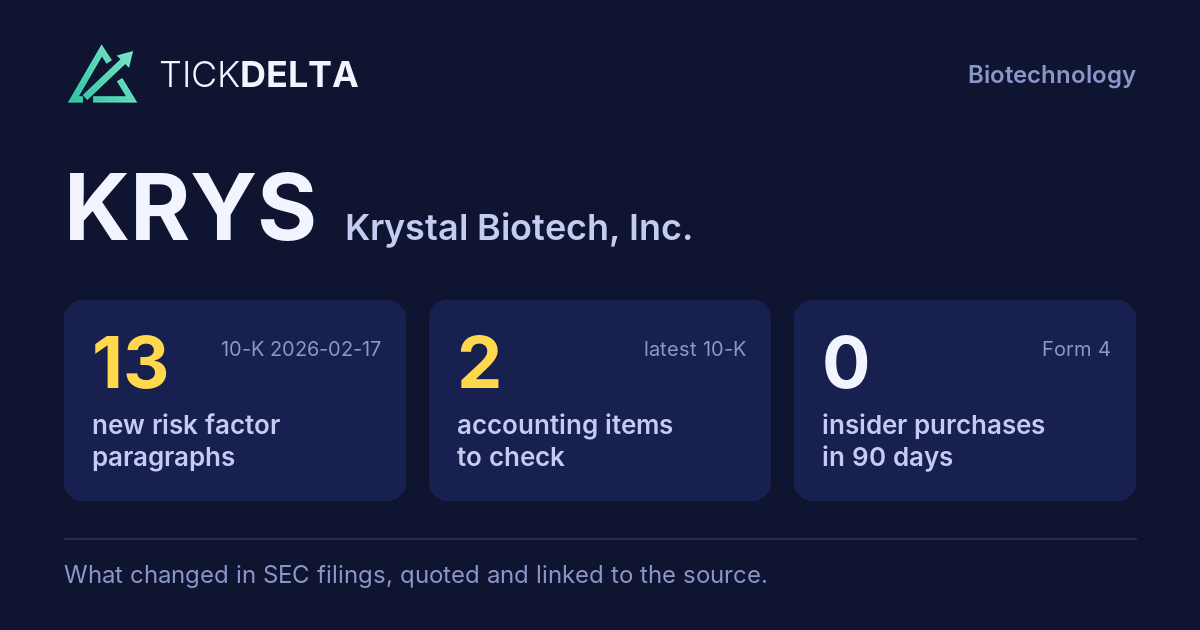
of the text changed · 32,917 words now · 13 new paragraphs, 19 gone
MD&A
36.8%
of the text changed · 7,071 words now · 13 new paragraphs, 31 gone
Legal Proceedings
63.6%
of the text changed · 684 words now
Accounting Policies
10.2%
of the text changed · 4,027 words now
10-K 0001711279-26-000016 (Feb 17, 2026) vs 10-K 0001711279-25-000008 (Feb 19, 2025)
Every paragraph, and how much of it changed
One bar per paragraph, in the order of the 10-K. Height and colour show the share of its words not in the closest paragraph a year earlier; the tallest bars are new paragraphs.
Risk Factors
383 paragraphs · 13 new · 145 reworded · 19 gone · 10-K Feb 17, 2026 against Feb 19, 2025
New paragraph
Reworded (5% of its words or more)
Same or nearly
Paragraph 162 · 48% changed
Every version of it
Paragraph 163 · 46% changed
Every version of it
Paragraph 178 · 42% changed
Every version of it
The FDA’s policies, and those of equivalent foreign regulatory agencies, may change and additional government regulations may be enacted that could negatively impact the existing marketing approval for VYJUVEK and prevent, limit, or delay regulatory approval of our product candidates. We cannot predict the likelihood, nature, or extent of government regulation that may arise from future legislation or administrative action, either in the United States or abroad. If we are slow or unable to adapt to changes in existing requirements or the adoption of new requirements or policies, or if we are not able to maintain regulatory compliance, we may lose any marketing approval that we may have obtained, which would materially and adversely affect our business, financial condition, results of operations, and prospects.
Paragraph 182 · 41% changed
Every version of it
Paragraph 139 · 39% changed
Every version of it
Paragraph 314 · 38% changed
Every version of it
•manufacture, market, and sell our lead product, VYJUVEK, in the United States and prepare for regulatory approvals outside of the United States market and if such approvals are received, commercialize sell VYJUVEK in those geographies; the EU and Japan;
Paragraph 75 · 37% changed
Every version of it
Paragraph 288 · 48% changed
Every version of it
10-K Feb 19, 2025certain executives, key employees, or advisors, may impede the progress of our research, development, and commercialization objectives and have a material adverse effect on our business, financial condition, results of operations, and prospects.
10-K Feb 17, 2026
have misappropriated the confidential information or trade secrets of third parties could have a similar negative impact on our business, financial condition, results of operations, and prospects.
Paragraph 162 · 48% changed
Every version of it
10-K Feb 19, 2025We rely on third parties to conduct certain of our preclinical studies and clinical trials. If these third parties do not successfully carry out their contractual duties, meet expected deadlines, or comply with regulatory requirements, we may not be able to obtain regulatory approval for, or commercialize, our product candidates.
10-K Feb 17, 2026
their contractual duties or meet expected deadlines, need to be replaced, or fail to adhere to our protocols or applicable regulatory requirements, or if the quality or accuracy of the preclinical or clinical data they generate is otherwise compromised, our development timelines, including clinical development timelines, may be extended, delayed or terminated, and we may be unable to complete development of, obtain regulatory approval for, or successfully commercialize our product candidates.
Paragraph 163 · 46% changed
Every version of it
10-K Feb 19, 2025Our failure or any failure by these third parties to comply with these regulations may require us to repeat clinical trials, which would delay the regulatory approval process. Moreover, our business may be adversely affected if any of these third parties violates federal or state fraud and abuse or false claims laws and regulations or healthcare privacy and security laws. Any third parties conducting our preclinical studies or our clinical trials will not be our employees and, except for remedies that may be available to us under our agreements with such third parties, we cannot control whether or not they devote sufficient time and resources to our preclinical studies and clinical programs. These third parties may also have relationships with other commercial entities, including our competitors, for whom they may also be conducting clinical trials or other product development activities, which could affect their performance on our behalf. If these third parties do not successfully carry out their contractual duties or obligations or meet expected deadlines, if they need to be replaced or if the quality or accuracy of the preclinical or clinical data they obtain is compromised due to the failure to adhere to our protocols or regulatory requirements or for other reasons, our development timelines, including clinical development timelines, may be extended, delayed or terminated, and we may not be able to complete development of, obtain regulatory approval of, or successfully commercialize our product candidates. As a result, our financial results and the commercial prospects for our product candidates would be harmed, our costs could increase, and our ability to generate revenue could be delayed or precluded entirely. Though we carefully manage our relationships with principal investigators and other third parties, there can be no assurance that we will not encounter challenges or delays or that these delays or challenges will not have a material adverse impact on our business, financial condition, and prospects.
10-K Feb 17, 2026
As a result, our financial results and the commercial prospects for our product candidates would be harmed, our costs could increase, and our ability to generate revenue could be delayed or precluded entirely. Though we carefully manage our relationships with principal investigators and other third parties, there can be no assurance that we will not encounter challenges or delays or that these delays or challenges will not have a material adverse impact on our business, financial condition, and prospects.
Paragraph 178 · 42% changed
Every version of it
10-K Feb 19, 2025
The FDA’s policies, and those of equivalent foreign regulatory agencies, may change and additional government regulations may be enacted that could negatively impact the existing marketing approval for VYJUVEK and prevent, limit, or delay regulatory approval of our product candidates. We cannot predict the likelihood, nature, or extent of government regulation that may arise from future legislation or administrative action, either in the United States or abroad. If we are slow or unable to adapt to changes in existing requirements or the adoption of new requirements or policies, or if we are not able to maintain regulatory compliance, we may lose any marketing approval that we may have obtained, which would materially and adversely affect our business, financial condition, results of operations, and prospects.
10-K Feb 17, 2026
The FDA’s policies, and those of equivalent foreign regulatory agencies, may change and additional government regulations may be enacted that could negatively impact the existing marketing approval for VYJUVEK and prevent, limit, or delay regulatory approval of our product candidates.
Paragraph 182 · 41% changed
Every version of it
10-K Feb 19, 2025Under the Orphan Drug Act of 1983, as amended, the FDA may designate a product candidate as an orphan drug if it is intended to treat a rare disease or condition, which is generally defined as having a patient population of fewer than 200,000 individuals in the United States, or a patient population greater than 200,000 in the United States where there is no reasonable expectation that the cost of developing the drug will be recovered from sales in the United States of such drug. Orphan drug designation itself does not convey any advantage in or shorten the duration of the regulatory review and approval process, but it can lead to financial incentives, such as opportunities for grant funding toward clinical trial costs, tax advantages, and user-fee waivers. In addition, if a product that has orphan designation subsequently receives the first FDA approval for the disease or condition for which it has such designation, the drug is entitled to orphan drug marketing exclusivity for a period of seven years. Orphan drug marketing exclusivity generally prevents the FDA from approving another application to market the same drug or biological product for the same disease or condition for seven years, except in limited circumstances, including if the FDA concludes that the later drug is safer, more effective, or makes a major contribution to patient care. A designated orphan drug may not receive orphan drug marketing exclusivity if it is approved for a use that is broader than the indication for which it received orphan designation. Orphan drug marketing exclusivity rights in the United States may be lost if the FDA later determines that the request for designation was materially defective or if the manufacturer is unable to assure sufficient quantity of the drug to meet the needs of patients with the rare disease or condition.
10-K Feb 17, 2026
the FDA concludes that the later drug is safer, more effective, or makes a major contribution to patient care. A designated orphan drug may not receive orphan drug marketing exclusivity if it is approved for a use that is broader than the indication for which it received orphan designation. Orphan drug marketing exclusivity rights in the United States may be lost if the FDA later determines that the request for designation was materially defective or if the manufacturer is unable to assure sufficient quantity of the drug to meet the needs of patients with the rare disease or condition.
Paragraph 139 · 39% changed
Every version of it
10-K Feb 19, 2025Preclinical studies, which are also known as nonclinical studies, refer to a stage of research that begins before clinical trials (testing in humans) can begin, and during which important feasibility, iterative testing, and safety data are collected. Because of their early nature, preclinical product candidates tend to carry a higher risk of failure as compared with clinical-stage assets. Preclinical product candidates must generate sufficient safety and efficacy data through in vitro studies and a variety of tests before they can be considered appropriate for testing in humans. The development risks, timeline, and cost of preclinical assets can be high because of the unknowns and absence of data. It can be difficult to identify relevant tests and animal models for preclinical studies. If preclinical studies of our product candidates do not generate strong data, our preclinical stage programs may never progress to clinical development and may prove to be worthless. In addition, the results of preclinical studies may not be predictive of the results of clinical trials. For example, we utilize animal models to ascertain the predicted safety and efficacy profile of our product candidates, but animal models are imperfect predictors of a product candidate’s effect/interactions in humans. As such, positive data from animal models may not be predictive of positive human results, patients may have side effects that were not observed in animals, and a product candidate may pose significant and unexpected safety risks to humans.
10-K Feb 17, 2026
studies may not be predictive of the results of clinical trials. For example, we utilize animal models to ascertain the predicted safety and efficacy profile of our product candidates, but animal models are imperfect predictors of a product candidate’s effect/interactions in humans. As such, positive data from animal models may not be predictive of positive human results, patients may have side effects that were not observed in animals, and a product candidate may pose significant and unexpected safety risks to humans.
Paragraph 314 · 38% changed
Every version of it
10-K Feb 19, 2025
•manufacture, market, and sell our lead product, VYJUVEK, in the United States and prepare for regulatory approvals outside of the United States and if such approvals are received, commercialize VYJUVEK in those geographies;
10-K Feb 17, 2026
•manufacture, market, and sell our lead product, VYJUVEK, in the United States and market and sell VYJUVEK in the EU and Japan;
Paragraph 75 · 37% changed
Every version of it
10-K Feb 19, 2025In the United States, federal, state, and local governments have enacted numerous data privacy and security laws, including data breach notification laws, personal information privacy laws, consumer protection laws, and other similar laws. Notably, HIPAA, as amended by HITECH, imposes requirements on covered entities, as well as their business associates regarding the privacy, security, and transmission of individually identifiable health information. Further, states continue to adopt new laws or amend existing laws related to data privacy, requiring attention to frequently changing regulatory requirements. For example, and the California Consumer Privacy Act of 2018 (“CCPA”) requires businesses to provide specific disclosures in their privacy notices and honor residents’ privacy rights. The CCPA provides for civil penalties of up to $7,500 per violation and allows private litigants affected by certain data breaches to recover significant statutory damages. Although the CCPA does not apply to certain data that we process in the context of clinical trials, efforts to comply with the CCPA may increase our annual compliance costs and subject us to potential liability with respect to other personal information we may maintain about California residents. In addition, the California Privacy Rights Act of 2020 (“CPRA”), which came into effect on January 1, 2023, expanded the CCPA’s requirements, extending it to cover personal information of business representatives and employees and the CPRA established a new regulatory agency to implement and enforce the law. Other states, such as Virginia, Nevada, Connecticut, Utah, Texas, and Colorado, have also passed comprehensive privacy laws, and similar laws are being considered in several other states, as well as at the federal and local levels, which impose similar obligations to those in the CCPA. Further, other states, such as Nevada and Washington, have enacted privacy laws specifically governing consumer health information, with Washington providing for a private right of action. Although many of these laws currently exempt certain health-related information, the laws may increase our potential liability related to our data processing activities, complicate our compliance efforts, and increase both legal risk and compliance costs for us and the third parties upon whom we rely.
10-K Feb 17, 2026
information of business representatives and employees and the CPRA established a new regulatory agency to implement and enforce the law. Other states, such as Virginia, Nevada, Connecticut, Utah, Texas, Colorado, Oregon, Montana, Iowa, Indiana, Tennessee, Delaware, and New Jersey, have enacted comprehensive privacy laws that have taken effect or are scheduled to take effect, and similar laws are being considered in several other states, as well as at the federal and local levels, which impose similar obligations to those in the CCPA. Further, other states, such as Nevada and Washington, have enacted privacy laws specifically governing consumer health information, with Washington providing for a private right of action, and additional states are considering similar consumer health information-related laws. Although many of these laws currently exempt certain health-related information, the laws may increase our potential liability related to our data processing activities, complicate our compliance efforts, and increase both legal risk and compliance costs for us and the third parties upon whom we rely.
MD&A
113 paragraphs · 13 new · 61 reworded · 31 gone · 10-K Feb 17, 2026 against Feb 19, 2025
New paragraph
Reworded (5% of its words or more)
Same or nearly
Paragraph 31 · 49% changed
Paragraph 70 · 48% changed
•an increase of $4.2 $9.2 million in of payroll related expenses, costs, including stock-based compensation, primarily driven by an increase in headcount to support overall growth, compensation;
Paragraph 16 · 48% changed
Paragraph 42 · 46% changed
Variable consideration reduces the transaction price to reflect the Company’s best estimate of the amount of consideration to which the Company is entitled based on the terms of the contracts and is recorded in the same period the related product revenue is recognized. The amount of variable consideration that is included in the transaction price may be constrained and is included in the net sales price only to the extent that it is considered probable that a significant reversal in the amount of the cumulative revenue recognized will not occur in a future period. Actual amounts of consideration ultimately received may differ from our estimates. If actual results in the future vary from our estimates, the Company will adjust these estimates in the period these variances become known.
Paragraph 26 · 44% changed
Paragraph 71 · 44% changed
•an increase of $3.6 $5.5 million in other research general and development expenses primarily relating administrative costs mainly related to licensing $1.5 million in charitable contributions, $1.1 million in taxes and regulatory costs and facilities and equipment related costs, and $1.1 million in subscriptions;
Paragraph 72 · 43% changed
•an increase of $3.3 $11.1 million related to professional services incurred to support our commercial growth. services, including legal and consulting services; and
Paragraph 73 · 41% changed
•an increase of $3.3 $6.7 million related to professional services incurred in marketing costs to support our commercial growth. sales of VYJUVEK.
Paragraph 31 · 49% changed
10-K Feb 19, 2025Selling, general and administrative expenses consist principally of salaries and other related costs, including stock-based compensation for personnel in our executive, finance, legal, commercial, business development, information technology and other general and administrative functions. Selling, general and administrative expenses also include professional fees associated with corporate and intellectual property-related legal expenses, consulting and accounting services, insurance, facility-related costs and expenses associated with obtaining and maintaining patents. Other selling, general and administrative costs include travel expenses, patient access program costs, management service fees, marketing expenses, and selling expenses which include transportation, shipping and handling fees.
10-K Feb 17, 2026
and administrative costs include travel expenses, patient access program costs, management service fees, marketing expenses, and selling expenses which include transportation, shipping and handling fees.
Paragraph 70 · 48% changed
10-K Feb 19, 2025
•an increase of $4.2 million in payroll related expenses, including stock-based compensation, primarily driven by an increase in headcount to support overall growth,
10-K Feb 17, 2026
•an increase of $9.2 million of payroll costs, including stock-based compensation;
Paragraph 16 · 48% changed
10-K Feb 19, 2025KB105 is a topical gel containing our novel vector designed to deliver two copies of the TGM1 transgene encoding the human enzyme TGM1 for the treatment of TGM1-deficient LI, a serious rare skin disorder most often caused by missing or mutated TGM1 protein. We expect to initiate the Phase 2 portion of JADE-1, a randomized, placebo-controlled Phase 1/2 study evaluating KB105 for the treatment of TGM1-deficient LI in 2026.
10-K Feb 17, 2026
KB111 is a topical gel formulation of our novel vector designed to deliver two copies of the ATP2C1 transgene encoding the human calcium transporter ATPase type 2C member 1 (“ATP2C1”) for the treatment of HHD, a serious and rare monogenic skin disorder characterized by painful rash and blistering in skin folds and linked to low ATP2C1 expression levels in keratinocytes. We are currently developing an HHD-specific evaluation scale necessary for the clinical evaluation of KB111. We expect to complete development and validation of the scale in the first half of 2026 and initiate a registrational study evaluating KB111 for the treatment of HHD in the second half of 2026.
Paragraph 42 · 46% changed
10-K Feb 19, 2025
Variable consideration reduces the transaction price to reflect the Company’s best estimate of the amount of consideration to which the Company is entitled based on the terms of the contracts and is recorded in the same period the related product revenue is recognized. The amount of variable consideration that is included in the transaction price may be constrained and is included in the net sales price only to the extent that it is considered probable that a significant reversal in the amount of the cumulative revenue recognized will not occur in a future period. Actual amounts of consideration ultimately received may differ from our estimates. If actual results in the future vary from our estimates, the Company will adjust these estimates in the period these variances become known.
10-K Feb 17, 2026
Variable consideration reduces the transaction price to reflect the Company’s best estimate of the amount of consideration to which the Company is entitled based on the terms of the contracts and is recorded in the same period the
Paragraph 26 · 44% changed
10-K Feb 19, 2025•expenses incurred under agreements with contract manufacturing organizations, contract research organizations, consultants and other vendors that conduct our preclinical activities;
10-K Feb 17, 2026
•agreements with contract research organizations, consultants and other third parties that conduct preclinical activities, clinical trials and other research and development activities on our behalf;
Paragraph 71 · 44% changed
10-K Feb 19, 2025
•an increase of $3.6 million in other research and development expenses primarily relating to licensing and regulatory costs and facilities and equipment related costs, and
10-K Feb 17, 2026
•an increase of $5.5 million in other general and administrative costs mainly related to $1.5 million in charitable contributions, $1.1 million in taxes and $1.1 million in subscriptions;
Paragraph 72 · 43% changed
10-K Feb 19, 2025
•an increase of $3.3 million related to professional services incurred to support our commercial growth.
10-K Feb 17, 2026
•an increase of $11.1 million related to professional services, including legal and consulting services; and
Paragraph 73 · 41% changed
10-K Feb 19, 2025
•an increase of $3.3 million related to professional services incurred to support our commercial growth.
10-K Feb 17, 2026
•an increase of $6.7 million in marketing costs to support commercial sales of VYJUVEK.
A paragraph is matched with the one last year that shares the most of its words; under half in common makes it new. The paragraphs shown are the 8 reworded the most in each section.
The paragraph that changed most in each section
The redline
Marked against last year's 10-K: cut words struck through, new words highlighted.
Risk Factors272 words changed in this paragraph; it is 32% similar to last year's version.
We were granted RMAT designation for B-VEC from the FDA, and we may seek RMAT designation for some of our product candidates. In 2017, the FDA established the RMAT designation as part of its implementation of the 21st Century Cures Act to expedite review of any drug that meets the following criteria: it qualifies as a RMAT, which is defined as a cell therapy, therapeutic tissue engineering product, human cell and tissue product, or any combination product using such therapies or products, with limited exceptions; it is intended to treat, modify, reverse, or cure a serious or life-threatening disease or condition; and preliminary clinical evidence indicates that the drug has the potential to address unmet medical needs for such a disease or condition. Like Breakthrough Therapy Designation, RMAT designation provides potential benefits that include more frequent meetings with the FDA to discuss the development plan for the product candidate, and eligibility for rolling review and priority review. Products granted RMAT designation may also be eligible for accelerated approval based on surrogate or intermediate endpoints reasonably likely to predict long-term clinical benefit, or reliance upon data obtained from a meaningful number of sites, including through expansion to additional sites. RMAT-designated products that receive accelerated approval may, as appropriate, fulfill their post-approval requirements through the submission of clinical evidence, clinical trials, patient registries, or other sources of real-world evidence, such as electronic health records; through the collection of larger confirmatory data sets; or via post-approval monitoring of all patients treated with such therapy prior to approval of the therapy. There is no assurance that we will be able to obtain RMAT designation for our product candidates. RMAT designation does not change the FDA’s standards for product approval, and there is no assurance that such designation will result in expedited review or approval or that the approved indication will not be narrower than the indication covered by the designation. Additionally, RMAT designation can be revoked if the criteria for eligibility cease to be met as clinical data emerges.
Source: Item 1A, 10-K 0001711279-26-000016 vs Item 1A, 10-K 0001711279-25-000008
MD&A229 words changed in this paragraph; it is 33% similar to last year's version.
In addition to focusing on genetic medicines to treat patients with diseases with high unmet medical needs, we are leveraging the ability of our platform to deliver proteins of interest to cells in the skin in the context of aesthetic medicine via our wholly-owned subsidiary, Jeune Aesthetics. Jeune Aesthethics’ lead program, KB301, is a solution formulation of Based on the broad aesthetic improvements observed following KB304 treatment in PEARL-2, our novel vector for intradermal injection designed to deliver two copies of the COL3A1 transgene to address signs of aging or damaged skin caused by declining levels of, or damaged proteins within the extracellular matrix, including COL3. In August 2024, Jeune Aesthetics announced positive interim safety and efficacy results from Cohorts 3 and 4 of the Phase 1 study PEARL-1, open label studies evaluating KB301 in KB304 for the treatment of lateral canthal lines at rest and dynamic wrinkles of the décolleté, respectively. Meaningful and sustained improvements in multiple skin aesthetic attributes, including wrinkles, crepiness, hydration, and radiance, were reported by we are progressing KB304 into Phase 2 study for the study investigators and subjects alike in both the décolleté and lateral canthal regions. Increased subject satisfaction with wrinkle appearance was also reported. Based on these Phase 1 results, Jeune Aesthetics has selected treatment of the dynamic wrinkles of the décolleté for advanced clinical development. Jeune Aesthetics has initiated development of a décolleté. We have aligned with the FDA on our validated décolleté-specific evaluation scale photonumeric scale, and expects we now expect to start a initiate the Phase 2 study evaluating KB301 in this indication in the second half of 2025. 2027.
Source: Item 7, 10-K 0001711279-26-000016 vs Item 7, 10-K 0001711279-25-000008
Legal Proceedings111 words changed in this paragraph; it is 55% similar to last year's version.
The Company enters into various agreements in the normal course of business with Contract Manufacturing Organizations (“CMOs”), Contract Research Organizations (“CROs”) and other third parties for preclinical research studies, clinical trials and testing and manufacturing services. The agreements with CMOs primarily relate to the manufacturing of our sterile gel that is mixed with in-house produced vectors as part of the final drug product for VYJUVEK. Agreements with third parties may also include research and development consulting activities, clinical-trial agreements, testing of our clinical-stage, pre-commercial and commercial stage products and/or storage, packaging and labeling. The Company is obligated to make milestone payments under certain of these contracts. The Company may also be responsible for the payment of a monthly service fee for project management services for the duration of any agreements. The estimated remaining commitment as of December 31, 2024 under these agreements is approximately $627 thousand. The Company has incurred research and development expenses related to commitments under these agreements of $7.1 million, $5.2 million and $6.0 million for the years ended December 31, 2024, 2023 and 2022, respectively.
Source: Item 3, via Note 7 – Commitments and Contingencies, 10-K 0001711279-26-000016 vs Item 3, via Note 7 – Commitments and Contingencies, 10-K 0001711279-25-000008
Accounting Policies102 words changed in this paragraph; it is 73% similar to last year's version.
Source: Item 8, Note 2 – Summary of Significant Accounting Policies, 10-K 0001711279-26-000016 vs Item 8, Note 2 – Summary of Significant Accounting Policies, 10-K 0001711279-25-000008
Sentences and paragraphs added, removed or reworded
Every change, by type
Sentences and paragraphs of KRYS's Risk Factors and MD&A, 10-K Feb 17, 2026 against 10-K Feb 19, 2025. Each links to the text at sec.gov.
Quiet changes are sentences kept from last year with one to four words changed, at least one of them a hedge, a modal or a qualifier (may, could, will, not, significant, material…). A year or date rolling forward is not counted.
The full word list
adverse, adversely, all, although, anticipate, anticipates, any, approximately, believe, believes, can, cannot, certain, could, expect, expects, generally, however, if, intend, intends, largely, likely, many, material, materially, may, might, most, must, never, no, not, possible, primarily, probable, should, significant, significantly, some, substantial, substantially, unlikely, will, would
AddedRisk Factors
allocate internal resources to a product candidate in a therapeutic area in which it would have been more advantageous to enter into a partnering arrangement.
Read it in 10-K Feb 17, 2026 at sec.gov
AddedRisk Factors
stricter labeling requirements for those product candidates that are approved, and a decrease in demand for any such product candidates.
Read it in 10-K Feb 17, 2026 at sec.gov
AddedRisk Factors
changes include the elimination of the coverage gap phase and the replacement of the Coverage Gap Discount Program with the Manufacturer Discount Program, under which drug manufacturers are required provide a 10% discount for brand-name drugs and biologics during the initial coverage phase and a 20% discount during the catastrophic phase. Multiple pharmaceutical manufacturers have challenged the law in court, largely on constitutional grounds. To date, the majority of these challenges have been unsuccessful, with courts upholding the IRA. However, these suits will likely continue and the ultimate effects of such legal challenges are unclear. On April 15, 2025, President Trump issued an executive order directing the Secretary of the Department of Health and Human Services to take certain actions on drug pricing reform, including working with Congress on amendments to the IRA and rule making to establish new Medicare payment models for so-called “high-cost” prescription drugs and biological products. Subsequently, President Trump has issued additional executive orders directing additional actions designed to lower drug prices, including by tying the price of certain drugs to the price of those drugs in other countries. It is unclear whether the Trump administration executive orders will lead to actual legislative initiatives. At this time, we continue to evaluate the effect of the IRA and the Trump administration’s executive actions on our business operations and financial condition and results as the full impact of the IRA and the executive actions remains uncertain.
Read it in 10-K Feb 17, 2026 at sec.gov
AddedRisk Factors
On July 4, 2025, legislation commonly referred to as the One Big Beautiful Bill Act was signed into law, which reduces funding to federal healthcare programs and imposes additional requirements to be eligible for healthcare, which may result in decreased access to healthcare, particularly in Medicaid programs.
Read it in 10-K Feb 17, 2026 at sec.gov
AddedRisk Factors
formulary managers on the other. The ACA amended the intent requirement of the federal Anti-Kickback Statute to clarify that a person or entity does not have to have actual knowledge of this statute or specific intent to violate it;
Read it in 10-K Feb 17, 2026 at sec.gov
AddedRisk Factors
•our operations in Europe and Japan may be directly or indirectly subject to European and Japanese law equivalents of each of the above U.S. federal laws, some of which may not have been applicable prior to the recent European Commission and MHLW approvals and commercial launch of VYJUVEK in Europe and Japan;
Read it in 10-K Feb 17, 2026 at sec.gov
AddedRisk Factors
In the United States, federal, state, and local governments have enacted numerous data privacy and security laws, including data breach notification laws, personal information privacy laws, consumer protection laws, and other similar laws. Notably, HIPAA, as amended by the Health Information Technology for Economic and Clinical Health Act, imposes requirements on covered entities, as well as their business associates regarding the privacy, security, and transmission of individually identifiable health information.
Read it in 10-K Feb 17, 2026 at sec.gov
AddedRisk Factors
misappropriation, loss or other unauthorized disclosure or use of confidential information of others, whether by us or a third-party, could: (i) subject us to civil and criminal penalties; (ii) have a negative impact on our reputation; or (iii) expose us to liability to third parties or government authorities.
Read it in 10-K Feb 17, 2026 at sec.gov
Show the other 71
AddedRisk Factors
There remains substantial uncertainty as to how the current U.S. administration will seek to or continue to modify or revise the requirements and policies of the FDA and other regulatory agencies with jurisdiction over VYJUVEK and our
Read it in 10-K Feb 17, 2026 at sec.gov
AddedRisk Factors
European Commission, MHLW, or other foreign regulators may issue new or revised guidelines concerning the development and marketing authorization of gene therapy medicinal products.
Read it in 10-K Feb 17, 2026 at sec.gov
AddedRisk Factors
We were granted RMAT designation for B-VEC from the FDA, and we may seek RMAT designation for some of our product candidates. In 2017, the FDA established the RMAT designation as part of its implementation of the 21st Century Cures Act to expedite review of any drug that meets the following criteria: it qualifies as a RMAT, which is defined as a cell
Read it in 10-K Feb 17, 2026 at sec.gov
AddedRisk Factors
•identification of patients and the willingness of physicians to prescribe new therapies;
Read it in 10-K Feb 17, 2026 at sec.gov
RemovedRisk Factors
RemovedRisk Factors
RemovedRisk Factors
RemovedRisk Factors
RemovedRisk Factors
RemovedRisk Factors
RemovedRisk Factors
RemovedRisk Factors
RemovedRisk Factors
RemovedRisk Factors
RemovedRisk Factors
RemovedRisk Factors
RewordedRisk Factors
If the models underlying AI technologies that we use or may use are incorrectly designed designed, implemented, or implemented, trained, or reliant trained; rely on incomplete, inadequate, inaccurate, biased, or otherwise poor quality data, or poor-quality data; rely on data with respect to which we do not have sufficient rights or in relation to for which we and/or or the data providers of such data have not implemented sufficient appropriate legal compliance measures, measures; are used without sufficient oversight and governance to ensure their responsible use, use; are misused, or used outside of the scope of applicable regulatory authorizations, and/or authorizations; or are adversely impacted by unforeseen defects, technical challenges, cybersecurity threats, or material performance issues, the performance of our products and business, as well as our reputation, could suffer or we could incur liability resulting from the violation of laws or contracts to which we are a party, regulatory enforcement actions, or civil claims. suffer.
Read it in 10-K Feb 17, 2026 at sec.gov
RewordedRisk Factors
Our use of distributors in these markets to market and sell VYJUVEK involves certain risks, including, but not limited to, risks that these organizations will not comply with applicable laws and regulations, not effectively sell or support VYJUVEK or reduce or discontinue their efforts to sell or support VYJUVEK, not devote the resources necessary to market and sell VYJUVEK in the volumes and within the time frame we expect, not be able to satisfy financial obligations to us or others, not provide us with accurate or timely information regarding their inventories of VYJUVEK or the number of patients who are using VYJUVEK, or not provide us with accurate or timely information regarding serious adverse events and/or product complaints.
Read it in 10-K Feb 17, 2026 at sec.gov
RewordedRisk Factors
RewordedRisk Factors
Any dispute, claim, or lawsuit may divert management’s attention away from our business, we may incur result in significant expenses in addressing to address or defending any dispute, claim, or lawsuit, defend such matters, and we may be required require us to pay damage awards or settlements or become subject to equitable remedies, any of which could materially and adversely affect our operations and financial results.
Read it in 10-K Feb 17, 2026 at sec.gov
RewordedRisk Factors
If we are slow or unable to adapt to changes in existing requirements or the adoption of new requirements or policies, or if we are not able to maintain regulatory compliance, if we experience delays in obtaining approval, or if we fail to obtain approval of our product candidates, we may lose any marketing approval that we may have obtained, which would materially and adversely affect our business, financial condition, results of operations, and prospects. prospects, or the commercial prospects for our product candidates may be harmed and our ability to generate revenue could be materially impaired.
Read it in 10-K Feb 17, 2026 at sec.gov
RewordedRisk Factors
Even though we have obtained orphan drug exclusivity for VYJUVEK in the United States; States, EU, and Japan and obtained orphan drug designation for B-VEC in the European Union and Japan; orphan drug designation for KB105 and KB407 certain product candidates in the United States and the European Union; and orphan drug designation for KB408 in the United States, Union, we may not be able to maintain orphan drug exclusivity, and if we are able to maintain the orphan drug exclusivity, the exclusivity may not effectively protect the product or product candidate from competition because different drugs can be approved for the same condition.
Read it in 10-K Feb 17, 2026 at sec.gov
RewordedRisk Factors
If we are required by the FDA, the EMA, the PMDA, European Commission, the MHLW, or other regulatory authorities to perform studies in addition to those currently expected, or if there are any delays in completing our clinical trials or the development of our product candidates, our expenses could increase and the timing or amount of revenue from product candidates in development could be adversely affected.
Read it in 10-K Feb 17, 2026 at sec.gov
RewordedRisk Factors
The ten-year market exclusivity in the European Union may be reduced to six years if, at the end of the fifth year, it is established that the product no longer meets the criteria for which it received orphan designation, including where it is shown that the product is sufficiently profitable not to justify maintenance of market exclusivity, or where the prevalence of the condition has increased above the threshold.
Read it in 10-K Feb 17, 2026 at sec.gov
RewordedRisk Factors
Provisions in our corporate charter documents certificate of incorporation and under bylaws, as well as provisions of Delaware law law, could make an acquisition of us, which our company that may be beneficial to our stockholders, stockholders more difficult and may could prevent attempts by or deter our stockholders to replace from replacing or remove removing our current management.
Read it in 10-K Feb 17, 2026 at sec.gov
RewordedRisk Factors
RewordedRisk Factors
If we or the third parties that process personal information or other sensitive data on our behalf fail, or are perceived to have failed, to address or comply with applicable privacy and data security obligations, we could face significant consequences, including but not limited to government enforcement actions (e.g., investigations, fines, penalties, audits, and inspections), litigation (including class-action claims), additional reporting requirements and/or oversight, bans on processing personal information, and orders to destroy or not use personal information.
Read it in 10-K Feb 17, 2026 at sec.gov
RewordedRisk Factors
We received FDA approval of VYJUVEK in May 2023 2023, European Commission approval of VYJUVEK in April 2025, and MHLW approval in July 2025, and initiated a commercial launch of VYJUVEK in the United States in the second quarter of 2023. 2023, in Germany in August 2025, and in Japan in October 2025.
Read it in 10-K Feb 17, 2026 at sec.gov
Quiet changesRisk Factors
There is also a risk of inappropriate disclosure of sensitive information, loss of trade secrets or other intellectual property, public exposure of personal information of our employees, patients who use VYJUVEK, clinical trial patients, and others, or negative or inaccurate posts or comments about us on any social networking website. media.
Read it in 10-K Feb 17, 2026 at sec.gov
Quiet changesRisk Factors
Further, the cost to comply with such laws, regulations or decisions and/or guidance interpreting existing laws, could be significant and would could increase our operating expenses (such as by imposing additional reporting obligations regarding our use of AI).
Read it in 10-K Feb 17, 2026 at sec.gov
Quiet changesRisk Factors
We can could face criminal liability and other serious consequences for violations, which can could harm our business.
Read it in 10-K Feb 17, 2026 at sec.gov
Quiet changesRisk Factors
Any third parties conducting our preclinical studies or our clinical trials will are not be our employees and, except for remedies that may be available to us under our agreements with such third parties, we cannot control whether or not they devote sufficient time and resources to our preclinical studies and clinical programs.
Read it in 10-K Feb 17, 2026 at sec.gov
Quiet changesRisk Factors
A loss of key personnel or their work product could hamper or prevent our ability to commercialize VYJUVEK or our product candidates, if approved, which could have an adverse effect on our business, results of operations, and financial condition.
Read it in 10-K Feb 17, 2026 at sec.gov
Quiet changesRisk Factors
Our Chief Executive Officer and Chairman of the Board of Directors and our Founder, President, Research & Development and Director will have the ability to substantially influence all matters submitted to stockholders for approval.
Read it in 10-K Feb 17, 2026 at sec.gov
AddedMD&A
VYJUVEK is a non-invasive, topical, redosable gene therapy approved in the United States, Europe, and Japan for the treatment of DEB, a rare and severe monogenic disease that affects the skin and mucosal tissues and is caused by one or more mutations in a gene called COL7A1. VYJUVEK is designed to deliver two copies of the COL7A1 gene when applied directly to DEB wounds, providing the patient’s skin cells the template to make normal type VII collagen protein and thereby addressing the fundamental disease-causing mechanism.
Read it in 10-K Feb 17, 2026 at sec.gov
AddedMD&A
We are commercializing VYJUVEK directly in the United States, major European markets, and Japan. We launched VYJUVEK in the United States in 2023, in Germany in August 2025, and in France and Japan in October 2025. The launch in France is under the post-marketing authorization early reimbursed access Accès Précoce program.
Read it in 10-K Feb 17, 2026 at sec.gov
AddedMD&A
Pricing negotiations are underway in both Germany and France and are expected to continue until at least the second half of 2026 in Germany and 2027 in France. Pricing negotiations were successfully completed in Japan prior to launch.
Read it in 10-K Feb 17, 2026 at sec.gov
AddedMD&A
We are advancing pricing discussions with Italian reimbursement authorities to enable a potential launch in Italy in the second half of 2026. We are also preparing regulatory filings for the United Kingdom and Switzerland, as well as initiating pricing discussions with relevant authorities in other key Western European markets. The timing of additional European launches will depend on the cadence and outcomes of regulatory interaction and pricing negotiations.
Read it in 10-K Feb 17, 2026 at sec.gov
AddedMD&A
We continue to expand our specialty distributor network to support the commercialization of VYJUVEK in territories outside of the United States, major European markets, and Japan.
Read it in 10-K Feb 17, 2026 at sec.gov
AddedMD&A
KB801 is an eye drop formulation of our novel HSV-1 based vector designed to deliver two transgene copies to the corneal epithelium for the sustained, localized expression and secretion of nerve growth factor and the treatment of NK, a rare, degenerative corneal disease caused by nerve damage in the eye that leads to corneal epithelial defects, ulcers, and perforation. Our engineered HSV-1 viral vector used in KB801 was granted platform technology designation by the FDA in October 2025. We are currently running a registrational, randomized, double-masked, multicenter, placebo-controlled study, EMERALD-1, evaluating KB801 for the treatment of NK. We expect to enroll approximately 60 adult patients with Stage 2 or Stage 3 NK in EMERALD-1. Enrollment is ongoing, and we expect to report top-line data in 2026.
Read it in 10-K Feb 17, 2026 at sec.gov
AddedMD&A
KB707 is a redosable, cancer immunotherapy designed to deliver genes encoding both human interleukin-2 and interleukin-12 to the tumor microenvironment and promote systemic immune-mediated tumor clearance. Two formulations of KB707 are in development, a solution formulation for transcutaneous injection and an inhaled (nebulized) formulation for lung delivery. We have prioritized development of the inhaled KB707 formulation for the treatment of non-small cell lung cancer (“NSCLC”) based on early evidence of efficacy from KYANITE-1, our ongoing, Phase 1/2 study evaluating inhaled KB707, as monotherapy or in combination to treat patients with locally advanced or metastatic solid tumors of the lung. We opened a new cohort in KYANITE-1 in late 2025 to evaluate inhaled KB707 in combination with chemotherapy in patients with advanced NSCLC. Enrollment in this cohort is ongoing, and we expect to report interim efficacy data and potential registrational study plans in 2026.
Read it in 10-K Feb 17, 2026 at sec.gov
AddedMD&A
We continue to follow patients enrolled in OPAL-1, our Phase 1/2 study, evaluating intratumoral KB707, as monotherapy or in combination, for the treatment of locally advanced or metastatic solid tumors.
Read it in 10-K Feb 17, 2026 at sec.gov
AddedMD&A
In addition to focusing on genetic medicines to treat patients with diseases with high unmet medical needs, we are leveraging the ability of our platform to deliver proteins of interest to cells in the skin in the context of aesthetic medicine via our wholly-owned subsidiary, Jeune Aesthetics. Based on the broad aesthetic improvements observed following KB304 treatment in PEARL-2, our Phase 1 study evaluating KB304 for the treatment of wrinkles of the décolleté, we are progressing KB304 into Phase 2 study for the treatment of wrinkles of the décolleté. We have aligned with the FDA on our validated décolleté-specific photonumeric scale, and we now expect to initiate the Phase 2 study in 2027.
Read it in 10-K Feb 17, 2026 at sec.gov
AddedMD&A
Jeune Aesthetics has several other aesthetic medicine product candidates in various stages of development, including our clinical-stage product candidate KB301 that is designed to deliver two copies of the COL3A1 transgene for the treatment of aesthetic skin conditions. We are currently evaluating aesthetic indications most suitable for advanced clinical development of KB301.
Read it in 10-K Feb 17, 2026 at sec.gov
AddedMD&A
The Company is subject to tax in the United States and numerous foreign jurisdictions. Significant judgments and estimates are required in the determination of consolidated income tax expense. Income tax expense reflects the Company’s best estimate of current and future taxes to be paid. The Company records deferred tax assets and liabilities for the expected future tax consequences of temporary differences between the financial statement carrying amounts and the tax basis of assets and liabilities using enacted tax rates expected to be in effect when the differences are expected to reverse. Valuation allowances are provided when necessary to reduce net deferred tax assets to the amount that is more likely than not to be realized. The Company weighs all available evidence, including cumulative income and forecasted future income in order to assess the realizability of deferred tax assets. The assumptions about future taxable income require the use of significant judgment and are consistent with the plans and estimates the Company is using to manage the underlying business. In the event the Company determines that it will be able to realize deferred tax assets for which a valuation allowance was used to reduce their carrying value, the adjustment to the valuation allowance will be recorded as a reduction to the provision for income taxes in the period such determination is made.
Read it in 10-K Feb 17, 2026 at sec.gov
AddedMD&A
The calculation of tax liabilities involves dealing with uncertainties in the application of complex tax laws and regulations in a multitude of jurisdictions across global operations. Significant judgment is required in the identification and measurement of uncertain tax positions. The liability for unrecognized tax benefits contains uncertainties because the Company is required to make assumptions and to apply judgment to estimate the exposures associated with our various filing positions. The Company adjusts the liabilities when judgment changes as a result of new information not previously available.
Read it in 10-K Feb 17, 2026 at sec.gov
RemovedMD&A
RemovedMD&A
RemovedMD&A
RemovedMD&A
RemovedMD&A
RemovedMD&A
RemovedMD&A
RemovedMD&A
RemovedMD&A
RemovedMD&A
RemovedMD&A
RemovedMD&A
RewordedMD&A
RewordedMD&A
RewordedMD&A
Net cash provided by financing activities for the year ended December 31, 2023 2025 was $202.8 $8.7 million and consisted of proceeds of $159.7 million from issuances of common stock, net of offering costs and proceeds of $43.8 $22.7 million from exercises of stock options, partially offset by $749 thousand $12.1 million used for employee tax withholding payments related to vested restricted stock units and $1.8 million used for employee tax withholding payments for settlement of vested restricted stock awards.
Read it in 10-K Feb 17, 2026 at sec.gov
RewordedMD&A
In July 2023, January 2026, we announced that we had dosed a positive interim clinical update from Cohort 3, the first patient in highest dose cohort of CORAL-1, a our Phase 1 multi-center, dose-escalation study evaluating KB407, delivered via a nebulizer, in KB407 for the treatment of patients with CF, regardless of their underlying genotype.
Read it in 10-K Feb 17, 2026 at sec.gov
RewordedMD&A
Product revenue, net was $389.1 million for the year ended December 31, 2025 as compared to $290.5 million for the year ended December 31, 2024 as compared to and $50.7 million for the year ended December 31, 2023 and zero for the year ended December 31, 2022 due to initial sales of VYJUVEK after FDA approval was obtained on May 19, 2023.
Read it in 10-K Feb 17, 2026 at sec.gov
RewordedMD&A
RewordedMD&A
The increase in cost of goods sold from 2023 2024 to 2024 2025 was driven by an increase in VYJUVEK sales following initial commercial sales recorded partially offset by a decrease primarily due to manufacturing process optimizations that resulted in August 2023. lower average costs per unit.
Read it in 10-K Feb 17, 2026 at sec.gov
RewordedMD&A
As we seek to obtain regulatory approval for our product candidates, candidates and prepare for product sales, marketing, commercial manufacturing, packaging, labeling and distribution, we expect to continue to incur significant manufacturing and commercialization expenses as we prepare for product sales, marketing, commercial manufacturing, packaging, labeling and distribution. expenses.
Read it in 10-K Feb 17, 2026 at sec.gov
RewordedMD&A
The estimated remaining commitment as of December 31, 2024 under these agreements is approximately $627 thousand, all of which is expected to be due in the next twelve months. months as of December 31, 2025 under these agreements is immaterial.
Read it in 10-K Feb 17, 2026 at sec.gov
RewordedMD&A
Non-cash adjustments included depreciation of $6.0 $5.7 million, amortization of operating lease right-of-use assets of $747 thousand, $0.8 million, stock-based compensation expense, net of $49.1 $54.5 million, and other adjustments of $652 thousand offset by realized gain on investments of $6.1 million and accretion on marketable securities of $1.7 million.
Read it in 10-K Feb 17, 2026 at sec.gov
RewordedMD&A
Cost of goods sold was $23.0 million for the year ended December 31, 2025 as compared to $20.1 million for the year ended December 31, 2024 as compared to and $3.1 million for the year ended December 31, 2023 and zero for the year ended December 31, 2022 due to initial sales of VYJUVEK after FDA approval was obtained on May 19, 2023.
Read it in 10-K Feb 17, 2026 at sec.gov
RewordedMD&A
Interest and other income, net for the years ended December 31, 2024, 2025, 2024 and 2023 and 2022 was $29.7 $28.2 million, $22.6 $29.6 million and $5.2 $22.5 million, respectively, and consisted of interest and dividend income earned from our cash, cash equivalents and investments. investments as well as the effects of foreign exchange rates.
Read it in 10-K Feb 17, 2026 at sec.gov
Quiet changesMD&A
The risks and uncertainties can cause actual results to differ significantly materially from those forecast in forward-looking statements or implied in historical results and trends.
Read it in 10-K Feb 17, 2026 at sec.gov
Sources
The two latest 10-Ks on EDGAR, section by section. Each change links to the text at sec.gov.
Also
New risk factors: paragraphs with nothing like them last year, quoted in full.
Work with it
Excel workbook · CSV. Google Sheet that stays up to date: paste =IMPORTDATA("https://tickdelta.com/company/KRYS/export.csv") into a cell.