Paragraph 239 · 48% changed
Every version of it
Screener
/
SEC EDGAR
/CIK 0001069258
/10-K filed Feb 23, 2026, compared with Feb 26, 2025
/Numbers from the XBRL of the 10-Ks
Nasdaq
Industrials · Defense
Kratos Defense & Security Solutions, Inc. KTOS
The 10-K against last year's
120 changes: 28 added, 20 removed, 72 reworded
10-K Feb 23, 2026 vs Feb 26, 2025
Risk Factors
9.7%
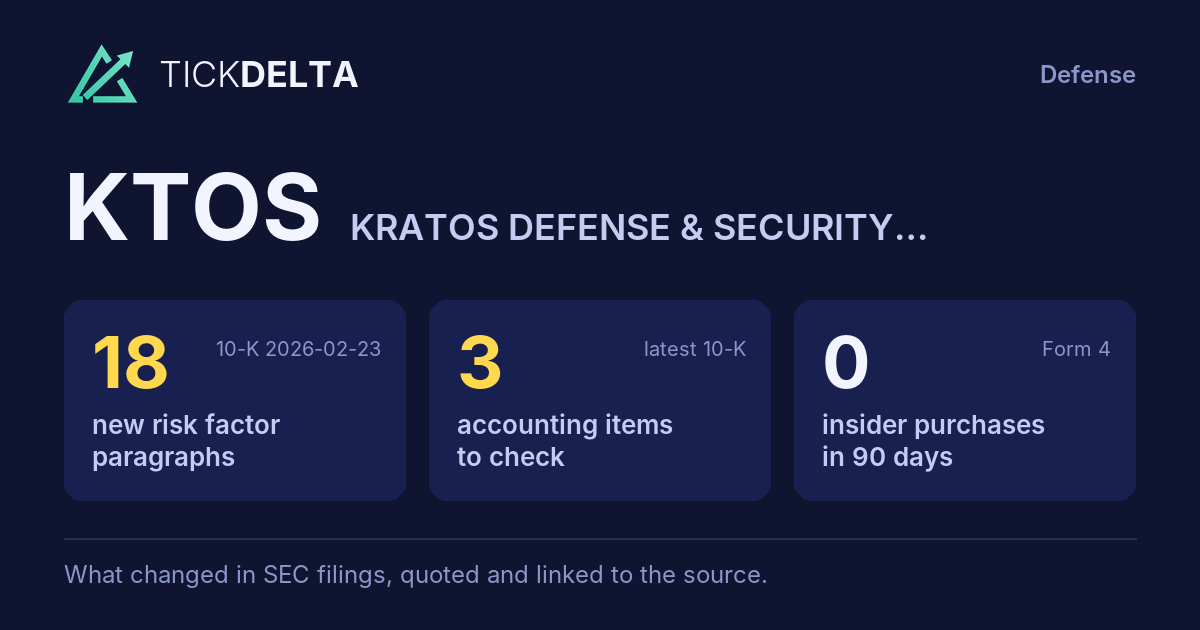
of the text changed · 21,505 words now · 18 new paragraphs, 10 gone
MD&A
27.7%
of the text changed · 9,254 words now · 10 new paragraphs, 10 gone
Legal Proceedings
10.7%
of the text changed · 634 words now
10-K 0001069258-26-000013 (Feb 23, 2026) vs 10-K 0001069258-25-000008 (Feb 26, 2025) Not compared: Accounting Policies.
Every paragraph, and how much of it changed
One bar per paragraph, in the order of the 10-K. Height and colour show the share of its words not in the closest paragraph a year earlier; the tallest bars are new paragraphs.
Risk Factors
295 paragraphs · 18 new · 56 reworded · 10 gone · 10-K Feb 23, 2026 against Feb 26, 2025
New paragraph
Reworded (5% of its words or more)
Same or nearly
Paragraph 200 · 47% changed
Every version of it
Paragraph 210 · 44% changed
Every version of it
The Pentagon, on January 31, 2020, released the official version of its unified Cybersecurity standard that all contractors must meet by 2026. This standard, the CMMC, will apply to any company that does business with the DoD. DoW. CMMC will also apply to subcontractors as well as prime contractors. CMMC borrows heavily from the existing NIST Cybersecurity Framework, and intends to rely heavily on a CMMC accrediting body up and running, companies will be able to apply for certification through a portal run by the accrediting body. The CMMC certification will be good for three years; with it, companies will be able to bid on contracts across the DoD and military services. In December 2020, the DoD disclosed the first seven contracts that are likely to be the initial test cases for the first “pathfinder” solicitations mandating CMMC. It is expected to take until 2026 to bring all contractors into compliance, since five years is the typical duration of a government contract. Contractors are required to flow the CMMC requirements down to all subcontracts except those for Commercial Off the Shelf (COTS) items. Additionally, a contractor may not award a subcontract unless the subcontractor has a current assessment in the Supplier Performance Risk System (SPRS). Because contractors only have access to their own information, contractors may need to rely on certifications from subcontractors for this requirement.
Paragraph 2 · 43% changed
Every version of it
Paragraph 42 · 43% changed
Every version of it
Paragraph 240 · 43% changed
Every version of it
Paragraph 51 · 35% changed
Every version of it
Paragraph 218 · 33% changed
Every version of it
Paragraph 239 · 48% changed
Every version of it
10-K Feb 26, 2025Our level of long-term borrowings increases the risk that we may default on our debt obligations. We may be unable to generate sufficient cash flow to pay the interest on our debt and to make the scheduled mandatory quarterly payments. If we are unable to service our indebtedness, we will be forced to adopt an alternative strategy that may include actions such as reducing capital expenditures, reducing internal investments in research and development efforts, selling assets, restructuring or refinancing our indebtedness or seeking additional equity capital. These alternative strategies may not be affected on satisfactory terms, if at all, and they may not yield sufficient funds to make required payments on our indebtedness.
10-K Feb 23, 2026
We are party to the Credit Agreement described elsewhere in this Annual Report on Form 10-K, which consists of a $200 million Revolving Credit Facility (and includes sub-facilities for the incurrence of up to $10.0 million of swingline loans and the issuance of up to $50.0 million of Letters of Credit). As of December 28, 2025, nothing was outstanding under our Credit Agreement and we currently have no long-term indebtedness. In the event we draw on our Credit Agreement or incur long-term loan indebtedness in the future, there is a risk that we may default on such debt obligations. For example, we may be unable to generate sufficient cash flow to pay the interest on our debt and to make any scheduled mandatory payments. If we are unable to service our indebtedness, we would be forced to adopt an alternative strategy that may include actions such as
Paragraph 200 · 47% changed
Every version of it
10-K Feb 26, 2025We may need to adopt new information technology systems and infrastructure to scale our business and obtain the synergies from prior and future acquisitions. Our information technology and business systems and infrastructure could create product development or production work stoppages, unnecessarily increase our inventory, negatively impact product delivery times and quality, and increase our compliance costs. Failure to invest in newer information technology and business systems and infrastructure may lead to operational inefficiencies and increased compliance costs and risks. In addition, an inability to maximize the utility and benefit of our current information technology and business tools could impact our ability to meet cost reduction and planned efficiency and operational improvement goals.
10-K Feb 23, 2026
maximize the utility and benefit of our current information technology and business tools could impact our ability to meet cost reduction and planned efficiency and operational improvement goals.
Paragraph 210 · 44% changed
Every version of it
10-K Feb 26, 2025
The Pentagon, on January 31, 2020, released the official version of its unified Cybersecurity standard that all contractors must meet by 2026. This standard, the CMMC, will apply to any company that does business with the DoD. CMMC will also apply to subcontractors as well as prime contractors. CMMC borrows heavily from the existing NIST Cybersecurity Framework, and intends to rely heavily on a CMMC accrediting body up and running, companies will be able to apply for certification through a portal run by the accrediting body. The CMMC certification will be good for three years; with it, companies will be able to bid on contracts across the DoD and military services. In December 2020, the DoD disclosed the first seven contracts that are likely to be the initial test cases for the first “pathfinder” solicitations mandating CMMC. It is expected to take until 2026 to bring all contractors into compliance, since five years is the typical duration of a government contract. Contractors are required to flow the CMMC requirements down to all subcontracts except those for Commercial Off the Shelf (COTS) items. Additionally, a contractor may not award a subcontract unless the subcontractor has a current assessment in the Supplier Performance Risk System (SPRS). Because contractors only have access to their own information, contractors may need to rely on certifications from subcontractors for this requirement.
10-K Feb 23, 2026
The Pentagon, on January 31, 2020, released the official version of its unified Cybersecurity standard that all contractors must meet by 2026. This standard, the CMMC, will apply to any company that does business with the DoW. CMMC will also apply to subcontractors as well as prime contractors. CMMC borrows heavily from the existing NIST Cybersecurity Framework, and intends to rely heavily on a CMMC accrediting body up and running, companies will be able to
Paragraph 2 · 43% changed
Every version of it
10-K Feb 26, 2025•Significant delays or reductions in appropriations for our programs and U.S. Government funding more broadly may negatively impact our business and programs and could have a material adverse effect on our financial position, results of operations and/or cash flows.
10-K Feb 23, 2026
•Competitive dynamics within our markets may affect our ability to win new contracts and result in reduced revenues, which could have a material adverse effect on our financial position, results of operations and/or cash flows.
Paragraph 42 · 43% changed
Every version of it
10-K Feb 26, 2025•Significant delays or reductions in appropriations for our programs and U.S. Government funding more broadly may negatively impact our business and programs and could have a material adverse effect on our financial position, results of operations and/or cash flows.
10-K Feb 23, 2026
Competitive dynamics within our markets may affect our ability to win new contracts and result in reduced revenues, which could have a material adverse effect on our financial position, results of operations and/or cash flows.
Paragraph 240 · 43% changed
Every version of it
10-K Feb 26, 2025If, for any reason, we are unable to meet our debt service and repayment obligations, we would be in default under the terms of the agreements governing our debt, which would allow our creditors at that time to declare certain outstanding indebtedness to be due and payable. If the amounts outstanding under any of our indebtedness were to be accelerated, our assets may not be sufficient to repay in full the money owed to the lenders or to our other debt holders.
10-K Feb 23, 2026
reducing capital expenditures, reducing internal investments in research and development efforts, selling assets, restructuring or refinancing our indebtedness or seeking additional equity capital. If the amounts outstanding under any of our indebtedness were to be accelerated, our assets may not be sufficient to repay in full the money owed to the lenders or to our other debt holders.
Paragraph 51 · 35% changed
Every version of it
10-K Feb 26, 2025In fiscal 2024, 2023 and 2022, we generated 67%, 69% and 69%, respectively, of our total revenues from contracts with the U.S. Government (including all branches of the U.S. military and FMS), either as a prime contractor or a subcontractor. We expect to continue to derive most of our revenues from work performed under U.S. Government contracts. See the Industry Update section in Item 1 “Business” contained within this Annual Report for a discussion of the current budgetary and funding constraints on U.S. Government spending and legislation enacted to reduce the U.S. federal deficit. As a result, we have experienced and expect to continue to experience reduced or delayed awards on some of our programs, with a related negative impact to our revenues, earnings and cash flows. Competitor bid protests also have become more prevalent in the current competitive environment, which has led to further contract award delays. In addition, any future changes to the fiscal policies of the U.S. Government and foreign governmental entities may decrease overall government funding for defense and homeland security, result in delays in the procurement of our products and services due to lack of funding, cause the U.S. Government and government agencies to reduce their purchases under existing contracts, or cause them to exercise their rights to terminate contracts at-will or to abstain from exercising options to renew contracts, any of which would have an adverse effect on our business, financial condition, results of operations and/or cash flows. Furthermore, on January 20, 2025, President Trump announced an executive order establishing the “Department of Government Efficiency” to maximize government efficiency and productivity. In February 2025, President Trump stated that he has directed DOGE to review Pentagon spending for potential waste and fraud. Pressures on and uncertainty surrounding the U.S. federal government’s budget and potential changes in budgetary priorities, could adversely affect our revenue, financial condition, and results of operations.
10-K Feb 23, 2026
reduce their purchases under existing contracts, or cause them to exercise their rights to terminate contracts at-will or to abstain from exercising options to renew contracts, any of which would have an adverse effect on our business, financial condition, results of operations and/or cash flows. Furthermore, on January 20, 2025, President Trump announced an executive order establishing the “Department of Government Efficiency” to maximize government efficiency and productivity. In February 2025, President Trump stated that he has directed DOGE to review Pentagon spending for potential waste and fraud. Pressures on and uncertainty surrounding the U.S. federal government’s budget and potential changes in budgetary priorities, could adversely affect our revenue, financial condition, and results of operations.
Paragraph 218 · 33% changed
Every version of it
10-K Feb 26, 2025Cybersecurity incidents can be caused by human error from our workforce or that of our third-party service providers, by malicious third parties, acting alone or in groups, or by more sophisticated organizations, including nation-states and state-sponsored organizations. Such risks may be elevated in connection with geopolitical tensions, including the Russia-Ukraine war. Certain unauthorized parties may have in the past managed, and may in the future manage, to overcome our security measures and those of our third-party service providers to access and misuse systems and software by exploiting defects in design or manufacture, including bugs, vulnerabilities and other problems that unexpectedly compromise the security or operation of a product or system. Further, malicious third parties have in the past attempted, and may in the future attempt, to fraudulently induce our employees or users of our products, services or solutions to disclose sensitive, personal or confidential information via illegal electronic spamming, phishing or other tactics, and this risk is heightened in our current hybrid model working environment. Malicious actors may engage in fraudulent or abusive activities through our products, services and solutions, including unauthorized use of accounts through stolen credentials, use of stolen credit cards or other payment vehicles, failure to pay for services accessed, or other activities that violate our terms of service. While we actively combat such fraudulent activities, we have experienced, and may in the future experience, impacts to our revenue from such activities. Further, unauthorized parties may also gain physical access to our facilities and infiltrate our information systems or attempt to gain logical access to our products, services or information systems to access content and data. The loss of or unauthorized access to data, such as resulting from computer viruses, worms, ransomware or other malware may harm our systems, expose us to litigation or regulatory investigation and subject us to costly and time-intensive notification requirements.
10-K Feb 23, 2026
Malicious actors may engage in fraudulent or abusive activities through our products, services and solutions, including unauthorized use of accounts through stolen credentials, use of stolen credit cards or other payment vehicles, failure to pay for services accessed, or other activities that violate our terms of service. While we actively combat such fraudulent activities, we have experienced, and may in the future experience, impacts to our revenue from such activities. Further, unauthorized parties may also gain physical access to our facilities and infiltrate our information systems or attempt to gain logical access to our products, services or information systems to access content and data. The loss of or unauthorized access to data, such as resulting from computer viruses, worms, ransomware or other malware may harm our systems, expose us to litigation or regulatory investigation and subject us to costly and time-intensive notification requirements. National security considerations may preclude us from, or cause us to delay, publicly disclosing a cybersecurity incident.
MD&A
102 paragraphs · 10 new · 50 reworded · 10 gone · 10-K Feb 23, 2026 against Feb 26, 2025
New paragraph
Reworded (5% of its words or more)
Same or nearly
Paragraph 44 · 48% changed
We use our operating cash flow to finance trade accounts receivable, fund necessary increases in inventory including increasing inventory stock levels and advance buys in larger lot sizes to gain pricing benefits where possible, in order to mitigate the impact of supply chain disruptions and price increases, utilize working capital to fund revenue growth, fund prepayments required for long lead items necessary for production, fund internal investments related to non-recurring of engineering and software development, development costs, fund capital expenditures, fund our IR&D internal research and development investments and our ongoing operations, service our debt debt, enhance our security infrastructure, including cyber security infrastructure, and make strategic acquisitions. Financing trade accounts receivable is necessary because, on average, our customers do not pay us as quickly as we pay our vendors and employees for their goods and services since because a number of our receivables are contractually billable and due to us only when certain contractual milestones are achieved, certain of which are not achieved until final shipment and acceptance of our products. achieved. Financing increases in inventory balances is are necessary to fulfill shipment requirements to meet delivery schedules of our customers. Cash from consolidated operations is primarily derived from our customer contracts customers, to fund advanced inventory purchases to mitigate supply chain disruptions, to achieve quantity volume discounts, and to fund production for work in progress and associated changes increased inventory levels and prepayments for long-lead materials related to production and revenue growth. These financing requirements have increased and have recently negatively impacted our operating cash flows due to actions we have taken to advance inventory purchases in working capital components. Our days sales outstanding (“DSO”) have decreased an attempt to 104 days as mitigate supply chain disruptions and to bolster our inventory levels. For the year ended December 28, 2025, approximately $19.3 million and $27.1 million of December 29, 2024 from 116 days as operating cash flow use was related to increases in inventory balances and other assets, respectively, which also include certain vendor prepayments and deposits related to the procurement of December 31, 2023. Our DSOs long-lead materials and inventory and certain investments we are impacted by the achievement of contractual billing milestones, such as equipment shipments and deliveries on certain products, and making for certain flight requirements that must be fulfilled on certain aerial target programs, or final billings which are not due until completion on certain projects, and therefore we are unable to contractually bill for amounts outstanding related to those milestones at this time. unmanned systems initiatives.
Paragraph 32 · 47% changed
Revenues increased $99.2 $210.5 million to $1,346.8 million for the year ended December 28, 2025 from $1,136.3 million for the year ended December 29, 2024 from $1,037.1 million for the year ended December 31, 2023. 2024. Revenues in our KGS segment increased $40.9 million primarily $189.0 million, due to increased revenues across all business units, with the most notable organic revenue increases in our C5ISR and microwave electronics products businesses primarily resulting from increased activity for multiple air defense systems and programs, and Defense Rocket Support business driven by our hypersonic business, as well as growth in our space, satellite, training and cyber, C5ISR, turbine technologies, training solutions technologies and defense microwave products businesses, and rocket support businesses primarily resulting from new contract awards, which collectively generated an aggregate increase in revenues the contribution of $88.7 million, partially offset by decreases in our space and satellite business, which has been primarily impacted by the extended CRA as well as the industry related OEM delays in the manufacture and delivery of software defined satellites, which impact includes the delay in the deployment of our commercial satellite ground equipment, with a total reduction of $47.8 $22.3 million in our space and satellite business. revenue from the February 4, 2025 acquisition of certain assets from Norden Millimeter, Inc. Revenues in our US segment increased $58.3 $21.5 million to $292.0 million primarily due to a full year contribution of revenues from the acquisition of the Sierra Technical Services, Inc. (“STS”), resulting in reflecting increased revenues of $17.7 million, and increased domestic target tactical drone production of approximately $13.2 million and a certain international target drone delivery which contributed $19.0 million in revenue activity during the twelve months ended December 29, 2024. 28, 2025.
Paragraph 76 · 47% changed
Paragraph 59 · 46% changed
between 0.25% and 1.25% per annum for base rate loans, and is based on the Company’s total net leverage ratio from time to time. The Credit Agreement contains certain covenants, which include, but are not limited to, restrictions on indebtedness, liens, fundamental changes, restricted payments, asset sales, and investments, and places limits on various other payments. Among other things, the Credit Agreement restricts our ability to pay dividends and make other restricted payments unless (a) the Total Net Leverage Ratio (as defined in the Credit Agreement) does not exceed 2.00:1.00, calculated on a Pro Forma Basis (as defined in the Credit Agreement) as of the last day of the most recently ended fiscal quarter for which financial statements have been (or are required to have been) delivered to the lenders pursuant to the Credit Agreement, (b) after giving effect to such dividend or other restricted payment, our Liquidity (as defined in the Credit Agreement) is at least $50,000,000 and (iii) no Default or Event of Default (as each such capitalized term is defined in the Credit Agreement) shall have occurred and be continuing at the time such dividend or other restricted payment is made.The Company was We were in compliance with the covenants contained in the Credit Agreement as of December 29, 2024. 28, 2025.
Paragraph 21 · 45% changed
We operate in two reportable segments. The KGS reportable segment is comprised of an aggregation of KGS operating segments, including its microwave electronic electronics products, space, satellite and cyber, training solutions, C5ISR/modular systems, turbine technologies technologies, and defense and rocket support services operating segments. The US reportable segment consists of our unmanned aerial, unmanned ground and ground, unmanned seaborne and command, control and communications system products. Our KGS and US segments provide products, solutions and services for mission critical National Security programs. KGS and US customers primarily include National Security related agencies, the DoD, intelligence agencies and classified agencies, and to a lesser degree, international government agencies and domestic and international commercial customers. We organize our operating segments based primarily on the nature of the products, solutions and services offered. For additional information regarding our reportable segments, see Note 13 of the Notes to Consolidated Financial Statements. From a customer and solutions perspective, we view our business as an integrated whole, leveraging skills and assets wherever possible. businesses.
Paragraph 56 · 40% changed
Paragraph 100 · 38% changed
Contingencies and litigation. We are currently involved in certain legal proceedings. We estimate a range of liability related to pending litigation where the amount and range of loss can be estimated. We record our estimate of a loss when the loss is considered probable and reasonably estimable. Where a liability is probable and there is a range of estimated loss and no amount in the range is more likely than any other number in the range, we record the minimum estimated liability related to the claim in accordance with FASB ASC Topic 450, Contingencies. As additional information becomes available, we assess the potential liability related to our pending litigation and revise our estimates. Revisions in our estimates of potential liability could materially impact our results of operations. See Note 14 of the Notes to Consolidated Financial Statements contained within this Annual Report for a further discussion of our legal proceedings.
Paragraph 13 · 37% changed
The potential challenges presented by the recent elections, U.S. Government shutdown, Presidential and congressional changes and the related transitions, the CRA, Congressional changes, proposed new tariffs, the current budgetary and deficit funding environment, the Trump Administration’s stated fiscal policies, Israel, Ukraine and Taiwan funding support, continuing potential heightened levels of inflation, ongoing supply chain disruption, and the challenging appropriations process, among other items, all continue to potentially create significant short and long-term risks to the industry and the Company. Additionally, the Trump Administration has recently executed certain executive orders directly related to significantly changing the current DoW procurement policies and procedures, and the Federal Acquisition Regulations, the potential impact of which such changes, if effected either by executive orders or changes to the relevant law, to the industry, and to Kratos, is unknown at this time.
Paragraph 44 · 48% changed
10-K Feb 26, 2025
We use our operating cash flow to finance trade accounts receivable, fund necessary increases in inventory and internal investments related to non-recurring engineering and software development, fund capital expenditures, fund our IR&D investments and our ongoing operations, service our debt and make strategic acquisitions. Financing trade accounts receivable is necessary because, on average, our customers do not pay us as quickly as we pay our vendors and employees for their goods and services since a number of our receivables are contractually billable and due to us only when certain contractual milestones are achieved, certain of which are not achieved until final shipment and acceptance of our products. Financing increases in inventory balances is necessary to fulfill shipment requirements to meet delivery schedules of our customers. Cash from consolidated operations is primarily derived from our customer contracts in progress and associated changes in working capital components. Our days sales outstanding (“DSO”) have decreased to 104 days as of December 29, 2024 from 116 days as of December 31, 2023. Our DSOs are impacted by the achievement of contractual billing milestones, such as equipment shipments and deliveries on certain products, and for certain flight requirements that must be fulfilled on certain aerial target programs, or final billings which are not due until completion on certain projects, and therefore we are unable to contractually bill for amounts outstanding related to those milestones at this time.
10-K Feb 23, 2026
We use our operating cash flow to finance trade accounts receivable, fund necessary increases in inventory including increasing inventory stock levels and advance buys in larger lot sizes to gain pricing benefits where possible, in order to mitigate the impact of supply chain disruptions and price increases, utilize working capital to fund revenue growth, fund prepayments required for long lead items necessary for production, fund internal investments of engineering and software development costs, fund capital expenditures, our internal research and development investments and our ongoing operations, service our debt, enhance our security infrastructure, including cyber security infrastructure, and make strategic acquisitions. Financing trade accounts receivable is necessary because, on average, our customers do not pay us as quickly as we pay our vendors and employees for their goods and services because a number of our receivables are contractually billable and due to us only when certain contractual milestones are achieved. Financing increases in inventory balances are necessary to fulfill shipment requirements to meet delivery schedules of our customers, to fund advanced inventory purchases to mitigate supply chain disruptions, to achieve quantity volume discounts, and to fund production for work in progress and increased inventory levels and prepayments for long-lead materials related to production and revenue growth. These financing requirements have increased and have recently negatively impacted our operating cash flows due to actions we have taken to advance inventory purchases in an attempt to mitigate supply chain disruptions and to bolster our inventory levels. For the year ended December 28, 2025, approximately $19.3 million and $27.1 million of operating cash flow use was related to increases in inventory balances and other assets, respectively, which also include certain vendor prepayments and deposits related to the procurement of long-lead materials and inventory and certain investments we are making for certain unmanned systems initiatives.
Paragraph 32 · 47% changed
10-K Feb 26, 2025
Revenues increased $99.2 million to $1,136.3 million for the year ended December 29, 2024 from $1,037.1 million for the year ended December 31, 2023. Revenues in our KGS segment increased $40.9 million primarily due to revenue increases in our C5ISR and microwave electronics products businesses primarily resulting from increased activity for multiple air defense systems and programs, and growth in our turbine technologies, training solutions and defense and rocket support businesses primarily resulting from new contract awards, which collectively generated an aggregate increase in revenues of $88.7 million, partially offset by decreases in our space and satellite business, which has been primarily impacted by the extended CRA as well as the industry related OEM delays in the manufacture and delivery of software defined satellites, which impact includes the delay in the deployment of our commercial satellite ground equipment, with a total reduction of $47.8 million in our space and satellite business. Revenues in our US segment increased $58.3 million primarily due to a full year contribution of revenues from the acquisition of the Sierra Technical Services, Inc. (“STS”), resulting in increased revenues of $17.7 million, and increased domestic target drone production of approximately $13.2 million and a certain international target drone delivery which contributed $19.0 million in revenue during the twelve months ended December 29, 2024.
10-K Feb 23, 2026
Revenues increased $210.5 million to $1,346.8 million for the year ended December 28, 2025 from $1,136.3 million for the year ended December 29, 2024. Revenues in our KGS segment increased $189.0 million, due to increased revenues across all business units, with the most notable organic revenue increases in our Defense Rocket Support business driven by our hypersonic business, as well as growth in our space, satellite, training and cyber, C5ISR, turbine technologies and microwave products businesses, and the contribution of $22.3 million in revenue from the February 4, 2025 acquisition of certain assets from Norden Millimeter, Inc. Revenues in our US segment increased $21.5 million to $292.0 million primarily reflecting increased tactical drone activity during the twelve months ended December 28, 2025.
Paragraph 76 · 47% changed
10-K Feb 26, 2025Long-lived and Intangible Assets. We account for long-lived assets in accordance with the provisions of FASB ASC Topic 360, Property, Plant, and Equipment (“Topic 360”). Topic 360 addresses financial accounting and reporting for the impairment or disposal of long-lived assets and requires that long-lived assets be reviewed for impairment whenever events or changes in circumstances indicate that the carrying amount of an asset may not be recoverable. Recoverability is measured by comparing the carrying amount of an asset to the expected future net cash flows generated by the asset. If it is determined that the asset may not be recoverable and if the carrying amount of an asset exceeds its estimated fair value, an impairment charge is recognized to the extent of the difference. Topic 360 requires companies to separately report discontinued operations, including components of an entity that either have been disposed of (by sale, abandonment or in a distribution to owners) or classified as held for sale. Assets to be disposed of are reported at the lower of the carrying amount or fair value less costs to sell.
10-K Feb 23, 2026
components of an entity that either have been disposed of (by sale, abandonment or in a distribution to owners) or classified as held for sale. Assets to be disposed of are reported at the lower of the carrying amount or fair value less costs to sell.
Paragraph 59 · 46% changed
10-K Feb 26, 2025
The Credit Agreement contains certain covenants, which include, but are not limited to, restrictions on indebtedness, liens, fundamental changes, restricted payments, asset sales, and investments, and places limits on various other payments. Among other things, the Credit Agreement restricts our ability to pay dividends and make other restricted payments unless (a) the Total Net Leverage Ratio (as defined in the Credit Agreement) does not exceed 2.00:1.00, calculated on a Pro Forma Basis (as defined in the Credit Agreement) as of the last day of the most recently ended fiscal quarter for which financial statements have been (or are required to have been) delivered to the lenders pursuant to the Credit Agreement, (b) after giving effect to such dividend or other restricted payment, our Liquidity (as defined in the Credit Agreement) is at least $50,000,000 and (iii) no Default or Event of Default (as each such capitalized term is defined in the Credit Agreement) shall have occurred and be continuing at the time such dividend or other restricted payment is made.The Company was in compliance with the covenants contained in the Credit Agreement as of December 29, 2024.
10-K Feb 23, 2026
between 0.25% and 1.25% per annum for base rate loans, and is based on the Company’s total net leverage ratio from time to time. The Credit Agreement contains certain covenants, which include, but are not limited to, restrictions on indebtedness, liens, fundamental changes, restricted payments, asset sales, and investments, and places limits on various other payments. We were in compliance with the covenants contained in the Credit Agreement as of December 28, 2025.
Paragraph 21 · 45% changed
10-K Feb 26, 2025
We operate in two reportable segments. The KGS reportable segment is comprised of an aggregation of KGS operating segments, including its microwave electronic products, space, satellite and cyber, training solutions, C5ISR/modular systems, turbine technologies and defense and rocket support services operating segments. The US reportable segment consists of our unmanned aerial, unmanned ground and unmanned seaborne system products. Our KGS and US segments provide products, solutions and services for mission critical National Security programs. KGS and US customers primarily include National Security related agencies, the DoD, intelligence agencies and classified agencies, and to a lesser degree, international government agencies and domestic and international commercial customers. We organize our operating segments based primarily on the nature of the products, solutions and services offered. For additional information regarding our reportable segments, see Note 13 of the Notes to Consolidated Financial Statements. From a customer and solutions perspective, we view our business as an integrated whole, leveraging skills and assets wherever possible.
10-K Feb 23, 2026
We operate in two reportable segments. The KGS reportable segment is comprised of an aggregation of KGS operating segments, including its microwave electronics products, space, satellite and cyber, training solutions, C5ISR/modular systems, turbine technologies, and defense and rocket support services operating segments. The US reportable segment consists of our unmanned aerial, unmanned ground, unmanned seaborne and command, control and communications system businesses.
Paragraph 56 · 40% changed
10-K Feb 26, 2025Our total long-term debt, decreased by $42.5 million to $185.0 million as of December 29, 2024 from $227.5 million as of December 31, 2023. On February 18, 2022, we completed the refinancing of our then-outstanding $90 million revolving credit facility and $300 million of Senior Secured Notes, with a new 5-year $200 million Revolving Credit Facility and 5-year $200 million Term Loan A issued pursuant to the 2022 Credit Facility. We incurred debt issuance costs of $3.3 million associated with the 2022 Credit Facility. We drew approximately $200 million under the Term Loan A and $100 million on the new Revolving Credit Facility at the time of the refinancing transaction (as more fully described in Note 5 of the accompanying Consolidated Financial Statements).
10-K Feb 23, 2026
On February 18, 2022, we completed the refinancing of our then-outstanding $90 million revolving credit facility and $300 million Senior Secured Notes, with a 5-year $200 million Revolving Credit Facility and 5-year $200 million Term Loan A. We incurred debt issuance costs of $3.3 million associated with the 2022 Credit Facility. On July 2, 2025, we extinguished all outstanding Term Loan A debt under the 2022 Credit Facility. The then outstanding Term Loan A aggregate principal balance of $177.5 million, plus accrued interest, was paid in full utilizing a portion of the proceeds we received from the June 27, 2025 public equity offering, which is described further in Note 10 to the accompanying consolidated financial statements. We incurred a loss on the extinguishment of the debt of $0.5 million related to the write-off of unamortized debt issuance costs.
Paragraph 100 · 38% changed
10-K Feb 26, 2025
Contingencies and litigation. We are currently involved in certain legal proceedings. We estimate a range of liability related to pending litigation where the amount and range of loss can be estimated. We record our estimate of a loss when the loss is considered probable and reasonably estimable. Where a liability is probable and there is a range of estimated loss and no amount in the range is more likely than any other number in the range, we record the minimum estimated liability related to the claim in accordance with FASB ASC Topic 450, Contingencies. As additional information becomes available, we assess the potential liability related to our pending litigation and revise our estimates. Revisions in our estimates of potential liability could materially impact our results of operations. See Note 14 of the Notes to Consolidated Financial Statements contained within this Annual Report for a further discussion of our legal proceedings.
10-K Feb 23, 2026
Contingencies and litigation. We are currently involved in certain legal proceedings. We estimate a range of liability related to pending litigation where the amount and range of loss can be estimated. We record our estimate of a loss when the loss is considered probable and reasonably estimable. Where a liability is probable and there is a range of estimated loss and no
Paragraph 13 · 37% changed
10-K Feb 26, 2025
The potential challenges presented by the recent elections, Presidential and congressional changes and the related transitions, the CRA, the current budgetary and deficit funding environment, Israel, Ukraine and Taiwan funding support, continuing heightened levels of inflation, ongoing supply chain disruption, and the challenging appropriations process, among other items, all continue to create significant short and long-term risks to the industry and the Company.
10-K Feb 23, 2026
The potential challenges presented by the recent U.S. Government shutdown, Presidential and Congressional changes, proposed new tariffs, the current budgetary and deficit funding environment, the Trump Administration’s stated fiscal policies, Israel, Ukraine and Taiwan funding support, potential heightened levels of inflation, ongoing supply chain disruption, and the challenging appropriations process, among other items, all continue to potentially create significant short and long-term risks to the industry and the Company. Additionally, the Trump Administration has recently executed certain executive orders directly related to significantly changing the current DoW procurement policies and procedures, and the Federal Acquisition Regulations, the potential impact of which such changes, if effected either by executive orders or changes to the relevant law, to the industry, and to Kratos, is unknown at this time.
A paragraph is matched with the one last year that shares the most of its words; under half in common makes it new. The paragraphs shown are the 8 reworded the most in each section.
The paragraph that changed most in each section
The redline
Marked against last year's 10-K: cut words struck through, new words highlighted.
MD&A309 words changed in this paragraph; it is 42% similar to last year's version.
We use our operating cash flow to finance trade accounts receivable, fund necessary increases in inventory including increasing inventory stock levels and advance buys in larger lot sizes to gain pricing benefits where possible, in order to mitigate the impact of supply chain disruptions and price increases, utilize working capital to fund revenue growth, fund prepayments required for long lead items necessary for production, fund internal investments related to non-recurring of engineering and software development, development costs, fund capital expenditures, fund our IR&D internal research and development investments and our ongoing operations, service our debt debt, enhance our security infrastructure, including cyber security infrastructure, and make strategic acquisitions. Financing trade accounts receivable is necessary because, on average, our customers do not pay us as quickly as we pay our vendors and employees for their goods and services since because a number of our receivables are contractually billable and due to us only when certain contractual milestones are achieved, certain of which are not achieved until final shipment and acceptance of our products. achieved. Financing increases in inventory balances is are necessary to fulfill shipment requirements to meet delivery schedules of our customers. Cash from consolidated operations is primarily derived from our customer contracts customers, to fund advanced inventory purchases to mitigate supply chain disruptions, to achieve quantity volume discounts, and to fund production for work in progress and associated changes increased inventory levels and prepayments for long-lead materials related to production and revenue growth. These financing requirements have increased and have recently negatively impacted our operating cash flows due to actions we have taken to advance inventory purchases in working capital components. Our days sales outstanding (“DSO”) have decreased an attempt to 104 days as mitigate supply chain disruptions and to bolster our inventory levels. For the year ended December 28, 2025, approximately $19.3 million and $27.1 million of December 29, 2024 from 116 days as operating cash flow use was related to increases in inventory balances and other assets, respectively, which also include certain vendor prepayments and deposits related to the procurement of December 31, 2023. Our DSOs long-lead materials and inventory and certain investments we are impacted by the achievement of contractual billing milestones, such as equipment shipments and deliveries on certain products, and making for certain flight requirements that must be fulfilled on certain aerial target programs, or final billings which are not due until completion on certain projects, and therefore we are unable to contractually bill for amounts outstanding related to those milestones at this time. unmanned systems initiatives.
Source: Item 7, 10-K 0001069258-26-000013 vs Item 7, 10-K 0001069258-25-000008
Risk Factors193 words changed in this paragraph; it is 62% similar to last year's version.
Source: Item 1A, 10-K 0001069258-26-000013 vs Item 1A, 10-K 0001069258-25-000008
Legal Proceedings67 words changed in this paragraph; it is 89% similar to last year's version.
In addition to commitments and obligations in the ordinary course of business, the Company is subject to various claims, pending and potential legal actions for damages, investigations relating to governmental laws and regulations and other matters arising out of the normal conduct of the Company’s business. The Company assesses contingencies to determine the degree of probability and range of possible loss for potential accrual in its consolidated financial statements. An estimated loss contingency is accrued in the Company’s consolidated financial statements if it is probable that a liability has been incurred and the amount of the loss can be reasonably estimated. Because litigation is inherently unpredictable and unfavorable resolutions could occur, assessing litigation contingencies is highly subjective and requires judgments about future events. When evaluating contingencies, the Company may be unable to provide a meaningful estimate due to a number of factors, including but not limited to the procedural status of the matter in question, the presence of complex or novel legal theories, and the ongoing discovery and development of information important to the matters. In addition, damage amounts claimed in litigation against it may be unsupported, exaggerated or unrelated to possible outcomes, and as such are not meaningful indicators of its potential liability. The Company regularly reviews contingencies to determine the adequacy of its accruals and related disclosures. The amount of ultimate loss may differ from these estimates. It is possible that cash flows or results of operations could be materially affected in any particular period by the unfavorable resolution of one or more of these contingencies. Whether any losses finally determined in any claim, action, investigation or proceeding could reasonably have a material effect on the Company’s business, financial condition, results of operations or cash flows will depend on a number of variables, including: the timing and amount of such losses; the structure and type of any remedies; the monetary significance any such losses, damages or remedies may have on the consolidated financial statements; and the unique facts and circumstances of the particular matter that may give rise to additional factors.
Source: Item 3, via Note 14 – Commitments and Contingencies, 10-K 0001069258-26-000013 vs Item 3, via Note 14 – Commitments and Contingencies, 10-K 0001069258-25-000008
Sentences and paragraphs added, removed or reworded
Every change, by type
Sentences and paragraphs of KTOS's Risk Factors and MD&A, 10-K Feb 23, 2026 against 10-K Feb 26, 2025. Each links to the text at sec.gov.
Quiet changes are sentences kept from last year with one to four words changed, at least one of them a hedge, a modal or a qualifier (may, could, will, not, significant, material…). A year or date rolling forward is not counted.
The full word list
adverse, adversely, all, although, anticipate, anticipates, any, approximately, believe, believes, can, cannot, certain, could, expect, expects, generally, however, if, intend, intends, largely, likely, many, material, materially, may, might, most, must, never, no, not, possible, primarily, probable, should, significant, significantly, some, substantial, substantially, unlikely, will, would
AddedRisk Factors
We operate in highly competitive markets and our competitors may have more financial capacity or more extensive or specialized engineering, technical, manufacturing, marketing or servicing capabilities than we do. They may be willing to accept more risk or lower profitability in competing for contracts. We have seen, and anticipate we will continue to see, increased competition, including in some of our core markets, especially as a result of our customers’ budget pressures and their focus on speed, affordability and competition. The U.S. government’s continued emphasis on reforming its acquisition processes, including procuring commercial products and services and utilizing non-Federal Acquisition Regulation-based procurement methods, such as Other Transaction Authority (OTA) agreements and other contract types, has facilitated, and may continue to facilitate, participation by new and emerging market entrants, which has increased and may in the future further increase competition for the programs we pursue, which could result in reduced contract opportunities, increased pricing pressure, and/or demands to accept less favorable terms. In certain circumstances, these alternative contracting models may place increased risk on the contractor, such as the potential for greater assumption of development costs or for limited reimbursement recourse in certain situations. Further, certain non-Federal Acquisition Regulation-based procurement methods, such as OTA awards, are not subject to all of the procurement requirements that typically apply to DoW contracts and rights to protest such awards may be more limited than for other contracts.
Read it in 10-K Feb 23, 2026 at sec.gov
AddedRisk Factors
Our customers are increasingly working with commercial contractors as well as newer entrants and startups in the defense industry for some products and services. Such contractors may have lower cost, more agile operating structures and access to capital and talent, a greater ability to leverage changes in the customer’s acquisition strategies (e.g., multiple awardees, short lifecycles) or be more inclined to take on increased risk than we are. In addition, some customers continue to utilize small business contractors or determine to source work internally.
Read it in 10-K Feb 23, 2026 at sec.gov
AddedRisk Factors
Our success in competing depends, in part, on our ability to remain price- and cost-competitive, respond to changes in customer acquisition strategies and preferences, accurately anticipate our customers’ needs, successfully effect our digital transformation strategy and identify, adopt and integrate new digital technologies, including artificial intelligence, into our manufacturing, operations, business processes, products and services.
Read it in 10-K Feb 23, 2026 at sec.gov
AddedRisk Factors
We expect that the increasing competition in the U.S. and outside the U.S. from U.S., foreign and multinational firms, including new entrants, could further increase due to mergers or acquisitions within our industry and could limit our access to certain suppliers, absent appropriate remedies to protect our interests. We are also facing increasing competition for, and more limited access to, various critical products, services and supplies.
Read it in 10-K Feb 23, 2026 at sec.gov
AddedRisk Factors
Additionally, in some instances, companies both inside and outside the U.S. may receive loans, investments, subsidies, preferential treatment and other assistance from their governments or customers that may not be provided or available to us. Such assistance may increase the competitiveness of such companies in certain opportunities that we may pursue. Certain foreign companies may also be subject to fewer restrictions on technology transfer than we are.
Read it in 10-K Feb 23, 2026 at sec.gov
AddedRisk Factors
In addition, U.S. government procurement and certain other countries’ laws permit legal challenges to the terms of a contract solicitation or award, sometimes referred to as a bid protest. Bid protests can result in award decisions being reversed and loss of the contract award. Even where a bid protest does not result in such a loss, it can result in significant expenses and delay the start of contract activities and revenue or result in contract modifications.
Read it in 10-K Feb 23, 2026 at sec.gov
AddedRisk Factors
In addition, President Trump has issued multiple executive orders, including one intended to reform the DoW’s defense acquisition processes and promote expedited and streamlined acquisitions. Following issuance of those executive orders, the Secretary of War issued a memorandum and released the DoW’s Acquisition Transformation Strategy, which is aligned with the executive orders and seeks to overhaul the existing defense acquisition system through process changes that prioritize speed, flexibility, and rigorous execution. A subsequent executive order was issued that may limit corporate distributions, share repurchases, and executive compensation incentives during periods of defense contractor underperformance, insufficient prioritization, investment or production speed under their U.S. Government contracts. Depending on the implementation thereof, our financial results and the market price of our common stock may be impacted by these executive orders and related actions.
Read it in 10-K Feb 23, 2026 at sec.gov
AddedRisk Factors
In addition, government contracts are frequently awarded only after formal competitive bidding processes, which have been and may continue to be protracted and typically impose provisions that permit cancellation in the event that necessary
Read it in 10-K Feb 23, 2026 at sec.gov
Show the other 58
AddedRisk Factors
Other strategic transactions, including spin-offs, divestitures, and investments involve significant risks and uncertainties that could adversely affect our business, financial condition, results of operations, cash flows and equity.
Read it in 10-K Feb 23, 2026 at sec.gov
AddedRisk Factors
In addition to acquisitions, we may engage in other strategic transactions in the future, including spin-offs, divestitures, and investments, any of which would present significant risks and uncertainties that could adversely affect our business, financial condition, results of operations, cash flows and equity. For example, while the Company has no current plans or arrangements to accept direct investment from the U.S. government or any governmental agency, the Department of War recently announced an Acquisition Transformation Strategy and "Go Direct-to-Supplier" initiative. According to its public statements, the DoW strategy calls for the DoW to negotiate and invest directly with critical suppliers to save money and time, while proactively managing the single points of failure. The DoW has announced significant investment transactions with other companies in our industry and we may have an opportunity to participate in the DoW “Go Direct-to-Supplier” initiative in the future. In the event we participate in any such strategic transaction, we will face numerous risk including, among others:
Read it in 10-K Feb 23, 2026 at sec.gov
AddedRisk Factors
•Challenges in achieving strategic objectives, cost savings and other expected benefits;
Read it in 10-K Feb 23, 2026 at sec.gov
AddedRisk Factors
•Risk that our markets do not evolve as anticipated and that the strategic transaction does not prove to be those needed to be successful in those markets;
Read it in 10-K Feb 23, 2026 at sec.gov
RemovedRisk Factors
RemovedRisk Factors
RemovedRisk Factors
RemovedRisk Factors
RemovedRisk Factors
RemovedRisk Factors
RemovedRisk Factors
RemovedRisk Factors
RemovedRisk Factors
RemovedRisk Factors
RewordedRisk Factors
RewordedRisk Factors
Significant fluctuations in our operating results for a particular quarter could cause us to fall out of compliance with the financial covenants related to our debt which, if not waived, could restrict our access to capital and cause us to take extreme measures to pay down the debt, outstanding indebtedness, if any, under our five-year $200 million Revolving Credit Facility and five-year $200 million Term Loan A entered into on February 18, 2022 (collectively, the “2022 Credit Facility”). or any future indebtedness.
Read it in 10-K Feb 23, 2026 at sec.gov
RewordedRisk Factors
RewordedRisk Factors
If we are unable to service our indebtedness, we will would be forced to adopt an alternative strategy that may include actions such as reducing capital expenditures, reducing internal investments in research and development efforts, selling assets, restructuring or refinancing our indebtedness or seeking additional equity capital.
Read it in 10-K Feb 23, 2026 at sec.gov
RewordedRisk Factors
If our government or prime contractor customer’s requirements should change or if the government or the prime contractor should direct the anticipated procurement to another contractor, or if the anticipated contract award does not materialize, or if the
Read it in 10-K Feb 23, 2026 at sec.gov
RewordedRisk Factors
Limitations on our ability to borrow contained in our Credit Agreement may limit our access to capital, and we could fall out of compliance with financial and other covenants contained in our Credit Agreement which, if not waived, would restrict our access to capital and could require us to pay down any then-existing debt under the Credit
Read it in 10-K Feb 23, 2026 at sec.gov
RewordedRisk Factors
Given the current market conditions and continued economic uncertainty in the U.S. defense industry and issues surrounding the national debt ceiling impacts to certain of our businesses, including disruptions in supply chain and inflationary impacts, our future revenues, profits, cash flows, and taxable income could be substantially lower than our then-current
Read it in 10-K Feb 23, 2026 at sec.gov
RewordedRisk Factors
These problems could result in expensive and time-consuming design modifications or warranty charges, delays in the introduction of new products or enhancements, significant increases in our service and maintenance costs, diversion of our personnel’s attention from our product development efforts, exposure to
Read it in 10-K Feb 23, 2026 at sec.gov
RewordedRisk Factors
Given the current market conditions and continued economic uncertainty in the U.S. defense industry, budget and deficit funding pressures, including sequestration and issues surrounding the national debt ceiling and inflationary impacts and cost input increases to certain of our businesses, our future revenues, profits and cash flows could be substantially lower than our current projections.
Read it in 10-K Feb 23, 2026 at sec.gov
RewordedRisk Factors
Further, malicious third parties have in the past attempted, and may in the future attempt, to fraudulently induce our employees or users of our products, services or solutions to disclose sensitive, personal or confidential information via illegal electronic spamming, phishing or other tactics, and this risk is heightened in our current hybrid model working environment. for any employees who work remotely.
Read it in 10-K Feb 23, 2026 at sec.gov
RewordedRisk Factors
CMMC borrows heavily from the existing NIST Cybersecurity Framework, and intends to rely heavily on a CMMC accrediting body up and running, companies will be able to apply for certification through a portal run by the accrediting body.
Read it in 10-K Feb 23, 2026 at sec.gov
RewordedRisk Factors
The market price of our common stock has been in the past, and will continue to be, subject to significant fluctuations as a result of a number of factors, most of which we cannot control, including: failure of our operating results to meet market or analysts’ expectations; general fluctuations in the stock market; actual or anticipated fluctuations in our operating results based on reduced and/or delayed government spending or the threat thereof; expectation regarding increased U.S. and allied country government defense spending; fluctuations in the stock prices of companies in our industry; changes in earnings estimated by securities analysts or our ability to meet those estimates; rumors or dissemination of false information; short selling of our common stock; litigation and government inquiries; political and/or military events associated with current worldwide conflicts; and domestic and foreign economic conditions.
Read it in 10-K Feb 23, 2026 at sec.gov
AddedMD&A
We believe that there is a generational recapitalization of weapon systems and related defense industrial bases occurring globally, including with the United States and its allies, to address individual and potential collective peer and near peer threats, including Russia, China, North Korea and Iran. The Company currently has record levels of backlog and opportunity pipeline. The Company is currently making significant capital, property, plant, equipment and other internally funded investments to address its backlog, current opportunity pipeline, and expected and potential future program and contract awards, including from or with the Department of War, traditional legacy prime systems integrators and partners. These investments include unmanned jet powered aircraft such as Kratos Valkyrie ahead of potential contract award; a hypersonic system fabrication and integration facility including for Kratos Zeus solid rocket missiles (SRMs) and Erinyes hypersonic flight systems in Indiana; the procurement of long lead items for 60 Oriole and 60 Zeus SRM’s for ballistic missile defense related, hypersonic or other expected customer missions; relocation and expansion of our small turbojet engine production capacity in Michigan; establishment of a planned small turbofan jet engine production facility in Oklahoma; expansion of our existing microwave electronics manufacturing facility in Israel, establishment of an additional microwave electronics facility in Israel, including a space qualified facility; expansion of our machining, milling, casting, 3D printing and additive manufacturing capable facility in the United States to support our jet engine and other product and system manufacturing requirements; establishment of a new facility related to the Sentinel intercontinental ballistic missile (ICBM) program; expansion of our unmanned jet drone manufacturing capability; and expansion of existing and construction of additional classified facilities for certain programs and contracts. Investments related to the Company’s Prometheus venture with Rafael and the new BladeWorks turbofan production facility in Oklahoma related to our arrangement with GE Aerospace are expected to begin to ramp up during 2026.
Read it in 10-K Feb 23, 2026 at sec.gov
AddedMD&A
We believe that our technology, intellectual property, proprietary products, reputation and designed-in positions on our customers’ programs, platforms and systems, and our ability to rapidly develop, demonstrate and field affordable leading
Read it in 10-K Feb 23, 2026 at sec.gov
AddedMD&A
On November 5, 2024, the U.S. Presidential and Congressional elections occurred, with Donald Trump being elected President of the United States, and the Republican party controlling both the U.S. Senate and the U.S. House of Representatives. On March 14, 2025 the Senate voted to pass the “Full-Year Continuing Appropriations and Extensions Act of 2025” (H.R. 1968) to further extend appropriations and avert a government shutdown through the end of the federal government’s fiscal year 2025 on September 30, 2025. This CRA largely extended fiscal year 2024 spending levels, including certain limited flexibility to reallocate certain program funds, and, according to the Congressional Budget Office, would allow for $1.6 trillion in discretionary spending in the federal government’s fiscal year 2025, with $893 billion for defense (an approximately $6 billion increase) and $708 billion for non-defense spending (an approximately $13 billion reduction).
Read it in 10-K Feb 23, 2026 at sec.gov
AddedMD&A
On July 4, 2025, the One Big Beautiful Bill Act (OBBBA) was enacted. This reconciliation bill appropriated an additional $156 billion for defense spending and national security priorities and is expected to result in increased investment by the DoW in defense modernization projects and increasing weapons and armaments production capacity. Approximately $113 billion of the $156 billion in OBBBA funding for defense and national security priorities is intended to be added to the final 2026 defense appropriations bill, as described below. The appropriated funds will remain available to be obligated until September 30, 2029 and expended through FY 2035. The OBBBA is expected to result in increased investments by the DoW in defense modernization projects and Pacific region deterrence, among other programs included those funded under prior year appropriations.
Read it in 10-K Feb 23, 2026 at sec.gov
AddedMD&A
On October 1, 2025, the U.S. Government entered a shutdown, which ended on November 12, 2025. The federal government operated under a continuing resolution (“CR”) that extended funding for most agencies (including DoW) until January 30, 2026.
Read it in 10-K Feb 23, 2026 at sec.gov
AddedMD&A
On February 3, 2026 President Trump signed the Consolidated Appropriations Act, 2026 (H.R. 7148) a $1.2 trillion funding package, that ended a brief government shutdown that began on February 1, 2026. This law provides funding for most federal agencies, including the DoW, through September 30, 2026. The funding bill includes $838.7 billion in defense appropriations for the DoW. This $838.7 billion, plus the approximate $113 billion included in the OBBBA noted above, and including approximately $45 billion in Department of Energy National Security related funds, brings the total U.S. Federal Fiscal Year 2026 National Security spend to approximately $1 trillion.
Read it in 10-K Feb 23, 2026 at sec.gov
AddedMD&A
June 27, 2025 public offering, and due to the receipt of a research and development tax related refund received by one of the
Read it in 10-K Feb 23, 2026 at sec.gov
AddedMD&A
Our total debt, decreased from $185.0 million at December 29, 2024 to zero at December 28, 2025, reflecting the extinguishment on July 2, 2025 of all outstanding Term Loan A debt under our Credit Agreement. The then outstanding Term Loan A aggregate principal balance of $177.5 million, plus accrued interest, was paid in full utilizing a portion of the proceeds we received from the June 27, 2025 public equity offering that generated net proceeds of approximately $555.9 million, which is described further in Note 5 to the accompanying consolidated financial statements. The undrawn $200 million revolving credit facility under our Credit Agreement referred to above remains active and available to the Company.
Read it in 10-K Feb 23, 2026 at sec.gov
AddedMD&A
On February 20, 2026, the 2022 Credit Facility was terminated in connection with the execution of the 2026 Credit Agreement. Please see “Item 9B(a) – Other Information” for more information regarding the 2026 Credit Agreement.
Read it in 10-K Feb 23, 2026 at sec.gov
AddedMD&A
The preparation of our Consolidated Financial Statements in conformity with GAAP requires us to make estimates and judgments that affect the reported amounts of assets and liabilities, stockholders’ equity, revenues and expenses, and related
Read it in 10-K Feb 23, 2026 at sec.gov
RemovedMD&A
RemovedMD&A
RemovedMD&A
RemovedMD&A
RemovedMD&A
RemovedMD&A
RemovedMD&A
RemovedMD&A
RemovedMD&A
RemovedMD&A
RewordedMD&A
We use our operating cash flow to finance trade accounts receivable, fund necessary increases in inventory including increasing inventory stock levels and advance buys in larger lot sizes to gain pricing benefits where possible, in order to mitigate the impact of supply chain disruptions and price increases, utilize working capital to fund revenue growth, fund prepayments required for long lead items necessary for production, fund internal investments related to non-recurring of engineering and software development, development costs, fund capital expenditures, fund our IR&D internal research and development investments and our ongoing operations, service our debt debt, enhance our security infrastructure, including cyber security infrastructure, and make strategic acquisitions.
Read it in 10-K Feb 23, 2026 at sec.gov
RewordedMD&A
We expect our capital expenditures for our fiscal year 2025 2026 to continue to be significant for investments we are making, including in our US business totaling approximately $35 to $40 million making for new production and manufacturing facilities, expansion of estimated expenditures, including approximately $28 to $30 million estimated for existing facilities and continued build of capital aerial targets and related support equipment as well as other manufacturing facility expansion for our Microwave Products and Defense and Rocket Support businesses. equipment.
Read it in 10-K Feb 23, 2026 at sec.gov
RewordedMD&A
Our net cash provided by used in operating activities was $49.7 $42.1 million for the year ended December 29, 2024, 28, 2025, primarily as a result of the net income of $16.3 $22.0 million and noncash charges of $86.8 $103.9 million which primarily includes stock compensation, depreciation and amortization, which was partially amortization offset by changes in net working capital accounts of $53.4 million, $168.0 million which included customer advance payments reflected as a decrease includes increases in Billings billed and unbilled receivables of $126.0 million and increases in Excess inventory of Costs of $25.7 $19.3 million.
Read it in 10-K Feb 23, 2026 at sec.gov
RewordedMD&A
We do believe that our business is well-positioned well-positioned, including in areas that the DoD Trump Administration, the DoW, and national security related and other customers currently indicate are priorities for future defense spending, including as identified in the 2024 defense budget and related Future Years Defense Program (FYDP), the President’s 2025 National Security and Defense Budget Request and the 2022 National Security Strategy document. spending.
Read it in 10-K Feb 23, 2026 at sec.gov
RewordedMD&A
Net cash used in investing activities was $88.3 million for the year ended December 31, 2023 28, 2025 is comprised of $52.4 $95.3 million in capital expenditures partially offset by the receipt of $8.3 $12.0 million of in proceeds from the sale of company owned Valkyries which had been were previously booked classified as capital assets as they were produced ahead of government contract award and $0.3 million cash acquired related to the acquisition of STS. expenditures.
Read it in 10-K Feb 23, 2026 at sec.gov
RewordedMD&A
These proceeds were partially offset by $7.5 $185.0 million of principal payments on our $200 million the Term Loan A, a $45.0 million payment (partially offset by a $10.0 million draw) A under our Credit Agreement, which was fully extinguished on the new Revolving Credit Facility, July 2, 2025, payroll withholding taxes paid from vested restricted stock traded for taxes of $17.4 $20.0 million and payments made on financing lease obligations of $1.4 $1.8 million.
Read it in 10-K Feb 23, 2026 at sec.gov
RewordedMD&A
RewordedMD&A
As noted above, we believe that there is a generational recapitalization of weapon systems and the defense industrial base occurring with the U.S. and its allies to address peer and near peer threats, including Russia, China, North Korea and Iran, and the Company’s positioning as a proven provider of hardware, systems and software to address these threats for and with our customers and partners is recognized in the industry. Iran.
Read it in 10-K Feb 23, 2026 at sec.gov
RewordedMD&A
RewordedMD&A
The Company recorded an income tax provision of $12.0 million for the year ended December 28, 2025, and an income tax provision of $10.2 million for the year ended December 29, 2024, and an income tax provision of $8.7 million for the year ended December 31, 2023. 2024.
Read it in 10-K Feb 23, 2026 at sec.gov
RewordedMD&A
Total Due within 1 Year Total debt $ 185.0 $ 10.0 Interest payment 25.0 10.9 Purchase orders 336.4 265.9 479.7 293.8 Operating leases 45.3 12.9 52.8 14.8 Finance leases 105.5 5.4 153.3 9.1 Joint venture contributions 82.3 55.0 Total contractual cash obligations and commitments $ 697.2 768.1 $ 305.1 372.7
Read it in 10-K Feb 23, 2026 at sec.gov
RewordedMD&A
Proceeds from the issuance of common stock, net of issuance costs $ 555.9 $ 330.7 $ — Borrowings under credit facility — 10.0 69.0 Repayments under credit facility, term loan and other debt (185.0) (52.5) (101.0) Payments of employee taxes withheld from share-based awards (20.0) (17.4) (3.7) Payments under finance leases (1.8) (1.4) (1.5) Proceeds from shares issued under equity plans 9.9 8.2 6.5 Proceeds from state grant for capital construction 1.7 — Net cash provided by (used in) financing activities $ 360.7 $ 277.6 $ (30.7)
Read it in 10-K Feb 23, 2026 at sec.gov
Sources
The two latest 10-Ks on EDGAR, section by section. Each change links to the text at sec.gov.
Also
New risk factors: paragraphs with nothing like them last year, quoted in full.
Work with it
Excel workbook · CSV. Google Sheet that stays up to date: paste =IMPORTDATA("https://tickdelta.com/company/KTOS/export.csv") into a cell.