Added10-Q Oct 29, 2026 vs 10-K Feb 26, 2026
• the scope, prioritization and number of our research and development programs;
Each branch is a paragraph in Risk Factors with nothing like it in the 10-K filed Feb 27, 2025. A box jumps to the paragraph as filed, below.
22 paragraphs in Risk Factors of the 10-K filed Feb 26, 2026 with nothing like them in the 10-K filed Feb 27, 2025. Quoted exactly. Paragraphs that were only edited are under 10-K change.
Further, there have been, and may continue to be, significant changes to U.S. trade policies, sanctions, legislation, treaties, and tariffs, including, but not limited to, trade policies and tariffs affecting products from outside of the U.S. The extent and duration of increased tariffs and the resulting impact on general economic conditions and on our business are not known and depend on various factors, such as negotiations between the U.S. and affected countries, their respective responses, potential exemptions or exclusions, and availability and cost of alternative sources of supply. Supply chain disruptions and delays could also negatively impact our cost of materials and production processes. If we are unable to obtain these materials in sufficient quantity and in a timely manner, the development, testing, and our clinical trials and any future product candidates may be delayed or infeasible, and regulatory approval or commercial launch may be delayed or not obtained, which could significantly harm our business.
Disruptions at the FDA and other federal agencies, including from federal government shutdowns like the one that occurred in October 2025, substantial leadership departures, personnel cuts, and policy changes, may also slow the time necessary for new drugs to be reviewed and/or approved, which would harm our business. These changes have been reported by some within the pharmaceutical industry as creating instances of in delays in the FDA’s responsiveness or in its ability to review IND submissions or applications, issue regulations or guidance, or implement or enforce regulatory requirements in a timely fashion or at all.
restructuring of our operations, any of which could adversely affect our ability to operate our business and our results of operations.
We and any third parties that we contract with are required to comply with regulations and requirements, including GCP, for conducting, monitoring, recording and reporting the results of clinical trials to ensure that the data and results are scientifically credible and accurate, and that the trial patients are adequately informed of the potential risks of participating in
On December 18, 2025, the NDAA was enacted, which includes Section 851, commonly referred to as the “BIOSECURE Act.” The BIOSECURE Act restricts U.S. government agencies from procuring certain biotechnology equipment or services from, or entering into contracts with, entities that use biotechnology equipment or services from designated “biotechnology companies of concern,” and from expending certain federal loan or grant funds for such equipment or services. While the BIOSECURE Act does not identify specific companies by name in the statutory text, it reflects continued U.S. government focus on limiting reliance on biotechnology providers with relationships to foreign adversaries that may pose national security risks. The BIOSECURE Act has not yet been fully implemented through final regulations, and the scope, interpretation, and enforcement of these restrictions remain uncertain.
We may depend on collaborations with other third parties for the development and commercialization of our product candidates in the future. If our collaborations are not successful, we may not be able to capitalize on the market potential of these product candidates.
invalidated or interpreted narrowly and our patent applications at risk of not issuing, and could provoke third parties to assert claims against us. We may not prevail in any lawsuits that we initiate and the damages or other remedies awarded, if any, may not be commercially meaningful. Accordingly, our efforts to enforce our intellectual property rights around the world may be inadequate to obtain a significant commercial advantage from the intellectual property that we develop or license.
impaired or delayed, which could in turn significantly harm our business. Even if we obtain a license, it may be nonexclusive, thereby giving our competitors access to the same technologies licensed to us.
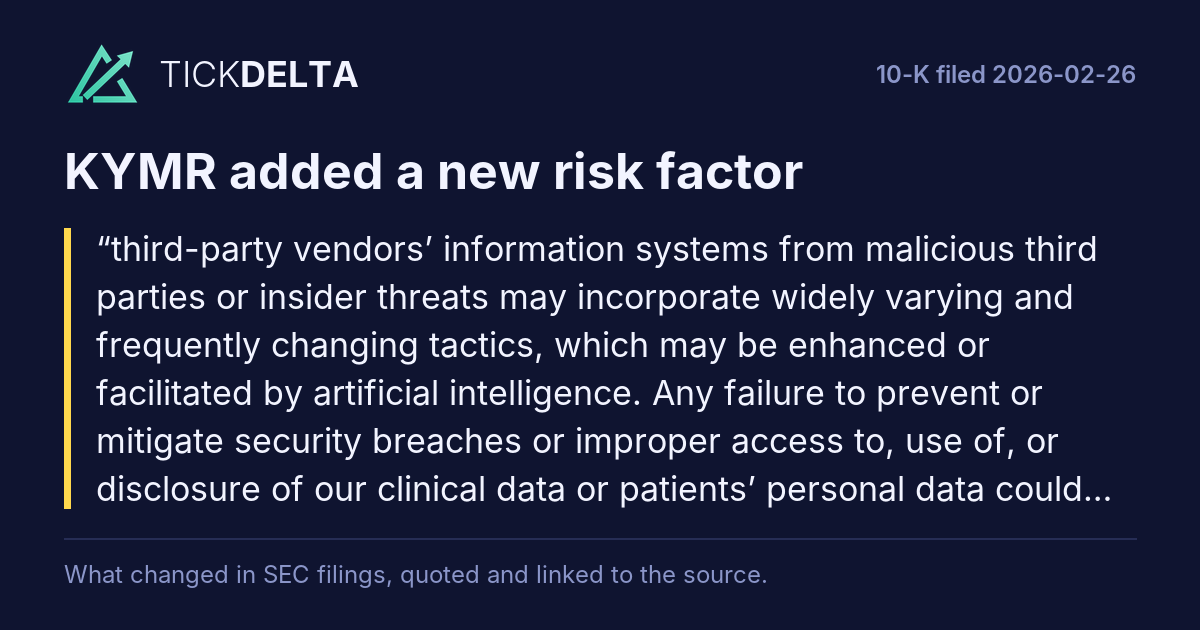
third-party vendors’ information systems from malicious third parties or insider threats may incorporate widely varying and frequently changing tactics, which may be enhanced or facilitated by artificial intelligence. Any failure to prevent or mitigate security breaches or improper access to, use of, or disclosure of our clinical data or patients’ personal data could result in significant liability under state (e.g., state breach notification laws), federal (e.g., HIPAA, as amended by HITECH), and international law (e.g., the EU General Data Protection Regulation, or GDPR) and may cause a material adverse impact to our reputation, affect our ability to use collected data, conduct new studies and potentially disrupt our business.
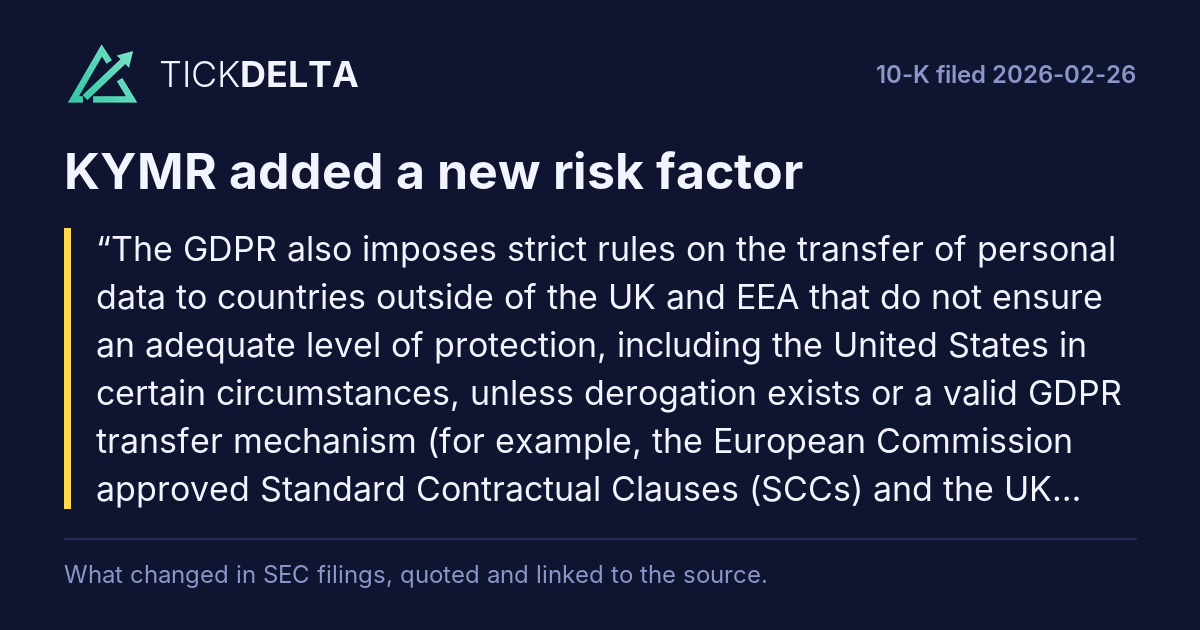
The GDPR also imposes strict rules on the transfer of personal data to countries outside of the UK and EEA that do not ensure an adequate level of protection, including the United States in certain circumstances, unless derogation exists or a valid GDPR transfer mechanism (for example, the European Commission approved Standard Contractual Clauses (SCCs) and the UK International Data Transfer Agreement or Addendum (UK IDTA)) have been put in place, and transfer impact assessments conducted. The EU and U.S. have adopted its adequacy decision for the EU-U.S. Data Privacy Framework, or Framework, which entered into force on July 11, 2023. This Framework provides that the protection of personal data transferred between the EU and the United States is comparable to that offered in the EU. This provides a further avenue to ensuring transfers to
the United States are carried out in line with GDPR. There has been an extension to the Framework to cover UK transfers to the United States. The Framework could be challenged like its predecessor frameworks. Any inability to transfer personal data from the UK or EEA to the United States in compliance with data protection laws may impede our operations and may adversely affect our business and financial position.
The UK’s data protection regime is independent from but aligned to the EU’s data protection regime. Although the UK is regarded as a third country under the EU’s GDPR, the European Commission has now issued an adequacy decision recognizing the UK as providing adequate protection under the EU GDPR and, therefore, transfers of personal data originating in the EEA to the UK remain unrestricted. In December 2025, the European Commission adopted a decision to extend the validity of the UK adequacy decision for six years until December 2031, determining that the UK continues to offer a level of data protection that is “essentially equivalent” to the EU standards. This follows the UK’s adoption of the Data (Use and Access) Act 2025 (the “DUAA”) on 19 June 2025. Like the EU GDPR, the UK GDPR restricts personal data transfers outside the UK to countries not regarded by the UK as providing adequate protection. The UK Government has confirmed that personal data transfers from the UK to the EEA remain free flowing. The respective provisions and enforcement of the EU GDPR and UK GDPR may further diverge in the future and create additional regulatory challenges and uncertainties. This lack of clarity on future UK laws and regulations and their interaction with EU laws and regulations could add legal risk, complexity and cost to our handling of personal data and our privacy and data security compliance programs and could require us to implement different compliance measures for the UK and the EEA.
Failure to comply with the requirements of the GDPR and the related national data protection laws of the EEA Member States and the UK may result in fines up to €20 million (17.5 million for the UK GDPR) or 4% of a company’s global annual revenues for the preceding financial year, whichever is higher. The GDPR also confers a private right of action on data subjects and consumer associations to lodge complaints with supervisory authorities, seek judicial remedies, and obtain compensation for damages resulting from violations of the GDPR. Complying with these European data protection laws may impose significant costs or otherwise require us to divert resources or implement changes to our business processes, and any actual or perceived non-compliance could result in significant penalties, claims and reputational damage.
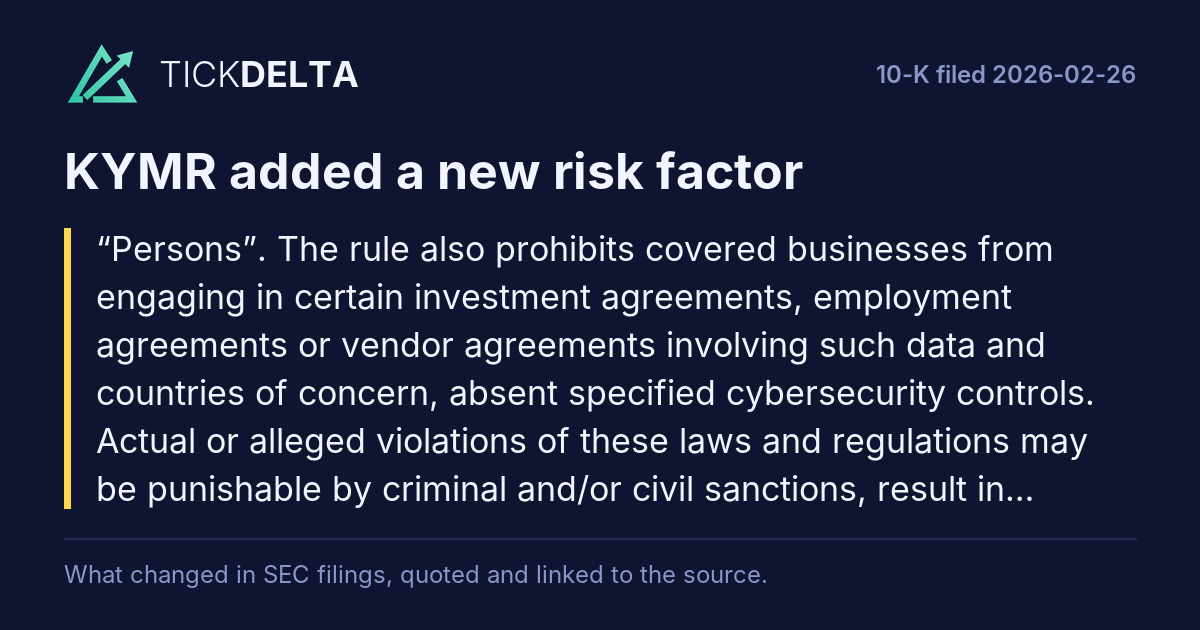
Persons”. The rule also prohibits covered businesses from engaging in certain investment agreements, employment agreements or vendor agreements involving such data and countries of concern, absent specified cybersecurity controls. Actual or alleged violations of these laws and regulations may be punishable by criminal and/or civil sanctions, result in exclusion from participation in federal and state programs or restrict our ability to use certain vendors, sites, investigators, or service providers in global clinical trials.
These current and future data privacy laws and regulations may require us to modify our data collection or processing practices and policies, incur substantial costs and expenses in an effort to comply and increase our potential exposure to regulatory enforcement, reputational damage, and/or litigation. Any failure or perceived failure by us to comply with any applicable federal, state or foreign laws and regulations relating to data privacy and security could result in damage to our reputation, as well as proceedings or litigation by governmental agencies or other third parties, including class action privacy litigation in certain jurisdictions, which would subject us to significant fines, sanctions, awards, injunctions, penalties or judgments. Any of the foregoing could have a material adverse effect on our business, financial condition, results of operations and prospects.
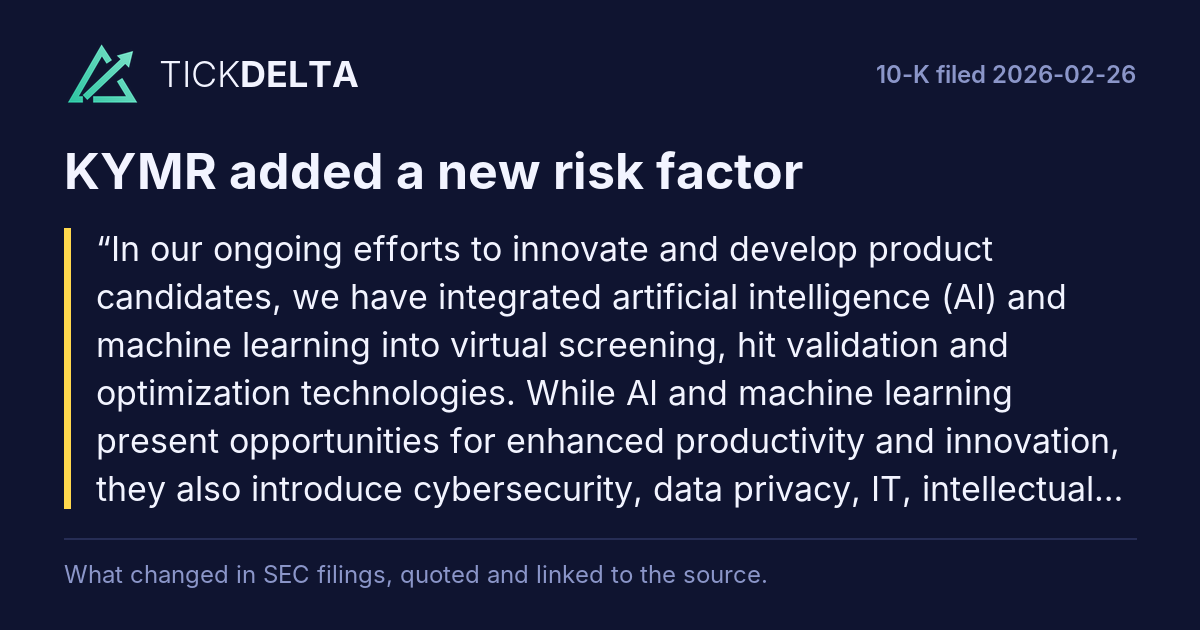
In our ongoing efforts to innovate and develop product candidates, we have integrated artificial intelligence (AI) and machine learning into virtual screening, hit validation and optimization technologies. While AI and machine learning present opportunities for enhanced productivity and innovation, they also introduce cybersecurity, data privacy, IT, intellectual property, regulatory, legal, operational, competitive, reputational and other risks that could adversely impact our business and reputation. Specifically, risks related to bias, AI hallucinations, discrimination, harmful content, misinformation, fraud, scams, targeted attacks (including model poisoning or data poisoning), surveillance, data leakage, inequality, environmental harms, and other harms may flow from our development, use, or deployment of AI technologies.
The rapid evolution of AI will require the application of significant resources to design, develop, test and maintain our products and services to help ensure that AI is implemented in accordance with applicable laws and regulations and in a socially responsible manner and to minimize any real or perceived unintended harmful impacts. If we enable or offer solutions that draw controversy due to perceived or actual negative societal impact, we may experience brand or reputational harm, competitive harm or legal liability. The use of certain AI technology can give rise to intellectual property risks, including compromises to proprietary intellectual property and intellectual property infringement.
The evolving regulatory landscape surrounding AI also poses a risk, as new laws and regulations could impose additional compliance burdens, resulting in increased operational costs to comply with U.S. and non-U.S. laws concerning the use of AI. We expect to see increasing regulation related to AI use and ethics, which may also significantly increase the burden and cost of research, development and compliance in this area. For example, the EU’s Artificial Intelligence Act (“AI Act”) entered into force on August 1, 2024, and, with some exceptions, will become fully effective in August 2026. As enacted, the AI Act imposes significant obligations on providers and deployers of high-risk AI systems and general purpose AI models and encourages providers and deployers to account for EU ethical principles when developing and using AI technology.
Likewise, in the United States, the regulatory environment is complex and uncertain. Over the past year, states have advanced, and in some cases passed, dozens of laws focusing on AI governance and regulation, including on deployment of AI in healthcare settings. At the federal level, the current administration has endorsed a federal moratorium on the enforcement of state AI laws, including through a December 11, 2025, executive order on “Ensuring a National Policy Framework for Artificial Intelligence.” So far, these efforts have not been successful at curtailing state action on AI regulation, contributing to a complicated legislative patchwork, which may be litigated in state and federal courts. Various federal and state regulators have also issued guidance and focused enforcement efforts on the use of AI in regulated sectors, such as healthcare. The U.S. Food and Drug Administration, for example, issued guidance on the use of AI in medical devices, requiring detailed risk management and review processes to obtain approvals. If we develop or use AI systems that are governed by these laws or regulations we will need to meet higher standards of data quality, transparency, and human oversight, as well as adhering to specific and potentially burdensome and costly ethical, accountability, and administrative requirements. We may also be subject to significant enforcement or litigation in the event of any perceived non-compliance.
We are committed to implementing governance and control mechanisms to mitigate these risks, but there can be no assurance that such measures will adequately prevent or mitigate the adverse effects that the integration and use of AI may have on our business, financial condition, and results of operations. The rapid evolution of AI will require the application of significant resources to design, develop, test and maintain our products and services to help ensure that AI is implemented in accordance with applicable law and regulation and in a socially responsible manner and to minimize any real or perceived
unintended harmful impacts. Our vendors may in turn incorporate AI tools into their offerings, and the providers of these AI tools may not meet existing or rapidly evolving regulatory or industry standards, including with respect to privacy and data security. Further, bad actors around the world use increasingly sophisticated methods, including the use of AI, to engage in illegal activities involving the theft and misuse of personal information, confidential information and intellectual property. In addition, the use of generative AI models in our internal or third-party systems may create new attack surfaces or methods for adversaries, which could impact us and our vendors. The integration of AI systems, by us or by our vendors, may increase cybersecurity risk. Any of these effects could damage our reputation, result in the loss of valuable property and information, cause us to breach applicable laws and regulations, and adversely impact our business.
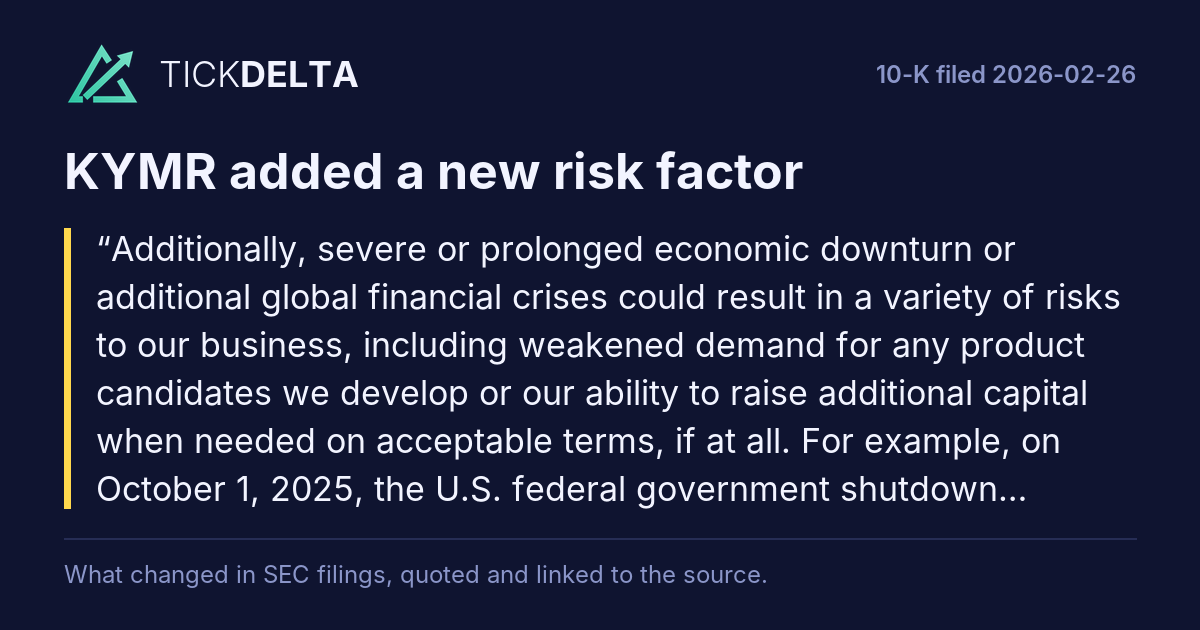
Additionally, severe or prolonged economic downturn or additional global financial crises could result in a variety of risks to our business, including weakened demand for any product candidates we develop or our ability to raise additional capital when needed on acceptable terms, if at all. For example, on October 1, 2025, the U.S. federal government shutdown through November 12, 2025, suspending services deemed non-essential as a result of the failure by Congress to enact regular appropriations for the 2026 fiscal year. If we experience another government shutdown, it could result in increased uncertainty and volatility in the global economy and financial markets which could have a material adverse effect on our business. Weak economic conditions or significant uncertainty regarding the stability of financial markets related to stock market volatility, inflation, recession, changes in tariffs or other trade restrictions, trade agreements, trade wars or governmental fiscal, monetary and tax policies, among others, could adversely impact our business, financial condition and operating results.
New in the latest 10-Q
11 paragraphs in the 10-Q filed Oct 29, 2026 with nothing like them in the 10-Q filed Aug 5, 2026 (at least half the words must differ; new numbers alone do not count). Quoted exactly, grouped by the item heading above them. This is text that changed, not a judgement of how serious it is.
In July 2026, the Company entered into a sublease for its 2019 Lease. The sublease commences on January 1, 2027 with rent commencement September 1, 2027, and terminates on March 31, 2030, which is concurrent with the termination of the Company's 2019 Lease. The Company was not relieved of its primary obligation under the 2019 Lease as a result of the sublease, and there was no incremental impairment recognized as a result of the sublease. The Company expects to begin recognizing sublease income on a straight-line basis over the term of the sublease agreement upon commencement of the lease.
Read in the 10-Q
indemnification agreements is unlimited. The Company is not aware of any claims under indemnification arrangements, and it has not accrued any liabilities related to such obligations as of September 30, 2026 or December 31, 2025.
Read in the 10-Q
September 30, September 30, 2026 2025 2026 2025 ──────────────────────────────────────────────────────────────────────────────────────────────────────────────────────────────────── Research and development $ 6,843 $5,919 $ 19,072 $17,615 General and administrative 6,473 6,626 19,780 18,891 Total equity-based compensation $ 13,316 $12,545 $ 38,852 $36,506 The weighted-average assumptions that the Company used in the Black-Scholes option pricing model to determine the grant date fair value of stock options granted to employees and non-employees for the three and nine months ended September 30, 2026 and 2025 were as follows: Three Months Ended Nine Months Ended
Read in the 10-Q
There was no impairment on long-lived assets for the three months ended September 30, 2026, compared to $3.9 million for three months ended September 30, 2025. The decrease of $3.9 million was the result of an incremental impairment charge taken on the 2019 Lease due to the continued worsening of market conditions for office and laboratory space in the area of the 2019 Lease.
Read in the 10-Q
There was no impairment on long-lived assets for the nine months ended September 30, 2026, compared to $3.9 million for nine months ended September 30, 2025. The decrease of $3.9 million was the result of an incremental impairment charge taken on the 2019 Lease due to the continued worsening of market conditions for office and laboratory space in the area of the 2019 Lease.
Read in the 10-Q
• the evolving geopolitical landscape that may limit or restrict access to foreign clinical trial sites and/or foreign clinical trial data and documentation;
Read in the 10-Q
• changes to U.S. trade policies, sanctions, legislation, treaties, and tariffs;
Read in the 10-Q
requirements and oversight if we become subject to a corporate integrity agreement or similar agreement to resolve allegations of non-compliance with these laws and the curtailment or restructuring of our operations, any of which could adversely affect our ability to operate our business and our results of operations.
Read in the 10-Q
security obligations. Further, although we maintain cyber liability insurance, this insurance may not provide adequate coverage against potential liabilities related to any experienced security incident or data breach.
Read in the 10-Q
The global economy and financial markets have experienced volatility and disruptions, including diminished liquidity and credit availability, declines in consumer confidence, actual or perceived changes in interest rates, inflation, declines in economic growth, global supply chain disruptions, increases in unemployment rates, and uncertainty about economic stability. Current inflationary trends in the global economy may impact salaries and wages, costs of goods and transportation expenses, among other things, and recent and potential future disruptions in access to bank deposits or lending commitments due to bank failures may create market and economic instability.
Read in the 10-Q
laws, which could result in an increase in our or our shareholders’ tax liability or require changes in the manner in which we operate in order to minimize or mitigate any adverse effects of changes in tax law or in the interpretation thereof.
Read in the 10-Q
Item 1A of the 10-Q filed Oct 29, 2026 against Item 1A of the 10-K filed Feb 26, 2026.
A 10-Q repeats only the risks that changed, so a 10-K paragraph that is missing from it is not counted as removed.
Added is a paragraph with nothing like it in the 10-K, Reworded a sentence that is in both with several words changed,
Quiet changes a sentence in both where one to four words changed and one is a hedge or a modal
(cut words struck through, new words highlighted).
Text on the page, not a score; each links to the filing at sec.gov.
The first 21 of 70 are shown (at most 12 of each type).
Two-word phrases in Risk Factors of the 10-K filed Feb 26, 2026 that are in none of the 1 earlier 10-Ks stored, back to Feb 27, 2025
Used at least twice, small words left out. Counted, not picked: a phrase can be new because the company renamed something.
8 paragraphs of last year's Risk Factors with nothing like them now. The longest are quoted.
Item 1A of each 10-K and 10-Q on EDGAR, quoted exactly. Each paragraph links to the filing at sec.gov.
10-K change: what was reworded or cut, section by section.
Excel workbook · CSV. Google Sheet that stays up to date: paste =IMPORTDATA("https://tickdelta.com/company/KYMR/export.csv") into a cell.