Paragraph 286 · 50% changed
Every version of it
Screener
/
SEC EDGAR
/CIK 0001815442
/10-K filed Feb 26, 2026, compared with Feb 27, 2025
/Numbers from the XBRL of the 10-Ks
Nasdaq
Health care · Biotechnology
Kymera Therapeutics, Inc. KYMR
The 10-K against last year's
140 changes: 30 added, 9 removed, 96 reworded, 5 quiet changes
10-K Feb 26, 2026 vs Feb 27, 2025
Risk Factors
15.3%
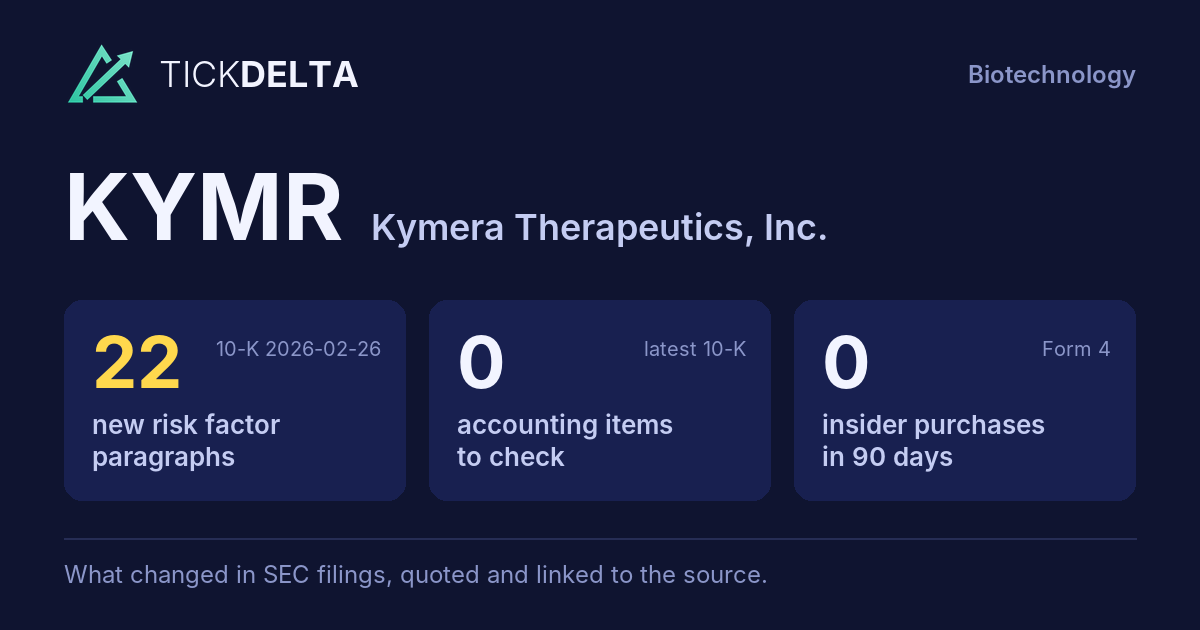
of the text changed · 41,219 words now · 22 new paragraphs, 8 gone
MD&A
15.2%
of the text changed · 8,619 words now · 8 new paragraphs, 1 gone
Legal Proceedings
0.0%
of the text changed · 256 words now
Accounting Policies
11.7%
of the text changed · 1,154 words now
10-K 0001193125-26-073395 (Feb 26, 2026) vs 10-K 0000950170-25-028355 (Feb 27, 2025)
Every paragraph, and how much of it changed
One bar per paragraph, in the order of the 10-K. Height and colour show the share of its words not in the closest paragraph a year earlier; the tallest bars are new paragraphs.
Risk Factors
451 paragraphs · 22 new · 92 reworded · 8 gone · 10-K Feb 26, 2026 against Feb 27, 2025
New paragraph
Reworded (5% of its words or more)
Same or nearly
Paragraph 184 · 49% changed
Every version of it
Among other matters, U.S. and foreign anti-corruption, including the Foreign Corrupt Practices Act (FCPA), anti-money laundering, export control, sanctions, and other trade laws and regulations, which we collectively refer to as Trade Laws, prohibit companies and their employees, agents, clinical research organizations, legal counsel, accountants, consultants, contractors, and other partners from authorizing, promising, offering, providing, soliciting, or receiving directly or indirectly, corrupt or improper payments or anything else of value to or from recipients in the public or private sector. Anti-corruption and anti-bribery laws have been enforced aggressively in recent years and are interpreted broadly. Violations of Trade Laws can result in substantial criminal fines and civil penalties, imprisonment, the loss of trade privileges, debarment, tax reassessments, breach of contract and fraud litigation, reputational harm, and other consequences. As we increase our activities outside the United States, which may include increased interactions with officials and employees of government agencies or state-owned or -affiliated entities, our risks under these laws may increase. Noncompliance with these laws could subject us to investigations, sanctions, settlements, prosecution, other enforcement actions, disgorgement of profits, significant fines, damages, other civil and criminal penalties or injunctions, adverse media coverage, and other consequences. Any investigations, actions or sanctions could harm our business, results of operations, and financial condition. We have direct or indirect interactions with officials and employees of government agencies or government-affiliated hospitals, universities, and other organizations.
Paragraph 387 · 48% changed
Every version of it
Paragraph 361 · 47% changed
Every version of it
We are highly dependent on the research and development, clinical and business development expertise of Nello Mainolfi, Ph.D., our President and Chief Executive Officer, Jared Gollob, M.D., our Chief Medical Officer, Bruce Jacobs, our Chief Financial Officer, Ellen Chiniara, Brian Adams, our Chief Legal Officer and Officer, Jeremy Chadwick, our Chief Operating Officer and Noah Goodman, our Chief Business Officer, as well as the other principal members of our management, scientific and clinical teams. Although we have entered into employment letter agreements with our executive officers, each of them may terminate their employment with us at any time. We do not maintain “key person” insurance for any of our executives or other employees. In addition, we rely on consultants and advisors, including scientific and clinical advisors, to assist us in formulating our research and development and commercialization strategy. Our consultants and advisors may be employed by employers other than us and may have commitments under consulting or advisory contracts with other entities that may limit their availability to us. If we are unable to continue to attract and retain high quality personnel, our ability to pursue our growth strategy will be limited.
Paragraph 162 · 47% changed
Every version of it
Paragraph 191 · 46% changed
Every version of it
Paragraph 376 · 45% changed
Every version of it
Paragraph 410 · 42% changed
Every version of it
Changes in U.S. federal policy that affect the geopolitical landscape could give rise to circumstances outside our control that could have negative impacts on our business operations. For example, during on September 25, 2025, the prior Trump administration, increased current U.S. administration announced a 100% tariff on brand-name or patented drugs unless pharmaceutical companies expand their manufacturing operations in the U.S. While pharmaceutical products are currently excluded from the baseline and "reciprocal" tariffs were implemented on goods imported into imposed by the U.S., particularly from China, Canada, such tariffs still apply to the raw materials and Mexico. On February 1, 2025, other products necessary for the manufacture and formulation of our product candidates. In addition, the current U.S. administration has expressed an intent to impose tariffs on pharmaceutical imports, with the stated policy objective of reshoring pharmaceutical manufacturing to the United States. Among other means, such tariffs may be imposed by the United States under Section 232 of the Trade Expansion Act of 1962, as amended, pursuant to which the U.S. imposed a 25% tariff Department of Commerce recently initiated an investigation to determine the effects of importing pharmaceuticals and pharmaceutical ingredients on imports from Canada and Mexico, national security. The current U.S. administration has threatened to continue to broadly impose tariffs, which were subsequently suspended for a period of one month, and a 10% additional tariff on imports from China. could lead to corresponding punitive actions by the countries with which the U.S. trades. Historically, tariffs have led to increased trade and political tensions, between not only the U.S. and China, but also between the U.S. and other countries in the international community. In response to tariffs, other countries have implemented retaliatory tariffs on U.S. goods. Political tensions as a result of trade policies could reduce trade volume, investment, technological exchange and other economic activities between major international economies, resulting in a material adverse effect on global economic conditions and the stability of global financial markets. Any changes in political, trade, regulatory, and economic conditions, including U.S. trade policies, could have a material adverse effect on our financial condition or results of operations. We are continuing to monitor global capital markets and assessing the potential impact of these factors on our business.
Paragraph 286 · 50% changed
Every version of it
10-K Feb 27, 2025Even if we acquire patent protection that we expect should enable us to establish and/or maintain a competitive advantage, third parties may challenge the validity, enforceability or scope thereof, which may result in such patents being narrowed, invalidated or held unenforceable. The issuance of a patent is not conclusive as to its inventorship, scope, validity or enforceability, and our patents may be challenged in the courts or patent offices in the U.S. and abroad. We may become involved in opposition, derivation, reexamination, inter partes review, or post-grant review proceedings challenging our patent rights or the patent rights of others from whom we may in the future obtain licenses to such rights, in the U.S. Patent and Trademark Office, or USPTO, the European Patent Office, or EPO, or in other countries. In addition, we may be subject to third-party submissions to the USPTO, the EPO, or elsewhere, that may reduce the scope or preclude the granting of claims from our pending patent applications. Competitors may challenge our issued patents or may file patent applications before we do. Competitors may also claim that we are infringing their patents and that we therefore cannot practice our technology as claimed under our patents or patent applications. Competitors may also contest our patents by showing an administrative patent authority or judge that the invention was not patent-eligible, was not novel, was obvious, and/or lacked inventive step, and/or that the patent application failed to meet relevant requirements relating to description, basis, enablement, and/or support; in litigation, a competitor could assert that our patents are not valid or are unenforceable for a number of reasons. If a court or administrative patent authority agrees, we would lose our protection of those challenged patents.
10-K Feb 26, 2026
patent-eligible, was not novel, was obvious, and/or lacked inventive step, and/or that the patent application failed to meet relevant requirements relating to description, basis, enablement, and/or support; in litigation, a competitor could assert that our patents are not valid or are unenforceable for a number of reasons. If a court or administrative patent authority agrees, we would lose our protection of those challenged patents.
Paragraph 184 · 49% changed
Every version of it
10-K Feb 27, 2025
Among other matters, U.S. and foreign anti-corruption, including the Foreign Corrupt Practices Act (FCPA), anti-money laundering, export control, sanctions, and other trade laws and regulations, which we collectively refer to as Trade Laws, prohibit companies and their employees, agents, clinical research organizations, legal counsel, accountants, consultants, contractors, and other partners from authorizing, promising, offering, providing, soliciting, or receiving directly or indirectly, corrupt or improper payments or anything else of value to or from recipients in the public or private sector. Anti-corruption and anti-bribery laws have been enforced aggressively in recent years and are interpreted broadly. Violations of Trade Laws can result in substantial criminal fines and civil penalties, imprisonment, the loss of trade privileges, debarment, tax reassessments, breach of contract and fraud litigation, reputational harm, and other consequences. As we increase our activities outside the United States, which may include increased interactions with officials and employees of government agencies or state-owned or -affiliated entities, our risks under these laws may increase. Noncompliance with these laws could subject us to investigations, sanctions, settlements, prosecution, other enforcement actions, disgorgement of profits, significant fines, damages, other civil and criminal penalties or injunctions, adverse media coverage, and other consequences. Any investigations, actions or sanctions could harm our business, results of operations, and financial condition. We have direct or indirect interactions with officials and employees of government agencies or government-affiliated hospitals, universities, and other organizations.
10-K Feb 26, 2026
Among other matters, U.S. and foreign anti-corruption, including the Foreign Corrupt Practices Act (FCPA), anti-money laundering, export control, sanctions, and other trade laws and regulations, which we collectively refer to as Trade Laws, prohibit companies and their employees, agents, clinical research organizations, legal counsel, accountants, consultants, contractors, and other partners from authorizing, promising, offering, providing, soliciting, or receiving directly or indirectly,
Paragraph 387 · 48% changed
Every version of it
10-K Feb 27, 2025In addition, federal and state legislators and regulators are imposing new and heightened protections for health and other sensitive information that could impact our business. For example, the Federal Trade Commission (“FTC”) has imposed stringent requirements on the collection and disclosure of sensitive categories of personal information, including health information, and has expanded the application of its Health Breach Notification Rule. Through executive and legislative action, the federal government has also taken steps to restrict data transactions involving certain sensitive data categories – including health data, genetic data, and biospecimens – with persons affiliated with China, Russia, and other countries of concern. Washington’s My Health My Data Act, which went into effect in March 2024, requires regulated entities to obtain consent to collect health information, grants consumers certain rights, including to request deletion, and provides for robust enforcement mechanisms, including enforcement by the state attorney-general and by litigants through a private right of action for consumer claims. These current and future data privacy laws and regulations may require us to modify our data collection or processing practices and policies, incur substantial costs and expenses in an effort to comply and increase our potential exposure to regulatory enforcement, reputational damage, and/or litigation.
10-K Feb 26, 2026
States are also putting in place laws that apply additional protections specifically to health information. For example, Washington’s My Health My Data Act, which went into effect in March 2024, requires regulated entities to obtain consent to collect health information, grants consumers certain rights, including to request deletion, and provides for robust enforcement mechanisms, including enforcement by the state attorney-general and by litigants through a private right of action for consumer claims. Connecticut and Nevada have also passed similar laws regulating consumer health data. In addition, other states have proposed or passed legislation that regulates the privacy and security of certain specific types of information. For example, a small number of states have passed laws that regulate biometric data specifically.
Paragraph 361 · 47% changed
Every version of it
10-K Feb 27, 2025
We are highly dependent on the research and development, clinical and business development expertise of Nello Mainolfi, Ph.D., our President and Chief Executive Officer, Jared Gollob, M.D., our Chief Medical Officer, Bruce Jacobs, our Chief Financial Officer, Ellen Chiniara, our Chief Legal Officer and Jeremy Chadwick, our Chief Operating Officer, as well as the other principal members of our management, scientific and clinical teams. Although we have entered into employment letter agreements with our executive officers, each of them may terminate their employment with us at any time. We do not maintain “key person” insurance for any of our executives or other employees. In addition, we rely on consultants and advisors, including scientific and clinical advisors, to assist us in formulating our research and development and commercialization strategy. Our consultants and advisors may be employed by employers other than us and may have commitments under consulting or advisory contracts with other entities that may limit their availability to us. If we are unable to continue to attract and retain high quality personnel, our ability to pursue our growth strategy will be limited.
10-K Feb 26, 2026
We are highly dependent on the research and development, clinical and business development expertise of Nello Mainolfi, Ph.D., our President and Chief Executive Officer, Jared Gollob, M.D., our Chief Medical Officer, Bruce Jacobs, our Chief Financial Officer, Brian Adams, our Chief Legal Officer, Jeremy Chadwick, our Chief Operating Officer and Noah Goodman, our Chief Business Officer, as well as the other principal members of our management, scientific and clinical teams.
Paragraph 162 · 47% changed
Every version of it
10-K Feb 27, 2025With the change in presidential administrations in 2025, there is substantial uncertainty as to how, if at all, the new administration will seek to modify or revise the requirements and policies of the FDA and other regulatory agencies with jurisdiction over our product candidates. The impending uncertainty could present new challenges or potential opportunities as we navigate the clinical development and approval process for our product candidates.
10-K Feb 26, 2026
There is substantial uncertainty as to whether and how the current administration will seek to modify or revise the requirements and policies of the FDA and other regulatory agencies with jurisdiction over our product candidates and any products for which we obtain approval. Additionally, the current administration could also issue or promulgate executive orders, regulations, policies or guidance that adversely affect us or create a more challenging or costly environment to pursue the development of new therapeutic candidates or delay the review or effectiveness of required regulatory or securities filings.
Paragraph 191 · 46% changed
Every version of it
10-K Feb 27, 2025levels. A primary trend in the U.S. healthcare industry and elsewhere is cost containment. Government authorities and third-party payors have attempted to control costs by limiting coverage and the amount of reimbursement for particular medications. Increasingly, third-party payors are requiring that drug companies provide them with predetermined discounts from list prices and are challenging the prices charged for medical products. Coverage and reimbursement may not be available for any product that we commercialize and, even if these are available, the level of reimbursement may not be satisfactory. Reimbursement may affect the demand for, or the price of, any product candidate for which we obtain marketing approval. Obtaining and maintaining adequate reimbursement for our products may be difficult. We may be required to conduct expensive pharmacoeconomic studies to justify coverage and reimbursement or the level of reimbursement relative to other therapies. If coverage and adequate reimbursement are not available or reimbursement is available only to limited levels, we may not be able to successfully commercialize any product candidate for which we obtain marketing approval. Coverage and reimbursement by a third-party payor may depend upon a number of factors, including the third-party payor’s determination that use of a product is:
10-K Feb 26, 2026
available only to limited levels, we may not be able to successfully commercialize any product candidate for which we obtain marketing approval. Coverage and reimbursement by a third-party payor may depend upon a number of factors, including the third-party payor’s determination that use of a product is:
Paragraph 376 · 45% changed
Every version of it
10-K Feb 27, 2025We rely on information technology systems that we or our third-party providers operate to process, transmit and store electronic information in our day-to-day operations. In connection with our product discovery efforts, we may collect and use a variety of personal data, such as names, mailing addresses, email addresses, phone numbers and clinical trial information. A successful cyberattack, security incident, or compromise could result in the theft or destruction of intellectual property, data or other misappropriation of assets, or otherwise compromise our confidential or proprietary information and disrupt our operations. Cyberattacks are increasing in their frequency, sophistication and intensity, and have become increasingly difficult to detect. Cyberattacks could include wrongful conduct by hostile foreign governments, industrial espionage, wire fraud and other forms of cyber fraud, the deployment of harmful malware, denial-of-service, social engineering fraud or other means to threaten data security, confidentiality, integrity and availability. A successful cyberattack could cause serious negative consequences for us, including, without limitation, the disruption of operations, the misappropriation of confidential business information, including financial information, trade secrets, financial loss and the disclosure of corporate strategic plans. Although we devote resources to protect our information systems, we realize that cyberattacks are a threat, and there can be no assurance that our efforts will prevent information security breaches that would result in business, legal, financial or reputational harm to us, or would have a material adverse effect on our results of operations and financial condition. Any failure to prevent or mitigate security breaches or improper access to, use of, or disclosure of our clinical data or patients’ personal data could result in significant liability under state (e.g., state breach notification laws), federal (e.g., HIPAA, as amended by HITECH), and international law (e.g., the EU General Data Protection Regulation, or GDPR) and may cause a material adverse impact to our reputation, affect our ability to use collected data, conduct new studies and potentially disrupt our business.
10-K Feb 26, 2026
A successful cyberattack could cause serious negative consequences for us, including, without limitation, the disruption of operations, the misappropriation of confidential business information, including financial information, trade secrets, financial loss and the disclosure of corporate strategic plans. Although we devote resources to protect our information systems, we realize that cyberattacks are a threat, and there can be no assurance that our efforts will prevent information security incidents or breaches that would result in business, legal, financial or reputational harm to us, or would have a material adverse effect on our results of operations and financial condition. Attempts to disrupt or gain unauthorized access to our and our
Paragraph 410 · 42% changed
Every version of it
10-K Feb 27, 2025
Changes in U.S. federal policy that affect the geopolitical landscape could give rise to circumstances outside our control that could have negative impacts on our business operations. For example, during the prior Trump administration, increased tariffs were implemented on goods imported into the U.S., particularly from China, Canada, and Mexico. On February 1, 2025, the U.S. imposed a 25% tariff on imports from Canada and Mexico, which were subsequently suspended for a period of one month, and a 10% additional tariff on imports from China. Historically, tariffs have led to increased trade and political tensions, between not only the U.S. and China, but also between the U.S. and other countries in the international community. In response to tariffs, other countries have implemented retaliatory tariffs on U.S. goods. Political tensions as a result of trade policies could reduce trade volume, investment, technological exchange and other economic activities between major international economies, resulting in a material adverse effect on global economic conditions and the stability of global financial markets. Any changes
10-K Feb 26, 2026
Changes in U.S. federal policy that affect the geopolitical landscape could give rise to circumstances outside our control that could have negative impacts on our business operations. For example, on September 25, 2025, the current U.S. administration announced a 100% tariff on brand-name or patented drugs unless pharmaceutical companies expand their manufacturing operations in the U.S. While pharmaceutical products are currently excluded from the baseline and "reciprocal" tariffs imposed by the U.S., such tariffs still apply to the raw materials and other products necessary for the manufacture and formulation of our product candidates. In addition, the current U.S. administration has expressed an intent to impose tariffs on pharmaceutical imports, with the stated policy objective of reshoring pharmaceutical manufacturing to the United States. Among other means, such tariffs may be imposed by the United States under Section 232 of the Trade Expansion Act of 1962, as amended, pursuant to which the U.S. Department of Commerce recently initiated an investigation to determine the effects of importing pharmaceuticals and pharmaceutical ingredients on national security. The current U.S. administration has threatened to continue to broadly impose tariffs, which could lead to corresponding punitive actions by the countries with which the U.S. trades. Historically, tariffs have led to increased trade and political tensions, between not only the U.S. and China, but also between the U.S. and other countries in the international community. In response to tariffs, other countries have implemented retaliatory tariffs on U.S. goods. Political tensions as a result of trade policies could reduce trade volume, investment, technological exchange and other economic activities between major international economies, resulting in a material adverse effect on global economic conditions and the stability of global financial markets. Any changes in political, trade, regulatory, and economic conditions, including U.S. trade policies, could have a material adverse effect on our financial condition or results of operations. We are continuing to monitor global capital markets and assessing the potential impact of these factors on our business.
MD&A
129 paragraphs · 8 new · 32 reworded · 1 gone · 10-K Feb 26, 2026 against Feb 27, 2025
New paragraph
Reworded (5% of its words or more)
Same or nearly
Paragraph 37 · 45% changed
In consideration for the exclusive licenses option and rights granted to Sanofi under the Sanofi Gilead Agreement, Sanofi paid to us an we received a non-refundable upfront payment of $150.0 $40.0 million. In addition to addition, if Gilead exercises the upfront payment, under the agreement option, we were eligible are entitled to receive certain development milestone payments an option exercise payment of up to $1.48 billion, $45.0 million and commercial milestone payments of up to $700.0 million, in the aggregate. Of these milestones, we remain will be eligible to receive up to $1.0 billion in development milestones $665.0 million upon the achievement of certain developmental or development, regulatory events, and up to $400.0 million in commercial milestones which milestones. We are payable upon the achievement of certain net sales thresholds, all of which are related to the IRAK4 program. We will further be also eligible to receive tiered royalties on net sales by Gilead ranging from the high single digits single-digit to high teens, mid-teen percentages, subject to low-single digits upward adjustments customary reductions in certain circumstances. As of December 31, 2024, we have achieved $55.0 million of milestones under the Sanofi Agreement related to certain IRAK4 clinical milestones. circumstances
Paragraph 71 · 43% changed
Impairment of long-lived assets was $4.9 $3.9 million for the year ended December 31, 2024, 2025, compared to $0 $4.9 million for year ended December 31, 2023. 2024. The increase decrease of $4.9 $1.0 million was as a result of the occupancy relative carrying values of the 2021 Lease facility in February of 2024 and underlying asset that was impaired relative to the corresponding exit of the 2019 Lease facility, resulting in an impairment charge of $4.9 million in the year ended December 31, 2024. expected future cash flows.
Paragraph 33 · 42% changed
In September 2023, the Company and Sanofi we mutually agreed to cease activities related to Collaboration Target 2. the undisclosed target and we are no longer eligible for the milestone and royalty payments associated with the second target.
Paragraph 27 · 39% changed
Paragraph 120 · 38% changed
Revenue is recognized when (or as) control of a performance obligation is transferred to the customer. When combined performance obligations contain a promised license and related services or other promises, management judgment is required to determine the appropriate timing of revenue recognition. In doing so, we must identify the predominant promise or promises in the contract to determine whether revenue is recognized at a point in time or over time. If over time, we must determine the appropriate measure of progress. If a license is deemed to be the predominant promise in a performance obligation, we must determine the nature of the license, whether functional or symbolic intellectual property, to conclude whether point-in-time or over-time revenue recognition is most appropriate. The determination of functional or symbolic intellectual property requires an assessment of whether the customer is able to exploit and benefit from the license in its current condition, or if the utility of the license is dependent on or influenced by our ongoing activities or being associated with us.
Paragraph 6 · 34% changed
Our publicly disclosed immunology programs target STAT6, TYK2 IRF5 and IRAK4, each of which addresses targets within validated pathways, providing the opportunity to treat a broad range of diseases. We are developing KT-621 as part of our STAT6 program, which is currently being evaluated and recently initiated the BROADEN2 Phase 2b clinical trial in adult and adolescent patients with moderate to severe Atopic Dermatitis (AD) and the BREADTH Phase 2b clinical trial in adult patients with moderate to severe asthma. We are also developing KT-579 as part of our oral IRF5 degrader program, and we recently initiated a Phase 1 clinical trial in healthy volunteers. Our lead molecule in our TYK2 program is KT-295, which we anticipate will enter the clinic in the second quarter of 2025. We are collaborating with Sanofi S.A., or Sanofi, S.A. (“Sanofi”) on the development of drug candidates targeting IRAK4, including KT-474/SAR444656, outside of oncology and immuno-oncology fields. our IRAK4 degrader, KT-485/SAR447971, which Sanofi has initiated two Phase 2b plans to advance into clinical trials of KT-474 testing in patients 2026. In June 2025, we announced a strategic collaboration with hidradenitis suppurativa (HS) and in patients with atopic dermatitis (AD). Gilead Sciences, Inc. (“Gilead”) to develop novel oral molecular glue degraders for CDK2. Our additional early undisclosed pipeline focuses programs focus on addressing high impact targets that have been elusive to conventional modalities and that drive the pathogenesis of multiple serious diseases with significant unmet medical needs.
Paragraph 69 · 33% changed
Research and development expenses were $316.6 million for the year ended December 31, 2025, compared to $240.2 million for the year ended December 31, 2024, compared to $189.1 million for the year ended December 31, 2023. 2024. The increase of $51.2 $76.3 million was primarily due to an increase of $58.4 $46.8 million in costs related to our STAT6, TYK2 STAT6 program, and MDM2 programs, as well as an increase increases of $21.1 $14.4 million and $8.0 million, respectively, in personnel, personnel and stock-based compensation compensation, and occupancy and overhead costs due to increases in employee headcount in our research and development functions. These increases were partially offset by a $10.9 million reduction in activities related to our IRAK4 and STAT3 programs and a $17.4 million reduction in our other research and development costs due to stage progression and breakout of STAT6 and TYK2 programs. headcount.
Paragraph 78 · 32% changed
Research and development expenses were $240.2 million for the year ended December 31, 2024, compared to $189.1 million for the year ended December 31, 2023. The increase of $51.2 million was primarily due to an increase of $58.4 $30.1 million in costs related to our STAT6, TYK2 clinical and MDM2 preclinical programs, as well as an increase and increases of $21.1 $10.9 million and $10.1 million respectively in personnel, personnel and stock-based compensation costs, and occupancy and overhead costs due to increases in employee headcount in our research and development functions. These increases were partially offset by a $10.9 million reduction in activities related to our IRAK4 and STAT3 programs and a $17.4 million reduction in our other research and development costs due to stage progression and breakout of STAT6 and TYK2 programs. headcount.
Paragraph 37 · 45% changed
10-K Feb 27, 2025
In consideration for the exclusive licenses granted to Sanofi under the Sanofi Agreement, Sanofi paid to us an upfront payment of $150.0 million. In addition to the upfront payment, under the agreement we were eligible to receive certain development milestone payments of up to $1.48 billion, and commercial milestone payments of up to $700.0 million, in the aggregate. Of these milestones, we remain eligible to receive up to $1.0 billion in development milestones upon the achievement of certain developmental or regulatory events, and up to $400.0 million in commercial milestones which are payable upon the achievement of certain net sales thresholds, all of which are related to the IRAK4 program. We will further be eligible to receive tiered royalties on net sales ranging from the high single digits to high teens, subject to low-single digits upward adjustments in certain circumstances. As of December 31, 2024, we have achieved $55.0 million of milestones under the Sanofi Agreement related to certain IRAK4 clinical milestones.
10-K Feb 26, 2026
In consideration for the exclusive option and rights granted under the Gilead Agreement, we received a non-refundable upfront payment of $40.0 million. In addition, if Gilead exercises the option, we are entitled to receive an option exercise payment of $45.0 million and will be eligible to receive up to $665.0 million upon the achievement of certain development, regulatory and commercial milestones. We are also eligible to receive tiered royalties on net sales by Gilead ranging from high single-digit to mid-teen percentages, subject to customary reductions in certain circumstances
Paragraph 71 · 43% changed
10-K Feb 27, 2025
Impairment of long-lived assets was $4.9 million for the year ended December 31, 2024, compared to $0 for year ended December 31, 2023. The increase of $4.9 million was as a result of the occupancy of the 2021 Lease facility in February of 2024 and the corresponding exit of the 2019 Lease facility, resulting in an impairment charge of $4.9 million in the year ended December 31, 2024.
10-K Feb 26, 2026
Impairment of long-lived assets was $3.9 million for the year ended December 31, 2025, compared to $4.9 million for year ended December 31, 2024. The decrease of $1.0 million was a result of the relative carrying values of the underlying asset that was impaired relative to the expected future cash flows.
Paragraph 33 · 42% changed
10-K Feb 27, 2025
In September 2023, the Company and Sanofi mutually agreed to cease activities related to Collaboration Target 2.
10-K Feb 26, 2026
In September 2023, we mutually agreed to cease activities related to the undisclosed target and we are no longer eligible for the milestone and royalty payments associated with the second target.
Paragraph 27 · 39% changed
10-K Feb 27, 2025On July 7, 2020, we entered into a collaboration agreement, or the Sanofi Agreement, with Sanofi to co-develop drug candidates directed to two biological targets. Under the Sanofi Agreement, we granted to Sanofi a worldwide exclusive license to develop, manufacture and commercialize certain lead compounds generated during the collaboration directed against IRAK4 and one additional undisclosed target in an undisclosed field of use. Such license is exercisable on a collaboration target-by-collaboration target basis only after a specified milestone. For compounds directed against IRAK4, the field of use includes diagnosis, treatment, cure, mitigation or prevention of any diseases, disorders or conditions, excluding oncology and immuno-oncology. We are responsible for discovery and preclinical research and conducting a phase 1 clinical trial for at least one degrader directed against IRAK4 plus up to three backup degraders. With respect to both targets, Sanofi is responsible for development, manufacturing, and commercialization of product candidates after a specified development milestone occurs with respect to each collaboration candidate.
10-K Feb 26, 2026
Pursuant to the Sanofi Agreement, with respect to both targets we are responsible for discovery and preclinical research and conducting a phase 1 clinical trial for at least one degrader directed against IRAK4 plus up to three back up degraders, the costs of which will be borne by us, except in certain circumstances. With respect to both targets, Sanofi is responsible for development, manufacturing, and commercialization of product candidates after a specified development milestone occurs with respect to each collaboration candidate.
Paragraph 120 · 38% changed
10-K Feb 27, 2025
Revenue is recognized when (or as) control of a performance obligation is transferred to the customer. When combined performance obligations contain a promised license and related services or other promises, management judgment is required to determine the appropriate timing of revenue recognition. In doing so, we must identify the predominant promise or promises in the contract to determine whether revenue is recognized at a point in time or over time. If over time, we must determine the appropriate measure of progress. If a license is deemed to be the predominant promise in a performance obligation, we must determine the nature of the license, whether functional or symbolic intellectual property, to conclude whether point-in-time or over-time revenue recognition is most appropriate. The determination of functional or symbolic intellectual property requires an assessment of whether the customer is able to exploit and benefit from the license in its current condition, or if the utility of the license is dependent on or influenced by our ongoing activities or being associated with us.
10-K Feb 26, 2026
Revenue is recognized when (or as) control of a performance obligation is transferred to the customer. When combined performance obligations contain a promised license and related services or other promises, management judgment is required to determine the appropriate timing of revenue recognition. In doing so, we must identify the predominant promise or promises
Paragraph 6 · 34% changed
10-K Feb 27, 2025
Our publicly disclosed immunology programs target STAT6, TYK2 and IRAK4, each of which addresses targets within validated pathways, providing the opportunity to treat a broad range of diseases. We are developing KT-621 as part of our STAT6 program, which is currently being evaluated in a Phase 1 clinical trial in healthy volunteers. Our lead molecule in our TYK2 program is KT-295, which we anticipate will enter the clinic in the second quarter of 2025. We are collaborating with Sanofi S.A., or Sanofi, on the development of drug candidates targeting IRAK4, including KT-474/SAR444656, outside of oncology and immuno-oncology fields. Sanofi has initiated two Phase 2b clinical trials of KT-474 in patients with hidradenitis suppurativa (HS) and in patients with atopic dermatitis (AD). Our pipeline focuses on addressing high impact targets that have been elusive to conventional modalities and that drive the pathogenesis of multiple serious diseases with significant unmet medical needs.
10-K Feb 26, 2026
Our publicly disclosed immunology programs target STAT6, IRF5 and IRAK4, each of which addresses targets within validated pathways, providing the opportunity to treat a broad range of diseases. We are developing KT-621 as part of our STAT6 program, and recently initiated the BROADEN2 Phase 2b clinical trial in adult and adolescent patients with moderate to severe Atopic Dermatitis (AD) and the BREADTH Phase 2b clinical trial in adult patients with moderate to severe asthma. We are also developing KT-579 as part of our oral IRF5 degrader program, and we recently initiated a Phase 1 clinical trial in healthy volunteers. We are collaborating with Sanofi S.A. (“Sanofi”) on the development of our IRAK4 degrader, KT-485/SAR447971, which Sanofi plans to advance into clinical testing in 2026. In June 2025, we announced a strategic collaboration with Gilead Sciences, Inc. (“Gilead”) to develop novel oral molecular glue degraders for CDK2. Our additional early undisclosed pipeline programs focus on addressing high impact targets that have been elusive to conventional modalities and that drive the pathogenesis of multiple serious diseases with significant unmet medical needs.
Paragraph 69 · 33% changed
10-K Feb 27, 2025
Research and development expenses were $240.2 million for the year ended December 31, 2024, compared to $189.1 million for the year ended December 31, 2023. The increase of $51.2 million was primarily due to an increase of $58.4 million in costs related to our STAT6, TYK2 and MDM2 programs, as well as an increase of $21.1 million in personnel, stock-based compensation and occupancy costs due to increases in employee headcount in our research and development functions. These increases were partially offset by a $10.9 million reduction in activities related to our IRAK4 and STAT3 programs and a $17.4 million reduction in our other research and development costs due to stage progression and breakout of STAT6 and TYK2 programs.
10-K Feb 26, 2026
Research and development expenses were $316.6 million for the year ended December 31, 2025, compared to $240.2 million for the year ended December 31, 2024. The increase of $76.3 million was primarily due to an increase of $46.8 million in costs related to our STAT6 program, and increases of $14.4 million and $8.0 million, respectively, in personnel and stock-based compensation, and occupancy and overhead costs due to increases in employee headcount.
Paragraph 78 · 32% changed
10-K Feb 27, 2025
Research and development expenses were $240.2 million for the year ended December 31, 2024, compared to $189.1 million for the year ended December 31, 2023. The increase of $51.2 million was primarily due to an increase of $58.4 million in costs related to our STAT6, TYK2 and MDM2 programs, as well as an increase of $21.1 million in personnel, stock-based compensation and occupancy costs due to increases in employee headcount in our research and development functions. These increases were partially offset by a $10.9 million reduction in activities related to our IRAK4 and STAT3 programs and a $17.4 million reduction in our other research and development costs due to stage progression and breakout of STAT6 and TYK2 programs.
10-K Feb 26, 2026
Research and development expenses were $240.2 million for the year ended December 31, 2024, compared to $189.1 million for the year ended December 31, 2023. The increase of $51.2 million was primarily due to an increase of $30.1 million in costs related to our clinical and preclinical programs, and increases of $10.9 million and $10.1 million respectively in personnel and stock-based compensation costs, and occupancy and overhead costs due to increases in employee headcount.
A paragraph is matched with the one last year that shares the most of its words; under half in common makes it new. The paragraphs shown are the 8 reworded the most in each section.
The paragraph that changed most in each section
The redline
Marked against last year's 10-K: cut words struck through, new words highlighted.
Risk Factors419 words changed in this paragraph; it is 54% similar to last year's version.
For example, with respect to the collection and processing of personal data relating to the European Union (“EU”), EU, European Economic Area (“EEA”) and United Kingdom (“UK”), we are subject to the EU General Data Protection Regulation (EU GDPR), the UK General Data Protection Regulation (UK GDPR), as well as applicable data protection laws in effect in the Member States of the EEA and in the UK (including the UK Data Protection Act 2018) which govern the processing of personal data in connection with (a) the offering of goods or services to/the monitoring of the behavior of individuals in the UK and EEA; or (b) the activities of our establishments in the UK and any EEA Member State. The UK’s data protection regime is independent from but aligned to the EU’s data protection regime. In this Form 10-K, “GDPR” refers to both the EU GDPR and the UK GDPR, unless specified otherwise. The GDPR is wide-ranging in scope and imposes numerous requirements on companies that process personal data, including imposing special requirements in respect of the processing of health and other sensitive data, requiring that consent of individuals to whom the personal data relates is obtained in certain circumstances, requiring additional disclosures to individuals regarding data processing activities, requiring that safeguards are implemented to protect the security and confidentiality of personal data, limiting retention periods for personal data, creating mandatory data breach notification requirements in certain circumstances, and requiring that certain measures (including contractual requirements) are put in place when engaging third-party service providers. The GDPR also imposes strict rules on the transfer of personal data to countries outside of the UK and EEA that do not ensure an adequate level of protection, including the United States in certain circumstances, unless derogation exists or a valid GDPR transfer mechanism (for example, the European Commission approved Standard Contractual Clauses (SCCs) and the UK International Data Transfer Agreement or Addendum (UK IDTA)) have been put in place, and transfer impact assessments conducted. Any inability to transfer personal data from the UK or EEA to the United States in compliance with data protection laws may impede our operations and may adversely affect our business and financial position. Following the UK’s exit from the EU, or Brexit, there will be increasing scope for divergence in application, interpretation and enforcement of the data protection laws between these territories. For example, the UK has introduced the Data Reform Bill into the UK legislative process with the intention for this bill to reform the UK’s data protection regime following Brexit. If passed, the final version of the Data Reform Bill may have the effect of further altering the similarities between the UK and EEA data protection regimes and threaten the UK adequacy decision from the EU Commission allowing the free flow of personal data from the UK to the EEA, which may lead to additional compliance costs and could increase our overall risk. This lack of clarity on future UK laws and regulations and their interaction with those of the EEA could add legal risk, uncertainty, complexity, and cost to our handling of European personal data and our privacy and security compliance programs, and could require us to implement different compliance measures for the UK and EEA. Failure to comply with the requirements of the GDPR and the related national data protection laws of the EEA Member States and the UK may result in fines up to €20 million (17.5 million for the UK GDPR) or 4% of a company’s global annual revenues for the preceding financial year, whichever is higher. The GDPR also confers a private right of action on data subjects and consumer associations to lodge complaints with supervisory authorities, seek judicial remedies, and obtain compensation for damages resulting from violations of the GDPR. Complying with these European data protection laws may impose significant costs or otherwise require us to divert resources or implement changes to our business processes, and any actual or perceived non-compliance could result in significant penalties, claims and reputational damage.
Source: Item 1A, 10-K 0001193125-26-073395 vs Item 1A, 10-K 0000950170-25-028355
Accounting Policies185 words changed in this paragraph; it is 31% similar to last year's version.
On August 18, 2022, June 30, 2025, the Company issued and certain accredited investors entered into a securities purchase agreement pursuant to which the Company agreed to sell and issue to such investors in a private placement (i) an aggregate of 2,769,228 sold 5,044,500 shares of the Company’s common stock at a purchase public offering price of $26.00 $44.00 per share, share. Additionally, in lieu of common stock to a certain investor, the Company issued and (ii) 3,000,000 sold pre-funded warrants to purchase 655,500 shares of common stock, stock at a purchase public offering price of $25.9999 $43.9999 per Pre-Funded Warrant. The Pre-Funded Warrants have an exercise pre-funded warrant, which represents the public offering price of $0.0001 per share of common stock less the $0.0001 per share exercise price of each pre-funded warrant. The aggregate gross proceeds from this initial closing, before deducting underwriting discounts and commissions and other estimated offering expenses payable by the Company, were approximately $250.8 million. In July 2025, the Company completed the follow-on offering through the closing of the underwriters’ full exercise of their option to purchase an additional 855,000 shares of common stock. The As a result, the total aggregate gross proceeds from this follow-on offering closed on August 22, 2022, resulting in net proceeds of $149.8 million after were approximately $288.4 million, before deducting underwriting discounts and commissions and other estimated offering expenses. expenses payable by the Company.
Source: Item 8, Note 1 – Description of Business and Summary of Significant Accounting Policies, 10-K 0001193125-26-073395 vs Item 8, Note 1 – Description of Business and Summary of Significant Accounting Policies, 10-K 0000950170-25-028355
MD&A151 words changed in this paragraph; it is 54% similar to last year's version.
Our publicly disclosed immunology programs target STAT6, TYK2 IRF5 and IRAK4, each of which addresses targets within validated pathways, providing the opportunity to treat a broad range of diseases. We are developing KT-621 as part of our STAT6 program, which is currently being evaluated and recently initiated the BROADEN2 Phase 2b clinical trial in adult and adolescent patients with moderate to severe Atopic Dermatitis (AD) and the BREADTH Phase 2b clinical trial in adult patients with moderate to severe asthma. We are also developing KT-579 as part of our oral IRF5 degrader program, and we recently initiated a Phase 1 clinical trial in healthy volunteers. Our lead molecule in our TYK2 program is KT-295, which we anticipate will enter the clinic in the second quarter of 2025. We are collaborating with Sanofi S.A., or Sanofi, S.A. (“Sanofi”) on the development of drug candidates targeting IRAK4, including KT-474/SAR444656, outside of oncology and immuno-oncology fields. our IRAK4 degrader, KT-485/SAR447971, which Sanofi has initiated two Phase 2b plans to advance into clinical trials of KT-474 testing in patients 2026. In June 2025, we announced a strategic collaboration with hidradenitis suppurativa (HS) and in patients with atopic dermatitis (AD). Gilead Sciences, Inc. (“Gilead”) to develop novel oral molecular glue degraders for CDK2. Our additional early undisclosed pipeline focuses programs focus on addressing high impact targets that have been elusive to conventional modalities and that drive the pathogenesis of multiple serious diseases with significant unmet medical needs.
Source: Item 7, 10-K 0001193125-26-073395 vs Item 7, 10-K 0000950170-25-028355
Sentences and paragraphs added, removed or reworded
Every change, by type
Sentences and paragraphs of KYMR's Risk Factors and MD&A, 10-K Feb 26, 2026 against 10-K Feb 27, 2025. Each links to the text at sec.gov.
Quiet changes are sentences kept from last year with one to four words changed, at least one of them a hedge, a modal or a qualifier (may, could, will, not, significant, material…). A year or date rolling forward is not counted.
The full word list
adverse, adversely, all, although, anticipate, anticipates, any, approximately, believe, believes, can, cannot, certain, could, expect, expects, generally, however, if, intend, intends, largely, likely, many, material, materially, may, might, most, must, never, no, not, possible, primarily, probable, should, significant, significantly, some, substantial, substantially, unlikely, will, would
AddedRisk Factors
Further, there have been, and may continue to be, significant changes to U.S. trade policies, sanctions, legislation, treaties, and tariffs, including, but not limited to, trade policies and tariffs affecting products from outside of the U.S. The extent and duration of increased tariffs and the resulting impact on general economic conditions and on our business are not known and depend on various factors, such as negotiations between the U.S. and affected countries, their respective responses, potential exemptions or exclusions, and availability and cost of alternative sources of supply. Supply chain disruptions and delays could also negatively impact our cost of materials and production processes. If we are unable to obtain these materials in sufficient quantity and in a timely manner, the development, testing, and our clinical trials and any future product candidates may be delayed or infeasible, and regulatory approval or commercial launch may be delayed or not obtained, which could significantly harm our business.
Read it in 10-K Feb 26, 2026 at sec.gov
AddedRisk Factors
Disruptions at the FDA and other federal agencies, including from federal government shutdowns like the one that occurred in October 2025, substantial leadership departures, personnel cuts, and policy changes, may also slow the time necessary for new drugs to be reviewed and/or approved, which would harm our business. These changes have been reported by some within the pharmaceutical industry as creating instances of in delays in the FDA’s responsiveness or in its ability to review IND submissions or applications, issue regulations or guidance, or implement or enforce regulatory requirements in a timely fashion or at all.
Read it in 10-K Feb 26, 2026 at sec.gov
AddedRisk Factors
restructuring of our operations, any of which could adversely affect our ability to operate our business and our results of operations.
Read it in 10-K Feb 26, 2026 at sec.gov
AddedRisk Factors
We and any third parties that we contract with are required to comply with regulations and requirements, including GCP, for conducting, monitoring, recording and reporting the results of clinical trials to ensure that the data and results are scientifically credible and accurate, and that the trial patients are adequately informed of the potential risks of participating in
Read it in 10-K Feb 26, 2026 at sec.gov
AddedRisk Factors
On December 18, 2025, the NDAA was enacted, which includes Section 851, commonly referred to as the “BIOSECURE Act.” The BIOSECURE Act restricts U.S. government agencies from procuring certain biotechnology equipment or services from, or entering into contracts with, entities that use biotechnology equipment or services from designated “biotechnology companies of concern,” and from expending certain federal loan or grant funds for such equipment or services. While the BIOSECURE Act does not identify specific companies by name in the statutory text, it reflects continued U.S. government focus on limiting reliance on biotechnology providers with relationships to foreign adversaries that may pose national security risks. The BIOSECURE Act has not yet been fully implemented through final regulations, and the scope, interpretation, and enforcement of these restrictions remain uncertain.
Read it in 10-K Feb 26, 2026 at sec.gov
AddedRisk Factors
We may depend on collaborations with other third parties for the development and commercialization of our product candidates in the future. If our collaborations are not successful, we may not be able to capitalize on the market potential of these product candidates.
Read it in 10-K Feb 26, 2026 at sec.gov
AddedRisk Factors
invalidated or interpreted narrowly and our patent applications at risk of not issuing, and could provoke third parties to assert claims against us. We may not prevail in any lawsuits that we initiate and the damages or other remedies awarded, if any, may not be commercially meaningful. Accordingly, our efforts to enforce our intellectual property rights around the world may be inadequate to obtain a significant commercial advantage from the intellectual property that we develop or license.
Read it in 10-K Feb 26, 2026 at sec.gov
AddedRisk Factors
impaired or delayed, which could in turn significantly harm our business. Even if we obtain a license, it may be nonexclusive, thereby giving our competitors access to the same technologies licensed to us.
Read it in 10-K Feb 26, 2026 at sec.gov
Show the other 50
AddedRisk Factors
third-party vendors’ information systems from malicious third parties or insider threats may incorporate widely varying and frequently changing tactics, which may be enhanced or facilitated by artificial intelligence. Any failure to prevent or mitigate security breaches or improper access to, use of, or disclosure of our clinical data or patients’ personal data could result in significant liability under state (e.g., state breach notification laws), federal (e.g., HIPAA, as amended by HITECH), and international law (e.g., the EU General Data Protection Regulation, or GDPR) and may cause a material adverse impact to our reputation, affect our ability to use collected data, conduct new studies and potentially disrupt our business.
Read it in 10-K Feb 26, 2026 at sec.gov
AddedRisk Factors
The GDPR also imposes strict rules on the transfer of personal data to countries outside of the UK and EEA that do not ensure an adequate level of protection, including the United States in certain circumstances, unless derogation exists or a valid GDPR transfer mechanism (for example, the European Commission approved Standard Contractual Clauses (SCCs) and the UK International Data Transfer Agreement or Addendum (UK IDTA)) have been put in place, and transfer impact assessments conducted. The EU and U.S. have adopted its adequacy decision for the EU-U.S. Data Privacy Framework, or Framework, which entered into force on July 11, 2023. This Framework provides that the protection of personal data transferred between the EU and the United States is comparable to that offered in the EU. This provides a further avenue to ensuring transfers to
Read it in 10-K Feb 26, 2026 at sec.gov
AddedRisk Factors
the United States are carried out in line with GDPR. There has been an extension to the Framework to cover UK transfers to the United States. The Framework could be challenged like its predecessor frameworks. Any inability to transfer personal data from the UK or EEA to the United States in compliance with data protection laws may impede our operations and may adversely affect our business and financial position.
Read it in 10-K Feb 26, 2026 at sec.gov
AddedRisk Factors
The UK’s data protection regime is independent from but aligned to the EU’s data protection regime. Although the UK is regarded as a third country under the EU’s GDPR, the European Commission has now issued an adequacy decision recognizing the UK as providing adequate protection under the EU GDPR and, therefore, transfers of personal data originating in the EEA to the UK remain unrestricted. In December 2025, the European Commission adopted a decision to extend the validity of the UK adequacy decision for six years until December 2031, determining that the UK continues to offer a level of data protection that is “essentially equivalent” to the EU standards. This follows the UK’s adoption of the Data (Use and Access) Act 2025 (the “DUAA”) on 19 June 2025. Like the EU GDPR, the UK GDPR restricts personal data transfers outside the UK to countries not regarded by the UK as providing adequate protection. The UK Government has confirmed that personal data transfers from the UK to the EEA remain free flowing. The respective provisions and enforcement of the EU GDPR and UK GDPR may further diverge in the future and create additional regulatory challenges and uncertainties. This lack of clarity on future UK laws and regulations and their interaction with EU laws and regulations could add legal risk, complexity and cost to our handling of personal data and our privacy and data security compliance programs and could require us to implement different compliance measures for the UK and the EEA.
Read it in 10-K Feb 26, 2026 at sec.gov
RemovedRisk Factors
RemovedRisk Factors
RemovedRisk Factors
RemovedRisk Factors
RemovedRisk Factors
RemovedRisk Factors
RemovedRisk Factors
RemovedRisk Factors
RewordedRisk Factors
If a prolonged government shutdown occurs, shut down occurs again or if the FDA, NIH, SEC or the USPTO experiences significant decreases in funding or personnel, it could significantly impact the ability of the FDA to issues licenses needed for conduct of our clinical trials, the NIH to conduct research or provide grants, and the abilities of the FDA and the USPTO to timely review and process our regulatory submissions, which could have a material adverse effect on our business.
Read it in 10-K Feb 26, 2026 at sec.gov
RewordedRisk Factors
We have entered into a collaboration and licensing arrangement with Sanofi with respect to our IRAK4 program and Gilead with respect to our CDK2 program and we may in the future form or seek strategic alliances or acquisitions, create joint ventures, or enter into additional collaboration and licensing arrangements with third parties that we believe will complement or augment our development and commercialization efforts with respect to our current product candidates and any future product candidates that we may develop.
Read it in 10-K Feb 26, 2026 at sec.gov
RewordedRisk Factors
RewordedRisk Factors
If we or our third-party providers fail to maintain or protect our information technology systems and data integrity effectively or fail to anticipate, plan for or manage significant disruptions to our information technology systems, we or our third-party providers could have difficulty preventing, detecting and controlling such cyber-attacks and any such attacks could result in losses described above, as well as disputes with physicians, patients and our partners, regulatory sanctions or penalties, increases in operating expenses, expenses or lost revenues or other adverse consequences, any of which could have a material adverse effect on our business, results of operations, financial condition, prospects and cash flows.
Read it in 10-K Feb 26, 2026 at sec.gov
RewordedRisk Factors
RewordedRisk Factors
RewordedRisk Factors
Though we do not currently receive U.S. government funding, BIOSECURE-related restrictions could indirectly affect our collaborators, customers, investors, or suppliers that receive U.S. government funding, and we are currently evaluating steps to mitigate any potential impact of any future stricter expanded or modified legislation towards or regulatory or administrative actions applicable to foreign entities providing services to U.S. based companies.
Read it in 10-K Feb 26, 2026 at sec.gov
RewordedRisk Factors
RewordedRisk Factors
For example, in preclinical studies, (i) studies KT-621 demonstrated full inhibition of IL-4/IL-13 pathway in all relevant human cell contexts with picomolar potency that was superior to exceeded published data for dupilumab, and equivalent or superior activity to dupilumab, and (ii) KT-295 demonstrated picomolar to nanomolar potencies across all relevant human cell types evaluated. dupilumab.
Read it in 10-K Feb 26, 2026 at sec.gov
RewordedRisk Factors
In addition, there could be public announcements of the results of hearings, motions or other interim proceedings or developments and if securities analysts or investors perceive these results to be negative, it could have a substantial adverse effect on the price of our common stock.
Read it in 10-K Feb 26, 2026 at sec.gov
RewordedRisk Factors
RewordedRisk Factors
Quiet changesRisk Factors
We do not expect to generate revenue from product sales unless and until we can advance and complete the development of, obtain marketing approval for, and begin to sell, one or more of our product candidates.
Read it in 10-K Feb 26, 2026 at sec.gov
Quiet changesRisk Factors
In particular, while we have conducted certain preclinical studies of KT-621 and KT-295, KT-579, we do not know whether either any of these product candidates will perform in our planned clinical trials as it has performed in these prior preclinical studies.
Read it in 10-K Feb 26, 2026 at sec.gov
Quiet changesRisk Factors
The number of patients for our product candidates in the United States and elsewhere may turn out
Read it in 10-K Feb 26, 2026 at sec.gov
Quiet changesRisk Factors
We face an inherent risk of product liability exposure related to the testing of our current or future product candidates in human clinical trials and will face an even greater risk if we commercially sell any current or future product candidates that we may develop.
Read it in 10-K Feb 26, 2026 at sec.gov
AddedMD&A
On July 7, 2020, we entered into a collaboration agreement, or the Original Sanofi Agreement, with Genzyme Corporation, a subsidiary of Sanofi, to co-develop drug candidates directed to two biological targets. The Original Sanofi Agreement became effective during the third quarter of 2020.
Read it in 10-K Feb 26, 2026 at sec.gov
AddedMD&A
In December 2022, Sanofi provided us with written notice of its intention to take KT-474 into Phase 2 clinical trials. In the fourth quarter of 2023, we achieved two milestones of $40.0 million and $15.0 million relating to the dosing of the first patient in the Phase 2 clinical trial for the first and second indications, respectively. In the first quarter of 2025, we achieved a development milestone related to certain preclinical activities associated with the IRAK4 program. In connection with this milestone we unconstrained $20.0 million of consideration in the first quarter of 2025. All milestone payments have been received as of December 31, 2025.
Read it in 10-K Feb 26, 2026 at sec.gov
AddedMD&A
In June 2025, Sanofi communicated its decision to exercise its full participation election under the terms of the companies’ collaboration agreement, and to advance KT-485/SAR447971, into clinical testing. As a result, Sanofi stopped development of KT-474. In connection with the IRAK4 program, we remain eligible to receive up to $975 million in development and commercial milestones upon the achievement of certain developmental or regulatory events and upon the achievement of certain net sales thresholds.
Read it in 10-K Feb 26, 2026 at sec.gov
AddedMD&A
On June 25, 2025, we entered into an exclusive option and license agreement (the “Gilead Agreement”) with Gilead Sciences, Inc. (“Gilead”), to collaborate on developing novel molecular glue degraders directed against cyclin-dependent kinase 2 (“CDK2”). Under the Gilead Agreement, the Company granted to Gilead an exclusive option, exercisable during a defined option period, to exercise an exclusive, worldwide license to develop, manufacture, and commercialize certain CDK2 degraders generated under the collaboration.
Read it in 10-K Feb 26, 2026 at sec.gov
AddedMD&A
Pursuant to the Gilead Agreement, we are responsible for all discovery and preclinical research activities through the delivery of a complete data package as defined in the agreement. If, after receiving the complete data package, Gilead exercises its option to license the program, Gilead will have global rights to develop, manufacture and commercialize all products resulting from the collaboration.
Read it in 10-K Feb 26, 2026 at sec.gov
AddedMD&A
If Gilead does not exercise the option during the option period defined in the agreement, then the Gilead Agreement will terminate. Following option exercise, the Gilead Agreement will expire on a product-by-product and country-by-country basis upon the expiration of all royalty obligations under the agreement. Gilead may terminate the agreement for convenience upon advance written notice. Each party may also terminate the agreement for material breach, insolvency, and the agreement may be terminated for certain other customary reasons, including Gilead’s right to terminate certain provisions of the agreement following a change of control of our company.
Read it in 10-K Feb 26, 2026 at sec.gov
AddedMD&A
As of December 31, 2025, we had outstanding pre-funded warrants to purchase 15,815,253 shares of common stock, each with an exercise price of $0.0001 per share. These warrants can be exercised at any time at the discretion of the holders, subject to certain ownership limitations. While the potential exercise of these pre-funded warrants would result in the issuance of additional shares, thus increasing the total shares outstanding, their nominal exercise price means they are already considered outstanding for purposes of calculating our weighted average common stock outstanding and earnings per share. Due to the minimal exercise price, we do not anticipate significant additional cash proceeds upon exercise and consequently does not expect the exercise of these warrants to materially affect its liquidity, capital resources, or overall financial condition.
Read it in 10-K Feb 26, 2026 at sec.gov
AddedMD&A
We have performance conditions included in certain of our restricted stock units and stock options that are based upon the achievement of pre-specified clinical development milestones. As the outcome of each event has inherent risk and uncertainties, and a positive outcome may not be known until the event is achieved, we begin to recognize the grant-date fair value of the performance-based restricted stock awards when we determine the achievement of each performance condition is deemed probable, a determination which requires significant judgment by management. On the date the performance condition is deemed probable, we record a cumulative expense catch-up, with remaining expense amortized over the remaining service period. We reassess the probability of achievement at each reporting period and adjust cumulative expense as necessary.
Read it in 10-K Feb 26, 2026 at sec.gov
RemovedMD&A
RewordedMD&A
RewordedMD&A
The increase of $51.2 $76.3 million was primarily due to an increase of $58.4 $46.8 million in costs related to our STAT6, TYK2 STAT6 program, and MDM2 programs, as well as an increase increases of $21.1 $14.4 million and $8.0 million, respectively, in personnel, personnel and stock-based compensation compensation, and occupancy and overhead costs due to increases in employee headcount in our research and development functions. headcount.
Read it in 10-K Feb 26, 2026 at sec.gov
RewordedMD&A
RewordedMD&A
The increase of $51.2 million was primarily due to an increase of $58.4 $30.1 million in costs related to our STAT6, TYK2 clinical and MDM2 preclinical programs, as well as an increase and increases of $21.1 $10.9 million and $10.1 million respectively in personnel, personnel and stock-based compensation costs, and occupancy and overhead costs due to increases in employee headcount in our research and development functions. headcount.
Read it in 10-K Feb 26, 2026 at sec.gov
RewordedMD&A
During the year ended December 31, 2024, 2025, net cash provided by financing activities was $608.9 $990.7 million, consisting of $547.9 $928.9 million in proceeds from issuance of common stock and accompanying pre-funded warrants, net of offering costs, $48.7 million in proceeds from the issuance of common stock through the Cowen Sales Agreement, net of issuance costs, $11.8 $61.6 million in proceeds from the exercise of employee stock options, $2.0 $1.7 million from proceeds from the employee stock purchase plan, partially offset by finance lease payments of $1.6 $1.5 million.
Read it in 10-K Feb 26, 2026 at sec.gov
RewordedMD&A
RewordedMD&A
The decrease in revenue is primarily attributable to the achievement satisfaction of $55 million in milestones the performance obligation under the Sanofi agreement in the fourth second quarter of 2023 and 2025, offset by revenue related to the associated cumulative catch-up of revenue at that time. Gilead agreement.
Read it in 10-K Feb 26, 2026 at sec.gov
RewordedMD&A
RewordedMD&A
Research and development expenses were $316.6 million for the year ended December 31, 2025, compared to $240.2 million for the year ended December 31, 2024, compared to $189.1 million for the year ended December 31, 2023. 2024.
Read it in 10-K Feb 26, 2026 at sec.gov
RewordedMD&A
General and administrative expenses were $68.2 million for the year ended December 31, 2025, compared to $63.5 million for the year ended December 31, 2024, compared to $55.0 million for the year ended December 31, 2023. 2024.
Read it in 10-K Feb 26, 2026 at sec.gov
RewordedMD&A
Other income, net was $38.0 million for the year ended December 31, 2025, compared to $37.8 million for the year ended December 31, 2024, compared to $18.6 million for the year ended December 31, 2023. 2024.
Read it in 10-K Feb 26, 2026 at sec.gov
RewordedMD&A
We will further be are also eligible to receive tiered royalties on net sales by Gilead ranging from the high single digits single-digit to high teens, mid-teen percentages, subject to low-single digits upward adjustments customary reductions in certain circumstances. circumstances
Read it in 10-K Feb 26, 2026 at sec.gov
Quiet changesMD&A
Patient access to therapy can also be a challenge, as biologics are can be more complex to prescribe and reimburse than small molecule medicines.
Read it in 10-K Feb 26, 2026 at sec.gov
Sources
The two latest 10-Ks on EDGAR, section by section. Each change links to the text at sec.gov.
Also
New risk factors: paragraphs with nothing like them last year, quoted in full.
Work with it
Excel workbook · CSV. Google Sheet that stays up to date: paste =IMPORTDATA("https://tickdelta.com/company/KYMR/export.csv") into a cell.