Form 10-K
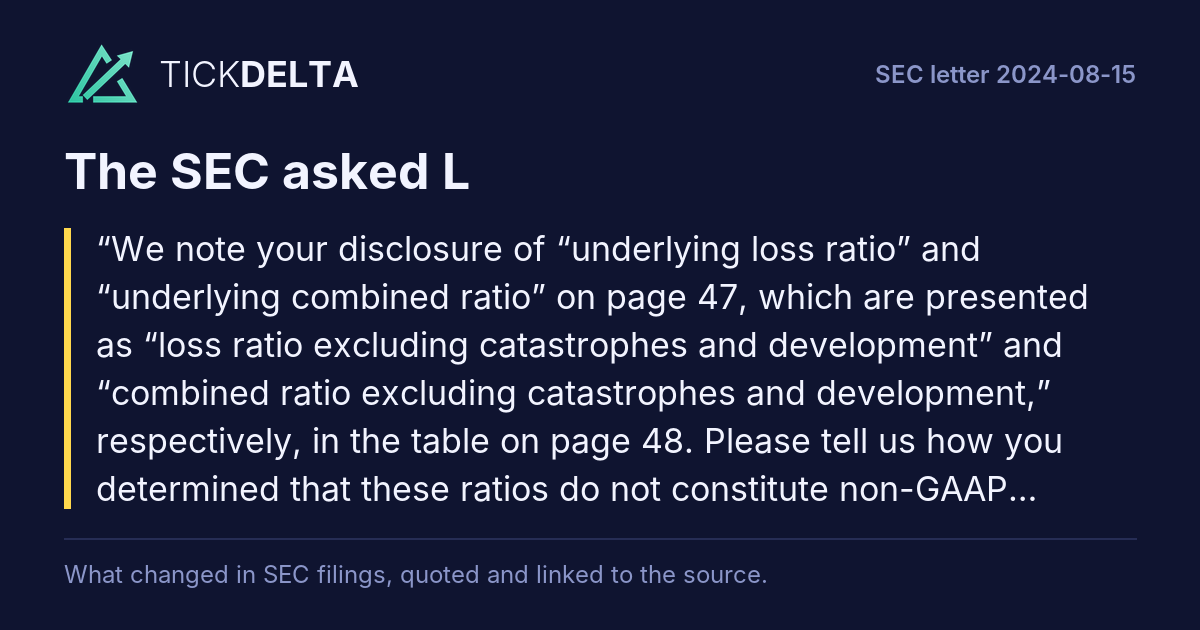
We note your disclosure of “underlying loss ratio” and “underlying combined ratio” on page 47, which are presented as “loss ratio excluding catastrophes and development” and “combined ratio excluding catastrophes and development,” respectively, in the table on page 48.Rest of the question
Please tell us how you determined that these ratios do not constitute non-GAAP financial measures considering these measures exclude the impact of catastrophe losses and development-related items. Refer to Rule 101(a) of Regulation G and Question 100.05 of the Division of Corporation Finance's C&DI on Non-GAAP Financial Measures. Please revise future filings as applicable, also ensuring consistent use of terminology. Altium Packaging, page 104 We note your disclosure on page 5 that you own 53% of Altium Packaging in addition to your disclosure on page 104 that you deconsolidated this subsidiary in 2021 when you sold approximately 47% of Altium Packaging to GIC. Please explain in further detail the 2. “certain participating rights with GIC related to capital allocation and other decisions” and any other terms of the sale to GIC that resulted in your accounting for your investment in Altrium Packaging under the equity method of accounting, effective April 1, 2021. In closing, we remind you that the company and its management are responsible for the accuracy and adequacy of their disclosures, notwithstanding any review, comments, action or absence of action by the staff.
The Company has not historically viewed the underlying loss ratio and the underlying combined ratio (collectively, the “underlying ratios”) as non-GAAP measures, because the ratios from which they are derived (the loss ratio and the combined ratio, respectively) are not presented in the statement of income, balance sheet, or statement of cash flows.Read in the reply ↗Rest of the answer
Rule 101(a) of Regulation G, and Item 10(e) of Regulation S-K define a non-GAAP measure as (emphasis added):
“A numerical measure of a registrant's historical or future financial performance, financial position or cash flows that: (i) Excludes amounts, or is subject to adjustments that have the effect of excluding amounts, that are included in the most directly comparable measure calculated and presented in accordance with GAAP in the statement of income, balance sheet or statement of cash flows (or equivalent statements) of the issuer; or (ii) Includes amounts, or is subject to adjustments that have the effect of including amounts, that are excluded from the most directly comparable measure so calculated and presented.”
The Company’s disclosures are transparent about the fact that the underlying ratios exclude the effects of catastrophes and development-related items, and those excluded impacts are separately quantified in the tables presented on page 48 of the Company’s Annual Report on Form 10-K for the fiscal year ended December 31, 2023, alongside the loss ratio and the combined ratio. These tables allow a user of the financial statements to reconcile to the loss ratio and the combined ratio, thus ensuring clarity of the disclosure.
Notwithstanding the above, in response to the Staff’s comment, reconsideration of the nature of the underlying loss ratio and underlying combined ratio, and in order to further the reader’s understanding of the underlying ratios, the Company will treat these ratios as non-GAAP in future filings and therefore intends to make certain additional disclosures in its Quarterly Report on Form 10-Q for the fiscal quarter ending September 30, 2024 (underlined below):
“In evaluating the results of Property and Casualty Operations, CNA utilizes the loss ratio, the underlying loss ratio, the expense ratio, the dividend ratio, the combined ratio and the underlying combined ratio. These ratios are calculated using GAAP financial results. The loss ratio is the percentage of net incurred claim and claim adjustment expenses to net earned premiums. The underlying loss ratio excludes the impact of catastrophe losses and development-related items from the loss ratio. Development-related items represent net prior year loss reserve and premium development, and includes the effects of interest accretion and change in allowance for uncollectible reinsurance and deductible amounts. The expense ratio is the percentage of insurance underwriting and acquisition expenses, including the amortization of deferred acquisition costs, to net earned premiums. The dividend ratio is the ratio of policyholders' dividends incurred to net earned premiums. The combined ratio is the sum of the loss, expense and dividend ratios. The underlying combined ratio is the sum of the underlying loss ratio, the expense ratio and the dividend ratio.
The underlying loss ratio and the underlying combined ratio are deemed to be non-GAAP financial measures and management believes some investors may find these ratios useful to evaluate CNA’s underwriting performance since they remove the impact of catastrophe losses which are unpredictable as to timing and amount, and development-related items as they are not indicative of CNA’s current year underwriting performance.”
Additionally, the Company will ensure that the comparable GAAP measures are more prominent in its presentation of these non-GAAP financial measures, including the reconciliation from GAAP to non-GAAP. Finally, the Company advises the Staff that, beginning with its Quarterly Report on Form 10-Q for the fiscal quarter ended March 31, 2024, it replaced any instances of “loss ratio excluding catastrophes and development” and “combined ratio excluding catastrophes and development” with “underlying loss ratio” and “underlying combined ratio,” respectively. As such, the captioning used within the tabular disclosures conforms to the language used in the above narrative disclosures.
First report after the company's reply of 2024-08-29: 10-Q filed 2024-11-04 ↗, against the 10-Q filed 2024-07-29 ↗.
Tickdelta does not hold the text of both reports, so they are not compared here.
Also in this review: closing letter, 2024-09-11