Form 10-K for the Fiscal Year Ended December 31, 2019
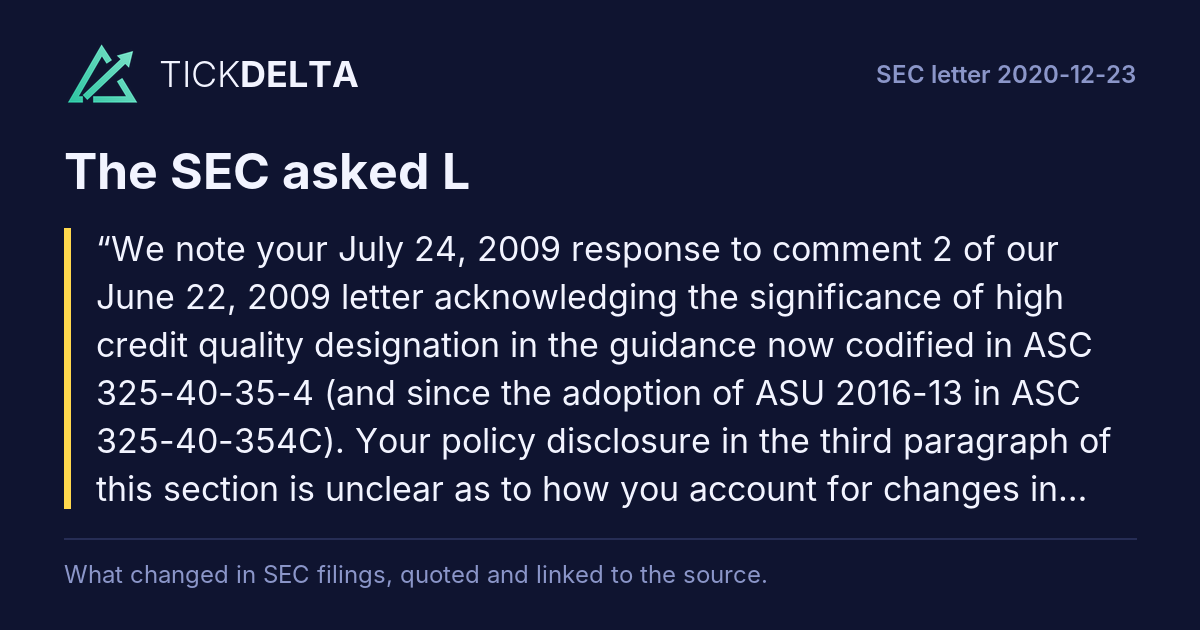
We note your July 24, 2009 response to comment 2 of our June 22, 2009 letter acknowledging the significance of high credit quality designation in the guidance now codified in ASC 325-40-35-4 (and since the adoption of ASU 2016-13 in ASC 325-40-354C).Rest of the question
Your policy disclosure in the third paragraph of this section is unclear as to how you account for changes in prepayment estimates but appears to imply use of the retrospective method which only applies to asset-backed securities of high credit quality. Given that it is apparent from the December 31, 2019 Supplemental Financial Information furnished as Exhibit 99.2 to the February 10, 2020 Form 8-K of CNA Financial Corporation (CNA) that about $3.2 billion of its total asset-backed securities investments of $8.8 billion, or 37% are rated below AA and therefore not of high credit quality, please provide us proposed revised disclosure to be included in future filings that clarifies how you account for changes in prepayment estimates for your asset-backed securities. Otherwise, tell us how your current policy disclosure and accounting complies with the guidance referenced above.
In response to the Staff’s comment, the Company advises the Staff that it has considered the guidance in ASC Topic 325-40 when determining its accounting policy. The scope of ASC 325-40 includes assetand mortgage-backed securities that are not of high credit quality, and high credit quality interest-only securities that can be contractually prepaid such that the holder would not recover substantially all of the recorded investment.Read in the reply ↗Rest of the answer
High credit quality is generally viewed by the SEC as having obtained a credit rating of AA (or equivalent) or higher from a major rating agency or being sufficiently collateralized to ensure that the possibility of credit loss is remote. The Company held approximately $3.3 billion of asset-backed securities rated below AA as of September 30, 2020. This included 42% rated A, 41% rated BBB, and 17% below investment grade. Interest-only securities did not make up a significant portion of the portfolio.
Given the nature of the portfolio, the impact of changes in prepayment estimates has been de minimis for the Company as there is limited variability anticipated in the cash flows expected to be collected. Over 90% of the portfolio consists of commercial assetand mortgage-backed securities, which unlike residential mortgage-backed securities, typically do not allow for penalty-free prepayments. Further reducing variability, many of the commercial mortgage-backed securities and asset backed securities we hold are non-amortizing, with the principal due in a lump sum at maturity. The majority of these securities are also rated as investment grade by one or more major rating agencies and are sufficiently collateralized to levels that cumulative potential credit losses in the portfolio are expected to be immaterial. Any such credit losses are identified through the
Company’s quarterly impairment process, and result in the Company recording a credit loss allowance.
Following thorough analysis of the portfolio and its impact on financial results, the Company modified its approach in 2016 to use the retrospective method, to be consistent with the remainder of its high-quality asset-backed securities and given the immateriality determination. The Company acknowledges that ASC 325-40 requires that changes in accretable yield be accounted for prospectively, and accordingly, the magnitude of any changes is monitored through quarterly control processes to ensure that any breach of our de minimis threshold would be identified promptly. We do not expect a material change related to prepayment estimates; however, were it to exceed the de minimis threshold the Company would account for it in accordance with ASC 325-40. The retrospective adjustment recorded through net income for changes in prepayment estimates related to instruments in scope of ASC 325-40 for the years ended December 31, 2017, 2018, and 2019 was approximately $0.3 million, $0.7 million, and $(0.4) million, respectively. As the Company reported net income attributable to Loews Corporation of $932 million, $636 million, and
$1,164 million for these periods, respectively, the Company has concluded that the retrospective adjustments are immaterial to each period.
In response to the Staff’s comment, the Company advises the Staff that it intends to clarify the accounting policy disclosure that describes the accounting for changes in prepayment estimates in the 2020 Form 10-K as follows. The changes from the 2019 Form 10-K disclosure are underlined below:
p. 3
For asset-backed securities included in fixed maturity securities, the Company recognizes income using an effective yield based on anticipated prepayments and the estimated economic life of the securities. When estimates of prepayments change, the effective yield is recalculated to reflect actual payments to date and anticipated future payments predominantly using the retrospective method.
First report after the company's reply of 2021-01-14: 10-K filed 2021-02-09 ↗, against the 10-K filed 2020-02-12 ↗.
Tickdelta does not hold the text of both reports, so they are not compared here.
Your policy disclosure for Altium Packaging LLC to recognize revenue in part when "there is persuasive evidence of an arrangement, the sales price is fixed and [sic] determinable and collection is reasonably assured" reflects guidance from SAB 104 that was superseded by ASC 606.Rest of the question
Please confirm for us that you recognize your packaging revenue based on the principle outlined in ASC 606-10-25-1 and provide us proposed revised disclosure to be included in future filings that is consistent with this guidance. Separately tell us in your response why it is appropriate to reflect resin price changes on a lagged basis as indicated on page 61 and reference for us the authoritative literature you rely upon to support your accounting. Explain why these costs if "passed through" are not probable of being collected when they are incurred instead of when they appear to be invoiced.
We confirm that Altium Packaging LLC (“Altium Packaging”) revenue is recognized in accordance with ASC 606-10-25-1.
The disclosure for the 2020 Form 10-K filing will be revised as follows. The changes from the 2019 Form 10-K disclosure are underlined below:
Altium Packaging is a packaging solutions provider and manufacturer in North America, serving a diverse customer base in the pharmaceutical, dairy, household chemicals, food/nutraceuticals, industrial/specialty chemicals, water and beverage/juice segments.Read in the reply ↗Rest of the answer
Altium
Packaging recognizes revenue at the time control is transferred to the customer, there is persuasive evidence of an arrangement, the sales price is fixed and determinable and collection is reasonably assured when obligations under the terms of a contract with a customer have been satisfied. This occurs at the time control is transferred to the customer, which generally occurs upon delivery or completion of the manufacturing process.
Separately tell us in your response why it is appropriate to reflect resin price changes on a lagged basis as indicated on page 61 and reference for us the authoritative literature you rely upon to support your accounting. Explain why these costs if “passed through” are not probable of being collected when they are incurred instead of when they appear to be invoiced.
Response:
We acknowledge that the term “passed through” may be interpreted differently than intended. Altium Packaging’s contracts with its customers provide for price adjustments for changes in resin prices on a prospective basis. Generally, Altium Packaging will adjust its contract price for future sales one month after resin prices change. However, Altium Packaging’s cost of sales includes the resin price change when a change occurs which impacts Altium Packaging’s gross margin, as revenue is recognized in accordance with ASC 606-10-25-1. The disclosure for the 2020 Form 10-K filing will be revised as follows:
p. 4
Altium Packaging’s contracts with its customers provide for price adjustments for changes in resin prices on a prospective basis. Due to fluctuations in resin prices, over time resin raw material costs are generally offset by the change in revenues, so that Altium Packaging’s gross margins return to the same level as prior to the change in prices.
Altium Packaging’s contracts generally provide for resin price changes to be passed through to its customers on a short-term lag, generally about one month. When a pass-through occurs, revenues and expenses generally change by the same amount so that Altium Packaging’s gross margin returns to the same level as prior to the change in prices.
First report after the company's reply of 2021-01-14: 10-K filed 2021-02-09 ↗, against the 10-K filed 2020-02-12 ↗.
Tickdelta does not hold the text of both reports, so they are not compared here.
In the risk factor on page 63 of your September 30, 2020 Form 10-Q you identify the energy, retail, travel, entertainment and real estate industries as being heavily impacted by the COVID-19 pandemic. You also indicate that CNA's municipal bond portfolio is subject to risks of default by state and local governments and agencies that are under increased strain related to the pandemic.Rest of the question
Finally, you disclose that these significant financial market disruptions may have a material impact on CNA's business, results of operations and financial condition. Please tell us the following: • Your current investment portfolio exposure to each of the industries identified above; • Your consideration for disclosing in your upcoming 2020 Form 10-K the concentration information in your investment portfolio for these industries and your municipal bond portfolio as stipulated in ASC 825-10-50-20 and 50-21; and • If your investment portfolio concentrations do not meet the disclosure threshold in the guidance identified in the preceding bullet, your consideration for otherwise disclosing in Management's Discussion and Analysis in your upcoming 2020 Form 10-K more information about the composition of your investment portfolio so that investors can better assess the underlying risks given the significant financial market disruptions you identify.
As of September 30, 2020, the Company’s investment portfolio exposure to each of the industries listed within the September 30, 2020 Form 10-Q risk factor disclosure is presented in the following table:
Cost or
Gross
Allowance
Estimated
Amortized
Unrealized
For Credit
Fair
September 30, 2020
Cost
Gains
Losses
Value
(In millions)
Corporate and other bonds:
Energy – Oil & Gas
$
1,193
151
1,304
Energy – Other
Energy – Pipelines
1,050
146
1,181
Entertainment
190
202
Financial – Real Estate/REITs
1,354
127
1,477
Retail
539
106
638
Travel &Read in the reply ↗Rest of the answer
Related
371
389
Other
16,014
2,461
18,436
Total Corporate and other bonds
20,734
3,047
23,658
Municipal bonds
9,459
1,766
11,224
Total
30,193
4,813
34,882
The Company’s investment portfolio is sufficiently diversified such that it is not exposed to significant concentrations of credit risk arising from a single issuer, nor is there exposure to significant concentrations of credit risk arising from groups of issuers that share similar economic characteristics that would cause those issuers’ ability to meet their contractual obligations to be similarly affected by changes in economic conditions. The Company has established internal investment guidelines to mitigate concentration risk, and the insurance subsidiaries adhere to all regulatory guidelines that limit issuer concentrations. Therefore, the Company respectfully submits that no additional disclosure is required under ASC 825-10-50-20 or 50-21 in the upcoming 2020 Form 10-K.
The financial market disruptions caused by the onset of COVID-19 during the first quarter of 2020 led to a sharp decline in market values and an increase in unrealized losses within the investment portfolio. At that time, the Company determined that including additional detail regarding sectors within its portfolio with heightened risk within its Risk Factor disclosures and the portfolio composition by industry within its MD&A would be beneficial to the reader. The Company retained the Risk Factor disclosure through the third quarter Form 10-Q filing due to ongoing uncertainty related to the pandemic, and the potential for further market volatility. However, the Company’s portfolio has exhibited a sustained recovery as evidenced by the decrease in unrealized losses during the second and third quarters of 2020. Gross unrealized losses for the portion of the Company’s portfolio invested in the industries listed per the SEC’s comment above were $428 million as of March 31, 2020, $75 million as of June 30, 2020 and $55 million as of September 30, 2020. The Company’s best estimate of expected credit losses for the industries listed above remained immaterial throughout the year, but also improved consistent with the market recovery; the allowance for credit losses attributable to industries listed above decreased from $48 million as of the end of the first quarter to $30 million as of the end of the third quarter. Given the recovery of the Company’s investment portfolio and more favorable U.S. and global economic outlook, management has determined that, presently, the industry narrative does not provide useful insight regarding the material risks to our business and, accordingly, the disclosure p. 6 will be modified in our December 31, 2020 Form 10-K by removing the industry concentration narrative from our Risk Factor disclosure.
For the reasons explained in the preceding paragraph, we also respectfully submit that disclosure of our portfolio composition within
Management's Discussion and Analysis is not required in the upcoming 2020 Form 10-K. We will continue to monitor our concentrations of credit risk, and to the extent it becomes beneficial to users of financial statements, we will include additional disclosure in future forms.
First report after the company's reply of 2021-01-14: 10-K filed 2021-02-09 ↗, against the 10-K filed 2020-02-12 ↗.
Tickdelta does not hold the text of both reports, so they are not compared here.
It is unclear whether your indication that you do not believe that the outcome of any such pending litigation will materially affect your results of operations or equity refers only to litigation arising in the ordinary course of business or also incorporates your conclusion on the Boardwalk Pipeline Partners, LP matter as well.Rest of the question
If it does, please provide us proposed revised disclosure to be included in future filing that provides clarification. If it does not, provide us proposed revised disclosure that indicates your estimate of possible loss or range of loss or a statement that such an estimated cannot be made as required by ASC 450-20-50-4b and separately support for us your revised disclosure. We remind you that the company and its management are responsible for the accuracy and adequacy of their disclosures, notwithstanding any review, comments, action or absence of action by the staff.
We confirm that the Boardwalk Pipeline Partners, LP matter is incorporated in our conclusion regarding the outcome of pending litigation. The disclosure for the 2020 Form 10-K filing will be revised as follows. The changes from the 2019 Form 10-K disclosure are underlined below:
The Company and its subsidiaries also are from time to time parties to other litigation arising in the ordinary course of business.Read in the reply ↗Rest of the answer
While it is difficult to predict the outcome or effect of any such litigation, management does not believe that the outcome of any such pending litigation, including the Boardwalk Pipelines matter described above, will materially affect the
Company’s results of operations or equity.
* * * p. 7
We acknowledge that the Company and its management are responsible for the adequacy and accuracy of the Company’s disclosures, notwithstanding any review, comments, action or absence of action by the Staff.
First report after the company's reply of 2021-01-14: 10-K filed 2021-02-09 ↗, against the 10-K filed 2020-02-12 ↗.
Tickdelta does not hold the text of both reports, so they are not compared here.
Also in this review: closing letter, 2021-01-15