Screener / SEC EDGAR /CIK 0001694028 /10-K filed Feb 2, 2026, compared with Feb 6, 2025 /Numbers from the XBRL of the 10-Ks
NYSE Energy · Oilfield Services

Liberty Energy Inc. LBRT

Compare with peers Embed
SEC comment letters, last 20 years

2 reviews of LBRT's filings by SEC staff

UPLOAD and CORRESP
Reviews 2 latest letter Jul 8, 2021
Questions asked 32 each answered in the company's own letter
No closing letter 1 reviews without a letter saying the staff completed it

When the SEC's staff reviews a filing, it writes to the company with numbered questions, and the company answers each one in a letter. SEC publishes the exchange once the review is over, at least 20 business days later. A question is not an accusation; most reviews end with the company adding detail to its next filing.

How the reviews went

Every review on EDGAR, from the first staff letter to the letter that closes it

  1. 1. Staff letters 5 UPLOAD
  2. 2. Questions in them 32 numbered comments
  3. 3. Company replies 15 CORRESP
  4. 4. Reviews closed 1 of 2 closing letter

Half the closed reviews took 55 days or less from the first letter to the closing letter.

Form 10-K for the Year Ended December 31, 2020

2021-07-08 to 2021-09-01 · 2 questions · 2 letters from the SEC, 2 from the company
Review closed 2021-09-01
Non-GAAP measuresResults discussion (MD&A)
Item 7. Managements Discussion and Analysis of Financial Condition and Results of Operations · Comparison of Non-GAAP Financial Measures, page 30
SEC asked
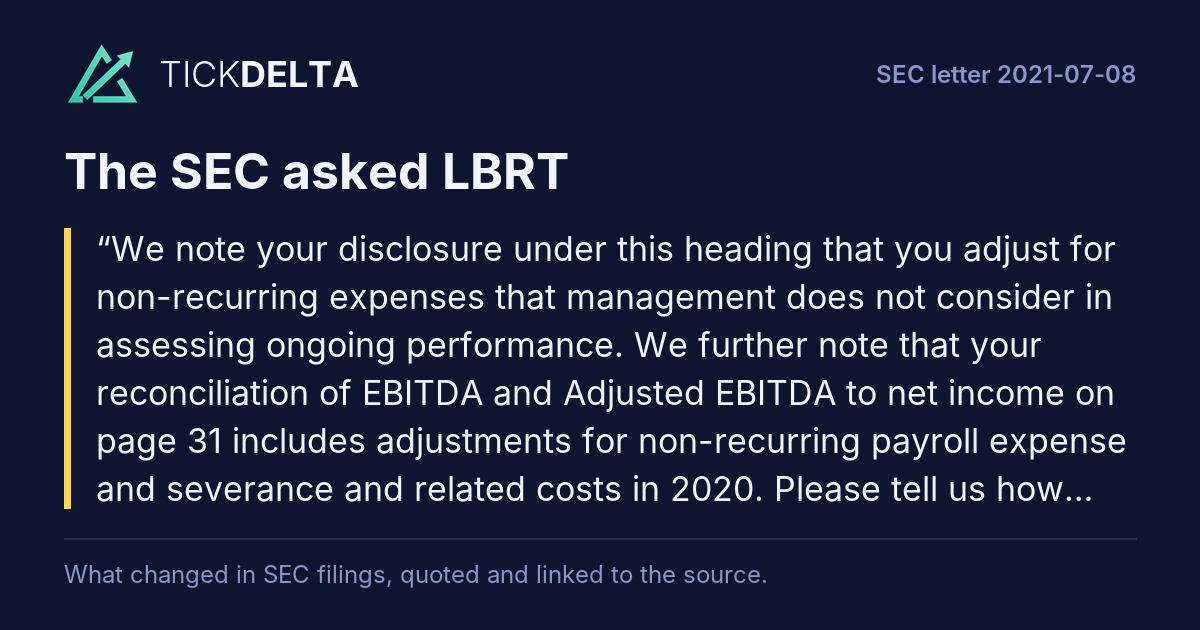
We note your disclosure under this heading that you adjust for non-recurring expenses that management does not consider in assessing ongoing performance. We further note that your reconciliation of EBITDA and Adjusted EBITDA to net income on page 31 includes adjustments for non-recurring payroll expense and severance and related costs in 2020.
Rest of the question

Please tell us how you determined payroll expense qualifies to be described as nonrecurring and how each of these adjustments does not represent normal, recurring cash expenses necessary to operate your business. Refer to Item 10(e)(1)(ii)(B) of Regulation S-K and Questions 100.01 and 102.03 of the Non-GAAP Financial Measures Compliance and Disclosure Interpretations for guidance.

LBRT answered
Non-recurring Payroll Expense

Non-recurring payroll expense of $2.398 million recorded in 2020 was related to a one-time payment to the Company sponsored 401(k) plan (the “Plan”) as a result of a submission under the IRS’ Voluntary Correction Program (“VCP”).

The Company has maintained the Plan since 2013. The Company has never previously submitted a VCP or made related payments.
Rest of the answer

Further, effective January 1,

2020, the Company amended the Plan to address the errors subject to the VCP submission so that they would not reoccur in the future.

The Company considered the guidance of Item 10(e)(1)(ii)(B) of Regulation S-K, as well as Questions 100.01 and 102.03 of the Non-GAAP Financial Measures Compliance and Disclosure Interpretations, and determined, based on the information summarized above, that the payroll expense for the VCP related payment was properly described as “non-recurring” as the Company concluded it was not reasonably likely that a similar charge would recur within two years and there was no similar charge that had occurred in the prior two years. This adjustment does not represent the normal, recurring cash expenses necessary to operate our business as the Company has never submitted or made payments under the VCP program before, and has amended the Plan so that the errors subject to the VCP submission will not recur in the future.

Severance and Related Costs

Severance and related costs of $10.166 million recorded in 2020 were primarily related to the reduction in our workforce in April 2020 and the commencement of furlough schedules for remaining employees in May 2020 during which the Company continued to pay health insurance and other benefits.

Following the onset of the COVID-19, the Company regrettably conducted a Company-wide reduction in force whereby its personnel count decreased by approximately 50%. At the same time, the Company also implemented a temporary furlough plan which spanned portions of May – August 2020. The Company provided multiple weeks of severance pay in conjunction with the reduction in force. During furlough periods, the Company paid the employee and employer portions of health and related benefit costs on behalf of the furloughed employees.

The Company considered the guidance of Item 10(e)(1)(ii)(B) of Regulation S-K, as well as Questions 100.01 and 102.03 of the Non-GAAP Financial Measures Compliance and Disclosure Interpretations, and determined, based on the information summarized above, the severance and related costs adjustment did not represent the normal, recurring cash expenses necessary to operate our business as i) the Company has never before conducted a Company-wide reduction in force and generally operates to avoid “seasonal” or recurring layoffs despite the cyclical nature of our industry, and ii) severance pay and the cost of health and related benefits for furloughed employees not working for customers are neither normal recurring cash expenses nor necessary costs to operate our business (active employees are necessary;

not furloughed employees). Both of these costs were voluntarily incurred and resulted from an unprecedented decline in commercial activity in the second quarter of 2020 due to the onset of a global pandemic.

Read in the reply
In its next report

First report after the company's reply of Jul 21, 2021: 10-Q filed Jul 30, 2021 ↗, against the 10-Q filed Apr 30, 2021 ↗.

Tickdelta does not hold the text of both reports, so they are not compared here.
Item 7. Management's Discussion and Analysis of Financial Condition and Results of Operations · Comparison of Non-GAAP Financial Measures, page 30
SEC asked
We note your response to prior comment 1 indicates that severance and related costs of $10.166 million were primarily related to the reduction in workforce in April 2020 and temporarily furloughed employees spanning portions of May to August 2020.
Rest of the question

Please provide the following: • Quantify the amount recorded in your non-GAAP adjustment for each of the components, including reduction in workforce, payment of salaries to furloughed employees and payment of health insurance and other benefits for these employees. • Clarify if your reduction in workforce resulted in the permanent termination of employees. If employees were permanently terminated, please quantify the amount of expense included in the adjustment related to these employees. • Your response indicates severance pay and the cost of health and related benefits for furloughed employees not working for customers are neither normal recurring cash expenses nor necessary costs to operate your business. When considering the compensation paid to employees temporarily furloughed, please explain further why you believe employee compensation paid during the pandemic for employees that returned to work is considered incremental to your normal operations. In closing, we remind you that the company and its management are responsible for the accuracy and adequacy of their disclosures, notwithstanding any review, comments, action or absence of action by the staff.

LBRT answered
The dollar amount for each component is as follows:

i.

Reduction in workforce

$7.502 million ii.

Salaries to furloughed employees

$0.0 iii.

Health insurance to furloughed employees

$2.664 million

$10.166 million

Clarify if your reduction in workforce resulted in the permanent termination of employees. If employees were permanently terminated, please quantify the amount of expense included in the adjustment related to these employees

Response:

The reduction in workforce did result in the permanent termination of employees.
Rest of the answer

The amount of expense included in the adjustment related to these employees was $7.5 million, as shown in the summary above.

Your response indicates severance pay and the cost of health and related benefits for furloughed employees not working for customers are neither normal recurring cash expenses nor necessary costs to operate your business. When considering the compensation paid to employees temporarily furloughed, please explain further why you believe employee compensation paid during the pandemic for employees that returned to work is considered incremental to your normal operations.

Response:

No wage or salary compensation was paid to furloughed employees. The only benefit provided was that the Company, on a voluntary basis, continued to provide health insurance benefits to the furloughed employees. We believe this cost is incremental to our normal operations because we do not normally incur health care costs for employees that are not actively providing services for us.

Read in the reply
In its next report

First report after the company's reply of Aug 30, 2021: 10-Q filed Oct 28, 2021 ↗, against the 10-Q filed Apr 30, 2021 ↗.

Tickdelta does not hold the text of both reports, so they are not compared here.

Also in this review: closing letter, 2021-09-01

Form S-1

2017-02-03 to 2017-05-04 · 30 questions · 3 letters from the SEC, 13 from the company
No closing letter
Results discussion (MD&A)RevenueLiquidity and cashRisk factorsIncome taxesClimateDebtExecutive payAcquisitions
General
SEC asked (1)
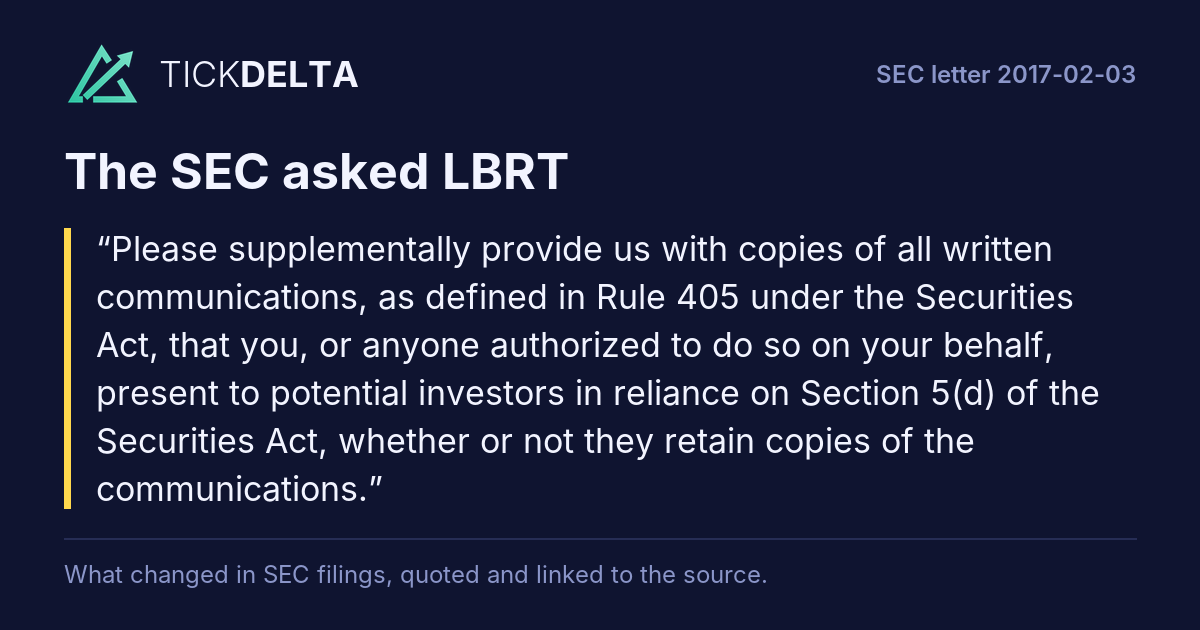
Please supplementally provide us with copies of all written communications, as defined in Rule 405 under the Securities Act, that you, or anyone authorized to do so on your behalf, present to potential investors in reliance on Section 5(d) of the Securities Act, whether or not they retain copies of the communications.
LBRT answered
We acknowledge the Staff’s comment and advise the Staff that, to date, neither we nor anyone authorized on our behalf has engaged in any “testing the waters” activity or otherwise presented any written communications to potential investors in reliance on Section 5(d) of the Securities Act of 1933, as amended (the “Securities

Act”). To the extent that we or anyone authorized on our behalf present any written communications to potential investors in reliance on Section 5(d) of the Securities Act, we will supplementally provide the Staff with copies of such written communications.
Read in the reply
General
SEC asked (2)
Your registration statement appears to indicate that you intend to conduct a firm commitment underwritten offering. In your next amendment, please include the names of the lead underwriters. To the extent you intend to conduct a firm commitment underwritten offering, please note that we will defer further review of any amendment that does not include the names of the lead underwriters.
LBRT answered
We acknowledge the Staff’s comment and have revised the Registration Statement accordingly to identify the lead underwriters. Please see the front and back cover pages of the Registration Statement and page 125 of Filing No. 1.
Read in the reply
Industry and Market Data, page ii
SEC asked (3)
Please provide us copies of the relevant portions of public industry data that you cite or rely on in your filing, including, but not limited to, market research data prepared by Baker Hughes Incorporated and Coras Oilfield Research.
Rest of the question

Please note that the requested information should be filed as EDGAR correspondence or, alternatively, should be sent in paper form accompanied by a cover letter indicating that the material is being provided pursuant to Securities Act Rule 418 and that such material should be returned to the registrant upon completion of the staff review process.

LBRT answered
We are providing to the Staff in the Supplemental Letter the copies of the relevant portions of public industry data that we cite or rely on in the Registration Statement, including, but not limited to, market research data prepared by Baker Hughes Incorporated and Coras Oilfield Research.

Prospectus Summary

Liberty Oilfield

Services Inc.
Read in the reply
Prospectus Summary · Overview, page 1
SEC asked (4)
We note you have included several references to the competitive strength of your enterprise and pursuits relative to other hydraulic fracturing service providers. For example, refer to your assertion on page 3 regarding the financial stress experienced by your competitors resulting in maintenance deferrals and idle fleets.
Rest of the question

We note further your assertion that your proprietary databases have yielded production data enabling your customers to complete “more productive and cost effective wells with shorter times and with less impact on the environment” and your observations regarding your “low employee turnover.” Please revise to provide quantifiable measures to substantiate your assertions regarding your competitive positions or alternatively, remove such representations.

LBRT answered
We acknowledge the Staff’s comment and have revised the Registration Statement accordingly. Please see pages 3, 4, 5, 59, 71, 72 and 79 of Filing No. 1. We note that a number of our competitors have filed for bankruptcy or have otherwise undergone significant restructuring of their debt on pages 3, 59 and 79 of Filing No. 1. These competitors include C&J Energy Services, Inc., Seventy Seven Energy, Inc. and Sanjel Corporation, but we do not believe it is necessary to cite specific companies in our revised disclosure and do not believe such companies would appreciate our doing so.
Read in the reply
Industry Trends and Market Recovery, page 2
SEC asked (5)
We note your discussion of the recovery of hydrocarbon prices and the attending increase in demand for your services in the third and fourth quarters of 2016. Please balance the disclosure in this section by briefly discussing the downward service pricing trend that served to offset the increase in hydraulic fracturing activity, which you highlight in your period to period revenue discussion in the MD&A section.
LBRT answered
We acknowledge the Staff’s comment and have revised the Registration Statement accordingly. Please see page 2 of Filing No. 1.
Read in the reply
Corporate Reorganization, page 8
SEC asked (6)
Please clarify whether Liberty LLC and Liberty Holdings will own a majority of your Class B common shares.
LBRT answered
We acknowledge the Staff’s comment and have revised the Registration Statement to reflect that the

Liberty Unit Holders will own all of the Class B common shares. Please see pages 10 and 102 of Filing No. 1.
Read in the reply
Corporate Reorganization, page 8
SEC asked (7)
Expand to disclose here that you will be dependent on the ability of Liberty LLC to make distributions to you in an amount sufficient to cover your obligations under the Tax Receivable Agreement.
LBRT answered
We acknowledge the Staff’s comment and have revised the Registration

Statement accordingly. Please see pages 11 and 103 of Filing No. 1.
Read in the reply
Our Principal Shareholders, page 10
SEC asked (8)
Please update this disclosure to include the applicable percentages of the securities holdings of your principal stockholders.
LBRT answered
We acknowledge the Staff’s comment and undertake to provide this information when available.
Read in the reply
The Offering, page 13
SEC asked (9)
Please revise this section to clarify whether you will use a portion of the offering proceeds to extinguish certain indebtedness under your credit facility.
LBRT answered
We acknowledge the Staff’s comment and have revised the Registration Statement to reflect that a portion of the net proceeds of the offering received by us will be contributed to Liberty LLC, which will use the proceeds to repay all of our outstanding indebtedness. Please see page 17 of Filing No. 1.
Read in the reply
Risks Related to Our Business · We are exposed to the credit risk of our customers, page 21
SEC asked (10)
We note the disclosure that you are exposed to the credit risk of your customers and were not able to collect certain debt due to the bankruptcy of certain of your customers for the fiscal year ended December 31, 2015. Please update this risk factor to disclose the amount, if any, of debt that you were not able to collect for the fiscal year ended December 31, 2016.
Rest of the question

We engage in transactions with related parties and such transactions present possible conflicts of interests, page 34

LBRT answered
We acknowledge the Staff’s comment and advise the Staff that there was no debt due to the bankruptcy of customers that we were not able to collect for the fiscal year ended December 31, 2016.

We engage in transactions with related parties and such transactions present possible conflicts of interests, page 34
Read in the reply
Risks Related to Our Business · We are exposed to the credit risk of our customers, page 21
SEC asked (11)
Expand the risk factor to briefly highlight the conflicts of interest that you may have with your related parties due to your relationships.
LBRT answered
We acknowledge the Staff’s comment and have revised the Registration Statement accordingly. Please see page 38 of Filing No. 1.
Read in the reply
Risks Related to this Offering and Our Class A Common Stock, page 34
SEC asked (12)
We understand from your disclosures on pages 41 and 42 that you will quantify and disclose an estimate of the present value of payments that may be required under the Tax Receivable Agreement that will take effect in connection with your offering.
Rest of the question

In describing the implications of this arrangement, you state “we expect that the payments we will be required to make under the Tax Receivable Agreement will be substantial,” “payments under the Tax Receivable Agreement may be accelerated and/or significantly exceed the actual benefits,” and “the Tax Receivable Agreement could have a substantial negative impact on our liquidity.” Tell us how you intend to account for this arrangement at the outset and in subsequent periods, specifically with regard to recognizing and adjusting an accrual for amounts payable under the agreement, and explain your rationale. Please identify the specific authoritative literature that you have considered in formulating your view. Please also clarify your expectations with regard to the timing of payments that will be made under the agreement, the likelihood of acceleration and early termination, and your view on the utility of any pro forma presentation that may be required. Please expand your disclosure in the Prospectus Summary to include further details of the amounts payable under the Tax Receivable Agreement, any critical assumptions underlying your estimate, the effects associated with the reasonably possible range of variation in such assumptions, and the accounting to be applied.

LBRT answered
We acknowledge the Staff’s comment and advise the Staff that we intend to account for any amounts payable under the Tax Receivable Agreements in accordance with ASC Topic 450, Contingent Consideration (“ASC 450”). We believe accounting for the Tax Receivable Agreements under the provisions of ASC 450 is appropriate due to significant uncertainties regarding the amount of payments, if any, to be made under the Tax Receivable Agreements. Uncertainties include those described in the risk factors relating to the Tax Receivable Agreements on pages 45 through 47 of Filing No.
Rest of the answer

1, which indicate the existence of a contingency as defined in ASC 450. Additionally, the Tax Receivable Agreements are not a transaction described in ASC

450-10-15-2A that is specifically scoped out of the guidance on contingent consideration (e.g. contingencies in a business combination).

We will complete an initial assessment of the amount of any Tax Receivable Agreements liability required under the provisions of ASC 450 as of the date the Tax Receivable Agreements are executed. Any resulting liability will be recorded with an offsetting entry to equity because it would arise as an immediate and direct result of the corporate reorganization and related transactions completed in connection with the initial public offering. The corporate reorganization represents a reorganization of entities under common control transaction that is recorded based on the historical carrying amounts of affected assets and liabilities in accordance with ASC 805-50, Business Combinations – Related Issues. Under that guidance, any difference between consideration paid (in this case, the Tax Receivable

Agreements liability) and the carrying amount of the assets and liabilities received is recognized within equity.

The initial liability, if any, will be adjusted at each reporting date through charges or credits in the statement of operations. We concluded on that accounting by analogy to the accounting treatment specified in ASC 740-20-45-11(g) for subsequent changes in a valuation allowance established against deferred tax assets that arose due to a change in tax basis in connection with a transaction with shareholders, which is recorded in the statement of operations. We believe that analogy is appropriate given the direct relationship between the amount of any estimated tax savings to be realized and the recognition and measurement of the Tax Receivable Agreements liability.

We advise the Staff that, as stated on page 106 of Filing No. 1, estimating the amount and timing of payments under the Tax Receivable Agreements is by its nature imprecise, and that we cannot reasonably estimate the likelihood of acceleration and termination under the Tax Receivable Agreements because, although we have no current intention of terminating the Tax Receivable Agreements early, we cannot determine with any reasonable certainty whether Liberty Inc. will, in the future, (i) be a party to certain mergers, asset sales, or other forms of business combinations

(or otherwise undergo a change of control) or (ii) breach a material obligation under the Tax Receivable Agreements, each of which could cause an acceleration of our payment obligations under the Tax Receivable Agreements. Because we cannot reasonably estimate the timing of payments or the likelihood of acceleration and termination under the Tax Receivable Agreements, we do not believe any pro forma presentation is required or useful. However, we have revised the Registration Statement to note that, in the event that the Tax Receivable Agreements are not terminated, the payments under the Tax Receivable Agreements are anticipated to commence in 2018 and to continue for 15 years after the date of the last exchange of the Liberty LLC Units. Accordingly, it is expected that payments will continue to be made under the Tax Receivable Agreements for more than 20 to 25 years. Please see page 107 of Filing No. 1.

The actual increase in tax basis, as well as the amount and timing of any payments under the Tax Receivable Agreements, will vary depending upon a number of factors including the timing of the exchanges of Liberty LLC Units, the price of our Class A common stock at the time of each exchange, the extent to which such exchanges are taxable transactions, the amount and timing of the taxable income we generate in the future and the U.S. federal income tax rate then applicable, and the portion of Liberty Inc.’s payments under the Tax Receivable Agreements that constitute imputed interest or give rise to depreciable or amortizable tax basis. We have revised the Registration Statement to include further details of the factors affecting the amounts payable under the Tax Receivable Agreements, the effects associated with the reasonably possible range of variation in such factors, and the accounting to be applied. Please see pages 66, 105, 106 and 107 in Filing No. 1.

Read in the reply
Use of Proceeds, page 46
SEC asked (13)
We note your disclosure indicating that all of the net proceeds of the offering will go to Liberty LLC in exchange for Units, and that entity will in turn repay a portion of its indebtedness. Please reconcile these details with your disclosure on page 7, which states that all borrowings will be paid with a portion of the net proceeds.
LBRT answered
We acknowledge the Staff’s comment and have revised the Registration Statement to reflect that a portion of the net proceeds of the offering received by us will be contributed to Liberty LLC, which will use the proceeds to repay all of our outstanding indebtedness. Please see page 52 of Filing No. 1.
Read in the reply
Use of Proceeds, page 46
SEC asked (14)
Please revise to specifically quantify the portion of Liberty LLC indebtedness that you plan to extinguish with offering proceeds.
LBRT answered
We acknowledge the Staff’s comment and have revised the Registration Statement to reflect that a portion of the net proceeds of the offering received by us will be contributed to Liberty LLC, which will use the proceeds to repay all of our outstanding indebtedness. Please see page 52 of Filing No. 1.
Read in the reply
Management’s Discussion and Analysis of Financial Condition and Results of Operations, page · Results of Operations, page 55
SEC asked (15)
We note your disclosures on pages 64 and 70, comparing in percentage terms the number of hydraulic fracturing stages performed during the last three fiscal years, also indicating how the number of stages and amount of proppant utilized in fracturing each horizontal well have changed over these periods.
Rest of the question

Please expand your disclosures to include a description of the work that constitutes a fracturing stage, noting any particular qualities or characteristics and the degree or range of comparability among stages. Please indicate how the number of fracturing stages is determined and clarify the unitary relevance of these measures in your comparisons, also the effects on revenues and costs of revenues of having more stages and utilizing more proppant for a given length of wellbore.

LBRT answered
We acknowledge the Staff’s comment and have revised the Registration Statement to include the requested expanded disclosures regarding fracturing stages. Please see pages ii and 59 of Filing No. 1.
Read in the reply
Management’s Discussion and Analysis of Financial Condition and Results of Operations, page · Results of Operations, page 55
SEC asked (16)
We note your disclosure explaining that revenues were materially impacted by pricing pressure for your services but were partially offset by higher levels of activity. When you attribute changes in significant line items to more than one factor or element, please quantify the impact of each factor or element and discuss the underlying reasons for the changes observed.
Rest of the question

You may refer to Item 303(a)(3) of Regulation S-K and FRC §501.04 for further guidance.

LBRT answered
We acknowledge the Staff’s comment and have revised the Registration Statement to focus on two key factors underlying our revenue: Average Active HHP and pricing for our services. Our explanation regarding changes in revenue between the reported periods quantifies the impact on revenue of changes in both of those factors. Please see page 61 of

Filing No. 1.
Read in the reply
Management’s Discussion and Analysis of Financial Condition and Results of Operations, page · Results of Operations, page 55
SEC asked (17)
We note your disclosures on pages 5 and 6 explaining that you ascribe 40,000 HHP to a fleet and have “purchased or ordered” eight new fleets since 2012, with a capacity of 320,000 HHP, including one fleet due to arrive in 2017. You also indicate that you acquired nine used fleets in 2016, with a capacity of 360,000 HHP.
Rest of the question

The tabulation on page 15 indicates active utilization of 271,000 HHP during the recent nine month interim period, and on pages 2 and 64 you indicate over 95% of your capacity was active and deployed during an unspecified period of economic downturn. Please expand these and other disclosures related to capacity and utilization, to include the active capacity percentages of total capacity for each period.

LBRT answered
We have revised the Registration Statement to disclose the average total hydraulic horsepower (“HHP”) and average deployable HHP for the periods presented, pursuant to which the active capacity percentages of total capacity may be calculated. Please see pages 19 and 56 of Filing

No. 1.
Read in the reply
Liquidity and Capital Resources · Overview, page 58
SEC asked (18)
We note that you plan to revise in future amendments to reflect your 2017 capex program. Please expand your disclosure in this section to more specifically discuss the six additional fleets you expect to employ during the 2017 fiscal year. Please also provide revised disclosure regarding the costs anticipated to upgrade the recently acquired five fleets to your specifications.
Rest of the question

We further note disclosure on page 46 which states that you expect to fund your capital program through your credit facility. If you intend to utilize the $60 million of expected availability under your credit facility and other sources to fund your program, please clarify here.

LBRT answered
We acknowledge the Staff’s comment and have revised the Registration Statement to clarify that we may use borrowings under our revolving credit facility to fund our capital program and to include the requested expanded disclosures regarding our 2017 capex program. Please see pages 52 and 64 of Filing No. 1.
Read in the reply
Business · Customers, page 72
SEC asked (19)
We note your disclosure here and also in the risk factors on page 20 regarding the significance of your recurring arrangements with your top five customers. Please file the respective master service agreement for each customer in accordance with Item 601(b)(10) of Regulation S-K, or tell us why you believe you are not required to file the agreements.
Rest of the question

Further, please disclose the material terms of the agreements, and discuss any material impact on your operations if either agreement were to be terminated.

LBRT answered
We respectfully submit that we do not believe that the master service agreements referenced above are required to be filed as exhibits to the Registration Statement because (i) such agreements are not “material contracts” pursuant to Item 601(b)(10) of Regulation S-K, (ii) such agreements were made in the ordinary course of business and (iii) our business is not substantially dependent on any such agreement. Such master service agreements do not contain material terms, such as pricing information, which are included in supplemental documents.
Rest of the answer

To that end, we do not believe the master service agreements are material contracts required to be filed or for which we are required to provide material disclosure regarding their terms. Additionally, these agreements are of a type that is common throughout the hydraulic fracturing services industry. Thus, we believe that these agreements are ones that would “ordinarily accompan[y] the kind of business conducted” by us under Item 601(b)(10)(ii). Additionally, we do not believe that the referenced agreements are agreements upon which our

“business is substantially dependent” under Item 601(b)(10)(ii)(B). In the event that any such agreement was terminated, we believe that we would be able to secure a substitute customer on substantially similar economic terms. Accordingly, we believe that we are not required to file these agreements as exhibits to the Registration Statement.

Read in the reply
Intellectual Property, page 80
SEC asked (20)
We note the brief disclosure in this section regarding your proprietary systems, including your customized fracture design and fluid systems, proppant logistics solutions, containerized sand delivery program and analysis techniques. We further note the disclosure that you have patents and trademarks for your proprietary systems.
Rest of the question

Revise to disclose the patents and related durations pursuant to Item 101(c)(1)(iv) of Regulation S- K.

LBRT answered
We acknowledge the Staff’s comment and we advise the Staff that we primarily rely on trade secret protection for the protection of our proprietary techniques and systems, including those for our fracture design and fluid systems, proppant logistics solutions and analysis techniques. None of the patents or trademarks owned by us are considered material to our business and we primarily rely on common law protection for our name and marks.
Rest of the answer

Therefore, because we primarily rely on trade secret protection and we do not consider the patents and trademarks we own to be material to our business, further disclosure is not required pursuant to Item 101(c)(1)(iv).

Read in the reply
Certain Relationships and Related Party Transactions, page 88
SEC asked (21)
We note reference in the prospectus summary to your chief executive officer’s role in Liberty Resources LLC, an affiliated E&P company operating in the Williston Basin. We also note further your brief disclosure under the Liberty LLC Agreement subheading on page 89 indicating that the Liberty LLC agreement places no restrictions on certain parties to compete with you.
Rest of the question

Please expand your disclosure here and elsewhere to more specifically address the types of conflicts that you believe may arise from your relationship with affiliated entities. Also provide conforming disclosure regarding conflicts arising from your relationship with Riverstone and its affiliate funds and the methods to be used to allocate such opportunities among the parties, if known.

LBRT answered
We acknowledge the Staff’s comment and have revised the Registration Statement accordingly. Please see pages 38, 109 and 110 of Filing No. 1.
Read in the reply
Executive Compensation, page 86
SEC asked (22)
Please revise this section to also include compensation disclosures awarded in fiscal year ended December 31, 2016.
LBRT answered
We acknowledge the Staff’s comment and have revised the Registration Statement to include compensation awarded in 2016. Please see pages 94 through 101 of Filing No. 1.
Read in the reply
Tax Receivable Agreement, page 89
SEC asked (23)
Please revise this section to specify the duration of the term under the Tax Receivable Agreement for which the payments are expected to continue. We note that the reference to “85% of the net cash savings … that the Company actually realizes (or is deemed to realize in certain circumstances) in periods after the closing” does not identify or quantify the “periods.”
LBRT answered
We acknowledge the Staff’s comment and have revised the Registration Statement accordingly. Please see pages 105 through 108 of Filing No. 1.
Read in the reply
Financial Statements
SEC asked (24)
You will need to update your registration statement to include two years of audited financial statements and related disclosures prior to the filing becoming effective.
LBRT answered
We acknowledge the Staff’s comment and will undertake to update the Registration Statement with two years of audited financial statements and related disclosures prior to the Registration Statement becoming effective.
Read in the reply
Financial Statements
SEC asked (25)
The terms of your restructuring indicate that you plan to consolidate the business, subject to a minority interest to be retained by legacy owners; also that you will be subject to corporate income taxes, and obligations under your Tax Receivable Agreement.
Rest of the question

We note that you have references to a section “Unaudited Pro Forma Combined Financial Information” on pages 15 and 50, although a corresponding section does not appear in your filing. Please adhere to the guidance in Article 11 of Regulation S-X in preparing your pro forma financial statements.

LBRT answered
We acknowledge the Staff’s comment and have revised the Registration Statement to remove references to the section “Unaudited Pro Forma Combined Financial Information.” We have reviewed Article 11 of Regulation S-X and have determined that pro forma financial statements other than the pro forma information presented on the face of the financial statements are not required. Please see pages 19 and 56 of Filing No. 1.
Read in the reply
Note 2 – Significant Accounting Policies, page F-8 · Revenue Recognition, page F-10
SEC asked (26)
We note your disclosure indicating you follow a proportionate performance method for revenue recognition and measure progress according to the number of fracturing stages completed. Please clarify whether your contract terms generally stipulate a fixed and determinable price for each stage or if receiving the contract price more typically depends upon and requires the completion of multiple stages.
Rest of the question

Tell us the specific authoritative guidance that you believe applies to your fracturing contracts and which you have relied upon in formulating your accounting policy.

LBRT answered
We acknowledge the Staff’s comment and advise the Staff that we recognize revenue in accordance with Accounting Standards Codification (ASC) 605-10-S99 (SAB Topic 13), which states that revenue generally is realized or realizable and earned when all of the following criteria are met: persuasive evidence of an arrangement exists; delivery has occurred or services have been rendered; the seller’s price to the buyer is fixed or determinable; and collectability is reasonably assured.
Rest of the answer

With respect to the third criterion, our contractual arrangements for a particular job, which generally are a week in duration for individual wellbores, do not include one fixed price for all stages anticipated under each job, rather, our contractual arrangements with customers generally include specific pricing for services associated with the completion of an individual stage as well as specific pricing for actual materials used (e.g. proppants and chemicals) in performing our services. The volumes of materials used may vary for each particular stage, but the volumes of materials used are quantifiable real-time as stages are completed. Our reference to proportionate performance was intended to demonstrate that our unit of measurement for revenue recognition is completion of an individual stage as a component of all stages anticipated for each job. In addition, our reference in the previous disclosure to accruing loss contracts was inadvertent and this fact pattern has never occurred.

Therefore, such a policy is not applicable to us, nor would we follow such policy under SAB Topic 13.

We meet the criteria for revenue recognition as individual stages are completed, although we generally invoice a customer upon completion of all stages covered by a particular work order. Upon completion of each stage, no further services are required to earn compensation for a completed stage, including completion of any additional stage under the applicable work order. At each reporting date, revenue contractually earned for completed stages that will be billed in the subsequent period are recognized as unbilled revenue on our balance sheets.

To clarify the points discussed in the two preceding paragraphs, we have revised the Registration Statement to clarify our accounting policy for revenue recognition. Please see page F-10 in Filing No. 1.

Read in the reply
Note 2 – Significant Accounting Policies, page F-8 · Revenue Recognition, page F-10
SEC asked (27)
We note that your cost of services measures do not appear to include depreciation, depletion and amortization. Please include a parenthetical notation clarifying the amount of this expense that is attributable to cost of services for each period to comply with Rule 5-03.2 of Regulation S-X, and SAB Topic 11:B.
Rest of the question

If the entire amount that is separately reported is not fully attributable to cost of services, you may alternatively include an additional line for the excluded amounts. Please also revise your tabulations and narratives in MD&A to address the amounts of depreciation, depletion and amortization that are attributable to cost of services.

LBRT answered
We acknowledge the Staff’s comment and have revised the Registration Statement to include a clarifying notation that amounts presented in our cost of services line item do not include depreciation and amortization, which are shown separately. Please see pages 19, 56, 61 and F-4 of Filing No. 1.
Read in the reply
Note 4 – Asset Acquisition, page F-11
SEC asked (28)
We understand that you purchased long-lived field service assets related to hydraulic fracturing from Sanjel Corporation for $69 million during 2016. You explain that you reviewed the guidance in FASB ASC 805 and determined the transaction would be accounted for as an asset acquisition rather than a business acquisition.
Rest of the question

You also state “The field service equipment was in various states of operability, and is reflected in construction in-progress until placed into service.” Please submit the analysis that you performed in concluding that you had not acquired a business; including details of the historical utilization and operability of the assets acquired. Tell us why you believe the assets are appropriately reported as construction in-progress under the authoritative guidance. Please also indicate the extent to which the capacity associated with such equipment is reflected in the figures on page 6, and considered part of total capacity in computing any active capacity percentages.

LBRT answered
We acknowledge the Staff’s comment. The assets acquired from Sanjel Corporation (“Sanjel”) included $2.5 million of chemicals and proppant inventory that we intend to use in our hydraulic fracturing jobs, $12.6 million of maintenance parts inventory and

$53.9 million of field services equipment. We considered the guidance in ASC 805-10-55-4, which states that a business consists of inputs and processes applied to those inputs that have the ability to create outputs, and clarifies that outputs are not required for an integrated set to qualify as a business.
Rest of the answer

ASC 805-10-55-5 further clarifies that a business need not include all of the inputs and processes that the seller used in operating that business if market participants are capable of acquiring the business and continuing to produce outputs, for example by integrating the business with their own inputs and processes. In order for an acquisition to meet the definition of a business, it must include both an input and a process. We do not believe that the transaction with Sanjel resulted in the acquisition of any processes. ASC 805-10-55-4 defines an input and a process as follows:

Input: any economic resource that creates, or has the ability to create, outputs when one or more processes are applied to it. Examples include long-lived assets (including intangible assets or rights to use long-lived assets), intellectual property, the ability to obtain access to necessary materials or rights, and employees.

Process: Any system, standard, protocol, convention, or rule that when applied to an input or inputs, creates or has the ability to create outputs. Examples include strategic management processes, operational processes, and resource management processes. These processes typically are documented, but an organized workforce having the necessary skills and experience following rules and conventions may provide the necessary processes that are capable of being applied to inputs to create outputs. Accounting, billing, payroll, and other administrative systems typically are not processes used to create outputs.

We believe the inventory represents an input, not a process, as inventory is a resource that creates an output when a process is applied to it. We also believe the field services equipment is an input, consistent with the guidance that says a long-lived asset is an example of an input. The equipment on its own does not represent a process.

Furthermore, as described in more detail below, the equipment must be refurbished before it can be deployed. We also note that the transaction did not include the acquisition of any employees, customers, operating contracts or revenue contracts. We will incorporate the equipment into our operations and will use our employees to operate the equipment. In the future, we may hire additional employees to be able to fully deploy the equipment. However, hiring additional employees did not occur at the time of the acquisition. Accordingly, we believe the acquisition represents an asset acquisition rather than a business combination.

Our management viewed the transaction with Sanjel as an opportunity to purchase additional hydraulic fracturing equipment at a discount to buying new equipment. However, before the equipment could be deployed in our operations, it needed to be refurbished to bring it to our specifications and operating standards. At the time of the transaction, Sanjel was involved in bankruptcy proceedings and had curtailed its repair and maintenance activities on the acquired field service equipment. As a result, much of the acquired equipment was not in sound operable condition and required significant expenditures for repairs and maintenance. This substandard condition of the equipment led to an additional $11 million decrease in the purchase price initially agreed upon for the assets. The cost of repairs, maintenance and upgrades to the acquired assets is estimated to approximate $73 million.

Due to the significant refurbishment required, the equipment could not be immediately placed in service. We are not aware of a definition of “construction in-progress” in generally accepted accounting principles in the United States of America (“GAAP”) or SEC guidance. However, construction-in-progress is generally understood to relate to long-lived assets under development or construction that have not yet been placed in service, and are therefore not being depreciated. Because the equipment could not be deployed until it was refurbished, we classified it in “construction in-progress” to indicate that the equipment was not yet in service and was not being depreciated. We note that under the heading “Depreciation, “ ASC 360-10-35-4 states, in part:

The cost of a productive facility is one of the costs of the services it renders during its useful economic life. GAAP requires that this cost be spread over the expected useful life of the facility in such a way as to allocate it as equitably as possible to the periods during which services are obtained from the use of the facility. This procedure is known as depreciation accounting, a system of accounting which aims to distribute the cost or other basic value of tangible capital assets, less salvage (if any), over the estimated useful life of the unit (which may be a group of assets) in a systematic and rational manner.

We believe this guidance supports our accounting as it provides that an asset should be depreciated over the period during which services are obtained from the use of the asset, which would not have been the case during the period it was being refurbished. As each piece of equipment becomes ready for deployment, the total cost of the asset is reclassified to field services equipment and depreciated using its applicable estimated useful life.

We expect the field service equipment acquired from Sanjel will constitute nine fleets, four of which were deployed in late 2016 and five of which are expected to be deployed before the end of 2017. These nine fleets are referred to on page 6 of Filing No. 1 (and on page

6 of our initial submission). Each of the four fleets deployed in late 2016 are included as active HHP for each month during which they were available for service. All active HHP is used in computing percentages of capacity that is active and deployed.

Read in the reply
The Offering · Prospectus Summary, page 1
SEC asked
We note your response to prior comment 4 and your revised disclosures. We further note 1. the revised disclosure that “publicly available production data” shows that your innovations in stimulation design and execution help your clients complete more productive and cost effective wells in shorter times, while improving your operating results.
Rest of the question

Please explain the statement and describe the publicly available production data which shows that your services help to complete more productive and cost effective wells in shorter times. We note the revised disclosure on page 11 that you will enter into two tax receivable 2. agreements. Please file the two tax receivable agreements as exhibits to your registration statement. Use of Proceeds, page 16 We have considered your revised disclosure in response to prior comment 9. Consistent 3. with your response, please supplement your disclosure here and in your later disclosure to clarify that Liberty LLC will, in turn, utilize the net proceeds received from the offering to discharge approximately $108 million in indebtedness under your credit facility or advise. When available, revise to disclose the portion of the net proceeds of this offering that you will use to purchase the Liberty LLC Units. Summary Historical Combined Financial Data, page 19 We note the revised disclosure provided in response to prior comment 17. Further revise 4. the disclosure to explain the difference between total and deployable HHP. Note 1 to your presentation appears to indicate that you intend to report pro forma 5. income tax benefit. Explain to us, in reasonable detail, why you believe presentation of pro forma income tax benefit would be consistent with the provisions of FASB ASC paragraphs 740-10-31-21 and 740-10-30-23. As part of your response, explain to us how you have considered the losses reported for 2015 and 2016. Risk Factors, page 22 Risks Related to this Offering and Our Class A Common Stock, page 38 Tell us whether you expect to record a liability related to the tax receivable agreements in 6. connection with completion of the reorganization transaction. Explain, in reasonable detail, the basis for your expectation. We have reviewed your response to prior comment 12 and are unclear regarding certain 7. aspects of your expected accounting for any liabilities recorded in connection with the tax receivable agreements. Accordingly, please provide an expanded description of your expected accounting. Your response should address, but not necessarily be limited to, the following:  The initial accounting for any liability recorded in connection with the reorganization transaction;  The initial accounting for any exchanges subsequent to the reorganization transaction; and,  The subsequent accounting for any changes to previously recorded liabilities, including changes resulting from changes to any valuation allowances associated with the underlying tax assets. Provide reference to the specific authoritative literature that supports your accounting. Management’s Discussion and Analysis of Financial Condition and Results of Operations Liquidity and Capital Resources Overview, page 64 We have considered your revisions in this section in response to prior comment 18. 8. Please revise to discuss with greater specificity your anticipated sources of funds for these and other anticipated cash obligations over the reference period, including your plans to utilize availability under your credit facility. Financial Statements General We note your response to prior comment 25 and the related revisions to your filing. 9. Explain to us, in reasonable detail, why you believe pro forma information reflecting the planned application of the offering proceeds, including to repay outstanding debt, is not required. See Item 11-01(a)(8) of Regulation S-X. Revise the pro forma information presented on the face of your statement of operations to 10. include pro forma tax expense. Other We note your response to prior comment 3 and the supplemental information provided to 11. us. Please tell us whether you commissioned any of the reports prepared by Baker Hughes Incorporated and Coras Oilfield Research.

LBRT answered
We acknowledge the Staff’s comment and advise the Staff that the statement, “Publicly available production data, together with completion efficiency data published by our customers, shows that our innovations in stimulation design and execution help

Securities and Exchange Commission

Page our clients complete more productive and cost effective wells in shorter times, while improving our operating results” means that based on (i) production data published by the states in which we operate, (ii) data from public hydraulic fracturing registry websites and

(iii) data from public filings and
Rest of the answer

reports by our customers, the wells on which we perform our hydraulic fracturing services show, on average, greater production of hydrocarbons over a similar period than wells not serviced by us. Additionally, the data shows that we complete, on average, more stages per hydraulic fracturing crew in a given time than our peers. We attribute these results to our innovations in stimulation design and execution, which we continually refine. As mentioned, the publicly available production data includes data published by the states in which we operate, including from the North Dakota Oil and Gas Division and the Texas Rail Road Commission, data from hydraulic fracturing registry sources, including the

FracFocus Chemical Disclosure Registry, and public disclosures from our customers made in public filings and reports.

Read in the reply
Prospectus Summary, page 1
SEC asked
We have considered your revisions and response to prior comment 1. Please 1. supplementally provide us with highlighted copies of the materials, both publicly available and customer-prepared, that served as the basis for these assertions regarding your innovations in stimulation design and execution which complete more productive and cost effective wells in shorter times for your clients.
Rest of the question

Alternatively, please revise to clarify that these statements constitute your belief. Prospectus Summary Industry Trends and Market Recovery, page 2 Please further supplement your disclosure in the section pertaining to stabilized 2. hydrocarbon prices, to the extent material, to address potential trends that may be extrapolated from your reduced revenue per average active HHP, which you attribute to continued service pricing decreases in your period to period comparisons in the MD&A section. Corporate Reorganization, page 8 We have read your response to prior comments 6 and 7 regarding the policies that you 3. will apply in recognizing tax assets and liabilities under your Tax Receivable Agreements when unit holders elect redemption, and in adjusting those accounts for subsequent changes in circumstances. We understand from various disclosures that you expect some unit holders will elect redemption at the time of the offering, and that you will utilize offering proceeds to acquire some units of Liberty LLC. Please disclose your expectations regarding the number of units to be acquired and the extent to which cash or Class A common shares will be utilized. As you indicate uncertainty regarding the number of elections that will occur in connection with the offering, also disclose the range of reasonably possible redemptions, along with the accounting effects associated with each scenario, including the tax assets, valuation allowances and liabilities that would be recorded in your financial statements. Please expand your disclosures to describe the utility/purpose of the call right and the 4. circumstances that will lead you to exercise this right and acquire LLC units directly, rather than having Liberty LLC acquire the units when redemptions occur. Also describe the circumstances that will determine whether you will utilize cash or issue Class A common shares as consideration for the units of Liberty LLC. Please expand your disclosure to clarify whether payments under the Tax Receivable 5. Agreements are limited to periods subsequent to an exchange; also whether payments will include any consideration relative to the unit holders interest in Liberty LLC prior to an exchange, incremental to the tax assets that are expected to arise based on the value of cash paid or Class A common shares issued to acquire the units. The Offering, page 15 Please revise to disclose the voting interests of the Liberty Unit Holders and other Legacy 6. Owners for their respective shares of Class A and Class B common stock after giving effect to this offering. Part II. Information Not Required in Prospectus Item 16. Exhibits and financial statement schedules, page II-2 We note your revised disclosure in the prospectus regarding the Stockholders’ Agreement 7. you plan to execute with certain principal stockholders. Please file this agreement as an exhibit to your registration statement.

LBRT answered
We acknowledge the Staff’s comment and advise the Staff that while we possess materials that we believe support our statements regarding our innovations and performance, we have revised the Registration Statement to clarify that these statements constitute our belief. Please see pages 4 and 75 of Amendment

No. 2.
Read in the reply

Also in this review: company letter, Mar 20, 2017, company letter, Apr 19, 2017, company letter, May 1, 2017, company letter, May 1, 2017, company letter, May 2, 2017, company letter, May 2, 2017, company letter, May 2, 2017, company letter, May 3, 2017, company letter, May 4, 2017, company letter, May 4, 2017

Letters without questions

Other letters

UPLOAD and CORRESP
6 other letters: notices that a filing will not be reviewed, requests to declare a registration effective, and the like
  • Jan 9, 2018 · LBRT: letter to the SEC · Liberty Oilfield Services Inc. · Registration Statement on Form · S-1 · File No. 333-216050
  • Jan 9, 2018 · LBRT: letter to the SEC · Liberty Oilfield Services Inc. · Registration Statement on Form · S-1 · File No. 333-216050
  • Dec 26, 2017 · LBRT: letter to the SEC · Liberty Oilfield Services Inc. · Registration Statement on Form S-1 · File No.: 333-216050
  • Dec 15, 2017 · LBRT: letter to the SEC · Liberty Oilfield Services Inc. · Amendment No. 7 to Registration Statement on Form S-1...
  • Nov 9, 2017 · LBRT: letter to the SEC · Liberty Oilfield Services Inc. · Amendment No. 6 to Registration Statement on · Form...
  • Nov 7, 2017 · LBRT: letter to the SEC · Liberty Oilfield Services Inc. · Registration Statement on Form S-1 · File No.: 333-216050

From the SEC's correspondence on EDGAR: staff letters (form UPLOAD) and company letters (form CORRESP), 27 letters filed since 2017-02-06. Questions and answers are matched by their numbers; topics come from words in each question. The reports are compared word for word (same form, before the first SEC letter against the first report after the company's reply). No AI.

Sources

The SEC's correspondence on EDGAR: staff letters (form UPLOAD) and company letters (form CORRESP), matched question by question. No AI.

Also

Filings: the letters in the filing list.

Work with it

Excel workbook · CSV. Google Sheet that stays up to date: paste =IMPORTDATA("https://tickdelta.com/company/LBRT/export.csv") into a cell.

Next in Owners and insiders:Insider trades
Esc

Type a ticker such as AAPL, a name, an investor such as Buffett, or a topic such as tariffs. ↑ ↓ to move, Enter to open.