Paragraph 48 · 47% changed
Every version of it
Screener
/
SEC EDGAR
/CIK 0000763744
/10-K filed Feb 26, 2026, compared with Feb 21, 2025
/Numbers from the XBRL of the 10-Ks
NYSE
Consumer discretionary · Auto Parts
LCI Industries LCII
The 10-K against last year's
80 changes: 14 added, 6 removed, 59 reworded, 1 quiet changes
10-K Feb 26, 2026 vs Feb 21, 2025
Risk Factors
10.6%
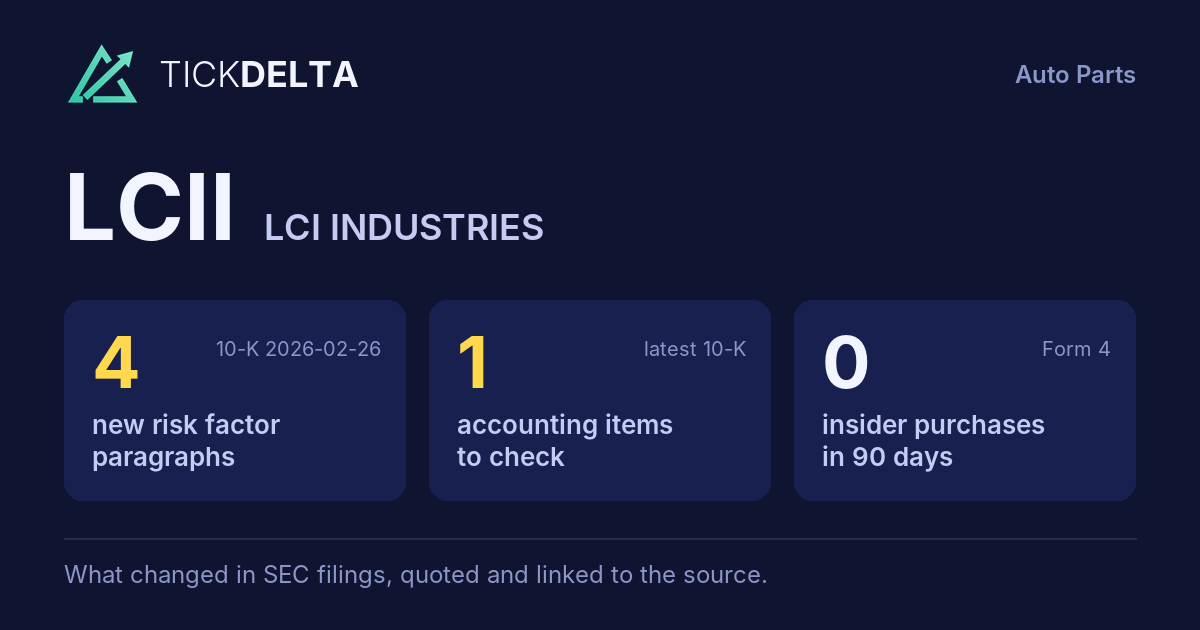
of the text changed · 8,523 words now · 4 new paragraphs, 1 gone
MD&A
22.4%
of the text changed · 5,094 words now · 10 new paragraphs, 5 gone
Legal Proceedings
11.5%
of the text changed · 391 words now
Accounting Policies
15.5%
of the text changed · 2,400 words now
10-K 0000763744-26-000011 (Feb 26, 2026) vs 10-K 0000763744-25-000022 (Feb 21, 2025)
Every paragraph, and how much of it changed
One bar per paragraph, in the order of the 10-K. Height and colour show the share of its words not in the closest paragraph a year earlier; the tallest bars are new paragraphs.
Risk Factors
126 paragraphs · 4 new · 29 reworded · 1 gone · 10-K Feb 26, 2026 against Feb 21, 2025
New paragraph
Reworded (5% of its words or more)
Same or nearly
Paragraph 92 · 47% changed
Every version of it
Paragraph 115 · 39% changed
Every version of it
Paragraph 102 · 39% changed
Every version of it
Paragraph 72 · 37% changed
Every version of it
Cyber-attacks, such as those involving the deployment of malware, are increasing in frequency, sophistication, and intensity and have become increasingly difficult to detect. Further, artificial intelligence technologies may be used for certain cybersecurity attacks, and may increase their frequency and intensity, resulting in heightened risks of security breaches and incidents. Despite our ongoing efforts to manage cybersecurity risks, we cannot assure you that they will be effective or will work as designed. If we fail to maintain or protect our information systems and data integrity effectively, we could: lose existing customers; have difficulty attracting new customers; suffer outages or disruptions in our operations or supply chains; have difficulty preventing, detecting, and controlling fraud; have disputes with customers and suppliers; have regulatory sanctions or penalties imposed; incur increased operating expenses; incur expenses or lose revenues as a result of a data privacy breach; or suffer other adverse consequences.
Paragraph 83 · 36% changed
Every version of it
We rely on certain trademarks, patents and other intellectual property rights, including contractual rights with third parties. Our success depends, in part, on our ability to protect our intellectual property against dilution, infringement, and competitive pressure by defending our intellectual property rights. We rely on intellectual property laws of the U.S., European Union, Canada, and other countries, as well as contractual and other legal rights, for the protection of our property rights. However, we cannot assure that these measures will be successful in any given instance, or that third parties will not infringe upon our intellectual property rights. We may be forced to take steps to protect our rights, including through litigation, which could result in a significant expenditure of funds and a diversion of resources. The inability to protect our intellectual property rights could result in competitors manufacturing and marketing similar products which could adversely affect our market share and results of operations. Competitors may challenge, invalidate, or avoid the application of our existing or future intellectual property rights that we receive or license.
Paragraph 27 · 35% changed
Every version of it
Paragraph 36 · 24% changed
Every version of it
A tight labor market has, and could in the future, result in difficulty obtaining skilled labor, and available capacity may initially not be utilized efficiently. result in increased labor and production costs.
Paragraph 48 · 47% changed
Every version of it
10-K Feb 21, 2025Our ability to expand our market share for our products that are used as components for RVs is limited. We have made investments in an effort to expand the sale of our products in adjacent industries, such as boats, buses, trucks, and trains, where we may have less familiarity with OEM or consumer preferences and could encounter difficulties in attracting customers due to a reduced level of familiarity with our brands. We have also made investments to expand the sale of our products in the aftermarket of our industries and to international markets and export sales of our products. These investments involve significant resources, put a strain on our administrative, operational, and financial capabilities and carry a risk of failure. Limited operating experience or limited brand recognition in new markets may limit our business expansion strategy. Lack of demand for our products in these markets or competitive pressures requiring us to lower prices for our products could adversely impact our business growth in these markets and our results of operations.
10-K Feb 26, 2026
Limited operating experience or limited brand recognition in new markets may limit our business expansion strategy. Lack of demand for our products in these markets or competitive pressures requiring us to lower prices for our products could adversely impact our business growth in these markets and our results of operations.
Paragraph 92 · 47% changed
Every version of it
10-K Feb 21, 2025The occurrence or consequences of any of these factors may have an adverse impact on our operating results and financial condition, as well as impact our ability to operate in international markets.
10-K Feb 26, 2026
reduce the efficiency of our operations. Any material interruptions or failures in our payment-related systems could have an adverse effect on our business, financial condition, and results of operations.
Paragraph 115 · 39% changed
Every version of it
10-K Feb 21, 2025Conversion of the Convertible Notes may dilute the ownership interest of our stockholders or may otherwise depress the price of our common stock.
10-K Feb 26, 2026
short positions, or anticipated conversion of the 2030 Convertible Notes into shares of our common stock could depress the price of our common stock.
Paragraph 102 · 39% changed
Every version of it
10-K Feb 21, 2025Our ability to make scheduled payments of the principal of, to pay interest on, or to refinance our indebtedness, including the Convertible Notes, depends on our future performance, which is subject to economic, financial, competitive and other factors beyond our control. Our business may not continue to generate cash flow from operations in the future sufficient to service our debt and make necessary capital expenditures. If we are unable to generate such cash flow, we may be required to adopt one or more alternatives, such as selling assets, curtailing spend, restructuring debt, or obtaining additional equity capital on terms that may be onerous or highly dilutive. Our ability to refinance our indebtedness will depend on the capital markets and our financial condition at such time. We may not be able to engage in any of these activities or engage in these activities on desirable terms, which could result in a default on our debt obligations.
10-K Feb 26, 2026
on terms that may be onerous or highly dilutive. Our ability to refinance our indebtedness will depend on the capital markets and our financial condition at such time. We may not be able to engage in any of these activities or engage in these activities on desirable terms, which could result in a default on our debt obligations.
Paragraph 72 · 37% changed
Every version of it
10-K Feb 21, 2025
data integrity effectively, we could: lose existing customers; have difficulty attracting new customers; suffer outages or disruptions in our operations or supply chains; have difficulty preventing, detecting, and controlling fraud; have disputes with customers and suppliers; have regulatory sanctions or penalties imposed; incur increased operating expenses; incur expenses or lose revenues as a result of a data privacy breach; or suffer other adverse consequences.
10-K Feb 26, 2026
Cyber-attacks, such as those involving the deployment of malware, are increasing in frequency, sophistication, and intensity and have become increasingly difficult to detect. Further, artificial intelligence technologies may be used for certain cybersecurity attacks, and may increase their frequency and intensity, resulting in heightened risks of security breaches and incidents. Despite our ongoing efforts to manage cybersecurity risks, we cannot assure you that they will be effective or will work as designed. If we fail to maintain or protect our information systems and data integrity effectively, we could: lose existing customers; have difficulty attracting new customers; suffer outages or disruptions in our operations or supply chains; have difficulty preventing, detecting, and controlling fraud; have disputes with customers and suppliers; have regulatory sanctions or penalties imposed; incur increased operating expenses; incur expenses or lose revenues as a result of a data privacy breach; or suffer other adverse consequences.
Paragraph 83 · 36% changed
Every version of it
10-K Feb 21, 2025
We rely on certain trademarks, patents and other intellectual property rights, including contractual rights with third parties. Our success depends, in part, on our ability to protect our intellectual property against dilution, infringement, and competitive pressure by defending our intellectual property rights. We rely on intellectual property laws of the U.S., European Union, Canada, and other countries, as well as contractual and other legal rights, for the protection of our property rights. However, we cannot assure that these measures will be successful in any given instance, or that third parties will not infringe upon our intellectual property rights. We may be forced to take steps to protect our rights, including through litigation, which could result in a significant expenditure of funds and a diversion of resources. The inability to protect our intellectual property rights could result in competitors manufacturing and marketing similar products which could adversely affect our market share and results of operations. Competitors may challenge, invalidate, or avoid the application of our existing or future intellectual property rights that we receive or license.
10-K Feb 26, 2026
We rely on certain trademarks, patents and other intellectual property rights, including contractual rights with third parties. Our success depends, in part, on our ability to protect our intellectual property against dilution, infringement, and competitive pressure by defending our intellectual property rights. We rely on intellectual property laws of the U.S., European Union, Canada, and other countries, as well as contractual and other legal rights, for the protection of our property rights.
Paragraph 27 · 35% changed
Every version of it
10-K Feb 21, 2025In 2024, we imported, or purchased from suppliers who imported, approximately 35 percent of our raw materials and components. Consequently, we rely on the free flow of goods through open and operational ports and on a consistent basis for a significant portion of our raw materials and components. Adverse geopolitical conditions, such as increased tariffs or import duties, trade embargoes, the heightened tensions between China and Taiwan, inclement weather, natural disasters, epidemics, public health crises, war, terrorism, or labor disputes at various ports or otherwise adversely impacting our suppliers create significant risks for our business, particularly if these conditions or disputes result in work slowdowns, lockouts, strikes, facilities closures, supply chain interruptions, or other disruptions, and could have an adverse impact on our operating results if we are unable to fulfill customer orders or are required to accumulate excess inventory or find alternate sources of supply, if available, at higher costs.
10-K Feb 26, 2026
significant risks for our business, particularly if these conditions or disputes result in work slowdowns, lockouts, strikes, facilities closures, supply chain interruptions, or other disruptions, and could have an adverse impact on our operating results if we are unable to fulfill customer orders or are required to accumulate excess inventory or find alternate sources of supply, if available, at higher costs.
Paragraph 36 · 24% changed
Every version of it
10-K Feb 21, 2025
A tight labor market has, and could in the future, result in difficulty obtaining skilled labor, and available capacity may initially not be utilized efficiently.
10-K Feb 26, 2026
A tight labor market has, and could in the future, result in difficulty obtaining skilled labor, and may result in increased labor and production costs.
MD&A
109 paragraphs · 10 new · 55 reworded · 5 gone · 10-K Feb 26, 2026 against Feb 21, 2025
New paragraph
Reworded (5% of its words or more)
Same or nearly
Paragraph 62 · 48% changed
Paragraph 67 · 48% changed
Paragraph 11 · 48% changed
OEM Segment: Manufactures and distributes a broad array of engineered components for the leading OEMs of RVs and adjacent industries, including boats; buses; trailers used to haul the transportation (buses, trailers, construction, trains, and power sports), marine (pontoon boats, livestock, equipment power boats, fishing boats, sailboats, and other cargo; trucks; trains; manufactured homes; yachts), and housing (manufactured and modular housing. homes, park models, commercial offices, restroom trailers, and residential housing) markets.
Paragraph 98 · 46% changed
Paragraph 66 · 44% changed
Paragraph 49 · 44% changed
Our increase in net sales to RV OEMs during 2024 2025 was driven by sales price increases related to tariffs, an increase in RV sales mix toward higher content fifth-wheel units, market share gains and a 13 3 percent increase in total North American RV wholesale shipments of travel trailers and fifth wheel units and market share gains, shipments, partially offset by a 24 percent decrease volume decreases in motorhome wholesale shipments and a shift in unit mix towards lower content single axle travel trailers. the European RV market.
Paragraph 53 · 43% changed
Paragraph 70 · 43% changed
Paragraph 62 · 48% changed
10-K Feb 21, 2025Our net sales to the Aftermarket Segment included lower volumes within the RV and marine aftermarkets, mostly offset by market share gains within the automotive aftermarket.
10-K Feb 26, 2026
The increase in net sales of the Aftermarket Segment was primarily driven by product innovations, the expanding Camping World relationship within the RV aftermarket, and sales from acquired businesses, partially offset by lower volumes within the automotive aftermarket.
Paragraph 67 · 48% changed
10-K Feb 21, 2025•Sales mix increase of lower margin products, which negatively impacted operating profit by $12.1 million compared to 2023.
10-K Feb 26, 2026
•Decreases in automotive aftermarket production volumes in response to lower retail volumes, which led to reduced utilization of fixed production overhead costs, negatively impacting operating profit by $3.9 million compared to 2024.
Paragraph 11 · 48% changed
10-K Feb 21, 2025
OEM Segment: Manufactures and distributes a broad array of engineered components for the leading OEMs of RVs and adjacent industries, including boats; buses; trailers used to haul boats, livestock, equipment and other cargo; trucks; trains; manufactured homes; and modular housing.
10-K Feb 26, 2026
OEM Segment: Manufactures and distributes a broad array of engineered components for the leading OEMs of RVs and adjacent industries, including the transportation (buses, trailers, construction, trains, and power sports), marine (pontoon boats, power boats, fishing boats, sailboats, and yachts), and housing (manufactured and modular homes, park models, commercial offices, restroom trailers, and residential housing) markets.
Paragraph 98 · 46% changed
10-K Feb 21, 2025b.See Note 11 of the Notes to Consolidated Financial Statements for additional information regarding the maturity of our lease obligations under operating leases. Our finance leases were not material at December 31, 2024.
10-K Feb 26, 2026
See Note 13 of the Notes to Consolidated Financial Statements for additional information related to our dividend and share repurchase programs.
Paragraph 66 · 44% changed
10-K Feb 21, 2025•Increases in production labor costs due to product mix, which negatively impacted operating profit by $10.2 million compared to 2023.
10-K Feb 26, 2026
•Investments in capacity, distribution and logistics technology to support continued growth in the Aftermarket Segment, which negatively impacted operating profit by $8.7 million compared to 2024.
Paragraph 49 · 44% changed
10-K Feb 21, 2025
Our increase in net sales to RV OEMs during 2024 was driven by a 13 percent increase in wholesale shipments of travel trailers and fifth wheel units and market share gains, partially offset by a 24 percent decrease in motorhome wholesale shipments and a shift in unit mix towards lower content single axle travel trailers.
10-K Feb 26, 2026
Our increase in net sales to RV OEMs during 2025 was driven by sales price increases related to tariffs, an increase in RV sales mix toward higher content fifth-wheel units, market share gains and a 3 percent increase in total North American RV wholesale shipments, partially offset by volume decreases in the European RV market.
Paragraph 53 · 43% changed
10-K Feb 21, 2025•Increases in production labor costs due to product mix, which negatively impacted operating profit by $10.2 million compared to 2023.
10-K Feb 26, 2026
•Reduced costs from materials sourcing strategies, which increased operating profit by $44.5 million compared to 2024.
Paragraph 70 · 43% changed
10-K Feb 21, 2025•Increases in production labor costs due to product mix, which negatively impacted operating profit by $10.2 million compared to 2023.
10-K Feb 26, 2026
•Reduced costs from materials sourcing strategies, which increased operating profit by $13.5 million compared to 2024.
A paragraph is matched with the one last year that shares the most of its words; under half in common makes it new. The paragraphs shown are the 8 reworded the most in each section.
The paragraph that changed most in each section
The redline
Marked against last year's 10-K: cut words struck through, new words highlighted.
Accounting Policies157 words changed in this paragraph; it is 30% similar to last year's version.
In December 2023, July 2025, the FASB issued ASU 2023-09, Income Taxes 2025-05, Financial Instruments - Improvements Credit Losses (Topic 326): Measurement of Credit Losses for Accounts Receivable and Contract Assets, which simplifies credit loss calculations by introducing a practical expedient (available to Income Tax Disclosures requiring enhancements and further transparency all entities) that allows entities to certain income tax disclosures, most notably assume current conditions will not change over an asset’s life, removing the tax rate reconciliation and income taxes paid. The new standard also eliminates certain existing disclosure requirements related to uncertain tax positions and unrecognized deferred tax liabilities. need for complex macroeconomic forecasts. This ASU is effective for fiscal years beginning after December 15, 2024 on a prospective basis 2025, and retrospective application is interim periods within those annual reporting periods, with early adoption permitted. The Company will adopt is evaluating the effect of adopting this ASU for new accounting guidance and does not expect the year ending December 31, 2025, and it will only standard to have a material impact the Company's disclosures with no impacts to on its financial condition or condition, results of operations. operations, or cash flows.
Source: Item 8, Note 2 – SUMMARY OF SIGNIFICANT ACCOUNTING POLICIES, 10-K 0000763744-26-000011 vs Item 8, Note 2 – SUMMARY OF SIGNIFICANT ACCOUNTING POLICIES, 10-K 0000763744-25-000022
MD&A136 words changed in this paragraph; it is 51% similar to last year's version.
The prices of key raw materials, consisting primarily of steel and aluminum, and components used by us which are made from these raw materials, are influenced by demand and other factors specific to these commodities, as well as by inflationary pressures. Prices including tariffs for materials sourced internationally. The prices for steel consumed in certain of our manufactured components were lower and the prices for aluminum consumed in certain of our manufactured components were higher during 2025 compared to 2024. While the prices for steel consumed in certain of our manufactured components were lower year-over-year, commodity prices for both steel and aluminum generally increased during 2025, and are expected to remain elevated in 2026. However, prices of these commodities have historically been volatile, volatile and over the past few months prices have continued to fluctuate. Overall, we experienced reduced prices there can be no assurances of these commodities in 2024, and at this time, we expect commodity prices to be generally stable in 2025; however, recent tariff activity could have an adverse impact. future prices. Please see "Results of Operations" above for additional information regarding the impact of raw material costs costs, including related to tariffs, on our results of operations for the year ended December 31, 2024. 2025.
Source: Item 7, 10-K 0000763744-26-000011 vs Item 7, 10-K 0000763744-25-000022
Risk Factors103 words changed in this paragraph; it is 58% similar to last year's version.
We rely on certain trademarks, patents and other intellectual property rights, including contractual rights with third parties. Our success depends, in part, on our ability to protect our intellectual property against dilution, infringement, and competitive pressure by defending our intellectual property rights. We rely on intellectual property laws of the U.S., European Union, Canada, and other countries, as well as contractual and other legal rights, for the protection of our property rights. However, we cannot assure that these measures will be successful in any given instance, or that third parties will not infringe upon our intellectual property rights. We may be forced to take steps to protect our rights, including through litigation, which could result in a significant expenditure of funds and a diversion of resources. The inability to protect our intellectual property rights could result in competitors manufacturing and marketing similar products which could adversely affect our market share and results of operations. Competitors may challenge, invalidate, or avoid the application of our existing or future intellectual property rights that we receive or license.
Source: Item 1A, 10-K 0000763744-26-000011 vs Item 1A, 10-K 0000763744-25-000022
Legal Proceedings28 words changed in this paragraph; it is 83% similar to last year's version.
In the normal course of business, the Company is subject to proceedings, lawsuits, regulatory agency inquiries, and other claims. All such matters are subject to uncertainties and outcomes that are not predictable with assurance. While these matters could materially affect operating results when resolved in future periods, management believes that, after final disposition, including anticipated insurance recoveries in certain cases, any monetary liability or financial impact to the Company beyond that provided in the Consolidated Balance Sheet as of December 31, 2025, would not be material to the Company's financial position or annual results of operations.
Source: Item 3, via Note 12 – COMMITMENTS AND CONTINGENCIES, 10-K 0000763744-26-000011 vs Item 3, via Note 12 – COMMITMENTS AND CONTINGENCIES, 10-K 0000763744-25-000022
Sentences and paragraphs added, removed or reworded
Every change, by type
Sentences and paragraphs of LCII's Risk Factors and MD&A, 10-K Feb 26, 2026 against 10-K Feb 21, 2025. Each links to the text at sec.gov.
Quiet changes are sentences kept from last year with one to four words changed, at least one of them a hedge, a modal or a qualifier (may, could, will, not, significant, material…). A year or date rolling forward is not counted.
The full word list
adverse, adversely, all, although, anticipate, anticipates, any, approximately, believe, believes, can, cannot, certain, could, expect, expects, generally, however, if, intend, intends, largely, likely, many, material, materially, may, might, most, must, never, no, not, possible, primarily, probable, should, significant, significantly, some, substantial, substantially, unlikely, will, would
AddedRisk Factors
Changing conditions and uncertainty over global tariffs, or the financial impact of tariffs and resulting consequences, have negatively affected, and may continue to negatively affect, our business, operating results, and financial condition.
Read it in 10-K Feb 26, 2026 at sec.gov
AddedRisk Factors
Changes in U.S. domestic and global tariff frameworks have increased our costs of sourcing goods and resulted in additional risks to our supply chain. The U.S. government has imposed significant tariffs impacting a wide variety of goods across multiple countries and indicated that additional tariffs may be imposed in the near future. In response, some countries have announced or imposed tariffs on goods made in the U.S. These actions resulted in higher material costs for us in 2025, which could continue or worsen, and pricing actions we have taken, or in the future may take, in light of material cost increases could negatively impact demand for our products, any of which could have a material adverse effect on our business, financial condition, results of operations and cash flow.
Read it in 10-K Feb 26, 2026 at sec.gov
AddedRisk Factors
Further increasing uncertainty related to trade policies, on February 20, 2026, the U.S. Supreme Court ruled against the U.S. presidential administration’s use of tariffs under the International Emergency Economic Powers Act ("IEEPA"), and U.S. Customs and Border Protection halted collections of IEEPA tariffs on February 24, 2026. However, the decision creates uncertainty related to various aspects of the tariffs previously collected under the IEEPA, including whether, and if so, how, companies may be able to recover any portion of IEEPA tariffs previously paid. Further, not all tariffs announced throughout 2025 were impacted by this U.S. Supreme Court decision since many tariffs were imposed under other legal authorities that remain in effect and new tariffs may continue to be implemented through these other legal authorities. Additionally, in response to the U.S. Supreme Court ruling, the U.S. presidential administration imposed a new worldwide tariff effective for 150 days from February 24, 2026. The imposition of these new, worldwide tariffs, as well as the potential for further tariff actions by the U.S. presidential administration or others, represents a significant source of uncertainty and could have a material adverse effect on our business, financial condition, and results of operations.
Read it in 10-K Feb 26, 2026 at sec.gov
AddedRisk Factors
In addition, political tensions and uncertainty as a result of rapidly changing trade policies could reduce trade volume, investment, technological exchange, and other economic activities between major international economies, resulting in a material adverse effect on global economic conditions and the stability of global financial markets, which could in turn have a material adverse impact on our business, financial condition, and results of operations.
Read it in 10-K Feb 26, 2026 at sec.gov
RemovedRisk Factors
RewordedRisk Factors
Adverse geopolitical conditions, such as increased tariffs or import duties, trade embargoes, the heightened tensions between China and Taiwan, inclement weather, natural disasters, epidemics, public health crises, war, terrorism, or labor disputes at various ports or otherwise adversely impacting our suppliers create significant risks for our business, particularly if these conditions or disputes result in work slowdowns, lockouts, strikes, facilities closures, supply chain interruptions, or other disruptions, and could have an adverse impact on our operating results if we are unable to fulfill customer orders or are required to accumulate excess inventory or find alternate sources of supply, if available, at higher costs.
Read it in 10-K Feb 26, 2026 at sec.gov
RewordedRisk Factors
RewordedRisk Factors
In addition, the existence of the 2030 Convertible Notes may encourage short selling by market participants because the conversion of the 2030 Convertible Notes could be used to satisfy short positions, or anticipated conversion of the Convertible Notes into shares of our common stock could depress the price of our common stock.
Read it in 10-K Feb 26, 2026 at sec.gov
Show the other 37
RewordedRisk Factors
Financing for our investments has been provided through a combination of currently available cash and cash equivalents, term loans, our 1.125 percent convertible senior notes due 2026 (the "2026 Convertible Notes"), our 3.000 percent convertible senior notes due 2030 (the "2030 Convertible Notes" and collectively with the 2026 Convertible Notes, the "Convertible Notes"), and use of our revolving credit facility.
Read it in 10-K Feb 26, 2026 at sec.gov
RewordedRisk Factors
A tight labor market has, and could in the future, result in difficulty obtaining skilled labor, and available capacity may initially not be utilized efficiently. result in increased labor and production costs.
Read it in 10-K Feb 26, 2026 at sec.gov
RewordedRisk Factors
For example, California has laws that give California residents certain privacy rights in the collection and disclosure of their personal information and requires businesses to make certain disclosures and take certain other acts in furtherance of those rights, and has recently created a new agency, the California Privacy Protection Agency, Agency is authorized to implement and enforce California’s privacy laws, which could result in increased privacy and information security regulatory actions.
Read it in 10-K Feb 26, 2026 at sec.gov
RewordedRisk Factors
If we are unable to generate such cash flow, we may be required to adopt one or more alternatives, such as selling assets, curtailing spend, restructuring debt, or obtaining additional equity capital on terms that may be onerous or highly dilutive.
Read it in 10-K Feb 26, 2026 at sec.gov
RewordedRisk Factors
Epidemic outbreaks, terrorist acts, political events, and political events civil unrest could disrupt our business and result in lower sales and otherwise adversely affect our financial performance.
Read it in 10-K Feb 26, 2026 at sec.gov
RewordedRisk Factors
External events, such as epidemic outbreaks, terrorist attacks, or disruptive political events events, or civil unrest could adversely affect our business and result in lower sales.
Read it in 10-K Feb 26, 2026 at sec.gov
RewordedRisk Factors
Costs and potential problems and interruptions associated with the implementation of new or upgraded systems and technology such as those necessary to maintain compliance with the PCI Standard or with maintenance or adequate support of existing systems could also disrupt or reduce the efficiency of our operations.
Read it in 10-K Feb 26, 2026 at sec.gov
RewordedRisk Factors
Certain provisions in the Indenture indentures governing the Convertible Notes may make it more difficult or expensive for a third party to acquire us.
Read it in 10-K Feb 26, 2026 at sec.gov
RewordedRisk Factors
A number of factors have in the past, and could continue to, negatively impact consumer demand, production levels, shipments, sales, and operating results, including credit availability, consumer confidence, employment rates, prevailing interest rates, inflation, fuel prices, and other economic conditions affecting consumer demand and discretionary consumer spending, such as occurred during 2025, as well as demographic and political changes.
Read it in 10-K Feb 26, 2026 at sec.gov
Quiet changesRisk Factors
Further, any leadership transitions can be inherently difficult to manage, may result in operational inefficiencies, and impact our ability to retain and hire other key members of management.
Read it in 10-K Feb 26, 2026 at sec.gov
AddedMD&A
volumes driven by an increased mix of higher content fifth-wheel units, market share gains, and a 3 percent increase in total North American RV wholesale shipments.
Read it in 10-K Feb 26, 2026 at sec.gov
AddedMD&A
•Tariff mitigation strategy of diversifying our supply chain, with help from vendors and other sourcing strategies, enabled us to minimize the impact of pricing to our customers as well as support profitability.
Read it in 10-K Feb 26, 2026 at sec.gov
AddedMD&A
•The impact of fixed costs spread over increased sales, which increased operating profit by $14.6 million related to fixed production overhead costs and $13.1 million related to fixed selling, general, and administrative costs.
Read it in 10-K Feb 26, 2026 at sec.gov
AddedMD&A
In 2025, we recorded an $8.9 million loss on extinguishment of debt, consisting of $6.2 million in connection with the repurchase of a portion of our 2026 Convertible Notes, $1.9 million related to the repayment of our previous term loan, and $0.8 million related to the repricing amendment for our Term Loans.
Read it in 10-K Feb 26, 2026 at sec.gov
AddedMD&A
As part of our footprint optimization efforts, we sold two owned real estate locations during 2025 for combined net cash proceeds of $22.7 million. The sales resulted in a total net gain on the sale of real estate of $19.7 million for the year ended December 31, 2025.
Read it in 10-K Feb 26, 2026 at sec.gov
AddedMD&A
•payments of $368.9 million for the repurchase of a portion of our 2026 Convertible Notes,
Read it in 10-K Feb 26, 2026 at sec.gov
AddedMD&A
•$303.0 million in repayments under our revolving credit facility, Term Loan, and other borrowings,
Read it in 10-K Feb 26, 2026 at sec.gov
AddedMD&A
•payments of $67.6 million for the purchase of convertible note hedge contracts, and
Read it in 10-K Feb 26, 2026 at sec.gov
AddedMD&A
•cash outflows of $5.3 million related to vesting of stock-based awards, net of shares tendered for payment of taxes,
Read it in 10-K Feb 26, 2026 at sec.gov
AddedMD&A
•net proceeds from the issuance of our 2030 Convertible Notes of $448.5 million,
Read it in 10-K Feb 26, 2026 at sec.gov
RemovedMD&A
RemovedMD&A
RemovedMD&A
RemovedMD&A
RemovedMD&A
RewordedMD&A
Manufactures and distributes a broad array of engineered components for the leading OEMs of RVs and adjacent industries, including boats; buses; trailers used to haul the transportation (buses, trailers, construction, trains, and power sports), marine (pontoon boats, livestock, equipment power boats, fishing boats, sailboats, and other cargo; trucks; trains; manufactured homes; yachts), and housing (manufactured and modular housing. homes, park models, commercial offices, restroom trailers, and residential housing) markets.
Read it in 10-K Feb 26, 2026 at sec.gov
RewordedMD&A
The decrease in net cash flows provided by operating activities was primarily due to the increase in inventories in 2025 of $35.0 million driven by higher inventory levels to support increased sales volume and higher material costs compared to the decrease in inventory in 2023 2024 of $235.3 $46.3 million driven by decreasing lower commodity costs and initiatives to reduce inventory levels, compared to the decrease in inventories in 2024 of $46.3 million. levels.
Read it in 10-K Feb 26, 2026 at sec.gov
RewordedMD&A
Cash flows used in financing activities of $426.2 $208.2 million in 2023 2024 were primarily comprised of $215.9 payments of quarterly dividends of $109.5 million, $52.5 million in net repayments under our revolving credit facility, payments of quarterly dividends of $106.3 million, $61.1 $36.7 million in repayments under our Term Loan and other borrowings, $31.9 million related to payment of contingent consideration and holdbacks related to acquisitions, and cash outflows of $9.6 $9.2 million related to vesting of stock-based awards, net of shares tendered for payment of taxes.
Read it in 10-K Feb 26, 2026 at sec.gov
RewordedMD&A
Under this stock repurchase program, we purchased 253,490 308,898 shares at a weighted average price of $94.89 $91.47 per share, totaling $24.1 million, $28.4 million including excise tax during March 2025, using approximately $28.3 million of the year ended December 31, 2022. net proceeds from the offering of the 2030 Convertible Notes.
Read it in 10-K Feb 26, 2026 at sec.gov
RewordedMD&A
Our decrease increase in net sales to OEMs in Adjacent Industries during 2024 2025 was primarily due to lower sales from acquired businesses and higher sales to North American marine and utility trailer OEMs, driven by current dealer inventory levels, inflation, and elevated interest rates impacting retail consumers. OEMs.
Read it in 10-K Feb 26, 2026 at sec.gov
RewordedMD&A
According to the Institute for Building Technology and Safety, wholesale shipments totaled 102,600 were approximately 102,700 units in 2024, up from 2025, compared to 103,300 in 2024 and 89,200 in 2023 but down from 112,900 in 2022. 2023.
Read it in 10-K Feb 26, 2026 at sec.gov
RewordedMD&A
RewordedMD&A
According to School Bus Fleet, sales decreased approximately 41,000 units were sold in 2025, compared to 40,300 units in 2024, down from 2024 and 41,200 in 2023 and 40,600 in 2022. 2023.
Read it in 10-K Feb 26, 2026 at sec.gov
RewordedMD&A
Cash flows used in investing activities of $61.1 $147.1 million in 2024 2025 were primarily comprised of $42.3 $112.7 million for business acquisitions and $52.6 million for capital expenditures and $20.0 million for a business acquisition. expenditures.
Read it in 10-K Feb 26, 2026 at sec.gov
RewordedMD&A
Supplies many of our engineered components to the related aftermarket channels of the recreation RV, transportation, marine, and transportation automotive markets, primarily to through retail dealers, wholesale distributors, and service centers, as well as direct to retail customers via the Internet. direct-to-consumer sales through online platforms.
Read it in 10-K Feb 26, 2026 at sec.gov
RewordedMD&A
Cash flows used in investing financing activities of $83.7 $125.5 million in 2023 2025 were primarily comprised of $62.2 million for capital expenditures and $25.9 million for the acquisition of businesses. following:
Read it in 10-K Feb 26, 2026 at sec.gov
RewordedMD&A
Under this stock repurchase program, 10b5-1 trading plan, we purchased 253,490 1,057,667 shares at a weighted average price of $94.89 $94.55 per share, share totaling $24.1 $101.0 million, including excise tax during the year ended December 31, 2022. 2025.
Read it in 10-K Feb 26, 2026 at sec.gov
Sources
The two latest 10-Ks on EDGAR, section by section. Each change links to the text at sec.gov.
Also
New risk factors: paragraphs with nothing like them last year, quoted in full.
Work with it
Excel workbook · CSV. Google Sheet that stays up to date: paste =IMPORTDATA("https://tickdelta.com/company/LCII/export.csv") into a cell.