Screener / SEC EDGAR /CIK 0001339688 /10-K filed Mar 31, 2026, compared with Mar 28, 2025 /Numbers from the XBRL of the 10-Ks
Nasdaq Materials · Mining

Lion Copper Corp. LCU

Compare with peers Embed
SEC comment letters, last 20 years

4 reviews of LCU's filings by SEC staff

UPLOAD and CORRESP
Reviews 4 latest letter Dec 10, 2024
Questions asked 17 each answered in the company's own letter
No closing letter 0 reviews without a letter saying the staff completed it

When the SEC's staff reviews a filing, it writes to the company with numbered questions, and the company answers each one in a letter. SEC publishes the exchange once the review is over, at least 20 business days later. A question is not an accusation; most reviews end with the company adding detail to its next filing.

How the reviews went

Every review on EDGAR, from the first staff letter to the letter that closes it

  1. 1. Staff letters 4 UPLOAD
  2. 2. Questions in them 17 numbered comments
  3. 3. Company replies 4 CORRESP
  4. 4. Reviews closed 4 of 4 closing letter

Half the closed reviews took 29 days or less from the first letter to the closing letter.

Form 10-K for the Fiscal year Ended December 31, 2023

2024-12-10 to 2025-01-08 · 5 questions · 1 letter from the SEC, 1 from the company
Review closed 2025-01-08
ControlsReserves and insurance
Form 10-K for the Fiscal year Ended December 31, 2023 Filed April 1, 2024 · Item 2. Properties, page 17
SEC asked (1)
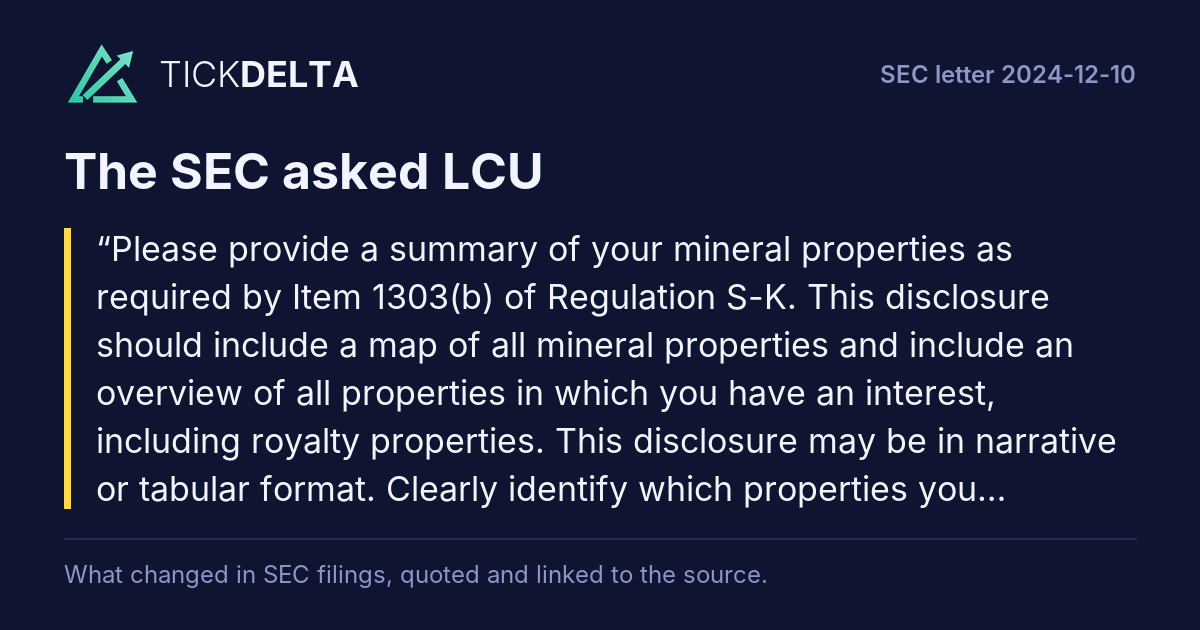
Please provide a summary of your mineral properties as required by Item 1303(b) of Regulation S-K. This disclosure should include a map of all mineral properties and include an overview of all properties in which you have an interest, including royalty properties. This disclosure may be in narrative or tabular format. Clearly identify which properties you consider to be material properties.
LCU answered
The Company has amended the disclosure in Item 2. Properties of the Amended Annual Report to provide the required summary disclosure under Item 1303(b)of Regulation S-K and clearly indicate which properties the Company considers material.
Read in the reply
In its next report

First report after the company's reply of Dec 26, 2024: 10-K filed Mar 28, 2025 ↗, against the 10-K filed Apr 1, 2024 ↗.

Tickdelta does not hold the text of both reports, so they are not compared here.

Form 10-K for the Fiscal year Ended December 31, 2023 Filed April 1, 2024 · Item 2. Properties, page 17
SEC asked (2)
For each material property please provide the disclosure required by Item 1304(b) of Regulation S-K.
LCU answered
The Company has amended the disclosure in Item 2. Properties of the Amended Annual Report to provide the disclosure required by Item 1304(b) of Regulation S-K for each of its material properties.
Read in the reply
In its next report

First report after the company's reply of Dec 26, 2024: 10-K filed Mar 28, 2025 ↗, against the 10-K filed Apr 1, 2024 ↗.

Tickdelta does not hold the text of both reports, so they are not compared here.

Form 10-K for the Fiscal year Ended December 31, 2023 Filed April 1, 2024 · Item 2. Properties, page 17
SEC asked (3)
Please disclose the information required by Item 1305 with respect to your internal controls used in your exploration and mineral resource and reserve estimation efforts.
LCU answered
The Company has amended the disclosure in Item 2. Properties of the Amended Annual Report to disclose the information required by Item 1305 of Regulation S-K in relation to its exploration results.
Read in the reply
In its next report

First report after the company's reply of Dec 26, 2024: 10-K filed Mar 28, 2025 ↗, against the 10-K filed Apr 1, 2024 ↗.

Tickdelta does not hold the text of both reports, so they are not compared here.

Form 10-K for the Fiscal year Ended December 31, 2023 Filed April 1, 2024 · Item 2. Properties, page 17
SEC asked (4)
We note that you have disclosed mineral resources for the Yerington deposit on page F-68 of your filing and on your company website. Only S-K 1300 compliant mineral resources may be disclosed in your filing. Please revise to disclose your S-K 1300 mineral resources in the mineral property section of your filing as required by Item 1303(b)(3) and Item 1304(d)(1) of Regulation S-K.
Rest of the question

Please file your S-K 1300 compliant technical report summary to support mineral resources as required by Item 1302(b) of Regulation S-K.

LCU answered
The Company has amended the disclosure contained in the F-pages of its Management's Discussion and Analysis in the Amended Annual Report to remove the disclosure of mineral resources which were inadvertently included in the filing as the same Management's Discussion and Analysis disclosure was being used to meet the Company's filing obligations in Canada under NI 43-101.
Read in the reply
In its next report

First report after the company's reply of Dec 26, 2024: 10-K filed Mar 28, 2025 ↗, against the 10-K filed Apr 1, 2024 ↗.

Tickdelta does not hold the text of both reports, so they are not compared here.

Form 10-K for the Fiscal year Ended December 31, 2023 Filed April 1, 2024 · Item 2. Properties, page 17
SEC asked (5)
Please revise to remove the results of your preliminary economic assessment until you have completed and filed an S-K 1300 initial assessment that includes an assessment of the economic potential of your mineral resources.
LCU answered
The Company has amended the disclosure contained in the Fpages of its Management's Discussion and Analysis in the Amended Annual Report to remove the results of the preliminary economic assessment.
Read in the reply
In its next report

First report after the company's reply of Dec 26, 2024: 10-K filed Mar 28, 2025 ↗, against the 10-K filed Apr 1, 2024 ↗.

Tickdelta does not hold the text of both reports, so they are not compared here.

Also in this review: closing letter, 2025-01-08
Form 20-F for the Fiscal Year Ended December 31, 2016

2017-06-07 to 2017-06-23 · 3 questions · 1 letter from the SEC, 1 from the company
Review closed 2017-06-23
Reserves and insurance
Mineral Resources, page 19
SEC asked (1)
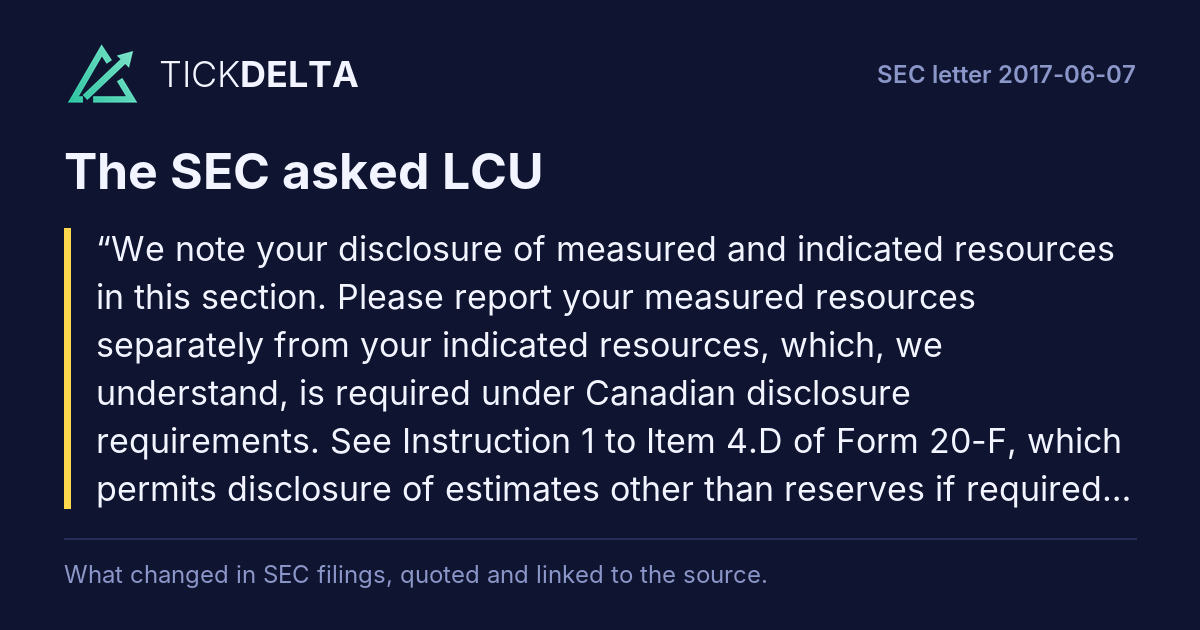
We note your disclosure of measured and indicated resources in this section. Please report your measured resources separately from your indicated resources, which, we understand, is required under Canadian disclosure requirements. See Instruction 1 to Item 4.D of Form 20-F, which permits disclosure of estimates other than reserves if required by foreign law.
LCU answered
The Company will in future filings disclose estimates of measured and indicated resources separately. The following two paragraphs are proposed to be used in place of the current wording found at page 19 of the Form

20-F under the sub-heading “Mineral Resources”.

The increases to the February 2012 resource are as follows.
Rest of the answer

Using a 0.12% TCu copper cutoff, the measured oxide and chalcocite resource increased 8% in tons, 10% in grade, and 17% in pounds of contained copper, the indicated oxide and chalcocite resource increased 37% in tons, 9% in grade, and 47% in pounds of contained copper while the inferred resource increased 5% in tons, 14% in grade, and 21% in contained copper. Using a 0.15% TCu copper cutoff, the primary measured resource decreased 3% in tons, increased 10% in grade, and increased 8% in contained copper, the primary indicated resource increased 19% in tons, 15% in grade and 35% in contained copper, while the primary inferred resource increased 4% in tons, 11% in grade, and 13% in contained copper.

Using a cutoff grade of 0.12%, the

Yerington Pit’s acid-soluble oxide/chalcocite mineralization includes a measured resource of 6.5 million tons averaging 0.25% TCu (33 million pounds of copper), an indicated resource of 17.0 million tons averaging 0.25% TCu (85 million pounds of copper), and an inferred resource of 25.9 million tons of 0.23% TCu

(118 million pounds of copper). Using a cutoff of 0.15% TCu, the measured primary copper resource contains 31 million tons averaging 0.33% TCu (205 million pounds of copper), the indicated primary copper resource contains 74 million tons averaging 0.30% TCu (428 million pounds of copper), and the inferred primary copper resource contains 128 million tons of 0.23% TCu (600 million pounds of copper).

Read in the reply
Mineral Resources, page 19
SEC asked (2)
The cutoff grade is a critical component used to evaluate the economic potential of the mineral properties. Please disclose the commodity prices, operating costs and recovery parameters used to determine your cutoff grade estimates. Please see Instruction 1 to Item 4.D of Form 20-F. Please show how your cutoff grade calculation demonstrates your mineral resources have reasonable prospects for economic extraction.
Rest of the question

In establishing your cutoff grade, your disclosure must realistically reflect the location, deposit scale, continuity, assumed mining method, metallurgical processes, costs, and metal prices.

LCU answered
The Yerington project is an exploration stage project and no economic analysis has been prepared. The parameters applied towards the estimation of resources at the Yerington project were based on benchmarking from similar projects. We will modify future disclosure to indicate that cut-off grades were determined based on benchmarking from similar projects, including from a report on the preliminary economic assessment the Company’s neighbouring

MacArthur Copper Project. A summary of the parameters used in the benchmarked cut-off grades will be included in the amended disclosure.
Rest of the answer

The following disclosure is proposed to be included in future filings in addition of the current disclosure on page 19 described in response to comment 1 above:

Cutoff grades of 0.12% and 0.15% for the oxide/chalcocite and sulfide mineralization, respectively, were used in the

Updated Yerington Technical Report based on benchmarking of the Yerington

Deposit to similar deposits using open pit mining. The cutoff values are representative of grades and recoveries used in calculating the mineral resources for the preliminary economic assessment for the Company’s adjacent

MacArthur Copper Project, which is described in a NI 43-101 technical report filed in January of 2014 using an effective date for the resource calculation of

May 2012. The MacArthur study indicates that using the cutoff grades in the report, the project has reasonable prospects for economic extraction of mineralization. The Yerington and MacArthur deposits are adjacent, geologically similar and have similar grade continuity. Open pit mining methods are proposed for both deposits. They will use similar metallurgical processes. The cutoff grades are based on similar costs, metal prices and mining/metallurgic parameters. The benchmark values applied to the Yerington Project from the

MacArthur project are:

Price and Recovery

Copper Price (average)

$2.42/lb

Oxide Ore recovery

65% of TCu

Sulfide Ore recovery

27% of TCu

Costs:

Read in the reply
Mineral Resources, page 19
SEC asked (3)
Please insert a small-scale map showing the location and access to each material property, as required by Instruction 1 to Item 4.D. of Form 20-F. We believe the guidance found in Industry Guide 7(b)(2) would generally require maps and drawings to comply with the following features:  A legend or explanation showing, by means of pattern or symbol, every pattern or symbol used on the map or drawing.
Rest of the question

 A graphical bar scale should be included. Additional representations of scale such as "one inch equals one mile" may be utilized provided the original scale of the map has not been altered.  A north arrow.  An index map showing where the property is situated in relationship to the state or province, etc., in which it was located.  A title of the map or drawing, and the date on which it was drawn.  In the event interpretive data is submitted in conjunction with any map, the identity of the geologist or engineer that prepared such data. Any drawing should be simple enough or of sufficiently large scale to clearly show all features on the drawing.

LCU answered
The company will include the following two location maps for the Yerington Projects in future disclosure:

Yerington Projects Location Map (Tetra Tech - February 2012)

Yerington Projects Prospect Location Map (Tetra Tech February 2012)

We trust the foregoing is satisfactory. Please advise should there be further comments.

Yours truly,

QUATERRA RESOURCES INC.

Per:

/s/ Thomas C. Patton

Thomas C. Patton, Ph.D.
Read in the reply

Also in this review: closing letter, 2017-06-23

Form 20-F for the Fiscal Year Ended December 31, 2013

2014-11-07 to 2014-11-17 · 2 questions · 1 letter from the SEC, 1 from the company
Review closed 2014-11-17
D. Property, Plants and Equipment page 15
SEC asked (1)
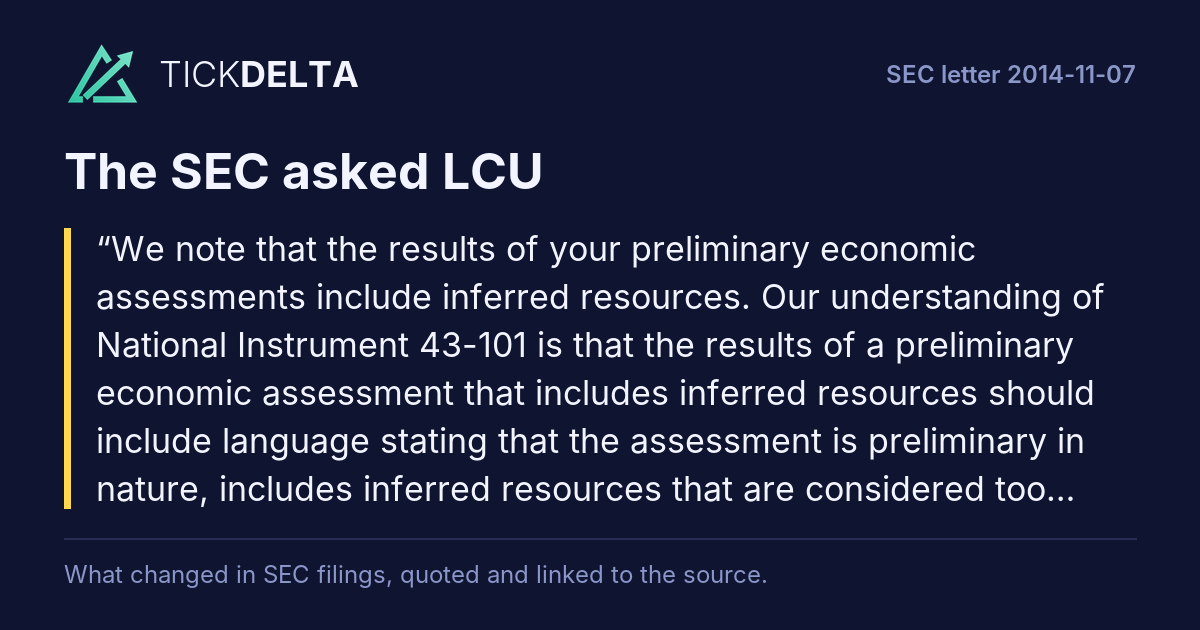
We note that the results of your preliminary economic assessments include inferred resources. Our understanding of National Instrument 43-101 is that the results of a preliminary economic assessment that includes inferred resources should include language stating that the assessment is preliminary in nature, includes inferred resources that are considered too speculative geologically to have economic considerations
Rest of the question

applied to them, and that there is no certainty that the assessment will be realized. Please advise.

LCU answered
In future filings and relevant submissions to the Securities and Exchange Commission (the

“Commission”), the Company will include the cautionary language referenced in your comment regarding the use of inferred resources. Please note that he appropriate cautionary notes regarding the use of inferred resources are however disclosed in the MacArthur preliminary economic analysis (“PEA”), the press release announcing the PEA and the Company’s corporate presentation. The technical reports, press release and corporate presentation are all posted on the Company’s website.
Read in the reply
D. Property, Plants and Equipment page 15
SEC asked (2)
We note your disclosure on page 26 regarding 124 million tons of mineralized material. Please tell us if this estimate is considered a historical estimate. If so, our understanding of National Instrument 43-101 is that historical estimates should include the language listed under section 2.4 of National Instrument 43-101. Please advise.
LCU answered
relevant submissions to the Commission, the Company will include the cautionary language referenced in your comment. Please note that the statement on page 26 of the Form 20-F regarding 124 million tons of mineralized material refers to the “residuals” present on the Yerington Mine Site that are present from previous mining operations at the site. The residuals are referenced in the

MacArthur PEA and the Yerington Mine 43-101 Resource reports, as “mineralized material” and therefore are neither a 43-101 compliant resource nor a historical resource.
Rest of the answer

Additional details regarding the residuals are described in the NI

43-101 Technical Reports. The residuals are not included in the resource estimate at the Yerington site or in the PEA or resource estimate at the

MacArthur site.

* * *

In connection with responding to the staff’s comments, the

Company acknowledges the following:

the Company is responsible for the adequacy and accuracy of the disclosure contained in the filing;

staff comments or changes to disclosure in response to staff comments do not foreclose the Commission from taking any action with respect to the filing; and the Company may not assert staff comments as a defense in any proceeding initiated by the Commission or any person under the federal securities laws of the United States.

Read in the reply

Also in this review: closing letter, 2014-11-17

Form 40-F

2012-09-18 to 2012-10-19 · 7 questions · 1 letter from the SEC, 1 from the company
Review closed 2012-10-19
Results discussion (MD&A)Reserves and insuranceControls
Annual Information Form · Mineral Resource Estimate, page 20
SEC asked (1)
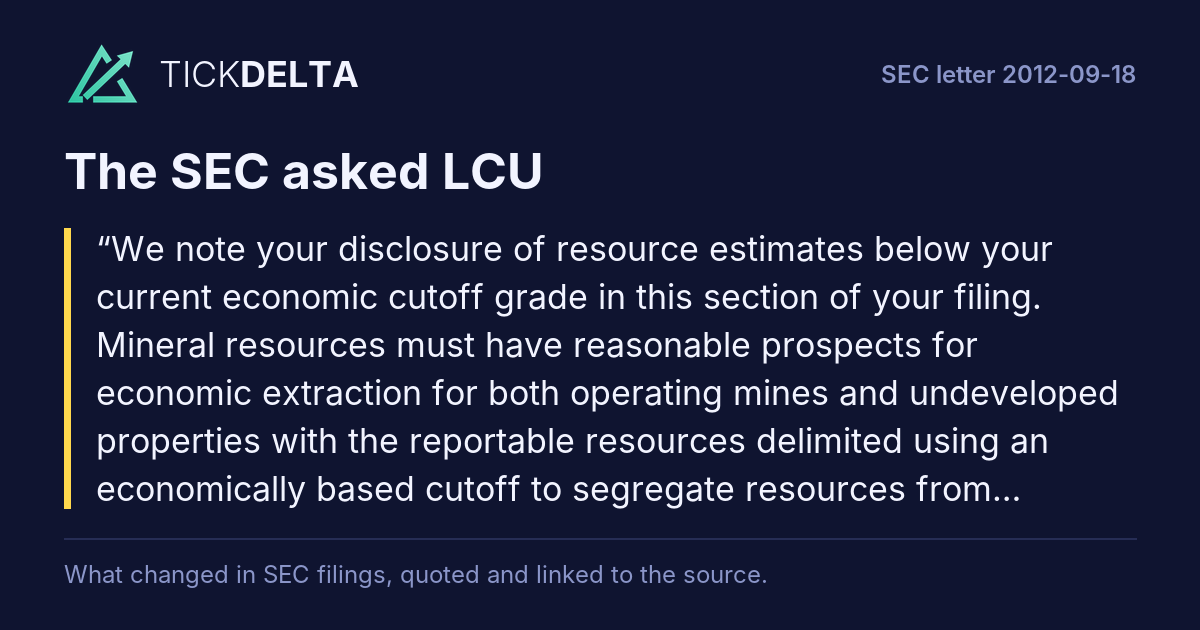
We note your disclosure of resource estimates below your current economic cutoff grade in this section of your filing. Mineral resources must have reasonable prospects for economic extraction for both operating mines and undeveloped properties with the reportable resources delimited using an economically based cutoff to segregate resources from mineralization.
Rest of the question

Please remove all resource estimates from your filing which are not based on an economically derived cutoff.

LCU answered
The current Indicated and Inferred Mineral Resources of the

Concordia and San Gregorio North veins, reported at various Ag ranges

(g/t)1 are shown in the following table:

… 2/

U.S. Securities and

Ag Range (g/t)

Vein

Zone

Classification

Tonnes (t)

Au (g/t)

Ag (g/t)

Au (oz) 2

Ag (oz) 2

> 45.0

Concordia

La Quinta

Indicated

4,590,000

0.10

103.4

14,757

15,259,171

Inferred

10,516,000

0.08

85.5

27,048

28,907,758

San Gregorio

North

4,005,000

0.15

79.4

19,315

10,223,998

>
Rest of the answer

60.0

3,625,000

0.11

117.0

12,820

13,636,144

6,319,000

0.09

107.8

18,285

21,901,045

San

Gregorio

2,608,000

0.16

94.3

13,416

7,907,096

> 75.0

2,757,000

0.13

132.6

11,523

11,753,792

3,734,000

136.3

13,206

16,363,187 inferred

1,792,000

0.17

107.1

9,795

6,170,569

> 90.0

2,057,000

0.14

149.8

9,259

9,907,038

2,506,000

0.12

163.1

9,669

13,141,131

1,383,000

114.6

7,559

5,095,708

> 120.0

1,106,000

189.8

5,689

6,749,150

1,454,000

206.6

6,545

9,658,117

460,000

137.8

2,514

2,038,003

> 150.0

655,000

0.19

229.0

4,001

4,822,525

904,000

251.2

4,360

7,301,058

72,000

169.4

440

392,142

1Tonnes have been rounded up to the nearest 1,000.

Au is reported to 2 decimal places and Ag to 1 decimal place.

troy ounce = 31.103 grams.

… 3/

U.S. Securities and Exchange Commission

Measured resources could not be estimated for the La Quinta and San Gregorio North zones because metallurgical testing is only in the preliminary stages and drill spacing is still considered too broad to confidently estimate. Material was reclassified from Indicated to Inferred Mineral Resource category in areas where the classification was supported by only one drill hole. The classification of material in the area of the historic Concordia mine was also reduced in its classification because the actual 3D location and extents of the workings are not accurately known. Based on a historic long section circa 1954, development appears to have been completed down to 200m below surface, and mining carried out only to approximately 100m depth.

A conceptual analysis of the resource model using mine planning software assisted the development of an appropriate exploration program to advance the Nieves Project. Gemcom Whittle software was used in this process with conceptual costs forecast by

Quaterra, the Mineral Resources (Indicated and Inferred) and two (2) pit slopes (45 and 50°) to create a number of scenarios. The resulting pit shells were examined in 3D and drill holes proposed that would test the area between the shells, along strike outside the shells and potentially upgrade Inferred Mineral Resources to the Indicated Mineral Resources classification.

The analysis showed that the La Quinta zone needs additional drill testing in the area between the shells to potentially upgrade the Inferred Mineral Resources to Indicated Mineral Resources and that additional drill testing should be completed along strike (both directions) of the extents of the larger conceptual pit to potentially increase the tonnage of the Ag mineralization. Similarly, drilling needs to be completed along strike, in both directions of the San Gregorio Zone to determine the extent of the mineralization that occurs along this trend. Drilling also needs to be closer spaced in the area drilled in the last exploration program to potentially increase to resource class from Inferred Mineral Resource to Indicated Mineral

Resource.

Specific recommendations by Caracle Creek for the Nieves project include step out drilling to close off the strike extent of the Concordia and San Gregorio vein systems and infill drilling to upgrade mineral resource classification in San Gregorio

North and to the SW of the high grade La Quinta resource. Additional recommendations include drill testing geophysical anomalies in the Dolores, Santa Rita, California and Orion areas and a continuation of metallurgical test work on the Concordia and the San Gregorio mineralization with additional specific gravity determinations to more accurately estimate the deposit tonnage along both vein systems.

On August 10, 2010, Caracle Creek completed an updated NI 43-101 compliant independent resource estimate for Nieves silver property. The updated resource estimate for the San Gregorio North zone was just over 4 million tonnes of Inferred Mineral

Resources with an estimated grade of 79.4 g/t Ag and 0.15 g/t Au equating to almost 10.25 million ounces of Ag and over 19,000 ounces of Au. Resources estimated for the La Quinta zone include almost 4.6 million tonnes of Indicated Mineral Resources averaging 103.4 g/t silver (~15.26 million Ag ounces) and 0.10 g/t Au in addition to just over 10.5 million tonnes of Inferred Mineral Resources grading 85.5 g/t Ag (~ 28.9 million Ag ounces) and 0.08 g/t Au.

Read in the reply
Annual Information Form · Mineral Resource Estimate, page 20
SEC asked (2)
Please disclose the metal price assumptions, all other key assumptions and parameters used to prepare all your resource estimates.
LCU answered
The updated resource estimate uses a base case cut-off of 45g/t

Ag. Although the mineralization occurs at both open pit and underground working depths, preliminary Whittle pit shells suggest that a significant proportion of material could be mined through open pit operations using a mining cost of

$1.50/tonne, processing costs of $12/tonne, assuming a 95% recovery and a silver price of $15 per troy ounce minus $1.00 for refinery and marketing.
Rest of the answer

At the 45/t

Ag (base case) cut-off grade, the Nieves resources are favorable with respect to selectivity and other factors when considering mining options and are considered to exhibit reasonable prospects for economic extraction.

Current Indicated and Inferred Mineral Resources for the

Concordia and San Gregorio vein systems reported at a 45 g/t Ag cut-off grade

(base case)1 are shown in the table below:

Resource Class

Ag (oz)2

0.1

1 Tonnes have been rounded up to the nearest 1,000.

Read in the reply
History, pages 23, 32, and 33
SEC asked (3)
Disclosure using non-SEC reserve definitions and resource estimates is allowed for Canadian incorporated companies under the exception in Instruction 3 to Paragraph (b)(5) of Industry Guide 7. However, all mineral reserves or resource estimates that you disclose under this provision must meet the standards of National Instrument 43-101.
Rest of the question

Please note disclosure of a non-compliant historical estimate may be disclosed using the historical terminology if the filer:  Identifies the source and state of the historical estimate  Comments on the relevance and reliability of the historical estimate  to the extent known, provides the key assumptions, parameters, and methods used to prepare the historical estimate;  States whether the historical estimate uses categories other than those prescribed by NI 43-101  Includes any more recent estimates or data available. Please modify your filing to comply with the guidance.

LCU answered
Metech Pty. Ltd., of Perth, Australia was commissioned to prepare an ore reserve and mining planning study of the MacArthur deposit in

1989 The Metech study initiated the purchase of the Anaconda Yerington district properties by Arimetco International (“Arimetco”). Arimetco mined a total of six million tons at an estimated grade of 0.36 % total copper using open pit methods from the MacArthur deposit in the period of 1995 to 1998. Due to financial difficulties resulting primarily from the low price of copper, Arimetco sought protection under Chapter 11 of the U. S.
Rest of the answer

bankruptcy Code in January 1997 and suspended all operations in 2000. After Arimetco’s departure, the mining claims over the deposit were allowed to expire. No consistent, large-scale mining has occurred on the site.

History, page 32

In 1976, all assets of The Anaconda Company, including the

Yerington Mine, were purchased by the Atlantic Richfield Company (ARCO) who in

1979 shut down dewatering pumps in the pit and closed the Yerington Mine due to low copper prices. In 1982, ARCO sold the entire Yerington Mine complex and Weed

Heights town site to Mr. Don Tibbals of Yerington, Nevada, who scrapped the plant and equipment. At closure, before dewatering pumps were shut off, the

Yerington mine plan hosted a pre-stripped, non NI 43-101 compliant historic

“reserve” of 98 million tons averaging 0.36% Cu containing approximately 696 million pounds of copper (K. L. Howard, Jr., Anaconda Internal Memo, 1979)within the ultimate pit design. The (Howard, 1979) historic estimate was prepared from a geologic section calculation using a 0.2 %TCu cut-off grade. Although the 1979 estimate contained no classification for measured, indicated, or inferred resources as defined by NI 43-101, the total estimate compares favorably to

Tetra Tech NI43-101 compliant independent resource estimate completed in

February 2012. An additional 22.8 million tons of material containing 136.8 million pounds copper was identified adjacent to the pit in this historic estimate. The (Howard, 1975) memo addressing this material is considered a reliable historic estimate because it cites mine reconciliation calculations and geologic projections from drill holes using a 0.2% Cu grade cut-off in an internal Anaconda memo by T. Leigh to W.C. Norem (1979).

History, page 33

The Bear Deposit, located partially in the northeast corner of the Yerington Mine property, was discovered in 1961 by Anaconda during condemnation drilling in the sulfide tailings disposal area. The program identified chalcopyrite mineralization hosted in a porphyry system below 500 to

1,000 feet of valley fill and unmineralized bedrock. The mineralization is related to micaeous veining rather than type quartz veining common in the

Yerington Mine porphyry system. Historic (not NI 43-101-compliant) resources estimated for the Bear Deposit are more than 500 million tons of material averaging 0. copper (Dilles and Proffett, 1995). The reference for this estimate does not include information regarding cut-off grade or methods used for the calculation and does not delineate categories for the resource. estimate is considered reliable as it was calculated by the author who was the principal geologist Anaconda (one of the world’s premiere copper companies of the time) responsible for the Bear drilling program in 1967. The Bear deposit is known to extend beyond the boundaries of SPS properties and percentage of the estimated resource controlled by SPS is unknown.

Read in the reply
Note 2 Significant accounting policies · Mineral Properties, page 12
SEC asked (4)
We note you capitalize costs related to exploration and development expenditures, net of any recoveries. Please describe to us and revise future filings to disclose the nature of these recoveries and provide the total amount included in the capitalized asset for the fiscal years presented. 17. Transition to IFRS, page 40
LCU answered
Going forward, we will amend the mineral properties accounting policy to include the following:

“Proceeds from the sale of properties or cash proceeds received from farm-out agreements are recorded as a reduction of the related mineral interest, with any excess proceeds accounted for in profit or loss.”

The recovery of $1,231,151 (2010 - $1,464,076) represents consideration received and reimbursement of expenses incurred on the Company’s

Mexican properties.

We will continue to separately present recoveries on the mineral properties continuity table.

… 7/

17. Transition to IFRS, page 40
Read in the reply
Note 2 Significant accounting policies · Mineral Properties, page 12
SEC asked (5)
Please provide us with the date you used to determine which accounting policies to apply. Please refer to the guidance in IFRS 1, particularly paragraphs 7 and 8.
LCU answered
8. As required by IFRS 1 paragraph 7 and 8, the significant accounting policies applied by the Company for the years ended December 31, 2011 and December 31, 2010 and as at January 1, 2010, comply with all IFRS standards that were effective as at December 31, 2011.
Read in the reply
Note 2 Significant accounting policies · Mineral Properties, page 12
SEC asked (6)
We note that you do not address the mandatory exceptions, as set forth in paragraphs 1417 and Appendix B of IFRS 1, that you applied upon the adoption of IFRS. To the extent that your primary financial statements reflect the use of mandatory exceptions, please identify the items or class of items to which the exceptions were applied and describe the accounting principle that was used and how it was applied.
Rest of the question

In addition and to the extent material, also qualitatively describe the impact on the financial condition, changes in financial condition and results of operations that the treatment specified by IFRS would have had absent these mandatory exceptions. Refer to paragraph 23 of IFRS 1.

LCU answered
We confirm that the Company did take into account the IFRS 1 mandatory exceptions. To the extent that they are applicable to the Company, the

Company applied the general premise of IFRS 1 mandatory exceptions which prevents companies from using hindsight retrospectively. The only mandatory exception applicable to the Company is estimates.

Estimates made by the Company in accordance with IFRS at transition date, and in the comparative period of the first IFRS consolidated financial statements, remained consistent with those determined under pre-changeover Canadian GAAP.

We confirm that
Rest of the answer

there was no significant impact on the application of the mandatory exceptions as listed in IFRS 1 paragraph 14 to 17 and Appendix B.

Read in the reply
Management’s Discussion and Analysis · Disclosure Controls and Internal Control over Financial Reporting, page 22
SEC asked (7)
We note you have referenced Canadian GAAP in this section. Please confirm to us that in future filings you will remove this reference as your financial statements are presented in accordance with IFRS.
LCU answered
We confirm, going forward, that reference to pre-changeover

“Canadian GAAP” will be removed and replaced with “IFRS”.

We acknowledge that:

The Company is responsible for the adequacy and accuracy of the disclosure in the filing;

Staff comments or changes to disclosure in response to staff comments do not foreclose the Commission from taking any action with respect to the filing; and

The Company may not assert staff comments as a defense in any proceeding initiated by the Commission or any person under the federal securities laws of the United States.

Yours truly,

QUATERRA RESOURCES
Rest of the answer

INC.

/s/Lawrence P. Page,

Q.C.

Lawrence P. Page, Q.C.

Read in the reply

Also in this review: closing letter, 2012-10-19

Letters without questions

Other letters

UPLOAD and CORRESP
1 other letter: notices that a filing will not be reviewed, requests to declare a registration effective, and the like

From the SEC's correspondence on EDGAR: staff letters (form UPLOAD) and company letters (form CORRESP), 13 letters filed since 2012-09-18. Questions and answers are matched by their numbers; topics come from words in each question. The reports are compared word for word (same form, before the first SEC letter against the first report after the company's reply). No AI.

Sources

The SEC's correspondence on EDGAR: staff letters (form UPLOAD) and company letters (form CORRESP), matched question by question. No AI.

Also

Filings: the letters in the filing list.

Work with it

Excel workbook · CSV. Google Sheet that stays up to date: paste =IMPORTDATA("https://tickdelta.com/company/LCU/export.csv") into a cell.

Next in Owners and insiders:Insider trades
Esc

Type a ticker such as AAPL, a name, an investor such as Buffett, or a topic such as tariffs. ↑ ↓ to move, Enter to open.