Lear Corp LEA
New risk paragraphs, branching off last year
Each branch is a paragraph in Risk Factors with nothing like it in the 10-K filed Feb 14, 2025. A box jumps to the paragraph as filed, below.
Paragraphs with nothing like them in last year's 10-K
11 paragraphs in Risk Factors of the 10-K filed Feb 13, 2026 with nothing like them in the 10-K filed Feb 14, 2025. Quoted exactly. Paragraphs that were only edited are under 10-K change.
Our sales and production may be further affected by new entrants to the industry, as well as various automakers entering or expanding in certain regions, and the restructuring actions, including facility closures, of our customers. Chinese domestic automakers, in particular, continue to expand their market share in China (through electric vehicles) and outside of China with both innovative designs and attractive pricing. As a result, several traditional automakers have experienced declines in revenue and market share. As these traditional automakers are among our largest customers, our business and financial results may be adversely affected by decreases in their businesses or market share.
Since his inauguration in January 2025, U.S. President Donald J. Trump has announced various tariffs that impact industries around the world, including the automotive industry. As of the date of this Report, many of the tariffs announced, implemented or threatened by the current U.S. administration apply to (a) the countries in which we do business or from which we purchase, either directly or indirectly, materials or components, including China, Mexico and Canada, and (b) the materials or components that we purchase, either directly or indirectly, or produce, including steel, aluminum and automobile parts, among others, and therefore could adversely impact our business by increasing our operating costs, requiring us to incur significant costs to transition to alternative suppliers if our mitigation efforts are unsuccessful, or negatively impacting our customers' production. In addition to tariffs, the U.S. and foreign governments have implemented sanctions, export controls and other trade restrictions that impact industries around the world, including the automotive industry.
The policies relating to these tariffs continue to evolve, including with respect to the type of tariff or export control, the tariff rates, the countries, components and materials to which such tariffs apply, and the existence and applicability of any exemptions. The actual impacts of tariffs and other trade restrictions on our business, financial condition and results of operations continue to be subject to a number of factors that are not yet known or are subject to change, including the effect such tariffs and restrictions may have on consumer demand and global automotive production volumes, the duration of such tariffs and restrictions, future changes in the amounts and scope of tariffs, the potential withdrawal of such tariffs and restrictions in whole or in part, the scope and effective date of any exemptions to such tariffs or restrictions, any modification to existing exemptions to such tariffs or restrictions, countermeasures that target countries may take in
response to such tariffs and restrictions, the impact such tariffs and restrictions may have on our customers and our supply chain, and whether and to what extent such tariffs are impacted by judicial review. We have entered into contractual agreements with our customers to recover substantially all tariff costs incurred to date and have implemented certain actions, and continue to consider others, to counter the potential impact of such tariffs on our business, financial condition and results of operations, including, without limitation, participating in efforts to inform the U.S. and certain foreign administrations and legislatures of the impact of current trade and tariff policies on the automotive industry and evaluating our production footprint and alternatives in our supply chain. To date, our mitigation efforts have been successful, but we cannot provide any assurance that future government actions will not adversely impact our customers' production or undermine our mitigation efforts, which could in turn adversely impact our business, financial condition and results of operations.
–international disputes, including war, military conflict, security or law enforcement operations, and geopolitical unrest, including due to threatened uses of force;
–labor scarcity, labor unrest and governmental regulations impacting labor supply;
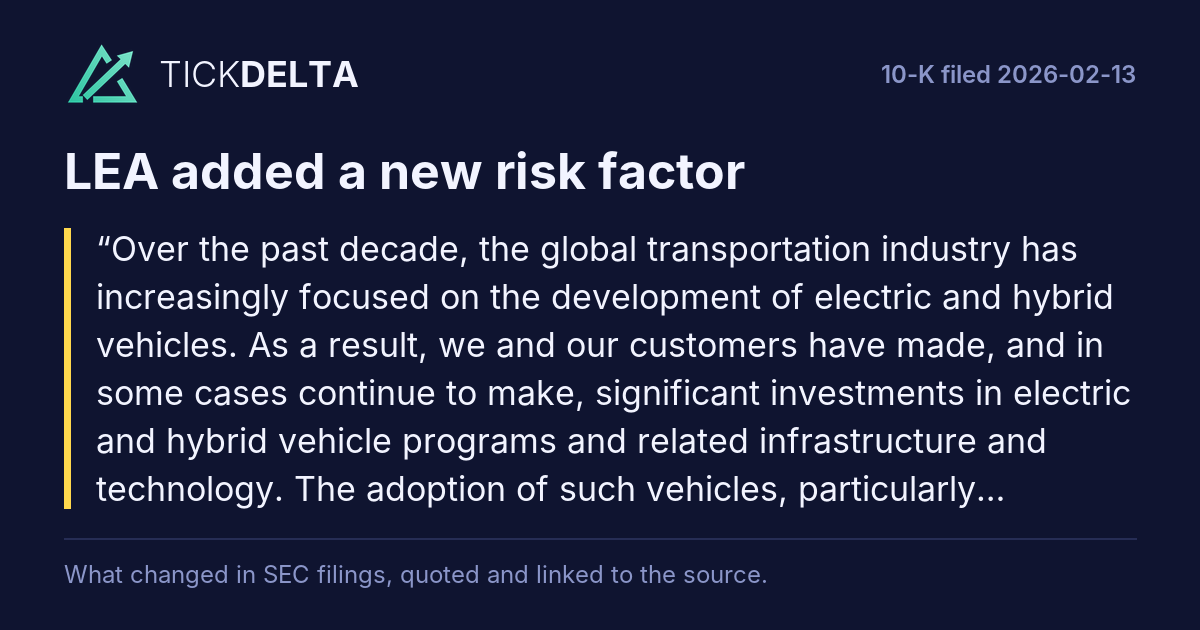
Over the past decade, the global transportation industry has increasingly focused on the development of electric and hybrid vehicles. As a result, we and our customers have made, and in some cases continue to make, significant investments in electric and hybrid vehicle programs and related infrastructure and technology. The adoption of such vehicles, particularly electric vehicles, has been slower than anticipated, particularly in the United States, as a result of, among other things, changes in government carbon emissions regulations and tax incentives, as well as prevailing consumer preferences. This has resulted in, among other things, various volume decreases related to, and cancellations of, vehicle programs for which we are a supplier, as well as general uncertainty about the overall rate of transition to electric and hybrid vehicles in certain regions. Our inability, or that of our customers, to respond to these evolving circumstances could adversely affect our financial condition, operating results and cash flows.
•Our increasing use of AI and other emerging technologies may expose us to operational, legal and regulatory risks that could adversely affect our business and reputation.
Our use of AI and machine learning presents risks that could adversely affect our business, financial condition and results of operations. We currently incorporate AI-powered tools into certain internal business operations, such as in our production processes and in certain of our administrative functions. AI algorithms may be flawed, and datasets may be insufficient, inaccurate, biased or otherwise problematic. The rapid evolution and increased adoption of AI technologies may increase the risk of technical disruptions to our operations and the processes and functions for which the technology is deployed. The use of AI tools also raises risks related to privacy and inadvertent disclosure of sensitive information. AI
systems may access, process or expose personal, confidential or proprietary data in ways that we do not intend or anticipate. Constraints in hardware (such as GPU availability), power capacity or other supply chain elements may further limit our ability to scale AI responsibly. We also face competitive risk if other companies develop or adopt AI capabilities more effectively, at lower cost or more rapidly than we do. Because our AI capabilities currently depend in part on third-party providers of models, cloud services and infrastructure, changes in their performance, pricing, licensing terms or availability could materially increase our costs. Collectively, these risks could adversely affect our financial condition, operating results, cash flows and reputation.
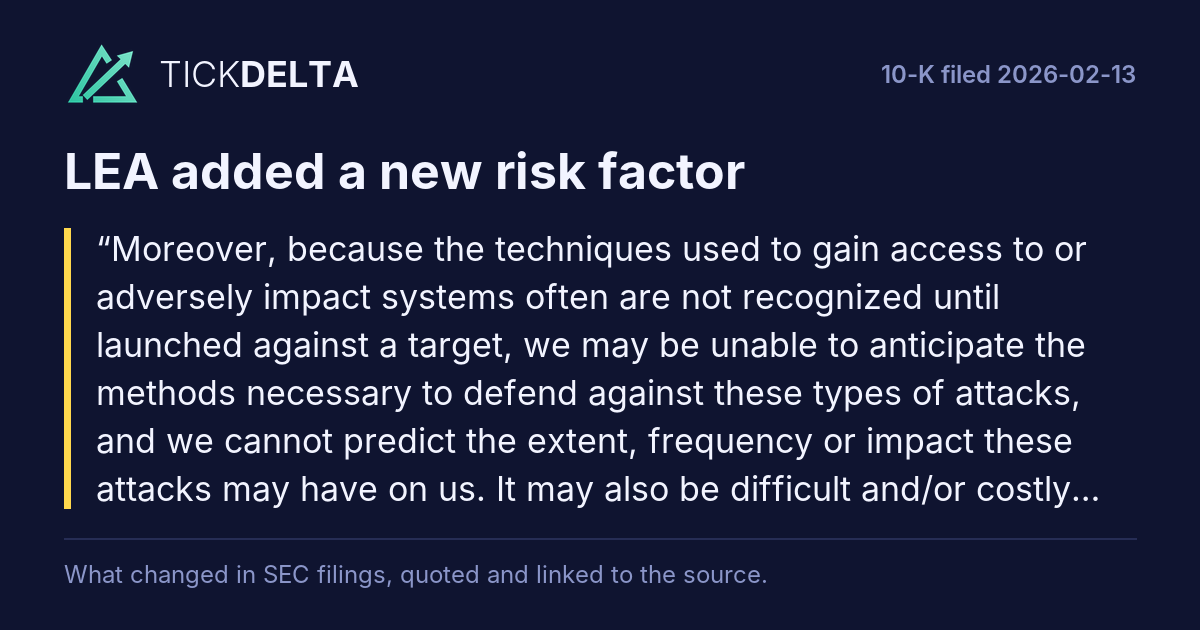
Moreover, because the techniques used to gain access to or adversely impact systems often are not recognized until launched against a target, we may be unable to anticipate the methods necessary to defend against these types of attacks, and we cannot predict the extent, frequency or impact these attacks may have on us. It may also be difficult and/or costly to detect, investigate, mitigate, contain and remediate a security incident. Our efforts to do so may not be successful. Actions
Paragraphs in the 10-Q filed Oct 30, 2026 that were not in the one before
New in the latest 10-Q
11 paragraphs in the 10-Q filed Oct 30, 2026 with nothing like them in the 10-Q filed Jul 31, 2026 (at least half the words must differ; new numbers alone do not count). Quoted exactly, grouped by the item heading above them. This is text that changed, not a judgement of how serious it is.
Financial statements and notes
Three Months Ended Nine Months Ended October 3, September 27, October 3, September 27,
Read in the 10-Q
Three Months Ended Nine Months Ended October 3, September 27, October 3, September 27,
Read in the 10-Q
Three Months Ended Nine Months Ended October 3, September 27, October 3, September 27,
Read in the 10-Q
Three Months Ended Nine Months Ended October 3, September 27, October 3, September 27,
Read in the 10-Q
Three Months Ended Nine Months Ended October 3, September 27, October 3, September 27,
Read in the 10-Q
Show the other 6
Three Months Ended Nine Months Ended October 3, September 27, October 3, September 27,
Read in the 10-Q
Three Months Ended Nine Months Ended October 3, September 27, October 3, September 27,
Read in the 10-Q
In the three months ended October 3, 2026, amounts outstanding under our $550 million 3.8% senior notes due 2027 (the "2027 Notes") and our delayed-draw term loan facility (the "Term Loan") were reclassified from long-term debt to current portion of long-term debt due to contractual maturities within the next twelve months.
Read in the 10-Q
Three Months Ended Nine Months Ended October 3, September 27, October 3, September 27,
Read in the 10-Q
In the three months ended October 3, 2026, approximately $600 million outstanding under our 2027 Notes and our Term Loan was reclassified from long-term debt to the current portion of long-term debt due to contractual maturities within the next twelve months.
Read in the 10-Q
Item 6
** 10.2 First Amendment to the Amended and Restated Lear Corporation Salaried Retirement Restoration Program, effective as of September 23, 2026.
Read in the 10-Q
The 10-Q's risk factors against the 10-K
Item 1A of the 10-Q filed Oct 30, 2026 against Item 1A of the 10-K filed Feb 13, 2026.
A 10-Q repeats only the risks that changed, so a 10-K paragraph that is missing from it is not counted as removed.
Added is a paragraph with nothing like it in the 10-K, Reworded a sentence that is in both with several words changed,
Quiet changes a sentence in both where one to four words changed and one is a hedge or a modal
(cut words struck through, new words highlighted).
Text on the page, not a score; each links to the filing at sec.gov.
What the 10-Q itself says about its risk factors:For a description of our risk factors, see Item 1A, "Risk Factors," in our Annual Report on Form 10-K for the year ended December 31, 2025.
Read in the 10-Q
1 paragraph in the 10-Q's Item 1A, and none of them adds, rewords or quietly edits a paragraph of the 10-K's.
Phrases used for the first time
Two-word phrases in Risk Factors of the 10-K filed Feb 13, 2026 that are in none of the 1 earlier 10-Ks stored, back to Feb 14, 2025
Where each one is used
- hybrid vehicles: Our sales are driven by the number of vehicles produced by our automotive manufacturer customers and our content per vehicle. The automotive industry is cyclical and sensitive to general economic conditions, including interest rates, inflation, consumer demand and spending levels, and geopolitical issues....
- trade restrictions: •International trade policies, such as tariffs, sanctions, export controls and other trade restrictions, could adversely affect our financial performance.
- operational disruptions: •Our industry is cyclical and a decline or significant fluctuation in the production levels of our major customers, particularly with respect to models for which we are a significant supplier, or the financial distress of or operational disruptions to one or more of our major customers could adversely affect our...
- chinese domestic: Our sales and production may be further affected by new entrants to the industry, as well as various automakers entering or expanding in certain regions, and the restructuring actions, including facility closures, of our customers. Chinese domestic automakers, in particular, continue to expand their market share in...
- traditional automakers: Our sales and production may be further affected by new entrants to the industry, as well as various automakers entering or expanding in certain regions, and the restructuring actions, including facility closures, of our customers. Chinese domestic automakers, in particular, continue to expand their market share in...
- sanctions export: •International trade policies, such as tariffs, sanctions, export controls and other trade restrictions, could adversely affect our financial performance.
- mitigation efforts: Since his inauguration in January 2025, U.S. President Donald J. Trump has announced various tariffs that impact industries around the world, including the automotive industry. As of the date of this Report, many of the tariffs announced, implemented or threatened by the current U.S. administration apply to (a) the...
- impact industries: Since his inauguration in January 2025, U.S. President Donald J. Trump has announced various tariffs that impact industries around the world, including the automotive industry. As of the date of this Report, many of the tariffs announced, implemented or threatened by the current U.S. administration apply to (a) the...
Used at least twice, small words left out. Counted, not picked: a phrase can be new because the company renamed something.
What was taken out
4 paragraphs of last year's Risk Factors with nothing like them now. The longest are quoted.
Sources
Item 1A of each 10-K and 10-Q on EDGAR, quoted exactly. Each paragraph links to the filing at sec.gov.
Also
10-K change: what was reworded or cut, section by section.
Work with it
Excel workbook · CSV. Google Sheet that stays up to date: paste =IMPORTDATA("https://tickdelta.com/company/LEA/export.csv") into a cell.