Rest of the answer
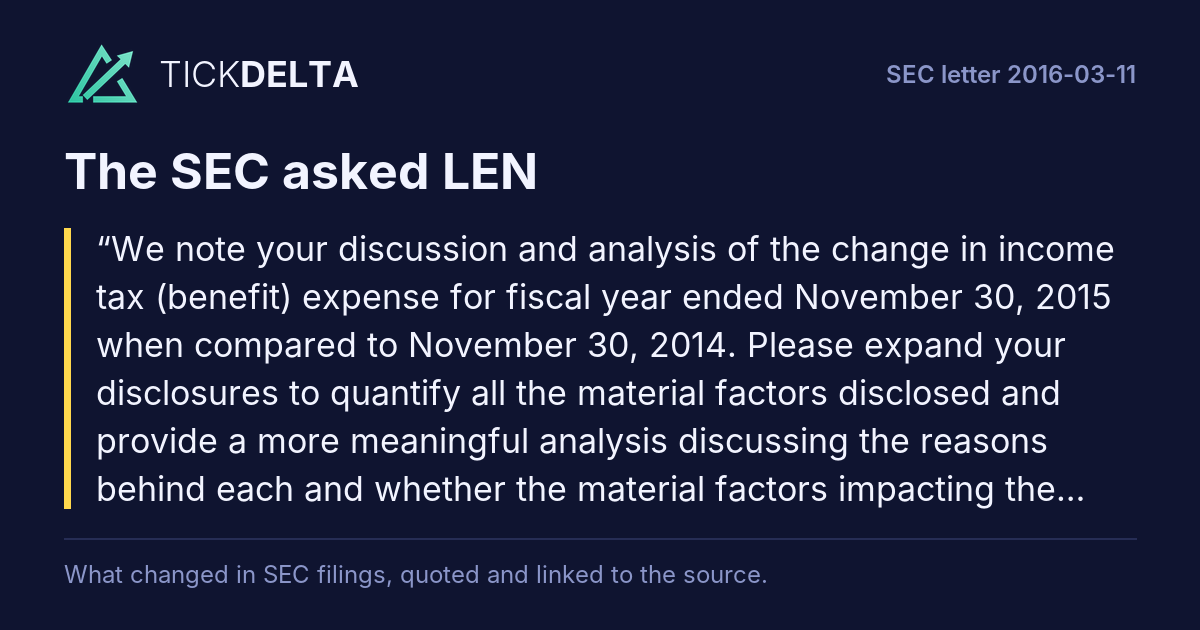
The Act adds a phase-out for the solar energy credit under which the "energy percentage" on which the credit is based will gradually be reduced from 30% to 10% in 2022. The Company is eligible for this tax credit through its Sunstreet residential solar business. For the year ended November 30, 2015, the impact of this credit on the Company’s effective tax rate was (0.91%).
In addition, in December 2014, the 2014 Tax Increase Prevention Act ("TIPA") was enacted. TIPA retroactively restored and extended the new energy efficient home credit for homes delivered in 2014. The Company is eligible for this tax credit to the extent its homes meet the energy efficiency standards required under the tax code. Since the legislation was enacted in our fiscal year ended November 30, 2015, the impact of this legislation on the Company’s effective tax rate for fiscal 2015 was (1.01%).
The Company will continue to be eligible for this credit through fiscal 2016 since the new energy efficient home credit was extended in December 2015 by the enactment of the Protecting Americans from Tax Hikes Act to homes delivered through 2016, including retroactively for homes delivered in 2015.
In addition to the solar energy tax credits and the energy efficient home credit mentioned above, the Company also expects its effective tax rate to continue to benefit from the domestic production activities deduction ("DPAD"), provided the Company continues to generate positive taxable income. The DPAD is currently not subject to sunset or phase-out. For the fiscal year ended November 30, 2015, the impact of the DPAD on the Company’s effective tax rate was (3.01%).
In future Form 10-K filings, we will provide a more detailed analysis of material changes in the Company's tax rate from period to period and whether we expect the cause of particular changes to have a continuing impact on the Company's effective tax rate in the future. In our Form 10-Q filings, we will update our disclosures for any significant changes in our effective tax rate. We expect that the expanded disclosures in our Form 10-Q for the three months ended February 29, 2016 will be as follows:
"In the first quarter of 2016 and 2015, we had a tax provision of $56.2 million and $59.7 million, respectively. Our overall effective income tax rates were 28.08% and 34.19% in the first quarter of 2016 and 2015, respectively. The reduction is primarily the result of the reversal of an accrual due to a settlement with the IRS, which reduced our effective tax rate by (5.42%). We do not anticipate similar settlements during the remainder of fiscal 2016. The effective tax rate for the first quarter of 2016 and 2015 included tax benefits for the domestic production activities deduction and energy tax credits, offset primarily by state income tax expense. During the first quarter of 2016, tax legislation was passed extending the new energy efficient home credit through 2016, as well as extending the 30% investment tax credit for solar energy property through 2022. Both of these tax credits benefited and we expect will continue to benefit our effective tax rate."
Rialto-Investments in Unconsolidated Entities, page 58
Comment No. 2
We note your disclosure that Rialto adopted a Carried Interest Plan which provides participants in the plan an equity interest in a Rialto subsidiary that entitles them to specified percentages of distributions. We further note your disclosure that Rialto recorded $3 million related to the amortization of compensation expense of the plan over the vesting period. In order to better understand the Company’s policy in accounting for this plan and given that your Rialto operations are considered a critical accounting estimate, please tell us and expand your disclosures to include a more robust discussion around how the Company is accounting for the compensation expense for the carried interest that the Rialto employees may be entitled to under the plan. In providing your response, please tell us and expand your disclosures to include the following:
•
Whether the amount of compensation expense recorded relates to the entire carried interest in the funds or just amounts not subject to clawback, such as the advance distributions to cover taxes;
The timing of the recognition of compensation expense and how and when the Company determines it has a liability for that compensation expense;
To the extent the compensation expense relates to the total carried interest, your expanded disclosures should state that the timing of recognition of compensation expense precedes the recognition of any management revenue related to carried interest given the Company’s policy to only recognize revenue related to carried interest when collectability is reasonably assured and in effect not subject to clawback; and
The amount of compensation expense that could be reversed in the future to the extent it is subject to clawback.
Response
During 2015, Rialto adopted a Carried Interest Plan (the "Plan"), which provides participants in the Plan the opportunity to participate in distributions made by a fund or other investment vehicle (a "Fund") managed by a subsidiary of Rialto.
Under the Plan, Rialto may assign its right to receive carried interest payments from a Fund to a limited liability company (a "Carried Interest Entity"), wholly owned and consolidated by Rialto, and distribute units, which are considered equity, of the Carried Interest Entity to some employees who are involved in the management of the Fund. The units entitle their holders to specified percentages of distributions made from the Fund to the Carried Interest Entity. Rialto may distribute to some of its employees units entitling them up to 40% of the distributions received by a Carried Interest Entity.
The awards were determined to be share-based payments and were accounted for in accordance with ASC 718, Compensation - Stock Compensation ("ASC 718"). Management determined that the awards did not meet any of the five types of awards described in ASC 718 as awards that should be classified as a liability:
1. An award with conditions or other features that are indexed to something other than a market, performance, or service condition.