LENLennar
- Headquarters
- Miami, FL
- CEO
- Stuart A. Miller
- Next results
- around Dec 15, 2026
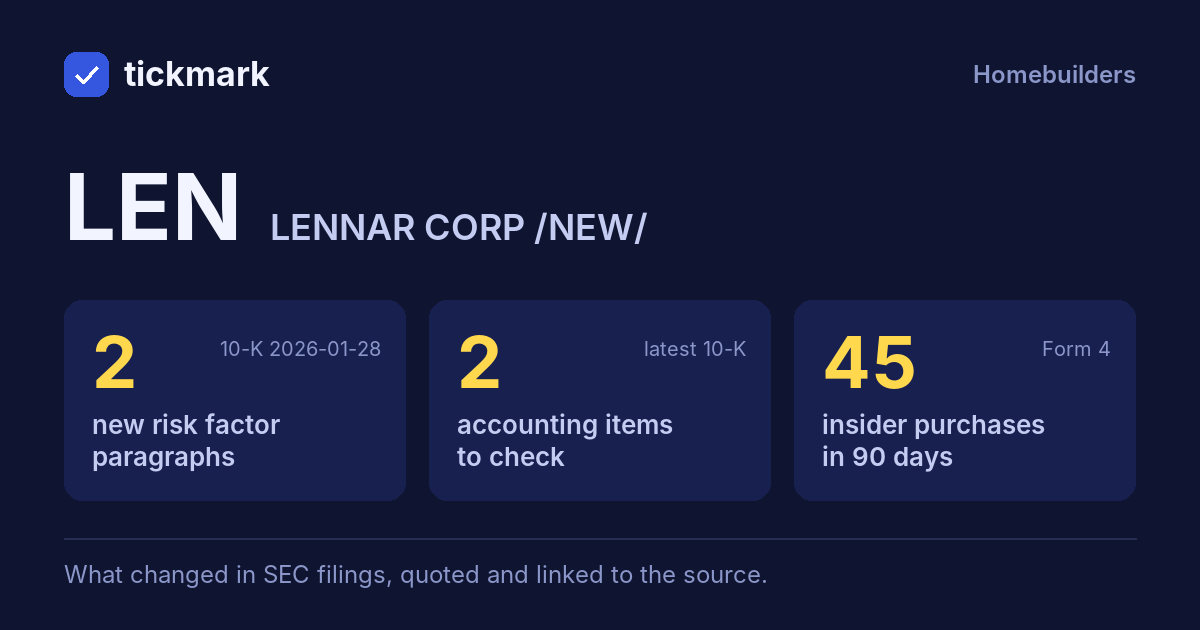
2 paragraphs in Risk Factors of the 10-K filed Jan 28, 2026 with nothing like them in the 10-K filed Jan 23, 2025. Quoted exactly. Paragraphs that were only edited are under 10-K change.
Compared with the Risk Factors in the latest 10-K of the other 46 Consumer discretionary companies: a paragraph with at least half its words the same at another company is called similar, and the companies are listed under it. A paragraph most of them have is marked boilerplate. No line means no other company has one like it. This counts text; it does not say how serious a risk is.
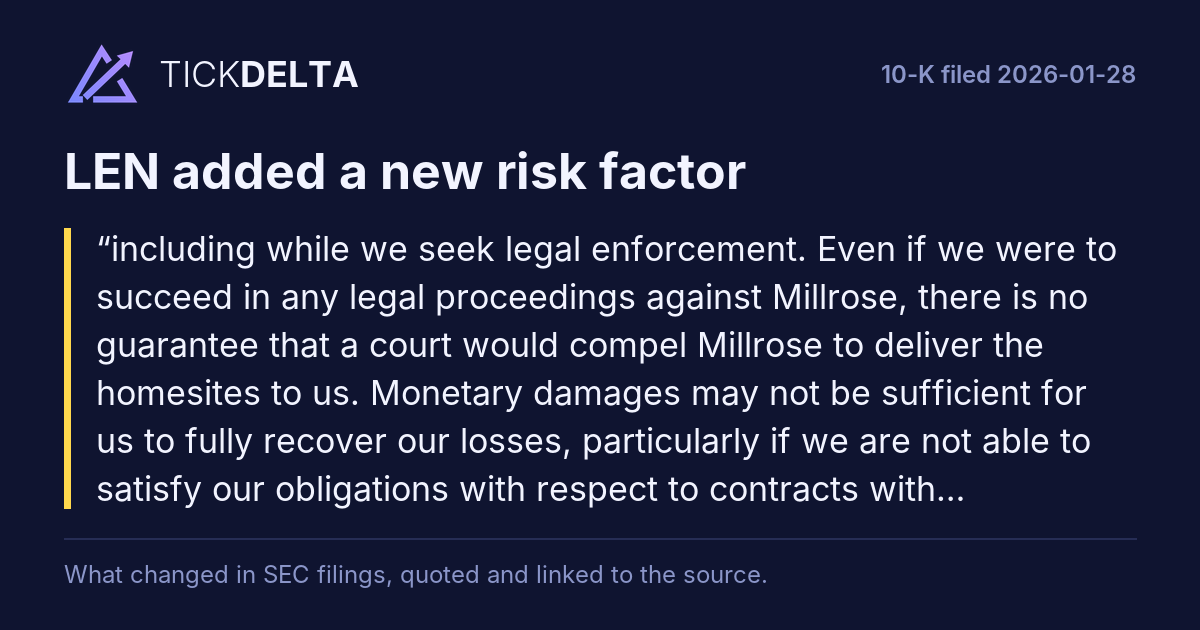
including while we seek legal enforcement. Even if we were to succeed in any legal proceedings against Millrose, there is no guarantee that a court would compel Millrose to deliver the homesites to us. Monetary damages may not be sufficient for us to fully recover our losses, particularly if we are not able to satisfy our obligations with respect to contracts with homebuyers.
Additionally, if in the future we are unable to identify or to develop and maintain the necessary relationships with suitable land banks, including Millrose, we will not be able to fully implement our land-light business strategy.
Read in the 10-K ↗
New in the latest 10-Q
10 paragraphs in the 10-Q filed Oct 2, 2026 with nothing like them in the 10-Q filed Jun 29, 2026 (at least half the words must differ; new numbers alone do not count). Quoted exactly, grouped by the item heading above them. This is text that changed, not a judgement of how serious it is.
Financial statements and notes
(1) Subsequent to August 31, 2026, the maturity date was extended to November 2026.
Read in the 10-Q ↗
may be incurred. The provision for loan losses was immaterial for both the three and nine months ended August 31, 2026 and 2025. Loan origination liabilities were $ 17.3 million and $ 17.4 million as of August 31, 2026 and November 30, 2025, respectively, and included in Financial Services’ liabilities in the Company's condensed consolidated balance sheets.
Read in the 10-Q ↗
Lennar's third quarter 2026 results reflect consistent operational execution against a macro backdrop that grew more difficult during the quarter. We delivered 20,840 homes, within our guidance range, and generated 20,879 new orders, just below our range, while gross margin improved sequentially to 15.8% and net earnings totaled $284 million, or $1.19 per share or $1.23 excluding one-time items. We remain intentionally focused on bringing affordable housing to an affordability-constrained consumer base, a choice that is still weighing on near-term margin but is building the volume and market position we believe will drive margin higher over time. While underlying housing demand remains steady, structural supply constraints persist.
Read in the 10-Q ↗
Mortgage interest rates moved higher during the quarter, with the 30-year fixed rate rising to approximately 7%, compared with the 6.4% to 6.5% range earlier this year, and the 10-year U.S. Treasury yield rising to approximately 5%. This increase was driven in significant part by inflation associated with energy prices tied to the ongoing geopolitical tension with Iran. Higher rates and living costs have further strained affordability, and in many of our markets, a significant portion of prospective buyers are finding it harder to qualify for a mortgage. The Federal Reserve remains focused on incoming economic data, but near-term interest rate relief appears unlikely. Resales of existing housing inventory have also begun to increase, particularly in Texas and Florida, intensifying competition for buyers in those markets. In addition, labor availability has become more constrained in certain geographies, reflecting immigration enforcement activity and competing construction demand, which we expect will continue to add cost pressure. Land costs per home, reflected in part through option maintenance fees associated with extended deal durations, have increased and will continue to pressure margin for a period of time while we work through land positions underwritten and committed under prior market conditions.
Read in the 10-Q ↗
Notwithstanding these pressures, sales incentives on deliveries declined during the quarter, and cost efficiencies from scale have helped offset a portion of the increase in labor costs. Construction costs per square foot declined further to approximately $80, down 6% from a year ago, and our cycle time reached a record low of 116 days, down from 121 days from second quarter 2026 and 126 days a year ago, reflecting the continued benefit of consistent volume and even-flow production.
Read in the 10-Q ↗
Our operating strategy has not changed. We remain focused on two priorities: driving consistent, even-flow production and volume, and continuing to refine our asset-light, land-light balance sheet model to generate strong and growing cash flow and returns. We continue to price to market and to offer incentives intended to maintain volume and affordability. We own approximately 2% of our homesites, with the substantial majority controlled through third parties, and approximately 86% of homes delivered this quarter were sourced through our land banking arrangements.
Read in the 10-Q ↗
We believe the fundamental shortage of housing in America has not been resolved and that demand remains deferred rather than diminished. We intend to continue managing our cost structure, cycle time, and land basis with the objective of positioning Lennar to benefit as affordability improves, whether through changes in interest rates, wages, or regulatory and entitlement reform, while remaining disciplined in the market as it exists today.
Read in the 10-Q ↗
effective tax rate for the three months ended August 31, 2026 compared to the prior period was primarily due to our spin-off of Millrose Properties, Inc.
Read in the 10-Q ↗
Market risk
As of August 31, 2026, we had $650 million outstanding borrowings under our Credit Facility.
Read in the 10-Q ↗
Controls and procedures
accumulated and communicated to our management, including our CEO and CFO, as appropriate to allow timely decisions regarding required disclosures.
Read in the 10-Q ↗
The 10-Q's risk factors against the 10-K
Item 1A of the 10-Q filed Oct 2, 2026 against Item 1A of the 10-K filed Jan 28, 2026.
A 10-Q repeats only the risks that changed, so a 10-K paragraph that is missing from it is not counted as removed.
Added is a paragraph with nothing like it in the 10-K, Reworded a sentence that is in both with several words changed,
Quiet changes a sentence in both where one to four words changed and one is a hedge or a modal
(cut words struck through, new words highlighted and underlined).
Text on the page, not a score; each links to the filing at sec.gov.
What the 10-Q itself says about its risk factors:
Read in the 10-Q ↗
Our business is subject to a variety of risks and uncertainties. These risks are described elsewhere in this Quarterly Report on Form 10-Q, including in Management’s Discussion and Analysis of Financial Condition and Results of Operations above, or in our other filings with the SEC, including Part I, Item 1A of our 2025 Form 10-K. There have been no material changes in our risk factors from those disclosed in those reports.
1 paragraph in the 10-Q's Item 1A, and none of them adds, rewords or quietly edits a paragraph of the 10-K's.
Work on LEN in a spreadsheet:
Excel workbook (a sheet per section, ten years by column, charts, links to the filings) ·
CSV.
For a Google Sheet that stays up to date, paste =IMPORTDATA("https://tickdelta.com/company/LEN/export.csv") into a cell.