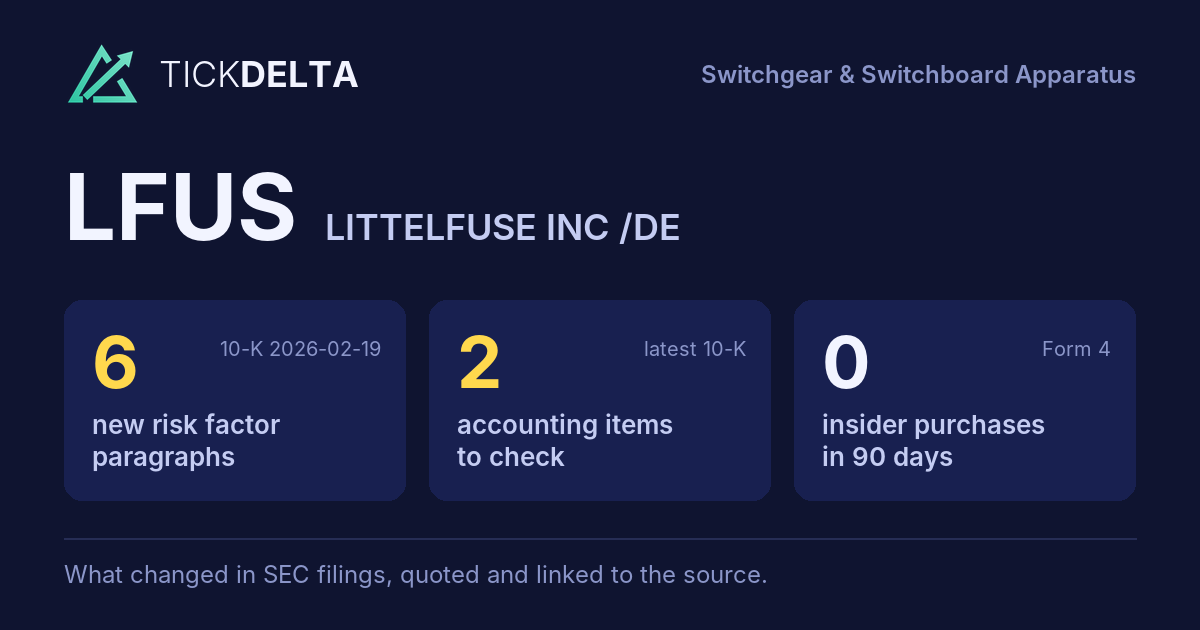
Paragraph 28 · 48% changed
Every version of it
Screener
/
SEC EDGAR
/CIK 0000889331
/10-K filed Feb 19, 2026, compared with Mar 13, 2025
/Numbers from the XBRL of the 10-Ks
Nasdaq
Industrials · Switchgear & Switchboard Apparatus
Littelfuse Inc LFUS
The 10-K against last year's
136 changes: 14 added, 30 removed, 90 reworded, 2 quiet changes
10-K Feb 19, 2026 vs Mar 13, 2025
Risk Factors
23.5%
of the text changed · 6,687 words now · 6 new paragraphs, 4 gone
MD&A
34.2%
of the text changed · 13,058 words now · 8 new paragraphs, 26 gone
Legal Proceedings
0.0%
of the text changed · 728 words now
Accounting Policies
15.7%
of the text changed · 6,036 words now
10-K 0001628280-26-009585 (Feb 19, 2026) vs 10-K 0000889331-25-000039 (Mar 13, 2025)
Every paragraph, and how much of it changed
One bar per paragraph, in the order of the 10-K. Height and colour show the share of its words not in the closest paragraph a year earlier; the tallest bars are new paragraphs.
Risk Factors
80 paragraphs · 6 new · 30 reworded · 4 gone · 10-K Feb 19, 2026 against Mar 13, 2025
New paragraph
Reworded (5% of its words or more)
Same or nearly
Paragraph 68 · 41% changed
Every version of it
Paragraph 27 · 40% changed
Every version of it
Paragraph 11 · 38% changed
Every version of it
Paragraph 51 · 34% changed
Every version of it
As a resource-intensive manufacturing operation, the Company is exposed to a variety of market and asset risks, including the effects of changes in commodity prices, foreign currency exchange rates, and interest rates. The Company has multiple sources of supply for the majority of its commodity requirements. The Company monitors and manages exposures in changes in commodity prices, foreign currency exchange rates, and interest rates as an integral part of its overall risk management program, which recognizes the unpredictability of markets and seeks to reduce the potentially adverse effects on its results. Nevertheless, changes in currency exchange rates, commodity prices and interest rates cannot always be predicted. In addition, because of intense price competition and the Company’s high level of fixed costs, it may not be able to address such changes even if they are foreseeable. Substantial changes in these rates and prices could have a material adverse effect on the Company’s results of operations and financial condition. In addition, significant portions of its revenues and earnings are exposed to changes in foreign currency rates. As it operates in multiple foreign currencies, changes in those currencies relative to the U.S. dollar will impact its revenues and expenses. The impact of possible currency devaluation in countries experiencing high inflation rates or significant exchange fluctuations can impact the Company’s results and financial guidance. For additional discussion of interest rate, currency or commodity price risk, see Item 7A, Quantitative and Qualitative Disclosures about Market Risk.
Paragraph 13 · 30% changed
Every version of it
The end markets for the Company’s products are characterized by technological change, frequent new product introductions and enhancements, changes in customer requirements and emerging industry standards. The introduction of products embodying new technologies and the emergence of new industry standards could render its the Company's existing products obsolete and unmarketable before it can recover any or all of its research, development, and commercialization expenses on capital investments. Furthermore, the life cycles of its products may change as result of developments in technology or otherwise and accordingly are difficult to estimate.
Paragraph 63 · 28% changed
Every version of it
As a result of the 2025 annual goodwill impairment test, the Company recorded a non-cash charge of $301.2 million to reflect the impairment of goodwill for the Semiconductor reporting unit within the Electronics segment. As a result of the 2024 annual goodwill impairment test, the Company recorded non-cash charges of $36.1 million and $8.6 million to reflect the impairment of goodwill for the Industrial controls and sensors reporting unit within the Industrial segment and the Automotive sensors reporting unit within the Transportation segment, respectively. There were no impairment charges recorded during the fiscal years of 2023 and 2022.
Paragraph 26 · 28% changed
Every version of it
In the past several years, the U.S. government adopted a new approach to trade policy and in some cases to renegotiate, or potentially terminate, certain existing bilateral or multi-lateral trade agreements. It also imposed tariffs on certain foreign goods and products. These measures may materially increase costs for goods imported into the U.S. Further, the global trade policies and tensions could create additional complexities. Our international presence subjects us to risks associated with international trade conflicts between the United States and its trade partners, including, without limitation, China, Mexico and Canada, particularly with regard to tariffs and import/export controls. These factors in turn could require us to materially increase prices to our customers which may reduce demand, or, if we do not or are unable to increase prices, could result in lower margins on products sold. Changes in U.S. trade policy have resulted in, and could result in more, U.S. trading partners adopting responsive trade policies making it more difficult or costly for us to export our products to those countries. Additionally, continued geopolitical issues may result in customers outside the U.S. seeking to source products from local suppliers, which could result in lower sales or lost customers.
Paragraph 28 · 48% changed
Every version of it
10-K Mar 13, 2025In the past several years, the U.S. government adopted a new approach to trade policy and in some cases to renegotiate, or potentially terminate, certain existing bilateral or multi-lateral trade agreements. It also imposed tariffs on certain foreign goods and products. These measures may materially increase costs for goods imported into the U.S. Further, the global trade policies and tensions could create additional complexities. Our international presence subjects us to risks associated with international trade conflicts between the United States and its trade partners, including, without limitation, China, Mexico and Canada, particularly with regard to tariffs and import/export controls. These factors in turn could require us to materially increase prices to our customers which may reduce demand, or, if we do not or are unable to increase prices, could result in lower margins on products sold. Changes in U.S. trade policy have resulted in, and could result in more, U.S. trading partners adopting responsive trade policies making it more difficult or costly for us to export our products to those countries. Additionally, continued geopolitical issues may result in customers outside the U.S. seeking to source products from local suppliers, which could result in lower sales or lost customers.
10-K Feb 19, 2026
Recently, the U.S. government has imposed extensive tariffs on goods imported from several countries, including, without limitation, China, Mexico and Canada, as well as certain broad, product-specific tariffs on foreign goods and products. Tariffs may increase the cost of materials in our supply chain, result in reciprocal levies on components and finished products exported to or imported from affected countries, and have an adverse impact on our cost of goods sold in the U.S. and abroad. These factors in turn could require us to materially increase prices to our customers which may reduce demand, or, if we do not or are unable to increase prices, could result in lower gross margins on products sold.
Paragraph 68 · 41% changed
Every version of it
10-K Mar 13, 2025Further, we have incurred additional costs and risks, including costs for accounting and legal fees in connection with the ongoing process of remediating the material weaknesses. We could also be subject to regulatory, stockholder or other actions in connection with the material weaknesses, and such actions would divert management’s time and attention. For a description of the material weaknesses identified by management and the remediation efforts being implemented to address the material weaknesses, see “Part II, Item 9A - Controls and Procedures.” If the enhanced controls implemented to address the material weaknesses and to strengthen our overall internal control do not operate effectively, if we are unsuccessful in implementing or following these enhanced processes, or if we are otherwise unable to remediate this material weaknesses, such failures may result in delayed or inaccurate reporting of our financial results.
10-K Feb 19, 2026
In 2025, the Company remediated the material weaknesses identified by management, see “Part II, Item 9A - Controls and Procedures.” If the enhanced controls implemented to address the material weaknesses and to strengthen our overall internal control do not operate effectively, or if we are unsuccessful in following these enhanced processes in the future, such failures may result in delayed or inaccurate reporting of our financial results. Management has excluded Basler's internal controls over financial reporting from its assessment of the effectiveness of internal controls over financial reporting as of December 27, 2025. The integration of Basler’s operations into the Company’s business may pose additional challenges to internal controls, and we may be unsuccessful or delayed in adopting our enhanced processes to Basler’s operations.
Paragraph 27 · 40% changed
Every version of it
10-K Mar 13, 2025In the past several years, the U.S. government adopted a new approach to trade policy and in some cases to renegotiate, or potentially terminate, certain existing bilateral or multi-lateral trade agreements. It also imposed tariffs on certain foreign goods and products. These measures may materially increase costs for goods imported into the U.S. Further, the global trade policies and tensions could create additional complexities. Our international presence subjects us to risks associated with international trade conflicts between the United States and its trade partners, including, without limitation, China, Mexico and Canada, particularly with regard to tariffs and import/export controls. These factors in turn could require us to materially increase prices to our customers which may reduce demand, or, if we do not or are unable to increase prices, could result in lower margins on products sold. Changes in U.S. trade policy have resulted in, and could result in more, U.S. trading partners adopting responsive trade policies making it more difficult or costly for us to export our products to those countries. Additionally, continued geopolitical issues may result in customers outside the U.S. seeking to source products from local suppliers, which could result in lower sales or lost customers.
10-K Feb 19, 2026
various European countries, particularly with regard to tariffs and import/export controls. These factors in turn could require us to materially increase prices to our customers which may reduce demand, or, if we do not or are unable to increase prices, could result in lower margins on products sold. Changes in U.S. trade policy have resulted in, and could result in more, U.S. trading partners adopting responsive trade policies making it more difficult or costly for us to export our products to those countries. It may also be time and resource-consuming for us to adapt our business strategies to adverse, changing trade policies. Compliance with rapidly changing tariffs and trade restrictions may require significant time and resources, and in turn increase our cost of doing business, and could result in reputational harm, fines, penalties or plant shutdowns if we are found to not be in compliance Additionally, continued geopolitical issues may result in customers outside the U.S. seeking to source products from local suppliers, which could result in lower sales or lost customers. Increased restrictions on international trade may have a material adverse effect on our business, financial condition, and results of operations. Export controls and impediments could impact our competitive position compared to local competitors and other companies not subject to the same restrictions. As such, we could lose market position and our business, operating results, and financial condition would be adversely impacted.
Paragraph 11 · 38% changed
Every version of it
10-K Mar 13, 2025The Company sources materials and sells products through various global networks. A disruption could occur within the Company’s manufacturing, distribution or supply chain network. This could include damage or destruction due to various causes including natural disasters or political instability which would cause one or more of these networks to become non-operational. This could adversely affect the Company’s ability to manufacture or deliver its products in a timely manner, impair its ability to meet customer demand for products and result in lost sales or damage to its reputation. Such a disruption could have a material adverse effect on the Company’s business, financial condition and results of operations.
10-K Feb 19, 2026
its ability to meet customer demand for products and result in lost sales or damage to its reputation. Such a disruption could have a material adverse effect on the Company’s business, financial condition and results of operations.
Paragraph 51 · 34% changed
Every version of it
10-K Mar 13, 2025
As a resource-intensive manufacturing operation, the Company is exposed to a variety of market and asset risks, including the effects of changes in commodity prices, foreign currency exchange rates, and interest rates. The Company has multiple sources of supply for the majority of its commodity requirements. The Company monitors and manages exposures in changes in commodity prices, foreign currency exchange rates, and interest rates as an integral part of its overall risk management program, which recognizes the unpredictability of markets and seeks to reduce the potentially adverse effects on its results. Nevertheless, changes in currency exchange rates, commodity prices and interest rates cannot always be predicted. In addition, because of intense price competition and the Company’s high level of fixed costs, it may not be able to address such changes even if they are foreseeable. Substantial changes in these rates and prices could have a material adverse effect on the Company’s results of operations and financial condition. In addition, significant portions of its revenues and earnings are exposed to changes in foreign currency rates. As it operates in multiple foreign currencies, changes in those currencies relative to the U.S. dollar will impact its revenues and expenses. The impact of possible currency devaluation in countries experiencing high inflation rates or significant exchange fluctuations can impact the Company’s results and financial guidance. For additional discussion of interest rate, currency or commodity price risk, see Item 7A, Quantitative and Qualitative Disclosures about Market Risk.
10-K Feb 19, 2026
As a resource-intensive manufacturing operation, the Company is exposed to a variety of market and asset risks, including the effects of changes in commodity prices, foreign currency exchange rates, and interest rates. The Company has multiple sources of supply for the majority of its commodity requirements. The Company monitors and manages exposures in changes in commodity prices, foreign currency exchange rates, and interest rates as an integral part of its overall risk management program, which recognizes the unpredictability of markets and seeks to reduce the potentially adverse effects on its results. Nevertheless, changes in currency exchange rates, commodity prices and interest rates cannot always be predicted.
Paragraph 13 · 30% changed
Every version of it
10-K Mar 13, 2025
The end markets for the Company’s products are characterized by technological change, frequent new product introductions and enhancements, changes in customer requirements and emerging industry standards. The introduction of products embodying new technologies and the emergence of new industry standards could render its existing products obsolete and
10-K Feb 19, 2026
The end markets for the Company’s products are characterized by technological change, frequent new product introductions and enhancements, changes in customer requirements and emerging industry standards. The introduction of products embodying new technologies and the emergence of new industry standards could render the Company's existing products obsolete and unmarketable before it can recover any or all of its research, development, and commercialization expenses on capital investments. Furthermore, the life cycles of its products may change as result of developments in technology or otherwise and accordingly are difficult to estimate.
Paragraph 63 · 28% changed
Every version of it
10-K Mar 13, 2025
As a result of the 2024 annual goodwill impairment test, the Company recorded non-cash charges of $36.1 million and $8.6 million to reflect the impairment of goodwill for the Industrial controls and sensors reporting unit within the Industrial segment and the Automotive sensors reporting unit within the Transportation segment, respectively. There were no impairment charges recorded during the fiscal years of 2023 and 2022.
10-K Feb 19, 2026
As a result of the 2025 annual goodwill impairment test, the Company recorded a non-cash charge of $301.2 million to reflect the impairment of goodwill for the Semiconductor reporting unit within the Electronics segment. As a result of the 2024 annual goodwill impairment test, the Company recorded non-cash charges of $36.1 million and $8.6 million to reflect the impairment
Paragraph 26 · 28% changed
Every version of it
10-K Mar 13, 2025
In the past several years, the U.S. government adopted a new approach to trade policy and in some cases to renegotiate, or potentially terminate, certain existing bilateral or multi-lateral trade agreements. It also imposed tariffs on certain foreign goods and products. These measures may materially increase costs for goods imported into the U.S. Further, the global trade policies and tensions could create additional complexities. Our international presence subjects us to risks associated with international trade conflicts between the United States and its trade partners, including, without limitation, China, Mexico and Canada, particularly with regard to tariffs and import/export controls. These factors in turn could require us to materially increase prices to our customers which may reduce demand, or, if we do not or are unable to increase prices, could result in lower margins on products sold. Changes in U.S. trade policy have resulted in, and could result in more, U.S. trading partners adopting responsive trade policies making it more difficult or costly for us to export our products to those countries. Additionally, continued geopolitical issues may result in customers outside the U.S. seeking to source products from local suppliers, which could result in lower sales or lost customers.
10-K Feb 19, 2026
In the past several years, the U.S. government adopted a new approach to trade policy and in some cases to renegotiate, or potentially terminate, certain existing bilateral or multi-lateral trade agreements. It also imposed tariffs on certain foreign goods and products. These measures may materially increase costs for goods imported into the U.S. Further, the global trade policies and tensions could create additional complexities. Our international presence subjects us to risks associated with international trade conflicts between the United States and its trade partners, including, without limitation, China, Mexico and Canada, and
MD&A
142 paragraphs · 8 new · 60 reworded · 26 gone · 10-K Feb 19, 2026 against Mar 13, 2025
New paragraph
Reworded (5% of its words or more)
Same or nearly
Paragraph 9 · 50% changed
Paragraph 23 · 50% changed
Paragraph 6 · 45% changed
On February 3, 2023, December 11, 2025, the Company completed the acquisition of Western Automation for approximately $162 million in cash. Headquartered in Galway, Ireland, Western Automation Basler Electric Company ("Basler"). Basler is a leading designer and manufacturer of innovative electrical shock control and protection devices used across a broad range of solutions for high-growth end markets, industrial markets including electric vehicle charging grid and utility infrastructure, industrial safety power generation and renewables. data center. At the time the Company and Western Automation entered into the definitive agreement, Western Automation of acquisition, Basler had annualized sales of approximately $25 $130 million. The business is reported within the Company’s Industrial segment. The Company financed the transaction with total purchase consideration was $350.3 million, net of cash on hand. acquired, subject to a working capital adjustment.
Paragraph 116 · 45% changed
On February 3, 2023, December 11, 2025, the Company completed the acquisition of Western Automation for approximately $162 million in cash. Headquartered in Galway, Ireland, Western Automation Basler. Basler is a leading designer and manufacturer of innovative electrical shock control and protection devices used across a broad range of solutions for high-growth end markets, industrial markets including electric vehicle charging grid and utility infrastructure, industrial safety power generation and renewables. data center. At the time the Company and Western Automation entered into the definitive agreement, Western Automation of acquisition, Basler had annualized sales of approximately $25 $130 million. The business is reported within the Company’s Industrial segment. The Company financed total purchase consideration was $350.3 million, net of cash acquired, subject to a working capital adjustment. The acquisition was funded with the transaction with Company's cash on hand.
Paragraph 25 · 44% changed
Paragraph 109 · 41% changed
Paragraph 62 · 40% changed
Operating income was $33.7 $84.8 million, representing a decrease an increase of $29.8 $26.2 million, or 47.0%, 44.7%, in 2023 2025 compared to $63.5 $58.6 million in 2022. 2024. The increase in operating income was primarily from the passenger car products business due to favorable price, volume leverage, cost reduction initiatives, along with the 2024 out-of-period adjustment of $11.1 million. Operating margins declined increased from 8.9% 8.7% in 2024 to 5.0% 12.5% in 2025 primarily due to lower volume driven by improved gross margin from the commercial vehicle passenger car products business, partially offset by higher volume and price realization lower gross margin in the passenger car automotive sensors business. In addition to the factors impacting operating income discussed above, the 2024 out-of-period adjustment of $11.1 million negatively impacted 2024 operating margins by 1.7%.
Paragraph 64 · 40% changed
Operating income was $42.3 $59.0 million, representing a decrease an increase of $12.5 $16.7 million, or 22.8%, 39.5%, in 2024 2025 compared to $54.8 $42.3 million in 2023. 2024. The decrease increase in operating income was driven by lower higher volume due to reduced industrial end market demand across industrial control products and from industrial circuit protection and industrial control and sensor products driven by increased end market demand, favorable price and cost reductions along with cost inflation. the 2024 out-of-period adjustment of $4.1 million. Operating margins were increased from 12.8% in 2024 compared to 16.4% 16.2% in 2023. The decrease in operating margin was 2025 primarily due to higher volume, favorable price and cost inflation, partially offset by favorable price. reductions. In addition, as mentioned addition to the factors impacting operating income discussed above, during the year ended December 28, 2024, the Company identified certain errors in its previously issued financial statements that have now been corrected through cumulative out-of-period adjustments in the financial statements as of and for the year ended December 28, 2024. The 2024 out-of-period adjustment related to the Industrial segment was $4.1 million, which negatively impacted the 2024 operating margin by 1.2%.
Paragraph 9 · 50% changed
10-K Mar 13, 2025Further, the global trade policies and tensions could create additional complexities. Our international presence subjects us to risks associated with international trade conflicts between the United States and its trade partners, including, without limitation, China, Mexico and Canada, particularly with regard to tariffs and import/export controls. These factors in turn could require us to materially increase prices to our customers which may reduce demand, or, if we do not or are unable to increase prices, could result in lower margins on products sold. Changes in U.S. trade policy have resulted in, and could result in more, U.S. trading partners adopting responsive trade policies making it more difficult or costly for us to export our products to those countries. Additionally, continued geo-political issues may result in customers outside the U.S. seeking to source products from local suppliers, which could result in lower sales or lost customers.
10-K Feb 19, 2026
Recently, the U.S. government has imposed extensive tariffs on goods imported from several countries, including, without limitation, China, Mexico and Canada, as well as certain broad, product-specific tariffs on foreign goods and products. Tariffs may increase the cost of materials in our supply chain, incur reciprocal levies on components and finished products exported to or imported from affected countries, and have an adverse impact on our cost of goods sold in the U.S. and abroad. These factors in turn could require us to materially increase prices to our customers which may reduce demand, or, if we do not or are unable to increase prices, could result in lower gross margins on products sold.
Paragraph 23 · 50% changed
10-K Mar 13, 2025As a result of the 2024 annual goodwill impairment test, the Company recorded non-cash charges of $36.1 million and $8.6 million to reflect the impairment of goodwill for the Industrial controls and sensors reporting unit within the Industrial segment and the Automotive sensors reporting unit within the Transportation segment, respectively. There were no impairment charges recorded during the fiscal years of 2023 and 2022.
10-K Feb 19, 2026
For the fiscal year ended December 27, 2025, the Company recognized impairment charges of $0.5 million and $0.4 million related to certain machinery and equipment in the commercial vehicle business within the Transportation segment and the electronics products business within the Electronics segment, respectively.
Paragraph 6 · 45% changed
10-K Mar 13, 2025
On February 3, 2023, the Company completed the acquisition of Western Automation for approximately $162 million in cash. Headquartered in Galway, Ireland, Western Automation is a designer and manufacturer of electrical shock protection devices used across a broad range of high-growth end markets, including electric vehicle charging infrastructure, industrial safety and renewables. At the time the Company and Western Automation entered into the definitive agreement, Western Automation had annualized sales of approximately $25 million. The business is reported within the Company’s Industrial segment. The Company financed the transaction with cash on hand.
10-K Feb 19, 2026
On December 11, 2025, the Company completed the acquisition of Basler Electric Company ("Basler"). Basler is a leading designer and manufacturer of innovative electrical control and protection solutions for high-growth industrial markets including grid and utility infrastructure, power generation and data center. At the time of acquisition, Basler had annualized sales of approximately $130 million. The business is reported within the Company’s Industrial segment. The total purchase consideration was $350.3 million, net of cash acquired, subject to a working capital adjustment.
Paragraph 116 · 45% changed
10-K Mar 13, 2025
On February 3, 2023, the Company completed the acquisition of Western Automation for approximately $162 million in cash. Headquartered in Galway, Ireland, Western Automation is a designer and manufacturer of electrical shock protection devices used across a broad range of high-growth end markets, including electric vehicle charging infrastructure, industrial safety and renewables. At the time the Company and Western Automation entered into the definitive agreement, Western Automation had annualized sales of approximately $25 million. The business is reported within the Company’s Industrial segment. The Company financed the transaction with cash on hand.
10-K Feb 19, 2026
On December 11, 2025, the Company completed the acquisition of Basler. Basler is a leading designer and manufacturer of innovative electrical control and protection solutions for high-growth industrial markets including grid and utility infrastructure, power generation and data center. At the time of acquisition, Basler had annualized sales of approximately $130 million. The business is reported within the Company’s Industrial segment. The total purchase consideration was $350.3 million, net of cash acquired, subject to a working capital adjustment. The acquisition was funded with the Company's cash on hand.
Paragraph 25 · 44% changed
10-K Mar 13, 2025undiscounted cash flows, an impairment loss is recorded for the excess of the asset’s carrying value over its fair value. For the fiscal year ended December 28, 2024, the Company recorded non-cash impairment charges of $47.8 million for the impairment of intangible assets, including $47.6 million related to the impairment of certain acquired customer relationships, developed technology, and tradename intangible assets in the Industrial controls and sensors reporting unit within the Industrial segment. The impairment of the intangible assets resulted from lower expectations of future revenue and cash flows driven by lower-than-expected demand in the electrical vehicle end market as well as reduced government funding to support charging infrastructures for electric vehicles, primarily in Europe. The remaining impairment charges included $0.2 million for patents and customer relationships related to the exit of a small business in China within the Industrial segment. In addition, during the first quarter of 2024, the Company recognized a $0.9 million impairment related to certain machinery and equipment in the commercial vehicle business within the Transportation segment. For the fiscal year ended December 30, 2023, the Company recognized a $3.9 million impairment charge related to the land and building of a property in the commercial vehicle business within the Transportation segment that the Company made the decision to donate, a $0.9 million impairment charge substantially related to certain patents in a business within the Industrial segment, and a $0.1 million impairment on certain machinery and equipment in the semiconductor business within the Electronics segment.
10-K Feb 19, 2026
For the fiscal year ended December 30, 2023, the Company recognized a $3.9 million impairment charge related to the land and building of a property in the commercial vehicle business within the Transportation segment that the Company made the decision to donate, a $0.9 million impairment charge substantially related to certain patents in a business within the Industrial segment, and a $0.1 million impairment on certain machinery and equipment in the semiconductor business within the Electronics segment.
Paragraph 109 · 41% changed
10-K Mar 13, 2025On November 15, 2017, the Company entered into a Note Purchase Agreement pursuant to which the Company issued and sold $175 million in aggregate principal amount of senior notes in two series. On January 16, 2018, $50 million aggregate principal amount of 3.48% Senior Notes, Series A, due February 15, 2025 (“U.S. Senior Notes, Series A due 2025”) and $125 million in aggregate principal amount of 3.78% Senior Notes, Series B, due February 15, 2030 (“U.S. Senior Notes, Series B due 2030”) (together, the “U.S. Senior Notes due 2025 and 2030”) were funded. Interest on the U.S. Senior Notes due 2025 and 2030 is payable on February 15 and August 15, commencing on August 15, 2018.
10-K Feb 19, 2026
off $50 million of U.S. Senior Notes, Series A due 2025. Interest on the U.S. Senior Notes Series B due 2030 is payable on February 15 and August 15, commencing on August 15, 2018.
Paragraph 62 · 40% changed
10-K Mar 13, 2025
Operating income was $33.7 million, representing a decrease of $29.8 million, or 47.0%, in 2023 compared to $63.5 million in 2022. Operating margins declined from 8.9% to 5.0% primarily due to lower volume from the commercial vehicle business, partially offset by higher volume and price realization in the passenger car business.
10-K Feb 19, 2026
Operating income was $84.8 million, representing an increase of $26.2 million, or 44.7%, in 2025 compared to $58.6 million in 2024. The increase in operating income was primarily from the passenger car products business due to favorable price, volume leverage, cost reduction initiatives, along with the 2024 out-of-period adjustment of $11.1 million. Operating margins increased from 8.7% in 2024 to 12.5% in 2025 primarily driven by improved gross margin from the passenger car products business, partially offset by lower gross margin in the automotive sensors business. In addition to the factors impacting operating income discussed above, the 2024 out-of-period adjustment of $11.1 million negatively impacted 2024 operating margins by 1.7%.
Paragraph 64 · 40% changed
10-K Mar 13, 2025
Operating income was $42.3 million, representing a decrease of $12.5 million, or 22.8%, in 2024 compared to $54.8 million in 2023. The decrease in operating income was driven by lower volume due to reduced industrial end market demand across industrial control products and industrial circuit protection along with cost inflation. Operating margins were 12.8% in 2024 compared to 16.4% in 2023. The decrease in operating margin was due to cost inflation, partially offset by favorable price. In addition, as mentioned above, during the year ended December 28, 2024, the Company identified certain errors in its previously issued financial statements that have now been corrected through cumulative out-of-period adjustments in the financial statements as of and for the year ended December 28, 2024. The out-of-period adjustment related to the Industrial segment was $4.1 million, which negatively impacted operating margin by 1.2%.
10-K Feb 19, 2026
Operating income was $59.0 million, representing an increase of $16.7 million, or 39.5%, in 2025 compared to $42.3 million in 2024. The increase in operating income was driven by higher volume from industrial circuit protection and industrial control and sensor products driven by increased end market demand, favorable price and cost reductions along with the 2024 out-of-period adjustment of $4.1 million. Operating margins increased from 12.8% in 2024 to 16.2% in 2025 primarily due to higher volume, favorable price and cost reductions. In addition to the factors impacting operating income discussed above, the 2024 out-of-period adjustment related to the Industrial segment negatively impacted the 2024 operating margin by 1.2%.
A paragraph is matched with the one last year that shares the most of its words; under half in common makes it new. The paragraphs shown are the 8 reworded the most in each section.
The paragraph that changed most in each section
The redline
Marked against last year's 10-K: cut words struck through, new words highlighted.
Accounting Policies193 words changed in this paragraph; it is 30% similar to last year's version.
In November 2023, December 2025, the Financial Accounting Standards Board ("FASB") FASB issued Accounting Standards Updates ("ASU") ASU No. 2023-07, "Segment Reporting (Topic 280): Improvements to Reportable Segment Disclosures." 2025-12, "Codification Improvements." The amendments in this update require additional detailed represent changes to the codification that clarify, correct errors, or make minor improvements. The amendments make the codification easier to understand and enhanced information about reportable segments' expense, including significant segment expenses and other segment items that bridge segment revenue, significant expenses to segment profit or loss. The ASU also requires disclosure of the title and position of the Chief Operating Decision Maker (“CODM”) on an annual basis as well as an explanation of how the CODM uses the reported measures and other disclosures. apply. The amendments in this update do not change how a public entity identifies its operating segments, aggregates those operating segments, or applies are varied in nature and may affect the quantitative thresholds to determine its reportable segments. application of guidance in cases in which the original guidance may have been unclear. The guidance is effective for fiscal years beginning after December 15, 2023 and interim periods within fiscal years beginning after December 15, 2024, 2026 with early adoption permitted. The Company does not expect any material effect of the adoption of ASU 2023-07 modified this guidance on the Company's disclosures in its Consolidated Financial Statements. See Note 16, Segment Information, for more details.
Source: Item 8, Note 1 – Summary of Significant Accounting Policies and Other Information, 10-K 0001628280-26-009585 vs Item 8, Note 1 – Summary of Significant Accounting Policies and Other Information, 10-K 0000889331-25-000039
MD&A193 words changed in this paragraph; it is 40% similar to last year's version.
Total operating expenses were $539.4 $868.5 million, or 22.8% 36.4% of net sales, for 2023 2025 compared to $506.1 $628.8 million, or 20.1% 28.7% of net sales, for 2022. 2024. The increase in operating expenses of $33.3 $239.8 million was primarily due to an increase in restructuring, impairment, and other charges of $211.6 million. The Company recorded a non-cash goodwill impairment charge of $301.2 million associated with the Electronics-Semiconductor reporting unit within the Electronics segment during 2025, while in 2024, the Company recorded $93.5 million of non-cash impairment charges, which included $47.8 million for the impairment of intangible assets primarily related to certain acquired customer relationships, developed technology, and tradename in the Industrial Controls and Sensors reporting unit within the Industrial segment, and $36.1 million and $8.6 million of non-cash goodwill impairment charges associated with the Industrial Controls and Sensors reporting unit within the Industrial segment and the Automotive Sensors reporting unit within the Transportation segment, respectively. Additionally, the remaining increase in operating expenses in 2025 was due to higher selling, general, and administrative expenses of $9.8 million, $31.4 million driven by higher amortization expense of $10.1 million and research and development expenses of $6.8 million mainly due to the C&K Switches and Western Automation acquisitions. Additionally, the Company incurred an increase in restructuring, impairment, and other charges of $6.5 million primarily related to the reorganization of certain manufacturing, selling and administrative functions within the Transportation and Industrial segments and a $3.9 million impairment charge related to the land and building of a property in the commercial vehicle business within the Transportation segment. This increase in operating expenses was partially offset by lower variable annual incentive compensation expense. expenses and the Dortmund Fab acquisition.
Source: Item 7, 10-K 0001628280-26-009585 vs Item 7, 10-K 0000889331-25-000039
Risk Factors146 words changed in this paragraph; it is 44% similar to last year's version.
Source: Item 1A, 10-K 0001628280-26-009585 vs Item 1A, 10-K 0000889331-25-000039
Sentences and paragraphs added, removed or reworded
Every change, by type
Sentences and paragraphs of LFUS's Risk Factors and MD&A, 10-K Feb 19, 2026 against 10-K Mar 13, 2025. Each links to the text at sec.gov.
Quiet changes are sentences kept from last year with one to four words changed, at least one of them a hedge, a modal or a qualifier (may, could, will, not, significant, material…). A year or date rolling forward is not counted.
The full word list
adverse, adversely, all, although, anticipate, anticipates, any, approximately, believe, believes, can, cannot, certain, could, expect, expects, generally, however, if, intend, intends, largely, likely, many, material, materially, may, might, most, must, never, no, not, possible, primarily, probable, should, significant, significantly, some, substantial, substantially, unlikely, will, would
AddedRisk Factors
As the Company keeps up with the pace of its rapidly evolving end markets, it has prioritized strategic market opportunities including data centers and data center infrastructure, aerospace and defense, battery energy storage and grid and utility infrastructure. The rapidly evolving nature of these end markets creates uncertainty concerning how our operations may develop, which reduces our ability to accurately forecast our success. Our failure to become competitive in and to integrate end markets into our focused strategy may divert our resources and adversely affect our financial condition.
Read it in 10-K Feb 19, 2026 at sec.gov
AddedRisk Factors
Tariffs have resulted in China and other countries imposing reciprocal tariffs on U.S. goods and ceasing sales of certain products to the U.S. and could result in more U.S. trading partners adopting responsive trade policies, including making it more difficult or costly for us to export our products to those countries. Sales to customers outside of the U.S., and to China in particular, comprise a significant portion of our net sales, and reciprocal tariffs may impact our business in China. Further, tariffs and trade policies may continue to change quickly and without warning, and we may not be able to accurately anticipate and mitigate the impacts. Any retaliatory actions by affected countries and foreign governments could result in tariffs, trade protection measures or other restrictions imposed on our current and future products. Our customers’ costs of doing business may increase or their sales may be negatively affected. As such, customer demand for our products may decline, which could adversely impact our ability to generate revenue and result in inventory impairment changes. Tariffs on hardware required for data centers, for example, could raise costs for our customers, potentially causing them to delay data center infrastructure investments. To the extent that the U.S., China or other countries seek to promote products that are produced domestically or reduce their dependence on products from another country, they may implement regulations or policies that may negatively affect our business.
Read it in 10-K Feb 19, 2026 at sec.gov
AddedRisk Factors
On July 4, 2025, the United States enacted into law the legislation formally titled "An Act to provide for reconciliation pursuant to title II of H. Con. Res. 14,” and commonly referred to as the One Big Beautiful Bill Act ("OBBB"). The OBBB contains multiple business tax provisions, including the permanent extension of several expiring provisions of the 2017 Tax Cuts and Jobs Act (the "Tax Act") and multiple modifications to the international tax framework. The legislation has multiple effective dates with certain provisions effective in 2025 and others to be implemented in future years, and the Company determined the impact for the year ended December 27, 2025 was not significant. The Company will continue to monitor future administrative guidance and regulations that clarify the legislative text of the OBBB and the bill’s potential effect on the Company’s income taxes.
Read it in 10-K Feb 19, 2026 at sec.gov
AddedRisk Factors
On January 5, 2026, the OECD published updated Pillar 2 administrative guidance, introducing the “Side-by-Side” Safe Harbor. This guidance provides significant relief for U.S.-parented multinational groups, including an exemption from the Pillar 2 Income Inclusion Rule ("IIR") and Undertaxed Profits Rule ("UTPR") starting in 2026, provided the U.S. parent remains subject to a qualifying U.S. minimum tax regime. As a result, the Company does not anticipate additional top-up taxes under this Safe Harbor rule. However, we remain subject to Qualified Domestic Minimum Top-up Taxes ("QDMTTs") imposed by certain countries, and we anticipate increased global tax compliance burden.
Read it in 10-K Feb 19, 2026 at sec.gov
AddedRisk Factors
If our eligibility for the Safe Harbor is restricted or revoked, or if local jurisdictions implement QDMTTs or other rules, we could face increased tax liabilities and higher administrative costs. These developments could adversely affect our effective tax rate and cash flows. We continue to monitor evolving international tax requirements and assess their potential impact on our business.
Read it in 10-K Feb 19, 2026 at sec.gov
AddedRisk Factors
The Company uses various metals in the manufacturing of its products, including copper, zinc, tin, gold, silver, and ruthenium. Worldwide demand, availability, and pricing of these raw materials have been volatile. In recent years, the prices of many of these raw materials have continue to fluctuate, and in many cases increased, and fluctuations may persist in the future. Also in the fourth quarter 2025 and through the date of filing, precious metal commodity pricing has significantly increased. If we must pay more for certain materials, it could reduce our profit margin or otherwise have a material adverse effect on our business and financial results.
Read it in 10-K Feb 19, 2026 at sec.gov
RemovedRisk Factors
RemovedRisk Factors
Show the other 48
RemovedRisk Factors
RemovedRisk Factors
RewordedRisk Factors
Compliance with rapidly changing tariffs and trade restrictions may require significant time and resources, and in turn increase our cost of doing business, and could result in reputational harm, fines, penalties or plant shutdowns if we are found to not be in compliance Additionally, continued geopolitical issues may result in customers outside the U.S. seeking to source products from local suppliers, which could result in lower sales or lost customers.
Read it in 10-K Feb 19, 2026 at sec.gov
RewordedRisk Factors
The volatility of the stock price may be related to any number of factors, such as volatility in the financial markets, general macroeconomic conditions, industry conditions, market expectations concerning the Company’s results of operations, or the volatility of its revenues as discussed above under “The Company’s revenues may vary significantly from period to period.
Read it in 10-K Feb 19, 2026 at sec.gov
RewordedRisk Factors
As a result of the 2024 2025 annual goodwill impairment test, the Company recorded a non-cash charges charge of $36.1 million and $8.6 $301.2 million to reflect the impairment of goodwill for the Industrial controls and sensors Semiconductor reporting unit within the Industrial segment and the Automotive sensors reporting unit within the Transportation segment, respectively. Electronics segment.
Read it in 10-K Feb 19, 2026 at sec.gov
RewordedRisk Factors
As a result of the 2024 annual goodwill impairment test, the Company recorded non-cash charges of $36.1 million and $8.6 million to reflect the impairment of goodwill for the Industrial controls and sensors reporting unit within the Industrial segment and the Automotive sensors reporting unit within the Transportation segment, respectively.
Read it in 10-K Feb 19, 2026 at sec.gov
RewordedRisk Factors
If we fail to maintain the adequacy of our internal controls, including any failure to timely and appropriately implement new, required or improved controls, such failure may result in the loss of investor confidence in our financial reports, and we may incur significant expenses to remediate any resulting internal control deficiencies.
Read it in 10-K Feb 19, 2026 at sec.gov
RewordedRisk Factors
Although, the Company generally attempts to limit its liability through standard contract terms and conditions and maintains insurance in connection with product defects and warranty claims, it is possible that the Company may not be able to enforce contractual limitations on damages and/or that a successful claim against the Company may exceed the Company’s applicable insurance policy limits or be excluded from coverage.
Read it in 10-K Feb 19, 2026 at sec.gov
RewordedRisk Factors
RewordedRisk Factors
The introduction of products embodying new technologies and the emergence of new industry standards could render its the Company's existing products obsolete and unmarketable before it can recover any or all of its research, development, and commercialization expenses on capital investments.
Read it in 10-K Feb 19, 2026 at sec.gov
RewordedRisk Factors
In addition, the widespread availability, adoption and rapid evolution of artificial intelligence technologies may increase our cybersecurity risk, including the use of generative artificial intelligence to augment existing or to create new malware. malware, and additional vulnerabilities may be introduced from the use of artificial intelligence by our customers or third parties.
Read it in 10-K Feb 19, 2026 at sec.gov
RewordedRisk Factors
If the enhanced controls implemented to address the material weaknesses and to strengthen our overall internal control do not operate effectively, or if we are unsuccessful in implementing or following these enhanced processes, or if we are otherwise unable to remediate this material weaknesses, processes in the future, such failures may result in delayed or inaccurate reporting of our financial results.
Read it in 10-K Feb 19, 2026 at sec.gov
RewordedRisk Factors
This could adversely affect the Company’s ability to manufacture or deliver its products in a timely manner, impair its ability to meet customer demand for products and result in lost sales or damage to its reputation.
Read it in 10-K Feb 19, 2026 at sec.gov
RewordedRisk Factors
In addition, the European Union ("EU") enacted the Corporate Sustainability Reporting Directive ("CSRD") and Corporate Sustainability Due Diligence ("CS3D") in 2023 and 2024, respectively. respectively, and published proposed revisions to both the CSRD and CS3D through omnibus legislation in 2025.
Read it in 10-K Feb 19, 2026 at sec.gov
Quiet changesRisk Factors
This could include damage or destruction due to various causes including natural disasters or political instability which would may cause one or more of these networks to become non-operational.
Read it in 10-K Feb 19, 2026 at sec.gov
Quiet changesRisk Factors
The tax holiday for one of the subsidiaries expired at the end of 2023 but was later extended for an additional three years, retroactively to include all of 2024, as well as 2025 and 2026; and for the other subsidiary, the tax holiday will expire expired at the end of 2025.
Read it in 10-K Feb 19, 2026 at sec.gov
AddedMD&A
The Company uses various metals in the manufacturing of its products, including copper, zinc, tin, gold, silver, and ruthenium. Worldwide demand, availability, and pricing of these raw materials have been volatile. In recent years, the prices of many of these raw materials continue to fluctuate, and in many cases increase, and fluctuations may persist in the future. Also in the fourth quarter and through the date of filing, precious metal commodity pricing has significantly increased. If the Company must pay more for certain materials, it could reduce our profit margin or otherwise have a material adverse effect on our business and financial results.
Read it in 10-K Feb 19, 2026 at sec.gov
AddedMD&A
Tariffs have resulted in China and other countries imposing reciprocal tariffs on U.S. goods and ceasing sales of certain products to the U.S. and could result in more U.S. trading partners adopting responsive trade policies, including making it more difficult or costly for us to export our products to those countries. Sales to customers outside of the U.S., and to China in particular, comprise a significant portion of our net sales, and reciprocal tariffs may impact our business in China. Further, tariffs and trade policies may continue to change quickly and without warning, and we may not be able to accurately anticipate and mitigate the impacts.
Read it in 10-K Feb 19, 2026 at sec.gov
AddedMD&A
Based on the results of the annual goodwill impairment test in 2025, in the fourth quarter, the Company recorded a non-cash charge of $301.2 million to reflect the impairment of goodwill for the Electronics-Semiconductor reporting unit within the Electronics segment, reflecting the amount by which the reporting unit’s estimated fair value was below its carrying value. The estimated fair value declined primarily due to updates to management’s forecasts that reduced revenue growth, profitability and cash flows. These forecasts require significant judgment and are inherently uncertain, particularly in light of the recent leadership transition and strategic reassessment in the semiconductor business. The reduction in projected cash flows was driven principally by lower projected volumes in the power semiconductor business, largely associated with the Dortmund fab, which reduced expected future cash generation for the reporting unit. Changes in future operating performance relative to these projections, or further changes in strategy, market conditions, or execution related to the Dortmund fab, could affect the reporting unit’s estimated fair value and may result in additional impairment charges in future periods.
Read it in 10-K Feb 19, 2026 at sec.gov
AddedMD&A
more of the indicators, the assets are assessed for impairment based on the estimated future undiscounted cash flows expected to result from the use of the asset and its eventual disposition. If the carrying value of an asset exceeds its estimated future undiscounted cash flows, an impairment loss is recorded for the excess of the asset’s carrying value over its fair value.
Read it in 10-K Feb 19, 2026 at sec.gov
AddedMD&A
The Company records acquisitions using the purchase method of accounting. All of the assets acquired and liabilities assumed are recorded at fair value as of the acquisition date. The excess of the purchase price over the estimated fair values of the net tangible and intangible assets acquired is recorded as goodwill. The application of the purchase method of accounting for business combinations requires management to make significant estimates and assumptions in the determination of the fair value of assets acquired and liabilities assumed, in order to properly allocate purchase price consideration between assets that are depreciated and amortized from goodwill. The fair value assigned to tangible and intangible assets acquired and liabilities assumed are based on management’s estimates and assumptions, as well as other information compiled by management, including valuations that utilize customary valuation procedures and techniques. Significant assumptions and estimates include, but are not limited to, the cash flows that an asset is expected to generate in the future, the appropriate weighted-average cost of capital, and the cost savings expected to be derived from acquiring an asset. If the actual results differ from the estimates and judgments used in these estimates, the amounts recorded in the financial statements may be exposed to potential impairment of the intangible assets and goodwill, as discussed in the Goodwill and Long-lived Assets under the Critical Accounting Estimates section.
Read it in 10-K Feb 19, 2026 at sec.gov
AddedMD&A
A significant portion of these fair value measurements relate to identifiable intangible assets, including customer relationships. The valuation of customer relationships is a critical accounting estimate due to the significant judgment required and the sensitivity of the estimate to changes in assumptions. Changes in these assumptions, particularly the attrition rate and discount rate, could have a material impact on the estimated fair value of customer relationships and the related amortization expense recognized in future periods.
Read it in 10-K Feb 19, 2026 at sec.gov
AddedMD&A
There are a number of estimates and assumptions inherent in calculating the various components of income taxes. Future events such as changes in tax legislation, jurisdictional mix of earnings, findings in tax audits, and earnings repatriation plans could have an impact on those estimates and our effective tax rate.
Read it in 10-K Feb 19, 2026 at sec.gov
AddedMD&A
On July 4, 2025, the United States enacted into law the legislation formally titled "An Act to provide for reconciliation pursuant to title II of H. Con. Res. 14," and commonly referred to as the One Big Beautiful Bill Act ("OBBB"). The OBBB contains multiple business tax provisions, including the permanent extension of several expiring provisions of the Tax Act and multiple modifications to the international tax framework. The legislation has multiple effective dates with certain provisions effective in 2025 and others to be implemented in future years, and the Company determined the impact for the year ended December 27, 2025 was not significant. The Company will continue to monitor future administrative guidance and regulations that clarify the legislative text of the OBBB and the bill’s potential effect on the Company’s income taxes.
Read it in 10-K Feb 19, 2026 at sec.gov
RemovedMD&A
RemovedMD&A
RemovedMD&A
RemovedMD&A
RemovedMD&A
RemovedMD&A
RemovedMD&A
RemovedMD&A
RemovedMD&A
RemovedMD&A
RemovedMD&A
RemovedMD&A
RewordedMD&A
In addition to the factors impacting comparative results for operating income discussed above, income before income taxes was primarily benefited impacted by lower foreign exchange losses of $12.1 $16.6 million in the fiscal year 2025 compared to foreign exchange gains of $9.2 million in the fiscal year 2024, and lower unrealized losses of $13.7 $3.6 million during the fiscal year 2025 compared to unrealized gains of $0.1 million during the fiscal year 2024 related to one of the Company's equity investment, and higher loss of $1.0 million from investments for 2023 compared to 2022. under equity method and higher non-operating pension expense of $0.9 million.
Read it in 10-K Feb 19, 2026 at sec.gov
RewordedMD&A
The increase in operating expenses of $89.4 million was primarily due to an increase in restructuring, impairment, and other charges of $91.9 million, which included Company recorded a non-cash goodwill impairment charge of $301.2 million associated with the Electronics-Semiconductor reporting unit within the Electronics segment during 2025, while in 2024, the Company recorded $93.5 million of non-cash impairment charges, which included $47.8 million for the impairment of intangible assets primarily related to certain acquired customer relationships, developed technology, and tradename in the Industrial controls Controls and sensors Sensors reporting unit within the Industrial segment, and $36.1 million and $8.6 million of non-cash goodwill impairment charges associated with the Industrial controls Controls and sensors Sensors reporting unit within the Industrial segment and the Automotive sensors Sensors reporting unit within the Transportation segment, respectively.
Read it in 10-K Feb 19, 2026 at sec.gov
RewordedMD&A
The Company also received proceeds of $5.6 million mainly from the sale of the Marine business within the Transportation segment in the fiscal year 2025 as compared to proceeds of $10.8 million mainly from the sale of a land use right within the Electronics segment and two buildings from the Transportation segment during in the fiscal year 2024 as compared to proceeds of $0.8 million from the sale of a property within the Electronics segment during the fiscal year 2023. 2024.
Read it in 10-K Feb 19, 2026 at sec.gov
RewordedMD&A
Also included in "Other" Operating income was $5.1 $5.4 million of legal and professional fees and other integration expenses related to completed and contemplated acquisitions, $0.6 million of purchase accounting inventory adjustments related to the Basler and Dortmund Fab acquisitions, and a gain of $1.0 $0.3 million for loss related to the sale of two buildings the Marine business within the Transportation segment, and a gain of $0.5 million recorded for the sale of a land use right within the Electronics segment.
Read it in 10-K Feb 19, 2026 at sec.gov
RewordedMD&A
The decrease in operating income was primarily due to lower operating income the non-cash goodwill impairment charge of $130.7 $301.2 million from the Electronics segment and higher operating expenses due recognized in 2025 compared to the non-cash charge of $92.6 million from the impairment of intangible assets and goodwill in 2024 as noted above, partially offset by higher operating income of $24.9 $50.2 million, $26.2 million from and $16.7 million across the Electronics, Transportation segment. and Industrial segments, respectively.
Read it in 10-K Feb 19, 2026 at sec.gov
RewordedMD&A
RewordedMD&A
Net sales were $2,362.7 $2,386.3 million, which decreased increased by $151.2 $195.5 million, or 6.0% 8.9% compared to 2022, 2024, including $0.7 $49.0 million or 2.2% of incremental net sales, from the Dortmund Fab acquisition in the semiconductor business within the Electronics segment and $17.6 million or 0.8% of favorable changes in foreign exchange rates for 2023 2025 compared to 2022. 2024.
Read it in 10-K Feb 19, 2026 at sec.gov
RewordedMD&A
As a percent of net sales, cost of sales increased 2.2% decreased 2.1% primarily driven by lower higher volume in the electronics products business within the Electronics segment, partially offset by improved margin from segment and across all businesses within in the Transportation segment driven by favorable price, product mix and cost reduction initiatives. Industrial segment.
Read it in 10-K Feb 19, 2026 at sec.gov
RewordedMD&A
The estimated discount rate was 10.6% 12.0% for the Electronics-Passive Products and Sensors, Electronics-Semiconductor, and Industrial Circuit Protection Sensors reporting units, 11.5% unit, 12.5% for the Electronics-Semiconductor reporting unit, 11.0% for the Passenger Car Products and Commercial Vehicle Products reporting units, 12.3% for the Automotive Sensors reporting unit, and 14.9% 14.0% for the Industrial Controls and Sensors reporting unit, and 13.0% for Industrial Circuit Protection reporting unit.
Read it in 10-K Feb 19, 2026 at sec.gov
RewordedMD&A
Europe net sales decreased $96.6 increased $66.1 million, or 17.2%, 14.2%, in 2024 2025 compared to 2023 2024 and included $49.0 million or 10.5% of incremental net sales from the Dortmund Fab acquisition in the semiconductor business within the Electronics segment and favorable changes in foreign exchange rates of $2.0 $18.9 million.
Read it in 10-K Feb 19, 2026 at sec.gov
RewordedMD&A
The Company recognized a net loss of $71.7 million, or $2.89 per diluted share, in 2025 compared to net income of $100.2 million, or $4.00 per diluted share, in 2024 compared to net income of $259.5 million, or $10.34 per diluted share in 2023. 2024.
Read it in 10-K Feb 19, 2026 at sec.gov
Sources
The two latest 10-Ks on EDGAR, section by section. Each change links to the text at sec.gov.
Also
New risk factors: paragraphs with nothing like them last year, quoted in full.
Work with it
Excel workbook · CSV. Google Sheet that stays up to date: paste =IMPORTDATA("https://tickdelta.com/company/LFUS/export.csv") into a cell.