Paragraph 141 · 49% changed
Every version of it
Screener
/
SEC EDGAR
/CIK 0000886163
/10-K filed Feb 27, 2026, compared with Feb 28, 2025
/Numbers from the XBRL of the 10-Ks
Nasdaq, OTC
Health care · Pharmaceuticals
Ligand Pharmaceuticals Inc LGND
The 10-K against last year's
121 changes: 50 added, 22 removed, 49 reworded
10-K Feb 27, 2026 vs Feb 28, 2025
Risk Factors
22.8%
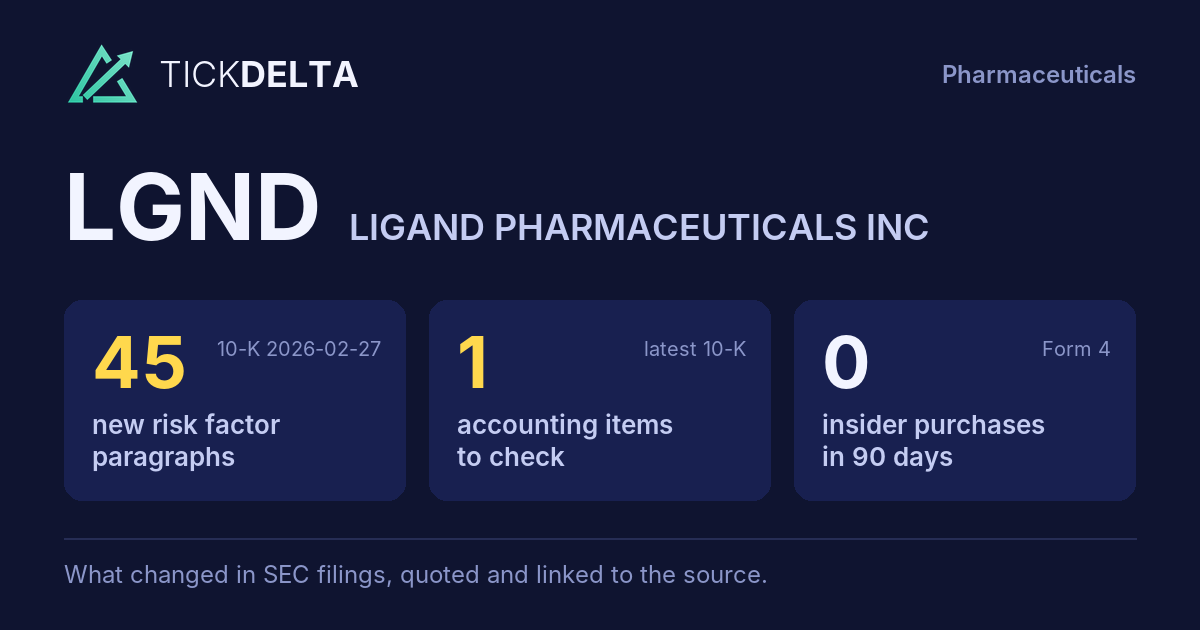
of the text changed · 27,982 words now · 45 new paragraphs, 11 gone
MD&A
29.3%
of the text changed · 3,827 words now · 5 new paragraphs, 11 gone
Legal Proceedings
49.2%
of the text changed · 861 words now
Accounting Policies
24.4%
of the text changed · 7,531 words now
10-K 0000886163-26-000006 (Feb 27, 2026) vs 10-K 0000886163-25-000012 (Feb 28, 2025)
Every paragraph, and how much of it changed
One bar per paragraph, in the order of the 10-K. Height and colour show the share of its words not in the closest paragraph a year earlier; the tallest bars are new paragraphs.
Risk Factors
271 paragraphs · 45 new · 75 reworded · 11 gone · 10-K Feb 27, 2026 against Feb 28, 2025
New paragraph
Reworded (5% of its words or more)
Same or nearly
Paragraph 53 · 49% changed
Every version of it
Paragraph 224 · 43% changed
Every version of it
Attacks upon information technology systems are increasing in their frequency, levels of persistence, sophistication and intensity, and are being conducted by sophisticated and organized groups and individuals with a wide range of motives and expertise. Furthermore, because the technologies used to obtain unauthorized access to, or to sabotage or disrupt, systems change frequently and often are not recognized until launched against a target, we may be unable to anticipate these techniques or implement adequate preventative measures. We may also experience security breaches that may remain undetected for an extended period. Even if identified, we may be unable A security breach or privacy violation that leads to adequately investigate disclosure, or remediate incidents modification of, or breaches due prevents access to, personal data or other protected information could harm our reputation, compel us to attackers increasingly using tools comply with federal and/or state breach notification laws and techniques foreign law equivalents, subject us to mandatory corrective action, require us to verify the correctness of data and otherwise subject us to liability under laws and regulations that are designed protect personal data, resulting in increased costs or loss of revenue. Similarly, the loss of clinical trial data from completed or ongoing or planned clinical trials could result in delays in our regulatory approval efforts and significantly increase our costs to circumvent controls, to avoid detection, and to remove recover or obfuscate forensic evidence. We may also face increased cybersecurity risks due to our reliance on internet technology and reproduce the number of our and our service providers’ employees who are (and may continue to be) working remotely, which may create additional opportunities for cybercriminals to exploit vulnerabilities. The White House, SEC and other regulators have also increased their focus on companies’ cybersecurity vulnerabilities and risks. data. Moreover, a
Paragraph 140 · 42% changed
Every version of it
Paragraph 231 · 41% changed
Every version of it
Paragraph 23 · 37% changed
Every version of it
A significant portion of our royalty revenue is based on sales of Kyprolis by Amgen, sales of Qarziba by Recordati, sales of Filspari by Travere, sales of Evomela by Acrotech Biopharma, sales of Teriparatide by Alvogen/Adalvo Alvogen/Adalvo, sales of Vaxneuvance and Capvaxive by Merck, sales of Ohtuvayre by Verona Pharma, now a subsidiary of Merck, and sales of Rylaze by Jazz. Royalties, including payments from the foregoing partners, are expected to be a substantial portion of our ongoing revenues for the foreseeable future. Any setback that may occur with respect to any of our partners' partners’ products, and in particular Kyprolis, could significantly impair our operating results and/or reduce our revenue and the market price of our stock. Setbacks for the products could include problems with shipping, distribution, manufacturing, product safety, marketing, government regulation or reimbursement, licenses and approvals, intellectual property rights, including failure by any of the foregoing partners to enforce their respective intellectual property rights, competition with existing or new products and physician or patient acceptance of the products, as well as higher than expected total rebates, returns, discounts, or unfavorable exchange rates. These products also are or may become subject to generic competition. For example, we entered into a settlement agreement with Teva and Acrotech Biopharma (the holder of the NDA for Evomela) which will allow Teva to market a generic version of Evomela in the United States on June 1, 2026, or earlier under certain circumstances. The entry of generic competition for Evomela may materially and adversely affect the revenue we derive from Evomela sales. Also, Amgen previously settled patent litigation related to Kyprolis on confidential terms with several parties, but it was publicly reported that the U.S. launch date for at least Breckenridge Pharmaceuticals’ applicable generic product will be “on a date that is held as confidential in 2027 or sooner, depending on certain occurrences.”
Paragraph 61 · 37% changed
Every version of it
We may have limited information concerning the products generating the royalties we are evaluating for acquisition. At times, the information we have regarding products following our acquisition of a royalty may be limited to the information that is available in the public domain. Therefore, there may be material information that relates to such products that we would like to know but do not have and may not be able to obtain. For example, we do not always know the results of studies conducted by marketers of the products or others or the nature or amount of any complaints from doctors or users of such products. In addition, the market data that we obtain independently may also prove to be incomplete or incorrect. Due to these and other factors, the actual cash flow from a royalty may be significantly lower than our estimates.
Paragraph 129 · 35% changed
Every version of it
Paragraph 141 · 49% changed
Every version of it
10-K Feb 28, 2025as well as a private right of action for data breaches that has increased the likelihood of, and risks associated with data breach litigation. Further, the California Privacy Rights Act (“CPRA”) generally went into effect on January 1, 2023, and significantly amends the CCPA. It imposes additional data protection obligations on covered businesses, including additional consumer rights processes, limitations on data uses, new audit requirements for higher risk data, and opt outs for certain uses of sensitive data. It also created a new California data protection agency authorized to issue substantive regulations and could result in increased privacy and information security enforcement. Additional compliance investment and potential business process changes may be required. Similar laws have passed in other states and are continuing to be proposed at the state and federal level, reflecting a trend toward more stringent privacy legislation in the United States. The enactment of such laws could have potentially conflicting requirements that would make compliance challenging. In the event that we are subject to or affected by HIPAA, the CCPA, the CPRA or other domestic privacy and data protection laws, any liability from failure to comply with the requirements of these laws could adversely affect our financial condition.
10-K Feb 27, 2026
collected under HIPAA and some data processed in the context of clinical trials, either at the entity level or the data level, so the impact might be limited particularly as it relates to PHI. Some states also have laws that specifically focus on the processing of personal data related to individuals’ health, including California’s Confidentiality of Medical Information Act and Washington’s My Health My Data Act. The enactment of such laws could have potentially conflicting requirements that would make compliance challenging. In the event that we are subject to or affected by HIPAA, the CCPA or other domestic privacy and data protection laws, any liability from failure to comply with the requirements of these laws could adversely affect our financial condition. Further, the existence of comprehensive privacy laws in different states in the country would make our compliance obligations more complex and costly and may increase the likelihood that we may be subject to enforcement actions or otherwise incur liability for non-compliance.
Paragraph 53 · 49% changed
Every version of it
10-K Feb 28, 2025Before we or our partners obtain the approvals necessary to sell any of our unpartnered assets or partnered programs, we must show through preclinical studies and human testing that each potential product is safe and effective. We and/or our partners have a number of partnered programs and unpartnered assets moving toward or currently awaiting regulatory action. Failure to show any product's safety and effectiveness could delay or prevent regulatory approval of a product and could, and has in the past, adversely affected our business. The product development and clinical trials process is complex and uncertain. For example, the results of preclinical studies and initial clinical trials may not necessarily predict the results from later large-scale clinical trials. In addition, clinical trials may not demonstrate a product's safety and effectiveness to the satisfaction of the regulatory authorities. A number of companies have suffered significant setbacks in advanced clinical trials or in seeking regulatory approvals, despite promising results in earlier trials. The FDA may also require additional clinical trials after regulatory approvals are received. Such additional trials may be expensive and time-consuming, and failure to successfully conduct those trials could jeopardize continued commercialization of a product.
10-K Feb 27, 2026
regulatory approvals, despite promising results in earlier trials. The FDA may also require additional clinical trials after regulatory approvals are received. Such additional trials may be expensive and time-consuming, and failure to successfully conduct those trials could jeopardize continued commercialization of a product.
Paragraph 224 · 43% changed
Every version of it
10-K Feb 28, 2025
Attacks upon information technology systems are increasing in their frequency, levels of persistence, sophistication and intensity, and are being conducted by sophisticated and organized groups and individuals with a wide range of motives and expertise. Furthermore, because the technologies used to obtain unauthorized access to, or to sabotage or disrupt, systems change frequently and often are not recognized until launched against a target, we may be unable to anticipate these techniques or implement adequate preventative measures. We may also experience security breaches that may remain undetected for an extended period. Even if identified, we may be unable to adequately investigate or remediate incidents or breaches due to attackers increasingly using tools and techniques that are designed to circumvent controls, to avoid detection, and to remove or obfuscate forensic evidence. We may also face increased cybersecurity risks due to our reliance on internet technology and the number of our and our service providers’ employees who are (and may continue to be) working remotely, which may create additional opportunities for cybercriminals to exploit vulnerabilities. The White House, SEC and other regulators have also increased their focus on companies’ cybersecurity vulnerabilities and risks.
10-K Feb 27, 2026
Attacks upon information technology systems are increasing in their frequency, levels of persistence, sophistication and intensity, and are being conducted by sophisticated and organized groups and individuals with a wide range of motives and expertise. Furthermore, because the technologies used to obtain unauthorized access to, or to sabotage or disrupt, systems change frequently and often are not recognized until launched against a target, we may be unable to anticipate these techniques or implement adequate preventative measures. We may also experience security breaches that may remain undetected for an extended period. A security breach or privacy violation that leads to disclosure, or modification of, or prevents access to, personal data or other protected information could harm our reputation, compel us to comply with federal and/or state breach notification laws and foreign law equivalents, subject us to mandatory corrective action, require us to verify the correctness of data and otherwise subject us to liability under laws and regulations that protect personal data, resulting in increased costs or loss of revenue. Similarly, the loss of clinical trial data from completed or ongoing or planned clinical trials could result in delays in our regulatory approval efforts and significantly increase our costs to recover or reproduce the data. Moreover, a
Paragraph 140 · 42% changed
Every version of it
10-K Feb 28, 2025as well as a private right of action for data breaches that has increased the likelihood of, and risks associated with data breach litigation. Further, the California Privacy Rights Act (“CPRA”) generally went into effect on January 1, 2023, and significantly amends the CCPA. It imposes additional data protection obligations on covered businesses, including additional consumer rights processes, limitations on data uses, new audit requirements for higher risk data, and opt outs for certain uses of sensitive data. It also created a new California data protection agency authorized to issue substantive regulations and could result in increased privacy and information security enforcement. Additional compliance investment and potential business process changes may be required. Similar laws have passed in other states and are continuing to be proposed at the state and federal level, reflecting a trend toward more stringent privacy legislation in the United States. The enactment of such laws could have potentially conflicting requirements that would make compliance challenging. In the event that we are subject to or affected by HIPAA, the CCPA, the CPRA or other domestic privacy and data protection laws, any liability from failure to comply with the requirements of these laws could adversely affect our financial condition.
10-K Feb 27, 2026
Certain states have also adopted comparable privacy and security laws and regulations, which govern the privacy, processing and protection of health-related and other personal information. Such laws and regulations will be subject to interpretation by various courts and other governmental authorities, thus creating potentially complex compliance issues for us and our future customers and strategic partners. For example, CCPA went into effect on January 1, 2020. The CCPA created new individual privacy rights for California residents, including the right to opt out of certain disclosures of their data, the right to limit the use and disclosure of sensitive personal information (including health information). The CCPA places increased privacy and security obligations on entities handling certain personal data of California residents or households, limits data use and mandates audit requirements for higher risk data. The CCPA also creates as a private right of action with statutory damages for certain data breaches, thereby potentially increasing risks associated with a data breach Although there are limited exemptions for clinical trial data and some other health data under the CCPA, as currently written, the CCPA may impact our business activities and exemplifies the vulnerability of our business to the evolving regulatory environment related to personal data and Protected Health Information (“PHI”). The CCPA is enforced by the California Privacy Protection Agency, a data protection authority, which has the power to issue substantive regulations and could result in increased privacy and information security enforcement. Additional compliance investment and potential business process changes may be required. Similar laws have passed in other states and are continuing to be proposed at the state and federal level, reflecting a trend toward more stringent privacy legislation in the United States. Many states have adopted statewide comprehensive privacy laws and other states have privacy legislation that is pending. Many of these new state laws contain some type of exemption for information
Paragraph 231 · 41% changed
Every version of it
10-K Feb 28, 2025The Credit Agreement contains customary affirmative and negative covenants that limit our ability to engage in certain transactions that may be in our long-term best interest. The affirmative covenants include, among others, covenants requiring us to maintain a leverage ratio of no greater than 2.50 to 1.00 (increasing to 3.00 to 1.00 with respect to the fiscal quarter in which a material permitted acquisition is consummated and the immediately subsequent three fiscal quarters thereafter) and maintain minimum consolidated EBITDA (as defined in the Credit Agreement) for any trailing four-quarter period of not less than $45 million. The negative covenants include, among others, limitations on our ability to incur indebtedness and certain liens, make certain investments, become liable under contingent obligations in certain circumstances, make certain restricted payments, make certain dispositions within guidelines and limits, engage in certain affiliate transactions, alter our fundamental business and make certain fundamental changes.
10-K Feb 27, 2026
million. The negative covenants include, among others, limitations on our ability to incur indebtedness and certain liens, make certain investments, become liable under contingent obligations in certain circumstances, make certain restricted payments, make certain dispositions within guidelines and limits, engage in certain affiliate transactions, alter our fundamental business and make certain fundamental changes.
Paragraph 23 · 37% changed
Every version of it
10-K Feb 28, 2025
A significant portion of our royalty revenue is based on sales of Kyprolis by Amgen, sales of Qarziba by Recordati, sales of Filspari by Travere, sales of Evomela by Acrotech Biopharma, sales of Teriparatide by Alvogen/Adalvo and sales of Rylaze by Jazz. Royalties, including payments from the foregoing partners, are expected to be a substantial portion of our ongoing revenues for the foreseeable future. Any setback that may occur with respect to any of our partners' products, and in particular Kyprolis, could significantly impair our operating results and/or reduce our revenue and the market price of our stock. Setbacks for the products could include problems with shipping, distribution, manufacturing, product safety, marketing, government regulation or reimbursement, licenses and approvals, intellectual property rights, including failure by any of the foregoing partners to enforce their respective intellectual property rights, competition with existing or new products and physician or patient acceptance of the products, as well as higher than expected total rebates, returns, discounts, or unfavorable exchange rates. These products also are or may become subject to generic competition. For example, we entered into a settlement agreement with Teva and Acrotech Biopharma (the holder of the NDA for Evomela) which will allow Teva to market a generic version of Evomela in the United States on June 1, 2026, or earlier under certain circumstances. The entry of generic competition for Evomela may materially and adversely affect the revenue we derive from Evomela sales. Also, Amgen previously settled patent litigation related to Kyprolis on confidential terms with several parties, but it was publicly reported that the U.S. launch date for at least Breckenridge Pharmaceuticals’ applicable generic product will be “on a date that is held as confidential in 2027 or sooner, depending on certain occurrences.”
10-K Feb 27, 2026
A significant portion of our royalty revenue is based on sales of Kyprolis by Amgen, sales of Qarziba by Recordati, sales of Filspari by Travere, sales of Evomela by Acrotech Biopharma, sales of Teriparatide by Alvogen/Adalvo, sales of Vaxneuvance and Capvaxive by Merck, sales of Ohtuvayre by Verona Pharma, now a subsidiary of Merck, and sales of Rylaze by Jazz. Royalties, including payments from the foregoing partners, are expected to be a substantial portion of our ongoing revenues for the foreseeable future. Any setback that may occur with respect to any of our partners’ products, and in particular Kyprolis, could significantly impair our operating results and/or reduce our revenue and the market price of our stock. Setbacks for the products could include problems with shipping, distribution, manufacturing, product safety, marketing, government regulation or reimbursement, licenses and approvals, intellectual property rights, including failure by any of the foregoing
Paragraph 61 · 37% changed
Every version of it
10-K Feb 28, 2025
We may have limited information concerning the products generating the royalties we are evaluating for acquisition. At times, the information we have regarding products following our acquisition of a royalty may be limited to the information that is available in the public domain. Therefore, there may be material information that relates to such products that we would like to know but do not have and may not be able to obtain. For example, we do not always know the results of studies conducted by marketers of the products or others or the nature or amount of any complaints from doctors or users of such products. In addition, the market data that we obtain independently may also prove to be incomplete or incorrect. Due to these and other factors, the actual cash flow from a royalty may be significantly lower than our estimates.
10-K Feb 27, 2026
We may have limited information concerning the products generating the royalties we are evaluating for acquisition. At times, the information we have regarding products following our acquisition of a royalty may be limited to the information that is available in the public domain. Therefore, there may be material information that relates to such products that we would like
Paragraph 129 · 35% changed
Every version of it
10-K Feb 28, 2025Additional changes that may affect our business include the expansion of new programs such as Medicare payment for performance initiatives for physicians under the Medicare Access and CHIP Reauthorization Act of 2015, or MACRA, which was fully implemented in 2019. At this time, it is unclear how the introduction of this Medicare quality payment program will impact overall physician reimbursement. The cost of prescription pharmaceuticals in the United States has also been the subject of considerable discussion in the United States. There have been several Congressional inquiries, as well as legislative and regulatory initiatives and executive orders designed to, among other things, bring more transparency to product pricing, review the relationship between pricing and manufacturer patient programs, and reform government program reimbursement methodologies for drug products.
10-K Feb 27, 2026
The cost of prescription pharmaceuticals in the United States has also been the subject of considerable discussion in the United States. There have been several Congressional inquiries, as well as legislative and regulatory initiatives and executive orders designed to, among other things, bring more transparency to product pricing, review the relationship between pricing and manufacturer patient programs, and reform government program reimbursement methodologies for drug products. In addition, on December 8, 2023, the National Institute of Standards and Technology published for comment a Draft Interagency Guidance Framework for Considering the Exercise of march-in rights, which for the first time includes the price of a product as one factor an agency can use when deciding to exercise march-in rights. While march-in rights have not previously been exercised, it is uncertain whether that will continue under the new framework. It is unclear whether or how much such rights may be exercised.
MD&A
50 paragraphs · 5 new · 28 reworded · 11 gone · 10-K Feb 27, 2026 against Feb 28, 2025
New paragraph
Reworded (5% of its words or more)
Same or nearly
Paragraph 11 · 50% changed
Total operating costs and expenses for 2024 2025 increased by $68.2 $37.3 million or 56% 20% compared with 2023. 2024. Cost of Captisol increased year over year in 2025 primarily due to an increase in sales of Captisol during 2025 compared to 2024. Amortization of intangibles remained relatively steady in 2025 at $32.7 million compared to $33.0 million in 2024, with the change due to the deconsolidation of LNHC, Inc. on July 1, 2025 in connection with the closing of the Pelthos Transaction.
Paragraph 49 · 48% changed
Paragraph 15 · 48% changed
Fair value adjustment to partner program derivatives was are not recognized in 2025 with the adoption of ASU 2025-07. Refer to Note 1, Basis of Presentation and Summary of Significant Accounting Policies, for additional information on the ASU 2025-07 adoption. The $15.1 million for gain recognized in 2024 primarily was due to certain Agenus partners discontinuing development of their partnered programs. These programs may be relicensed at a later date, and Ligand would retain its economic interest upon any relicense activity.
Paragraph 13 · 47% changed
Paragraph 19 · 40% changed
Interest income consists primarily of interest earned on our short-term investments and remained relatively steady investments. The increase over the prior year period was due to the increase in 2024 average investment balances in 2025 compared to 2023. 2024.
Paragraph 12 · 38% changed
At any one time, we are working on multiple programs. As such, we generally do not track our R&D expenses on a specific program basis. Our R&D expenses decreased increased by $3.1 $59.8 million in 2024 2025 compared to 2023, 2024, with the decrease increase primarily attributable due to lower employee a $44.3 million research and development funding arrangement related expenses to the D-Fi royalty rights acquired with the Castle Creek Investment transaction and lab supplies resulting from a $17.8 million research and development funding arrangement related to the Pelican spin-off Orchestra transaction. Both transactions are discussed in September 2023. The decrease was partially offset by additional costs associated with incubating the Pelthos business. Note 3, Investment Transactions.
Paragraph 14 · 32% changed
Financial royalty asset impairment was $30.6 decreased by $24.4 million for 2024 in 2025 compared to 2024. The 2025 impairment of $6.2 million is primarily due to Takeda's UGN-301 and other Agenus partner programs. The 2024 impairment of $30.6 million was primarily due to Takeda’s decision to discontinue the soticlestat program.
Paragraph 20 · 31% changed
Interest expense in 2024 consists primarily of a royalty and milestone payments purchase agreement, entered by Novan in 2019, and assumed as part of the Novan acquisition in September 2023. Interest expense in 2023 consists primarily of 1) the 0.75% coupon cash interest expense in addition to the non-cash accretion of discount (including the amortization of debt issuance costs) on our 2023 Notes. In May 2030 Notes issued in August 2025, and 2) interest accrued related to a royalty and milestone payments purchase agreement entered into by Novan, Inc. in 2019, assumed by Ligand as part of the Novan acquisition in September 2023, the 2023 Notes matured, and we paid the remaining $76.9 million principal amount and $0.3 million accrued interest in cash. See additional information in “Item 8. Financial Statements and Supplementary Data—Notes to Consolidated Financial Statements—Note (10), Debt.” deconsolidated on July 1, 2025.
Paragraph 11 · 50% changed
10-K Feb 28, 2025
Total operating costs and expenses for 2024 increased by $68.2 million or 56% compared with 2023.
10-K Feb 27, 2026
Total operating costs and expenses for 2025 increased by $37.3 million or 20% compared with 2024. Cost of Captisol increased year over year in 2025 primarily due to an increase in sales of Captisol during 2025 compared to 2024. Amortization of intangibles remained relatively steady in 2025 at $32.7 million compared to $33.0 million in 2024, with the change due to the deconsolidation of LNHC, Inc. on July 1, 2025 in connection with the closing of the Pelthos Transaction.
Paragraph 49 · 48% changed
10-K Feb 28, 2025We recognize income from financial royalty assets when there is a reasonable expectation about the timing and amount of cash flows expected to be collected. Income is calculated by multiplying the carrying value of the financial royalty asset by the periodic effective interest rate. We account for financial royalty assets related to developmental pipeline or recently commercialized products on a non-accrual basis. Developmental pipeline products are non-commercialized, non-approved products that require FDA or other regulatory approval, and thus have uncertain cash flows. Newly commercialized products typically do not have an established reliable sales pattern, and thus have uncertain cash flows.
10-K Feb 27, 2026
products that require FDA or other regulatory approval, and thus have uncertain cash flows. Newly commercialized products typically do not have an established reliable sales pattern, and thus have uncertain cash flows.
Paragraph 15 · 48% changed
10-K Feb 28, 2025
Fair value adjustment to partner program derivatives was $15.1 million for 2024 primarily due to certain Agenus partners discontinuing development of their partnered programs. These programs may be relicensed at a later date, and Ligand would retain its economic interest upon any relicense activity.
10-K Feb 27, 2026
Fair value adjustment to partner program derivatives are not recognized in 2025 with the adoption of ASU 2025-07. Refer to Note 1, Basis of Presentation and Summary of Significant Accounting Policies, for additional information on the ASU 2025-07 adoption. The $15.1 million gain recognized in 2024 was due to certain Agenus partners discontinuing development of their partnered programs.
Paragraph 13 · 47% changed
10-K Feb 28, 2025Total operating costs and expenses for 2024 increased by $68.2 million or 56% compared with 2023.
10-K Feb 27, 2026
General and administrative expenses increased by $13.8 million in 2025 compared to 2024, with the increase primarily due to transaction costs.
Paragraph 19 · 40% changed
10-K Feb 28, 2025
Interest income consists primarily of interest earned on our short-term investments and remained relatively steady in 2024 compared to 2023.
10-K Feb 27, 2026
Interest income consists primarily of interest earned on our short-term investments. The increase over the prior year period was due to the increase in average investment balances in 2025 compared to 2024.
Paragraph 12 · 38% changed
10-K Feb 28, 2025
At any one time, we are working on multiple programs. As such, we generally do not track our R&D expenses on a specific program basis. Our R&D expenses decreased by $3.1 million in 2024 compared to 2023, with the decrease primarily attributable to lower employee related expenses and lab supplies resulting from the Pelican spin-off in September 2023. The decrease was partially offset by additional costs associated with incubating the Pelthos business.
10-K Feb 27, 2026
At any one time, we are working on multiple programs. As such, we generally do not track our R&D expenses on a specific program basis. Our R&D expenses increased by $59.8 million in 2025 compared to 2024, with the increase primarily due to a $44.3 million research and development funding arrangement related to the D-Fi royalty rights acquired with the Castle Creek Investment transaction and a $17.8 million research and development funding arrangement related to the Orchestra transaction. Both transactions are discussed in Note 3, Investment Transactions.
Paragraph 14 · 32% changed
10-K Feb 28, 2025
Financial royalty asset impairment was $30.6 million for 2024 primarily due to Takeda's decision to discontinue the soticlestat program.
10-K Feb 27, 2026
Financial royalty asset impairment decreased by $24.4 million in 2025 compared to 2024. The 2025 impairment of $6.2 million is primarily due to UGN-301 and other Agenus partner programs. The 2024 impairment of $30.6 million was primarily due to Takeda’s decision to discontinue the soticlestat program.
Paragraph 20 · 31% changed
10-K Feb 28, 2025
Interest expense in 2024 consists primarily of a royalty and milestone payments purchase agreement, entered by Novan in 2019, and assumed as part of the Novan acquisition in September 2023. Interest expense in 2023 consists primarily of the 0.75% coupon cash interest expense in addition to the non-cash accretion of discount (including the amortization of debt issuance costs) on our 2023 Notes. In May 2023, the 2023 Notes matured, and we paid the remaining $76.9 million principal amount and $0.3 million accrued interest in cash. See additional information in “Item 8. Financial Statements and Supplementary Data—Notes to Consolidated Financial Statements—Note (10), Debt.”
10-K Feb 27, 2026
Interest expense consists primarily of 1) the 0.75% coupon cash interest expense in addition to the non-cash accretion of discount (including the amortization of debt issuance costs) on our 2030 Notes issued in August 2025, and 2) interest accrued related to a royalty and milestone payments purchase agreement entered into by Novan, Inc. in 2019, assumed by Ligand as part of the Novan acquisition in September 2023, and deconsolidated on July 1, 2025.
A paragraph is matched with the one last year that shares the most of its words; under half in common makes it new. The paragraphs shown are the 8 reworded the most in each section.
The paragraph that changed most in each section
The redline
Marked against last year's 10-K: cut words struck through, new words highlighted.
Risk Factors500 words changed in this paragraph; it is 64% similar to last year's version.
We are also or may become subject to rapidly evolving data protection laws, rules and regulations in foreign jurisdictions. For example, the European Union General Data Protection Regulation (“GDPR”) GDPR governs certain collection and other processing activities involving personal data about individuals in the European Economic Area (“EEA”). Companies that must comply with the GDPR face increased compliance obligations and risk, including more robust regulatory enforcement of data protection requirements and potential fines for noncompliance of up to €20 million or 4% of the annual global revenues of the noncompliant company, whichever is greater. The European Data Protection Board continues to release guidelines for industries and impose fines related to the GDPR, some of which have been very significant, including proposed amendments to the GDPR in November 2025. Among other requirements, the GDPR regulates transfers of personal data subject to the GDPR to third countries that have not been found to provide adequate protection to such personal data, including the United States, and the efficacy and longevity of current transfer mechanisms between the EEA and the United States remains uncertain. Case law from the Court of Justice of the European Union (“CJEU”) states that reliance on the standard contractual clauses - a standard form of contract approved by the European Commission as an adequate personal data transfer mechanism - alone may not necessarily be sufficient in all circumstances and that transfers must be assessed on a case-by-case basis. On October 7, 2022, President Biden signed an Executive Order on ‘Enhancing Safeguards for United States Intelligence Activities’ which introduced new redress mechanisms and binding safeguards to address the concerns raised by the CJEU in relation to data transfers from the EEA to the United States and which formed the basis of the new The EU-US Data Privacy Framework (“DPF”), as released on December 13, 2022. The European Commission adopted its Adequacy Decision in relation to the DPF on July 10, 2023, rendering the DPF effective as (“DPF”) also introduced a GDPR transfer mechanism to for transfers between the E.U. and U.S. entities self-certified under the DPF. The DPF also introduced with a new redress mechanism for E.U. citizens which addresses a key concern in the previous CJEU Court of Justice of the European Union judgments and may mean transfers under standard contractual clauses are less likely to be challenged in future. With the advice of outside counsel and privacy experts, we take appropriate steps to ensure transfers of personal data outside the EEA and the UK, including to the United States, are conducted in a manner consistent with applicable law and legal requirements. We expect the existing legal complexity and uncertainty regarding international personal data transfers to continue. In particular, we expect the DPF Adequacy Decision to be challenged and international transfers to the United States and to other jurisdictions more generally to continue to be subject to enhanced scrutiny by regulators. As a result, we may have to make certain operational changes and we will have to implement revised standard contractual clauses and other relevant documentation for existing data transfers within required time frames. Since the beginning of 2021, after the end of the transition period following the United Kingdom’s departure from the European Union, we are also subject to the United Kingdom data protection regime, which imposes separate but similar obligations to those under the GDPR and comparable penalties, including fines of up to £17.5 million or 4% of a noncompliant company’s global annual revenue for the preceding financial year, whichever is greater. On October 12, 2023, the UK Extension to the DPF came into effect (as approved by the UK Government), as a UK GDPR data transfer mechanism to U.S. entities self-certified under the UK Extension to the DPF. As we continue to expand into other foreign countries and jurisdictions, we may be subject to additional laws and regulations that may affect how we conduct business. In addition, on June 19, 2025, the UK’s Data (Use and Access) Act 2025 (the “DUAA”) was granted Royal Assent, implementing various measures concerning data usage in the UK and reforming data protection laws. The provisions within the DUAA will come into force through 2026, and it remains too soon to tell how the DUAA will be implemented and what impact it will have on our international activities. Further, other EU and member state laws and regulations may impose further obligations or restrictions on processing health information in the EEA, such as the European Health Data Space Regulation. In the EEA, the NIS 2 Directive (“NIS 2”) is replacing the cybersecurity legal framework under the current NIS framework, aiming to ensure a high level of cybersecurity in the region. NIS 2 brings new medium and large organizations providing services in the EEA within scope of the legal framework. It extends to additional sectors and expands the list of in-scope healthcare organizations, including to certain providers engaged in research and development of medicinal products. The new regime imposes direct obligations on management in respect of an in-scope organization's compliance with NIS 2, requires covered organizations to put in place certain cyber risk management measures, strengthens incident reporting requirements and provides supervisory authorities with greater oversight. The majority of obligations will come into force when national legislation implementing NIS 2 becomes effective in the relevant EU member state. EU member states had until October 17, 2024 to transpose NIS 2 into national legislation, although many countries have still not completed the transposition. As such, the cybersecurity regulatory landscape in the EU is currently fragmented and uncertain. To the extent that we become subject to NIS 2 in the future, we may
Source: Item 1A, 10-K 0000886163-26-000006 vs Item 1A, 10-K 0000886163-25-000012
Legal Proceedings156 words changed in this paragraph; it is 72% similar to last year's version.
On August 22, 2024, CyDex Pharmaceuticals, Inc. filed a Verified Complaint in the Delaware Court of Chancery against Bexson Biomedical, Inc. (“Bexson”), asserting claims for declaratory relief and breach of contract arising out of a Captisol In Vivo Agreement (the “In Vivo Agreement”) between the parties, pursuant to which CyDex provided Bexson with research-grade Captisol and related confidential and proprietary information for a potential new formulation of ketamine being developed by Bexson. CyDex alleges that Bexson breached its obligations under the In Vivo Agreement, including by misusing confidential information and materials provided by CyDex and by using CyDex’s confidential information and materials to file patent applications that purport to cover formulations that are “not ketamine.” ketamine”. CyDex also asserts that Bexson failed to return and destroy Cydex’s CyDex’s confidential information and materials as required by the In Vivo Agreement. CyDex seeks relief including specific performance of certain co-ownership provisions of the In Vivo Agreement and disgorgement from Bexson for any benefits obtained in violation of the In Vivo Agreement. On September 27, 2024, Bexson filed a Motion to Dismiss the Verified Complaint. A Verified Amended Complaint was filed by CyDex on November 6, 2024, and a Motion to Dismiss the Verified Amended Complaint was filed by Bexson on January 17, 2025. On May 23, 2025, Bexson withdrew its pending Motion to Dismiss and filed a Verified Counterclaim, Answer, and Affirmative Defenses. On July 17, 2025, CyDex and Bexson agreed to a joint stipulation for a schedule on judgment on the pleadings, providing for briefing to be complete by November 17, 2025. CyDex filed its reply to Bexson’s counterclaim on July 23, 2025. On August 22, 2025, Bexson filed its opening brief in support of its motion for judgment on the pleadings. On September 25, 2025, CyDex filed its partial cross-motion for judgment on the pleadings and opposition to Bexson’s motion, and on October 27, 2025 Bexson filed its combined answering brief in opposition to CyDex’s motion and reply in support of its motion. CyDex filed a reply brief on November 17, 2025. Oral argument on the pending motions for judgment on the pleadings is scheduled to occur on April 22, 2026.
Source: Item 3, 10-K 0000886163-26-000006 vs Item 3, 10-K 0000886163-25-000012
MD&A153 words changed in this paragraph; it is 35% similar to last year's version.
In 2023, 2025, we generated cash from operations primarily from revenue and other operating income. income which was partially offset by our investments in Castle Creek and Orchestra R&D funding arrangements, and cash operating expenses. We used cash for in investing activities primarily for the purchases of short-term and other investments, financial royalty assets, the Novan acquisition and our investment in Primrose Bio, derivative assets, as well as cash outflow on deconsolidation of LNHC, Inc., partially offset by cash proceeds from the sale and maturity of short-term investments including Viking shares. During investments, and cash proceeds from financial royalty assets. We generated cash from financing activities primarily due to net proceeds from the year, we used cash for financing activities, including the repayment issuance of the remaining $76.9 million principal amount upon maturity of the 2023 2030 Notes and $0.3 million accrued interest in cash. related transactions (i.e., purchase of hedge, issuance of warrants, and repurchase of shares), stock options exercises and ESPP, as well as proceeds from Pelthos investors bridge loans. Refer to Note 2, Pelthos Transaction, for more information on the Pelthos Transaction, and Note 9, Debt, for more information on the 2030 Notes.
Source: Item 7, 10-K 0000886163-26-000006 vs Item 7, 10-K 0000886163-25-000012
Accounting Policies147 words changed in this paragraph; it is 32% similar to last year's version.
Source: Item 8, Note 1 – Basis of Presentation and Summary of Significant Accounting Policies, 10-K 0000886163-26-000006 vs Item 8, Note 1 – Basis of Presentation and Summary of Significant Accounting Policies, 10-K 0000886163-25-000012
Sentences and paragraphs added, removed or reworded
Every change, by type
Sentences and paragraphs of LGND's Risk Factors and MD&A, 10-K Feb 27, 2026 against 10-K Feb 28, 2025. Each links to the text at sec.gov.
Quiet changes are sentences kept from last year with one to four words changed, at least one of them a hedge, a modal or a qualifier (may, could, will, not, significant, material…). A year or date rolling forward is not counted.
The full word list
adverse, adversely, all, although, anticipate, anticipates, any, approximately, believe, believes, can, cannot, certain, could, expect, expects, generally, however, if, intend, intends, largely, likely, many, material, materially, may, might, most, must, never, no, not, possible, primarily, probable, should, significant, significantly, some, substantial, substantially, unlikely, will, would
AddedRisk Factors
•We continue to have exposure to risks related to Pelthos due to our ongoing equity ownership and other investments in Pelthos, which could adversely affect our financial condition and results of operations.
Read it in 10-K Feb 27, 2026 at sec.gov
AddedRisk Factors
•Cybersecurity incidents could compromise sensitive data and interrupt operations, leading to regulatory enforcement and reputational harm. We may be or become subject to certain data protection laws (e.g., the European Union General Data Protection Regulation and the UK equivalent of the same (collectively, “GDPR”) and the California Consumer Privacy Act of 2018 (as revised and amended by the California Privacy Rights Act, the “CCPA”)) and failure to comply with such laws could result in enforcement actions, fines and reputational harm;
Read it in 10-K Feb 27, 2026 at sec.gov
AddedRisk Factors
•Ineffective development or deployment of artificial intelligence (“AI”) technologies could lead to errors or disruptions in our operations and evolving AI regulations could impose additional compliance burdens; and
Read it in 10-K Feb 27, 2026 at sec.gov
AddedRisk Factors
The royalty market may not grow at the same rate as it has in the past, or at all, and we may not be able to acquire sufficient royalties to sustain the growth of our business.
Read it in 10-K Feb 27, 2026 at sec.gov
AddedRisk Factors
We have been able to grow our business over time by primarily acquiring royalties. However, we may not be able to identify and acquire a sufficient number of royalties, or royalties of sufficient scale, to invest the full amount of capital that may be available to us in the future, or at our targeted amount and rate of capital deployment, which could prevent us from executing our growth strategy and negatively impact our business. Changes in the royalty market, including its structure, participants growth rate, changes in preferred methods of financing and capital raising in the biopharmaceutical industry, reduced access to capital or higher cost of capital, or a reduction in the growth of the biopharmaceutical industry, could lead to diminished opportunities for us to acquire royalties, fewer royalties (or fewer royalties of significant scale) being available, or increased competition for royalties. Even if we continue to acquire royalties, they generally will not generate a meaningful return for a period of several years, if at all, due to transaction structures, circumstances relating to the underlying products or other factors. As a result, we may not be able to continue to acquire royalties or otherwise grow our business as we have done in the past, or at all.
Read it in 10-K Feb 27, 2026 at sec.gov
AddedRisk Factors
timely or at acceptable costs, if at all. In addition to manufacturing at Hovione’s facilities in Ireland and Portugal, we have processing capacity for Captisol in both the United States and England.
Read it in 10-K Feb 27, 2026 at sec.gov
AddedRisk Factors
The manufacture and distribution of a biopharmaceutical product may be interrupted by regulatory agencies or supplier deficiencies.
Read it in 10-K Feb 27, 2026 at sec.gov
AddedRisk Factors
The manufacture of products generating our royalties is typically complex and is highly regulated. In particular, biopharmaceutical products are manufactured in specialized facilities that require the approval of, and ongoing regulation by,
Read it in 10-K Feb 27, 2026 at sec.gov
Show the other 55
AddedRisk Factors
the FDA in the United States and, if manufactured outside of the United States, both the FDA and non-U.S. regulatory agencies, such as the MHRA and the EMA. With respect to a product, to the extent that operational standards set by such agencies are not adhered to, manufacturing facilities may be closed or production interrupted until such time as any deficiencies noted by such agencies are remedied. Any such closure or interruption may interrupt, for an indefinite period of time, the manufacture and distribution of a product and therefore the cash flows from the related biopharmaceutical asset may be significantly less than expected.
Read it in 10-K Feb 27, 2026 at sec.gov
AddedRisk Factors
In addition, manufacturers of a product may rely on third parties for selected aspects of product development, such as packaging or to supply bulk raw material used in the manufacture of such product. In the United States, the FDA requires that all suppliers of pharmaceutical bulk materials and all manufacturers of pharmaceuticals for sale in or from the United States adhere to the FDA’s current “Good Manufacturing Practice” regulations and guidelines and similar requirements that exist in jurisdictions outside the United States. Marketers of biopharmaceutical products generally rely on a small number of key, highly specialized suppliers, manufacturers and packagers. Any interruptions, however minimal, in the operation of these manufacturing and packaging facilities could adversely affect production and product sales and therefore adversely affect our business, financial condition or results of operations.
Read it in 10-K Feb 27, 2026 at sec.gov
AddedRisk Factors
In addition, our collaboration partners may develop products, either alone or with others, that compete with the types of products they are developing with us (or that we are developing on our own). This would result in increased competition for our
Read it in 10-K Feb 27, 2026 at sec.gov
AddedRisk Factors
We may undertake strategic acquisitions of operating biopharmaceutical companies or acquire securities of biopharmaceutical companies. Our failure to realize the expected benefits of such acquisitions could adversely affect our business, financial condition or results of operations.
Read it in 10-K Feb 27, 2026 at sec.gov
RemovedRisk Factors
RemovedRisk Factors
RemovedRisk Factors
RemovedRisk Factors
RemovedRisk Factors
RemovedRisk Factors
RemovedRisk Factors
RemovedRisk Factors
RemovedRisk Factors
RemovedRisk Factors
RemovedRisk Factors
RewordedRisk Factors
RewordedRisk Factors
Even if we do obtain orphan drug designations and are the first to obtain marketing approval of our product candidates for the applicable indications, we will not be able to rely on these designations to exclude other companies from manufacturing or selling biological products using the same principal molecular structural features for the same indication beyond these timeframes.
Read it in 10-K Feb 27, 2026 at sec.gov
RewordedRisk Factors
Setbacks for the products could include problems with shipping, distribution, manufacturing, product safety, marketing, government regulation or reimbursement, licenses and approvals, intellectual property rights, including failure by any of the foregoing partners to enforce their respective intellectual property rights, competition with existing or new products and physician or patient acceptance of the products, as well as higher than expected total rebates, returns, discounts, or unfavorable exchange rates.
Read it in 10-K Feb 27, 2026 at sec.gov
RewordedRisk Factors
Although we believe that we and our partners have adjusted our business practices to the impacts of the COVID-19 pandemic, in the future, we may experience similar pandemics or epidemic diseases that could severely impact our business, drug manufacturing and supply chain, nonclinical activities and clinical trials and our partners’ business may be impacted in similar ways, including due to delays or difficulties in enrolling patients in clinical trials, diversion of healthcare resources away from the conduct of clinical trials, interruption of, or delays in receiving, supplies of Captisol or other product or product candidates from contract manufacturing organizations due to staffing shortages, production slowdowns or stoppages and disruptions in delivery systems, which may result in cancellations of Captisol orders or refunds if we fail to deliver Captisol timely, interruption or delays to discovery and development pipelines and difficulties launching or commercializing products, including due to reduced access to doctors as a result of social distancing protocols.
Read it in 10-K Feb 27, 2026 at sec.gov
RewordedRisk Factors
If we fail to comply with any such laws, rules or regulations, we may face government investigations and/or enforcement actions, fines, civil or criminal penalties, private litigation or adverse publicity that could adversely affect our business, financial condition and results of operations.
Read it in 10-K Feb 27, 2026 at sec.gov
RewordedRisk Factors
It may be necessary for us to pursue litigation or adversarial proceedings before the patent office in order to enforce our patent and proprietary rights or to determine the scope, coverage and validity of the proprietary rights of others.
Read it in 10-K Feb 27, 2026 at sec.gov
RewordedRisk Factors
The DPF EU-US Data Privacy Framework (“DPF”) also introduced a transfer mechanism for transfers between the E.U. and U.S. with a new redress mechanism for E.U. citizens which addresses a key concern in the previous CJEU Court of Justice of the European Union judgments and may mean transfers under standard contractual clauses are less likely to be challenged in future.
Read it in 10-K Feb 27, 2026 at sec.gov
RewordedRisk Factors
If a prolonged government shutdown occurs, or if there are other significant changes in funding, it could significantly impact the ability of the FDA to provide feedback on clinical trials and development programs, to meet with sponsors and to otherwise timely review and process our regulatory submissions, which could have a material adverse effect on our business.
Read it in 10-K Feb 27, 2026 at sec.gov
RewordedRisk Factors
RewordedRisk Factors
The FDA or comparable foreign regulatory authorities, as the case may be, may also require us or our partners to conduct additional preclinical nonclinical studies or clinical trials for our product candidates either prior to or post-approval, or may object to elements of clinical development programs.
Read it in 10-K Feb 27, 2026 at sec.gov
RewordedRisk Factors
RewordedRisk Factors
The diversion of our management's management’s attention and any delay or difficulties encountered in connection with any future acquisitions we may consummate could result in the disruption of our ongoing on-going business or inconsistencies in standards and controls that could negatively affect our ability to maintain third-party relationships. operations.
Read it in 10-K Feb 27, 2026 at sec.gov
AddedMD&A
(1) Our royalty rate on Ohtuvayre is 3%, of which 2% is recognized in revenue from intangible royalty assets and the remaining 1% is accounted for as financial royalty asset.
Read it in 10-K Feb 27, 2026 at sec.gov
AddedMD&A
The gain from change in fair value of equity method investments and other investments was $90.7 million for 2025, attributable to the fair value changes of the shares of Pelthos common stock and Pelthos Series A convertible preferred stock that we acquired in connection with the Pelthos Transaction. For additional information, see Note 2, Pelthos Transaction. The loss from change in fair value of equity method investments and other investments was $34.6 million for 2024, attributable to the fair value adjustment of $25.8 million to Primrose Bio securities investment, the $5.8 million impairment to Primrose Bio equity method investment, and the $3.0 million impairment loss related to Neuritek warrants.
Read it in 10-K Feb 27, 2026 at sec.gov
AddedMD&A
On August 14, 2025, we issued the 2030 Notes. The $460 million aggregate principal balance of the 2030 Notes includes the purchase of an additional $60 million aggregate principal amount of the 2030 Notes by the initial purchasers pursuant to the full exercise of their overallotment option. The net proceeds from the 2030 Notes offering were approximately $445.1 million, after deducting the initial purchasers’ discounts and commissions and the debt issuance costs incurred by Ligand. Refer to Note 9, Debt, for more information on the 2030 Notes.
Read it in 10-K Feb 27, 2026 at sec.gov
AddedMD&A
In connection with the offering of the 2030 Notes, on August 11, 2025, we entered into the second amendment to the Credit Agreement, to permit, among other things, certain cash settlement payments on the 2030 Notes, subject to customary conditions set forth therein. On September 12, 2025, we entered into the third amendment to the Credit Agreement to, among other things, extend the maturity date to September 12, 2028 and modify the minimum consolidated EBITDA (as defined in the Credit Agreement) covenant to require us to maintain not less than $55 million of consolidated EBITDA (as defined in the Credit Agreement) for the trailing four-quarter period ended September 30, 2025 and each trailing four-quarter period ending thereafter.
Read it in 10-K Feb 27, 2026 at sec.gov
AddedMD&A
In 2025, we generated cash from operations primarily from revenue and operating income which was partially offset by our investments in Castle Creek and Orchestra R&D funding arrangements, and cash operating expenses. We used cash in investing activities primarily for purchases of short-term and other investments, financial royalty assets, and derivative assets, as well as cash outflow on deconsolidation of LNHC, Inc., partially offset by cash proceeds from sale and maturity of short-term investments, and cash proceeds from financial royalty assets. We generated cash from financing activities primarily due to net proceeds from the issuance of the 2030 Notes and related transactions (i.e., purchase of hedge, issuance of warrants, and repurchase of shares), stock options exercises and ESPP, as well as proceeds from Pelthos investors bridge loans. Refer to Note 2, Pelthos Transaction, for more information on the Pelthos Transaction, and Note 9, Debt, for more information on the 2030 Notes.
Read it in 10-K Feb 27, 2026 at sec.gov
RemovedMD&A
RemovedMD&A
RemovedMD&A
RemovedMD&A
RemovedMD&A
RemovedMD&A
RemovedMD&A
RemovedMD&A
RemovedMD&A
RemovedMD&A
RemovedMD&A
RewordedMD&A
Interest expense in 2023 consists primarily of 1) the 0.75% coupon cash interest expense in addition to the non-cash accretion of discount (including the amortization of debt issuance costs) on our 2023 Notes. 2030 Notes issued in August 2025, and 2) interest accrued related to a royalty and milestone payments purchase agreement entered into by Novan, Inc. in 2019, assumed by Ligand as part of the Novan acquisition in September 2023, and deconsolidated on July 1, 2025.
Read it in 10-K Feb 27, 2026 at sec.gov
RewordedMD&A
In addition, the increase was driven by changes in the fair value of our ownership in Viking common stock (an unrealized gain of $9.0 million in 2024 compared to an unrealized gain of $2.6 million in 2023) and 2024, we recorded a $7.1 million net gain on the arrangements we executed and exercised in 2024 to hedge against the fluctuation in Viking's Viking’s share price.
Read it in 10-K Feb 27, 2026 at sec.gov
RewordedMD&A
RewordedMD&A
Total revenue and other income increased by $35.8 $101.0 million, or 27%, 60%, to $268.1 million in 2025 compared to $167.1 million in 2024 compared to $131.3 million in 2023 primarily due to the $23.8 $52.2 million increase in royalties. royalties and $39.4 million increase in contract revenue and income.
Read it in 10-K Feb 27, 2026 at sec.gov
RewordedMD&A
Captisol sales increased by $2.5 $9.3 million to $40.2 million in 2025 compared to $30.9 million in 2024 compared to $28.4 million in 2023. 2024.
Read it in 10-K Feb 27, 2026 at sec.gov
RewordedMD&A
RewordedMD&A
Other non-operating expense, net, primarily consists of mark-to-market adjustments on derivatives (other than Viking Share Collar and Put and the partner program derivatives) and derivatives), mark-to-market adjustments on CVRs and absorbed losses on for equity method investments. investment in Primrose Bio.
Read it in 10-K Feb 27, 2026 at sec.gov
RewordedMD&A
As of December 31, 2024, 2025, we had $3.7 $3.2 million in fair value of contingent consideration liabilities associated with the acquisitions related to our business combinations to be settled in future periods.
Read it in 10-K Feb 27, 2026 at sec.gov
RewordedMD&A
RewordedMD&A
Interest income consists primarily of interest earned on our short-term investments and remained relatively steady in 2024 compared to 2023. investments.
Read it in 10-K Feb 27, 2026 at sec.gov
RewordedMD&A
Our effective tax rate for 2025 and 2024 was 22% and 2023 was 260% and 15%, 260%, respectively.
Read it in 10-K Feb 27, 2026 at sec.gov
RewordedMD&A
The increase in royalties in 2024 2025 was primarily due to income from Qarziba financial royalty asset acquired in the third quarter of 2024 and an increase in sales of Travere Therapeutics’ Filspari. Filspari, Ohtuvayre and Capvaxive.
Read it in 10-K Feb 27, 2026 at sec.gov
Sources
The two latest 10-Ks on EDGAR, section by section. Each change links to the text at sec.gov.
Also
New risk factors: paragraphs with nothing like them last year, quoted in full.
Work with it
Excel workbook · CSV. Google Sheet that stays up to date: paste =IMPORTDATA("https://tickdelta.com/company/LGND/export.csv") into a cell.