Screener / SEC EDGAR /CIK 0000202058 /10-K filed Feb 12, 2026, compared with Feb 14, 2025 /Numbers from the XBRL of the 10-Ks
NYSE Industrials · Defense Electronics

L3Harris LHX

Compare with peers Embed
New in the 10-K 5 paragraphs with nothing like them in the 10-K filed Feb 14, 2025 New in the 10-Q 39 paragraphs not in the 10-Q filed Jul 30, 2026 10-Q against the 10-K 11 risk factor paragraphs and sentences added or reworded

New risk paragraphs, branching off last year

Each branch is a paragraph in Risk Factors with nothing like it in the 10-K filed Feb 14, 2025. A box jumps to the paragraph as filed, below.

5 new

Paragraphs with nothing like them in last year's 10-K

Quoted exactly

5 paragraphs in Risk Factors of the 10-K filed Feb 12, 2026 with nothing like them in the 10-K filed Feb 14, 2025. Quoted exactly. Paragraphs that were only edited are under 10-K change.

Compared with the Risk Factors in the latest 10-K of the other 81 Industrials companies: a paragraph with at least half its words the same at another company is called similar, and the companies are listed under it. A paragraph most of them have is marked boilerplate. No line means no other company has one like it. This counts text; it does not say how serious a risk is.

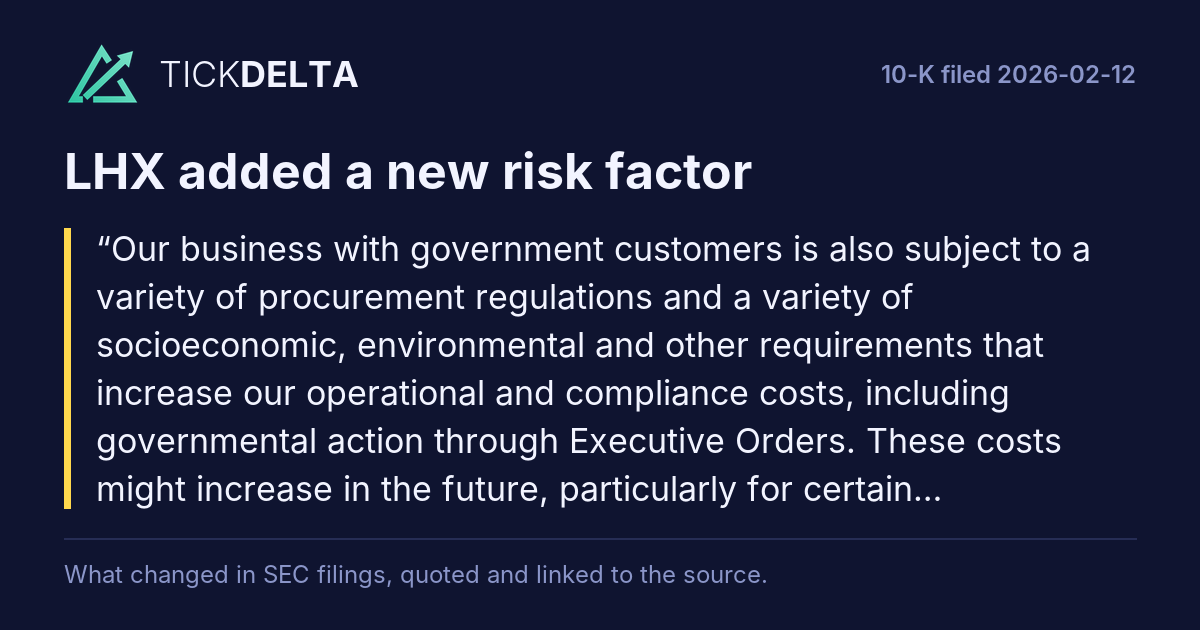
Our business with government customers is also subject to a variety of procurement regulations and a variety of socioeconomic, environmental and other requirements that increase our operational and compliance costs, including governmental action through Executive Orders. These costs might increase in the future, particularly for certain international markets and customers, thereby reducing our margins.

Read in the 10-K

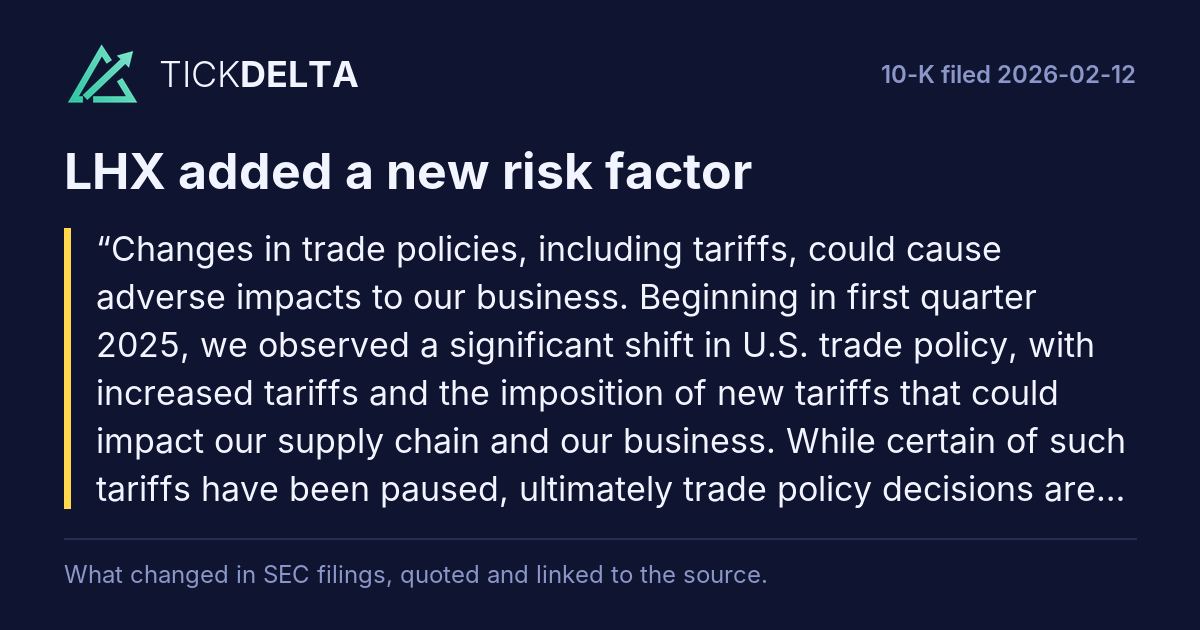
Changes in trade policies, including tariffs, could cause adverse impacts to our business. Beginning in first quarter 2025, we observed a significant shift in U.S. trade policy, with increased tariffs and the imposition of new tariffs that could impact our supply chain and our business. While certain of such tariffs have been paused, ultimately trade policy decisions are outside of our control and may have consequences for our business. Changes in trade policies, such as new tariffs or increases in tariffs, or reactionary measures including retaliatory tariffs, legal challenges, or currency manipulation, could adversely impact us.

Even though we primarily sell our products and services to U.S. Government customers and our suppliers are primarily domestic, we still rely on imported materials, components, or finished goods, and if tariffs increase, our supply chain costs may rise, adversely affecting our business, results of operations and cash flows. We also operate a business in Canada that supports both domestic and international programs. If we are not granted exemptions from tariffs due to the nature of our business and customers, we could see greater impacts than we currently expect, especially as it relates to tariffs between the U.S. and Canada. Additionally, retaliatory measures, or prolonged uncertainty in trade relationships could result in supply chain disruptions, delayed shipments, or increased operational complexity, which could also adversely affect our business, results of operations and cash flows. While we intend to take steps to mitigate any impacts of tariffs or other impacts resulting from changes in trade policy, our ability to do so may be limited by operational and supply chain constraints, especially in the short term.

Similar paragraph at 1 of 81 other Industrials companies: ROK
Read in the 10-K

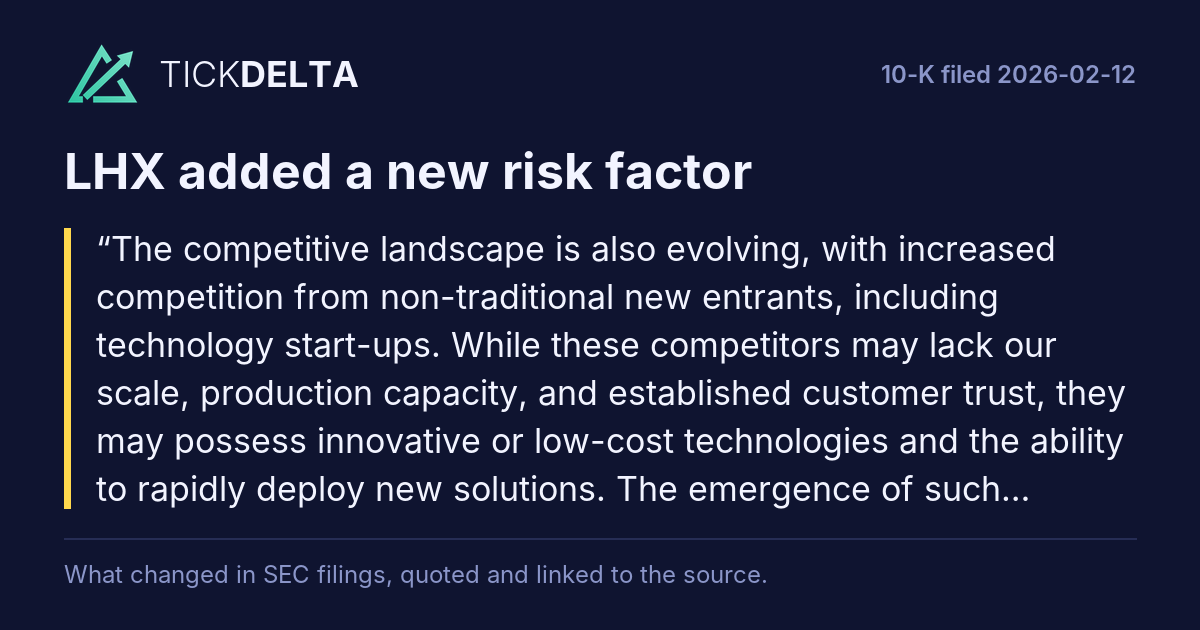
The competitive landscape is also evolving, with increased competition from non-traditional new entrants, including technology start-ups. While these competitors may lack our scale, production capacity, and established customer trust, they may possess innovative or low-cost technologies and the ability to rapidly deploy new solutions. The emergence of such players may intensify pricing pressure and threaten our market share or competitive advantage.

Read in the 10-K

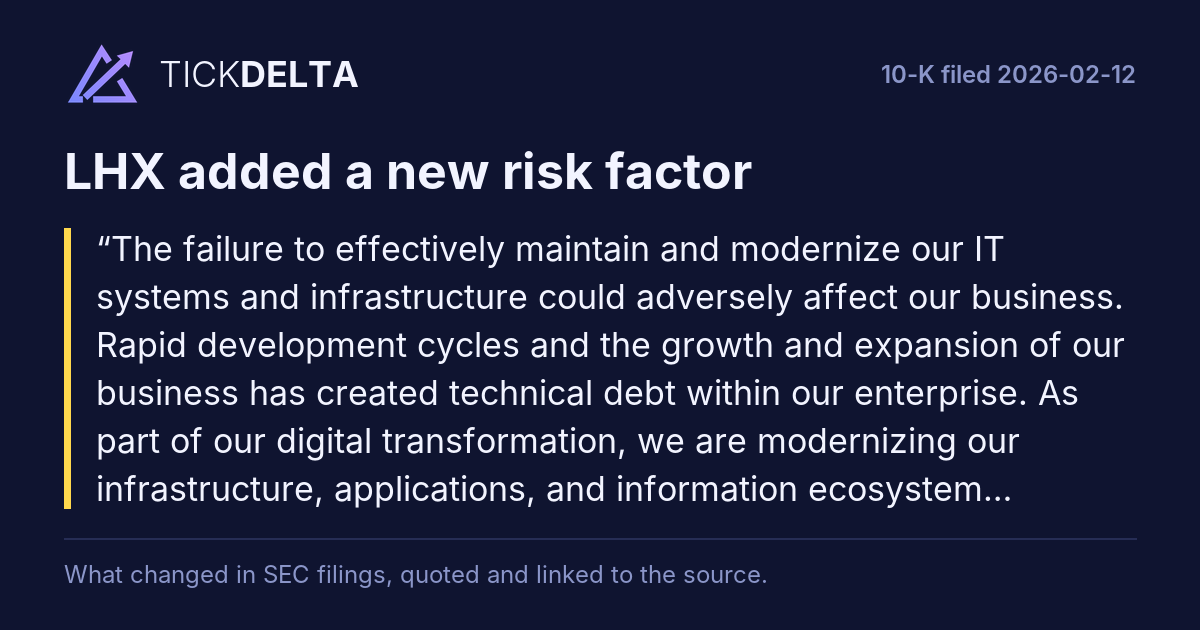
The failure to effectively maintain and modernize our IT systems and infrastructure could adversely affect our business. Rapid development cycles and the growth and expansion of our business has created technical debt within our enterprise. As part of our digital transformation, we are modernizing our infrastructure, applications, and information ecosystem, inclusive of cloud migrations, increasing automation and expanding the use of AI. Until our digital transformation is fully complete, we will continue to rely on significant manual processes and procedures that subject us to increased risk of error and internal control failure compared to automated processes. Our ability to modernize our technology systems and infrastructure requires us to execute large-scale, complex programs and projects, which rely on the commitment of significant financial and managerial resources and effective planning and management processes. We also rely on third party outsourcing, so the speed and effectiveness of our digital transformation may be subject to additional factors beyond our control. Additionally, integrating AI capabilities could increase technical complexity, potentially exacerbating these challenges. As a result, we may be unable to complete our digital transformation and manage our technical debt efficiently or in a timely manner, which could result in operational resiliency issues, delivery delays, cost overruns, additional expenses, reputational harm, legal and regulatory actions, and other adverse consequences.

Read in the 10-K

Paragraphs in the 10-Q filed Oct 29, 2026 that were not in the one before

New in the latest 10-Q

39 paragraphs in the 10-Q filed Oct 29, 2026 with nothing like them in the 10-Q filed Jul 30, 2026 (at least half the words must differ; new numbers alone do not count). Quoted exactly, grouped by the item heading above them. This is text that changed, not a judgement of how serious it is.

Financial statements and notes

In May 2026, the Financial Accounting Standards Board (“FASB”) issued Accounting Standards Update (“ASU”) 2026-02, Environmental Credits and Environmental Credit Obligations, which provides guidance on how companies should recognize, measure, and present environmental credits and environmental credit obligations in their financial statements. ASU 2026-02 is effective for annual and interim reporting periods beginning after December 15, 2027, and should be applied retrospectively. We are currently evaluating the potential impact of adopting ASU 2026-02 on our operating results, financial position and cash flows.

Read in the 10-Q

If the milestones are achieved by December 31, 2027, the Investor can convert the Subsidiary Series A Preferred Stock at any time (including in the case of an IPO after December 31, 2027), or a redemption on or after April 17, 2031 could occur. The Investor’s conversion rate will be determined based on the face value of the Subsidiary Series A Preferred Stock ($ 1 billion) divided by 15 times 2026 AXYV earnings before interest, taxes, depreciation, and amortization (“EBITDA”). The redemption price would be calculated on or after April 17, 2031, and would equal the greater of (i) the Liquidation Preference or (ii) the fair market value, calculated in the same manner as noted above.

Read in the 10-Q

(1) Acquisition-related intangibles recorded at Corporate, as they benefit the entire Company. Amortization is included in “Unallocated corporate items and other, net” in Note Q: Business Segment Information.

Read in the 10-Q

(2) Asset is recorded at Corporate, as it benefits the entire Company. Amortization is included in the “Revenue” line item of our Condensed Consolidated Statement of Operations. See Note B: Strategic Investment in Subsidiary for further information.

Read in the 10-Q

On August 3, 2026, we completed the sale of a 60 % controlling interest in our Space Technology disposal group for cash proceeds, net of cash divested, of $ 539 million, subject to final purchase price adjustments, including the final working capital settlement, as set forth in the agreement. In connection with the transaction, we recognized a $ 248 million equity method investment, reflecting the fair value of our retained 40 % noncontrolling interest in the newly formed company, RocketForce Technologies LLC (“Rocketdyne”). See Note P: Investments for further information on our Rocketdyne equity method investment.

Read in the 10-Q
Show the other 34

The Space Technology disposal group consists of certain contributed assets and liabilities of the Space Propulsion and Power Systems business and the Space Avionics & Communications division, both previously reported in our Missile Solutions segment. The Space Technology disposal group excludes our RS-25 rocket engine and hypersonics businesses.

Read in the 10-Q

During third quarter 2026, we entered into time deposits with contractual maturities of more than three months but less than one year. Time deposits are held with high credit quality financial institutions and are intended to be held to maturity. As of October 2, 2026, the aggregate carrying value of our time deposits was $ 550 million, which is included in the “Short-term investments” line item in our Condensed Consolidated Balance Sheet.

Read in the 10-Q

Rocketdyne Equity Method Investment. On August 3, 2026, in connection with the divestiture of the Space Technology disposal group, further discussed in Note O: Divestitures, we recorded an initial equity method investment of $ 248 million, reflecting fair value of our 40 % retained noncontrolling interest in Rocketdyne. The recognition of this investment is a non-cash investing activity, excluded from our Condensed Consolidated Statement of Cash Flows.

Read in the 10-Q

As of October 2, 2026, segment aligned investments, consisting of both equity method and equity interest investments, were $ 54 million and $ 43 million in our Space and Mission Systems and Communications and Spectrum Dominance segments, respectively. Net investment gains included in segment operating income were $ 39 million for year to date 2026. There were no investment gains or losses included in segment operating income for third quarter 2026, third quarter 2025 or year to date 2025.

Read in the 10-Q

Divestiture. On August 3, 2026, we completed the sale of our Space Technology disposal group, which was reported in our Missile Solutions segment through the date of divestiture. See Note O: Divestitures in the Notes for further information.

Read in the 10-Q

Included in gross margin are the following net EAC adjustments, by segment, for the periods presented:

Read in the 10-Q

We monitor contractual backlog as an operational indicator of future business activity. Although backlog is not necessarily indicative of revenue to be recognized in any particular period, it provides insight into demand trends and expected future utilization of production and service capacity. Our contractual backlog by segment, including funded and unfunded components, were as follows:

Read in the 10-Q

Our total contractual backlog increased during third quarter 2026, driven by new awards across all three segments and contract modifications during the period, including firm amounts associated with undefinitized contract action (“UCA”), partially offset by a reduction of approximately $2.0 billion in contractual backlog associated with the completed Space Technology disposal group divestiture.

Read in the 10-Q

In our Missile Solutions segment, third quarter 2026 awards included UCA awards of $6.3 billion and $4.7 billion on our Terminal High Altitude Area Defense (“THAAD”) and PAC-3 Missile Segment Enhancement programs, respectively. These awards represent two seven-year contracts consistent with the long-term framework agreements established with the DoW. The first year of each contract is included in funded contractual backlog and the remaining contract years are included in unfunded contractual backlog.

Read in the 10-Q

In our Communications & Spectrum Dominance segment, third quarter 2026 awards included UCA awards of $723 million associated with our Next Generation Jammer Electronic Warfare and $540 million in new VAMPIRE™ program awards.

Read in the 10-Q

Divestitures. In 2026, we completed the divestiture of our Space Technology disposal group for net cash proceeds of $539 million, subject to final purchase price adjustments, as set forth in the purchase agreement. In 2025, we completed the divestiture of our CAS disposal group for net cash proceeds of $831 million.

Read in the 10-Q

Risk Factors

Our multi-year capacity expansion in our Missile Solutions segment involves substantial capital commitments and is reliant on our multi-year procurement contracts. In response to the Munitions Acceleration Council (“MAC”) framework initiatives and increased demand, we are executing a multi-year capacity expansion and modernization plan involving more than $3 billion of capital investments through 2030 across our Missile Solutions segment to materially increase annual production capacity for solid rocket motors, divert and attitude control systems, and precision fuzes across priority MAC programs.

Read in the 10-Q

These large-scale facility build-outs and advanced manufacturing expansions are subject to complex execution and commissioning risks, including: delays in permitting, site preparation, engineering, and construction; extended lead times, delivery delays, or integration challenges for specialized tooling, large-scale propellant mixers, robotics, and automated production systems; technical difficulties in scaling manufacturing processes; and delays in completing rigorous customer and government validation, testing, and qualification milestones required before expanded facilities can achieve full-rate production authorization. The expansions also increase our existing risk of supply chain disruption because of increased production volumes.

Read in the 10-Q

While we have agreed to multi-year contracts for minimum production volumes for priority MAC missile programs, these contracts require sustained government appropriations across the multi-year performance periods. Although cancellation fees under these multi-year contracts are designed to cover facilitization charges and are higher than our standard terms, cancellation fees may not cover all of our incurred capital expenditures, site preparation costs, long-lead supply commitments, and ongoing facility operating expenses. Furthermore, if orders are canceled, we may be unable to fully utilize this specialized manufacturing footprint or redirect these custom facilities to alternative programs, resulting in unabsorbed overhead, facility underutilization, and unrecovered capital investments.

Read in the 10-Q

Additionally, achieving target production rates requires rapidly scaling our specialized workforce at these expansion sites, including engineering, assembly, quality assurance, and Environmental, Health and Safety personnel with active security clearances. Bottlenecks in recruitment, training, or government security clearance processing, as well as operational constraints associated with increased energetic mixing volumes and hazardous waste disposal limits, could impede facility ramp milestones.

Read in the 10-Q

Our long-term funding and production volumes could also be adversely affected by proposed legislative initiatives, including second-source mandates for certain of our missile products and subsystems for which we are the sole supplier. If enacted into law or implemented into DoW procurement strategy, mandatory second sourcing could redirect government funding or future contract awards to competitors or new entrants, reduce our share of program quantities, and undermine the economic assumptions underlying our capital investments, leaving our expanded production lines with excess capacity.

Read in the 10-Q

Any failure to successfully execute our facility expansion and modernization plans on schedule and within budget, or any cancellation, reduction in appropriations, or legislative reallocation of procurement funding to second sources that leaves capital investments unrecovered, could impair our ability to meet customer delivery commitments on priority missile programs, undermine our competitive position, and adversely affect our business, financial condition, results of operations, cash flows and equity.

Read in the 10-Q

We depend on our subcontractors and suppliers, and failures in or disruptions to our supply chain could cause our products and or services to be produced or delivered in an untimely or unsatisfactory manner. Our ability to manufacture and deliver products and services to our customers requires our U.S. and non-U.S. subcontractors and suppliers to provide a variety of materials, components, subsystems and services. In some instances, we depend upon a single supplier for certain components, which adds risk because that supplier may at times be unable to meet our needs and because we may have limited negotiating leverage with sole-source suppliers. Identifying and qualifying dual and second-source suppliers can be difficult, time-consuming and may result in increased costs. Any inability to timely develop cost-effective alternative sources of supply could materially impact our ability to manufacture and deliver products and services to our customers.

Read in the 10-Q

In particular, we rely on subcontractors and suppliers for our multi-year contracts in our Missile Solutions segment to materially increase production capacity for solid rocket motors, divert and attitude control systems, and precision fuzes across priority MAC programs. Some of these suppliers are currently sole-source, and we cannot guarantee that all of our suppliers will be able to increase their capacity to the levels required under our multi-year contracts.

Read in the 10-Q

In addition, we are required to procure certain materials and components, including rare earth minerals, such as tungsten, and microelectronic components, from U.S. Government-approved supply sources. Heightened regulatory requirements that may apply to these sources can further limit the subcontractors and suppliers we may utilize. Legislation, regulatory changes or other governmental actions, including product certification or stewardship requirements, sourcing restrictions, tariffs, export controls, embargoes, product authenticity, cybersecurity regulation, and environmental standards may all impact our subcontractors and suppliers. These impacts may be worsened by increased demand.

Read in the 10-Q

From time to time, our subcontractors and suppliers experience financial and operational difficulties outside of our direct control, which may impact their ability to deliver the materials, components, subsystems and services we need.

Read in the 10-Q

In recent years, global supply chains, including ours, have experienced significant disruption from material availability and supplier performance, as well as extended lead times, pricing volatility, inflationary pressures and labor issues. We and our subcontractors and suppliers have also experienced difficulties in the timely procurement of necessary materials and components, including rare earth minerals and microelectronics. Current geopolitical conditions, including sanctions and other trade restrictive activities and strained inter-country relations, have contributed to issues procuring necessary materials and components. For example, some materials and components in our supply chain have previously been sourced from areas now under sanctions or other trade restrictions, such as specialty metals from Russia and certain raw materials and equipment from China, or are currently sourced from areas which are at risk of sanctions or other trade restrictive actions, not just by the United States but by other nations or groups, such as the European Union.

Read in the 10-Q

While we continuously work to implement supply chain resiliency initiatives, including investment in our supply chain for priority MAC programs, we cannot guarantee the success of any of these efforts. Material supply disruptions may still occur in the future. Any supply chain disruption could result in delayed deliveries, increased costs, loss of customers, contractual penalties or damages, claims or litigation, regulatory investigations or actions, loss of future business opportunities, or reputational harm, any of which could materially and adversely affect our business, results of operations, financial condition and cash flows.

Read in the 10-Q

Other information

We require all executive officers and directors to effect purchase and sale transactions in L3Harris securities pursuant to a trading plan (each, a “10b5-1 Plan”) intended to satisfy the requirements of Rule 10b5-1 under the Exchange Act (“Rule 10b5-1”). We limit executive officers to a single 10b5-1 Plan in effect at any time, subject to limited exceptions in accordance with Rule 10b5-1.

Read in the 10-Q

On August 16, 2026, Christopher Kubasik, the Company’s former Chairman and CEO, terminated his February 4, 2026 10b5-1 Plan, which provided for the sale of 189,501 shares.

Read in the 10-Q

Other than as disclosed above, during third quarter 2026, none of the Company’s directors or officers adopted, modified or terminated any 10b5-1 Plan.

Read in the 10-Q

On October 23, 2026, upon the recommendation of the compensation committee (the “Committee”) of the Board, the Board amended each of the Company’s Annual Incentive Plan (the “AIP”) and the Company’s Severance Pay Plan (the “Severance Plan”).

Read in the 10-Q

The amendment to the AIP removes the individual payout cap, such that the Committee retains discretion to determine the payout for each award, subject to a maximum payout not to exceed 200% of the applicable target award.

Read in the 10-Q

The amendment to the Severance Plan adds a CEO severance benefit, providing for a lump sum cash payment equal to two times the sum of the CEO’s annual base pay and annual bonus at target, and 24 months of COBRA coverage.

Read in the 10-Q

The foregoing descriptions of the amendment to the AIP and the amendment to the Severance Plan are summaries, do not purport to be complete and are qualified in their entirety by reference to the full text of the AIP and the Severance Plan, each effective October 23, 2026, which are filed as Exhibits 10.3 and 10.4, respectively, to this Report and incorporated herein by reference.

Read in the 10-Q

Item 6

(10.1) Separation Agreement, dated August 16, 2026, between L3Harris Technologies, Inc. and Christopher Kubasik, incorporated herein by reference to Exhibit 10.1 to L3Harris Technologies, Inc.’s Current Report on Form 8-K filed with the SEC on August 17, 2026. (Commission File Number 1-3863).

Read in the 10-Q

(10.2) Summary of Annual Compensation of L3Harris Technologies, Inc. Non-Employee Directors, effective as of August 17, 2026.

Read in the 10-Q

(10.3) L3Harris Technologies, Inc. Annual Incentive Plan (Amended and Restated Effective as of October 23, 2026).

Read in the 10-Q

(10.4) L3Harris Technologies, Inc. Severance Pay Plan (Amended and Restated Effective as of October 23, 2026).

Read in the 10-Q

The 10-Q's risk factors against the 10-K

Item 1A of the 10-Q filed Oct 29, 2026 against Item 1A of the 10-K filed Feb 12, 2026. A 10-Q repeats only the risks that changed, so a 10-K paragraph that is missing from it is not counted as removed. Added is a paragraph with nothing like it in the 10-K, Reworded a sentence that is in both with several words changed, Quiet changes a sentence in both where one to four words changed and one is a hedge or a modal (cut words struck through, new words highlighted). Text on the page, not a score; each links to the filing at sec.gov.

Added10-Q Oct 29, 2026 vs 10-K Feb 12, 2026
Investors should carefully review and consider the information regarding certain factors that could materially affect our business, results of operations, financial condition, cash flows and equity as set forth in Part I. Item 1A. Risk Factors in our Fiscal 2025 Form 10-K. Except as set forth below, there have been no material changes to the risk factors disclosed in our Fiscal 2025 Form 10-K. We may disclose changes to our risk factors or disclose additional risk factors from time to time in our future filings with the SEC. Additional risks and uncertainties not presently known to us or that we currently believe not to be material also may adversely impact our business, financial condition, results of operations, cash flows and equity.

Read it in the 10-Q at sec.gov

Added10-Q Oct 29, 2026 vs 10-K Feb 12, 2026
Our multi-year capacity expansion in our Missile Solutions segment involves substantial capital commitments and is reliant on our multi-year procurement contracts. In response to the Munitions Acceleration Council (“MAC”) framework initiatives and increased demand, we are executing a multi-year capacity expansion and modernization plan involving more than $3 billion of capital investments through 2030 across our Missile Solutions segment to materially increase annual production capacity for solid rocket motors, divert and attitude control systems, and precision fuzes across priority MAC programs.

Read it in the 10-Q at sec.gov

Added10-Q Oct 29, 2026 vs 10-K Feb 12, 2026
These large-scale facility build-outs and advanced manufacturing expansions are subject to complex execution and commissioning risks, including: delays in permitting, site preparation, engineering, and construction; extended lead times, delivery delays, or integration challenges for specialized tooling, large-scale propellant mixers, robotics, and automated production systems; technical difficulties in scaling manufacturing processes; and delays in completing rigorous customer and government validation, testing, and qualification milestones required before expanded facilities can achieve full-rate production authorization. The expansions also increase our existing risk of supply chain disruption because of increased production volumes.

Read it in the 10-Q at sec.gov

Added10-Q Oct 29, 2026 vs 10-K Feb 12, 2026
While we have agreed to multi-year contracts for minimum production volumes for priority MAC missile programs, these contracts require sustained government appropriations across the multi-year performance periods. Although cancellation fees under these multi-year contracts are designed to cover facilitization charges and are higher than our standard terms, cancellation fees may not cover all of our incurred capital expenditures, site preparation costs, long-lead supply commitments, and ongoing facility operating expenses. Furthermore, if orders are canceled, we may be unable to fully utilize this specialized manufacturing footprint or redirect these custom facilities to alternative programs, resulting in unabsorbed overhead, facility underutilization, and unrecovered capital investments.

Read it in the 10-Q at sec.gov

Added10-Q Oct 29, 2026 vs 10-K Feb 12, 2026
Additionally, achieving target production rates requires rapidly scaling our specialized workforce at these expansion sites, including engineering, assembly, quality assurance, and Environmental, Health and Safety personnel with active security clearances. Bottlenecks in recruitment, training, or government security clearance processing, as well as operational constraints associated with increased energetic mixing volumes and hazardous waste disposal limits, could impede facility ramp milestones.

Read it in the 10-Q at sec.gov

Show the other 6
Added10-Q Oct 29, 2026 vs 10-K Feb 12, 2026
Our long-term funding and production volumes could also be adversely affected by proposed legislative initiatives, including second-source mandates for certain of our missile products and subsystems for which we are the sole supplier. If enacted into law or implemented into DoW procurement strategy, mandatory second sourcing could redirect government funding or future contract awards to competitors or new entrants, reduce our share of program quantities, and undermine the economic assumptions underlying our capital investments, leaving our expanded production lines with excess capacity.

Read it in the 10-Q at sec.gov

Added10-Q Oct 29, 2026 vs 10-K Feb 12, 2026
Any failure to successfully execute our facility expansion and modernization plans on schedule and within budget, or any cancellation, reduction in appropriations, or legislative reallocation of procurement funding to second sources that leaves capital investments unrecovered, could impair our ability to meet customer delivery commitments on priority missile programs, undermine our competitive position, and adversely affect our business, financial condition, results of operations, cash flows and equity.

Read it in the 10-Q at sec.gov

Added10-Q Oct 29, 2026 vs 10-K Feb 12, 2026
In particular, we rely on subcontractors and suppliers for our multi-year contracts in our Missile Solutions segment to materially increase production capacity for solid rocket motors, divert and attitude control systems, and precision fuzes across priority MAC programs. Some of these suppliers are currently sole-source, and we cannot guarantee that all of our suppliers will be able to increase their capacity to the levels required under our multi-year contracts.

Read it in the 10-Q at sec.gov

Reworded10-Q Oct 29, 2026 vs 10-K Feb 12, 2026
Any supply chain disruption could result in delayed deliveries, increased costs, loss of customers, contractual penalties or damages, claims or litigation, regulatory investigations or actions, loss of future business opportunities, or reputational harm, any of which could materially and adversely affect our business, operational results, results of operations, financial condition and cash flow. flows.

Read it in the 10-Q at sec.govThe 10-K sentence

Phrases used for the first time

Two-word phrases in Risk Factors of the 10-K filed Feb 12, 2026 that are in none of the 1 earlier 10-Ks stored, back to Feb 14, 2025

digital transformation ×4non-traditional new ×3new entrants ×3trade policy ×3procurement reform ×2increased competition ×2additional factors ×2factors beyond ×2control additionally ×2export controls ×2reputational harm ×2trade policies ×2new tariffs ×2technical debt ×2timely manner ×2data rights ×2
Where each one is used
  • digital transformation: The failure to effectively maintain and modernize our IT systems and infrastructure could adversely affect our business. Rapid development cycles and the growth and expansion of our business has created technical debt within our enterprise. As part of our digital transformation, we are modernizing our...
  • non-traditional new: Services Administration Schedules and other multi-award contracts, which has resulted in greater competition and increased pricing pressure. The DoW’s current procurement reform initiative, including the increased use of other transaction authority (“OTA”) agreements, could reduce barriers to entry and result in...
  • new entrants: Services Administration Schedules and other multi-award contracts, which has resulted in greater competition and increased pricing pressure. The DoW’s current procurement reform initiative, including the increased use of other transaction authority (“OTA”) agreements, could reduce barriers to entry and result in...
  • trade policy: Changes in trade policies, including tariffs, could cause adverse impacts to our business. Beginning in first quarter 2025, we observed a significant shift in U.S. trade policy, with increased tariffs and the imposition of new tariffs that could impact our supply chain and our business. While certain of such...
  • procurement reform: Services Administration Schedules and other multi-award contracts, which has resulted in greater competition and increased pricing pressure. The DoW’s current procurement reform initiative, including the increased use of other transaction authority (“OTA”) agreements, could reduce barriers to entry and result in...
  • increased competition: Services Administration Schedules and other multi-award contracts, which has resulted in greater competition and increased pricing pressure. The DoW’s current procurement reform initiative, including the increased use of other transaction authority (“OTA”) agreements, could reduce barriers to entry and result in...
  • additional factors: Services Administration Schedules and other multi-award contracts, which has resulted in greater competition and increased pricing pressure. The DoW’s current procurement reform initiative, including the increased use of other transaction authority (“OTA”) agreements, could reduce barriers to entry and result in...
  • factors beyond: Services Administration Schedules and other multi-award contracts, which has resulted in greater competition and increased pricing pressure. The DoW’s current procurement reform initiative, including the increased use of other transaction authority (“OTA”) agreements, could reduce barriers to entry and result in...

The 10-K at sec.gov

Used at least twice, small words left out. Counted, not picked: a phrase can be new because the company renamed something.

What was taken out

5 paragraphs of last year's Risk Factors with nothing like them now. The longest are quoted.

Across all companies
Our U.S. Government business also is subject to specific procurement regulations and a variety of socioeconomic and other requirements that, although customary in U.S. Government contracts, increase our performance and compliance costs. These costs might increase in the future, thereby reducing our margins, which could have an adverse effect on our business, financial condition, results of operations, cash flows and equity. In addition, the U.S. Government has and may continue to implement initiatives focused on efficiencies, affordability and cost growth and other changes to its...
In the 10-K filed Feb 14, 2025
Failure to achieve the expected results of LHX NeXt could adversely affect our future financial condition and results of operations. In fiscal 2023, we announced LHX NeXt, a targeted three-year program designed to enhance organizational agility and performance by leveraging our scale and relationships across segments to drive operational efficiency and competitiveness for the enterprise. We have seen significant progress on LHX NeXt in fiscal 2024, however, there can be no assurances that such progress will continue in fiscal 2025, that the initiatives that are part of LHX NeXt will...
In the 10-K filed Feb 14, 2025
and proposals for contracts and the risk that we may fail to accurately estimate the resources and costs required to fulfill any contract awarded to us. We may choose not to bid in certain competitive bidding processes, which would result in the potential loss of opportunities. Additionally, bid protests from unsuccessful bidders can result in significant expense or delay, contract modification or contract rescission as a result of our competitors protesting or challenging contracts awarded to us.
In the 10-K filed Feb 14, 2025
While our outstanding long-term debt is all fixed rate and our repayment schedule is known, the costs and returns related to our defined benefit plans are variable. Accordingly, our defined benefit plan liabilities could increase, which could require us to make significant funding contributions to our defined benefit plans and affect cash flows in future periods.
In the 10-K filed Feb 14, 2025

Sources

Item 1A of each 10-K and 10-Q on EDGAR, quoted exactly. Each paragraph links to the filing at sec.gov.

Also

10-K change: what was reworded or cut, section by section.

Work with it

Excel workbook · CSV. Google Sheet that stays up to date: paste =IMPORTDATA("https://tickdelta.com/company/LHX/export.csv") into a cell.

Next:10-K change
Esc

Type a ticker such as AAPL, a name, an investor such as Buffett, or a topic such as tariffs. ↑ ↓ to move, Enter to open.