Form 10-K for the Fiscal Year Ended December 31, 2023
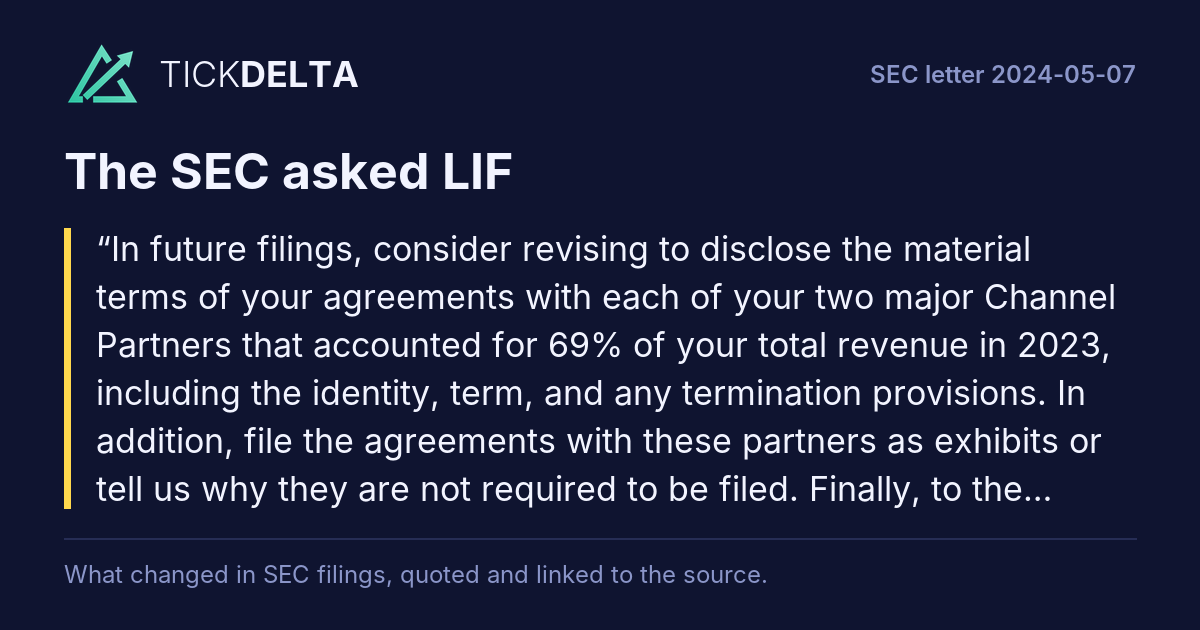
In future filings, consider revising to disclose the material terms of your agreements with each of your two major Channel Partners that accounted for 69% of your total revenue in 2023, including the identity, term, and any termination provisions. In addition, file the agreements with these partners as exhibits or tell us why they are not required to be filed.Rest of the question
Finally, to the extent material, disclose the total number of Channel partners for each period presented.
The Company acknowledges the Staff’s comment and respectfully advises the Staff that beginning with the Company’s Q1 Form 10-Q, it has included disclosure on page 9 of the Q1 Form 10-Q of the identity of its two major Channel Partners, Apple and Google. The Company further advises theRead in the reply
Staff that it has a limited number of additional smaller Channel Partners, the total number of which may fluctuate from time to time, and the Company does not believe the number of additional smaller Channel Partners the Company may have in each period presented will be material to investors in understandingRest of the answer
the Company’s ability to reach its members.
The Company respectfully advises the
Staff that it does not believe its arrangements with these Channel Partners constitute material agreements that are required to be filed. The Company has not entered into unique agreements with these Channel Partners, but rather is subject to the standard policies and terms of service of these third-party platforms, which generally govern the promotion, distribution, content, and operation of applications on such platforms. These terms and conditions apply to any developer publishing applications on these platforms and do not include a term or any termination provisions. As such, the Company is subject to the same standard policies and terms and conditions that apply to almost all application developers on these platforms and does not believe the Company’s particular agreements would be meaningful to investors in understanding the Company’s business. In connection with the preparation of its periodic reports, the Company reviews its disclosures to ensure that it identifies and adequately discusses the material factors that affect its business and operations. For example, in the “Risk Factors” section in Part I, Item 1A of the Company’s Form 10-K, and
Part II, Item 1A of the Q1 Form 10-Q, the Company has included under the header, “Distribution and marketing of, and access to, our products and services depends, in significant part, on third-party publishers and platforms. If these third parties change their policies in such a way that restricts our business, increases our expenses or limits, prohibits or otherwise interferes with or changes the terms of the distribution, use or marketing of our products and services in any material way or affects our ability to collect revenue, our business, financial condition and results of operations may be adversely affected.” information with respect to the Company’s arrangements with these Channel Partners and the most significant risks it faces in connection therewith. Accordingly, the Company believes that these arrangements do not constitute material agreements that are required to be filed and that the material information regarding these relationships is adequately described throughout the Company’s filings with the Commission.
First report after the company's reply of May 9, 2024: 10-Q filed May 10, 2024 ↗, against the 10-Q filed Nov 14, 2023 ↗.
Tickdelta does not hold the text of both reports, so they are not compared here.
In your disclosure of revenue by geography, please revise future filings to disclose revenue attributed to your country of domicile. Refer to ASC 280-10-50-1(a).
In response to the Staff’s comment, beginning with the Q1 Form 10-Q, the Company has revised the disclosure on page 10 of the Q1 Form 10-Q.Read in the reply
Security Ownership of Certain Beneficial Owners and Management,
First report after the company's reply of May 9, 2024: 10-Q filed May 10, 2024 ↗, against the 10-Q filed Nov 14, 2023 ↗.
Tickdelta does not hold the text of both reports, so they are not compared here.
In future filings, revise to provide the natural person(s) who have voting and dispositive control over the shares owned by Paradice Investment Management Pty Ltd and Regal Funds Management Pty Limited, or tell us why it is not required.
The Company acknowledges the Staff’s comment, and to the extent applicable, will revise the disclosure in future filings beginning with the Company’s Annual Report on Form 10-K for the year ended December 31, 2024, to provide the natural persons who have voting and dispositive control over the shares owned by Paradice InvestmentRead in the reply
Management Pty Ltd and Regal Funds Management Pty Limited.
First report after the company's reply of May 9, 2024: 10-Q filed May 10, 2024 ↗, against the 10-Q filed Nov 14, 2023 ↗.
Tickdelta does not hold the text of both reports, so they are not compared here.
We note your presentation of non-GAAP financial measures under the subheading of Key Financial Metrics. Please address the following: • Please refrain from referring to these non-GAAP measures as “Key Financial Metrics.” Refer to Question 100.05 of Non-GAAP Financial Measures Compliance & Disclosure Interpretations; • Please revise to include the directly comparable GAAP financial measure with greater or equalRest of the question
prominence for each non-GAAP measure presented in the table. Refer to Item 10(e)(1)(i)(A) of Regulation S-K and Question 102.10(a) of Non- GAAP Financial Measures Compliance & Disclosure Interpretations; • Include an explanation of the usefulness of each of these non-GAAP financial measures. Refer to Item 10(e)(1)(i)(C) of Regulation S-K; • Ensure you include a reconciliation from the GAAP financial measure to the non- GAAP financial measure for each of the non-GAAP financial measures presented, including non-GAAP U.S. subscription revenue, non-GAAP international subscription revenue, non-GAAP user acquisition and TV costs, non-GAAP other Sales and Marketing, and non-GAAP commissions, as well as a GAAP to non-GAAP reconciliation of each of the non-GAAP revenue measures presented for the year ended December 31, 2023. Refer to Item 10(e)(1)(i)(B) of Regulation S-K; and • Explain what consideration you gave to whether the non-GAAP hardware bundling adjustments have the effect of changing the recognition and measurement principles required to be applied in accordance with GAAP, which would be considered individually tailored and may cause the presentation of the non-GAAP measures to be misleading. Refer to Question 100.04 of Non-GAAP Financial Measures Compliance & Disclosure Interpretations.
In response to the Staff’s comment, beginning with the Company’s Q1 Media Release, the Company has revised its disclosure to delete any reference to “Key Financial Metrics” when referring to non-GAAP measures.Read in the reply
b.
Please revise to include the directly comparable GAAP financial measure with greater or equal prominence for each non-GAAP measure presented in the table.Rest of the answer
Refer to Item 10(e)(1)(i)(A) of Regulation S-K and Question 102.10(a) of Non- GAAP
Financial Measures Compliance & Disclosure Interpretations;
Response: In response to the Staff’s comment, beginning with the Q1 Media Release, the Company has revised its disclosure to remove the table under the subheading of “Key Financial Metrics”.
c.
Include an explanation of the usefulness of each of these non-GAAP financial measures. Refer to Item 10(e)(1)(i)(C) of Regulation S-K;
Response: In response to the Staff’s comment, beginning with the Q1 Media Release, the Company has revised its disclosure to include an explanation of the usefulness of each non-GAAP financial measure.
d.
Ensure you include a reconciliation from the GAAP financial measure to the non-GAAP financial measure for each of the non-GAAP financial measures presented, including non-GAAP U.S. subscription revenue, non-GAAP international subscription revenue, non-GAAP user acquisition and TV costs, non-GAAP other Sales and Marketing, and non-GAAP commissions, as well as a GAAP to non-GAAP reconciliation of each of the non-GAAP revenue measures presented for the year ended December 31, 2023. Refer to Item 10(e)(1)(i)(B) of Regulation S-K; and
Response: In response to the Staff’s comment, beginning with the Q1 Media Release, the Company has revised its disclosure to include a reconciliation from the GAAP financial measure to the non-GAAP financial measure for each of the non-GAAP financial measures presented.
e.
Explain what consideration you gave to whether the non-GAAP hardware bundling adjustments have the effect of changing the recognition and measurement principles required to be applied in accordance with GAAP, which would be considered individually tailored and may cause the presentation of the non-GAAP measures to be misleading. Refer to Question 100.04 of Non-GAAP Financial Measures Compliance & Disclosure Interpretations.
Response: The Company acknowledges the Staff’s comment and respectfully advises the Staff that it believes it is in compliance with Question 100.04 of the Compliance & Disclosure Interpretations related to Non-GAAP Financial Measures and does not believe it has utilized an individually tailored accounting principle. Additionally, the Company’s non-GAAP hardware bundling adjustments are not intended to change recognition and measurement principles required to be applied in accordance with GAAP, but rather to provide additional detail on the components of GAAP revenue and underlying drivers of the business.
The Company introduced bundled Life360 subscription and hardware offerings in the second quarter of 2023. Under GAAP, revenue associated with members in Paying Circles who sign up for bundled subscriptions is required to be allocated between subscription and hardware revenue based on the relative stand-alone selling price (“SSP”) of the separate performance obligations. Revenue allocated to ongoing subscription service is deferred and recognized over a period of time and amounts allocated to hardware are recognized at a point in time. As a result, the recurring subscription revenue attributed to Life360 paying subscribers is reduced for the portion of the offering at signup related to hardware, driving economic misalignment between the recognized subscription revenue and potential future recurring revenue associated with each paying subscriber. The Company believes that investors are focused on analyzing subscription revenue trends across periods, rather than assessing the single-period impacts of revenue allocated to hardware when new subscribers purchase a bundled subscription. Accordingly, in order to allow investors to more meaningfully compare the Company’s revenues originating from paying subscribers across periods, the Company presents non-GAAP subscription revenue, which reverses the impact of allocated hardware revenue due to bundled offerings, in addition to the bundled GAAP subscription revenue. The Company believes these metrics, and their related components, are useful for investors to more easily understand the dynamics associated with bundling and subscription growth and that the Company’s non-GAAP hardware bundling adjustments allow investors to analyze how the Company’s primary subscription business, which is comprised predominantly of monthly subscriptions, has performed over time on a comparable basis to periods before the Company introduced its bundled offerings and between periods where bundled offerings may vary. As a result, investors are able to gain additional insights into the underlying trends in the Company’s business, as compared to its historical practice. Specifically, the underlying key performance indicators derived from non-GAAP revenue, including Average Revenue per Paying Circle (ARPPC) and Average Revenue per Paying Subscription (ARPPS), are useful measures for investors to determine the Company’s effectiveness at monetizing Paying Circles through tiered product offerings and to measure annualized total subscription revenue recognized and derived from Life360, Tile and Jiobit subscriptions on a per subscriber basis, that if calculated on a GAAP basis would introduce variability within these measures and not reflect the underlying trends for assessing the subscription business. In addition, the use of these adjustments provides investors with an understanding of how management evaluates the performance of the Company’s business, including member growth and pricing considering long-term goals and related assumptions. Importantly, the Company’s management team uses these adjusted measures internally to make operating decisions, including those related to operating expenses, evaluate performance, and perform strategic planning and annual budgeting. The Company has provided a reconciliation of these non-GAAP metrics to the comparable GAAP metrics to allow investors and analysts to bridge between GAAP and Non-GAAP.
First report after the company's reply of May 9, 2024: 10-Q filed May 10, 2024 ↗, against the 10-Q filed Nov 14, 2023 ↗.
Tickdelta does not hold the text of both reports, so they are not compared here.
We note your response to prior comment 4. As noted in Question 104.05 of Non-GAAP Financial Measures Compliance & Disclosure Interpretations, revenue amounts adjusted in any manner are considered non-GAAP financial measures. The bundled offerings adjustment reverses the allocation of hardware revenue that is required to be recognized at a point in time under ASC 606.Rest of the question
This adjustment appears to have the effect of changing the measurement and the pattern of revenue recognition, which is inconsistent with the guidance in Question 100.04 of Non-GAAP Financial Measures Compliance & Disclosure Interpretations. Please remove this adjustment from all non-GAAP measures in future filings.
In response to the Staff’s comment, in future filings we will remove the bundled offerings adjustment from all non-GAAP financial measures.Read in the reply
We note the revised explanation of usefulness of each of the non-GAAP measures within “Supplementary and Non-GAAP Financial Information” in response to prior comment 4. You indicate that non-GAAP cost of revenue and non-GAAP operating expenses are adjusted for non-recurring, non-cash expenses. However, we note that certain of these adjustments are recurring.Rest of the question
Please explain how you considered Item 10(e)(1)(ii) of Regulation S-K and the guidance in Question 102.03 of Non-GAAP Financial Measures Compliance & Disclosure Interpretations.
In response to theRead in the reply
Staff’s comment, the Company has reviewed its disclosure of adjustments to GAAP financial information and the related rules and guidance cited by the Staff. Specifically, Item 10(e)(1)(ii) of Regulation
S-K prohibits adjusting a non-GAAP financial performance measure to eliminate or smooth items identified as non-recurring, infrequent or unusual when the nature of the charge or gain is such that it is reasonably likely to recur within two years or if there was a similar charge or gain within the prior two years.Rest of the answer
Question 102.3 of the
Non-GAAP Financial Measures Compliance & Disclosure Interpretations (“Question 102.3”) clarifies that this prohibition is based on the description of the charge or gain that is being adjusted rather than the nature of the charge or gain.
The Company’s adjustments between GAAP and non-GAAP cost of revenue and operating expenses include both non-cash expenses, such as stock-based compensation, depreciation and amortization, and convertible notes and derivative liability fair value adjustments and non-recurring expenses, such as workplace restructuring costs and the write-off of obsolete inventory.
The non-recurring workplace restructuring costs incurred to date in 2024 and for the year ended December 31, 2023 consist of severance payments made to previous employees who were impacted by a reduction in force (“RIF”) in January 2023. The one-time RIF was designed to streamline the Company’s operations and drive lower operating expenses following the Company’s acquisition of Tile, Inc. (the “Tile Acquisition”). The Tile Acquisition was a unique and non-recurring transaction. The Company supplementally advises the Staff that routine severance costs incurred outside unique non-recurring events have not been included as part of the non-recurring adjustment.
The non-recurring write-off of obsolete inventory relates to the Company’s write-off of raw materials related to a specific chip set hardware product offering previously in development that was sunset during the first quarter of 2023 and is no longer included in the product roadmap going forward. This specific raw materials chip set had no alternative use to the Company following the decision to halt development. The Company determined the inventory did not align with the Company’s product roadmap and would not be utilized. At that time, the inventory was written-off and expense was incurred. The Company supplementally advises the Staff that routine inventory write-offs incurred outside unique non-recurring events have not been included as part of the non-recurring adjustment.
The Company believes its adjustments are appropriate within the requirements of Regulation G and Item 10(e) of Regulation S-K and advises the Staff that it did not intend to characterize the recurring adjustments as non-recurring. Accordingly, the Company respectfully advises the Staff that it intends to revise its disclosure in future filings to provide further clarity on the nature of the adjustments in accordance with Item 10(e)(1)(ii) of Regulation S-K and the guidance in Question 102.03.
First report after the company's reply of May 24, 2024: 10-Q filed Aug 8, 2024 ↗, against the 10-Q filed Nov 14, 2023 ↗.
Tickdelta does not hold the text of both reports, so they are not compared here.
Also in this review: closing letter, 2024-05-31