tickdelta
Sign in

Tickdelta is free for now. Sign up and get Pro free

← Screener

LIILennox International

Industrials · HVAC Equipment · NYSE

We are a global leader in energy-efficient climate-control solutions. 10-K, Item 1

Employees
12,900
Headquarters
Richardson, TX
CEO
Alok Maskara
Next results
around Jan 27, 2027
Compare with peers → Embed

When the SEC's staff reviews a filing, it writes to the company with numbered questions, and the company answers each one in a letter. SEC publishes the exchange once the review is over, at least 20 business days later. Below: what the staff asked LII, and the company's answer to each question, quoted from the letters. A question is not an accusation; most reviews end with the company adding detail to its next filing.

Schedule 13D

2025-04-21 to 2025-04-21 · 2 questions · 1 letter from the SEC, 0 from the company
No closing letter
Acquisitions
SEC letter of 2025-04-21 ↗ no reply letter on EDGAR
Schedule 13D filed February 4, 2025 · General
SEC asked (1)
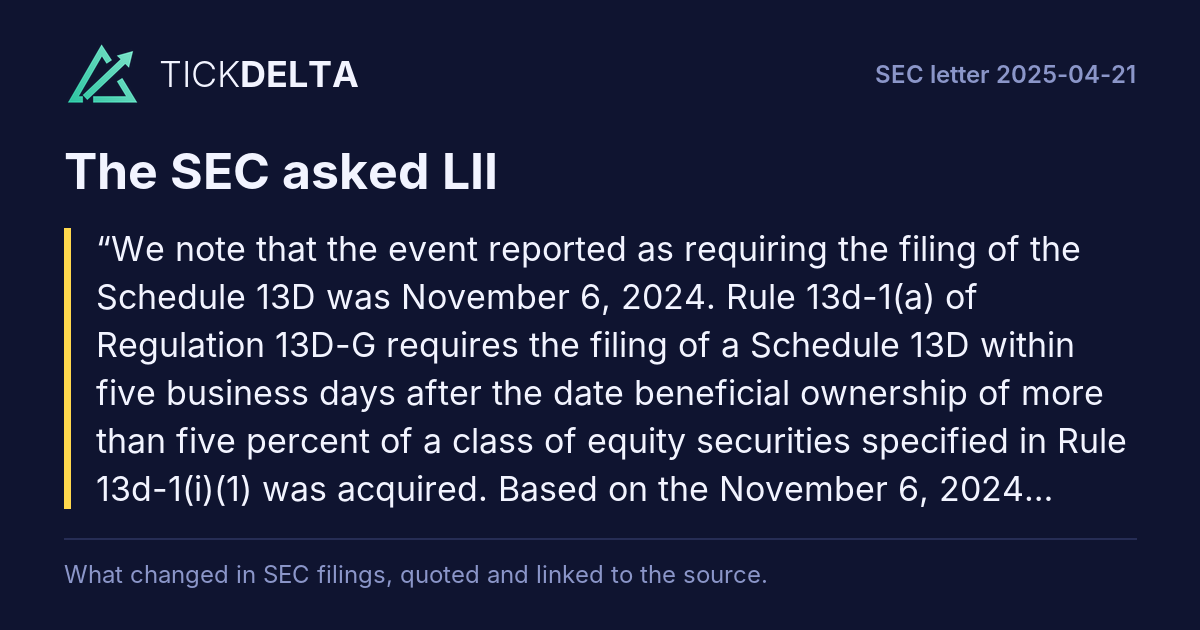
We note that the event reported as requiring the filing of the Schedule 13D was November 6, 2024. Rule 13d-1(a) of Regulation 13D-G requires the filing of a Schedule 13D within five business days after the date beneficial ownership of more than five percent of a class of equity securities specified in Rule 13d-1(i)(1) was acquired.
Rest of the question

Based on the November 6, 2024 event date, the Schedule 13D submitted on February 4, 2025 was not timely filed. Please advise us why the Schedule 13D was not filed within the required five business days after the date of the acquisition.

LII answered

No reply letter found.

Schedule 13D filed February 4, 2025 · General
SEC asked (2)
The cover page of the above-captioned Schedule 13D indicates that November 6, 2024 was the date of the event that required this filing to have been made. Please advise us how this date was determined. Item 5, page 1 We note the disclosure that "[i]n the past 60 days, The Cabin Foundation sold in the 3.
Rest of the question

open market 2,300 shares of Common Stock described in Item 3." Please revise to provide the requisite disclosure with respect to all transactions in the securities between the deadline for timely filing the Schedule 13D and the actual filing of the Schedule 13D. In amending the Schedule 13D to include any of the omitted required disclosures, please be advised that the Instruction to Item 5(c) requires the beneficial owner to "describe," at a minimum, the following: "(1) The identity of the person covered by Item 5(c) who effected the transaction; (2) the date of transaction; (3) the amount of securities involved; (4) the price per share or unit; and (5) where and how the transaction was effected."

LII answered

No reply letter found.

Form 10-K

2023-08-31 to 2023-11-22 · 7 questions · 2 letters from the SEC, 2 from the company
Review closed 2023-11-22
ClimateResults discussion (MD&A)
General
SEC asked (1)
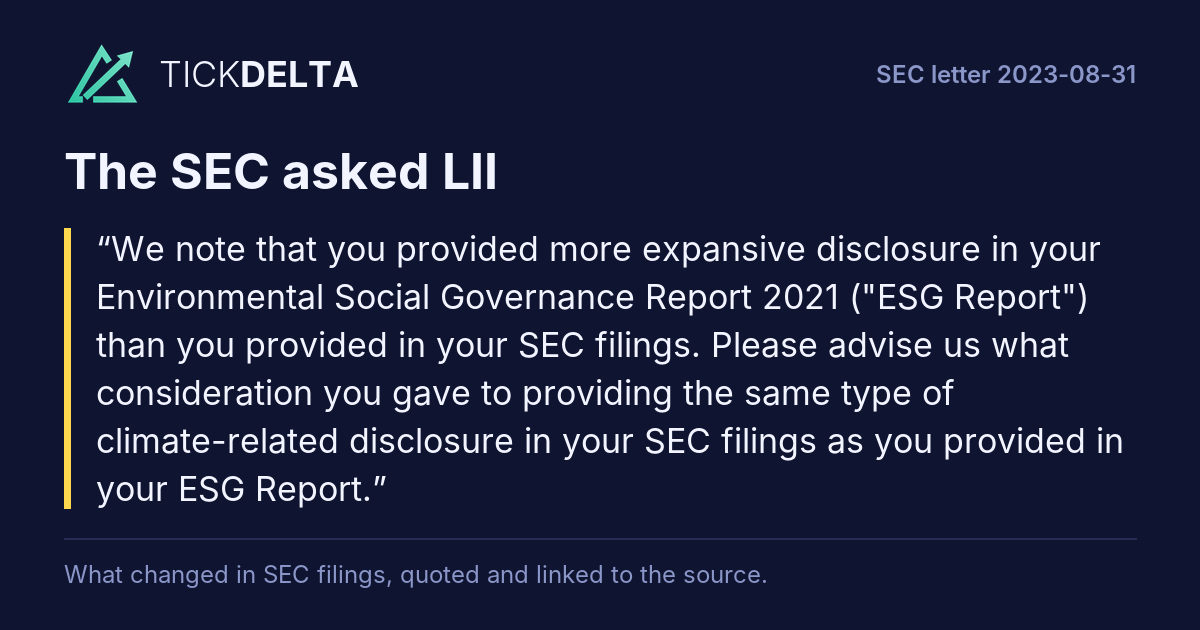
We note that you provided more expansive disclosure in your Environmental Social Governance Report 2021 ("ESG Report") than you provided in your SEC filings. Please advise us what consideration you gave to providing the same type of climate-related disclosure in your SEC filings as you provided in your ESG Report.
LII answered
We disclose in our SEC filings information either required under applicable federal securities regulations, or that is otherwise material to, or reasonably likely to have a material impact on, our business, financial condition, or results of operations. Separately, we publicly disclose information in the ESG Report and elsewhere regarding our environmental, social, and governance (“ESG”) initiatives that we believe may be of interest to a wide range of stakeholders, even when the information is not “material” to investors and is beyond the scope of the information required to be disclosed in
Rest of the answer

our SEC filings. These stakeholders include not only our investors but also our employees, customers, vendors, and the communities where we operate.

When considering whether to include climate-related information in our SEC filings, we take into account currently applicable SEC rules and regulations, including Item 101, Item 103, Item 105, and Item 303 of Regulation S-K, as well as the SEC’s Compliance and Disclosure Interpretations, available guidance from the Staff (including the SEC’s 2010 Guidance Regarding Disclosure Related to Climate Change), and applicable standards of materiality.

Finally, we acknowledge our obligation to continuously review climate-change related matters as part of our ongoing disclosure controls and procedures and disclose any material impact on, our business, financial condition, or results of operations in our SEC filings. At the same time, we appreciate the interest many of our stakeholders have in climate-related information, and we expect to continue providing information about climate change and other ESG topics, which do not rise to the level of materiality required for SEC reporting, through various public disclosures, including on our website and in our ESG Report.

Read in the reply ↗
Management's Discussion and Analysis of Financial Condition and Results of Operations, page
SEC asked (2)
To the extent material, discuss the indirect consequences of climate-related regulation or business trends, such as the following: • decreased demand for goods or services that produce significant greenhouse gas emissions or are related to carbon-based energy sources; • increased demand for goods that result in lower emissions than competing products; • increased competition to develop innovative new products that
Rest of the question

result in lower emissions; • increased demand for generation and transmission of energy from alternative energy sources; • any anticipated reputational risks resulting from operations or products that produce material greenhouse gas emissions; and • potential climate-related opportunities, such as the development of electric heat pumps and refrigerants with lower global warming potential.

LII answered
As described below, we disclose and discuss the indirect consequences of climate-related regulation or business trends in our SEC filings. Except as previously disclosed, we have not seen, to date, any material indirect consequences of climate-related regulation or business trends. Because we acknowledge that this is a dynamic and evolving area, we will continue to monitor consumer demand trends, competition from lower emission goods, reputational risks, and climate-related risks and opportunities, and will update our future SEC filings as appropriate if circumstances change.

Set forth below
Rest of the answer

is our response to each of the items referenced in the comment:

Increased or Decreased Demand

In our risk factors disclosure on page 11 of our Form 10-K for the year ended December 31, 2022 (the “2022 Form 10-K”) under the risk factor “Changes in Environmental and Climate-Related Legislation, Government Regulations, or Policies Could Have an Adverse Effect on Our Results of Operations,” we acknowledge that demand for our products may be impacted by changes in legislation, government regulations, or policies related to global climate change and other environmental initiatives and concerns. These changes could include new regulations designed to reduce greenhouse gas emissions either through consumer incentives or through more restrictive emissions standards.

However, at the time of the filing of our 2022 Form 10-K and at present, except as disclosed, we have not identified any material indirect consequences as being relevant to our business and operations related to either (a) decreased demand for goods or services that produce significant greenhouse gas emissions or are related to carbon-based energy sources or (b) increased demand for goods that result in lower emissions than competing products. Although we have observed that consumer preference and demand are placing a greater emphasis on a product’s energy efficiency, we believe these preferences are primarily related to cost savings and improved technology, and do not attribute this to climate-related regulation or business trends to a material extent.

Increased Competition

As a global leader in energy-efficient climate-control solutions, we recognize the importance of understanding, and offering products to meet, consumer preferences for heating, ventilation, air conditioning and refrigeration (“HVACR”) products. In our risk factors disclosure on page 9 of our 2022 Form 10-K under the risk factor “We May Not be Able to Compete Favorably in the Competitive HVACR Business,” we discuss competition risk in detail and identify several factors that may impact competition in the HVACR industry, including the development of more energy-efficient products. We closely monitor our direct peers, their product portfolios, and their responses to industry-wide environmental regulations and, to date, have not identified material competitive pressures resulting from other manufacturers developing lower emission products. We are working to develop products and brands that have a reduced impact on climate change.

Additionally, in our risk factors disclosure on page 11 of our 2022 Form 10-K under the risk factor “Changes in Environmental and Climate-Related Legislation, Government Regulations, or Policies Could Have an Adverse Effect on Our Results of Operations,” we acknowledge that some customers may prefer products that meet certain emissions or other environmental standards. However, while we believe that ESG considerations sometimes impact consumer buying decisions, to date, we have not identified material demand trends that are reasonably likely to have a material favorable or unfavorable impact on competition.

Alternative Energy Sources

We are unaware of any increased demand for the generation and transmission of energy from alternative energy sources that would materially and negatively impact our business operations. We are not engaged in the generation or transmission of energy from alternative energy sources or otherwise.

Reputational Risks

Through our risk assessment and disclosure controls processes, we have identified on page 11 of our 2022 Form 10-K under the risk factor “Changes in Environmental and Climate-Related Legislation, Government Regulations, or Policies Could Have an Adverse Effect on Our Results of Operations,” the risks associated with changing customer and market expectations with respect to greenhouse gas emission reductions. We consider for each SEC reporting period whether any reported or unreported risks have significantly increased or related events have occurred during the period for purposes of determining whether to enhance the description of the risk or to report an event or trend. To date, the reputational risks associated with operations or products that produce greenhouse gas emissions have not caused a material trend in customer demand or any material consequences to us.

However, acknowledging Staff’s comment, we will amend the following risk factor in our Form 10-K, Part I, Item IA - Risk Factors for the fiscal year ended December 31, 2023, in substantially the following form:

Changes in Environmental and Climate-Related Legislation, Government Regulations, or Policies Could Have an Adverse Effect on Our Results of Operations, and Increasing Attention to Environmental, Social, and Governance (“ESG”) Matters May Impact our Reputation and our Business.

The sales, gross margins, and profitability for each of our segments could be directly impacted by changes in legislation, government regulations, or policies (collectively, “LRPs”) relating to global climate change and other environmental initiatives and concerns. These LRPs, implemented under global, national, and sub-national climate objectives or policies, can include changes in environmental and energy efficiency standards and tend to target the global warming potential of refrigerants and hydrofluorocarbons, equipment energy efficiency, and combustion of fossil fuels as a heating source. Many of our products consume energy and use refrigerants and hydroflurocarbons. LRPs that seek to reduce greenhouse gas emissions may require us to make increased capital expenditures to develop or market new products to meet new LRPs. Further, our customers and the markets we serve may impose emissions or other environmental standards through LRPs or consumer preferences that may require additional time, capital investment, or technological advancement. Our inability or delay in developing or marketing products that match customer demand while also meeting applicable LRPs may negatively impact our results.

There continues to be a lack of consistent climate legislation and regulations, which creates economic and regulatory uncertainty. Such regulatory uncertainty could adversely impact the demand for energy efficient buildings and could increase costs of compliance. Additionally, the extensive and ever-changing legislation and regulations could impose increased liability for remediation costs and civil or criminal penalties in cases of non-compliance. Because these laws are subject to frequent change, we are unable to predict the future costs resulting from environmental compliance.

Further, due to the increasing focus on climate change, we may face adverse reputational risks due to our products consuming energy or using refrigerants and hydroflurocarbons. If we are unable to satisfy the increasing ESG-related expectations of certain stakeholders, we may suffer reputational harm, which may cause our stock price to decrease or cause certain investors and financial institutions not to purchase our securities or otherwise provide us with capital or credit on favorable terms, which may cause our cost of capital to increase.

In addition, we may not be able to achieve our goals related to our ESG initiatives, which are and will continue to be impacted by many variables, such as a tight labor market, challenging economic environment, changes to our operations, and changes to our portfolio of businesses via acquisitions or divestitures. Moreover, we may determine that it is in our best interest, and in the best interest of our shareholders, to prioritize other business, social, governance, or sustainable investments over the achievement of our current ESG initiatives. A failure or perceived failure by us in this regard may damage our reputation and adversely affect our results of operations and financial position.
Opportunities

We strive to offer products with improved energy efficiency and continuously invest in product development and enhancements. For example, as disclosed on page 2 of our 2022 Form 10-K, in 2021, we launched the Lennox Model L rooftop unit featuring technology to maximize energy savings, and in late 2022, we introduced the Enlight rooftop unit which features a high efficiency heat pump line. Future product developments and enhancements will likely include additional products that will reduce energy consumption. However, as noted above, we believe customer demand is primarily related to cost savings and improved technology, and does not directly result from any climate-related regulation or business trends to a material extent.

Read in the reply ↗
In its next report

First report after the company's reply of 2023-09-28: 10-Q filed 2023-10-26 ↗, against the 10-Q filed 2023-07-27 ↗.

Tickdelta does not hold the text of both reports, so they are not compared here.

Management's Discussion and Analysis of Financial Condition and Results of Operations, page
SEC asked (3)
We note your disclosure that the effects of climate change include extreme weather events, long-term changes in temperature levels, and water availability. Please discuss the physical effects of climate change on your operations and results.
Rest of the question

This disclosure may include the following: • severity of weather, such as floods, hurricanes, sea levels, extreme fires, and water availability and quality; • quantification of weather-related damages to your property or operations; • potential for indirect weather-related impacts that have affected or may affect your major customers or suppliers; and • the extent to which extreme weather events have reduced the availability of insurance or increased the cost of insurance. Include quantitative information for each of the periods covered by your Form 10-K and explain whether increased amounts are expected in future periods.

LII answered
Severity of Weather and Quantification of Weather-Related Damages

We report weather-related physical damages to our property or operations in our Consolidated Statement of Operations under the line item “Loss from natural disasters, net of insurance recoveries.” Expenses for the fiscal years covered by our 2022 Form 10-K, as disclosed on page 35, were as follows:

For the Years Ended December 31,

(in millions)

2022 2021 2020

Operating expenses:

Loss from natural disasters, net of insurance recoveries: -- -- $3.1

Losses reported in 2020 related to a 2018 tornado and a 2020 wind storm
Rest of the answer

impacting our manufacturing facility in Marshalltown, Iowa, as disclosed on page 50 of our Form 10-K for the fiscal year ended December 31, 2021.

We will continue to monitor weather-related expenses and will report any material amounts in future SEC filings.

Indirect Weather-Related Impacts

HVAC markets are driven by seasonal weather patterns. In our 2022 Form 10-K, we disclose this on page 10 under the risk factor “Cooler than Normal Summers and Warmer than Normal Winters May Depress Our Sales,” and on page 18 under “Business Overview.” In both instances, we discuss the risks related to weather conditions, whether related to climate change or not, because variations in weather impact demand for and sales of our products.

Not only do we have a seasonal business model, but natural disasters could also indirectly impact our business if such natural disaster were to damage or disrupt our suppliers and supply chain efficiencies. This is disclosed on page 13 of our 2022 Form 10-K under the risk factor “Our International Operations Subject Us to Risks Including Foreign Currency Fluctuations, Regulations and Other.”

To the extent we identify any additional physical effects of climate change that are material, individually or in the aggregate with other factors, we will disclose them in our future SEC filings.

Insurance

Our property insurance premiums have increased by less than 1% of operating expenses during the fiscal years covered by our 2022 Form 10-K, primarily due to general insurance market conditions and increased insurable values. We do not currently expect to experience material weather-related impacts on the cost or availability of insurance in the future, but we acknowledge that this is a dynamic and changing area, and we will continue to monitor for any impact and will evaluate including disclosures as appropriate in our future SEC filings if circumstances change.

Read in the reply ↗
In its next report

First report after the company's reply of 2023-09-28: 10-Q filed 2023-10-26 ↗, against the 10-Q filed 2023-07-27 ↗.

Tickdelta does not hold the text of both reports, so they are not compared here.

Management's Discussion and Analysis of Financial Condition and Results of Operations, page
SEC asked (4)
Your ESG Report references the purchase of renewable energy credits ("RECs"). If material, please provide disclosure about your purchase and sale of carbon credits, carbon offsets, or RECs, and any material effects on your business, financial condition, and results of operations.
Rest of the question

Provide us with quantitative information for each of the periods covered by your most recent Form 10-K and the amounts budgeted for or expected to be incurred in future periods.

LII answered
In fiscal years 2022, 2021, and 2020, respectively, we purchased approximately $29,900, $17,700, and $3,800 of carbon credits, carbon offsets, and RECs. These amounts are insignificant and are not material to our business, financial condition, or results of operation. We expect future REC expenditures to be similar, or slightly higher than those incurred in 2022. Read in the reply ↗
In its next report

First report after the company's reply of 2023-09-28: 10-Q filed 2023-10-26 ↗, against the 10-Q filed 2023-07-27 ↗.

Tickdelta does not hold the text of both reports, so they are not compared here.

Management's Discussion and Analysis of Financial Condition and Results of Operations, page
SEC asked (1)
We note your response to prior comment 2. Please further address the following: • Your response acknowledges that “some customers may prefer products that meet certain emissions or other environmental standards.” Tell us more about what you have experienced in this regard, including the extent to which you have been or expect to be affected by the emissions reduction targets of your primary customers.
Rest of the question

• Explain how you determine whether the changes in demand and competition you have observed are related to climate change, as compared to the other factors noted in your response, and how you assess these changes, providing support for your materiality determination. • Your response states that you “are working to develop products and brands that have a reduced impact on climate change.” Clarify whether your development work is related to the changes in demand and competition you have observed, and tell us how you considered disclosing this as a climate-related business trend. • Tell us more about the energy from alternative energy sources used in your operations and explain how this relates to the indirect consequences you considered. Provide support for your evaluation of materiality regarding increased demand for energy from alternative energy sources, including quantification of related costs for each of the periods covered by your Form 10-K and expected to be incurred in future periods. • We note your proposed amended disclosure regarding reputational risks “due to our products consuming energy or using refrigerants and hydrofluocarbons.” Tell us how you considered disclosing reputational risks related to your operations, in addition to your products.

LII answered
In connection with the preparation of the Form 10-K for the year ended December 31, 2022 (the “2022 Form 10-K”), the Company considered whether the items identified in the “Risk Factors” section of the Form 10-K (and specifically, the Risk Factor “Changes in Environmental and Climate-Related Legislation, Government Regulations, or Policies Could Have an Adverse Effect on Our Results of Operations”) should be disclosed as a material trend. In conducting this materiality assessment, the Company references various standards of materiality.
Rest of the answer

For example, the Company is aware that many issuers use a 5% “rule of thumb” and consider amounts greater than 5% of pre-tax income to be material to investors. The Company also refers to the standard of materiality set forth in Basic Inc. v. Levinson, 485 U.S. 224 (1988), the definition of “material” set forth in Rule 12b-2 and Rule 405 (based on the standard of material set forth in TSC Industries, Inc. v. Northway, Inc., 426 U. S. 438 (1976)), as well as other relevant standards of materiality. Each of these standards of materiality is analyzed in the context of the Company’s performance. For example, the Company generated consolidated net sales of $4.7 billion in fiscal year 2022.

The Company concluded that customer preference for certain emissions or other environmental standards is not currently a material trend that is imposing a material indirect impact on the Company’s historical business, financial condition, and results of operations. As discussed further below, it is the customers’ demand for high-quality and cost-efficient products that is the primary driver of our product development. Therefore, the Company’s disclosure of the fact that some customers may prefer products that meet certain emissions or other environmental standards was only disclosed because it is a potential risk that could have an indirect impact in the future.

With respect to your question about emissions reductions targets of our primary customers, as disclosed in the 2022 Form 10-K, more than 67% of our net sales in 2022 were derived from our residential business segment. In our experience and as discussed further below, our residential customers are primarily focused on the availability, reliability and quality, service, and price of a particular product. We are not aware of any trend that suggests homeowners in the residential segment are setting emissions reductions targets for their households.

As disclosed on pages 1 and 51 of our 2022 Form 10-K, equipment sales to customers in our commercial business segment constituted approximately 16% of 2022 net sales. We are not aware of any impact on our business from emissions reductions targets set by our commercial customers and believe, based on trend analysis described below, commercial customers are more focused on lead times and shipping, product quality, and service.

Therefore, we do not think it is currently appropriate to discuss the hypothetical impact of our primary customers setting emissions targets.

•Explain how you determine whether the changes in demand and competition you have observed are related to climate change, as compared to the other factors noted in your response, and how you assess these changes, providing support for your materiality determination.

When we forecast and analyze demand trends, we rely on recent sales trends of product tiers, or mix, to see if customer preferences or buying patterns are changing. Examples of changing buying patterns we try to detect include relative percentage of products sold at minimum efficiency standard versus percentage above minimum standard efficiency, and new equipment system sales versus parts and supplies repair demand. To date, the Company has not identified a material change or trend in demand or competition that suggests climate-related considerations are a material driver of consumer behavior.

Our sales force also regularly communicates directly with contractors and distributors and they share this information with sales leadership and operations so we can appropriately plan our production and inventory planning processes. In addition to this direct feedback, the Company conducts formal surveys of its customers and dealers. For example, based on feedback from dealers in September 2023, the Company sees that customers purchase products primarily for reasons related to the availability, reliability and quality, service, and price of a particular product. Similarly, feedback from commercial equipment business customers in October 2023 identified lead times and shipping, product quality, and service as primary drivers of purchase and loyalty. These drivers are consistent with our disclosure on page 4 of the 2022 Form 10-K under the heading “Competition.”

•Your response states that you “are working to develop products and brands that have a reduced impact on climate change.” Clarify whether your development work is related to the changes in demand and competition you have observed, and tell us how you considered disclosing this as a climate-related business trend.

We disclose our total research and development expenses on page 55 of our 2022 Form 10-K. Our research and development work, as disclosed in our 2022 Form 10-K on page 4, “focuses on new technology invention, product development, product quality improvements and process enhancements, including our development of next-generation control systems as well as heating and cooling products that include some of the most efficient products in their respective categories.” Our development of products is, of course, also driven by the need to comply with applicable environmental regulations impacting the whole industry (e.g., Environmental Protection Agency rules about the phaseout of R-410A, a refrigerant used in HVAC products). However, our total research and development expenses, as a percentage of net sales, have decreased slightly over the period covered by the 2022 Form 10-K. On a dollar value basis, the increase in research and development expenses over the period covered by the 2022 Form 10-K is primarily due to inflationary factors and investments to strengthen supply chain resiliency and increase product vitality, as well as prepare for regulatory change. Therefore, we do not think that it is appropriate to cite environmental regulations as a business trend at this time.

•Tell us more about the energy from alternative energy sources used in your operations and explain how this relates to the indirect consequences you considered. Provide support for your evaluation of materiality regarding increased demand for energy from alternative energy sources, including quantification of related costs for each of the periods covered by your Form 10-K and expected to be incurred in future periods.

We have not observed any increased demand for generation and transmission of energy from alternative sources related to our operations. However, as we seek to reduce our energy efficiency intensity, we have publicly reported that we signed an eight-year contract with our electric provider to source renewable energy to cover 100% of our electricity consumption in Texas operations (our headquarters state). In fiscal year 2022, approximately 11% of our total electricity consumption came from renewable energy, purchased through 100% renewable energy credits (RECs).

As disclosed in our Prior Response Letter, costs for RECs over the three-year period covered by the 2022 Form 10-K were as follows:

For the Years Ended December 31,

(in millions)

2022 2021 2020

Operating expenses:

Renewable energy credits: $0.030 $0.018 $0.004

All of these amounts are well below 1% of 2022 net income and are not material to our business, financial condition, or results of operation. We expect future REC expenditures to be similar, or slightly higher than those incurred in 2022, but still immaterial.

We have also joined the Department of Energy’s Building Better Plants initiative, with the goal to reduce our U.S. facilities’ energy efficiency intensity by 25% by 2025 vs. 2014. As a result of the Company’s existing and continuing efforts in this regard, we do not reasonably anticipate any significant increased demand for generation and transmission of energy from alternative energy sources related to our operations.

•We note your proposed amended disclosure regarding reputational risks “due to our products consuming energy or using refrigerants and hydroflurocarbons.” Tell us how you considered disclosing reputational risks related to your operations, in addition to your products.

Acknowledging Staff’s comment, we will further amend the following risk factor in our Form 10-K, Part I, Item IA - Risk Factors for the fiscal year ended December 31, 2023, in substantially the following form:

Changes in Environmental and Climate-Related Legislation, Government Regulations, or Policies Could Have an Adverse Effect on Our Results of Operations, and Increasing Attention to Environmental, Social, and Governance (“ESG”) Matters May Impact our Reputation and our Business.

The sales, gross margins, and profitability for each of our segments could be directly impacted by changes in legislation, government regulations, or policies (collectively, “LRPs”) relating to global climate change and other environmental initiatives and concerns. These LRPs, implemented under global, national, and sub-national climate objectives or policies, can include changes in environmental and energy efficiency standards and tend to target the global warming potential of refrigerants and hydrofluorocarbons, equipment energy efficiency, and combustion of fossil fuels as a heating source. Many of our products consume energy and use refrigerants and hydroflurocarbons. LRPs that seek to reduce greenhouse gas emissions may require us to make increased capital expenditures to develop or market new products to meet new LRPs. Further, our customers and the markets we serve may impose emissions or other environmental standards through LRPs or consumer preferences that may require additional time, capital investment, or technological advancement. Our inability or delay in developing or marketing products that match customer demand while also meeting applicable LRPs may negatively impact our results.

There continues to be a lack of consistent climate legislation and regulations, which creates economic and regulatory uncertainty. Such regulatory uncertainty could adversely impact the demand for energy efficient buildings and could increase costs of compliance. Additionally, the extensive and ever-changing legislation and regulations could impose increased liability for remediation costs and civil or criminal penalties in cases of non-compliance. Because these laws are subject to frequent change, we are unable to predict the future costs resulting from environmental compliance.

Further, due to the increasing focus on climate change, we may face adverse reputational risks due to our products and manufacturing operations consuming energy or using refrigerants and hydroflurocarbons. If we are unable to satisfy the increasing ESG-related expectations of certain stakeholders, we may suffer reputational harm, which may cause our stock price to decrease or cause certain investors and financial institutions not to purchase our securities or otherwise provide us with capital or credit on favorable terms, which may cause our cost of capital to increase.

In addition, we may not be able to achieve our goals related to our ESG initiatives, which are and will continue to be impacted by many variables, such as a tight labor market, challenging economic environment, changes to our operations, and changes to our portfolio of businesses via acquisitions or divestitures. Moreover, we may determine that it is in our best interest, and in the best interest of our shareholders, to prioritize other business, social, governance, or sustainable investments over the achievement of our current ESG initiatives. A failure or perceived failure by us in this regard may damage our reputation and adversely affect our results of operations and financial position.
Read in the reply ↗
In its next report

First report after the company's reply of 2023-11-13: 10-K filed 2024-02-13 ↗, against the 10-K filed 2023-02-21 ↗.

Tickdelta does not hold the text of both reports, so they are not compared here.

Management's Discussion and Analysis of Financial Condition and Results of Operations, page
SEC asked (2)
We note your response to prior comment 3. Please tell us how you considered providing disclosure regarding the potential for the physical effects of climate change to affect your operations and results, for instance in relation to the risks discussed in your Form 10-K
LII answered
We note your response to prior comment 3. Please tell us how you considered providing disclosure regarding the potential for the physical effects of climate change to affect your operations and results, for instance in relation to the risks discussed in your Form 10-K under the caption “Our Ability to Meet Customer Demand may be Limited by Our Single-Location Production Facilities, Reliance on Certain Key Suppliers and Unanticipated Significant Shifts in Customer Demand.”

In the Management Discussion and Analysis section of our 2022 Form 10-K, we “focus specifically on material events and
Rest of the answer

uncertainties known to management that are reasonably likely to cause reported financial information not to be necessarily indicative of future operating results or of future financial condition. This includes descriptions and amounts of matters that have had a material impact on reported operations, as well as matters that are reasonably likely based on management's assessment to have a material impact on future operations.” Regulation S-K Item 303(a).

In assessing the materiality of physical effects that may have resulted from climate change, we have considered the impact on our suppliers and our manufacturing, as well as our customers. As disclosed on page 35 of our 2022 Form 10-K, loss from natural disasters, net of insurance recoveries, did not exceed $3.5 million, below 1% of net income, in any year during the periods covered by our 2022 Form 10-K, and, accordingly, we concluded no quantifiable disclosure was warranted as the impact was not material.

However, because we may experience climate-related impacts to our operations and results due to the physical effects of climate change in the future, we do believe it is appropriate to recognize potential risks and the disclosures in our 2022 Form 10-K directly addresses these potential risks. For instance, in the Risk Factor disclosure on page 11 of our 2022 Form 10-K under the caption “Price Volatility for Commodities and Components We Purchase or Significant Supply Interruptions Could Have an Adverse Effect on Our Cash Flow or Results of Operations,” we state that “Additionally, the effects of climate change, including extreme weather events, long-term changes in temperature levels, water availability, increased cost for decarbonizing process heating, supply costs impacted by increasing energy costs, or energy costs impacted by carbon prices or offsets may exacerbate supply chain constraints and disruption.” We also make disclosures about weather risks on page 10 of our 2022 Form 10-K under the caption “Cooler than Normal Summers and Warmer than Normal Winters May Depress Our Sales,” where we state that “The effects of climate change, such as extreme weather conditions and events and water scarcity, may exacerbate fluctuations in typical weather patterns, creating financial risks to our business.”

To address the Staff’s comment, we will amend the following risk factor in our Form 10-K, Part I, Item IA - Risk Factors for the fiscal year ended December 31, 2023 to address that climate-related disasters, among other things, could exacerbate the single-supplier risk:

Our Ability to Meet Customer Demand may be Limited by Our Single-Location Production Facilities, Reliance on Certain Key Suppliers and Unanticipated Significant Shifts in Customer Demand.

We manufacture many of our products at single-location production facilities. In certain instances, we heavily rely on suppliers who also may concentrate production in single locations or source unique, necessary products from only one supplier. Any significant interruptions in production at one or more of our facilities, or at a facility of one of our key suppliers, could negatively impact our ability to deliver our products to our customers, especially as we continue to experience disruptions in supply.

Further, even with all of our facilities running at full production, we could potentially be unable to fully meet demand during an unanticipated period of exceptionally high demand. This inability to fully meet demand would be exacerbated if a single-location production facility is disrupted due to a climate-related disaster, pandemic, geopolitical political instability, or war, among other things. Our inability to meet our customers’ demand for our products could have a material adverse effect on our business, financial condition, and results of operations.

As climate-related business trends, risks, and regulations evolve, we will continue to monitor and evaluate whether inclusion of expanded and/or more specific disclosures regarding the physical effects of climate change may be warranted in future SEC filings based on materiality and applicable disclosure requirements.

Read in the reply ↗
In its next report

First report after the company's reply of 2023-11-13: 10-K filed 2024-02-13 ↗, against the 10-K filed 2023-02-21 ↗.

Tickdelta does not hold the text of both reports, so they are not compared here.

Location Production Facilities, Reliance on Certain Key Suppliers and Unanticipated · Significant Shifts in Customer Demand.”
SEC asked (3)
We note your response to prior comment 3 regarding insurance. Please quantify for us the cost of insurance for each of the periods covered by your Form 10-K. Clarify how the upward trend in the costs of insurance noted in your response, including in relation to any weather-related impacts, has affected your expectations for insurance costs and availability.
Rest of the question

Explain whether and how your use of self-insurance is related to the cost and availability of insurance affected by extreme weather events.

LII answered
Property insurance expenses for the fiscal years covered by our 2022 Form 10-K were as follows:

Property insurance: $3.7 $3.2 $2.8

As stated in our Prior Response Letter, the upward trend in the costs of insurance was primarily due to general insurance market conditions and increased insurable values. Insurance costs increased by less than $1 million from 2020 to 2022, and during that time period, we were able to renew our property insurance on substantially the same terms and conditions.
Rest of the answer

While we anticipate that insurance costs will continue to increase due to inflation, reinsurance, valuation adjustments, and both weather and non-weather-related claims, based on past experience and market knowledge, we do not believe these increases will be material.

The Company uses a mix of self-insurance and third-party insurance to efficiently manage costs and mitigate risk. Our use of self-insurance is not related to the cost and availability of insurance affected by extreme weather events.

Read in the reply ↗
In its next report

First report after the company's reply of 2023-11-13: 10-K filed 2024-02-13 ↗, against the 10-K filed 2023-02-21 ↗.

Tickdelta does not hold the text of both reports, so they are not compared here.

Also in this review: closing letter, 2023-11-22

From the SEC's correspondence on EDGAR: staff letters (form UPLOAD) and company letters (form CORRESP), 6 letters filed since 2023-08-31. Questions and answers are matched by their numbers; topics come from words in each question. The reports are compared word for word (same form, before the first SEC letter against the first report after the company's reply). No AI.

Work on LII in a spreadsheet: Excel workbook (a sheet per section, ten years by column, charts, links to the filings) · CSV. For a Google Sheet that stays up to date, paste =IMPORTDATA("https://tickdelta.com/company/LII/export.csv") into a cell.